
 +91-8742004849 books@jvbharati.org

A JOURNEY OF 5 NIGHTS WITH A MONK
Cover Page
Title Page
A JOURNEY OF 5 NIGHTS WITH A MONK
MUNI KUMARSHRAMAN


ISBN No.: 978-93-89793-7 1-0
© Jain Vishva Bharati, Ladnun
Blessings
To, who not only inspire, but push me to write the book.
If our lifestyle is good, then our consciousness too can become good. Good thinking, good language, good dietary restraint, good self-control of senses, good concentration and good purification of emotions are essential for a good lifestyle.
His Holiness Gurudev Tulsi and His Holiness Acharya Mahapragya used to tell about Preksha Meditation. The 5 principles in the practice of Preksha Meditation are very important. If these five principles - Mindful action, freedom from reaction, amity, moderation of food, and moderation of speech - are imbibed in life, life can move in the direction of ultimate bliss.
Muni Kumarashraman ji is a learned young monk. He is entrusted with various assignments. The book ‘A journey of 5 nights with a monk’ shall prove to be a valuable source of knowledge for the English readers.
Acharya Mahashraman
♦
Foreword
“Happiness is your nature. Sorrow is your creation.”
A Mercedes-Benz suddenly slowed down. The driver stopped the car at the kerb and a young man with an unmistakable air of wealth, alighted from the car. He was wearing a Louis Vuitton suit, a Rolex watch and other branded accessories to match with it.
He began to stride towards the Monk, who was walking on the road, very slowly, eyes fixed on the ground, taking each and every step with awareness.
A sudden sense of curiosity overcame him, and he asked the Monk, “Oh Monk! Why are you walking barefoot? Please sit in my car. I will drop you wherever you wish to go.”
“Walking is our vow. We don’t use vehicles. We walk on foot for our whole life,” replied the Monk with a warm smile.
The businessman was astounded by the Monk’s simplicity. He could not control his curiosity and started bombarding him with questions.
“Oh, Monk! Where are you going? Why have you chosen this path? Why is happiness so radiant on your face?”
The Monk smiled and calmly replied, “It is a long story. I am on my way to visit my guru. It will take me five nights to get there. I know the secret to remaining happy in every situation. If you want to discover the secret, then accompany me along my journey. We will walk during the day and discover the secret of happiness during the night.”
The businessman, who was suffering from a stressful life, could not resist this offer and decided to join the Monk on his journey.
Compelled by his digital addiction, a few minutes later, he updated his status on Facebook. “On a journey of five nights with a Monk. If you want to join, you are also welcome.” As usual, his comments on social media created a buzz, and comments started pouring in immediately.
Someone asked, in a surprise, “Hi! Sanjay, are you planning to become a Monk?”
He texted, “No. I am with a Monk to discover the secrets of happiness.”
“May I also join you?” asked a doctor.
“Why not, it will be a pleasure to have a friend like you on the journey. The more, the merrier,” replied Sanjay.
Dr. Reddy asked for the location and joined the Monk and Sanjay on the journey.
The trio walked together silently. Half an hour later, a motorbike came and two young men also joined them. One was Vicky, an IT engineer working for a multinational company and another was Siddharth, a student of Business School pursuing a master’s course. They all started walking together.
After 5-6 kilometres, the four friends were exhausted. They started sweating and became short of breath, whereas the same journey seemed to have no consequences on the Monk. He showed no sign of tiredness. The Monk looked at them and smiled. They requested the Monk to take a small halt for rest since none of them were used to walking on foot. The Monk nodded positively and turned towards a banyan tree. Everybody relaxed under the cool shade of the tree. After some time, they requested the Monk to tell them the secret of his enduring happiness, his energy and radiance.
“It will take a long time to explain. My guru taught me the five golden secrets to remain happy in every situation. I will share that ancient knowledge and wisdom with you. You all have to keep patience. You can forever be in a state of happiness by following these guidelines.” announced the Monk in a calm and soothing voice.
Everybody started listening to Monk’s sermon carefully, eager to absorb the knowledge, as the Monk started to share his secret.
“There are infinite living beings in this universe. One of the common desires among all is ‘to be happy.’ Nobody desires to be unhappy. In fact, not only human beings but even an ant desires, that it should not be troubled.
Nobody wants to be sad. Everyone wants to be happy yet people do things which make them unhappy. Foremost you have to realise what happiness is? Happiness is a state of mind, and we can achieve this state by changing our thought pattern.
Seeing the quizzical look on their faces, the Monk explained further. Once God was asked, “Kim Bhaya Paana?” which means what is a living being afraid of?
“Dukkh Bhaya Paana.” which means every living being is afraid of unhappiness, replied the God.
Again, the God was asked, “Ken Kade Dukkhe?” means who made this unhappiness?
“Atta Kade Dukkhe Pamaenam.” which means this unhappiness is caused by self, and we have created this out of our mistakes only. It is not given by anyone else, explained the God.
Therefore, you need to understand a few things first.
Unhappiness is not by birth
When you were born, you did not suffer from the bug of unhappiness. In fact, you brought happiness to your parents, your relatives. When you smiled, you made the world joyous and everyone, irrespective of their age or relation, starts smiling with you. Thus, unhappiness is not your nature, it is not by birth, rather it is the result of your own thoughts and your actions. You were born to be happy and make others happy.
Nobody makes you unhappy
A common perception exists among people is that someone makes them unhappy. It is only a false conjecture. Nobody in the world has the power to make you unhappy. You and only you are responsible for making yourself unhappy. Your actions and your thoughts are the reason for this unhappiness. If you wish to remain happy, you can remain happy.
You think in such a way that you become unhappy. The whole game is about the vision of our thoughts. I will relate this logic with a narrative.
Once, an Indian went to Japan. In the morning, he entered his office building and walked to the elevator. A Japanese man was already waiting in front of the elevator door.
“Ohayo Gozaimasu,” greeted the Japanese man with a smile.
The Indian did not know the Japanese language and presumed that the Japanese person was asking his name. “Shreyas Dugar,” replied the Indian.
Since the Japanese also did not know the Indian language, he was not sure what the Indian had replied.
The next day the Indian met the same Japanese person at the elevator and the Japanese again said, “Ohayo Gozaimasu.”
The Indian thought that he might have forgotten my name and is asking again. He said, “Shreyas Dugar.”
On the third day, the same situation arose. They both met in the elevator. The Japanese man once again said, “Ohayo Gozaimasu.”
The Indian was perplexed and thought, why is he harassing me? Why is he asking my name daily? Still being patient, and out of courtesy he replied, “Shreyas Dugar.”
That day after going to his office, he confronted one of his Japanese colleagues and said, “A Japanese person has been harassing me for the past couple of days. He meets me in the elevator and asks for my name daily.”
The Japanese colleague asked him, “What did the person ask you in the elevator?”
“Ohayo Gozaimasu,” replied the Indian.
The Japanese colleague had a good laugh and explained that the person was not asking his name but greeting him with a good morning in Japanese.
“Oh! is it?” asked the Indian surprised, “I have been telling him my name daily.”
The next day, as soon as the Indian saw the Japanese person, he happily said to him, “Ohayo Gozaimasu.”
The Japanese promptly replied, “Shreyas Dugar.” He guessed, this was how the Indians greeted each other.
The point is that your sense of understanding is guided by your assumptions or perceptions and it can convert a simple greeting into your name and your name into a greeting.
You also do the same thing. Like experiencing unhappiness even in a happy moment. First of all, you have to change this way of thinking. Perception shapes a person’s personality. No one can make you unhappy. Similar to ‘Ohayo Gozaimasw’ you have created many perceptions in your mind, that other people are making you unhappy. Anyone may harm you, but no one can make you unhappy.
Remove the misconception. To be happy or not is only in your hands. If you cultivate this perception, many problems can be resolved.
There are few people in this world who can find happiness in sad situations and many who can find unhappiness even in pleasant moments. I want to explain this with two short stories. It will help you to understand the moral of this narrative.
Once upon a time, there lived a king. He went hunting with his minister and accidentally cut off his finger as he was mounting an arrow on the string of his bow. The king looked frustratingly and helplessly at the minister.
“Whatever happened, it is for the best.” replied the minister habitually.
The king became furious and said, “O! Minister, my finger is severed and yet you are looking for something good in this. Don’t you have any feelings? You are not my well-wisher. I terminate you from the position of minister,” he ordered his soldiers to imprison him.
The minister calmly replied, “Whatever is happening, it is for the best.” The soldiers brought the minister to the kingdom and locked him in a prison cell.
The king continued his hunting expedition. He galloped his horse and soon all the soldiers were left behind, and he got lost deep in the wood. He was moving alone in search of the right direction when suddenly a group of tribesmen surrounded him and trapped him. They were all very pleased and felt blessed by God to have found a human for sacrifice. The king turned pale with anxiety. The tribesmen brought the king to their village in the woods and began a festival-like celebration. They lit the ceremonial fire in the centre and danced around it. The king was tied with a thick rope to the pillar.
A man stood beside the pillar with a sharpened axe to cut off his head. The king feared for his life. An old jungle priest came and carried out a thorough inspection of the king, who was tied from head to toe. While Inspecting, he found out that the king was missing a finger.
“We cannot sacrifice the king as he has a missing body part,” explained the priest. It was their belief that anything sacrificed to their deity had to be devoid of any flaws. Because of this, the king’s life was saved. The king was released and somehow managed to get back to his kingdom.
After reaching his kingdom, he ordered the release of his minister. The minister was brought to the king.
The king spoke, “You are profoundly wise. You said truthfully that whatever happens, happens for best. I was saved today only by this cut finger.” The king continued to narrate the complete story to him.
The king was still curious and asked the minister, “How was it best for you when I dismissed you as minister and jailed you.”
“Your Majesty, if I were not dismissed as minister then naturally, I would have also been with you while hunting. The tribesmen would have caught us both. They would have left you because of your cut finger, but my head have been sacrificed since I did not have any body parts damaged. Hence, it was best for me too,” replied the minister with a smile on his face.
We can say this is the attitude to find happiness even in sad situations. ‘Every cloud has a silver lining.’
Nobody can make such a person unhappy, who can find happiness in an adverse situation. A person who loses his job can be sad, on the other hand, he can think a new job opportunity is open for me. Maybe he will get a better job ina new company. He will get a chance to learn something new. A person who loses a client. Maybe, he can get a new client, a new business opportunity. Thus, despite being sad, if he tries to find happiness, then nobody can make him unhappy.
There are such people also in the world, who are bitten by the bug of unhappiness. They find unhappiness in the pleasant moments. Now, let us take another example.
A person bought two lottery tickets. Each cost him one rupee. The first prize in the lottery was one million rupees and, by luck, he won the first prize. His friend came to congratulate him, but he was unhappy for some reason. “You have won one million rupees, but still, you seem unhappy. Why?” asked a friend.
“I had purchased two tickets costing one rupee each. I won the prize in one ticket, but my other ticket went in vain. I have suffered a pure loss of one rupee,” answered the man.
This situation shows, how a man was not happy for what he got but was crying for what he did not. He could have celebrated that one million rupees but ended up in mourning for the one rupee. We can say that he was harvesting unhappiness from happy moments.
In the same way, instead of being unhappy with what we are not gaining, we can enjoy what we have.
The key to happiness and sorrow are both in your hands. It is your choice what you want to become; glad or sad. If you change your perception, the scenario will also be changed. As by changing the direction of the boat, the riverbank changes.
Problem and sorrow are not the same
Another misconception is that problem and sorrow are the same. They are two different things. We should not mix them together. A person may face a problem, but it is not necessary that he should suffer from sorrow as well. Somebody can trouble you, but cannot make you sorrowful. Even you can find something good in a troubled situation too. It solely depends upon your perception. How you look at the incidents and the things.
If you try to solve the problem, it can be resolved. ‘A lock is never made without a key.’ You can pick up something good from the bad situation as well. For example, if someone lost 10 million in business, is ita situation to be sad or not?
“Yes or no?” Monk asked.
“Yes,” everyone replied in chorus.
“What have I taught you just now? You seem to have forgotten it already?” said the Monk with a smile.
“Even if someone loses 10 million, it is not necessary to be sad. He can think, still, he has 50 million with him. He can easily have a meal in the evening. If someone wants to become sad, then one hundred rupees is enough to make him. If 10 million is lost and you become sad then will the 10 million come back again? And if it does not come, then what is the benefit of being sad and wasting time and energy. So, you should think, with a peaceful mind, is there any way to get 10 million again? If yes, then try to find the way. If not, then move ahead and find a way to earn 10 million again.
The situation can be adverse, but being sad is not necessary, explained the Monk. “Challenging situations can occur, difficulties might arise. As wandering Monks, many times we stay in places where even proper flooring is not available. So what? Should we start crying? Because we did not get a proper floor to sleep on. No, we should think at least we have a roof over us. Many people are deprived even of a roof over their heads. If you only look upwards, then there is a great chance of your becoming sad and if you look downwards, you may consider yourself much luckier than a lot of people.”
A person once came to me and said, “O Monk! Please bless me. I am a very unfortunate person. I own only a small apartment. I want a big bungalow.”
I advised him, “Dear brother, atleast you are not living in a small hut. You own a apartment. If you want to see yourself as unfortunate, you can perceive that in a bungalow too. You will think that you only have a bungalow, not a farmhouse. You will be unhappy again. Otherwise, you can remain happy in your apartment. For being happy you do not need a bungalow or apartment.
Problems and sorrow are different things If you start believing in this principle, then your misconception will be eliminated, and you will not be unhappy even in adverse situations.
Few people hold a misconception that ‘I will be happy if I have this and that.... if I have a car, then I will be happy.’ Some can think ‘when I am worth 10 million, then I will become happy.’ Some ladies may think, ‘after I own a necklace, I will be happy.’ But will you remain happy after getting all these?
“No, because happiness is not in materialistic things. Desires are like a treadmill, even if you keep running on a treadmill all the day, at the end of the day, you do not get anywhere. You acquire something and then the next desires start. A person thinks that if he gets a job in a multinational company, he will become happy. He got the job as well, yet after a few days, he is again unhappy. Now he thinks if he becomes the Project Manager, he will be happy, and he also gets the opportunity to become one too. After two years, he desires to become the CEO and again becomes unhappy with his managerial position.
Happiness is not in the position or possession, but within us. If you try to find it in materialistic things, you will never succeed.
Do you remember when you were a kid, you cried for chocolates? If your elders gave you chocolates, you became happy. If someone gives you the same chocolate today, would you feel the same happiness? No, because your parameters of happiness have changed. If happiness was really in the chocolates, then you should feel the same happiness today as well. This is just our misconception, that ifI get this, then I will be happy. Many times, I have seen people suffering from anxiety after getting things that they eagerly wanted to possess. Now they are worried, what if they would lose it. The fear conscious starts “What if it is taken away from me?”
You get married to someone you love, and become happy. When the relationship breaks or the spouse leaves you, you become unhappy. You were happy in childhood with a play station, today you no longer feel the same happiness in playing with those toys. If happiness existed in materialistic things, then the shopkeeper would have been the happiest person in the world,” said the Monk.
Happiness is not in the money
Many people are confused by this belief that money gives us happiness, it is a false belief. Money can buy comfort, but it cannot give us happiness. You can buy a comfortable bed, but you cannot buy sleep. You can buy a good house, but you cannot buy a love filled home. You can buy expensive food, but you cannot buy appetite. So, remember this wise saying ‘Money is for life, Life is not for money.’ You cannot buy happiness from all your money. A lot of rich people are suffering from anxiety, stress, sleeping disorders, etc.
‘A happy heart is better than a full purse.’ If you wish to be happy you must forego the attachment of money and materialistic things.
Acharya Shri Mahashraman says ‘Limit your desires, your sorrow will limit too.’ Desires are infinite like space. Bhagwan Mahavir taught ‘Icchha u agaas samaa anantaya’. ‘Once a desire is fulfilled, another starts.’ The more you have, the more you want. Many people keep running in life for money. They set a target of hundred million and, when achieved, they mark the next target of one billion, then ten billion, then hundred billion and so on. Why? Even he can live his whole life very comfortably with ten million.
If you wish to be happy, learn to accept everything “as it is” — “Do not expect, just accept.”
A person called Dr. Shuller, and said, “I am very unhappy because I lost most of my wealth.”
“Can you see?” asked Dr. Shuller.
He replied, “Yes, I can.”
“Can you hear?” asked Dr. Shuller further.
Puzzled, the man replied, “Yes, I can.”
“Do your legs and hands work?” asked Dr. Shuller again.
He replied affirmatively.
“So please be happy with what you have rather than what is gone. Be grateful that you have a perfect body.” advised the doctor. Do not cry for what is gone, feel happy for what you have.
If you accept the situation as it is, then you can remain happy. Whatever you get is good for you. We, Jain Monk walk on foot, we halt at different places for the night. Sometimes we get to stay in very beautiful bungalows, but it does not awake the sense of happiness. Many a time we stay in very ordinary homes, it does not awake the sense of unhappiness because we know that we must leave it, then why should we become unhappy?
“Please tell me, have you travelled on holiday somewhere for sightseeing?” asked the Monk.
“Yes, many times. I travelled to Paris last year,” came the promptreply from Vicky.
“What did you see there?” the Monk asked.
“The Eiffel Tower,” answered Vicky.
“How did you like it?” asked the Monk.
“Very nice. It was wonderful,” Vicky replied cheerfully.
“Did you look at it judgmentally or did you accept it as it is?” asked the Monk.
“I saw and accepted it as it is,” replied Vicky.
“That is why you liked it; otherwise, if you had looked at it with judgment then you would think, it is not in a proper shape, why is the upper part not equal, etc. You sometimes see beautiful gardens and you accept that, as it is. You never think critically and say, why this flower is red and why it is not green? You do not criticize the shape, fragrance, formation. You never complain, but just accept, that is why you enjoy it.
When you were a kid you saw a rainbow, but had no judgment as to why it is curved, why it is nota little darker, etc. So, you liked the rainbow because you accepted the rainbow as it is. You saw it without being judgmental.
Then why don’t you practice the same theory in life? In any situation in life, why do you become so judgmental?
‘Why did he do it like this?” “Why did he speak like that?’ ‘Why is the weather so hot today” ‘Why it is so cold?’ My dear, accept everything ‘as it is’ without being judgmental, then you will be happy in every situation.
The advancement in neuroscience has led to the study of the activities in the brain. It is said that every second, millions of connections are formed between the neurons (brain cells). If we keep reminding the brain that we are unhappy, then all the neurons will develop a negative connection and thus give us long-term remorse. Happy and positive thoughts create a positive and strong connection in the brain. Happiness begins with one’s own deeds.
My friends, you now understand happiness very well. There are five golden principles, which were taught by my Guru. I practice these five golden principles and hence, I remain happy.” explained the Monk.
“What are the five golden principles?” asked Vicky curiously.
“Be patient, my dear! I believe you have all taken enough rest for now. We have five nights together. I will unlock all the secrets of happiness during our night stay. Shall we resume our journey now?” replied the Monk smilingly.
“Yes,” everybody said in chorus.
All of them started walking.
Sanjay asked Dr. Reddy, “Don’t you have any pills for happiness?”
“If I had them, then why would I have taken so much trouble to join you all?” answered Dr. Reddy.
All of them laughed.
♦
Contents
THE VILLAGE OF PRESENT
We usually do not live in the present. Our mind keeps shuffling constantly between the past and the future. That is the root cause of our suffering, pain and sorrow.
We must realise: “The past is history, the future is a mystery and the present is a gift — that’s why they call it the present.” It is only the present that is available to us for action. When we concentrate and focus our mind on the action, something that we can do only in the present, we will realise that we are ever free of all sorrows in that ‘present’ moment.
Therefore, the first secret of happiness lies in mastering the practice of “Mindful Action” i.e. “Bhavkriya”. Mindful Action also means "Living in The Present". This implies a Conscious Action - The Living Action.
So, the first principle to be learnt in “The Village of Present” is to always live in the Present.
“By flowing in the unnecessary memories of the past or by flying into the sky of the unknown future, We let the present slip away silently.”
The Monk started his journey. Occasional chirping of birds and the cool breeze was soothing the mind. After walking ten kilometres they reached a village. “The Village of Present welcomes you” was glittering on a signboard.
All of them stayed there in a house. The monk began his meditation. At night everybody came and sat before the monk and requested him to share the secrets of happiness.
The monk started to unlock the secret.
“We all live in a world where all the things are governed by time. The Sun has its own time to rise and set. The Stars, moon, ocean, everything follows the rule of time and their actions are defined by the present moment of time. Only human beings fluctuate their mind between past and future. Thus, the first principle which my Guru taught me is, Mindful Action.
Mindful action is called Bhavkriya in our terminology. It has two meanings: Living in Present and Mindfulness. Kriya means action. When it is connected with Bhav, it transforms into living action. Living action implies that whatever you do, do it consciously. If you do something without being conscious aboutit, then it will be fruitless.
If you begin to live in the present moment, only then you will be happy forever. The root cause of pain is living in the past or the future. Usually, either we live in the past or in the future.
If we learn to live in the present, then there will be no sorrow. We have to remember that the past is history, future is a mystery. Nobody knows what will happen tomorrow. I wish to narrate you a story thatis flashing in my mind.
Once upon a time, there was a king. He had a very wise minister who always remained happy.
Someone asked the minister, “What is the secret of your happiness?”
“Live in Present,” came the reply.
One day some jealous fellow men poisoned the king’s ears about the minister. The king got very angry and ordered to hang the minister at 5 o’clock in the evening.
When a person is sentenced to death, usually he and his loved ones will dwell in grief. Surprisingly, there were celebrations in the minister’s house. Everyone was enjoying delicious food, singing beautiful songs, and dancing.
The king came to know about the celebrations at the minister’s house. The king at once summoned the minister and asked in surprise, “O! Minister, you are going to be hanged in the next two hours, yet you are making celebrations at your house. How come you are looking so calm and happy?”
“O! Majesty, I have to die in two hours, then why should I die in sorrow during these two hours. The problem will arise in two hours, why should I lose my happiness now? I believe in living in the present moment. Who knows what will happen in the next two hours? Nobody knows about the next moment,” explained the minister very wisely.
“Why should we lose today, as who has seen tomorrow?
The moments we can smile, why spend them in sorrow?”
Impressed by this, the king grant him life.
So my dear friends, if you keep thinking about the future, then the present will slip away silently. ‘One today is worth two tomorrows.’
A lot of time we see people who are engulfed by the words “What if...?”
What if I incur loss in my business? What if I fail in my exam? Some even fear about the roof caving in on top of them! What would happen if there was an earthquake? What if the flood ravages us? Is there any end to what ifs?
If we learn to live in the present, then a wonderful present of happiness will be in our hand.
A lot of time people live in the past. What is the meaning of the past? Past means all your deeds, good or bad, have been performed. Past is history. There is no eraser to change it. It is not written with a pencil so you can erase it and write a new one. Whatever happened has already happened. If you live in the past, then you will be full of sorrow.
Think of a moment when someone abused you or slapped you. How long did the pain of the slap remain? Two minutes, five minutes, but after that there is no sensation of physical pain, however the sense of sorrow continues. You recall the memories of the past, inviting with them the sorrow as an unwanted companion. Why did my brother slap me? He should not have done this. There is no medicine which can eradicate the incident. If you continue to think just about it, even after three hours, you will be unhappy. Even after three days, three months, three years you will never come out of sorrow. If some dear ones speak bitter words, it is more painful.
Pain is not due to the bitter words, rather it is connected with the emotions. The more you recall the memories of the past, the more it hurts.
A person was sad. “What makes you unhappy today?” asked his friend.
“Today I lost 30,000 rupees in gambling,” replied the person with a frown.
“I was watching a cricket match on television. The batsman hit the ball and I bet that it would go for a six, but he was caught out. I bet the same on the next ball and again I lost it,” the person replied.
“That was the replay, not the next ball.” replied the friend smilingly.
If you replay all the past things, then you also end up losing something. If you replay all the past incidents, like two years back ‘this adverse situation happened to me’ and you will become sad. I cannot save you. Even God cannot save you. Because you have invited the sorrow. If you leave the past and move ahead, then the sorrow will dissipate.
There is no sorrow in the present moment. You all are sitting in front of me. Do you have any kind of sorrow? Monk asked. “No,” everyone replied.
Monk continued, because in the present there cannot be any sorrow. Present is momentary, as it lasts only for a miniscule fleeting moment.
Past and future are mere figments of our thinking, they do not exist in reality. Only the present has an existence. If we understand how to live in the present, then lots of problems can be resolved.
If someone has the presence of mind, he also can find the solution to his problem. Absence of it may cause trouble.
Once Mullah Nasreddin was travelling by train. Coincidentally, there were just three people in the train’s compartment. Mullah Nasreddin was sleeping on the upper berth and the lower berths were occupied by a couple.
After some time, the husband told the wife, he wanted to pull the emergency chain to stop the train midway.
His wife replied, “No, my dear, you cannot. It is a punishable offence. There will be a fine of 10,000 rupees.”
The husband was adamant and asked, “How much money do you have?”
“4,000 rupees,” replied his wife.
“I have 6,000 and you have 4,000 rupees so in total 10,000 rupees. Now nothing can stop me from fulfiling my wish,” said the husband.
Suddenly he got an idea and explained to his wife, “There are only three people in this compartment. I will pull the chain and when the police come to question who pulled the chain? I will take Mullah Nasreddin’s name and you can confirm it by being my witness. In this way, I can fulfil my wish without having to pay any fine. We can blame Mullah.” Mullah overheard their conversation.
The husband pulled the emergency chain, bringing the train to a screeching halt. Soon thereafter the police came and as expected questioned them, “Who pulled the chain?”
The husband immediately answered, “Mullah pulled the chain.”
The wife also eagerly told them it was indeed Mullah who pulled the chain and she was a witness to this.
The Sergeant asked the Mullah, “Did you pull the chain? What was the reason to do so?”
Mullah used his presence of mind and replied, “Yes Sir! I pulled the chain.”
The couple was puzzled. The police inquired as to why Mullah did so.
“I had 10,000 Rupees with me and this couple robbed me. You can search them. The man kept 6,000 with him and gave his wife 4,000. I beg of you to please make them return my hard-earned money.” Mullah replied with his hands folded.
The Police checked the couple and found the money with them. Police returned the money to Mullah and took the couple into custody.
If Mullah had no presence of mind or if he lived in the past and explained to the police he had not committed the crime, that the couple was framing him etc. there would have been no solution. The police would not have listened to him. Whenever we live in the past or future, there is a problem. Whenever we live in the present, there is a solution.
Siddharth interrupted the Monk and said, “O! Monk, you say to live in the present but if I forget the past then how will I work? It would be something like if I gave two million to someone on loan and as per your preaching, to live in the present, I should forget it.”
“My dear, living in the present doesn’t mean that you forget the past. Living in the present means you should live in the present. Whatever happened in the past, take the lesson from that. There is no problem in having memories of the past but do not dwell there. Do not replay the same thing in your mind. If you replay the same matter again and again, then it can make you mentally unrestful.
You can see some insane people on the road, because their minds are stuck on one point. They are revising the same matter again and again, thus, leading to mental disorders. In the same way for the future, there is no harm in planning for business or society, but do not keep making plans continuously about the future, do not live in the future.
When we do not live in the present, then a lack of concentration emerges. If we ask children, they too accept that, during studies, their mind wanders. Can a person become successful without concentration? Absolutely not. Concentration is required in every field and at all times.
If you are driving a car and do not concentrate, what will happen? Of course, an Accident. If you are cooking food or boiling milk and your concentration is on chatting on WhatsApp, what will happen? Food will burn, milk will spill. If you are doing accounts and lose concentration? A simple zero placed at the wrong place can disturb your whole balance sheet. If you are working in a shop, a customer comes to purchase something and your concentration is not on business, either the customer will return without any purchases or he will return with something without your knowledge.
My friends, concentration is required in every aspect of life and the only way to achieve it is through mindfulness.
Now a days, even when people eat, either they watch television or use mobile phones. Where is the mind, on the food or the phone? Many times while eating, people are so engrossed in talking on their mobiles that they start walking. Mobile does not mean that you also become mobile while talking. They do not remember that they are eating food. They quarrel on the phone, do business over the phone and meanwhile the food becomes cold.
When we eat food, our digestive system requires more blood supply. If we start thinking, the brain demands more blood supply. So either the digestive system or brain, one of the two has to suffer. If you eat with mindfulness, then the experience of eating even one bite becomes rich and fulfiling. When you are eating, just eat.
If we do one job at a time with mindfulness, it is called Bhavkriya.
A few days ago I was reading the book ‘how to train the wild elephant’. I want to share an exercise from that book with you.”
Take Three Breaths
“As many times a day as you are able, give the mind a short rest. Just take 3 long breaths. This simple practice can come as a relief from a constantly churning mind. You are asking the mind to rest a bit. As the mind rests, it will be in the present moment.
Even when you have to ring a telephone, take 3 full breaths to settle the mind before calling. Before a meeting just take 3 long breaths, then you will conduct your meeting with more openness and clarity.”
When we allow the mind to rest in the present moment, full of what is actually happening right now, redirecting it away from repeated fruitless energy-sapping excursions into the past or future, we are doing something very important. We are conserving the energy of the mind. It remains fresh and open, ready to respond to whatever appears before it.
There is a very beautiful proverb in Russian literature, “If you try to chase two rabbits, you will not be able to catch even one.”
If we do one job at a time, then the work which would have taken two hours in general, could be completed in an hour. If we do two or more jobs simultaneously, then it takes more time. Now a days management has replaced multitasking with monotasking. If we monotask then our complete focus will be on one point and we will do it more profoundly. When you are studying then only study when you are driving then only drive. “Onlyness” is very helpful in happiness. If our mind is wandering here and there, then we cannot produce quality work.
What is meditation? In a simple understanding, it is a concentration on a single point. When the light becomes concentrated, it becomes a laser beam. A laser beam can cut the strongest or toughest diamond too. Thus, we need to learn concentration, we need to live in the present, we need to do monotasking for happiness. Do not dwell in the past or future, just live in the present with awareness and you will be happy.
This is the first golden principle of happiness.
“O Monk! you have said to live in the present but in my mind, all the time, a lot of thoughts pour in like a flood,” asked Dr. Reddy. “Even while praying there are lots of thoughts other than prayer in my mind. If I attempt to stop the thoughts, it increases more and more.”
Monk smiled, “I knew that you would ask this question. My dear, I can teach you a technique by which you will be able to control your thoughts. My Guru taught me this technique in International Preksha Meditation Camp. This is a simple and powerful technique to control the wavering mind. We always breathe in and breathe out, commonly known as respiration. Being a doctor, you know very well about respiration. Our mind is like a horse which runs here and there all the time. To control the horse, one needs a rein. Long breath is the rein for the mind. If we control our breath, then we will be able to control our mind. Just do a small exercise, you can feel the effects in a couple of minutes.
Here is how the exercise goes. You have to inhale for 5 seconds and then hold your breath inside for 5 seconds. Exhale for 5 seconds and hold your breath outside for 5 seconds. You have to repeat the same cycle. If someone has a heart problem or asthma, they should not forcibly hold their breath. Practise comfortably,” explained the Monk.
“Would you like to practise for two minutes now?” asked the Monk.
“Yes,” said everyone in chorus.
The Monk started to teach the practice of breathing and instructed.
“Close your eyes softly, concentrate on your breath, Inhale for 5 seconds, hold your breath inside for 5 seconds. Exhale for 5 seconds, hold your breath outside for 5 seconds.”
After two minutes Monk asked them, “How many thoughts came into your mind during practice?”
Every one of them replied, “No Thoughts.”
“Where were you? In the past or future? Any memories? Any Imaginations?” asked the Monk again.
“We were in the present. No memories, no imaginations,” reply came.
The Monk asked again, “Was there any pain or sorrow?”
“No,” they answered.
“If you lived in the present for two minutes then with some practice you can live in the present for five minutes too. With prolonged practice you can live for half an hour as well, without any memories of past and imaginations of future. If you live in the present, then your life will be full of happiness,” said the Monk.
“May I ask you a question other than this topic?” asked Sanjay.
“Why not? Curiosity is the mother of knowledge.” said the Monk.
“Why do you wake up so early in the morning?” asked Sanjay.
“Do you remember the wise saying? ‘Early to bed and early to rise; makes a man healthy, wealthy and wise.’
The period from 4:00 am till sunrise is called Brahma muhurta. This is the best time to meditate. If we want to explain it in scientific terms, the time from 4:00 am till sunrise is the time for the secretion of the hormone serotonin, also known as the happy hormone. At that time serotonin is secreted from the pineal gland which is very helpful to man from many perspectives,” explained the Monk.
Everyone was satisfied and thanked the monk for an inspiring lesson. Vicky said good night to the monk and left the room.
The monk started meditation before sleeping. Everyone hit the bed and very quickly fell asleep because all were tired after the long walk.
What is the most significant lesson that You learned from this
chapter?
What particular habit or behaviour do You need to change in
yout life?
Your action plan for self-transformation.
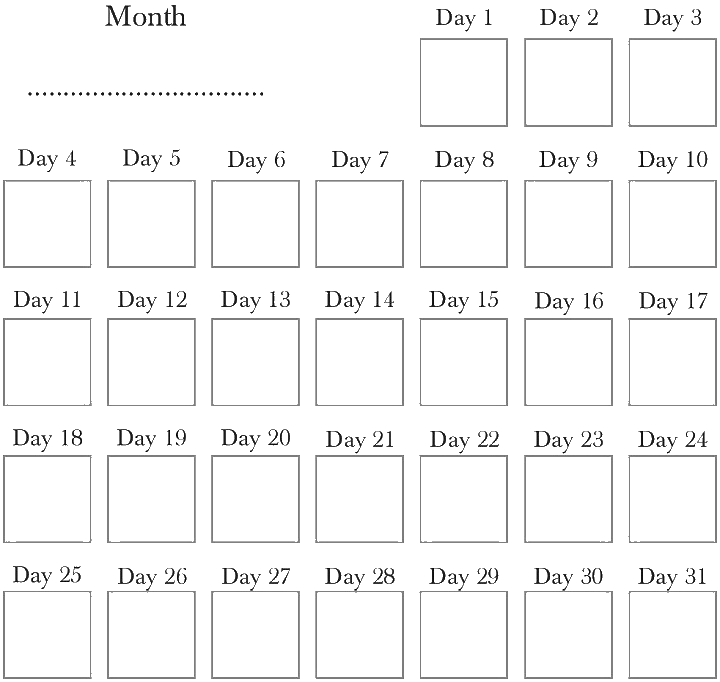
To help you practice MINDFUL ACTION, an easy to use format is presented here. It can be used for daily appraisal. Fill in the appropriate score as per the scoring method suggested below:
Write your experience here :
SCORING METHOD
⟡ Practised all the time - 5 ⟡ Practised occasionally - 3 ⟡ Halfhearted efforts - 1 ⟡ Totally forgot - 0
Note: Writing with a pencil will help you to reuse it.
♦
THE VILLAGE OF DISCRETION
When we “ACT” we are in control of our lives.
However, when we “REACT”, we let others control us.
We get entangled in an infinite cycle of actions and reactions.
In the process, we end up losing our freedom, something that we should always cherish. There is no life without freedom.
Being free of reactions restores our freedom, our lives. Our brain, however, in pursuance of our quest for survival, is naturally designed to react.
Therefore, we need to make conscious efforts to avoid reacting.
So, two simple words: ACTION and REACTION
One worth doing, the other avoidable, and best avoided.
Here in “The Village of Discretion” we can learn this important lesson.
On the second day, the monk continued his journey towards his destination. Filled with anticipation, all four friends accompanied him. The trail ran parallel to a river and everyone followed the Monk as he strode with compassionate attentiveness, carefully so as not to step on any greenery. Sensing the tiredness of his followers, the monk decided to halt for a while and sat down close to the river. Tired and grateful, everyone settled down around the Monk to catch their breath.
Monk started the talk, “Look at the river. You can learn a very nice lesson from it. A river never loses its continuity. It will always keep flowing towards its ultimate destination, the sea. Sometimes great obstacles, like mountains, etc. appear in its way. But it will not stop until it reaches its destination.
Likewise, you also have to move continuously toward your destination. If any kind of difficulties arise, you have to find the solution and keep moving forward. Determination to reach the destination will allow you to succeed.
I made a small halt for your comfort. Now that you all seem refreshed and recharged, we should continue walking toward our destination.” said the Monk.
After another long walk, they reached a village. The name of the village was displayed on a board, “The Village of Discretion”
The monk was meditating at night. Soon everyone gathered around him, eagerly waiting to learn another secret from him. After a few minutes, the monk opened his eyes. Everyone bowed to him and requested him to unlock the second secret of happiness.
“What was the first one?” asked the Monk.
“Mindful Action,” replied Sanjay.
“Have you practised it?” asked the Monk.
“I tried to live in the present, but my mind wandered here and there every time. How can I control it?” wondered Sanjay.
“You should practise deep breathing. Your mind will be more focused and concentrated. Do not try to stop the mind forcefully. Just perceive the thoughts, and you will be in the present. Who else practices Mindfulness?” asked the Monk.
“I set a new wallpaper on my iPhone. It says ‘Mindfulness is the first step to happiness’. It helps me to remember the principle. I think it will take time to internalise this notion,” replied Siddharth.
“Keep it up. “Great oaks grow from small acorns.’ Now, let us discuss the second secret of happiness, which my Guru taught me,” said the Monk.
Everybody started listening profoundly.
“The second secret is “Freedom from Reaction.”
Act, do not React.
There are two words, one is action, another is reaction. Every action has an equal and opposite reaction. This rule is predominant in the areas of science, philosophy and can also be seen in general behaviour. When we perform an action, it generates a reaction. The reaction brings forth a further reaction, and it creates a chain of reactions. This chain of reactions causes sorrow. The reaction gives trouble. If medicine acts, it helps a person. By contrast, if it reacts, it hurts a person through side effects. Likewise, you should act, but should not react. If you give a reaction to a person, you will only get a reaction in return.
“If you place two mirrors in front of each other, how many reflections will be there?” Monk asked.
“Infinite,”answered Dr. Reddy promptly.
Monk explained, “In the same way, if you do not stop reacting, then the Infinite reaction starts. This is a chain of reactions.
One important aspect that will help you find happiness is, to know, how to break that chain.
I just remembered a story. Once, a man was going to the market and came across a donkey, which was standing in the way. Suddenly, the donkey kicked the man. The man became furious and kicked the donkey. The donkey kicked the man once more. The man kicked back again.
A wise person who was passing by and observed the entire happening said, “Sir! He is a donkey.”
“Do you think I am lesser than a donkey?” replied the man.
This happens when you do not know where to draw the line. There was no difference between the human and the donkey.
You can see in day to day life, if someone abuses a person by calling him or her a fool, immediately the other person retorts ‘You are a fool, your father is a fool, and your grandfather is a fool.’ Nobody knows how far the abuse goes. If the person chooses not to react, then the chain is broken — the issue is resolved. There is a very nice saying, Abuse comes alone. If it is returned, it multiplies. Ifit is not returned, it vanishes.’
Monk asked Siddharth to perform a small experiment. “Go near the wall and say something abusive to it,” instructed the Monk.
Siddharth went near the wall and said something abusive to the wall.
“Did you get any reaction?” asked the Monk.
“The wall does not react and there is no reaction in me either,” answered Siddharth.
“Now, go to the public and see what would happen, if you said something....” asked the Monk smilingly.
“I am afraid that we will start arguing and even start fighting because there will be a chain reaction,” he said.
Monk continued, “So, wherever there is a chain of reaction, sorrow is ready there. Controlling someone’s actions is not in our hands but keeping a check on our own reactions is possible and lies in our own hands. If we learn to control our reactions, the other person’s actions will curb per se.
When the maid drops a brand new and expensive glass, instead of asking ‘Did you hurt yourself?’, the immediate response we give is ‘Couldn’t you be more careful?” What we fail to realise is that our warp will not fix the broken pieces of glass. You should think before any reaction. ‘It is no use crying over spilt milk.’
Human anatomy consists of two systems — the sympathetic nervous system and the para sympathetic nervous system. Our body is designed to respond to stimuli. Am I right, Dr. Reddy?” the Monk asked.
“Absolutely,” came the confirmation.
“Hypothetically, if you are passing through a jungle and a lion comes out of nowhere, what will you do?” asked the Monk.
“What will I do? Whatever has to be done, the lion will do!” replied Vicky with a smile.
“I will try to run from there.” said Siddharth almost instantly.
“Our body will enter in fight or flight mode,” said Dr. Reddy.
“Correct, Dr. Reddy.” Monk said. “The first thing that your mind will instruct you to do is to run. If there is no place to run and hide, you fight the lion and the outcome is something you are already aware of. As soon as the body recognises fear or anger, the heart starts racing. The blood pressure increases, and the heart rushes the blood to the brain.
Thus, the sympathetic system of the body comes into play. The arteries and veins become dilated to facilitate the transfer. The muscles stretch due to the expansion of the arteries and veins.
When the situation becomes normal, then the para-sympathetic system starts working, the nervous system engages in calming the mind and the body by releasing the tension between the nerves. But what happens if this occurs repeatedly? It can cause damage to the body.
Imagine, a cleaner sweeping the floor and people keep littering the place while he cleans. The cleaner will clean for some time, but if it happens again and again, he will walk out, leaving that place dirty.
Similarly, when we react too much, then the para sympathetic nervous system cannot match the pace. Avoiding reaction in any situation can act as a life saver.
The nature of a ‘reaction’ is extremely fine grained. While driving, when someone overtakes your vehicle, you react. When someone says that you are looking beautiful, you react. And when someone does not compliment you at a party for your outfit, or does not say how beautiful your jewellery is, you react again. But this time it will be in disappointment.
We react even to the pettiest of issues. For instance, if the weather is dull, we become depressed. If the weather is bright, we become cheerful. We fail to realise that our feelings will not tamper with what is happening around us. If the American President does something, there is a reaction. And even if he does not do anything, there is still a reaction. We resort to reactions that are of no use to us. These petty things form a chain of reactions.
In the food that you eat, if there is very little salt or no salt, you react. Many people will get angry and curse the cook for giving them a bad meal. Many people will leave the plate and walk off. There will be very few who say politely, “There is not enough salt in the food. Could you please give me some more salt?”
People who cook your food 365 days a year, are never thanked for their hard work for 364 days, but are damned the day, they make a mistake. If you go to the kitchen and try to cook the food even once, you will realise how much of effort they make to serve you. You have to be thankful for their service, instead of reacting.
The reaction is the main cause that spoils a relationship. A lot of relationships can be saved if people would not react. Generally ‘answer a stone, with a stone’ is followed.
Why? Is it at all necessary?
Our senior monk Muni Kishanlal ji says so often, ‘Couldn’t you answer astone, with a flower?’
I suggest that you do not answer a stone with a stone. You should collect them all and build an empire with it.
The first thing to learn is to cut the chain. Identify where you can draw a line to avoid unnecessary reactions in the future. Secondly, do not mix your reactions with anger.
Anger is acommon emotion felt by most people. It can range from mild irritation or annoyance to full-blown rage. When such situations come up where in you know that you can lose your temper, try not to respond like a stretched arrow. ‘Anger is the only thing, transformed for the better through delay.’ Wait for your anger to settle down on its own, irrespective of the time it takes. Once you are back to your senses, respond with a calm mind. This will facilitate you to avoid problems and unnecessary drama.
When the consciousness is mingled with anger, reactions are bound to take place. If the conscience is free from anger, a lot of reactions can be avoided.
I want to share an incident from my life. A few days ago, a man said some unpleasant things to me in his anger. I wanted to react. But I realised, if I react then it will start the chain of reaction. Why should I waste my mental peace and energy? So, I remained quiet. After a few days, the same person came again, and I explained the fact of the matter to him. This time he was calm and composed. He apologised for his behaviour during the previous discussion.
Every day you come across such situations where you are forced by nature, to react. But if you learn to pause in such times, it will be beneficial to all. If you are patient in that one moment of anger, you will avoid 100 days of sorrow.
There is a saying in Sanskrit which reads ‘Sahasa Vidadheet Na Kriyam’ - ‘Do not execute any action in haste.’
Learn to pause. Once you learn to do that, you will have a sense of judgment. Before reacting to anybody or any situation, try to step into their shoes. Reflect, what would you do in their place? Many a time, people get angry at their colleagues and office staff. If the office clerks make a mistake, learn to co-operate with them. Because, if they had the same capabilities as you, they could possibly be working as managers in the office.
When a maid is late for work, we tend to question her and scold her, failing to realise that she has left her son, who is apparently suffering from a heavy fever, just to work for you.
Dear friends, just push the pause button of reaction. Try to place yourself in the same situation as the other person, before you start judging and questioning their motives.
Allow me to further explain with an incident.
There was once a boy who had an accident. His father rushed him to a hospital. On reaching there, he found out that the doctor was not present. The anguished father yelled at the nursing staff.
“Where is the doctor?” asked the father while panicking.
“The doctor is on his way and will be here soon,” assured the nursing staff.
The doctor arrived after an hour. The father yelled at the doctor for being so irresponsible and negligent about his duties. The doctor heard everything and left straight to the operation theatre where the son was admitted.
After some time, he came out and said, “I am sorry, you had to wait, but there is nothing to worry about. Your son is safe. He will be fine.” Saying so, he left.
The father was puzzled. He told the staff about the incompetence of the doctor and how disappointed he was.
“Calm down Sir, you are mistaken. The doctor just lost his only son. He was performing his son’s last rites on the funeral ground when we called him. He left his son’s funeral and came here to save the life of your son,” said the nursing staff.
The father was speechless and ashamed of his impulsive reaction.
Always think before you react to anything. If you react without thinking, you might have to face the same embarrassing situation. First, try to understand and only then respond. If you cannot stop your reaction, then learn to delay it. This will help in curbing unwanted outcomes, in turn avoiding any chain of reactions.
The world of reaction is very subtle. A lot of times you cannot understand how you react because it is in your subconscious. I want to explain it using a metaphor of a puppet show. Puppets are quite intriguing and people are fascinated by the puppet shows.
A puppet show happens when there is someone pulling on strings that are attached to characters or puppets. Similarly, in life, you let other people pull your strings. For instance, if I wear such clothes, I will impress them. IfI do this xyz work, I will gain popularity among them.
A person was buying a BMW, although he already owned a Mercedes-Benz, simply because, this was a way of fitting into society. Whether one travels by a flashy Mercedes-Benz or an ordinary Maruti car, the destination remains the same. If you are living to please others, then you cannot stop reacting. If you are living for yourself, then you are shielded from such reactions.
Someone once asked a philosopher, “What is the biggest disease today?”
“The biggest disease today is the fear of ‘What will people say?” replied the philosopher.
“If we live by the likes and terms of other people, then we are puppets of sorts. We should not be influenced by what people think about us. We should be cautious and be alert of ourselves. I once asked a group of people about the number of dresses they owned. One said 200, the other said 250, and yet another said 500. On an average, nobody had less than 150 dresses. Then I asked them why they had so many dresses?”
They replied, “People pass remarks when you regularly repeat your clothes. We do not want them to think that we are cheap or cannot afford new clothes.”
The Monk continued, “You are living for others. Anything you do for inviting the attention of others, make you a puppet. You will then be forced to dance to their tunes. When you place your strings into someone else’s hands, they will pull them according to their own free will, and will take advantage of you for their own benefit.
This attribute is commonplace among family members and neighbours. When they want to create strife between two people, they fill the other’s ears with manipulated facts or wrong accusations. Without validating the authenticity of the statement, that person will believe whatever news he has heard about the other, without even blinking an eye. This happens on both sides and when they escalate it to a one to one battle, itis a sight of sheer enjoyment for the audience.
As soon as you tell the older of the two co-sisters in law that her mother in law is partial towards the younger one, the older one will be outraged.
If you react immediately, are you not similar to a puppet?
My dear, think a little and stop reacting in haste. If it is necessary, then first give a wise thought and then respond. Decide whether you want to be puppets, whose strings are pulled by other people or do you want to create your own show with no strings attached.”
“Thanks for such a wonderful lesson,” said Dr. Reddy with a sense of gratitude.
“I want to ask a question. In a lot of situations, if we do not react, that particular incident runs continuously in our mind. How do we tackle such situations?” asked Sanjay.
It is in our habit, to react. If the reaction comes in your mind and if you take it in speech or action, then next time it occurs more and more. To avoid the situation, you can do three things.
First thing: when you get such thoughts, before you react to any situation, find out what was the reason for his action. Ponder over it. Maybe, you will discover some different facts with another angle too. Without knowing the reason, if you react, you might have to face the consequences.
Second thing: you have to ask yourself ‘will my reaction solve this problem?’ When you think about finding a solution, you might find one.
Third thing: practise the art of ‘No reaction’. It will help you bring down the number of reactions. ‘A stitch in time saves nine.’ Once you get into the habit of not reacting, you can control your mind easily.” explained the Monk.
“Many a time, we think that we should not react. But situations are such that, in a reflex, a reaction comes out. What should we do in such situations?” asked Vicky.
“It will happen because you do not have the practice of freedom from reaction. You can do a simple exercise to overcome it. Next time when you come across such situations wherein you react through harsh words or by a wrong action, take a pledge that you will not eat salt in your food the next day. One day without salt will remind you for the next month to be alert. It is important to have self discipline in this case,” answered the Monk.
“It is better to avoid reaction than to avoid salt for a day!” remarked Vicky.
“How does one subdue anger?” asked Dr. Reddy.
“It is a long topic to discuss. Without going into detail, I am sharing the knowledge which Acharya Shri Mahashraman taught me to subdue anger,” the Monk said.
The best way to deal with anger is -
1. Simple, deep breathing exercises using the diaphragmatic (abdominal) muscles, which can calm the effects of the sympathetic nervous system.
2. Learning to meditate (to relax your body and mind). This helps you to control your reactions to thoughts and feelings. You can join Preksha Meditation Camps too. It really helps a lot.
3. Practice Jyoti Kendra Preksha for 10 minutes. Here is how you can do it:
• Concentrate your conscious mind at Jyoti Kendra situated in the middle of your forehead. Perceive bright white colour there, like a full moon.
• Experience bright white colour particles entering throughout your forehead.
• Experience the forehead completely filled with bright white colour particles.
• Experience complete peace and bliss.
4. The practice of silence at the time of anger.”
“I will surely follow this great tip,” said Dr. Reedy satisfied.
“O monk! You are a practitioner of meditation. You can control the reaction. But we are common people. How do we abstain from reacting? If we keep it within ourselves, it will only lead to depression,” asked Siddharth.
The Monk replied with a smile, “A Journey of a thousand miles begins with a single step. I am still a traveller on that path, but I have come a little distance from where I started. You can also do the same thing. In a day, try to save yourself 3 to 4 times from reacting and, as days go by, with practice and perseverance, you will learn not to react and to avoid the chain of reactions.
I think it is rather late and now you all may go to bed now and have a proper sleep because we all have quite a distance to walk tomorrow too.”
Everyone left the room with gratitude for the monk in their heart. The Moon was shining in the sky. It looked like a large, polished, silver dish. The stars sparkling all around added to its charm.
What is the most significant lesson that You learned from this
chapter?
What particular habit or behaviour do You need to change in
yout life?
Your action plan for self-transformation.
To help you practice FREEDOM FROM REACTION, an easy to use format is presented here. It can be used for daily appraisal. Fill in the appropriate score as per the scoring method suggested below:
Write your experience here :
SCORING METHOD
⟡ Practised all the time - 5 ⟡ Practised occasionally - 3 ⟡ Halfhearted efforts - 1 ⟡ Totally forgot - 0
Note: Writing with a pencil will help you to reuse it.
♦
THE VILLAGE OF FRIENDSHIP
“I have AMITY with all. There is no enmity with anyone.”
But sometimes we meant someone as an enemy. This is so, because we think that others are doing things which harm us or our interests. Sometimes because of our vanity and ego or even short sightedness, we let jealousy take over our behaviour.
Once a relationship is devoid of amity, it quickly degenerates into enmity and creates both mistrust and misery. We are not meant to live like that.
One secret wisdom, that we can apply to regain friendship with all is to forgive others and seek forgiveness from others. Merely the simple act of forgiving others can ultimately lead one to realise that there are no enemies.
“All are FRIENDS”
This is an important take away from “The Village of Friendship!”
On the third morning, with the first ray of dawn, the monk set forth on his journey. The monk was performing a walking meditation. After walking several hours, they reached a village. The name of the village was displayed on the signboard, “The Village of Friendship.” They walked up to a house and settled down to rest for the day.
“Friends, have you followed the principle of ‘do not react’?” asked Dr. Reddy.
“Yes, uncle. I practised it last night. When Siddharth snored too loudly, my sleep was disturbed, but I did not react,” replied Vicky.
“I also practised. Vicky was talking very loudly on the mobile phone, when I was going to sleep. Although I found it utmost irritating, but I abstained myself from reacting,” Siddharth hit back.
The doctor smiled and asked, “Is it not a reaction?”
Smile came on everyone’s face.
As dusk descended, the Monk performed Pratikraman, a daily ritual of introspection and repentance. After Pratikraman, the monk started uncovering the third secret of happiness.
“My dear friends, the third secret of happiness is called Amity. Friendship gives happiness. In the journey of life, every person comes into this world alone and leaves alone. Meanwhile, on this journey, a person makes friends with many people.
When people live in a society,they develop friendships with a potpourri of people. Some are their ‘best friends’, some are ‘school friends’ some are ‘neighbours’ and some are those who dwell in the same society.
Making a few friends is not a big task. It is simple. Go to a party or become a part of a social community wherein you can meet new people. Chances are, you can make 10,15 or even 100 friends. If you want to have a larger friend circle, you can log on to diverse social media like Linked-In and Facebook which will help you connect with people across the globe. Even in the virtual world, Facebook has set a limit of 5,000 friends after which you cannot add more people to your profile.
If you want to be happy forever, then you have to make infinite friends. But the question at hand here is, how to make infinite friends?
The very simple solution is taught by Lord Mahavira “Mitti me savva bhuesu, Veram majjh na kenai”— “I have amity with all living beings of the universe. There is no enmity with anyone.”
It means you have infinite friends, not just human beings but all living beings of the world are your friends. If you want to make friends, open yourself and expand the horizon of your friendship with every living being. Don’t treat anyone like an enemy.
Once a person came to Gurudev Tulsi and said in a proud voice, “In my religion, messengers have taught a great thing and nothing is greater than it.”
Acharya Shri Tulsi asked about the teaching of the messengers.
The person replied that the messengers taught, “You should love your enemy.” Further, the person asked, “Can anyone teach such a great message?”
“Every great person has given the same message of humanity in every era, replied Acharya Shree Tulsi. “Lord Mahavira also taught the same thing but with a little variation - ‘One should not consider anyone as an enemy,’ Would it be great if you first consider someone an enemy and then treat him like a friend? It is better if you treat everyone like a friend and do not consider anyone an enemy at all.” The person had no answer.
Monk continued, if we learn to be a friend with everyone, there will be no sorrow. Friendship should not be subject to conditions. One must always be ready to give unconditional support to their friends. Making someone your friend just because, they do something for you or you will take care of them only if they look out for you, is not true friendship. That is a bargain, a deal between you and the other person. In amity, your love and support should always be unconditional to everyone, with no expectations in return. Having a friendly attitude towards everyone, without asking the same in return always goes along way.
This world works on the law of reciprocation. You reap what you sow. Give amity, gain amity. Give cruelty, gain cruelty. Give enmity, get enmity. If your feelings towards a person are of enmity, the opposite person will also feel the same way about you.
I would like to tell you about a real life incident. Once there were two persons, who argued with each other on almost every issue. There came a point where they even stopped talking to each other. One of the two, inspired by a monk, gave this situation a thought and asked himself,‘Is it good to have enmity against him? If not, then how should I change the situation?’
In theory, change always occurs from both ends. It is the classic “You take one step, I will take one step’ attitude. But what happens if I offer to apologise, and he refuses?
The monk suggested him to do the contemplation of Amity. He began the practice. This practice involves giving autosuggestions to the mind. So, the person repeatedly told himself, ‘I am friendly towards that person. We bear no enmity anymore.’ He repeated this every day, at night before going to bed and in the morning after waking up.
After a few days, it was seen that there was a change in the perception of both those men, which led them to become friends again. This is the power of contemplation of amity.
Jain literature teaches “Aaytule Payasu” You should see every living being as your soul. As you desire to live, afraid of dying, want to stay happy, afraid of sorrow, in the same way every living being desires the same. Nobody wants to die. Every living being desires happiness, nobody wants sorrow. Every soul is similar to my soul. If you realise and etch this fact in your heart, that we are all souls of the same cadre, then there will be no enmity with anyone. You will not cause sorrow to anyone. If you do not cause sorrow, then you will also not get sorrow. Give sorrow, get sorrow. It reciprocates.
If you start quarrelling with someone, you will find that the other person will also start quarrelling with you, and if you say hello by shaking hands, the other person will give you a warm smile. Who is responsible for amity or enmity? Making friends and enemies, both are in our hands and in our hands only.
If you are someone who wants to make a lot of friends, then make sure you have an equal amount of politeness within you. It is also important that we treat them with respect. Providing someone with money, comfort or any other object is of no use, when you cannot respect that person. When someone treats you with respect, you are involuntarily attracted to that person. Similarly, when you give someone the respect they deserve and sympathise with them, they will become attracted to you.
There is a person who gives you some money, but insults you amidst thousands of people and there is another who does not give you money, but greets you with a smile and is of a welcoming nature. Who would you choose?
Everyone wants to be treated with due respect. You give someone respect, you will receive respect in return.
One of the important reasons for being unhappy is jealousy. This jealousy sometimes leads to strife between our families and friends. ‘Why has he been promoted?’ ‘Why is success knocking only on his door?’ ‘Why does he have more money?’ — These are few questions that arise in the minds of those who give in to jealousy.
Someone once asked a philosopher, “Why are people unhappy?”
“Because their neighbours are happy.” came the witty reply.
If your neighbour is happy, then you become unhappy. If you see your neighbour as yourself, as your soul, then his happiness becomes your happiness, his progress becomes your progress. Where jealousy exists, there is a feeling of “It does not matter if I get hurt, as long as my neighbour gets hurt too.” Where such a mentality exists, you cannot think about happiness. If there is a desire to harm someone, to inflict pain on someone, then it should be understood that, somewhere, there is a lack of healthy personality.
I want to explain this using an incident where a person wants to cause trouble for someone else. Once, three tourists took a trip to Saudi Arabia. Each of them had a bottle of liquor. The three men got caught, as alcohol is banned in Saudi Arabia. They were taken to the Sheikh to decide their fate. The Sheikh decided that these three men should be taken to the crossroad and each be given 100 lashes of the whip.
After he passed his judgment, he was reminded that it was the 21st birthday of his seventeenth wife. The Sheikh decided to fulfil one wish for each of the three men.
On being asked about his one wish, the first traveller, after deep thought, said that he would like a pillow to be tied on his back before he gets whipped. The Sheikh agreed, and his wish was granted. After getting lashed about 70 times, the pillow ripped and the remaining 30 bruised his back.
Next, it was the second traveller’s turn. He imagined that if one pillow could save him from getting 70 lashes, then two pillows will last up to 140. He asked to have two pillows tied to his back before he got whipped. His wish was granted and, as he had hoped, the pillows lasted all of his 100 lashes and he got out of it, without a mark.
Finally, it was the third traveller’s turn. The Sheikh suddenly said, that he would grant not one, but two wishes of his. After deep thought, The third traveller said that his first wish would be to get 200 lashes. Everyone was surprised. His second wish was that when he got his share of lashes, the second traveller should be tied to his back.
When there is a desire to cause trouble for someone, it implies a lack of amity. Our horizon of amity should not be limited to any country or any community. It should be expanded to all living beings. If you are walking and see an ant, and if you perceive the soul of the ant similar to your soul, if you are walking on the grass and you perceive the grass also similar to your soul then you can’t give trouble to anyone. You should have kindness in your heart, amity in your heart, then you will be happy forever.
We are living in a generation where there is a constant rift between countries or neighbours or siblings. The only way to resolve these perennial matters is by extending a hand of friendship. The day we learn to have an affinity towards others, even when they do not reciprocate, we will have a feeling of real and unimaginable contentment.
Making a friend is easy, maintaining friendship is difficult. An easy way to not lose friends is to stop reminding them of what took place in the past. It is human psychology to remember things that took place in the past and find the right instance to disclose them. ‘He said that to me,’ ‘He did that to me,’ etc. — such sentences should be avoided in order to keep friends. You should try to forget the mistakes of the past. Do not recall the unhappy incidents of the past and spoil your present. Many times we see that a person meet and greet a person with a smile and hug but, deep down, the hatred and jealousy are still fresh.
“Dear friends, I want to suggest a small exercise, would you like to do it?” asked the monk.
Everybody was excited to try out another interesting activity.
“Of course, I will do it,” volunteered Siddharth.
“You all have a home and a kitchen in that. Now the exercise is, do not throw out the garbage from your home for one month, do not clean the utensils or the clothes, and leave everything as it is for a month. Nothing more,” Said the Monk and smiled.
Everyone said, “it would not be possible.”
Monk smiled and looked at Siddharth. But Siddharth seemed to avoid any eye contact.
“Could the same be done for fifteen days?” asked the Monk.
Again everyone refused.
The monk asked again, “this time for seven days.”
“It is impossible,” everyone gasped is disbelief.
“How much garbage do you have in your mind? Have you ever thought about it? For months and months, years and years, you keep hatred, bad memories, grievance in your mind. Is itnot your home? asked the Monk.
“Think, my dear, if one month’s pile of garbage turns your home into a dump then what will happen with all the mental and emotional garbage you have stacked away in your mind from years and years. Imagine the plight of your mind. Acharya Shri Mahashraman says that “if you cannot make your mind a pious place, you have no right to make it a dustbin either.”
“Is it possible to eliminate the garbage of hatred, bitterness, and bad memories from the mind, which have been stored there for years and years?” asked Vicky.
“Yes, it is possible. You are an Information Technology engineer. What do you do to speed up your mobile phone?” the Monk wanted to know.
“In the world of smartphones, we need to clean the residual files and delete the unnecessary applications to increase the speed. On our computers too, we keep deleting the useless files,” explained Vicky.
Monk explained, “In the same way, we have to delete the bitterness and bad memories from the mind. Should we not work on our minds and make them hassle free?
Sometimes, when your colleagues say something rude or you get into a heated argument with your boss or even the slightest of misunderstandings between your family and friends, you make it a point to revoke any relations, you have with them. Can you not go past that? What makes you keep all that garbage?
You have to start practising forgiveness. There is a couplet which has a profound wisdom. You can recite this couplet, contemplate on the couplet before sleeping. The couplet is -
“Khamemi savva jive, Savve jiva khamnatu me
Mitti me savva bhuesu, Veram majjh na kenai”
It means “I am forgiving all living beings and every living being should forgive me. I have amity with everyone, no enmity with anyone.”
If you give forgiveness, then you will become light. Research shows that forgiveness helps us experience better mental, emotional, and physical health. And it is prooved, as showed by the Stanford Forgiveness Project, which trained 260 adults in forgiveness during a 6 week course.
70% reported a decrease in their feelings of hurt.
13% experienced reduced anger.
27% experienced fewer physical complaints like pain, gastro-intestinal upset, dizziness, etc.
The practice of forgiveness has also been linked to better immune function and a longer lifespan. Other studies have shown that forgiveness has more than just a metaphorical effect on the heart, it can actually lower your blood pressure and improve cardiovascular health as well.
If you retain bitterness towards another person, that person is not going to be affected by the garbage inside your mind. If you keep garbage at home, its bad odour can reach your neighbour too, but if you have garbage in your mind, the stench of your hatred will not have any influence on the opposite being. It will only cause damage to the inside, your mind, and your body. ‘Do not dig your grave with your own knife and fork.’ It has been scientifically proven that hatred can cause ulcers, high blood pressure and, sometimes, lead to stroke. Dr. Reddy can confirm it,” Monk said.
Dr. Reddy explained, “Feelings ofrage and hatred build up in the mind, affecting the body’s organs and natural processes and breeding even more negative emotions. Prolonged bouts of anger can take a toll on the body in the form of high blood pressure, stress, anxiety, headaches, and poor circulation. Research also shows that even one five minute episode of anger is so stressful that it can impair your immune system for more than six hours. These health issues can lead to more serious problems such as heart attacks and strokes. Anger and hatred can be directed at yourself or other people, but either way, you lose when you allow these negative emotions to take over.
The latest research, to give credence to the link between the state of mind and health, is a study from Concordia University that has found that constant bitterness can make a person ill. Holding on to bitterness can affect metabolism, immune response or organ function and lead to physical disease.”
Monk continued his preaching, “If you learn to forgive and to forget the bitterness, then nobody can stop you from progressing. If someone has to climb Mount Everest, before starting the voyage, they must make sure that they have extremely limited baggage with them. When travelling on a flight, you make sure that you carry only the stipulated weight as allowed by the airline to avoid paying the excess baggage charges later. Just because there is no penalty or taxes on the amount of emotional baggage you keep in your mind, you tend to overload to its maximum capacity. It is always better to let go of trivial things, that ruin your peace of mind, in order to live better and live healthily.
My dear friends, reduce the baggage from your mind. The more unnecessary memories you erase from your mind, the happier you become. Learn to forgive and forget.
If you were asked to leave your house with only one bag and you could carry all that you want in just that one bag, what would you take along?” the Monk wanted to know.
“I would only carry the things which are of value to me. For instance, I would take my jewellery, cash and those which have worth,” replied Siddharth.
“In the same way, keep only necessary things in your mind, said the Monk. “Whatever is unnecessarily stored in your mind, retrospect and eliminate. If you keep only useful things in your mind, then there will be no place for bitterness and hatred. If there is no bitterness and hatred in your mind for anyone, then it will be easier to remain happy.
Keep the thoughts of amity and friendship with everyone. Automatically, everyone will be friendly with you. Whatever we think, it has an effect. There is a principle “Energy follows Thought”.
Allow me to tell you a story.
Once a king sent his minister to the neighbouring nation’s king for a solution. The minister reached the kingdom of the neighbouring nation and asked the king, “Where I come from, kings die at a young age, while, in your nation, kings lead a long life. What could be the reason for this?”
The king ordered his soldiers to arrest the minister and put him behind the bar and keep him until the banyan tree fell down, which was in front of the prison. The minister was puzzled and thought that he had not committed an act worthy of punishment. He was extremely worried, but he had no other option than to spend his days in prison, until that banyan tree fell down. The minister prayed the whole day and night that ‘the banyan tree would fall down.’ He continuously thought the same thing. He held only one image in his head, that banyan tree falling down.
After almost 15 days, the banyan tree fell. The minister was released from prison and broughtin front of the king.
“Why did you put me in prison?” he asked the king.
The king smiled and replied, “To answer your question.”
The minister was highly puzzled by the king’s answer.
The king explained, “You were thinking the whole day and night that the banyan tree would fall and the once strong and healthy banyan tree fell down in almost 15 days. In the same way, your king gives a lot of trouble to his people, so every citizen thinks that the king should die. Strong contemplation has an effect. I always try to keep my citizens happy, so they always pray for my long life.”
Monk continued the talk, “My dear friend, whatever be your thoughts, the energy will give you the result accordingly. The energy that flows inside of you, creates an aura around you that makes the other person think in the same way. You should keep amity with everyone, you should do good to everyone, as much as possible, because thoughts always have a mirror effect. If you always perceive good thoughts towards your colleague, then your colleague will also think well of you. A boss who once disliked you, might start appreciating you. Constant fights between spouses, siblings or friends can easily be solved, but Rome was not built in a day. It takes time to perfect the practice.
The important question is, Who should start? It always calls for someone to take the first step. If we wait for the other person to start, then it will not happen. You should leave your ego and start from your side. It will give you a better result. What is the point of keeping your pride? When we come across a door with a height smaller than ours, we bend and pass through it. Otherwise, our head will hit against the frame. Then, what is the issue in bowing down in front of your elder brother? What is the issue in bowing down in front of your father, mother, spouse, neighbour? If you practise positive affirmations, automatically, you will find the mirror effect. You will find a change in them.
You ought to understand the other person’s point of view too. Truth is always multi dimensional. If you see things from your point of view, then there will be a different truth. If you consider the same thing from another person’s point of view, then you will find a different truth. The only difference here is the perception. Perhaps the intention of the other person is different but ignoring other’s point of view and only insisting upon your own perspective often leads to misunderstanding. If you put yourself in another’s shoes, then you will obtain a shared perception of the truth.
There is a very good example about multi dimensional truth. A philosopher came with a half-full glass of water and asked the students, is it full or empty?
One person said, that the glass was half full, and another person said, that the glass was half empty. Both are equally true. Itis their own perception.
The philosopher said, there were other dimensions too. The glass was 100% full. Half with water and the other half with air.
The moral is, a lot of time there is an undiscovered dimension, which we neglect. If we try to understand the perspective, then a lot of misunderstandings can be removed. There is a philosophy of Anekant (relativity). If we try to understand relativity then a good deal of misconceptions can be vanquished. He is right from his perspective, and I am right from mine. If you learn to live a life according to the philosophy of Anekant, the excess garbage in your mind will find an exit door.
We believe in the theory of Karma. If you think negatively towards someone, then you will attract negative karma. Negative karma. attracts negative energy. Positive karma attracts positive energy. Try to replace the negative with positive, try to replace the bitterness with sweetness, and try to replace the enmity with amity.
When the beauty of your garden is disturbed by weeds, you uproot them and discard them to make the garden beautiful again. Similarly, wherever the weeds of bitterness grow in life, in a relationship, in friendship, you have to remove that from the root and make your life more beautiful.
Everyone was grateful to the monk for such a pragmatic and profound lesson. Siddharth raised his hand to ask a question. The monk nodded and smiled.
“In this current era, it is impossible to live without having enmity with people. Can anything be done about that?” wondered Siddharth.
“Instead of calling it ‘impossible’ we can call it ‘difficult’. Ifyou find it difficult to stay away from enmity, then at least try to reduce it. If you have enmity with 10, reduce it to 9 and so on. Keep avoiding what is not required until you can turn the ‘impossible’ into ‘possible’.” proposed the Monk.
Sanjay said with a sense of pain, “I had a friend five years back. We were thick in terms of our friendship. But because of some misunderstanding, we have not had good relations for the last five years. From my side, I have cleared everything. I am ready to bend and do anything that is required to resolve this issue. But still there is no effect on our relationship.”
“We can do our part, and also change the perspective of the other person by the contemplation of amity, explained the Monk. “Every day after waking up and every night before going to bed, tell yourself “The person standing in front of me will have a friendly attitude towards me. He is my good friend. We have a very cordial relationship.’ If there is a strong visualisation of this, it will show its result.”
“What are the qualities of a good friend? Dr. Reddy wanted to know. “Not everyone we meetis our friend. Unwanted people are unwanted garbage. And what importance should a friend be in our life?”
“Friends are the pearls of our lives,” said the Monk, “A good friend is a person who will help do something for you without expecting anything in return. I think these few qualities CAST a light on the essential qualities of friends.
1. Caring — Friends have your best interests in mind.
2. Adviser — A friend gives you an honest opinion and beneficial advice.
3. Supportive — Friends show up whenever we need them, especially during the tough times.
4. Trustworthy — Friendship, rather every kind of relationship needs to have trust as a base and a core quality.
“Good friends can be your biggest cheerleaders and your greatest advocates”
“As a Monk, you have your daily routine of doing Pratikraman twice a day, where in you ask for forgiveness for all the actions you have performed for the day. For us worldly beings, can you suggest a daily practice?” prodded Siddharth.
“Dear friend, you can recite this couplet three times daily: -
“Khamemi savoa jive, Savve jiva khamnatu me.
Mitti me savva bhuesu, Veram majjh na kenai”
If you recite this with undivided attention and with a conscious mind, this will leave an impact,” explained the Monk.
“If somebody has caused us harm, how can we be polite to them?” Vicky asked.
Monk replied calmly, “Those who do bad things to others, bad things will happen to them in return. Ifyou do not let go of such things, it will constantly keep playing in your mind and in turn leave you upset. If you think, taking revenge on the person will put an end to it, you are wrong. This is like a chain reaction. Instead of dragging it to the place where there is no end, it is better to nip it in the bud. If you think a particular person is negative, itis better to stay away from such people.
“Dear friends, it is time to retire for the day. I recommend you all do a little retrospection before going to bed. Do you have any enmity with someone? How can you convert it into friendship?”
Everyone left the room by saying thanks to the monk. Thoughts and memories were brimming in everyone’s mind. All went towards their bed, practised retrospection before falling asleep.
Sanjay could not sleep. His mind was struggling with a heap of bitter memories. He felt that he had hurt the feelings of his elder brother over something trivial. He went outside and stood on the balcony. Tears started rolling down his cheeks. He was thinking about all the things he did and said to his elder brother. There had been no communication between them for the past ten years. He realised his mistakes, and at midnight, he called his brother to apologise.
His brother could not believe that Sanjay was calling him at this time. He answered the phone. Sanjay apologised for his behaviour. “I am so sorry my brother, I have hurt your feelings. I beg your forgiveness,” Sanjay’s voice was shaking.
The brother also asked for forgiveness. They both forgave each other and renewed their relationship.
After completing the process of mutual forgiveness, suddenly Sanjay felt very light. The burden on his heart lifted. All of his enmity disappeared and sublimated into a stream of amity.
He went to bed and fell into a deep sleep.
What is the most significant lesson that You learned from this
chapter?
What particular habit or behaviour do You need to change in
yout life?
Your action plan for self-transformation.
To help you practice FREEDOM FROM REACTION, an easy to use format is presented here. It can be used for daily appraisal. Fill in the appropriate score as per the scoring method suggested below:
Write your experience here :
SCORING METHOD
⟡ Practised all the time - 5 ⟡ Practised occasionally - 3 ⟡ Halfhearted efforts - 1 ⟡ Totally forgot - 0
Note: Writing with a pencil will help you to reuse it.
♦
THE VILLAGE OF HEALTH
If you ask a person, “Why do you eat?” the usual response would be “To Live.” But when you observe closely, it seems like we all rather “Live to Eat”
Each and every cell of our body is made out of the food that we eat. Naturally, what we eat? how much we eat? when and how we eat? are all important factors that affect our health.
If eaten prudently, food can be a medicine, but paradoxically, it is the most common cause of disease!
Here in “The Village of Health” our stay is fruitful, if we can understand the real significance of the philosophy that “Food is for life, Life is not for food.” This understanding is very essential for leading a healthier and happier life.
And finally, the sun appeared on the distant horizon, filling the sky with vibrant shades of fiery orange, radiating hope and happiness all around. The Monk started his journey towards the next village, his energetic paces matched by the burning heat of the hot summer sun. All along the way, there were dense trees on both the sides of the path. Birds were fluttering about, their musical chirping fading away in the dense forest foliage. After a demanding walk of twenty-five kilometres, they reached the village. The name was prominently displayed on the signboard, “The Village of Health.”
At night, when the monk finished meditation and opened his eyes, he saw that everyone was already sitting around him. They all greeted him and eagerly asked him to unlock the fourth secret of happiness. There was absolute silence as everyone was keen to hear him. The Monk started unlocking the fourth secret of happiness.
“The fourth secret of happiness is “The Moderation of Food.” A man requires basic things to live a life. The most important needs are food, clothing, and shelter. If there is no shelter, he can survive. If there are no clothes, he can live in the jungle, but if there is no food, a man cannot live for a long period. Maybe he can live for a few days without food, but at last he will need food to survive.
The question is, why do human beings need food? What is the reason? They eat breakfast in the morning, lunch in the afternoon, dinner in the evening and often some snacks. It seems like some people are almost eating around the clock.
Many people just do breakfast or lunch because it is their daily routine. When it is time for breakfast, they have breakfast, whether they are hungry or not. Some people seem to have made their stomach into a lunch box.
Once a man went to a lavish wedding reception. A mind boggling variety of delicious food was freely available. If food is available for free, often people take more food than actually needed. This man also ate too much at the wedding reception. Soon his stomach was full. Someone came to him and asked if he would like to take some more.
“No, there is no space in my stomach,” replied the man.
Another person came and requested, “Take something more, please.”
“No, there is no space in my stomach now,” he said again.
After some time, a person came with a delicious pizza. The man ate that pizza.
“You said there was no space in your stomach. How did you eat that pizza?” asked the first person.
“Delicious pizza is like a president’s car on our crowded city streets. It can make its way by blowing the siren,” he replied playfully.
Dear friends, if this is the mentality of eating, then our stomach is not just a stomach, it is a lunch box. You should not make it a lunch box. You should treat your stomach as a stomach. It is not a lunch box that you should stuff with whatever you wish.
Divide the space of your stomach in a mental calculation. 50% of the space in your stomach is for food. 25% is for water or liquid and the other 25% is for air. If you fill it 100% with food, then there will be a problem.
Everybody eats food, and food is very essential for life. But the problem is, many people do not know how to eat, what to eat, when to eat or where to eat. If we all become aware of these things, then eating will become an art. It will also become a meditation.
“First, we will discuss why we eat. Why do we need food? Can anybody tell me?” asked the Monk.
“To live,” replied Dr. Reddy.
“Very simple and beautiful answer. If we have to use our body, we have to give it food. It is like a machine. To move the car, we have to put fuel or electricity in it. In the same way, we give food to our body to maintain our life, explained the Monk.
“We do not have to eat food to satisfy our taste. We have to eat food for health, to support spiritual practice.
Is your purpose of eating to fill the stomach? No, because if your purpose is to fill the stomach, then you can fill it with anything. Even if you drink a lot of water, your stomach will be full. If you eat only vegetables, then also your stomach will be filled. If you eat only bread, then also your stomach will be full. But you use a lot of variety. Your body needs a lot of nutrition. Nutrition comes in the form of carbohydrates, fibre, vitamins, minerals, proteins, etc. Everything in the body is absorbed from the food itself.
It is very important to know how to eat and what to eat. Keep in mind that ‘You are what you eat.’
A poet explained it very well, using a metaphor - once a lamp was burning in the dark and was emitting a thick black smoke. The poet wondered why this lamp, which normally produces light, was emitting darkness. Then the reply came - because the lamp was eating darkness, so it was producing darkness. If you eat satvik food (pure food), then your thoughts will become pure. If you eat a lot of spicy food or tamsik food (impure food), then there is a high chance of getting impure thoughts.
While eating the food, we must practice mindful eating. The meaning of mindful eating is having food with awareness. Our ancient scripture Ayurveda says Tan mana bhunjita, i.e. eat your food mindfully. Eating with mindfulness is a kind of meditation. Focus your whole mind on eating your food. No thinking, no talking. If we eat with mindful awareness, then the experience of eating even one bite becomes rich.
A lot of people do other activities simultaneously, which is not good. You must turn off the TV, avoid talking on the cell phone and stay away from the internet while you are eating.
I found this small exercise of mindfulness very interesting, suggested by Dr. Bays -
“One bite at a time”
After you take a bite, put the spoon or fork back down in the bowl or on the plate. Place your awareness in your mouth, until that one bite has been enjoyed and swallowed. Only then pick up the cutlery and take another bite. If you are eating with your hands, put down the sandwich, apple, or cookie between bites.
Studies have reported that eating mindfully can reduce physiological distress such as depression, anxiety, stress, and eating behaviours including binge eating. Mindful eating has also resulted in weight loss of overweight and obese people.
Apart from mindfulness, chewing the food is also very important.
The most helpful organ in eating is the mouth. In the mouth, there is only one tongue but thirty-two teeth. Do you know what this means? Eat less, chew more. You must chew well, whatever you eat. You should chew a morsel 32 times or until your mouthful of food is liquified or has lost all of its solidness. By chewing properly, you can improve the digestion of your food.
Remember, the digestion process starts with chewing itself, not when the food is in your stomach. When you chew your food properly, your body releases digestive enzymes in the stomach that help to break down food, so that your body can convert it into energy.
When the food is not chewed properly, then your intestines have to work harder to digest the food. Nature has put teeth in our mouth, not in the intestines. So, you ought to chew the food in the mouth itself. In Bengal, there is a saying “Eat the water and drink the food.” If we chew the food long enough, it becomes liquid.
If you look carefully, nature has given us two ears. They have one job, and that is to listen. Nature has given us two eyes. They too have one job, to see. Nature has also given us two nostrils, and they too have one job, smelling. Nature has given us one mouth, but it has two functions, eating and speaking.
This indicates that you should do half the amount of eating and half the amount of speaking. But what you are doing is that you are eating too much and also speaking too much.
If we give overwork to it, only doctors will be happy. Many doctors say that if people ate correctly, they would be jobless.
Many people are suffering from obesity. What is the reason behind it? The major cause of obesity is eating either too much food or junk food. People living with obesity have higher chances of developing serious medical issues. These health problems affect nearly every part of the body, including the brain, blood vessels, heart, liver, gallbladder, bones, and joints. ‘Sickness in the body brings sadness in the mind.’
Moderation of food is the best way to avoid obesity.
A lot of importance is given to fasting. Thousands of people practice fasting for a month every year. Thousands of people fast for eight days, three days, or even for a day. Not everyone has the same capacity of their bodies to fast regularly.
There is a simple and easy way to do penance, which is called Unodari. It means just eat less than your hunger. You can seta limit for the items in your food. You can make a resolution that you will not eat anything for a specific amount of time, like an hour or so. This is also a practice of Unodari. You have to limit your food. If you continuously practice these kinds of things, then you can easily moderate your food.
There is a very nice saying in old literature, “A person who eats less, and eats only healthy food, does not need a doctor. They themselves are their own doctor.” There is very little chance of an illness in the body. If we eat too much, then there is a greater chance of getting sick.
I have read a very nice phrase ‘Eat your food as a medicine, otherwise, you have to take medicine as your food.’ If you want to remain happy and healthy, you should have control over your food.
There are two kinds of food. One that gives you pleasure and the other, that is good for your health. The food which gives you pleasure, is not necessarily healthy food. You may like a lot of spicy, fried and junk food, butitis not healthy food.
The needs of your tongue differ from the needs of your body. If you eat to satisfy your tongue, then the body will be disturbed. The tongue needs tasty food whereas the body demands fibre, protein, vitamins, carbohydrates, calcium, etc. You drink soft drinks, which is not healthy for your body. You eat junk food, which causes constipation. Eating excessive spicy food causes the problem of acidity.
Think, do you eat food for taste or for health, for the tongue or for the body? Your tongue enjoys the food, at the most for a couple of minutes. After that, all food is mixed. It changes its taste, shape, colour, smell, etc. For only the pleasure of a minute, why create so much trouble for your body? If you just give a conscious thought about food and its effect on your health, then a lot of bad habits of eating will be reduced.
The purpose of food is health. The purpose of food is to maintain the body, which is useful in spiritual practices. The body is the medium for spiritual practice. Ifit remains healthy, then you remain happy.
Dr. Reddy raised his hands to say, “Being a doctor, I also want to share a few points with all of you, about what to eat.” It is recommended that men should have around 2,500 calories a day (10,500 kilojoules). Women should have around 2,000 calories a day (8,400 kilojoules). But of course, it directly depends on your lifestyle.
Robinson and Segal suggest that we all need a balance of protein, fat, carbohydrates, fibre, vitamins, and minerals in our diets to sustain a healthy body.
Protein - Protein gives you the energy to get up and go—and keep going—while also supporting mood and cognitive function.
Fat - Not all fat is the same. While bad fats can wreck your diet and increase your risk of certain diseases, good fats protect your brain and heart. In fact, healthy fats—such as omega-3s are vital to your physical and emotional health.
Fibre - Eating food, high in dietary fibre (grains, fruit, vegetables, nuts and beans) can help you stay healthy and lower the risk of heart disease, stroke, and diabetes. Fibre also aids in digestion, making it easier for your body.
Calcium - As well as leading to osteoporosis, not getting enough calcium in your diet can also contribute to anxiety, depression, and sleep difficulties. Whatever be your age or gender, it is vital to include calcium rich foods in your diet.
Carbohydrate - Carbohydrates are one of your body’s main sources of energy. But most should come from complex, unrefined carbs (vegetables, whole grains, fruit) rather than sugars and refined carbs.
Water - Drink plenty of water. Water helps to flush waste products and toxins of our systems. Your overall dietary pattern is most important.
The cornerstone of a healthy diet should be to replace processed food with real food, whenever possible. Eating food that is as close as possible to the way nature made it, can make a huge difference to the way you think, look, and feel. It is as good for your mind as it is for your body.
“Thanks uncle, for sharing this with us,” Siddharth expressed his gratitude.
“Uncle, what do you suggest about non-vegetarian foods?”
Vicky asked out of curiosity.
“Avoiding non-vegetarian food is good for health and soul too. Do not make your stomach a graveyard,” instructed Dr. Reddy.
‘So, I am living without fats, without meat, without fish, but I am feeling quite well this way. It always seems to me that man was not born to be a carnivore.’ Albert Einstein wrote these words in a letter dated 30 March 1954.
“Now, experts around the world are advising people to eat a more plant based diet, or a vegetarian diet because it is healthier.
Problems that occur from non-vegetarian food include type 2 diabetes, high blood pressure, increased cholesterol and obesity. This increases the risk of dying early in non vegetarians. To be specific, the risk of dying from heart disease is less in vegetarian people as compared to non vegetarians.
A lot of pandemics like the Covid-19 (Corona virus), bird flu, swine flu etc. are caused by non vegetarian foods. Being a vegetarian is also environmentally friendly.
Monk continued his talk, “Now we will discuss when to eat.”
Whatever you eat, needs time to digest. The stomach is not like an overpowered machine. You should maintain a gap of minimum 2 to 3 hours between meals. It will help in proper digestion.
According to nutrition specialists, this waiting period is ideal because it is the average time for the stomach’s contents to be emptied into the small intestine after a standard meal. Waiting for this long will also ensure that a true appetite has returned to sustain the body, instead of just eating out of habit or as an emotional response.
In the Jain lifestyle, it is advised not to have food after sunset. The main reason behind this is non-violence. But it is very scientific and has a lot of impact on our health.
Our ancestors were very wise. They knew the system of the biological clock. Our body does not have an actual clock, but it has an internal rhythm called the ‘circadian rhythm.’ It works based on the solar system. When itis time for food, then it secretes the enzymes which help in digestion. When it is dark, it relaxes the body, and all organs get proper rest. Your body slows down the metabolism. Eating during the night, creates conflict in the mechanism of the body.
Dinner is usually the last meal of your day, unless you have a strange habit of waking up at midnight and eating. So, if you eat at night, that food is not utilised for energy. It instead gets converted to fat stores, resulting in weight gain. You will suffer from digestive problems like acidity, gas, and heartburn. So, when you go to sleep, the stomach acid gets re-fluxed to the oesophagus, causing uneasiness. On the contrary, when you eat early, your digestive system processes the food well in time before you go to bed.
As part of an experiment, few people stopped eating at night for a month, and they felt very light, more energetic, and fresh minded.
It is very important to know about the food and the process to take it. If you practise moderation of food, then you can safeguard yourself from a lot of diseases.
Father of Medicine, Hippocrates also said, “Your food is your medicine.”
A very big reason for all the diseases is the uncontrolled intake of food and an unbalanced lifestyle.
Every year 17.7 million people die from heart attack and Cardiac disease. Our food plays a major role in this.
421 million people are suffering from diabetes.
Every year 4 million people die from lung disorder.
2 million people die from kidney failures every year.
70 million people die from cancer disease.
If you intake a lot of salt, then there is a great chance of negatively affecting the kidneys.
People consuming too much alcohol suffer from liver problems.
This is not the fault of the organ, it is the fault of our food habit. If we make our food habits proper, if we adopt moderation of food in our habits, then we can lead a healthy and happy life.
Do not treat your stomach like a lunch box that needs to be stuffed. Respect it as a stomach. Acharya Shri Mahapragya always teaches “Food is for life. Life is not for food.” If you control your food, your body and your mind will be healthy. If your mind and body are healthy, then you can live with happiness.
“My son is also obese, yet he can’t stop eating junk food. What can I do?” questioned Sanjay.
“Encourage your child to eat only when he feels hungry and limit unhealthy foods in the household. You can inspire them to avoid junk food, icecream, etc. for six days a week. As much as possible, but you have to be an example for him too,” the Monk answered.
After getting a nice lesson from the Monk, they expressed their thankfulness to him for such an eye opening information and valuable knowledge. Before leaving the room Vicky said good night to the monk, and gradually, everybody left the room.
What is the most significant lesson that You learned from this
chapter?
What particular habit or behaviour do You need to change in
yout life?
Your action plan for self-transformation.
To help you practice MODERATION OF FOOD, an easy to use format is presented here. It can be used for daily appraisal. Fill in the appropriate score as per the scoring method suggested below:
Write your experience here :
SCORING METHOD
⟡ Practised all the time - 5 ⟡ Practised occasionally - 3 ⟡ Halfhearted efforts - 1 ⟡ Totally forgot - 0
Note: Writing with a pencil will help you to reuse it.
♦
THE VILLAGE OF PEACE
Thoughts, words, and actions are closely related. Words are derived from thoughts and lead to action. Just like anything powerful, words have disastrous consequences when not used wisely.
We must learn to carefully weigh and balance each word that we speak as our peace and happiness depends on how and what we communicate.
We usually tend to speak more often than required. We should realise the need to practise silence too.
Silence is better than spoken words. Unlike speech, silence does not deplete the vital force. Practicing ‘maun’ or inner silence, even for a few hours a day, can be instrumental in bringing about peace and happiness in life.
At “The Village of Peace” let us master the art of balancing speech and silence to attain peace and happiness.
“Those who know don’t speak.
Those who speak don’t know.”
~ Lao Tzu
“A meaningful silence is always better than meaningless words.”
Everyone woke up early and got ready to continue their journey. After walking for almost twenty kilometres, they saw a sign that read “Welcome to the Village of Peace.” Tired from their long walk, the group settled down to rest in the community hall to relax and rest their tired bodies.
That night, they sat around the monk. He asked the group, how they were feeling.
“Today, my leg started to ache but, after using pain relief spray, now itis fine,” said Siddharth in a rather tired voice.
Sensing everybody’s eagerness to know the fifth secret of happiness, the Monk started sharing his wisdom with them.
“The fifth golden principle of happiness is the Moderation of Speech.
Talking is one of the more frequently performed activities. We converse with different people every day, be it our families, peers, colleagues, neighbours or friends. A lot of times we speak necessarily and more so often we speak unnecessarily. One should not speak until one is required to. ‘A wise head keeps a still tongue.’ Practising complete silence is very difficult for a social being, but it is good to observe silence for a few hours a day. It will save your vital energy. Such practise is very much beneficial.
We are all searching for inner peace and happiness, and it cannot be found in the constant stream of noise and an outward looking mind. Finding this peace and happiness is an inside job. Being in silence trains the mind to look inwards, which leads to clear thoughts, self awareness, and contentment.
A number of scientific studies have proven that silence is essential to our health and happiness.
• Silence lowers blood pressure and allows us to deal with life’s challenges in a better way. Loud noises over 30 decibels increase high anxiety, stress, and blood pressure.
• Silence is an immunity booster; it helps our body fight off invading bacteria and other pathogens.
• Silence lowers blood cortisol and adrenaline levels. Adding 30 minutes of silence a day can change your life.
• Silence keeps plaque from forming in our arteries and thus helps to prevent cardiovascular disease and strokes.
• Silence makes us look and feel younger and have a lot more energy.
• Silence recharges our mind. While sleep reboots the mind, silence recharges it.
• Silence allows us to get grounded when too many things around us are moving constantly. It helps to calm the emotions down, detach from the situation and make wise decisions.
• Silence makes us happy. Spending time in silence boosts brain chemistry and increases our ability to concentrate.
Considerable peace follows in the period of silence. The speech energy becomes transmuted into spiritual energy.
It is not possible for everyone to observe silence completely. Knowing how to balance and weigh our words is of vital importance because, directly or indirectly, speaking is related to happiness or sorrow. People get influenced by words at the blink of an eye. So, it is highly essential that you keep a check on what you say.
Any activity or action that is performed with finesse and dedication become an art. Just simply drawing criss-cross lines along the wall is considered defacing, but when you do it with an artistic alignment, it becomes a piece of art. Similarly, speaking is an action. But knowing why, how, what, when and where to speak is an art.
First of all, we will discuss why we speak?
The main motive behind speaking is to communicate thoughts to other people. It is one of the tools of communication besides writing and texting. We make use of all these tools to communicate our thoughts to another person. Language plays a vital role in communication. People living in a society have to master this art to ensure that their presence is felt in the community. Speaking is important, but to know when to speak, what to speak, how much to speak and where to speak is extremely essential.
“How does this car work?” the person asked in utter amazement.
“This vehicle operates through voice command,” explained the salesman.
The man was puzzled and asked, “But how does it move?”
“What do you do when you want something to work in your favour?” inquired the salesman.
“We just say our God’s name, Bolo Bajrangbali ki jai,” the man replied.
The salesman recorded that and told the man to sit inside the vehicle and repeat what he had said. As soon as he said, ‘Bolo Bajrangbali ki jai’, the vehicle started.
The man was impressed with this. “How do I stop the vehicle?” he asked the salesman.
“When you want to stop the vehicle, you just have to say STOP,” the salesman explained.
The man placed an order for this vehicle and got it shipped to India.
It is quite natural,when somebody purchases a brand new thing, they show it to their kith and kin. If you purchase a new watch or dress, you want to show it to others, to impress them. So, after it arrived home, the man invited all of his relatives to see his new voice command vehicle.
Friends joked, “What kind of a box have you imported from Japan? It can’t be a car because it doesn’t have an accelerator, brake, clutch or even a steering wheel.”
The man smiled and asked them to sit inside. Everyone sat inside the car and the man told them to say, ‘Bolo Bajrangbali ki jai.’ The vehicle moved forward and the people in the car were all very surprised by this.
After some time, the man wanted to stop the car, but there was a problem. The man could not recall the word he had to say to make the vehicle stop. The car kept moving forward and the people inside it panicked as they realised that the car was hurtling towards a fast flowing river, and they were bound to fall soon into the gushing water. They asked the man to stop the vehicle.
The man said he could not remember the command to stop the vehicle.
Everyone became hysterical and started cursing the man for putting them in such a situation. All of them started praying to god.
Just ten metres before the river, the man suddenly remembered the command to make the car stop. He yelled, ‘Stop’ and the vehicle came to a halt.
Relieved, everyone in the car began to sing praises to the god and said, ‘Bolo Bajrangbali ki jai.’ Hearing this, the car started moving again and fell into the river.
You should keep a check on your situation and position in mind before you speak. Analysing the outcome of what you say is essential. Acharya Shri Mahashraman says, “Think before you speak.’ We have to weigh our words before we say them. Thinking, before we speak is much better than thinking on what was said. ‘It is always better to be safe than sorry.’
More than speaking, we should pay attention to what we are speaking about, and whether it is necessary to say what we want to say. Talking less has its own benefits. Any item available in the market in large quantities is always priced less and things that are available in fewer quantities have a higher price.
There are two types of jewellery. One is the anklet, that women wear on their feet, and the other is the necklace. The anklet always makes a noise, so that is why they wear it on their feet. On the other hand, the necklace does not make noise and remains silent and so it is worn around the neck. Similarly, people who make a lot of noise are kept near the feet and those who speak less are kept near the heart. There is a saying in Sanskrit which reads:
“Moukharyam laghav karam, Moun munnati karanam.
Mukhuro nupuro pade, Kanthe haro virajate.”
“Too much speaking provides fun where as practising silence leads you to a higher position. The anklet, which speaks too much, remains at the feet while the necklace is around the neck.”
A person who speaks too much does not gain respect, and those who speak less are heard and respected by everyone. The same goes for children. When parents yell at their kids too much, kids will eventually stop listening to them and become stubborn. To make your kids disciplined, it is important, you tell them in a way that they understand better, and your respect will also be maintained.
The act of speaking consumes energy. A lot of muscles and many neurons in our brain have to work. What is the sense in wasting such vital energy on unnecessary talking? Some even tend to avoid such a person.
Once there were two friends. One of the two was very sad and held his head in his hands because of a severe headache.
“What happened?” asked the other friend confused.
The man with the headache told him everything that had happened to him from start to finish. He was narrating his sad story for about an hour. After a while, the man said, “I feel relieved and my headache has vanished. I do not know where it has gone.”
“I know where your headache has gone. After listening to your long speech, I have got your headache!” the other friend said.
It is important that we make sure, what we say does not become a reason for causing trouble or pain to others.
In Jainism, there is a concept of Moun or not speaking. Many people practice it daily for an hour or more. Some do not speak for days together. This helps in avoiding a lot of problems. Fewer problems mean fewer things to worry about. Acharya Shri Mahashraman emphasises the fact that you should not speak without reason. Unless it is necessary, one should not speak. Use your words like a valuable currency; just like you are cautious when you spend it, you should be cautious and alert about how you use your words. You try to get the best price by bargaining with a simple vegetable vendor. Similarly, you should think, can you save your words by speaking maybe two lines less? If you think about it and apply it in your life, you will save a lot of your time and energy.
Now we will discuss how to speak. We need to keep three things in check: Thoughts, Words, and Actions. What we think becomes our thoughts. We convey our thoughts by speech, and words determine our actions. This is a properly connected triangle. Sitting with our heads resting in our palms, will lead to sad thoughts arising in our minds. Smile for some time and joy will start emerging from inside. Sitting in a lazy posture will make you lazy. When you remain in a certain posture, your emotions will follow accordingly. From these emotions, words will follow accordingly. And these words will in turn affect your subconscious mind. Always take proper care whenever you have to speak - always give positive affirmation to your mind and refrain from giving negative affirmation.
We should always have a positive attitude towards anything so that what we do, will give us positive results.
A lady came to me and said, she had a problem with her memory. She could not remember anything. She asked me to suggest measures to help her.
The first thing, I told her to do was, to stop saying that she could not remember anything. “Do not give negative associations to your mind that you can’t remember anything. You have a good memory.” I asked her my name, and she replied correctly. I asked her own name and where she was from. She answered correctly. I told her that if she could remember 100 things and forget maybe two or three, she should not immediately label herself as “forgetful.” Instead, she should reaffirm her mind with a positive statement like ‘I remember almost everything.’ Her mind will automatically improve her memory.
There are many examples that can be given. Some people say, they are never successful in whatever they do. Success is nota part of it. Itis possible, you might try something a couple of times and not achieve the desired outcome, but that does not mean, you label yourself a “failure” forever. You can change a lot of situations, if you practise the concept of positive affirmations.
In my opinion, a negative message is widely given to children. Parents tell their kids a lot of times, you are extremely careless, stubborn, disobedient, you do not study, you get into fights and you utterly lack discipline. It is hard to keep track of the number of times, a child hears one or more of these statements in a day. Since the child is exposed to such negative things, his thoughts take shape accordingly. They become negative and, as a result, the child becomes all the above mentioned, without even trying. But if you want your child to refrain from such activities, you have to change your style of parenting.
Next time, when your child does what you ask him to do, motivate him by saying “well done.” Even if you ask him to eat something, and he eats it, say, “Wow, I have such a wonderful kid. He obeys whatever I say, and finishes his work on time.” When you say such words, it will ring a bell in the child’s mind and cause positive affirmation.
This works in the case of fear as well. Some people are scared of lizards or cockroaches or other things. What makes them scared? Their size? Their shape? No. They are scared because they have trained their mind to sense fear in the presence of a lizard or a cockroach. If you want to get rid of that, you need to tell your mind that you are not afraid of them anymore and they are just small creatures, who will not cause any harm to you. You have to start positive affirmations.
“If a tree is tied with a rope 100 times, what would you do if you want to open it?” the Monk asked Vicky.
“If I want to untie that rope, then I have to unwind it 100 times,” Vicky answered.
“Exactly, you have to do the same thing with your mind. If you have suggested to your mind with negative affirmation, then you have to feed it the same amount of positive affirmation.
We often hear people say, ‘I cannot do this’. This happens when a situation arises out of their comfort zone. They give up before the race even begins. They should say ‘at least I will try’. Dear friends, next time do not say ‘I cannot’; say ‘I can’. Irrespective of whether you are doing that or not, your affirmative mind will tell you that you have the capacity and the confidence to do it.
In Ramayan, the famous Sanskrit epic of ancient India, when Lord Hanuman had to go to the demon king Ravan’s abode in Lanka to rescue Sita, the abducted wife of Lord Ram. He initially thought he could not cross the ocean. Jambvant and other monkey soldiers encouraged him by saying ‘O Hanuman, you are so capable and powerful that you can cross not one, but seven oceans.’ This gave him the confidence to do it. He crossed the ocean, and the rest is history.
Constantly reinforcing your mind with positive thoughts will cause positive actions. But sometimes they need to be said ina different way. Instead of saying ‘I will not get angry,’ say ‘I will remain calm’. Even though they mean the same, the way it is put will leave a much better impact on the mind.
One more thing to remember while you speak, do not blame. Put a check on your tone. Ifa person walks in late for work one day, the boss tends to tell him, “You are always late. You are lazy and lethargic and you don’t do a single job on time.’ The man was late once, and the boss labelled it as his habit and his nature. Then, it slowly becomes his nature. Instead of blaming the man, if the boss had just stated the fact, i.e. “You are late today,’ the man would have given a reasonable explanation as to why he was late that day. The relationship between the two would be more productive.
Do not label a one time behaviour as someone’s nature. Only discuss the current context and take care to speak politely.
‘A soft answer turns away wrath.’ Talking with politeness is extremely important. Just using polite words, you can get things done easily. If you are aggressive, you can spoil the matter and your relationship with other people too. ‘Go, get water for me’ and ‘Could you please get me a glass of water’ - these two statements have the same meaning. In both the scenarios, water will be given to you but in the former, it will be with a negative aura and the latter will be with a positive aura. We have been taught some good manners and to say words like ‘Sorry’ and “Thank you’. But it should come from within - mere verbal speech is only words, with no effect.
Mantri Munishri Maganmalji Swami, one of our oldest monks, was in Sardarshahar village. Once, one monk in his group, who was assigned to serve him water, was unusually late in bringing water. Instead of reprimanding the younger monk, he said, ‘Look how much he looks after me. He has served me water. He has taken time off his busy schedule just to serve me water.’ In this way, he conveyed what he had to say without hurting him and the monk also became more careful.
If a point comes where you have to point out someone’s mistake, use a sandwich technique, suggested the Monk.
“What is sandwich technique?” inquired Siddharth.
“A sandwich typically comprises vegetables, placed in between slices of bread. Likewise you can point out the mistake in between two sentences of appreciation or praise. For example, if salt is a little less in your food, instead of telling the person who has cooked the meal that he/she has not cooked it properly, if a person tell them they have made a beautiful dish packed with flavours. However, if it had a little more salt, it would have become more delicious. Nonetheless, I appreciate your sincere efforts. This type of positive response will keep them happy and also point out their mistake. This is similar to a sandwich situation. In between two positive statements, push in the mistake you wish to convey to the person.
Any person can make a mistake. It is natural. So instead of blaming them, we can be polite and tell them their mistake, but with a little sugar coating. Our purpose to point out mistakes, is for the betterment of that person, not to demoralise the person.
“A crow never takes away anything from anyone. A cuckoo gives nothing to anyone. But, just because of her sweet voice, the cuckoo is loved by the world and no one loves the crow.”
Once a taxi was hit by a vehicle, which was coming in the wrong direction. The taxi was mildly scratched in the collusion. The driver of the other vehicle got out and yelled at the taxi driver, even though it was his fault. The taxi driver remained silent and only smiled.
“Driver, why didn’t you say anything to that man? It was not your fault, it was his, and yet he was shouting at you,” the passenger in the taxi asked him.
The taxi driver said, “Sir, whatever happened, has happened. My taxi is a bit dented, but these dents will not mend if I hurl a hundred abuses at that man. That man was spilling out garbage from his mouth, which was stored in his head. If I said something in return, it would have meant that I had accepted it. I did not want to take his garbage, and that is why I did not say a word. I don’t keep garbage in my mind, so how can I become abusive like him?”
Monk further said, “If the taxi driver can have such high thoughts, why can’t you? If you do not hold trash in your mind, you cannot speak abusive language. If you yell, then there is no difference between the two of you. Just smile and ignore the abuse as a response.
In the Jain Canon Dashveaaliyam, an entire chapter Vakka Suddhi is dedicated to “How to speak.” Every Monk should adhere to it while conversing.
It is said that calling a thief “a thief” and calling a deaf person “deaf” also gives rise to bad karma. It might be the truth, but it is something that causes pain to the other person.
Many other such things were mentioned in our Jain Scriptures almost two thousand years ago. This wisdom does not specifically apply to Monks alone, but can be relevant for everyone.
In Mahabharata, the famous Sanskrit epic of ancient India, a major battle was fought because of one insulting line “Andhe ka beta andha hota hai” - a blind man’s son is also blind. This statement of queen Draupadi, enraged Duryodhana, the eldest of the hundred sons of blind king Dhritarashtra and led to the destructive battle of Mahabharata and the rest is history.
In the current age of nuclear families, it is always better to avoid fighting and provoking each other with unnecessary taunts and tantrums.
There was once a man who had to catch an early flight the next day. The man and his wife had argued bitterly over some trivial issue the previous day and had a row. When we speak too much during a fight, it results in ‘the silent treatment afterwards. Here too, neither of them were talking to each other. Their ego did not let them budge, and each wanted the other to apologise. And this, as you can well imagine, did not happen.
Now the man had to wake up early morning at 6 o’clock to catch the flight and he was worried that the alarm would not suffice to wake him up. He got an idea. He wrote a small memo to his wife stating “I have an early flight to catch tomorrow as I am going for a business meeting. Wake me up at 6 o’clock.” He left the note on his wife’s pillow.
His wife saw the note and did not say anything and they both fell asleep. The next day the husband woke up and saw that it was 8 o'clock already. He looked angrily at his wife and pointed to his request note. The wife silently pointed to the side of his bed. There was a note which read, “The time is 6 o’clock. Please wake up.”
This is what happens when people stop talking. People stop talking when they fight. They fight because they talk a lot or talk ill about others. There is a nice saying that ‘A closed mouth catches no flies.’
In the present age of mobile phones, there is more talking than ever before. Earlier, we used to talk to people only when we would meet them. Now we can talk without physically meeting each other. People talk to their family, friends, customers, and other peers on the phone all the time. You can reduce unnecessary chit-chatting.
People used to bring their business-work home with them. It should be made imperative that they do not attend to any business related phone calls and discussions at home or during the night. Talking to clients, working on their project etc., are to be kept only in the office. Otherwise, when can you really be at home? For those who are keen on taking business calls at home, why not simply put a bed in your office or order in food from some food delivery Apps? It is best not to bring the office to your home and, likewise, not to take your home to the office.
If these things are taken care of, then there will automatically be moderation in your speech. Everyone should practise the art of Maun (not speaking for a stipulated amount of time). Interestingly, in ancient scriptures, Maun is defined as tap, (penance). A particular time could be scheduled, perhaps an hour, to observe silence every day.
Silence conserves your vital energy. This saved energy will keep you energised throughout the day. If you speak less, your value will increase and you will only be spoken to when people need your advice. This will help you in avoiding unnecessary conversations resulting in a calmer mind, and a calm mind will bring you joy and happiness.
Everyone was satisfied with the knowledge, that they gained from the wise Monk.
“Do you remember all five principles?” the Monk wanted to know.
“Yes, of course,” everyone answered together.
“Could you please narrate all the five principles together,” Monk asked.
All together, they started reciting,
1. Mindful Action
2. Freedom from Reaction
3. Amity
4. Moderation of Food
5. Moderation of Speech
Monk was pleased and said, “Very good. These five principles, which we discussed over the last five nights, are the five guiding principles of Preksha Meditation. Preksha Meditation is a combination of ancient wisdom and modern science. It helps in achieving a blissful life while also bestowing purity of the soul.
Thousands of people from all walks of life have benefited from this meditation technique. Preksha meditation is for all, irrespective of religion, nationality, race, caste, or creed. Every year several meditation retreats are organised around the world, where the participants of the retreat have to follow these five principles. These five principles act as a guide into the world of meditation and help people to be happy throughout their lives.
I think these five golden secrets will help you remain happy in your life. The only thing is, knowing is not enough, following these principles is most important. If you do not practice, you will not get results. I am sure you know the wise saying “practice makes perfect.” My dear friends, if you follow these principles throughout your lifetime, then my efforts would have been fruitful,” explained the Monk.
“Sure, I will follow these five principles in my life. Not only in my life, but I will also share this wisdom with all my relatives and friends,” assured Siddharth.
“Me too,” Vicky joined.
“We are all thankful to our friend Sanjay. If he had not invited us, then we could not have had this golden opportunity.” Dr. Reddy thanked Sanjay, on behalf of everyone.
“It was my pleasure to have such a wonderful journey with the Monk. These five nights will forever be etched in my memory. It has taught me a lot of useful things and practical wisdom,” replied Sanjay politely.
“Tomorrow, we will visit my Guru His Holiness Acharya Shri Mahapragya. He is very wise and a fountain of knowledge. His name is the symbol of spirituality in this era. You will have the chance to meet with him,” informed the Monk.
“That would be great,” Siddharth said cheerfully.
Vicky said good night to the monk. Everyone, filled with gratitude and overflowing with joy, left the room. The moon was shining brightly in the sky.
What is the most significant lesson that You learned from this
chapter?
What particular habit or behaviour do You need to change in
yout life?
Your action plan for self-transformation.
To help you practice MODERATION OF SPEECH, an easy to use format is presented here. It can be used for daily appraisal. Fill in the appropriate score as per the scoring method suggested below:
Write your experience here :
SCORING METHOD
⟡ Practised all the time - 5 ⟡ Practised occasionally - 3 ⟡ Halfhearted efforts - 1 ⟡ Totally forgot - 0
Note: Writing with a pencil will help you to reuse it.
♦
THE VILLAGE OF WISDOM
“ Walk on the path of equilibrium and you will forever be happy.”
On the morning of the last day, the entire group started walking. The monk looked happier today. Everyone was excited to meet the great Guru Acharya Shri Mahapragya and several questions were bubbling up in their heads. They were all imagining the royal attire of the great Acharya. After a few hours, they reached the village and the name of the village was displayed on the signboard, “The Village of Wisdom.”
They went into the building where Acharya Shri was staying. He was sitting on a simple seat. There was no luxurious setup. Everyone was amazed by the simplicity of the great Acharya. The Monk bowed down at the pious feet of His Holiness Acharya Shri Mahapragya. Acharya Shri smiled and blessed the Monk by placing his palm on his head. The Monk was overwhelmed by his blessings.
“How was your journey?” asked Acharya Shri.
“By your grace, everything was fine. These four persons joined me on the journey,” answered the Monk respectfully.
He introduced everyone to Acharya Shri. Everyone bowed down in greeting. Acharya Shri blessed them too.
“Guruji, we are extremely thankful to the Monk, who shared the knowledge of happiness with us, said Sanjay. “We are so grateful to have a chance to meet you. Till now, we have been quenching our thirst with the water from the pot. Today, we have finally come across the original source - the fountain of knowledge.
If you permit, we want to seek some guidance from you, which will help us to find the happiness,” requested Sanjay.
Acharya Shri was gracious and immediately began quenching their thirst with his knowledge.
“Once, an old woman was searching for a needle on the road, outside her house. A few children playing there asked her, “What are you looking for?”
“I am searching for a needle,” replied the woman.
“Where did it fall?” asked the children.
“I lost the needle in my room, but the room is very dark. Here, there is brightness on the road, so I am searching for the needle here,” she answered.
Usually we laugh at others for such foolish acts but, unconsciously, we do the same. The spring of happiness lies within us, but we search for it outside. We behave like that old woman. Meditation puts an end to such foolish behaviour. It makes us seek happiness within and stop searching for it in the material world.
We need two kinds of things: one which fulfils our material needs and the other which is capable of giving us happiness. Spiritual exertion does not satisfy our material needs, but gives us happiness. If material objects could give us happiness, then modern man would have been the happiest living being in this world. The potential for production of material possessions has been raised to the skies and, yet, we are unhappy. The more material wealth we acquire, the unhappier we become. It is the rich who lose their peace of mind most easily, lose their sleep, sometimes even end up committing suicide. Unlimited production and excessive consumption are the roots of our grief. Industrially advanced countries themselves are in search of mental balance and happiness.
To be happy and to be absolutely happy are two different things. During a single day, how many times, does a man shift between the states of happiness and sorrow? We often notice that a person who had been happy a few minutes earlier, suddenly becomes sad. There is a continuous fluctuation in man’s mood. But one who has attained the state of absolute happiness will never become sorrowful.
The question arises here, what is the secret of absolute happiness? Equanimity in day to day life is the hidden secret of absolute happiness. The state of respect and disrespect, of honour and dishonour, keeps changing in a person’s life. One who knows the secret of spirituality can remain happy in any state.
If we study the life of great men, we find that it is the quality of equilibrium that made them great. Defining the word yoga, the Bhagwad Gita says, “Samatvam yog muchyate” - equilibrium is Yoga. The real meaning of yoga is practising equilibrium in every situation. One who remains balanced in every situation cannot be made sorrowful by anything. One who becomes happy in achieving honour or respect, can also be easily made sorrowful by the slightest disrespect. The spiritual practise of equilibrium is the greatest achievement in the spiritual sphere.
Spiritual leaders have discovered the secret of happiness. They say, ‘Walk on the path of equilibrium and you will forever be happy.’
“But Guruji, don’t you think material possessions can give happiness?” questioned Sanjay.
“Though a man might collect materials for his comfort; it is not within his control to be happy,” Acharya Shri answered. “Generally, the affluent have no dearth of material comforts, but there are very few who actually feel happy. Most of them suffer from tension and sorrow. They are not content with what they have. They continue to be unhappy thinking of what they do not have. So, they go on amassing material wealth and comforts and, in the process, they fail to enjoy the comforts they have.
Shekhsadi was a reputed holy man. One day, he saw a lame beggar who seemed quite happy and satisfied. The beggar’s face had no signs of worry. Observing him, he contemplated the day, while this beggar is totally content despite leading a life of material deprivation, bereft of even the barest necessities. Although he is physically disabled, he is happy and at ease. I have almost everything that I desire, yet I am unhappy. What is his secret?’
Shekhsadi walked up to the beggar and asked, “You are so deprived in your life; how come you are still happy?”
“I have learned the philosophy of never brooding over the negative things in life and always feel a sense of gratitude towards God for blessing me with a healthy mind. I remain happy because of it and never feel sad about my disability,” replied the beggar.
Shekhsadi grasped the secret of his happiness.
There are two kinds of people - the ones who focus on what they do not have and the ones who focus on what they have. Bliss is experienced by one, who rejoices in what he has and never worries about what he does not possess. A person who is truly content will never worry about what he does not possess. Such a person remains satisfied forever, content with what he has, and is full of bliss.”
“Acharya ji, I am a physician by profession. You look very sound and active even at the age of ninety. Could you please share the secret of your health?” Dr. Reddy requested.
Acharya Shri shared the secret and said, “The secret of health lies in emotional well being. Emotional well being will result in mental as well as physical well being. On the contrary, any disturbance in the emotional system will result in both mental and physical illness. ‘This is a totally new perspective offered by Preksha Meditation. The objective of Preksha Meditation is to refine the emotional world. I practise meditation and kayotsarg, a yogic posture for ‘dismissing the body’ in the Jain meditation, each day. Sonic vibrations created by chanting mantras play an important role as well.
Yogasan and Pranayam are integrated in my daily routine on a regular basis. It helps me to maintain my health. Yogasan can revitalise our organs, and Pranayam increases our vital energy.
I always believe in positive thinking. In fact, I cannot recall any moment when I was angry at somebody. Therefore, purify the emotions and obtain the optimum health and happiness.”
“I want to know how I could maintain harmony within the family,” asked Siddharth.
“There are two important values for leading a successful and satisfying family life. They are reassurance and trust. Relationships cannot be sustained without these. To lead a blissful and peaceful life; we must nurture the seeds of trust within our families. The system of a well connected family has always been based on these values. Family life should be organised in such a manner that no member feels left out or isolated.
Tolerance is the protective armour for any close family. Where people know how to tolerate others, harmony prospers. Tolerance gives us the strength to stay calm when there is a disagreement. The most powerful mantra of peaceful coexistence in the family is ‘tolerance’.
Mutual understanding is the vital force behind it. Hence, we should enhance the power of understanding and keep our heart and mind open, so we remain considerate towards others as well.
With the development of the virtues of tolerance and peaceful coexistence, one can individually and collectively bloom in a harmonious family.” spoke Acharya Shri.
“Acharya Shri, in our life, we have too much tension due to market competition. Could you please guide us on how to overcome tension in a quick manner?” Vicky asked.
“From a scientific point of view, tension emerges from the senses. The more you see, the more you hear, greater is the amount of tension created. Tension is created when your communication with the outer world increases. If we cut down our link with the outer world and completely break off our communication with it, automatically, our tension ends.
You can practise the ‘Sarvendriya Sanyam Mudra’ at any time.
The process for practising it is as follows:
Put your thumbs in your ears, place your right index finger on your right eye and your left index finger on your left eye. Place your two middle fingers on your nose and the other four fingers on your lips. This is how you stop the activities of senses and mind. If you practise it for three to five minutes, you will feel relaxed, fresh, and rejuvenated, as if you just took arest, and absolutely not fatigued at all.
In this posture, all the senses are controlled. Removing your fingers and opening your eyes will make you feel as if you were in a different world. Practising this posture for only five minutes will wipe out the tensions created by working for a couple of hours.
Another good way to get rid of tension is to practise ‘Mahapran Dhvani’. Sit in a relaxed posture with your back and neck in a straight line, loosen every muscle, close your eyes, and take a long, deep breath, and exhale producing a humming sound like a bee, through the nostrils and throat. Whenever you are stressed, practise Mahapran Dhvani for two to three minutes, and this will free you of stress. These simple techniques are an important aid in relieving yourself of common tensions,” answered Acharya Shri.
“Guru ji, is there anything else that we can do?” Dr. Reddy wanted to know.
“It is vital that you should practise everything you have learned. As you practise with faith, commitment and dedication, your path will be illuminated. You will be navigated in the right direction, and new horizons will open up before you.
If you can spare a few days of your life and join the Preksha Meditation Camp, it will surely make you experience a new world; a world where your negative emotions are eliminated and you are full of peace and bliss,” Acharya Shri said.
“Sure, Guru ji, we will attend the Preksha Meditation Camp,” Dr. Reddy assured.
Everyone was happy to receive knowledge from the Acharya Shri Mahapragya. They all expressed their gratitude to Acharya Shri by bowing down in respect and finally left the room.
Stepping outside the building, they all gathered around the Monk and thanked him for the wonderful time they spent with him and did goodbye.
Everyone imparted on their journey towards home. Suddenly, Sanjay stopped in his tracks and came back to the monk.
“O Monk! How foolish of me. I never even asked your name. Can I know your name?” Sanjay asked politely.
With a benevolent smile the Monk said, “My name is Muni Kumarshraman...
5 Secrets of everlasting Happiness
🙂 Mindful Action
🙂 Freedom from Reaction
🙂 Amity
🙂 Moderation of Food
🙂 Moderation of Speech
♦
008_backmatter
A JOURNEY OF 5 NIGHTS WITH A MONK
MUNI KUMARSHRAMAN
For any Feedback/Comments/Queries:
Please write to books@jvbharati.org
About

Center of excellence in the field of Education and special emphasis on Jain studies and the Prakrit Language, learning on Ahimsa (Non Violence), Jeevan Vigyan (Science of Living), Preksha Dhyan (Preksha Meditation) and many more...
Post Box No. 8, Post - Ladnun - 341306,
Dist. Didwana-Kuchaman, Rajasthan (India)