
 +91-8742004849 books@jvbharati.org

Bhagavai Viahapannatti
- Cover
- Title Page
- Samarpana
- 03_Obeisance_for_bhagavati
- 04_Utterance_of_Ecstasy
- Publishers’ Note (English Version)
- Preface
- Abbreviations
- Contents
- Third Sataka
- 10_Preface
- First Section
- Second Section
- Third Section
- Fourth Section
- Fifth Section
- Sixth Section
- Seventh Section
- Eighth Section
- Ninth Section
- Tenth Section
- Fourth Sataka
- 22_Preface
- First to Fourth Section
- Fifth to Eighth Section
- Ninth Section
- 26_ch26
- 27_ch27
- 28_ch28
- Tenth Section
- Fifth Sataka
- 31_ch31
- First Section
- Second Section
- Third Section
- Fourth Section
- Fifth Section
- Sixth Section
- Seventh Section
- Eighth Section
- Ninth Section
- Tenth Section
- Sixth Sataka
- 43_ch43
- First Section
- Second Section
- Third Section
- Fourth Section
- Fifth Section
- Sixth Section
- Seventh Section
- Eighth Section
- Ninth Section
- Tenth Section
- Seventh Sataka
- 47_ch47_7
- First Section
- Second Section
- Third Section
- Fourth Section
- Fifth Section
- Sixth Section
- Seventh Section
- Eighth Section
- Ninth Section
- Tenth Section
- Backmatters
- BM
Cover
Title Page
Bhagavai Viahapannatti
Ganadhipati Tulsi


ISBN : 978-81-89667-08-5
© Jain Vishva Bharati
Samarpana
॥ 1 ॥
Puttho vi pannā-puriso siidakkho,
Ānā-pahāno jani jassa niccam ।
Saccappaoge pavarāsayassa,
Bhikkhussa tassa ppanihānapuvvam ॥
I dedicate this (work) with blissful feelings to (Rev.) Sri Bhiksu, whose intellect was made strong by his inner wisdom, and still it was mainly dependent on the ajña (i.e., the commandment of the Jina), and whose psyche (conscience) was prominently guided by the truth-in-practice.
॥ 2 ॥
Vilodiyam āgamaduddhameva,
Laddham suladdham navaniya maccham ।
Sajjhāyasajjhānarayassa niccam,
Jayassa tassa ppanihānapuvvam ॥
I dedicate this work with blissful feelings to (Rev.) Sri Jayācārya, who had procured pure butter in abundance by churning the buttermilk of āgama (literature) and who always remained engrossed in the auspicious meditation and self-studies.
॥ 3 ॥
Pavāhiyā jena suyassa dhārā,
Gane samatthe mama manase vi ।
Jo heubhūo ssa pavāyanassa,
Kalussa tassa ppanihānapuvvam ॥
I dedicate this work with blissful feelings to (Rev.) Kālugani, who had flowed the stream of learning the āgama in the whole samgha (or gana) as well as in my mind, and who was the main source of inspiration for undertaking editing work of the agamas.
Bowed down with all humbleness :
Ganādhipati Tulsi
03_Obeisance_for_bhagavati
OBEISANCE (FOR BHAGAVATI BHASYA)
Obeisance to (Scriptural Articulation)
Let us pay our obeisance with cheerful mind to the Scriptural Articulation (of āpta—the Lord), in which every aksara (letter) has become aksara (imperishable) in revealing the Truth; which has incarnated through the path of kaivalya (i.e., omniscience); which has been preserved for a long time; which is destroyer of the darkness (of ignorance); and which is elegant and worthy of paying obeisance to.
Obeisance to Vira (i.e., Mahavira)
Let us all follow the foot-steps of the Lord Vira who was the authentic exponent of the doctrine of purusārtha (self-exertion) of the purusa (i.e., the soul); who forebore everything that happened by engrossing himself in his own (inner) consciousness; and who gave the sūtra of samanvaya (harmony) as the first step to the enlightened world-view.
Obeisance to Bhiksu
(Let us pay our obeisance to) Rev. Bhiksu who wrote the poetry on the verses of āgama, which were difficult to comprehend through intelligence; who perceived the path of painlessness through his spontaneous wisdom; whose guidance is available to us because of our own fate which has become the determinant of editing the āgamas.
Obeisance to Jaya and Kālu
(Let us pay our obeisance to) Rev. Jayacharya, who milked the cow of the literature of the āpta, which had been nourished for a long time and who as if made sun-rise in the Order of Bhiksu and whose every articulation became the seed that was sown in the fertile (land) of that sunrise; and (Rev.) Kālu whose well-contemplated idea became a new inscription (for us).
Obeisance to the Synod-chief Ganadhipati Tulsi
(Let us pay obeisance to) Rev. Ganadhipati Tulsi, the Synod-chief, whose intellect was responsible for all innovations; in fact, it was all his contributions; this innovation of writing the Bhāsya in Hindi, the national language, is indeed a new experiment in the Bhāsya-yuga (i.e., age of writing Bhāsyas).
Bowed down with all humbleness :
Ācārya Mahaprajña
04_Utterance_of_Ecstasy
Ecstasy is not a subject of articulation for a gardener who sees his garden full of trees and plants laden with verdure, flowers and fruits, or for an artist who sees his idea getting a form on the canvas, or for a visionary who sees his dreams getting realized, through his own efforts. For a long time, I had been visualizing that the critical editing of the Jain scriptures be undertaken and the laborious moments of my life be devoted to it. The visualization was transformed into a reality. Considering me a nucleus, the members of my Religious Order got engrossed in that endeavor. I would like to make, therefore, all of them who have contributed to this work the participants in my ecstasy. In brief, the contribution is as follows:
| Editor & Annotator | : | Acarya Mahāprajna |
| Assistant in Sanskrit rendering & Hindi translation | : | Mahasramani Sadhvi Pramukha Kanakaprabha |
| Assistants in Editing & Bhāsya | : | Muni Hirālāl Muni Mahendra Kumar Muni Vimal Kumar |
Equality in participation and distribution is considered to be our duty. All of them who have contributed freely to this uphill task deserve my blessings. I aspire the brilliance of this work to be reflected in their bright future.
Ganadhipati Tulsi
Publishers’ Note (English Version)
PUBLISHERS’ NOTE (ENGLISH VERSION)
Both of our Institutes—Jain Vishva Bharati and Jain Vishva Bharati University—are dedicated to the publications of the Jain Āgama Sāhitya (Canonical Literature of Jainism).
In the past thirty-five years, the Jain Vishva Bharati has published—
(1) A complete series of original text in Prakrit, critically edited with variants and complete word-index.1
(2) Another series of original text with Sanskrit rendering (chāya), Hindi Translation with Extensive Critical Annotation (Bhāsya), several Appendices including the complete Word-index etc. and Bibliography.2
(3) In the third series, jointly we have already published the Original Text in Roman Script, English Translation with Extensive Critical Annotation (Bhāsya), several Appendices including the complete Word-index etc. and Bibliography.3
The present volume of Bhagavati Viāhapannatti is the third in the third series. The English Version is totally based on the Hindi Version. Ganadhipati Tulasi who was the Synod-chief of the Āgama-vācanā was a bahusruta (i.e. versatile) scholar and Ācārya Mahaprajña (who is the successor to Ganadhipati Ācārya Tulasi) is the learned editor and Bhāsyakāra (i.e. the author of the Bhāsya); the commendable effort made by both of these great ācāryas can be gauged only by a thorough study of the work.
The present volume (which is the second one) of the Bhagavati Viāhapannatti contains the Satakas III to VII.
In the Hindi Version, Rev. Yuvacarya Sri Mahasramana, Muni Sri Hiralalaji, Muni Sri Mahendra Kumaraji and Muni Sri Vimala Kumaraji who were the assistants in editing the Bhāsya, had made great efforts to give a presentable form to the treatise. Rev. Sādhvi Pramukhā Kanaka Prabhaji had accomplished the Sanskrit Rendering and Hindi Translation. The respectable Samani-group has helped in preparing the decent manuscript of the work.
In the English Version, Late Prof. N. Tatia and Prof. Muni Sri Mahendra Kumaraji have spent years to yield a comprehensive English translation. After the sad demise of Prof. N. Tatia, Prof. Muni Sri Mahendra Kumaraji made a strenuous effort to complete the whole work which took about fourteen years. He was assisted by his collegue Muni Sri Abhijita Kumaraji, together with team of several Samanijis. including Dr.-Samani Caitanya-prajña, Samani Rtuprajña, in proof-reading.
We consider ourselves privileged to be the Publishers of this well-edited treatise of the Jaina Āgama.
We hope that, like the earlier publications, this one too would also be considered by the scholars as an useful contribution to Jain canonical literature.
Surendra Choradla President
Jain Vishva Bharati Ladnun (Raj.)
Dr. Samani Mangal Prajna Vice-chancellor
Jain Vishva Bharati University Ladnun (Raj.)
1. Angasuttāni, part-1—Āyāro, Sūyagado, Thānam, Samavāo.
Angasuttāni, part-2—Bhagavai Viāhapannatti.
Angasuttāni, part-3—Nāyādhammakahāo, Uvāsagadasāo, Amtagadadasāo, Anuttarovavāiyadasāo, Panhāvāgaranāim, Vivāgasuyam.
Uvangasuttāni, part-1—Ovāiyam, Rāipasenaiyam, Jivajivabhigame.
Uvangasuttāni, part-2—Pannavanā, Jambûddivapannatti, Camdapannatti, Surapannatti, Nirayāvaliyāo, Kappavadimsiyāo, Pupphiyāo, Pupphacūliyāo, Vanhidasāo.
Navasuttāni—Āvassayam, Dasaveāliyam, Uttarajjhayanāni, Vavahāro, Nandi, Anuogadārāim, Dasāo, Kappo, Nisihajjhayanam.
2. Dasaveāliyam
Uttarajjhayanāni
Āyāro
Sūyagado
Thānam
Samavāo
Bhagavai Viāhapannatti, Vol. i, I, II, III, IV
Nandi
Anuyogadārāim
Nāyādhammakahāo
3. Ācārānga Bhāsyam
Bhagavai Viāhapannatti (Vol. I) Sataka I & II
Bhagavai Viāhapannatti (Vol. II) Sataka III–VII
Preface
(By the Bhāsyakāra)
This Is the second volume of the Bhagavai Viāhapannatti (with Bhāsya) being present to th readers. The critically edited complete original text had already been published in “Angasuttāni, vol. II.” In the style of editing accepted by us, both the points viz., the decision of the actual text (and the variants) and the comprehension of the meaning therein, have been taken into account. For, understanding the meaning of the text, the correct from of the text should he first decided and for the correction of the text what is required is the precise understanding of the text.
The present version would help the reader in the correct understanding of the text. In the Hindi version, we have given the original text together with its Sanskrit Chāyā, Hindi Translation and the Bhāsya on the sūtra in Hindi. (In the English version, however, the sanskrit chāyā is not given; the original text in prakrit is given in the Roman script together with the English Translation and the Bhāsya (i.e., critical annotations) on the sūtras in English (with the references in Roman script in the foot-notes are given at the end of the each Bhāsya).
The task of editing critically the original text is quite complicated. But the comprehension of the meaning (and the purport) of the text is even more intricate. Although the portion of the text which is related with the narration of the story and the description (of the city etc.) is not difficult to comprehend, yet the content of the text, which deals with the metaphysics and the doctrines is very terse and full of very profound sense, for understanding of which we have mainly two fundamental treatises before us :
1. Vrtti by Abhayadevasūri — It is considered as a vivar ana (i.e. merely descriptive work) by the author himself, and not as an exegesic or explanatory exposition (which is expected in a Vrtti), which can explain to us the hidden meaning of the sūtras.
2. Bhagavati-joda — It is in Rajasthani language written by Shrimaj Jayacharya in poetic verses, not only translating freely the original text, but also expounding the total contents. The author has made an extensive use of Abhayadevasūri’s Vrtti. He has also made use of the “Tabba by Dharmasi” at several places. The author himself has written many critical vārtikas (i.e. explanatory notes) on the basis of his own versatility as well as the wide reading of other canonical texts.
Besides the above two sources, we have utilised the other canonical texts, the treatises of both the traditions of Svetāmbaras as well as Digambaras and also many classical works of the Vedic and Buddhist traditions.
We had written Bhāsya on Āyāro in Sanskrit, but we have preferred Hindi for writing this Bhāsya on Bhagavai (the English translation of which is given here in the English Version).
In our translation versions of Thānam, Sūyagado etc., our style of presentation has been in this way — Original Text in Prakrit, Sanskrit Chāyā, Hindi Translation followed by the notes or bhāsya on the whole sthāna (in case of Thānam) and adhyayana (in case of other āgamas such as Sūyagado) at the end of each chapter. In the present Bhāsya on Bhagavati, we have adopted a new style—by writing Bhāsya on each sūtra or each ālāpaka (i.e. a topic comprising several sūtras).
The appendices at the end of the Hindi version are :
1. Name Index
2. Index of the words on which Bhāsya is written
3. Index of the technical terms used in the text or Bhāsya
4. Bibliography (List of the books consulted)
5. Cūrni (Text) by Jinadāsa Mahattara (Satakas 1, 2)
6. Vrtti (Text) by Abhayadevasūri (Satakas 1, 2)
(In English version we have given only the first four appendicies).
Each Sataka is preluded with a brief preface, with the text of the references, used therein, given in the footnotes.
The Special Feature of the Bhāsya on Bhagavati
The Bhagavati Sūtra is the biggest āgama in the available āgamas. It is an inexhaustible treasure of metaphysical knowledge. Besides, we get some such important information about the ancient history (of India) as not to be found elsewhere. Although several scholars have done some work on it, yet, according to our humble submission the labour undertaken so far is not that much as it should have been. Garudeva (Acharya Tulsi) had the feeling that we should undertake this task by exerting strenuous endeavour adn making deeper studies. We have heartily obeyed to this indication and the outcome of our efforts is also in accordance with the Gurudeva’s feeling. Only those who would undertake deep study of our work would be able to evaluate the outcome. It is our definite opinion that without making extensive studies of the treatises of all traditions (mentioned above and adopting wider perspective it would be difficult to grasp the actual purport of the present āgama. For example, we can take a word ‘avarā’ occuring in 1.349. Pt. Bechardasji has interpreted it as ‘another one (nadi)‘.1
Now, let us examine it critically. According to the Carakasamhitā, the embryo (foetus) in the womb gets nutrition through “rasavahinis” (the ducts carrying the rasa from the mother’s body). A nadi (duct) is appended to the navel of the foetus; there is “apartf” (i.e., the placenta with which is connected the nadi of the foetus; and the aparā is connected (at the other end) with the heart of the mother. The mother’s heart would saturate the aparā (placenta) through the secreting veins (in which the conduction of rasa and blood takes place) with rasa and blood.2 (See page no. 242 of the present text). (‘Placenta’ is a special technical term used in anatomy; thus aparā stands for placenta, and not for another (nadi).
Feeling of Co-operation
There is a very old history of Vācanā (Synod) in the Jain tradition. We know about four such vācanās that took place till about 1500 years ago, (which is the time of Devarddhigani). After Devarddhigani, no systematic synod has taken place. The āgamas that were made to writing in the last synod during Devarddhigani’s time had become corrupt during the long time-flow. Hence, a systematic synod to put the āgamas in systematic form was the need of the hour. Rev. Pūjya Ganadhipati Gurudeva Sri Tulsi first made an effort to call a synod collectively of all Jain ācāryas, but it did not succeed. Lastly, we reached the conclusion that if our synod would be really based on research and if our attitude would be unbiased, and also if we would undertake hard efforts, then automatically our synod would be acceptable collectively. On the basis of this conclusion, we had started our work on āgama-vācanā (in 1955).
Our Synod-chief was Ganadhipati Sri Tulsi. Actually, vācanā signifies ‘teaching’. In our course of vācanā, these were the constituents of our teaching-work—research in the correct version of the text, translation (into Hindi), critical studies of the āgamas, and so on. In all these activities we were fortunate enough to get active support, guidance and inspiration from Gurudeva. This is the only source of seed of energy we got for being engaged in this stupendous task.
The present volume is the first volume of the version of the Bhagavati Sūtra with Translation and Bhāsya. It contains the first two Satakas. It comprises the original text, Sanskrit chāyā, Hindi translation (which is translated into English), Bhāsya and references (in foot-notes). The Hindi translation was done by Sadhvi Pramukhā Kanaka Prabhā. Mahāsramana Muni Mudit Kumār, Muni Mahendra Kumār and Muni Hirālālji assisted us in the works of taking dictation as well as editing the publication. In preparing the appendices and also in the work of editing, some of the nuns and samanis have also made their contributions.
Thus, many monks and nuns have given their co-operation in editing the present publication. We all who have done this work under the shadow of the Gurudev’s blissful hands are co-workers in this great task. Nevertheless, I express my auspicious feelings towards all the monks and nuns who have made contribution in any form in this work.
Ācārya Mahāprajna
Abbreviations
Amta—Amtagadadasāo
Anu.—Anuogadārāim
Anukampā.—Anukampā Ki Caupai
Anu. Cū.—Anuyogadvāra Cūrni
Anu. Ma. Vr.—Anuyogadvāra Malayadhānyavrtti
Anu. Hā. Vr.—Anuyogadvāra Hāribhadnyavrtti
A.Ci., Abhi.—Abhidhānacintāmani Nāmamālā
Ā.Cū.—Āyāra Cūlā
Āpte—Apte’s Sanskrit English Dictionary
Ava. Cū.—Āvasyaka Cūrni
Ava. Ni. Hā. Vr.—Āvasyakaniryukti Hāribhadnyavrtti
Ā. Vr.—Ācārānga Vrtti
Uttara.—Uttarajhayanāni
Uttara. Ni.—Uttarādhyayana Niryukti
Uvā.—Uvāsagadasāo
O. Ni.—Oghaniryukti
Ovā.—Ovāiyam
Ka. Pā.—Kasāya Pāhuda
Go. Sā. Ka.—Gommatasāra Karma Kānda
Go. Sā. Ji.—Gommatasāra Jiva Kānda
Jambu.—Jambūddivapannatti
Jiva.—Jivajivabhigame
Jiva. Vr.—Jivajivabhigamavrtti
Jai. A. Va. Ko.—Jain Āgama Vanaspati Kosa
Jai. Si. Ko.—Jainendra Siddhānta Kosa
Jnātā. Vr.—Jflātādharmakathā Vrtti
Ta. Bhā.—Tattvārtha Bhāsya
Ta. Rā. Vā.—Tattvārtha Rāja Vārtika
Ta. Sū.—Tattvārtha Sūtra
Ta. Sū. Bhā. Vr.—Tattvārtha Sūtrādhigama Bhāsya Vrtti
Ti. Pa.—Tiloya Pannatti
Dasavai. Ji. Cū.—Dasavaikālika Jinadāsa Cūrni
Dasave.—Dasaveāliyam
Ni. Cū.—Nisitha Cūrni
Ni. Bhā.—Nisitha Bhāsya
Ni. Bhā. Cū.—Nisitha Bhāsya Cūrni
Nisiha.—Nisihajjhayayanam
Pam. Sam.—Pamcasamgraha
Pam. Sam. Di.—Pamcasamgraha Digambara
Pajjo.—Pajjovasanākappo
Panna.—Pannavanā
Panhā.—Panhāvāgaranāim
Pā. Yo. Da.—Pātanjala Yoga Darsama
Pā. Sa. Ma.—Pāiyasaddamahannavo
Pra. Sā.—Pravacana Sāra
Pra. Sāro.—Pravacanasāroddhāra
Br. Ka. Bhā.—Brhatkalpa Bhāsya
Bha./Bhaga.—Bhagavati
Bha. Cū.—Bhagavati Cūtni
Bha. Jo.—Bhagavati Joda
Bha. Vi.—Bhagavati Viāhapannatti
Bha. Vr.—Bhagavati Vrtti
Rāja. Vr., Rā. Vr.—Rajaprasniyavrtti
Rāya.—Rāyapasenaiyam
Vava.—Vavahāro
Vi. Bhā.—Visesāvasyaka Bhāsya
Sa. Kha./Sa.—Satkahndāgama
Sama.—Samavāo
Sammati.—Sammati Prakarana
Sa. Si.—Sarvārthasiddhi
Sthā. Vr.—Sthānānga Vrtti
Sūya.—Sūyagado
Sūra.—Sūrapannatti
Sūtra. Ni.—Sūtrakrtānga Niryukti
Surtra. Vr.— Sūtrakrtānga Vrtti
A.—Adhyayana
U.—Uddesaka
Kha.—Kandea
Gā.—Gāthā
Pa.—Patra
Pu.—Pustaka
Pū.—Pūrtti-sthala
(Bhā.)—Bhāsya
Bhā.—Bhāga
Sū.—Sūtra
p.—page
pp.—pages
Contents
Sūtra
Preface
SamgahanlGāthā—Summary Verse
1-3 Ukkheva-padam—Introduction
4-25 Devavikuvvana-padam—The Topic of Creation of Protean Images by the Gods (Devas)
26-53 Tamalissa isanimda-padam—The Topic of Status of Tamali as the Chief of the liana Heaven
54-71 Sakkisana-padam—The Topic of Sakra and isana
72-76 Sanamkumāra-padam—The Topic of Sanatkumara
77-78 Camarassa bhagavao vaijidana-padam—The Topic of Paying of Obeisance to the Lord by Camara
79-96 Asurakumāra-vannaga-padam—The Topic of the Description of Asurakumāra
97-98 Camarassa uddhamuppāya-padam—The Topic of Cámara’s Travel to the Upper Region
99-101 Camarassa puvvabhave pūranagāhāvai-padam —The Topic of Purana, the Householder, in Previous Birth of Cámara
102-103 Pūranassa dānāmā pavvajjā-padam—The Topic of Dānāmā Initiation of Purana
104 Pūranassa pāovagamanā-padam—The Topic of Parana’s Fast-unto-death
105 Bhagavao egarāiyā mahāpadimā-padam-The Topic of Lord Mahavira’s a Night-long Super-intensive Course
106-108 Pūranassa camaratta-padam—The Topic of the Attainment of the Status of Cámara by Purana
109-111 Camarassa kova-padam—The Topic of the Anger of Cámara
112 Camarassa bhagavao nisapuvvam sakkassa āsāyana-padam—The Topic of Insulting Sakra by Cámara after seeking Support of the Lord
113 Sakkenidassa vajjapakkheva-padam—The Topic of hurling of Vajra by Sakrendra
114 Camarassa bhagavao sarana-padam—The Topic of taking Refuge in the Lord by Cámara
115-116 Sakkassa vajja-padisāharana-padam—The Topic of seizing the Vajra by Sakra
117-126 Sakka-camara-vajjāna gaivisaya-padam—The Topic of Relative Speed of Sakra, Cámara and Vajra
127-130 Camarassa cimtā-padam—The Topic of Worry by Cámara
131-132 Asurakumārānam uddham-uppayanassa heu-padam—The Topic of Reason for Asurakumāras’ Travel in the Upper Region
133-139 Kiriyā-padam—The Topic of Urges (Kriyā)
140-142 Kiriya-vedana-padam—The Topic of Urge and Experience (of Pleasure and Pain)
143-148 Amtakiriyā-padam—The Topic of Liberation
149-151 Pamattāpamattaddhā-padam—The Topic of the Duration of the Remiss and the Non-Remiss
152,153 Lavanasamuddavuddhi-hani-padam—The Topic of Ebb-tide and Flood-tide of the Lavana-ocean
154-163 Bhāviappa-padam—The Topic of Soul, Self-cultivated (through Self-restraint and Austerity)
164-171 Vāukāya-padam—The Topic of Air-bodied Beings
172-182 Balāhaka-padam—The Topic of Transformation of Cloud
183-185 Kinūesovavaya-padam—The Topic of which Lesyā at Birth
186-193 Bhāviappa-vikuvvanā-padam—The Topic of The Creation of Protean Forms by a Self-cultivated Ascetic
194-208 Bhāviappa-vikuvvanā-padam—The Topic of Creation of Protean Forms by a Self-cultivated Ascetic
209-221 Bhāviappa-abhijumjanā-padain—The Topic of the Sorcery of a Self-cultivated Ascetic
222-243 Bhāviappa-vikuvvanā-padam—The Topic of Creation of Protean Forms by a Self-cultivate Ascetic
244-246 Āyarakkha-padam—The Topic of the Sentinels
247-249 Logapāla-padam—The Topic of Custodians
250-255 Soma-padam—The Topic of Soma
256-260 Yama-padam—The Topic of Yama
261-265 Varuna-padam—The Topic of Varuna
266-271 Vesamana-padam—The Topic of Vaisravana
272-275
Samgahanl Gāthā—Summary Verse
276-278
279
280-281
Sūtra
Preface
Isāna-logapāla-padam—The Topic of the Custodians of isana
Samgahanl Gāthā—Summary Verse
1-5
6
7 Neraiya-uvavāya-padam—The Topic of Birth of Infernal Being
8, 9 Lessā-padam—The Topic of Lesyā (Psychic Colour)
Sūtra
Preface
Samgahanl Gāthā—Summary Verse
1-3 Jamhuddlve sūriya-vattavvayā-padam—The Topic of the Description of the Sun in the Jambudvipa
4-12 Jambuddive divasarai-vattavvaya-padam—The Topic of the Description of Day and Night in the Jambudvipa
13-16 Jambuddive uu-vattavvayā-padam—The Topic of the Ord rs of Season in the Jambudvipa
17-20 Jainbuddive ayanādi-vattavvayā-padam—The Topic of the Description of Solstice etc. in Jambu Island
21-30 Lavanasamuddādisu sūriyādi-vattavvayā-padam—The Topic of the Description of Suns etc. in the Lavana Ocean
Sūtra
31-50 Vāu-padam—The Topic of Wind
51-54 Odanadinam kimsariratta-padam—The Topic of ‘Whose Bodies’ are Rice etc.
55,56 Lavanasamudda-padam—The Topic of Lavana Ocean
57,58 Āu-pakarana-padisamvedana-padam—The Topic of the Binding and Experiencing the Life-span
59-63 Sāuyasamkamana-padam—The Topic of Transmigration accompanied with the Life-span (in action)
64-67 Chaumattha-kevalinam saddasavana-padam—The Topic of the Hearing of sound by One with Veil of Ignorance and the Omniscient One
68-71 Chaumattha-kevalinam hūsa-padam—The Topic of Laughter by One with Veil of Ignorance and the Omniscient One
72-75 Chaumattha-kevalinam niddā-padam—The Topic of Sleep in One with the Veil of Ignorance and the Omniscient One
76,77 Gabbhasāharana-padam—The Topic of Transferance of the Embryo
78-82 Aimuttaga-Padam—The Topic of Atimuktaka
83-88 Mahāsukkāgayadeva-panha-padam—The Topic of the Query of Gods Arriving from Mahasukra Kalpa
89-92 Devānam nosamjayavattavvayā-padam—The Topic of Designation of Gods as Non-restrained
93 Devabhāsā-padam —The Topic of the Language of the Gods
94-99 Chaumattha-kevalinam nānabheda-padam—The Topic of the Difference between the Knowledge of the Person, with the Veil of Ignorance, and that of the Omniscient
100-102 Kevalinam paniya-mana-vai-padam—The Topic of the Auspicious mind and speech of the Omniscient
103-107 Anuttarovavaiycinam kevalinā ālāva-padam—The Topic of Communication between the Omniscient and the Gods of the Highest Heavens
108-109 Kevalinam imdiyanāna-nisedha-padam—The Topic of the Absence of Sensory Knowledge in the Unveiled (Omniscient) Lords
110,111 Kevalinam jogacamcalaya-padam—The Topic of the Fluxon due to Activity of the Body of the Unveiled (Omniscien) Lords
112-114 Coddasapuvvinam samattha-padam—The Topic of the Ability of the Monk, possessed of the Knowledge of Fourteen Pūrvas
115 Mokkha-padam—The Topic of Liberation
116-121 Evambhūya-anevambhūya-vedanā-padam—The Topic of Karmic Experience, corresponding to the Karma bound (in the Past)
122,123 Kulagarādi-padam—Th e Topic of the Kulakara etc..
124,125 Appayu-dihayu-padam—The Topic of the Long and Short Life-spans
126,127 Asubhasubha-dihayu-padam—The Topic of the Inauspicious and Auspicious Long Life-span
128-132 Kayavikkae kiriyā-padam—The Topic of Kriyās (Urges) in Purchase and Sale
133 Aganikāe mahakammādi-padam—The Topic of the Great ATarma-bondage etc. in the Fire-bodied (Beings)
134,135 Dhanupakkheve kiriyā-padam—The Topic of the Kriyās (Urges) in Darting of the Arrow
136,137 Annautthiya-padam—The Topic of the Heretics
138 Neraiyaviuvvanā-padam—The Topic of the Protean Phenomena by the Infernals
139-146 Āhākammādiāhāre ārāhanādi-padam—The Topic of the Meticulous Observance of the Discipline in Relation to Acceptance of the Ādliākarma (Food prepared for the Monk) etc.
147 Āyariya-uvajjhāyassa siddhi-padam—The Topic of Attainment of Liberation by Ācārya and Upādhyāya
148,149 Abbhakkhānissa kammabamdha-padam—The Topic of Bondage of Karma by One who indulges in Deliberate False Allegation
150-153 Paramānu-khamdhānam eyanādi-padam—The Topic of Simple Vibrations etc. of Paramanu and Skandha
154-159 Paramānu-khamdhānam chedādi-padam—The Topic of Piercing etc. of Paramanu and Skandhas
160-164 Paramānu-khamdānam saaddhasamajjhādi-padam—The Topic of Possibility of Halving, having Middle Point etc. of Paramānus and Skandhas
165-168 Paramānu-khanidhānam paropparam phusanā-padam—The Topic of Mutual touching of Paramānus and Skandhas
169-174 Paramānu-khaindhānam samfhii-padam—The Topic of Duration of Paramanu and Skandha
175-180 Paramānu-khamdhānam amtarakāla-padam—The Topic of Duration of Interval for Paramānus and Skandhas (for reverting to the same state again)
181 Paramānu-khanrdliānam paropparam appābahuyatta-padam—The Topic of Mutual Relative Numerical Strength of (the periods of stability of) Paramānus and Skandhas
182-190 Jivanam sārambha-sapariggaha-padam—The Topic of the Souls with (the Urges for) Violence and Possessiveness
191-199 Heu-padam—The Topic of Hetu (the Presence of Cause)
200-207 Niyamtlūputta-nārayaputta-padam—The Topic of (Dialogue between) Niyamthiputta and Nārayaputta
208-224 Jivanam vuddhi-hāni-avatthii-padam—The Topic of Increase, Decrease, Remaining Constant of the Souls
225-234 Jivanam sovacaya-sāvacayādi-padanx—The Topic of Accumulation and Diminution of the Souls
235-236 Kimidam rāyagiha-padam—The Topic of ‘What is Rajagrha?’
237-247 Ujjoya-amdhayāra-padam—The Topic of Light and Darkness
248-253 Manussakhette samayādi-padam—The Topic of Samaya etc. in the Human Region
254-257 Pāsāvaccijja-padam—The Topic of the Ascetics of Paràva’ s Order
258,259 Devaloya-padam—The Topic of Heavens
260
Sūtra
Preface
Samgahani Gāthā—Summary Verse
1-4 Pasatthanijjarāe seyatta-padam—The Topic of Superiority of One with Auspicious Falling Away of Karma
5-14 Karana-padam—The Topic of Karana (Instrumentality)
15-17 Mafiāvedanā-mahānijjarā-caubliamga-padam—The Topic of Four Alternatives with respect to Intensive Pain
18-19
SamgalianiGatlia—Summary Verse
20,21 Maliakammadinam poggalabanidliādi-padam—The Topic of the Souls with Massive Karma etc.
22,23 Appakammadinam poggalabhedādi-padam—The Topic of Separation of Pudgalas from Souls possessed of Light Karmas etc.
24-26 Kammovacaya-padam—The Topic of Accumulation of Karma
27-29 Kammovacayassa sādi-anāditta-padam—The Topic of Accumulation of Karma with Beginning or without Beginning
30-32 Jivanam sādi-anāditta-padam—The Topic of Beginningness and Beginninglessness of the Souls
33-51 Kammapagadi-banidJia-viveyana-padam—The Topic of Detailed Description of the Types and Bondage of Karma
52,53 Vedagāvedagāna jivanam appābahuyatta-padam—The Topic of Relative Numerical Strength of Souls, with Sexual Disposition and of Souls, free from It.
54-63 Kālādesenam sapadesa-apadesa-padam—The Topic of “Uni-duration” and “Multi-duration” with-reference to Time
64-69 Paccakkhānādi-padam—The Topic of Vow to Abandon any Sin, etc.
70-88 Tamukkāya-padam—The Topic of the Mass of Darkness
89-105 Kanharai-padam—The Topic of औ lack Streaks
106-119 Logamtiyadeva-padam—The Topic of the Terminal Gods (Lokāntika Devas, residing at one terminus of the cosmos)
120-121 Neraiyādmam āvāsa-padam—The Topic of the Abodes of the Infernáis etc.
122-128 Māranamtiyasamugghāya-padam—The Topic of Expansion of Soul-units due to Impending Death
129-131 Dhannānam joni-thii-padam—The Topic of Lasting of the Yoni (Reproduction-power) of Grains
132 Ganana-kāla-padam—The Topic of Measurable Units of Time
133,134 Ovamiya-kāla-padam—The Topic of Time-units measured by Comparisons
135,136 Susama-susamāe bharahavāsa-padam—The Topic of the Continent of Bharata in the Aeon of Supreme Plenty
137-150 PudliavT-ādisu gehādipucchā-padam—The Topic of Query about House etc. in the (Infernal) Lands etc.
151-154 Āuyabamdha-padam—The Topic of Bondage of Life-span
155-161 Lavanādisamudda-padam—The Topic of Oceans named Lavana etc.
162 Kaminappagadibaindha-padam—The Topic of औ ondage of Types of Karma
163-167 Mahiddhiyadeva-vikuvvana-padam—The Topic of Exercise of Protean Power by Gods (Devas) of Great Fortune
168-170 Avisuddhalesādi devānam jānānā-pāsanā-padam—The Topic of Knowing and Intuiting by Gods (Devas) having Impure Lesyā
Sūtra
171-173 Suha-duha-uvadamsana-padain—The Topic of making One directly experience Pleasure and Pain of Others
174-182 Jiva-ceyana-padam—The Topic of Soul and Consciousness
183-185 Vedanā-padam—The Topic of Experience (of Pain and Pleasure)
186 Neraiyadinam āhāra-padam—The Topic of Nourishment of Infernáis etc.
187-189 Kevalissa nāna-padam—The Topic of Knowledge of the Omniscient
Sūtra
Preface
SamgalianiGatlia—Summary Verse
1 Anāhāraga-padam—The Topic of the Non-ingester of Nourishment
2 Savvappāhāraga-padam—The Topic of Minimum Ingestion of Nourishment
3 Logasainthāna-padam—The Topic of the Shape of the Cosmos
4,5 Samanovāsagassa kiriyā-padam—The Topic of the Activity of the Follower of the Ascetic (Sramana)
6,7 Samanovāsagassa anāuttihimsā-padam—The Topic of Violence perpetrated unintentionally by a Lay Follower of Sramanas
8,9 Samanapadilābhena lābha-padam—The Topic of the Benefit of Offering (Food etc.) to an Ascetic
10-15 Akammassa gati-padam—The Topic of the Motion of Akarma (Soul free from Karma)
16-19 Dukkhissa dukkhaphāsādi-padam—The Topic of Painful Sensation etc. of a Sorrowful Person
20,21 Iriyāvahiya-samparāiya-kiriyā-padam—The Topic of AiryapathikiKriyā and Samparayiki Kriyā (the Activities that are free from passions (instantaneous) and those that are informed with passion (long-term))
22-26 Saimgālādidosaduttlia-pānabhoyana-padam—The Topic of Drinks and Foods vitiated by the Blemishes of ‘Like Charcoal’ etc.
27,28 Supaccakkhāna-dupaccakkhāna-padam—The Topic of the Supratyākhyāna (Virtuous Renunciation) and the Duspratyākhyāna (Vicious Renunciation)
29-35 Paccakkhāna-padam—The Topic of the Pratyākhyāna (Renunciation)
36-57 Paccakkhāni-apaccakkhāni-padam—The Topic of the Renouncer and the Non-Renouncer
58-61 Sāsaya-asāsaya-padam—The Topic of the Eternal and the Non-eternal
62-65 Vanassai-āhāra-padam—The Topic of the absorbing Nourishhment by Vegetation-bodied beings
66 Anamtakāya-padam—The Topic of the Souls, the Infinite Number of which have a Common Body
67-73 Appakamma-mahākamma-padam—The Topic of (the Infernáis and Gods) possessed of less Karma and more Karma
74-92 Vedanā-nijjarā-padam—The Topic of Experiencing of Karma and Falling away of Karma
93-96 Sāsaya-asāsaya-padam—The Topic of the Eternal and the Non-eternal
97,98 Samsaratthajiva-padam—The Topic of Mundane Souls
99,100 Jonisamgaha-padam—The Topic of Kinds of Yoni
Sūtra
101-106 Auyapakarana-veyana-padam—The Topic of the Binding and Experiencing the Life-span (-determining (Karma)
107-112 Kakkasa-akkasaveyaniya-padam—The Topic of the Karma of Harsh and Soft Experience
113-116 Sayasaya-veyaniya-padam—The Topic of Feeling-producing Karma qua Pleasure and Pain
117-124 Dussamadussamā-padam—The Topic of the Severest Aeon of Extreme Privation
125-126 Samvudassa kiriyā-padam—The Topic of the Activity of Self-inhibited (Samvrta) Ascetic
127-145 Kāma-bhoga-padam—The Topic of the Kama (Craving) and Bhoga (Physical Enjoyment) of Sensual Objects
146-149 Dubbalasarirassa bhogapariccāya-padam—The Topic of Renunciation of Enjoyment by a Weak Person
150-152 Akāmanikarana-vedanā-padam—The Topic of the Sensation due to Ignorance
153-155 Pakāmanikarana-vedanā-padam—The Topic of the Sensation due to Mental Faculty
156,157 Mokkha-padam—The Topic of Liberation
158,159 Hatthi-kumthu-jiva-samanatta-padam—The Topic of the Equality of the Souls of Elephant and Kunthu (a subtle insect)
160 Sulia-dukkham-padam—The Topic of Pleasure and Pain
161 Dasavūiasannā-padam—The Topic of the Tenfold Instinct
162 Neraiyānam dasavihavedanā-padam—The Topic of the Ten Kinds of Feelings in the Infernáis
163,164 Hatthi-kumthūnam apaccakkliānakiriyā-padam—The Topic of the Act of Non-Renunciation of the Elephant and the Kunthu (a Subtle Insect) 601 -602
165,166 Ahākammādi-padam—The Topic of the Food, prepared for the Monk etc.
167-172 Asamvuda-anagārassa viuvvanā-padam—The Topic of the Exercise of Protean Power by Non-self-inhibited Ascetic
173-181 Mahāsilākamtayasamgāma-padam—The Topic of the Mahāsilākantaka Battle
182-191 Rahamusalasamgāma-padam—The Topic of the Rathamusala Battle
192-203 Varuna-nāganattuya-padam—The Topic of the Varuna, the Maternal Grandson of Nāga
204-211 Varunanāganattuya-mitta-padam—The Topic of the Friend of Varuna, the Maternal Grandson of Nāga
212-216 Kālodāi-pabhitlnam pamcatthikāe sanideha-padam—The Topic of Doubt about the Five Astikāyas (Extended Substances) in the Mind of Kālodāyi and Others
217-221 Kālodāissa samāhānapuvvatn pavvajjā-padam—The Topic of the Initiation of Kālodāyi after Resolving the Doubt
222-233 Kālodāissa-kammādivisae pasina-padam—The Topic of the Kālodāyi’s Query on the Subject of Karma and the Like
Appendices 1-5 (See detail on p. 633)
Third Sataka
Third Sataka
10_Preface
The visible world is confined to the human beings and the animals. The limits of our knowledge are restricted to senses, mind and the intellect. This limitation of knowledge has limited the scope of the knowables. The world of gods, infernáis and subtler beings is beyond our power of direct knowledge, so the description of these objects generates doubt, speculation and wonder.
In the canonical literature, there are frequent discussions of gods, infernáis and subtler beings, the reason being that they are amenable only to direct supersensuous intuition. The enlightened person endowed with the power of direct intuition is capable of knowing the invisible world by means of his supersensuous knowledge (clairvoyance or omniscience) and he describes those objects of the invisible world. These descriptions are not amenable to logic and so they are subjects of argumentation for us. The problem of indirect cognition and direct intuition led Ācārya Siddhasena Divākara1 to divide the knowable objects in two categories: those that were amenable to logic and those that were not so, or were only subjects of scriptural knowledge. The philosophers who explain things that are amenable to logic by means of logic and those that are not amenable to logic by means of scriptures are the bonafied propounders of the truth. A proper appreciation of the limits of logic and supersensuous perception will save a person both from blind faith and denial of the supersensuous world.
Agnibhūti Gautama asked some questions about the protean power of gods and Lord Mahavira answered them. Agnibhūti placed the description of the protean power before Vāyubhūti. Vāyubhūti, however, could not believe his description and approached Lord Mahavira for his approval. On getting his approval, Vāyubhūti placed faith in Agnibhūti’s description.2 The upshot of this incident is that only the enlightened person, endowed with the power of direct intuition of the objects that cannot be known by logic, is the reliable source in such matters. And he alone is trustworthy for the person who has only the power of indirect knowledge. Of the eleven immediate chief disciples of Lord Mahavira, the first three, viz., Indrabhūti, Agnibhūti and Vāyubhūti, belonged to the Gautama gotra (lineage). In the present canon, most of the questions are asked by Indrabhūti Gautama. In the present dialogue it is worthy of note that Agnibhūti is the principal interrogator, Vayubhūti being only secondarily associated with the dialogue.
In the present Sataka, there are ten sections. The first one begins with the query about the protean power of the gods. By means of the protean power one can change the shape of his body and create many new shapes. All the gods are possessed of such powers, though there is no uniform development of that power in all of them. The first section of the Sataka provides much valuable information about this power.
The anecdote of Tamali, the ascetic, testifies the truth that the tenets of Jainism had a spiritual background and as such they stood for a universal religion at all levels, not being confined to any kind of sectarian narrowness. Ascetic Tamali, by dint of the power of his austerity, was born as its chief in the second heaven, called isana. The prediction that though a heretic, he would attain liberation in future could not be possible, had there been any sectarian bias in the mind of the predictor.
In the present Sataka,3 we have a very attractive and practical description of the mutual relationship between Sakra, the chief of the first heaven, and isanendra, the chief of the second heaven.
We do not find any kind of direct relationship between gods and humans. The relationship, if any, is indirect. The anecdote of Sanatkumāra, the chief of the third heaven, is a testimony thereof. Mahavira’s religion fascinated him. That he was an admirer and well-wisher of his religious order was disclosed by Mahavira himself.4
Lord Mahavira has depicted at several places the events of his own life. In the eleventh year of his ascetic life, there (3.105-116) occurred a fight between Camarendra and Sakra. Camarendra concealed and sheltered himself between the feet of Lord Mahavira, which was a hair-raising event.5
The relative velocity of Camarendra and Vajra (the weapon of the Indra) can be computed with reference to the science of kinetics and kinematics.
The protean power of gods is their birthright. But humans too can acquire such power by practice of austerities, which in its different aspects has found lucid description6 as a topic of the spiritual or occult science. The ancient science of the practice of austerities for acquiring protean powers fell into oblivion. Reference to such powers is a special feature of the Bhagavati Sūtra. Such powers are inherent in the air-bodied beings and also in the clouds, which in, Jainism, are living organisms. But their powers are very meagre and undeveloped.7
The description of four custodian gods in the Sakra’s domain, in this Sataka, raises an intriguing question. In Jainism, there is no God as the originator and the ruler of the universe, as in monotheistic religions. The natural events are governed by the cosmic laws. Are then the custodian gods the governers of the natural events?
The descriptions of these custodians give an impression that the same natural events are connected with the guardians and the associate gods, who, however, do not interfere in every natural event. But it is evident from the descriptions that occurrence of some natural events are within their knowledge. The Fiendish youths, the Luminous gods and the Forest deities follow the wishes of the custodian gods. They sometimes influence and change the natural events in accordance with their orders.8 This is not mentioned in our canonical text, though it can be gathered from other canonical sources9 that draugnt, floods, thunders, lightning-flashes etc. are also made by gods. In ancient times natural disasters, floods, epidemics etc. were considered due to the wrath of gods, and for the mitigation of the horrors wrought by them, they were sought to be pacified by their worship, adoration and offerings. Do the canonical descriptions confirm the popular convictions of those days about the part played by the gods in the occurrence of calamities or they simply confirm the truth that those events occurring on earth were due to some divine powers behind them. The truth appears to be that there was no absolute divine power that controlled natural disasters, though it cannot be denied that occasionally gods could change the course of events. There is coordinating relationship between the three: our earth, mankind and divine power. The dialogue under consideration is very much useful for understanding the role of tripartite relationship that guides our destiny.
In the third section of the present Sataka, Lord Mahavira explains to his sixth Chief Disciple, Manditaputra, the process of attaining liberation—which is very important for understanding the subject. It is explained how a distracted and agitated aspirant reaches the end of his state of agitation and attains the transcendent state of motionlessness. The expressions “eyati veyati” “no eyati,” “no veyati” remind us of the Upanisadic Phrases “tad ejati, tan naijati.”10 The present Sataka is worthy of careful perusal for scholars engaged in the study of mysticism and parapsychology. There is much scope for research in these subjects of the present Sataka.
1. Sammati., 3.43,45—
duviho dhammāvāo ahehuvāo ya heuvāo ya.
tattha u aheuvāo bhaviyā’bhaviyādao bhāvā..
jo heuvāyapakkhammi heuo āgame ya āgamio.
so sasamayapannavao siddhamtavirāhao anno..
2. Bha. 3.8,10.
3. Ibid., 3.54-71.
4. Ibid., 3.72,73.
5. Ibid., 3.105-116.
6. Ibid., 3.154-163, 186-192, 194-220.
7. Ibid., 3.164-182.
8. Ibid., 3.247-270.
9. Thānam, 3.359,360, 71, 70.
10. Isavāsyopanisad, 5—
tadejati tannaijati tad dure tad vāntike.
tadantarsya sarvasya tadu sarvasyāsya bāhyatah...
♦
First Section
Section-1
Text
Samgaham-gāhā
1. kerisaviuvvanā 2. camara 3. kiriya 4,5. jānitthi 6. nagara 7. pālāya 8. ahivai 9. imdiya 10. parisā, tatiyammi sae dasuddesā //1//
Compiltary Verse
1. The nature of protean power, 2. Cámara, 3. Action, 4. Knowledge, 5. Women, 6. City, 7. Custodians, 8. Lords, 9. Senses and 10. Assemblies. These are the ten topics of the third Sataka.
Text
Ukkheva-padam
3.1 tenam kālenam tenam samaenam moyā nāmam nayari hotthā-vannao.
Introduction
In that period, at that time, there was a city, named Mokā—Description.
3.2 tise nam moyae nayarie bahiyā uttarapuratthime disibhāge namdane nāmam ceie hotthā-vannao.
On the outskirts of that city of Mokā, in the north-eastern direction, there was a shrine, named Nandana—Description.
3.3 tenam kālenam tenam samaenam sāmi samosadhe. parisā niggacchai, padigayā parisā.
In that period, at that time, the Lord arrived in the assembly. The multitude (from the city) congregated. The multitude departed.
Devavikuvvanā-padam
3.4 tenam kālenam tenam samaenam samanassa bhagavao mahāvlrasa docce amtevāsl aggibhūināmam anagāre goyame gottenam sattussehe jāva pajjuvāsamāne evam vadāsi—camarenam bhamte! asurimde asurarāyā kemahiddhie? kemahajjutie? kemahābale? kemahāyase? kemahāsokkhe? kemahānubhāge? kevaiyam ca nam pabhū vikuvvittae?
goyamā! camarenam asurimde asurarāyā mahiddhie, mahajjutie, mahābale, mahāyase, mahāsokkhe, mahānubhāge. se nam tattha cottlsāe bhavanāvāsasaya-sahassānam, causatthie sāmāniyasāhassTnam, tāyattisāe tāvattlsagānam, caunham logapālānam, pamcanham aggamahisTnam saparivārānam, tinham parisānam, sattanham aniyānam, sattanham aniyāhivalnam caunham causatthinam āyarakkhadeva-sāhassinam, annesim ca bahūnam c amar ac ame arāyahānivatthavvānam devana ya devina ya āhevaccam porevaccam sāmittam bhattittam ānā-Xsara-senāvaccam kāremāne pālemāne mahayāhayanatta-glya-vāiya-tamti-tala-tāla-tudiya-ghanamuimgapadu-ppavāiyaravenam divvāim bhumjmāne viharai. emahiddhie, emahajjutie, emahābale, emahāyase, emahāsokkhe, emahānubhāge, evatiyam ca nam pabhū vikuvvittae. se jahānāmae—juvatim juvāne hatthenam hatthe genhejjā, cakkassa vā nābhi aragāuttā siyā, evāmeva goyamā! cantare asuririmde asurarāyā veuvviyasamugghāenam samohannai, samohanittā samkhejjāim joyanāim damdam nisirai, tarn jahā—rayanānam vayarānam veruliyānam lohiyakkhānam masāragallānam hamsagabbhānam pulagānam sogamdhiyānam joirasānam amjanānam amjanapulagānam rayayānam jāyarūvānam amkānam phalihānam ritthānam ahābāyare poggale parisādei, parisādettā ahāsuhume poggale pariyāyai, pariyāittā doccam pi veuvviyasamugghāenam samohannati.
pabhū nam goyamā! camare asurimde asurarāyā kevalakappam jambuddivam divam bahūhim asurakumārehim devehim devThi ya āinnam vitikinnam uvatthadam samthadam phudam avagādhāvagādham karettae.
aduttaram ca nam goyamā! pabhū camare asurimde asurarāyā tiriyamasam-khejje diva-samudde bahūhim asurakumārehim devehim devihi ya āinne vitikinne uvatthade samthade phude avagādhāvagādhe karettae.
esa nam goyamā! camarassa asurimdassa asuraranno ayameyārūve visae visayamette buie, no ceva nam sampattie vikuvvimsu vā vikuvvati vā vikuvvissati vā.
The Topic of Creation of Protean Images by the Gods (Devas)
In that period, at that time, the ascetic, named Agnibhūti of the Gautama lineage, the second among the chief disciples of the Ascetic Lord Mahavira, seven standard cubits in height1–Description ......up to while offering adoration to the Lord, addressed him thus: Possessed of how great fortune,2 how great splendour, how great strength, how great fame, how great happiness, how great power is Cámara, the chief and the king of the Asuras, O Lord? How great mastership has he in creating the protean forms?
Gautama, Cámara, the chief and the king of the Asuras, is possessed of great fortune, great splendour, great strength, great fame, great happiness and great power. He exercises sovereignty, first citizenship, lordship, protectorship, supreme authority and commandership over thirty-four hundred thousand mansions, sixty four thousand co-chiefs,3 thirty-three ministers,4 four custodians,5 five chief queens, with retinue, three assemblies, seven armies, seven army-chiefs,6 two hundred fifty-six thousand sentinels,7 and many other gods and goddesses inhabiting the capital city of Camaracañca. He imposes orders on other gods for compliance.8 Enjoying celestial pleasures of flawless dances, songs,9 music produced by stringed instruments, palms of hands, rhythmic slapping, tearing, cube and drum by the expert singers and musicians, he dwells there. He is possessed of such great fortune,10 such great splendour, such great strength, such great fame, such great happiness and such great power. His mastership in creating the protean forms is described thus: just like the tight clasping of the hand of a maiden by the hand of a youth or like the hub of a wheel11 of a cart connected with the spokes from all sides, O Gautama! Cámara, the chief and the king of Asuras, creates protean images by his power of projection12 (in order to pervade the whole of the Island of Jambudvipa by coloured forms connected with his body). Engaged in creating the protean images, he projects from his body a column numerable yojanas long. Thereafter, he appropriates the fine particles, after dropping off the gross ones, from gems, diamonds, lapis lazuli, coral, emerald, topaz, stained gem, saugandhika (a kind of ruby), reddish white gem, black stone, inferior black stone, silver, gold, anka, crystal and unlucky gem. Appropriating the tine particles, he again creates the protean image for the second time.
Capable indeed, O Gautama! is Cámara, the chief and the king of the Asuras, of covering, overlaying, pervading, touching and densely filling up the entire Island of Jambudvipa with numerous Asurakumāra gods and goddesses. Moreover, O Gautama, Cámara, the chief and the king of Asuras, is capable of covering, overlaying, pervading, touching and densely filling up with numerous Asurakumāra gods and goddesses the horizontal region of innumerable islands and oceans.
This is merely the description of the domain of Cámara, the chief and the king of the Asuras, though he did never exercise such power of projecting protean bodies in the past, nor does he exercise such power in the present, nor will he do so in the future.
Bhāsya
1. Seven standard cubits (hatha) in height
See Bhāsya on Bha. 1.9. It may be mentioned here that ‘hātha’ here is to be measured in terms of utsedhārigula.1
2. Possessed of how great fortune
The Vrtti has explained the Prakrit phrase kemahiddhie in two ways: (1) in what fashion he is possessed of great fortune? (2) what type of great fortune he is possessed of ? It quotes another explanation which purports to ask about the extent of his fortune.2
3. Co-chiefs
These gods are equal to lndra, i.e., the chief of the gods as regards fortune.3 According to TBh, they are equal in all respects to the chief, excepting the exalted status of chiefhood. In this connection, Siddhasenagani writes that these gods do not enjoy the status of the chief in the same sense as actual Indra: actually they do not enjoy the lordship of the entire heaven, though they are as much respectable as the father, guru, teacher, etc.4 The Vrtti has only given the etymological meaning of the word sāmānika.5
4. Tāvattrimsaka
In the TBh, we find the word trāyastrimsa.6 In the Vrtti on the TBh and TRV, also the same word is available.7 These gods are like ministers and priests. The original Prakrit term should be Sanskritized as tāvattrimsaka. In the Buddhist Pali literature, we find the word tāvatimsa.8
5. Custodians
In the TBh, the ‘custodians’ have been compared with the border security guards9 and the protector of people against theft.10 A detailed description of these custodians is available in the seventh section of this Sataka.
6. Seven armies, seven army-chiefs
For details, refer to the Thānam, 7.113-129.
7. Sentinels
They have been compared with the head-guards. They stand behind important persons, holding weapons in their hands. They do not appear to have any utility as gods do not need any security personnel, and so it is not necessary to engage them for the protection of the gods. They are justified in order to show the grandeur and magnificance of the gods and to observe the protocol of the chief of the gods.”
8. Sovereignty............army-chiefs
In the present Sutra, there are five phrases indicating leadership:12
| 1. Adhipatya | – | sovereignty |
| 2. Paurapatya | – | first citizenship |
| 3. Svāmitva | – | lordship |
| 4. Bhartrtva | – | protectorship |
| 5. Ājnā-Tsvara-senāpati | – | supreme authority and commander, enjoying the power to order and direct. |
9. Ahata-natya-gita
The Vrtti gives two Sanskrit forms to explain the meaning of the phrase: (1) ākhyānaka — dance related to a narrative, accompanied by appropriate song. (2) āhata—harmonious dance and song. The first meaning is in accordance with the earlier commentary, whereas the second is the opinion of the author of the Vrtti himself.13
10. Possessed of great fortune (emahiddhie)
The Vrtti sanskritizes the Prakrit phrase as evammaharddhika and considers the Sanskrit equivalent iyanmaharddhika as the opinion of others.14
11. Clasping of hands............hub of the wheel
In order to explain the dense pervasion of the bodies created by the protean power, the Sūtra gives two examples: Clasping the hand of a maiden by a youth in the state of erotic rapture, that brings the fingers of the maiden so close that no gap is left between them, comparable to the pervasion of the entire Island of Jambudvipa by the all protean images that lie so closely located that no gap exists between them.
The second example illustrates the pervasion of the whole Island of Jambudvipa by all the protean images connected to the image of god, like all the spokes of the wheel meeting at the hub.
The Vrtti has mentioned an earlier commentary which explained the purpose of the examples as follows: Just as a maiden walks with the youth with clasped hands in a crowd and keeps attached to the crowd, so the bodies created by the protean power keep themselves connected with their creator god. Similarly, just as the hub of the cart-wheel connected with the spokes becomes devoid of gaps, exactly so the creator of the protean bodies densely fills up the whole space with those bodies that are connected with his own body.15
Maharsi Patañjali has identified the protean power with the psychic power capable of creating things (nirmāna-citta). The meditator (yogi) can create different nirmāna-cittas by means of the principle of asmitā (ego) with which the numerous nirmāna-cittas remain connected, and as such they are all related to the same soul (jiva). (The yogi endowed with such power can create numerous bodies, each of which has a separate mind (manas) which, in turn, is operated by a nirmāna-citta. The number of such cittas is also as great as that of the bodies. But all these cittas are ultimately connected with the original one which is in the form of asmitā). Patañjali has mentioned five means of the creation of such cittas, viz., birth, medicine, mantra, austerity and meditation.16
According to him, the soul, emancipated from the worldly bondage, also can exercise his power to create nirmāna-cittas.17
12. Exercising the power of projecting the protean bodies
The soul resides in the body. It has innumerable number of soul-units which, in special circumstances, are expanded outside the body. Such expansion is called samudghāta which is of seven types, due to (1) sensation, (2) passions, (3) impending death, (4) protean body, (5) fiery body, (6) conveyance body, and (7) prematurely exhausting sensation-karma by the omniscient.18
When the soul exercises its power of creating various images (bodies), it expands its soul-units outside the body. In such circumstances, it employs its protean power to create various forms. This is the first step in such creation. At the second stage, it creates a vertical column which is numerable yojanas in length; its breadth and thickness are equal to that of the body of the soul. Such image is made up of the combination of the soul-units and the karmic particles. At the third stage, there is appropriation of the fine particles of gems, after rejecting the gross ones. At the fourth stage, the soul exercises the protean power for the second time, in order to create the desired images.
The fine particles of varieties of gems are utilized for the creation of varieties of images. In the world of science, the use of laser rays is prevalent today, which is a sort of utilizing the fine particles of gems. The Vrtti here raises the question as to—’how the particles of the gems which are gross by nature could be utilized for the creation of the protean bodies? The creation of the protean bodies should need specific material particles that are suitable for the purpose’. The Vrtti answers the query in a language which is metaphorical. In its opinion, the mention of gems has been made in order to imply the specific nature of particles, suitable to the creation of the protean body. So, in the present Sūtra, the reference is not to the gems like diamonds, rubies etc., but to the material particles that are as precious as the gems for creating the protean body. The Vrtti has mentioned another opinion which purports to point out that the soul initially accepts gross material particles for the creation of the protean body, but afterwards they are transformed into material particles suitable for the protean forms.19
It is evident from the plain meaning of the original text that the fine particles of the gems were used for creating (protean) bodies. So, there should be no difficulty in the transformation of those particles into material particles, suitable for the creation of the protean body.
Semantics:
Tantri—lute, stringed instrument.
Tata — palm of the hand.
Tāla — rhythmic clapping of the hands to produce music. A musical instrument made up of the bell-metal. The Vrtti has explained tala-tāla as clapping of hands. Alternately, it explains tala as hands and tāla as the bell-metal.20
Mrdanga —a kind of drum. The Vrtti explains ghana-mrdanga as a cubic drum and gives mardala as its synonym.21
Nābhi — hub of the wheel.
Vajramani — diamond. In the Kautilya’s Arthasāstra,22 we find a detailed description of vajramani.
Vaidūryamani — lapis lazuli; it may be a “cat’s eye” gem, a precious grey coloured stone or may be of red, yellow or green colour.
Lohitāksa — it is black in the centre and red on the border; it is also called lohitāka, coral.
Masāragalla — masāra means an emerald; it may be a polished precious stone or a metal which has a colour of coral.
Hansagarbha — topaz, a kind of lapis lazuli.23
Pulaka — a kind of stone or gem, a flaw or defect in a gem. It has a black spot in the middle. In the Kautilya’s Arthsāstra, there is a list of eighteen kinds of gems, which include Pulaka.24
Saughandhika — a ruby; five varieties of ruby have been mentioned in the Kautilya’s Arthasāstra, of which this is the first.25
Jyotirasa — a reddish white gem.
Añjana — a variety of jewel, samlraka.
Añjanapulaka — a bluish black gem.
Anka — a variety of gem.
Sphatika — a transparent gem, crystal.
Rista — a special kind of gem.
Àkirna.......Sprsta— for all these words, see Bhāsya on Bha. 1.47-50.
Visaya— the domain of the application of the protean power.
Samprāpti— accomplishment of the aforesaid object.
1. Anu. su. 401.
2. Bha. Vr., 3.4—kena rupena maharddhikah? kimrūpā vā maharddhirasyeti kimmaharddhikah, kiyanmaharddhika ityanye.
3. Ta. Bhā. 4.4—indrasamānah sāmānikāh amātyapitrgurūpādhyāyamahattaravat kevalamindratva-hinah.
4. Ta. Sū. Bhā. Vr. 4.4.—sāmānikāstvindratulyā bhavantyāyuskādibhih kevalamindratvam sakalakalpādhipatvam nāsti, sesam samānam, athah samānasthāne bhavāh sāmānikāh samānasya tadādesceti vacanādaupasamkhyānikasthak. anyāsyānirdesādindraih saha samānabhāvah te cāmātyapitrgurQpādhyāyamahattaravad drastvyāh, amā sahārthe, saha bhavantTtyāmātyāh—kāryālocanasamarthāh pitā gururupādhyāyo mahattarasca sarva ete pūjaniyastadvat te’pi sāmānikā iti.
5. Bha. Vr. 3.4—samānayā—indratulyayā rddhayā carantiti sāmānikāh.
6. Ta. Bhā. 4.4—trāyastrimsā mantri-puiohita-sthāmyāh.
7. (a) Ta. SQ. Bhā. Vr 4.4—trāyastrimsāh.
(b) T.R.V. 4.4—trayastrimsadeva trāyastrimsā iti.
8. In Pāli Tripitakas, the word ‘tāvatimsa’ is used at all places. For example, see Digha Nikāya, Mahavagga. Pāyāsirājafifiasuttam—Tāvatimsadeva upamā, p.244 (Nalanda Edition).
9. Ta. Bhā. 4.4—lokapālā āraksakārthacarasthāniyāh.
10. Ta. SQ. Bhā. Vr. 4.4 — lokapālā āraksakārthacarasthāmyāh svavisayasandhiraksananirūpitā ārakskāh, arthacharāscauroddharanikarājasthāmyādayasatatsadrsā lokapālāh.
11. (a) Ta. Bhā. 4.4—ātmaraksāh siroraksasthaniyah.
(b) Ta. SQ. Bhā. Vr. 4.4—ātmaraksāh siroraksasthāniyāh udyatpraharanā raudrāh prsthato’va-sthāyinah apāyābhāvāt kalpanāvaiyarthyamiti cet, tad na sthitimātraparipālanāt pratiprakarsa-hetutvācca.
12. Bha. Vr. 3.4—tatrādhipatyam—adhipatikarma, purovarttitvam—agragāmitvam, svāmitvam svasvāmitvam, bhartrtram—posakatvam.
13. Ibid., 3.4—’āhay’tti ākhyānakapratibaddhāmti vrddhāh, athavā ‘ahaya’tti ahatāni.
14. Ibid., 3.4—’evamahiddhie’tti evam maharddhika iva maharddhikah, iyanmaharddhika ityanye.
15. Ibid., 3.4—yathā yuvatim yuvā hastena haste grhnāti kāmavasād ghādhataragrahanato nirantarahastāngulitayetyarthah. drstāntāntaramāha—’cakkase’tyādi, cakrasya vā nabhih kimbhūtā? ‘aragāutta’tti arakairāyuktā—abhividhinā’nvitā arakāyuktā ‘siya’tti ‘syāt’ bhavet, athavā’rakā uttāsitā—āsphālitā yasyām sā’rakottāsitā, ‘evameva’tti nirantaratayetyarthah prabhurjambūdvipam bahubhirdevadibhirakirnam kartumiti yogah vrddhaistu vyākhyātam—yathā yātrādisu yuvati yūno haste lagnā pratibaddhā gacchati bahulokapracite dese, evam yāni rūpāni vikurvvitāni tānyekasmin kartari pratibaddhāni yathā vā cakrsya nabhirekā bahubhirarakaih pratibaddhā ghanā nischidrā, evamātmasariraprati-baddhairasuradevairdevTbhisca pūrayediti.
17. Ibid., 1.25.
18. For detailed description of ‘samudghāta’, see Bhāsya on Bha. 2.74.
19. Bha. Vr. 3.4--iha ca yadyapi ratnādipudgalā audārikā vaikriyasamudghāte ca vaikriyā eva grāhyā bhavanti tathapiha tesām ratnādipudgalānāmiva sāratāpratipādanāya ratnānāmityādyuktam, tacca ratnānāmivetyādi vyākhyeyam, anye tvāhuh—audārikā api te grhitāh santo vaikriyatayā parinamantiti.
20. Ibid., 3.4—talatālāh hastatālāh talā vā—hastāh, tālāh—kamsikāh.
21. Ibid., 3.4—ghanākāro dhvanisādharmyādyo mrdango—mardalah.
22. Kautilya Arthsastra, 2.11.29.
23. Uttara. 36.71-77.
24. Kautilya Arthasāstra, 2.11.29.
25. Ibid., 2.11.29.
Text
3.5 jai nam bhamte! camare asurimde asurarāyā emahiddhie jāva evaiyam ca nam pabhū vikuvvittae. camarassa nam bhamte! asurimdassa asuraranno sāmāniyā devā kemahiddhiyā? jāva kevaiyam ca nam pabhū vikuvvittae?
goyamā! camarassa asurimdassa asuraranno sāmāniyā devā mahiddhlyā mahajjutlyā mahābalā mahāyasā mahāsokkhā mahānubhāgā. tenam tattha sānam-sānam bhavanānam, sānam-sānam sāmāniyānam, sānam-sānam aggamahisinam jāva divvāim bhagabhagāim bhumjamānā viharamti. emahiddhlyā jāva evaiyam ca nam pabhū vikuvvittae. se jahānāmae—juvatim juvāne hatthenam hatthe genhejjā, cakkassa vā nābhT aragāuttā siyā, evāmeva goyamā! camarassa asurimdassa asuraranno egamege sāmāniyadeve veuvviyasamugghāenam samohannai jāva doccam pi veuvviyasamugghāenam samohannai.
pabhū nam goyamā! camarassa asurimdassa asuraranno egamege sāmāniyadeve kevalakappam jambuddivam dlvam bahūhim asurakumārehim devehim devihi ya āinnam vitikinnam uvatthadam samthadam phudam avagādhāvagādham karettae.
aduttaram ca nam goyamā! pabhū camarassa asurimdassa asuraranno egamege sāmāniyadeve tiriyamasamkhejje dlva-samudde bahūhim asurakumārehim devehim devihi ya āinne vitikinne uvatthade samthade phude avagādhāvagādhe karettae.
esa nam goyamā! camarassa asurimdassa asuraranno egamegassa sāmāniya-devassa ayameyārūve visae visayamette buie, no ceva nam sampattie vikuvvimsu vā vikuvvamti vā vikuvvissamti vā.
If, O Lord, Cámara, the chief and the king of the Asuras, is possessed of such great fortune......up to mastership in creating such protean bodies, then, O Lord, how great is the fortune of the co-chiefs of Cámara, the chief and the king of the Asuras,......up to mastership in creating the protean bodies?
O Gautama, the co-chiefs of Cámara, the chief and the king of the Asuras, possess great fortune, great splendour, great strength, great fame, great happiness and great power. They dwell there enjoying celestial pleasures while living in their own mansions, exercising their authority upon their respective co-chiefs and chief queens. They possess such great fortune...... up to such capability of creating the protean bodies. Just like the clasping of the hand of a maiden by a youth or the hub of a wheel of a cart connected with spokes from all sides, O Gautama, every co-chief of Cámara, the chief and the king of Asuras, creates the protean images......up to he creates the protean images for the second time. Capable indeed is each co-chief of Cámara, the chief and the king of the Asuras, of covering, overlaying, pervading, touching and densely filling up the entire Island of Jambudvipa with numerous Asurakumāra gods and goddesses.
Moreover, O Gautama, each co-chief of Cámara, the chief and the king of the Asuras, is capable of covering, overlaying, pervading, touching and densly filling up with numerous Asurakumāra gods and goddesses the horizontal region of innumerable islands and oceans.
This is merely the description of the domain of each co-chief of Cámara, the chief and the king of the Asuras, though he did never exercise such protean power in the past, nor does he exercise it at present, nor will he do so in the future.
3.6 jai nam bhamte! camarassa asurimdassa asuraranno sāmāniyadevā emahi-ddhlyā jāva evatiyam ca nam pabhū vikuvvittae, camarassa nam bhamte! asurimdassa asuraranno tāvatūsayā devā kemahiddhlyā?
tāvattlsayā jahā sāmāniyā tahā neyavvā. loyapālā taheva, navaram—samkhejjā dlva-samuddā bhāniyavvā.
If, O Lord, the co-chief of the gods of Cámara, the chief and the king of the Asuras, possess so great fortune......up to such mastership in creating the protean forms, then, O Lord, how great fortune is possessed of by the ministers of Cámara, the chief and the king of the Asuras ?
The ministers are to be described just like the co-chief gods. Similarly, the custodians are to be described, only substituting numberable islands and oceans (in the place of innumerable etc.).
3.7 jai nam bhamte! camarassa asurimdassa asuraranno logapālā devā emahi-ddhlyā jāva evatiyam ca nam pabhū vikuvvittae, camarassa nam asurimdassa asuraranno agamahisw devTo kemahiddhTyāo jāva kevaiyam ca nam pabhū vikuvvittae ?
goyamā! camarassa asurimdassa asuraranno aggamahislo devTo mahiddhiyāo jāva mahānubhāgāo. tāo nam tattha sānam-sānam bhavanānam sānam-sānam sāmāniyā-sāhassmam, sānam-sānam mahatariyānam, sānam-sānam parisānam jāva emahiddhTyāo. annam jahā logapālānam aparisesarn.
If, O Lord, the custodian gods of Cámara, the chief and the king of the Asuras, possess such great fortune......up to such mastership of creating the protean forms, then the possessors of how great fortune ......up to mastership in creating the protean bodies are the chief queens of Cámara, the chief and the king of the Asuras ?
O Gautama, the chief queens of Cámara, the chief and the king of the Asuras, are possessed of great fortune......up to great power. They exercise authority over their respective mansions, their respective one hundred co-chief goddesses, their respective elderly women, their respective assemblies...... up to they are possessed of such great fortune. The rest of the description is like that of the custodians.
3.8 sevam bhamte! sevam bhamte! tti bhagavam docce goyame samanam bhagavam mahāvlram vamdai namamsai, vamdittā namamsittā jeneva tacce goyame vāyubhūti anagāre teneva uvāgacchai, uvāgacchittā taccam goyamain vāyubhūtim anagāram evam vadāsi — evam khalu goyamā! camare asurimde asurarāyā emahiddhle tarn ceva evam savvam aputthavāgaranam neyavvam aparisesiyam jāva aggamahisinam vattavvayā samattā.
“That is exactly so, O Lord!; that is exactly so, O Lord!” In this way, Lord Agnibhūti, the second (chief disciple) of Gautama lineage, paid homage and obeisance to the Ascetic Lord Mahavira. Having thus paid homage and obeisance, he reached the place where the Ascetic Vāyubhūti, the third (chief disciple) of Gautama lineage, was sojourning. Having reached there, he addressed him thus: O Gautama, the Cámara, the chief and the king of Asuras, is possessed of such great fortune. Here follows the entire description ......up to that of the chief queens, which was related by Agnibhūti, without being asked to do so.
3.9 tenam se tacce goyame vāyubhūti anagāre doccassa goyamassa aggibhūtissa anagārassa evamāikkhamānassa bhāsamānassa pannavemānassa parūvemā-nassa evamattham no saddahai no pattiyai no roei, eyamattham asaddahamāne apattiyamāne aroemāne utthhāe utthei, utthettā jeneva samarte bhagavam mahāvlre teneva uvāgacchai jāva pajjuvāmāne evam vayāsi-evam khalu bhamte! docce goyame aggibhūi anagāre mamam evamāokkhai bhāsai pannavei parūvei— evam khalu goyamā! camare asurimde asurarāyā mahiddhle jāva mahānubhāge. se nam tattha cottTsāe bhavanāvāsasayasahassānam tarn ceva savvam aparisesam bhāniyavvam jāva aggamahisinam vattavvayā samattā.
Now, the Ascetic Vāyubhūti, the third (chief disciple) of Gautama lineage, did not have faith, trust, interest, in what was narrated, spoken of, intimated and propounded by the Ascetic Agnibhūti, the second (chief disciple) of Gautama lineage. Having no faith, no trust, no interest he got up and reached the place where the Ascetic Lord Mahavira was residing......up to offering adoration, and asked (see Bha. 1.10) the Ascetic Agnibhūti, the second (chief disciple) of Gautama lineage narrates thus, speaks thus, intimates thus: O Gautama, Cámara, the chief and the king of the Asuras, is possessed of supernatural powers......up to great powers. He rules over thirty-four hundred thousand mansions......up to the end of the description of chief queens.
3.10 se kahameyam bhamte! evam?
goyamādi! samane bhagavam mahāvTre taccam goyamam vāyubhūtim anagāram evam vayāsl-jam nam goyamā! tava docce goyame aggibhūl anagāre evamāikkhai bhāsai pannavei parūvei-evam khalu goyamā! camare asurimde asurarāyā mahiddhle tarn ceva savvam jāva aggamahisw. saccenam esamatthe. aham pi nam goyamā! evamāikkhāmi bhāsāmi pannavemi parūvemi-evam khalu goyamā! camare asurimde asurarāyā mahiddhle tarn ceva jāva aggamahisw. saccenam esamatthe.
Is it so, O Lord?
The Ascetic Lord Mahavira uttered: Ό Gautama’, and addressed the Ascetic Vāyubhūti, the third (chief disciple) of Gautama lineage, thus: O Gautama, as the Ascetic Agnibhūti, the second (chief disciple) of Gautama lineage narrates, speaks, intimates and propounds to you, it is indeed true, I also, O Gautama, narrate thus, speak thus, intimate thus, propound thus that Cámara, the chief and the king of the Asuras, is possessed of great fortune...... up to (the entire description......up to the chief queens).
3.11 sevam bhamte! sevam bhamte! tti tacce goyame vāyubhūlanagāre samanam bhagavam mahāvlram vamdai namamsai, vamdittā namamsittā jeneva docce goyame aggibhūl anagāre teneva uvāgacchai, uvāgacchittā doccam goyamam aggibhūim anagāram vamdai namamsai, vamdittā namamsittā eyamattham sammam vinaenam bhujjo-bhujjo khāmei.
“That is indeed so, O Lord!; that is indeed so, O Lord!” Having said thus, the Ascetic Vāyubhūti, the third (chief disciple) of Gautama lineage, offered homage and obeisance. Having offered homage and obeisance, he reached the place where the Ascetic Agnibhūti, the second (chief disciple) of Gautama lineage was sojourning. Having reached there, he offers homage and obeisance to him. Having offered homage and obeisance, he solicited pardon again and again with humility in this matter.
3.12 tae nam se tacce goyame vāyubhūti anagāre doccenam goyamenam aggibhūtinā anagārenam saddhim jeneva samane bhagavam mahāvlre teneva uvāgacchai jāva pajjuvāsamāne evam vayāsl—-jai nam bhamte! camare asurimde asurarāyā emahiddhle jāva evatiyam ca nam pabhū vikkuvvittae, ballnam bhamte! vairoyanimde vairoyanarāyā kemahiddhle? jāva kevaiyam ca nam pabhū vikuvvittae?
goyamā! ballnam vairoyanimde vairoyanarāyā mahiddhle jāva mahānubhāge. jahā camarassa tahā balissa vi neyavvam, navaram—sātiregam kevalakappam jambuddivam divam bhaniyavvam, sesam tarn ceva niravasesam neyavvam, navaram-nānatam jāniyavvam bhavanehim sāmāniehi ya.
Thereafter, the Ascetic Vāyubhūti, the third (chief disciple) of Gautama lineage, together with the Ascetic Agnibhūti, the second (chief disciple) of Gautama lineage, repaired to the place where the Ascetic Lord Mahavira was sojourning......up to offering adoration, and addressed him thus, ‘If, O Lord, Cámara, the chief and the king of the Asuras, is possessed of such great fortune......up to the power of creating the protean bodies, then, O Lord, how great fortune.......up to the power of creating the protean bodies, is possessed of by Bali, the chief and the king of Vairocana.
Bali, the chief and the king of Vairocana, is possessed of great fortune...... up to great power. The description of Bali is just like the description of Cámara, the difference being only in respect of the Island of Jambūdvipa, which is replaced by an area slightly bigger than that of the Island of Jambūdvipa. The entire account otherwise is the same. There is another difference in the number of mansions and the co-chief gods, which are respectively thirty hundred thousand and sixty hundred thousand respectively.
3.13 sevam bhamte! sevam bhamte! tti tacce goyame vāyubhūl anagāre samanam bhagavam mahāvlram vamdati namamsati, vamdittā namamsittā naccāsanne nātidūre sussūsamāne namamsamāne abhimuhe vinaenam pamjaliyade pajjuvāsai.
“That is exactly so, O Lord! that is exactly so, O Lord!” Thus saying, the Ascetic Vāyubhūti, the third (chief disciple) of Gautama lineage, pays homage and obeisance to the Ascetic Lord Mahavira. Having paid homage and obeisance, he seated himself neither too near nor too far, with keen desire to listen, in front of the Lord, bowing down with folded hands as a mark of humility, offering adoration.
3.14 tāte nam se docce goyame aggibhūl anagāre samanam bhagavam mahāvlram vamdai namamsai, vamdittā namamsittā evam vayāsl-jai nam bhamte! ballvairo-yanimde vairoyanarāyā emahiddhle jāva evatiyam ca nam pabhū vikuvvittae, dharanenam bhamte! nāgakumārimde nāgakumārarāyā kemahiddhle? jāva kevaiyam ca nam pabhū vikuvvittae?
goyamā! dharenenam nāgakumārimde nāgakumārāyā mahiddhle jāva mahānu-bhāge. se nam tattha coyāllsāe bhavanavāsasayasahassānam, chanham sāmāni-yasāhasslnam, tāyatlsāe tāvattlsagānam, caunham logapālānam, chanharn aggamahisinam saparivārānam tinham parisānam, sattanham aniyānam, sattanham aniyāhivālnam, cauvvlsāe āyarakkhadeva-sāhasslnam annesim ca jāva viharai. evatiyam ca nam pabhū viuvvittae. se jahānāmae juvatlm juvāne jāva pabhū kevalakappam jambuddivam dlvam jāva tiriyam samkhejje dlva-samudde bahūhim nāgakumārlhim jāva vikuvvissati vā.
sāmāniyā tāvattlsa-logapālaggamahislo ya taheva jahā camarassa, navaram—samkhejje diva-samudde bhaniyavve.
Then, the Ascetic Agnibhūti, the second (chief disciple) of Gautama lineage, offered homage and obeisance to the Ascetic Lord Mahavira. Having offered homage and obeisance, he addressed him thus: If, O Lord, Bali, the chief and the king of Vairocana, is possessed of such great fortune......up to the mastership of creating such protean bodies, then, O Lord, how great fortune ......up to the mastership of creating such protean bodies, is possessed of by Dharana, the chief and the king of the Nāgakumāras?
O Gautama, Dharana, the chief and the king of the Nāgakumāras, is possessed of great fortune......up to great power. He is the possessor of forty hundred thousand mansions, six thousand co-chief gods, thirty-three ministers, four custodians, six chief queens with retinue, three assemblies, seven armies, seven army chiefs, twenty-four thousand sentinels and many other gods and goddesses (over whom he has sovereignty). He is capable of creating such number of protean bodies, just like the clasping of hand of a maiden by a youth etc.,......up to that can fill up entire Island of Jambūdvipa......up to numberable islands and oceans in the horizontal direction with numerous Nāgakumāras......up to creating the protean bodies.
As regards the number of co-chiefs, ministers, custodians and chief queens, they are just like that of Cámara, excepting that numerable islands and oceans are to be mentioned here.
3.15 evam jāva thaniyakumārā, vānamamtarā, joTsiyā vi, navaram—dāhinille savve aggibhūlpucchai, uttarille savve vāyubhūlpucchai.
Similar descriptions hold good for gods......up to Stanitakumāra, Forest gods and Luminous gods. There is however exception in that Agnibhūti makes query about all the southern gods, while Vāyubhūti makes query about all the northern ones.
Bhāsya
1. Sūtra 15
In the present Sūtra the description is abridged one. About the number of mansions and co-chiefs, a detailed account is available in the Pannavanā.1
1. Parma. 2.40-48.
Text
3.16 bhamteti! bhagavam docce goyame aggibhūl anagāre samanam bhagavam mahāvlram vamdai namamsai, vamdittā namamsittā evam vayāsl—jai nam bhamte! jolsimde joisarāyā emahiddhle jāva evatiyam ca nam pabhū vikkuvvittae, sake nam bhamte! devimde devarāyā kemahiddhle? jāva kevatiyam ca nam pabhū vikuvvittae ?
goyamā! sakenam devimde devarāyā mahiddhle jāva mahānubhāge. senam battlsāe vimānāvāsasayasahassānam, caurāslya sāmāniyasāhasslnam, tāyattlsāe tāvattlsagānam, caunham logapālānam atthanham aggamahisinam saparivā-rānam, tinham parisānam sattanham aniyānam, sattanham aniyāhivalnam, caunham caurāslnam āyarakkhasāhasslnam, annesim ca jāva vihari. emahiddhle jāva evatiyam ca nam pabhū vikuvvittae, evam jaheva camarassa taheva bhāni-yavvam, navaram—do kevalakappe jambuddive dive, avasesam tarn ceva. esa nam goyamā! sakkassa devimdassa devaranno imeyārūve visae visayamette buie, no cêva nam sampattle vikuvvimsu vā vikkuvvati vā vikuvvissati vā.
Having addressed as Ό Lord’, the Lord Agnibhūti, the ascetic and the second (chief disciple) of Gautama lineage, offered homage and obeisance to the Ascetic Lord Mahavira. Having offered homage and obeisance, he addressed him thus: “If, O Lord, the chief and the king of the Luminous gods is possessed of such great fortune......up to such mastership of creating the protean bodies, then how great fortune......up to mastership in creating the protean bodies is possessed of by Sakra, the chief and the king of gods? O Gautama, Sakra, the chief and the king of gods, is possessed of great fortune......up to great power. He enjoys the sovereignty over twenty-two hundred thousand celestial abodes, eighty-four thousand co-chief gods, thirty-three ministers, four custodians, eight chief queens with retinue, three assemblies, seven armies, seven army-chiefs, three hundred thirty-six thousand sentinels and other gods and goddesses. He is possessed of such great fortune and such great mastership in creating the protean bodies. In this way, the description of Sakra is like that of Cámara. There is, however, exception in that Sakra can fill up an area of two Island of Jambūdvipas by the protean images created by himself. The rest of the description is the same (as in the case of Cámara).
O Gautama, this is indeed merely the description of the domain of Sakra, the chief and the king of gods, though he did never exercise such protean power in the past, nor does he exercise such power at present, nor will he do so in the future.
3.17 jai nam bhamte! sake devimde devarāyā emahiddhle jāva evatiyam ca nam pabhū vikuvvittae, evam khalu devānuppiyānam amtevāsi tlsae nāmam anagāre pagaibhaddae pagaiuvasamte pagaipayanukohamānamāyālobhe miumaddava-sarnpanne alllne vinle chattham chatthenam anivikkhattenam tavokammenam appānam bhāvemāne bahupadipunnāim attha samvaccharāim sāmanna-pariyāgam pāunittā, māsiyāe lehanāe attānam jhūseitā, satthima bhattāim anasanāe cheddettā āloiya-padikkamte samāhipatte kālamāse kālam kiccā sohamme kappe sayamsi vimānamsi uvavāyasabhāe devasayanijjamsi devadūsamtarie amgulassa asamkhejjaibhāgamittle ogāhanāe sakkassa devimdassa devaranno sāmāniyadevattāe uvavanne.
tae nam tlsae deve ahunovavannamette samāne pamcavihāe pajjattle pajjattibhāvam gacchai (tarn jahā—āhārapajjattTe, sarirapajjattie, imdiyapajjattie, ānāpānupajjattie, bhāsāmanapajjatūe.
tae nam tarn tisayam devam pamcavihāe pajjattie pajjattibhāvam gayam samānam sāmāniyaparisovavannayā devā karayalapariggahiyam dasanaham sirasāvattam matthae amjalim kattu jaenam vijaenam vaddhāvimti vaddhāvittā evam vayāsl—aho nam devānuppiehim diva deviddhidiva devajjui divve devānubhāve laddhe patte abhisamannāgae. jārisiyānam devānupiehim devā deviddhi diva devajjui divve devānubhāve laddhe patte abhisamanāgae, tārisiyānam sakena vi devimdena devarannā divvā deviddhi jāva abhisamannāgae. jārisiyā nam sakenam devimdenam devarannā divvā deviddhi jāva abhisamannāgae, tārisiyā nam devānuppiehim divvā deviddhi jāva abhisamannāgae. se nam bhamte! tisae deve kemahiddhle jāva kevatiyam ca nam pabhū vikku-vvittae?
goyamā! mahiddhle jāva mahānubhāge, se nam tattha sayasa vimānassa, caunha sāmāniyasāhassinam, caunham aggamahisinam saparivārānam, tinham parissānam, sattanham aniyānam, sattanham aniyāhivalnam, solasanam āyarakkhadevasāhassmam, annesim ca bahūnam vemāniyānam devānam, devina ya jāva viharai. emahiddhle jāva evatiyam ca nam pabhū vikuvvittae. se jahānāmae juvatim juvāne hatthenam hatthe genhejjā, jaheva sakkassa taheva jāva esa nam goyamā! tisayassa devassa ayameyārūve visae visayamette buie, no ceva nam sampattie vikuvvimsu vā vikuvvati vā vikuvvissati vā.
If, O Lord, Sakra, the chief and the king of gods, is possessed of such great fortune......up to mastership in creating such protean bodies, then (how great is the fortune......up to the mastership of creating the protean bodies, possessed of by would-be god (viz.,) the Ascetic Tisyaka who is a disciple of your good self, the beloved of gods, who is by nature virtuous, peaceful, or attenuated anger, pride, deceit and greed, humble, self-absorbed and modest, sanctifying his soul by practising continuous fasts, thus completing eight years of ascetic life, emaciating himself by a month-long scraping penance, observing the fast unto death by missing all sixty meals, and having confessed the lapses and having resolved not to repeating them again, the state of ecstasy, he passed away in due course taking birth in the Saudharma heaven, in his own celestial abode, in the hall of birth by descent, at the place of birth on celestial bed, covered by celestial wrapper,1 his physical height being an innumerableth part of the finger-breadth,2 incarnating as a co-chief god to Sakra, the chief and the king of gods.
Then, the god Tisyaka, just born, attains five-fold maturations3 (viz., alimentary, bodily, sensory, respiratory and vocal). Then, on his attaining the five-fold maturations, the gods born in the assembly of co-chiefs acclaimed him with victory and conquest, by rotating their folded hands displaying their ten nails in front of his face. Having thus acclaimed, they addressed him thus: Oh thou, the beloved of gods, hath achieved, obtained and attained the divine celestial fortune, the divine celestial splendour, the divine celestial power. The kind of the divine celestial fortune, the divine celestial splendour, the divine celestial power achieved, obtained and attained by thyself, the beloved of gods, had been achieved, obtained and attained by Sakra, the chief and the king of gods. The kind of the divine celestial fortune ......up to attained by Sakra, the chief and the king of gods, has been......up to attained by thyself, the beloved of gods.
O Lord, how great fortune......up to how great mastership in creating the protean bpdies are possessed of by god Tisyaka?
O Gautama, Tisyaka god is possessed of great fortune......up to great power.
He lives there exercising sovereignty over his own space-abode, four thousand co-chiefs, four chief queens with retinue; three assemblies, seven armies, seven army-chiefs, sixteen thousand sentinels and many other Empyrean gods and goddesses. Possessed of such great fortune......up to mastership of creating the protean bodies, just like a youth clasping the hands of a maiden, etc.,......up to like that of Sakra. This is indeed merely the description of the domain of Tisyaka god though he did never exercise such protean power in the past, nor does he exercise such power at present, nor will he do so in the future.
Bhāsya
1. The celestial bed covered with celestial wrapper in the Hall of birth by descent:
There are three types of birth: by agglutination of material particles, by the womb, and by descent. Gods are born by descent. Their birthplace is called the Hall of birth by descent. In that Hall, there is a celestial bed with a bed-sheet. The bed-sheet is covered by a celestial robe. According to Siddhasenagani, the god is born in between the bed-sheet and the celestial robe and absorbs the protean material particles to build his protean body. He does not build his body by the material particles of the bed-sheet or the celestial robe. Nor does he build his protean body by the semen and blood of the parents. His birth consists in reaching the place of celestial bed in the Hall of birth by descent.1
2. The height of the innumerableth part of a finger-breadth
At the time of birth, the height of the embryo is equal to the innumerableth part of the finger-breadth. The maximum height varies from individual to individual. The minimum height is equal to the innumerableth part of the finger-breadth.
3. State of maturity attained through five kinds of maturation
Maturation relates to the stream of life. The formation of the body starts with the types of bio-potential which are six in number. The soul begins all six varieties of bio-potential simultaneously, but completes them successively, beginning with the alimentary bio-potential which involves the attraction of various types of material particles suitable for constructing the body, senses, respiration, speech and mind respectively. The gods, like other thinking beings, are endowed with mind. The souls, endowed with mind, have necessarily all the six bio-potentials. But in spite of that, here the attainment of only five bio-potentials has been mentioned. The Vrtti comments on the problem by pointing out that the identity of the bio-potential of speech and mind is intended in the Sūtra in deference to the opinion of some Ācāryas who were deeply learned in the scripture.2 There does not appear any definite reason given by the Vrtti. According to Malaygiri, there is very slight temporal gap between the formations of these two bio-potentials, and so they have been identified, for the practical purpose.3
The process of bio-potentials starts at the very first time-unit of birth. There is, however, difference of time in their completion. The alimentai bio-potential is completed in one time-unit. Each of the remaining five completes their bio-potentials within a period of one Indian hour (i.e., 48 minutes). According to Nemichandra, the rule of temporal completion is applicable only in the case of gross bodies. The rule for the completion in the case of protean body is quite different. In the case of gods, the bio-potential of speech and mind are completed simultaneously. This is why these two bio-potentials have been considered identical.4
This problem can be considered from the standpoint of anatomy and physiology. There is a close relationship between the speech-organ and mental activity. Memory, thought and imagination which are the functions of the mind are not possible without speech. On these grounds, speech and mind can be considered identical. There is perhaps a close relationship between speech-bio-potential and mind-bio-potential in the case of the protean body. So, their identity might have been accepted in the present Sūtra.
1. Ta. SO. Bhā. Vr. p. 190 2.32—upapātaksetraprāptimātranimittarn yajjanma. tadupapātasabdenocyate, nahi pracchadapatadevadösyapudgalānevāsau saririkaroti, nāpisukrādipudgalānādadāna utpadyte, tasmāt prativisistaksetraprāptirevāsya janamano nimittam bhavati.
2. Bha. Vr. 3.17— paryāptih— aharasariradi nāmabhinirvrttih, sā cānyatra sodhoktā, iha tu paficadhā, bhāsāmanah paryaptyorbahusrutābhimatena kenāpi kāranenaikatvavivaksanāt.
3. Jivā. Vr. p.242—bhāsāmanahparyaptyoh samāptikālāntarasya prāyah sesaparyāptikālāntarāpeksayā stoktvādektvena vivaksanam.
4. Pra. Sāro. patra 232, gā. 1317,1318—
āhārasanrimdiya pajjatti ānapāna bhāsamane. cattāri pamca chappiya egimdiya-vigala-sanninam.. padhamā samaya pamānā sesā amtomuhuttiyā ya kamā. samagam pi hurnti navaram parncama chatthā ya amarānam..
Text
3.18 jai nam bhamte! tlsae deve mahiddhle jāva evaiyam ca nam pabhū vikuvvittae, sakkassa nam bhamte! devimdassa devaranno avasesā sāmāniyā devā kemahiddhlyā? taheva savvam jāva esa nam goyamā! sakkassa devimdassa devaranno egamegassa sāmāniyassa devassa imeyārūve visae visayamette buie, no ceva nam sampattle vikuvvimsu vā vikuvvati vā vikuvvissati vā. tāvattlsayalogapālaggamahislnam jaheva camarassa, navaram—do kevalakappe jambuddive dive, annam tarn ceva.
If, O Lord, Tisyaka god is possessed of such great fortune......up to the mastership in creating the protean bodies, then, how great fortune is possessed of by the remaining co-chiefs of Sakra, the chief and the king of gods—all these descriptions are as before ...... up to O Gautama, the description of the protean power of each co-chief of Sakra, the chief and the king of gods, has been propounded merely as a topic, though, no god did actually exercise such protean power in the past, nor does he exercise such power in the present, nor will he do so in the future. The descriptions of the ministers, the custodians and the chief queens are just like that of Cámara, the exception being that each of the ministers, custodians and chief queens can pervade by his (or her) protean images an area that is equal to that of two Island of Jambūdvipas. The rest of the description is the same.
3.19 sevam bhamte! sevam bhamte! tti docce goyame jāva viharai.
“That is exactly so, O Lord!; that is exactly so, O Lord!” Thus saying, the second (chief disciple) of Gautama lineage, offering obeisance and homage to the Ascetic Lord Mahavira......up to leads the life of an ascetic sanctifying his self with the practice of self-restraint and austerity.
3.20 bhamteti! bhagavam tacce goyame vāyubhūl anagāre samanam bhagavam mahāvlram vamdai namarnsai, vaindittā namamsittā evam vadāsl-jai nam bhamte! sakke devimde devarāyā mahiddhle jāva evaiyam ca nam pabhū vikuvvittae, Isāne nam bhamte! devimde devarāyā kemahiddhle? evam taheva, navaram-sāhie do kevalakappe jambuddive dive, avasesam taheva.
The Lord Vāyubhūti, the ascetic and the third (chief disciple) of Gautama lineage, uttered: *0 Lord’ and offered homage and obeisance to the Ascetic Lord Mahavira. Having offered homage and obeisance, he addressed him thus: “If, O Lord, Sakra, the chief and the king of gods (of the first heaven) is possessed of such great fortune......up to mastership in creating the protean bodies, then, O Lord, possessed of how great fortune is isana, the chief and the king of gods (of the second heaven)? Same description as above, excepting that there is difference in description of the area pervaded by his protean bodies which, in this case, is slightly bigger than the area of two complete Jambū islands. The rest of the description is as before.
3.21 jai nam bhamte! Isāne devimde devarāyā emahiddhle jāva evatiyam ca nam pabhū vikuvvittae, evam khalu devānuppiyānam amtevāslkurudattaputte nāmam anagāre pagatibhaddae jāva vinie atthamamatthamenam anikkhittenam, pāranae āyambilapariggahienam tavokammenam uddham bāhāo pagijjhiya-pagijjhiya sūrabhimuhe āyāvanabhūmle āyāvemāne bahupadipunne chammāse sāmannapariyāgam pāunittā, addhamāsiyāe samlehanāe attānamjhūsettā, tisam bhattāim anasanāe chedettā āloiya-padikkamte samāhipatte kālamāse kālam kiccā Isāne kappe sayamsi vimānamsi uvavāyasabhāe devasayanijjamsi devadū-samtarie amgulassa asamkhejjaibhagamettie ogāhanāe Tsānssa devimdassa devaranno sāmāniyadevatāeuvavanne. jā tisae vattavvayā sacceva aparisesā kurudattaputte vi navaram sātirege do kevalakappe jambuddive dive, avasesam tarn ceva.
evam sāmāniya-tāvattisaga-logapāla-aggamahismam jāva esa nam goyamā! isanassa devimdassa devaranno egamegāe aggamahisie devie ayameyārūve visae visayamette buie, no ceva nam sampattie vikuvvimsu vā vikuvvati vā vikuvvisati vā.
If, O Lord, isana, the chief and the king of gods, is possessed of such great fortune......up to the mastership in creating such protean bodies, then, possessed of how great fortune, etc., is the Ascetic Kurudattaputra who was the disciple of your goodself, the beloved of gods, and who was by nature virtuous......up to modest, observed three continuous fasts, taking single rough cereal as breakfast and practising austerity with upraised arms, facing the sun, exposing his body to the sun on the sunbaked ground1 and completing six full months of ascetic life, emaciating himself by fortnight long scrapping penance, observing fast unto death by missing thirty meals and having confessed the lapses and resolved not to repeat them again, in the state of ecstasy, he passed away in due course taking birth in the isana heaven, in his own celestial abode in the Hall of birth by descent, on celestial bed covered by celestial wrapper in the Hall of birth by descent, his physical height being an innumerableth part of finger-breadth, incarnating as a co-chief god to isana, the chief and the king of gods. Here, in the case of Kurudattaputra follows the same description as in the case of Tisyaka, excepting that the area filled up by the protean bodies is equal to the area slightly bigger than two complete Jambū islands. A similar description follows here about co-chiefs, ministers, custodians and chief queens......up to Ό Gautama, the subject of the protean power of such chief queen of isana, the chief and the king of gods, is merely the description of her domain, though she did never exercise such protean power in the past, nor does she exercise such power in the present, nor will she do so in the future’.
Bhāsya
1. Exposing the body to the sun on the sunbaked ground
For sunbaked ground, see Bhāsya on Bha. 2.62.
Text
3.22 evam sanamkumāre vi, navaram-cattāri kevalakappe jambuddive dive, aduttaram ca nam tiriyamasamkhejje.
evam sāmāniya-tāvattisaga-logapāla-aggamahismam. asamkhejje diva-samudde savve vikuvvamū, sanamkumārāo āraddhā uvarillā logapālā savve vi asamkhejje diva-samudde vikuvvamū.
There is a similar description in the case of Sanatkumāra also, excepting the pervaded area which, in this case, is equal to the area of four complete Jambū islands and horizontally innumerable islands and oceans. There is a similar description in the case of the co-chiefs, the ministers, the custodians and the chief queens.1 All of them project their protean forms in innumerable islands and oceans. Beginning from Sanatkumāra, all the custodians above them project their protean forms over innumerable islands and oceans in the horizontal direction.
Bhāsya
1. The chief queens
Goddesses are born only in the first two heavens, viz., Saudharma and Isāna. Sanatkumāra is the third heaven. The mention of the chief queen in the third heaven is not relevant. The Vrtti has discussed this problem, according to which, thi goddesses born in the Saudharma heaven visit the Sanatkumāra heaven where they are enjoyed by the gods of that heaven. The mention of chief queens in the Sanatkumāra heaven has been made with reference to their visit to that heaven to satisfy the gods there.1
Although the Vrtti has tried to rationalize the mention of goddesses in the Sanatkumāra heaven, yet the subject needs further consideration. Our text does not mention goddesses in general but it mentions only the chief queen. It cannot be denied that the reading of the phrase aggamahisi (chief queen) as found place in the main scripture is a stereotype. The preceding dialogue about Isāna has been verbally imitated here. In fact, the reading in the present Sūtra should be tāvattisaga-logapālānam. In the Pannavanā,2 there is a reading that avoids the word agramahisi. This strongly confirms our guess. Srimajjayācārya has quoted the opinion of the Vrtti and commented that the expressions agramahisi had been used in a general way. There is no mention of this phrase in the subsequent Sūtra.3
1. Bha. Vr. 3.22—’aggamahisinam’ ti yadyapi sanatkumāre stnnāmutpattirnāsti tathā’pi yāh saudharmotpannāh samayādhikapalyopamādidasapalyopamāntasthitayo’parigrhitadevyastāh sanatkumāradevānām bhogāya sarnpadyante itikrtvā’gramahisya, ityuktamiti.
2. Parma. 2.52—sesam jahā sakkassa aggamahisivajjam.
3. Bha. Jo. 1.49.37-41.
Text
3.23 evam māhimde vi, navaram—sātirege cattāri kevalakappe jambuddive dive. evam bambhaloe vi, navaram attha kevalakappe. evam lamtae vi. navaram sātirege attha kevalakappe. mahāsukke solasa kevalakappe. sahassāre sātirege solasa. evam pānae vi, navaram batisam kevalakappe. evam accue vi, navaram sātirege battisam kevalakappe jambuddive dive, annam tarn ceva.
There is a similar description in the case of the fourth heaven, named Mahendra, excepting that the area pervaded by the protean forms is equal to the area that is slightly bigger than the area of four complete Jambū islands.
There is a similar description in the case of the fifth heaven, named Brahmaloka also, excepting that the area pervaded by the protean forms is equal to an area that is equal to eight Islands of Jambudvipa. There is a similar description in the case of the sixth heaven named Lāntaka, excepting that the area pervaded is slightly bigger than the area of eight Jambū islands.
In the seventh heaven named Mahāsukra, the area pervaded is equal to the area of sixteen Islands of Jambūdvipas. In the eighth heaven named Saha-srāra, the area pervaded is slightly bigger than the area of sixteen Islands of Jambūdvipas. Similarly, also in the ninth heaven, the area pervaded is equal to the area of thirty-two complete Islands of Jambūdvipas. Similarly, in the Acyuta heaven, the area pervaded is slightly bigger than the area of thirty --two complete Islands of Jambūdvipas. The rest of the description is to be similarly construed.
3.24 sevam bhamte! sevam bhamte! tti tacce goyame vāyubhm anagāre samanam bhagavam mahaviram vamdai namamsai jāva viharai.
“That is exactly so, O Lord; that is exactly so, O Lord!” Having said so, the Ascetic Vāyubhūti, the third (chief disciple) of Gautama lineage, offered homage and obeisance to the Ascetic Lord Mahavira......up to leads the life of an ascetic, sanctifying his self by the practice of self-restraint and austerity.
3.25 tae nam samane bhagavam mahavire annoy ā kayāi moyāo nay año namdanāo ceiyāo padinikkhamai padinikkhamittā bahiyā janavayavihāram viharai.
The Ascetic Lord Mahavira, on some other day, departed from the Nandana shrine in the city of Mokā. And departing from there, he roamed in the countryside outside the city.
Tāmalissa isanimda-padam
3.26 tenam kālenam tenam samaenam rāyagihe nāmam nagare hotthā—vannao jāva parisā pajjuvāsai.
The Topic of Status of Tamali as the Chief of the Isāna Heaven.
In that period, at that time, there was a city named Rājagrha......up to the assembly offers adoration.
3.27 tenam kālenam tenam samaenam isane devimde devarāyā isāne kappe Isānavademsae vimāne jaheva rāyappasenaijje jāva divvam deviddhim divvam devajutim divvam devānubhāgam divvam battlsaibaddham nattaviham uvadamsittā jāva jāmeva disim pāubbhūe, tāmeva disim padigae.
In that period, at that time, Isāna, the chief and the king of gods of Isāna heaven, travelled in the Isānāvatamsaka vehicle (to pay obeisance to Lord Mahavira)......description (of Sūryābha god) as in the Rāyapasenaiyam...... up to displaying the divine celestial fortune, the divine celestial splendour, the divine celestial power, the divine celestial art of dancing in thirty-two ways (to the ascetics including Gautama)......up to departed to the direction from which he appeared.
3.28 bhamteti! bhagavam goyame samanam bhagavam mahāvlram vamdai namamsai, vamdittā namamsittā. evam vadāslaho nam bhamte! Isāne devimde devarāyā mahiddhle jāva mahānubhāge. Isānassa nam bhamte! sā divvā deviddhi divvā devajjutldivve devānubhāge kahim gate? kahim anupavitthe? goyamā! sarlram gate, sarlram anupavitthe.
Addressing the Ascetic Lord Mahavira as Ό Lord’, the Lord Gautama offered homage and obeisance to him. Having offered homage and obeisance, he addressed him thus: “It is really astonishing, O Lord, that Isāna, the chief and the king of gods, is possessed of great fortune......up to great power. Where has that divine celestial fortune, divine celestial splendeour and divine celestial power of Isāna, O Lord, departed, vanished? Gautama, that has departed to his body, that has merged into his body.
3.29 se kenatthenam bhamte! evam vuccai—sarlram gate! sarlram anupavitthe? goyamā! se jahānāmae kūdāgārasālā siyā duhao littā guttā guttaduvārā nivāyā nivāyagambhlrā. tlse nam kūdāgārasālāe adūrasāmamte, ettha nam mahege janasamūhe egam maham abbhavaddalagam vā vāsavaddalagam vā mahāvāyam vā ejjamānam pāsati, pāsittā tarn kūdāgārasālam amto anupavisittā nam citthai. se tenatthenam goyamā! evam vuccati—sarlram gate, sarlram anupavitthe.
In what sense has it been said, O Lord, that it has departed to his body, it has merged into his body?
Gautama, just as there is a house with a room on the top,1 with the shape resembling a mountain-peak; it is plastered on both sides (inner and outer), protected, with doors which are well protected, and is absolutely airless with ample space. Near that house, there is a multitude which sights a huge thunder cloud, or a water-bearer cloud, or a stormy wind, approaching it. Having sighted it, the multitude enters into the house and takes shelter there. In that sense, O Gautama, it is said that it has departed to his body, it has merged into his body.
Bhāsya
1. House with a room on the top
In the Panhavāgaranāim and Dasāo, the expression kutāgāra has been used.1 In the Vrtti on the Panhavāgaranāim, it has been explained as a mansion with a peak.2 In the Ñisitha Cūrni, the term kutāgāra has been explained as “a house of the shape of hill on the upper floor.”3 We find the phrase kutāgarasālā in the Bhagavai and Rāyapasanaiyam. Both Malayagiri and Abhayadevasuri have explained it as a house of the shape of a peak. Malayagiri has given another meaning: a house with a top like the peak of a mountain.4
In the commentary on the Caraka Sūtra (14.27), kutāgāra has been explained as “a circular or round room.” The description of kutāgarasālā in the Bhagaval implies that it was a house with its upper part like the peak of a mountain. It was plastered on both sides— interior and exterior—with cow-dung etc.. It was protected— it had a rampart outside it. Its doors were well-protected, it was airless, there being no passage for the entry of air. It was a deep airless huge structure.5 Precisely speaking, it was a secret house with the upper part appearing as a mountain-peak, with a big hall in the interior depth (comparable with the modern ‘bunker’).
1. (a) Panhā. 4.7.
(b) Dasāo, 10.24.
2. Prasna. Vr. patra 82—kūtāgāranibham sasikharabhavanatulyam.
3. Nisitha Sūtram, part 2, p.433—adhovisālam uvaruvarim samvaddhitam kūdāgāram.
4. Rā. Vr. pp. 150,151—kūtasyeva—parvatasikharasyeva ākāro yasyàh sā kūtākārā yasyā upari ācchādanam sikharākāram sā kūtākārā iti bhāvah, kūtākārā cāsau sālā ca kūtākārasālā.
5. Rā. Vr. p. 151—bahir antasca gomayādinā liptā guptā bahih prākārāvrtā guptadvārā dvārasthaganāt yadi vā guptadvārā kesāmcid dvārānām sthagitatvāt kesāmcid vā asthagitatvād iti. nivātā vayorapravesāt kila mahad grham nivātam prāyo na bhavati, tata āha—nivātagambhirā—-nivātā sati visālā ityartah.
Text
3.30 Isāne nam bhamte! devimdenam devarannā sā divvā devaddhldivvā devajjutl divve devānubhāge kinnā laddhe ? kinnā patte ? kinnā abhisamannāgae ? ke vā esa āsi puvvabhave? kirnnāmae vā? kimgotte vā? kayaramsi vā gāmamsi vā nagaramsi vā jāva sannivesamsi vā? kirn vā daccā? kirn vā bhoccā? kirn vā kiccā? kirn vā samāyarittā? kassa vā tahārūvassa samanassa vā māhanassa vā amtie egamavi āriyam dhammiyam suvayanam soccā nisamma? jam nam Isānenam devimdenam devarannā sā divvā deviddhi divvā devajjuti divve devānubhāge laddhe patte abhisamannāgae?
How1 did, O Lord, Isāna, the chief and the king of gods, acquire, achieve and attain such divine celestial fortune, divine celestial splendour and divine celestial power? What was he in his previous life, what was his name, what was his lineage, where was his village or his city or......up to (Bha. 1.50) his countryside? Offering what kind of alms, consuming what kind of food, undertaking what kind of penance, following what kind of code of conduct and hearing and listening to even a single noble phrase of religious sermon from which reputed ascetic or māhana, did Isāna, the chief and the king of gods, acquire, achieve and attain that divine celestial fortune, divine celestial splendour and divine celestial power?
Bhāsya
1. Sūtra 30
Five questions have been asked about how Isāna, the king of gods, could achieve such celestial fortune: [i] what did he offer in alms, [iil what kind of food did he consume, [iiil what did he practise, [iv] what discipline did he follow, [v] what did he hear? The Vrtti has answered these questions: He offered food etc., in alms, he consumed rough and dry (insipid) food, he practised meditation and so on and followed the ascetic discipline.1 By such means, a person earns merit (punya) and is born as a god. Tamali practised austerity and he became Isāna, the chief of gods. This is an example of the practice of penance, about which is asked the question—by undertaking ‘what kind of penance’ Isāna became the king of gods? The fortune of Subāhukumāra illustrates the reply to “by offering what in alms.” In his life as Sumukha, he offered acceptable food to a monk, and bound the life-span of a human being.2
1. Bha. Vr. 3.30 — iha dattvā’sanādi bhuktvā’ntaprāntādi krtvā tapah subhadhyānādi, samācarya ca pratyupreksāpramārjanādi, ‘kassa ve’tyādi vākyasya cānte punyamupārjitāmiti vākyaseso drsyah.
2. Vivāgasuyam, 2.1.15-23.
Text
3.31 evam khalu goyamā! tenam kālenam tenam samaenam iheva jambuddive dive bhārahe vāse tamalittināmam nayarihotthā—vannao.
Thus, O Gautama, there was in that period, at that time, in this very Island of Jambudvipa, in the continent of Bharata, a city named Tāmralipti...... description.
3.32 tattha nam tamalittie nayarie tamali nāmam moriyaputte gāhāvai hotthā— addhe ditte jāva bahujanassa aparibhūe yāvi hotthā.
In that city of Tāmralipti, there was a householder named, Mauryaputra Tamali. He was affluent and brilliant......up to (see Bha. 2.94) not vanquished by anybody.
3.33 tae nam tassa moriyaputtassa tāmalissa gāhāvaissa annayā kayāipuvvarattā-varattakālasamayamsi kutumbajāgariyam jāgaramānassa imeyārūve ajjhatthie cimtie patthie manogae samkappe samuppajjitthā—atthi tā me purā porānānam sucinnānam suparakkamtānam subhānam kallānānam kadānam kammānam kallānaphalavittivisese, jenāham hirannenam vaddhāmi, suvannenam vaddhāmi, dhanenam vaddhāmi, dhannenam vaddhāmi, puttehim vaddhāmi, pasūhim vaddhāmi, vipuladhana-kanaga-rayana-mani-mottiya-samkha-silappavāla-rattarayana-samtasārasāvaejjenam ativa-ativa abhivaddliāmi, tarn kirn nam aham purā porānānam succinnānam suparakkamtānam subhānam kallānānam kadānam kammānam egamtaso khayam uvehamāne viharāmi?
tarn jāvatāva aham hirannenam vaddhāmi jāva ativa-ativa abhivaddhāmi, jāvam ca me mitta-nāti-niyaga-sayana-sambamdhi-pariyano ādhāti pariyānāi sakkārei sammānei kallānam mamgalam devayam vinaenam ceiyam pajjuvāsai, tāvatā me seyam kallam pāuppabhāyāe rayanle jāva utthiyammi sūre sahassarassimmi dinayare teyasā jalamte sayameva dārumayam padiggahagam karettā viulam asana-pāna-khāima-sāimam uvakkhadāvettā, mitta-nāi-niyaga-sayana-sam-bamdhi-pariyanam viulenam asana-pāna-khāima-sāimenam vattha-gamdha-mallālamkārena y a sakkārettā sammānettā, tasseva mitta-nāi-niyaga-sayana-sambamdhi-pariyanassa purao jetthaputtam kutumhe thāvettā, tarn mitta-nāi-niyaga-sayana-sambamdhi-pariyanam jetthaputtam ca āpucchittā, sayameva dārumayam padiggahagam gahāya mumde bhavittā pānāmāe pavvajjāe pavvaittae. pavvaie vi ya nam samāne imam eyārūvam abhiggaham abhiginhissāmi—kappai me jāvajjlvāe chatthamchatthenam anikkhittenam tavokammenam uddham bāhāo pagijjhiya-pagijjhiya sūrābhimuhassa āyāvanabhūmle āyāvemānassa viharittae, chatthassa vi ya nam pāranayamsi āyāvanabhūmlo paccorubhittā sayameva dārumayam padiggahagam gahāya tāmalittle nayarle ucca-nlya-majjhimāim kulāim gharasamudānassa bhikkhāyariyāe adittā suddhodanam padiggāhetā tarn tisattakkhutto udaenam pakkhalettā tao pacchā āhāram āharittae tti kattu evam sampehei, sampehettā kallam pāuppabhāyāe rayanle jāva utthhiyammi sūre sahassarassimmi dinayare teyasā jalamte sayameya dārumayam padiggahagam karei, karettā viulam asana-pāna-khāima-sāimam uvakkhadāvei, uvakkhadāvettā tato pacchā nhāe kayabalikamme kayakouya-mamgala-pāyacchitte suddhappā-vesāim mamgallāim vatthāim pavaraparihie appamahagghābharanālam kiyasarlre bhoyanavelāe bhoyanamamdavamsi suhāsanavaragae te nam mitta-nāi-niyaga—sayana-sambamdhi-parijanenam saddhim tarn viulam asana-pāna-khāima-sāimam āsādemāne vlsādemāne paribhāemāne paribhumjemāne viharai. jimiyabhuttuttarāgae vi ya nam samāne āyainte cokkhe paramasuibbhūe tarn mitta-nāi-niyaga-sayana-sambamdhi-pariyanarn viulenam asana-pāna-khāima-sāimenam vattha-gamdha-mallālamkārena ya sakkārei sammānei, tasseva mitta-nāi-niyaga-sayana-sambamdhi-pariyanassa purao jetthaputtam kutumbe thāvei, thāvettā tarn mitta-nāi-niyaga-sayana-sambamdhi’pariyanam jetthaputtam ca āpucchai, āpucchittā mumde bhavitā pānāmāe pavvajjāe pavvaie. pavvaie vi ya nam samāne imam eyārūvam abhiggaham abhiginhii—kappai me jāvajjlvāe chatthamchatthenam jāva āharittae tti kattu imam eyārūvam abhiggaham abhiginhihittā jāvajjlvāe chatthamchatthenam anikkhittenam tavokammenam uddham bāhāo pagijjhiya-pagijjhiya sūrabhimuhe āyāvanabhūmle āyāvemāne viharai. chatthassa vi ya nam pāranayamsi āyāvanabhūmlo paccorubhai, paccorubhittā sayameva dārumayam padiggahagam gahāya tāmalittle nayarle ucca-nlya-majjhimāim kulāim gharasamud ānassa bhikkhāyariyāe adai, aditta suddhodanam padiggahei, padiggāhetta tisattakkhutto udaenam pakkhālei, pakkhālettā tao pacchā āhāram āhārei.
Then once, around the midnight while the householder Mauryaputra Tamali was wake lull ν pondering on his family affairs, there arose in his mind such internal, recollective, wishful and mental resolve: ‘At present, I am getting the beneficial fruits of my past, old, righteous, well exerted, auspicious and beneficial karma, on account of which I am thriving in silver, gold, wealth, grain, progeny, cattle, huge fortune, precious metal, precious stone, gem, pearl, conchshell, inferior gems, coral, red gems, best objects, riches, I am thriving more and more. Should I now wantonly squander away the rewards of my past, old, well-practised, enthusistically undertaken, auspicious and beneficial karma?
‘Therefore, during this period of my thriving in silver etc.,......up to while I am thriving more and more, and my friends, kinsmen, near ones, own people, relatives, attendants respect me, recognize me, greet me, revere me and offer adoration to me as a lucky, auspicious deity and shrine with humbleness, it would be beneficial for me to prepare myself a wooden bowl next morning on the rise of the thousand-rayed brightly shining sun at the end of the night and to get prepared plentiful food, drink, dainties and delicacies, and to invite friends, kinsmen, near ones, own people, relatives and attendants. I shall then honour and respect those friends, kinsmen, near ones, own people, relatives and attendants with profuse food, drink, dainties and delicacies, clothes, perfumes, garlands and ornaments. And in the presence of those friends, kinsmen, near ones, own people, relatives and attendants, I shall install my eldest son as the head of the family. And then with the consent of my friends, kinsmen, near ones, own people, relatives, attendants and the eldest son, I shall ceremonially take up the wooden bowl, shave my head and initiate myself in a hermit’s life called prānāma pravrajyā. Being thus initiated, I shall impose on myself this restrictive resolve: it behoves me to lead my life by exposing my body to the sun on the sunbaked ground with upraised arms, practising austerity of continuous two-day fasting till the end of my life; on the breakfast day after the two-day fasting, coming out of the sunbaked ground with my wooden bowl, I shall visit the high, the low and the middle class families of the city of Tāmralipti for begging alms, accepting the pure (acceptable) rice from all houses without distinction. Having accepted the pure (acceptable) rice, I shall wash them twenty-one times by water before consuming them’. Having reflected thus, at twilight next morning on the rise of the thousand-rayed sun brightly shining, he himself prepares the wooden bowl. Having prepared the bowl, he gets plentiful of food, drink, dainties and delicacies cooked. Having got them cooked, he takes bath, offers oblation, puts auspicious mark on his forehead, offers auspicious obeisance and performs penance. Then he puts on pure and auspicious ceremonial gown in a proper way. Then he adorns his body with light and precious ornaments. At meal time, he sits in the dining hall on a comfortable seat. Having thus seated himself, he relishes the plentiful food, drink, sweetmeats and dainties in the company of those friends, kinsmen, near ones, own people, relatives and attendants. Relishing them to his heart’s content, distributing them and enjoying them, he passes his time. After finishing the meal, he washes his mouth. Having washed his mouth, he is perfectly clean and purified. Then he went to his sitting place where he honours and offers respect to those friends, kinsmen, family members, own people, relatives and attendants with that profuse food, drink, dainties and delicacies, and offering them clothes, perfumes, garlands and ornaments. Then in the presence of those friends, kinsmen, family members, own people, relatives, attendants, he installs his eldest son as the head of the family. Having installed him thus, he sought consent of those friends, kinsmen, family members, own people, relatives, attendants and the eldest son. Having obtained their consent, he shaves his head and initiates himself in the discipline of prānāma pravrajyā. Having initiated himself thus, he imposed upon himself the restrictive resolve: for whole life till death I shall practise two-day fasts......up to I shall consume only rice washing them twenty-one times. Having thought thus and imposing upon himself the restrictive resolve, he practises uninterrupted two-day fasting till the end of his life. He passed his days on the sunbaked ground with upraised arms, exposing his body to the heat of the sun. On the breakfast day after two-day fasting, he departs from the sunbaked ground with the wooden bowl in his hand for begging alms in the city of Tāmralipti from the high, the low and the middle class families without distinction. In his tour, he accepts only rice and consumes them after washing them twenty-one times.
Bhāsya
1. Sūtra 33
In the present Sūtra, the causal relation has been established between wholesome acts done in the past and the prosperity in silver, gold, wealth etc., in this life. This was the doctrine in the tradition of the ancient ascetics. Here, the doctrine of Lord Mahavira has not been mentioned. It was accepted by the people in general that one earns wealth, gold, grain etc., by means of his wholesome acts. The topic has not been discussed as an established doctrine of karma.
Semantics
madhyarātri — (puvvarattāvaratta)—midnight. See Bhāsya on Bha. 2.66.
kufumba-jāgarikā — reflection on family affairs.
ādhyātmika......samkalpa — see Bhāsya on Bha. 2.31.
dhana — precious objects; they are of four kinds: ganima (sold in pieces); dhanima (sold in weight); māpijja (sold in measure); parichijja (sold by test).
ratna — an object that is the best of its kind is called ratna. Best stones charm the minds of people, so they are called ratna; what is best of its kind is called rama; ratna is a precious stone, which delights men.
mani — gem, the moon-stone etc.
silā-pravāla — the Vrtti identifies it with coral (mūngā). Alternately, silā has been explained as rājapatta, a diamond of inferior quality, and pravāla has been explained as mūngā (red-orange, pinkish or white stony substance secreted by corals, used to make jewellery and ornaments); silā is also a name of mainsila (red arsenic); the synonyms of mainsila are: manahsilā, manohavā, manoguptā, nāgajihvā, nepālT, kunta, silā, divyausadhi etc.1
rakta-ratna — ruby etc.
santa — best.
sāra — a fragrant substance like sandalwood. In the Ayurvedic books, sāra has been given as the name of a class of fragrant objects. The Vrtti has explained santa as ‘what is existing’ and sāra as ‘what is top in quality’.2
egamtaso khayam—only to destroy my past deeeds - if the earned property is wasted and new property is not earned, then the former decays. Mauryaputra Tamali reflected—I am consuming the rewards of past wholesome acts without earning the benefits of fresh wholesome acts;3 will that be for my welfare? Such thought acted as a strong plea and inspiration for Tamali to lead a holy ascetic life.
jūāti — kinsman.
nijaka — maternal or paternal relatives.
ceiyatn — see Bhāsya on Bha. 1.5.
parijana — attendants etc.4
parijānāti — Here, it means “to accept as a master.”
suddhodana — Pure rice devoid of soup, vegetables etc.5
āsvādmāna, visvādamāna — The Vrtti sanskritizes these words as asvādayan, visvādayan. The root √svad or √svād is ātmanepadi May be the Vrtti had a parasparapadiparadigm before him.
paribhājayan — Offering or to distributing.
jimiyabhuttuttarāgae—The Vrtti accepts the elision of the first case-ending, singular number. Bhuktottara āgata has been considered as an independent word. If they are regarded as forming a compound, they can be treated as a single word.6
prānāma — See Bhāsya on Bha. 3.34.
1. Abhi. Ci. 4.125,126.
2. Bha. Vr. 3.33 — dhanarn ganimādi ratnāni—karketanadini, manayah—candrakāntādyāh Silā— pravālāni vidrumāni, anyetvāhuh—silā—rājapattādirūpāh, pravālam—vidrurnarn, raktaratnāni padmarāgādini, etadrOparn yat ‘sarnta’tti vidyamānarn sāram—pradhānam svāpateyarn dravyarp tattathā.
3. Ibid., 3.33 — ekāntena ayarn navānām subhakarmmanāmanupārjanena.
4. Ibid., 3.33 —jñátayah—sajātiyāh nijakā—gotrajāh sambandhino—matrpaksiyāh svasura-kuhna va parijano dāsādih.
5. Ibid., 3.33 — sūpasākādivarjitam kūram.
6. Ibid., 3.33 — ‘jimiya’tti prathamaikavacanalopāt jemitah—bhuktvān ‘bhuttottara’tti bhuktottaram—bhojanottarakālam ‘āgae’tti āgatah upavesanasthāne bhuktottarāgatah.
Text
3.34 se kenatthenam bhamte! evam vuccai—pānāmā pavvajjā?
goyamā! pānāmāe nam pavvajāe pavvaie samāne jam jattha pāsai—imdam vā khamdam vā ruddam vā sivam vā vesamanam vā ajjam vā kottakiriyam vā rāyam vā isaram vā talavaram vā mādambiyam vā kodumbiyam vā ibbham vā setthhim vā senāvaim vā satthavāham vā kākam vā sānam vā pānam vā—uccam pāsai uccam panāmam karei, nlyam pāsai niyam panāmam karei, jam jahā pāsai tassa tahā panāmam karei.
se tenatthenam goyamā! evam vuccai—pānāmā pavvajjā.
What1 is the meaning, O Lord, of the phrase ‘prānāma pravrajyā’?
Gautama, the person initiated in the ‘prānāmā pravrajyā’ offers obeisance to whomever and wherever he happens to meet—Indra or Skanda or Rudra or Siva or Vaisramana or Āryā or Kauttakriyā (goddess Candika) or a king or a prince or a vassal or a lieutenant or a servant or a rich head of guild or a general or a trade leader or a crow or a dog or a cándala’, when he meets a high class person, he offers obeisance with extra-ordinary humbleness; when he meets a low class person, he offers obeisance with commonplace humbleness.2 He offers obeisance according to the status of the’ person. Gautama, on this account it is called ‘prānāmā pravrajyā’ (initiation that prescribes obeisance).
Bhāsya
1. Sūtra 34
This Sūtra defines the nature of prānāmā pravrajyā. The Vrtti has given the etymological meaning of the phrase as the discipline that prescribes obeisance is called prānāmā.1
Semantics
Indra — chief of gods.
Skanda — Kārtikeya, the son of Mahādeva.
Rudra —-Mahādeva.
Siva — this is synonymous with Mahādeva, The Vrtti identifies him with a forest god. Alternately, a god in a cruel posture can be called Rudra and a god in a tranquil posture can be called Siva.2
Vaisravana — the custodian of the northern cardinal point,
Āryā — Candikā in her tranquil posture.
Kottakriyā — Candikā killing the Mahisāsura?
Isvara......sārthavāha — see Bhāsya on Bha. 2.30.
2. Offers obeisance to a high class person, offers obeisance to a low class person
These two propositions specify the difference in offering obeisance. Obeisance was not a uniform process. It was offered to a high class respectable personality with a special mode of humbleness, whereas in offering obeisance to a low class or non-respectable person, commonplace humbleness was shown. In such acts, humbleness does not appear to be the main factor but the mentality of ‘like person, like obeisance’ is prominent here.
1. Bha. Vr. 3.33 — pānāmāe’tti pranāmo’sū vidheyatayā yasyam sā prānāmā.
2. Ibid., 3.34 — ‘ruddam vā’ mahādevam ‘sivam va’tti vyantaravisesam, ākāraviseso drsyah ākāravisesodharam vā rūdrameva.
3. Ibid., 3.34 — āryām prasāntarūpām candikām, ‘kottakiriyam va’tti candikāmeva raudrarupām, mahisakuttanakriyāvatimityarthah.
Text
3.35 tae nam se tamali moriyaputte tenam orālenam vipulenam payattenam pagga-hienam bālatavokammenam sukke lukkhe nimmamse atthi-cammāvanaddhe kidikidiyābhūe kise dhamanisamtae jāe yāvi hotthā.
Then,1 the body of Mauryaputra Tamali, on account of that unenlightened austerity2 that was great, vast, approved and meticulously observed, turned dry, rough, fleshless, bare bone covered with skin, rattling, emaciated and strewn over with veins.
3.36 tae nam tassa tāmalissa bālatavassissa annayā kayāi puvvarattāvaratta-kālasamayamsi aniccajāgariyam jāgaramānassa imeyārūve ajjhatthie cimtie patthie manogae samkappe samuppajjhitthā—evam khalu aharn imenam orālenam vipulenam payattenam paggahienam kallānenam sivenam dhannenam mamgallenam sassiñenam udaggenam udattenam uttamena mahānubhāgenam tavokammenam sukke lukkhe jāva dhamanisamtae jāe, tarn atthijāva me utthāne kāmme balevTrie purisakkāraparakkame tāvatā me seyam kallam pāuppabhāyāe rayanle jāva utthiyammi sūre sahassarassimmi dinayare teyasā jalamte tāmalittle nagarle ditthābhatthe ya pāsam datthe ya gihatthe ya puvvasamgatie y a pariyāya-samgatie ya āpucchittā tāmalittle nagarle majjhammajjhenam niggacchittā pāduga-kumdiya-mādlyam uvagaranam dārumayam ca padiggahagam egamte edei edittā tāmalittle nagarle uttarapuratthime disibhāe niyattaniya-mamdalam ālihittā samlehanā-jhūsanā-jhūsiyassa bhattapānapadiyāikkhiyassa pāovaga-yassa kālam anavakamkhamānassa viharittae tti kattu evam sampehei, sampehettā kallam pāuppabhāyāe rayanle jāva utthiyammi sūre sahassarassimmi dinayare teyasā jalamte tāmalittle nagarle ditthābhatthe ya pāsamdatthe ya gihatthe ya puvvasamgatie ya pariyāyasamgatie ya āpucchai, āpucchittā tāmalittle nayarle majjhammajjhenam niggacchai, niggacchittā paduga-kumdiya-mādlyam uvagaranam dārumayam ca padiggahagam egamte edei, edittā tāmalittle nagarle uttarapuratthime disibhāe niyattaniya-mamdalam ālihai, ālihittā samlehanā--jhūsanā-jhūsie bhattapāna-padiyāikkhiepāovagamanam nivanne.7
Then,1 once, around the midnight, while Tamali who was practising unenlightened austerity2 was pondering over the transitory nature of things3, there arose in him such internal, recollective, wishful and mental resolve, “My body has turned dry, rough (Bha. 3.35)......up to strewn over with veins, on account of my practising austerity that is lofty4, long-drawn, approved (by the scripture), respected, salutary, unhindered, fortunate, auspicious, resplendent, progressive, magnanimous, excellent, unperplexed and vastly impressive; and till I have enthusiasm, karma (action), strength, energy, self-exertion and self-efficiency, it will be beneficial for me to ask tomorrow in the twilight of the morning on the rise of the thousand-rayed sun, shining brightly, those persons whom I had met in the city of Tāmralipti, those heretical ascetics5 and householders with whom I had talked, people with whom I was acquainted before initiating myself into ascetic life and also with whom, I made acquaintance during my ascetic life; after asking them, I should pass through the middle of the city of Tāmralipti, and putting aside my religious outfit of wooden footwear, kamandalu and wooden bowl in a lonely place, I should mark out a spot of the length of my body in the north-eastern corner of the city of Tāmralipti and absorb myself in the practice of scraping penance, giving up food and drink to fast unto death without any hankering for death.” He reflects thus. Having reflected thus, next day in the twilight of the morning, on the rise of the thousand-rayed sun, shining brightly, he sought consent of those persons whom he had met in the city of Tāmralipti, those heretical ascetics and householders with whom he had talked, people with whom he was acquainted before initiating himself into ascetic life, and also with whom he made acquaintance during his ascetic life. Having sought their consent, he passes through the middle of the city of Tāmralipti, having passed through, he deposits his footwear, outfit of kamandalu etc., and the wooden pot in a lonely place; having deposited them, he marks out a spot of the length of his body in the north-eastern corner of the city of Tāmralipti; having marked out, he undertakes the scraping penance and gives up food and drink and engages himself in the fast unto death.6
Bhāsya
1. Sūtras 35,36
See Bhāsya on Bha. 2.64.
2. By the act of unenlightened austerity (sūtra 35), the ascetic practising unenlightened austenty (sūtra 36)
Here the expression bāla (unenlightened) has been used to denote ‘deluded world-view’, and non-abstinence. The austerity devoid of enlightened world-view is called bālatapa, and the practitioner of such austerity is called balatapasvi. There are four reasons that lead to birth in heaven. Out of them, the third is unenlightened austerity.1 Even though the austerity practised by Tamali was free from any kind craving or desire for reward, it was within the domain of unenlightened austerity on account of the absence of enlightened world-view.
3. Wakeful thought about the transitoriness of things
Acquisition of things is impermanent. Reflection on such nature of things is wakeful thinking about their transitoriness.
4. Lofty etc.,
See Bhāsya on Bha. 2.64.
5. Heretical asetic (Pāsandastha)
A person ordained as an ascetic is pāsandastha. Tamali was a hermit. There were five kinds of ascetics; one among them was called hermit (Tāpasa).2 So Tamali had association with ascetics. Tamali took consent of these ascetics who are ditthābhattha. He also took consent of those householders who were his old associates, that is, who were acquainted with him in his householder’s life. He also took the consent of those who were acquainted with him during his ordained life. From all these descriptions, it follows that Tamali was not initiated by any guru. Had he any guru, he would have sought his permission for fasting. Skandaka fasted with the approval of Lord Mahavira (Bha. 2.67). In the present account, there is no mention of the consent of any guru or ācārya.
6. Preparation for fasting unto death
See Bhāsya on Bha. 2.49.
The points of difference between undertaking the fasting unto death by Skandaka and the same by Tamali are as follows —
| Skandaka | Tamali |
| 1, spreading grass on an earthen slab | Marking out a spot of his body’s length |
| 2. in crossed leg posture | X |
| 3. chanting namostu twice | X |
| 4, undertaking the great vows | X |
The nivartana ksetra (marked out spot)—It is a kind of measurement. The author of the Vrtti does not give any clear definition. He has also mentioned an opinion according to which a ground of the length of the body is called nivartana:3 A nivartana is twenty dandas or eighty cubits in length.4 Four aratanis (a closed fist hand) make one danda. Ten dandas make one rajju; three rajjus make one nirva-tana.5 According to the LilāvatT,6 10 cubits = bamboo. 20 bamboos = 1 nivartana. Thus different measures of a nivartana are available in different places. The hermit Tamali marked out a spot for his fasting, which was bigger than ten cubits in length.
7. Nivanna
The Vrtti has sanskritized the word as nispanna.7 But the Prakrit equivalent of nispanna should be nippanna or nipphanna. The Sanskrit equivalent of nivanna may be nipanna which means ‘lying down’. Skandaka undertook fasting unto death in crossed-leg posture. May be, Tamali undertook the fast in lying posture. The kāyotsarga is performed in three postures—sitting, standing and lying. It is not possible to fast in standing posture, which can be done only while sitting or lying. Among the ascetics, the practice of lying posture in kāyotsarga was prevalent. For the meanings of pādukā, kundikā etc., see Bhāsya, on Bha. 2.31.
Semantics ditthābhattha — It consists of two words : dittha and ābhattha. The meaning of the word dittha is—’whom he had met’ and ābhattha is—’whom he had talked with’. Ābhattha is a desl word.
1. Bha. 8.428 — devāuyakammāsanrappayogabamdhe nam bhamte! kassa kammassa udaenam? goyamā! sarāgasamjamenam, samjamāsamjamenam, bālatavokammenarn, akāmanijjarāe devāuyakammāsarlrappayoganāmāe kammassa udaenam devāuyakammāsanrappayogabamdhe.
2. Dasavve. Hā. T. p. 68. See Dasavve. 1.3 note p. 11.
3. Bha. Vr. 3.36 — nivarttanam — ksetramānāvisesastatparimānam nivarttanikam, nijatanupramānā-mityanye.
4. Apte. Nivartana — A measure of land (20 rods) danda — A measure of length equal to 4 Hastas.
5. Kautilya Arthasāstra, p. 115, astatrimsa prakarana, 20th adhyāya — caturaratnirdando......dasa dandā rajjuh. trirajjukam nivartanam.
6. Lilavati, Paribhāsāprakaranam, sloka 7 —
tathā karānām dasakena vamsah, nivartanam vimsativamsasamkhaih..
7. Bha. Vr. 3.36 — ‘nivvanne’tti pādapopagamanam ‘nispannah’ upasampanna āsrita ityarthah.
Text
3.37 tenam kālenam tenam samaenam balicamcā rāyahānl aniindā apurohiyā yā vi hotthā.
In that period, at that time, the capital city Balicaiicā was without a chief (Indra) and without a priest (Purohita).1
1. Without Indra and Purohita
In the present Sūtra, there are two words— anindra and apurohita. There are ten ranks among gods: chiefs, co-chiefs, ministers, counsellors, sentinels, custodians, army chiefs, citizens, attendants and menials.1 There is no mention of priest (Purohita) among them. In the TBh., the ministers (Trāyastrimsā) have been identified as priest (Purohita).2 The Vrtti has described the function of Purohita ās maintaining peace. According to it, the Purohita is attached to Indra (chief). In the absence of Indra, there is no Purohita. So, we find the mention of two words: anindra and apurohita together.3
In the present context, the argument of the Vrtti deserves scrutiny. If, in the absence of Indra, there is the absence of Purohita, how could then the ranks of co-chiefs etc. be possible? How would the chief queens be possible? Here Purohita should be taken as an adjective qualifying Indra. The Asurakumāra gods focus on the absence of Indra with considerable force, when they exclaim: “We have no Indra— there is nobody to rule us, there is no Purohita, there is none occupying the position of the chief. It is clearly evident from such utterances that Indra and Purohita are not two distinct persons. It is also not relevant to discuss the question of Purohita in connection with Indra. In sūtra 38, there are three phrases: ‘under the control of Indra’, ‘controlled by Indra’, ‘working under the control of Indra’— which strongly support our contention.
The Vrtti has explained Purohita as a ‘maintainer of peace’. But the expression Purohita has also the following meanings as pointed out by Apte’s ‘The Practical Sanskrit-English Dictionary’ : placed in front, appointed, charged, one charged with a business, an agent, a family priest, one who conducts all the ceremonial rites of the family.4
1. Ta. Su. 4.4 — indrasāmānikatrāyastrimsapārisadyātm kilvisikāscaikasah.
2. Ta. Bhā. 4/4 — trāyastrimsā mantripurohotasthāmyāh.
3. Bha. Vr. 3/37 — ‘animda’ tti indrābhāvāt ‘apurohiya’ tti sāntikarmakārirahitā anindratvādevapurohito hTndrasya bhavati tadabhāve tu nāsāviti.
4. Apte.
Text
3.38 tae nam te balicaincārāyaha nivatthavvayā bahave asurakumārā devā ya devTo ya tāmalim bālatavassim ohinā ābhoemti, ābhoettā annamannam saddāvemti, saddāvettā evam vayāsi—evam khalu devānuppiyā! balicamcā rāyahānlanimdā apurohiyā, amhe ya nam devānuppiyā! imdāhlnā imdāhitthiyā imdāhlnakajjā, ayam ca nam devānuppiyā! tamali bālatavassl tāmalittle nagarle bahiyā uttarapuratthime disibhāge niyattaniya-matndalam ālihittā sainlehanā-jhūsanā--jhūsie bhatapānapadiyāikkhie pāovagamanam nivanne, tarn seyam khalu devānuppiyā! amham tāmilam bālatavassim bālicamcāe rāyahānle thitipakappam pakarāvettae tti kattu annamannassa amtie eyamattham padisunemti, padisunettā balicamcāe rāyahāme majjhammajjhenam niggacchamti, nigacchitā jeneva ruyagimde uppāyapavvae teneva uvāgacchamti, uvāgacchitā veuvviyasamu-gghāenam samohannamti, samohanittā jāva uttaraveuvviyāim rūvāim vikuvvamū, vikuvvittāe ukkitthāe turiyāe cavalāe camdāe jaināe cheyāe sThāe sigghāe uddhuyāe divāe devagaie tiriyam asamkhejjānam divasamuddānam majjhamma-jjhenam vuvayamānā-vUvayamānā jeneva jambuddive dive jeneva bhārahe vāse jeneva tāmalitū nagari jeneva tamali moriyaputte teneva uvāgacchamti, uvāgacchittā tāmalissa bālatavassissa uppim sapakkhim sapadidisim thiccā divvam deviddhim divvam devajjutim divvam devānubhāgam divvam battisativiham nattavihim uvadamsemti, uvadamsettā tāmalim bālatavassim tikkhutto āyāhinapayāhina karemti, karettā vamdamti namamsamti, vamdittā namamsittā evam vayāsi evam khalu devānuppiyā! amhe balicamcārāyahām-vatthavvayā bahave asurakumārā devā ya devio ya devānuppiyam vamdāmo namamsāmo sakkāremo sammānemo kallānam mamgalam devayam ceiyam pajjuvāsāmo. amhannam devānuppiyā! balicamcā rāyahām animdā apurohiyā, amhe ya nam devānuppiyā! imdāhlnā imdāhitthiyā imdāhlnakajjā, tarn tubbhe nam devānuppiyā! balicamcam rāyahānim ādhāha pariyānaha sumaraha, attham bamdhaha, nidānam pakareha, thitipakappam pakareha, tae nam tubbhe kālamāse kālam kiccā balicamcāe rāyahāme uvavajjissaha, tae nam tubbhe amham imdā bhavissaha, tae nam tubbhe amhehim saddhim divvāim bhogābhogāim bhumjamānā viharissaha.
Then, a good many Asurakumāra gods and goddesses, inhabiting the capital city, named Balicañca, sight Tamali, the unenlightened hermit, by their clairvoyance (intuition and knowledge). Having sighted him, they call one another. Having called one another, they spoke thus: “O beloved of gods! the capital city Balicañcá is without Indra and without Purohita. O beloved of gods! we are under the control of Indra, we are controlled by Indra, and all our work is controlled by Indra. O beloved of gods! the unenlightened hermit Tamali has marked out a spot of his body’s length in the northeastern direction, outside the city of Tāmralipti, and is practising the scraping penance; he has given up food and drink and is fasting unto death in a lying posture. O beloved of gods, it would be beneficial for us to induce the unenlightened hermit Tamali for ‘the resolve to stay (i.e., to get reincarnation at Balicañcá.” Having pondered thus, they promised one another. Having promised, they walked out through the middle of the capital city, Balicanca. Having done so, they reached the Rucakendra Utpata Mountain. Having reached there, they assumed protean bodies. Having done so, they created para-protean bodies. Having done so, they proceeded towards the Island of Jambudvipa, passing in horizontal direction through innumerable islands and oceans in highest speed that was hasty, quick, terrible, accelerating, top, like that of lion’s rapid, swift and celestial; and there they reached Mauryaputra Tamali in the city of Tāmralipti in Bhāratavarsa. Having reached there, they stationed themselves in the sky just above the unenlightened hermit Tamali and display their divine celestial fortune, divine celestial splendour, divine celestial power and thirty-two of celestial dance-forms. Having displayed them, they circumambulated the hermit Tamali thrice, starting from the right side. Circumambulating thus, they offered homage and obeisance. Having offered homage and obeisance, they addressed him thus: O beloved of gods! we, Asurakumāra gods and goddeses, the inhabitants of the capital city Balicancā, offer you homage and obeisance, greet you and honour you; for us, you are well-wisher, benevolent, divine and delightsome for us. So we offer our adoration. O beloved of gods! the capital city Balicancā is without Indra and without Purohita. O beloved of gods, we are under the control of Indra, we are controlled by Indra, all our activities are control by Indra, so O beloved of gods, be kind enough to have discriminative consideration for the capital city Balicañ cā, have keenness in it, take interest in it, have keen desire, make the resolve to stay there. Departing from here in due course, please take birth in the capital city Balicancā, and be our Indra’, you will then enjoy celestial pleasures with us.
Bhāsya
1. Sthittprakalpa
To resolve to stay (i.e., to take reincarnation) at Balicancā.1
2. Swift.........celestial
There are nine adjectives that qualify the speed of gods. The Vrtti has given merely their etymological senses.2 The ancient tradition which gives exact explanation of these adjectives is not available.
3. Sapakkhim sapadidisim
Stationing themselves in the sky just above Tamali; when a person or thing is situated exactly above or below another person or thing, such situation is called sapaksa or sapratidik. The nasal element in sapakkhim is according to the Prakrit idiom.3 In the Thānam we find these two words frequently used.4
4. Thirty-two dance-forms
See Rayapasenaijja, 65-118 for the thirty-two dance-forms.
5. Adhaha.... thitipakappam pakareha
By these six expressions, the successive stages of resolve have been indicated.
The first stage of resolve is respect. In the absence of the feeling of respect, the resolve is not fulfilled.
The second stage is discriminating view of the object of resolve, in the absence of which the success is not achieved.
The third stage is awareness which is very much necessary for fulfilling the resolve.
The fourth stage is ‘keen interest in the purpose of the resolve’ without which success is not attained.
The fifth stage is ‘keen desire for the success of the resolve’. Deep craving for the fulfillment of the resolve is very much in demand for achieving the end.
The Asurakumāra gods and goddesses enunciated these five stages for the fulfillment of the ‘resolve to stay’. These are supremely important for auto-suggestlogy and goal-achievement.
1. Bha. Vr. 3/38 — sthitau — avasthāne balicañcavisaye prakalpah-sankalpah sthiti-prakalpah.
2. Ibid., 3/38 — ‘utkrstatayā’ utkarsavatyā devagatyeti yogah ‘tvaritayā’ ākula(ta)yā na svabhāva-jayetyarthah, antarākūtato’pyesā syādityata aha—’capalayā’ kāyacāpalopetayā ‘candayā’ raudrayā tathāvidhotkarsayogena ‘jayinyā’ gatyantarajetrtvāt ‘chekayā’ nipunayā upāyapravrttitah ‘sinhayā’ siiihagatisamānayā sramābhāvena, ‘sighraya’ vegavatyā ‘divyayā’ pradhānayā ‘uddhūtayā’ vastrādmāmuddhūtatvena, uddhatayā vā sadarpparyā.
3. Ibid., 3/38 — ‘sapakkhim’ tti samāh sarve paksāh — pārsvāh pūrvāparadaksinottarā yatra sthāne tatsapaksam, ikārah prākrtaprabhavah, samāh—sarvāh pratidiso yatra tatsapratidik.
4. Thānam 3/131, 132, 4/482.
Text
3.39 tae nam se tamali balatavassitehim balicamcārāyahānivatthavvaehim bahūhim asurakumārehim devehim devihi ya evam vutte samāne eyamattham no ādhāi, no pariyānei, tusinie samcitthai.
Then the unenlightened hermit Tamali, thus addressed by many Asurakumāra gods and goddesses, the inhabitants of the capital city Balicancā, did not show respect, did not have discriminating consideration (for their request), but remained silent.
3.40 tae nam te balicamcārāyahānivatthavvayā bahave asurakumārā devā ya devio ya tāmalim moriyaputtam doccam pi taccam pi tikkhutto āyāhina-payāhinam karemti jāva amham ca nam devānuppiyā! balicamcā rāyahānl animdā apurohiyā, amhe ya nam devānuppiyā! imdāhmā imdāhitthiyā imdāhlnakajjā, tarn tubbhe nam devānuppiyā! balicarncam rāyahānim ādhāha pariyānaha sumaraha, attham baindhaha, nidānam pakareha jāva doccam pi taccam pi evam vutte samāne eyamattham no ādhāi, no pariyānei, tusinie samcitthai.
Then those many Asurakumāra gods and goddesses, the inhabitants of the capital city Balicancā, thrice circumambulated Tamali Mauryaputra, keeping him to the right, for the second and the third time ......up to addressing him thus: O beloved of gods, our capital city Balicañcá is without Indra and without Purohita; we are, O beloved of gods, under the control of Indra, controlled by Indra, all our activities are under the control of Indra. So, O beloved of gods, be kind enough to show respect for the capital city Balicañcá, have a discriminating consideration for it, have keenness in it, take interest in it, have keen desire, make resolve to stay (to reincarnate) there......up to being thus addressed even the second time and the third time, he did not show respect, did not have discriminating consideration (for their request), but remained silent.
3.41 tae nam te balicamcārāyahānivatthavvayā bahave asurakumārā devā ya devTo ya tāmalinā bālatavassinā anādhāijjamānā apariyānijjamānā jāmeva disim pāubbhūyā tāmeva disim padigayā.
Then, the good many Asurakumāra gods and goddesses, the inhabitants of the capital city Balicañcá, being thus neither respected by nor discriminately recognised by the unenlightened hermit Tamali, returned to the directions from which they had come.
3.42 tenam kālenam tenam samaenam isāne kappe animde apurohiye yāvi hotthā.
In that period, at that time, the Isāna heaven was without Indra, without Purohita.
3.43 tae nam se tamali balatavassi bahupadipunnāim satthim vāsasahassāim pariyāgam pāunittā, domāsiyāe samlehanāe attānam jhūsittā, savisam bhattasayam anasanāe chedittā kālamāse kālam kiccā isāne kappe isānavademsae vimāne uvavāyasabhāe devasayanijjamsi devadūsamtarie amgulassa asamkhejjaibhāgametie ogāhanāe isānadevimdavirahiyakāla-samayamsi isānadevimdattāe uvavanne.
Then, the unenlightened hermit Tamali, having practised discipline of a hermit for full sixty thousand years, undertook a two month scraping penance and emaciated his body by fasting, missing one hundred twenty meals and meeting death in due course, was born in the Isāna heaven in the isanavatamsaka space-abode, in the hall of the birth by descent on the celestial bed under the celestial robe. The height of his body was innumerableth part of a finger-breadth. He was born as the chief of isana gods at a time when the heaven was without its Indra.
3.44 tae nam se isane devimde devarāyā ahunovavanne pamcavihāe pajjattie pajjattibhāvam gacchai, (tarn jahā—āhārapajjattie jāva bhāsā-manapajjattie).
Then, the Isa na, the chief and the king of gods, just born, attained all the five bio-potentials, for example, the alimentary bio-potential......up to bio-potentials of speech and mind.
3.45 tae nam te balicamcārāyahānivatthavvayā bahave asurakumārā devā ya devio ya tāmalim bālatavassim kālagatam jānittā, isāne ya kappe devimdattāe uvavannam pāsittā āsuruttā rutthā kuviyā camdikkiyā misimisemānā balicamcāe rāyahāme majjhammajjhenam niggacchamti, niggacchittā tāe ukkitthāe jāva jeneva bhārahe vāse jeneva tamalitti nayari jeneva tāmalissa bālatavassissa sarirae teneva uvāgacchamti, vāme pāe sumbena bamdhamti, tikkhutto muhe nitthuhamti, tāmalittle nagarle simghādaga-tiga-caukka-caccara-caummuha-mahāpaha-pahesu ākaddhavikaddhim karemānā, mahayā-mahayā saddenam ugghosemānā-ugghosemānā evam vayāsi—kesa nam bhol se tamali balatavassi sayamgahiyalimge pānāmāe pavvajjāe pavvaie ? kesa nam.se isāne kappe isāne devimde devarāyā?—tti kattu tāmalissa bālatavassissa sarirayam hilamti nimdamti khimsamti garahamti avamannamti tajjemti tālemti parivahemti pavahemti, ākaddhavikaddhim karemti, hllettā nimdittā khimsittā garahittā avamannettā tajjettā tālettā parivahettā pavvahettā ākaddha-vikaddhim karettā egamte edamti, edittā jāmeva disim pāubbhūyā tāmeva disim padigayā.
Then, finding that the unenlightened hermit Tamali had expired and been born in the Isāna heaven, as the Indra of gods, the good many Asurakumāra gods and goddesses, the inhabitants of the capital city Balicañcá, were surcharged with emotion, became angry, enraged and ferocious, quashing teeth with anger. They traveled out through the middle of the capital city Balicañcá. Having so traveled, in high speed.......up to they reached the city of Tāmralipti in Bhāratvarsa, where the (dead) body of the unenlightened hermit Tamali was lying. They tied his left leg with a rope and spat on his face thrice, and dragged his body through triangular paths, meeting of three paths, meeting of four paths, meeting of more than four paths, four-faced paths, thoroughfares and ordinary paths, and shouting aloud, they said: “Who is that unenlightened hermit Tamali, who, of his own accord, took the dress of a hermit and initiated himself in Prānāma Pravajā ? Who is that chief and the king of gods in the Isāna heaven?” Having said thus, they humbled, despised, rebuked, spoke ill of, insulted, abused, beat, tortured, pained and mishandled the body of unenlightened hermit Tamali. After humbling, despising, rebuking, speaking ill of, insulting, abusing, beating, torturing, paining and mishandling, they dragged the body and threw it in a lonely place. Having thrown it, they returned to the direction from which they had come.
Bhāsya
1. Sūtra 45
Semantics
āsurutta — suddenly surcharged with emotion. The Sanskrit equivalent is āsurupta. The root rup with the ending kta gives rupta. In Apte ‘s Practical Sanskrit-English Dictionary the meaning of rup is ‘to disturb’. The Vrtti explains āsurutta as ‘deluded by anger’.1
camdikkiya — surcharged with ferocious emotion.2 It is derived from candikka. In the Bha. 12.103, there are ten synonyms of krodha. Of them, one is candikka which is a desi word.3
misimisemana — hot red with anger. Apte has explained √mis as ‘to be angry’.4
sumha — rope. According to Apte, sumba means a rope.
nitthuhamti — spit. The Vrtti has explained the reading utthuhamti.5
hilamti......ākadha-vikaddhim karemti — the Asurakumāra gods dishonoured the body of Tamali which is described in ten verbs—helanā, nindā, khimsā, garhā, avamānanā, tarjanā, tādanā, parivyathā, pravyathā and ākarsa-vikrsti. All these verbs connote high degree of dishonour, though they have different connotations according to the science of semantics. The Vrttikāra has explained them.6 Out of these verbs, some deserve consideration. For instance, vfiimsā is a des! root. The root ‘Vvyath has two meanings— fear and movement. Vyathā also means pain. But as a dead body feels no pain, the word should mean ‘to move’.
1. Bha. Vr. 3/45 — ‘āsurutta’-sighrakopavimūdhabuddhayah.
2. Ibid., 3/45 — ‘candikkiya’ tti prakatitaraudrarūpāh.
3. Desisabdakosa.
4. (a) Bha. Vr. 3/45 — ‘misimisemāne’ tti dedlpyamānāh krodhajvalaneneti.
(b) Apte — misa — to be angry.
5. Bha. Vr. 3/45 — ‘utthuhamti’ tti avasthivyanti — nisthivanam kurvanti.
6. Ibid., 3/45 — ‘hilemti’ tti jātyādyudghātanatah kutsanti, ‘nindati’ tti cetasā kutsanti, ‘khimsamti’ tti svasamaksam vacanaih kutsanti, ‘garahamti’ tti lokasamaksam kutsantyeva, ‘avamannarnti’ tti avamanyante—avajfiā”spadammanyante, ‘tajjimti’tti sarvatto vyathantekadarthayanti, ‘pavvahamti’ tti pravyathante prakrstavyathāmivotpādayanti, ‘ākaddhavikaddhim’ tti ākarsavikarsikām.
Text
3.46 tae nam te TsānakappavāsT bahave vemāniyā devā y a devio ya balicam-cārāyahānivatthavvaehim bahūhim asurakumārehim devehim devihi y a tāmalissa bālatavassissa sarirayam hilijjamanam nimdijjamānam khimsijjamānam garahi-jjamānam avamannijjamānam tajjijjamānam tālejjamānam parivahijjamānam pavvahijjamānam ākaddha-vikaddhim kiramānampāsamti, pāsittā āsuruttā jāva misimisemānā jeneva isāne devimde devarāyā teneva uvāgacchamti, uvāgacchittā karayala-pariggahiyam dasanaham sirasāvattam matthae amjailm kattu jae nam vijae nam vaddhāvemū, vaddhāvettā evam vayasi—evam khalu devānuppiyā! balicamcārāyahānivatthavvayā bahave asurakumārā devā ya devio ya devānuppie kālagae jānittā isāne ya kappe imdattāe uvavanne pāsettā āsurutā jāva egamte edemti, edettā jāmeva disim pāubbhūyā tāmeva disim padigayā.
Then, a good many Empyrean gods and goddesses, the inhabitants of the heaven of Isāna, sighted the body of the unenlightened hermit Tamali, being humbled, despised, rebuked, spoken ill of, insulted, abused, beaten, tortured, pained and mishandled by the good many Asurakumāra gods and goddesses, the inhabitants of the capital city Balicañcá. Having sighted that, they were surcharged with emotion.......up to quashing teeth with anger, they reached the place of Isāna, the chief and the king of gods. Having reached there, they greeted him with victory and conquest, by rotating the folded hands, displaying the nails in front of their forehead. Having greeted, they addressed him thus: Ό beloved of gods, a good many Asurakumāra gods and goddesses, the inhabitants of the city Balicañcá, knowing thee, the beloved of gods, expired and born in the Isāna heaven as the chief are surcharged with emotion......up to quashing teeth with anger, threw your body in a lonely place, and having thrown, departed to the direction from which they had come.
3.47 tae nam Isāne devimde devarāyā tesim TsānakappavāsTnam bahūnam vemāniyānam devāna ya devina ya amtie eyamattham soccā nisamma āsurutte jāva misimisemāne tattheva sayanijjavaragae tivaliyam bhiudim nidāle sāhattu balicamcārāyahānim ahe sapakkhim sapadidisim samabhiloei.
Then, Isāna, the chief and the king of gods, hearing and listening to the account from a good many Empyrean gods and goddesses, the inhabitants of Isāna heaven, was surcharged with emotion .... up to quashing teeth with anger, and right from there in, the high celestial bed, knitting three wrinkles on his forehead,1 looked straight downward at the capital city Balicañcá.
Bhāsya
1. Sūtra 47
Bhrkuti — The Vrtti explains it as a variety of ‘casting sight’.1 Contracting the brows is a kind of casting sight.2
1. Bha. Vr. 3/47— ‘bhrkuti ‘ drstivinyāsavisesam.
2. Apte. — bhrkuti — contraction of the eye-brows.
Text
3.48 tae nam sā balicamcā rāyahānl Tsānenam devimdenam devarannā ahe sapakkhim sapadidisim samabhūoiyā samānl tenam divvappabhāvenam imgālabbhūyā mummurabbhūyā chāriyabbhūyā tattakavellakabbhūyā tattā samajoibbhūyā jāyā yāvi hotthā.
Then the capital city Balicañcá being looked at straight downward by Isāna, the chief and the king of gods, was reduced to charcoal, reduced to embers, reduced to ashes, was like a hot plate,1 which is heated and reduced to flame.2
Bhāsya
1. Plate —
We find both words—kavellaka and kavella; they mean a pan, a plate, a potsherd.1
2. Is heated and reduced to flame
tattā samajoibbhūyā — Here the word tatta is single, while samajoibbhūyā is compound. In Bhagavai 7.118, there is tattasamajotibhūyā which is a compound. Here the Vrtti explains it as ‘became like fire’.2
In the Vrtti on the seventh ‘Sataka, it is explained as “it became like ‘fire’ due to heat.”3 In the Thānam, the expressions tattāni and samajoibhūtāni are read separately.4 The same meaning is available in the Sthānānga Vrtti5 as well.
1. Deslsabdakosa.
2. Bha. Vr. 3/48 — ‘samajoibhūya’ tti sarna jyotisā’gninā bhūtā samajyotirbhūtā.
3. Ibid., 7/118 — ‘tattasamajoibhöya’ tti taptena—tápena samā—tulyājyotisā—vanhinā, bhūtāni—jātāni yā sā tathā.
4. Thānam, 8/10.
5. Sthā. Vr. pa. 398 — taptāni—usnāni, samāni—tulyāni jājvalyamānatvāj jyotisā—vanhinā, bhūtāni— jātāni yāni tāni samajyotirbhūtāni.
Text
3.49 tae nam te balicamcārāyahānivatthavvayā bahave asurakumārā devāya devio ya tarn balicamcam rāyahānim imgālabbhūyam jāva samajoibhūyam pāsamti, pāsittā bhTā tatthā tasiā uvviggā samjāyabhayā savvao samamtā ādhāvemti paridhāvemti, ādhāvettā paridhāvettā annamannassa kāyam samaturamgemānā-samaturamgemānā citthamti.
Then,1 the good many Asurakumāra gods and goddesses, the inhabitants of the capital city Balicañcá, find the capital city Balicañcá reduced to charcoal.......up to reduced to flame. Finding that, they were afraid and horrified; they became thirsty and anxious, stricken with fear, they ran and moved in all directions, running and moving, the stood embracing one another.
Bhāsya
1. Sūtra 49
Semantics
tasiya — their throats became degydrated out of thirst. In the manuscripts of the Vrtti, both the readings — tasiyā and susiya are found explained.1
samaturamgemānā — this is a desiwovà. The Vrtti explains it as ‘embracing’. In the ancient commentary, it is explained as ‘entering one another’.2
1. See footnote of Angasuttāni, part 2, p. 137.
2. Bha. Vr. 3/49 — ‘samaturamgemāne’ tti samāslisyantah, anyo’nyamanupravisanta iti vrddhāh.
Text
3.50 tae nam te balicamcārāyahānivatthavvayā bahave asurakumārā devāya devio ya Tsānam devimdam devarāyam parikuviyam jānittā Xsānassa devimdassa devaranno tarn divvam devajjuim divvam devānubhāgam divvam teyalessam asahamānā savve sapakkhim sapadidisam thiccā karayalapariggahiyam dasanaham sirasāvattam matthae amjalim kattu jaenam vijaenam vaddhāvemū, vaddhāvettā evam vayāsT—aho! nam devānuppiehim divvā deviddhi divvā devajjui divve devānubhāve laddhe patte abhisamannāgae, tarn ditthā nam devānuppiyānam divvā deviddhi divvā devajjui divve devānubhāve laddhe patte abhisamannāgae tarn khāmemo nam devānuppiyā! khamatntu nam devānuppiyā! khamtumarihamti nam devānuppiyā! nāi bhujjo evam karanayāe tti kattu eyamattham sammam vinaenam bhūjjo-bhūjjo khāmemti.
Then, those many Asurakumāra gods and goddesses, the inhabitants of the capital city Balicañcá, marking that isana, the chief and the king of the gods, was enraged, and being incapable of tolerating the divine celestial fortune, the divine celestial splendour, the divine celestial power and the divine fiery colouring, they all stood looking straight toward isana and greeted him with victory and conquest, rotating their folded hands, displaying ten nails, before their forehead. Having greeted him, they addressed him thus: O, thou, the beloved of gods, have achieved, obtained and attained divine celestial fortune, the divine celestial splendour, the divine celestial power, we have now witnessed the divine celestial fortune, the divine celestial splendour, the divine celestial power achieved, obtained and attained by thee, the beloved of gods. So we pray Your Forgiveness, O beloved of gods! let the beloved of gods forgive us; it behoves the beloved of gods to forgive us. We will not repeat such act. Having said thus, they humbly prayed forgiveness again and again.
Bhāsya
1. Tejólesyā
See Bhāsya on Bha. 1.9.
Text
3.51 tae nam se isane devimde devarāyā tehim balicamcārāyahānivatthavvaehim bahūhim asurakumārehim devehim devihi ya eyamattham sammam vinaenam bhujjo-bhujjo khāmite samāne tarn divvam deviddhim jāva teyalessam padisāharai. tappabhitim ca nam goyamā! te balicamcārāyahānivatthavvayā bahave asurakumārā devā ya devio ya isanam devimdam devarāyam ādhamti pariyānamti sakkārernti sammānernti kallānam mamgalam devayam vinaenam ceiyam pajjuvāsamti, isānassa ya devimdassa devaranno ānā-uvavāya-vayana-niddese citthamti. evam khalu goyamā! isānenam devimdenam devarannā sā divvā deviddhi divvā devajjui divve devānubhāve laddhe patte abhisamannāgae.
Then, Isāna, the chief and the king of the gods, being humbly prayed for forgiveness again and again by many Asurakamāra gods and goddesses, the inhabitants of the capital city Balicañcá, for their act, withdrew (the display of) his divine celestial fortune.... up to fiery colouring. Since then, O Gautama, the many Asurakumāra gods and goddesses, the inhabitants of the capital city Balicañcá, have respect for, have discriminating consideration for him, greet and respect him as beneficial auspicious deity, and offer adoration as a delightful person, with humbleness, and abide by the α/κά,1 upapāta,2 vacaría3 and nirdesa4 of Isāna, the chief and the king of the gods. Thus indeed, O Gautama, the divine celestial fortune, the divine celestial splendour and the divine celestial power was achieved, obtained and attained by isana, the chief and the king of the gods.
Bhāsya
1. ājūā — Instruction for duty.
2. upapāta — Service, appearance; uvavciya is sanskritized as upapāta; if sanskritized as upapāda, it would mean: ‘to go near’, ‘to sit’, ‘to worship’.
3. vacaría — Command forcibly imposed.
4. nirdesa — A definitive reply to a query.1
1. Bha. Vr. 3/51 — ājnā-karttavyamevedamityādyādesah, upapātah — sevā, vacanam — abhiyogapQrvaka ādesah, nirdesah — prasnite kārye niyatārthamuttaram.
Text
3.52 Tsānassa bhamte! devimdassa devaranno kevatiyam kālam thii pannattā? goyamā! sātiregāim do sāgarovamāim thii pannattā.
How great, O Lord, is the life-span of Isāna, the chief and the king of the gods?
Gautama, it is slightly more than two ocean-measured periods.
3.53 isāne nam bhamte! devimde devarāyā tāo devalogāo āukkhaena bhava-kkhaenam thiikkhaenam anamtaram cayam caittā kahim gacchihiti? kahim uvavajjihiti?
goyamā! mahāvidehe vāse sijjhihiti bujjhihiti muccihiti parinivvāhiti savvadukkhānam amtam kāhiti.
Where would, O Lord, Isāna, the chief and the king of the gods, will go and be born after departing from that heaven on the expiry of his life-span, on the expiry of his (celestial) fife, on the expiry of his (celestial) sojourn? Gautama, he will be liberated, quieted, freed, emancipated and make an end of all sufferings, in the continent of Mahāvideha.
Text
Sakklsāna-padam
3.54 sakkassa nam bhamte! devimdassa devaranno vimānehimto Tsānassa devimdassa devaranno vimānā Tsim uccatarā ceva Tsim unnayatarā ceva? Tsānassa vā devimdassa devaranno vimānehimto sakkassa devirndassa devaranno vimānā Tsim nTyatarā ceva Tsim ninnatarā ceva?
hamtā goyamā! sakkassa tain ceva savvatn neyavvam.
Are the space-abodes of Isāna, the chief and the king of the gods, O Lord, slightly higher and slightly more exalted1 than those of Sakra, the chief and the king of the gods? Or, are the space abodes of Sakra, the chief and the king of the gods, slightly lower and slightly less exalted than those of Isāna, the chief and the king of the gods?
Yes, O Gautama, all about Sakra is to be thus described.
Bhāsya
1. Higher and more exalted
Usually ‘high’ and ‘exalted’ are used to denote height. Here both the words are used together. The Vrtti has explained ‘higher’ as ‘higher in respect of measure’ and ‘exalted’ as ‘exalted in referente to quality. Alternately, the meaning of ‘higher’ is in reference to the palace and ‘exalted’ is in reference to ‘foundation’ of the palace.1
1. Bha. Vr. 3/54 — ‘uccatarā ceva’tti uccatvam pramānatah ‘unnatatarā ceva’ tti unnatatvam gunatah athavā uccatvam prāsādāpeksam, unnatatvam tu prasadapithapeksamiti.
Text
3.55 se kenatthenam bhamte! evam vuccai?
goyamā! se jahānāme karayale siyā dése ucee dése unnae. dése nie, dése ninne. se tenatthenam goyamā! sakkassa devimdassa devaranne jāva Tsim ninnatarā ceva.
In what sense, O Lord, has it been so said?
Gautama, even as the palm of the hand is high at some place, and low in some other place, low at some place, high at another; exactly so, Gautama, it is said so: the space-abodes of Sakra, the chief and the king of gods....... up to slightly lower and slightly less exalted.
3.56 pabhū nam bhamte! sake devimde devarāyā Tsānassa devimdassa devaranno amtiyarn pāubbhavittae ?
hamtā pabhū.
Is1 Sakra, the chief and the king of the gods, Ό Lord’, qualified enough to appear before Isāna, the chief and the king of the gods? Yes, he is.
3.57 se bhamte! kirn ādhāmāne pabhū? anādhāmāne pabhū? goyamā! ādhāmāne pabhū, no anādhāmāne pabhū.
Is he, O Lord, so qualified (to appear before Isāna) with due respect, or without it?
Gautama, he is qualified (to appear) with due respect, not without it.
3.58 pabhū nam bhamte! isāne devimde devarāyā sakkassa devimdassa devaranno amtiyam pāubbhavittae?
hamtā pabhū.
Is Isāna, the chief and the king of the gods, O Lord, qualified enough to appear before Sakra, the chief and the king of the gods? Yes, he is.
3.59 se bhamte! kirn ādhāmāne pabhū? anādhāmāne pabhū? goyamā! ādhāmāne vi pabhū, anādhāmāne vi pabhū.
Is he, O Lord, so qualified (to appear before Sakra) with due respect, or without it?
Gautama, he is qualified (to appear) with due respect, not without it.
3.60 pabhū nam bhamte! sakke devimde devarāyā fsānam devimdam devarāyam sapakkhim sapadidisim samabhiloittae ?
hamtā pabhū.
Is Sakra, the chief and the king of the gods, O Lord, qualified to look straight towards Isāna, the chief and the king of the gods? Yes, he is.
3.61 se bhamte! kirn ādhāmāne pabhū? anādhāmāne pabhū? goyamā! ādhāmāne pabhū, no anādhāmāne pabhū.
Is he, O Lord, so qualified (to look straight) with due respect, or without it? Gautama, he is qualified (to look straight) with due respect, not without it.
3.62 pabhū nam bhamte! isāne devimde devarāyā sakkam devimdam devarāyam sapakkhim sapadidisim samabhiloittae ? hamtā pabhū.
Is Isāna, the chief and the king of the gods, O Lord, qualified to look straight towards, Sakra, the chief and the king of the gods? Yes, he is.
3.63 se bhamte! kirn ādhāmāne pabhū? anādhāmāne pabhū? goyamā! ādhāmāne vi pabhū, anādhāmāne vi pabhū.
Is he, O Lord, so qualified (to look straight) with due respect, or without it? Gautama, he is qualified (to look straight) with due respect, and also without due respect.
3.64 pabhū nam bhamte! sakke devimde devarāyā isāne nam devimdenam devarannā saddhim ālāvam vā samlāvarn vā karettae ? hamtā pabhū.
Is, Sakra, the chief and the king of the gods, O Lord, qualified to hold conversation and dialogue with Isāna, the chief and the king of the gods?
3.65 se bhamte! kirn ādhāmāne pabhū? anādhāmāne pabhū? goyamā! ādhāmāne pabhū, no anādhāmāne pabhū.
Is be, O Lord, so qualified (to hold conversation and dialogue) with due respect, or without it? Gautama, he is so qualified with due respect, not without it.
3.66 pabhū nam bhamte! Isāne devimde devarāyā sakkenam devimdenam devarannā saddhim ālāvam vā samlāvam vā karettae ? hamtā pabhū.
Is Isāna, the chief and the king of the gods, O Lord, qualified to hold conversation and dialogue with Sakra, the chief and the king of the gods? Yes, he is.
3.67 se bhamte! kirn ādhāmāne pabhū? anādhāmāne pabhū? goyamā! ādhāmāne vi pabhū, anādhāmāne vi pabhū.
Is he, O Lord, so qualified with due respect, or without it? Gautama, he is so qualified both with and without respect.
3.68 atthi nam bhamte! tesim sakkTsānānam devimdānam devarālnam kiccāim karanijjāim samuppajjamti ? hamtā atthi.
Does there arise, O Lord, in Sakra and Isāna, the chief and the king of the gods, a thought for actions to be performed? Yes, it arises.
3.69 se kahamidānimpakaremti?
goyamā! tāhe ceva nam se sakke devimde devarāyā Tsānassa devimdassa devaranno amtiyam pāubbhavati, Tsāne vā devimde devarāyā sakkasa devimdassa devaranno amtiyam pāubbhavati. iti bho! sakkā! devimdā! devarāyā! dāhinaddhalogāhivaT! iti bho! Tsānā! devimdā! devarāyā! uttaraddhalogāhivaT! iti bho! iti bho! tti te annamannassa kiccāim karanijjāim paccanubbhavamānā viharamti.
If so, how do they translate that into action?
Gautama, if there is an occasion for, Sakra, the chief and the king of the gods, he would appear before Isāna, the chief and the king of the gods and if there is an occasion for Isāna, the chief and the king of gods, he would appear before Sakra, the chief and the king of the gods. Isāna would say: O Sakra, the chief and the king of gods, O Lord of the southern region! at this time such and such work is to be done. Sakra would say: O Isāna, the chief and the king of the gods, O Lord of the Northern Region! at this time, such and such work is to be done. (On being given such assignment) both would mutually experience the necessity of the work and lead their life by asserting ‘Such and such work is to be done, such and such work is to be done’.
3.70 atthi nam bhamte! tesim sakkTsānānam devimdānam devarāinam vivādā samuppajjamti ? hamtā atthi.
Does there arise, O Lord, any dispute between Sakra, the chief and the king of the gods, and Isāna, the chief and the king of the gods? Yes, there-arises.
3.71 se kahamidānim pakaremti ?
goyamā! tāhe ceva nam te sakkTsānā devimdā devarāyāno sanamkumāram devimdam devarāyam manasTkaremti. tae nam se sanamkumāre devimde devarāyā tehim sakkTsānehim devimdehim devarāThim manasTkae samāne khippāmeva sakkTsānānam devimdānam devarāTnam amtiyam pāubbhavati, jam se vadai tassa ānā-uvavāya-vayana-niddese citthamti.
How do they resolve then?
Gautama, both Sakra and Isāna, the chiefs and the kings of the gods, mentally communicate with Sanatkumāra, the chief and the king of the gods. When Sanatkumāra, the chief and the king of gods, is mentally communicated by Sakra and Isāna, the chiefs and the kings of gods, he quickly appears before Sakra and Isāna, the chiefs and the kings of the gods, and whatever he says, they abide by his order, service, commandment and instructions.
Bhāsya
Sūtras 56-71
In this section, the mutual relations between Sakra and Isāna have been explained. Both these chiefs have almost a common role but even then the place of Isāna is somewhat superior, so Isāna may deal with Sakra indifferently. Sometimes there may arise dispute between them. The boundaries of their heavens are contiguous. The dispute may relate to the boundary also or any other subject. When they fail to resolve their dispute, they make telepathy with Sanatkumāra, the lord of the third heaven. Sanatkumāra instantly appears before them. The media of all their communications is telepathy. A complete account of this process is available in the Nāyādhammakahāo, according to which, the throne of a god shakes, on account of his being recollected by some person. When the throne shakes, the occupant god knows, by his power of clairvoyance, the person who happens to recollect him, and then he reaches him.1
Naya. 1/1/54-56.
Sanamkumāra-padam
3.72 sanamkumāre nam bhamte! devimde devarāyā kirn bhavasiddhie? abhavasiddhie? sammadditthi? micchaditthi? parittasamsārie ? anamtasamsārie? sulabhabohie? dullabhabohie? ārāhae? virāhae? carime? acarime? goyamā! sanamkumāre nam devimde devarāyā bhavasiddhie, no abhavasiddhie. sammadditthi, no micchaditthi. parittasamsārie, no anamtasamsārie. sulabhabohie, no dullabhabohie. ārāhae, no virāhae. carime, no acarime.
The Topic of Sanatkumāra
Is1 Sanatkumāra, the chief and the king of gods, capable of attaining liberation or is he incapable of doing so? Is he possessed of enlightened world-view or is he possessed of deluded world-view? Is his worldly existence of limited duration, or is his worldly life of infinite duration? Is it easy for him to get enlightenment, or is it difficult for him to do so? Is he a bonafied observer of the path (leading to salvation) or is he a transgressor of the path (leading to salvation)? Is he in his last birth of worldly existence? Gautama, Sanatkumāra, the chief and the king of the gods, is capable of attaining liberation, not incapable of attaining liberation. He is possessed of enlightened world-view, not deluded world-view. He has limited duration of worldly existence, it is not infinite. He is capable of easily attaining enlightenment, it is not difficult for him to do so. He is a bonafied observer of the path (leading to salvation), not the transgressor of it. He is in the last birth of his worldly life, not otherwise.
Bhāsya
1. Sūtra 72
In the Rayapaseniya, six questions have been put to Suryābha god. The present Sūtra appears to be an imitation of that. It cannot be denied that the present dialogue was interpolated in the Bhagavai at the time of its compilation.
Semantics
bhavasiddhika — capable of attaining liberation.
paritasamsāri — one who has made limited his span of worldly existence.
sulabhabodhika — for whom the enlightenment is easily attainable.
ārādhaka — strict observer of the path (disciplines) of knowledge, faith and conduct.
carama — the Vrtti explains it in two ways: the would-be human body would be the last birth of worldly existence; this birth as god is the last birth of Sanatkumāra, the king of gods.1 He will attain liberation after one more birth as a human being.
The soul which is capable of attaining liberation is of two types: (i) soul which has attained enlightenment or (ii) a soul which has not attained enlightenment. This is why the second question had been asked. The soul which has attained enlightenment may or may not make limited the span of his worldly existence. This justifies the third question. The attainment of enlightenment may be either easy or difficult for such soul. Hence, the fourth question. The soul that has easily attained enlightenment may or may not be the strict observer of the path and so the fifth question. The strict observer of the path may or may not be in the last birth of his worldly existence, which justifies the sixth query. Āchārya Malayagiri has discussed this issue in detail in his Vrtti2 on Raya.
1. Bha. Vr. 3/72 — ‘carame’ti eva bhayo yasyāprāptastisthati, devabhavo vā cáramo yasya sah, caramabhavo vā bhavisyati yasya ca caramah.
2. Rāya. Vr. p. 118.
Text
3.73 se kenatthenam bhamte!
goyamā! sanamkumāre nam devimde devarāyā bahūnam samanānam bahūnam samaninam bahūnam sāvayānam bahūnam sāviyānam hiyakāmae suhakāmae patthakāmae ānukampie nisseyasie hiya-suha-nissesakāmae. se tenatthenam goyamā! sanamkumāre nam devimde devarāyā bhavasiddhie, no abhavasiddhie. samadditthi, no micchaditthi. parittasamsārie, no anamtasamsārie. sulabhabohie, no dullabhabohie. ārāhae, no virāhae. carime, no acarime.
For what reason, O Lord, has it been so said?
Gautama, Sanatkumāra, the chief and the king of gods, is the wisher of welfare, wisher of happiness, wisher of well-being, compassionate, wisher of liberation, and wisher of welfare of many monks, nuns, laymen and lay-women.
It is for this reason, Gautama, that Sanatkumāra, the chief and the king of gods, is capable of attaining liberation, not incapable; is possessed of enlightened world-view, not deluded world-view; is subject to limited duration of worldly existence, not infinite duration of worldly existence; is capable of attaining enlightenment easily, not with difficulty; is the bonafide observer of the path, not the transgressor; is in the last birth of worldly existence, not otherwise.
Bhāsya
1. Sūtra 73
In the present Sūtra, Sanatkumāra has been qualified by six adjectives, which demonstrate the deep faith of Sanatkumāra, the king of gods, in the path preached by Lord Mahavira. The raison d’etre of this account has not been explained in the scripture or the Cūrni ox the Vrtti.
Semantics
hiyakāmae (hitakāmakah) — the wisher of welfare; hita means useful, beneficial, appropriate, favourable, profitable, etc. The Vrtti explains the word as ‘the object that is a means to happiness’. But sukhakāmaka is also given here.
pattha (pathya) — deliverance from suffering.
ānukampie (ānukampikah) — compassionate.
nisseyasie (naisreyasika) — inspiring for liberation (nihsreyas).1
nisesakāmae (nisreyasakāmakah) — The Vrtti explains nissesa as nihsesa (completely), but it should be nihsreyas by eliding ‘ya’. In the Thānam also we find: tao thānā vavasiyassa hitāesubhāe khamāe nissesāe ānugāmiyattāe bhavamti.2 The expressions hita, sukha and nihsreyasa are closely related.3
The scripture clearly says that Sanatkumāra, the king of gods, wishes welfare, happiness and well-being. Some people believe that Sanatkumāra, in his past life, served the four divisions of the Jaina order with alms of food, etc., and was consequently born as king of gods. Srimajjayācārya has rejected this traditional view. He opines that the adjectives ‘wisher of welfare’, etc., refer to the present condition of Sanatkumāra; they have no concern with his past life.4
1. Bha. Vr. 3/73 — ‘hiyakāmae’ tti hitam—sukhanibandhanam vastu ‘patthakāmae’tti pathyam— duhkhatrānam, kasmādevamityāha—’ānukampie’tti krpāvān, ata evāha—’nisseyasiya’tti nihsreya-sam—moksastatra niyukta iva naihsreyasikah.
2. Thānam, 3/524.
3. Bha. Vr. 3/73 — hitam yatsukham—aduhkhānubandhamityarthah tannihsesānām—sarvesām kāmayate—vānchati yah sa tathā.
4. Bha. Jo. 5/36-54.
Text
3.74 sanamkumārassa nam bhamte! devimdassa devaranno devaiyam kālam thitl pannattā?
goyamā! satta sāgarovamāni thitl pannattā.
How great is the life-span, O Lord, propounded of Sanatkumāra, the chief and the king of gods?
Gautama, his life-span has been propounded to be seven ocean-measured periods.
3.75 se nam bhamte! tāo devalogāo āukkhaenam bhavakkhaenam thiikkhaenam anamtaram cay am caittā kahim gacchihii ? kahim uvavajjihii ?
goyamā! mahāvidehe vāse sijjhihiti bujjhihiti muccihiti parinivvāhiti savvadukkhānam amtam karehiti.
Where would he go, where will he be re-born, O Lord, having departed from that heaven on the expiry of his life-span, on the expiry of his (celestial) life, on the expiry of his (celestial) sojourn?
Gautama, he will be liberated, quieted, freed, emancipated and make an end of all sufferings, in the continent of Mahāvideha.
3.76 sevam bhamte! sevam bhamte!
That is so, O Lord! That is so, O Lord!
Samgāham-gāhā
chatthatthamamāso, addhamāso vāsāim attha chammāsā ।
tisaga-kurudattānarn,
tava-bhattaparinna-pariyāo i ॥1॥
uccatta vimānānam,
pāubbhava pecchanā ya samlāve ।
kicca-vivāduppattl,
sanamkumāre y a bhaviyattam ॥2॥
Compilatory Verse
(The penance of Tisyaka monk was) continuous two-day fasts, month-long fasting unto death and the ascetic life of eight years. (The penance of Kurudatta monk was) continuous three-day fasts, fortnight long fasting unto death and the ascetic life of six months.
The height of the space-abodes, appearance of chiefs before one another, visits, conversation, acts to be done, origin of dispute and Sanatkumāra’s capability for emancipation, etc., are described in this section.
♦
Second Section
Section-2
Text
Camarassa bhagavao vamdana-padam
3.77 tenam kālenam tenam samaenam rāyagihe nāmam nagare hotthā jāva parisā pajjuvāsai.
The Topic of Paying of Obeisance to the Lord by Cámara
In that period, at that time, there was a city named Rajagrha (Ovā. Sū. 19-52)......up to the assembly offered adoration.
3.78 tenam kālenam tenam samaenam camare asurimde asurarāyā camaracamcāe rāyahāme, sabhāe suhammāe, camaramsi sThāsanamsi, causatthTe sāmāniya-sāhassThim jāva nattavihim uvadamsettā jāmeva disim pāubbhūe tāmeva disim padigae.
In that period, at that time, Cámara, the chief and the king of Asuras, seated on the Cámara throne, in the Sudharmā Assembly Hall of the capital Camarcancā was surrounded by sixty-four thousand co-chiefs of gods (Ray. Sū. 7-120)......up to displayed the art of dance before the Lord and departed to the direction from which he had come.
Asurakumāra-vannaga-padam
3.79 bharnteti! bhagavam goyame samanam bhagavam mahāvlram vamdai namamsai, vamdittā namamsittā evam vayāsT—atthi nam bhamte! imise rayanappabhāe pudhavTe ahe asurakumārā devā parivasamti?
goyamā! no inatthe samatthe.
The Topic of the Description oí Asurakumāra
Addressing him as 4O Lord’, the Ascetic Lord Gautama offered homage and obeisance to the Ascetic Lord Mahavira. Having offered homage and obeisance, Gautama addressed him thus: O Lord, do the Asurakumāra gods reside beneath the Gem-hued (infernal) land? Gautama, it is not a consistent statement.
3.80 evam jāva ahesattamāe pudhavTe, sohammassa kappassa ahe jāva atthi nam bhamte! isippabbhārāe pudhavTe ahe asurakumārā devā parivasamti ? no inatthe samatthe.
O Lord!, similarly do the Asurakumāra gods, reside beneath (A. Sū. 287)...... up to the seventh (infernal) land, Sudharmā heaven (A. Sū. 287)......up to O Lord, the slightly tilted land? It is not a consistent statement.
3.81 se kahim khāi nam bhamte! asurakumārā devā parivasamti?
goyamā! ¿mise rayanappabhāe pudhavTe asTtuttarajoyanasayasahassabāhallāe evam asurakumāradevavattavvayā jāva divvāim bhogabhogāim bhumjamānā viharamti.
O Lord!1 where do then the Asurakumāra gods reside?
Gautama, the Asurakumāra gods reside in the Gem-hued (infernal) land which is one hundred eighty thousand yojanas in thickness. The Asurakumāra gods are to be described in this way (Panna. 2.31)......up to these gods dwell there, enjoying celestial pleasures.
Bhāsya
1. Sūtra 81
The Gem-hued (infernal) land is one hundred eighty thousand yojanas in thickness.1 The Asurakumāra gods live there, excluding the portion of one thousand yojanas at the top and the same number of yojanas at the bottom of that land.
1. Sarvārthasiddhi, 3.5.209.3.
Text
3.82 atthi nam bhamte! asurakumārānam devānatn ahe gativisae ? hamtā atthi.
Do the Asurakumāra gods, O Lord, travel to the lower region? Yes, they do.
3.83 kevattiyannam bhamte! asurakumārānam devānatn ahe gativisae pannatte ? goyamā! jāva ahesattamāe pudhavTe. taccam puna pudhavim gayā ya gamissamti ya.
How far in the lower regions, do, O Lord, the Asurakumāra gods travel? Gautama,- they can travel down to the seventh (infernáis) land; they have actually travelled down to the third (infernal) land, and will do so in the future.
3.84 kimpattiyannarn bhamte! asurakumārā devā taccam pudhavim gayā ya gamissamti ya ?
goyamā! puvvaveriyassa vā vedanaudTratiayāe, puvvasamgatiyassa vā vedanauvasāmanayāe—evam khalu asurakumārā devā taccam pudhavim gayā ya gamissamti ya.
What1 is the reason, O Lord, that the Asurakumāra gods travelled and will travel down to the third land?
The Asurakumāra gods do so for two reasons in order to aggravate the sufferings of their foes in the previous birth, or to tranquillize the sufferings of their friends of previous life.
1. Sūtra 84
All the Asurakumāra gods do not aggravate the sufferings of the infernáis. It is only those Asurakumāras who are full of anger that inflict sufferings on the beings of the first three infernal lands.1 These gods belong to the exceedingly impious class of gods. In the present Sūtra, only a general statement has been made about inflicting pain on the enemies of the past birth, by travelling down to the first three hells. The Asurakumāra gods travel there also in order to tranquillize the suffering of old friends. That the sequence of enmity or friendship extends even beyond the present birth follows from the dialogue in the present section. Ācārya Bhiksu has explained this doctrine thus—friendship follows friendship, enmity follows enmity.2 The soul has to experience the fruits of his own karma: other people can only be an instrument to aggravating or tranquillizing the effects of karma. In the present Sūtra, the importance of instrumentality has been propounded.
1. Ti. P. 2.34.346.
2. Anukampā. 11.45.
Text
3.85 atthi nam bhamte! asurakumārānam devānam tiriyam gativisae pannatte? hamtā atthi.
O Lord, has the motion of the Asurakumāra gods been propounded in the lateral directions (in the middle universe)? Yes, it has been.
3.86 kevatiyannam bhamte! asurakumārānam devānam tiriyam gativisae pannatte ? goyamā! jāva asamkhejjā dlva-samuddā, namdisaravarampuna divam gayā ya gamissamti ya..
O Lord,1 how far can the Asurakumāra gods travel in the lateral directions? O Gautama, their motion in the lateral directions is limited to innumerable number of Islands and oceans. They had travelled (in the past) and will travel (in future)......up to the Nandisvara Island.
3.87 kimpattiyannam bhamte! asurakumārā devā namdissaravaram divam gayā ya gamissamti ya ?
goyamā! je ime arahamtā bhagavamto, eesi nam jammanamahesu vā, nikkha-manamahesu vā, nānuppāyamahimāsu vā, parinivvānamahimāsu vā—evam khalu asurakumārā devā namdissaravaram divam gayā ya gamissamti ya.
What is the reason, O Lord, that the Asurakumāra gods had travelled and will travel......up to the Nandisvara Island?
O Gautama, the Asurakumāra gods had travelled and will travel to the Nandisvara Island on four occasions: on the festival of the birth, renunciation of worldly life, attainment of omniscience and liberation of the Adorable Lords.
Bhāsya
1. Sūtras 86-87
In these Sūtras, four reasons have been given for journey (of gods) to the Nandisvara Island: the celebration of birth, renunciation of worldly life, attainment of omniscience and liberation. Here the celebration of Lords’ “entry into the womb” has not been mentioned. In the Jambūddiva-pannatti, two celebrations of Lord Rsabha have been mentioned: the celebration of birth, the celebration of liberation.1 In the Thānam, five special occasions have been mentioned for the Tirthaiikara Padmaprabha: entry into mother’s womb in citrā constellation, birth in the same constellation, renunciation in the same constellation, attainment of omniscience in the same constellation, liberation in the same constellation. In the same way for some other tlrthankaras also, five special occasions have been mentioned there, but there is no mention of celebration of such occasions in the Thānam? In the Bhagavai, 14/24, four great occasions have been mentioned. The account of celebrating the festival of birth etc. by gods has been given in the Digambara literature also.3 In the Buddhist literature also, the description of the god’s arrival and holding celebration of the birth of the Buddha is available.4 The incorporation of this topic in the Bhagavati Sūtra appears to be an interpolation in later times.
For information about the Nandisvara Island, see Jivajivabhigame, 3.880-924.
1. Jambū. 5th vaksaskāra 2.89.120.
2. Thānam, 5.84-97.
3. JambūdTvapannatT Samgaho, 13.93 —
gabbhāvayārakāle jammanakāle taheva nikkhamane. kevalanānuppanne parinivvānammi samayammi..
4. Jātaka, Avidūrenidāna, Hindi Translation (First Part), pp.66-67.
Text
3.88 atthi nam bhamte! asurakumārānam devānam uddham gativisie ? hamtā atthi.
O Lord, do the Asurakumāra gods travel to the upper-regions (in the upper universe)?
Yes, they do.
3.89 kevattiyannam bhamte! asurakumānam devānam uddham gativisae? goyamā! jāva accutto kappo, sohammam puna kappam gayā ya gamissamti ya.
Up to what distance in the upper-regions (of the upper universe) do the Asurakumāra gods travel?
Gautama, Asurakumāra gods can travel in the upper-regions (of the upper universe) up to Acyuta heaven. They had travelled (in the past) and will travel (in future)......up to Sudharmā heaven.
3.90 kimpattiyannam bhamte! asurakumārā devā sohammam kappam gayā ya gamissamti ya ?
goyamā! tesi nam devānam bhavapaccaie verānubamdhe, te nam devā vikku-vvemānā pariyāremānā vā āyarakkhe deve vittāsemti ahālahusagāim rayanāim gahāya āyāe egamtamamtam avakkamamti.
What1 is the reason, O Lord, that the Asurakumāra gods had travelled (in the past) and will travel (in future) up to Sudharmā heaven? O Gautama, the Asurakumāra gods have enmity by birth with the Sudharmā gods. They had travelled and will travel up to Sudharmā heaven for four reasons: they create huge protean bodies to frighten the Sudharmā gods, they want to have sexual enjoyment with the goddesses there, they want to terrify the sentinels, and they steal small gems from there and flee away to a solitary place.
Bhāsya
1. Sūtra 90
vikuvvemāna — The Asurakumāra gods employ their protean power to create a special kind of body in order to travel......up to the Sudharmā heaven. According to Srimaj jay ācārya, they create terrible shapes to terrify the inhabitants of Sudharmā heaven.1
pariyāremānā — Another reason for their journey to Sudharmā heaven is their desire to get sexual enjoyment with the goddesses of other worlds.
ahālahusagāim — The Vrtti has explained it as a ‘small thing’. They cannot carry big gems, so the meaning ‘small thing’ is relevant to the context. As an alternate explanation, the opinion of the elders has been mentioned, according to which the expression ‘alaghu’ is there in the compound word ‘ahālahusagāim’ which means ‘big’ or ‘best’.2 The word ‘laghusvakā’ has been used in the sense of ‘small thing’ at several places of the canon. For example, the goddesses of the Ratnadvipa gets enraged even with slight offence.3 In the story of Dhana Sārthavāha, the expression laghusavaka is available.4 So, the opinion of the Vrtti is correct.
The enmity by birth of Asurakumāra gods with the gods of Sudharmā heaven echoes the events of antagonism between sura and asura in Hinduism. Copulation with goddesses and stealing gems indicate that there is no fundamental difference between human beings and gods in respect of such heinous propensities. Both human beings and gods can develop their character only by moral and religious discipline.
1. Bha. Jo. 1.56.21—
jina khai asuravaimānika sura re, bhava-pratyaya je vairo. krodha kari mahārūpa vikurve, tasa darāvana kero..
2. Bha. Vr. 3.90—’ahālahussagāim’tti ‘yathe’tti yathocitāni laghusvakāni—amahāsvarūpāni, mahatām hi tesām netum gopayitum vā’sakyatvāditi yathālaghusvakāni, athālaghūni—mahānti varisthaniti vrddhah.
3. Nāyā. 1.9.26.
4. Ibid., 1.2.35.
Text
3.91 atthi nam bhamte! tesim devānam ahālahusagāim rayanāim? hamtā atthi.
Do those gods (of Sudharmā heaven) possess small gems, O Lord? Yes, they do.
3.92 se kahamidānipakaremti?
tao se pacchā kāyam pavvahamti.
How do the Empyrean gods react on such occasion?
The Empyrean gods inflict pain (with weapons) on the bodies of Asurakumāra gods.
Bhāsya
1. Sūtra 92
It is usually said that gods have only pleasures whereas infernáis have only sufferings, but the truth of such statement is to be understood in relative context. The experience of feeling is of three kinds: pleasurable, painful, pleasurable ‘n’ painful. A question was asked: Ό Lord, do the infernáis experience pleasurable feelings or painful feeling or pleasurable ‘n’ painful feeling?’ The reply was given: ‘they experience all the three kinds of feeling’.1 It follows from this that gods also experience painful feeling. The gods of Sudharmā heaven strike with weapon the Asurakumāra gods who steal their gems, which cause heavily painful feeling that lasts (antarmuhūrtta) in the minimum and six months in maximum.2
1. Panna. 35.8-11.
2. Bha. Vr. 3.92—esārn ratnādātrnāmasurānām ‘kāyarn’ deham ‘pravyathante’ prahārairmathnānti vaimānikā devāh, tesām ca pravyathitānām vedanā bhavati jaghanyenāntaramuhūrttamutkristatah sanmāsān yāvat.
Text
3.93 pabhū nam bhamte! asurakumārā devā tattha gayā ceva samānā tāhim accharāhim saddhim divvāim bhogabhogāim bhumjamānā viharittae ?
no inatthe samatthe. te nam tato padiniyattamti, tato padiniyattitā ihamāgacchamū. jai nam tāo accharāo ādhāyamti pariyānamti, pabhū nam te asurakumārā devā tāhim accharāhim saddhim divvāim bhogabhogāim bhumjamānā viharittae. aha nam tāo accharāo no ādhamti, no pariyānamti, no nam pabhū te asurakumārā devā tāhim accharāhim saddhim divvāim bhogabhogāim bhumjamānā viharittae. evam khalu goyamā! asurakumārā devā sohammam kappam gayā y a gamissamti ya.
O Lord, are the Asurakumāra gods, who visit the Sudharmā heaven, capable of enjoying the divine intercourse with the celestial goddesses there? It is not possible. They return from there. Having returned from there, they retire to their places. If those celestial damsels respect them, accept them, then the Asurakumāra gods are capable of enjoying divine intercourse with them. If the celestial damsels do not respect them or accept them, then the Asurakumāra gods are not capable of enjoying the divine intercourse with them. Gautama, for such purposes, Asurakumāra gods had travelled (in past) and will travel (in future) to the Sudharmā heaven.
3.94 kevaiyakālassa nam bhamte! asurakumārā devā uddham uppayamti jāva sohammam kappam gayā ya gamissamti ya ?
goyamā! anamtāhim osappinihim, anamtāhi ussappinihim samatikkamtāhim atthi nam esa bhāve loyaccherayabhñe samuppajjai, jam nam asurakumārā devā uddham uppayamti jāva sohammo kappo.
O Lord,1 after what interval (of time) do the Asurakumāra gods travel to the upper region (in the upper universe) had travelled (in past)......up to and will travel (in future)......up to the Sudharmā heaven?
Gautama, after an interval of infinite number of desending and ascending time-cycles, there occurs an event of Asurakumāra gods travelling the upper region and visiting the Sudharmā heaven. Such an event strikes surprise to the people of the world.
Bhāsya
1. Sūtra 94
Ten wonders have been mentioned in the Thānam,1 among them there is mention of the journey of Cámara, the chief and the king of Asurakumāra to the upper region, namely, the Sudharmā heaven. Owing to the occurance of such events after the interval of infinite span of time, it is considered as a ‘wonder’.
1. Thānam, 10.160.
Text
3.95 kirn nissāe nam bhamte! asurakumārā devā uddham upayamti jāva sohammo kappo?
goyamā! se jahānāmae iham sabarā i vā babbarā i vā tamkanā i vā cucuyā i vā palhā i vā pulimdā i vā egam maham rannam vā gaddham vā duggam vā darim vā visamam vā pavvayam vā nlsāe sumahallamavi āsabalam vā hatthibalam vā johabalam vā dhanubalam vā āgalemti, evāmeva asurakumārā vi devā nannattha arahamte vā araham-tacetiyāni vā anagāre vā bhāviappano nissāe uddham uppayamti jāva sohammo kappo.
By taking whose shelter, O Lord, do the Asurakumāra gods travel to the upper region......up to the Sudharmā heaven?
Gautama, just as (the tribals like) barbara, tamkana, cucuka, palhava or pulinda can thwart the cavalary, troops on elephant-back, army and troops of archers, by taking shelter in a dense forest, cave, fort, ravine, impassable land, or a mountain, so the Asurakumāra gods can travel upward......up to the Sudharmā heaven by taking shelter of an arhat, an arhat-caitya or an ascetic who has sanctified his self by self-restraint and austerity. Without taking their shelter, they can not travel to the upper region.
Bhāsya
1. Sūtra 95
In the present Sūtra, three sheltering agents for the Asurakumāra’s entry into the upper region have been mentioned : [i] adorable ones [ii] the caityas of the adorable ones [iii] the ascetic who has practised austerity. The ‘adorable ones’ refers to the Tirthankara (founder of the religious “ford”), or a clairvoyant, or a mind-reader or an omniscient. “Caitya of the adorable ones” can have two meanings: the idol of the adorable one, or an adorable ascetic. The monk, who has sanctified his self by the pratice of self-restraint and austerity, stands for a monk who has sanctified his self by the cultivation of knowledge, faith, etc..
The Vrtti explains the phrase ‘nannattha’ in two ways—nanu+atra, or na anyatra. In connection with the second interpretation, the Vrtti mentions the reading—arábante vā nissāe, uddham uppayanti.1 It follows from this that the Vrtti had before it only one reading. The whole section is related to Mahavira. The idol of the arhat is believed to have been in the Sudharmā Assembly of Cámara. Why should then Cámara go to Mahavira for taking his shelter? No reply to this query is available. Cámara had gone to the upper region only after having gone to Mahavira and after having taken shelter in him and so the reading adopted in the Vrtti appears reasonable. With reference to the act of showing disrespect, the reading arahantaceiyāni vā is not available. On these grounds, the reading arahantaceiyāni vā is subject to scrutiny.2
In the Uvasagadasāo (1.45), in connection with the reading annautthiyā-pariggahiyāni vā arahantaceiyāim, the topic of conversation and offering of food and drink has been spoken of, which is related to only a person, and not any idol. On this ground, in the present section also, the meaning arhat-caitya is plausibly arhat-muni. Srimajj ay ācārya has explained it as ‘a chadmastha tirthankara, i.e., with veil of ignorance.3 He has elaborately and critically discussed the topic.4
1. Bha. Vr. 3.95—’nannattha’tti ‘nanu’ niscitam ‘atra’ ihaloke, athavā ‘arahamte vā nissāe uddham uppayamti’ ‘nānyatra’ tannisrayādanyatra na, na tām vinetyarthah.
2. Bha. 3.115.
3. Bha. Jo. 1.56.36 —
kevalajñana-sahita, te arihamta pahilo sarana. chadmastha-jina samgita, caitya samanyajflani tiko..
(b) Prasnottara Tattvabodha, 10th Cámara Adhikāra.
Text
3.96 savve vi nam bhamte! asurakumārā devā uddham uppayamti jāva sohammo kappo?
goyamā! no inatthe samatthe. mahiddhiyā nam asurakumārā devā uddham uppayamti jāva sohammo kappo.
O Lord, can all the Asurakumāra gods travel to the upper region (in the upper universe)......up to the Sudharmā heaven?
Gautama, It is not possible. It is only the Asurakumāra gods, who are possessed of great fortune that can travel......up to the Sudharmā heaven.
Camarassa uddhamuppāya-padam
3.97 esa vi ya nam bhamte! camare asurimde asurarāyā uddham uppaiyapuvve jāva sohammo kappo ?
hamtā goyamā! esa vi ya nam camare asurimde asurarāyā uddham uppaiyapuvve jāva sohammo kappo.
The Topic of Camara’s Travel to the Upper Region
O Lord, has Cámara, the chief and the king of Asurakumāra gods, ever travelled to the upper region......up to the Sudharmā heaven?
Yes, Gautama, Cámara, the chief and the king of Asurakumāra gods, has travelled to the upper region......up to the Sudharmā heaven.
3.98 aho nam bhamte! camare asurimde asurarāyā mahiddhle mahajjuie jāva mahānubhāge. camarassa nam bhamte! sā divvā deviddhi divvā devajjuttidivve devānubhāge kahim gate? kahim anupavitthe? kudāgārasālāditthamto bhāniyavvo.
O Lord, Cámara, the chief and the king oí Asurakumāra (Bha. 3.4) gods, is possessed of great fortune, great splendour and......up to (Bha. 3.4) great power. O Lord, where has that divine celestial fortune, that divine celestial splendour, that divine celestial power departed to and merged into? Here the example of the kutāgārasālā is to be described (see Bhāsya on Bha. 3.29).
Camarassa puvvabhave pūranagāhāvai-padam
3.99 camare nam bhamte! asurimdenam asurarannā sā divvā deviddhi divvā devajjutidivve devānubhāge kinnā laddhe?patte? abhisamannāgae?
The Topic of Purana, the Householder, in Previous Birth of Cámara
O Lord, how had the Cámara, the chief and the king of Asurakumāra gods, obtained that divine celestial fortune, that divine celestial splendour and that divine celestial power? How had he achieved them? How had he attained them?
3.100 evam khalu goyamā! tenam kālenam tenam samaenam iheva jambudive dive bhārahe vāse vimjhagiripāyamūle bebhele nāmam sannivese hotthā—vannao.
Gautama, in that period, at that time, at the foothill of Vindhyaparvata1 in Jambū Island of Bhāratavarsa, there was a sannivesa, named Bebhela.2
Bhāsya
1. Vindhyaparvata
Vindhyaparvata is a mountain situated at the boundary of the present state of Madhya Pradesha.
2. Bhebhela Sannivesa
This place needs investigations for its identity.
Text
3.101 tattha nam bebhele sannivese pūrane nāmam gāhāvaiparivasai—addhe ditte jāva bahujanassa aparibhūe yā vi hotthā.
In that sannivesa, named Bebhela, there lived a householder, named Purana. He was affluent, brilliant and unvanquished by any people.
Pūranassa dānāmā pavvajjā-padam
3.102 tae nam tassa pūranassa gāhāvaissa annayā kayāi puvvarattāvarattakāla-samayamsi kutumbajāgariyam jāgaramānassa imeyārūve ajjhatthie cimtiepatthie manogae samkappe samuppajjhitthā—atthi tā me purā porānānam sucinnānam suparakkamtānam subhānam kallānānam kadānam kammānam kallānaphala-vittivisese, jenāham hirannenam vaddhāmi suvannenam vaddhāmi, dhanenam vaddhāmi, dhannenam vaddhāmi, puttehim vaddhāmi, pasūhim vaddhāmi, vipuladhana-kanaga-rayana-mani-mottiya-samkha-silapavāla-rattarayana--samtasārasāvaejjenam ativa-ativa abhivaddhāmi, tarn kirn nam aham purā porānānam succinnānam jāva kadānam kammānam egamtaso khayam uvehamāne viharāmi?
tarn jāvatāva aham hirannenam vaddhāmi jāva ativa-ativa abhivaddhāmi, jāvam ca me mitta-nāti-niyaga-sayana-sambamdhi-pariyano ādhātipariyānāi sakkārei sammānei kallānam mamgalam devayam vinaenam ceiyam pajjuvāsai, tāvatā me seyam kallam pāuppabhāyāe rayanie jāva utthiyammi sūre sahassarassimmi dinayare teyasā jalamte sayameva cauppudayam dārumayam padiggahagam karettā viulam asana-pāna-khāima-sāimam uvakkhadāvettā, mitta-nāi-niyaga--sayana-sambamdhi-pariyanam āmamttettā, tarn mitta-nāi-niyaga-sayana--sambamdhi-pariyanam viulenam asana-pāna-khāima-sāimenam vattha--gamdha-mallālamkārenaya sakkārettā sammānettā, tasseva mitta-nāi-niyaga-sayana-sambamdhi-pariyanassa purao jetthaputtam kutumbe thāvettā, tarn mitta-nāi-niyaga-sayana-sambamdhi-pariyanam jetthaputtam ca āpucchittā, sayameva cauppudayam dārumayam padigahagam gahāya mumde bhavittā dānāmāe pavvajjāe pavvaittae. pavvaie vi ya nam samāne imam eyārūvam abhiggaham abhiginhissāmi—kappai me jāvajjlvāe chatthamchatthenam anikkhittenam tavokammenam uddham bāhāo pagijjhiya-pagijjhiya sūrabhimuhassa āyāvanabhūmle āyāvemānassa viharittae, chatthassa vi ya nam pāranayamsi āyāvanabhūmlo paccorubhittā sayameva dārumayam padiggaha-gam gahāya tāmalittle nayarle ucca-nlya-majjhimāim kulāim gharasamudānassa bhikkhāyariyāe adittā jam me padhame pudae padai, kappai me tarn pamthe pahiyānam dalaittae. jam me docce pudae padai, kappai me tarn kāga-sunayānam dalaittae. jam me tacce pudae padai, kappai me tarn maccha-kacchabhānam dalaittae. jam me cautthe pudae padai, kappai me tarn appanā āhāram āhārettae—tti kattu evam sampehei, sampehettā kallam pāuppabhāyāe rayanle tain ceva niravasesam jāva jam se cautthe pudae padai, tarn appanā āhāram āhārei.
The Topic oí Dānāmā Initiation oiPūrana
Then, once around the midnight, while Purana, the householder, was wakefully pondering over his family affairs, there arose in his mind such internal, recollective, wishful and mental resolve: ‘At present, I am getting the beneficial fruits of my past, old, righteous, well exerted, auspicious and beneficial karma, on account of which I am thriving in silver, gold, wealth, grain, progeny, cattle, huge fortune, precious metal, precious stone, gem, pearl, conchshell, inferior gems, coral, red gem, best objects, riches, I am thriving more and more. Should I now wantonly squander away the rewards of my past, old, well-practised, enthusistically undertaken, auspicious and beneficial karma?
‘Therefore, during this period of my thriving in silver etc.,......up to while I am thriving more and more, and my friends, kinsmen, near ones, own people, relatives, attendants respect me, recognize me, greet me, revere me and offer adoration to me as a lucky, auspicious deity and shrine with humbleness, it would be beneficial for me to prepare myself a quadripartite wooden bowl next morning on the rise of the thousand-rayed brightly shining sun at the end of the night. Having prepared the bowl, I shall prepare plentiful food, drink, sweetmeats and dainties, and invite friends, kinsmen, near ones, own people, relatives and attendants. I shall then honour and respect those friends, kinsmen, near ones, own people, relatives and attendants with profuse food, drink, sweetmeats and dainties, clothes, perfumes, garlands and ornaments. And in the presence of those friends, kinsmen, near ones, own people, relatives and attendants, I shall install my eldest son as the head of the family. And then with the consent of my friends, kinsmen, near ones, own people, relatives, attendants and the eldest son, I shall ceremonially take up the quadripartite quadripartite wooden bowl, shave my head and initiate myself in a hermit’s life called dānāmā pravrajyā. Being thus initiated, I shall impose on myself this restrictive resolve: it behoves me to lead my life by exposing my body to the sun on the sunbaked ground with upraised arms, practising austerity of continuous two-day fasting till the end of my life; on the breakfast day after the two-day fasting, coming out of the sunbaked ground with my quadripartite wooden bowl, I shall visit the high, the low and the middle class families of the city of Bebhela Sannivesa for begging alms. The alms received in the first area of my quadripartite wooden bowl, I shall distribute it among the wayfarer on my way. The alms received in the second one, I shall distribute it among crows and dogs; what is received in the third area of my bowl, I shall distribute among fish and tortoises; what is received in the fourth area, would be suitable for my own consumption’. Having reflected thus, at twilight next morning, he exactly follows the same......upto what is received in the fourth area, he consumes himself.
Bhāsya
1. Dānāmā
This is the ascetic discipline adopted by householder Pūrana, which prescribes a special ritual for distributing and consuming alms. The follower of this discipline keeps a quadripartite wooden bowl. He distributes the alms received in the first quadrant of the bowl among the wayfarers: what is received in the second quadrant is distributed among crows and dogs: what is received in the third quadrant is distributed among fish and tortoises: what is received in the fourth quadrant is consumed by himself.
Text
3.103 tae nam se pūrane bālatavassl tenam orālenam viulenam payattenam paggahienam bālatavokammenam sukke lukkhe nimamse atthi-cammāvanaddhe kidikidiyābhūe kise dhamanisamtae jāe yāvi hotthā.
Then, the body of Pūrana, the unelightened hermit, on account of that unenlightened austerity that was great, vast, approved and meticulously observed, turned dry, rough, fleshless, bare bone covered with skin, rattling, emaciated and strewn over with veins.
Pūranassa pāovagamanā-padam
3.104 tae nam tassa pūranassa bālatavassissa annayā kayāipuvvarattāvarattakāla-samayamsi aniccajāgariyam jāgaramānassa imeyārūve ajjhatthie cimtie patthie manogae samkappe samuppajjhiithā—evam khalu aham imenam orālenam vipulenam payattenam paggahienam kallānenam sivenam dhannenam mamgallenam sassirTenam udaggenam udattenam uttamenam mahānubhāgenam tavokammenam sukke lukkhe jāva dhamanisamtae jāe, tarn atthi jāva me utthāne kāmme bale virie purisakkāraparakkame tāvatā me seyam kallam pāuppabhāyāe rayame jāva utthiyammi sūre sahassarassimmi dinayare teyasā jalamte bebhelassa sannivesassa ditthābhatthe ya pāsamdatthe ya gihatthe ya puvvasamgatie ya pariyāya-samgatie ya āpucchittā bebhelassa sannivesassa majjhammajjhenam niggacchittā, pāduga-kumdiya-mādlyam uvagaranam cauppudayam dārumayam ca padiggahagam egamte edittā bebhelassa sannivesassa dāhinapuratthime dislbhāge addhaniyattaniya-mamdalam ālihittā samlehanā.-jhūsanā-jhūsiyassa bhattapānapadiyāikkhiyassa pāovagayassa kālam anavakamkhamānassa viharittae tti kattu evam sampehei, sampehettā kallam pāuppabhāyāe rayanle jāva utthiyammi sūre sahassarassimmi dinayare teyasā jalamte bebhele sannivese ditthābhatthe ya pāsamdatthe ya gihatthe ya puvvasamgatie ya pariyāyasamgatie ya āpucchai, āpucchittā bebhelassa sannivesassa majjhammajjhenam niggacchai, niggacchittā pāduga-kumdiya-mādiyam uvagaranam cauppudayam dārumayam ca padiggahagam egamte edei, edittā bebhelassa sannivesassa dāhinapuratthime dislbhāge addhaniyattaniya--mamdalam ālihittā samlehanā-jhūsanā-jhūsie bhattapāna-padiyāikkhie pāovagamanam nivanne.
The Topic of Pūrana’s Fast-unto-death
Then, once, around the midnight, while Pūrana who was practising unenlightened austerity was pondering over the transitory nature of things, there arose in him such internal, recollective, wishful and mental resolve, “My body has turned dry, rough (Bha. 3.35)......up to strewn over with veins, on account of my practising austerity that is lofty, long-drawn, approved (by the scripture), respected, salutary, unhindered, fortunate, auspicious, resplendent, progressive, magnanimous, excellent, unperplexed and vastly impressive; and till I have enthusiasm, karma (action), strength, energy, self-exertion and self-efficiency, it will be beneficial for me to ask tomorrow in the twilight of the morning, on the rise of the thousand-rayed sun, shining brightly, those persons whom I had met in Bebhela Sannivesa, those heretical ascetics and householders with whom I had talked, people with whom I was acquainted before initiating myself into ascetic life and also with whom, I made acquaintance during my ascetic life; after asking them, I should pass through the middle of Bebhela Sannivesa, and putting aside my religious outfit of wooden footwear, kamandalu and quadripartite wooden bowl in a lonely place, I should mark out a spot half of the length of my body in the south-western corner of Bebhela Sannivesa and absorb myself in the practice of scraping penance, giving up food and drink to fast unto death without any hankering for death.” He reflects thus. Having reflected thus, next day in the twilight of the morning, on the rise of the thousand-rayed sun, shining brightly, he sought consent of those persons whom he had met in Bebhela Sannivesa, those heretical ascetics and householders with whom he had talked, people with whom he was acquainted before initiating himself into ascetic life, and also with whom he made acquaintance during his ascetic life. Having sought their consent, he passes through the middle of Bebhela Sannivesa, having passed through, he deposits his footwear, outfit of kamandalu etc., and the quadripartite wooden bowl in a lonely place; having deposited them, he marks out a spot of half the length of his body in the south-western corner of Bebhela Sannivesa; having marked out, he undertakes the scraping penance and gives up food and drink and engages himself in the fast unto death.
Bhagavao egarāiyā mahāpadimā-padam
3.105 tenam kālenam tenam samaenam aham goyamā! chaumatthakāliyāe ekkārasa-vāsapariyāe chatthamchatthenam anikkhittenam tavokammenam samjamenam tavasā appānam bhāvemāne puvvānupuvvim caramāne gāmānugāmam duijjamāne jeneva sumsumārapure nagare jeneva asoyasamde ujjāne jeneva asoyavarapāyave jeneva pudhavTsilāvattae teneva uvāgacchāmi, uvāgacchittā asogavarapāyavassa hetthā pudhavisilāvattayamsi atthamabhattam paginhāmi, do vi pāe sāhattu vagghāriyapānl egapoggalani-vitthaditthi animisanayane isipabbhāragaenam kāenam, ahāpanihiehim gattehim, savvimdiehim guttehim egarāim mahāpadimam uvasampajjettā nam viharāmi.
The Topic of Lord Mahavira’s a Night-long Super-intensive Course
In1 that period, at that time, O Gautama, I was in the eleventh year of my ascetic life with the veil of ignorance, leading the life of an ascetic sanctifying myself by the practice of self-restraint and austerity, observing uninterrupted three-days fasts. Wandering serially from village to village, I arrived at a stone-slab under an excellent Ashoka tree, in a big Ashoka garden, in the city of Sumsumārapura. Under the excellent Ashoka tree, on the stone-slab, I undertook three-days fast, with both legs closely joined and the arms fully stretched, with the eye fixed on a single material particle, with unblinking eyes, tilting my body slightly forward, fixing the limbs at their proper places, controlling all the senses, I was practising a night-long intensive course of penance.
Bhāsya
1. Sūtra 105
In the present Sūtra, there is a description of the super-intensive course of penance, practised by Lord Mahavira. In the Antagadadasāo, also there is a mention of a night-long super-intensive course of penance. Among the twelve intensive courses of penance, the twelfth one is called One day long penance’, which can be compared with the super-intensive penance mentioned here.
See the following table.
Lord Mahavira, in the three days’ fasting adopted a night-long intensive course of penance. Monk Gajasukumara, on the first day of ordination, adopted a nightlong intensive course of penance in the Mahākāla crematory. In the Dasāo, there is no mention of the term ‘super-intensive course of penance’. There only the ‘one-day intensive course of penance’ practised by a monk is mentioned. Such penance is adopted during a three-day fast. From the above three lists, it is clearly known that there is only difference of nomenclature between the night-long intensive course of monks and the night-long super-intensive course of penance, there being no substantial difference between them.
2. Fixing the eyes unblinkingly on a single material particle
In the Jain system of meditation, the fixing of gaze steadily on a particular material particle is designated as ‘unblinking perception’. Lord Mahavira practised such concentration quite frequently.1 In the Tantra-sāstra and Hathayoga such practice is called Trātak. Here ‘the material particle’ may stand for either ‘a part of body’ or ‘an external object’. It is an important aspect of the practice of meditation to fix unblinkingly the gaze on the tip of the nose or in the middle of both the eyebrows. Ācārya Hemachandra has characterized the unblinking gaze on the tip of the nose as a form of Jinendra-mudrā (a posture of the Jina).2 The fixing of the unblinking gaze in the middle of both the eyebrows has been called ‘Sāmbhavi mudrā’ in the Gheranda Samhitā.3
Semantics
astama-bhakta — after lapsing seven meals in three days, accepting the eighth meal i.e., the three-day fasting.
vaggahāriya — this is a deslv/ord which means ‘stretched’. The words vāghāri and vāghāriya are also available.4
prāgbhāra — the front part, summit.5 The Vrtti explains this as ‘the face titled forward, that is inclined downward.6
yathāpranihita — limbs put in their proper (i.e., prescribed) position.
1. Āyāro, 9.1.5.
2. Ayogavyayacchedikā, 20—
vapusca paryankasayam slatham ca, drsau ca nāsāniyate sthire ca. na siksiteyam paratirthanathaih, jinendra! mudrāpi tavānyadāstām..
3. Gherandasamhitā, 3.64—
netrāfijanam samālokya, ātmārāmam niriksayet. sā bhavocchāmbhavimudrā, sarvatantresu gopitā..
4. Deslsabdakosa.
5. Apte—Prāgbhāra—the front part, fore part, top or summit of a mountain.
6. Bha. Vr. 3.105—prāgbhārah—agratomukhabhavanatatvam.
Text
Pūranassa camaratta-padam
3.106 tenam kālenam tenam samaenam camaracamcā rāyahānl animdā apurohiyā yā vi hotthā.
The Topic of the Attainment of the Status of Cámara by Pūrana
In that period, at that time, the capital city Camaracancā was without a chief Indra and without priest (Purohita).
3.107 tae nam se pūrane bālatavassibahupadipunnāim duvālasavāsāim pariyāgam pāunittā, māsiyāe samlehanāe attānam jhūsettā, satthim bhattāim anasanāe chedettā, kālamāse kālam kiccā camaracamcāe rāyahāme uvavāyasabhāe jāva imdattāe uvavanne.
Then, the unenlightened hermit Pūrana, completing the term of full twelve years of ascetic life, practised a month long scrapping penance, missing sixty meals and passed away and was born as the chief of the gods in the hall of descent in the Camaracancā capital.
3.108 tae nam se camare asurimde asurarāyā ahunovavanne pamcavihāe pajjattle pajjattibhāvarn gacchai, (tarn jahā—āhārapajjattle jāva bhāsa-manapajjattie).
Then, Cámara, the chief and the king of Asuras, just born, attained all the five maturations, for example, the alimentai maturation......up to maturation of speech and mind.
Camarassa kova-padam
3.109 tae nam se camare asurimde asurarāyā pamcavihāe pajjattle pajjattibhāvarn gae samāne uddham visasāe ohinā ābhoei jāva sohammo kappo, pāsai ya tattha—
sakkam devimdam devarāyam, maghavam pākasāsanam. sayakkatum sahassakkham,
vajjapānim puramdaram. dāhinaddhalogahivaim battlsavimānasayasanassāhivaim erāvanavāhanam surimdam arayambaravatthadharam ālaiyamālamaudam nava-hema-cārucitta--camcala-kumdala-vihijjamānagamdam bhāsurabomdim palambavanamālam divvenam vannenam jāva dasa disāo ujjovemānam pabhāsemānam sohamme kappe sohamavademsae vimāne sabhāe suhammāe sakkamsi sihāsanamsi jāva divvāim bhogabhogāim bhumjamānampāsai, pāsittā imeyārūve ajjhatthie cimtie patthie manogae samkappe samuppajjhitthā—kesa nam esa apatthipatthe duramtapamta-lakkhane hirisiriparivajjie hTnapunnacāuddase jam nam mamam imāe eyārūvāe divvāe deviddhle divvāe devajjuttie divve devānubhāve laddhe patte abhisamannāgae uppim appussue divvāim bhogabhogāim bhumjamāne viharai—evam sampehei, sampehettā sāmāniyaparisovavannae deve saddāvei, saddāvettā evam vayāsT—kesa nam esa devānuppiyā! apatthiyapatthae jāva divvāim bhogabhogāim bhumjamāne viharai?
The Topic of the Anger of Camara
Then, Cámara, the chief and the king of Asuras, being possessed of the five maturations, by his natural1 power of clairvoyance, fixed his attention upward on the Sudharmā heaven, looked at Sakra, the chief of gods, the king of gods, Magavā, Pākasasana, Satakratu, Sahasrāksa, Vajrapāni, Purandara:2 the lord of southern half of the heaven, the lord of thrity-two hundred thousand vimānas and the rider of the Erāvana elephant, the lord of gods, wearing garment as pure as sky,3 wearing garland......up to the crown with his cheeks adorned with moving earring with beautiful golden painting, with shining body, wearing long garlands brightening, illuminating the ten directions by his celestial complexion. He saw him in that Sudharmā heaven in the space-abode, in the Sudharmā Assembly seated on the throne called Sakra......up to enjoining celestial pleasures. On seeing that, there arose an internal, thoughtful, desirable, mental resolve in him—”who is the fellow hankering after the undesirable, possessed of miserable end and disagreeable character, devoid of shame and grace, born on ominous fourteenth day of dark fortnight?4 Even though he has acquired, obtained and attained such special celestial fortune, celestial splendour and celestial divine power, is seated, above my head, enjoying celestial pleasures with immense patience. He thought thus, and having thought thus, he called the gods born in the assembly of co-chiefs, having called them, he spoke to them thus—”O beloved of gods, who is that fellow hankering after the undesirable ......up to enjoying the celestial pleasures with immense patience?”5
Bhāsya
1. Natural
Visasā (visrasa)—nature. In Sanskrit lexicons, the word visrasā stands for decay, debility, decrepitude, old age. In the commentaries on the Agamas, it stands for ‘nature’ and vaisrasika means ‘natural’.
2. Maghavā ..... Purandare—nine names of Indra have been compiled in one single verse, beginning with Sakka (Sakra). The Vrtti gives etymologies of some of the names, which are different from the Niruktas of Sāyana, given below:
Maghavā—maghā means ‘massive clouds’ ; the controller of such clouds is maghavā. This is available in Dasāsrutaskandha Cūrníalso. See Niryuka Kosa—maghavā.
Pākasāna—pāka means ‘a powerful enemy’; the vanquisher of such enemy is pākāsāsana.
Satakratu—the practitioner of hundred kratus; kratu means ‘an intensive course of penance’, that is, special resolve for penance. It may also stand for the fifth course of intensive penance of the lay devotees, with reference to the life of Kartikasresthi.
Sahasrāksa—the possessor of thousand eyes. Indra has five hundred ministers; the eyes of those ministers are engaged in the affairs of Indra, and as such, Indra has thousand eyes.
Purandara—Indra is so called because he demolishes the cities of the Asuras and the like.
The Vrtti depends on the Dasāsrutaskandha Cūrní for explaning these words. See the Nirukta Kosa on those words.
| Bhagavati Vrtti | ι Other Nirukta |
| Maghavā—maghā mahāmeghāste yasya vase santyasau maghavā | Maghavā—dhanavān, havismān (sāyanabhāsye) mahyute pūjyate iti maghavān (sabdakalpa-drume). |
| Pākasāsanah—pāko nāma balavān ripustamyah sāsti—nirākarotyasau pākasāsanah. | Pākasāsanah—pākam tannāmakam daityam sāsti (vācaspatikosa). |
| Satakratuh—satam kratunām—pratimānāma-bhigrahaxnsesānāmsramanopāsakapaūcamapra-timārūpānām vā kārtikasrestibhavāpeksayā yas-yāsau satakratuh. | Satakratuh—satakarmā (sāyanabhāsye)—satam kratavo (yajnāli) yasya (vācaspatikosa). |
| Sahasrāksah—sahasramaksanām yasyāsau sahasrāksah. indrasya kila mantrinām pañcasa-tāni santi. tadlyānām cāksnāmindraprayojana-vyāprtatayendrasambandhitvena vivaksanāttasya sahasrāksatvamiti. | Sahasrāksah—anantajvālah—(sāyanabhāsye)— : sahasram aksTni yasya sah (vācaspatikosa). |
| Purandarah—asurādipurānām dāranāt purandarah. 1 | Purandarah—satrūnārn purām dārayitā (sāyanabhāsye)—satrūnārn purah dārayati— nāsayati (vācaspatikosa). |
3. Wearing garments as pure as sky
(arayambaravatthadhara)—araya means ‘pure’; here ambara means ‘sky’. The two words qualify the ‘garment’ implying that he wears garments as pure and clean as the sky. This is the explanation offered by the Vrtti. The first adjective is arajas, and so what is the point in saying that the garment is as clean as the sky? So it would be more appropriate to explain that the garment is of blue hue or fine like the sky, being invisible.
4. Born on ominous fourteenth day of dark fortnight
hinapunnacauddasa—it is a vituperative phrase. According to the Vrtti, the fourteenth day is regarded as auspicious for birth; the vituperative phrase is ‘you are not born on the fourteenth day’. Srimaj jay ācārya has explained it as ‘born on the fourteenth day of the dark fornight.2 One meaning of the word cāturdasa is rāksasa (demon).3
5. With immense patience (alpotsuka)
The Vrtti has explained it as alpautsukya. Autsukya means ‘quickly’ or ‘in haste’. The person who is not ‘in haste’ or ‘overeager’ can be called anutsuka.
Semantics
apatthiyapatthae—hankering after the undesirable. Srimaj jay ācārya has explained it as ‘one who is desirous of death’.4
duramtapamtalakkhane—possessed of miserable end and disagreeable character. Herepanta is a desTwoid, which means ‘disagreeable’ or ‘undesirable’.
1. Bha. Vr. 3.109.
2. Bha. Jo. 1.58.21 —
hinapunya cauddasi no Qpano, kali būli amāvasa jāyo. jeha bhani mujjha ehava, ehave riipa kari yukta tahyo..
3. Apte. Caturdasam—A demon (Caturdasyām drsyate iti).
4. Bha. Jo. 1.58.20—
kuna re eha apatthiya-patthae, maranavanchaka viparita.
Text
3.110 tae nam te sāmāniyaparisovavannagā devā camarenam asurimdenam asurarannā evam vuttā samānā hatthatutthacittamānamdiyānamdiyā plimanā ρ ramas o manas s iy ā harisavasavisappamānāhiyayā karayalapariggahiyam dasanaham sirasāvattam matthae amjailm kattu jaenam vijaenam vaddhāvemti, vaddhāvettā evam vayāsT—esa nam devānuppiyā! sakke devimde devarāyā jāva divvāim bhogabhogāim bhumjamāne viharai.
Then, being thus addressed by Cámara, the chief and the king of Asuras, the co-chief gods born in the assembly had their minds full of glue and gladness, were happy, pleased, with minds full of delight, and deeply satisfied. Their heart was puffed up with glee. Rotating their folded hands, displaying ten nails, before their forehead greeted the chief of the Asuras with chorus of victory. Greeting him thus, with victory, they addressed him thus: Ό beloved of gods! he is Sakra, the chief and the king of gods,......up to enjoying celestial pleasures’.
3.111 tae nam se camare asurimde asurarāyā tesim sāmāniyaparisovavannagānam devānam amtie eyamattham soccā nisamma āsurutte rutthe kuvie camdikkie misimisemāne te sāmāniyaparisovavannage deve evam vayāsl—arme khalu bho! se sakke devimde devarāyā, anne khalu bho! se camare asurimde asurarāyā, mahiddhle khalu bho! se sakke devimde devarāyā, appiddhle khalu bho! se camare asurimde asurarāyā, tarn icchāmi nam devānuppiyā! sakkam devimdam devarāyam sayameva accāsāittae tti kattu usine usinabbhūe jāe yāvi hotthā.
Hearing and listening thus from those co-chief gods born in the assembly of the sāmānika, Cámara, the chief and the king of Asuras was surcharged with emotion, and became angry, enraged and ferocious, quashing teeth with anger. He then addressed those co-chief gods thus: Ό beloved of gods, the Sakra, the chief and the king of gods, is alien from me, my antagonist; the Cámara, the chief and the king of Asuras is other than him, his antogonist. Sakra, the chief and the king of gods, is possessed of great fortune, and Cámara, the chief and the king of Asuras, is possessed of little fortune. So I wish to denigrate1 the Sakra, the chief and the king of gods’. Saying thus, he was infuriated, hot with the fire of anger.
Bhāsya
1. ati-āsātanā (accāsāittae)
In order to denigrate him of his reputation.1
1. Bha. Vr. 3.111—atyāsātayitum chāyāyā bhramsyitumiti.
Text
Camarassa bhagavao nlsāpuvvam sakkassa āsāyana-padam
3.112 tae nam se camare asurimde asurarāyā ohim paumjai, paumjittā mamam ohinā ābhoei, ābhoettā imeyārūve ajjhatthie cimtie patthie manogae samkappe samuppajjitthā—evam khalu samane bhagavam mahāvlre jambūdlve dive bhārahe vāse sumsumārapure nayare asogasamde ujjāne asogavarapāyavassa ahe pudhavisilāvattayamsi atthamabhattam paginhittā egarāiyam mahāpadimam uvasampijjittānam viharai, tarn seyam khalu me samanam bhagavam mahāvlram nlsāe sakkam devimdam devarāyam sayameva accāsāittae tti kattu evam sampehei, sampehettā sayanijjāo abbhutthei, abbhutthettā devadūsam parihei parihettā jeneva sabhā suhammā jeneva coppāle paharanakose teneva uvāgacchai, uvāgacchittā phaliharayanam parāmusai, ege able phaliharayanamāyāe mahayā amarisam vahamāne camaracamcāe rāyahānle majjhammajjhenam niggacchai, niggacchittā jeneva tigimchikūde uppāyapavvae teneva uvāgacchai, uvāgacchittā veuvviyasamugghāenam samohannai, samohanittā jāva uttaraveuvviyam rūvam vikuvvai, vikuvvittā tāe ukkitthāe turiyāe cavalāe camdāe jaināe cheyāe slhāe sigghāe uddhuyāe divvāe devagale tiriyam asamkhejjānam divasamuddānam majjhammajjhenam vuvayamāne-vuvayamāne jeneva jambūdlve dive jeneva bhārahe vāse jeneva sumsumārapure nagare jeneva asoyasamde ujjāne jeneva asoyavarapāyave jeneva pudhavisilāvattae jeneva mamam amtie teneva uvāgacchai, uvāgacchittā mamam tikkhutto āyāhina-payāhinam karei, karettā vamdai, namamsai, vamdittā namamsittā evam vayasi—icchāmi nam bhamte! tubbham nisae sakkam devimdam devarāyam sayameva accāsāittae tti kattu uttarapuratthimam disibhagam avakkamei, avakkamettā veuvviyasa-mugghāenam samohannati, samohanittā jāva doccam pi veuvviyasamugghāenam samohannai, egam maham ghoram ghorāgāram bhimam bhimāgāram bhāsuram bhayāmyam gambhlram uttāsanayam kāladdharatta-māsarāsisamkāsam joyanasayasāhassTyam mahābomdim viuvvai, viuvvettā apphodei vaggai gajjai, hayahesiyam karei, hatthigulagulāiyam karei, rahaghanaghanāiyam karei, pāyadaddaragarn karei, bhūmicavedayam dalayai, sihanādam nadai, uccholei paccholei, tivatim chimdai, vāmam bhuyam ūsavei, dāhinahatthapadesinle amgutthanahena ya vitiriccham muham vidamvei, mahayā-mahayā saddena kalakalaravam karei, ege able phaliharayanamāyāe uddham vehāsam uppaie—khobhamte ceva aheloyam kampemāne va meinitalam sākaddhamte va tiriyaloyam, phodemāne va ambaratalarn, katthai gajjamte, katthai vijjuyāyamte, katthai vāsam vāsemāne, katthai rayugghāyampakaremāne, katthai tamukkāyam pakaremāne, vānamamtare deve vittāsemāne-vittāsemāne, joisie deve duhā vibhayamāne-vibhayamāne, āyarakkhe deve vipalāyamāne-vipalāyamāne, phaliharayanam ambaratalamsi viyattamāne-viyattamāne, viubbhāemāne-viubbhāemāne tāe ukkitthāe turiyāe cavalāe camdāe jaināe cheyāe sihāe sigghāe uddhuyāe divvāe devagale tiriyamasamkhejjānam divasamuddanam majjhammajjhenam vuvayamāne-vuvayamāne jeneva sohamme kappe, jeneva sohammavademsae vimāne, jeneva sabhā suhammā teneva uvāgacchai, egam pāyam paumavaraveiyāe karei, egam pāyam sabhāe suhammāe karei, phaliharayanenam mahayā-mahayā sadenam tikkhutto irndakilam āudei, āudettā evam vayāsl—kahi nam bho! sakke devimde devarāyā? kahi nam tāo caurāsusā-māniyasāhasslo? kahi nam te tāyattisayatāvattTsagā? kahi nam te cattāri loga-pālā? kahi nam tāo attha aggamahisw saparivārāo ? kahi nam tāo tinni parisāo ? kahi nam te satta aniyā? kahl nom te satta aniyāhival? kahi nam tāo cattāri caurāsuo āyarakkhadevasāhassw? kahi nam tāo anegāo accharākodlo? ajja hanāmi, ajja mahemi, ajja vahemi, ajja mamam avasāo accharāo vasamuvana-mamtu tti kattu tarn anittham akamtam appiyam asubham amanunnam amanānam pharusam giram nisirai.
The Topic of Insulting Sakra by Cámara after seeking Support of the Lord
Then, Cámara, the chief and the king of Asuras, applied his power of clairvoyance. Doing so, he looks at me (Lord Mahavira). On seeing me, there arose in his mind the internal, recollective, wishful and mental resolve: At this moment, the Ascetic Lord Mahavira is seated on a stone slab under an excellent Asoka tree in the Asoka garden at the city of Sumsumārapura in the continent of Bhārata, in the Island of Jambū, with the resolve of a three day fast, undertaking a nightlong great intensive course of penance. It will be better for me to denigrate Sakra, the chief and the king of gods, seeking the support of the Ascetic Lord Mahavira. Thinking thus, he ponders; having pondered, he got up from the bed, put on the celestial robe. Putting on the celestial robe, he reaches the Sudharmā hall and the place of the arsenal named Coppola. Reaching there, he lifts up the club-gem1 (a weapon) in his hand. Lifting up the club-gem, not depending on anybody else, alone he passes through the middle of the capital of Camaracaficā, infuriated with extreme anger. Having done so, he arrived at the Utpāta (takeoff) mountain called Tigimcchikūta.2 Then he exercises his protean power. Exercising his protean power,......up to he creates the para-protean body.3 Having done so, he proceeded, in speed that was high, quick, hasty, terrible, accelerating, topmost like that of lion’s rapid, swift and celestial, in horizontal direction through innumerable Islands and oceans and consecutively reached the Island of Jambūdvipa, the continent of Bhārata, the city of Sumsumārapura, the Asoka garden, the excellent Asoka tree, the stone slab and the spot in my vicinity. Having reached there, he circumambulated me, keeping me to the right, thrice. Having done so, he offered homage and obeisance to me. Having offered homage and obeisance to me, he addressed me thus: O Lord, with your support, I wish to denigrate Sakra, the chief and the king of gods. Having said so, he reached the north-eastern corner. Having reached there, he created the protean body. Having done so, he created the second para-protean body that was most terrible, of terrible shape, dreadful, of dreadful shape, terrific (bhāsura), fearful,4 deep, terror-producing, as dark as the midnight of the fifteenth night of dark fortnight and a heap of black beans, of the height of one hundred thousand yojanas. Having done so, he threw his arms upward, jumped, roared, neighed like horse, gargled like elephant, rattled like chariot, patted on the earth with feet,5 slapped on the earth with feet, roared like the lion, patting sometimes forward, sometimes backward,6 cuts the tripadf (like a wrestler playing a trick), raises up the left arm, distorts his face by bending it by the nails of the forefinger and the thumb of the right arm and murmurs loudly. Then, he flew alone, without any other support, upward in the sky in this terrible posture with the club-gem. It appeared as if he was agitating the underworld, shaking the earth, contracting the horizontal region, exploding the sky, sometimes roaring, sometimes sparkling like lightening, sometimes raining, sometimes raising the dust and sometimes creating dense darkness, and repeatedly frightening the forest gods, dividing the luminous gods in two parts, dispersing the sentinel gods, brandishing the club-gem in the sky and rebuking. Thus, he reached the Sudharmā Hall, the saudharmāvatamsaka space-abode, passing through innumerable Islands and oceans in the horizontal region with speed that was best, quick, hasty, terrible, accelerating, topmost, like that of lion’s, rapid and celestial. There, he placed one leg on the padmavaravedikā and another on the Sudharmā Hall and shouted aloud, striking on the indraklla (the banner of Indra) thrice with the club-gem. Striking thus, he exclaimed—’where is that Sakra, the chief and the king of gods, where, are the eighty-four thousand co-chief gods, where are those thirty-three minister gods, where are those four custodians, where are those eight chief queens with retinue, where are those three assemblies, where are those seven armies, where are those seven army-chiefs, where are those three lac thirty-six thousand sentinel gods, where are those millions of celestial damsels? I shall beat them all, twist them, torture them, let the celestial damsels who were not under my control, come under my control now’. Thus he hurls harsh abuses that were unseemly, indecorous, unsavory, inauspicious, unpleasant and disagreeable.
Bhāsya
1. Parigharatna (club-gem)
In Apte’s The Practical Sanskrit-English Dictionary, Parigha is translated as ‘an iron club in general’. It is a kind of weapon. For club, we have gada, mudgara, danda or lāthi in English-Hindi Dictionary.
2. Tigimcchikūta, Utpātparvat
These have been described in Bhagavati, 2.118. In the Thānam, there is mention of many Utpat mountains of Cámara and others.1
3. Uttarvaikriyarūpa (para-protean body)
When the Empyrean and other gods come to the human world, they create bodies appropriate to the human world. The gods have two types of bodies: bodies appropriate to their life form, and para-protean bodies created provisionally. The neck-dwelling gods and the gods of the victory heavens do not create para-protean bodies, and so they have only bodies that are appropriate to their life-form. Other gods have both types of bodies. The bodies of gods and infernals, that are appropriate to their life-forms are called proto-protean. Their newly created bodies are post-protean as compared with the proto-protean. Abhayadevasūri has explained the post-protean (para-protean body) as the body created subsequently.2 Mostly gods do not travel to other places in their original body (which is appropriate to their life-form).
They create their para-protean body in their own abode before travelling to other places.3
4. Bhayāniya (fearful)
It is the Prakrit form of Bhayānita. The Vrtti gives two Sanskrit forms of this word: Bhayānita and Bhayānika.4
5. He pats on the earth by his feet
Here ‘daddaraga’ is a desl word which means shaking, striking, beating.5
6. Uccholei, Paccholei
Both these words are desl verbal forms. The Vrtti has explained it as patting forward and backward.6 In the Rayapaseniya, the readings are ucchalemti and pacchalemti, which mean ‘jump up on feet’ lingually.7 These readings appear to be lingually appropriate. There has been change of vowel in the present reading, ‘echa’ changed into ‘echo’.
7. Cuts the tripadi
The Vrtti says that just as the wrestler cuts the tripadi, that is, undertakes three-step gait in the wrestling ground, similarly Cámara cuts the tripadi? From the exposition of the Vrtti, the meaning of tripadi-cchede appears to be a trick of a wrestler. In the wrestling a piece of cloth is tied to the shoulder of the opposite wrestler. The tearing of that piece of cloth or taking it off is called tripadi- ccheda. According to Pāiyasaddamahannava, the meaning of tripadi is given as ‘taking three steps on the ground’.
Semantics
apphodei—clapping,9 that is throwing up the hands into the sky.
kāladdharattha—Srimaj jay ācārya gives its meaning as ‘as dark as the midnight of amā—the fifteenth night of dark fortnight.10
vidambai—to distort.11
viubbhāemāne—its Sanskrit form is vyapabhrājamāna. The Vrtti gives the Sanskrit forms vyudbharājamānah, vijrmbhamānah, yudabhājayan.12
indrakilam—the Vrtti explains it as the bolt fitted at the joint of the doors of the city-gate.13 Cámara stroke the bolt three times. Another meaning of the indrakilam is banner of Indra,14 which appears to be relevant here.
1. Thānam, 10.47-61.
2. Bha. Vr. 3.112—pūvavaikriyāpeksayottarāni—uttarakālabhāvini vaikriyāni uttaravaikriyāni.
3. (a) Bha. 6.165.
(b) Bha. Vr. 6.165—tatra ca svasthāna eva prayo vikurvante yatah krttottaravaikriyarupa eva prāyo’nyatra gacchatiti no ihagatān pudgalān paryādāya ityādyuktamiti.
4. Bha. Vr. 3.112—’bhayaniyam’ tti bhayamanitam yayā sā bhayāmtā’tastām, athavā bhayam bhayahetutvadanikam—tatparivārabhūtamulkāsphulingādi sainyam yasyāh sā bhayāmkā’tastām.
5. Ibid., 3.112—’pāyadaddaragam’tti bhūmeh pādenāsphotanam. See the word ‘daddaraga’ in Desisabdokosa.
6. Ibid., 3.112—’uccholei’tti agratomukhām capetām dadāti, ‘paccholei’tti prsthatomukhām capetām dadāti.
7. Rāya. sū. 281.
8. Bha. Vr. 3.112—malla iva rangabhūmau tripadicchedam karoti.
9. Ibid., 3.112—’apphodai’tti karasphotam karoti.
10. Bha. Jo. 1.58.50.
11. Bha. Vr. 3.112—’vidambei’tti vikrtam karoti.
12. Ibid., 3.112—’viujjhāemāne’tti vyudbhrājamānah—sobhamāno vijrmbhamāno vā vyudbhrājan vā’mbaratale parigharatnamiti yogdh.
13. Ibid., 3.112—’imdakila’tti gopurakapātayugasandhinivesāsthānam.
14. Apte—indrakila—The banner of Indra.
Text
Sakkemdassa vajjapakkheva-padam
3.113 tae nam se sakke devimde devarāyā tarn anittham akamtam appiyam asubham amanunnam amanāmam assuyapuvvam pharusam giram soccā nisamma āsurutte rutthe kuvie camdikkie misimisemāne tivaliyam bhiudim nidāle sāhattu camaram asurimdam ausrarāyam evam vadāsi—ham bho! camarā! asurimdā! asurarāyā! apatthiyapatthayā! duramtapamtalakkhanā! hirisiriparivajjiyā! hlnapunnacāu-ddasā! ajja na bhavasi, nāhi te suhamatthiti kattu tattheva sihāsanavaragae vajjamparāmusai, parāmusittā tarn jalamtam phudamtam tadatadamtam ukkāsa-hassāim vinimmuyamānam-vinimmuyamānam, jālāsahassāim pammucamānam-pammucamānam, imgālasahassāim pavikkhiramānam-pavikkhiramānam, phulimgajālāmālāsahassehim cakkhu-vikkhevaditthipadighātam pi pakare-mānam huyavahaairegateyadippamtam jainavegam phullakimsuyasamānam mahabbhayam bhayamkaram camarassa asurimdassa asuraranno vahāe vajjam nisirai.
The Topic of hurling of Vajra by Sakrendra
Sakra,1 the chief and the king of gods, hearing and listening to the harsh abuses that were unseemly, indecorous, unsavory, inauspicious, unpleasant, disagreeable, and unheard of before was surcharged with emotion and became angry, enraged, ferocious and ablaze with the fire of anger, knitting three wrinkles on his forehead, addressed Cámara, the chief and the king of Asuras, thus: Ό Cámara, the chief and the king of Asuras, hankering after the undesirable, possessed of miserable end and disagreeable character, devoid of shame and grace, born on omninous fourteenth day of dark fortnight, you will not survive any more, you will be happy no more’. Thus saying, just seated on the throne, Sakra siezed the Vajra (i.e. the weapon of Indra) by his hand; it was burning, exploding, hissing, constantly emitting thousands of flames, radiating thousands of blazes, scattering red-hot charcoals, distorting the sight and obstructing the vision by thousands of sparks and blazes, shining with glow brighter than fire, moving with tremendous speed, red like full blown kimsuka blossoms, fearful and deadly. Sakra lifted it and hurled it towards Cámara, the chief and the king of Asuras, in order to kill him.
1. Sūtra 113
Semantics
caksuviksepa (distorting of the sight)—ocular error.1
drstipratighāta (obstructing the vision)—obstruction of the vision.2
jainavega (tremendous speed)—the Vrtti explains it as a speed that surpasses all other speeds,3 which deserves scrutiny. The word jaināe is used as an adjective qualifying ‘speed’. It is derived from the word java which means fast. Here also the expression jaina is related with java.
phullakimsuyasamānam—the kimsuka flowers are of deep red colour that appears from a distance like a sparkling fire.
1. Bha. Vr. 3.113—caksurviksepasca—caksurbhramah.
2. Ibid., 3.113—drstipratighātasca—darsanābhāvah.
3. Ibid., 3.113—’jainavegam’tti jayisesavegavudvegajayi vego yasya tattatha.
Text
Camarassa bhagavao sarana-padam
3.114 tae nam se camare asurimde asurarāyā tarn jalamtam jāva bhayamkaram vajjamabhimuham āvayamānam pāsai, pāsittā jhiyāi pihāi, pihai jhiyāi, jhiyāyittā pihāittā taheva sambhaggamaudavidave sālambahatthābharane uddhampāe ahosire kakkhāgayaseyam piva vinimmuyamāne-vinimmuyamāne tāe ukkitthāe jāva tiriyamasamkhejjānam dtvasamuddānam majjhammajjhenam viivayamāne-viivayamāne jeneva jambūdlve dive jāva jeneva asogavarapāyave jeneva mamam amtie teneva uvāgacchai, uvāgacchittā bhie bhayagaggarasare ‘bhamgavam saranam ‘ iti vuyamāne mamam donha vi pāyānam amtaramsi jhatti vegenam samovardie.
The Topic of taking Refuge in the Lord by Cámara
Cámara, the chief and the king of Asuras perceives the burning......up to deadly Vajra approaching him. Having perceived it, he becomes engrossed in thought. He closes his eyes, while thinking.1 He opens his eyes after some time and then closes them again. He becomes engrossed in thought with his eyes closed. In this moment of anxiety, his crest of the crown broke down; his armlet hang downward; with legs up and head down and with his armpits as if sweating, he proceeded in speed that was high, quick (3.112)......up to in horizontal direction through innumerable continents and oceans and consecutively reached the Jambū Island,......up to the Asoka garden, the excellent Asoka tree and the spot which was in my vicinity. Reaching there, fear-sticken, he spoke to me murmuring with fear thus; Ό Lord! thou art my refuge’. Saying so, he at once fell down with great speed in the space between my feet.
1. He becomes engrossed......while thinking
The Vrtti explains jhiyāi as thinking andpihāi as ‘hankering’, there being two objects of such hankering: hankering for the weapon like a Vajra, or hankering after returning to his own abode happily. An alternate meaning of pihāi namely ‘to close the eyes’ has been recorded in the Vrtti. These two verbal expressions disclose the mental anxiety of Cámara.1 The word jhiyāi can also be explained in the sense ‘to see’. The. preposition ‘ra’ plus root ^dhyaVmeans to see: ‘nidhyānamava-lokanam‘.2 Cámaras looks at the vajra and closes his eyes, he closes his eyes and opens his eyes again and again.
Semantics
taheva—in the moments of thinking.3
maudavidave—crest of the crown.
sālambahathābharane—Cámara was running in headlong posture, so his armlets hang downward.
kakkhāgaya-seyam piva—the bodies of gods are protean and so they do not sweat. So the preposition piva has been used here to say as if it were sweating.4
1. Bha. Vr. 3.114—’jhiyāi’ tti dhyāyati kimetat? iti cinatayati, tathā ‘pihāi’ tti sprhayati yadyevamvidham praharanam mamāpi syādityevam tadabhilasati svasthānagamanam vā’bhilasati, athavā ‘pihāi’ tti aksini pidhatte—nimilayati ‘pihāi jhiyāi’ tti pūrvoktameva kriyādvayam vyatyayena karoti, anena ca tasyātivyākulatoktā.
2. Abhi. Ci. 3.241.
3. Bha. Vr. 3.114—’taheva’tti tathā dhyātavāmstathaiva tatksana evetyarthah.
4. Ibid., 3.114—’kakkhāgayaseyam piva’ tti bhayātirekātkaksāgatam svedamiva muñcayan, devānām kila svedo na bhavatiti samdarsanārthah pivasabdah.
Text
Sakkassa vajja’padisāharana-padam
3.115 tae nam tassa sakkassa devimdassa devaranno imeyārūve ajjjhatthie cimtie patthie manogae samkappe samuppajjitthā—no khalu pabhū camare asurimde asurarāyā, no khalu samatthe camare asurimde asurarāyā, no khalu visae camarassa asurimdassa asuraranno appano nissāe uddham uppaittā jāva sohammo kappo, nannattha arahamte vā, arahamtaceiyāni vā, anagāre vā bhāviappānno nisāe uddham uppayai jāva sohammo kappo, tarn mahādukkham khalu tahārūvānam arahamtānam bhagavamtānam anagrāna ya accāsāyanāe tti kattu ohim paumjai, mamam ohinā ābhoei, ābhoettā hā! hā! aho! hato ahamamsi tti kattu tāe ukkitthāe jāva divvāe devagaie vajjasa vihim anugacchamāne-anugacchamāne tiriyamasamkhejjānam divasamuddānam majjhammajjhenam jāva jeneva asogavarapāyave, jeneva mamam amtie teneva uvāgacchai, uvāgacchittā mamam cauramgulamasainpattam vajjarn paclisāharai, aviyāim me goyamā! mutthivāenam kesagge vtttthā.
The Topic of seizing the Vajra by Sakra
There arose in Sakra, the chief and the king of gods, the following resolve that was internal, recollective, wishful and mental: ‘Cámara, the chief and the king of Asuras is not the master. Cámara, the chief and the king of Asuras, is not enough capable. The chief and the king of Asuras has no jurisdiction that he, depending on himself can fly upward to the Sudharmā heaven. He can not reach upward to the Sudharmā heaven without the support of the jina, the jina-caitya or an ascetic who has sanctified himself by meditation. Therefore, it is a matter of great discomfort for me that I have shown great disrespect to the great Lord Jina and ascetic’. Thinking thus, he applied his power of clairvoyance and finds me out by means of his clairvoyance. Having found, me out he exclaims, ‘Oh! Oh! I am undone myself, I am ruined’. Saying thus, he followed the track of the Vajra in high......up to celestial speed and passing through innumerable continents and oceans in the horizontal region, reached the Asoka tree in my vicinity. Reaching there, he caught hold of the Vajra which was only four fingers away from me, shaking my hair tips by the gush of air from his fist, seizing the Vajra.
3.116 tae nam se sakke devimde devarāyā vajjam padisāharittā mamam tikkhutto āyāhina-payāhinam karei, karettā vamdai namamsai, vamdittā namamsittā evam vayāsl—evam khalu bhamte! aham tubbham nlsāe camarenam asurimdenam asurarannā sayameva accasāie. te nam mae parikuvienam samānenam camarassa asurimdassa asuraranno vahāe vajje nisatthe. tae nam mamam imeyārūve ajjhatthie cimtie patthie manogae samkappe samuppajjitthā—no khalu pabhū camare asurimde asurarāyā, no khalu samatthe camare asurimde asurarāyā, no khalu visae camarassa asurimdassa asuraranno appano nissāe uddham uppaittā jāva sohammo kappo, nannattha arahamte vā, arahamtaceiyāni vā, anagāre vā bhāviappāno nlsāe uddham uppayai jāva sohammo kappo, tarn mahādukkham khalu tahārūvānam arahamtānam bhagavamtānam anagārāna ya accāsāyanāe tti kattu ohim paumjāmi, devānuppie ohinā ābhoemi, ābhoettā hā! hā! aho! hato ahamamsi tti kattu tāe ukkitthāe jāva jeneva devānuppiye teneva uvāgacchāmi, devānuppiyā nam cauramgulamasampattam vajjam padisāharāmi, vajjapadisāharanatthayāe nam ihamāgae iha samosadhe iha sampatte iheva ajja uvasampajjittānam viharāmi. tarn khāmemi nam devānuppiyā! khamamtunam devānuppiyā! khamtumariihamtinam devānuppiyā! nāi bhujjo evam karanayāe tti kattu mamam vamdai namamsai, vamdittā namamsittā uttapuratthiamam dislbhāgam avakkamai, vāmenam pādenam tikkhutto bhūmim vidalei, vidalettā camaram asurimdam asurarāyam evam vayāsi—mukko si nam bho camarā! asurimdā! asurarāyā! samanassa bhagavao mahāvlrassa pabhāvena—nāhi te dānim mamāto bhayamathi tti kattu jāmeva disim pāubbhūe tāmeva disim padigae.
Catching hold of the Vajra, Sakra, the chief and the king of gods, circumambulated me three times, keeping me to his right. Having circumambulated me, he offered me homage and obeisance. Having offered homage and obeisance, he addressed me thus: Ό Lord, Cámara, the chief and the king of Asuras, depending on your support had grossly denigrated me. Then, infuriated, I hurled my Vajra to kill Cámara, the chief and the king of Asuras. At that time there arose the idea in me that was internal, thoughtful, desirable and mental: Cámara, the chief and the king of Asuras, is not master, enough capable, and has no jurisdiction that depending on himself can fly upward to Sudharmā heaven. He can not reach upward to the Sudharmā heaven without the support of the jina, the yi/ia-shrine or an ascetic who has sanctified himself by meditation. Therefore, it was a matter of great discomfort for me that I should grossly denigrate the great Lord Jina and ascetic. Having thought thus, I applied my power of clairvoyance. By clairvoyance I found out thyself. Finding thus, I thought Oh! Oh! I am undone myself. Thinking thus, I reached near thy vicinity in high......up to celestial speed and caught hold of the vajra that was four fingers away from thyself. I have come down here, travelled here, reached here, to catch hold of the vajra, and staying here today in thy vicinity. I therefore beg pardon of you, O beloved of gods! please excuse me. O beloved of gods! thou art competent enough to forgive me. O beloved of gods! I pledge solemnly not to repeat such act at anytime in the future’. Having said so, he offered homage and obeisance. Having offered homage and obeisance, he departed to the north-eastern direction. There, he digs the earth three times by his left feet. Having done so, he addressed the chief and the king of Asuras thus: Ό Cámara, the chief and the king of Asuras, you are now freed by the power of the Ascetic Lord Mahavira. You have now no fear from me’. Having said so, he departed to the direction from which he had come.
Sakka-camara-vajjāna gaivisaya-padam
3.117 bhamteti! bhagavam goyame samanam bhagavam mahāvlram vamdai, namamsai, vamdittā namamsittā evam vayāsl—deve nam bhamte! mahiddhle jāva mahānubhāge puvvāmeva poggalam khivittā pabhū tamevam anupariyattittā nam genhittae ?
hamtā pabhū.
The Topic of Relative Speed of Sakra, Cámara and Vajra
Addressing him as Ό Lord’, Lord Gautama offered homage and obeisance to the Ascetic Lord Mahavira. Having offered homage and obeisance, he addressed him thus: O Lord! is the god possessed of great fortune......up to great power capable of running after and catching the material body that he had ejected earlier? Yes, he is.
3.118 se kenatthenam bhamte! evam vuccai—deve nam mahiddhle jāva mahānubhāge puvvāmeva poggalam khivittā pabhū tameva anupariyattittā nam genhittae ? goyamā! poggale nam khitte samāne puvvāmeva sigghagalbhavittā tato pacchā mamdagatlbhavati, deve nam mahiddhle jāva mahānubhāge puvvim pi pacchā vi slhe slhagatlceva turie turiyagatl ceva. se tenatthenam jāva pabhū genhittae.
O Lord! in what sense has it been said that the god, possessed of great fortune ......up to great power, is capable of running after and catching the material body that he had ejected earlier?
Gautama, a material body, when ejected, travels fast at the beginning and afterwards travels slow. But the god, possessed of great fortune......up to great power, travels fast and swift all along, beginning to end. It is in this sense that the god is capable of catching the material body.
3.119 jai nam bhamte! deve mahiddhle jāva pabhū tameva anupariyattittā nam genhittae, kamhā nam bhamte! sakkenam devimdenam devarannā camare asurimde asurarāyā no samcāie sāhatthim genhittae ?
goyamā! asurakumārānam devānam ahe gaivisae slhe-slhe ceva turie-turie ceva, uddham gaivisae appe-appe ceva mamde-mamde ceva. vemāniyānam devānam uddham gaivisae slhe-slhe ceva turie-turie ceva, ahe gaivisae appe-appe ceva mamde-mamde ceva.
jāvatiyam khettam sakke devimde devarāyā uddham uppayai ekkenam samaenam, tarn vajje dohim, jam vajje dohim, tarn camare tihim. savvatthove sakkassa devimdassa devaranno uddhaloyakamdae, aheloyakamdae samkhejjagune. jāvatiyam khettam camare asurimde asurarāyā aheovayai ekkenam samaenam, tarn sakke dohim, jam sakke dohim tarn vajje tlhim. savvatthove camarassa asurimdasa asuraranno aheloyakamdae, uddhaloya-kamdae samkhejjagune. evam khalu goyamā! sakkenam devimdenam devrannā camare asurimde asurarāyā no samcāie sāhatthim genhittae.
O Lord!1 if the god, possessed of great fortune......up to great power, is capable of running and catching the material body ejected earlier by him, then why Sakra, the chief and the king of gods, could not catch by his own hands Cámara, the chief and the king of Asuras?
Gautama, the act of motion of the Asurakumāra gods in the lower region (downward) is fast and swift, but in the upper region (upward) it is slow and sluggish.
The act of motion of the Empyrean gods in the upper region (upward) is fast and swift, but in the lower region (downward) it is slow and sluggish. The distance travelled by Sakra, the chief and the king of gods, in one samaya in the upper region, is travelled by the Vajra in two samayas. The distance travelled by the Vajra in two samayas is travelled by Cámara in three samayas. The samaya of the upward flight of Sakra, the chief and the king of gods, is the least, while that of his downward flight is numerable times more.
The distance travelled downward in one samaya by Cámara, the chief and the king of Asuras, is travelled in two samayas by Sakra. The distance travelled downward by Sakra in two samayas is travelled by Vajra in three samayas. The samaya of the downward travel in the lower regions of Cámara, the chief and the king of Asuras, is the least, while the samaya of upward travel in the upper-region is numerable times more.
This is the reason why, O Gautama Sakra, the chief and the king of gods, is unable to catch Cámara, the chief and the king of Asuras, by his own hands.
3.120 sakkassa nam bhamte! devimdassa devaranno uddham ahe tiriyam ca gaivisayassa kayare kayarehimto appe vā? bahue vā? tulle vā? visesāhie vā? goyamā! savvatthovam khettam sakke devimde devarāyā ahe ovayai ekkenam samaenam, tiriyam samkhejje bhāge gacchai, uddham samkhejje bhāge gacchai.
What is the comparatively numerical strength—more, similar or specially more speed of Sakra, the chief and the king of gods, with reference to his travels in the upper, lower or the horizontal regions?
Gautama, Sakra, the chief and the king of gods, travels the least distance in one samaya in the lower region; in the horizontal region, he travels numerable part more; in the upper region, he travels numerable part more than the latter.
3.121 camarassa nam bhamte! asurimdassa asuraranno uddham ahe tiriyam ca gaivisayassa kayare kayarehimto appe vā? bahue vā? tulle vā? visesāhie vā? goyamā! savvatthovam khettam camare asurimde asurarāyā uddham uppayai ekkenam samaenam, tiriyam samkhejje bhāge gacchai, ahe samkhejje bhāge gacchai.
O Lord, what is the comparatively numerical strength—more, similar, or specially more speed of Cámara, the chief and the king of Asuras, with reference to his travels in the upper, lower, or the horizontal regions? Gautama, Cámara, the chief and the king of Asuras, travels the least distance in the upper-region; travels numerable times more than that in the horizontal region; and in the lower region, he travels numerable times more than the latter.
3.122 vajjassa nam bhamte! uddham ahe tiriyam ca gaivisayassa kayare kayarehimto appe vā? bahue vā? tulle vā? visesāhie vā?
goyamā! savvatthovam khettam vajje ahe ovayai ekkenam samaenam, tiriyam visesāhie bhāge gacchai, uddham visesāhie bhāge gacchai.
O Lord, what is the comparatively numerical strength—more, similar or specially more speed of the Vajra with reference to his travels in the upper, lower or the horizontal regions?
Gautama, the Vajra travels the least distance in one samaya in the lower region; in the horizontal region, it travels somewhat more distance, and in the upper-region, he travels some what more than the latter.
3.123 sakkassa nam bhamte! devimdassa devaranno ovayanakilassa ya, uppayana-kālassa ya kayare kayarehimto appe vā? bahue vā? tulle vā? visesāhie vā? goyamā! savvatthove sakkassa devimdassa devaranno uppayanakāle, ovayanakāle samkhejjagune.
O Lord, what is the comparatively numerical strength of the speed—little, more or similar or somewhat more—of Sakra, the chief and the king of gods, while travelling downward and while travelling upward? Gautama, the time taken by Sakra, the chief and the king of gods, for travelling upward is the least, while, whereas the time taken for downward movement is numerable times more than that.
3.124 camarassa vi jahā sakkassa, navaram—savvatthove ovayanakāle, uppayanakāle samkhejjagune.
The motion of Cámara is to be described just like that of Sakra, the difference being only that his downward movement takes the least time, whereas his upward movement takes time that is numerable times more than the latter.
3.125 vajjassa pucchā.
goyamā! savvatthove uppayanakāle, ovayanakāle visesāhie.
The query about the Vajra.
Gautama, the upward movement of the Vajra takes the least time, whereas the downward movement somewhat more than the latter.
3.126 eyassa nam bhamte! vajjassa, vajjahivaissa, camarassa ya asurimdassa asuraranno ovayanakālassa ya, uppayanakālassa ya kayare kayarehimto appe vā? bahue vā? tulle vā? visesāhie vā?
goyamā! sakkassa ya uppayanakāle, camarassa ya ovayanakāle—ee nam donni vi tullā savvatthovā. sakkassa ya ovayanakāle, vajjassa ya uppayanakāle—esa nam donha vi tulle samkhejjagune. camarassa ya uppayanakāle, vajjassa ya ovayanakāle—esa nam donha vi tulle visesāhie.
O Lord, what is the comparatively numerical strength—little, more similar or somewhat more—of time taken by the Vajra, Sakra, the possessor of the Vajra and Cámara, the chief and the king of Asuras, to travel downwards and upwards?
Gautama, the time of the upward movement of the Sakra and the time of downward movement of Cámara are similar (equal) and the least. The downward movement of Sakra and the upward movement of the Vajra are both equal, numerable times more than the latter. The upward movement of the Cámara and the downward movement of the Vajra are both equal, but little more than the latter.
1. Sūtras 119-126
There are three kinds of motion: upward, downward and horizontal. The motion of Sakra is not uniform in all these three directions; in some it is quick, in others it is slow. Similarly, the speed of the Vajra and Cámara is also not uniform. There are nine possible combinations concerned with the three directions, namely, upward, downward and horizontal, and the three moving bodies namely Sakra, Cámara, and Vajra. The speed of Sakra in one samaya in the lower direction is the least; in the horizontal direction, it is numerable parts more; and in the upper direction, it is numerable parts more than the latter. The speed of Cámara in one samaya in the upward direction is the least; in the horizontal direction, it is numerable times and in the lower direction, it is numberable times the latter. The speed of the Vajra in one time-unit in the downward direction is the least; in the horizontal direction, it is somewhat more; and in the upper direction, it is somewhat more than the latter.
Calculated in the yojanas, the speeds of Sakra, Cámara and the Vajra are as follows:
Sakra travels, in one samaya, two yojanas in upward direction, one and a half yojanas in the horizontal direction and one yojana in downward direction. Cámara travels, in one time-unit 21/3 gavyūties in upward direction, 51/3 gavyūties in horizontal direction and two yojanas in downward direction (1 yojana = 4 gavyūties).
The Vajra travels, in one samaya, one yojana in upward direction, 31/3 gavyūties in horizontal direction, and 22/3 gavyūties in downward direction. The following table will make the calculation easily understandable —
| Sakra | Vajra | Cámara | |
| Upward | 2 yojanas | 1 yojana | 21/3 gavyūties |
| Horizontal | 11/2 yojanas | 31/3 gavyūties | 51/3 gavyūties |
| Downward | 1 yojana | 21/3 gavyūties | 2 yojanas |
The following is the outcome of the comparative study of the subject of speed.
The upward speed of Sakra and the downward speed of Cámara are identical, each being two yojanas.
The upward speed of the Vajra and the downward speed of Sakra are identical, each being one yojana.
The upward speed of Cámara and the downward speed of the Vajra are identical, each being 2/3 gavyūties.
The horizontal speed of Cámara is greater than that of the Vajra.
The horizontal speed of Sakra is greater than that of Cámara.
The maximum speed in one samaya is two yojanas. One yojana = 4 gavyūties.1 So two yojanas are equal to eight gavyūties. Although, according to a belief, 1 yojana=2 gavyutas or gavyūties.2 But, here we calculate according to the former belief.
In order to transform the above figure into integral number, we should multiply the yojanas by twelve and gavyūta by three. The result will then be as follows—
| Sakra | Vajra | Cámara | |
| Upward 24 | 12 | 08 | |
| Horizontal | 18 | 10 | 16 |
| Downward | 12 | 08 | 24 |
1. Abhi. Ci. 3.551—gavyūtam krosah.
Ibid., 3.551-552—.......................................tau dvau tu gorutam..
gavyā gavyūta gavyūti catuskosantu yojanam.
2. Apte, gavyūta, gavyūtih—
1. A measure of length nearly equal to two miles or one krosa.
2. A measure of distance equal to two krosas.
Text
Camarassa cimtā-padam
3.127 tae nam se camare asurimde asurarāyā vajjabhayavippamukke, sakkenam devimdenam devarannā mahayā avamānenam avamānie samāne camaracamcāe rāyahāme sabhāe suhammāe camaramsi sihāsanamsi ohayamanasamkappe cimtāsoyasāgarasampavitthe karayalapalhatthamuhe attajjhānovagae bhūmigayaditthie jhiyāti.
The Topic of Worry by Cámara
Cámara, the chief and the king of Asuras, was now freed from any fear of the Vajra. But, being subjected to great insult by Sakra, the chief and the king of gods, he was engrossed in mournful meditation, fixing his gazé on the ground, pondering over something, seated on the Cámara throne in the Sudharmā Hall of the capital city Camaracancā, with bruised thought, immersed in the occasion of worries and lamentation, resting his face on his palm.
3.128 tae nam camaram asurimdam asurarāyam sāmāniyaparisovavannayā devā ohayamanasamkappam jāvajhiyāyamānam pāsamti, pāsittā karayalaparigga-hiyam dasanaham sirasāvattam matthae amjailm kattu jaenam vijaenam vaddhāvemti, vaddhāvettā evam vayāsl—kirn nam devānuppiyā! ohayamanasam-kappa cimtāsoyasāgarasampavitthā karayalapalhatthamuhā attajjhānovagayā bhūmigayaditthiyā jhiyāyaha ?
The gods, born in the co-chiefs’ assembly, find Cámara, the chief and the king of Asuras, engrossed in bruised thought......up to resting his face on his palm. Having seen him so, they rotated, their closed hands, displaying their ten nails before their forehead and greet him with chorus victory and glory. Having greeted him, they spoke to him thus, Ό beloved of gods, what are you pondering over today with bruised mind immersed in worries and lamentation, resting your face on your palm, engrossed in mournful meditation, fixing your gaze on the ground in front?’
3.129 tae nam se camare asurimde asurarāyā te sāmāniyaparisovavannae deve evam vayāsl—evam khalu devānuppiyā! mae samanam bhagavam mahāvlram nlsāe sakke devimde devarāyā sayameva accāsāie. tae nam tenam parikuvienam samānenam mamam vahāe vajje nisatthe. tarn bhdddannam bhavatu devānuppiyā! samanassa bhagavao mahāvlrassa jassamhi pabhāvenam akitthe avvahie aparitāvie ihamāgae iha samosadhe iha sampatte iheva ajja uvasampijjattānam viharāmi. tarn gacchāmo nam devānuppiyā! samanam bhagavam mahāvlram vamdāmo namamsāmo jāvapajjuvāsāmo tti kattu causatthle sāmāniyasāhasslhim jāva savviddhle jāva jeneva asogavarapāyave, jeneva mamam amtie teneva uvāgacchai, uvāgacchittā mamam tikkhutto āyāhina-payāhinam karettā vamdettā namamsittā evam vayāsl—evam khalu bhamte! mae tubbham nlsāe sakke devimde devarāyā sayameva accāsāie. tae nam tenam parikuvienam samānenam mamam vahāe vajje nisatthe. tarn bhaddannam bhavatu devānuppiyānam jassamhi pabhāvenam akitthe avvahie aparittāvie ihamāgae iha samosadhe iha sampatte iha ajja uvasampajjittā nam viharāmi. tarn khāmemi nam devānuppiyā! khamamtu nam devānuppiyā! khamtumarihamti nam devānuppiyā! nāi bhujjo evam karanayāe tti kattu mamam vamdai namamsai, vamdittā namamsittā uttarapuratthimam dislbhāgam avakkamai, avakkamittā jāva battlsaibaddham nattavihim uvadamsei, uvadamsettā jāmeva disim pāubbhūe tāmeva disim padigae.
Cámara, the chief and the king of Asuras, addressed those gods, born in the co-chiefs’ assembly, as follows:
O beloved of gods, I myself denigrated, depending on the support of the Ascetic Lord Mahavira, Sakra, the chief and the king of gods. Being enraged, he hurled his Vajra to kill me. O beloved of gods, blessed is the Ascetic Lord Mahavira, by whose power I have returned here unafflicted, unharmed and untortured, ‘I have congregated here, I have arrived here, and today passing my days here in a state of tranquillity. So, O beloved of gods, we should go to the Ascetic Lord Mahavira to offer him the homage and obeisance.......up to adore him’. Thinking thus, together with his sixty four thousand co-chief gods,.......up to his whole fortune, he reached the excellent Ashoka tree in my vicinity. Having reached there, he circumambulated three times keeping me to his right. Having offered me homage and obeisance, he addressed me thus:
*I myself denigrated, depending on your support, Sakra, the chief and the king of gods. Being enraged, he hurled his Vajra to kill me. O beloved of gods, blessed are you, by whose power I have returned here, unafflicted, unharmed and untortured, I have congregated here, I have arrived here, and today passing my days here in a state of tranquillity. O beloved of gods! I beg pardon of you. O beloved of gods, please forgive me. O beloved of gods! you are capable of forgiving me. I shall not repeat such acts in future’. Having said so, he offered me homage and obeisance. Having offered me homage and obeisance, he returned to the north-eastern direction. Having returned there he displays thirty-two dance-forms. Having displayed them, he departed in the direction which he had come from.
Bhāsya
Semantics
akittha—The Vrtti gives two Sanskrit forms of it: akrsta and aklista. Akrsta means what has not been smeared or thinned. Aklista means unhindered.
aparitāpita—There was a great chance of heating in the vicinity of Vajra. But there was no such heating.
Text
3.130 evam khalu goyamā! camarenam asurimdenam asurarannā sā divvā deviddhi divvā devajjutti divve devānubhāge laddhe patte abhisamannāgae. thii sāgarovamam. mahāvidehe vāse sijjhihii jāva amtam kāhii.
Gautama, Cámara, the chief and the king of Asuras, acquired, obtained and attained such divine celestial fortune, divine celestial effulgence and divine celestial power. His life-span is one ocean-measured period. He will attain liberation in the Mahāvideha region......up to he will make an end of all suffering.
Asurakumārānam uddham-uppayanassa heu-padam
3.131 kimpattiyam nam bhamte! asurakumārā devā uddham uppayamti jāva sohamo kappo?
goyamā! tesi nam devānam ahunovavannāna vā carimabhavatthāna vā imeyārūve ajjhatthie cimtie patthie manogae samkappe samuppajjai—alio! nam amhehim divvā deviddhi jāva abhisamannāgae, jārisiyā nam amhehim divvā deviddhi jāva abhisamannāgae, tārisiyā nam sakkenam devimdenam devarannā divvā deviddhi jāva abhisamannāgae. jārisiyā nam sakkenam devimdenam devarannā jāva abhisamannāgae, tārisiyā nam amhehi vi jāva abhisamannāgae. tarn gacchāmo nam sakkassa devimdassa devaranno amtiyam pāubbhavāmo pāsāmo tāva sakkassa devimdassa devaranno divvam deviddhim jāva abhisamannāgayam, pāsau tāva amha vi sakke devimde devarāyā divvam deviddhim jāva abhisamannāgayam. tarn jānāmo tāva sakkassa devimdassa devaranno divvam deviddhim jāva abhisamannāgayam, jānau tāva amha vi sakke devimde devarāyā divvam deviddhim jāva abhisamannāgayam. evam khalu goyamā! asurakumārā devā uddham uppayamti jāva sohammo kappo.
The Topic of Reason for Asurakumāras’ Travel in the Upper Region
O Lord!1 for what reason do the Asurakumāra gods travel ...... up to Sudharmā heaven in the upper region?
O Gautama! to the gods, just born and in their last existence in worldly life there occurs such internal, recollective, wishful and mental resolve: Oh! I have acquired, obtained and attained such divine celestial fortune, etc. Sakra, the chief and the king of gods, has also acquired, obtained and attained similar to that of mine divine celestial fortune etc. I have also acquired, obtained and attained divine celestial fortune etc.. That is similar to those of Sakra, the chief and the king of gods. Therefore I should go to Sakra, the chief and the king of gods, appear there and witness the celestial divine fortune etc., acquired, obtained and attained by Sakra, the chief and the king of gods. Let Sakra, the chief and the king of gods, perceive the divine celestial fortune etc., that I have acquired, obtained and attained. I should acquaint myself with the divine celestial fortune, acquired, obtained and attained by Sakra, the chief and the king of gods. Let Sakra, the chief and the king of gods, also know the divine celestial fortune etc., acquired, obtained and attained by me.
It is for this reason that, O Gautama! the Asurakumāra gods travel......up to the Sudharmā heaven in the upper region.
Bhāsya
1. Sūtra 131
In this very Sataka, in Sūtra 90, a reason for the Asurakumāra gods travelling up to the Saudharma heaven has been mentioned—an inimical attitude inherited at birth. In the present Sūtra, another reason has been indicated, which is a sort of curiosity or query or the inclination to a comparative knowledge concerning their fortune, the purpose being to inspect the fortune of Sakra and show him his own fortune. Even gods are not free from curiosity and display of their own powers, which follow from the descriptions in tins context.
In the present Sūtra, two features of the curiosity to inspect and display fortune are mentioned. The first feature of curiosity is ‘recent birth’ and the second is ‘last birth’. The ‘recently born god’ comes to such state of existence, so there is the curiosity in him to inspect the fortune of the Sakra or to display his own fortune to the Sakra. Similarly, there is such curiosity at the last birth of one’s life. He thinks that before passing to the next birth, he should inspect the fortune of Sakra or display his own to the Sakra.
Semantics
Carimahhavattha (In one’s last birth)—here ‘in one’s last birth’ gives information about the last part of one’s life.1
1. Bha. Vr. 3.131—’carimabhavatthána va’tti bhavacaramabhāgasthānām cyavanāvasara ityarthah.
Text
3.132 sevam bhamte! sevam bhamte! tti.
That is so, O Lord! That is so, O Lord!
कृ व व व कृ
♦
Third Section
Section-3
Text
Kiriyā-padam
3.133 tenam kālenam tenam samaenam rāyagihe nāmam nayare hotthā jāva parisā padigayā.
The Topic of Urges (Kriyā)
In that age, at that time, there was a city named Rājagrha ...... up to the congregation departed.
3.134 tenam kālenam tenam samaenam samamassa bhagavao mahāvTrassa amtevāsT mamdiaputte nāmam anagārepagaibhaddae jāva pajjuvāsamāne evam vayāsl—kai nam bhamte! kiriyāo pannattāo?
mamdiaputtā! pamca kiriyāo pannattāo, tarn jahā—kāiyā, ahigaraniā, pāosiā, pāriyāvaniā, pānāivāyakiriyā.
In1 that age, at that time, there was the ascetic named Manditaputra, a disciple of the Ascetic Lord Mahavira. He was gentle by nature ...... up to offering homage to Lord Mahavira. He addressed the Lord thus: “How many kinds of urges are said to be there, O Lord?”
“O Manditaputra! there are said to be five urges, viz., physical, involving instruments of destruction, malicious activities, torturous activities and depriving a being of its life.
3.135 kāiyā nam bhamte! kiriyā kaivihā pannattā ?
mamdiaputtā! duvihā pannattā, tarn jahā—anuvarayakāyakiriyā ya, duppautta-kāyakiriyā ya.
“How many kinds of physical urges are there?”
“O Manditaputra! it is of two types, viz., physical urge of the non-abstinent, and physical urge of a person indulging in misconduct.”
3.136 ahigaraniā nam bhamte! kiriyā kaivihā pannattā?
mamdiaputtā! duvihā pannattā, tarn jahā—samjoyanāhigaranakiriyā ya, nivattanāhigaranakiriyā ya.
“How many kinds of urges are said to be there involving instruments of destruction?”
“O Manditaputra! it is of two types, viz., by assembling the instruments of destruction and by manufacturing the instruments of destruction.
3.137pāosiā nam bhamte! kiriyā kaivihā pannattā?
mamdiaputtā! duvihā pannattā, tarn jahā—jivapāosiā ya, ajivapaosia ya.
“How many kinds of malicious urges are said to be there?”
“O Manditaputra! it is of two types, viz., involving living beings and involving inanimate objects.”
3.138 pāriyāvaniā nam bhamte! kiriyā kaivihā pannattā?
mamdiaputtā! duvihā pannattā, tarn jahā—sahatthapāriyāvaniā ya, parahatthapāriyāvaniā ya.
“How many kinds of torturous urges are said to be there, O Lord?
“O Manditaputra! it is said to be of two types, viz., torturing by one’s own hand, and getting tortured by other’s hand.
3.139 pānāivāyakiriyā nam bhamte! kiriyā kaivihā pannattā?
mamdiaputtā! duvihā pannattā, tarn jahā—sahatthapānāivāyakiriyā ya, paraha-tthapānāivāyakiriyā ya.
“How many types of urge involving depriving of life are there, O Lord?”
“O Manditaputra! it is of two types, viz., depriving of life by ones’ own hand and getting deprived of life by other’s hand.”
Bhāsya
1. Sūtras 134-139
The Jain religion is not a non-activist one; in fact, there is a balance or harmony of both activism and non-activism in it. Thus, it is neither only activist, nor only non-activist. Āsrava (the cause of influx of karma) and samvara (inhibition of the influx of karma) represent activism and non-activism respectively. The former is the cause of bondage, the latter is the cause of liberation. In the beginning of one’s spiritualistic sādhanā, both activity and abstinence from activity are there. On reaching the culmination of sādhanā, the sequence of the former ceases; only the latter, i.e., abstinence from activity persists.
There are two forms of activity—auspicious and inauspicious. According to the Prajūāpanā Vrtti, the pentad of kriyā, under discussion, is related with the special activity having the capacity to bring about the killing of living being.1 The present classification of urges is related with inauspicious activity.
Urge (kriyā) is an effort2 that leads to karmic bondage. It has been classified in many ways.3
The citta (psyche) is the motivating cause of urge, which activates both mind and/or body. The immediate cause of urge is the activation of the body, because in absence of mind at lower levels, body becomes the immediate cause of urge. This is why the physical urge has been assigned the first place in the enumeration of urges. Ultimately, the interest or the desire or motivation is the cause of urge which is not mere gross activity. From this point of view, the physical urge has been divided into two types:
[1] Physical urge of a non-abstinent.
[2] Physical urge of a person indulging in misconduct.
The former is subtle and subliminal, while the latter is gross; the former is persistent, while the latter is non-persistent. The agent of the former is the non-abstinent person, while that of the latter may also be non-abstinent or the abstinent (when he is remiss, i.e., in the sixth stage of spiritual development).4 Man is always active with relation to inauspicious activity. Non-abstinence, being a very subtle urge, is only an activity taking place at unconscious level, whereas the inauspicious activity is gross one, taking place at conscious level.
The next cause of urge is external instruments, viz., the machines or weapons of destruction. The body of a non-abstinent person is a sort of instrument of destruction. The instruments of destruction of fall into two categories: (i) assembled weapons and (ii) newly manufactured weapons.5
Both non-abstinence and indulging in misconduct are the cause of manufacture of weapons. The physical urge is the pre-condition of the urge of involving instruments. The background of the manufacture of weapons is non-abstinence; while the process of manufacture is indulgence in misconduct.
The third variety of urge is malice or the urge of anger. Man directs his urge sometimes on himself, sometimes on others and sometimes jointly on both. This is malice towards living beings. The author of Vrtti has considered only the pure urge of anger as malica towards living beings. Sometimes he would direct his urge of anger on inanimate objects. This is malice towards inanimate objects. The author of Vrtti has also considered the pure urge of anger as malice towards inanimates objects.6
Torture and killing are the next two stages of malice. Non-abstinence is the fundamental basis of violence. The weapon is the external cause of violence, while malice is the internal one. Torture and killing are two varieties of violence. To inflict pain is torture and to deprive one of life is killing. Man tortures himself by his own hands and also tortures others and sometimes both himself and others. This is called svahastaparitapanikikriyā.
Some people have the view that the Jains ill-treat their own body and consider such treatment as a sort of spiritual discipline. But such view is not proper. To torture one’s own body out of passionate emotion is as unreligious as torturing the body of others. The latter leads to binding of inauspicious karma. The practice of austerity according to one’s own capacity is not a case of torture of the body. As soon as the spiritual austerity starts appearing as a physical torture, it loses its character of a spiritual practice.
The urge to kill one ownself or others or both through one’s own hand is called svahastaparitapaniki kriyā. The urge to kill one own self or others or both through the agency of others’ is called parahastaprānātipatiki kriyā. In the background of urge of killing, there is the urge of malice of anger.
Some people consider the practice of fasting for the purpose of ‘Samādhi-mararuC (dying in a state of self-absorption through meditation) as a sort of suicide, but this is their misunderstanding. Fasting unto death is not killing one’s self by oneself, but it is the spiritual practice of meditation. Death is not the aim of such meditation. Here death occurs as an incidence.
Suicide-however is death that is related to an urge of malice.
1. Pajña. Vr. p. 444—iha kāyikikriyā audārikādikriyāsritā prānātipātanirvartanasamarthā prativisistā parigrhyate, na yā kácana kārmanakāyāsritā vā.
2. Bha. Vr. 3.134—karanam kriyā karmabandhanibandhanā cestā.
3. See Thānam 2.2-37 and it’s footnote.
4. Bha. Vr. 3.135—anuparatah—aviratastasya kāyakriyā’nuparatakāyakriyā, iyamaviratasya bhavati, ‘duppauttakāyakiriyā ya’ tti dustam prayukto duhprayuktah sa cāsau kāyasca duhprayuktakāyastasya kriyā duhprayuktakāyakriyā athavā dustam prayuktam prayogo yasya duhprayuktastasyakāyakriyā duhprayuktakāyakriyā, iyam pramattasamyatasyāpi bhavati, viratimatah pramāde sati kāyadustaprayogasya sadbhāvāt.
5. Bha. Vr. 3.136—samyojanam-hala-gara-visa-kūtayamtrādyangānām pūrvanirvarttitānām milanam tadevādhikaranakriyā samyojanādhikaranakriyā ‘nivvattanāhigaranakiriyā ya’ tti, nirvartanam—asisaktitomarādmām nispādanam tadevādhikaranakriyā nirvarttanādhikaranakriyā.
6. Ibid., 3.137—jivasya—ātmaparatadubhayarūpasyopari pradvesād yā kriyā pradvesakaranameva vā, ‘ajwapāusiyā ya’tti ajivasyopari pradvesād yā kriyā pradvesakaranameva vā.
Text
Kiriyā-vedanā-padam
3.140puvvim bhamte! kiriyā, pacchā vedanā? puvvim vedanā, pacchā kiriyā? mamdiaputtā! puvvim kiriyā, pacchā vedanā. no puvvim vedanā, pacchā kiriyā.
The Topic of Urge and Experience (of Pleasure and Pain)
1Is the urge prior to experience, O Lord? Or the experience is prior to urge? O Manditaputra! urge is prior to experience, experience is not prior to uge.
3.141 atthi nam bhamte! samanānam niggamthānam kiriyā kajjai? hamtā atthi.
Are the bondless ascetics subject to urge, O Lord?
Yes, they are.
3.142 kahannam bhamte! samanānam niggamthānam kiriyā kajjai? mamdiaputtā! pamāyapaccayā, joganimittam ca. evam khalu samanānam niggamthānam kiriyā kajjai.
How O Lord! Are the bondless ascetics subject to urge?
O Manditaputra! remissness is the material casue and activity (of mind, speech and body) is the formal cause of their urge. It is thus that the bondless ascetics are subject to urge.
Bhāsya
1. Sūtras 140-142
Urge (kriyā) and experience (vedanā) are casually related, the former being the cause of the latter. The Vrtti gives two meanings of urge: the karmic bondage due to urge or the urge itself as the karmic bondage. Experience is the feeling of the result and karma. If there is no karma, what is the object of experience?1
The reason behind the query of Manditaputra is that the urge is the seed and experience is the sprout. There cannot be sprout without seed. This truth is too plain to be subjected to a query.
Experience may be both pleasurable and painful. There were philosophers who regarded the experience of pleasure and pain as not due to pre-determined cause. They were upholders of doctrine of determinism, which considered every event as pre-fixed, there being no intelligent agent behind them. Such doctrine is refuted here by postulating a definite causal chain leading to every event.
In other words, the Sūtra under discussion establishes the mechanistic view of causation against the teleological doctrine. The doctrine of karma upholds the mechanistic view that implies the freedom of the individual to create his own future by means of his own karma independently of the influence of the external agencies. We find the essential elements of the Jain doctrine of karma clearly defined in this very brief Sūtra. In Dhavalā, the etymological explanation of vedanā is related with both time-divisions, viz., present as well as future—’experience is that which is being experienced or that which is to be experienced’.2
For detailed information about pramāda-pratyaya and yoganimita, see Bhāsya on Bha. 1.140-146.
1. Bha. Vr. 3.140—kriyā—karanam tajjanyatvātkarmāpi kriyā, athavā kriyata iti kriyā karmaiva, vedanā tu karmano’nubhavah, sā ca pascādeva bhavati karmmapūrvakatvāttadanubhavanasyeti.
2. Sa. Kha. Dhavalā, book. 11, vol. 4, part 2, sū. 10, p.302—vedyate vedisyate iti vedanā sabdah siddhah. atthavihakammapoggala khamdho veyanā.
Text
Amtakiriyā-padam
3.143 jive nam bhamte! sayā samitam eyati veyati calati phamdai ghattai khubbhai udTrai tarn tarn bhāvam parinamai?
hamtā mamdiaputtā! jive nam bhamte! sayā samitam eyati veyati calati phamdai ghattai khubbhai udTrai tarn tarn bhāvam parinamai.
The Topic of Liberation
Does1 a soul, O Lord, always and in definite measure, undergo simple vibrations, complex vibrations, motion, oscillation, collision, penetration and motivation, that is, undergoes varied transformation?
Yes, O Manditaputra! it does so — it always and in definite measure, undergo simple vibrations, complex vibrations, motion, oscillation, collision, penetration and motivation, that is, undergoes varied transformation.
3.144 jāvam ca nam bhamte! se jive sayā samitam eyati veyati calati phamdai ghattai khubbhai udirai tarn tarn bhāvam parinamai, tāvam ca nam tassa jivassa amte amtakiriyā bhavai ?
no inatthe samatthe.
So long as, O Lord! the soul, always and in definite measure, undergoes simple vibrations, complex vibrations, motion, oscillation, collision, penetration and motivation, that is, undergoes varied transformation, does it attain liberation at the end? No, this is not possible.
3.145 se kenatthenam bhamte! evam vuccai—jāva ca nam se jive sayā samitam eyati veyati calati phamdai ghattai khubbhai udTrai tarn tarn bhāvam parinamai, tāvam ca nam tassa jivassa amte amtakiriyā na bhavati?
mamdiaputtā! jāvam ca nam se jive sayā samitam eyati veyati calati phamdai ghattai khubbhai udirai tarn tarn bhāvam parinamai, tāvam ca nam se jive—ārabhai sārabhai samārabhai, ārambhe vattai sārambhe vattai samārarnbhe vattai, ārabhamāne sārabhamāne samārabhamāne, ārambhe vattamāne sārambhe vattamāne samārarnbhe vattamāne bahūnam pānānam bhūyānam jivanam sattānam dukkhāvanayāe soyāvanayāe jūrāvanayāe tippāvanayāe pitthāvanayāe pariyāvanayāe vattai.
se tenatthenam mamdiaputtā! evam vuccai—jāvam ca nam se jive sayā samitam eyati veyati calati phamdai ghattai khubbhai udirai tarn tarn bhāvam parinamai, tāvam ca nam tassa jivassa amte amtakiriyā na bhavati.
Why, O Lord! is it said that so long as the soul, always and in definite measure, undergoes simple vibrations, complex vibrations, motion, oscillation, collision, penetration and motivation, that is, undergoes transformation, it does not attain liberation at the end?
O Manditaputra! so long as the soul, always and in definite measure, undergoes simple vibration, complex vibrations, motion, oscillation, collision, penetration and motivation, that is, undergoes varied transformation, it commits violence, it intends to kill and it indulges in torturing (other beings), it continues to commit violence, it continues to intend killing and it continues to indulge in torturing. While committing violence, intending to kill and indulging in torturing and while continuing to commit violence, continuing to intend killing and continuing to indulge in torturing, it (soul) inflicts sorrow on many living beings, animates, souls and living substances, it inflicts grief on them, it subjects their body to decay, it makes them cry, it beats them, and it tortures them.
It is, O Manditaputra! for this reason that it has been said that so long as the soul, always and in definite measure, undergoes simple vibrations, complex vibrations, motion, oscillation, collision, penetration and motivation, that is, undergoes transformation, it does not attain liberation at the end.
3.146 jive nam bhamte! sayā samitam no eyati no veyati no calati no phamdai no ghattai no khubbhai no udirai no tarn tarn bhāvam parinamai?
hamtā mamdiaputtā! jive nam sayā samitam no eyati no veyati no calati no phamdai no ghattai no khubbhai no udirai no tarn tarn bhāvam parinamai.
Is it possible that a soul, O Lord! always and in definite measure, does not undergo simple vibrations, complex vibrations, motion, oscillation, collision, penetration and motivation, that is, it does not undergo varied transformation?
Yes, O Manditaputra! it is possible that a soul does not always and in definite measure, do so—does not, always and in definite measure, undergo simple vibrations, complex vibrations, motion, oscillation, collision, penetration and motivation, that is, does not undergo varied transformation.
3.147 jāvam ca nam bhamte! se jive no eyati no veyati no calati no phamdai no ghattai no khubbhai no udirai no tarn tarn bhāvam parinamai, tāvam ca nam tasa jivassa amte amtakiriyā bhavai?
hamtā mamdiaputtā! jāvam ca nam se jive no eyati no veyati no calati no phamdai no ghattai no khubbhai no udirai no tarn tarn bhāvam parinamai, tāvam ca nam tasa jivassa amte amtakiriyā bhavai?
So long as a soul, O Lord! always and in definite measure, does not undergo simple vibrations, complex vibrations, motion, oscillation, collision, penetration and motivation, that is, does not undergo transformation, does it attain liberation at the end?
Yes, O Manditaputra! so long as a soul does not, always and in definite measure, undergo simple vibrations, complex vibrations, motion, oscillation, collision, penetration and motivation, that is, does not undergo varied transformation, it does attain liberation at the end.
3.148 se kenatthenam bhamte! evam vuccai—jāvam ca nam se jive no eyati no veyati no calati no phamdai no ghattai no khubbhai no udirai no tarn tarn bhāvam parinamai, tāvam ca nam tasa jivassa amte amtakiriyā bhavai?
mamdiaputtā! jāvam ca nam se jive sayā samitam no eyati no veyati no calati no phamdai no ghattai no khubbhai no udirai no tarn tarn bhāvam parinamai, tāvam ca nam se jive—no ārabhai no sārabhai no samārabhai, no ārambhe vattai no sārambhe vattai no samārarnbhe vattai, anārabhamāne asārabhamāne asamārabhamāne, ārambhe avattamāne sārambhe avattamāne samārarnbhe avattamāne bahūnam pānānam bhūyānam jivanam sattānam adukkhāvanayāe asoyāvanayāe ajūrāvanayāe atippāvanayāe apitthāvanayāe apariyāvanayāe vattai.
se jahānāmae kei purise sukkam tanahatthayam jāyateyamsi pakkhivejjā, se nūnam mamdiaputtā! se sukke tanahatthae jāyateyamsi pakkhitte samāne khippāmeva masamasāvijjai?
hamtā masamasāvijjai.
se jahānāmae kei purise tattamsi ayakavallamsi udayabimdum pakkhivejjā, se nūnam mamdiaputtā! se udayabimdū tattamsi ayakavallarnsipakkhivette samāne khippāmeva viddhamsamāgacchai ? hamtā viddhamsamāgacchai.
se jahānāmae harae siyā punne punnappamāne volattamāne vosattamāne samabharqghadattāe citthati. ahe nam kei purise tamsi harayamsi egam maham nāvam satāsavam satacchidam ogāhejjā, se nūnam mamdiaputtā! sā nāvā tehim āsavadārehim āpūramām-āpūramām punnā punnappamānā volattamānā vosattamānā samabharaghadattāe citthati?
hamtā citthati.
ahe nam kei purise tise nāvāe savvao samamtā āsavadārāim pihei, pihettā nāvā--ussimcanaenam udayam ussimcejjā se nūnam mamdiaputtā! sā nāvā tamsi udayamsi ussittamsi samānamsi khippāmeva udāi?
hamtā udāi.
evāmeva mamdiaputtā! attattā-samvudassa anagārassa iriyāsamiyassa bhāsāsamiyassa esanāsamiyas sa āyānabhamdamattanikkhevanāsamiyassa uccāra-pāsavana-khela-simghāna-jalla^āritthavaniyāsamiyassa manasamiyassa vaisamiyassa kāyasamiyassa manasamiyassa vaisamiyassa kāyasamiyassa mamaguttassa vaiguttassa kāyaguttassa guttasa guttimdiyassa guttabambha-yārissa, āuttam gacchamānassa citthamānassa nislyamānassa tuyattamānassa, āuttam vattha-padiggaha-kambala-pāyapumchanam genhamānassa nikkhiva-mānassa jāva cakkhupamhanivāyamavi vemāyā suhumā iriyāvahiyā kiriyā kajjai—sā padhamasamayabaddhaputthā, bitiyasamayaveiyā, tatiyasamayanijja-riyā. sā baddhā putthā udlriyā veiyā nijjinnā seyakāle akammam vāvi bhavati. se tenatthenam mamdiaputtā! evam vuccai—jāvam ca nam se jive sayā samitam no eyati no veyati no calati no phamdai no ghattai no khubbhai no udirai no tarn tarn bhāvam parinamai, tāvam ca nam tassa jivassa amte amtakiriyā bhavai.
For what reason has it been said, O Lord! that when the soul, always and in definite measure, does not undergo simple vibrations, complex vibrations, motion, oscillation, collision, penetration and motivation, that is, does not undergo varied transformation, it is liberated at the end?
O Manditaputra! when the soul, always and in definite measure, does not undergo simple vibrations, complex vibrations, motion, oscillation, collision, penetration and motivation, that is, does not undergo varied transformation, it does not commit violence, it does not intend to kill and it does not indulge in torturing (other beings), it does not continue to commit violence, it does not continue to intend killing and it does not continue to indulge in torturing. While not committing violence, not intending to kill and not indulging in torturing and while not continuing to commit violence, not continuing to intend killing and not continuing to indulge in torturing, it (soul) does not inflict sorrow on many living beings, animates, souls and living substances, it does not inflict grief on them, it does not subject their body to decay, it does not make them cry, it does not beat them, and it does not torture them.
For instance, when some person throws a bundle of dry straw in fire, O Manditaputra! does not that bundle of dry straw thrown into fire immediately burn not?
Yes, it does burn out.
For instance! when some person throws drops of water on a hot iron plate, O Manditaputra, do not those drops of water immediately dry up?
Yes, they do so—they dry up.
For instance, there is a lake that is full, full to the brim, overflowing, over swelling and evenly full of,water like a pitcher. Now some person floats a giant boat with hundred inlets and hundred pores, O Manditaputra, does the boat, with water constantly flowing in through the inlets and the pores, get full, full to the brim, overflowing, overswelling and evenly full of water like a pitcher?
“Yes, it does so.”
Now, if some person stops the inlets of the boat, completely from all sides, and having stopped so, empties the boat by means of emptying-vessel, O Manditaputra! does not the boat, on the water being drained out, immediately rise up to the surface?
“Yes, it does rise up.”
Similarly, O Manditaputra! the ascetic of the following description subjects himself to bondage of subtle instantaneous action of different measures pertaining to pure movement free from passions: such ascetic is self-inhibited, self-composed in respect of movement, speech, begging alms, picking up placing robes, pots, etc., depositing excreta, urine, phlegm, mucus of the nose and dense dirt of the body; self-composed in mind, speech and body; self-guarded in respect of mind, speech and body; self-guarded in all respect; self-guarded in respect of sensuality and celibacy; self-aware while walking, standing, sitting and changing sides (while sleeping); self-aware while picking up and placing clothes, pot, blanket and duster up to even while blinking of eyes; such action results in bondage and assimilation of karma at the first time-unit, experiencing the karma at the second time-unit and wearing-off the karma in the third time-unit. Such action (resulting in bondage and assimilation) is bound, assimilated, aroused, experienced, worn-off and turned into non-karma in the next time-unit. From this standpoint, O Manditaputra! it has been said that when the soul, always and constantly, does not undergo simple vibrations, complex vibrations, motion, oscillation, collision, penetration and motivation, that is does not undergo varied transformation, it attains liberation at the end.
Bhāsya
1. Sūtra 143-148
In the first Sataka (143), the expression ‘anta-kriyā’ has been used in the sense of attainment of the liberation. The Vrtti explains it as the state of elimination of all karmas.1
In the topic under consideration, the nature of ‘anta-kriyā’ has been fully explained. There arises a general question: ‘Every action is the cause of bondage; so long as the bondage continues, liberation cannot be attained; then how the liberation would take place?’ We find answer to this question in the present Sūtras. There is a state of cessation of action between activity and attainment of liberation. This cessation of action is essential condition for the attainment of liberation.
Simple vibrations, motivation etc., are different stages of an action, which transform the soul in it various states. So long as this cycle of action keeps running, death is not followed by liberation. The reason is that the soul continues to intent, prepare and commit violence in the presence of such action.
The stoppage of simple vibrations etc., is followed by elimination of karma, which has been illustrated by three examples of a bundle of dry straw, consumed by fire, drops of water, fallen on hot iron-plate and the boat, devoid of any inlet.
The first step to the attainment of liberation is freedom from passions, which is termination of passionate action;2 in other words, there continues only dispassioned action, which leads to the bondage of blissful karma. The blissful karmic bondage is of short duration, lasting for two time-units only. Here, the bondage occurs at the first time-unit. There is experience in the second, and wearing-off in the third. This process continues till the end of the life-span, when there takes place the absolute stoppage of all activities, resulting in the state of complete non-action that inhibits all types of karmic bondage. This is the second step to the attainment of liberation. In the third step, there is the final stage of freedom from all karmic association, which tantamounts to elimination of all karmas.
Semantics
sayā samitam—(always and every moment).
In the Bhāsya on Bha. 1.314-316, we have already discussed at length about this phrase. ‘Samitam’’ has four connotations—
1. samita— in definite measures (sapramāna)3
2. samita— sightly occupied in activity
3. samita— properly organised4
4. samita— every moment.5
In the present context, even though the Vrttikāra has explained ‘samitam’ as ‘sapramānam’ i.e., ‘in definite measures,’ yet ‘every moment’ seems to be more relèvent. In the Vrtti of the sixth sataka, the Vrttikāra explains—“sadā means sarvadā (i.e., always), but the use of sada is in vogue in the sense of “discontinuously”; hence, to connote ‘continuity’, the word samita (i.e., every moment) is added to sadā.”
ejana—simple vibration.
vyejana—complex or varied vibration.
calaña—motion from one place to another one.
spandana—slight motion; according to some ācāryas, it connotes oscillation (i.e., after a slight motion to another space-point, it moves back to its original place).6
ghattana—to move in all directions or to touch (or collide with) other object.
ksobha—penetration.
udirana—motivation.
After the cluster of these Seven words, the Sūtra refers to ‘transformation in various forms’.
tarn tarn bhāvam parinamai (Transformation)—motivation is followed by various transformation which imply that simple vibrations, complex vibrations, motion, oscillation, collision, penetration and motivation are the states prior to transformation. Transformation begins with simple vibration and continues up to the seventh state called motivation. A novel transformation takes place after every movement, replacing previous state of transformation. Such transformation is technically called explicit mode (vyañjana paryāya) which is activation of the soul accompanied with interaction with matter. Attainment of liberation is not possible in such circumstance.
ārambha—killing or initiation of any activity.
samrambha—intention to kill.
samārambha—torture.7
Soul (or living being) which indulges in ārambha, samrambha, and samārambha inflicts various forms of troubles to other living beings.
dukkhāpana—inflicting sorrow by killing or by depriving someone of his desirables.
sokāpana—inflicting grief or privation on someone.
jūrāvana—inflicting distress of decaying life or aging life.8
Ācārya Hemachandra has substituted √jura for √khid,9 and so √jura may mean inflict distress.
tippāvana—to cause to weep.
pittāvana—to beat.
paritāvana—to torture.
tanahattha—a bundle of straw. Here hattha means a ‘bundle’.
masamasāvijjai—to burn rapidly. It is a desi word.
ayakavalla—an iron-plate or an iron frying pan.
volattamāne, vosattamāne, etc.—see Bhāsya on Bha. 1.313.
2. Airyapathiki Kriyā (Dispassioned action)
In Pāli, Tryāpatha stands for ‘way of deportment, mode of movement, good behaviour’; there are four iryapathas viz., walking, standing, sitting, lie down.
In the present cannon (Bhagavati) the expression iryāvahi kiriyā is used at fifteen places10 and iryāpatha-bandha at four places. The Vrtti gives ‘path for walking’ as the etymological meaning of iryāpatha. But its practical usage is in the sense of ‘action due to pure (dispassioned) yogā’.11 Bondage on account of such action occurs at the 11th, 12th and 13th stages of spiritual development.12 This is attested by the following text of the scripture—’jassa nam kohamānamāyālobhā vocchinnā bhavamti, tassa nam itiyāvahiyā kiriyā kajjai, jassa nam kohamānamāyālobhā avocchinnā bhavamti, tassa nam samparāiyā kiriyā kajjai’ .13
In the above passage ‘vocchinnā ‘means ‘eliminated’; Jayācārya has given its meaning alsoas ‘suppressed’.14
As in the eleventh gunasthāna, the moha is only suppressed (and not eliminated), vocchinna cannot be interpreted as only ‘eliminated’.
The dispassioned action does not mean only the action related with walking path (iryāpatha). On the contrary, the dispassioned action comprises all kinds of postures and movements of body, speech and mind including the subtle movement of blinking, winking etc., all sorts of voluntary and involuntary actions — movement necessary for sustenance of life. The resultant karmic bondage is dispassioned binding. Dispassion action is of different measures or of ‘meagre measure’ as explained in earlier commentary.15
At the first time-unit, there is binding (baddha) which means the transformation of appropriate material particles into karmic particles; and also their assimilation (puttha) with the soul. At the second time-unit, there is experience of the ‘bound karma’ and at the third time-unit there is wearing-off of the karma. In the sūtra, the state in the second time-unit is indicated by udiriyā veiyā, implying that there are two states of karma in the second time-unit, viz., rising and experiencing. Bondage and rising cannot synchoronize and so, rising takes place in the second time-unit.16
In the time-unit that follows the third time-unit (i.e., in the fourth time-unit) (seyakāle), the karma is transformed into akarma. This is a relative statement. According to the Vrtti, the karma is transformed into akarma in the third time-unit, but the text itself identifies the past and the future time-units metaphorically and speaks of the state of akarma in the fourth time-unit.17
In the present scripture, there is a discussion of ‘experience’ and ‘wearing-off of karma. On being asked by Gautama whether experience and wearing-off of karma are identical, Lord Mahavira replied that they were not identical. Karmic experience is.concerned with karma, while wearing-off relates to nokarma (quasi-karma),18 i.e., karma which has lost its karmic aspect. After producing its experience, karma turns into nokarma, and there it wears-off. This is the opinion of transcendental standpoint. In the present context, however, the Sūtra has resorted to the empirical standpoint in identifying the fourth time-unit for karma turning into nokarma.
The dispassioned action is possible only for an ascetic who is self-inhibited,19 inhibited,20 inhibited one in the ‘path which is devoid of agitation’(avicipatha),2i and who is self-cultivated.22 The description of all these expressions and adjectives are worthy of comparative investigations.
The duration of dispassioned action is two time-units.23 The Vrtti does not discuss the duration. Srimajj ay ācārya has mentioned duration of two time-units.24 The TBh. has accepted duration as one time-unit only.25 According to the Vrtti of TBh., the time-unit in which the karma is being experienced is the time of duration.26
1 Bha. Vr. 3.144—amtakiriyā’tti sakalakarmmaksayarūpā.
2. Bha. 18.159,160.
3. Bha. Vr. 3.143—’samiyam’ti sapramanam.
4. See the Bhāsya of Bha. 1.314-316.
5. Bha. Vr. 6.20—’sayā samiyam’ti sadā ‘sarvadā’, sadātvam ca vyavahārato’sātatye’pi syādityata samitam santatam.
6. Ibid., 3.143—anyamavakāsam gatvā punastatraivāgacchatityanye.
7. (a) Ibid., 3.145 āhaca —
samkappo samrambho paritāvakaro bhave samārambho ।
ārambho uddavao savvanayānam visuddhānam II
(b) See the footnote of Thānam 7.84-89
8. Apte—jūrū—To grow old.
9. Hemaàabdanusasanam—8.4.132.
10. Bha. 1.444,445; 3.148; 7.4,5,20,21,125,126; 10.11-14; 18.159,160.
11. Bha. Vr. 3.148—’iriyavahiya’ti iryapatho—gamanamārgastatra bhavā eryapathiki kevalayoga-pratyayeti bhāvah.
12. Ibid., 3.148—upasantamohaksinamohasayogikevalilaksanagunasthanakatrayavarti vitarāgo’pi hi sakriyatvātsātavedyam karma badhnatiti bhāvah.
13. Bha. 7.126.
14. Bha. Jo. 121.8—krodha māna māyā lobha te, viccheda gayā hai jāsa ।
upasamana athavā ksaya thayā, itiyābahiyā tāsa II
15. Bha. Vr. 3.148—’cakkhupamhanivāyamavi’ tti kirn bahunā āyuktagamanādinā sthūlakriyājāleno-ktena? yāvaccaksuhpaksmanipāto’pi, prākrtatvāllimgavyatyayah, unmesānimesamātrākriyā’pyāsti āstām gamanādikā tāvaditi sesah. ‘vimāya’ tti vividhamātrā, antarmuhūrttāderdesonapūrva-kotiparyantasya kriyākālasya vicitratvāt, vrddhāh punarevamāhuh—yāvatā caksuso nimesonmesa-mātrā’pi kriyā kriyate tāvatā’pi kālena vimātrayā stokamātrayā’piti.
16. (a) Bha. Vr. 3.148—etadeva vākyāntarenāha—sābaddhā sprstāprathame samaye, dvitiye tu ‘udirita’ udayamupannitā, kimuktam bhavati? veditā, na hyekasmin samaye bandha udayasca sambhavatT-tyevam vyākhyātam.
(b) Uttara. 29.72—’pejjadosamicchādamsanavijaenam bhamte! jive kirn janayai? pejjadosamicchādam-sanavijaenam nānadamsanacarittārāhanayāe abbhutthei. atthavihassa kammassa kammagamnthi-vimoyanayāe tappadhamayāe jahānupuvvim atthavisaiviham mohamjjam kammam ugghāei, pamcaviham nānāvaranijjam navaviham damsanāvaranijjam pamcaviham amtarāyam ee tinni vi kammamse jugavam khavei. tao pacchā anuttaram anamtam kasinam padipunnam nirāvaranam vitimiram visuddham logālogappabhāvagam kevalavaranānadamsanam samuppādei. jāva sajogi bhavai tāva ya iriyāvahiyam kammam bamdhai suhapharisam dusamayathiiyam. tarn padhama-samae baddham biiyasamae veiyam taiyasamae nijjhinnam tarn baddham puttham udiriyam veiyam nijjhinnam seyāle ya akammam cāvi bhavai.
17. Bha. Vr.3.148—akarmā’pi ca bhavati ihaca yadyapi trtiye’pi samaye karmākarma bhavati, tathā’pi tatksana evātitabhāvakarmatvena dravyakarmatvāt trtiye nirjirnam karmeti vyapadisyate, caturthādisamayesu tvakarmeti.
18. Bha. 7.74,75.
19. Ibid., 3.148.
20. Ibid., 7.125,126.
21. Ibid., 10.13,14.
22. Ibid., 18.159,160.
23. Uttara. 29.72—tāva ya iriyāvahiyam kammam bamdhai, suhapharisam dusamayathiiyam.
24. Jhini Carcā, dhāla 17.26 —
ghanā samaya sthiti samparāya, be samaya iriyāvahi.... ।
25. Ta. Bhā. 6.6—akasāyasyeryāpathasyaivaikasamayasthiteh.
26. Ta. Sū. Bhā. Vr. 6.6—vedyamānakarmasamayo madhyamah sa eva sthiti-kālah. ādyo bamdhasama-yastrtiyah parisātanasamaya iti.
Pamattāpamattaddhā-padam
3.149 pamattasamjayassa nam bhamte! pamattasamjame vattamānassa savvā vi ya nam pamattaddhā kālao kevacciram hoi?
mamdiaputtā! egam jlvam paducca jahannenam ekkam samayam, ukkosenam desūnā puvvakodl. nānājlve paducca savvadham.
The Topic of the Duration of the Remiss and the Non-Remiss
What1 is the temporal dimension, O Lord! of the path of the remiss (ascetic) stationed in the stage of self-restraint with remissness?
With reference to a single soul, O Manditaputra, the minimum temporal dimension is one time-unit, the maximum temporal dimension is a little (8.25 years) less than one purva-koti (=84000002 x 107 years). With reference to many souls, it is entire time-dimension, which is without beginning and end.
3.150 appamattasamjayassa nam bhamte! appamattasamjame vattamānassa savvā vi ya nam appamattaddhā kālao kevacciram hoi?
mamdiaputtā! egam jlvam paducca jahannenam amtomuhuttam, ukkosenam desūnā puvvakodl nānājlve paducca savvadham.
What is the temporal dimension, O Lord! of the path of the non-remiss (ascetic) stationed in the stage of self-restraint devoid of remissness? With reference to a single soul, O Manditaputra! The minimum temporal dimension is one intra-hour and the maximum temporal dimension is a little (8.25 years) less than one purva-koti. With reference to many souls, it is entire time-dimension, which is without beginning and end.
Bhāsya
1. Sūtras 149-50
In the present dialogue, the temporal dimensions of the ascetic stationed in the sixth stage, i.e., self-restraint with remissness and the seventh stage, i.e., self-restraint without remissness have been considered. An eight years and three months old boy has been accepted as qualified for monkhood.1 The maximum life-span of a human is one purva-koti. As such, the maximum temporal dimension of sāmāyikacāritra (preliminary initiation into monkhood) is = one purva-koti less 8.25 years,2 the minimum temporal dimension being one time-unit.
According to the Vrtti, this is possible only on the death immediately after one time-unit of adopting monkhood.3 This however is only a conditional description from the standpoint of treatises on the doctrine of karma. At the very beginning of his initiation, a monk attains self-restraint without remissness. Afterwards he attains the stage of self-restraint with remissness. The death may occur in the first time-unit immediately after entering into the stage of self-restraint with remissness from the stage of self-restraint without remissness. It is with reference to such circumstance that the minimum temporal dimension of self-restraint with remissness has been described as one time-unit.4
The maximum time-dimension of pramatta samyata (self-restraint with remissness) may be counted in two ways:
[i] As the stages of self-restraint with remissness are interrupted by the stage of self-restraint without remissness, the maximum time-dimension of stages of self-restraint with remissness is to be ascertained by actually counting those stages.5
[ii] According to another opinion, the maximum time-dimension may be obtained by counting the period of uninterrupted stage of self-restraint with remissness.6
According to the Vrtti, the minimum time-dimension of self-restraint without remissness is an intra-hour because the ascetic at this stage cannot die. According to the Cūrní, the stages higher than that of self-restraint with remissness of the ascetic are all of self-restraint without remissness, because there is no remissness. The ascetic ascending the ladder of suppression can meet death within one muhūrtta, it is from this point of view that the minimum time-dimension of ascetic without remissness has been stated to be one anatarmuhūrtta.7
According to Jayācārya’s interpretation, here the apramatta (ascetic without remissness) must be the one ascending the ladder of suppression, and not other apramatta? The maximum dimension of self-restraint without remissness has been computed with reference to an ascetic who has attained omniscient (i.e., the 13th gunasthāna). A child of 8.25 years age may be an ordinary ascetic or even an omniscient one. It is from this standpoint that the temporal dimensions have been mentioned.
1. Vavahàro, 10.22.
2. Bhaga. 25.533.
3. Bha. Vf. 3.149—’ekkam samayam’ ti katham? ucyate — pramattasamyamapratipattisamayasama-nantarameva maranāt.
4. Bha. Cūrni—pamattasya jahanno kālo samao eso ya apamattaddhānāto cavamāno pamattasamjato kālarn karejjā tasya labbhati.
5. Bha. Vr. 3.149—kila pratyekamantarmuhūittapramāne eva pramattāpramattagunasthānake, te ca paryāyena jāyamāne desonapūrvakotim yāvadutkarsena bhavatah, samyamavato hi pūrvakotireva paramSyuh, sa ca samyamamastāsu varsesu gatesveva labhate, mahānti cāpramattāntarmuhur-ttāpeksayā pramattāntarmuhūrttāni kalpyante, evam cāntarmuhūrttapramānānām pramattāddhānām sarvāsām milanena desonā pūrvakoti kālamānam bhavati.
6. Ibid., 3,149—anyetvihuh—astavarsonām pūrvakotim yāvadutkarsatah pramattasamyatatā syāditi.
7. (a) Ibid., 3.149—cūrnikāramatam tu pramattasamyamavarjah sarvo’pi sarvavirato’pramatta ucyate, pramādābhāvāt, sa copaáamaáremm pratipadyamāno muhūrttābhyantare kālam kurvan jaghanyakālo labhyata iti.
(b) Bha. CO. p. 4—appamatto jahannakālo uvasamagasedhi padivajjamāno muhuttebhyamtarato kālam karemāno hoti.
8. Bha. Jo. vārtika of 1.64.95—e apramadi upasama-sreni cadhai tiko jiva grahivo, jo āthamaim gunathānai upaáama-áreni cadhato prathama samaya marai to pina sātamaim gunathānaim apramattapanaim amtarmuhūrtta rahyo temātai jaghanai amtarmuhūrtta, ihām upasama-sreni cadhai tiko apramatta grahyo. pina anya apramatta grahana na kiyo.
3.151 sevam bhamte! sevam bhamte! tti bhagavam mamdiaputte anagāre samanam bhagavam mahāvlram vamdai namamsai, vamdittā namamsittā samjamenam tavasā appānarn bhāvemāne viharati.
‘That is so O Lord! That is so, O Lord! ‘ Thus saying Manditaputra anagāra, paid respectful obeisance and homage to the Sramana Bhagavan Mahavira; having paid respectful obeisance and homage, he asks permission for proper and suitable sojourn. On getting permission, he dwelt there sublimating his self through self-restraint and austerity.
Lavanasamuddavuddhi-hani-padam
3.152 bhamteti! bhagavam goyame samamam bhagavam mahāvlram vamdai namamsai, vamdittā namamsittā evam vayāsl—kamhā nam bhamte! lavanasa-mudde cāuddasauhamudditthapunnamāsinlsu atirege vaddhai vā? hāyai vā? lavanasamuddavattavvayā neyavvā jāva loyatthil, loyānubhāve.
The Topic of Ebb-tide and Flood-tide of the Lavana-ocean
Lord Gautama offered obeisance and paid homage to the Ascetic Lord Mahavira, by addressing him as “O Lord!” and asked, “Why does the Lavana-ocean, O Lord! is subject to excessive ebb-tide and flood-tide on the fourteenth, eighth, new moon and full moon days?”
Here the description of Lavana-ocean up to toy atthi and loyānubhāve (as given in Jivajivabhigame, 3.723-95) is to be known.
Text
3.153 sevam bhamte! sevam bhamte! tti jāva viharati.
That is so, O Lord! That is so, O Lord! (1.51)......up to austerity.
♦
Fourth Section
Section-4
Text
Bhāviappa-padam
3.154 anagāre nam bhamte! bhāviappā devam veuvviyasamugghāenam samohayam jānarūvenam jāmānam jānai-pāsai?
goyamā! 1. atthegaie devam pāsai, no jānam pāsai. 2. atthegaie jānam pāsai, no devam pāsai. 3. atthegaie devam pi pāsai, jānam pi pāsai. 4. atthegaie no devam pāsai, no jānam pāsai.
The Topic of Soul, Self-cultivated (through Self-restraint and Austerity)
Does1 an ascetic, self-cultivated by means of self-restraint and austerity, O Lord! know and see a god who is flying in his vehicle, created through exercising his protean projection?
O Gautama! 1. there is some one among the self-cultivated ascetics, who sees the god, but not the vehicle, 2. there is some one who sees the vehicle, but not the god, 3. there is some one who sees the god and the vehicle, 4. there is some one who neither sees the god nor the vehicle.
3.155 anagāre nam bhamte! bhāviappā devim veuvviyasamugghāenam samohayam jānarūvenam jāmānim jānai-pāsai?
goyamā! 1. atthegaie devim pāsai, no jānam pāsai. 2. atthegaie jānam pāsai, no devim pāsai. 3. atthegaie devim pi pāsai, jānam pi pāsai. 4. atthegaie no devim pāsai, no jānam pāsai.
Does an ascetic, self-cultivated by means of self-restraint and austerity, O Lord! know and see a goddess who is flying in her vehicle, created through exercising her protean projection?
O Gautama! 1. there is some one among the self-cultivated ascetics, who sees the goddess, but not the vehicle, 2. there is some one who sees the vehicle, but does not see goddess, 3. there is some one who sees the goddess and the vehicle, 4. there is some one who neither sees the god nor the vehicle.
3.156 anagāre nam bhamte! bhāviappā devam sadevlam veuvviyasamugghāenam samohayam jānarūvenam jāmānam jānai-pāsai ?
goyamā! 1. atthegaie devam sadevlam pāsai, no jānam pāsai. 2. atthegaie jānam pāsai, no devam sadevlam pāsai. 3. atthegaie devam sadevlam pi pāsai, jānam pi pāsai. 4. atthegaie no devam sadevlam pāsai, no jānam pāsai.
Does an ascetic, self-cultivated by means of self-restraint and austerity, O Lord! know and see a god who, accompanied by the goddess, is flying in his vehicle, created through exercising his protean projection?
O Gautama! 1. there is some one among the self-cultivated ascetics, who sees the god, accompanied by the goddess, but net the vehicle, 2. there is some one who sees the vehicle, but not the god, accompanied by the goddess, 3. there is some one who sees the god, accompanied by the goddess, and the vehicle, 4.” there is some one who neither sees the god accompanied by the goddess nor the vehicle.
3.157 anagāre nam bhamte! bhāviappā rukkhāssa kirn amto pāsai? bāhim pāsai? goyamā! 1. atthegaie rukkhāssa amto pāsai, no bāhim pāsai. 2. atthegaie rukkhāssa bāhim pāsai, no amto pāsai. 3. atthegaie rukkhāssa amto pi pāsai, bāhim pi pāsai. 4. atthegaie rukkhāssa no amto pāsai, no bāhim pāsai.
Does a self-cultivated ascetic, O Lord! see the interior of a tree or the exterior of a tree?
O Gautama, among them, 1. there is some one who sees the interior of the tree, not the exterior, 2. there is some one who sees the exterior of tree not the interior, 3. there is some one who sees the interior of tree and also the exterior, 4. there is some one who neither sees interior nor the exterior.
3.158 anagāre nain bhamte! bhāviappā rukkhāssa kirn mūlampāsai? kamdampāsai? goyamā! 1. atthegaie rukkhāssa mūlam pāsai, no kamdam pāsai. 2. atthegaie rukkhāssa kamdam pāsai, no mūlam pāsai. 3. atthegaie rukkhāssa mūlam pi pāsai, kamdam pi pāsai. 4. atthegaie rukkhāssa no mūlam pāsai, no kamdam pāsai.
Does a self-cultivated ascetic, O Lord! see the root of a tree or the bulb of a tree?
O Gautama! among them 1. there is some one who sees the root of the tree, but does not see the bulb, 2. there is some one who sees the bulb of tree, but does not see the root, 3. there is some one who sees the root of the tree and also sees the bulb, 4. there is some one who neither sees the root of tree, nor the bulb.
3.159 mūlam pāsai? khamdhampāsai? caubhamgo.
Does one see the root? Does one see the trunk? Four alternatives (are to be spoken of as in 3.158).
3.160 evam mūlenam (jāva?) bijam samjoeyavvam.
Thus by combination with root, each term ...... up to seed gives four alternatives in each case.
3.161 evam kamdena vi samam samjoeyavvam jāva biyam.
In a similar way, by combination with the bulb, each term......up to seed gives four alternatives in each case.
3.162 evam jāva pupphena samam biyam samjoeyavvam.
In a similar way, by combination with seed, each term......up to flower gives four alternatives in each case.
3.163 anagāre nam bhamte! bhāviappā rukkhāssa kirn phalam pāsai ? blyam pāsai ? caubhamgo.
Does a seíf-cultivated ascetic, O Lord, see the fruit of a tree, or the seed? Here also four alternatives (are to be spoken of).
Bhāsya
1. Sūtras 154-63
An important principle of spirituality and meditation is cultivation (bhāvanā). This means ‘the determination to achieve something sublime’, and then achieve that goal by constant practice. ‘Imbuing’, ‘impressing’ are synonymous with ‘cultivation’. Transformation of personality starts with cultivation. Its starting-point here is ‘simple vibration’ and the end result is ‘undergoing varied transformation’.1 TheVrtti explains ‘self-cultivation’ (bhāvitātmā) as ‘transformation of the self by means of self-restraint and austerity’. Self-cultivation results mostly in attainment of potentialities like clairvoyance, etc..2 In Dhyānasataka, four types of self-cultivation are mentioned, viz., cultivation with respect to knowledge, faith, conduct and detachment.3 In the Thānam, the self-cultivated soul (bhāvitātmā) has been characterised as ‘possessor of supernormal powers’.4
In the present scripture, we get a detailed description of supernormal powers of self-cultivated souls.5 In the Sūyagado, we find the expression the ‘self-cultivated ascetic (bhāvitātmā anagāra) with respect to scriptural knowledge.’6 The expression ‘self-cultivated soul’ has been used in the present scripture for a vitaraga, i.e., soul absolutely detached.7
The upshot of all these equations is that the expression ‘self-cultivated soul’ was frequently used in the Āgamika period. The usage of this expression is found in Mahābhārata8 and Yogavasistha9 also.
The power of clairvoyance is manifold; this is indicated by means of four alternatives in the sūtra no, 154-156, The sūtras 157-163 indicate 45 alternatives in the following way:
1. Bha. 3.143.
2. Bha. Vr. 154—bhāvitātmā samyamatapobhyāmevamvidhānāmanagārānām hi prāyo’vadhijfiānā-dilabdhayo bhavantiti krtvā bhāvitātmetyuktam.... ।
3. Dhyānasataka, 30 -
puvvakayabbhāso bhāvanāhim jhānassa joggayamuvei I tāo ya nānadamsanacarittaveragganiyatāo II
4. Thānam, 5.168.
5. Bha. 18.191-195.
6. Sūya. 1.13.13.
7. Bha. 18.159,160.
8. Mahābhārata, Svargārohana Parva, 5.37—
sarvajñena vidhijñena, dharmajftānavatā satā ।
atindriyena sucinā, tapasābhāvitātmanā ॥
9. Yogavāsistha, 4.11.59,60—
yathaiva bhāvayatyātmā satatam bhavisyati svayam ।
tathaivāpūryate saktyasighrameva mahānapi ॥
bhāvitā saktirātmānamātmatām nayati ksanāt ।
anantamakhilam prāvrt, mihikā mahati yathā ॥
Text
Vāukāya-padam
3,164 pabhū nam bhamte! vāukāe egam maham itthirūvarn vā purisarūvam vā (āsarūvam vā?) hatthirūvam vā jānarūvam vā juggarūvam vā gillirūvam vā thillirūvam vā siyarūvam vā samdamamyarūvam vā viuvvittae?
goyamā! no inatthe samatthe. vāukāe nam vikuvvamāne egam maham padāgā-samthiyam rūvam vikuvvai.
The Topic of Air-bodied Beings
Is1 the eir.bodied being, O Lord! capable of projecting protean body of the shape of a voluminous woman, man, (horse?), elephant, vehicle, plain palanquin, elephant-saddle, mule-cart, covered palanquin or special palanquin of the length of man?
O Gautama! this is not possible. The air-bodied being creates a shape of a voluminous flag by exercising its protean power.
3.165pabhū nam bhamte! vāukāe egam maham padāgāsam thiyam rūvam viuvvittā anegāim joyanāim gamittae?
hamtā pabhū.
Can the air-bodied being, O Lord! by creating a protean body of the shape of a voluminous flag, traverse a multitude of yojanas?
Yes, it can.
3.166 se bhamte! kirn āiddhle gacchai? pariddhie gacchai?
goyamā! āiddhle gacchai, no pariddhie gacchai.
Does the air-bodied being, O Lord! traverse by the supernormal power of its own or of somebody else?
O Gautam, it traverses by virtue of its own supernormal power, not that of anybody else.
3.167 se bhamte! kirn āyakammunā gacchai? parakammunā gacchai?
goyamā! āyakammunā gacchai, no parakammunā gacchai.
Does the air-bodied being, O Lord! traverse by self-effort or by the effort of others?
O Gautama! it traverses by virtue of self-effort, not that of others.
3.168 se bhamte! kirn āyappayogena gacchai? parappayogena gacchai?
goyamā! āyappayogena gacchai, no parappayogena gacchai.
Does the air-bodied being, O Lord! traverse by self-impetus, or by the impetus of others?
O Gautama! it traverses by virtue of self-impetus, not that of others.
3.169 se bhamte! kirn ūsiodayam gacchai?patodayam gacchai? goyamā! ūsiodayam pi gacchai, patodayam pi gacchai.
Does the air-bodied being, O Lord! traverse in the shape of high-flying flag or low-flying flag?
O Gautama! it traverses as both—high-flying flag and low flying flag.
3.170 se bhamte! kirn egaopadāgam gacchai? duhaopadāgam gacchai. goyamā! egaopadāgam gacchai, no duhaopadāgam gacchai
Does the air-bodied being, O Lord! traverse in the shape of flag flying unilaterally or bi-laterally?
O Gautama! it traverses in the shape of a flag flying uni-Iaterally and not bilaterally,
3.171 se bhamte! kirn vaukae ? padāgā ?
goyamā! vāukāe nam se, no khalu sā padāgā.
Is it O Lord! air-bodied being or a material flag?
O Gautama! it is air-bodied being, not a material flag.
Bhāsya
1. Sūtras 164-171
Gods and infernáis have protean bodies by birth. Humans and animals, possessed of mind can acquire protean body by the virtue of their supernormal potentiality.1 In the air-bodied beings which have undeveloped bio-potential, it is not possible, but as soon as they attain developed bio-potential, they achieve it.2 According to the Dhavalā, the fire-bodied beings with developed bio-potential also are possessed of the protean body,3 as distinguished from the Évetambara tradition.
The power of creating varied protean shapes in the air bodied beings is very much limited. The configuration of air-bodied being is that of a flag, which it can expand by its protean power.4 The air-bodied being traverses space by means of its own power, effort and impetus, without the assistance of any other external agency for its projection. The logic behind such motion of the protean body is that air-bodied being is an animate object that does not need any external impetus for its zig-zag horizontal motion like that of a cow.5
Semantics
yugya (jugga)—A kind of palanquin two cubits in length and breadth and provided with a square-shaped seat; such palanquin was used by the people of Golla country. In Lata countryside, thilla is called yugya.6 It was carried by four persons.7
gilli—A palanquin carried by a couple of persons or an ambāvādi-equipped saddle (howdah) on elephant.8 According to Silānkācārya, a bag-shaped spreadout cloth to carry a person within it is called gilli.9
thitti—A cart drawn by mule, prevalent in Lata country.10
sivikā—A covered palanquin.11
syandamānikā—A palanquin of the length of a human being,12 This was used by distinguished people as a transport.13
In Bha, Vr, almost these same meanings of the words from yugya up to syandam&nikā are given.14
ucchritadaya—A high-Hying (flag). [See figure 1]
patat-udaya—A low-flying (flag),15 [See figure 2]
ekatahpataka —A flag flying unilaterally. [See figure 3]
dvidhapataka—A flag flying bilaterally. [See figure 4]
Srimajj ay ācārya potes an opinion exjlainmg the expression as ‘standing for two flags flying in the s^rne direction’.16
Fig. 1
Fig. 2
Fig. 3
Fig. 4
2. Panna. 21.50.
3. Sa. Kham. Dhavalā, pu.4, kham 1. bhā.4, su.66, p.249—teukkaiyapajjatta ceva veuvviya sariram uthāvemti apajjattesu tadabhāvā (Jainendra Siddhānta Kosa, part 3, quoted from p. 610).
4. (a) Panna. 21.26,57.
(b) Bha. Vr. 3.165—mahat pūrvapramānāpeksayā patākāsamsthitam s varöpenaiva vāyoh patākākāra-sariratvād vaikriyāvasthāyāmapi tasya tadākārasyaiva bhāvāditi.
5. Dasavai. Ji. CO. p.136—sātmako vāyuh aparaprerita tirganiyamitanirgamanād govat.
6. (a) Anu. CO. p.53—golavisaye jampā nam dvihatthamātram caturasram savedikamupasobhitam juggayam, lācjā nam thilli jugayam.
(b) Anu. Hā. Vr. p.79.
(c) Anu. Mala. Vr. pa. 146.
7. Footnote of Suya. 2.2.58.
8. (a) Anu. CO. p.53—hastina upari kollaram gilativa manusam gili.
(b) Anu. Hā. Vr. p.79.
(c) Anu. Mala. Vr. pa.146.
9. Sūtra Vr. p.73—purusadvayotksiptā jhollikā.
10. Ibid., p. 73—vegasaradvayavinirmito yānavisesah.
11. (a) Anu. CO. p.54—uvarim kūdāgārachādiyā sibiyā.
(b) Anu. Hā. Vr. p.79.
(c) Anu. Mala. Vr. pa.146.
12. (a) Anu. Cū. p.54—diho jampāna viseso purisassa svapramānāvagāsadānatta nao syandamānim.
(b) Anu. Hā. Vr. p.79.
(c) Anu. Mala. Vr. pa.146.
13. Footnote of Suya. 2.2.58.
14. Bha. Vr. 3.164—’juggam’ti gollavisayaprasiddham jampānam dvihastapramānam vedikopasobhi-tam ‘gilli’tti hastina upari kollararöpā yā mānusam gilativa ‘thilli’ ti lātānām yadasvapalyānam tadanyavisayesu thilityucyate ‘siya’ tti sibikā kūtākārācchādito jampānavisesah ‘samdamāniya’ tti purusapramānāyāmo jampānavisesah.
15. Ibid 3.169—jicchrta—ūrddhvam udaya—āyāmo yatra gamane taducchritodayam, urddhvapatā-kamityarthah kriyāvisesanam cedam ‘patodayam’tti patadudayam patitapatākam gacchati.
16. Bha. Jo. 1.65.76—
duhao padāgā dekha, te damda naim bihum disi visai ।
kei karai ima lekha, kei kahai ika disi behum ॥
Text
Balāhaka-padam
3.172 pabhū nam bhamte! balāhae egam maham itthirūvam vā jāva samdamāniya-rūvam vā parināmettae?
hamtā pabhū.
The Topic of Transformation of Cloud
Can1 the cloud, O Lord! take the shape of a voluminous woman, (as in 3.164) ......up to that of the special palanquin of the length of a man?
“Yes, it can.”
3.173 pabhū nam bhamte! balāhae egam maham itthirūvam parināmettā anegāim joyanaim gamittae?
hamtā pabhū.
Can the cloud, O Lord! taking the shape of a voluminous woman, traverse multitude oí yojanas? “Yes, it can.”
3.174 se bhamte! kirn āiddhle gacchai?pariddhie gacchai?
goyamā! no āiddhle gacchai, pariddhie gacchai.
Does it traverse by virtue super-natural power of its own or of any other object?
O Gautama! it does not traverse by virtue of the super-normal power of its own, but that of some other object.
3.175 se bhamte! kirn āyakammunā gacchai? parakammunā gacchai?
goyamā! no āyakammunā gacchai, parakammunā gacchai.
Does it traverse by virtue of its super-natural effort of its own or of any other efforts?
Gautama! it does not traverse by virtue of the super-natural efforts of its own, but that of some other object.
3.176 se bhamte! kirn āyappayogenam gacchai? parappayogenam gacchai?
goyamā! no āyappayogenam gacchai, parappayogenam gacchai.
Does it, O Lord! traverse by self-impetus or by the impetus of others? Gautama! It does not traverse by virtue of self-impetus, but that of others.
3.177 se bhamte! kirn ūsiodayam gacchai? patodayam gacchai?
goyamā! ūsiodayam pi gacchai, patodayam pi gacchai.
Does it, O Lord! traverse in the shape of high-flying flag or low-flying flag? Gautama! It traverses as both—high-flying and low-flying flag.
3.178 se bhamte! kirn balāhae ? itthl?
goyamā! balāhae nam se, no khalu sā itthl.
It is simply a cloud (material object), not indeed a woman.
3.179 evam purise, āse, hatthl.
Similarly, it is neither man, nor horse, nor elephant.
3.180 pabhū nam bhamte! balāhae egam maham jānarūvam parināmettā anegāim joyanāim gamittae ?
jahā itthirūvam tahā bhāniyavvam.
Can the cloud, O Lord! traverse multitude oí yojanas, taking the shape of a vehicle?
The same description is to be given as in the case of woman (sūtra 1.173).
3.181 se bhamte! kirn egaocakkavālam gacchai? duhaocakkavālam gacchai?
goyamā! egaocakkavālam pi gacchai, duhaocakkavālam pi gacchai.
Can a cloud, O Lord! traverse space like a wheel unilaterally or bilaterally?
0 Gautama! It can traverse unilaterally as well as bilaterally like a wheel.
3.182 jugga-gilli-thilli-siyā-samdamāniyā taheva.
The same description follows with reference to a plain palanquin, elephant-saddle, mule-cart, covered palanquin and a palanquin of the length of a human beivng.
Bhāsya
1. Sūtras 172-182
Here it has been queried about the creation of varied shapes or exercise of protean power by an air-bodied being and taking natural shapes by clouds. The reason is that the clouds are inanimate objects, and as such, devoid of the power, effort or impetus of creating shapes voluntarily, their transformation being mechanical. They traverse space by the impetus given by air or gods.1 In the Thānam, there is mention of motion of clouds as due to air or gods.2
Semantics
cakravāla—wheel.
1. Bha. Vr. 3.172-174—balāhakasyājrvatvena vikurvanāyā asambhavāt parināmayitumityuktam, parināmascāsya visrasārūpah ‘noāyaddhle’ tti acetanatvānmeghasya vivaksitāyāh sakterabhāvānnāt-marddhyā gamanamasti, vāyunā devena vā preritasya tu syādapi gamanam.
2. Thānam, 3.359.
Text
Kimlesovavāya-padam
3.183 jive nam bhamte! je bhavie neraiesu uvavajjittae, se nam bhamte! kimlessesu uvavajjai?
goyamā! jallessāim davvāim pariyāittā kālam karei, tallessesu uvavajjai, tarn jahā—kanhalessesu vā, nilalessesu vā, kāulessesu vā. evam jassa jā lessā sā tassa bhāniyavvā. jāva —
The Topic of which Lesyā at Birth
1 Among the infernáis, of what lesyā (psychic colour), O Lord! is the soul destined to be born as infernal, born?
O Gautama! It is born among the infernáis of the same material colouration as it appropriates at the time of its death, for instance, among the infernáis of black lesyā, or blue lesyā, or grey lesyā, according as appropriating black, blue or grey lesyā respectively. Similarly the material lesyā that is appropriated in a particular soul is to be described (with reference to all the twenty-four groups of soul) up to—
3.184 jive nam bhamte! je bhavie joisiesu uvavajjittae, se nam bhamte! kimlessesu uvavajjai?
goyamā! jallessāim davvāim pariyāittā kālam karei, tallessesu uvavajjai, tarn jahā—teulessesu.
Among, the luminous gods, of what lesyā, O Lord! is the soul, destined to be born as the luminous god, born?
O Gautama! it is born among the luminous gods of the same material colouration as it appropriates at the time of its death. For instance, among the gods of fiery colouration.
3.185 jive nam bhamte! je bhavie vemāniesu uvavajjittae, se nam bhamte! kimlessesu uvavajjai?
goyamā! jallessāim davvāim pariyāittā kālam karei, tallessesu uvavajjai, tarn jahā—teulessesu vā, pamhalessesu vā, sukkalessesu vā.
Among the Empyrean gods, of what lesyā, O Lord! is the soul, destined to be born as the Empyrean god, born?
O Gautama! it is born among the Empyrean gods of the same material colouration as it appropriates at the time of its death. For instance, among the Empyreans of fiery lesyā, or yellow (filament) lesyā, or white lesyā, according as appropriating fiery, yellow or white lesyā respectively.
Bhāsya
1. Sūtras 183-185
In the present dialogue, the doctrines of lesyā (psychic colour) and re-birth have been propounded. The guiding principle of colouration is that the colouration that obtains at the last moment of life is inherited in the next birth. In other words, the soul is born in a form of life where that lesyā is available. The Uttarajjhayanāni describes this principle elaborately—the process of transformation of lesyā continues for antarmuhūrtta. No soul is born with the lesyā that obtains at the first or the last time-unit of the process of transformation. It is born with the colouration that obtains in between two antarmuhūrtta periods, one of the previous birth and one of the next one.1
In the principle of inheriting colouration, three aspects of colouration are involved, viz., material lesyā, psychical lesyā and the lesyā available in the place of rebirth. The life-span of the next birth is bound in the present birth. At the time of death, the matter of that lesyā is appropriated which will be available to the soul at the place of re-birth. For instance, there is fiery colouration in the luminous god. The soul that has bound the life-span of a luminous god will appropriate the material of fiery colouration immediately before his death, and transform itself in corresponding psychic lesyā, and will take birth in the same lesyā as a luminous god after death.
The following table gives the details of the lesyā available in 24 groups of souls —
| Serial No. of Dandaka | Soul | Lesyā |
| 1 - | Several infernal beings | First three colour |
| 2-13 | Ten Bhavanpati gods and earth-bodied being, water-bodied being, long-bodied being. | First four colour |
| 14,15,17,19 | Fire-bodied being, air-bodied being, two sensed, three sensed and four sensed being. | First three colour |
| 20 | Subhuman beings without minds, subhuman beings with minds. | Six colour |
| 21 | Humans without mind, humans with mind belonging to karma-bhumi, Yaugalika humans. | First three colour |
| 22 | Forest gods. | First four colour |
| 23 | Luminous gods. | Only fiery colour |
| 24 | First, second heaven, first minial | Only fiery colour |
| gods. Third fourth, fifth heaven and second |
Only padma | |
| minial gods. Third minial gods, from sixth heaven up to highest Empyrean gods. |
Only white colour |
The clause ‘jallesāim davvāim pariyāittā’’ refers to the ‘material of lesyā appropriated by the soul’. Material lesyā has three implications—
(1) The material clusters needed for the psychic colouration which starts on the appropriation of the material clusters.
(2) The colour of the body of the soul.
(3) The aura or the nimbus.
The first aspect is relevant to the present dialogue, which implies that at the time immediately before death, there takes place the process of transformation of the material and psychical lesyā conforming to the next birth. The Vrtti also points to such interpretation.2
1 Uttara. 34.58-60—
lesahim savvahim padhame samayammi parinayāhim tu ।
na vi kassavi uvavāo, pare bhave atthi jivassa ॥
lesahim savvahim carame samayammi parinayāhim tu ।
na vi kassavi uvavāo, pare bhave atthi jivassa ॥
amtamuhuttammi gae, amtamuhuttammi sesae ceva ।
lesahim parinayāhim, jiva gacchamti paraloyam ॥
2. Bha. Vr. 3.183—’jallesāim’ti yā lesyā yesām dravyānām tāni yallesyāni yasyā lesyāyāh samban-dhini-tyarthah, ‘pariyāittā’tti paryādāya parigrhya bhāvaparināmena kālam karoti mriyate tallesyesu nārakesötpadyate.
Text
Bhāviappa-vikuvvanā-padam
3.186 anagāre nam bhamte! bhāviappā bāhirae poggale apariyāittāpabhū vebhāram pavvayam ullamghettae vā?pallamghettae vā?
goyamā! no inatthe samatthe.
The Topic of The Creation of Protean Froms by a Self-cultivated Ascetic
Can a self-cultivated ascetic, O Lord! jump over (once) or leap across (again and again) the Vaibhāra Mountain without appropriating the external material clusters1? “O Gautama! This is not possible.”
Bhāsya
1. External material clusters
In the present dialogue, the external material clusters stands for what is appropriate for the protean body.1 The acts like jumping over the Vaibhāra Mountain is possible only by protean body. It is for this reason that “external material clusters” have been mentioned here to indicate the clusters that are appropriated for the formation of protean body.
1. Bha. Vr. 3.186—audārikasanravyatiriktān vaikriyānityarthah.
Text
3.187 anagāre nain bhamte! bhāviappā bāhirae poggale pariyāittā pabhū vebhāram pavvayam ullamghettae vā?pallamghettae vā.
hamtā pabhū.
Can a self-cultivated ascetic, O Lord! jump over once or leap across (again and again) the Vaibhāra Mountain by appropriating the external material clusters?
Yes, he can.
3.188 anagāre nam bhamte! bhāviappā bāhirae poggale apariyāittā jāvaiyāim rāyagihe nagare rūvāim, evaiyāim vikuvvittā vebhāram pavvayam amto anuppavisittā pabhū samam vā visamam karettae ? visamam vā samam karettae ? goyamā! no inatthe samatthe.
Can a self-cultivated ascetic, O Lord! without appropriating external material clusters, creating, by his protean power, the varied forms of all kinds (of bodies of humans and animals) inhabiting Rājgrha, enter in the interior of the Vaibhāra Mountain and make its even surface uneven and vice-versa? “O Gautama! this is not possible.”
3.189 anagāre nam bhamte! bhāviappā bāhirae poggale pariyāittā jāvaiyāim rāyagihe nagare rūvāim, evaiyāim vikuvvittā vebhāram pavvayam amto anuppavisittāpabhū samam vā visamam karettae ? visamam vā samam karettae ? hamtā pabhū.
Can a self-cultivated ascetic, O Lord! appropriate external material clusters, creating by his protean power, the varied forms of all kinds (of bodies of human and animals) inhabiting Rājagrha, enter in the interior of the Vaibhāra Mountain and make its even surface uneven and vice-versa? “Yes, he can.”
3.190 se bhamte! kim mat vikukuvvai? amāl vikuvvai?
goyamā! mal vikuvvai, no amāl vikuvvai.
Does he, O Lord! exercise his protean power (for formation of forms) as one instigated by deceit or one free from deceit1?
“O Gautama! it is the deceitful (one instigated by deceit)1 that exercises his protean power, and not the un-deceitful (one who is free from deceit)2.”
Bhāsya
1,2. Deceitful, Un-deceitful
The expression deceitful (māyā) has more than one meaning; one meaning of māyā is crookedness, the third variety of passions. Among the three (psychical) thorns, the first is ‘deceit’. Another meaning of māyā is Sāmbari Vidyā—sorcery, magic.1 The person who knows māyā is called māyākāra or mayi. The Vrtti has explained mayi as ‘a person possessed of passions’ or ‘a person possessed of remissness’. According to it, the person devoid of remissness cannot exercise protean power.2 This opinion of the Vrtti is directly confirmed by the text, “no amayi vikuvvai.”3 This interpretation of the Vrtti needs scrutiny. The amayi also exercises the protean power-potential. Now, if mayi is explained as ‘remiss’ and amayi as ‘non-remiss’, how could the latter exercise the protean power; because absence of remissness confers on him a higher status that prevents him from such detrimental act. The whole dialogue given in sūtras 3.231-239 (supra) describes creation of protean body by the amayi. Here, the meaning of mayi as ‘remiss’ or ‘possessed of passions’ is obviously irrelevant.
In the present dialogue, mayFplausibly stands for one who practises incantation and auspicious rite, inspired by the cultivation of sorcery or occult power. In support of this guess of ours, there are sūtras 3.219-220 (supra), according to which, the mayi ascetic is born in the heaven of ‘attendant gods’4 and the amayi ascetics is born in heavens other than that. In the Uttarādhyayana, it is explicitly mentioned that one who practises incantation and auspicious rite, etc. cultivates the sorcery or occult power.5 Here the meaning of exercising protean power is ‘formation of protean body by the power of occult science, incantation, etc’ The Vrtti mentions the variant reading, “mayiabhijumjai “ in Bhagavai 3/218. It has identified ‘abhiyoga’6 with ‘vikriyā’.1 In Bha. 3/209-210, the use of ‘abhijumjittae’ and in Bha. 3/211 the use of ‘abhijumjitta’ are found. In the present dialogue (3/192), the reading ‘abhijumjaV is more appropriate than ‘viuvvai’, because the latter expresses more explicitly the exercise of sorcery than the former.
1. (a) Abhi. 3.589—māyā tu sambar!.
(b) Apte—māyā—Jugglery, witch-craft, an illusion of magic.
2. Bha. Vr. 3.190—’mayi’ ti māyāvān, upalaksanatvādasya sakasāyah pramatta iti yāvat apramatlo hi na vaikriyam kuruta iti.
3. Bha. 3.190.
4. Ta. Su. 4.4; (That Which Is, p.98).
5. Uttara. 36.264—
mamtājogam kāum, bhūikammam ca je paumjamti ।
sāyarasaiddhieheum, abhiogam bhāvanam kunai ॥
6. Cf. Pali abhiyoga and abhiyogi; and also vikuvvanā.
7. Bha. Vr. 3.218—’mal viuvvai’ tti drsyate, tatra cābhiyogo’pi vikurvanoti marttavyarp, vikriyārūpa-tvāttasyeti.
Text
3.191 se kenatthenam bhamte! evam vuccai—mal vikuvvai, no amāl vikuvvai? goyamā! mainam paniyam pāna-bhoyanam bhoccā-bhoccā vameti. tassa nam tenam panienam pāna-bhoyanenam atthi-atthimimjā bahalibhavamti, payanue mamsa-sonie bhavati. je vi ya se ahābāyarā poggalā te vi ya se parinamamti, tarn jahā—soimdiyattāe cakkhimdiyattāe ghānimdiyattāe rasimdiyattāe, phāsimdiyattāe, atthi-atthimimja-kesa-mamsu-roma-nahattāe, sukkattāe, soniyattāe.
amai nam lūham pāna-bhoyanam bhoccā-bhoccā no vāmeL tassa nam tenam lūhenam pāna-bhoyanenam atthi-atthimimjā payanūbhvamti, bahale mamsa-sonie. je vi ya se ahābāyarā poggalā te vi ya se parinamamti, tarn jahā—uccārattāe pāsavanattāe khelattāe simghānattāe vamtattāe pittattāe pūyattāe soniyattāe.
se tenatthenam goyamā! evam vuccai—maivikuvvai, no amai vikuvvai.
For what reason, O Lord! is it said that it is the deceitful (one instigated by deceit) that exercises his protean power, and not the un-deceitful.
O Gautama! a deceitful ascetic intakes nourishing food and drink repeatedly and vomits and purges them. His bones and bone-marrows become stout (bulky),1 and flesh and blood become thin, and the gross food material that he intakes is transformed, for instance, into ears, eyes, nose, tongue and skin, bone, bone-marrows, hair, mustache, pore-hair, nail, semen and blood.
An un-deceitful ascetic intakes non-nourishing food and drink repeatedly and does not vomit or purge them. His bones and bone-marrows become weak (and thin), his flesh and blood become thick, and the gross food material that he intakes is transformed, for instance, into stool, urine, phlegm, snot, vomit, bile, pus and blood.2 For that reason, O Gautama! it has been said that the deceitful ascetic exercises protean power, the non-deceitful does not.
Bhāsya
1. Bone and bone-marrow becomes stout (bulky)
In the present dialogue, the process of exercising protean power has been shown. The bone and the bone-marrow are both important factors in protean action. The power of protean action is earned in them. The repeated intake of oily food and vomiting after the intake is the process of oiling the bone and bone-marrow. By this process both bone and bone-marrow becomes taught while flesh and blood became weak. The remaining food augment the power of the sense-organs.1
2. Gross food material......pus and blood
Incidentally, there is description of the un-nourishing food which is transformed into stool etc. in larger quantity. Here the nourishment of bone, bone-marrow and sense-organs does not take place in sufficient measure.2
1. Bha. Vr. 3.191—yathocitabādarāh aharapudagala ityarthah parinamanti srotrendriyaditvena, anyatha sarirasya dārdhayāsambhāt.
2. Ibid., 3.191—rūksabhojina uccārāditayaibāhārādipudgalāh parinamanti anyatha sarirasya-sāratā’ nāpatteriti.
Text
3.192 mal nam tassa thānassa anāloiyapadikkamte kālam karei, natthi tassa ārāhanā. amāl nam tassa thānassa āloiya-padikkamte kālam karei, atthi tassa ārāhanā.
The deceitful ascetic dies without confessing and retracing from his action; there is no observance of discipline leading to liberation in his case. The non-deceitful ascetic dies by confessing and retracing from his action; there is observance of discipline leading to liberation1 in his case.
Bhāsya
1. There is observance of the discipline for liberation
The present Sūtra is prescribed for the ascetic who has became non-deceitful from his previous deceitful condition. The ascetic who practised the intake of reach food and also exercise of protean power in his state of being deceitful, now gives up both these practices and becomes non-deceitful. He also confesses his past faults and retraces from it and consequently becomes pure. His death in this condition is endowed with the faculty of the observance of knowledge, faith and conduct for attaining the liberation.1
1. Bha. Vr. 3.192—’mal namityādi’, ‘tassa thānassa’tti tasmātsthānādvikurvanākaranalaksanātprani tabhojanalaksanādvā, ‘amāi na’ mityādi, pörvarp māyitvādvaikriyam pranitabhojanam vā krtavān pascājjātānutāpo’māyi san tasmātsthānādālocitapratikrāntah san kālam karoti yastasyāstyārādhaneti.
Text
3.193 sevam bhamte! sevam bhamte! tti.
That is so, O Lord! That is so, O Lord!
♦
Fifth Section
Section-5
Text
Bhāviappa-vikuvvanā-padam
3.194 anagāre nam bhamte! bhāviappā bāhirae poggale apariyāittā pabhū egam maham itthirūvam vā jāva samdamāniyarūvam vā viuvvittae?
no inatthe samatthe.
The Topic of Creation of Protean Forms by a Self-cultivated Ascetic
Is it possible for a self-cultivated ascetic, O Lord! to create the form of a voluminous woman,......up to without appropriating external material clusters by exercising his protean power? “No, this is not possible.”
3.195 anagāre nam bhamte! bhāviappā bāhirae poggale pariyāittā pabhū egam maham itthirūvam vā jāva samdamāniyarūvam vā viuvvittae?
hamtā pabhū.
Is it possible for a self-cultivated ascetic, O Lord! to create the form of voluminous woman...... up to a palanquin of the length of a human being (see 3.164) by appropriating internal material clusters by exercising his protean power? “Yes, this is possible.”
3.196 anagāre nam bhamte! bhāviappā kevaiyāim pabhū itthlrūvāim viuvvittae? goyamā! se jahānāmae—juvatim juvāne hatthenam hatthe genhejjā, cakkassa vā nābhlaragāuttā siyā, evāmeva anagāre vi bhāviappā veuvviyasamugghāenam samohannai jāva pabhū nam goyamā! anagāre nain bhāviappā kevalakappam jambūdlvam dlvam bahūhim itthirūvehim āinnam vitikinnam uvatthadam samthadam phudam avagādhāvagādham karettae. esa nam goyamā! anagārassa bhāviappano ayameyārūve visae, visayamette buie, no ceva nam sampattle viuvvimsu vā, viuvvati vā, viuvvissati vā. evam parivādle neyavvam jāva samdamāniyā.
How many forms of a woman can a self-cultivated ascetic, O Lord! create. O Gautama! just like the tight clasping of the hand of a maiden by the hand of a youth or like the hub of a wheel of a cart connected with spokes from all sides, the self-cultivated ascetic (3.196)......up to can create protean replicas of the woman by his power of protean projection, that are capable of covering, overlaying, pervading, touching and densely filling of the whole of the Island of Jambudvipa. This is merely the description of the protean power of the self-cultivated ascetic, though he did never exercise such power of projection of the protean body in the past, nor does he exercise such power in the present, nor will he do so in the future. In this way, it is to be understood...... up to the creation of a palanquin of the length of a human being (syandamānikā) (see 3.164).
3.197 se jahānāmae kei purise asicammapāyam gahāya gacchejjā, evāmeva anagāre vi bhāviappā asicammapāyahatthakiccagaenam appānenam uddham vehāsam uppaejjā?
hamtā uppaejjā.
Like a person who goes acquiring sword and shield, does a self-cultivated ascetic fly in the sky, equipped with a sword and shield in his hand, applying his occult powers1?
“Yes, he does fly.”
Bhāsya
1. Sword and shield......applying his occult powers
The Vrtti has explained ‘‘ asi-carmapātra1 as ‘shield’ and alternately, ‘asV as ‘sword’ and ‘carmapātra’ as ‘shield’ or ‘scabbard’.1
The Vrtti has explained ‘hasta krtya’ in three ways:-
(1) To hold sword and shield in hand to serve the purpose of religious order, etc. (krtya).
(2) The person who has caught hold of by his hand, having acquired sword and shield.
(3) The person who has acquired the dexterity in use of sword and shield.2 Of these, the last meaning is more appropriate and relevant.
The whole dialogue is concerned with krtya, meaning māyā (sorcery), indrajāla (magical tricks) or witchcraft.3
1. Bha. Vr. 3.197—asicarmapātram—sphurakah athavā’sisea—khadgah, carmapātram ca sphurakah khadgakosako vā.
2. Ibid, 3.197—asicarmmapātram haste yasya sa tathā krtyam—samghādi prayojanam gatah—āsritah krtyagatah tatah karmadhārayah, atastenātmanā, athavā asicarmapātram krtvā haste krtam yenāsau asicarmapātrahastakrtvākrtastena, prākrtatvāccaivam samāsah athavā asicarmapātrasya hastakrtyām—hastakaranam gatah—prāpto yah sa tathā tena.
3. Apte—krtyā—Magic.
Text
3.198 anagāre nam bhamte! bhāviappā kevaiyāim pabhū asicamma (pāya?) hatthakiccagayāim rūvāim viuvvittae ?
goyamā! se jahānāmae—juvaim juvāne hatthenam hatthe genhejjā, tarn ceva jāva viuvvimsu vā, viuvvati vā, viuvvissati vā.
How many protean creations of magical forms, O Lord! can a self-cultivated ascetic make of a man equipped with sword and shield in his hand?
O Gautama! (here the reply is mutatis mutandis 3.196, replacing the ‘woman’ by ‘man possessed of sword and shield in his hand’.
3.199 se jahānāmae kei purise egaopadāgam kāum gacchejjā, evāmeva anagāre vi bhāviappā egaopadāgāhatthakiccagaenam appānenam uddham vehāsam uppaejjā?
hamtā uppaejjā.
Like a person who goes carrying a flag flying unilaterally, does a self-cultivated ascetic fly in the sky, equipped with a flag flying unilaterally, applying his occult power?
“Yes, he does fly.”
3.200 anagāre nam bhamte! bhāviappā kevaiyāim pabhū egaopadāgāhatthakicca-gayāim rūvāim vikuvvittae ?
evam ceva jāva vikuvvimssu vā, vikuvvati vā, vikuvvissati vā.
How many protean creations of magical forms, O Lord! can a self-cultivated ascetic make of a man carrying a flag flying unilaterally? O Gautama! (here the reply mutatis mutandis 3.196 replacing ‘woman’ by ‘man carrying a flag flying unilaterally’).
3.201 evam duhaopadāgam pi.
Similarly, ‘man carrying a flag flying bilaterally’.
3.202 se jahānāmae kei purise egaojannovaitam kāum gacchejjā, evāmeva anagāre vi bhāviappā egaojannovaitakiccagaenam appānenam uddham vehāsam uppaejjā?
hamtā uppaejjā.
Like a person who goes wearing sacred thread on one shoulder unilaterally, does a self-cultivated ascetic, fly in the sky, equipped with wearing sacred thread on one shoulder unilaterally, applying his occult power? “Yes, he does fly.”
3.203 anagāre nam bhamte! bhāviappā kevaiyāim pabhū egaojannovaitakicca-gayāim rūvāim vikuvvittae?
tarn ceva jāva vikuvvimssu vā, vikuvvati vā, vikuvvissati vā.
How many protean creations of magical forms, O Lord! can a self-cultivated ascetic make of a man wearing sacred thread on one shoulder unilaterally? Here the reply mutatis mutandis 3.196 replacing ‘woman’ by ‘man wearing sacred thread on one shoulder unilaterally’.
3.204 evam duhaojannovaiyam pi.
Similarly, ‘man wearing sacred thread on both shoulders’.
3.205 se jahānāmae kei purise egaopalhatthiyam kāum citthejjā, evāmeva anagāre vi bhāviappā egaojannovaitakiccagaenam appānenam uddham vehāsam uppaejjā?
tarn ceva jāva vikuvvimsu vā, vikuvvati vā, vikuvvissati vā.
O Lord! like a man who, sitting in half-simple posture,1 does a self-cultivated ascetic fly in the sky, equipped with sitting in half-simple posture? Here the reply mutatis mutandis 3.196 replacing the ‘woman’ by ‘man sitting in half-simple posture’.
Bhāsya
1. Simple Posture (palhatthiyam)
In Hathayogapradipikā, paryastikā has been explained as—the posture formed by placing both the feet in between the thighs and knees and binding a triangular posture, and by sitting silently.1 In Gherandasamhitā also, we get the same definition.2
In Uttarajjhayanāni (footnote on 1.19), the second meaning of palhatthiyam is also given.
1. Hathayogapradipikā, 1/19—
jānūrvorantare samyak krtvā pādatale ubhe ।
rjukāyah samasinah svastikarn tat pracaksate ॥
2. Gherandasamhitā, 2/12.
Text
3.206 evam duhaopalhatthiyam pi.
Similarly, man sitting in full-simple posture.
3.207 se jahānāmae kei purise egaopaliyamkam kāum citthejjā, evāmeva anagāre vi bhāviappā egaopaliyamkakiccagaenam appānenam uddham vehāsam uppaejjā?
tarn ceva jāva vikuvvimsu vā, vikuvvati vā, vikuvvissati vā.
Like a man who, sitting in half-lotus posture,1 does a self-cultivated ascetic fly in the sky, equipped with sitting in half-lotus posture? “Yes, he does fly.” (Here the reply is mutatis mutandis 3.196 replacing the ‘woman’ by ‘man sitting in half-lotus posture’.
Bhāsya
1. Ekatahparyañkūsana
Paryankāsana & ardhaparyankāsana are identified respectively with lotus seat and half-lotus seat. Some Ācāryas mention the posture of paryankāsana as identical with the posture of vajrāsana.
paryanka—to sit with the lower-part of each thigh placed on the opposite foot. ardhaparyaiika—sitting with the lower part of the leg placed on the foot.1
According to Iyangar, the posture paryankāsana is slightly different from the posture of supta-vajrāsana. It is a posture, in which the top of the head touches the ground, the back is raised upward together with the neck and breast also raised; no part of the trunk touches the ground.2
Paryanka means a bed or a sofa. The shape of the supta-vajrāsana becomes like that of a bed. For this reason, the expression “duhao palyañka” may mean supta-vajrāsana. The meaning of ‘egao palyañka’ is ardhavajrāsana—that is to sit by resting the lower part of a thigh on a foot; and to seat by folding the second foot and raising up the knee. For detailed information about paryankāsana, see Bha. 2.62.
1. Mūlārādhanā, 3.224-25.
2. Yogadipika, p. 89.
Text
3.208 evam duhaopaliyamkam pi.
Similarly, ‘man sitting in full lotus-posture’.
Bhāviappa-abhijumjanā-padam
3.209 anagāre nam bhamte! bhāviappā bāhirae poggale apariyāittā pabhū egam maham āsarūvam vā hatthirūvam vā sTharūvam vā viggharūvam vā vigarūvam vā dtviyarūvam vā accharūvam taraccharūvam vā parāsararūvam vā abhijum-jittae?
no inatthe samatthe.
The Topic of the Sorcery of a Self-cultivated Ascetic
Can a self-cultivated ascetic create (by exercising his protean power), without appropriating external material clusters,1 the shapes of voluminous horse, elephant, lion, tiger, wolf, leopard, bear, hyena or octopad (and enter into and pervade their body) by his occult powers?
“No, this is not possible.”
Bhāsya
1. External Material Clusters
In sūtra 3.194, we get the reading as bāhirae poggale. There, the Vrtti explains it as the protean material cluster.1 In the present Sūtra the same is explained as the external material cluster appropriated by the power of the occult science.2 The reason is that in sūtra 3.194, the creation of forms by the protean power potential is mentioned, whereas in the present Sūtra the entering into other body is described.
Semantics
vrka—wolf
dvipika—leopard
taraksa—hyena
parāsara—octopad
1. See Bhāsya on Bha. 3.194. ,
2. Bha. Vr. 3.209 — ‘abhiyoktum’ vidyādisāmarthyatastadanupravesena vyāpārayitum, yacca svasyānupravesanenābhiyojanam tadvidyādisāmarthyoupāttabāhyapudgalān binā na syāditikrtvā.
Text
3.210 anagāre nam bhamte! bhāviappā bāhirae poggale pariyāittā pabhū egam maham āsarūvam vā hatthirūvam vā slharūvam vā viggharūvam vā vigarūvam vā dlviyarūvam vā accharūvam taraccharūvam vā parāsararūvam vā abhijumjittae?
hamtā pabhū.
Can a self-cultivated ascetic create (by exercising his protean power), by appropriating external material clusters, the shapes of voluminous horse, elephant, lion, tiger, wolf, leopard, bear, hyena or octopus (and enter into and pervade their body) by his occult powers?
“Yes, this is possible.”
3.211 anagāre nam bhamte! bhāviappā (pabhū?) egam maham āsarūvam vā abhijumjittā anegāim joyanāim gamittae ?
hamtā pabhū.
Can a self-cultivated ascetic, O Lord! by means of his occult power,1 create a form a voluminous horse, (and entering into and pervading its body) traverse multitude oí yojanas! “Yes, this is possible.”
Bhāsya
1. By means of his occult power . .
The self-cultivated ascetic creates new forms by his protean power potential, and by means of his occult power, he enters, pervades and activates the body of others. The ābhiyogiki bhāvanā is concerned with occult science and incantation etc.. The Vrtti explains abhijumjittae as entering the bodies of horse etc. and pervade them and activate them by the power of occult sciences. In the Uttaradhyāyana, there is mention of abhiyogikl bhāvanā which is concerned with incarnation subduing etc.1
1. Uttara. 36.264.
Text
3.212 se bhamte! kirn āiddhle gacchai? pariddhie gacchai?
gūyamat aiddhie gacchai, no pariddhie gacchai.
Does the seif-eùltivaied ascetic, O Lord! traverse by the supernormal power of its own or of somebody else?
O Gautama! it traverses by Virtue of its own supernormal power, not that of anybody else.
3.213 se bhamte! Mm āyakammunā gacchai? parakammunā gacchai?
goyamā! āyakamunnā gacchai, no parakammunā gacchai.
Does the self-cultivated ascetic, O Lord! traverse by self-effort or by the effort of others?
O Gautama! it traverses by virtue of self-effort, not that of others.
3.214 se bhamte! kirn āyappayogenam gacchai?parakammunā gacchai? goyamā! āyappayogenam gacchai, no parakammunā gacchai.
Does the self-cultivated ascetic, O Lord! traverse by self-impetus or by ; impetus of others?
O Gautama! it traverses by virtue of self-impetus, not that of others.
3.215 se, bhamte! kirn ūsiodayam gacchai? patodayam gacchai?
goyamā! ūsiodayam pi gacchai, patodayam pi gacchai.
Does the self-cultivated ascetic, O Lord! traverse in the shape of high-flying flag or low-flying flag?
O Gautama! it traverses as both—high-flying and low-flying flag.
3.216 se nam bhamte! kirn anagāre? āse?
goyamā! anagāre nam se, no khalu se āse.
Is it O Lord! ascetic? or a horse?
O Gautama! it is ascetic, not a horse.
3.217 evam jāva parāsararūvam vā.
The same description follows with reference from elephant to octopad.
3.218 se bhamte! kirn mayi vikuvvai? amayi vikuvvai?
goyamā! mayi vikuvvai, no amayi vikuvvai.
Does he, O Lord! exercise his protean power1 (for formation of forms) as one instigated by deceit or one free from deceit?
O Gautama! it is deceitful (one instigated by deceit) that exercises his protean power, and not un-deceitful (one who his free from deceit).
Bhāsya
1. Exercises the protean power
In Sūtra 218, the authorised reading has been accepted as ‘vikuvvai ‘. The Vrtti has considered abhiyoga and vikriyā as synonymous. But truly speaking, they are not so. Their difference has been made clear in the above account.
Text
3.219 mayi nam bhamte! tassa thānassa anāloiyapadikkamte kālam karei, kahim uvavajjai?
goyamā! annayaresu ābhiyogiesu devalogesu devattāe uvavajjai.
Where is born, O Lord! a deceitful ascetic who dies without confessing and returning from his action?
O Gautama! he is born as a god in one of the ābhiyogika devalokas (i.e., the heavens of the attendant gods).
3.220 amayi nam bhamte! tassa thānassa āloiyapadikkamte kālam karei, kahim uvavajjai?
goyamā! annayaresu anābhiyogiesu devalogesu devattāe uvavajjai.
Where is born, O Lord! an un-deceitful ascetic who dies after confessing and returning from his action?
O Gautama! he is born as a god in one of the anābhiyogika devalokas (i.e., the heavens of the gods other than the category of the attendant ones).
Text
3.221 sevam bhamte! sevam bhamte! tti
That is so, O Lord! That is so, O Lord!
Samgahani gāhā
itthl asi padāgā
jannovaie ya hoi boddhavve ।
palhatthiya paliyamke,
abhioga vikuvvanā mayi ॥1॥
Summary Verse
Woman, sword, flag, sacred
thread, half-simple posture,
full-simple posture, sorcery,
exercise of protean power
and the deceit. These are the
topics of this section.
♦
Sixth Section
Section-6
Text
Bhāviappa-vikuvvanā-padam
3.222 anagāre nam bhamte! bhāviappā mayi micchaditthi viriyaladdhie veuvviya-laddhie vibhamgananaladdhie vānārasim nagarim samohae, samohanittā rāyagihe nagare rūvāim jānai-pāsai?
hamtā jānai-pāsai.
The Topic of Creation of Protean Forms by a Self-cultivated Ascetic
Does1 a self-cultivated ascetic, O Lord! who is deceitful, is possessed of deluded view, and has attained energy power-potential, protean power-potential and deluded clairvoyance power-potential, exercise his protean projection for creating the city of Varanasi and doing so, does he know and see bodies situated in the city of Rājagrha? “Yes, he knows and sees.”
3.223 se bhamte! kirn tahābhāvam jānai-pāsai? annahābhāvam jānai-pāsai?
goyamā! no tahābhāvam jānai-pāsai, annahābhāvam jānai-pāsai.
Does that ascetic, O Lord! know and see what is true or what is not true? O Gautama! he does not know and see what is true, but he knows and sees what is not true.
3.224 se kenatthenam bhamte! evam vuccai—no tahābhāvam jānai-pāsai ? annahābhāvam jānai-pāsai?
goyamā! tassa nam evam bhavai—evam khalu aham rāyagihe nagare samohae, samohanittā vānārasie nagarie rūvāim jānāmi-pāsāmi. sesa damsana-vivaccāse bhavai. se tenatthenam goyamā! evam vuccai—no tahābhāvam jānai-pāsai, annahābhāvam jānai-pāsai.
From what standpoint, O Lord! is it said that he does not know and see what is true, he knows and sees what is not true?
O Gautama! it occurs to him : I exercised protean projection in the city of Rājagrha and doing so, I know and see the forms situated in the city of Varanasi. This is perversity of his view-point. O Gautama! from this standpoint, it is said that he does not know and see what is true, he knows and sees what is not true.
3.225 anagāre nam bhamte! bhāviappā mayi micchaditthi viriyaladdhie veuvviya-laddhie vibhamgananaladdhie rāyagihe nagare samohae, samohanittā vānārasie nayarie rūvāim jānai-pāsai?
hamta jānai-pasai.
Does a self-cultivated ascetic, O Lord! who is deceitful, possessed of deluded view, and has attained energy power-potential, protean power-potential and deluded clairvoyance power-potential, exercise his protean projection to create the city of Rājagrha and doing so, know and see bodies situated in the city of Varanasi?
“Yes, he knows and sees.”
3.226 se bhamte! kirn tahābhāvam jānai-pāsai? annahābhāvam jānai-pāsai?
goyamā! no tahābhāvam jānai-pāsai, annahābhāvam jānai-pāsai.
Does that ascetic, O Lord! know and see what is true or what is not true?
O Gautama! he does not know and see what is true, he knows and sees what is not true.
3.227 se kenatthenam bhamte! evam vuccai—no tahābhāvam jānai-pāsai? annahābhāvam jānai-pāsai?
goyamā! tassa nam evam bhavai—evam khalu aham vānārasie nagarle samohae, samohanittā rāyagihe nagare rūvāim jānāmi-pāsāmi. sesa damsana-vivaccāse bhavai. se tenatthenam goyamā! evam vuccai—no tahābhāvam jānai-pāsai, annahābhāvam jānai-pāsai.
From what standpoint, O Lord! is it said that he does not know and see what is true, he knows and sees what is not true?
O Gautama! it occurs to him: I exercised protean projection in the city of Varanasi and doing so, I know and see the forms situated in the city of Rājagrha. This is perversity of his view-point. O Gautama! from this standpoint it is said that he does not know and see what is true, he knows and sees what is not true.
3.228 anagāre nam bhamte! bhāviappā mayi micchaditthi viriyaladdhie veuvviya-laddhie vibhamgananaladdhie vānārasim nagarim, rājagiham ca nagaram, amtarā egam maham janavayaggam samohae, samohanittā vānārasim nagarim rāyagiham ca nagaram amtarā egam maham janavayaggam jānati-pāsati ? hamtā jānati-pāsati.
Does a self-cultivated ascetic, O Lord! who is deceitful, is possessed of deluded view and has attained the energy power-potential, the protean power-potential and the deluded clairvoyance power-potential, exercise his protean power of projection to create the city of Varanasi, the city of Rājagrha and a big countryside in between the cities of Varanasi and Rājagrha, and having done so, does he know and see the cities of Varanasi and Rājagrha, and the big countryside situated in between them? “Yes, he knows and sees.”
3.229 se bhamte! kirn tahābhāvam jānai-pāsai? annahābhāvam jānai-pāsai?
goyamal no tahābhāvam jānai-pasai, annahābhāvam jānai-pasai.
Does that ascetic, O Lord! know and see what is true or what is not true? O Gautama! he does not know and see what is true, but he knows and sees what is not true.
3.230 se kenatthenam bhamte! evam vuccai—no tahābhāvam jānai-pāsai? annahābhāvam jānai-pāsai?
goyamā! tassa khalu evam bhavati—esa khalu vānārasl nagarl, esa khalu rāyagihe nagare, esa khalu amtarā ege maham janavayagge, no khalu esa maham viriyaladdhi veuvviyaladdhi vibhamganānaladdhX iddhi juti jase bale virie purisakkāra-parakkame laddhe patte abhisamannāgae. sesa damsana-vivaccāse bhavati. se tenatthenam goyamā! evam vuccai—no tahābhāvam jānai-pāsai, annahābhāvam jānai-pāsai.
From what standpoint, O Lord! is it said that he does not know and see what is true, but he knows and sees what is not true?
O Gautama! it occurs to him: ‘this is the city of Varanasi, this is the city of Rājagrha, this is a big countryside in between the cities of Varanasi and Rājagrha. It is not my energy power-potential, protean power-potential and deluded clairvoyance power-potential. This is not indeed the supernormal power, effulgence, yasa, strength, energy and manly valour, secured, obtained and attained (on account of the fruition) by me’. This is his perversity of perception. For this reason, O Gautama! has it been said that he does not know and see what is true, he knows and sees what is not true.
Bhāsya
1. Sūtras 222-230
In the present section, there are three dialogues, which give three illustrations of deluded view. The creation of corporeal bodies is done by the protean power-potential. The energy power-potential is auxiliary condition, which is indispensable in all kinds of activities of soul. The Pannavanā mentions four causes of karmic bondage, viz.* deceit, greed, anger and pride; activated by energy, they lead to karmic bondage.1
The deluded clairvoyance power-potential is not a causal factor in the protean power-potential. Here the former has been associated with the latter in order to explain the epistemological aspect of the situation. Here the energy power-potential and the protean power-potential are not the main subjects of discussion. The main subject is the ‘perversion of faith’(i.e., deluded view), which is connected with the deluded clairvoyance. Clairvoyance is an extra-sensory perception which when influenced by the rise of view-deluding karma becomes vitiated and is called vibhaiiga jnāna (i.e. deluded clairvoyance).
The Vrtti2 explains ‘perversity of view’ as ‘confusing the properties of two different objects’, just like a direction-deluded person, mistaking the ‘East’ for the ‘West’.
Srimajj ay ācārya has considered the problem in detail and offered clarification. According to him, the perversity of perception, which is epistemological error, is not connected with each case of deluded clairvoyance. It is connected with the person possessed of deluded clairvoyance, who is like a confused person (direction-deluded person).3
We can compare the expression unmattavat in Tattvārtha Sūtra 1.33 with the present topic. Thus, as an infatuated person cognises what is untrue (opposite of true) as true. For example, he regards a piece of stone as a piece of gold and vice versa. Similarly, a person afflicted with deluded view cognises the object contrarily.4
Srimajj ay ācārya has clearly distinguished the deluded clairvoyance from perversity of view. His argument is: “In the Anuyogadāraim, the deluded clairvoyance has been shown to be due to the elimination-cum-suppression of the knowledge-covering karma. It can not know the object erroneously. Therefore, what is perversity of view is due to the rise of view-deluding karma.”5 His second argument is: The confused (direction-deluded) person knows the east as the west: this is a case of the rise and not the case of the elimination-cum-suppression of knowledge-covering karma. When the eye is diseased, it sees two moons. This perception of two moons is not due to the faculty of eye, but due to some disease in the eyes. The disease is due to the rise of body-making karma, but the ocular cognition is a case of the elimination-cum-suppression of knowledge-covering karma. Similarly, the deluded clairvoyance is a case of the eliminationg-cum-supperssion of knowledge-covering karma and the perversity of the perception is due to the rise of knowledge-covering karma. Therefore, these two are quite different from (sūtras 222-224) each other.6
The subject matter of the first dialogue (sūtras 222-224) is the creation of the city of Varanasi by the protean power, and knowledge and perception of the corporeal objects existing in the city of Rājgrha by means of deluded clairvoyance. Here the perversity of perception is there because the person thinks that he has created the city of Rājagrha by his protean power and that he is knowing and seeing the corporeal objects situated in Varanasi.
In the second dialogue (sūtras 225-227), there is only the confusion between the creation of the city and the name of the city where the corporeal objects are known and seen.
In the third dialogue, the ascetic, by his protean power creates the city of Varanasi, the city of Rājagrha, and the countryside in between the two cities. But he considers the cities created by himself as ‘real objects’. He has not the knowledge that he himself has created them all by his own protean power.7
Semantics
anagāra—one who has renounced householder’s life.
bhāvitātmā—the person who has cultivated himself according to his view and faith.
mayi—a person influenced by deceit.
mithyādrsti—a heretic who believes in absolutism.
rapa—animate and inanimate objects.8
In the Āyāro also, we find this word in this sense.9
tathābhāva—an object as it is.
anyathābhāva—an object as it is not.
rddhi—the grandeur of the protean power.
dyuti—the effulgence of the protean power.
yasa—self-restraint, concentration of mind, or the control of the psychical transformation.
1. Panna. 23.6.
2. Bha. Vr. 3.224—darsane viparyāso viparyayo bhavati, anyadiyaröpānāmanyadiyatayāvikalpitatvāt, digmohādiva pūrvāmapi pascimām manyamānasyeti.
3. Bha. Jo. 68.30.
4. Ta. Sū. Bhā. Vr 1.33—sadasatoravisesād yadrcchopalabdherunmattavat.
Bhāsya—yathonmattah karmodayādupahatendriyamatirvipantagrātn bhavati. So’svam gorityadhyavasyati gārn cāsva iti lostam suvarnamiti, suvarnam losta iti lostam ca losta iti suvarnam suvarnamiti tasyaivamavisesena lostam suvarnam suvarnam lostamiti viparitamadhyavasyato niyatamajñanameva bhavati. tadvanmithyādarsanopahatendriyamatermati srutāvadhayo’pyajūānam bhavamti.
5. Bha. Jo. 68.36-41—
bali anuyogaja dvāra jfiānāvarani-karma nām ।
ksaya-upasama thi sāra vium jfiāna ajftāna rū pūrva sruta ॥36॥
tina kārana viparita, te to anya disai achai ।
ksayopasama bhāva pratrta te to ujjala jiva chai ॥37॥
avadhijftāna nom sāra bali vibhamga-annāna nom ।
darsana avadhi udāra te viparita huvaija kima? ॥38॥
moha-karma udaya thi hoya, udaya-bhāva sāvaja tiko ।
pina ksayopasama thi joya, viparitaja chai kina vidhai? ॥39॥
darsana visai vicāra viprayāsa ākhyo ihām ।
pina darsana avadhi udāra ksaya-upasama nahi viparyaya ॥40॥
darsana visaija ora udaya bhāva chai tehnai ।
viprayāsa je ghora, te viparitapano achai ॥41॥
6. Ibid., 68.52-57 —
disāmūdha avaloya, pörava nai jānai pachima ।
udaya bhāva e joya, pina ksayopasama bhāva nahim ॥52॥
hai caksu main roga, be camdā dekhai pramukha ।
te chai roga prayoga, tima viparitaja jānavo ॥53॥
caksu roga mita jāye, tathā pachai dekhai tiko ।
e hibhun judā kahāya, roga anai bala netra te ॥54॥
udayabhāva chai roga caksu ksayopasama bhāva chai ।
e bihun judā prayogā, tina vidha e pina jānavo ॥55॥
chai ksayopasama-bhāva vibhanga no darsana avadhi ।
viparitapano kahāva, udaya-bhāva kahijai tasum ॥56॥
te mātai ihān ema, dākhyo darsana nai visai ।
viparitapunun ja tema, pina e donūñ jūjuā ॥57॥
7. Bha. Vr. 3.228-230—vānārasim rājagrham tayorevam cāntarālavarttinam janapadavargam desasamūham samavahato vikurvvitavān tathaiva ca tāni vibhangato jānāti-pasyati kevalam no tathābhāvam, yato’sau vaikriyānyapi tāni mányate svābhāvikāni.
8. Ibid., 3.222—rupani pasupurusaprasadaprabhrtini.
9. Āyāro, 3.57—virāgarn rūvehim gacchejjā, mahayā khuddaehi vā.
Text
3.231 anagāre nam bhamte! bhāviappā amayi samaditthl viriyaladdhie veuvviya-laddhie ohinānaladdhle rāyagiham nagaram samohae, samohanittā vānārasie nagarie rūvāim jānai-pāsai ?
hamtā jānai-pāsai.
Does1 a self-cultivated ascetic, O Lord! who is not deceitful, is possessed of right view, and has attained energy power-potential, protean power-potential and clairvoyance power-potential, creates the city of Rājagrha, and having done so know and see the corporeal objects in the city of Varanasi? “Yes, he knows and sees.”
3.232 se bhamte! kirn tahābhāvam jānai-pāsai? annahābhāvam jānai-pāsai? goyamā! tahābhāvam jānai-pāsai, no annahābhāvam jānai-pāsai.
Does he, O Lord! know and see what is true, or what is not true?
O Gautama! he knows and sees what is true, he does not know and see what is not true.
3.233 se kenatthenam bhamte! evam vuccai—tahābhāvam jānai-pāsai, no annahābhāvam jānai-pāsai ?
goyamā! tassa nam evam bhavai—evam khalu aham rāyagihe nayare samohae, samohanittā vānārasie nayarie rūvāim jānāmi-pāsāmi. sesa damsana-avivaccāse bhavati. se tenatthenam goyamā! evam vuccai—tahābhāvam jānai-pāsai, no annahābhāvam jānai-pāsai.
For what reason, O Lord! has it been said that he knows and sees what is true, he does not know and see what is not true?
O Gautama! it occurs to him: I exercise the protean power in the city of Rājagrha; having done so I am knowing and seeing corporeal objects in the city of Varanasi. This is his non-perversion of perception. For this reason, O Gautama! it is said that he knows and sees what is true. He does not know and see what is not true.
3.234 anagāre nam bhamte! bhāviappā amayi samaditthl viriyaladdhie veuvviya-laddhie ohinānaladdhle vānārasim nagarim samohae, samohanittā rāyagihe nagare rūvāim jānai-pāsai?
hamtā jānai-pāsai.
Does a self-cultivated ascetic, O Lord! who is non-deceitful, is possessed of right view, create the city of Varanasi by his energy power-potential, protean power-potential and clairvoyance power-potential? Having done so, does he, know and see the corporeal bodies situated in Rājagrha?
“Yes, he knows and sees.”
3.235 se bhamte! kirn tahābhāvam jānai-pasai? annahābhāvam janai-pasai?
goyamā! tahābhāvam jānai-pāsai, no annahābhāvam jānai-pāsai.
Does he, O Lord! know and see what is true, does not know and see what is not true?
O Gautama! he knows and sees what is true, he does not know and see what is not true.
3.236 se kenatthenam bhamte! evam vuccai—tahābhāvam jānai-pāsai? no annahābhāvam jānai-pāsai ?
goyamā! tassa nam evam bhavai—evam khalu aham vānārasim nagarim samohae, samohanittā rāyagihe nagare rūvāim jānāmi-pāsāmi. sesa damsana-avivaccāse bhavati. se tenatthenam goyamā! evam vuccai—tahābhāvam jānai-pāsai, no annahābhāvam jānai-pāsai.
For what reason, O Lord! has it been said that he knows and sees what is true, he does not know and see what is not true?
O Gautama! it occurs to him, Ί projected by protean power the city of Varanasi and having projected I know and see the corporeal bodies in the city of Rājagrha’. This is his non-perversity of perception. For this reason, O Gautama! has it been said that he knows and sees what is true, he does not know and sec what is not true.
3.237 anagāre nam bhamte! bhāviappā amayi sammaditthiviriyaladdhie veuvviya-laddhie ohinānaladdhle rāyagiham nagaram, vānārasim ca nagarim, amtarā egam maham janavayaggam samohae, samohanittā rāyagiham nagaram, vānārasim ca nagarim, amtarā egam maham janavayaggam jānai-pāsai? hamtā jānai-pāsai.
Does a self-cultivated ascetic, O Lord! who is not non-deceitful and is possessed of right view, create by his energy power-potential, protean power-potential, clairvoyance power-potential the city of Rājagrha, the city of Varanasi and a big countryside in between those cities? Having created them, does hé know and see the city of Rājagrha, the city of Varanasi and a big countryside situated in between them. “Yes, he knows and sees.”
3.238 se bhamte! kirn tahābhāvam jānai-pāsai? annahābhāvam jānai-pāsai?
goyamā! tahābhāvam jānai-pāsai, no annahābhāvam jānai-pāsai.
Does he, O Lord! know and see what is true? Does he know and see what is not true?
O Gautama! he knows and sees what is true, he does know and see what is not true.
3.239 se kenatthenam bhamte! evam vuccai—tahābhāvam jānai-pāsai, no annahābhāvam jānai-pāsai?
goyamā! tassa nam evam bhavati—no khalu esa rāyagihe nagare, no khalu esa vānāraslnagari, no khalu esa amtarā ege maham janavayagge, esa khalu mamam viriyaladdhlveuvviyaladdhiohinānaladdhliddhljutijase bale virie purisakkāra-parakkame laddhe patte abhisamannāgae. sesa damsana-avivaccāse bhavai. se tenatthenam goyamā! evam vuccai—tahābhāvam jānai-pāsai, no annahābhāvam jānai-pāsai.
For what reason has it been said O Lord! that he knows and sees what is true, he does not know and see what is not true?
O Gautama! it occurs to him: this is not the city of Rājagrha, this is not the city of Varanasi, there is no big countryside in between those cities. This is indeed my energy potential, protean power-potential, clairvoyance power-potential, supernormal power, effulgence, fame, strength, energy, manly valour, secured, obtained, attained. This is his non-perversity of perception. For this reason, O Gautama! has it been said that he knows and sees what is true, he does not know and see what is not true.
Bhāsya
1. Sūtras 231-239
The topic of exposition in the present dialogue is right perception. Therefore, the meanings of the terms anagāra and bhāvitātmā are to be explained in context of right perception or right world-view.
Semantics
anagāra—the ascetic who renounces the household life in accordance with the commandment of the Arhat.
bhāvitātmā—onw who sublimates or sanctifies his self with the contemplation on knowledge, detachment and penance.
Text
3.240 anagāre nam bhamte! bhāviappā bāhirae poggale apariyāittā pabhū egam maham gāmarūvam vā nagararūvam vā jāva sannivesarūvam vā viuvvittae? no tinatthe samatthe.
Can a self-cultivated ascetic, O Lord! project by protean power a big village or a city or ...... up to or a hamlet without appropriating external material clusters?
“No, that is not possible.”
3.241 anagāre nam bhamte! bhāviappā bāhirae poggale pariyāittā pabhū egam maham gāmarūvam vā nagararūvam vā jāva sannivesarūvam vā viuvvittae? hamtā pabhū.
Can a self-cultivated ascetic, O Lord! project by protean power a big village or a city or......up to or a hamlet by appropriating external material clusters?
“Yes, he can.”
3.242 anagāre nam bhamte! bhāviappā kevaiyāim pabhū gāmarūvāim vikuvvittae ? goyamā! je jahānāmae—juvatim juvāne hatthenam hatthe genhejjā tarn ceva jāva vikuvvimsu vā, vikuvvati vā, vikuvvissati vā.
What number of villages, O Lord! can a self-cultivated ascetic create by his protean power? Here repeat 3.196 mutatis muntadis.
O Gautama! just like the tight clasping of the hand of a maiden by the hand of a youth or like the hub of a wheel of a cart connected with spokes from all sides, the self-cultivated ascetic......(3.196) up to though he did never exercise such power of projection of the protean body in the past, nor does he exercise such power in the present, nor will he do so in the future.
3.243 evam jāva sannivesarūvam vā.
In the same way......up to hamlet.
Āyarakkha-padam
3.244 camarassa nam bhamte! asurimdassa asuraranno kai āyarakkhadevasāhassw pannattāo ?
goyamā! cattāri causatthio āyarakkhadevasāhassw pannattāo. te nam āyara-kkhā—vannao.
The Topic of the Sentinels
How many thousand of sentinel gods, O Lord! is Cámara, the chief and the king of asuras said to possess?
O Gautama! he said to possess two lakh fifty-six thousand sentinel gods. Description of sentinel gods—(see, Rāyapaseniyam, sūtra 664).
3.245 evam savvesim imdānam jassa jattiyā āyarakkhā te bhāniyavvā.
Similarly,1he sentinel gods of all the chiefs are to be spoken off.
Bhāsya
1. Sūtra 245
The sentinel gods are four-times the co-chief gods.1
1. On basis of Panna. Pada 2 (Uvamgasuttāni, part 2, p.64)
Text
3.246 sevam bhamte! sevam bhamte! tti.
That is so, O Lord! That is so, O Lord!
♦
Seventh Section
Section-7
Text
Logapāla-padam
3.247 rāyagihe nagare jāva pajjuvāsamāne evam vayāsl—sakkassa nam bhamte! dedevimdassa devaranno kati logapālāpannattā?
goyamā! cattāri logapālā pannattā, tarn jahā—some, jame, varune vesamane.
The Topic of Custodians
The city of Rājagrha (Bha. 1.4-10)......up to offering homage, he asked—How many custodians,1O Lord, is Sakra, the chief and the king of gods, said to possess?
O Gautama! he is said to possess four custodians: Soma, Yama, Varuna and Vaisravana.
Bhāsya
1. Custodians
There are ten categories of the community of gods—indra, sāmānika, trāyastrimsā, pārisadya, ātmaraksaka, lokapālā, anlka, praklrna, ābhiyogya and kilvisika} Among them, the lokapālas occupy the sixth position. They are like the guards of the frontiers and the protectors of the people from thieves.2
1. Ta. Sū. 4.4.
2. Ta. Sū. Bhā. Vr. 4.4—lokapālā āraksakārthacarasthārnyāh svavisayasamdhiraksananirupitā āraksakāh arthacarāscauroddharamkarājasthāniyādyastat sadrsā lokapālāh.
Text
3.248 eesi nam bhamte! caunham logapālānam kati vimānā pannattā ? goyamā! cattāri vimānā pannattā, tarn jahā—samjhappabhe varasitthe sayamjale vaggū.
How many vimānas, O Lord! are said to be possessed by the four custodians? O Gautama! four vimānas are said to be possessed by them—Sandhyā-prabha, Varasista, Svayañjvala and Valgu.
3.249 kahi nam bhamte! sakkassa devimdassa devaranno somassa mahāranno samjhappabhe nāmam mahāvimāne pannatte ?
goyamā! jambūdlve dive mamdarassa pavvayassa dāhine nam imlse rayanappa-bhāe pudhavle bahusamaramanijjāo bhūmibhāgāo uddham camdima-sūriya-gahagana-nakkhatta-tārārūvānam bahūim joyanāim jāva pamca vademsayā pannattā, tarn jaha—asogavademsae, sattavannavademsae, campayavademsae, cūyavademsae, majjhe sohammavademsae.
Where is O Lord! the Mahāvimāna, named Sandhyāprabha, of the great king Soma, the custodian of Sakra, the chief and the king of gods, situated? O Gautama! in the southern part of the Mt. Meru in the Jambū Island, above the agreeable plain surface of the Ratnaprabhā hell, many Yojanas away from the moons, suns, planets, constellations and stars, there are said to exist five avatamsaka—Asokāvatamsaka, Saptaparnāvatamsaka, Campakāvatamsaka, Cūtāvatamsaka and Saudharmāvatamsaka situated in the middle.
Soma-padam
3.250 tassa nam sohammavademsayassa mahāvimānassa puratthimenam sohamme kappe asamkhejjāim joyanāim vuvaittā, ettha nam sakkassa devimdassa devaranno somassa mahāranno samjhappabhe nāmam mahāvimāne pannatte—addhaterasajoyanasayasahassāim āyāma-vikkhambhenatn, uyāllsam joyanasayasahassāim bāvannam ca sahassāim attha ya adayāle joyanasae kimci visesāhie parikkhevenam pannatte. jā sūriyābhavimānassa vatavvayā sā aparisesā bhāniyavvā jāva abhiseo navaram—somo devo.
The Topic of Sorna
O Gautama!1 the great celestial abode, named Sandhyāprabha, of the great king Soma, the custodian of Sakra, the chief and the king of gods, is said to be situated at the place reached by traversing innumerable yojanas in the Saudharma Kalpa in the eastern region of that great celestial abode called Saudharmāvatamsaka. Its diameter is 12’Λ lakh yojanas and the circumference is a little more than thirty-nine lakh fifty-two thousand eight hundred and fourty-eight yojanas. Here the description of the Suryābha Vimānā......up to the description of ‘anointing ceremomy at the time of his coronation’ is to be given, only the name Suryābha is to be replaced by the name Soma.
Bhāsya
1. Sūtras 250-277
The Bhāsya of this dialogue (from Sūtras 250-277) has been given after the sūtra 277.
Text
3.251 samjhappabhassa nam mahāvimānassa ahe, sapakkhim, sapadidisim asamkhejjāim joyanasahassāim ogāhittā, ettha nam sakkassa devimdassa devaranno somassa mahāranno somānāmarn rāyahānlpannattā—egam joyana-sayasahassam āyāma-vikkhambhenam jambūdlvappamānā. vemāniyānam pamānassa addham neyavvam jāva ovāriyalenam solassa joyanasahassāim āyāma-vikkhambhenam, pannāsam joyanasahassāim pamca ya sattānaue joyanasate kimci visesūne parikkhevenam pannattam. pāsāyānarn cattāri parivādlo neyavvāo, sesā natthi.
There is said to be the capital, named Soma, of the great king Soma, a custodian of Sakra, the chief and the king of gods, which is situated in the horizontal region, innumerable thousand yojanas directly below the Sandhyāprabha Mahāvimāna. The diameter of this great celestial abode is one lakh yojana like those of the Jambū Island. The number of palaces etc., are half the number of palaces in the Saudharma (Heaven)......up to there is the pithika (i.e., a platform at the entrance), sixteen thousand (16000) yojanas in diameter and a little less than fifty thousand five hundred and ninety-seven (50597) yojanas in circumference. There are four rows of his palaces. The rest (i.e., the Sudharmā Sabhā) does not exist there.
3.252 sakkassa nam devimdassa devaranno somassa mahāranno ime devā ānā-uvavāya-vayana-niddese citthamti, tarn jahā—somakāiyā i vā, somadevayakāiyā i vā, vijjukumārā, vijjukumārio, aggikumārā, aggikumārlo, vāyakumārā, vāya-kumārio, carndā, sūrā, gahā, nakkhattā, tārārūvā—jeyāvanne tahappagārā savve te tabbhattiyā, tappakkhiyā, tabbhāriyā sakkassa dedevimdassa devaranno somassa mahāranno ānā-uvavāya-vayana-niddese citthamti.
The following are the gods who obey the command of great king Soma, a custodian of Sakra, the chief and the king of gods, attend upon him and carry out his orders and directives: Somakāyikas, Somadevakāyikas, Vidyut-kumāras, Vidyutkumāris, Agnikumāras, Agnikumāris, Vayukumāras, Vayakumāris, moons, suns, planets, constellations and stars. All other similar gods nourish devotion for him, assist him in his purposes and are controlled and sustained by the great king Soma, a custodian of Sakra, the chief and the king of gods; they obey his command, attend upon him, and carry out his order and directives.
Bhāsya
Semantics
tadbhaktika—nourishing the devotion for Soma.1
tatpaksika—assisting Soma in his purposes.2
tadbhārya—the Vrtti has given two forms of tabbhāriyā—tadbhārya and tadbhārika. As they are controlled and sustained by Soma, they are called ‘bhārya’. Alternately, as they carry the burden of Soma, they are called tadbhārika.3
1. Bha. Vr. 3.252—’tabbhattiya’tti tatra somo bhaktih—sevā bahumāno vā yesām te tadbhaktikāh.
2. Ibid., 3.252—’tappakkhiyā’tti somapāksikāh somasya prayojanesu sahāyāh.
3. Ibid., 3.252—’tabbhāriyā’tti ‘tadbhāryāh’ tasya somasya bhāryāh iva bhāryā atyantam vasyatvāt-posamyatvācceti tadbhāryāh tadbhāro vā yesām vodhavyatayā’sti te tadbhārikāh.
3.253 jambūdlve dive mamdarassa pavvayassa dāhine nam jāim imāim samuppajjamti, tarn jahā—gahadamdā i vā, gahamusalā i vā, gahagajjiyā i vā, gahajuddhā i vā, gahasimghādagā i vā, gahāvasavvā i vā, abbhā i vā, abbharukkhā i vā, samjhā i vā, gamdhavvanagarā i vā, ukkāpāyā i vā, disidāhā i vā, gajjiyā i vā, vijjuyā i vā, pamsuvutthl i vā, jūve i vā, jakkhālittae tti vā, dhūmiyā i vā, mahiyā i vā, rayugghāe tti vā, camdovarāgā i vā, sūrovarāgā i vā, camdoparivesā i vā, sūraparivesā i vā, padicamdā i vā, padisūrā i vā, imdadhanūi vā, udagamacchā i vā, kapihasiyā i vā, amohā i vā, pālnavāyā i vā, palnavāyā i vā, dāhinavāyā i vā, udlnavāyā i vā, uddhavāyā i vā, ahovāyā i vā, tiriyavāyā i vā, vidislvāyā i vā, vāubbhāmā i vā, vāukkaliyā i vā, vāyamamdaliyā i vā, ukkaliyāvāyā i vā, mamdaliyāvāyā i vā, gumjāvāyā i vā, jhamjhāvāyā i vā, samvattayavāyā i vā, gāmadāhā i vā, jāva sannivesadāhā i vā, pānakkhayā, janakkhayā, dhanakkhayā, kulakkhayā, vasanabbhūyā manāriyā—je yāvanne tahappagārā na te sakkassa devimdassa devaranno somassa mahāranno annāyā aditthā asuyā amuyā avinnāyā, tesim vā somakāiyānam devānam.
The1 following of the phenomena that occur in the southern part of Mt. Meru in the Island of Jambudvipa, for instance, the long horizontal series of three or four planets such as Mars etc., in the shape of a rod; the vertical series of the planets arranged in the shape of a pestle; the roaring sound produced by the motion of the planets; coming of two planets vis-a-vis in sreni (orbit); triangular position of the planets; motion of planets in opposite directions (crooked motion of planets); clouds; clouds in the shape of tree; morning and evening twilight; shape of city reflected in the sky, meteoric rain, light shining above darkness, resembling a city set on fire; thunders, lightnings, sand-rain, blending of the light of the setting sun with that of the rising moon on the first three days of bright half of the month, glow in the sky created by forest god, mist, frost, dust storm, lunar eclipse, solar eclipse, halo around the moon, halo around the sun, second moon, second sun, rainbow, bits of rainbow, sudden flash of lightening, beams of light in elongated shape at sunrise and sunset, eastern wind, western wind, southern wind, northern wind, upward wind, downward wind, horizontal wind, wind from the intermediate direction, hurricane, slowly blowing breeze, cyclone, waving wind, whirl wind, hissing wind, violent wind accompaning rains, gale, burning of village......up to burning of hamlet, involving destroying life, destroying people, destroying wealth, destroying family, inflicting evil and undesirable all such disasters—all these and such other phenomena are not unknown, unseen, unheard of, unremembered, uncomprehended by the great king Soma, the custodian of Sakra, the chief and the king of gods, and also by those Somakāyika gods.
1. Sūtra 253
Semantics
grahadanda — the long horizontal series of three or four planets such as Mars etc., in the shape of a rod.1
grahamusala — the vertical series of the planets arranged in the shape of a pestle.
grahagarjita — the roaring sound produced by the motion of the planets.
grahayuddha — coming of two planets vis-a-vis in sreni (orbit).2 According to Jivajivabhigama Vrtti, it stands for ‘passing of a planet through another planet’.3
grahasrngātaka — triangular position of the planets.
grahāpasavya — motion of planets in opposite directions.
abhra — clouds.
abhravrksa — clouds in the shape of tree.
gandharvanagara — shape of city reflected in the sky.4
ulkāpāta — the rain of meteors (shooting star or falling star). It is seen like a bright line of light in the sky,5 (which is only momentary).
digdāha — light shining above darkness, resembling a city set on fire.6
yūpaka — Those factors which are responsible for covering the sections of the evening (twilight) during the first three days of bright half of the month.7 Jay ācārya has called it—’the brightening of the evening’, which is corroborated by Sthānāiiga Vrtti? However, according to the Nisithacūrni, yupaka is blending of the light of the setting sun with that of the rising moon.9
yaksoddipta — glow in the sky. According to Bhagavati Vrtti, glow in the sky created by Forest god.10
dhūmikā, mahikā — both of them denote mist or frost. The former has a brown colour, the latter has a white colour.11
raja-udghāta — directions becoming dusty.
candra-parivesa — the halo around the moon; a luminous envelope around the moon.
sūrya-parivesa — the halo around the sun; a luminous envelope around the sun.
praticandra — second moon.
pratisūrya — second sun.
udakamatsya — bits of rainbow.
kapihasita — sudden or spontaneous flash of lightning in the cloudless sky. However, according to other opinion, it stands for a spontaneous shape created in the sky, resembling a smile of someone who has a disfigured face like a monkey.12
amoghā — the elongated (stick-like) rays of the sun at the times of sunrise and sunset. The shape of these rays are akin to that of an yoke of the cart, which is narrow in front and broad in the rear part. For detailed discussion, see Dasaveāliyam, 5/1/3, annotation. The colour of these rays is slightly red and black.13
vātodbhrama — hurricane.
vātotkalikā — slowly blowing breeze.
vātamandalikā — cyclone.
utkalikāvāta — waving wind.
mandalikāvāta — whirl wind.
guūjāvāta —· hissing wind.
jhanjhāvāta — violent wind accompaning rains. The Vrttikāra explains it as—inauspicious and harsh wind.14
samvartakavāta — gale that carries away the light objects like straw etc..
vyasanabhūta — disasters.
anārya — evil and undesirable.
amuya — unremembered.
1. Bha. Vr. 3.253—’gahadamda’tti dandā ivā dandāh—tiryagāyatāh srenayah grahānām—mamgalā-dinàm tricaturādmām dandā grahadandā.
2. Ibid., 3.253—grahayuddhāni grahayorekatra naksatre daksinottarena samasrenitayā’vasthānāni.
3. Jiva. Vr. pa. 282—grahayuddham—yadeko graho’nyasya grahasya madhyena yāti.
4. Bha. Vr. 3.253—’gandharvanagarāni’ ākāse vyantarakrtāni nagarākārapratibimbāni.
5. Ibid., 3.253—’ulkāpātāh’ sarekhāh sodhyotā vā tārakasyeva pātāh.
6. Ibid., 3.253—’digdāhāh’ anyatamasyām disi andho’ndhakārā upari ca prakasātmakā dahyamāna-mahānagaraprakāsakalpāh.
7. Ibid., 3.253—’jūvaya’ti suklapakse pratipadādi dinatrayam yāvadyaih sandhyāchedā āvriyante te yūpakāh.
8. (a) Bha. Jo. 1.69.61—
suklapaksa rai māyarn ।
padavādika je dina tihurp, samdhyā phūlai re te yūpa kahāya ॥
(b) Sthā. Vr. pa. 451—In the Sthānānga Vrtti, the simultaneous existence oí sandhyāprabha and chandraprabhā is called ‘yūpaka’. For detailed explanation, see footnote on Thānam, 10.20,21.
9. Ni. Cū. 703—samjhappabhā camdappabhā ya jena jena jugavam bhavamti tena jugavo.
10. Bha. Vr. 3.253—’jakkhalittaya’tti ‘yaksoddlptāni’ ākāse vyantarakrtajvalanāni.
11. Ibid., 3.253—dhūmikāmahikayorvarnarkrto visesah tatra dhūmikā—dhūmravarnā dhūsarā ityarthah, mahikā tvāpāndureti.
12. Ibid., 3.253—’kavihasiya’tti anabhreyā vidyut sahasā tat kapihasitam, anye tvāhuh—kapihasitam nāma yadākāso vānaramukhasadrsasya vikrtamukhasya hasanam.
13. Ibid., 3.253—’amona’tti amoghā ādityodayāstamayayorādityakiranavikārajanitāh ‘ātāmrāh’ krsnāh syāmā vā sakatoddhisamsthitā dandā iti.
14. Ibid., 3.253—’jhanjhāvātāh’ asubhanisthurāh.
Text
3.254 sakassa nam devimdassa devaranno somassa mahāranno ime devā ahāvaccā abhinnāyā hotthā, tarn jahā—imgālae viyālae lohiyakkhe sanniccare camde sūre sūkke būhe bahassai rāhū.
The following gods are recognized like sons to the great king Soma, the custodian of Sakra, the chief and the king of gods: Mars, Vikālaka ( a class of luminous god) Lohitaksa (one of the 88 great planets), Saturn, Moon, Sun, Venus, Mercury, Jupiter and Rahu (one of the nine planets, moon’s ascending node).
3.255 sakkassa nam devimdassa devaranno somassa mahāranno satibhāgam paliovamam thii pannattā. ahāvaccābhinnāyānam devānam egapaliovamam thii pannattā. emahiddhle jāva mahānubhāge some mahārāyā.
The life-span of the great king Soma, the custodian of Sakra, the chief and the king of gods, is said to be one plus one-third of ‘pit-measured’ period; the life-span of the gods recognized1 as his sons is said to be exactly one pit-measured period. Soma, the custodian, is possessed of so great fortune...... up to so great power (see 3.4).
Bhāsya
1. Recognised as sons
It means ‘they are considered as sons’ because they obediently follow what is desired by Soma.1
1. Bha. Vr. 3.255—’ahāvacca’tti yathā’patyāni tathā ye te yathā’patyādevāh putrasthaniya ityarthah ‘abhinnāya’ tti abhimatā abhimatavastukāritvāditi.
Text
Yama-padam
3.256 kahi nam bhamte! sakkassa devimdassa devaranno jamassa mahāranno varasitthe nāmam mahāvimānepannatte?
goyamā! sohammavademsayassa mahāvimānassa dāhine nam sohamme kappe asamkhejjāim joyanasahassāim vtJvaittā, ettha nam sakkassa devimdassa devaranno jamassa mahāranno varasitthe nāmam mahāvimāne pannatte— addhvaterasajoyanasayasahassāim—jahā somassa vimānam tahā jāva abhiseo. rāyahānl’taheva jāva pāsāyapamtw.
The Topic of Yama
Where, O Lord! is said to be situated the great celestial abode, named Varasista, of the great king Yama, the custodian of Sakra, the chief and the king of gods?
O Gautama! the great celestial abode, named Varasista, of the great king Yama, the custodian of Sakra, the chief and the king of gods, is said to be situated at the place reached by traversing innumerable thousand yojanas in the Saudharma Kalpa in the southern region of the great celestial abode called Saudharmāvatamsaka. Its diameter is 12Vi thousand yojanas’, here the same description is to be given as of Soma’s celestial abode......up to his coronation (3.250). The description of the capital......up to the rows of palaces is to be given as those of Soma (3.251).
3.257 sakkassa nam devimdassa devaranno jamassa mahāranno ime devā ānā--uvavāya-vayana-niddese citthamti, tarn jahā—jamakāiyā i vā, jamadevayakāiyā i vā, petakāiyā i vā, petadevayakāiyā i vā, asurakumārā, asurakumārlo, kamdappā, nirayapālā, ābhiyogā—je yāvanne tahappagārā savve te tabbhattigā, tappakkhiyā, tabbhāriyā sakkassa devimdassa devaranno jamassa mahāranno ānā-uvavāya-vayana-niddese citthamti.
The following are the gods who obey the command of the great king Yama, who is a custodian of Sakra, the chief and the king of gods, attend upon him, and carry out his order and directives: Yamakāyikas, Yamadevakāyikas, Pretakāyikas, Pretadevakāyikas, Asurakumāras, Asurakumāris, Kandrapas,1 Navakapalas and Ābhiyogikas.2 All other similar gods nourish devotion for him, assist him in his purposes and are controlled and sustained by him; they obey his command, attend upon him, and carry out his order and directives.
Bhāsya
1. Kandarpas
Born among Kandarpika (amorous) gods on account of being influenced by amorous meditation: gods engaged in sports.1
2. Ābhiyogika
On account of being influenced by Ābhiyogika Bhāvanā (practice of charms, incantation etc.), born among the attendant gods.2
1. See Bhāsya on Bha. 1.113.
2. See, Ibid.
Text
3.258jambūdlve dive mamdarassa pavvayassa dāhine nam jāim imāim samuppa-jamti, tarn jahā—dimbā i vā, damarā i vā, kalahā i vā, bolā i vā, khārā i vā, mahā-juddhā i vā, mahāsamgrāmā i vā, mahāsatthanivadanā i vā, mahāpurisanivadanā i vā, mahāruhiranivadanā i vā, dubbhūyā i vā, kularogā i vā, gāmarogā i vā, mamdalarogā i vā, nagararogā i vā, slsaveyanā i vā, acchiveyanā i vā, kannaveyanā i vā, nahaveyanā i vā, damtaveyanā i vā, imdaggahā i vā, khamdaggahā i vā, kumāraggahā i vā, jakkhaggahā i vā, bhūyaggahā i vā, egāhiyā i vā, behiyā i vā, tehiyā i vā, cāutthayā i vā, uvveyagā i vā, kāsā i vā, sāsā i vā, sosā i vā, jarā i vā, dāhā i vā, kacchakohā i vā, ajlragā i vā, pamdurogā i vā, arisā i vā, bhamgadalā i vā, hiyayasūlā i vā, matthayasūlā i vā, jonisūlā i vā, pāsasūlā i vā, kucchisūlā i vā, gāmamārli vā, nagaramārl i vā, khedamārli vā, kavvadamārli vā, donamuhamārl i vā, madambamārl i vā, pattanamārl i vā, āsamamārl i vā, samvāhamārl i vā, sannivesamārl i vā, pānakkhayā, janakkhayā, dhana-kkhayā, kulakkhayā, vasanabbhūyā manāriyā—je yāvanne tahappagārā na te sakkassa devimdassa devaranno jamassa mahāranno annāyā aditthā asuyā amuyā avinnāyā, tesim vā jamakāiyānam devānam.
The following are the phenomena that occur in the southern part of the Mt. Meru in the Island of Jambudvipa: disputes (riots), revolts, quarrels, murmurs, envious acts, great battles (disorderly fights), great wars (orderly fights), falling of a great weapon, fall of great people, flow of stream of blood, pests (germs, insects), epidemics which are widespread in family, village, district and city, headache, pain in the eye, pain in the ear, pain in the nail, toothache, being possessed by Indra, being possessed by Skanda, being possessed by Kumār a, being possessed by Yaksa, being possessed by ghost, fever on alternate days, fever on the third day, fever on the fourth day, fever on the fifth day, harassment created by thieves, cough, asthma, dehydration, aging, burning, abscess in the armpits, indigestion, jaundice, piles, fistula, angina, headache, vaginal pain, pain in the rib, stomachache, plague widespread in village, city, kheda (a city surrounded by a wall) kavvada (a city devoid of beauty), dronamuha (a city having access by land and sea), madamba (a village or city which has no habitation surrounding it up to a distance of 2Vz yojanas), pattana (a big town), āsrama (hermitage), samvāha (a camp) and sannivesa (a hamlet), destruction of life, destruction of people, destruction of wealth, destruction of family, inflicting evil and undesirable all such disasters—all these and such other phenomena are not unknown to, unseen, unheard of, unremembered or unperceived by the great king Yama, a custodian of Sakra, the chief and the king of gods, and also by those Yamakāyika gods.
Bhāsya
1. Sūtra 258
Semantics dimba—dispute or riot.1
damara—revolt. It is trouble caused by princes, etc.2
According to Apte,3 dimba means affray, or riot; dimba-yuddha means petty warfare etc..4
bola—murmur or tumult.5
khāra—envy.6
mahāyuddha, mahāsangrāma—ordinarily they are synonymous. The Vrtti, however, draws a line of distinction between them. According to it, disorderly great battle is mahāyuddha’, the orderly great battle in which there is circular array of troops, etc. is mahāsangrāma.7
durbhūta—pest. The pest include the rats and locusts etc. which are a hazard to the crop, etc..8
indragraha—to be possessed by Indra.
skandagraha—to be possessed by Skanda.
kumāragraha—to be possessed by Kumāra. Skanda and Kumāra are the two names of Kārtikeya. The text, however, has given Kumāra as separate from Skanda.
yaksagraha—possessed by Yaksa.
bhūtagraha—possessed by bhūta.
AU such possessions are the cause of madness. In the Bhagavati Sataka 14, madness caused by the possession of Yaksa has been mentioned.9 In the Thānam also, it has been recognised as one of the causes of madness.10
udevajaka (uvveyaga)—two Skt. forms are given by the Vrtti—
{1} udvegaka—grief caused by the separation of near and dear ones;
{2} udvejaka—thieves and the like causing terror in masses.11
sosa—dehydration of the body; or emaciation of the essential ingredients of the body (which are seven in number—viz., juice, blood, flesh, etc.); or tuberclosis.12
kaksākotha—abscess or putrefaction or gangrene of the arm-pit.13
1. Bha. Vr. 3.258—dimbā—vignāh.
2. Ibid., 3.258—’damara’ti ekarājye eva rājakumārādikrtopadravāh.
3. Apte—-dimbah—1. affray, riot; dimbayuddham—Petty warfare, an affray without weapons, skirmish, sham-fight;
damarah—1. Riot, tumult, affray. 2. Petty warfare between villages. 3. Terrifying an enemy by shouts and gestures.
4. See the note on Suya. 2.1.13—according to Cūrní of Sūyagado, dimba is the revolt by one’s own army (coup t’etat), while domara is an attack from outside enemy. The Vrtti of Sūyagado, however, reverses the meanings.
5. Bha. Vr. 3.258—’bola’tti avyaktāksaradhvanisamūhāh.
6. Ibid., 3.258—’khāra’tti parasparamatsarāh.
7. Ibid., 3.258—’mahājuddha’tti mahāyuddhāni vyavasthāvihinamahāranāh, ‘mahāsamgāma’tti savyavasthacakrādivyūharacanopetamahāranāh.
8. Ibid., 3.258—’dubhūya’tti dustā—janadhānyādmāmupadravahetutvād bhūtāh—sattvāh yūkāmatkunonduratiddaprabhrtayo durbhūtāTtaya ityarthah.
9. Bha. 14.16-20.
10. Thānam, 2.75.
11. Bha. Vr. 3.258—’uvvayega’tti udvegakā istaviyogādijanyā udvegāh udvejakā vā lokodvegakārina-s’corādayah.
12. Apte, sosah— 1. Drying up, dryness 2. Emaciation, withering up, 3. Pulmonary Consumption or Consumption in general.
13. Apte, kaksayā—arm-pit; kotha—putrefaction, gangrene.
Text
3.259 sakkassa devimdassa devaranno jamassa mahāranno ime devā ahāvaccā abhinnāyā hotthā, tarn jahā—
The following gods are recognised like sons to the great king Yama, a custodian of Sakra, the chief and the king of gods for instance—
Samgahanl-gāhā
ambe ambarise ceva,
sāme sabale tti yāvare ।
ruddovarudde kāle ya,
mahākāle tti yāvare ॥1॥
asipatte dhanū kumbhe,
value vetarani tti ya ।
kharassare mahāghose,
ete pannarasāhiyā ॥2॥
Summary Verse
amba and ambarisa,
rudra uparudra and syāma and
sabala kāla and mahākāla ॥1॥
asipatra, dhanu, kumbha,
vāluka and vaitarani
kharasvara mahāghosa—
these fifteen gods are like son to Yama. ॥2॥
Bhāsya
1. Sūtra 259
The fifteen kinds of gods—amba etc. belong to the Asuranikāya (Mansion-dwelling gods). These gods are called Paramādhārmika (i.e., very impious gods). (Their work is to torture the infernal beings. Because of their wicked dispositions, they are called Paramādhārmika). The Vrtti explains their names with etymology:1
1. Amba—he tosses the infernáis aloft and drops them down.
2. Ambarisa—he cuts the infernáis by scissors into pieces and makes them fit for cooking in a pitcher (ambarisa). This is reason why these are called ambarisa.
3. Syāma—he tortures the infernáis. He has black (syāma) complexion, and hence so called.
4. Sabala—he plucks out the intestine, heart etc. of the infernáis and is sabala (i.e., variegated) by complexion.
5. Raudra—he pierces the infernáis with lance and spear. He is called rudra, because of his cruelty (raudrata).
6. Uparaudra—he tears the limbs and sublimbs of the infernáis.
7. Kāla—he cooks the infernáis in earthenwares like pitchers. He is called kāla because he is as dreadful as death.
8. Mahākāla—they feed the infernáis with bits of oily flesh. They are so called because they have a deep black complexion.
9. Dhanu—he tears the ear etc. by arrows of the shape of crescent moon darted from his bow.
10. Asipatra—by protean power, he aquires the shape of a leaf of the shape of a sword (asipatra).
11. Kumbha—he cooks the infernáis in a pot (kumbha).
12. Bāluka—he is so called because he cooks the infernáis in sand-dust (valudhuli) of the shape of kadamba (Nauclea cadamba) flower.
13. Vetarani—he creates the vaitaraniùvcr (Styx) full of flesh, blood etc..
14. Kharasvara—he creates a salmalitvee full of thorns which are hard like vajra (a very hard substance like diamond) and puts the infernáis on them and pull them while they loudly cry. Hence, he is called Kharasvara.
15. Mahāghosa—he is so called, because he binds the infernáis in enclosures like animals, while making loud sounds.2
See note on Samavāo 15.1.
1. Bha. Vr. 3.259—’amba’ ityādayah pamcadasa asuranikāyāntavarttinah paramādhārmikanikāyāh.
2. Ibid., 3.259.
Text
3.260 sakkassa nam devimdassa devaranno jamassa mahāranno satibhāgam paliovamam thii pannattā, ahāvaccābhinnāyānam devānam egam paliovamam thii pannattā. emahiddhle jāva mahānubhāge jame mahārāyā.
The life-span of the great king Yama, a custodian of Sakra, the chief and the king of gods, is said to be one and one third (IV3) pit-measured period. The life-span of the gods recognised to be like his sons is said to be only one pit-measured period. The great king Yama has such great fortune......up to such great power.
Varuna-padam
3.261 kahi nam bhamte! sakkassa devimdassa devaranno varunassa mahāranno sayamjale nāmam mahāvimāne pannatte?
goyamā! tassa nam sohammavademsayassa mahāvimānassa paccatthime nam jāva somassa tahā vimāna-rāyadhānw bhāniyavvā jāva pāsādavademsayā, navaram—nāmanānattam.
The Topic of Varuna
Where, O Lord! is said to be situated the great celestial abode, named Svayañjala, of the great king Varuna, a custodian of Sakra, the chief and the king of gods?
O Gautama! the great celestial abode named Svayañjala, of the great king Varuna, the custodian of Sakra, the chief and the king of gods, is said to be situated in the west of that Saudharmāvatamsaka Mahāvimāna. The description of vimāna, capital,......up to Prasādāvatamsaka is to be known as similar to those of Soma. There is only difference in respect of nomenclature.
3.262 sakkassa nam devimdassa devaranno varunassa mahāranno ime devā ānā-uvavāya-vayana-niddese citthamti, tarn jahā—varunakāiyā i vā, varunadeva-yakāiyā i vā, nāgakumārā, nāgakumārw, udahikumārā, udahikumario, thaniyakumārā, thaniyakumārio—je yāvanne tahappagārā savve te tabbhattiyā, tappakkhiyā, tabbhāriyā sakkassa devimdassa devaranno varunassa mahāranno ānā-uvavāya-vayana-niddese citthamti.
The following gods are the gods who obey the command of the great king Varuna, a custodian of Sakra, the chief and the king of gods, attend upon him and carry out his orders and directives; Varunakāyikas, Varunadeva-kāyikaSy Nāgakumāras, Nāgakumāris, Udadhikumāras, Udadhikumāris, Stanitakumāras and Stanitakumāris. All other similar gods nourish devotion for him, assist him in his purposes and are controlled and sustained by the great king Varuna, a custodian of Sakra, the chief and the king of gods.
3.263 jambūdlve dive mamdarassa pavvayassa dāhine nam jāim imāim samuppajjamti, tarn jahā—aivāsā i vā, mamdavāsā i vā, suvutthi i vā, duvutthi i vā, udbbhedā i vā, udappttā i vā, ovāhā i vā, pavāhā i vā, gāmavāhā i vā, jāva sannivesavāhā i vā, pānakkhayā, janakkhayā, dhanakkhayā, kulakkhayā, vasanabbhūyā manāriyā je yāvanne tahappagārā na te sakkassa devimdassa devaranno varunassa mahāranno annāyā aditthā asuyā amuyā avinnāyā, tesim vā varunakāiyānam devānam.
The following of the phenomena that occur in the southern part of the Mt. Meru in Island of Jambudvipa, for instance, heavy rains, slight rains, timely rains, untimely rains, the fountains, heavy floods, low floods, streams, village streams......up to hamlet streams, destruction of life, destruction of people,
destruction of wealth, destruction of family, inflicting evil and undesirable disasters—all these and such other phenomena are not unknown to, unseen, unheard of, unremembered or unperceived by the great king Varuna, a custodian of Sakra, the chief and the king of gods, and also by those Varunakāyikā gods.
Bhāsya
1. Sūtra 263
Semantics
suvrsti—rain suitable for the growth of paddy etc.
durvrsti—rain unsuitable for paddy etc.
udbheda—fountain.
udakotplda—excessive flow of water.1
apavaha—light flow of water.
1. Apte—utpida—Overflow.
Text
3.264 sakkassa nam devimdassa devaranno varunassa mahāranno ime devā ahāvaccā-bhinnāyā hothā, tarn jahā—
kakkodae kaddamae,
amjane samkhavālae pumde ।
palāse moe jae,
dahimuhe ayampule kāyarie ॥
The following are like the sons to the great king Varuna, a custodian of Sakra, the chief and the king of gods.
karkotaka, kardamaka,
anjana, sankhapālāka, pundra ।
palāsa, modajaya,
dadhimukha, ay amputa, kātarika ॥
3.265 sakkassa nam devimdassa devaranno varunassa mahāranno desūnāim do paliovamāim thiipannattā. ahāvaccābhinnāyānam devānam egam paliovamam thii pannattā. emahiddhle jāva mahānubhāge varune mahārāyā.
The life-span of the great king Varuna, a custodian of Sakra, the chief and the king of gods is said to be a little less than two pit-measured periods. The life-span of the gods, recognised to be like his sons is only one pit-measured period. Possessed of such great fortune......up to great power is the great king Varuna.
Vesamana-padam
3.266 kahi nam bhamte! sakkassa devimdassa devaranno vesamanassa mahāranno vaggu nāmam mahāvimāne pannatte?
goyamā! tassa nam sohammavademsayassa mahāvimānassa uttare nam jahā somassa vimāna-rāyahāni-vattavvayā tahā neyavvā jāva pāsādavademsayā.
The Topic of Vaisravana
Where, O Lord! is said to be situated the great celestial abode named Valgu, of the great king Vaisravana, a custodian of Sakra, the chief and the king of gods?
O Gautama! the great celestial abode, named Valgu, of the great king Vaisravana, the custodian of Sakra, the chief and the king of gods, is said to be situated in the north of that Saudharmāvatamsaka Mahāvimāna. The description of vimāna, capital,......up to Prasādāvatamsaka is to be known as similar to those of Soma.
3.267sakkassa nam devimdassa devaranno vesamanassa mahāranno ime devā ānā-uvavāya-vayana-niddese citthamti, tarn jahā—vesamanakāiyā i vā, vesamade-vayakāiyā i vā, suvannakumārā, suvannakumārw, divakumārā, divakumario, disākumārā, disākumārw, vānamamtarā, vānamamtario—je yāvanne tahappagārā savve te tabbhattiyā, tappakkhiyā, tabbhāriyā sakkassa devimdassa devaranno vesamanassa mahāranno ānā-uvavāya-vayana-niddese citthamti.
The following gods are the gods who obey the command of the great king Vaisravana, a custodian of Sakra, the chief and the king of gods, attend upon him and carry out his orders and directives; Vaisravanakāyikas, Vaisravanadevakāyikas, Suparnakumāras, Suparnakumāris, Dvipakumāras, Dvipakumāris, Dikkumāras, Dikkumāris, Vānamantaras, Vānamantaris. AH other similar gods nourish devotion for him, assist him in his purposes and are controlled and sustained by the great king Vaisravana, a custodian of Sakra, the chief and the king of gods.
3.268jambūdlve dive mamdarassa pavvayassa dāhine nam jāim imāim samuppa-jamti, tarn jahā—ayāgarā i vā, tauyāgarā i vā, tambāgarā i vā, sisāgarā i vā, hirannāgarā i vā, suvannāgarā i vā, rayanāgarā i vā, vairāgarā i vā, vasuhārā i vā, hirannavāsā i vā, suvannavāsā i vā, rayanavāsā i vā, vairavāsā i vā, ābharanavāsā i vā, pattavāsā i vā, pupphavāsā i vā, phalavāsā i vā, blyavāsā i vā, mallavāsā i vā, vannavāsā i vā, cunnavāsā i vā, gamdhavāsā i vā, vatthavāsā i vā, hirannavutthi i vā, suvannavutthl i vā, rayanavutthi i vā, vairavutthi i vā, abharanavutthi i vā, pattavutthii vā, pupphavutthi i vā, phalavutthii vā, viyavutthi i vā, mallavutthi i vā, vannavutthi i vā, cunnavutthi i vā, gamdhavutthi i vā, vatthavutthi i vā, bhayanavutthi i vā, khiravutthi i vā, sukālā i vā, dukkālā i vā, appagghā i vā, mahagghā i vā, subhikkhā i vā, dubbhikkhā i vā, kayavikkayā i vā, sannihi i vā, sannicayā i vā, nihi i vā, nihānā i vā—ciraporānāi vā, pahlnasāmiyāi vā, pahinasetuyai vā, pahmamaggāi vā, pahlnagottāgārāi vā, ucchannasāmiyāi vā, ucchannasetuyāi vā, (ucchannamaggā i vā?) ucchanna-gottāgārā i vā, simghāduga-tiga-caukka-caccara-caummuha-mahāpaha-pahesu vā, nagaraniddhamanesu vā, susāna-giri-kamdara-samtiselovatthāna-bliavanagihesu samnikkhittāim cittlxamti, na tāim sakkassa devimdassa devaranno vesamanassa mahāranno annāyāim aditthāim asuyāim amuyāim avinnāyāim, tesim vā vesamanakāiyānam devānam.
The following are the phenomena that occur in the south of Mt. Meru in Island of Jambudvipa, for instance, iron mines, tin mines, copper mines, lead mines, silver mines, gold mines, gem mines, diamond mines, downpour of wealth, shower of silver, shower of gold, shower of gems, shower of diamonds, shower of ornaments, shower of leaves, shower of flowers, shower of fruits, shower of seeds, shower of garlands, shower of sandalwood powder, shower of perfumed powder, shower of scent, shower of clothes, rain of silver, rain of gold, rain of gems, rain of diamonds, rain of ornaments, rain of leaves, rain of flowers, rain of fruits, rain of seeds, rain of garlands, rain of colour, rain of powder, rain of scent, rain of clothes, rain of utensils, rain of milk, a season of plenty, famine, low cost commodities and precious commodities, easy availability of alms, difficult availability of alms, buying and selling (of commodities), storage of dairy products and molasses, granaries, treasures (available on earth) and treasures buried under earth—which are of great antiquity, which have been abandoned by owners, whose approach-bridges have been abandoned, whose approach-paths have been abandoned, houses of whose owner’s clan have been abandoned, whose owners have become extinct, whose approach-bridges have become extinct, whose approach-paths have become extinct, and houses of whose owners’ clan have become extinct. The treasures buried in earth might have been deposited at the junction of two roads, three roads, or four roads, or at cross roads, or at places with entrance on four sides, or on royal roads and avenues, or in city-outlets or in crematoriums, or in houses on or in caves, or in houses for peace-rituals, or in houses carved out of hills or in assembly halls, or in houses for relatives. They (treasures) are not unknown, unseen, unheard of, unremembered and unrecognised by the great king Vaisravana, a custodian of Sakra, the chief and the king of gods, and the Vaisravanakāyika gods.
Bhāsya
1. Sūtra 268
Semantics
vasudhārā—the downpour of gems from the sky at the birth of the jina, and the like.
varnavarsā—shower of sandalwood-powder etc.
cūrnavarsā—shower of a perfumed powder; slight rain or shower is called varsā and heavy rain is called vrsti.
alpārghya—low-cost commodities.
mahārghya—precious commodities.
sannidhi—storage of dairy products and molasses.
sannicaya—granaries.
nidhi—treasures (available on earth).
nidhāna—treasures buried under earth.
prahinasetuka—whose approach bridge has been abandoned. The word prahina is derived from root √ha, which means ‘to abandon’. Prahina, therefore means ‘abandoned’ or ‘left’. The Vrtti however has sanskritised this word as prahina-secaka; secaka means persons who deposited wealth.1
prahinagotrāgāra—abandoned house of the reputed owners’ clan.2
ucchinna (ucchanna)—in Thānam, the word ucchinna has been used.3 The meaning of both the word is same.
nagaraniddhamana—niddhamana is a desl word which means a outlate of waters.
smasānagrha—crematorium.
girigrha—house on the top of a mountain.
kandaragrha—cave.
sāntigrha—place where rituals for peace is performed
sailagrha—a house carved out of a hill.
upasthānagrha—meeting hall.
bhavanagrha—house for relatives.4
1. Bha. Vr. 3.268—’pahinaseuyaim’tti prahiriah—alpibhûtah sektārah—secakāh—dhanaprakseptāro yesām tāni tathā.
2. Ibid., 3.268—’pahinagottāgārāim’tti prahinam viralmhūtamānusam gotrāgāram—tatsvāmigotra-grham yesām tāni tathā.
3. Thānam, 5.21,22.
4. Bha. Vr. 3.268—’nagaraniddhavanesu’ ti nagaranirddhamanesu nagarajalanirgamanesu ‘susānagirikandarasamtiselovaūhānabhavanagihesu’ tti grhasabdasya pratyekam sambandhātsma-sanagrham—pitrvanagrham, girigrham—parvatoparigrham, kandaragrharp—guhā, sāiitigrham— santikarmasthānam, sailagrham—parvatamutkirya yatkrtam, upasthānagrham—āsthānamandapo, bhavanagrham—kutumbivasanagrhamiti.
Text
3.269 sakkassa nam devimdassa devaranno vesamanassa mahāranno ime devā ahāvaccābhinnāyā hotthā, tarn jahā—punnabhadde manibhadde sālibhadde sumanabhadde cakkarakkhe punnarakkhe savvāne savvajase savvakāme samiddhe amohe asamge.
The following are the gods who are recognised like sons to the great king Vaisravana, a custodian of Sakra, the chief and the king of gods; viz., Pūrnabhadra, Mānibhadra, Sālibhadra, Sumanabhadra, Cakraraksa, Pūrnaraksa, Savyāna, Sarvayasa, Sarvakāma, Samrddha, Amoha, and Asanga.
3.270 sakkassa nam devimdassa devaranno vesamanassa mahāranno do paliova-māim thii pannattā. ahāvaccābhinnāyānam devānam egam paliovamam thii pannattā. emahiddhie jāva mahānubhāge vesamane mahārāyā.
The life-span of the great king Vaisravana, a custodian of Sakra, is said to be two pit-measured periods, that of the gods recognised like his sons is said to be only one pit-measured period. Possessed of such great fortune......up to great power is indeed the great king Vaisravana.
3.271 sevam bhamte! sevam bhamte! tti.
That is so, O Lord! That is so, O Lord!
♦
Eighth Section
Section-8
Text
3.272 rāyagihe nagare jāva pajjuvāsamāne evam vayasi—asukumārānam bhamte! devānam kai devā āhevaccam jāva viharamti?
goyamā! dasa devā āhevaccam jāva viharamti, tarn jahā—camare asurimde asurarāyā, some, jame, varune, vesamane, ball, vairoyanimde vairoyanarāyā, some, jame, vesamane, varune.
In the city of Rājagrha......up to offering homage to the Ascetic Lord Mahavira, Lord Gautama addressed him thus—How many gods among the Asurakumāras, O Lord! dwell imposing order......up to musicians? (3.4). Ten gods, O Gautama! dwell imposing orders...... up to musicians, viz., (i) Cámara, the chief and the king of Asurakumāras, and his custodians, (ii) Soma, (iii) Yama, (iv) Varuna, (ν) Vaisravana, (vi) Bali, the chief and the king of Vairocana, (and his custodians) (vii) Soma, (viii) Yama (ix) Vaisravana, (x) Varuna.
3.273 nāgakumārā nam bhamte! devānam kai devā āhevaccam jāva viharamti? goyamā! dasa devā āhevaccam jāva viharamti, tarn jahā—dharane nam nāgakumārimde nāgakumārarāyā, kālavāle, kolavāle, selavāle, samkhavāle, bhūyānamde nāgakumārimde nāgakumārarāyā, kālavāle, kolavāle, samkhavāle, selavāle.
How many gods among the Nāgakumāras, O Lord! dwell imposing order ......up to musicians? (3.4). Ten gods, O Gautama! dwell imposing order......up to musicians, viz., (i) Nāgakumārendra-Nāgakumārarāja-DJiarana, (ii) Kālapāla (iii) Kolapāla (iv) Sailapāla (v) Sankhapāla. (vi) Nāgakumārendra-Nāgakumārarāja~Bhūtā-nanda, (vii) Kālapāla, (viii) Kolapāla, (ix) Sankhapāla, (x) Sailapāla.
3.274jahā nāgakumārimdānam etāe vattavvayāe my am evam imānam neyavvam— suvannakumārānam—venudeve venudāli-citte-vicitte-cittapakkhe-vicittapakkhe. vijjukumārānam—harikamta-harissaha-pabha-suppabha-pabhakamta-suppabhakamtā.
aggikumārānam—aggisiha-aggimānava-teu-teusiha-teukamta-teuppabhā,
dlvakumārānam—punna’visitfiha-rūya-rUyamsa-rūyakamta-rūyappabhā.
udahrkumārānatn—jalakamta-jalappabha-jala-jalaruya-jalakamta-jalappabhā.
disākumārānam—amitagati-amitavāhana-turiyagati-khippagati-sihagati-sihavi’ kkamagatl
vāukumārānam—velamba-pabhamjana’kāla’irmhākāla-amjana-ritthā.
thaniyakumārānam—ghosa-mahāghosa-āvatta-viyāvatta-namdiyāvatta mahānamdiyavatta.
evam bhāniyavvam jahā asurakumārā.
The same description as given in the case of chiefs of the Nāgakumāra gods is to be given in the case of following gods—
Suparnakumāras—Venudeva, Citra, Vicitra, Citrapaksa, Vicitrapaksa. Venudāli, Citra, Vicitra, Vicitrapaksa, Citrapaksa.
Vidyutkumāras—Harikānta, Prabha, Suprabha, Prabhakānta, Supra-bhakānta. Harissaha, Prabha, Suprabha, Suprabhakānta, Prabhakānta.
Agnikumāras—Agnisikha, Teja, Tejahsikha, Tejaskānta, Tejahprabha. Agnimānava, Teja, Tejahsikha, Tejahprabha, Tejaskānta.
Dvipakumaras—Purria, Rūpa, Rūpānsa, Rūpakānta, Rūpaprabha. Visi§ta, Rūpa, Rūpānsa, Rūpaprabha, Rūpakānta.
Udadhikumāras—Jalakānta, Jala, Jalarūk, Jalakānta, Jalaprabha. Jalaprabha, Jala, Jalarūk, Jalaprabha, Jalakānta.
Dikkumāras—Amitagati, Tvaritagati, Kçipragati, Simhagati, Simha-vikramagati. Amitavāhana, Tvaritagati, Ksipragati, Simhavikramagati, Simhagati.
Vāyukumāras—Velamba, Kāla, Mahākāla, Anjana, Rista. Prabhañjana, Kāla, Mahākāla, Rista, Anjana.
Stanitakumāras—Ghosa, Āvartta, Vyāvartta, Nandyāvartta, Mahāndyā-vartta. Mahāghosa, Āvartta, Vyāvartta, Mahāndyāvartta, Nandyāvartta. Description is to be given similarly as in the case oí Asurakumāras (3.272)
3.275 pisāyakumārā nam bhamte! devānam kai devā āhevaccam jāva viharamti? goyamā! do devā āhevaccam jāva viharamti, tarn jahā—
How many gods among the Pisācakumāras, (and the like) (of the Forest gods) O Lord! dwell imposing order......up to musicians? (3.4).
Two gods (in each), O Gautama! dwell imposing order......up to musicians viz.,
Samgahani gāhā
kāle yā mahākāle,
surūva-padirūva-punnabhadde ya ।
amar avalmānibhadde,
bhime ya tahā mahābhime ॥1॥
kinnara-kimpurise khalu,
sappurise khalu tahā mahāpurise ।
aikāya-mahākāe,
giyarai ceva giyajase ॥2॥
ete vānamamtarānam devānam ॥
Summary Verse
(Among the Pisācas)—Kāla and Mahākāla.
(Among the औ huta s)—Svarūpa and Pratirūpa.
(Among the Yaksas)—Purnabhadra and Manibhadra, the master of gods.
(Among the Raksasas)—Bhima and Mahabhimas.
(Among the Kinnara)—Kinnara and Kimpurusa.
(Among the Kimpurusa)—Satpurusa and Mahāpurusa.
(Among the Mahoragas)—Atikāya and Mahākāya.
(Among the Gandharvas)—Gitarati and Gitayasā.
The above are the chiefs of the Forest gods.
3.276 joisiyānam devānam do devā āhevaccam jāva viharamti, tarn jahā—camde ya, sūre ya.
Two luminous gods, viz., Moon and Sun, among the luminous gods dwell imposing order......up to musicians. (3.4)
3.277 sohammisānesu nam bhamte! kappesu kai devā āhevaccam jāva viharamti? goyamā! ddsa devā āhevaccam jāva viharamti, tarn jahā—sakke devimde devarāyā, some, jame, varune, vesamane. isāne devimde devarāyā, some, jame, vesamane, varune.
esā vattavvayā savvesu vi kappesu ee ceva bhāniyavvā. je ya imdā te ya bhāni-yavvā.
How many gods among the Saudharmakalpa and isanakalpa, O Lord! dwell imploring order......up to musicians?
Ten gods, O Gautama! dwell imploring order upto musicians, viz., (i)
Devendrá Devarāja Sakra, Soma, Yama, Varuna and Vaisravana. Devendrá Devarāja liana, Soma, Yama, Vaisravana and Varuna.
In all the Kalpas, the custodians are to be described in accordance with this description. The Indra, however, who is there should be described accordingly.
Bhāsya
Sūtras 250-277
The dialogue (Sūtras 250-277) reveals an important aspect of the doctrine of gods. It throws new light on their relationship with our planet, earth. This topic is also discussed in the 14th Sataka of this scripture.1 Jainism does not believe in creatorship of God or gods. In the present dialogue, divine creationship has not been accepted, but the gods as custodians are conversant with the natural phenomena like floods, draughts, hidden treasures, epidemics, natural disasters, uncertain climatic conditions, the sufferings of living beings, etc.. Potentially they are able to participate and cooperate in natural events as well as human affairs. This does not however amount to denial of the doctrine of individual responsibility of souls. In a limited sense, gods are however capable of affecting change in natural events in the physical world such as rains, storms, etc., and thus exercise the power of creation to that extent.2
1671. Bha. 14/117-121.
2. Ibid., 14/21-24.
Text
3.278 sevam bhamte! sevam bhamte! tti.
That is so, O Lord! That is so, O Lord!
♦
Ninth Section
Section-9
Text
3.279 rāyagihe jāva evam vayāsl—kaivihe nam bhamte! imdiyavisae pannatte? goyamā! pamcavihe imdiyavisae pannatte, tarn jahā—sotimdiyavisae cakhimdiya-visae ghānimdiyavisae rasimdiyavisae phāsirndiyavisae. jivabhigame joisiya-uddesao neyavvo apar is eso.
In the city of Rājagrha ......up to offering homage to the Ascetic Lord Mahavira, Lord Gautama, addressed him thus—How many kinds of objects, O Lord! known by the senses, are said to be there?
There are, O Gautama! said to be five kinds of objects, viz., the objects of the sense of audition, vision, smell, taste and touch. The entire section on luminous gods in the Jivajivabhigame is to be noted here.
♦
Tenth Section
Section-10
Text
3.280 rāyagihe jāva evam vayāsl—camarassa nam bhamte! asurimdassa asuraranno kai parisāo pannattāo?
goyamā! tao parisāo pannattāo, tarn jahā—samiyā, camdā, jāyā. evam jahānu-puvvle jāva accuo kappo.
In the city of Rājagrha......up to offering homage to the Ascetic Lord Mahavira, Lord Gautama, addressed him thus — How many assemblies are there, O Lord! of Cámara, the chief and the king of Asuras?
O Gautama! three assemblies are said to be there, viz., tamed (samita), fierce (candā), and neutral (jātā).
In the same order, the description is to be noted......up to the Acyuta Heaven.
3.281 sevam bhamte! sevam bhamte! tti.
That is so, O Lord! That is so, O Lord!
♦
Fourth Sataka
Fourth Sataka
22_Preface
In the third Sataka, there is a description of the Custodians of Sakra, the chief and the king of Saudharma Heaven. In the present (IV) Sataka, there is a short description of the Custodians of Isāna, the chief and king of Isāna Heaven (2nd heaven). Custodians are available only among the Mansion and Empyrean gods. They are absent among the Forest and the Luminous gods.1 Like the Custodians of Sakra, those of Isāna have the relationship with the human world.
The present Sataká is very concise. It has ten sections which deal with their topics very briefly. The first eight sections are concerned with the Custodians, the remaining two refer to the Pannavanā for description of colouration (lesyā).
The method of ‘reference to’ other texts has raised some questions—Were the referred subjects originally a part of the Bhagavai or Pannavanā or of both? Had they been originally in the Bhagavai, they would not have been referred to as belonging to the Pannavanā, the conjecture that they belonged to the Pannavanā would be tenable. Had they been both (the Bhagavai and the Pannavanā), then what would be the logic of omitting the text in the Bhagavai (and referring to the Pannavanā for it)? A final and definite solution of the problem is difficult.
A conjecture can however be made that to assign authenticity to the contents of the text of the outer corpus (uvangas), like Pannavanā (authored by Syamācārya), Jiva., Jambū., etc., extracts from them were incorporated in the Bhagavai which was a text of the inner corpus (angas), and as such enjoyed absolute authencity. These insertions were plausibly made at the time of the third synod presided over by Devarrddhigani (c.450 A.D.).
A very important addition to the Viāha. is found in the fifth Sataka.2 The abridged text—
Samsāramamdalam neyavvam—which occurs expanded in Samavāo.3
In Samavāo also, the text appears to be inserted from Prathamānuyoga which is mentioned in the Nandi4 as Mulaprathamānuyoga along with Gandikānuyoga. Kālakācārya5 (Kalkacharya) composed Lokānuyoga and Gandikānuyoga (containing expositions on sentences uniform in senses).
The Mūlaprathmānuyoga contains the biographies of the Tirthankaras, while Gandikānuyoga describes the life of Kulakaras, etc..6 According to Kasāyapāhuda, the Prathamānuyoga is the third among the five arthādhikāras of the Drstivāda, there being in all 24 arthādhikāras of Prathamānuyoga. The Purānas, related to the Tirthankaras, do not have Gandikānuyoga separately, because all types of Purānas are included in the former.7
Muni Kalyana Vijayji, on account of the word mūla (in Mūlaprathamānu-yoga) mentioned in Nandi, has conjectured two Prathamānuyogas.8 Kālakācārya’s disciples at Ujjaini did not accept the Anuyogas composed by Kālakācārya. Eventually Kālakācārya went to the ascetic, named, Sāgara in Suvarnabhūmi, where his Anuyoga was accepted.9
On the evidence of the above reference, it can not be denied that the later Anuyoga-sūtras like the ‘sansāramandala’ were incorporated in the text of the Inner Corpus for assigning authenticity to them. It is very much necessary to investigate whether the insertion was made at Devardhiganfs synod or at some later period by some eminent Ācārya.
Thus the present volume of the Bhagavati has been enormously enriched by the incorporation of a multitude of scriptural extracts, spread, over a number of centuries.
The reason behind such abridgement of the present Sataka (IV), in the mind of the author of the scripture or its compiler, deserves deep/critical investigation.
The Viāhapannatti is a description of the expositions of central problems of Jain Philosophy and Religion. The nucleus of this text is, as pointed by Jozef Deleu, “a bewildering amalgam of detached teachings. The diversity of the topics discussed, and in many cases, that of persons and circumstances attending these discussion all but defy methodical description.”10 Deleu has noted a number of accretions made in the texts from time to time. For instance, “Sataka XXI to XXIII are the first secondary Pannatti added to the nucleus of the Viahapannati.”11 “Sataka XXIV is a further addition to XXI to XXIII and enlarges upon the topic ‘rebirths’ by taking into account all the 24 kinds of beings, among which also figure the plants, already treated in XXI to XXIII.”12
1. Ta. Sū. 4.5—trāyastrimsalokapālavarjā vyantarajyotiskai.
2. Bha. 5.122.
3. Sama. p. 216-247.
4. Pañcakalpabhasya, Suvarnabhūmi me kālakācārya, p.6,7.
5. Nandi. Sū. 119.
6. Ibid., 120,121.
7. Ka. Pā. p. 141, sū. 115—ditthivāde pamca atthāhiyārā—pariyammam suttarn padhamāniogo puvva-gayam cūliyā cedi.
pudhamānioe cauvisa atthāhiyārā titthayarapurānesu savvapurānānamamtabbhāvādo.
8. Suvarnabhūmi me Kālakācārya, p.25.
9. Br. Ka. Bhā. part 1 (plthikā), p. 73, bhāsya gāthā. 139—
sāgāriyamappāhana, suvannasuyasissakhamtalakkhena ।
kahanā sissāgamanam, dhūlí pumjovamānam ca ॥
Also see, Malayagirivrtti, Br. Ka. Bhā. part 1 (pithika), p.73,74.
10. Viāhapannatti (Bhagavai), Introduction, p. 34..
11. Ibid., p. 19.
12. Ibid., p. 20.
♦
First to Fourth Section
Padhamo, Bio, Taio, Cauttho Uddeso
Section-1,2,3,4
Text
Isāna-logapāla-padam
Samgaham-gāhā
cattāri vimānehim,
cattāri ya homti rāyahānihim ।
neraie lessāhi ya,
dasa uddesā cautthasae ॥1॥
The Topic of the Custodians of Isāna
Summary Verse
Four vimānas, four capital cities,
the infernáis and the lesyās (psychic colours)—
these are the ten Uddesakas (sections)
in the fourth Sataka.
Text
4.1 rāyagihe nagare jāva evam vayāsT—Tsānassa nam bhamte! te! devimdassa devaranno kai logapālā pannattā ?
goyamā! cattāri logapālā pannattā, tarn, jahā—some, jame, vesamane, varune.
The city of Rājagrha (Bha. 1.4-10)......up to offering homage, he asked — How many custodians, O Lord, is Isāna, the chief and the king of gods, said to possess?
O Gautama! he is said to possess four custodians: Soma, Yama, Vaisravana and Varuna.
4.2 eesi nam bhamte! logapālānam, kai vimānāpannati?
goyamā! cattāri vimānā pannattā, tarn jahā—sumane, savvaobhadde, vaggū, suvaggū.
How many vimānas, O Lord! are said to be possessed by the four custodians? O Gautama! four vimānas are said to be possessed by them (i) Sumana (ii) Sarvatobhadra (iii) Valgu (iv) Suvalgu.
4.3 kahi nam bhamte! Tsānassa devimdassa devaranno somassa mahāranno sumane nāmam mahāvimāne pannatte?
goyamā! jambūdtve dive mamdarassa pavvayassa uttare nam imise rayana-ppabhāe pudhavTe jāva Tsāne nāmam kappe pannatte. tattha nam, jāva pamca, vademsaya pannattā, tarn jaha—amkavademsae, phalihavademsae, rayanavademsae, rūvavademsae, majjhe Tsānavademsae.
Where is, O Lord! the Mahāvimāna, named Sumana, of the great king Soma, the custodian of Isāna, the chief and the king of gods, said to be located? Gautama! in the northern part of the Meru Mountain in the Jambū Island, above the agreeable plain surface of the Ratnaprabhā hell......up to there is said to be the Kalpa called Isāna.
There are said to exist five avatamsaka viz.,—(i) Amkāvatamsaka (ii) Sphati-kāvatamsaka (iii) Ratnāvatamsaka (iv) Jātarūpāvatamsaka (ν) Isānāvatamsaka situated in the middle.
4.4 tassa nam Tsānavademsayassa mahāvimānassa puratthime nain tiriya-masamkhejjāim joyanasahassāim vTTvaittā, ettha nam Tsānassa devimdassa devaranno somassa mahāranno sumane nāmam mahāvimāne pannatte addhaterasajoyanasayasa-hassāim, jahā sakkassa vatavvayā taiyasae tahā Tsānassa vi jāva accaniyā samattā.
The great celestial abode, named Sumana, of the great King Soma, the custodian of Isāna, the chief and the king of gods is said to be situated at the place reached by traversing innumerable yojanas in the eastern region of that great celestial abode, called Isānāvatamsaka. Its diameter is 12V4 lakh yojanas. The description of Isāna is to be given here like that of Sakra, given in the third Sataka......up to arcanikā.
4.5 caunham vi logapālānarn vimāne-vimāne uddesao caūsu vi vimānesu cattāri uddesā apqrisesā, navaram-thiTe nānatam—
One uddesaka each for each vimāna of all the four custodians is to be understood in its entirety, the only difference is in their life-span (which is as follows:).
Samgahanlgāhā
ādi duya tibhāgūnā,
paliyā dhanayassa homti do cevā ।
do satibhāgā varune,
paliyamahāvaccadevānam ॥1॥
Summary Verse
The life-span of the first two custodians is
(2-1/3) palyopamas; the life-span of Dhanada
(Vaisravana) custodians is 2palyopamas; the
life-span of Varuna is (2+1/3)palyopamas; the
life-span of the gods who are identified as the
(fostered) sons of the custodians is 1 palyopama.
♦
Fifth to Eighth Section
Pamcamo, Chattho, Sattamo, Atthamo Uddeso
Section-5, 6,7,8
Text
4.6 ràyahànisu vi cattāri uddesā bhāniyavvā jāva emahiddhle jāva varune mahārāyā.
Four uddesakas of capital city are also to be understood......up to the King Varuna is possessed of such great power.
♦
Ninth Section
Section - 9
Text
Neraiya-uvavāya-padam
4.7 neraie nam bhamte! neraiesu uvavajjai? aneraie neraiesu uvavajjai? pannavanāe lessāpae taio uddesao bhāniyavvo jāva nānāim.
The Topic of Birth of Infernal Being
Does, O Lord! the infernal being take birth among the infernal beings or the non-infernal being take birth among the infernal beings?
Here, the third uddesaka of the Lesyā-pada (the 17th pada) of Pannavanā...... up to the topic of knowledge is to be narrated.
♦
26_ch26
Padhamo, Bio, Taio, Cauttho Uddeso
Section-1, 2, 3, 4
Text
īsāņa-logapāla-padam Samgahani-gāhā
cattāri vimānehim,
cattāri ya homti rāyahānīhim!
neraie lessāhi ya,
dasa uddesā cautthasae ॥1॥
The Topic of the Custodians of Išāna
Summary Verse
Four vimānas, four capital cities, the infernals and the leśyās (psychic colours) these are the ten Uddeśakas (sections) in the fourth Sataka.
Text
4.1 rāyagihe nagare jāva evam vayāsī—īšānassa nam bhamte! te! devimdassa devaranno kai logapālā pannattā?
goyamā! cattāri logapālā pannattā, tam, jahā—some, jame, vesamune, varuņe.
The city of Rājagsha (Bha. 1.4-10) ...... up to offering homage, he asked — How many custodians, O Lord, is Išāņa, the chief and the king of gods, said to possess?
O Gautama! he is said to possess four custodians: Soma, Yama, Vaiśravaņa and Varuņa.
4.2 eesi ņam bhamte! logapālānam, kui vimāņā pannati?
goyamā! cattari vimāņā pannattā, tam jahā--sumane, savvaobhadde, vaggū, suvaggū.
How many vimānas, O Lord! are said to be possessed by the four custodians? O Gautama! four vimānas are said to be possessed by them (i) Sumana (ii) Sarvatobhadra (iii) Valgu (iv) Suvalgu.
4.3 kahi nam bhamte! īsānassa deviņdassa devaranno somassa mahāranno sumane nāmam mahāvimāne pannatte?
goyamā! jambūdīve dive mamdarassa pavvayassa uttare nam imise rayana ppabhāe pudhavie jāva išāne nămam kappe pannatte. tattha ņam, jāva pamca, vademsayā pannattā, tam jaha-amkavademsae, phalihavademsae, rayanavademsae, rūvavademsae, majjhe išānavademsae.
Where is, O Lord! the Mahāvimāna, named Sumana, of the great king Soma, the custodian of īsāna, the chief and the king of gods, said to be located? Gautama! in the northern part of the Meru Mountain in the Jambū Island, above the agreeable plain surface of the Ratnaprabhā hell ...... up to there is said to be the Kalpa called Iśāna.
There are said to exist five avatamsaka viz.,-(i) Amkāvatamsaka (ii) Sphati kāvatamsaka (iii) Ratnăvatamsaka (iv) Jātarūpāvatamsaka (v) Išānāvatamsaka situated in the middle.
4.4 tassa nam iśänavademsayassa mahāvimānassa puratthime nam tiriya masamkhejjāim joyanasahassāim vīīvaittā, ettha nam īsāṇassa deviņdassa devaranno somassa mahāranno sumane nāmain mahāvimāne pannatte addhaterasajoyanasayasa-hassāim, jahā sakkassa vatavvayā taiyasae tahā īsānassa vi jāva accaniyā samattā.
The great celestial abode, named Sumana, of the great King Soma, the custodian of īsāna, the chief and the king of gods is said to be situated at the place reached by traversing innumerable yojanas in the eastern region of that great celestial abode, called iśānāvatamsaka. Its diameter is 124/2 lakh yojanas. The description of Īsāna is to be given here like that of Sakra, given
in the third Sataka ...... up to arcanikā.
4.5 caunhamn vi logupālāņam vimāņe-vimāre uddesao caūsu vi vimāņesu cattāri uddesā aparisesā, navaram-thiie nānatam
One uddeśaka each for each vimāna of all the four custodians is to be understood in its entirety, the only difference is in their life-span (which is as follows:).
Samgahaņī gāhā
ādi duya tibhāgūņā, paliyā dhanayassa homti do cevā । do satibhāgā varune, paliyamahāvaccadevānam॥1॥
Summary Verse
The life-span of the first two custodians is (2-1/3) palyopamas; the life-span of Dhanada (Vaiśravaņa) custodians is 2 palyopamas; the life-span of Varuņa is (2+1) palyopamas; the life-span of the gods who are identified as the (fostered) sons of the custodians is 1 palyopama.
♦
27_ch27
Pamcamo, Chattho, Sattamo, Atthamo Uddeso
Section-5,6,7,8
Text
4.6 rāyahāṇīsu vi cattāri uddesā bhāniyavvā jāva emahiddhie jüva varune mahārāyā.
Four uddesakas of capital city are also to be understood ..... up to the King Varuņa is possessed of such great power.
♦
28_ch28
Navamo Uddeso
Section - 9
Text
Neraiya-uvavāya-padam
4.7neraie nam bhamte! neraiesu uvavajjai? aneraie neraiesu uvavajjai? pannavaņāe lessāpae taio uddesao bhāņiyavvo jāva nāņāimn.
The Topic of Birth of Infernal Being
Does, O Lord! the infernal being take birth among the infernal beings or the non-infernal being take birth among the infernal beings?
Here, the third uddeśaka of the Leśyā-pada (the 17th pada) of Pannavaņā ...... up to the topic of knowledge is to be narrated.
♦
Tenth Section
Dasamo Uddeso
Section - 10
Text
Lessā-padam
4.8se nūnam bhamte! kanhalessā nilalessam pappa tárūvattāe, tāvannattāe, tāgamdhattāe, tārasattāe, tāphāsattāe bhujjo-bhujjo parinamati?
hamtā goyamā! kanhalessā nilalessam pappa tārūvattāe, tāgamdhattāe, tārasattāe, tāphāsattāe bhujjo-bhujjo parinamati. evam cauttho uddesao pannavaņāe ceva lessāpade neyavvo java —
The Topic of Leśyā (Psychic Colour)
Does,' O Lord! the black-lesyā, on appropriating the material clusters, suitable for blue-leśyā, transform again and again its form, colour, smell, taste and touch into those of the latter (i.e. blue colouration)?
Yes, O Gautama! the black-leśyā, on appropriating the material clusters, suitable for blue-leśyā, does transform its form, colour, smell, taste and touch into those of the latter (i.e. blue-leśyā). Thus, the fourth section of leśyā -pada (chapter on leśyā), in the Paņņavaņā (pada 17) is to be understood here ...... up to
Samgahaņī gāhā
parināma-vanna-rasa-gamdha-suddha-apasattha-samkilitthhunhā। gai-pariņāma-paesogāha-vaggaņāțhānamappabahum ॥1॥
Summary Verse
Heterogeneous transformation, colour, taste, smell, pure, auspicious, unpolluted, hot, realms of birth, homogeneous self-transformation, number of pradeśas (indivisible units), volume, varieties of clusters, stages and relative numerical strength.
Bhāsya
1. Sūtra 8
Attitudinal trends undergo constant transformation, bringing about correspon ding change in leśyā (psychic colour) and aura. Just as a white peace of cloth transforms its colour into blue, red or yellow on account of its association with respective colours; in the same way the leśyās such as black etc. change on account of their association with material clusters of different colours (blue, etc.).
Text
4.9sevam bhamte! sevam bhamte! tti.
That is so, O Lord! That is so, O Lord!
♦
Fifth Sataka
Pamcamam Sayam
Fifth Sataka
31_ch31
PREFACE
The present Sataka (V) starts with the measurement of days and nights, which is the subject matter of astronomy. The minimum length of day or night is 12 muhūrtas (=9 hours, 36 minutes) and the maximum is 18 muhūrtas (= 14 hours, 24 minutes). This measurement is with reference to some particular parts of the hemisphere of earth. Here, it is described in the context of Bhāratavarşa only (which is the southernmost continent of the Jambű Island). The solar system is mobile in the regions inhabited by humans, while it is immobile beyond those regions where there is no alternate occurence of day and night-there, the days are always days and nights nights.
In the Vaiseșika Philosophy, the theory of infinite beginningless cycles of creation and dissolution is accepted.
Creation is followed by dissolution which, in its turn, is followed by creation. At the time of creation, the four types of material atoms which were in the state of disintegration at the time of dissolution are again integrated. The souls, the atoms, time, directions and space are eternal entities that continue to exist even at the time of dissolution. Both creation and dissolution are not accepted in Jainism. The descending and ascending time-wheel have partial similarity with the concepts of creation and dissolution. The sixth period (spoke) of the descending time-wheel is very much like the state of dissolution. Evolution starts from the 2nd period (spoke) of the ascending time-wheel. This order of evolving and devolving cycles is called time-wheel with eternal recurrence. This time-wheel obtains only in the five continents, named Bharata and five, named Airāvat.1
The Jain philosophy upholds the doctrine of transformation with continuity (eternality with change). The substance (Being) never loses its existence, and in this sense, it is eternal. The substance, however, is subject to constant transformation (Becoming), and in this sense, the Jainism upholds the aspect of transformation. Being and Becoming cannot be separated. This is the essence of the doctrine of 'eternality with transformation2.? The essence of the doctrine of transformation is explained by the phrase "kimśarīratva” (identification of the possessor of the body)3. For instance, a grain of rice which has the body of vegetation-souls is transformed, on being cooked, into the body of 'fire souls'.4 In its preceding mode, it was a vegetation-soul, where as in its succeeding mode, it becomes fire-soul. The preceding mode does not continue in the succeeding mode. The result of transformation is the origination of a new mode.5 To take another example, the iron is the body of an earth-soul6 and the bone is the body of a soul of a mobile being.7 But when heated, they are transformed into the body of fire-souls.
In the present 'Sataka', distinction between the knowledge, the conduct and the life-style of an omniscient person and those of a soul with a veil of ignorance has been made clear in a very simplified way:8 Omniscience is the highest point of knowledge, the attainment of which makes one omniscient. A person with a veil of ignorance can attain freedom from passions, but as his ignorance has not been eliminated, he cannot reach the summit of knowledge.
The omniscience is designated as kaivalya in Jainism, which is quite different from the kaivalya of Sāmkhya-yoga philosophy, which has been defined as the total cessation of the gunas on account of their futility for human ends, or the power of consciousness attaining its self-nature.9
Kriyā (urge or impulse) is the principal subject matter of Jain doctrine of conduct. In present Sataka, this topic has been discussed in connection with the act of sale and purchase of goods.10 The doctrine of kriyā has been considered in depth as regards it subtlety. The souls, parts of whose body have been used in the manufacturing of the bow are affected with four kinds of impulsive activity when those instruments are used for acts of violence. This is a very subtle issue of the doctrine of violence.
The names of Kanāda and Democritus are mentioned among the Indian philosophers and western thinkers, respectively, as the propounders of the atomic theory. Democritus flourished in 462-370 B.C. The Vaiseșika Sūtras were composed by Kanāda in first century A.D.11 The date of Lord Mahāvīra is 599-527 B.C. The atomic theory of Lord Mahāvīra was thus definitely earlier than the doctrines of Democritus and Kanāda. But the authors of the history of the Greek and Indian philosophies are not familiar with this truth. The reason for such indifference appears to be their insufficient knowledge of Jain philosophy. The individuality of atom is accepted both by the Jain and Vaiśesika philosophers. They also agree on the point that atoms have no parts. In Jainism, the material atom is partless while the quality -atom has part. Four kinds of atoms are accepted in Vaiseșika philosophy, namely, atoms of earth, water, fire and air. In Jainism, eight, main categories of material clusters are found mentioned.
The atomic doctrine is a part of the doctrine of matter (pudgala). In Jainism, the interaction between soul and matter is considered in detail.12
The problem of the number of souls has been a topic of human curiosity, which has been answered by Lord Mahāvīra by the method of division of issues;13 so far as the total number of souls is concerned, it does neither decrease nor increase, but so far specific categories of souls are concerned, there is numerical variation.
The phenomena of darkness is due to the presence of specific material clusters,14 In later philosophical literature, the topic is very hotly discussed. Darkness is but the absence of light15_this view of Vaišişika is not accepted by Jainism which has logically propounded the doctrine of darkness as due to specific material clusters, which are preponderantly dark.
The order of Lord Pārśva was concurrently prevalent in the time of Lord Mahāvīra. There were frequent meetings and dialogues of the disciples of Pārsva with Mahāvīra himself and also his disciples. Lord Mahāvīra used to show great respect to Lord Pārsva. Lord Mahāvīra unreservedly supported and explained the cosmology propounded by Lord Pārýva to the elders in the Pārsva tradition. 16
All the ten sections of the present Sataka are full of subject-matter that deserves careful investigation.
1.Bha. 5.27–-jayā ņam bhamte! dāhiņaddhe padhamā osappiņí, tayā ņam uttaraddhe vi; jayā ņam uttaraddhe, tayā ņam dhāyaisamde mamdarāņam pavvayāņam puratthima-paccatthime nas natthi osappiņī jāva samaņāuso?
hamtá goyamā! jāva samaņāuso.
2.Whitehead's 'eternalness'.
3.Bha. 5.51.
4.N. Tatia, That Which Is, p.144.-"Modes appear and disappear, but substances and qualities do not. Qualities change in their intensity, but do not change in their essential nature. The change that takes place in substances is more fundamental and can be defined only in reference to time-units which are more subtle.”
5.Ta. Sū. Bhā. Vș5.26_pūrvapariņāmepamardena uttapariņāmabhavanam, tasmimścottarapariņāme pūrvapariņāmasyāsambhava eva bhāvāntaräpattiphalatvāt pariņāmasya.
6.Bha. 5.52.
7.Ibid., 5.53.
8.Ibid., 5.64-75, 94-102, 108-111.
9.Pā. Yo. Da. 4.34 puruşārthaśūnyānām guņānām pratiprasavaḥ daivalyam svarūpapratişthā vā vitisaktitiri.
10.Bha. 5.128-135.
11.Syādvādamañjarī, p.330-yűT (Ui)
12.Bha. 5.208-233.
13.Some discussion on this issue has been covered in Bhag, 1.312, 313.
14.Bha. 5.237,238.
15.Vai. Sū. 95.2.19-dravyaguņakarmanispattivaidharmyādabhāvastamah.
16.Bha. 5.254,255.
♦
First Section
Padhamo Uddeso
Section-1
Text
Samgaharī gāhā
1. campa-ravi 2. anila 3. gamthiya 4. sadde
5-6. chaumāu 7. eyana 8. niyamthel
9. rāyagiham
10. campā
camdimā ya dasa pamcamammi sae ॥1॥
Summary Verse
1. The (dialogue on the) sun in the city of Campā; 2. (the directions of) winds; 3. Knots (in nets); 4. (varieties of) sound; 5. Souls with veil of ignorance; 6. Life-span; 7. Vibration; 8. Knotless ascetics; : 9. The (designation of) Rājagrha (in respect of all its constituent parts); 10. (The dialogue on) the moon (in the city of Campā)—these are the ten sections in the fifth Śataka.
Text
Jambuddīve sūriya-vattavvayā-padam
5.1 tenam kālenam tenam samaenam campā nāmam nagarī hotthā vannao.
The Topic of the Description of the Sun in the Jambūdvīpa
In that age, at that time there was a city, named Campā.
5.2 tīse nam campāe nagarie punnabhadde nāmam ceie hotthā~-vannao. sāmī samosadhe jāva parisā padigayā.
In that city of Campā, there was a shrine called Pūrnabhadra-description. ... Lord Mahāvīra came ..... up to the congregation departed.
5.3 teņam kālenam tenam samaenam samaņassa bhagavao mahāvīrassa jetthe amtevāsī imdabhūi nāmam anagāre goyame gottenam jāva evam vayāsı jambuddīve nam bhamte! dīve sūriyā udīna-pāīnamuggaccha pāīņa-dāhina māgachamti, pāīna-dāhiņamuggacha dāhiņa-padīnamā-gacchamti, dāhina-padī namuggaccha padīna-udīnamāgacchamti, padīna-udīņamuggaccha udīci-pāīnā magacchamti?
hamtā goyamā! jambuddīve dīve nam dīve süriyā udīņa-pāīņamuggaccha jāva udīci-pāīnamāgacchamti.
In that age,1 at that time, the ascetic named Indrabhūti of the Gautama clan, the eldest disciple of the ascetic Lord Mahāvīra ...... spoke thus: “O Lord! in this Island of Jambūdvīpa (continent), do the (two) suns rise in the north-east and set in east-south, rise in east-south and set in south-west, rise in south-west and set in west-north, rise in west-north and set in north east?"
Yes Gautama! the suns do rise in the north-east and set in east-south, rise in east-south and set in south-west, rise in south-west and set in west-north, rise in west-north and set in north-east.
Jambuddīve divasarāi-vattavvayā-padam
5.4 jayā ņain bhamte! jambuddīve dīve mamdarassa pavvayassa dāhiņaddhe divase bhavai, tayā ņam uttaraddhe vi divase bhavai; jayā ņam uttaraddhe divase bhavai, tayā nam jambuddīve dīve mamdarassa pavayassa puratthime-paccatthime nam rai bhavai?
hamtā goyama! jayā nam jambuddīve dive dāhinaddhe divase jāva puratthima -paccatthime nam rai bhavai.
The Topic of the Description of Day and Night in the Jambūdvīpa
O Lord! when there is day-time in the southern half of the Mount Meru in the Island of Jambūdvīpa, is there day-time also in the northern half of the Mount Meru? Is there night-time in the east and west part of the Mount Meru in the Island of Jambūdvīpa when there is day-time in the north half of the Mount Meru?
Yes, Gautama! when there is day-time in the southern half of the Mount Meru in Island of Jambūdvīpa, there is day-time also in northern half of the Mount Meru. There is night-time in the east and west part of the Mount Meru in the Island of Jambūdvīpa when there is day-time in the north half of the Mount Meru.
5.5 jayā ņam bhamte! jambuddīve dīve mamdarassa pavvayassa puratthime nam divase bhavai, tayā nam paccutthime navi divase bhavai; jayā nam paccatthime nam divase bhavai, tayā nam jambuddive dīve mamdarassa pavayassa uttara -dāhine nam rai bhavai?
hamtā goyama! jayā nam jambūddīve dīve mamdarassa pavvayassa puratthime nam divase jāva uttura-dāhine nam rai bhavai.
O Lord! when there is day-time in the eastern half of the Mount Meru in the Island of Jambūdvīpa, is there day-time also in western half of the Mount Meru? Is there night-time in the north and south part of the Mount Meru in the Island of Jambūdvīpa when there is day-time in the west half of the Mount Meru?
Yes, Gautama! when there is day-time in the eastern half of the Mount Meru in the Island of Jambūdvīpa, there is day-time also in western half of the Mount Meru. There is night-time in the north and south part of the Mount
Meru in the Island of Jambūdvīpa, when there is day-time in the western half of the Mount Meru.
5.6 jaya nam bhamte! jambuddīve dīve mamdarassa pavvayassa dāhinaddhe ukkosae atthārasamuhutte divuse bhavai, tayā nam uttaraddhe vi ukkosae atthāra samuhutte divase bhavai; jayā ņam uttaraddhe ukkosae atthārasamuhutte divase bhavai, tayā nam jambuddīve dīve mamdarassa pavayassa puratthime paccatthime nam jahanniyā duvālasamuhuttā rai bhavai?
hamtā goyama! jayā ņam jambuddīve dīve dāhineďdhe ukkosae atthārasamuhutte divase jāva duvālasamuhuttā rai bhavai.
Is there also, O Lord! the longest day of 18 muhūrttas in the northern half of the Mount Menu in the Island of Jambūdvīpa, when there is the longest day of 18 muhürttas in the southern half of the Mount Meru? Is there the shortest night of 12 muhürttas in the eastern and western parts of Mount Meru in the Island of Jambūdvīpa, when there is the longest day of 18 muhurttas in the northern halt"?
Yes, Gautama! when there is the longest day of 18 muhūrttas in the southern half of Mount Meru in Island of Jambūdvīpa ...... up to (as in question above) at that time there is the shortest night of 12 muhürttas in the eastern and western parts of the Mount Meru.
5.7 jayā nam bhamte! jambuddīve dīve mamdarassa pavvayassa puratthime ukkosae atthārasamuhutte divase bhavai, tayā nam paccathime vi ukkosae atthārasamuhutte divase bhavai; jayā ņam paccatthime nam ukkosue atthārasamuhutte divase bhavai, tayā ņam jambuddīve dīve uttara-dāhine nam jahanniyā duvālasamuhuttā rai bhavai?
hamtā goyamā! jāva bhavai.
Is there also, O Lord! the longest day of 18 muhūrttas in the eastern of the Mount Meru in the Island of Jambūdvipa, when there is the longest day of 18 muhūrttas in the western of the Mount Meru? Is there the shortest night of 12 muhūrttas in the northern and southern parts of Mount Meru in the Island of Jambūdvīpa when there is the longest day of 18 muhürttas in the east?
Yes, Gautama, it is so.
5.8 jayā nam bhamte! jambuddīve dīve dāhinaddhe atthārasamuhuttanamtare divase bhavai, tayā nam uttaraddhe vi atthārasamuhuttānamtare divase bhavai; jayā nam uttaraddhe atthārasamuhuttānamtare divase bhavai, tayā nam jambuddīve dīve mamdarassa pavayassa puratthîme-paccatthime nam sāiregā duvālasa muhuttä rui bhavai?
hamtā goyama! jayā nain jambuddīve dīve rai bhavai.
Is there also, O Lord! the day of duration slightly less than 18 muhūrtes in the northern part of Mount Meru in Island of Jambūdvīpa, when there is the day of the same) duration (i.e.) slightly less than 18 muhurttas in the southern part of Mount Meru in the Island of Jambūdvīpa? At that time, is there the night of duration of slightly greater than 12 muhūrttas in the eastern-western parts of Mount Meru in the Island of Jambūdvīpa?
Yes Gautama! when there is day of the duration slightly less than 18 muhürttas in the southern part of Mount Meru in the Island of Jambūdvīpa, there is also the day of (the same) duration (i.e. slightly less than 18 muhūrttas) in the northern part of Mount Meru in the Island of Jambūdvīpa.
5.9 jayā nam bhamte! jambuddīve dīve mamdarassa pavvayassa puratthime nam atthārasamuhuttānamtare divase bhavai, tayā ņam paccathime vi atthāra samuhuttānamtare divase bhavai; jayā ņam paccatthime atthärasamu huttānamtare divase bhavai, tayā nam jambuddive dīve mamdarassa pavvayassa uttaradāhine nam săiregă duvālasamuhuttā rai bhavai?
hamtā goyamā! jāva bhavai.
Is there also, O Lord! the day of duration slightly less than 18 muhūrttas in the eastern part of Mount Meru in Jambű island when there is the day of (the same) duration (i.e.) slightly less than 18 muhūrttas in the western part. of Mount Meru in the Island of Jambūdvīpa? At that time is there the night of duration of slightly greater than 12 muhurttas in the northern-southern part of Mount Meru in the Island of Jambūdvīpa?
Yes, Gautama! it is also so.
5.10 evam eenam kamenam osāreyavvam sattarasamuhutte divase, terasamuhuttă rāi. sattarasamuttāṇamtare divase, sāiregā terasamuhuttā rāi.
solasamuhutte divase, säiregă coddasamuhuttā rāi. solasamuhuttānamtare divase, säiregā cauddasamuhuttā rāi.
pannarasamuhutte divase, pannarasamuhuttā rāi. pannarasamuhuttānamtare divase, sāiregā pannarasamuhuttā rāl.
coddasamuhutte divase, solasamuhutta räi. coddasamuhuttānamtare divase, säiregā solasamuhuttă rāi. terasamuhutte divase, sattarasamuhuttā rāi.
terasamuhuttāṇamtare divase, sāiregăsattarasamuhuttā rāi.
Similarly, in the same order there is the day of 17 muhürttas, and the night of 13 muhūrttas, a day of duration slightly less than 17 muhūrttas, and the night of duration slightly more than 13 muhūrttas.
Day of 16 muhūrttas and night of 14 muhurttas; a day of duration slightly less than 16 muhūrttas and the night of duration slightly more than 14 muhürttas.
Day of 15 muhürttas and night of 15 muhürttas; a day of duration slightly less than 15 muhūrttas and the night of duration slightly more than 15 muhurttas.
Day of 13 muhūrttas and night of 17 muhürttas; a day of duration slightly less than 13 muhūrttas and the night of duration slightly more than 17 muhürttas.
5.11 jayā nam bhamte! jambuddīve dive mamdarassa pavvayassa dāhinaddhe jahannae duvālasamuhutte divase bhavai, tayā nam uttaraddhe vi; jayā nam uttaraddhe, tayā nam jambuddīve dīve mamdarassa pavayassa puratthime paccatthime nam ukkosiyā atthārasamuhuttā rai bhavai? hamtā goyama! evam ceva uvvāreyavvam jāva rai bhavai.
Is there also, O Lord! the shortest day of 12 muhūrttas in the northern half, when there is the shortest day of 12 muhūrttas in the southern half of the Mount Meru in the Island of Jambūdvīpa? Is there the longest night of 18 muhūrttas in the eastern and western parts of the Mount Meru in the Island of Jambūdvīpa, when there is the shortest day of 12 muhurttas in the northern half.
Yes, Gautama! the whole text is to be spoken of mutatis mutandis ..... up to the longest night of 18 muhurttas.
5.12jayā ņam bhamte! jambuddīve dīve mamdarussa pavvayassa puratthime nam jahannae duvālasamuhutte divase bhavai, tayā nam pacchatthime navi; jaya nam paccatthime, tayā nam jambuddīve dīve mamdarassa pavayassa uttara -dāhinena ukkosivă atthārasamuhuttā rai bhavai?
hamtā goyama! jāva rai bhavai.
Is there also, O Lord! the shortest day of 12 muhürttas in the western part when there is the shortest day of 12 muhūrttas in the eastern part of the Mount Meru in the Island of Jambūdvīpa? Is there the longest night of 18 muhūrttas in the northern and southern parts of the Mount Meru in the Island of Jambūdvīpa, when there is the shortest day of 12 muhūrttas in the western part?
Yes, Gautama! mutatis mutandis ...... up to the longest night of 18 muhūrttas.
Bhāşya
1. Sūtras 3-12
In the Island (continent) of Jambūdvīpa, the sun gradually rises in the North East and sets in the East-South; rises in the East-South; and sets in the South-West, rises in the South-West, and sets in the West-North, rises in the West-North and sets in the North-East.
When the visible sun becomes invisible, people identify this phenomenon with the setting in of the sun; when the invisible becomes visible, the phenomenon is called rising up of the sun.
There are two suns in the Island of Jambū. When one of those suns is in the North of Mount Meru, the other is in the South. At that time, there is day-time in the North and South parts of Mount Meru, and the night-time in the East and West parts of Mount Meru. When there is day-time in the East and West parts of Mount Metu, there is the night-time in the North and South parts.
When the longest day is eighteen muhürttas, the night is twelve muhurttas, because there are thirty muhürttas in a diurnal period. The shortest day is twelve muhürttas, and at that time, the night is eighteen muhūrttas. The sun completes one mandala' (diurnal circle) in sixty muhürttas. The largest day is of eighteen muhürttas, and therefore, 18 muhūrttas is equal to 18th part of 60 muhurttas that is, 18/6=3/0 When the day is of 18 muhūrttas, each sun lights 30 part of the Island of Jambūdvīpa. The circumference of Island of Jambūdvīpa is 316228 yojanas. % of that circumference is
316228 x 3/10 = 948684/10, yojanas.
This is the lit field of Island of Jambūdvīpa.
The perimeter of Mount Meru is 31623 yojanas. The lit field of Mount Meru is / of this perimeter, that is 31623 x 3/10 = 94869/10 yojanas.
The shortest day is 12 muhurttas, which is 2/10 part of sixty muhūrttas. The circumference of Island of Jambūdvīpa is 316228 yojanas. In the shortest day, the lit field of Island of Jambūdvīpa will be 2/10 part of that circumference. It is = 61245 6/10 yojanas.
The perimeter of the Mount Meru is 31623 yojanas. The lit field of Mount Meru on the shortest day is----
31623 x 2/10 = 6324 6/10 yojanas.
In length, the lit field of the Island of Jambūdvīpa is 45000 yojanas2 and that of the Lavaņa Ocean is 33333 1/3 yojanas. When these both are added, the total comes to 45000 + 33333 1/3, that is, 78333 1/3, yojanas. (See figure on p. 710).
When the longest day is of eighteen muhūrttas, the sun is in its inner circle (mandala). When the shortest day is twelve muhurttas, the sun is in their outer circle (mandala). The sun starts it journey towards the south from the inner muhürttu circle and that period is called southern solstice (winter solstice). When the sun starts it journey from the outer muhurtta circle towards the north it is called summer solstice. In one solstice the sun has to cross 183 circles. The difference between the largest and the shortest day time is 18 - 12 that is six muhürttas. The sun takes six muhūrttas to cross 183 circles and therefore it takes 6/183 muhūrttas to cross one mandala. When the sun crosses from the innermost circle to the outermost circle, the length of the day-time is 18- 2/61 = 17 59/61, muhūrttas, and at that time the length of the night-time is 12 + 2/61 = 12 2/61, muhūrttas. The length of the night-time increases in proportion to decrease in the length of day-time, because the total of the length of day-time and the night-timem increases in proportion to is thirty muhūrttas. Every day there is increase or decrease of ls, muhürttas in the length of the day-time. When the length of the day time is seventeen muhūrttas that of the night-time is thirteen. There is decrease or increase of one muhūrtta when the sun crosses 301, mandalas = 01/, mandalas. There is thus decrease of ?, muhürttas in one mandala.
In 61/2, mandalas, there is decsease of 61/2 x 2/61 = 1 muhūrtta. In this order, when there is the day-time of seventeen muhūrttus, the night-time is thirteen muhũrttas. When the day-time is sixteen muhürttas, the night-time is fourteen muhũrttas, when the day-time is fifteen muhurttas, the night-time is also fifteen muhūrttas, when the day time is fourteen muhūrttas, the night-time is sixteen muhūrttas, when the day-time is thirteen muhürttas, the night-time is seventeen muhurttas, when the day-time is twelve muhūrttas, the night-time is eighteen muhūrttas. The largest day is of eighteen muhūrttas and the shortest one is of twelve muhürttas. In the same order, when the shortest night is twelve muhurttas, the longest night is eighteen muhūrttas.
According to modern belief, the length of day and night in the northern and the southern hemispheres are in reverse order when there is the longest day in the northern hemisphere, there is the longest night in the southern hemisphere, and vice-versa. For example—in India (in northern hemisphere) when there is the day of 18 muhūrttas, there is night of 18 muhūrttas in Arjentina (in southern hemisphere).
Semantics
navi—it is a joint form of nam and avi.
anamtara—when the sun enters into the mandala which is next to the innermost mandala, then the length of the day is slightly less than 18 muhūrttas. This decrease in the length of day 2/61 muhurttas. Hence, the meaning of atthārasamuhürttānam tara is a little less than 18 muhürttas. Here, the term 'anantara' signifies the presence of sun in the mandala,
Text
Jambuddīve uu-vattavvayā-padam
5.13 jayā ņam bhamte! jambuddive dive dāhinaddhe vāsānam padhame sumae padivajjai, tayā nam uttaraddhe vi vāsānam padhame sumae padivajjai; jayā ņam uttaraddhe vāsānam padhame samae padivvajai, tayā nam jambuddīve dīve mamdarassa pavvayassa purathima-paccatthime nam anamtaraputakkhade samayamsi vāsāņam padhame samae padivajjai?
hamtā goyamā! jambuddive dīve dāhinaddhe väsäņam padhame samae padivajjai, taha ceva jāva padivajjai.
The Topic of the Orders of Season in the Jambūdvīpa
O Lord! when' in the southern half of the Mount Meru in Island of Jambūdvīpa, there is the first samaya (the ultimate indivisible time-unit) of rain, is there also the first samaya of rain at that time in the northern half? When there is the first samaya of rain in the northern half, is there at that time in the east and west of the Mount Meru in the Island of Jambūdvīpa the first samaya of the rain immediately after the first samaya of (occurrence) of the rain?
Yes, Gautama! when there is the first samaya of rain in the southern half of Mount Meru in the Island of Jambūdvīpa, there is ...... up to the first samaya of the rain.
5.14 jayā ņam bhamte! jambuddīve dīve mamdarassa pavvayassa puratthime ņam vāsāņam padhame samue padivajjai, tayā nam paccatthime navi vāsānam padhame samae padivajjai; jayā nam paccatthime nam vāsānam padhame samae padivvajai, tayā ņam jambuddive dive mamdarassa pavvayassa uttara-dāhine nam anamtarapacchākadasamayamsi vāsānam pudhame samae padivanne bhavai?
hamtā goyamā! jayā nam jambuddīve dīve mamdarassa pavvayassa puratthime nam evam ceva uccăreyavvam jāva padivanne bhavai.
O Lord! when there is the first samaya of rain in the eastern part of the Mount Meru in the Island of Jambūdvipa, is there also the first samaya of rain in the western part? When there is first samaya of rain in the western part, is there at that time in the northern and southern parts of the Mount Meru in the Island of Jambūdvīpa, the first samaya of the rain immediately after the first samaya of (occurance of) the rain, with respect to the first samaya of rain in the pūrvavideha and aparavideha?
Yes, Gautama! when there is the first samaya of rain in the eastern part of the Mount Meru in the Island of Jambūdvīpa, ...... the complete text is to be reproduced up to aparavideha.
5.15 evam jahā samaenam abhilāvo bhanio vāsānam tahā avaliyāevi bhāņiyavvo. āņāpānāvi, thovenavi, lavenavi, muhuttenavi, ahorattenavi, pakkhenavi, māseņavi, uūnnavi. eesim savvesim jahā samayassa abhilovā tahā bhāņiyavvo.
Similarly, just like the description of the rain with reference to a samaya, the description of rain should be spoken with reference to avalikā, āņāpāņa, stoka, lava, muhurtta, ahorätra, fortnight, month and season.
5.16 jayā ņam bhamte! jambuddive dīve mamdarassa pavvayassa dāhiņaddhe hemamtānam padhame samae padivajjai, jaheva väsānam, abhilāvo taheva hemamtāṇam vi, gimhāņa vi, bhāniyavvo jāva uüe. evam, tinni vi. eesim tīsam ālāvagā bhāniyavvā.
O Lord! when there is the first samaya of the winter in the southern half of the Mount Meru in the Island of Jambūdvīpa...... Here the same dialogue as in the case of samaya of rains is to be described with reference to winter, summer....up to season. The same description is to be made with reference. to the three seasons. There are thirty dialogues in all.
Jambūddīve ayanādi-vattavvayā-padam
5.17 jayā nam bhamte! jambuddive dive mamdarassa pavvayassa dāhinaddhe padhame ayane paờivajjai, tayā nam uttaraddhe vi padhame ayane padivajjai; jahā samaenam abhilāvo taheva ayanena vi bhāniyavvo jāva anamtara pacchākadasamayamsi padhame ayane padivanne bhavai.
The Topic of the Description of Solstice etc. in Jambūdvīpa
When O Lord! there is the first solstice (winter solstice) in the southern part of the Mount Meru in the Island of Jambūdvīpa, is there the same solstice in the northern part? Here the description of the solstice is just like the description in the case of samaya ...... up to there occurs the first solstice in the immediately following samaya.
5.18 jahā ayaņenam abhilāvo tahā samvaccharena vi bhāniyavvo. juena vi, vāsasaena vi, väsasahasseņa vi, puvvena vi, tudiyamgera vi, tudiena vi evarn puvvamge, puvve, tudiyamge, tudie, adadamge, adade, avavamge, avave, hūhūyamge, hühūe, uppalamge, uppale, paumamge, paume, nalinamge, nailne, atthaniuramge, atthaniure, auayamge, aue, nauyamge, ņaue, pauyamge, paue, cūliyamge, cūliyā, sīsapaheliyamge, sīsapaheliyām paliovamena, sāgarovamena vi bhāniyavvo.
The dialogue in the case of samvatsara (a period of one year) is just like the dialogue in the case of the solstice. The same pattern follows in the dialogue about the periods of yuga, hundred years, thousand years, one lakh years, one pūrvänga, one pūrva, one truţitānga and one trutita, atatānga, atata, avavānga, avava, hūhūkānga, hūhūka, utpalānga, utpala, padmānga, padma, nalinārga, nalina, arthanikurānga, arthanikura, ayutānga, ayuta, nayutānga, nayuta, prayutānga, prayuta, cũlikāiga, culikā, iryaprahelikānga, sirşaprahelikā and pit-measured period and ocean-measured period.
5.19 jayā ņam bhamte! jambuddīve dīve mamdarassa pavayassa dāhinaddhe padhamā osappiņī padivajjai, tayā nam, uttaraddhe vi padhamā osappiņi padivajjai; jayā ņam uttaraddhe padhama osappini padivajjai, tayā ņam, jambūddive dīve mandarassa pavvayassa puratthima-pacchatthime nam nevatthi osappinī, nevatthi ussappiņi, avatthie nam tatha kāle pannatte samaņāuso? hamtā goyama! tam ceva ucсāreyavvam jāva samaņāuso.
Is Biere, O Lord! the first ascending time-cycle also in the northern half of Mount Meru, when there is the first ascending time-cycle in the southern half of Mount Meru in the Island of Jambūdvīpa? When there is the first ascending time-cycles in the northern-half, are there not ascending and descending time-cycles in the eastern part and western part of Mount Meru in the Island of Jambūdvīpa? Is the time there uniform, O Long-lived Ascetic?
Yes, Gautama! here the description follows just as in the query....up to O Long-lived Ascetic!, the time is there uniform.
5.20 jahā osappiņie ālāvao bhänio evam ussappinie vi bhāniyavvo.
The dialogue about the descending time-cycle also follows the same pattern of the dialogue as mentioned about the ascending time-cycle.
Lavaṇasamuddādisu sūriyādi-vattavvayā-padam
5.21 lavane nam bhamte! samudde sūriyā udīna-pāīnamuggaccha pāīna-dāhina māgacchamti, jacceva jambudīvassa vattavvayā sacceva savvā aparisesiyā lavaṇasamuddassa vi bhāņiyavvā, navaram abhilāvo imo jāņiyavvo.
The Topic of the Description of Suns etc. in the Lavaņa Ocean
O Lord! the suns rise between the north and east directions and set in the west and south directions. The entire description of the suns in the Jambū Island follows here intact with reference to the Lavana Ocean, with the difference that the present dialogue is to be particularly added here.
5.22 jayā nam bhamte! lavanasamudde dāhinaddhe divase bhavai, tam ceva jāva tadā ņam lavanasamudde puratthima-paccathime nam rāí bhavati.
O Lord! when there is day-time in the southern half of the Lavaņa Ocean..... the same description follows ..... up to at that time there is night-time in the east and west of Lavaņa Ocean.
5.23 eenam, abhilāvenam neyavvam jāva jayā nam bhamte! lavansamudde dāhinaddhe padhamā osappiņi padivajjai, tayā ņam uttaraddhe vi padhamā osappiņi padivajjai; jayā nam uttaraddhe padhamā osappiņi padivujjai, tayā ņam lavanasamudde puratthima-paccatthime nam nevarthi osappiņī nevatthi ussappiņi avatthie nam tattha kāle pannatte samanāuso? hamtā goyamā! jāva samanāuso.
According to this dialogue it is to be understood ...... up to O Lord! when there is the first ascending time-cycle in the southern half of the Lavaņa Ocean, is there the first ascending time-cycle also in the northern half? When there is the first ascending time-cycle in the northern half, are there not the ascending and descending time-cycles in the east and west of the Lavaņa Ocean? Is time there uniform, O Long-lived Ascetic?
Yes, Gautama ...... up to O Long-lived Ascetic, the time is uniform there.
5.24 dhāyaisamde nam bhamte! dīve sürīyā udīnapăīmugguccha päiņa dāhinamāgacchamti, jaheva jambūdīvassa vattavvayā bhāniyā sacceva dhāiyasamdassa vi bhāniyavvā, navaram imenam abhilāvenam savve ālāvagā bhäņiyavvā.
O Lord! in the Dhātakīkhanda Island the suns rise between the north and east and set between the west and the south. The description about the Dhātakīkhanda follows the same pattern as in the case of the Jambu Island, with the difference that all the dialogues are to be stated just like the present dialogue.
5.25 jayā nam bhamte! dhāyaisamde dīve dāhinaddhe divase bhavai, tadā nam uttaraddhe vi; jayā ņam uttaraddhe, tayā nam dhāyaisamde dīve mamdarāņam pavvayānam puratthima-paccatthime nam rāī bhavai. hamtā goyamā! evam ceva jāva rāī bhavai.
Is there O Lord! day-time also in the northern half, when there is day-time in the southern half of the Dhătakīkhanda Island (continent)? Is there night -time in the east and west of the Mount Meru in the Dhātakīkhaņda, when there is day-time in the northern half?
Yes, Gautama! this is just so there is night-time.... half.
5.26 jayā nam bhamte! dhāyaisamde dīve mamdarāņam pavvayānam puratthime nam divase bhavai, tayā nam paccatthime navi; jayā ņam paccatthime nam divase bhavai, tayā nam dhāyaisamde dīve mamdarānam pavvayānam uttara-dāhine nam rāī bhavai? hamtā goyamā! jāva bhavai.
O Lord! is there day-time also in the western part, when there is day-time in the eastern part of Mount Meru in the Dhātakīkhanda Island? Is there night -time in the northern and southern parts of the Mount Meru in the Dhătakīkhanda Island when there is day-time in the western part?
Yes, Gautama! ...... up to there is night-time.
5.27 evam eenam abhilāvenam neyavvam jāva jayā ņam bhamte! dāhinaddhe padhamā osuppiņi tayā nam uttaraddhe vi; jayā nam uttaraddhe, tayā nam dhāyaisamde mamdarāņam pavvayāņam puratthima-paccatthime nam natthi osappiņī jāva samaņāuso? hamtā goyamā! jāva samaņāuso.
In the same way, according to this dialogue it is to be understood ..... up to O Lord! when there is the first ascending time-cycle in the southern half, is there the first ascending time-cycle in the northern half also? When there is the first ascending time-cycle in the northern half, are there not the ascending and descending time-cycles in the eastern and western parts of the Mount Meru in the Dhātakīkhanda Island? ...... up to 0 Long-lived Ascetic?
Yes, Gautama! ...... up to O Long-lived Ascetic.
5.28 jahā lavanasamuddassa vattavvayā tahā kālodassa vi bhāniyavvā, navaram kālodassa nāmam bhāniyavvam.
What has been described about the Lavaņa Ocean is to be spoken now about the Käloda Ocean also, the difference is that the name Kāloda Ocean is to be spoken of in the place of Lavaņa Ocean.
5.29 abbhimtarapukkharaddhe nam bhamte! sūrīyā udīna-pāīnamuggaccha pāīņadāhiņamāga-cchamti, jaheva dhāyasamdassa vattavvayā taheva abbhintarapukuharaddhassa vi bhāniyavvã, navaram abhilavo janiyavo jāva tayā nam abbhimtarapukkharaddhe mamdarāņam puratthima-paccatthime ņam nevatthi osappiņi, nevatthi ussappiņi, avatthie nam tattha kāle pannatte samaņāuso.
O Lord! in the inner half of the Puşkara Island (continent) the suns rise up in the north-east and sets down in the south-west......the description about the Dhātakīkhanda follows also in the case of the inner half of the Puşkara Island, the difference being that there is neither the ascending time-cycle nor the descending time-cycle in the east and the west of the Mount Meru in the inner half of the Puşkara Island; the time is said to be uniform there.
Bhāşya
1. Sūtras 13-30
See Bhāsya on Bha. 6.33,34 for discussion on time-units.
5.30 sevam bhamte! sevam bhamte! tti.
That is so O Lord! That is so, O Lord!
1.It is revealed that the Jainian concept of mandala (diurnal circle) alludes to the notion of declination and that a notion of spiral motion of sun and moon is also implied therein.
2.The radius of Island of Jambūdvīpa is 50,000 yojanas and that of Mount Meru is 5,000 yojanas. Therefore, the length of the lit field is 45,000 yojanas:
3.Bha. Vị. 5.8 - asthārasamuhuttānamtare' tti yadā sarvābhyantaramandalānantare mandale varitate süryastadā muhūrtaişastibhāgadvayahīnāstādaśamuhurtto divaso bhavati, sa cāstādaśamuhurttā ddivasādanantaro'stādaśamuhūr-ttānantaramiti vuapadistah.
♦
Second Section
Bīo Uddeso
Section 2
Text
Vāu-padam
5.31 rāyagihe nagare jāva evam vayāsimatthi nam bhamte! īsim purevāyā pacchā vāyā mamdā vāyā mahāvāyā vāyamti?
hamtā atthi.
The Topic of Wind
In the city of Rājagrha,' while offering obeisance to Lord Mahāvīra, Lord Gautama said thus, "Do, O Lord! the slightly eastern winds, western winds, mild winds and stormy winds blow?
Yes, Gautama! they do blow.
5.32 atthi nam bhamte! puratthime nam isim purevāyā pacchā vāyā mamdā vāyā mahāvāyā vāyamti?
hamtā atthi.
O Lord! do the slightly eastern winds, western winds, mild winds and stormy winds blow in the east?
Yes, Gautama! they do blow.
5.33 evam paccatthime nam, dāhine nam, uttare nam, uttara-puratthime nam, dāhina-paccatthime nam, dāhiņa-puratthime ņam, uttara-paccatthime nam.
In the same way the description follows with reference to the west, south, north, the north-east (īsāna), south-west (nairtya), south-east (āgneya) north west (vāyavya).
5.34 jayā nam bhamte! puratthime nam īsim purevāyā pacchā vāyā mamdā vāyā mahāvāyā vāyamti, tayā ņam paccatthime navi īsim purevāyā pacchā vāyā mamdā vāyā mahāvāyā vāyamti; jayā ņam paccatthime nam īsim purevāyā pacchā vāyā mamdā vāyā mahāvāyā vāyamti, tayā nam puratthime navi? hamtā goyamā! jayā ņam bhamte! puratthime nam īsim purevāyā pacchā vāyā mamdā vāyā mahāvāyā vāyamti, tayā ņam paccatthime navi īsim purevāyā pacchā vāyā mamdā vāyā mahāvāyā vāyamti; jayā nam paccatthime nam īsim purevāyā pacchā vāyā mamdā vāyā mahāvāyā vāyamti, tayā nam puratthime navi īsim purevāyā pacchā vāyā mamdā mahāvāyā vāyamti.
O Lord! when the slightly eastern winds, western winds, mild winds and stormy winds blow in the east, do the slightly eastern winds, western winds, mild winds and stormy winds blow also in the west? When the slightly eastern winds, western winds, mild winds blow and stormy winds in the west, do they blow also in the east?
Yes, Gautama! when the slightly eastern winds, western winds, mild winds and stormy winds blow in the east, the slightly eastern winds, western winds, mild winds and stormy winds blow also in the west. When the slightly eastern winds, western winds, mild winds and stormy winds blow in the west, they blow also in the east.
5.35 evam disāsu, vidisāsu.
In the same way, (the four kinds of) winds blow in all directions and sub directions.
5.36 atthi nam bhamte! dīviccayā isim purevāyā? hamtā atthi.
O Lord! do the slightly eastern winds (etc. as in 5/31) arising in the islands blow?
Yes, they do blow.
5.37 atthi nam bhamte! sāmuddayā īsim purevāyā?
hamtā atthi.
O Lord! do the slightly eastern winds (etc. as in 5/31) arising in the oceans blow?
Yes, they do blow.
5.38 jayā ņam bhamte! dīviccayā īsim purevāyā, tayā nam sāmuddayā vi īsim purevāyā, jayā ņam sāmuddayū īsim purevāyā, tayā ņam dīviccayā vi īsim purevāyā?.
no inatthe.samatthe.
O Lord! when the slightly eastern winds (etc. as in 5/31) arising in the islands blow, do the slightly eastern winds (etc. as in 5/31) arising in the oceans also blow at that time? When the slightly eastern winds (etc. as in 5/31) arising in the oceans blow, do the slightly eastern winds (etc. as in 5/31) arising in the islands also blow at that time?
This is not possible.
5.39 se kenarthenam bhamte! evam vayāsī-jayā nam dīviccayā īsim purevāyā, no nam tayũ sâmuddayũ [sim purevayũ, jayũ nam sãnuddayũ Tsim purevāyā, no ņam tayā dīviccayā īsim purevāyā?
goyama! tesi nam vāyānam annamannavivaccāsenam lavapasamudde belam nāikkamai.
se tenatthenam jāva no nam tuyā dīviccayā īsim purevāyā pacchā vāyā mamdā vāyā mahāvāyā vāyamti.
O Lord! in what respect it has been said that when the slightly eastern winds (etc. as in 5/31) arising in the islands blow, at that time the slightly eastern winds (etc. as in 5/31) arising in the oceans do not blow; when the slightly eastern winds (etc. as in 5/31) arising from the ocean blow, at that time the slightly eastern winds (etc. as in 5/31) arising in the islands do not blow? Gautama, the winds (etc. as in 5/31) arising in the island and arising in the ocean blow differently and so the Lavaņa Ocean does not cross the coast line. In this respect it has been said that ...... up to at that time the slightly eastern winds, the western winds, the mild winds and the stromy winds arising in the islands do not blow.
5.40 atthi nam bhamte! īsim purevāyā pacchā vāyā mamdā vāya mahāvāyā vāyamti?
hamtā atthi.
O Lord! do the slightly eastern winds, western winds, mild winds and stormy winds blow?
Yes, they do blow.
5.41 kayā ņam bhamte! īsim purevāyā jāva vāyamti? goyamā! jayā nam vāuyãe ahārīyam riyati, tayā ņam īsim purevāyā jāva vāyamti.
O Lord! when do the slightly eastern winds (etc. as in 5/40)...... up to blow? Gautama! when the air-bodied being makes motion through its natural body, at that time the slightly eastern winds ...... up to stormy winds blow.
5.42 atthi nam bhamte! īsim purevāyā?
hamtā atthi.
O Lord! do the slightly eastern winds and the like (etc. as in 5/40) blow?
Yes, they do blow.
5.43 kaya nam bhamte! īsim purevāyā?
goyamā! jayā nam võuyāe uttarakirīyam riyai, tayā ņam īsim purevāyā jāva vāyamti.
O Lord! when do the slightly eastern winds and the like blow? Gautama, the slightly eastern winds ...... up to stormy winds blow at the time when the air-bodied being makes motion through its secondary protean body.
5.44 atthi nam bhamte! isim purevāyā?
hamtā atthi.
O Lord! do the slightly eastern winds and the like (as in 5/40) blow?
Yes, they do blow.
5.45 kayā ņam bhamte! īsim, purevāyā pacchā vāyā?
goyamũ! jayũ nam vãukumarõ vaukumärio và appanno parassa vũ tadubhayassa vũ atthắe vãukayam udiremti tayũ nam ĩsim purevāyā java văyamti.
O Lord! when do the slightly eastern winds and the like blow?
Gautama! the slightly eastern winds ...... up to storming winds blow when the vāyukumāra and vāyukumāris (the gods belonging to the category of Mansion gods) force the air-bodied being to undertake motion for themselves, for others and both.
Bhāsya
1. Sūtras 31-45
In the present dialogue, the varieties of winds, area of their motion and the laws of their motion have been propounded. There are four varieties of winds: eastern winds, western winds, slow winds, and stormy winds.
Abhayadevasūrī has explained purovãta (eastern winds) as winds with moisture. The word pacchā in pacchāvāyu can have two Sanskrit forms: paścât and pathya. The Vrtti here accepts pathya, meaning what is salutary to vegetation. In his Vrtti to the Nāyadhammakahāo, Abhayadevasūri has given two meanings of purovāta-winds with moisture, eastern winds; two meanings of paccha vāta-winds that is salutary to vegetation, western winds.
In some manuscripts of the present canon, we find the reading patthā. Abhayadevasűri also has explained the word pathyā on the basis of this reading. In the Nāyādhammakahão (1/11/2,4,6,8), we find the reading pacchā and so the alternate meaning paścāt is accepted. The reading pacchā is not plausible. Among the four varieties of winds, we have two pain of opposite winds—the first pair, namely, the eastern and western winds stand for opposite winds. In the second pair we have slow winds and stormy winds. The meaning of pathya as "what is salutary to vegetation" request scrutiny. According to the Nāyadhammakahão, all the four varieties of the winds blow in the islands and oceans, and at that time dāvadrava tree on the sea shore produce foliage and flowers. This implies that all the four varieties of winds are salutary to vegetation and so the meaning of pathya has no special significance. The confusion of meaning has been due to the reading pattha for pacchā. In the ancient script, the conjunct consonant ttha and ccha have almost the same shape and so the reading patthā for pacchā should cause no surprise.
In the sūtras 32-35, the laws of the motion of the winds in the four directions and the four sub-directions have been propounded. In the sūtras 36-39, it has been propounded that in the islands and oceans, there are all the four varieties of the winds. But in them the same variety of the winds does not blow simultaneously. If there is blowing of slow winds in the island, there is blowing of stormy winds in the ocean. Similarly, if there is blowing of stormy winds in the island, there should be blowing of slow winds in the ocean. On account of such opposite blowings, the Lavaņa Ocean does not cross the sea-shore.3
In the sūtras 40-45, the laws of motion of the winds are propounded. There are three laws of motion of the winds:
(1) Normal motion--this takes place when the winds blow in their natural motion.4
(2) The motion of the secondary body—the basic body of the air-bodied beings is gross. The air-bodied beings possess also the protean body as a secondary body. When the winds blow with their protean body that is called secondary action.”
(3) Motion on account of agitation-this motion is affected by the Vāyukumāra gods and Vāyukumārī goddesses, who belong to Mansion gods.
The Vrtti mentions the text approved by a different synod, according to which, the stormy winds have no normal motion, which is possible only in the other three varieties of winds. There is no subsequent action motion in the slow winds, which is possible only in the other three varieties of winds. The motion on account of agitation is possible in all varieties of winds.7
The availability of protean body in the air-bodied beings has been accepted. Protean-body means the body which can create multiple forms. The air-bodied beings are however not capable of creating multi-fold forms by it. They are capable of undertaking multi-fold motions.
Text
5.46 vặuyặe nam bhapte! vãuyāyam ceva anặnamti vã? Đănamamti vã? usasanti va? nisasamti vũ? hamtĩgoyanā! vặuyặe nam vãuyũye ceva ānānamti vã, pănamanti vã, 4sasanti vũ, nĩsasami vã.
Does1 the air-bodied being, O Lord, breathe in and breathe out, and inhale and exhale only the air-bodied clusters? Yes, Gautama, the air-bodied being breathes in and breathes out and inhale and exahle only the air-bodied clusters.
5.47 vāuyāe nam bhamte! vāuyãe ceva anegasayasahassakhutto uddäittā-uddāittā tattheva bhujjo-bhujjo paccāyāti? hamtā goyamā! vāuyāe nam vāuyāe ceva anegasayasahassakhutto uddāittā -uddäittā tattheva bhujjo-bhujjo paccāyāti.
Does the air-bodied being, O Lord! take birth again and again after dying several hundred thousand times in the same air-body itself?
Yes, Gautama! the air-bodied being does take birth again and again after dying several hundred thousand times in the same air-body itself.
5.48 se bhamte! kim putthe uddāti? aputthe uddāti? goyamā! putthe uddāti, no uputphe uddāti.
Does the air-bodied being, O Lord! die being touched or without being touched? Gautima! it dies being touched, it does not die without being touched.
5.49 se bhamte! kim sasariri nikkhamai? asariri nikkhamai?
goyamā! siya sasarīrī nikkhamai, siya asarīrī nikkhamai.
Does the air-bodied being, O Lord! depart from its body, being possessed of body or without possessed of body?
Gautama! it departs with body in some respect, and without body in some other respect.
5.50 se keņatthenam bhamte! evam vuccaimsiya sasarīrī nikkhamai? siya asarīrī nikkhamai?
goyamā! vāuyāyassa nam cattāri sarīrayā pannattā, tam jahā orālie, veuvvie, teyae, kammae. orāliya-veuvviyāim vippajjahāya teyaya, kammae. orāliya veuvviyāim vippajahāya teyayu-kammaehim nikkamai. se tenathenam goyama! evam vuccai-siya sasariya nikkhamai, siya asarīrī nikkumai.
In what sense, O Lord! has it been said that it departs with body in some respect, and without body in some other respect?
Gautama! the air-bodied being has four bodies: gross, protean, fiery and karmic. When departing, it abandons the gross and the protean bodies but continues to possess the fiery and karmic bodies.
Gautama! in this sense it has been said that the air-bodied being departs with body in some respect, and without body in other respect.
Bhäsya
1. Sūtras 46-50
See Bhāsya on 2.8-12.
Odanādīnam kimsarīratta-padam
5.51 aha nam bhamte! odane, kummāse, sură ee nam kimsarira ti vattavam siya? goyamā! odane, kummāse, surāe ya je ghane davve ee nam, puvvabhāvapanna vanam paducca vanassajīvasarīrā. tao pacchă satthāttīyā, satthapariņāmiyā, aganijjhāmiyā aganijhûsiya aganiparināmiyā, aganijīvasarīrā li vattavvam siya. surāe ya je dave davve ee nam puvvabhāvapannavanam paducca äujīvasarīrā. tao pacchā satthātīyā jāva aganijīvasarīrā ti vattavvam siyā.
The Topic of "Whose Bodies' are Rice etc.
O Lord!' whose bodies may rice, pulse and wine be said to be?
Gautama! the solid contents in rice, pulse and wine are the bodies of vegetation jīva with reference to their appearance of exposed past modes. Afterwards when they are exposed to a weapon, (or transfer by weapon), roasted in fire, dried in fire and converted into fire, they can be called the body of fire-bodied beings. The liquid content in wine is the body of water bodied beings with reference to their appearance in past modes. Afterwards, when they are subjected to weapon ...... up to transform as fire, they can be called the bodies of fire-bodied beings.
5.52 aha ņam bhamte! aye, tambe, taue, sīsae, uvale, kasattiya ee nam kimsarīrā ti vattavvam siyā?
goyamā! aye, tambe, taue, sīsae, uvale, kasattiyā ee nam puvvabhāvapanna vanam paducca pudhavījīvasarīrā. tao pacchă stthātīyā jāva aganijīvasarīrā ti vattavvam siyā.
O Lord! whose bodies may iron, copper, zinc, lead, stone and touchstone be called?
Gautama! iron, copper, zinc, lead, stone and touchstone are the bodies of earth-bodied beings with reference to their appearance as past modes. Afterwards, when they are subjected to weapons ...... up to transform as fire, they can be called the bodies of fire-bodied beings.
5.53 aha nam bhamte! ațrhī, atthijjhāme, camme, cammajjhāme, rome, romajjhāme, simge, simgajjhāme, khure, khurajjhāme, nakhe nakhajjhāme ee nam kimsarīrā tti vattavvam siyā?
goyamā! atthi, camme, rome, simge, khure, nakhe ee nam tasapānajīvasarīrā. atthhijjhāme, cammajjhāme, romajjhāme, somgajjhāme, khurajjhāme nakha jjhāme-ee nam puvvabhāvapannavaṇam paducca tasapāna-jīvasarīrā, tao pacchā satthātīyā jāva aganijīvasarīrā ti vattavvam siyā.
O Lord! whose bodies may bone, burnt bone, skin, burnt skin, pore-hair, burnt pore-hair, horn, burnt horn, hoof, burnt hoof, nail, burnt nail be called? Gautama! bone, skin, pore-hair, horn, hoof and nail are bodies of the beings which have mobile vitality. Burnt bone, burnt skin, burnt pore-hair, burnt horn, burnt hoof and burnt nail are bodies of the beings which have mobile vitality with reference to past modes. Afterwards, when they are subjected to weapon ..... up to transform as fire, they can be called the bodies of fire -bodied-beings.
5.54 aha nam bhamte! imgāle, chărie, bhuse, gomaemee nam kimsarīrā ti vattavain siyā?
goyamā! imgāle, chārie, bhuse, gomae-ee ņam puvvabhāvapannavanam paducca egimdiyajīvasarīrappayogapariņāmiyā vi jāva pamcimdiyajīva surīrappayogapariņāmiyā vi. tao pacchā satthātīyā jāva aganijīvasarīrā ti vattavvam siyā.
O Lord! whose bodies may a burning charcoal, burning ashes, hay and cow dung be called?
Gautama! a burning charcoal, burning ashes, hay and cow-dung are the bodies of one-sensed ...... up to five-sensed beings with reference to past modes. Afterwards, when they are subjected to weapon ...... up to transform as fire, they can be called the bodies of fire-bodied beings.
Bhāsya
1. Sūtras 51-54
In the present dialogue, the doctrine of transformation, that is, the identification of the modes with the substance has been propounded. The application of this doctrine is possible in the fields of ontology and meditation. According to Acārya Kundakunda, a substance immediately becomes identical with the mode in which it is transformed.' The soul becomes identical with the mode in which it is transformed. For instance, a person deeply meditating on the arhat (jina) becomes spiritually like the jina.
What was the body of vegetation-soul in its past mode, is changed, when it is transformed into fire, into the body of fire-bodied being. Such transformation into the fire-bodied being is a consequential mode, which is an example of the flow of modes. No substance continues unchanged, there being a constant flow of mode. It is according to this doctrine of transformation that the bodies of immobile beings such as vegetation, water-bodied and earth bodied, and also the mobile beings are transformed into the bodies of fire-bodied beings.
The doctrine of the transformation of modes is discussed in their own way in Nyāya-Vaiśesika philosophies with reference to their doctrine of ārambha (new creation). On its contact with fire, there is creation of some special quality in the earth. This quality is called a quality born by baking. Such creation of quality due to baking is not possible in water, air and fire.
Is this quality due to baking produced in atoms or the body made of atoms? According to the Vaiseșika philosophers, when the jar is burnt by fire all the atoms of the jar are disintegrated, and then having acquired new quality due to burning, they integrate into a new jar. This process is technically called pīlupāka (baking of the atoms).
This doctrine is opposed by the Naiyāyika philosophers who assert that if all the atoms in the jar were disintegrated, the jar would cease to exist. On account of the new aggregation of atoms, the existence of a new jar has to be admitted. But, on its being baked in fire there arises no difference in the jar other than the colour. On just seeing, one can immediately recognize it as the same jar, so it can not be said that the previous jar ceased and new jar has arisen. The atoms in the jar continue remain conjoined, as before, though there is entry of dissimilar fire particles in the pores that are there in the jar, which is responsible for the change of colour in the jar. This theory is called pitharapāka, that is baking of the article called jar. In Jainism, the doctrine of change of modes or the doctrine of transformation has been accepted. Colour, smell, taste and touch are the qualities of matter, which undergo change due to the action of some other entity on them (prāyogika) or due to their own nature (svābhāvika). The change brought about in rice due to the conjunction of fire is a chănge due to action of some other entities. There are all kinds of colour in a material atom or a material body. So a jar made of the atoms of black earth, when burnt in fire, becomes red. For the support of this explanation, there is no need of any special doctrine of change.
Semantics
puvvabhāvapannavanam (pūrvabhāvaprajñāpanām)--appearance of past modes.
paducca (pratītya) -with reference to, due to.
satthātīyā (sastrātīte)-exposed to weapon.
satthapariņāmiyā (sastrapariņāmitāni)-transfer by weapon.
aganijjhamiyā-roasted in fire.
Text
Lavaṇasamudda-padam
5.55 lavane nam bhamte! samudde kevaiyam cakkavālavikkhambhenam pannatte? evam neyavvam jāva logatthiī, logāņubhāve.
The Topic of Lavaņa Ocean
O Lord! what is the width of the ring-shaped Lavaņa Ocean?
(The width of the ring-shaped Lavana Ocean is two lakh yojanas)......up to the location of the cosmos and the nature of the cosmos--this is to be described as in Jīvājīvābhigame (3.706-795).
5.56 sevam bhamte! sevam bhamte! tti bhagavam goyame jāva viharai.
“That is so, O Lord! That is so, O Lord!”, thus saying Lord Gautama! (1.51) .... up to austerity,
1.'īsim purevāyatti' manāk sasnehavātāḥ ‘patthāvāya' tti pathyā vanaspatyādihitā vāyavah.
2.Jñāta. VỊ, p.179ĩsat putovatah-manak sasnehavāta ityarthah pürvadik sambamdhino vã, pathyā--vanaspatīnām sāmānyena hitā vāyavah paścãdvātā vā.
3.Nāyā. 1.11.2.
4.Bha. Vr. 5.39-anyonyavyatyāsena yadaike īşatpurovātādi visesaņa vānti tadetare na tathāvidhā vāntītyarthaḥ, 'belam nāikkamai'tti tathāvidhavātadravyasamarthād velāyāstathāsvabhāvatvācceti.
5.Ibid, 5.41--rītam rītiḥ svabhāva ityarthaḥ tasyānatikramena yathā rītam ‘rīyate' gacchati yadā svābhāvikyā gatyā tītyarthah.
6.Ibid, 5.43-vāyukäyasya hi mülaśarīramaudārikamuttaram tu vaikriyamata uttarā uttara śarīrāśrayä kriyā gatilaksaņā yatra gamane taduttarakriyam.
7.Ibid, 5.43-vācanāntare tvädyam kāranam mahāvātavarjitānām, dvitīyam tu mandavātavarjitānām, tặtīyam caturņāmapyuktamiti.
8.Bha. 2.12.
1.Pra. Sā. 8-pariņamadi jeņa davvam, takkälam tammayatti pannattam.
2.Tatvānuśāsana, 290-
parinamate yenātmā bhāvena satena tanmayo bhavati ।
arhad dhyānāvisto bhāvārhan syāt svayam tasmät ॥
3.Bhāratīya Darśan Paricaya, Second part, Vaiseșika Darśan, p.121.
♦
Third Section
Taio Uddeso
Section-3
Text
Āu-pakaraṇa-padisamvedana-padam
5.57 annautthiyā nam bhamte! evaņāikkhamti bhāsamti pannavemti parūvemti--se jahānāmae jalagamthiyā siyā—ānupuvvigadhiyā aṇamtaragadhiyā parampara gadhiyā annamannagadhiyā, annamannagaruyattae annamannabhāriyattāe annamannagaruya-sambhāriyattāe annamannaghadattāe citthai, evāmeva bahūnam jīvānam bahūsu ājātisahasesu bahūim āuyasahassāim ānupuvvi gadhiyāim jāva cisthamti.
ege vi ya nam jīve ege nam samaenam do āuyāim padisamvedei, tam jahā—ihabhaviyāuyam ca, parabhaviyāyuam ca.
jam samayam ihabhaviyāuyam padisamvedei, tam samayam parabhaviyāuyam padisamvedei. jum samayam parabhaviyāuyam padisamvedei, tam samayam ihabhaviyāuyam padisamvedei.
ihabhaviyāuyassa padisamvedanayāe parabhaviyāuyam padisamvedei.
parabhaviyāuyassa padisamvedanayāe ihabhaviyāuyam padisamvedei.
evam khalu ege jīve egenam samaenam do äuyāim padisamvedei, tam jahā--- ihabhaviyāuyam ca, pabhaviyāuyam ca.
The Topic of the Binding and Experiencing the Life-span
O Lord!! The heretical teachers say, speak, proclaim and propound thus Suppose there is a net with knots woven in order, without any gap in between them, connected immediately and remotedly with one another, existing expanded with one another and weighty with one another, expanded and weighty with one another, stuck with one another. In the same way, in respect of all souls, there are nets with (knots of) several thousand life-spans in several thousands births; which are woven in order without any gap in between them ...... up to stuck with one another.
One soul at one time experiences two life-spans, for instance, the life-span of this life and the life-span of next life.
When the soul experiences the life-span of this life, it also experiences at the same time the life-span of the next life.
When the soul experiences the life-span of next life, it also experiences the life-span of this life.
By experiencing the life-span of this life, it experiences the life-span of the next life. By experiencing the life-span of the next life, it also experiences the life-span of this life.
In this way one soul experiences the life-span of two lives at the same time, for instance, the life-span of this life and the life-span of the next life.
5.58 se kahameyam bhamte! evam?
goyamā! ja nnam tam annautthiyā tam jahā-jāva parabhaviyāuyam cā je te evamāhamsu tam micchā, aham puna goyamā! evamāikkhāmi bhāsāmi pannavemi parūvemtise jahānāmae jalagamthiyā siyā-ānupuvvigadhiyā anamtaragadhiyā paramparagadhiyā annamannagadhiyā, annamanna garuyattae annamannabhāriyattāe annamannagaruya-sambhāriyattāe annamannaghadattāe citthati, evāmeva egamegassa jīvassa bahūhim ajātisahassehim bahūim āuyasahassāim āņupuvvigadhiyaim jäva citthamti. ege vi ya nam jīve egenam samaenam egam äuyāim padisamvedei, tam jaha-Jihabhaviyāuyam vã, parabhaviyāyuan vã.
jam samayam ihabhaviyāuyam padisamvedei, no tam samayam parabha viyāuyam padisamvedei. jam samayam parabhaviyāuyam padisamvedei, no tam samayam ihabha viyāuyam padisamvedei ihabhaviyāuyassa padisamvedanayãe, no parabhaviyāuyam padisamvedei. parabhaviyāuyassa padisamvedanayãe, no ihabhaviyāuyam padisamvedei. evam khalu ege jīve egenam samaenam egenam āuyāim padisamvedei, tam jahãJihabhaviyāuyan vũ, pabhaviyāuyam vã.
How is it so, O Lord!?
Gautama! the saying of the heretic teachers ...... up to one soul experiences the life-spans of two lives at the same time, for instance, the life-span of this life and the life-span of the next life, is false. Gautama! I say, speak, proclaim and propound thus-suppose there is a net with knots woven in order without any gap in between them, connected immediately and remotedly with one another, existing expanded with one another and weighty with one another, expanded and weighty with one another, stuck with one another. In the same way, in respect of each soul, there are nets with (knots of) several thousand life-spans by several thousand births, which are woven in order without any gap in between them ..... up to stuck with one another. One soul at one time experiences one life-span, for instance, the life-span of this life or the life-span of next life.
When the soul experiences the life-span of this life, it does not experience at the same time the life-span of the next life.
When the soul experiences the life-span of the next life, it does not experience the life-span of this life.
By experiencing the life-span of this life, it does not experience the life-span of the next life.
By experiencing the life span of the next life, it does not experience the life span of this life.
In this way one soul experiences the life-span of one life, for instance the life span of this life or the life-span of the next life.
1. Sūtras 57-58
In sūtras 420 and 421 of first Sataka, the doctrine of simultaneous binding of two life-spans, and in the present Sūtras, the doctrine of simultaneous experiences of two life-spans are propounded. In the Āgamic period, the doctrine of karma was very much in discussion. The life-span is closely related to the doctrine of karma. In Jainism, the life-span-determining karma is one of the eight types of karma. Maharși Pātañjali has shown three resultants of the accumulated karma: birth, life span and experiences of pleasure and pain.' Out of the eight types of karma in Jainism, the āyusya-karma includes both jāti and āyu of Patañjali, and the vedaniya karma is identical with bhoga of Patañjali.
There was a doctrine concerning life-span, that admitted the fruition of more than one life-span during the period of a particular life-span. This doctrine is found in the Pătañjala-yoga-bhāsya which illustrates the doctrine by reference to the life of Nahusa and Nandīśvara. Nahuşa could become Indra, the king of gods, by performing sacrifices, but on account of his excessive sexuality, he wanted to enjoy Sacī, the wife of former Indra, but in order to fulfil the demand of Sacī, he had to employ the hermit like Agastya to draw his palanquin. Agastya, on being struck by Nahusa's kick, caused him to the life of a python.? In this case, the experiencing of pleasure and pain was changed, but there was no change in life-span. The Yoga bhāsya refers to the life of Nandīśvara to illustrate the change in the life-span as well as the experience of pleasure and pain. In support of this doctrine, it has been pointed out in the Pātañjala-yoga-bhāsya that thousands of life-spans of the souls are interwoven like the knots of a net and it is for this reason that there is experience of more than one kind of life-span in one birth. According to the Bhāsya, the accumulated karma (karmāśaya) is of one birth only (ekabhavika)." In the Bhāsya, the example of the fish-net is also given. It can be inferred from this that the doctrine approving the Yoga philosophy is the opponents' view in the Bhagavatī--the experiencing of two life-spans in one birth.
Lord Mahāvīra has refuted the doctrine of experiencing two life-spans in the same birth. According to him, one can experience only one kind of life in one birth If all the lives of all the souls are simultaneously experienced, it would follow that there will be arising an event of experiencing of many births in one birth which is not acceptable. He has explained the example of the knotted net in a different way. According to the opponents' view, the knots are woven with one another. Similarly, the life-spans of the lives of many souls are tied with one another, Consequently, there can be the experience of two lives in one birth.
According to Mahāvīra, the knotted net is a chain with rings tied with one another. Similarly, there is a chain of the life-spans. Each soul had experienced thousands of life-spans (that preceded the present life-span). The present birth is produced only by the present life-span. Consequently, there is the experience of only one life-span in one birth.6
Semantics
Knotted net (jālaganthiā)—the net which is woven with knots.
Stuck (ghadattāe)-stuck with one another, forming a whole net. Here structure of the whole net; ghatatayā means in the form of the ghata which means 'form of the structure of the whole net'.
Birth (ājāti)-here, it is used in the sense of “up to thousands of births.” The prefix 'ān’ is used in the sense of 'abhividhi'.
Life-span of this life (ihabhaviāua)—the life-span of the present life.
Life-span of the next life (parabhaviāua)-the life-span of the next life which is already bound in the present life but is experienced only in the next birth.
Text
Säuyasamkamaņa-padam
5.59 jīve nam bhamte! je bhavie neraiesu uvavajjittae, se nam bhamte! kim sãue samkamai? nirāue samkamai?
goyamā! sāue samkamai, no nirāue sumkamai.
The Topic of Transmigration accompanied with the Life-span (in action)
Does1 the soul, O Lord! who is destined to be born in the infernals, transmigrates there accompanied with the life-span (in action) or without the life-span (in action)?
The soul, O Gautama! transmigrates (there), accompanied with the life -span (in action), not without it.
5.60 se nam bhamte! äue kahim kade? kahim samāinne?
goyamā! purime bhave kade, purime bhave samāinne.
In which birth, O Lord! did he bind the life-span and in which birth did he commit the action leading to that bondage?
Gautama! he bound that in the preceding life and committed the action leading to that bondage in the same life,
5.61 evam jāva vemāniyā nam damdao.
In the same way, the description is to be known ...... up to the group of vaimānika (Empyrean) gods.
Bhāsya
1. Sūtras 59-61
In the present dialogue, there is the description of the chain of life-span. No mundane soul lives for a moment without life-span. The period between the death and next birth is the interval of transit. There is the absence of the gross and the protean body during that interval. In this sense, the soul is without any body during the interval. In the absence of body, the sense-organs made up of matter are also absent, and in this sense, the soul is devoid of any sense-organ. But the soul is not without the life-span; even in the transit period, he is endowed with life-span.
The life-span of the next birth is determined in the present birth. The following are the rules that regulate the binding of ensueing life-span:3
On the binding of life-span, we get two more views in the Commentary on Gommatsāra, 4 which are quite different from the above;
(1) The soul binds the life-span of the next birth, when the innumerableth part of an ävalikā in the present life-span is remnant.
(2) The soul binds the life-span of the next life, when one muhurtta less one time-unit in the present life-span is remnant.
Now, let us make a review of this discussion. The current life-span is experienced in the present birth; the experience of the life-span of the next-birth begins in the time-unit immediately following the end of the preceding birth. In accordance with this rule of the experience of the life-span, the doctrine that the soul during the internal transit is possessed of the life-span of the next birth, is implied. Jinabhadragani Ksamāśramana has discussed in detail the internal transit from the empirical and metempirical points of view.5 Siddhasenagani has briefly given its substance as follows: In the case of straight transit to the place of birth, the life-span of the preceding birth continues till the arrival at the next birth-place. In the case of transit with turn, there is the life-span of the preceding birth in the first time-unit, and in the second time-unit there begins the life-span of the next birth. Srimajjayāchārya, following this doctrine, writes: "The liberated soul eliminates the four aghāti karmas in the first time-unit of its liberated state. Any intelligent person can compare the first section of the fourth chapter of the Thānam for the confirmation of this truth.”? In the following gāthā of Uttarādhyayanas also, this has been stated: “After having abandoned the body (here), the soul goes to siddhasilā (the abode of liberated souls) and becomes liberated there."
‘iham bomdim caittāņam tattha gamtūna sisihai'.
Text
5.62 se nūņam, bhamte! je jam bhavie jonim, uvavajjittae, se tamāuyam, pakarei, tam jaha neraiyāuyam vā? tirikkhajoniyāuyam vā? manussāuyam va? devāuyam vi?
goyamā! je jam, bhavie joņim. uvavajjittae, se tamāuyam pakarei, tam jahā eraiyāuyam, vã, tirikkhajoniyāuyam vã manussäuyam vã, devāuvam vã. neraiyāuyam pakaremāne sattaviham pakarei, tam jahā-rayanappabhāpudha vinerayāuyam vā, sakkarappabhāpudhavineraiyāuyam vā, bāluyappābhāpudha vineraiyāuyam vũ, pamkappabhāpudhavineraiyāuyam vũ, dhāmappabhāpudha vineraiyāuyam vā, tamappabhāpudhavineraiyāuyam vă, ahesattamāpudha vineraiyāuyam vã. tirikkhajoniyāuyam pakaremāne pamcaviham pakarei, tam jahā--egimdi yatirikkhajoniyāuyam vā, beimdiyatirikkhajoniyāuyam vā, teimdiyatirikkha joniyāuyam va caurimdiyatirikkhajoniyāuyam vã, pancindiyatirikkhaioni уйиуат va mnussāyam duviham pakarei, tam jaha--ammucchimamanussāuyam vā, gabbha vakkamtiyamaņussāuyam vā. devāuyam, cauvviham pakarei, tam jahā-bhavanavāsidevāuyam va, vānamam taradevậuyam, vi, joisiyadevặuyam vã, vemāniyadevặuyam vã.
Does the soul, O Lord! bind the life-span of that life-form, in which he is destined to be born, for instance, the life-span of infernal, of the sub-human being, of the human or of celestial?
Yes Gautama! the soul binds the life-span of that life-form, in which he is destined to be born, for instance, the life-span of infernal, of the sub-human, of the human or of celestial. The soul that binds the life-span of the infernal binds seven types of life-span: viz., the life-span of the infernal of Ratnaprabhā land, the life-span of the the infernal of Sarkrāprabhā land, the life-span of the infernal of the Bālukāprabhā land, the life-span of the infernal of Parkaprabhā land, the life-span of the infernal of Dhūmaprabhā land, the life-span of the infernal of Tamahprabhā land, the life-span of the infernal of Adhaḥsaptami land. The soul that binds the life-span of the sub-human being binds five types of life-span, namely the life-span of one-sensed sub -human being, the life-span of two-sensed sub-human being, the life-span of three-sensed sub-human being, the life-span of four-sensed sub-human being, the life-span of five-sensed sub-human being. The soul that binds the life -span of the human being binds two types of life-span, namely, the human being born by agglutination of material particles, or the human being born in the womb. The soul that binds the life-span of celestial binds four types of life-span, namely, the life-span of Mansion gods, the life-span of Forest gods, the life-span of Luminous gods or the life-span of Empyrean gods.
Bhāsya
1. Sūtra 62
‘Life-span' means the mass of material clusters constituting the “life-span -determining karma', which can not be explained without a reference to the ‘life form'. The soul binds the life-span-determining karma in accordance with its capacity to take birth in a particular life-form. There are four kinds of life-forms: 1. Infernal, 2. Sub-human, 3. Human, 4. Celestial. The different causes that produce the capacity to take birth in a particular life-form has been mentioned at many places in the scriptures.' In the present sūtra, the relationship of the life-span has been established with all the four types of life-form.
The life-span of the next birth is bound in the present birth with reference to following six aspects2
(1)Life-span bound as inalterable (except augmentation and reduction) in its aspect of jāti (species), of birth according to sense-organs Determination of one particular species out of the five.
(2)Life-span bound as inalterable in its aspect of gati (life-form)--Determination of one particular life-form out of the four.
(3)Life-span bound as inalterable in its aspect of sthiti (duration) Determination of duration of the life-span.
(4)Life-span bound as inalterable in its aspect of avagāhanā (body) Determination of body out of the two kinds viz. gross body or protean body.
(5)Life-span bound as inalterable in its aspect of pradeśa (the number of indivisible units) ---Determination of the number of pradeśas or the material clusters of atoms or mass of matter.
(6)Life-span bound as in alterable in its aspect of anubhāga (the intensity of fruition). Determination of the intensity of the fruition of life-span (vulnerable and invulnerable).3
Text
5.63 sevam bhamte! sevam bhamte! tti.
That is so, O Lord! That is so, O Lord!
1.(a) Bha. 8.425-428.
(b) Thānam, 4.628-631.
2.Panna. 6.118-123.
3.Ta. Sũ. Bhã. VỊ. 2.51.
1.Pā. Yo. Da. 2.13_sati mūle tadvipāko jātyāyurbhāgāḥ.
2.Devi Bhagvati, Skandha VI, adhyaya VIII.
3.Ibid., 2.13 (Vyäsa-bhāşya), p.151-tasmājjanma-prāyaṇāntare krtaḥ punyãpunyakarmāśayapracayo vicitraḥ pradhānopasarjanabhāvenāvasthitaḥ prāyaṇābhivyakta eka praghattakena militvā maranam prasādhya sammūrcchita ekameva janma karoti, tacca janma tenaiva karmanā labdhãyuskam bhavati, tasminnāyuși tenaiva karmaņā bhogah sampadyata iti. asau karmaśayo janmāyurbhogahetutvāt trivipāko’bhidhīyata iti. ataḥ ekabhavikaḥ karmaśaya ukta iti.
4.Ibid., 2.13 (Vyāsa-bhāsya), p. 151-kleša karmavipākānubhavanimittābhistu vāsanābhiranādikāla sammūrcchitamidam cittam citrīkstamiva sarvato matsyajālam granthibhirivātatamityetā anekabhava pūrvikā vāsanāh. yastvayam karmāśaya eşa evaikabhavika ukta iti.
5.Bha. Vr. 5.58—sarvajīvānām sarvãyuh samvedanena sarvabhavabhavanaprasanga iti.
6.Ibid., 5.57-ekaikasya jīvasya na tu bahūnām bahudhā ājātisahasreșu kramavýttisvatītakālikeșu tatkālāpekṣayā satsu bahūnyāyuḥsahasrānyatītāni varttamānavabhavāntāni. anyabhavikamnyabhavi kena pratibaddhamityeva sarvāṇi parasparam pratibaddhāni bhavanti na punarekabhava eva bahūni.
1.Bha. 1.342,343.
2.Ibid., 1.340,341.
3.(a) Panna. 6. 114-116.
(b) Ta. Sữ. Bhã. VỊ. 1.51, p.219.
4.Jai. Si. Ko. part 1, p.271.
5.Vi. Bhã. gā. 3160-3165
jamiham bomdiccāo tadeva siddhattanam ca jam ceham!
tassāhanam ti to puvvabhāvanayao idam siddhi ॥316011
jeņa u na bomdikāle siddho cāyasamae ya jam gamaņam i
paccuppannanayamayam sijjhai gamtūna teneha 113161॥
atthisīyajjhārovalakkhiyam maņuyalogaparimāramı
logagganabhobhāgo siddhikkhettam jiņakkhāyam 113162॥
dehattibhāgo susiram tappüranao tibhāgahīņo tti!
so joganirohe cciya jão siddho vi tadavattho 113163॥
samhārasambhavão paesamettammi kim na samthāi?
samatthābhāvão sakammayão sahāvão 11316411
siddho vi deharahio sapayattābhāvao na samharai ।
apayattassa kiha gaī, naņu bhāniyā'samgayāihim 11316511
6.Ta. Sū. 2.29-rjugatau pūrvakamevā'yurbhavati yāvadupapātadeśam prāpnoti, kuțilagatau yāvad vakram tävat pūrvakam, tatparato bhavisyajjanmavişayamāyurudeti.
7.Jhīņi Caracă, dhāla 17, gāthā 13.
prathama samaya nām siddha cyāra karmām nām amša khapāvai rai ।
cauthe thānai prathama uddeše, buddhivamta nyāya milāvai re ॥
8.Uttara. 36.56
♦
Fourth Section
Cauttho Uddeso
Section-4
Text
Chaumattha-kevalīnam saddasavana-padam
5.64 chaumatthe nam, bhamte! manusse äudijjamāņāim saddāim sunei, tam jahāsamkhasaddāņi vā, simgasaddāņi vā, samkhiyasaddāni vä, khara muhĩsaddāni vã, poyāsaddāni vã, piripiriyāsaddāni vã, panavasaddāni vã, padahasaddāni vã, bhambhāsaddāni vã, horambhasaddāni vã, bherisaddāni vã, jhallarĩsaddāni vã, dumdubhisaddni vã, tatani võ, vitatani vã, ghanāni vã, jhusirăni vã?
hamta goyamā! chaumatthe nam manusse āudijjamānāim saddāim sunei, tam jahā – samkhasaddāņi vā jāva jhusirāni vā.
tāim bhamte! kim putthāim sunei? aputthaim sunei?
goyamā! putthāim sunei, no aputthāim, sunei.
jāim bhamte! putthāim suņei tăim kim ogādhāim. sunei? anogādhāim. sunei?
goyamā! ogādhāim sunei, no anogādhāim sunei.
jāim bhamte! ogādhāim sunei tāim kim anamtarogādhāim sunei? paramparo gādhāim suņei? goyamā! anamtarogādhāim sunei, no paramparogādhāim sunei. jāim bhamte! anamtarogādhāim sunei tāim kim anüim sunei? bādarāim sunei? goyamā! unuim pi sunei, bādarāim pi sunei. jāim bhamte! anūim pi sunei bādarāim pi sunei tāim kim uddham sunei? ahe sunei? tiriyam sunei? goyamā! uddham pi sunei, ahe vi sunei, tiriyam pi sunei. jāim bhamte! uddham pi sunei ahe vi sunei tiriyam pi sunei tāim kimäim sunei? majjhe sunei? pajjavasāne sunei?
goyamā! āim pi sunei, majjhe pi sunei, pajjavasāne vi sunei. jāim bhamte! āim pi sunei majjhe vi sunei pajjavasāne vi sunei tāim kim savisue surei? avisae sunei? goyamā! savisae sunei, no avisae sunei. jāim bhamte! savisae sunei tāim kim ānupuvvim sunei? anānupuvvim sunei? goyamā! ānupuvvim sunei, no aņāņupuvvim sunei. jāim bhamte! ānupuvvim sunei tāim kim tidisim sunei jāva chaddisim sunei?
goyamā! niyamā chaddisim sunei.
The Topic of the Hearing of sound by One with Veil of Ignorance and the Omniscient One
Does1 a man with a veil of ignorance, O Lord! hear a sound produced by beating (an instrument) such as--the sound of a conch, the sound of a horn, the sound of a mini-conch, the sound of a drum, the sound of a big drum, the sound of a Vīņā (lute) fastened with two gourds at both the ends, the sound of a small drum or a taboret, the sound of a kettle-drum, the sound of a double drum, the sound of a large double drum, the sound of a drum, the sound of a cymbals, the sound of a large kettledrum, the sound of a stringed instrument, the sound of a non-stringed instrument, the sound of a bronze instrument, the sound of a 'wind instrument'.
Yes, Gautama! a man with a veil of ignorance hears a sound produced by beating (an instrument) such as the sound of a conch up to the sound of a ‘wind instrument'.
Does he hear, O Lord! those sounds which touch (the ear)? or does he hear those sounds which do not touch the ear?
O Gautama! he hears the sounds which touch (the ear), he does not hear the sounds which do not touch.
Does he hear, O Lord! those sounds which have entered into the soul-units or which have not entered into the soul-units?
O Gautama! he hears those sounds which have entered into the soul-units and not those which have not entered into the soul-units.
Does, he hear, O Lord! those entered sounds which have entered into the soul and situated immediately without gap, or situated remotedly?
O Gautama! he hears those entered sounds which have entered into the soul and situated immediately without gap and not those which are situated remotedly.
Does he hear, O Lord! those sounds entered into soul-units and situated immediately without gap which are only subtle or gross?
O Gautama! he hears both the subtle and the gross. Does he hear, O Lord! those subtle or gross sounds situated at the top, or at bottom or horizontally?
O Gautama! he hears those situated at the top, at bottom and also situated horizontally.
O Lord! does he hear the initial or the middle or the end parts of those sounds situated at the top, bottom and horizontally?
O Gautama! he hears the initial, the middle and also the end part of the sounds. O Lord! does he hear initial, the middle and end parts of those sounds which are the objects of his own sense-organ or which are the not objects of his own sense-organ?
O Gautama! he hears the sounds that are the objects of his own sense-organ; he does not hear the sounds that are not be objects of his own sense-organ.
O Lord! does he hear the sounds that are the objects of his own sense-organ, in regular order or without regular order (at random)?
O Gautama! he hears them in their proper order and not without any order, at random.
O Lord! does he hear from three upto six directions those sounds that he hears in their proper order?
O Gautama! he hears those sounds from six directions as a rule.
Bhāsya
1. Sūtra 64
In the present dialogue, the process of hearing the sound has been explained. There are five objects of the sense-organs: touch, taste, smell, colour (also shape) and sound. The three sense-organs, namely, tactile, gustatory and olfactory (i.e., touch, tongue and nose) sense their objects which are bound with them and are in touch with them; the eye sees the object that is not in touch, the ear perceives the object that is in touch with it.' On this basis, these sense-organs have been classified as those that perceive their objects that are in touch, and those perceive their objects that are not in touch. There is no touch between the eye and its object, so the eye sees the object that is not in touch with it. The remaining four sense-organs perceive their objects, when they are in touch with them. Although there is touch between the ear and the material atoms and clusters of sounds, there is no feeling of them. But in the case of other three sense-organs, namely, touch, taste and smell, there is touch with the object as well as the feeling of the object. On this basis, the five sense organs have been divided into two classes: the first three (namely touch, taste and smell are called bhogi (feeling-producing) and the remaining two (eye and ear) are called kāmi (desire producing). The following are the fundamental conditions of the process of hearing:
1.The sound that is in touch with the soul-units in the auditory faculty can be heard.3
2.The sound which is situated in the same space-units as the soul-units can be heard.4
3.The sound which is situated in the same space-units as the soul-units without any gap can be heard.5
4.Both the subtle and gross sounds can be heard.
Here 'subtle' and 'gross' are relative. The material atoms in the sound cluster (speech cluster) have four touches only, and hence, they can not be heard. There is an explosion of the sound produced by the mouth of the speaker. In that explosion, many other material clusters possessed of infinite number of indivisible units, combining together, transform the sound clusters of four touches into those with eight touches. The resultant sound material clusters with eight touches become the object of the auditory sense-organ. Here 'subtle does not mean subtle atom with four touches. Malayagiri has clarified the meaning of 'subtle' as the material clusters of a small number of indivisible units, and 'bādara' as meaning the material clusters of a large number of indivisible units.?
5.All the three kinds of sound, namely, sound situated at the top, the bottom and horizontally, can be heard.
6.The sound can be heard at all the three time-units, namely, beginning, middle and end. The time appropriate for grasping the material clusters belonging to speech clusters (bhāșa dravya) is intra-hour in the maximum. The sound can become the object of hearing at the first time-unit, middle time-unit and last time-unit. There are waves of sound which flow. A wave begins at a particular place and ends after crossing some distance, giving rise to another wave that begins and ends at some distance. One can grasp all the three stages—the beginning, middle and the end of the waves.
7.The sound which is object (svavisaya) of one's own sense-organ can be heard. In the Pannavanā, the distance of the object of hearing has been described as the innumerableth part of a breadth of a finger in the minimum and 12 yojanas in the maximum. Malayagiri has given three meanings of the word 'object of one's own hearing' as the sound that is in touch with the ear, occupying the same space as one's soul and doing so without a gap. But the first meaning is more appropriate.
8.In order (ānupuvvī) Only those sounds which come in regular order to the field of hearing can be heard; those coming out of order or by jump cannot be heard.
9.The sounds from all the six directions--cast, west, north, south, top and bottom-can be heard. The reason is that the articulation of sound is possible for the mobile beings who exclusively inhabit only the central cord of the cosmos called "cord of mobile beings”. They hear sound from all the six directions as a rule. In the loka's central cord of mobile beings, it is possible for them to grasp the matter from all the six direc tions (because the extreme top and bottom of the loka's central cord are not inhabited by the mobile beings. See fig. in Bhāsya on 2.2-7).
Semantics
Drum (kharmuhi) - It is a military drum.12
Vīņā (piripiriyā) - It is a typical Indian musical instrument like a lute or sitāra (like a guitar with a long neck and seven strings), with gourds on both ends.' Among the musical instruments in the Southern India, there is mention of tamjorī vīņā and tambūrā. Tamjorī vīņā is an important string instrument in south Karnataka music. There are two gourds in this instrument. In Southern India, tambūrā is used to provide basic tone to the music. It is somewhat different in shape from the tänapurā of north India. In the tambūrā, there is tumbā (gourd) made of wood, not natural tumbā. Tānpurā is sometimes also called tambūrā. There is a tānapurā with two tumbās in the museum at Madras.14 The tumbā in the tänapurā is arround at bottom and slightly flat at top. It is hollow inside, so the sound vibrales in it.15
Panava - drum of the bhāndas (bhānda means a musical instrument according to Apte), small drum (a tabor or a taboret). 1. Like mrdanga, panava (a tabor) is also a very ancient Indian musical instrument fastened by calf-skin on the head. Maharshi Bharata, in his Nātyu-sāstru, has assigned a very important place to panava, after mrdargu, among such instruments. About the shape and size of panava, he has said, “It is sixteen angulas in length, concave in the middle, eight argulas in width, and at both the ends five argulas in diameter. Its wood is langustha in thickness, and the diameter of the hollow inside is 4 angulas. Both the ends of the panava are fastened with soft calf-skin, tightened by thread, which is kept somewhat loose."17
Pataha - drum.18
Bhambhā - dhakkā19 i.e., double drum or jayadhakkā20 (i.e., a double drum which is sounded on gaining victory in the battle).
Horambha - a large double drum.21
Bheri nagadā, darkā-kettle-drum.22
Nagādā is made of a cup like bowl, made of earth or wood; it is struck with two pieces of sharp wood. It is also called nakūrā.23 According to one opinion, nagādā was a musical instrument used in mediaeval period, which was round in shape and was made of two weak iron cups of the same size, covered with the hide of goat or buffalo.24
Jhallari–Cymbals 25 It is a folk-music instrument. It is concave-circular in middle. Two big size concave circular metal pieces produce sound when they are clashed. It is called jhālarä in South India, which is like manjirā made of bronze and brass or any other bell metal. There is a hole in the centre, through which a thread or a string is passed, for holding the plates. It is played by the support of both hands. According to another opinion, metal circular pieces of 8 to 16 ungulas in diameter are called jhāñjha. Any desirable tone can be produced by clashing the plates held in hands tightened by the threads. A small cymbal (or jhāñjha) is called manjirā (or cymbalet). Mostly these instruments are used in hymnal prayers of gods/goddesses.27
Dundubhi - a large kettle-drum.28
The words from tata ...... up to sușira
There are four types of musical instruments:
Tata ---stringed instruments such as vīnā and the like.
Vitata --- non-stringed instruments such as drum and the like.
Ghana ---- bronze intruments such as cymbals and the like.
Sușira --- wind instruments29 such as flute and thelike.
The terms tata and vitata are differently explained in Tattvārtharājvārtika and Tattvārthabhāsya.30 For a detailed consideration of the tones produced by the four kinds of musical instruments, see Thānamn 2/112-119, 4/632, notes.
Text
5.65 chaumatthe nambhamte! manūse kim āragayāim saddāim sunei? pāragayāim saddāim sunei? goyamā! āragayāim saddāim sunei, no pāragayāim saddāiņ sunei.
Does, O Lord! a human, with the veil of ignorance, hear sound that are within the reach of his senses or beyond them? Gautama! he hears the sounds which are within the reach of his senses and not that which are beyond the senses.
5.66 jahā ņam bhumte! chaumatthe manūse äragayāim saddāim sunei, no pāragayāirn saddāim sunei, tahā ņam kevali kim maņāse āragayāim saddāim sunei? pāragayāim saddāim sunei?
goyamā! kevali nam āragayam vā, pāragayam vā savvadūrumālamanamtiyam saddam jānai-pāsai.
Does, O Lord! the omniscient hears the sounds within the reach of the senses and also (beyond them) unlike a human with the veil of ignorance who hears the sounds within the reach of the senses and not those which are beyond them?
O Gautama! the omniscient indeed transcendentally knows and sees the sounds that are within the reach of the senses or beyond them, and the sound that are remotest, nearest and in the middle.
5.67 se kenatthenam bhamte! evam vuccai --- kevali nam āragayam vā pāragayam vā savvadāramālamanamtiyam saddam jānai-pāsai?
goyamā! kevalīnam puratthime nam miyam pi jānai, umiyam pi jāņai. evam dāhine nam, paccatthime nam, uttare num, uddham, ahe miyam pi jānai, amiyam pi jānai. savvam jānui kevali, savvam pāsai kevalī.
suvvav jāņai kevali, savvao pāsai kevali.
savvakālam jāņai kevali,
savvakālam pāsai kevalī.
savvabhāve jānai kevali,
savvabhāve pāsai kevali.
anamte nāne kevalissa, anamte dam.sane kevalissa.
nivvude nāne kevalissa, nivvude damsane kevalissa, se tenattheņam goyamā! evam vuccai--kevali namăragayum vā, pāragayam vā savvaduramālamanam tiyam saddam jāņai-pāsai.
For what reason, O Lord! has it been said that the omniscient indeed transcendentally knows and sees the sounds that are within the reach of the senses or beyond them and the sounds that are remotest, nearest and in the middle?
O Gautama! the omniscient transcendentally knows and sees the measurable (or countable) as well as the immeasurable (or uncountable) in the east. Similarly in the south, west, north, above and below, he transcendentally knows and sees the measurable as well as the immeasurable. The omniscient transcendentally knows and sees the all, he transcendentally knows and sees in all respects, he transcendentally knows and sees in all times, he transcendentally knows and sees all modes. His knowledge is infinite, his vision is infinite, his knowledge is without any veil, his vision is without any veil.
For this reason, it is said, O Gautama! that the omniscient indeed transcendentally knows and sees the sounds that are within the reach of the senses or beyond them and the sounds that are remotest, nearest and in the middle.
Bhāsya 1.
1. Sūtras 65-67
In the present context, a line of distinction has been drawn between the soul with veil of ignorance and the omniscient soul that is pure and perfect, and free from the veil of ignorance. The soul with veil of ignorance hears the sound, but the omniscient soul simply knows it (but does not sensually hear it). The omniscient does not know through the senses, or any other media,' but he directly knows by the soul. He directly perceives the sound waves, independently of the medium of ear. It has on this ground been established that the omniscient only knows (as distinguished from hears) the sounds that are within or beyond the field of hearing. The soul, with the veil of ignorance, hears the sound by his ears, and so he can hear only those sounds which are only within the reach of his ears; he cannot hear those sounds which are beyond the field of his hearing.
Semantics
Aragayam- The sound which is within the reach of the sense-organ.
Pāragayam- The sound which is beyond the reach of the sense-organ.
Savvadūramüla-manamtiyam- The omniscient knows the sounds that are spatially remotest and that are spatially nearest and that are situated in the middle; temporally speaking, the sounds that are without a beginning and that are without an end.
The commentator has given two interpretations--one with respect to space and the other with respect to time. According to him, savvadūramūla stands for both the remotest and the nearest; ananantikam stands for that which is not near and not far i.e. which is situated in the middle. Temporally, savvadūramūla stands for 'what has no beginning (anādi)', and ananiiyam stands for 'what has no end'.2 Nivvude--Free from veils.
Text
Chaumattha-kevalīnam hāsa-padam
5.68 chaumatthe nam, bhamte! inanuse hasejju vā? ussuyāejja vā? hamtã haseja vũ, assuyaejja vã.
The Topic of Laughter by One with Veil of Ignorance and the Omniscient One
Does1 a man with veil of ignorance, O Lord! indulge in laughter? Does he indulge in excitement?
Yes, he does indulge in laughter and excitement.
5.69 jahā nam, bhamte! chaumatthe maņuse hasejja vā, ussuyäejja vā, tahā nam
kevali vi hasejja vā? ussuyāejja va?
goyamā! no inatthe samatthe.
Does an omniscient one, O Lord! indulge in laughter, does he indulge in excitement just like the one with a veil of ignorance?
Gautama! this is not possible.
5.70 se kenathenam bhamte! evam vuccai--jahā ņam chaumatthe manuse hasejja vā, ussuyāejja vā, no nam tahā kevalī hasejja vā? ussuyāejja vā?
goyanā! jam nam jĩvũ carittanohani jjassa kanmassa udaenam hasanti vã, ussuyāyamti vā. se nam kevulissa natthi. se tenattheņam goyamā! evam vuccai jahā nam chaumatthe manuse hasejja vā, ussuyāejja vā, no nam tahā kevali haseja vũ, assuyaejja vã.
For what reason has it been said, O Lord! that an omniscient one does not indulge in laughter and excitement just like the one with a veil of ignorance? Gautama! because the souls indulge in laughter and excitement on account of the udaya (rise) of conduct-deluding karma and because the omniscient one is devoid of such karma. Gautama! for this reason it has been said that an omniscient one does not indulge in laughter and excitement just like the one with a veil of ignorance.
5.71 jīve nam bhamte! hasamāne vā, ussuyamāne vā kai kammapagadio bamdhai? goyumā! sattavihabamdhae vā, athavihabamdhae vā. evam jāva vemāņie. pohatiaehim jīvegimdiyavajjo tiyabhamgo.
O Lord! how many types of karma does a soul bind when indulging in laughter and excitement?
Gautama! he binds seven types of karma, or eight types of karma.? In this way it is to be spoken of upto the Empyrean (vaimāņika) gods. In the sūtras, in which the jīva is in plural number, there are three alternatives everywhere, excepting the sūtras for the jīvas in plurals and the one-sensed beings:
(1) All of the souls (in the 19 dandakas) bind seven types of karma. (2) All souls, (except one) bind seven types of karma and a single jīva binds eight types of karma.
(3) Some souls bind seven types of karma and some souls bind eight types of karma.
There is only one alternative in the case of plurality of souls and one-sensed souls--all of them bind seven types and eight types of karma.
Bhāsya
1. Sūtras 68-71
There are two classes of conduct-deluding karma”-passions and quasi passions. Quasi-passions stand for something like passions or auxiliary passions. The first type of quasi-passions is laughter. Siddhasenagani has mentioned many kinds of laughter-such as utprāsana (joking etc.).1 The Tattvārtha Vārtika also has mentioned them.2
Excitement is a kind of relish (rativedanīya)3 In the Uttarajjhayanāņi, it is said that renunciation of pleasure produces absence of excitement, resulting in the destruction of the conduct-deluding karma. 4.
He binds seven types of karma ....... or eight types of karma
There are two broad division of karmika bondage. The binding of the life span-determining karma occurs only once in life time, so generally speaking there is the division of the binding of the seven types of karma. The division of the binding of the eight types of karma happens at the time of binding of the life-span determining karma.
3. The sūtras for the jīvas in plural (prthaktva sūtras)
The word 'prthaktva sūtra' means—the sūtra with a word in plural. In the sūtras when the word jīva is in the plural, there are three alternatives in the nineteen classes (dandakas), excepting the word jīva and the one-sensed beings (earth, water, fire, air and vegetation). Under the term jīva and the one-sensed beings, there are many souls, so there is only one alternative consisting of many souls binding seven types of karma and many souls binding eight types of karma. The constitution of three alternatives is made thus:
(1) All souls that bind seven types of karma.
(2) All souls (except one) bind seven types of karma and only one soul binds eight types of karma.
(3) Many souls bind seven types of karma and many souls bind eight types of karma,
There exist laughter and excitement in the one-sensed beings such as carth bodied beings and the like. According to the Vrtti, laughter, excitement etc. are the consequences of the karma of past life. In the present life also (of one-sensed beings), laughter and excitement exist in dormant condition.
Text
Chaumattha-kevalīnam niddā-padam
5.72 chaumatthe nam bhumte! manusse niddāejja vā? payalāejja vā?
hamta niddaejja vã, payalaeja vũ.
The Topic of Sleep in One with the Veil of Ignorance and the Omniscient One
Does1 the soul with the veil of ignorance, O Lord! undergo sleep? Does he undergo pracalā (i.e., sleeping while standing and walking)?
Yes, he does undergo sleep, he does undergo pracalā.
5.73 jahā nam bhamte! chaumatthe manusse niddāejja vä, payalāejja vā, tahā ņam
kevali vi niddaejja vũ? payalaejja vũ?
goyamā! no inathe samatthe.
Does the omniscient soul, O Lord! undergo sleep and does he undergo pracalā just like the soul with the veil of ignorance?
Gautama! this is not possible.
5.74 se kenathenam bhamte! evain vuccai-jahā namn chaumatthe manusse niddāejja vā, payalāejja vā, no nam tahā kevalī nidāejja vā? payalāejja vă?
goyumā! jam nam jīvā darisanāvaranijjassa kummassa udaenam niddāyamti vā, payalāyamti vā. se nam kevalissa natthi, se tenatthenam goyamā! evam vuccai-jahā nam chaumatthe manusse nidāejja vā, payalāejja vā, no nam tahā kevali nidāejju vā, payalāejja vā.
For what reason, O Lord! has it been said that unlike the soul with veil of ignorance who undergoes sleep and pracalā, the omniscient one does not undergo sleep and pracalā?
Gautama! on account of the udaya (rise) of the perception-veiling (darśanā. varaniya) karma, the souls undergo sleep and pracalā; such rise of the karma is absent in the omniscient one. For this reason, it has been said that unlike the man with the veil of ignorance who undergoes sleep and pracalā, the omniscient one neither undergoes sleep nor pracalā.
5.75 jīve nam bhamte! niddāyumāne vā, payalāyamāne vā kai kammapagadīo bumdhai?
goyarnă! sattavihabandhae vũ, atthuvihabandhae vã, evan java vemănie. pohattiesu jivegirndiyavajjo tiyabhamgo.
How many types of karma does the soul, O Lord! bind while undergoing sleep or pracalā?
Gautama! he binds seven types or eight types of karma ..... thus up to Empyrean (vaimāņika) gods, in the sūtras in plural number, there are always three alternatives, excepting the souls and the one-sensed souls (as in the sūtra no 5.71).
Bhāsya
1. Sūtras 72-75
In the present dialogue, a line of distinction has been drawn between the soul, with the veil of ignorance, and the omniscient one, on the basis of sleep. According to the doctrine of karma, the rising of darśanāvaranīya karma is the cause of sleep. According to Caraka, when the mind is tired and the sense-organs are inactive and detached from their respective objects, human being sleeps. The function of the darśanävaranīya is to veil the sensual intuition. Sleep occurs when those sensual intuitions are veiled. One can see the similarity between the doctrine of karma and the view of Caraka regarding sleep.
According to modern medical science, the whole time of sleep can be divided into several cycles of sleep. A cycle of sleep of a person is round about 90 minutes (it means in a sleep of 7.5 hours, there will be such 5 cycles). Each cycle of sleep is divided into two parts-(i) The first part which is about 70-80% lasts for 70 minutes, and is called non-rapid eye movement (N. R. E. M.), (ii) the second part which is about 20 to 25% lasts for 20 minutes, and is called rapid eye movement (R. E. M.). The N. R. E. M. is a state of rest, and is divided into four states---(i) drowsiness or napping (ii) undoubtedly pure sleep (iii) & (iv) a deep state of sleep. The R. E. M. sleep can be termed as pseudo-sleep or false sleep, for in this state the person remains in sleep in spite of overactive or too much agitated state of brain. During this state, there is a rapid movement of the eyes. Generally, it is this state during which one dreams. The reasons of the rapid movement of the eyes is also that a person tries to follow what he sees in the dream, but because of the relaxed condition of the muscles of the body, the person himself does not make movement. Actually, it is a state of deep sleep. It is important for consolidation of the memory power. Generally, one does not remember the dreams one has during NREM state, but remembers those which occur during REM state.
There are several beliefs about the process of the origin of sleep. One remains awake on account of the agitative condition of the Raticular Activity System of the brain. When there is any hindrance in this agitation, the state of sleep occurs. Also, when the neurons of some portion of the brain, which release serotonin, becomes stimulated, sleep occurs. The cause of the REM sleep is the stimulation of locus serulius and situated in the pons of the brain and also of the noradrinergic neurons.2
Text
Gabbhasāharana-padam
5.76 se nūņam bhamte! hari-negamesi sakkadūe itthīgabbham saharamāne kim gabbhāo gabbham sāharai? gabbhão jonim sāharai? jonio gabbham sāharai? jonio jonim sāharai?
goyamā! no gabbhão gabbham sāharai, no gabbhāo jonim sāhurai, no jonio jonim sāharai, parāmusiya-parāmusiya avvābāhenum avvābāhuin joņão gabbhum sāharai.
The Topic of Transferance of the Embryo
Does1 Hari-negamesī, the Messenger of Sakra, O Lord! while transferring the embryo from the body of a woman, transfers the embryo from the womb to the womb, or womb to vagina, or from vagina to womb, or vagina to vagina?
Gautama! he does not transfer (the embryo) from womb to womb, nor from womb to vagina, nor from vagina to vagina, but he takes out the embryo from the vagina and places it in the womb of another woman by safely manipulating its transfer manually, without causing any pain to the embryo.
5.77 pabhū nam bhamte! hari-negamesī sakkadüe itthīgabbham nahasiramsi vā, ronakavansi vã saharittae vã? nữharittae vã?
hamtā pabhū, no ceva nam tassa gabbhasa kimci ābāham vā vibāham vā uppāejjā, chavicchedam puna karejjā. esuhumum ca ņam sāharejja vā, nīharejja vā.
Is Harī-negamesī, the Messenger of Sakra, O Lord! capable of taking out embryo (from the womb of the mother) and placing it in the womb of another woman) with the tip of his nail or with the pore of his hair respectively? Yes, he is so capable; and while doing it, he neither causes the embryo any kind of pain, slight or severe, nor dose he pierce the skin. Taking out the embryo from one womb and placing it into another womb is performed with such great expertise.
Bhāsya
1. Sūtras 76-77
In the present dialogue, there is description of the transference of the embryo. In the Antagadadasão, we get an allusion to Hari-negamesī also. There Sulasā made an idol of Harī-negamesī and worshipped it. Hari-negamesī carried the newborn dead sons of Sulasā by his palms and deposited them near Devakī and carried away the just born alive sons of Devaks to Sulasā.' From this, we get the information about the involvement of the god Hari-negamesī in the act of transferring the embryos or bodies of children. In the Ayāracūlā, there is mention of the transfer of the embryo of Mahāvīra, but there is no mention of Hari-negamesī there.? In the Pajjosanākuppo, there is description of the transfer of Mahāvīra's embryo, where god Hari-negamesī is mentioned. 3
In the Ayurvedika literature, Naigamesa is mentioned both as a god and a planet.4
ajānanaścalāksibhrūḥ kāmarūpī mahāyaśāh.
bālam bālapitā devo naigameșo'bhiraksatu..
In the Suśruta Samhitā, the Naigamesa planet is found created by Pārvatī. His face is like that of a ram. He is the protector of children and is an intimate friend of god Kārtikeya. Naigameșa has also been called pitrgraha (father planet). From the Ayurvedika literature, we can know the paediatrical practices of Naigameşa. But there we do not find any mention of carrying away or planting of embryo. In the modern times, the experiment in transplanting of embryos is in vogue.
Semantics
parāmusiya — by touching with hand; Hari-negamesī manually manipulated the transference of the embryo.
avvābāheņam avvābāham — without inflicting any pain.
nahasiramsi — by the tip of the nail.
In the Rāyapaseņaiyam, we find the mention of the gods having nails in the reference to 'ten nails on the folded palms of gods”.7 In the Oväiyam and Panna vaņā, we get also the mention of gods having hair on their body.8
sāharittae — in order to insert.9
nīharittae — in order to draw out.10
vibādhā — severe hurting.
abadhā — nominal hurting.
chaviccheda — piercing the skin.
esuhumam (yatsukşamam) — with such great manual dexterity or expertise (hastalaghava). This is an adverb of the verb “sāharejja vā nīharejja vā”.
The above sloka is also found in Astānga Samgraha, with a slight variant :
ajānanaścalāksibhrūh kāmarūpī mahāyaśā ।
bālam bālahito devo naigameso'bhiraksatu ।
(Aștāřga Sangraha, Uttarasthāna, adhyāya 6, sūtra 26, p.657).
5. Suśruta-samhitā, Uttaratantra, adhyāya 37, śloka 6, p. 669 —
naigameșastu pārvatyā sșsto meşānano grahaḥ।
kumāradhārī devasya guhasyätmasamah sakhā ॥
6. Suśruta-samhitā, Uttaratantra, adhyāya 27, sloka 5, p. 660 —
navamo naigameşaśca yah pitsgrhasamjñltah ।
7. Rāya. sū. 10 — dasanaham sirasāvattam.
8. (a) Ovā. 47.
(b) Panna. 2.31.
9. Bha. Vț. 5.77 —- samharttum - praveśāyitum.
10. Ibid, 5.77 - nirhartum - niskāśayitum.
Text
Aimuttaga-Padam
5.78 tenum kālenam tenam samaenam, samanassa bhagavao mahāvīirassa amtevāsī aimutte nāmam kumāra-samane pagaibhaddae pugaiuvasamte pagaipayanuko hamānamāyālobhe miumaddavasampanne allīme viņie.
The Topic of Atimuktaka
1In that age, at that time, there was a child ascetic, named Atimuktaka, a disciple of the Ascetic Lord Mahāvīra. He was gentle by nature, tranquil by nature, with attenuated anger, pride, deceit and greed, by nature, endowed with softness and modesty, disciplined and humble.
5.79 tae nam se aimutte kumara-samane annayā kayāi mahāvutthikāyamsi nivaya mānamsi kakkhapadiggaha-rayaharanamāyāe bahiyā sampatthie vihārāe.
Then, on some other day, when it was raining heavily, the child ascetic Atimuktaka went to the outskirts to ease nature, keeping his bowl and duster in his arm-pit.
5.80 tae nam se aimutte kumara-samane vāhayam vahamāņam pāsai, päsittā mattiyāe pālim hamdhai, baindhittă ‘ņāviyā me, nāviyā me' nāvio viva ņāvamuyam padiggahagam udagamsi pavvāhamāņe-pavvāhamāṇe abhiramai. tam ca therā uddakkhu. jeneva samane bhagavam mahāvīre teneva uvāgacchamti, uvāgacchittā evam vadāsī— evam khalu devānuppiyāṇam amtevāsī aimutte nāmain kumara-samane, se nam bhamte! aimutte kumaru-samane katihim bhavaggahanehim sijjhihiti bujjhihiti muccihiti parinivvāhiti savvadukkhānain amtam karehiti??
Then, the child ascetic Atimuktaka sees a brook flowing; having seen it, he erects a barrier of soil; having done so, he exclaims, pointing to his bowl, “this is my boat, this is my boat", and like a boatman, floats his bowl on water, and starts playing with it. The elderly monks marked him thus playing. They, then repaired to the Ascetic Lord Mahāvīra, and addressed him thus, “Thus, there is indeed, O Lord! the child ascetic named Atimuktaka, the disciple of the beloved of gods (i.e., Your Lordship!). The child ascetic, O Lord! after assuming how many births will be liberated, quieted, freed, emancipated and make an end of all sufferings?”
5.81 ajjoti! samane bhagavam mahāvīre te there evam vayāsi-evam khalu ajjo! mamam amtevāsī aimutte nămam kumāra-samane pagibhaddae jāva vinie, se nam aimutte kumāra-samane imenum ceva bhavaggahanenam sijjhihiti jāva amtam karehiti, tam mā ņam ajjo! tubbhe aimuttam kumăru-samaņam hileha nimdaha khimsaha garahaha avamannaha. tubbhe ņam devaņuppiyā! aimuttam kumāra-samanam agiläe samginnaha, agilāe uvaginhaha, agilāe bhuttenam, pāņenamn vinaenam veyāvadiyam kareha. aimutte ņam kumāra-samane amtakare ceva, amtimasarīrie ceva.
“O Noble Ones!” saying so, the Ascetic Lord Mahāvīra addressed the Elders thus: Thus, indeed, O Noble Ones! my disciple, the child ascetic, named Atimuktaka, is gentle by nature ...... up to humble (as in 5.78). He, Atimuk taka, the child ascetic, will, in this very birth, be liberated ..... up to sufferings (as in 5.80). Therefore, do not you, Noble Ones! disdain, despise, deprecate, censure and insult him. O you beloved of gods! accept the child ascetic Atimuktaka without any feeling of disgust, support him without any feeling of disgust, and serve him with food and drink with humbleness, without any feeling of disgust. The child ascetic Atimuktaka is destined to put an end to his mundane existence and is now in his last reincarnation.
5.82 tae ņam te therā bhagavamto samaneņam bhagavayā mahāvīrenam evam vuttā samāṇā samanam bhagavam mahāvīram vamdati namamsati, aimuttam kumāra samanum agilāe samginhamti, agilae uvaginhamti, agilăe bhatteņam pāņeņam viņaenam veyāvadiyam kuremti.
Thus told by the Ascetic Lord Mahāvīra, those Lord Elders offer homage and obeisance to the Ascetic Lord Mahāvīra. They accept the child ascetic Atimuktaka without any feeling of disgust, offer him support without any feeling of disgust, and serve him with food and drink with humbleness and without any feeling of disgust.
Bhāsya
1. Sūtras 78-82
The life of the child ascetic, Atimuktaka, is found delineated in the Amta gadadasão1. The incident of floating the bowl as a boat in water, however, is not mentioned there. The Vrtti says that the child ascetic, Atimuktaka, was ordained in his sixth year which is considered by the commentator as surprise.2 The Amtagadadasão does not mention the age of ordination of Atimuktaka. When he expressed his desire for ordination, his parents said him thus: 'O son! you are yet a child, unenlightened and ignorant of the monastic discipline”,3
There is no doubt that Atimuktaka was ordained when he was a mere child.
Semantics
agilā——without any feeling of disgust.
samginhaha—accept.
uvaginhaha—support.
amtakara-destined to put an end to birth and death.
amtimasarīrī-caramaśarīrī-destined to attain liberation in this very birth.
Text
Mahāsukkāgayadeva-panha-padam
5.83 tenam kālenam tenam samaenam mahāsukkāo kappão, mahāsāmānāo vimūnāo do devā mahiddhiya jāva mahānubhāgū samnassa bhagavao mahāvīrassa amtiyam pāubbhūyā. tae nam te devā samanum bhagavam mahāvīram vamdati namamsati, manasā ceva imam eyārāvam vāgaranam pucchamtim
The Topic of the Query of Gods Arriving from Mahaśukra Kalpa
1In that age, at that time, a pair of gods, possessed of great fortune up to great power (see 1.339), from Mahāsāmāna Vimāna of the Mahāśukra Kalpa, appeared before the Ascetic Lord Mahāvīra. They (the two gods) offered homage and obeisance to the Ascetic Lord Mahāvīra and mentally put him the following query -
5.84 kati nam bhamte! devānuppiyānam amtevasīyāim sijjhihimti jāva antam kurehimti? tue nam sumane bhagavam mahāvīre tehim devehim munasā putthe tesim devānam munusă ceva imam eyārūvum vāgaranam vāgarei-evam khalu devānuppiyā! mamam satta amtevāsīsayāim sijjhihiinti jāvu amtam karehimti. tae nam te devā samunenam, bhagavayā mahāvīrenam maņasā puthenam manasā ceva imum eyürūvam rāguranam vāgariyā sainanā hatihatuttacitta mānamdiyā namdiyä piimunā parumasoinarassiyā harisavasavisappamāna hiyayā sumanum bhagavam mahāvīram vamdittā namamsittă manasā ceva sussüsamānā namamsamūņā abhimuhā viņaenum pumnjaliyadā pajjuvāsamti.
“How many hundred of your disciples, O Lord! will be liberated ...... put an end to the sufferings (see 5.82)?" Then the Ascetic Lord Mahāvīra, thus mentally asked by the gods, mentally replied thus-“O beloved of gods! seven hundred disciples of mine will be liberated ......... sufferings (5.82).” Then those two gods, being thus mentally addressed, for their mentally put query by the Ascetic Lord Mahāvīra, were happy, pleased, composed, delighted and beatified. They were excited with excessive joy. They paid their homage and obeisance to Ascetic Lord Mahāvīra.
Having offered obeisance and homage to him, they seated themselves in front of (the Lord), intent on hearing the Lord, offering obeisance in humility with folded palms.
5.85 tenam kälenam tenum samaenam samaņassa bhagavao mahāvīrussa jetthe amtevāsī imdambhūi nāmam unagare jāva adūrasāmamte uddhamjāņū ahosire jhānakotthovagae sumjamenam tavasā appānam bhūvemāne viharai. tae nam tassa bhagavuo goyamassa jhānamtariyūe vuttamānassa imeyārūve ajjhatthie cimtie patthie manogae samkappe samuppajjitthā--evam khalu do devä mahiddhiyā jāva mahānubhāgā samanassa bhagavao mahāvīrassa amtiyam pāubbhūyā, tam no khalu aham te deve jāņāmi kayarão kappão vā saggão vā vimānāo vũ kassa vũ atthassa atthae tham havvamāgayũ? tam gucchămi nam samanam bhagavam mahāvīram vamdāmi namamsāmi jāva pajjuvāsāmi, imāim ca nam eyārūvāim vāgaraņāim pucchissāmi tti kattu evam sampehei, sampehettă utthāe utthei, utthetā jeņeva samane bhagavam mahāvīre teņeva uvāgacchai jāva pajjuvāsai.
In that age, at that time, there was the ascetic named Indrabhūti, of Gautama lineage. He was seniormost disciple of the ascetic Lord Mahāvīra. He was seven standard cubits in height and possessed of a symmetrical quadrangularly built configuration, and (the first type of bone-structure, viz.,) vajra-rşabha-nārāca samhanana, i.e., his bone-joints were fastened together by a bony ring pierced by a bony nail. His complexion was yellowish white resembling a slender streak of gold left on touchstone and lotus-pollens. He was practising austerity that was rigorous, shining, blazing, intensive, awful, unrelenting and of inimitable quality, and sublime; he was observing unfaltering celibacy; he was endowed with yogic power of levitation, massive fiery power condensed in his body, complete knowledge of the Fourteen Books of the Early Lore; he was possessed of first four types of knowledge, and the potency of the knowledge of the combination of the letters. He was seated neither too near nor too far from the Ascetic Lord Mahāvīra, with his knees erect and head bent. He was engrossed in meditation cell, sublimating the self by means of self-restraint and austerity. At that time, there arose, in his state of interval between two meditation sessions, the following resolve that was internal, recollective, wishful and mental Thus, indeed, two gods, possessed of great fortune ...... great power (5.83), have appeared before the Ascetic Lord Mahāvīra; I do not indeed know those gods, from which kalpas or heavens or vimānas, or for what purpose, indeed, have they come here. So I should go to the Ascetic Lord Mahāvīra, offer him obeisance and homage ...... up to worship him. I should ask him these questions in such form.' Thinking thus, he ponders thus; having so ponde red, he gets up in the posture of rising and, having risen, he repairs to the place of Ascetic Lord Mahāvīra ...... up to worships him. (as in 1.10).
5.86 goyamādi! samane bhagavam mahāvīre bhagavam goyamam evam vayāsise nūņam tava goyamā! jhānamtariyāe vattamānassa imeyārūve ajjhatthie jāva jeneva mamam amtie teneva havvamāgae, se nūnum goyamā! atthe samatthe? hamtā atthi. tam gacchāhi nam goyamā! ee ceva devā imāim eyārūvāim vāgaraņāim vāgarehimti.
Addressing Lord Gautama, 'O Gautama!', the Ascetic Lord Mahāvīra told him thus: 'O Gautama! there arose, in your state of interval between two meditation sessions, such resolve that was internal, recollective, wishful and mental ..... and you immediately approached me; is it so, O Gautama?
Yes, it is so.
Then, go Gautama! these gods themselves will give answer of these queries of yours in such form.
5.87 tae nam bhagavam goyame sumanenambhagavayā mahāvīrenam abbhanunņāe sumāņe samanam bhagavam mahāvīrum varndai namamsai, jeneva te devā teneva pahārettha gamaņāe.
Then, thus permitted by the Ascetic Lord Mahāvīra, Lord Gautama offered homage and obeisance to the Ascetic Lord Mahāvīra and resolved to repair to the place where those two gods were abiding.
5.88 tae nam te devā bhagavam goyamam. ejjamāņam pāsamti, pūsittu hatthatutỊhacittamāna ņamdiyā pīimanā paramasomanassiyā harisavasavisa ppamānahiyayā khippāmeva abbhutthemti, abbhutthettä khippāmeva abbhuva gacchamti jeneva bhaagavam goyame teneva uvāgacchamti jāva namamsittā evam vayāsī-evam khalu bhamte! amhe mahāsukkāo kappão mahāsāmānão vimāņāo do devā mahiddhiyā jāva mahānubhāga samanassa bhagavao mahāvīrassa amtiyam paubbhūyā. tae nam amhe samanam bhagavam mahāvīram vamdāmo namamsāmo, vamdittā namamsittā manasā ceva imāim eyārūvāim vāgaranāim pucchāmo-kai nam bhamte! devānuppiyānam amtevāsīsayāim sijjhihimti jāvu amtam karehiņti? tae nam samane bhagavam mahāvīre amhehim munasā putthe amham manasā ceva imam eyārūvar vägaranam vāgarei-evam khalu devānuppiya! mama satta umtevāsīsayāim jāva amtam karehimti. tae nam amhe samanenam bhagavaya mahāvīrenam manasā ceva putthenam maņasā ceva imam eyārūvam vāgaranamn vāgariyā samānam bhagavam mahāvīram vamdāmo namamsāmo jāva pajjuvāsāmo tti kattu bhagavam goyamam vamdati namumsamti, vamdittā namamsittā jāmeva disam paubbhūyā tāmeva disam padigayā.
Then, those two gods found Lord Gautama, advancing towards them. Having found him, being happy, pleased, composed, delighted and beatified, and being excited with excessive joy, they quickly stood up, and having stood up, moved forward to welcome him. They reached the place where Lord Gautama had reached ...... up to having offered obeisance, they addressed him thus-"Indeed, O Lord! we, the two gods, possessed of great fortune...... up to great power (as in 1.339), appeared before the Ascetic Lord Mahāvīra, from Mahāsāmāna Vimāna of Mahāśukra Kalpa. We offered homage and obeisance to the Ascetic Lord Mahāvīra and mentally put him the query_How many hundred of your disciples, O Lord! will be liberated (as in 5.82) ...... up to put an end to the sufferings?' The Ascetic Lord Mahāvīra, thus mentally asked by us (the two gods), mentally replied us thus-'O beloved of gods! seven hundred disciples of mine will be liberated ...... upto put an end to the sufferings'. Then, we, the two gods, being thus mentally addressed for our mentally put query by the Ascetic Lord Mahāvīra, paid our homage and obeisance to the Ascetic Lord Mahāvīra ...... upto we worship him'. Having said so, the two gods paid their homage and obeisance to Lord Gautama. Having paid homage and obeisance, they (the two gods) departed in the direction from which they had come.
Bhāsya
1. Sūtras 83-88
Mental dialogue quâ question and answer is a super-sensuous process. Any person can become a mental questioner and any other person can be a mental replier. There is nothing extra-ordinary in this process. But what is para-normal is to understand the mentally communicated query and on the other end to grasp the reply given by the replier at the mental level. The Lord was omniscient, so it was not difficult for him to know the query put at the mental level and give the answer mentally. The gods were possessed of clairvoyant knowledge, so it was possible for them to understand the answer communicated to them at the mental level.
The omniscient Lord has no psychic mind (bhāva mana), but he does possess the physical mind (dravya mana) which he exercises for communication. The psychical mind can be compared with the sensory nervous system, while the motor nervous system is comparable to the physical mind.
In Jain epistemology, yoga (i.e., activities of body, speech and mind) and upayoga (i.e., activities of consciousness) are considered to be separate phenomena. The former is in the form of the motor activities, while the latter is a cognitive process of sentience.
According to modern medical science, the sensory nerves carry out the cognitive (sensory) activities--the messages of sense-organs to the brain as well as the neuronal activities of the brain, which ultimately interpret the sensory message and result in sensory knowledge. On the other hand, the motor nerves are responsible for carrying out various muscular activities which result in physical activities of body. The speech activities are also regulated through the vocal cord's motor nerves.
The Omniscient (Kevali) does not use the sense-organs for cognitive activities; in the same way, the Omniscient does not use bhāva mind (mana) for cognitive activities, thus the bhāva mana in the form of cognitive activities is absent in the Kevalī, but the Kevali does make use of the mind in the form of motor nerves' activities for carrying on the activities of mind and speech. As there is yoga in Kevali, he can do the activities of muscles-of body and vocal cords. Hence, there is the use of physical mind (dravya mana) in carrying out the activities of manoyoga, but this is quite different from the cognitive mind used in the cognitive activities. Also refer to Bhāsya on Bha. 5.100-102.
Semantics
jhānamtariä — It is the interval between two meditation sessions. It is the period between the end of one session and beginning of another.1
vyākaraņa — Exposition through question and answer.
Text
Devāņam nosamjayavattavvayā-padam
5.89 bhamteti! bhagavam goyame samanam bhagavam mahāvīram vamdati namamsati jāva evam vayāsī - devā ņam bhumte! samjayā ti vattavvam siya?
goyamā! ļo tinatthe samatthe. abbhakkhānameyam devāņam.
The Topic of Designation of Gods as Non-restrained
'O Lord!'l adressing the Ascetic Lord Mahāvīra, thus Lord Gautama offered his obeisance and homage to the Ascetic Lord Mahāvīra ...... up to (as in 2.34) he said thus 0 Lord! is it proper to designate gods as restrained'? Gautama! this is not proper, because this is inappropriate designation of gods.
5.90 devā ņam bhamte! asamjatā ti vattavvam siyā?
goyamā! ņo tinatthe samatthe. nithuravayanameyam devāņam.
Is it proper, O Lord! to designate gods as unrestrained?
Gautama! this is not proper, because this is a harsh designation of gods.
5.91 devā nam bhamte! samjayāsamjayā ti vattavvam siya?
goyamā! no tiņatthe sumatthe. asabbhūyameyam devānam.
Is it proper to designate, O Lord! restrained-cum-unrestrained?
It is not proper, O Gautama! because it is a false designation of god.
5.92 se kim khãi nam bhamte! devā ti vattavvam siyā?
goyamā! devā nam nosamjayā ti vattavvain siyā?
Then how should the gods be designated, O Lord?
They should be designated as non-restrained, O Gautama!
Bhāsya
1. Sūtras 89-92
In the present dialogue, there is discrimination between proper and improper languages. Human beings have been divided into three groups on the basis of restraint and absence of restraint:
1.Unrestrained — devoid of restraint.
2.Restrained-cum-unrestrained — that is, a person who is partially restrained along with lack of restraint.
3.Restrained — possessed of complete restraint.
Gods can not practise self-restrained or even partial self-restraint, so it would not be proper to designate them "self-restrained” or “restrained-cum-unrestrained”. To call them “unrestrained” would amount to using harsh language; so, a new designation has been invented-gods are "non-restrained”. Such usage is neither unreal, nor harsh.
Text
Devabhāsā-padam
5.93 devā nam bhamte! kayarãe bhāsāe bhāsamti? kayarā va bhāsā bhāsijjamāņi visisati?
goyamā! devā ņam addhamăgahāe bhāsāe bhāsamti. sā vi ya nam addhamāgahā bhāsā bhāsijjamāņi visissati.
The Topic of the Language of the Gods
In what language, O Lord!" do the gods speak? Which language acquires special significance, while being spoken?
O Gautama! the gods speak in the Ardhamāgadhi language. The Ardha māgadhī language acquires special significance, while being spoken.
Bhāșya
1. Sūtra 93
Lord Mahāvīra delivered his sermon in the Ardhamāgadhi language1. Among the thirty-four supernormal qualities of the tīrtharkara, it has been said that the Lord exposes his sermons in the Ardhamāgadhīlanguage.2 In the present Sūtra, the Ardhamāgadhi language has been described as a language of gods. In the Vaidika literature, Samskrta has been designated as the language of gods. The designation of language of gods differs from tradition to tradition. The Vrtti has mentioned six kinds of languages: Prākrta, Samskrta, Māgadhi, Paiśācī, Sauraseni and Apa bhramsa.3 According to the Vrtti, the language that exhibits the characteristics of both Prāksta and Mägudhi is Ardhamāgadhi.4 The Ardhāmagadhi language acquires a special significance while being spoken. This has not been explained in the Vrtti. One reason of the special significance may be due to its being the language of tirtharkara, which has the power of being transformed into many dialects. The implication is that the language of the tirthankara is adaptable to the dialects of the audience.5 The second quality is that it is the language of gods. The third quality is that it is the language of people.
Text
Chaumattha-kevalīnam nānabheda-padam
5.94 kevali nam bhainte! amtakaram vā, umtimasaririyam vā jānai-pāsai? hamtā jānai-pāsai.
The Topic of the Difference between the Knowledge of the Person, with the Veil of Ignorance, and that of the Omniscient
Does1 the omniscient, O Lord! know and see the person who will put an end to his worldly life and the person who is in his last corporeal incarnation?
Yes, he knows and sees.
5.95 jahū num bhamte! kevali amtakuram vā, amtimasarīriyam vā jānai-pāsai, tahā nurn chaumatthe vi amtakaram vā, amtimasurīriyam vā jānai-pāsai? goyamā! no inutthe samutthe. soccā jānai-pāsai, pamāṇato vā.
Does the person, with the veil of ignorance, O Lord! know and see the person who will put an end to his worldly life and who is in his last corporeal incarnation like the omniscient one?
Gautama! this is not possible. The person, with veil of ignorance, can only know by hearing (from an authority), or by any other source of valid knowledge.
5.96 se kim tum soccā?
Soccūnain kevalissu vīī, kevalisūvagassa vā, kevalisāviyae vă, kevaliuvāsagassa, kevaliuvásiyae vā, tappakkhiyassa vâ tappakkhiyasāvagssa vā, tuppakkhiyasāviyae vā tappakkhiyauvasagassa vā tapakkhiyuuvāsiyūe vā. se tum socců.
What is the meaning of hearing (from an authority)?
Hearing means hearing from the omniscient, or from a monk-disciple of the omniscient, or from a nun-disciple of the omniscient, or from a male lay disciple of the omniscient, or from a female lay disciple of the omniscient, or from a self-enlightened, or from a monk-disciple of a self-enlightened, or from a nun-disciple of a self-enlightened, or from a male lay follower of a self-enlightened, or from a female lay follower of a self-enlightened. This is the meaning of 'hearing'.
5.97 se kiin tam pamāne?
pumāne canvihe pannatte, tam jahā-paccakkhe uņumāne ovamme ūgame, jahā anuogudāré tahā neyavvum pamānain jāvu tena puram suttassa vi atthassa vi no attāgume, no unatarūīgame, parumpurāgame.
What is the other source of valid knowledge?
The other sources of valid knowledge are propounded to be fourfold, viz., direct perception, inference, analogy and scripture; these are to be explained as in the Anuyogadvāra Sūtra, starting from the topic of pramāņa (Source of Valid Knowledge) ..... the topic that follows, viz, for the grand-disciples of the gañadharas (chief disciples of the jina) both the sūtrāgama and arthāgama are neither the ātmāgama, nor anantarāgama but only paramparāgama.
5.98 kevalī num bhamte! carimakammam vā, carimanijjaram vā jānai-pāsai? hamtā jānai-pāsai.
Does the omniscient, O Lord! know and see the carama karma (last karmika resultant) and the carama nirjarā (last falling away of karmika particles) of the souls?
Yes, he knows and sees.
5.99 jahả nam bhamte! kevali carimakummam vā, carimanijjaram vā jānai-pāsai, tahā ņam chaumatthe vi curimakammam vā, carimaņijjaram vā jāņai-pāsai? goyama! no inatthe samatthe. soccā janai-pāsai, pamānato vã. jaha nam amtakarenam ālāvago tahā carimakammena vi aparisesio neyavvo.
Does the person, with the veil of ignorance, O Lord! know and see the last karmic resultant and the last falling away of the karmic particles of the souls like the omniscient one?
Gautama! This is not possible. He can only know and see by hearing (from authentic persons) or from other sources of valid knowledge. The description of the last karmika resultant is to be known in toto just as in the dialogue about a person putting an end to the worldly life.
Bhāsya
1. Sūtras 94-99
In the present dialogue, a line of distinction between a person, with the veil of ignorance, and the omniscient has been drawn.1 The person, with the veil of ignorance, does not know and see the person in his last corporeal incarnation, or the last karmika resultant, or the last falling away of karmika particles. Only the omniscient knows and sees them.
Unlike the omniscient, the person, with the veil of ignorance, knows and sees indirectly by two means-(1) hearing (from the omniscient or his immediate disciple who has heard from the omniscient), or (2) by any other source of valid knowledge. In the Jain scriptures, these sources of valid knowledge are classified in two ways--In Anuyogaddārāim, the sources of valid knowledge are four-direct perception, inference, analogy and scriptures. This classification is approved in the school of Nyāya philosophy. The author of the Anuogaddārăim, Aryarakṣita, was initially a scholar of Nyāya philosophy. When he became a Jain monk in his later life, he introduced this classification in Jain philosophy. (See the topic on 'asoccā’ in Bha. 9.9-32)
The second way of classification of the sources of knowledge is found in the Nandī Sūtra, which classifies knowledge as direct and indirect.
In the earlier Āgamika period, five-fold classification of knowledge was in vogue, which were divided into two groups viz., mati and śruta as indirect, and the other three, via., avadhi, manahparyāya and kevala as direct. This classification of knowledge as direct and indirect is accepted by Umasvati in his Tattvārtha Sūtra.
In early Jainism, the doctrine of five varieties of knowledge was dealt with in great detail. But later on, the doctrine of four pramanas of the Nyāya school was introduced in Jainism by Aryarakṣita, as noted alone. Later on, in the Tattāvrtha Sūtra, we find the earlier five kinds of knowledge, classified as pratyakșa and parokșa, and brought in line with the general doctrine of pramāna in Indian logic.2
The Anuyogadvāra's classification of four-fold pramāna did not get an important place in the later Jain logical literature. The mention of fourfold pramāna in the present canon needs scrutiny as to whether it found place in the time of Devarddhiganī or was there from earlier times. Had Devarddhiganī himself introduced them in the cannon, he should have mentioned pratyaksa and paroksa as the the two sources of knowledge, which was the very fundamental mode of classification in Jainism.
Semantics
antakara antim sariri — for the concepts, see, Bhagavati Bhāşya 5/78-82.
carama karma - last karmika resultant. This is experienced in the last time-unit at the fourteenth spiritual state called ayogī or śailesi.
carama nirjarā - last falling away of karmika particles; it is synchronous with the first time-unit of the state of siddha.2
kevali-śrāvaka - a monk-disciple of omniscient. According to Vrtti, śrāvaka means one who desires to hear the sermon of the omniscient.
kevali-upāsaka-he is not a śrāvaka, because he does not intend to hear the omniscient, being only a worshipper of the omniscient.3 (Explanation given in the Vrtti needs further consideration. In Pāli, the word sāvaka is used for 'a monk', and upāsaka is used for a lay follower).
tatpāksika — kevalipāksika. i.e. svyambuddha (self-enlightened). The term pakkhiye is a scriptural usage.
ātmāgama, anantarāgama, paramparāgama — The tirtharkura himself propounds the meaning. Therefore the attha i.e., 'meaning' is ātmāgama that is the essence of the canon revealed by the tīrtharikara. The essence embodied in language is the sutta composed by ganadhara. This sūtra is ananturāgama because the tīrtharikaru is the immediate source of it. The sūtra is anantarāgama for the disciples of ganadhara, and the attha (artha) is the paramparāgama for those disciples. Both the sūtra and the artha are neither ātmāgama nor anantarāgama but only the paramparāgama for the grand-disciples of the ganadhara.4
Text
Kevalīnam panīya-mana-vai-padam
5.100 kevalī ņam bhamte! panīyam manam vā, vaim vā dhārejjā? hamtā dhārejja.
The Topic of the Auspicious mind and speech of the Omniscient
Does1 the omniscient, O Lord! hold (exercise) an auspicious mind and speech?
Yes, he does.
5.101 jannam bhamte! kevalī paņīyam manam vā, vaim vā dhārejjā, tannam vemāniyā devā jānamti-păsamti?
goyamā! atthezuriyā jānamti-pāsamti, atthegatiyā ņa jānumti, na pásamti.
Do the Vaimānika gods know and see that the omniscient hold (exercise) an auspicious mind and speech?
Gautama! some, among such gods, do know and see; there are others they do not know and see.
5.102 se kenatthenam bhamte! evam vuccai-atthegatiyā jānamti-pāsamti, atthegatiyā na jānamti-pāsamti, atthegatiya na jānamti, na pāsamti? goyamā! vemāniyā devā duvihā pannattā, tam jahă-māimicchäditthiu vavannagă ya, amāisammaditthiuvavannagā ya. tattha nain jete māimiccha ditthiuvavannagā te na jānamti na pāsamti. tattha nam jete amāisamma dit hữuvavannagã te nam jānanti-pāsanti. se keņatthenam? goyamā! amäisammaditthhi duvihā pannattā, tam jahā anamtarovavannagā ya, paramparovannagă ya. tattha nam jete anamtarova vannagāte ņa jāpamti na pāsamti. tattha nam jete paramparovavannagă te nam jāņamti-pāsamti. se kenatthenam? goyamā! paramparovavannagā duvihā pannattâ, tam jahā-- apajjattaga ya, pajjattaga ya. tattha nam jete appajjattagā te na jānamti, no pāsamti. tattha nam jete pajjattagā te nam jānamti-pāsamti. se kenatthenam? goyamā! pajjattagā duvihā pannattā, tam jahā-anuvauttā ya uvauttā ya, tattha nam jete anuvauttă te na jāņamti, nu pāsamti. tattha nam jete uvauttă te nam jānamti-pásamti. se tenatthenam goyamā! evam vuccai atthegatiyā jānamti-pāsumti, atthegatiyā na jānamti, na pāsamti.
For what reason it has been said, O Lord! that some, among such gods, do know and see, there are others they do not know and see?
Gautama! the Vaimānika gods are of two kinds viz., born with deceitfulness and perverse view, born free from deceitfulness and with right view. Among them those who are with deceitfulness and wrong view do not know and see. Those who are free from deceitfulness and are with right view do know and see.
For what reason?
Gautama! those, free from deceitfulness and possessed of right view, are of two kinds, viz., those who are just born (that is, who are in the first samaya of birth), and those who are in the subsequent samaya (after birth). Among them those who are just born do not know and see. Those who are in the subsequent samaya do know and see.
For what reason?
Those who are in the subsequent samaya are of two kinds viz., undeveloped and developed. Those who are undeveloped do not know and see. Those who are developed do know and see.
For what reason?
Gautama! the developed Vaimānika gods are of two kinds, viz., those who are intent (on knowing and seeing) and those who are not intent. Those who are not intent do not know and see.
Those who are intent do know and see. For this reason it has been said that some among of Vaimāņika gods do know and see and some do not know and see.
Bhäsya
1. Sūtras 100-102
Manam—it is knowledge due to the annihilation-cum-suppression of the jñānā varuna and durśanavarana karma. The knowledge of the omniscient is due to the complete annihilation of these karmu, so the omniscient has been designated as nosumjñī noasamjñī,' the implication being that the omniscient has nosamjñāmana. In the present dialogue, the existence of mana (mind) has been accepted in the omniscient. Mind is of two kinds--corporeal mind (dravya mana) and non-corporeal mind (bhāva muna). The corporeal mind is made of matter, the incorporeal mind is of the nature of knowledge. The omniscient has no non-corporeal mind, he has only the corporeal mind. In the present dialogue, it is the corporeal mind that has been described in omniscient.
The mind and speech are closely related. So, the question arises as to the possibility of the speech for the omniscient if he has no mind.
In the Visesūvasyaka Bhāsya, it is pointed out that the delivered speech is preceded by mental thinking According to Gomațțasāra, the speech of a speaker who is possessed of only sensory knowledge is preceded by the activity of the mind. The activity of the mind has been only metaphorically accepted in the omniscient and the person of super-sensuous knowledge. In the Dhavalā also, this question has been discussed: if the omniscient has no mind, how could speech, which is the product of mind, be possible for him in the absence of mind? In reply, the author of Dhavalā asserts that speech is the product of knowledge and not mind. So, possibility of speech in omniscient can not be denied. See Bhã. on Bha, 5. 83-88.
Semantics
pranīya -- most auspicious.
māimicchāditthi amāisammaditthi — see Bhā. on Bha. 1.101.
Text
Aņuttarovavāiyāṇam kevaliņā ālāva-padam
5.103 pabhū nam bhamte! anuttarovaväiyā devā tatthagayā ceva samāņā ihagae ņam kevaliņā saddhim ālāvam vā, samlāvam vā karettae?
hamtā pabhū.
The Topic of Communication between the Omniscient and the Gods of the Highest Heavens
Is1 it possible, O Lord! for the gods of the highest heavens, from their abodes, to enter into dialogue and discussion with the omniscient, residing here?
Yes, they can.
5.104 se kenarthenam bhamte! evam vuccai-pabhū nam anuttaarovavāiyā devā tatthagayā ceva samānā ihagaenam kevalinā suddhimālāvam vā, samlāvam vā karettae?
goyamā! jannam unuttarovavāiyā devā tatthagayā ceva samāņā attham vā heum vā pasinam vā kāranam vā vāgaranum vā pucchamti, tannam ihagae kevalī atham vā heum vā pasinam vā kāranam vā vāgaranam vā vāgarei. se tenatthenam goyamā! évam vuccai-pabhū nam anuttaarovavõiya devā tatthagayā ceva samāņā ihagaenam kevalinā saddhim ālāvam vā, samlāvam vā karettae.
For what reason it has been said, O Lord! that the gods of the hightest heaven, from their abodes, are capable of entering into dialogue and discussion with the omniscient, residing here?
Gautama! whatever import or reason or question or cause or exposition is asked by the gods in the highest heavens, from their abodes, is answered by the omniscient residing here. For this reason it has been said, O Gautama! that the gods in the highest heavens from their abodes are capable of entering into the dialogue and discussion with the omniscient, residing here.
5.105 ja nnam bhamte! ihagae kevali attham vā heum vā pasinam vā kāraṇam vă vāgaranam vā vāgarei, taņņain anuttarovavāiyā devā tatthagayā ceva samāņā jānamti-päsumti? hamtā jāņamti-pásamti.
Do the gods in the highest heavens, from their abodes know and see the import or reason or question or cause or exposition made by the omniscient, residing here?
Yes, they know and see.
5.106 se kenatthenam bhamte! evam vuccain-jannam ihagae kevali athum vā heum vā pasinam vā kārunum vā vāgaranam vā vāgurei, tannam anuttarovavāiyā devā tatthagayā ceva samāṇā jānamti-pāsumti?
goyamā! tesiin ram devānam anamtāo manodavvavagganão laddhão pattāo abhisamannāgayão bhavamti. se tenathenam goyamā! evam vuccai-jannam ihagae kevali attham vā heum vă pasinam vā kāranam vā vāgaranam vā vāgarei, tannam anuttarovavāiyā devā tatthagayā ceva samāṇā jānamti-pásamti.
For what reason has it been said, O lord! that whatever import or reason or question or cause or exposition is made by the omniscient, residing here, can be known and seen by the gods of the highest heavens, from their abodes? Gautama! those gods have the capacity of acquiring, obtaining and getting possession of infinite number of material clusters fit for formation of mind (mental thoughts etc.). For this reason has it been said, O Gautama! that whatever import or reason or question or cause or exposition is made by the omniscient, residing here, is known and seen by the gods of the hightest heaven, residing in their abodes.
Bhāsya
1. Sūtras 103-106
In the present dialogue, the doctrine of psychical communication has been propounded. When any question arises in the minds of the gods of the highest heavens they, sitted in their abodes, enter into psychic dialogue and discussion with the Omniscient Lord residing in the human world. The Omniscient Lord answers their question at the mental level. The gods know the answer through the modes of the mental clusters in the Omniscient Lord. The Omniscient Lord does not possess non-corporeal mind but he exercises the corporeal mind. When the Omniscient Lord wants to convey anything there is vibration in his soul-units which attracts the mental (material) clusters?1 The gods of the highest heavens know those modes of the mind. According to the Vrtti, the domain of their clairvoyance is the cosmic cord. Even the person whose domain of knowledge is innumerableth part of the cosmos is the capable of knowing the mental clusters so it should not be impossible for the gods to know the modes of the mind, because the domain of their knowledge is the entire cosmic cord.2
Srimajjayācārya in his hymn addressed to Nami, the twenty-first tīrthankara, has referred to the above topic." It is, “The gods of the highest heaven ask question to the jina (tīrtharkura) and the jina gives annswer to them; the gods know through their clairvoyance the answer given by the Jina. O Lord Naminātha! you are my beloved."
Text
5.107 anuttarovaväiyā nam bhamte! devā kim udinamohā? uvasamtamohā? khīnamohā?
goyamā! no udinnamohā, uvasamtamohā, no khīņamohā.
O Lord! are the gods in the highest heaven with their deluding karma intensely arising, or suppressed, or annihilated?
Gautama! they are with their deluding karma not intensely arising, but suppressed, not annihilated.
Bhāsya
1. Sūtra 107
According to the Vrtti, the word "deluding karma' stands for a 'conduct deluding karma concerning sex'. There are three states of the deluding karma, viz., (i) as rising, (ii) as suppressed and (iii) as eliminated. In the gods of the highest heaven, there is no intense rising of this karma, nor this karma is eliminated there, but the karma is in the state of suppression. Umāsyāti has characterized the Neck -dwelling gods and the gods of the highest heavens as devoid of sexual indulgence. In them, the sex is very mild, so they are uninterruptedly absorbed in the bliss of meditation. They are satisfied with natural highest beatitude. As a result, there does not arise in them, the desire for attractive forms, tastes, smells, touch and sounds. This is found mentioned in the Pannavanā2 also.
The expression ‘suppressed delusion' in the present dialogue has a relative import, because even in the gods of the highest heavens, the delusion is not absolutely suppressed as in the case of the 11th state of spiritual development, viz., “suppressed delusion (upaśanta-moha)" on the ‘ladder of suppression', but it remains suppressed to some extent.3
Text
Kevalīņam imdiyanāna-nisedha-padam
5.108 kevali nam bhamte! āyānehim jānai-pāsai?
goyamā! no tinutthe samatthe.
The Topic of the Absence of Sensory Knowledge in the Unveiled (Omniscient) Lords
Does1 the unveiled (omniscient) lord, O Lord! know and see through the external media (such as senses, instruments, etc).
Gautama! this is not consistent.
5.109 se kenatthenam bhamte! evam vuccai-kevali nam āyānehim na jānai, na pāsai?
goyamā! kevalī ņam purathhime nam miyam pi jānai, amiyam pi jāņai. evam dāhine nam, paccatthime nam, uttare nam, uddham, ahe miyum pi jānai, amiyam pi jānai.
savvam jānai kevalī, savvam pāsai kevalī.
suvvao jāņai kevalī, savvao pāsai kevali.
savvakālam jānai kevali, savvakālam pasai kevali.
savvabhāve jāņai kevali, savvabhāve păsai kevali.
anamte nāne kevalissa, anamte damsune kevalissa.
nivvude nāne kevalissa, nivvude damsane kevalissa, se tenatthenam goyamā! evam vuccai-kevali număyānehim na jānai, ņa pāsai..
For what reason has it been said that the unveiled (omniscient) lord does not know and see through the external media?
Gautama! it is because the unveiled (omniscient) lord knows both the finite and the infinite, in the Eastern direction, and so also in the southern, western, and northern directions and also upward and downward directions. (In meaning that the sensory media cannot know infinity in any direction).
The unveiled (omniscient) lord knows all, sees all.
The unveiled (omniscient) lord knows entire space in all directions sees entire space in all directions.
The unveiled (omniscient) lord knows entire time' (past, present and future), sees 'entire time'.
The unveiled (omniscient) lord knows all modes, sees all modes.
Infinite is the knowledge of the unveiled (omniscient) lord, infinite is the intuition of the unveiled lord.
Uncovered is the knowledge of the unveiled (omniscient) lord, uncovered in the intuition of the unveiled lord.
Gautama! it is from this standpoint that has it indeed been said that unveiled (omniscient) lord does not know through sensory media, he does not see through sensory media.
Bhāsya
1. Sūtras 108-109
The main source of our knowledge is our senses. The external world is of the nature of touch, taste, smell, colour and sound, which can be known only through the senses; so we are only familiar with both the sensory knowledge and the external world known through it, but not with the super-sensory knowledge and the world revealed in it.
The super-sensory knowledge has three varieties-clairvoyance, mind-reading and omniscience. The person possessed of super-sensory knowledge directly knows the objects. He does not need the services of the sensory media. Sensory knowledge is veiled, whereas the omniscience is absolutely unveiled and as such the latter knows both the finite and the infinite world.
Omniscience has been propounded from four standpoints, viz.,
(i) Substance-e.g., the proposition savvam jāņai.
(ii) Space-e.g., the proposition savvao jānai.
(iii) Time—e.g., the proposition savvakālam jāņai.
(iv) Modesm—e.g., the proposition savvabhāve jänai.1
In the Tattārtharājavārtika and Dhavalā, the question is posed that if the omniscient does not have the sensory instruments, why has he been designated as possessed of “five senses.” The reply given is that his five senses are inactive or defunct, because the omniscient does not need their utilization. Omniscience and the senses can not function simultaneously.2
Semantics
ädäna — the word ādāna has many meanings such as-karmika inflow, possessions, etc.. Because etymologically the word means “grasping of anything', 'grasping’ here means the knowledge of the objects', ādāna stands for the external media such as the sense-organs, other instruments, etc.3
mitam, amitam-The scope of the sensory organs is finite, while that of omniscience is infinite. By the sensory-organs or any instruments, the infinite substance, space, time and mode cannot be comprehended. It is only the omniscience that can know the infinite substance, space, time and mode.
Text
Kevalīņam jogacamcalayā-padam
5.110 kevali nam bhamte! assim samayamsi jesu āgāsapadesesu hattham vā pāyam vā bāham vā ürum vā ogāhittānam citthati, pabhū nam kevali seyakālamsi vi test ceva āgāsapadesesu hattham vã pāyam va baham vã urum vã ogahittanam citthattae?
goyamā! no tiņatthe sumatthe.
The Topic of the Fluxon due to Activity of the Body of the Unveiled (Omniscien) Lords
Will1 it be possible, O Lord! for the unveiled (omniscient) lord, to occupy in future those same space-points by his hands, feet, arms or thigh that were occupied by him in the past?
Gautama! this is not possible.
5.111 se kenatthenain bhainte! evam vuccai--kevali nam assim samayamsi jesu agasapadesesu hatthan vã pāyan vã bãham vã ũrum vã ogahittănam cithati, no nam pabhū kevali seyakālamsi vi tesu ceva āgāsapadesesu hattham vā pāyam vũ bãham vũ ũrum vã ogahittănam citthattae?.
goyama! kevalissa nam vīriya-sajoga-saddavvayãe calāim uvakaruņāim, bhavamti, calovakaranatthayāe ya nam kevali assim samayamsi jesu āyāsa padesesu hattham vã pāyam vũ bãham vã ũrum vỡ ogahittănam cithati, no nam pabhū kevali seyakālamsi vi tesu ceva āgāsapadesesu hattham vā pāyam vā bāham vā ürum vā ogāhittäņam citthattae. se tenathenam goyamā! evam vuccai-kevalī nam assim samayamsi jesu āgāsapadesesu hattham vā pāyam vā bāham vāūrum vā ogāhittānam citthati, no nam pabhū kevali seyakālamsi vi tesu ceva āgāsapadesesu hatthan vã pāyam vũ bãham va arum vã ogahittănam cithattae.
For what reason, O Lord! has it been said that it will not possible for the unveiled (omniscient) lords to occupy in future those same space-point by his hands, feet, arms or thigh that were occupied by him in the past?
Gautama! the limbs of the unveiled (omniscient) lord are in flux, because of the substance of the limbs are in flux due to the release of activity on account of the elimination (kşaya) of the energy-obstructing karma. On account of the flux of his limbs, it is not possible for the unveiled (omniscient) lord to occupy in future the same space-points by his hands, feet, arms and thighs that were occupied by the limbs--hands, legs, arms or thighs.
Gautama! it is for this reason that it has been said that it would not be possible for the unveiled (omniscient) lord to occupy in future those same space-point by his hands, feet, arms or thigh that were occupied by him in the past?
Bhäsya
1. Sūtras 110-111
In the present dialogue, knowledge has been distinguished from energy. In the unveiled (omniscient) lord, there are infinite knowledge and infinite energy. The body is the medium of the expression of energy. Energy arises from body. From energy arises activity of mind, speech and body.1 When the unveiled (omniscient) lord places his hands, feets etc. on the ākāśa-pradeśas (space-points), he knows those space-points, but on account of energy, activity and material flux he can not put his hands, feets, etc. on those very space-points. Heraclitus propounded the doctrine of flux. He said “Into the same river we go down and we do not go down, for into same river no man can enter twice, ever it flows in and flows out." Of course this explains the flux of the stream. But in the present dialogue, the flux of the body has been explained.
Semantics
viriya-sajoga-saddavvayāe-Abhayadevasūri gives three meanings of this compound-(i) the existing substance of soul, (ii) own substance, (iii) connected with the clusters of mind etc..3
In the discussion of bondage of gross body, we find the compound vīriya sajoga-suddavvayāe. Here, Abhayadevasūri has explained dravya as matter of a special kind. In the present context it will be proper to explaine dravya as matter. In the Tattārtha Bhāsya, we find compound apāyasadravyatayā. Siddhasenagaṇī has explained saddravya as 'sobhana dravya'- samyaktva dalika”. Here also the meaning of dravya is pudgala.' Saddravva can also be explained sa-dravya. Here sa is appropriately connected with yoga and dravya.
Text
Coddasapuvvīņam sāmattha-padam
5.112 pabhū nam bhamte! coddasapuvvi ghadāo ghadasahassam, padão pada sahassam, kadão kadasahassam, rahão rahasahassam, chattāo chattasahassam, damdão damdasahassam, abhinivvattettā uvadamsettae? hamtā pabhū.
The Topic of the Ability of the Monk, possessed of the Knowledge of Fourteen Pūrvas
O Lord!' is the monk, possessed of the knowledge of fourteen pūrvas, capable of producing and exhibiting a thousand jars out of a single jar, a thousand pieces of clothes out of a single cloth, a thousand mats out of a single mat, a thousand chariots out of a single chariot, a thousand umbrellas out of single umbrella and a thousand wands out of a single wand?
Yes, Gautama! he is so capable.
5.113 se kenatthenam pabhū coddasapuvvī jāva uvadamsettae?
goyama! codassapuvvissa nain anamtăiin davvāim ukkūriyābheenam bhijja māņāim luddhāim pattāim abhisamannāgayāin bhavamti.
se tenatthenamn goyamā! evam vuccai-pabhū nam coddusapurvī ghadāo ghadu sahassam, padão pudasahassam, kadão kadasahassam, rahão rahasahassum, chattāo chattasahassam, damdāo damdasahussum, abhinivvattettā uvadamsettae.
What is the reason that a monk, possessed of ...... up to capable of producing and exhibiting ...... up to wand?
Gautama! the monk, possessed of knowledge of fourteen pūrvas, have acquired power to produce and exhibit infinite objects by dint of what is called utkārikā-bheda. He has attained this power, which is at his disposal. It is for this reason, O Gautama! it has been said that the monk, possessed of the knowledge of fourteen pūrvas, is capable of producing and exhibiting a thousand jars out of a single jar, a thousand pieces of clothes out of a single cloth, a thousand mats out of a single mat, a thousand chariots out of a single chariot, a thousand umbrellas out of a single umbrella and a thousand wands out of a single wand.
Bhāsya
1. Sūtras 112-113
In the present dialogue, the doctrine of the power of producing thousand of similar objects from a single object has been propounded. This doctrine is called utkārika (utkārika-bheda).1 In the Pannavaņā, five varieties of splitting up has been mentioned [1] khandabheda (breaking into pieces) [2] pratara bheda (separation into layers) (3] cürnikā bheda (pounding) [4] unutaţikā bheda (left as on the muddy bottom of a pond [5] utkarikā bheda (splitting). It is like the release of caster seeds from the pod like different cluster of atoms release from a single cluster of atom.2
The process of utkarikā-bheda is known to the monk with the knowledge of fourteen pūrvas through his srutajñāna. By means of that process, the accomplished monk can produce many similar objects from a single object.3
Patañjali has described eight supernormal powers, viz., [1] subtle body (animā) [2] light body (laghimā) [3] huge body (mahimā) [4) touching anything at any distance (prâpti) [5] walking at will (prākāmya) [6] subjugating all creatures [7] lordship of all creatures [8] yatrakāmāvasāyitva.4 išitrtva is capable of the creation, destruction and configuration of the material entities.5 The accusation of the super normal power animā etc. is possible by conquering by material element. The process of the material elements is given in the sūtra sthūlasvarūpasākṣmānva yārthavattvasamyamad bhūtajayah.6
Semantics
Labdha -- the clusters of atoms spliting up are known.
Patta (prāpta) — grasped.
Abhisamanvāgata — their transformation jar etc..
Text
5.114 sevam bhamte! sevam bhamte! tti.
That is so, O Lord! That is so, O Lord!
1.Namdī, sū. 54, gā. 4 --
puttham suņei saddam rüvam puņa pāsai apuţtham tu ।
gamdham rasam ca phâsam ca, baddhaputtham viyāgare ॥
1.Bha. 7.138,139.
1.Prajñā, Vr. p. 363 - sprstāni.-ātmapradeśasaņsprstāni.
4.Ibid, p.263 - avagādhāni--ātmapradesauḥ saha eka kşetrāvisthitāni.
5.Ibid, p.263 — anantarāvagādhāni—-avyavadhänenāvasthināni grhņāti na paramparāvagādhāni, kimuktam bhavati? yeşvātmapradeśeșu yāni bhāsādravyāṇyavagādhāni tairātmapradesaustānyeva gphņāti na tvekadvitryātmapradeśavyavahitāni.
6.See Bha. Bhāşya 1.19,20.
7.Prajñā, Vs. p. 263 - anunyapistokapradeśānyapi gļhņāti bādaranyapi-- prabhūtapradeśo pacitānyapi, ihānutvabādaratve tesāmeva bhāṣāyogyānām skandhānām pradeśastokabāhulyäpikṣayā vyakhyäte.
8.Ibid, p.263 - yāni bhāṣādravyāṇyantarmuhurttam yāvad grahanocitāni lāni grahaņocitlakālasya utkarşato'ntarmuhürttapramāṇasyādāvapi prathamasamaye, madhyepidvitīyādişvapi samayeşu, paryavasānepi-paryavasānasamayepi gěhņāti.
9.Panna. 15.40.
10.Prajñā, Vr. p.264 — svavisayān—svagocarān sprstāvagādhānantarāvagādhākhyān grhņāti.
11.Ibid, p. 264 - bhāşako hi niyamāt trasanādyām anyatra trasakāyāsambhavāt trasanädyām ca vyavasthitasya niyamāt saddigāgatapudgalasambhavāt.
12.Bha. Vr. 5.34 "Kharamuhi'tti kāhalā.
13.(a) Ibid, 5.64 - ‘paripiriya'tti kolika puțakāvanaddhamukho vādyavi sesah.
(b) Ā. Vr. p. 380 — koliyakapuțāvanaddhā vamšādinalikā.
14.Bhāratīya Sangita me Vāyavşnda, pp. 83,84,163.
15.Sangīta Viśärada, p.284.
16.Bha. Vļ. 5.64 --- “panava' tti bhändapataho laghupataho vā.
17.Bharatiya Sangita me Vădyavrnda, p.7.
18.(a) Bha. Jo. 2.71.5 — padaha artha dhola viśeşānī.
(b) Apte. Pațaha - A kettle-drum, a wat-drum, drum, tabor,
19.(a) Bha. Vr. 5.64 - 'bhambhatti' dhakkā;
(b) Apte. Dhakkā --- double drum.
20.Abhi. (Svopajña Tīkā) 3.376 - bhambhā jayadhakkaiva sāramasya bhambhāsāraḥ.
21.Rāja. Vř. p. 126, Jīvā. Vp. p.266 — horambhā mahādhakkā.
22.Brhat Hindi Kosa -- See, the word 'bherī’.
23.Sangita Viśārada, p. 431.
24.Bhāratīya Sangīta me Vädyavrnda, p. 167.
25.Bha. Vị. 5.64. jhallari' tti valayākāro vādyavisesah.
26.Bhāratīya Sangīta me Vädyavrnda, pp. 86, 166.
27.Sangīta Viśārada, p. 432.
28.Apte, dundubhi -- A sort of large kettle-drum.
29.(a) Bha. Vț. 5.64 - tatāni vīņādivādyāni tajjanita śabdā api tatāh, evamanyadapi, padatrayam, navaramayam visesastatādīnām -
tatam viņādikam jñcyam, vitatam pațahādikam।
ghanam tu kāmsyātālādi, vamśādi susiram matam ॥
(b) Abhi. 2.200,201 -
tatam vīņā prabhrtikam, tālapravștikam ghanam ।
vamśädikantu sușiram, ảnaddham murajādikam ॥
30.(a) Ta. Rā. Vā. 5.24.
(b) Ta. Sü. Bhā. Vr. 5.24
1.Bha. 5.208.
2.Bha. Vs. 5.65—-savvadūramūlamanamtiyam' ti sarvathā dūram viprakrstam mülam ca nikatam sarvadūramūlam tadyogăcchabdo'pi sarvadūramülo'tastam atyartham dūravarttinamatyantāsannam cetyarthah antikammāsannam tannisedhādanantikam 'naño'lpārthatvāt' näntyantikam adūrāsannamityarthah tadyogācchabdo pyanantiko'tastam athavā savva'tti anena ‘savvao samamtā' ityupalakṣitam. 'dūramūlam' ti anādikamiti hrdayam. ‘anamtiyam' ti anantikamityarthah.
1.Ta. Sū. Bhā. Vị. 6.15 - utprāsanadīnābhilāșitā-kandarpopahāsanabahupralāpahāsasīlatä häsyavedaniyasyäsravaḥ.
2.Ta. Rā. Vā. 6.14.
3.Ta. Sü. Bhā. Vị. 6.15 - Vicitraparikridanaparacittāvarjanabahuvidharamanapīdābhāvadeśadyausu kyaprītīsañjananādīni rativedanīyasya.
4.Uttara. 29.30.
5.Bha. VỊ. 5.11 - prchivyadĩnăm hāsah prügbhavika tatparināmādavaseya iti.
1.Caraka, Sūtrasthāna, 21.35 —
yadā tumanasi klānte karmātmānaḥ klamānvitāḥ ।
vişayebhyo nivartante tadā svapiti mānavaḥ ॥
2.Dainik Bhāskara, Jaipur, 4 September, 1997, an article on "Why sleeplessness occurs for the whole night" by Shubakama Arya.
1.Amta. 3.33-41.
2.Ā. Cūlā. 15.56.
3.Pajjo, sū. 15-17.
4.Susruta-samhitā, Uttaratantra, adhyāya 36, śloka 11, p.668 —
1.Amta. 6.15.
2.Bha. Vļ, 5.78 - ‘kumārasamaņe' tti șadavarşajātasya tasya pravrajitatvāt āha ca-"chavvariso pavvaio niggamtham roiūņa pāvayanam” ti, etadeva cāścaryamiha, anyathā varsāstakādārāņņa pravajyā syāditi.
3.Amta. 6.15.91.
1.Bha. Vț. 5.85,86 --- “jhānamtariyãe' tti antarasya-vicchedasya karanamantarikā dhyānasyāntarikā dhyānāntarikā--- ärabdhadhyānasya samāptipūrvasyānārambhaņāmityarthah.
1.Ovā. Sū. 71--addhamāgahāe bhāske bhāsai--arihā dhammam parikanei.
2.Sama. 34.1.
3.Bha. Vị. 5.93—-'addhamāgaha' tti bhāṣā kila șadvidhā bhavati, yadāha—
"prākstasamskstamāgadhapiścăcabhāṣā ca saureseni ca ।
şastho'tra bhūribhedo deśaviśeşādapabhramśaḥ ॥"
4.Ibid, 5.93 ---tatra māgadhabhāṣālakṣanam kiñcitkiñcicca präkệtabhāṣālakṣaṇam yasyāmasti sārddham māgadhyā iti vyutpattyä'rddhamāgadhīti.
5.Ovā. Sū. 71 -- sā vi ya nam addhamāgahā bhāsā tesim savyesim āriyamanāriyāņam appaņo samāsāe pariņāmenam pariņamai.
1.See Bha. 5.68-74.
2.Bha. Vr. 5.98--caramakarma yacchaileśīcaramasamaye'nubhūyate, caramanirjarā tu yattato'nantarasamaye jīvapradeśebhaḥ parisatati.
3.Ibid, 5.96--kevalinamupāste yah śravanānākāmksī tadupāsanamātraparah sannasau kevalyupāsakah.
4.Aņu. 551---ahavā āgame tivihe paņņatte, tam jahā-attāgame anamtarāgame paramparāgame. titthagarāņam atthassa attāgame. ganaharānam suttassa attāgame, atthassa anamtarāgame. ganaharasīsānam suttassa anamtarāgame, atthassa paramparāgame. tena para suttassa vi atthassa vi no attāgame, no anamtarăgame paramparāgame.
1.(a) Paņņa. 31.4—manūsā saņņī vi asanni vi no saņņí noasannī vi.
(b) Prajñā. Vị. pa. 534_kevalī hi yadyapi manodravyasambandhabhāk tathāpi na tairasau bhūtabhavadbhāvibhāvasvabhāvaparyālocanam karoti, kintu kşiņasakalajñāna-darśanavaranatvät paryālocamanamantareņaiva kevalajñānena kevaladarśanena ca sākṣātsamastam jānāti paśyati ca, tato na sajñī, nāpyasajñī.
2.Vi. Bhā. gā. 3.72 VI-manahpūrvakatvāt visistavacasaḥ.
3.Go. Sā. Jī. gā. 228 (Jai. Si. Ko. Bhā. 1, p.163)—
maņasahiyāņam vayanam dittham tappuvvamidi sajogamhi ।
utto maňovayārenimdiyaņāņeņa hīņammill
4.Şa. Kham. Dhavalā, pu. 1, kham. 1, bhā. 1. sū. 123, p. 368-tatra manaso’bhāve tatkāryasya vacaso'pi na sattvamiti cena na, tasya jñānakäryatvāt.
1.Şa. Kham. Dhavalä, Pu. 1, Kham. 1, Bhā. 1. Sū. 123, p. 368-jīvapradeśaparispandahenuno karma janitaśadtyastitvāpeksayā vā tatsattvānna virodhah.
2.Bha. Vț. 5.136m-yatsteṣāmavadhijñānam sambhinnalokanādīvişayam, yacca lokanādīgrāhakam tanmanovargaņāgrāhakam bhavatyeva, yato yo'pi lokasankhayeyabhāga visayo'vadhiḥ so'pi manodravyagrähīyaḥ punaḥ sambhinnalokanādīvişayo'sau katham na manodravyagrāhī bhavisyati? işyate ca lokasankhayeyabhāgāvadhermanodravyagrāhitvam, yadāha samkhejja ma ņodavve bhāgo logapaliyassa boddhavvo.
3.Choți Caubīsī, 21.5.
sura anuttara vimāna nā sevai re, praśna pūcchyā uttara jina devai re।
avadhijñāna karī jāņa levai, prabhu naminātha jī mujha pyārā re॥
1.Ta. Sū. Bhā. Vř. 4.10—pare apravīcārāḥ-avidyamānapravīcārāḥ apravīcārāḥ, kalpopannebhyaḥ pare ye devā graiveyakavāsino'nuttaravimānavāsinaścāpravícārā bhavanti, alpasankleśatvāddhetorantah śuddhalvāt ca, te svasamādhijameva sukhamupabhuñjate, adhikataram caisām tad bhavatyalpamoha tvāt kāyakleśarahitam, svasthāḥ pratanukamohanīyakarmapatalānurañjita svarūpatvāt mandadevāgni tvācchītībhūtāḥ pañcavidhāḥ pravīcārāḥ rūparasagandhasparśaśabdāḥ pravīcārāhetavo manoharāḥ kārane kāryopacārādhyāropāduktāḥ tatsamudāyajādapi sukhavićeşād parimitagunaprītiprakarsā bahu gunaprītiprakarșayujah paramasukhatıptā eva bhavanti. durlabham hi tädřk samsāre sukhamanyanivā seșu śabdādi viņayanirapeksatvāt sahajam atastenajanmaprabhṛtyā sthitiksayāt satatameva tịptāsta iti.
2.Panna. 34.18--gevejjaanuttarovavāiyā devā apariyāragā.
3.Bha. Vr. 5,107_udinnamohao tti utkatavedamohaniyah uvasamtamoha' ti anutkatavedamohaniyah paricāraņāyāḥ kathañcidapyabhāvāt, na tu sarvathopaśāntamohāḥ upaśamaśreņestesāmabhāvāt ‘no khīņamoha' tti kşapakaśrenyā abhāvāditi,
1.See Nandi Sū. 33.
2.(a) Ta. Rā. Vā. 1.30–ārşehi sayogyayogikevalinoḥ pañcendriyatvam dravyendriyam prali uktam na bhävendriyam prati. (b) Şa. Kham. Dhavalā, pu. 1, kham. 1, bhā. 1. sū. 36, p.263-kevalinām nirmūlato vinastāntarangen driyāņām prahatabāhyendriyavyāpārāņām bhāvendriya-janitadravyendriyasattvāpekṣayā pañcedriya tvapratip!danāt.
3.Bha. Vr. 5.108—-ādīyate grhyate'rtha ebhirityādānāni-indriyāņi.
1.Bha. 1.143, 144.
2.Päścātya Darśankā Ailihäsika Vivecana, p. 19.
3.Bha. Vị. 5.111--vīryam-vīryāntarāyakşayaprabhavāśaktiḥ tatpradhānam sayogam.-mānasādivyā pārayuktam yatsad-vidyamānam dravyam-jívadravyam tattathā, vīryasadbhāve'pi jīvadravyasya yogānvinā calanam na syāditi, sayogaśabdena saddravyam vişesitam, saditi višeşanam ca tasya sadā sattāvadhāranārtham, athavā svam-ātmā, tadrūpam dravyam svadravyam tatah karmadhārayah, athavā vīryapradhānaḥ sayogo-yogavān vīryasayogaḥ sa cāsau saddravyaśca--manaḥ prabhịti varganāyukto Vīryasayogasaddravyastasya bhāvastattā tayā hetubhūtayā.
4.Bha. 8.369.
5.Bha. Vļ.-santi-vidyamānāni dravāņi_tathāvidhapudgalā yasya jīvasyāsau saddravyaḥ vīryapra dhānaḥ sayogo vīryasayogah. sa cāsau saddravyaśceti vigrahastadbhāvastattā, tayā vīryasayoga saddravya tathā, savīryatayă sayogatayā saddravyatayā jīvasya.
6.Ta. Bhā. 1.11.-nitittāpekṣatvăt apāyasaddravyatayā matijñānam.
7.Ts. Sū. 1.11_saddravyamiti sobhanāni dravyāņi samyaktvadalikāni.
1.Bha. Vr. 5.113-iha cotkārikābhedagrahaņam taddhinnānāmeva dravyānām vivakṣitaghațădinispā dana samarthyamasti nānyeşām.
2.Panna. 11.73-79.
3.Bha. Vr. 5,113__tannotkārikābhedena bhidyamānāni ‘laddhāim' tti labdhiviseșādgrahanaviśayatām gatāni 'pattāim' tti tata eva grhītāni ‘abhisamannāgayāim' tti ghatādirudapena pariņāmayitumarabdhāni tatastairghața sahastrādi nirvarttayati, āhārika śarīravat nirvartrya ca darśayati janänām.
4.Pā. Yo. Da. 3.45—-tato'nimādiprādurbhāvaḥ kāyasampattad dharmānabhighātasca.
5.Ibid., 3.45 Bhãsyamīšitrtvam teşām prabhavāpyaya vyūhānāmīste.
6.Ibid., 3.44.
♦
Fifth Section
Pamcamo Uddeso
Section-5
Text
Mokkha-padam
5.115 chaumatthe nam bharte! maņūse tiyamanamtam sāsayam samayam keva lenam samjamenam, kevalenam samvarenam, kevalenam bambhaceravūsenam, kevalahim pavayanamāyāhim sijjhimsu? bujjhimsu? muccimsu? pariņivvāimsu? savvadukkhānam amtam karimsu?
goyamā! ņo inatthe samatthe. jahā padhamasae cautthuddese ălāvagā taha neyavvā jāva alamatthu tti vattavvam siyā.
The Topic of Liberation
Did1 a veiled human being, O Lord! in the infinite eternal past, get liberated, quieted, freed, emancipated and make an end of all sufferings by purest self-restraint, purest inhibition, purest celibacy and purest scriptural matrices?
No, this is not possible, O Gautama! here the dialogues of the first Sataka, Section IV (Sūtras 201-209) are to be inserted.
Bhāsya
1. Sūtra 115
See Bhāsya on Bha. 1.200 to 210.
Text
Evambhūya-aņevambhūya-vedanā-padam
5.116 anrautthiyā ņam bhamte! evamãikkhamti jāva parūvemti-savve pānā savve bhūyā savve jīvā savve sattā evambhūyam vedanam vedemti.
The Topic of Karmic Experience, corresponding to the Karma bound (in the Past)
The heretics1 O Lord! say thus ..... up to propound thus--all living beings, all souls, all sentient beings or all animate substances experience feeling that is corresponding (to the karma bound in the past).
5.117 se kahameyam bhamte! evam?
goyamā! jannam te annautthiyā evamāikkhumti jāva save sattā evambhūyam vedanam vedemti. je te evamāhamsu, miccham te evamāhamsu. aham puna goyamā! evamãikkhāmi jāva parūvemi atthegaiyā pāņā bhūyā jīvā sattā evambhūyam vedenam vedemti, atthegaiyā pārā bhūyā jāvā sattā anevambhūyam vedanain vedemti.
How is that (statement of the heretics)?
Gautama! the statement of the heretics that all living beings etc. experience feeling that is corresponding (to the karma bound in the past) is false.
O Gautama! I however say thus ...... up to propound thus: there are some living beings etc., who experience feeling that is corresponding (to the karma bound in the past). But there others who experience feeling that is not corresponding (to the karma bound in the past).
5.118 se kenatthenam bhamte! evam vüccai-atthegaiyā pānā bhūyā jīvā sattā evambhūyam vedanam vedemti, atthegaiyā pānā bhūyā jīvā sattā anevambhūyam vedanum vedemti?
goyamā! je nam pāņā bhūyā jīvā sattā jahā kaļā kammā tahā vedanam vedemti, te nam pana bhuyā jĩvã sattã evanbhūyam vedenam vedemti.
je nam pāņā bhūyā jīvā sattā jahā kadā kammā no tahā vedanam, vedemti, te nam pāņā bhūyā jīvā sattā anevambhūyam vedanam vedemti. se tenatthenam, goyama! evam vũccai atthegaiyā pāņā bhūya jīvā sattā evambhūyam vedanam vedemti, atthegaiyā pānā bhūyā jīvā sattā anevambhūvam vedanam vedemti.
For what reason it has been said, O Lord! that there are some living beings etc. who experience feeling that is corresponding (to the karma bound in the past) but there are others who experience feeling that is not corresponding (to the karma bound in the past)?
Gautama! the living beings etc. who experience their karma exactly as they bound experience feeling that is corresponding (to the karma bound in the past). The living beings etc., who do not experience feeling that is corresponding to the karma that they bound, experience non-corresponding feeling. For this reason Gautama! it is said that there are living beings etc., who experience corresponding feeling and there are living beings etc. who experience non-corresponding feeling.
5.119 neraiyā nam bhamte! kim evambhūyam vedanam vedemti? anevambhūyam veduņam vedemti?
goyamā! neraiyā nam evambhūyamn pi vedanam vedeinti, anevambhiyain pi vedanain vedemti.
Do the infernals, O Lord! experience corresponding feeling, or non-corres ponding feeling?
Gautama! the infernals experience corresponding feeling as well as non -corresponding feeling.
5.120 se kerațshenam bhainte! evum vuccai neraiyā ņam evambhūyam pi vedanam vedeinti, anevambhūyam pi vedanaın vedemti?
soyamā! je nam neraiya jahā kadā kammā tahā vedanum vedemti, te nam neraiyā unevambhūyam vedanaın vedemti. je nam neraiyā jahā kadā kammā no tahā vedanam vedemti, te nam neraiyā unevambhūyam vedanam vedemti, se tenatihenam.
For what reason, O Lord! has it been said that the infernals experience corresponding feeling as well as non-corresponding feeling?
Gautama! the infernals who experience feeling that is corresponding to the karma that they bound experience corresponding feeling.
Infernals who do not experience feeling that is corresponding to the karma that they bound experience non-corresponding feeling. For this reason it was said so.
5.121 evam jāva vemāniyā.
Similar description O Lord! ..... up to the Empyrean (Vaimāņika) gods.
Bhāsya
1. Sūtras 116-121
According to the Jain doctrine of karma, the experiencing of the feeling is both evambhūta and anevambhūta, i.e., corresponding and non-corresponding to the karma bound in the past. In the former case, the feeling is in agreement with the type of karma that was bound in the past, while in the latter case, one experiences quite a different feeling which is contradictory to the karma that was bound in the past. Abhayadevasūri has scrutinized the doctrine of the experiencing of corresponding feeling. According to him, the life-span-determining karma that was to be experienced for a long time can be cut short. Untimely death is a commonplace occurrence known to all. If untimely premature death is not accepted, then the death of millions of human beings in great war will remain unexplained.1 He has given scriptural evidence for the experience of non-corresponding feeling. According to him, the scripture propounds the reduction of the duration and intensity of the fruition of the karma? 2
Here heretics stand for the followers of Buddhism”, according to whom the experience of feeling is always corresponding.
Text
Kulagarādi-padam
5.122samsāramamdalam neyavvam.
The Topic of the Kulakara etc..
Here samsāra-mandala is to be understood.
Bhāsya
1. Samsāra-mamdala
This is a symbolic reading. The whole text is found in the Samavão (Prakirnaka Samavāya, Sūtra 218-247).
Text
5.123sevain bhamte! sevam bhamte! tti jāva viharai.
That is so, O Lord! That is so, O Lord! ...... austerity (1.51).
1.Bha. Vș. 5.116—na hi yathā baddham tathaiva sarvam karmānubhūyate, āyuḥ karmaṇo vyabhicārāt, tathāhi dirghakālānubhavanīyasyāpyāyuh jarmaņo’lpīyasā'pi kālenānubhavo bhavati, kathamanyathā'pamstyuvyapadeśaḥ sarvajanaprasiddhah syāt? katham vā mahāsamyugādau jīvalaksaņāmatyekadauva mộtyurupapadyeteti?
2.Ibid.,5.117--yathā baddham karma naivambhūtā anevambhūtā atastām śrūyante hyāgame karmaṇaḥ sthitighātarasaghātādaya iti.
♦
Sixth Section
Chattho Uddeso
Section-6
Text
Appāyu-dīhāyu-padam
5.124 kahannam bhamte! jīvā appāuyattāe kaminam pakaremti?
goyama! pāne aivũettã, musam vaittã, tahārāvam samanam vũ nahanan vã aphāsuenam anesaņijjenam asana-pāna-khāima-säimeņum padilābhettāmevam khalu jīvā appāuyattāe kaimam pakaremti.
The Topic of the Long and Short Life-spans
How1 do, O Lord! living beings bind short life-span-determining karma? Gautama! (they bind short life-span-determining karma) on account of causing injury to living beings, making false statement, offering prohibited and unacceptable food, drink, dainties and delicacies to the genuine ascetics śramaņas and māhanas. Thus, do the living beings bind short life-span determining karma.
5.125 kahannam bhamte! jīvā dīhāuyattāe kammam pakaremti?
goyamā! no pāņe aivāettä, no musam vaittā, tahārāvam samunam vā mūhanam vā phāsuenamasenijjenam asaņa-pāna-khāima-säimeņam padilābhettāmevam khalu jīvā dīhāuyattāe kammam pakaremti.
How do, O Lord! the living beings bind long life-span-determining karma? Gautama! (they bind long life-span-determining karma) on account of not causing injury to life, not making false statement, offering permitted and acceptable food drink, dainties and delicacies to the genuine śramanas and māhanas. Thus do the living beings bind long life-span-determining karma. Asubhasubha-dīhāyu-padam
5.126kahannam bhamte! jīvā asubhadīhāuyattāe kammam pakaremti?
goyama! pẫne aivāettã, musam vaittã, tahārāvam samanam vã mahapam vã hīlittā nimdittā khimsittā garahittā avamannittā annayarenam amanunnenam apītikāraenam asana-pāna-khāima-säimenam padilābhetta-evam khalu jīvā asubhadīhāuyattāe kammam pakaremti.
The Topic of the Inauspicious and Auspicious Long Life-span
How do, O Lord! the living beings bind inauspicious long life-span-deter mining karma?
Gautama! (they bind) inauspicious long life-span-determining karma on account of causing injury to life, making false statement, disdaining, despising, depricating, censuring and insulting genuine śramaņas and māhanas, offering any kind of disagreeable and unpleasant food, drink, dainties and delicacies to the genuine śramanas and māhanas. Thus the living beings bind inauspicious long life-span-determining karma.
5.127 kahannamn bhamte! jīvā subhadīhāuyattāe kamman pakaremti?
goyumā! no pāne aivāettā, no musam vaittä, tuhārūvam samanam vā māhanam vã vandita namansittā java pajjuvästa anayarenam manunnenam pītikāraenam asaņa-pāna-khāima-sāimenam padilābhetta-evam khalu jīvā subhadīhāuyattāe kammam pakaremti.
How do, O Lord! the living beings bind auspicious long life-span-determining karma?
Gautama! (the living beings bind) auspicious long life-span-determining karma on account of not causing injury to life, not making false statement, offering homage and obeisance ..... up to worshipping the genuine śramaņas and māhanas, offering any kind of agreeable and pleasant food, drink, dainties and delicacies to the genuine śramanas and māhanas. Thus the living beings bind auspicious long life-span-determining karma.
Bhāsya
1. Sūtras 124-127
The karma-doctrinal view on the binding of the life-span karma has been given in the Bha. Sataka 8, sūtras 425-428, according to which causing injury to life has been stated as the cause of binding of infernal life-span, and making false statement as the cause of binding of sub-human life-span. There is no mention of offering food etc. in those sätras.
In the present dialogue, there is no clear mention of the meaning of short life span and long life-span, The long life-span of despicable life-form would not be auspicious; short life-span is better. Short life-span of laudable life is not desirable. Long life-span is agreeable. One, indulging in causing injury to life, making false statement and offering prohibited articles to the ascetics, can not bind human and celestial life-spans. There is no short life-span in infernal life-form. In subhuman life-form, the life-span is short, so the mention of short life-span in the present dialogue should refer to the life-span of subhuman beings.
Inauspicious long life-span is possible in all the four life-forms. Auspicious long life-span is possible in three life-forms, excepting the infernal life-form.
This whole dialogue is available in Thānam also.2
In the present dialogue, there is mention of short life-span on account of offering prohibited and unaccepted food etc. to the ascetics, and in Bhagavati 8.246, it is said that there is nirjarā (falling away of karma) on account of offering prohibited and unacceptable food. This apparent self-contradiction deserves scrutiny.
Text
Kayavikkae kiriyā-padam
5.128gāhāvaissa ņam bhamte! bhamdam vikkinamānassa kei bhamdam avaharejjā, tassa nam bhamte! bhamdam anugavesamānassa kim ārambhiyā kiriyā kajjai? pāriggahiyā kiriyā kajjai? māyāvattiyā kiriyā kajjai? apaccakkhānakiriyā kajjai? micchādamsanavattiyakiriyā kajjai?
goyamā! ärambhiyā kiriyā kajjai, pāriggahiya kiriyā kajjai, māyāvattiyā kiriyā kajjai, apaccakkhānakiriyā kajjai, micchādamsanakiriyā siya kajjai, siya no kajjai. aha se bhamde abhisamannāgae bhavai, tao se pacchā savvão tão payanuī bhavamti.
The Topic of Kriyās (Urges) in Purchase and Sale
O Lord!1 if some of the earthenwares of a seller are stolen and if he starts search for them, then in doing so, does he indulge in the urges quâ damage to environment, possessive clinging, deceitful action, harbouring passions and possession, or the urge quâ promotion of deluded view?
Gautama! he indulges in the urges quâ damage to environment, possessive clinging, deceitful action, harbouring passions and possessions, but he may or may not indulge in the urge quâ promotion of deluded view. When he recovers the stolen wares, his urges become light.
5.129 gāhāvaissa nam bhamte! bhamda vikkinamānassa kaie bhamda sāijjejā, bhamde ya se anuvanie siyā.
gāhāvaissa nam bhamte! tão bhamdāo kim ārambhiyā kiriyā kajjai? jāva inicchādamsanakiriyā kajjai? kiyassa vũ tão bhamdão kim ārambhiyā
kiriyā kaijaijāva micchādansanakiriya kajjai?
goyamā! gāhāvaissa tāo bhamdão ārambhiyā kiriyā kajjai jāva apaccakkhă nakiriyā kajjai. micchādamsanakiriyā siya kajjai, siya no kajjai. kiyassa nam tāo savvão payaņuībhavamti.
O Lord! a seller is selling some earthenwares; a buyer accepts them (as per agreement) but has not taken delivery of them.
In such case, does the householder (seller), on account of those wares, indulge in the urge quâ damage to environment ...... up to the urge quâ promotion of deluded view?
Does the buyer on account of those wares, indulge in the urge quâ damage to environment ...... up to the urge quâ promotion of deluded view?
Gautama! the householder indulges in the urge quâ damage to environment ...... up to the urge quâ harbouring passions and possessions, but he may or may not indulge in the urge quâ promotion of deluded view.
Of the buyer, all those urges become lighter.
5.130 gāhāvaissa nam bhamte! bhamda vikkinamāṇassa kaie bhamda sāijjejā, bhamde se uvanie siyā.
kaiyassa ņam bhamte! tāo bhamdão kim ārambhiyā kiriyā kajjai? jāva micchā damsanakiriyā kaijai gāhāvaissa vũ tão bhamdão kim ārambhay kiriya kaijai jāva micchādamsana kiriyā kajjai? goyamā! kaiyassa tão bhamdão hetthillão cattāri kiriyão kajjamti. micchādam sanakiriyā bhayanāe. gāhāvaissa ņam tão savvāo payaņuibhavamti.
O Lord! a householder is selling his earthenwares, the buyer accepts them (as per agreement) and takes delivery of them.
Do the buyer, O Lord! of those earthenwares, indulge in urge due to damage to environment ...... up to the urge quâ promotion of deluded view?
Do the householder (seller) from the selling of those earthenwares indulge in the urge quâ damage to environment ...... up to urge quâ promotion of deluded view?
Gautama! the buyer of those earthenwares indulge in the first four urges, but the urge quâ promotion of deluded view is problematic, i.e., sometimes it occurs, sometimes it does not occur.
For the householder (seller), all those urges become lighter.
5.131 gāhāvaissa nam bhamte! bhamda vikkinamāṇassa kaie bhamdam sāijjejjā, dhanne ya se anuvanie siyā.
kaiyassa ņam bhamte! tão dhanão kim ārambhiyā kiriyā kajjai? jāva miccha dansanakiriya kajjai?
gāhāvaissa vũ tão dhanão kim ārambhiyũ kiriyā kajjai? jāva micchādansana kiriyā kajjai?
goyamā! kaiyassa tão dhaņāo hetthillāo cattāri kiriyāo kajjamti. miccha damsanakiriya bhayanặe.
gāhāvaissa nam tão savvāo payaņuībhavamti.
O Lord! a householder is selling his earthenwares, the buyer accepts them (as per agreement), but the householder has not received the money (price). Does the buyer, O Lord! on account of that money, indulge in the urge quâ damage in to environment ...... up to the urge quâ promotion of deluded view?
Does the householder, on account of that money, indulge in the urge quâ damage to environment ...... up to the urge quâ promotion of deluded view? Gautama! the buyer, on account of that money, indulges in the first four urges, but the urge quâ promotion of deluded view is problematic, i.e., sometimes it occurs, sometimes it does not occur.
For the householder (seller), all these urges become lighter.
5.132 gāhāvaissa ņam bhamte! bhamdam vikkiņamānassa kaie bhamdam säijjejjā, dhane ya se uvanie siyā.
gāhāvaissa nam bhamte! tāo dhaņão kim ārambhiyā kiriyā kajjai? jāva micchādamsanakiriyā kajjai?
kaiyassa vũ tão dhanao kim ārambhiya kiriya kajjai? java micchādamsanakiriya kajjai?
goyamā! gāhāvaissa tão dhanão ārambhiyā kiriyā kajjai jāva apaccakkhā nakiriyā kajjai. micchādamsanakiriyā siya kajjai, siya no kajjai. kaiyassa ņam tāo savvão payaņuibhavamti.
O Lord! a householder is selling his earthenwares, the buyer accepts them as per agreement and the householder accepts the money (price).
Does the householder (seller), O Lord! on account of that money, indulge in the urge quâ damage to environment ...... the urge quâ promoting deluded view? Does the buyer, on account of that money, indulge in the urge quâ damage to environment ...... the urge quâ promoting deluded view?
Gautama! the householder (seller), on account of that money, indulges in the urge quâ damage to environment ...... the urge quâ harbouring passions and possessions, but he may or may not indulge in the urge quâ promotion of deluded view.
Of the buyer, all those urges become lighter.
Bhāsya
1. Sūtras 128-132
In the present dialogue, there are five sūtras about urges (kriyās). (See also the Bhāsya on kriyā in Bha. 1.276-286). Here, these urges have been comparatively explained, according to their relative intensity and mildness. In the householder (seller), the first four urges occur necessarily; the urge promoting deluded view occurs only in a person possessed of deluded view, but not in one with enlightened world-view; hence, its occurrence has been said to be problematical.
The five urges are:
[1]ārambhiyā kiriyā-the urge that results in harming living being and damaging the environment.1
[2]pārigahiyā kiriyā-the urge of possessive clinging for earning and preserving money.2
[3]mayāvattiyā kiriyām--the urge that promotes deceitfulness.
[4]apaccakhānakiriyā—the urge harbouring passions and possessions, and not renouncing them.
[5]micchādamsaņavattiyā kiriyā—the urge that promotes deluded view.
All these urges and activities lead to the influx (and consequential bondage) of karma. The urge becomes intense or mild (light) in proportion to the intensity or mildness of the passions, as Umāsvati has elaborately explained —
“tīvrumandajñātājñātabhāvavīryādhikaranavišeșebhyastadviśesah.”
“The nature of karmika bondage caused by influx varies according to the particular physical and psychological conditions of the subject, which are: high or low intensity of the passions, whether the act is done knowingly or unknowingly, the enthusiasm (energy) with which the act is done and the instrument used in the act."3
The present dialogue can be sited as exposition of the above aphorism of Umāsvati.
The first sūtram—a householder is in search of his stolen goods. At that time, the first four urges become more intense in him. When he recovers the stolen goods, his impulses become mild (lighter). At the time of searching, the endeavour is excessive. On the recovery of the goods, the endeavour ceases, so those impulses become light.
The second sūtra—the buyer has not got the bought object. So his four urges about the goods are mild. The goods under sale are still under the possession of the seller, so his four urges are strong.
The third sūtra——the buyer has taken delivery of the purchased goods, so his four impulses are strong, but four urges of the seller have become light.
The fourth sūtra-—the buyer has made an agreement to purchase the goods, but has not made payment to the seller. Under such circumstance, the four urges of the seller are mild. At the movement the price (money) is under the possession of the buyer, so his four urges are strong.
The fifth sūtra—the seller has got the price of the goods from the buyer. Under such circumstance, the four urges of the seller are strong. The buyer has no right on the money (price), so his four urges are mild.
The implication of the present dialogue is that the urges of the person in possession of the goods and the money are strong. The person not in possession of the goods and the money has mild urges.
1.Ta. Sữ. Bhã. VỊ. 6.6-bhũmyādikāyopaghātalaksana Suskatrnädicchedalekhanādikā vãopyārambha kriyā.
2. Ibid., 6.6—bahūpāyārjanarakṣaṇamūrcchalaksaņā parigrahakriyā.
3. Ta. Sū. 6.7.
Text
Aganikāe mahākammādi-padam
5.133aganikāe nam bhamte! ahuņojjalie samāre mahākammatarāe ceva, mahākiriyatarãe ceva, mahāsavatarãe ceva, mahāvedanatarãe ceva bhavai. ahe nam samae-samae vokkasijjamāne-vokkasijjamāṇe carimakālasamayamsi imgālabbhūe mumurabbhūe chariyabbhūe, tao pacchā appakammatarāe ceva, appakiriyatarãe ceva, appăsavatarāe ceva, appaveyanatarãe ceva bhavai? hamtā goyamā! aganikāe ņam ahunojjalie samāne tam ceva.
The Topic of the Great Karma-bondage etc. in the Fire-bodied (Beings)
The fire-bodied (soul)' just produced (ablaze) has great karma, great urges, great karmic inflow and great pain; afterwards every moment it becomes milder and milder and finally turns into burning charcoal, burning chaff and ashes; does, O Lord! after this, it (the fire-bodied soul) become one with light karma, light urges, light karmic inflow and light pain? Yes Gautama! the fire-bodied (soul) indeed, just ablaze, has great karma ...... up to after becoming milder, it does become one with light pain.
Bhāşya
1. Sūtra 133
In the present Sūtra, two stages of fire have been propounded. In the just lit fire, the power of burning is great. In the extinguishing fire, the power is mild. In the just lit fire, the function of burning (cumbstion) is great, so the karmika bondage and the karmika influx are also great. All these are mild in an extinguishing fire. The intensity of karmika bondage and influx of karmika flow are also great. In the state of intensely burning fire, the pain created by the mutual friction of the bodies of the fire-bodied beings is also great. All these are mild in an extinguishing fire. The intensity of karmika bondage and influx has been surmised to be due to the intensity of burning. On the reduction of the act of burning, all other acts automatically become scanty.
The Vrtti, in connection with burning charcoal and burning chaff, has explained alpa (mild) as few (stoka); the ashes is lifeless, so in connection with ashes, alpa (mild) has been explained as non-existent i.e. nil.1
Text
Dhanupakkheve kiriyā-padam
5.134purise nam bhamte! dhanum parāmusai, parāmusittà usum parāmusai, parāmusittă țhānam thāi, țhiccā āyatakannāyatam usum kareti, uddham vehāsam usum uvvihai.
tae nam se usū uddham vehāsam uvvihie samāne jāim tattha pāņāim bhūyāim jīvāim sattăim abhihaņai vatteti leseti samghāei samghatteti paritāvei kilāmei, thānão thānam samkāmei, jīviyão vavarovei. tae nam bhamte! se purise katikirie? goyamnā! jāvam ca nam se purise dhanum parāmusai, usum parāmusai, thānam thāi, āyatakannāyatam usum karemti, udụham vehāsam usum uvvihai, tāvam ca nam se purise kāiyāe, ahigaraniyāe, pāosiyāe, pāriyavaniyāe, pāņāivāyakiriyāe pamcahim kiriyāhim putthe. jesim pi ya nam jīvānam sarīrehim dhaņā nivvattie te vi ya nam jīvā kāiyāe jāva pamcahim kiriyāhim putthā. evam dhanupathe pamcahim kiriyāhim, jīvā pamcahim, nhārā pamcahim, usū pamcahim--sare, pattane, phale, nhārā pamcahim.
The Topic of the Kriyās (Urges) in Darting of the Arrow
A person,1 O Lord! picks up a bow, and having picked up, he picks up an arrow; having picked up the arrow, he takes position in the warrior's posture called Vaišākha); taking the position, he pulls the arrow up to his ear and shoots the arrow in the sky.
Then that arrow, shot up in the sky, injures, upturns, hurts, destroys, scratches, torments, damages, displaces, and deprives of life whatever animates, living beings, souls and living entities are there. By such act, O Lord! by how many kriyās (urges) does a person is touched?
Gautama! when the person picks up the bow, picks up the arrow, takes ...... pulls the arrow up to his ear, and shoots the arrow up in the sky, he indulges in the five kriyās (urges) viz., the urges quâ bodily activity (kāyiki), act of violence or use of weapon (adhikaranikī) malice (prādveșikī), inflicting pain (pāritāpanikī) and killing (prāņātipātikī).
Also those souls with whose bodies the bow has been manufactured, are touched (involved) by the same five urges. Similarly, those souls with whose bodies the bow-stick, the bow-string, the sinews and the arrow are manufactured are touched by the same five urges. Also those souls with whose bodies the shaft (of the arrow), the feathers (of the arrow), the head (of the arrow), and the sinews (of the arrow) are manufactured are touched with the same five urges.
5.135 aha nam se usū appano guruttãe, bhāriyattāe, gurusambhāriyattāe ahe vīsasāe paccovayamāne jāim tattha pāņāim jāva jīviyão vavarovei tāvam ca nam se purise katikirie?
goyamā! jāvam ca nam se usū appano guruyattāe jāva jīviyão vavarovei tāvam ca nam se purise kāiyāe jāva cauhim kiriyāhim putthe. jesim pi ya nam jīvānamn sarīrehim dhanu nivvattie te vi jīvā cauhim kiriyāhim, dhanupatthe cauhim, jīvā cauhim, nhārā cauhim, usū pamcahim--sare, pattane, phale, șhārā pamcahi. je vi ya se jīvā ahe paccovayamānassa uvaggahe vattamti te vi ya namn jīvā kāiyāe jāva pamcahim kiriyāhimn putthā.
Now, when the arrow, due to its own gravity, its heaviness and its gravitational heaviness, starts falling downward by its own nature, injures, upturns ...... deprive of life whatever animates (5.134) ...... up to living entities are there, by how many urges does the person is touched?
Gautama! when the arrow, due to its own gravity ...... up to living entities there, that person is touched by four urges viz., kāyiki ...... up to pāritāpanikī. And also those souls, with whose bodies the bow has been manufactured, are touched with four urges, the bow-stick by four, the string by four, the sinews by four, the arrow, shaft, feathers, head and sinew by five. And the souls that become the support of the falling arrow also are touched by five urges, viz., kāyikī and the like.
Bhāsya
1. Sūtras 134-135
It is understandable that a person who tortures and kills living beings by throwing his arrow is touched by five kriyās (urges), but it is difficult to understand why those souls with whose body the bow, the string etc. are manufactured are also touched by the five urges.
The Vrtti has raised the question that if karmika bondage is possible even by the body which had been left by the soul after the death, why should not there be bondage by the bodies of emancipated souls, for their body can be used as an instrument (weapon) for killing living beings. Just as the body of the bow etc. becomes the cause of the urges, so also the utensils etc. made of the body of the vegetation soul may serve as instrument for protecting living beings; hence, they should be admitted as the cause of auspicious karmika bondage. The resolution of such problem (as given by the Vrtti itself is that the karmika bondage is due to the disposition of non-abstinence. As there is an innate disposition of non-abstinence in man, so it is also in those souls by whose body the bow etc. are manufactured. In the emancipated souls there is absence of such disposition of non-abstinence; so, if the killing is due to their body, there does not occur the karmika bondage to them. There is no power of discrimination leading to auspicious bondage in those souls with whose bodies the utensils etc. are manufactured; so, there can not be auspicious bondage in those souls. The Vrtti has finally shown the subject as amenable only by faith.1
This explanation given by the Vrtti raises some problems that need scrutiny. The disposition of non-abstinence may be equally powerful in the person who throws the arrow and the soul with whose body the bow etc. are made. But the cause of karmika bondage is not only the disposition of non abstinence but the body and mind of the person are also responsible for that bondage. Two kinds of the urge quâ bodily action (kāyiki kriyā)---kāyiki kriyā of a non-abstinent person and that of a person indulging in evil bodily action are propounded.? The former is related with the disposition of non-abstinence. The physical activity of the archer is inauspicious; hence, both types of kāyiki kriyā are present in him. But there is only the former kind of kāyikī kriyā in the souls with whose body the arrow is made, while the latter one is not available in them. The remaining urges are also there in those souls, because they have not taken the vow of desisting from causing torture (paritāpa) etc. Both mind and body of the archer are engaged in causing torture (paritāpa) etc., so both his non-abstinence and inauspicious activities are responsible for the urges of all five types.
The urge quâ non-abstinence is not only there in the souls with whose body the bow etc. are made, but is present also in those souls with whose bodies the bow etc. are not made. Why then the urges are mentioned only with reference to the particular soul with whose body the bow has been made?
There are two possibilities in the resolution to this problem. The first possibility is the doctrine that those souls who have not taken the vow of desisting from injury to life, etc. are subject to the effect of disposition of non-abstinence, and on account of that they are touched by the four urges. The second possibility is that there is the instinct of possessiveness for their own (past) bodies with which the weapons like bow have been manufactured; that instinct is responsible for those souls being touched with the four urges. Both these possibilities point to the disposition of non abstinence as the principal cause for the soul being touched by those urges.
When the arrow falls down on account of its own gravity it causes torture and killing of living beings. In the act, the archer has a secondary role, and so he is touched only with four urges; while the souls with whose bodies the bow is manufactured are said to be touched by five urges.3
Semantics
parāmusai—picks up in his hand.
thānam thāi—taking the position for shooting in the warrior's posture known as vaišākha.
āyata—pulled for darting.
kaņņāyata—pulled up to the ear.
vehāsa-vihāyasa—sky.
uvvihai—to throw upward, to pierce.
vatteti—upturns i.e. to revolve in circular motion and change direction.
leseti—hurts. Cf, Vrisa (skt.)4 meaning to hurt, to injure, to harm, etc.
samghāyai—destroys by mutually squeezing together the limbs.
samghattei—makes to move or disturbs.
dhaņuputtha—bow-string.
jīvā-pratyañčā—bow-stick.
nhārū—sinews with which the bow-string is made.
sara—shaft of the arrow.
pattana—feathers of the arrow.
phala—the head or share of the arrow.
paccovayamāna—descending.
uvvagaha—support or interaction between the two.
Text
Annautthiya-padam
5.136annautthiya nam bhamte! evamātikkhamti jāva parūvemti--se jahānāmae juvamti juvāne hatthe nam hatthe genhejjā, cakkassa vă nābhī argāutta siyā, evāmeva jāva cattāri pamca joyanasayāim bahusamāinne manuyaloe maņussehim.
The Topic of the Heretics
1Heretics, O Lord! say thus ..... up to propound thus—just like the hand of a maiden is tightly clasped by the hand of a youth or like the hub of a wheel (of a cart) is connected with spokes from all sides, in the same way ...... up to a part of human world measuring four-to-five hundred yojanas is densely filled up by human beings (there being no gap between them).
5.137 se kahameyam bhamte! evam?
goyamā! jannam te aạnautthiyā evamātikkhamti jāva bahusamāinne manuyaloe maņussehim. je te evamāhamsu, miccham te evamāhamsu. aham puna goyamā! evamāikkhāmi jāva parūvemi-se jahānāmae juvatim juvāne hatthenam hatthe geņhejjā, «cakkassa vā nābhi aragāuttā siyā, evāmeva jāva catāri pamca joyanasayāim bahusamāinne nirayaloe neraiehim.
Is it so, O Lord?
Gautama! the heretics who say thus ...... up to human world is densely filled by human beings, make a false statement. I, however, O Gautama! say thus ...... propound thus-just like the hand of a maiden is tightly clasped by the hand of a youth or like the hub of a wheel (of a cart) is connected with spokes from all sides, in the same way ..... a part of the infernal world measuring four-to-five hundred yojanas is densely filled up by the infernal beings (there being no gap between them).
Bhāsya
1. Sūtras 136-137
In the present dialogue, the perverse nature of deluded clairvoyant (the heretics) is illustrated. The person with deluded clairvoyance is in utter confusion mistaking the infernal world as the human world and the infernals as the humans. This is their perverse clairvoyance. See Bha. 3/222-239.
Text
Neraiyaviuvvaņā-padam
5.138 neraiyā ņam bhamte! kim egattam pabhū viuvvittae? pahattam pabhū viuvvittae?
goyamā! egattam pi pabhū viuvvittae, puhattampi pabhū viuvvittae. jahā jīvābhigame ālāvago tahā neyavvo jāva viuvvittā annamannassa kāyam abhihanamāņā-abhihanamāṇā veyanam udīremti-ujjalam viulam pagādham kakkasum kadduyam pharusam nitthuram camdam tivvam dukkham duggam durahiyāsam.
The Topic of the Protean Phenomena by the Infernals
Is1 an infernal, O Lord! capable of protean creation of a single (weapon) or many (weapons)?
Gautama! they are capable of doing both--single and manifold. The whole dialogue is to be described in the same way as in Jīvājīvābhigame ...... up to by striking the bodies of one another by protean creation of weapons, they inflict suffering which is distinctly felt, immense, deep, harsh, bitter, rough, cruel, fierce, intense, painful, unassessable and unbearable.
Bhāşya
1. Sūtra 138
The present Sūtra describes the protean creations by the infernal beings who are all endowed with the protean bodies. They can create single or manifold weapons by their protean power. However, they have not the power to create body isolated from their own.
Semantics
ujjvala—distinctly felt, i.e., excessively burning, there being not an iota of joy.
vipula—immense, i.e., pervading the whole body.
karkasa—harsh i.e., undesirable.
durgama—unassessable i.e., difficult to get over.
duḥsaha—unbearable.
Text
Ahākammādiāhāre ārāhaņādi-padam
5.139āhākammam 'anavajje'tti manam pahārettā bhavati, se nam tassa thānassa aņāloiyapadikkamte kālam kareinatthi tassa ārāhaņā. se nam tassa thānassa āloiyapadikkamte kālam karei-atthi tassa ärāhanā.
The Topic of the Meticulous Observance of the Discipline in Relation to Acceptance of the Adhākarma (Food prepared for the Monk) etc.
A monk1 who conceives in his mind that acceptance of the food, prepared for the monk, is immaculate and dies without confessing and retracing from such an act, such a monk has not meticulously observed the discipline. But, if he dies after confessing and retracing from the such an act, he has meticulously observed the discipline.
5.140 eenam gamenam neyavvam-kiyagadam, thaviyam, raiyam, kamtāra-bhattam, dubbhikkhabhattam, vaddaliyābhattam, gilānabhattam, sejjāyara-pimdam, rāyapimdam.
The same pattern is to be understood in relation to the (acceptance of) food etc.- purchased for the monk, stored for the monk, modified for the monk, prepared for the forest journey, prepared for the monk during famine, prepared for giving to the monk during rainy time, prepared for the sick monk for his recovery, offered by the landlord and obtained from the anointed king.
5.141 āhākammam 'anavajje' tti sayameva paribhumjittā bhavati, se ņam tassa thānassa anāloiyapadikkamte kālam karei-natthi tassa ārāhaņā. se nam tassa thānassa āloiyapadikkamte kālam kareimatthi tassa ārāhanā.
A monk who thinking that the acceptance of the food etc., prepared for the monk, is immaculate, consumes such food etc. and dies without confessing and retracing from such an act, such a monk has not meticulously observed the discipline. But if he dies after confessing and retracing from such an act, he has meticulously observed the discipline.
5.142 eyam pi taha ceva jāva rāyapimdim.
The same description in connection with the consumption of food, prepared for the monk (as given in 5.141), is to be given here about the consumption of the food, purchased for the monk, ...... up to the one, obtained from the anointed king.
5.143 āhākammam ‘anavajje' tti annamannassa anuppadāvaittā bhavai, se nam tassa thāṇassa aņāloiyapadikkamte kālam karei-natthi tassa ārāhaņā. se nam tassa thānassa aloiyapadikkamte kālam karei-atthi tassa ārāhaņā.
A monk who, thinking that the acceptance of the food etc., prepared for the monk is immaculate, distributes such food etc. mutually among other monks and dies without confessing and retracing from such an act, such a monk has not meticulously observed the discipline. But if he dies after confession and retracing from such an act, he has meticulously observed the discipline.
5.144 eyam pi taha ceva jāva rāyapimdim.
The same description in connection with the distribution mutually among others of food, prepared for the monk, is to be given here about the distribution mutually among others of the food, purchased for the monk, ...... up to the one obtained from the anointed king.
5.145 āhākammam nam 'anavajje' tti bahujanamajjhe pannavaittā bhavati, se nam tassa thānassa anāloiyapadikkamte kālam karei-natthi tassa ärähanā. se nam tassa thānassa āloiyapadikkamte kālam karei-atthi tassa ārāhaņā.
A monk who, thinking that the acceptance of the food etc., prepared for the monk is immaculate, propounds the idea among many people and dies without confessing and retracing from such as act, such a monk has not meticulously observed the discipline. But if he confesses and retraces from such an act before dying, he has meticulously observed the discipline.
5.146 eyam pi taha ceva jāva rāyapimdam.
The same description as given in connection with the propounding the idea that acceptance of food etc., prepared for the monk is immaculate, in 5.145 is to be given here about propounding the idea that acceptance of the food etc., purchased for the monk is immaculate, among many people...... up to propounding the idea that acceptance of the food etc., purchased for the monk, is immaculate among many people...... up to propounding the idea that acceptance of food etc., obtained from the annointed king, is immaculate among many people.
Bhāsya
1. Sūtras 139-146
In the present dialogue, there are four statements about ādhākarma (acceptance of the food etc. prepared for the monk):
[1]The mental conception that the ādhākarma food etc. is immaculate.
[2]To consume the ādhākarma food etc. considering it as immaculate.
[3]Considering that ādhākarma food etc. to indulge in mutual distribution of such food.
[4]To propound to the masses the idea that the ādhākarma is immaculate.
To indulge in these four blemishes and not to confess and retrace from them is virādhanā.
These statements are concerned with monastic conduct. Acceptance of food is an important item in monastic life. Lord Mahāvīra prescribed acceptance of immaculate food for the monk. To consider a blameworthy food as blameless is a perverse attitude. To partake of blameworthy food and distribute it mutually among other monks is transgressing the monastic discipline. To propound the blameworthy food as blemeless is but a propagation of wrong ethical concept.
In the canonical texts, there are many classification of blemishes of accepting foods. See the list given below:
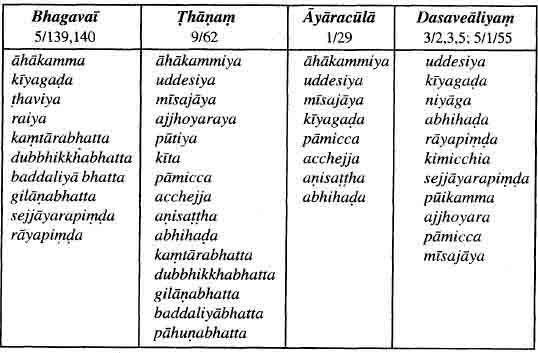
In the ninth Sataka of Bhagavatī and the Nāyadhammakahāo also, there is mention of the blemishes such as ādhākarmika etc.1
Semantics
āhākamma (adhākarma—food etc., prepared only for the monk.? See Bhāsya on Bha. 1. 436,437.
kīyagada (krītaksta)—food, purchased for the monk.
thaviya (sthāpita)—food, stored for the monk.3
raiya (racita)—food, modified for the monk.
kamtārabhatta (kāntārabhakta)—food, prepared for the forest journey of monks. In the ancient time, monk used to travel with caravans. Sometimes out of the mercy for the monk, foods were prepared for them. Such food is called käntārabhakta.
dubbhikkhabatta (durbhikṣabhakta)—during famines the king and the rich people prepare food for the monk. Such food is called durbhikṣabhakta.
vaddaliyābhatta (bārdalikābhakta)—When the sky is cloudy and there is rain-fall, the monks can not go for collecting food. Under such circumstance, the householder prepares food for the monk. Such food is called bãdalikabhakta.
gilānabhatta (glānabhakta)—food, prepared for the sick monk. It has three meanings: (i) food, given to sick monk for recovery (ii) food, prepared for giving it to the monk4 (iii) food, offered as charity in hospitals,4
sejjāyarapimda (sayyātarapinda)—food, offered by the landlord (who offers shelter).
rāyapimda (rajapiņda)—food, received from place of an anointed king.
Text
Ayariya-uvajjhāyassa siddhi-padam
5.147āyariya-uvajjhāe nam bhamte! savisayamsi ganam agilāe samginhamāņe, agilāe uvaginhamāne kaihim bhavaggahanehim sijjhati jāva savvadukkhānam amtam kareti?
goyamā! atthegatie teņeva bhavaggahaņenam sijjhati, atthegatie doccenam bhaggahanenam sijjhati, taccam puna bhagavvahanam näikkamati.
The Topic of Attainment of Liberation by Ācārya and Upādhyāya
After how many births, O Lord! the Ācāryas and Upādhyāyas who tirelessly contribute to the development of the religious order in the form of augmen ting the strenghth and supporting (them in their sādhanā) by means of fulfilling their assignments (of teaching the purport and the text of the canons respectively) get liberated ...... up to and put end to all sufferings?
Gautama! some (ācāryas and upādhyāyas) get liberated in the very same birth, while some in the next birth, but in no case they cross the limit of the third birth-definitely get liberated in the third birth.
Bhāsya
1. Sūtra 147
The ācārya-cum-upādhyāya who augments and supports the religious order make immense nirjarā (wearing off of the karma); hence, he attains the liberation soon. There are three alternatives with regard to the limit of number of births he will have to take:
1. Attainment of liberation in the same birth.
2. Attainment of liberation in the second birth. Here second birth means actually the third birth. For the intermediate birth in heaven is not considered.
3. Attainment of liberation in the third birth. It implies the fifth birth.1
Semantics
āyariya-uvajjhāya (ācārya-upādhyāya)-Acārya-cum-upādhyāya.2 It means he is the same person. He performs the work of bothm--the ācārya and the upādhyāya. In the Vyavahāra Sūtra, the minimum tenure of monkhood eligible for becoming upādhyāya is three years, and that for becoming ācārya is five years.4
sarisaya (svavişaya)—The ācārya is specially assigned with the work of teaching the meaning and purport of the canonical literature, while the upādhyāya is supposed to teach the canonical texts themselves.
agaläe (aglanā)—Tirelessly, i.e. without feeling any kind of exhaustion or ennui.
Text
Abbhakkhānissa kammabamdha-padam
5.148je nam bhamte! param alienam asabbhūenam abbhakkhānenam abbhakkhāti, tassa ņam kahappagārā kammā kajjamti?
goyamā! je nam param alienam asabbhūenam abbhakkhānenam abbhakkhāti, tassa nam tahappagārā ceva kammā kajjamti. jattheva nam abhisamāgacchati tattheva nam padisamvedeti, tao se pacchă vedeti.
The Topic of Bondage of Karma by One who indulges in Deliberate False Allegation
What1 types of karma, O Lord! are bound by one who deliberately makes false fanciful allegations on an other person?
Gautama! One who delibeately makes false fanciful allegations on another person binds like types of karma. He undergoes the fruition of those karma where he is born; afterwards, he wears them off.
Bhāsya
1. Sūtra 148
A law of the doctrine of karma has been propounded in the present Sūtra. The law is: The bondage of karma is akin to the action and so is its effect (fruition). One who deliberately makes false allegation is himself meted out with false allegation in future. There is an echo of the proverb, viz., "what you sow, so shall you reap." There are two ways of purging of karma—
1.Expiation
2.Undergo its fruition.
Here, however, only the former is described.
Semantics
alika—false.
asadbhūta—to create fanciful allegation. E.g., to call a non-thief a thief.
abhyākhyāna—make (false) allegation; to make public the faults of others (falsely).
abhyākhyāti—to deliberately make (false) allegation.
abhisanāgacchati—takes birth (at).
pratisamvedayati—undergoes the effect or the fruition.
Text
5.149sevam bhamte! sevam bhamte! tti.
That is so, O Lord! That is so, O Lord!
1.See Bha. 8.427,428.
2.Thãnam, 3.17-20.
1.Bha. Vr. 5.133mangārādyavasthāmāśritya alpaśabdaḥ stokārthaḥ, kşārāvasthāyām tvabhāvārthaḥ.
1.Bha. Vị. 5.134—nanu puruṣasya pañca kriyā bhavantu, kāyādivyāpārāņām tasya drśyamānatvāt, dhanurādinirvarttakaśarīrāņām tu jīvānām katham pañca kriyāḥ? kāyamātrasyāpi tadîyasya tadānīmacetanatvāt acetanakāyamātrādapi bandhābhyupagame siddhānāmapi tatprasangah tadiya śarīrāņāmapi prānātipātahetutvena loke viparivarttamānatvāt, kiñca-yathā dhanurādīni kāyikyā dikriyāhetutvena pāpakarmabandhakāraṇāni bhavanti tajjīvānāmevam pātradandakādīni jīvaraksā hetutvena punyakarmanibandhanāni syuh nyāyasya samānatväd iti, atrocyate, aviratipariņāmad bandhan aviratipariņāmasca yathā purusasyāsti evam dhanurādinirvarttakaśarīrajīvānāmapiti siddhānām tu nástyasăviti na bandhaḥ, pātrādi jīvānām ca na punyabandhahetulvam, taddhetorvive kādestesvabhāvāditi, kiñca-sarvajña. avacanapramānyadyathoktam tattathā śraddheyamevetti.
2.Bha, 3.135.
3.Bha. Vr. 5.1354-iha dhanuşmadādīnām yadyapi sarvakriyāsu kathañcinnimittabhāvo'sti tathäpi vivakṣitabandham pratyamukhyapravịttikatayā vivaksitavadhakriyāyāstaiḥ kṣtatvenāvivakşaņācchai sakriyānām ca nimittabhāvamātreņāpi tatkrtatvena vivaksaņāccatasrastā uktāḥ. bāņādijīvasarīrāṇamm tu sākṣād vadhakriyāyām pravsttatvātpañceti.
4.Pischel, Engligh Translation of Prakrit Grammar by Subhadra Jha, § 350.
1.(a) Jīvā. Vļ. P. 120-sambaddhāni svātmanaḥ śarīrasamlagnāni 'nāsambaddhāni' na svasarīrāt prthagbhūtāni, svaśarīrāt prthagbhūtakarane śaktyabhāvāt. (b) See. Bhäsya of Bha. 2.74.
1.Bha. 9.177, Nāyā--1.1.113,
2.Vya. Bhā. Vř. u.3, p.35ādhäkārmika yanmūlata eva sādhūnām krte kstam.
3.Ibid., p.35-sthāpitam yatsamyatārtham svasthāne parasthāne.
4.Bha. VỊ. 5.139_glãnasya nirogatarkham bhiksukadānāya bhaktam tad glãnakam.
5.See, the note on Thäņam, 9.62.
1.Bha. Vț. 5.147—dvitīyaḥ trtīyaśca bhavo manuşyabhavo devabhavāntarito drśyaḥ, cāritravato’nantaro devabhava eva bhavati na ca tatra siddhirastīti.
2.(a) Bha. Vț. 5.147—ācryeņa sahopadhyāya ācāryopādhyāyaḥ, (b) Bha. Jo. 88.41
jina kahai kei tiņahija bhava sījhai।
jāva sarva duḥkha amta karījai ॥
3.Ibid., 3.3.
4.Ibid., 3.5.
♦
Seventh Section
Sattamo Uddeso
Section-7
Text
Paramāņu-khamdhāņam eyaņādi-padam
5.150 paramānupoggale nam, bhamte! eyati veyati calati phamdai ghattai khubbhai udīrai, tam tam bhāvam pariņamati?
goyamā! siya eyati veyati jaya tam tam bhavam pariņamati; siya ņo eyati java ņo tam tam bhāvam parinamati.
The Topic of Simple Vibrations etc. of Paramāņu and Skandha
Does1 the material paramāņu (ultimate atom), O Lord! undergo simple vibrations, complex vibrations, motion, oscillation, collision, penetration and rise, that is, undergo varied transformation?
O Gautama! under certain condition, it undergoes simple vibrations, complex vibrations, motion, oscillation, collision, penetration and motivation, that is, undergoes varied transformation; under other condition, it does not undergo simple vibrations, complex vibrations, motion, oscillation, collision, penetration and motivation, that is, it does not undergo varied transfor mation.
5.151 duppasie nam bhamte! khamdhe eyati jāva tam tam bhāvam pariņamati? goyamā! siya eyati jāva tam tam bhāvam parinamati. siya no eyati jāva no tam tam bhāvam parinamati. siya dese eyati, dese no eyati.
Does a material cluster of two pradeśas (i.e., consisting of two paramāņus) (dyad) undergo simple vibrations, ...... up to varied transformation?
O Gautama! under certain condition, it undergoes simple vibrations, ...... up to varied transformation; under certain condition, it does not undergo simple vibrations ...... up to does not undergo varried transformation; under certain condition, a part of it undergoes simple vibrations, another part does not.
5.152 tippaesie ņam bhamte! khamdhe eyati?
goyamā! siya eyati, siya no eyati. siya dese eyati, no dese eyati. siya dese eyati, no desā eyamti. siya desā eyamti, no dese eyati.
Does a material cluster of three pradeśas (i.e., consisting of three paramānus) (triad) undergo simple vibrations?
O Gautama! under certain condition, it undergoes simple vibrations; under other condition, it does not undergo simple vibrations. Under certain condition, a part of it undergoes simple vibrations, another part (any one of the remaining parts) does not. Under certain condition, a part of it undergoes simple vibrations, other parts do not. Under certain condition, some (two) parts of it undergo simple vibrations, the (remaining) part does not.
5.153 cauppaesie nam bhamte! khmdhe eyati?
goyamā! siya eyati, siya no eyati. siya dese eyati, no dese eyati. siya dese eyati, no desā eyamti siya desă eyamti, no dese eyati. siya desā eyamti, no desā eyamti. jahā cauppaesio tahā pamcapuesio, tahā jāva anamtapaesio.
Does a material cluster of four pradeśas (i.e., consisting of four paramānus) undergo simple vibrations?
O Gautama! under certain condition, it undergoes simple vibrations; under other condition, it does not undergo simple vibrations. Under certain condition, a part of it undergoes simple vibrations, another part (anyone of the remaining parts) does not. Under certain condition, a part of it undergoes simple vibrations, other parts do not. Under certain condition, some parts undergo simple vibrations, the (remaining) part does not.
Under certain condition, some (two) parts undergo simple vibrations, other (two) parts do not.
The description of the material cluster of five pradeśas (i.e., consisting of five paramānus) ...... up to cluster of infinite number of pradeśas (i.e., consisting of infinite number of paramānus) follows the same pattern as that of the cluster of four paramāņus.
Bhāsya
1. Sūtras 150-153
According to the Jain philosophy, there are only two substances capable of motion, viz., soul and matter.1 Therefore, vibrations and oscillations are possible only in these two substances. The vibrations in soul are described in Bhag. 3/143 148.
The paramānu (ultimate atom) is the smallest unit of matter which has been described in Bha. 20.26, according to which, in a paramāņu, there are one colour, one smell, one taste and two touches, viz.,
1. cold and viscous
or 2. cold and dry
or 3. hot and viscous
or 4. hot and dry.
A skandha (material cluster) is made by the integration of two or more ultimate paramānus. The number of pradeśas (indivisible parts) in a cluster is equal to the number of paramāņu it consists of. Combination of two paramānus makes a dyad (cluster of two pradeśas (consisting of two paramāņu), of three paramānus makes a triad ..... up to combination of infinite number of parainānus makes a material cluster (made up) of infinite number of paramāņus. The paramāņu is the ultimate cause of the material cluster. In the Nayacakra, the paramānu has been described both as a cause and an effect. The cluster is produced by the combination of para mānus, and as such the latter is the cause of the former. On the disintegration of the cluster, the paramānu assumes its own form; so, paramānu is the effect of the cluster.2
The Ta.Si. mentions disintegration as the cause of paramānu.3 The cluster is the product of both-disintegration and integration.
On the disintegration of the cluster of four paramānus, two clusters each of two paramānus (dyads)--are produced. These clusters are produced due to disintegration. The combination of four paramānus gives rise to a cluster of four paramānus. This cluster is produced due to integration. In the state of cluster, the paramänu is technically called pradeśa (indivisible part).
“Under certain condition, the paramānu undergoes simple vibrations etc. and under other condition, it does not”-this is a relative (conditional) proposition. There is an uninterrupted process of origination and cessation, which is related with the intrinsic mode of a substance. The processes of simple vibrations etc. are a kind of specific transformation. The transformation of paramānu into cluster is only due to the activities like special vibrations, etc. This is explained in the dialogue of the third Sataka, in which it is propounded that the person, involved in the activities of simple vibrations etc., indulges in committing and intending to commit injury to life. A person free from the activities of simple vibrations etc., does not undergo varied transformation, and hence, does not indulge in committing and intending to commit injury to life.
The same rule applies to the ultimate paramānu and cluster—if they undergo the processes of simple vibrations, etc. then they get transformed into varied states, (tam tam bhāvam parinamai). In the absence of those processes, they are not liable to transformation into various states. The rules of transformation of paramāņu and clusters are given in sūtra 179 of this sataka (i.e. þataka V).
The doctrine of anekāntavāda or syadvāda is a cardinal feature of Jainism. The expression siya (under certain condition) is syat in Sanskrit, which has many implications, viz., doubt, in some respect, at some times, multiple aspects, etc. According to Nyayacakra, the expression syat discards the absolutistic attitude and approves of relativistic approach.? Abhayadevasuri, here, explains syat as kadācit (at 'some times'). According to him, in paramānu and clusters, the processes of simple vibrations etc. take place only occassionally.8
The possible alternatives in paramāņu and clusters are:
1. There are two alternatives in a single paramāņu—
(i) under certain condition, there is simple vibration in it;
(ii) under certain condition, there is no simple vibration in it.
2. There are three alternatives in a cluster of two pradeśas (consisting of two paramānus) (dyad) —
(i) under certain condition, there is simple vibration;
(ii) under certain condition there is no simple vibration,
(iii) under certain condition, there is simple vibration in a part and there is no simple vibration in the other part.
3, There are five alternatives in a cluster of three pradeśas (consisting of three paramānus) (triad) —
(i) under certain condition, there is simple vibration.
(ii) under certain condition, there is no simple vibration.
(iii) under certain condition, there is simple vibration in a part and there is no simple vibration in anyone of the remaining parts.
(iv) under certain condition, there is simple vibration in a part and there is no simple vibration in the (remaining two) parts.
(v) under certain condition, there is simple vibration in two parts and there is no simple vibration in the (remaining) part.
4. There are six alternatives in the cluster of four pradeśas (consisting of four paramāņus) —
(i) under certain condition, there is simple vibration.
(ii) under certain condition, there is no simple vibration.
(iii) under certain condition, there is simple vibration in a part and there is no simple vibration in anyone of the remaining parts.
(iv) under certain condition, there is simple vibration in a part and there is no simple vibration in the remaining parts.
(v) under certain condition, there is simple vibration in three parts and there is no simple vibration in the remaining part.
(vi) under certain condition, there is simple vibration in two parts, and there is no simple vibration in the (remaining) two parts.
Text
Paramāņu-khamdhānam chedādi-padam
5.154 paramāņupoggale nam bhamte! asidhāram vā khuradhāram vā ogāhejjā? hamtā ogāhejjā.
se nam bhamte! tattha chijjejja vă bhijjejja vā?
goyamā! no tinaţthe samatthe, no khalu tattha sattham kamai.
The Topic of Piercing etc. of Paramāņu and Skandhas
Can1 the material paramāņu, O Lord! extend itself on the edge of a sword or razor?
Yes, it can extend itself.
Does it, O Lord! get pierced there and cut there?
Gautama! that is not possible. No weapon can operate on it.
5.155 evam jāva asamkhejjapaesio.
In the same way ...... up to a material cluster of innumerable number of pradeśas (consisting of innumerable number of paramāņus).
5.156 anamtapaesie nam bhamte! khamdhe asidhāram vākhuradhāram vā ogāhejjā?
hamtā ogāhejjā.
se nam bhamte! tattha chijjejja vā bhijjejja vā?
goyamũ! atthegaie chijjejja vũ bhijjejja vũ, atthegate no chijjejja vã bhijjejja vã.
Can a material cluster of infinite number of pradeśas (consisting of infinite number of paramānus), O Lord! extend itself on the edge of a sword or on the edge of razor?
Yes, it can extend itself.
Does it, O Lord! get pierced and cut there?
Gautama! there are some clusters which can get pierced and cut, there are some which can not pierce and cut.
5.157 paramāņupogalle nam bhamte! aganikäyassa majjhammajjhenam vīvaejjā?
hamtā viivaejjā.
se nam bhamte! tattha jhiyāejjā?
goyamā! no inatthe samatthe, no khalu tattha sattham kamai.
se nam bhamte! pukkhalasamvattagassa mahāmehassa majjhammajjhenam vīivaejjā?
hamtā vīvaejjā.
se nam bhamte! tattha ulle siya?
goyamā! no inatthe samatthe, no khalu tattha sattham kamai.
se nam bhamte! gamgāe mahāņadie padisoyam havvamāgacchejjā?
hamtā havvamāgacchejjā.
se nam bhamte! tattha vinihāyamāvajjejjā? goyamā! no inatthe samatthe, no khalu tattha sattham kamai. se nam bhamte! udagāvattam vā udagabimdum vā ogāhejjā? hamtā ogāhejjā. se nam bhamte! tattha pariyāvajjejjā? goyamā! no inatthe samarthe, no khalu tattha sattham kamai.
Can a material paramāņu, O Lord! pass through the middle of a fire-body? Yes, it can pass through.
Does it, O Lord! burn there?
Gautama! this is not possible. No weapon can operate on it.
Can it, O Lord! pass through the middle of a dense cloud called Puskara samvartaka?
Yes, it can pass through.
Does it become wet there?
Gautama! this is not possible. No weapon can operate on it.
Can it, O Lord! quickly cruise against the current of the great river Gangā?
Yes, it can.
Does it, O Lord! get destroyed there?
Gautama! this is not possible. No weapon can operate on it.
Can it, O Lord! extend itself in the whirlpool of water or a drop of water? Yes, it can.
Does it, O Lord! get pressed there?
Gautama! this is not possible. No weapon can operate on it.
5.158 evam jāva asamkhejjapuesio.
In the same way ...... up to a material cluster of innumerable number of pradeśas (consisting of innumerable number of paramānus).
5.159 anamtupaesie nam bhamte! khamde aganikāyassa majjhammajjhenam viivaejjā?
hamtā vīivaejjā.
se nam bhamte! tattha jhiyāejjā?
goyamā! atthegaie jhiyāejjā, atthegaie no jhiyāejjā.
se nam bhamte! pukkhalasumvattagassa mahāmehassa majjhammajjhenam vīvaejjā?
hamtā vīivaejjā.
se nam bhamte! tattha ulle siyā?
goyamā! atthegaie ulle siyā, atthegaie no ulle siyā.
se nam bhamte! gamgāe mahānadie padisoyam havvamāgacchejjā?
hamtā havvamāgacchejjā.
se nam bhamte! tattha viņihāyamāvajjejjā?
goyamā! atthegaie vinihāyamāvajjejjā, atthegaie no viņihāyamāvajjejjā. se nam bhamte! udagāvattam vā udagabimdum vā ogähejjā? hamtā ogāhejjā. se nam bhamte! tattha pariyāvajjejjā? goyamā! atthegaie pariyāvajjejjā, atthegaie no pariyāvajjejjā.
Can a material cluster of infinite number of pradeśas (consisting of infinite number of paramūnus), O Lord! pass through the middle of a fire-body?
Yes, it can pass.
Does it, O Lord! burn there?
Gautama! some of them burn, some of them do not burn.
Can it, O Lord! pass through the middle of a huge cloud called Puşkara samvartaka?
Yes, it can.
Does it get a wetting there?
Gautama! some of them can get a wetting, some of them can not get a wetting. Can it, O Lord! quickly cruise against the current of the great river Gangā?
Yes, it can.
Does it, O Lord! get destroyed there?
Gautama! some of them can get destroyed, some of them can not get destroyed.
Can it, O Lord! extend itself in the whirlpool of water or a drop of water?
Yes, it can.
Does it, O Lord! get pressed there?
Gautama! some of them can get pressed, some of them can not pressed there.
Bhāsya
1. Sūtras 154-159
In the Aņuyogadārāim, two kinds of paramāņus have been mentioned: subtle (transcendental) and empirical.1 The empirical paramāņu is a cluster of infinite number of subtle paramānus. Precisely speaking, it is a cluster made of infinite number of paramāņu.2 From the empirical point of view, it is called an empirical paramānu.3 The same properties that have been assigned to the paramānu have been given in the case of a cluster of innumerable number of pradeśas. There are, however, two alternatives in the case of a clusters made of infinite number of pradeśas; some of them can be pierced and cut by the edge of the sword, some can not be. The reason is that those clusters which are grossly formed can be pierced and cut by the edge of a sword, but those with subtle form can not be. The empirical paramāņu is a cluster of infinite number of paramāņu which are capable of undergoing subtle transformation. According to the Anuyogadārāim, it can not be pierced and cut by the edge of the sword.5
In modern science, in earlier period, there was an opinion that the division of atom was not possible, but now the atom has been disintegrated. According to Jainism, the atom accepted in science is a cluster made of infinite number of paramāņus (ultimate atoms). Even an empirical atom can not be broken by instrument. Here a question arises: in the canonical literature, it has been said that a paramāņu can not be pierced and cut by the edge of sword. The edge of the sword however, is very gross, so it is true that a atom can not be divided by it. But modern science has developed very subtle instruments. It seems possible to disintegrate the empirical paramānu by such instrument.
Text
Paramāņu-khamdhāņam saaddhasamajjhādi-padam
5.160 paramānupoggale nam bhamte! kim saaddhe samajjhe sapaese? udāhu anaddhe amajjhe apaese?
goyamā! anaddhe amajjhe apaese, no saaddhe no samajjhe no sapaese.
The Topic of Possibility of Halving, having Middle Point etc. of Paramāņus and Skandhas
Is the material paramāņu (ultimate atom), O Lord! capable of being halved, has it a middle (point) and is it possessed of parts? Or can it not be halved, has it no middle (point), and is it partless?
Gautama! the material paramānu can not be halved, it has no middle (point), it is partless: it is not what can be halved, it is not what has middle (point), it is not what is possessed of parts.
5.161 duppaesie nam bhamte! khamde kim saaddhe samajjhe sapaese? udāhu anaddhe amajjhe apaese?
goyamā! saaddhe amajjhe sapaese, no anaddhe no samajjhe no apaese.
Is a cluster of two pradeśas, O Lord! capable of being halved, has it a middle (point) and is it possessed of parts? Or can it not be halved, has it no middle (point) or is it partless?
Gautama! cluster of two pradeśas can be halved, it has no middle (point), it is possessed of parts; it is not that which can not be halved, it is not that which has middle (point), it is not that which is partless.
5.162 tippaesie nam bhamte!khamde pucchā.
goyamā! anaddhe samajjhe sapaese, no asaddhe no amajjhe no apaese.
Is a cluster of three pradeśas, O Lord! capable of being halved, has it a middle (point), and is it possessed of parts? Or can it not be halved, has it no middle (point) and is partless?
Gautama! it can not be halved, it has a middle (point) and it is possessed of parts; it is not that which is capable of being halved, it is not that which has no middle (point) and it is not that which is partless.
5.163 jahā duppaesio tahā je samā te bhāņiyavvā, je visamā te jahā tippaesio tahā bhāniyavvā.
The clusters of an even number of paramāņu are to be described like the cluster of two paramānus. The clusters of an odd number of paramānu are to be described like the cluster of three paramānus.
5.164 samkhejjapaesie nam bhamte! khamdhe kim saaddhe? pucchā.
goyamā! siya saaddhe amajjhe sapaese, siya anaddhe samajjhe sapaese. jahā samkhejjapaesio tahā asamkhejjapaesio vi, anamtapaesio vi.
Is the cluster of numerable number of pradeśas capable of being halved? etc. Question as before (has it a middle (point) and is it possessed of parts? Or is it not capable of being halved, has it no middle (point) and is it partless?).
Gautama! under some condition, it can be halved, it has no middle (point), and it is possessed of parts; under some condition, it can not be halved, it has a middle (point) and it is possessed of parts.
The cluster of innumerable number of pradeśas: and the clusters of infinite number of pradeśas are to be described like the cluster of numerable number of pradeśas.
Bhāsya
1. Sūtras 160-164
The paramānu in its ultimate state, remains alone and a solitary unit. In its independent state, it is a single point, devoid of any further division. It is transformed as a part of a cluster when it is associated with other paramānu/paramānus.
“A paramānu is partless”--this statement is with reference to the paramāņu as a substance. With reference to time and modes (properties), it can also be possessed of parts.1 In the present canon, four types of paramānus have been distinguished paramāņu as a substance, paramāņu as space, paramānu as time, and paramāņu as mode (property).2 According to Siddhasenagaṇī, paramānu as mode (property) is possessed of parts, but paramānu as substance is partless. A paramāņu is possessed of one taste, one smell, one colour and two kinds of touch.3 A particular colour of a paramāņu can vary in quantity (intensity). Sometime the colour is, say, one unit black, sometime two units black, upto sometime numerable units black, sometime innumerable units black and sometime infinite units black. There are similar variations in the intensity of smell, taste and touch. With reference to this variation, an paramāņu is said to be possessed of many parts"; precisely speaking, they are modes. That which is partless necessarily can not be halved, nor can it have a middle (point).
A cluster of an even number of pradeśas, i.e. indivisible parts, can be halved, but has no middle (point), whereas a cluster with an odd number of pradeśas can not be halved, but has middle. The clusters of numerable, innumerable and infinite number of pradeśas are of both the types—possessed of even number and odd number of pradeśas.
According to Thānam, a paramānu is impenetrable, incombustible, impercep tible, can not be halved, has no middle (point), is partless and indivisible.4
Text
Paramāņu-khamdhāņam paropparam phusanā-padam
5.165 paramāņupoggale nam bhamte! paramānupoggalam phusamāṇe kim 1. desenam desam phusai 2. deseņam dese phusai 3. desenam savvam phusai 4. desehim desam phusai 5. desehim dese phusai 6. desehim savvam phusai 7. savvenam desam phusai 8. savvenam dese phusai 9. savvenam savvam phusai? goyamā! 1. no desenam desam phusai 2. no desenam dese phusai 3. no desenam savvam phusai 4. no desehim desam phusai 5. no desehim dese phusai 6. no desehim savvam phusai 7. no savvenam desam phusai 8. no savvenam dese phusai 9. savvenam savvam phusai.
The Topic of Mutual touching of Paramāņus and Skandhas
1When, O Lord! a material paramāņu (ultimate atom) touches another material paramāņu, does it touch-(i) a part by a part, (ii) parts by a part, (iii) the whole by a part, (iv) a part by parts, (v) parts by parts, (vi) the whole by parts, (vii) a part by the whole, (viii) parts by the whole, (ix) the whole by the whole?
O Gautama! such material paramāņu--(i) does not touch a part by a part, (ii) does not touch parts by a part, (iii) does not touch the whole by a part, (iv) does not touch a part by parts, (v) does not touch parts by parts, (vi) does not touch the whole by parts, (vii) does not touch a part by the whole, (viii) does not touch parts by the whole, (ix) touches the whole by the whole.
5.166 paramānupoggale duppaesiyam phusamāne sattama-navamehim phusai. paramāņupoggale tippaesiyam phusamāne nipacchimaehim tihim phusai. jahā paramānupoggale tippaesiyam phusāvio evam phusāveyavvo jāva anamtapaesio.
When a material paramānu (ultimate atom) touches a cluster of two paramāņus (a dyad), the seventh and the ninth alternatives are applicable, viz., (vii) touches a part by the whole, and (ix) touches the whole by the whole.
When a material paramāņu (ultimate atom) touches a cluster of three paramānus (a triad), the last three alternatives are applicable, viz., (vii) touches a part by the whole, (viii) touches parts by the whole, and (ix) touches the whole by the whole.
When a material paramāņu touches a cluster of four paramānus ...... up to that of infinite number of paramānus, the same alternatives are applicable as in the case of touching a cluster of three paramāņus.
5.167 duppaesie nam bhamte! khamdhe paramānpupoggalam phusamāne kim desenam desam phusai? pucchā.
tattiya-navamehim phusai.
duppaesio duppaesiyam phusamāṇe padhama-tatiya-sattama-navamehim phusai.
duppaesio tippaesiyam phusamāne ūdillaehi ya, pacchillaehi ya tihim phusai, majjhimaehim tihim vipadiseheyavvam.
duppaesio jahā tippaesiyam phusăvio evam phusāveyavvo jāva anamtapaesiyam.
When, O Lord! a cluster of two paramānus (a dyad) touches a material paramāņu, does it touch-(i) a part by a part? etc.--all the nine alternatives are asked as above (sūtra 5.165).
The third and the ninth alternatives are applicable, viz., (iii) the whole by part, (ix) the whole by the whole.
When a cluster of two paramāņus touches a cluster of two paramāņus, the 1st, 3rd, 7th and 9th alternatives are applicable, viz., (i) a part by a part, (iii) the whole by a part, (vii) a part by the whole, (ix) the whole by the whole.
When a cluster of two paramāņus (a dyad) touches a cluster of three paramāņus (a triad), the first three and the last three alternatives are applicable and the middle three are prohibited.
Just as a cluster of two paramānus (a dyad) were made to touch the cluster of three paramāņus, similarly the cluster of two paramāņus should be made to touch the clusters of four ...... up to infinite number of paramāņus.
5.168tipaesie nam bhamte! khamdhe paramānpupoggalam phusamăne pucchā. tattiya-chattha-navamehim phusai.
tipaesio duppaesiyam phusamāṇe padhamaenam-tatiyaņam-cauttha-chattha -sattama-navamehim phusai.
tipaesio tipaesiyam phusamāne savvesu vi phānesu phusai.
jahā tipaesio tipaesiyam phusāvio evam tippaesio jāva anamtapaesienam samjoeyavvo.
jahā tipaesio evam jāva anamtapaesio bhāniyavvo.
When, O Lord! a cluster of three paramāņus touches a material paramāņu, does it touch-(i) a part by a part, all the nine alternatives are to be asked. Here 3rd, 6th and 9th alternatives are applicable.
When a cluster of three paramāņus touches a cluster of two paramāņus, the 1st, 3rd, 4th, 7th and 9th alternatives are applicable.
When a cluster of three paramāņus touches a cluster of three paramāņus, all the nine alternatives are applicable.
Just as a cluster of three paramāņus was made to touch a cluster of three paramāņus, so it should be related to a cluster of four ..... up to infinite number of paramāņus atoms. The same description as in the case of a cluster of three paramāņus touching others holds good in the cage of a cluster of four...... up to infinite number of paramāņus.
Bhāsya
1. Sūtras 165-168
To the query whether when a paramāņu (ultimate atom) touches another one, the touch takes place between whole and whole or between a part and a part, there arise nine alternatives, of which the first eight were stated impossible by Lord Mahāvīra; only one-the ninth one was stated possible. The reason is that the paramāņu is partless, so a paramāņu touches another one completely. It is not possible to imagine contact between a part and parts.
The nine alternatives are given in the following table —
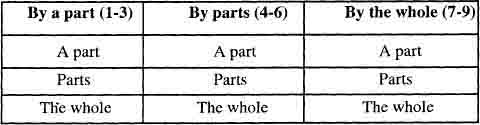
The Vrtti has raised a question-"If a paramāņu touches another paramānu as a whole touching the whole, then two paramāņus will transform into unitary entity. Thus no combination of paramāņu will result in any composite entity (cluster) like a jar.” The answer is that —
(1) When two paramāņus join each other, they do not join half-and-half. There is simply addition of (1+1), not identification of one with another. The identification of the paramānu will make the creation of a cluster (say a jar) impossible. But the addition rebuts that possibility, i.e. absence of creation of a new entity.?
(2) When a paramāņu touches a cluster of two paramāņus, there are two alternatives (1) a part by the whole and (2) a part by the part. When the cluster of two paramānus occupies two ākāśa-pradeśas (space-points), the paramāņu as a whole touches a part of the cluster of two paramānus; but when the cluster of two paramāņus transforms itself into a subtler entity capable of occupying a single space-point, and then the contact is between the whole and the whole.
(3) When a paramānu touches a cluster of three paramānus, there are three alternatives.—
(1)the whole touching a part
(2)the whole touching two parts
(3)the whole touching the whole.
Explanation:
(i) When the cluster of three paramāņus occupies three space-points, then the paramāņu as a whole touches one part of the cluster.
(ii) When two pradeśas of the cluster of three paramānus occupy one space point, and the remaining pradeśas occupy another space-point, then the alternative-the whole touching two parts-becomes applicable-i.e., the paramānu as a whole touches two parts of the cluster in the form of two paramāņus occupying one space-point.
(iii) When due to subtlety of transformation, the cluster of three paramāņus occupies a single space-point, then the alternative of the whole touching the whole becomes possible.
A cluster of three pradeśas (paramāņus) is a single composite entity; hence two paramāņus of it occupying a single space-point can be regarded as two parts of it. A cluster of two pradeśas (paramānu) is a single composite entity of two pradeśas. Therefore, the alternative of the whole touching the two parts is not possible here, because then it is the whole and not parts.
In other words, a cluster of three pradeśas (paramānu), is a composite entity of three pradeśas, therefore it is possible to touch two parts of the single entity, but as there are only two pradeśas in a cluster of two pradeśas (paramānu), the two pradeśas of which entity should a paramānu touch? When the two pradeśas of a cluster of three pradeśar are touched, there remains one pradeśa untouched; so the alternative of the whole touching two parts' becomes possible.
A Cluster of two pradeśas touching a Paramānu
When a cluster of two pradeśas (paramāņu) touches a paramāņu, there are two alternatives —
(i) the whole by a part
(ii) the whole by the whole
When the cluster of two pradeśas occupies two space-points, it touches the whole paramānu by its part. But when the cluster of two-pradeśas occupies a single space-point, the alternative of the whole by the whole' becomes possible.
A Cluster of two pradeśas touching a cluster of two pradeśas
When a cluster of two pradeśas touches another cluster of two pradeśas, four alternatives are possible —
(i) When both the clusters occupy two space-points each, then the alternative of 'a part touching a part' becomes possible.
(ii) When a cluster of two pradeśas occupying two space-points touches another cluster of two pradeśas occupying a single space-point, the alternative of 'the part touching the whole' is obtained.
(iii) When a cluster of two pradeśas occupying a single space-point touches another cluster of two pradeśas occupying two space-points, the alternative of 'the whole touching a part' is obtained.
(iv) When both the clusters of two pradeśas occupy a single space-point, the alternative of the whole touching the whole' is obtained.
In the same way the description of the cluster of three pradeśas should be understood.
Text
Paramāņu-khamdhāņam samthii-padam
5.169 paramāņupoggale ņam bhamte! kālao kevaccitam hoi?
goyamā! jahanneņam egam samayam, ukkosenam asamkhejjam kālam. evam jāva anamtapuesio.
The Topic of Duration of Paramānu and Skandha
How1 long, O Lord! does a material paramāņu (ultimate atom) remain in the form of paramāņu?
Gautama! in the minimum, it remains as a paramāņu for one samaya (indivisible unit of time); in the maximum, for innumerable time. Similar description follows about a cluster of infinite number of paramāņus.
5.170 egapaesogādhe ņam bhamte! poggale see tammi vā thāne, annammi vă ţhāne kālao kevacciram hoi?
goyamā! jahanneņam egam samayam, ukkosenam avaliyãe asamkhejjaibhāgam. evam jāva asamkhejjapaesogādhe.
How long does a vibrating material entity, O Lord! occupying a single space -point, continue to vibrate at that particular locus or any other locus?
O Gautama! in the minimum, it continues to vibrate for one samaya; in the maximum innumerablth part of an āvalikā. Similar duration is to be described) ...... up to a vibrating material entity, occupying innumerable space-points.
5.171 egapaesogādhe nam bhamte! poggale niree kālao kevacciram hoi?
goyamā! jahanneņam egam samayam, ukkosenam asamkhejjam kālam. evam jāva asamkhejjapaesogādhe.
How long does a material entity, O Lord! occupying a single space-point, continue to remain without vibration (at the same place)?
O Gautama! in the minimum, (it continues to remain without vibration) for one samaya; in the maximum, for a period for innumerable time-units. Similar duration is (to be described) for a non-vibrating material entity, occupying two ...... up to innumerable space-points.
5.172 egagunakālae nam bhamte! poggale kālao kevacciram hoi?
goyamā! jahannenum egam samayam, ukkosenam asamkhejjam kālam. evam
jāva anamtagunakālae.
evam vanna-gamdha-rasa-phāsa jāva anamtagunalukkhe. evam suhumaparinae poggale, evam bādarapariņae poggale.
How long, O Lord! does a material entity of one unit of black colour remain (in the form of material entity of one unit of black colour)?
O Gautama! in the minimum, it will (remain as such) for one samaya; in the maximum for a period of innumerable time.
Similar duration is to be described) for material entities of two ...... up to infinite units of black colour.
Similar duration is to be described) for all colours, smells, tastes and touches ...... up to infinite units of dry touch.
Similar duration is (to be described) for material entities which have been transformed into subtle form, as well as for those which have been transformed into gross forms.
5.173 saddapariņae nam bhamte! poggale kälao kevacciram hoi?
goyamā! jahannenam egam samayam, ukkosenam ūvaliyāe asamkhejjabhāgam.
How long , O Lord! does a material entity which has been transformed into the form of sound will remain in the form of sound?
Gautama! it will remain as such for one samaya in the minimum and innumerableth part of an āvalikā in the maximum.
5.174 asaddapariņae nam bhamte! poggale kālao kevacciram hoi?
goyamā! jahanneņam egam samayam, ukkosenam asamkhejjam kālam.
How long does, O Lord! a material entity which has been transformed into a form that is other than sound will remain in that form?
Gautama! it will remain as such for one samaya in the minimum and for innumerable time in the maximum.
Bhāsya
1. Sūtras 169-174
In the present dialogue, some universal laws regarding a material entity have been laid down.
First Law—The law of avasthāna-kāla i.e., duration of paramānu and skandha for remaining in the same state the material entity (pudgala) has two forms: paramānu (ultimate atom) and skandha (cluster of ultimate paramāņu). The ultimate paramāņu combined together make a cluster. On the disintegration of the cluster, they again become ultimate atoms. This cycle of transformation goes on forever. The maximum duration of an ultimate atom remaining as an ultimate atom is a period of innumerable time. After that it must transform into a cluster. No material entity can endure in the same state for ever. The minimum limit of transformation is very small, viz., one samaya (i.e., the indivisible unit of time). There can be as many varieties of states as there are samayas in the period of inmumerable time.
Second Law—The law of duration of a vibrating and non-vibrating material entities for remaining at a particular space-point/space-points-one samaya in the minimum, innumerableth part of an āvalikā in the maximum.2
Third Law—It is concerned with the duration of the continuity of the units of a quality. Colour, smell, taste and touch are the qualities of a material entity. There are five types of colour, two types of smell, five types of taste and eight types of touch). The black colour is a quality in which there can be infinite number of units. In the present dialogue, the word guna has been used in the sense of guņāmía (which means units or degrees of the quality, say blackness etc.). The units of the quality in the paramāņu of black colour undergoes transformation. Sometimes it has one unit, sometimes two, sometimes three and so on ...... up to an infinite number of units of blackness. Each unit of quality is divided again in infinite number of indivisible parts (pariccheda). An entity of one unit of black colour is called black of the lowest grade. When there is increase in an indivisible part, there is transformation respectively of one unit into state of two units, three units, four units etc.4 The 'unit' in the 'quality' does not remain constant, it continuously undergoes change. In the present dialogue, the limit of duration of continuity in the same state has been propounded—one samaya in the minimum and the period of innumerable time in the maximum. This law is applicable to all the units of the qualities of colour, smell, taste and touch.
This law is applicable to the material entity with subtle transformation as well as gross transformation.
Fourth Law—It is concerned with the material entities which have been transformed as sound and non-sound.
The law of a paramānu, with vibration and without vibration occupying one space-unit-Amaterial entity can not continue to vibrate for a long time. The duration of its remaining in the state of vibration is one samaya in the minimum and the innumerableth part of an āvalikā in the maximum. A material entity can stay as devoid of vibration for a longer periodone samaya in the minimum and a period of innumerable time in the maximum. In the XXV Sataka of the present canon, the durations of the time of a material entity contuinuing to remain in the state of vibration and devoid of vibration have been stated.5
Text
Paramāņu-khamdhānam amtarakāla-padam
5.175 paramānupoggalassa nam bhamte! amtaram kālao kevacciram hoi?
goyamā! jahannenam egam samayam, ukkosenam asamkhejjam kālam.
The Topic of Duration of Interval for Paramānus and Skandhas (for reverting to the same state again)
How1 much time lapses before a paramāņu, O Lord! reverts to its state of paramāņu?
Gautama! one samaya in the minimum and a period of innumerable time in the maximum.
5.176 duppaesiyassa ņam bhamte! khamdhassa amtaram kālao kevacciram hoi?
goyamā! jahannenam egam samayam, ukkosenam anamtam kālam. evam jāva anamtapaesio.
How much time lapses before a material cluster of two pradeśas, O Lord! reverts to the same state of cluster of two pradeśas?
Gautama! one samaya in the minimum and a period of infinite time in the maximum. Similar description holds good for the material clusters of three...... up to an infinite number of pradeśas.
5.177 egapaesogādhassa ņam bhamte! poggalassa seyassa amtaram kālao kevacciram hoi?
goyamā! jahannenam egam samayam, ukkosenam asamkhejjam kālam. evam jāva asamkhejjapaesogādhe.
How much time lapses before a vibrating material entity occupying one space unit O Lord! reverts to the same state?
Gautama! one samaya in the minimum and the period of innumerable time in the maximum. Similar description holds good for a vibrating material cluster occupying (two) ...... up to an innumerable number of pradeśas.
5.178 egapaesogādhassa nam bhamte! poggalassa nireyassa amtaram kālao kevacciram hoi?
goyamā! jahannenam egam samayam, ukkosenam āvaliyāe asamkhejjaibhāgam. evam jāva asamkheijapaesogādhe.
vanna-gamdha-rasa-phäsa-suhumapariņayabāyarapariņayānam-etesim jam ceva samcitthaņā tam ceva amtaram pi bhāņiyavvam.
How much time lapses before a material entity occupying one space-unit, O Lord! non-vibrating reverts to the same state?
Gautama! one samaya in the minimum and the innumerablth part of an āvalikä in the maximum. Similar description holds good for a non-vibrating material cluster occupying (two pradeśas) ...... up to an innumerable number of pradeśas. The duration of the time-lapse before the material entities revert to the same state, in respect of their colour, smell, taste, touch, subtle transformation and gross transformation is the same as the temporal duration of their continuing of remaining in the same state.
5.179 saddapariņayassa nam bhamte! poggalassa amtaram kālao kevacciram hoi?
goyamā! jahannenam egam samayam, ukkosenam asamkhejjam kālum.
How much time, O Lord! lapses before a material entity which has been transformed in the form of sound reverts to the same state?
Gautama! one samaya in minimum and a period of innumerable time in the maximuni.
5.180 asaddapariņayassa nam bhamte! poggalassa amtaram kālao kevacciram hoi?
goyamā! jahannenam egam samayam, ukkosenamāvaliyāe asamkhejjaibhāgam.
How much time, O Lord! lapses before a material entity which has been transformed as non-sound reverts to the same state?
Gautama! one samaya in the minimum and the innumerableth part of an āvalikã in the maximum.
Bhāşya
1. Sūtras 175-180
In the previous dialogue, the laws governing the duration of occupation of space-points by an ultimate atom and the cluster were propounded. In the present dialogue, the laws governing the interval (antara-kāla) are stated. Interval means the lapse of time between the present state of transformation and a similar state in the future. The transformations in the intervening period are different from the previous transformation; for instance, a paramānu, abandoning its state of paramānu, transforms in the state of a cluster and again transforms into the state of paramāņu. The intervening period here is the time that lapsed during its transformation as the cluster. Similarly a material cluster of two pradeśas transforms into clusters of three pradeśas etc. and also may transform as an atom and finally reverts to the state of a cluster of two pradeśas. Here the intervening period is technically called the interval of the cluster of two prudeśas. A cluster can pass through many states from the state of the cluster of two pradeśas to the state of the cluster of an infinite number of pradeśas. It means that the number of clusters formed during this period is infinite. The maximum duration of each cluster is a period of innumerable time. So the interval (time of lapse) of a cluster of two pradeśas (reverting to its orginal state) is a period of infinite time.1
The sūtras 170-171 give the avasthāna-kāla i.e., the temporal durations of the material entities, with vibration and devoid of vibration, continuing to remain in the same state. Comparing them with their anatara-kāla, it is found that)-The temporal duration of a material entity devoid of vibration is equal to the interval of the material entity with vibration and the temporal duration of a material entity with vibration is equal to the interval of a material entity without vibration. The temporal duration (avasthāna-kāla) of a material entity with one unit of black colour, smell etc. is same as its interval (antara-kāla). See the following table.
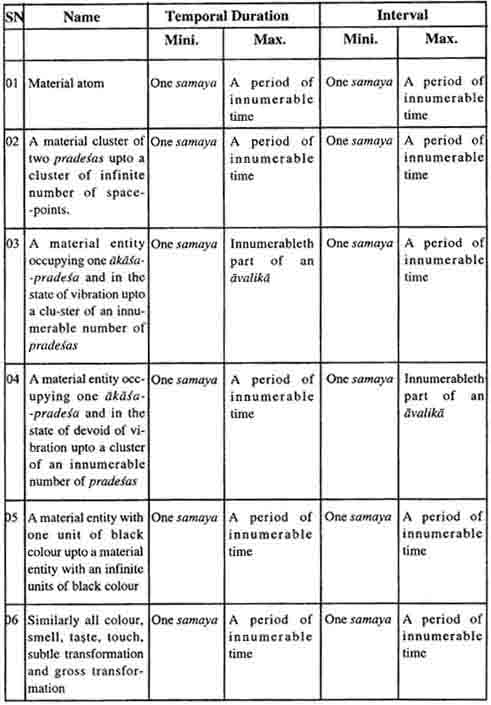
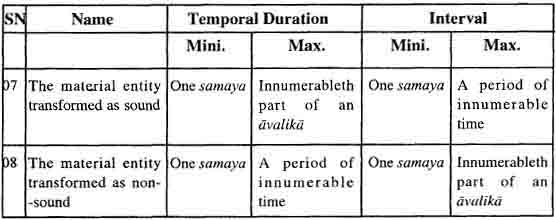
Text
Paramānu-khamdhānam paropparam appābahuyatta-padam
5.181 eyassa ņam bhamtel davvatthāņāuyassa, khettatthāņāuyassa, ogāhanatthā ņāuyassa, bhāvatthānăuyassa kayare kayarehimto appā vā? bahuyā vā? tulla vã? visesahiyā vũ?
goyamā! savvatthove khettatthāņāue, ogāhanatthānāue, asamkhejjagune, davvatthāņāue asamkhejjagune, bhāvatthānāue, asamkhejjagune.
The Topic of Mutual Relative Numerical Strength of (the periods of stability of) Paramāņus and Skandhas
1What, O Lord! is the mutual relative numerical strength--less, more, equal or a little more-between the periods of stability of a material entity with respect to (i) the number of paramāņus, (ii) stay at a particular space, (iii) size of space occupied, (iv) modifications?
O Gautama! (i) the least is the period of stability of (a material entity with respect to) its stay at a particular space, (ii) innumerable times of it is the period of stability of (a material entity with respect to) size of space occupied (by it), (iii) innumerable times of it is the period of stability of (a material entity with respect to) the number of paramāņus in (it), (iv) innumerable times of it is the period of stability of (a material entity with respect to) modifications in it.
Samgahanī gāhā
khettogāhanadavve,
bhāvatthānāuyam ca appa-bahum
khette savvatthove,
sesā thānā asamkhejjaguna ॥1॥
Summary Verse
The relative numerical strength of the periods of stability of (a material entity with respect to) its stay at a particular space, occupation of space, number of paramāņus and modi fication is the topic under discussion; the least is the period of stability with respect to stay at a particular) space and the rest are each innumerable times of what precedes.
Bhāsya
1. Sūtra 181
In the present Sūtra, the relative numerical strength of the periods of stability of a material entity (i.e. an ultimate atom or a cluster) with respect to the number of paramāņus in the entity, its stay at a particular space, the size of space occupied by it and the modifications undergone by it.
(1) The period of stability of stay at a particular space-space is non-corporeal and material entity is corporeal; so there is no special bond between them, the result is that a material entity does not stay for long at a particular space. Hence, the period of stability of stay at a particular space is the least.
(2) The size of a material entity can remain constant even inspite of occupying different space at different times. Therefore, the period of stability of the size of space occupied is innumerable times that of the stay at a particular space.
(3) There is possibility of expansion and contraction in a material entity-sometimes it contracts and sometimes it expands, and there is a consequent change in the size of the space occupied, but the number of paramāņus constituting the material entity may remain stable for a longer time. For this reason, the period of stability of the number of paramāņus is innumerable times that of the size of the space occupied by the entity.
(4) The number of paramānus in a material entity may undergo change on account of the process of integration and disintegration. In spite of this change, the modes of quality like colour, etc. may not undergo change so quickly. Therefore, the period of stability of modes is innumerable times that of the number of paramānus in the material entity.
Abhayadevasūri has quoted fifteen gāthās for explaining the relative numerical strength, which give the logical justification of their relative numerical strength.
Text
Jīvānam sārambha-sapariggaha-padam
5.182 neraiyā nam bhamte! kim sārambhā sapariggahā? udāhu anārambhā apariggahā?
goyamā! neraiyā sārambhā sapariggahā, no aņārambhā apariggahā.
The Topic of the Souls with (the Urges for) Violence and Possessiveness
Are1 the infernals, O Lord! possessed of (the urges for) violence and possessi veness? Or are they devoid of (the urges for) violence and possessiveness? Gautama! the infernals have (the urges for) violence and possessiveness, they are not free from (the urges for) violence and possessiveness.
5.183 se kenathenam bhamte! evam vuccaineraiyā sārambhā sapariggahā, no aņārambha apariggahā?
goyamā! neraiyā ņam pudhavikāyam samārambhamti, āukāyam samārambhamti, teukāyam samārambhamti, vāukāyam samārambhamti, vaņassaikāyam samārambhamti, tasakāyam samārambhamti, sarīrā pariggahiya bhavamti, kammā pariggahiya bhavamti, saccittācitta-misayāim davvāim pariggahiyāim bhavamti. se tenatthenam goyamā! evam vuccai--neraiyā sārambhā sapariggahā, no uņārambhā apariggahā.
For what reason has it been said, O Lord! that the infernals have (the urges for) violence and possessiveness, they are not free from (the urges for) violence and possessiveness?
Gautama! the infernals injure the earth-bodied beings, the water-bodied beings, the fire-bodied beings, the air-bodied beings, the vegetation, the mobile beings. They have possessiveness of the bodies, the karma and animate, inanimate and mixed substances. For this reason it has been said, O Gautama! that the infernals have (the urges for) violence and possessiveness, they are not free from (the urges for) violence and possessiveness.
5.184 asurakumārā nam bhamte! kim särambhā? pucchā.
goyama! asurakumārā sārambhā sapariggahā, no anārambhā apariggahā.
Are the Asurakumāras, O Lord! possessed of (the urges for) violence (and possessiveness)? Query as before.
Gautama! the Asurakumāras have (the urges for) violence and possessive ness, they are not free from the urges for) violence and possessiveness.
5.185 se kenatthenam? goyamā! asurakumārā nam pudhavikāyam samaram-bhamti jāva tasakāyam samarambhamti, sarīrā pariggahiyā bhavamti, kammā parigahiyā bhavamti, bhavanā pariggahiyā bhavamti, devă devio manusā maņussio tirikkhajoniyā tirikkhajoņiņio pariggahiyā bhavamti, āsaņa-sayana bhamdamattovagaranā pariggahiyā bhavamti, sacittăcitta-mīsayāim davvāim pariggahiyāim bhavamti. se tenatthenam goyamā! evam vuccai asurakumārā sārambhā sapariggahā, no anārambhā apariggahā.
"For what reason has it been said so?” «Gautama! the Asurakumāras injure the earth-bodied beings ...... up to mobile beings. They have possessiveness of the body, the karma, the mansions, the gods, goddesses, men, women, the male animals, the female animals, seats, beds, wares, utensils and other instruments, the animate, inanimate and mixed substances.
"For this reason it has been said, O Gautama! the Asurakumāras have (the urges for) violence and the urge for possessiveness, they are not free from violence and possessiveness."
5.186 evam jāva thaniyakumārā, egimdiyā jahā neraiyā.
This description is to be followed ..... up to the Stanitakumāra. The one -sensed beings are to be described like the infernals.
5.187 beimdiyā nam bhamte! kim sārambhā sapariggahā? udāhu anārambhā apariggahā?
tam ceva beimdiyā nam pudhavikāyam samarambhamti jāva tasakāyam samarambhamti, sarīrā pariggahiyā bhavamti, kammā pariggahiyā bhavamti, bāhirā bhamda-mattovagaraņā pariggahiyā bhavamti, sacittācitta-mīsayāim davvāim pariggahiyāim bhavamti.
Are the two-sensed beings, O Lord! possessed of (the urges for) violence and possessiveness? Or are they free from (the urges for) violence and possessiveness.
The two-sensed beings, like the infernals, injure the earth-bodied beings ...... up to the mobile beings. They possess the bodies, karma and the external wares, utensils and instruments, animate, inanimate and mixed substances.
5.188 evam jāva caurimdiyā.
The same description is applicable ...... up to the four-sensed beings.
5.189 pamcamdiyatirikkhajoniyā nam bhamte! kim sārambha sapariggahā? udāhu anārambhā apariggahā?
tam ceva jāva kamma pariggahiyā bhavamti, tamkā kūdā selā siharī pabbhārā pariggahiyā bhavamti, jala-thala-bila-guha-leņā pariggahiyā bhavamti, ujjhara nijjhara-cillala-pallala-vappiņā pariggahiyā bhavamti, agada-tadāga-daha-naio vāvī-pukkharini-dihiyā gujāliyā sarā sarapamtiyão sarasarapamtiyāo bilapamtiyão pariggahiyāo bhavamti, ārāmujjāņa-kānanä vanā vaṇasamdā vanarājo pariggahiyão bhavamti, devaula-sabhapava-thubha-khāiya-parikhão pariggahiyāyo bhavamti, pāgāra-attālagucariya-dāra-gopurā pariggahiyā bhavamti, pāsāda-ghara-sarana-lenaāvaņā pariggahiyā bhavamti, simghādaga -tiga-caukka-caccaracaummuha-mahāpaha-pahā pariggahiyā bhavamti, sagada -raha-jūna-jugga-gilli-thilli-siya-samdamāniyāo pariggahiyão bhavamti, lohi lohakaļāha-kaducchayā pariggahiyā bhavamti, bhavaņā pariggahiyā bhavamti, devā devīo maņussā maņussïo tirikkhajoniyā tirikkhajoniņio pariggahiyā bhavamti, āsaņa-sayana-khambha-bhamda-sacittācittamīsayāim davvāim pariggahiyāim bhavamti. se tenatthenam.
Are the five-sensed sub-humans, O Lord! possessed of (the urges for) violence, and possessiveness? Or are they free from (the urges for) violence and possessiveness?
Like the infernals, the five-sensed sub-humans possess ......... karma (vide sutra 5.185). They also possess-plateau, summit of a hill, hill without a summit, hill with a summit and slightly inclined hilly area; they also possess water, land, burrows, caves, and a house carved out of a rock; they also possess water-fall from a hill, stream, muddy tank, small water pond, water canal; they also possess well, pond, lake, river, circular tank, lily-pool, spring, curved canal, tank with internal stream, series of tanks, interconnected series of tanks and series of burrows; they also possess pleasure-resort, park, grove near a city, forest remote from city, and forest with same kind of trees and rows of trees: they also possess temple, rural court of justice, water-shed for travellers, stupa (monumental tower or pillar), ditch wide at the top and narrow at the bottom, ditch of the same size at top and bottom; they also possess rampart, turret, passage between rampart and fort (for elephants etc., to pass through) door and city-gate; they also possess palace, house, thatched (cottage or an ante-room), rest-house and shops (bazaar); they also possess triangular corners, a meeting of three paths, squares, cross roads, four exit areas, high ways and common ways; they also possess cart, chariot, vehicle, plain palanquin, howdah, mule-cart covered palanquin, special palanquin of the length of the man; they also possess iron pan, cauldron and ladle; they also possess mansions; they possess gods, goddesses, men, women, male sub-humans and female sub-humans; they also possess seats, beds, pillars, earthenwares, animate, inanimate and mixed substances; it is in this sense it has been said that the five-sensed sub-humans are possessed of (the urges for) violence and possessiveness; they are not free from (the urges for) violence and possessiveness.
5.190 jahā tirikkhajoniyā tahā manussā vi bhāniyavvā. vānamamtara-joisa-vemā niyā jahā bhavanavāsi tahā neyavvā.
The humans are to be described like the sub-humans. The Forest gods, Luminous gods and the Empyrean gods are to be described like the Mansion gods.
Bhāsya
1. Sūtras 182-190
Indulging in injurious activity and possessiveness are the basic urges of the mundane soul. These are available in the infernals, sub-humans, humans and also gods. There are six classes of living beings--the earth-bodied, water-bodied, fire bodied, air-bodied, vegetation bodied and mobile beings. The infernals indulge in injury to the six classes of beings, so they are possessed of the urge to commit injury. In the Thānam, three kinds of possessions are mentioned: body, karma and material possession.
In the present dialogue, all the three kinds of possessions viz., possesiveness of bodies, the Karma and the animate, inanimate and mixed substances are mentioned. The infernal being has all the three kinds of possessions, so he is possessed of the urge of possessiveness. In the Thānam, however, the infernals and one-sensed beings have been described as devoid of the third kind of possession.'
In the present dialogue, the third kind of possession has been divided into two parts-[1] house, seat, bed, utensils etc. (2) animate, inanimate and mixed substances appropriate for being taken as food. The infernal soul utilizes the possession of animate, inanimate and mixed substances, but he has no house, woman, seat, bed etc. For gods, both the types of possessions-abode, seat, bed etc. and animate, inanimate and mixed substances have been mentioned. See sūtras 184-185.
The one-sensed beings are to be described like the infernals, see sūtra 186.
In the case of infernals and one-sensed beings, the Thāṇam also accepts that they have the possession of animate, inanimate and mixed substances. So there is no contradiction between the present dialogue and the Thānam. The two-sensed beings store external objects. They built their own habitat of soil.? So their descriptions are unlike the one-sensed beings.
Semantics
bhamda—earthenware
uvagarana—instrument such as pan, ladle etc.
tamka—plateau
kūda—summit of a hill
sela—hill without a summit
sihari—hill with a summit
pabbhāra—slightly inclined hilly area
lena—a house carved out of a rock (i.e. a cave)
ujjhara—water-fall from a hill
nijjhara—stream
Ācārya Hemacandra has derived the words ujjhara and nijjhara from nirjhara.4
cillala—muddy tank
pallala—small water pond
vappiņa—field with beds (or water-canal)
agada—well
pukkhariņī—deep circular water-reservoir with a flight of stains; lily-pool
sāriņīm—spring or water-canal
gumjāliā—crooked canal
sara—tank with internal springs5
sarapamti—series of natural tanks
sarasarapaņkti—series of interconnected tanks so that water from a tank can pass into another tank through a flood-gate.6
bilapamkti—series of burrows or long and deep pits
ārāmam—a garden or a grove (used as a pleasure-resort)
ujjāņa—a park on a hilly land. The Vrtti interprets it as a park densely packed with trees laden with flowers, which is used as a picnic-park on ceremonious occasion.7
kānanam—a grove near a city.8
vanam—dense forest (which is congested with trees) remote from a city9
vaņasamda—forest with same kind of trees10
vaņarāi—(grove or forest with) rows of trees
devaula—temple
sabhā—rural court of justice
pavā—water-shed for serving water to travellers
thūbha—stūpa—a hemispherical or cylinderical mound or tower artificially constructed of earth, brick or stone surmounted by a spire or umbrella and containing a relic chamber.
khãiya—ditch wide at top and narrow at bottom12
parikhā—ditch of cqual size at top and bottom.13 Ditch around a city or a fort to make it inaccessible.
pāgāra—rampart—a wall around a city or a fort for its protection from enemy's attack.
attlālagam—turret of a fort; a tower for gun and gunners built on the rampart.14
cariya—a passage between rampart and the fort.15
gopura—the main city-gate pāsādam palace of deity or king, or a multi-storeyed building.16
sarana—thatched hut (ante-room).17
āvana—shop or bazaar (market).
For singadaga, etc. see Bhāsya on Bha. 2.30.
For jugga, etc. see Bhāsya on Bha. 3.164.
lohi—a frying pan.18
lohakadāha—cauldron.19
kaducchuya—ladle20
[Introductory Note by English Translators to Sūtras 5.191-198
The topic of hetu (presence of cause) is concerned with the presence of basic causes of worldly existence, which are the urges of aggression and possession, ārambha and parigraha. A person, with enlightened world-view, knows, sees, has insight with right faith and attains the highest knowledge the presence of cause of the worldly existence. But on account of his veil of ignorance, he meets death while realising the presence of cause in him. On the other hand, a person, with deluded world-view, is ignorant of the presence of the aforesaid basic cause of worldly existence, so he does not know, see, etc. and meets the death of an ignorant person.
As distinguished from the above two types of persons viz,, persons of enlightened and deluded world-view, the omniscient soul knows, perceives, etc. the absolute absence of cause of worldly existence in him
The sūtras 5.197-198 refer to persons, with veil of ignorance, who have not attained the state of freedom from the basic cause of worldly existence i.e. anārambha and aparigrahu, and hence, they do not know and see the absence of basic cause of worldly existence.
They meet their death not realising the absence of the cause of the worldly existence.)
Text
Heu-padam
5.191 pamca heu pannattā, tam jahā-heum jāņai, heum pāsai, heum, bujjhai, heum abhisamāgacchai, heum, chaumatthamaranam, marai.
The Topic of Hetu (the Presence of Cause)
A person,1 with enlightened world-view, realises the hetu (presence of cause) of worldly existence i.e., ārambha (violence) and parigraha (possessiveness) in five ways, viz., 1. he knows the presence of cause, 2. he sees the presence of cause, 3, he has insight with right faith in the presence of cause, 4. he attains highest knowledge of the presence of cause, 5. (and ultimately) he meets with the death of veiled (though enlightened) person while realising the presence of cause. (Thus he becomes an ārādhaka (one who meticulously observes the discipline while dying).
5.192 pamca heū pannattā, tam jahā-heum jānai, heum pāsai, heum bujjhai, heum abhisamāgacchai, heum chaumatthamaranam marai.
A person with enlightened world-view realises the hetu (the presence of cause) of worldly existence i.e., ārambha (violence) and parigraha (possessiveness) in five ways, viz., 1. he knows (the truth) through (his enlightenment about) the cause (of worldly existence), 2. he sees (the truth) through (his enlightenment about) the cause (of worldly existence), 3. he has insight with right faith in (the truth) through (his enlightenment about) the cause (of worldly existence), 4. he attains highest knowledge of (the truth) through (his enlightenment about) the cause (of worldly existence), 5. (and ultimately) he meets with the death of a veiled (through enlightened) person through the realisation of the cause.
5.193 pamca heū pannattā, tam jaha-heum nam jānai jāva heumannāna-maranam marai.
A deluded person does not realise the presence of cause of worldly existence in five ways, viz., 1. he does not know the cause (of worldly existence), 2. he does not see cause of worldly existence, 3. he has no insight with right faith in the cause of worldly existence, 4. he does not attain highest knowledge of the cause of worldly existence, 5. (and ultimately) he meets with the death of a pervert while not realising the presence of cause. (Thus he becomes a virādhaka (one who is the transgressor of discipline while dying).
5.194 pamca heŭ pannattā, tam jahā-heunā ņa jāņai jāva heunā annāna-maranam marui.
A deluded person does not realise the presence of cause of worldly existence in five ways, viz., 1. he does not know through the cause of worldly existence, 2. he does not see through the cause of worldly existence, 3. he has no insight with right faith through the cause of worldly existence, 4. he does not attain highest knowledge through the cause of worldly existence, 5. he meets with the death of a pervert while not realising through the cause. (Thus he becomes a virādhaka one who is the trans-gressor of discipline while dying).
5.195 pamca aheū pannattā, tam jaha-aheum jānai jāva aheum kevalimaranam marai
An omniscient, i.e., kevali (who is free from the presence of ārambha (violence) and parigraha (possessiveness), realise the absence of cause (ante-dote) of worldly existence i.e. anārambha (non-violence) and aparigraha (non possessiveness) in him in five ways, viz., 1. he knows the absence of cause in him, 2. he sees the absence of cause in him, 3. he has insight with right faith in the absence of cause in him, 4. he attains highest knowledge of the absence of cause in him, 5. (and ultimately) he meets with death of an omniscient while realising the absence of cause in him. (Thus he becomes an āradhaka).
5.196 pamca aheū pannattā, tam jahā--aheunā jānai jāva aheunā kevalimuranamn marai.
An omniscient, i.e., kevalī (who is free from the presence ofārambha (violence) and parigraha (possessiveness), realise the absence of cause (ante-dote) of worldly existence i.e. anārambha (non-violence) and aparigraha (non possessiveness) in him in five ways, viz., 1. he knows through the absence of cause in him, 2. he sees through the absence of cause in him, 3. he has insight with right faith through the absence of cause in him, 4. he attains the highest knowledge through the absence of cause in him, 5. (and ultimately) he meets with death of an omniscient while realising through the absence of cause in him. (Thus he becomes an ārādhaka).
5.197 pamca aheŭ pannattā, tam jahā-aheum na jāņai jāva aheurn chau-mattha maranam marai.
A veiled (though enlightened) person has not realised the absence of cause (ante-dote) of worldly existence in five ways, viz., 1. he does not know the absence of cause, 2. he does not see the absence of cause, 3. he has no insight with right faith in the absence of cause, 4. he does not attain highest knowledge of the absence of cause, 5. (and ultimately) he meets with death of a veiled (though enlightened) person while not realising the absence of cause in him. (Thus he becomes an ārādhaka).
5.198 pamca aheū pannattā, tam jahā-aheuņā na jāņai jāva aheuņā chaumattha maranam marai.
A veiled (though enlightened) person does not realise the absence of the cause (anti-dote) of worldly existence in five ways, viz., 1. he does not know through the absence of cause of worldly existence, 2. he does not see through the absence of cause of worldly existence, 3. he has no insight with right faith through the absence of cause of worldly existence, 4. he does not attain highest knowledge through the absence at cause of worldly existence, 5. (and ultimately) he meets with death of a veiled (though enlightened) person. (Thus he becomes ārādhaka).
Bhāsya
1. Sūtras 191-198
In the present dialogue, there are four sūtras concerning presence of cause", and four sūtras concerning "absence of cause". The Vrtti interprets hetu as an invariable means, cause or reason for proving the probandum.' Hetu is a factor of the process of inference. In the Vaisesika philosophy, five synonyms of hetu (cause) are given: hetu, apadeśa (statement of the reason), limga (sign), pramāņa (proof) and karaṇa (means).? In the present dialogue, the word hetu has been used in three senses, viz., the person adducing the reason, the object known by the reason, and reason itself. The person who knows the reason becomes identical with the reason when he adduces the reason. So he is called reason.3
Siddhasena Divākara has distinguished two kinds of objects of knowledge on the basis of two varieties of knowledge-objects known by reasoning and objects known independently of reasoning.4 A reason is adduced in order to know a parokşa (indirectly known) object, so such object is called an object known by reasoning. An object directly known or known by the statement of an authentic source is called an ‘object known independently of any reason'.
The sūtras that 'one knows the reason', and 'one knows through the reason’ are with reference to the person of the enlightened world-view'.
(i) A person, with the enlightened world-view, knows the cause along with its effect it-self.
(ii) He knows and sees the object knowable by reason by means of reason.
(iii) A person, with deluded world-view, knows and sees the effect, but does not know and see its cause.
(iv) He does not know and see the object knowable by reason by means of reason.
(v) The omniscient person knows and sees the object not knowable by reason. He knows and sees the ahetuka parinamana i.e. natural transformation.
(vi) He knows and sees by ahetu, i.e. independently of reasoning, which means omniscience.
(vii) The veiled person can not know and see the objects that are not known by reason through his knowledge attained through annihilation-cum-suppression of jñānāvaranīya karma.
(viii) He does not know and see the object by means of omniscience, i.e. ahetu.
Death is of two kinds 1. death that occurs on account of some cause and 2. death that occurs without a cause. In the Thāṇam, seven causes of death, viz., adhyavasāna (primal drives) etc. have been pointed out. Here the effect of the cause has also been designated as cause by metaphorically identifying the cause with the effect .
In the Samavão, seventeen varieties of death have been mentioned which include the death of a veiled as well as unveiled person.6 Among them there is no mention of ajñānamarana. In the Bhagavati,7 Mūlārādhana8 and Uttarādhyayana Niryukti9 also there is no mention of such death among the classification of death.
In the present dialogue, ajñānamarana should mean the death due to intensity of emotions like attachment and hatred. So the ajñānamarana has been said to be sahetuka. The death of a veiled person may be sahetuka as well as ahetuka. In the omniscient, there are no emotions of attachment and hatred, so their death is ahetuka.
In the Sūtra under discussion, five kinds of hetu and ahetu have been mentioned, Among them four are related to knowledge and the fifth to 'death'. The meaning of "knows and sees" is clear, but the meanings of budhyate and abhisamāgacchati need clarifications. The expression budhyate refers to bodhi (enlightenment) which is related to knowledge, right world-view and conduct.10
The world abhisamăgacchati is related to attainment and contentment. After attaining enlightenment, the veiled person acquires the hetu, and attains the results viz., hāna (avoidance), upādanā (aceptance) and mādhyasthu (neutrality). The omniscient comprehends ahetu and attains the pure neutrality.
The implication of the present dialogue is: substances are of two kinds: corporeal and non-corporeal. The corporeal substance is known by reasoning. The non-corporeal substance can not be known by reasoning. It is known and seen by omniscient independently of reasoning. By the term hetu in the accusative case, two varieties of substances are indicated. By the word hetu in the instrumental case two varieties of knowledge are indicated. See-Thānam, 7.75-82; see also notes on them, pp.623,624.
[A note by English Translators--- In the above exposition of meaning of hetu as a term of logic, we have strictly followed the Vrtti. The author of the Vrtti however is not pleased with his own exposition and he invokes the exposition of the topic by Acāryas superior to himself and more familiar with the Agamas. In fact, the sudden introduction of a logical term appears strange. The reference to death in the Sūtra is enigmatic. It perhaps refers to the discipline of ārādhanā and its opposite virädhanā. All these points lead us to interpret hetu as hetu (cause) of worldly existence, the āśrvas, specifically árambha and parigraha. In the Ayāro (3.78), we find samjoga which is equivalent of ăśrava as a cause of dukkha.
In the present Sūtras, what appears to be most plausible is the interpretation of the word hetu as the root cause of dukkha.
The opposite of hetu is ahetu i.e. an āśrava or absence of ārambha and parigraha which may be identified with kaivalya. A kevali is so called because there is absolute absence of ārambha and parigraha and at the 14th stage, he is a kevali who is free from all āśravas,
The kevalī knows, sees, etc. He is absolutely free from ārambha and parigraha. In that sense, he knows that he is ahetu. This can be compared with the Buddhist conception of bodhi as-kṣayānutpădu-jñāne bodhi--"Bodhi consists in two knowledge, viz., that one's āśravas have been destroyed (kşaya-jñāna), and also that the āśravas will never arise again. In this respect, the kaivalya of Jainism comes very near to this concept of bodhi in Buddhism].
Text
5.199 sevam bhamte! sevam bhamte! tti.
That is so, O Lord! That is so, O Lord!
1.Thānam, 10.1.
2.Nayacakra (Māilla Dhavala), sloka 29 —
jo khalu aņāiņihaņo, kārañarūvo hu kajjarūvo vā ।
paramānupoggalānam so davva shāvapajjão ॥
3.Ta. Sū. 5.27-bhedādanuḥ.
4.Ibid., 5.26_bhedasamghätebhya utpadyante.
5.Bha. 3.143-148.
6.(a) Ta. Rā. Vā. 4.42-syāt sabdo'nekāntārthasya dyotakah.
(b) Aptamīmāmsā, 103, 104–
vākyeşvanekāntadyotī gamyam prativiśeșanam।
syānnipăto'rthayogitvāttava kevalināmapi ॥
syädvādḥ sarvathaikāntatyāgāt kim vịttacidvidhah ॥
saptabhamganayāpeksayo heyādeyavisesahaḥ ॥
7.Nayacakra (Māilla Dhavala), 253—
niyamaņisehanasīlo nipādaņādo ya, jo hu khalu siddho ।
so siyasaddo bhanio, jo sāvekkam pasāhedi ॥
8.Bha. Vr. 5.150_kadacidejate, kadacitkatvặtsarvapudgleyvejanadidharmmãnăm.
1.Anu, sū. 396.
2.Ibid., sű. 398.
3.Anu. Ma. Vř. p.148-—tato'sau niścayataḥ skandho’pi vyavahāranayamatena vyāvahārikah paramānu ruktah.
4.Bha. Vș, 5.156-atthegaie no chijjejjatti sūkşmapariņāmatvāt.
5.(a) Aņu. sű. 398.
(b) Anu. Ma. Vr. p. 148—idamuktam bhavati.--yadyapyanantaiḥ paramānubhirnispannāḥ kāșthā dayaḥ śastrachedādiviṣayā drstāstathāpyanantakasyāpyanantabhedatvāt tāvat pramāṇenaiva para māņvanantakena nispnno'sau vyāvahārikah paramāņurgrāhyo yāvat pramāņena nispannodyāpi sūksmatvānnaśastracchedādivisayatāmāsādayatīti bhāvah.
1.Prajñā. Vr. p.202,203-paramāņurhi apradeśo gîyate, dravyarūpatayā sāmso na bhavatīti, nanu kālabhāvābhyāmapi "apaeso davvatthayāe” iti vacanãt. tataḥ kālabhāvābhyām sapradeśatvepi na kaściddoṣaḥ
2.Bha. 20.37-41.
3.Ta. Sū. Bhā. Vp.5. 1nanu caiko’pi paramāņuḥ pudgaladravyameva sa katham bahvavayavo bhavet? kimatra pratipādyam? nanu prasiddhamevedamekarasagandhavarņo dvisparśaścāņur-bhavati, bhävāvayavaiḥ sāvayavo dravyāvayavairnirvayava iti.
4.Thānam, 3.329-335.
1.Bha. Vr. 2.165-atra ca sarveņa sarvamityeka eva ghatate, paramāņorniramśatvena śesāņāmasam bhavāt.
2.Ibid., 5.165-nanu yadi sarveņa sarvam sprśatītyuccyate tadā paramāņvorekatvāpatteh kathama parāparaparamāņuyogena ghatādi skandha nişpattiḥ? iti, atrocyate, sarveņa sarvam sprśatīti ko'rthah? svātmanā tāvanyo'nyasya lagato, na punararddhadyamsena arddhadideśasya tayorabhāvāt, ghatādya bhāvāpattistu tadaiva prasajyeta yadā tayorekatvāpattiḥ, na ca tayoḥ sā, svarūpabhedāt.
1.Bha. Vr. 5.169-"asamkhejjam kālam' tti asamkhyeyakālātparaḥ pudgalānāmekarūpeņa sthityabhāvāt.
2.See for avalikā, Bha. 6.132.
3.The meaning of praticcheda is sakti-amsa i.e., the minimum unit of energy,
4.Şa. Kham. Dhavalā, pu.14, kham. 5, bhā. 6, sū. 539, p.450 and sū. 540, p.451.
5.Bha. 25.189, 200.
1.Bha. Vț. 5.181.-nanu kşetrasyāvagāhanāyāśca ko bhedaḥ? ucyate, kşetramavagādhameva, avagāhanā tu vivakṣitakşetrādanyatrāpi pudgalānām tatparimāṇāvagāhitvamiti.
1.Thānam, 3.95-tivihe pariggahe pannatte, tam jahā—kammapariggahe, sarīrapariggahe, bāhirabham. damattapariggahe, evaņ---asurakumārāņam. evam egimdiyaneraiyavajjam jāva vemāniyānam.
2.Ibid., 3.95mahavā-tivihe pariggahe pannatte, tam jahä-sacitte, acitte, misae. evam ņeraiyānam niramtaram jāva vemāniyānam.
3.Bha. Vr. 5.1874-tatkrtagrhakādinyavaseyāni.
4.Prākrta Vyakarana 1.98-vā nirjhare nā.
5.Bha. Vr. 5.238-sara' tti sarāmsi-svayamsambhūta jalāśaya-viśeşā”.
6.Bha. Vr. 5.189 “sarapamtiyāo' tti sarahpamktayah sarasarapamtiyāo' tti yāsu sarahpamktisu ekasmātsaraso'nyasminnanyasmādanyatra evam sancārakapātakenodakam samcaratitāḥ saraḥsarahpamklayah.
7.Ibid., 5. 189—'udyānāni' puspädimad vrkşasamkulāni utsavādau bahujanabhogyāni.
8.Ibid., 5.189—kānanāni sāmānyavrkşasamyuktāni nagarāsannāni.
9.Ibid., 5.189..-Vanāni nagaraviprakrstāni.
10.Ibid., 5.189—-vanasndāḥ ekajātīyavrkșasamūhātmakāḥ.
11.Ibid., 5.189—vanarājayo vặkşapamktayaḥ.
12.Ibid., 5. 189—-khātikāh' uparivistīrņādhaḥ samkatakhātarūpāḥ.
13.Ibid., 5. 189---parikhā adha upari ca samakhātarūpāḥ.
14.Ibid., 5. 189—'attālagā' tti präkäroparyäśrayaviśeşāḥ.
15.Ibid., 5. 189—carikā gļhyaprākārāntaro hastādipracāramārgah.
16.Ibid., 5. 189—-prāsādā devānām rājñā ca bhavanāni, athavā utsedhabahulāh--prāsādāḥ.
17.Ibid., 5. 189—śaraṇāni trņamayāvasarikādini.
18.Ibid., 5. 189—lauhi-mandakādipacanikā.
19.Ibid., 5. 189—-lohakaļāhiti kavellī.
20.Ibid., 5. 189——kaducchuyatti pariveșaņādyartho bhājanāvišeșah.
1.Bha. Vr. 5.191-hetum sādhyāvinābhūtam sādhyaniscayārtham.
2.Vaiseșika Sūtra 9.2.4.--heturapadeso limgam pramāņam karanamityanarthāntaram.
3.Bha. Vț. 5.191-iha hetusu varttamānaḥ puruso hetureva tadupayogānyatvād.
4.Samatti. 3.43_
duviho dhammāvão aheuvão ya heuvāo ya।
tattha u aheuvão bhaviya' bhaviyādao bhāvā ॥
5.Thānam, 7.72-sattavidhe aubhede paņņatte, tam jahā
ajjhavasāņa-nimitte, āhāre veyaņāparāghāte ।
phäse änāpāņu sattavidham bhijjae āum ॥
6.Sama. 17.9.
7.Bha. 2.49.
8.Mülārādhanā, 1.25 Vijayodayā Vștti pa.86.
9.Uttara. Ni. gā. 212-214.
10.Thānam, 3.176.
♦
Eighth Section
Atthamo Uddeso
Section-8
Text
Niyamthiputta-nārayaputta-padam
5.200tenam kāleņam tenam samaenam jāva parisā padigayā.
The Topic of (Dialogue between) Niyamthiputta and Nārayaputta
In that age, at that time (Bha. 1.4) ...... up to the multitude departed.
5.201 tenam kälenam tenam samaenam samanassa bhagavao mahāvīrassa amtevāsi nārayaputte nāmam anagāre pagaibhaddae jāva viharati.
teņam kālenam teņam samaeņam samaņassa bhagavao mahavīrassa amteväsī niyamthiputte nămam anagāre pagaibhaddae jāva viharati.
tae nam se niyamthiputte anagāre jenāmeva nārayaputte anagāre teneva uvāgacchai, uvāgacchittā nārayaputtam anagāramevam vayasi-savvapoggalā te ajjo! kim saaddhā samajjhā sapaesä? udāhu anaddhā amajjhā apaesā?
ajjo! tti nārayaputte anagāre niyamthiputtam evam vayāsi-savvapoggalā me
ajjo! saaddhā samajjhā sapaesā, no anaddhā amajjha apaesā.
In1 that age, at that time, the ascetic, named Nārayaputta, who was a disciple of ascetic Lord Mahāvīra, was gentle by nature, tranquil by nature, with attenuated anger, pride, deceit and greed by nature, endowed with softness and modesty, disciplined and humble. He was seated there, neither too far nor too near the Ascetic Lord Mahāvīra, with his knees erect and head bent, engrossed in meditation cell, sublimating on the self by means of restraint and austerity.
In that age, at that time, the ascetic, named Niyamthiputta, who was a disciple of ascetic Lord Mahāvīra, was gentle by nature ...... up to restraint and austerity. Then the ascetic Niyamthiputta reached the place of the ascetic Nārayaputta; having reached there, he addressed the Nārayaputta thus: 0 noble one! have all the material entities their halves, have they their middle, have they their pradeśas: or are they not capable of halved, are they without middle, are they without pradeśas?
The ascetic Nārayaputta spoke to the ascetic Niyamthiputta thus: O noble one! all the material entities have the halves, have middle, have pradeśa; they are not incapable of being halved, they are not without middle, they are not without pradeśas.
5.202tae nam se niyamthiputte anagăre nărayaputtamanagāramevam vayasim-jai nam te ajjo! savvapoggalā saaddhā samajjhā sapaesā, no anaddhā amajjhā apaesẵ, kim—
davvādesenam ajjo! savvapoggalā saaddhā samajjhā sapaesā, no anaddhā amajjhā apaesā?
khettādeseņam ajjo! savvapoggală saaddhā samajjhā sapaesā, no anaddhā amajjhā apaesā?
kālādeseñamajjo! savvapoggală saaddhā samajjhā sapaesā, no anaddhã amajjhā apaesā?
bhāvādesenam ajjo! savvapoggalā saaddhă samajjhā sapaesā, no anaddhā amajjhā apaesä?
tae nam se nārayaputte anagāre niyamthiputtam anagāre evam vayāsim davvāmesena vi me ajjo! savvapoggalā saaddhā samajjhā sapaesā, no anaddhā amajjhā apaesā, khettādesena vi, kālādesenam vi, bhāvādesena vi.
The ascetic Nirāyaputta spoke to the ascetic Niyamthiputta thus: If according to your opinion all the material entities have halves, have middles, have pradeśas and are not without halves, are not without middle, are not without pradeśas, then O noble one! are all the material entities, with reference to their substance, with halves, with middle, with pradeśas, and not without halves, not without middle, not without pradeśas?
Are all material entities, with reference to their space, with halves, with middle, with pradeśas, and not without halves, not without middle, not without pradeśas? Are all entities, with reference to their time, with halves, with middle, with pradeśas, and not without halves, not without middle, not without pradeśas? Are all entities, with reference to their modes, with halves, with middle, with pradeśas, and not without halves, not without middle, not without pradeśas? The ascetic Nārayaputta told the ascetic Niyamthiputta thus: In my opinion, all material entities, even with reference to substance, are with halves, with middle, with pradeśas, and not without halves, not without middles, not without pradeśas.
In the same way, all material entities, even with reference to their space, time and modes, are with halves, with middle, and with pradeśas, and not without halves, not without middle, and not without pradeśas.
5.203tae nam se niyamthiputte anagäre nārayaputtam anagāram evam vayasī-jai nam ajjo! davvādesenam savvapoggalā saaddhă samajjhā supaesā, no anaddhā amajjhā apaesā, evam te paramāņupogalle vi saaddhe samajjhe sapaese, no anaddhe amajjhe apaese?
jai ņam ajjo! khettādesenam vi savvapoggalā saaddhā samajjhā sapaesā, evam te egapaesogādhe vi poggale saaddhe samajjhe sapaese.
jai nam ajjo! kālādeseņam savvapoggalā saaddhă samajjhā sapaesā, evam te egasamayatthittie vi poggale saaddhe samajjhe sapaese.
jai ņam ajjo! bhāvādesenam savvapoggală saaddhä samajjhā sapaesā, evam te egagunakālae vi poggale saaddhe sumajjhe sapaese.
aha te evam na bhavati to jam vayasī 'davvādeseņa vi savvupoggalā saaddhā samajjhā sapaesā, no anaddhā amajjhã apaesā, evam khettādeseņa vi, kālādeseņa vi, bhavādesena vi tam nam miccha.
The ascetic Niyamthiputta told the Nārayaputta thus: O noble one! if all the material entities with reference to the substance have halves, have middle, have pradeśas, are not without halves, are not without middle, are not without pradeśas, then, in your opinion, a material atom also has halves, has middle, has pradeśas, is not without halves, is not without middle, is not without pradeśas.
O noble one! if even with reference to the space all material entities are with halves, with middle, with pradeśas (not without halves, not without middle, not without pradeśas), then in your opinion a material entity even though occupying one pradeśa is with halves, with middle, with pradeśas (not without halves, not without middle, not without pradeśas).
O noble one! if with reference to time, all material entities are with halves, with middle and with pradeśas, (not without halves, not without pradeśas), then in this way, in your opinion, even a material entity of the duration of one time-unit will be with halves, with middle and with pradeśas (not without halves, not without middle and not without pradeśas). O noble one! if with reference to mode, all material entities are with halves, with middle, with pradeśas (not without halves, not without middle, not without pradeśas), then, in this way, in your opinion, even a material entity of one unit of black colour will be with halves, with middle and with pradeśas (not without halves, not without middle and not without pradeśas). If, in your opinion, it is not so, then your statement that even with reference to substance, all material entities are with halves, with middle and with pradeśas, not without halves, not without middle, not without pradeśas; similarly, also with reference to space, time and modes, all material entities are with halves, with middle and with pradeśas, and not without halves, without middle, without pradeśas', is false.
5.204 tae nam se nārayaputte anagăre niyamthiputtam anagāram evam vayāsi-no khalu evam devānuppiyā! eyamatpham jānāmo-pāsāmo. jai nam devānuppiya no gilāyamti parikahittae, tam icchāmi ņam devāņuppiyānam amtie eyamattham soccă nisamma jänittae.
The ascetic Nārayaputta told the Niyamthiputta thus: O beloved of the gods! if you have no difficulty to explain this subject to me, then I want to hear from you, O beloved of the gods! this subject and know it definitely.
5.205 tae nam se niyamthiputte anagāre nārayaputtam anagāram evam vayasī-davvādeseņa vi me ajjo! save poggalā sapaesā vi, appaesā vi-anamtā. khettādeseņa vi me ajjo! savve poggalā sapaesā vi, appaesã viếanamtā. kālādeseņa vi me ajjo! savve poggalā sapaesā vi, appaesā viwanamtā. bhāvadeseņa vi me ajjo! savve poggalā sapaesā vi, appaesa via-anamtā.
je davvao apaese se khettao niyamā apaese, kālao siya sapaese, siya apaese, bhāvao siya sapaese, siya apaese.
je khettao apaese se davvao siya sapaese, siya apaese, kālao bhayanāe, bhāvao bhayanāe.
jaha khettao evam kālao, bhāvao.
je davvao sapaese se khettao siya sapaese, siya upaese, evam kālao, bhāvao vi. je khettao sapaese se davvao niyamā sapaese, kālao bhayanāe, bhāvao bhayaņāe. jahā davvao tahā kālao, bhāvao vi.
The ascetic Niyamthiputta told the Nārayaputta thus: O noble one! in my opinion, even with the reference to substance, all material entities are with pradeśas and also without pradeśas--such material entities are infinite in number. O noble one! in my opinion, all material entities, even with reference to space, are with pradeśas and also without pradeśa-such material entities are infinite in number.
O noble one! in my opinion, even with reference to time, all material entities are with pradeśas and also without pradeśas---such material entities are infinite in number.
O noble one! in my opinion, even with reference to mode, all material entities are with pradeśas and also without pradeśa-such material entities are infinite in number.
The material entities which is apradeśa with reference to substance is necessarily apradeśa with reference to space; with reference to time, in some respect it is sapradeśa, in another respect it is apradeśa; with reference to mode, in some respect it is sapradeśa, in some other respect it is apradeśa. The material entity which is apradeśa with reference to space, with reference to substance, it is in some respect sapradeśa, in some other respect it is apradeśa; with reference to time, there is division-in some respect it is sapradeśa, in some other respect it is apradeśa. There is also division with respect to modes-it is sapradeśa in some respect, it is apradeśa in other respect.
As from the standpoint of space, it is described as sapradeśa, so from the standpoints of time and modes, also it is described as apradeśa. The material entity which is sapradeśa with reference to substance is, with reference to space, sapradeśa in some respect and apradeśa in other respect. In the same way, also with reference to time and modes, in some respect it is sapradeśa, in other respect it is apradeśa.
The material entity which is sapradeśa with reference to space is, without exception, sapradeśa with reference to substance. There is option with reference to time it is sapradeśa in some respect and apradeśa in other respect. There is option with reference to modes--in some respect it is sapradeśa in other respect it is apradeśa.
As from the standpoint of substance, it is described as sapradeśa, so from the standpoints of time and modes, it is also described as sapradeśa.
5.206 eesi nam bhamte! poggalānam davvādesenam khettādesenam kälādesenam bhāvādesenam sapaesānam apaesāna ya kayare kayarehimto appā vā? bahuyā vũ? tulla vũ? visesahiya vũ? nārayaputtā! savvatthovā poggalā bhāvādesenam apuesā, kālādesenam apaesā asamkhejjagunā, davvādesenam apaesā asamkhejjagunā, khettādesenam apaesā asamkhejjagunā, khettādesenam ceva sapaesā asamkhejjaguņā, davvādesenam sapaesu visesähiyā, kālādeseņam sapaesā visesăhiyā, bhāvādesenm sapaesā visesāhiyā.
O Lord! among the material entities that are sapradeśa and apradeśa with reference to substance, space, time and mode, which are relatively less, more, equal or slightly more?
O Nārayaputta! with reference to modes, the material entities that are apradeśa are the minimum in number: with reference to time, the material entities which are apradeśa are innumerable times more than them; with reference to substance, the material entities which are apradeśa are innumerable times more than them; with reference to space, the material entities which are apradeśa are infinite times more than them; with reference to space, the material entities which are sapradeśa are innumerable times more than them; with reference to substance, the material entities that are sapradeśa are somewhat more than them; with reference to time, the material entities which are sapradeśa are somewhat more than them; with reference to modes, material entities that are sapradeśa are somewhat more than them.
5.207 tae nam se nārayaputte anagāre niyamthiputtam anagāram vamdai namamsai, vamdittā namamsittà eyamattham sammam viņaenam bhujjo-bhujjo khāmeti, khămettā samjameņam tavasā appānam bhāvemāne viharai.
The ascetic Nārayaputta bows down and offers obedience to the ascetic Niyamthiputta; having bowed down and offered omniscience, he begs forgiveness again and again with proper humility for the exposition. Having begged forgiveness, he dwelt there sublimating his self through self-restraint and austerity.
Bhāsya
1. Sūtras 201-207
In Bhagavati 5.160-164, there was a discussion about the topic of a material atom and a material cluster being with halves, with middle and with pradeśa (indivisible part). In the present dialogue, the same subject is considered with reference to the standpoints of substance, space, time and modes —
Dravyādeśa (standpoint of substance)--with reference to substance, a paramānu is without pradeśa and the clusters like dvipradesi etc. are sapradeśa.
Kșetrādeśa (the standpoint of space)__with reference to space, a material entity occupying a single ākāśa-pradeśa is apradeśa, and a material entity occupying many ākāśa-pradeśas is sapradeśa.
Kālūdesa (the standpoint of time)—with reference to time, a material entity enduring for one samaya (indivisible time-unit) is apradeśa; a material entity enduring for many samayas is sapradeśa.
Bhāvādeśa (the standpoint of mode)with reference to mode, a material entity with one unit of colour, smell, taste and touch is apradeśa; a material entity with many units of colour, smell, taste and touch is sapradeśa.
Considered from the standpoint of the transformation, all entities are infinite in numbers,1
[1] The Law of being Apradeśa and Sapradeśa with Reference to Substance
[a] What is apradeśa with reference to substance is necessarily apradeśa with reference to space. The reason is that a paramānu can occupy only one pradeśa of space.
[b] With reference to time, it can be one samaya and also of infinite samayas in duration. So, in some respect it is apradeśa and in another respect it is sapradeśa.
[c] With reference to mode, it can be of one unit of colour etc. and also of many units of colour etc. So in some respect it is apradeśa and in other respect it is sapradeśa.
[2] The Law of being Apradeśa and Sapradeśa with Reference to Space
[a] In a single space-unit, there can be the occupation of one paramānu and also the occupation of clusters of two pradeśas, three pradeśas and so on ..... up to infinite number of pradeśas. So it is in some respect apradeśa and in another respect it is sapradeśa.
[b,c] The description of time and modes is similar to that of substance. A material entity, occupying one space-unit can be of the duration of one samaya and also of the duration of many sumayas.
With reference to modes, it can be of one unit of colour, smell, taste and touch and also of many units of colour, smell, taste and touch.
[3,4] The Law of being Apradeśa and Sapradeśa with Reference to Time and Modes
The description of time and modes is like that of space. What is apradeśa with reference to time can be with reference to substance in some respect apradeśa and in another respect sapradeśa. With also reference to space and modes, in some respect it can be apradeśa and in another respect sapradeśa. What is sapradeśa with reference to mode can be with reference to substance, space and time apradeśa in some respect and sapradeśa in some other respect.
[1] The Law of being sapradeśa and apradeśa with Reference to Substance
What is sapradeśa with reference to substance can occupy one space-unit and also many space-units. So with reference to space, in some respect it is apradeśa and in another respect it is sapradeśa.
With reference to time and modes, it can be supradeśa as well as apradeśa.
[2] The Law of being Sapradeśa and Apradeśa with Reference to Space With reference to substance, an apradeśa paramāņu can not occupy two or more space-units, so what is sapradeśa with reference to space is necessarily sapradeśa with reference to substance. With reference to time and mode, it is in some respect sapradessa and in some respect apradeśa.
[3,4] The Law of being Sapradeśa and Apradeśa with Reference to Time and Mode
The description with reference to time and mode is the same as that with reference to substance.
The Relative Numerical Strength of a Sapradeśa and Apradeśa Entity
[1] The material entity of one unit of colour, smell, taste and touch are very few in number. So, with reference to mode, the apradeśa material entities are the least in number.
[2] With reference to time, the material entities of the duration of one samaya are of many transformation of colour, smell, taste, touch, integration, disintegration, subtleness, grossness etc. In every transformation, with reference to the duration of one samaya, they are apradeśa. So, the apradeśa entities with reference to time are innumerable times in comparison with those with reference to modes.?
[3] With reference to substance, a paramāņu is apradeśa. Paramānus with many units of the qualities of colour etc. are more in number than the paramāņus with one unit of the qualities of colour etc. Thus considered the apradeśa entities with reference to the substance are innumerable times more.
The use of the word “pradeśa" is available for the smallest atom-like (indivisible) part, and also in the sense of cluster. A paramānu attached to a cluster is called pradeśa. The atom-like part of space is called pradeśa. The word pradeśa is used also in the context of time and mode. In the Tattvārtha Sūtra, the use of the word pradeśa has been made in the sense of cluster.3
Text
Jīvānam vuddhi-hāņi-avatļhii-padam
5.208bhamtetti! bagavam goyame samanam bhagavam mahāvīram vamdai namamsai, vamdittā namamsittā evam vayāsījīvā ņam bhamte! kim vaddhamti? hāyamti? avatthiyā?
The Topic of Increase, Decrease, Remaining Constant of the Souls
Addressing1 him by the epithet ‘O Lord'!, Lord Gautama bowed down and offered obeisance to the Ascetic Lord Mahāvīra. Having bowed down and offered obeisance, he asked him thus: do the number of souls, O Lord! increase, decrease or remain constant?
Gautama! the number of souls do not increase, do not decrease but remains constant.
5.209 neraiyā ņam bhamte! kim vaddhamti? hāyamti? avatthiya?
goyamā! neraiyā vaddhamti vi, hāyamti vi, avatthiyā vi.
Does a number of the infernals, O Lord! increase, decrease or remain constant?
Gautama! the number of infernals (sometime) increase, or (sometime) decrease or (sometime) remain constant also.
5.210 jahā neraiyā evam jāva vamāniyā.
Like the infernals are also to be described the categories of souls ..... up to the Vaimānika gods.
5.211 siddhā nam bhamte! pucchā?
goyamă! siddhā vaddhamti, no hāyamti, avatthiyā vi.
Does the number of liberated souls, O Lord! ........ query.
Gautama! the liberated souls (sometime) increase in number, they do not decrease, (sometime) they also remain constant in number.
5.212jīvā nam bhamte! kevatiyam kālam avatthiya?
goyamā! savvadham.
For how long, O Lord! the number of souls remain constant?
Gautama! always.
5.213 neraiyā nam bhamte! kevatiyam kālam vaddhamti?
goyamā! jahanneņam egam sumayam, ukkosenam āvaliyāe asamkhejjaibhāgam.
For how long, O Lord! do the infernals increase in number?
Gautama! in the minimum, for one samaya; in the maximum, for the innumerableth part of an avalikā.
5.214evam hīyamti vi.
Their number decrease also in the same way.
5.215 neraiyā ņam bhamte! kevatiyam kālam avatthiyā?
goyamā! jahannenam egam samayam, ukkosenam cauvīmsa muhuttā.
For how long, O Lord! do the number of infernals remain constant in number?
Gautama! for one time unit in the minimum, for the twenty-four muhūrttas in the maximum.
5.216 evam sattasu vi pudhavisu 'vaddhamti, hāyamti' bhāņiyavvam navaram — avatthiesu imam nānattam, tam jahā--rayanappabhāe pudhavie adayâlīsam muhuttă, sakkarappabhāe coddasa rāimdiyā, vāluyappabhāe māsam, pamkappabhāe do māsā, dhūmappabhāe cattari māsā, tamãe atthamāsā, tamatamãe bārasa māsā.
In all the seven infernal lands, the increase and decrease is to be described in the same way. But there is variety in the case of constant number, viz., forty-eight muhūrttas in the Ratnaprabhā hell, fourteen days and nights in the Sarkarāprabhā, one month in the Bālukāprabhā, two months in the Parkaprabhā, four months in Dhūmaprabhā, eight months in the Tamā, twelve months in the Tamatamā.
5.217asurakumārā vi vaddhamti, hāyamti jahā neraiyā. avatthiya jahanneņam ekkam samayam, ukkosenam atrhacattālīsam muhuttā.
The number of Asurakumāra gods also (sometime) increase and decrease like the infernals. Their number is constant for one samaya in the minimum and forty-eight muhūrttas in maximum.
5.218 evam dasavihă vi.
The periods of increase, decrease and constancy in the number of the ten types of Mansion gods are to be described in the same way.
5.219 egimdiyū vaddhamti vi, hāyamti vi, avatthiyā vi. ee him tihi vi jahannenam ekkam samayam, ukkoseņam āvaliyāe asamkhejjaibhāgam.
The number of one-sensed souls (sometime) increase, (sometime) decrease and (sometime) also remain constant. The three durations of the increase, decrease and constancy respectively in the number is one samaya in the minimum and the innumerableth part of an āvalikā in maximum.
5.220 beimdiyā vaddhamti, hāyamti taheva, avatthiyā jahannenam ekkam samayam, ukkosenam do amtomuhuttā.
The two-sensed souls (sometime) increase and (sometime) decrease in number like the one-sensed beings. They remain constant for one samaya in the minimum and two antarmuhūrttas in the maximum.
5.221 evam jāva caurimdiyā.
The increase, decrease and constancy in the number of four-sensed souls is to be described similarly.
5.222avasesā savve ‘vaddhamti, hāyamti' taheva, avatthiyānam nānattam imam, tam jahā--sammucchimapamcimdiyatirikkhajoniyāṇam do amtomuhuttā, gabbhavakkamtiyānam cauvvīsam muhuttă, sammucchimamaņussānam atthacattālisam muhuttā, gabbhavakkamtiyamaņussānam cauvisam muhuttā, vānamamtara-jotisiya-sohammisānesu atthhacattālisam muhuttā, saņamkumāre atthārusa rāimdiyāim cattālīsa ya muhuttā, māhimde cauvisam rāimdiyāim vísa ya muhuttā, bambhaloe pamcacattālīsam rāimdiyāim, lamtae nauim räimdiyāim, mahāsukke satthim rāimdiyasayam, sahassāre do rāimdiyasayāim, ānayapāņa -yānam, samkhejjā māsā; āraṇaccuyānam samkhejjāim vāsāim, evam gevejjadevāṇam, vijaya-vejayamta-jayamta-aparājiyānam asamkhejjāim vāsasahassāim, savvatthasiddhe paliovamassa samkhejjaibhāgo. evam bhāniyavvvam-vaddhamti, hāyamti jahjannenam ekkam samayam, ukkosenam āvaliyāe asamkhejjaibhāgam, avatthiyānam jam bhaniyam.
All the remaining categories of souls (sometime) increase and (sometime) decrease in number like the one-sensed beings. The varieties of the constancy of number are as follows: the coagulated five sensed sub-humans--two antarmuhurtas, the five-sensed sub-humans born of womb-twenty-four muhūrttas. Forest gods, Luminous gods, Saudharma and Iśāna gods—forty eight muhūrttas Sanatkumāra gods-eighteen days and nights and forty muhürttas. Māhendra gods—twenty-four days and nights and twenty muhurttas. Brahmaloka gods—forty-five days and nights, Lāntaka gods-ninety days and nights, Mahāśukra gods—one hundred and sixty days and nights. Sahasrära gods—two hundred days and nights, Anata and Prāṇata gods—numerable months, Araņā and Acyuta gods—numerable years; in the same way Graiveyaka gods and Vijaya, Vaijayanta, Jayanta and Aparājita gods- innumerable thousand years and Sarvärthasiddha numerableth part of palyopama. This whole subject is to be described thus the duration of increase and decrease of the souls is one samaya in the minimum and innumerableth part of āvalikā in maximum and duration of constancy is one samaya in minimum and maximum is as described above.
5.223siddhā nam bhamte! kevaiyam kālam vaddhamti?
goyamă! jahannenam ekkam samayam, ukkoseņam attha samayā.
O Lord! for how long the liberated souls increase in number?
Gautama! one samaya (indivisible time-unit) in minimum and eight samayas in maximum.
5.224 kevaiyam kälam avatthiyā?
govamā! jahannenam ekkam. samayam ukkosenam chammāsā.
O Lord! how long do the liberated souls remain constant in number?
Gautama! one samaya in the minimum and six months in the maximum.
Bhāsya
1. Sūtras 208-224
The soul is a fundamental substance. It is a sentient entity. It can not be transformed into non-sentient entities; neither the non-sentient substances can be transformed into sentient entity. This is the eternal cosmic law. It means that the soul is an eternal entity it was not produced at any time, nor will it cease to existence at any time. Hence, no new soul can emerge nor any existing soul can be destroyed. The number of souls in the universe is constant, there being no increase and decrease in their number.
The 24 groups of living beings such as the infernals etc. are the modes or the special states of the sentient substances, so increase and decrease in their number go on taking place. The constancy of their number is relative, depending on the viraha-kāla, i.e., the interval of time and equation between new arrivals and departures. According to the Pannavanā, the viraha-kāla is 12 muhürttas in all the seven infernal lands. During this interval, there is neither new arrival nor departure of infernals.2
The period of the next 12 muhurttas, there is equation between the number of infernals born and infernals dead. Thus, the period of constancy of number of infernals is 24 muhūrttas; there is neither increase nor decrease in number of infernals during this period.3
The period of constancy of number of infernal vary from hell to hell as shown below.
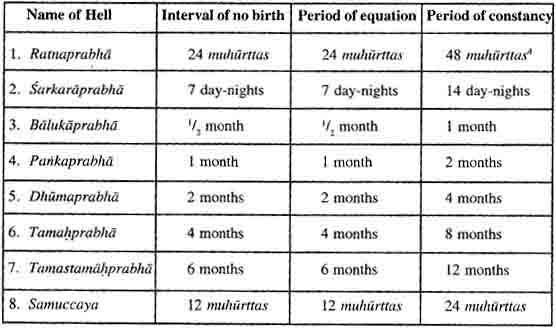
The one-sensed beings continue to take birth every samaya, so the viraha -kāla is zero.5 When one-sensed beings are born in greater number and die in smaller number, then there is increment in their total number. When they die in greater number and are born in smaller number, there is decrease in total number. When the deaths and births are equal in number, there is constancy of number.
In the case of the two-sensed, three-sensed, four-sensed, and coagulated five -sensed beings, the viraha-kāla is one antarmuhürtta and the period of equation of births and deaths is also one antarmuhürttu; thus, the period of constant number of these beings is two antarmuhürtta.
The viraha-kāla of other living beings is giving in the following chart —
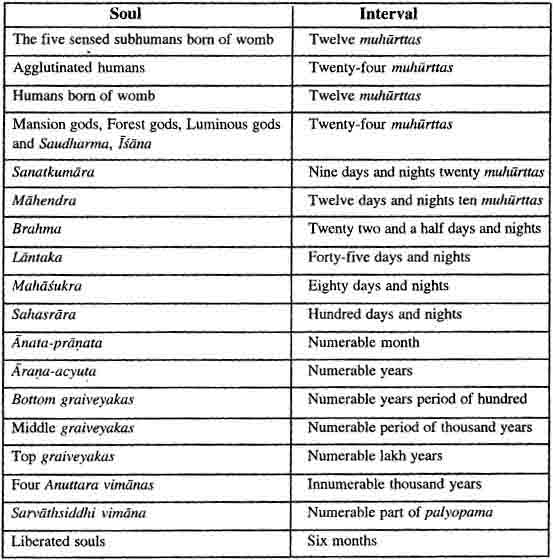
The period of equation of births and deaths is equal to the viraha-kāla and so, when these two periods are added together, they give the period of constancy of the number of these beings.
Text
Jīvānam sovacaya-sāvacayādi-padam
5.225jīvā nambhamte! kim sovacayā? sāvacayā? sovacaya-sāvacayā? niruvacaya niravacayā?
goyamă! jīvā no sovacayā, no sāvacayā, no sovacaya-sāvacayā, niruvacaya niravacayā.
egimdiyā tatiyapade, sesā jīvā cauhim vi padehim bhāniyavvā.
The Topic of Accumulation and Diminution of the Souls
Do1 the souls, O Lord! undergo accumulation, diminution, accumulation and diminution, non-accumulation and non-diminution?
Gautama! the souls do not undergo accumulation, do not undergo diminution, do not undergo accumulation and diminution, but they undergo non accumulation and non-diminution, (i.e., they are without accumulation and diminution).
The one-sensed beings belong to the third category of description viz., sovacayā-sāvacayā (accumulation and diminution). All the other categories of the souls belong to all the four categories of description.
5.226siddhā nam bhumte! pucchā.
goyamā! siddhā sovacayā, no sāvacayā, no sovacaya-sávacayā, niruvacaya niravacayā.
Query about the liberated souls, O Lord!
Gautama! the liberated souls undergo accumulation, do not undergo diminution, do not undergo accumulation and diminution, they undergo non-accumulation and non-diminution.
5.227 jīvā ņam bhamte! kevatiyam kālam niruvacaya-niravacayā? goyamā! savvaddham.
For how long are the souls, O Lord! without accumulation and without diminution?
Gautama! for all times.
5.228neraiya nam bhamte! kevatiyam kālam sovacayā?
goyamā! jahannenam ekkam samayam, ukkosenamāvaliyae asamkhejjaibhāgam.
For how long do the infernals, O Lord! undergo accumulation?
Gautama! for one samaya (indivisible time-unit) in the minimum and the innumerableth part of avalikã in the maximum.
5.229kevatiyam kālam sāvacayā?
evam ceva.
For how long do they undergo diminution?
For one samaya (indivisible time-unit) in the minimum and the innumerableth part of avalikā in the maximum.
5.230 kevatiyam kālam sovacaya-5āvacayā?
evam ceva.
For how long do the infernals undergo accumulation and diminution?
For one samaya (indivisible time-unit) in the minimum and the innumerableth part of an avalikā in the maximum.
5.231 kevatiyam kālam niruvacaya-niravacaya?
goyamā! jahunnenam ekkam samayam, ukkosenam bārusa muhuttā. egimdiyā davve sovacaya-sävacayā savvaddham. sesă savve sovacayā vi, sāvacayā vi, sovacaya-sāvacayā vi, jahunnenam ekkam samayam, ukkosenam āvaliyāe asamkhajjaibhāgam. avatthiehim vakkartikālo bhāniyavvo.
For how long do they (infernals) remain without accumulation and without diminution?
Gautama! for one samaya (indivisible time-unit) in the minimum and twelve muhârttas in the maximum.
All the one-sensed beings undergo accumulation and diminution for all periods of time. All the remaining living beings undergo accumulation, diminution; and also undergo accumulation and diminution; the length of time for this is one samaya (indivisible time-unit) in the minimum, and innumerableth part of the avalikā in the maximum. The period of constancy is to be described like the period of the absence of new birth (see 5.222).
5.232siddhā nam bhamte! kevatiyam kālam sovacayā?
goyamā! jahanenam egam samayam, ukoseņam uttha samayā.
O Lord! for how long the liberated souls undergo accumulation?
Gautama! for one samaya (indivisible time-unit) in the minimum and eight samayas in the maximum.
5.233kevatiyam kālam tiruvacaya-niravacaya?
jahaņenam ekkam samayam, ukosenam cha māsā.
For how long they are without accumulation and without diminution? For one samaya in the minimum and six months in the maximum.
Bhāsya
1. Sūtras 225-233
In the present dialogue, there are four alternatives about the accumulation and diminution of souls. Accumulation means increase, diminution means decrease. The absence of accumulation and diminution is constancy. What then is the difference between the previous and this dialogue? The author of the Vrtti has raised this question and solved the problem. According to him, increase and decrease refer to quantity, whereas upacaya (accumulation) and apacaya (diminution) refer to utpāda and udvartana. So in the third alternative (sopacaya-sāpacaya), all the three viz., increase, decrease and constancy are comprised. When there is utpāda of many, there is increase, when there is udvartana of many, there is decrease. And when there is equal utpāda and udvartana, there is constancy.1
The one-sensed beings fall under the third alternative. Among them, there is simultaneous utpāda and udvartana. There is no exclusive utpāda or exclusive udvartana and absence of utpāda and udvartana. So the remaining three alternatives are not applicable to them.2
About all living beings beginning from the two-sensed living beings, the absence of new birth is to be described as in the Pannavaņā.This is period of constancy or that of nirupacaya and nirapacaya. In this state both upacaya and apacaya are absent. The souls attain liberation without stop from one samaya...... up to eight samayas. After that there is interval of ‘no liberation which is one samaya in the minimum and eight samayas in the maximum.
Text
5.234 sevam bhamte! sevam bhamte! tti.
That is so, O Lord! That is so, O Lord!
1.Bha. Vț. 5.205—'anamta' tti tatparimānajñāpanaparam tat svarūpābhidhānam.
2.Ibid., 5.206–dravye prāyeņadvayādiguņā anantaguņāntāḥ kālakatvādayo bhavanti ekagunakālakādayastvalpā iti bhāvaḥ. ayamarthaḥ-yohi yasmin samaye yadvarṇagandharasa sparśasanghātabhedasūksmatvabādaratvādipariņāmāntaramāpannaḥ sa tasmin samaye tadpekṣayā kālato'pradeśa ucyate, tatra caikasamayasthititityanye, pariņāmasca bahava iti pratipariņāmam kālāpradeśasambhavāttadbahulatvamiti. etadeva bhāvyate bhāvato ye'pradeśā eka gunakālatvādayo bhavanti te kālato dvividhā api bhavanti sapradeśā apradeśāścetyarthah.
3.Ta. Sū. 2.39--pravsddho deśaḥ pradeśaḥ, anantāņuskandhaḥ pradeśo'trābhidhîyate.
1.Thānam, 10.1.
2.Panna. 6.1.6.
3.Bha. Vr. 5.215_saptasvapi prthivīşu dvādaśa muhürttān yāvanna ko'pyutpadyate vă, utkrstato virahakālasyaivamrüpatvāt, anyeșu punardvādaśamuhürtteșu yāvanta utpadyante tāvanta evodvarttanta ityevam caturvimşatimuhūritân yāvannārakāņāmekaparimāņatvādavasthitatvam výddhihānyorabhāva ityarthah.
4.Ibid., 5.245-evam ratnaprabhādisu yo yatrotpadodvarttanävirahakālascaturcimśatimuhürttädiko vyutkrāntipade'bhihitaḥ sa tatra teșu tattulyasya samasankhayānāmutpădodvarttanākālasya mīlanād dviguņitaḥ sannavasthitakālo'sața catvāriņsaumuhürttādikah sūtrokte bhavati, virahakālasca pratipadamavasthaanakālārddhabhūtah svayamabhyuhya iti.
5.Panna. 6.29.
1.Bha. Vț. 5.225-nanüpacayo vặddhirapacayastu hāniḥ, yugapaddvayamadvayam vā'vasthitvam evam ca sabdabhedavyatirekena ko'nayoh sūtrayorbhedah? ucсyate, pūrvatra parimānamabhipretam, iha tu tadanapeksamutpādodvarttanā mātram tataśceha tộtīyabhangake pūrvoktavěddhyādi vikalpānām trayamapi syāt tathāhi-bahutarotpăde vỊddhirbahutarodvarttane ca hāniḥ, samotpadodvarttanayoścā vasthitatvamityevam bheda iti.
2.Ibid., 5.225—'egimdiyātaiyapae' tti sopacayasăpacayā ityarthaḥ yugapadutpādodvarttanābhyām vȚddhihānibhāvāt, śeşabhangakeșu tu te na sambhavanti, pratyekamutpādodvarttanayostadvirahasya cābhāvāditi.
3.Ibid 5.231-nirupacayanirapacayeșu 'vakkaņtikālo bhāniyavvo'tti virahakālo vācyah.
♦
Ninth Section
Navamo Uddeso
Section-9
Text
Kimidam rāyagiha-padam
5.235 tenam-kālenam, tenam, samaeņam jāva evam vayāsi-kimidam bhamte! nagaram, rāyagiham, ti pavuccai? kim pudhavī nagaram, rāyagiham ti pavuccai? kim āū nagaram rāyagiham ti pavuccai? kim teữ văū vanassai nagaram rāyagiham ti pavuccai? kiin tamkā kūdā selā siharī pabbhārā nagaram rāyagiham ti pavuccai? kim jala-thala-bila-guha-lenā nagaram rāyagiham ti pavuccai? kim ujjhara-nijjhara-cillala-pallala-vappiņā nagaram rāyagiham ti pavuccai? kim agada-tadāga-daha-naio vāvī-pukkhariņi-dīhiyă gumjāliyā sarā sarapamtiyāo sarasarapamtiyão bilapamtiyão nagaram rāyagiham ti pavuccai? kim ārāmujjāņa-kānanā vanā vaṇasamdā vanarāio nagaram rāyagiham ti pavuccai? kim devaula-sabha-pava-thūbha-khāiya-parikhão nagaram rāyagiham ti pavuccai? kim pāgāra-attālaga-cariya-dāra-gopurā nagaram rāyagiham ti pavuccui? kim pasāda-ghara-sarana-lena-āvanā nagaram rāyagiham ti pavuccai? kim simghādaga-tiga-caukka-caccara-caummuha-mahāpaha-pahā nagaram rāyagiham ti pavuccai? kim sagada-raha-jāna--jugga-gilli-thilli-siya -samdamāniyāo nagaram rāyagiham ti pavuccai? kim lohi-lohakadāha-kaļu cchayā nagaram rāyagiham ti pavuccai? kim bhavanā nagaram rāyagiham ti pavuccai? kim devā devīo maņussā maņussīo tirikkhajoniyā tirikkhajoninio nagaram rāyagihum ti pavuccai? kim āsana-sayaņa-khambha-bhamda-sacittā cittamīsayāim davvāim nagaram rāyagiham ti pavuccai? goyamā! pudhavīvi nagaram rāyagiham ti pavuccai jāva sacittācitta-mīsayāim davvāim nagaram rāyagiham ti pavvuccai.
The Topic of 'What is Rājagrha?'
In that age, at that time ..... up to address thus: O Lord! what is called the city of Rājagsha? Is the earth called the city of Rājagsha? Is the city comprising water called the city of Rājagsha? Is the city comprising fire, air and vegetation called the city of Rājagặha? Is the city comprising plateau, summit of a hill, hill without a summit, hill with a summit, and slightly inclined hilly area called the city of Rājagsha? Is the city comprising water, land, burrows, caves, a house carved out of a rock called the city of Rājagrha? Is the city in the form of water fall from a hill, stream, muddy tank, small water pond, furrowed (field) called the city of Rājagsha? Is the city in the form of well, pond, lake, river, square tank, lily-pool, spring, croaked canal, tank with internal stream, series of tanks, interconnected series of tanks, series of burrows called the city of Rājagsha? Is the city in the form of pleasure-resort, park, forest near a village, forest remote from city, forest with same kind of trees grove called the city of Rājagrha? Is the city comprising temple, rural court of justice, water-shed for travellors, stūpa, ditch wide at the top and narrow at the bottom, ditch of equal size at top and bottom called the city of Rājagrha? Is the city comprising rampart, turret, passage between rampart and fort for elephants, a small door within a big door, city gate called the city of Rājagsha? Is the city in the form of palace, house, thatched ante-room, rest house and shops (bazzar) called the city of Rājagsha? Is the city comprising triangular corners, a meeting of three paths, square, cross roads, four exit areas, high way, and common ways called the city of Rājagsha? Is the city in the form of car, chariot, vehicle, plain, palanquin, howdah, mule-cart, covered palanquin, special palanquin of the length of the man called the city of Rājagrha? Is the city in the form of iron vessel, cauldron, ladle called the city of Rājagsha? Is the city comprising mansions called the city of Rājagsha? Is the city in the form of gods, goddesses, men, women, male sub-humans, female sub-humans called the city of Rājagrha? Is the city in the form of seats, beds, pillars, earthen wares, animate, inanimate and mixed substances called the city of Rājagsha?
Gautama! the earth is also called the city of Rājagsha ...... up to animate, inanimate and mixed substances are also called the city of Rājagsha.
5.236 se kenarthenain?
goyamā! pudhavi jīvā i ya, ajīvā i ya nagaram rāyagiham ti pavuccai jāva sacittācitta-mīsayāim davvaim, jīvā i ya, ajīvā i ya nagaram rāyagiham ti pavuccai. se tenatthenam tam ceva.
For what reason?
Gautama! the earth comprising jīva and ajīva is called Rājagrha ..... up to animate, inanimate and mixed substances comprising jīva and ajīva is called the city of Rājagsha. It is for this reason that it is so.
Bhāsya
1. Sūtras 235-236
We get exposition of the nature of city from many angles.
In the present dialogue, a city (Rājagrha) has been explained metaphysically, A city is not made of any particular substance. It is a combination of many substances. Briefly, it is made of three substances that are animate, inanimate and mixed; elaborately speaking a city is made of a totality of water tanks, palaces, roads, men, animals, birds etc. The question was asked about the Rājagļha city and in answer Bhagavān Mahāvīra said, “Rājagļha is not the name of a particular substance, but it is a totality of animate, inanimate and mixed substances.” For the meaning of tanka, kula etc., see Bhāsya on Bha. 5,182-190.
Text
Ujjoya-amdhayāra-padam
5.237 se nūnam, bhamte! diyā ujjoe? rāim amdhayāre?
hamtā goyamā! diyā ujjoe, rāim amdhayāre.
The Topic of Light and Darkness
O Lord!' is there light in the day and darkness in the night?
Yes Gautama! there is light in the day and darkness in the night.
5.238 se kenatthenam?
goyamā! diyä subhā poggalā subhe poggalapariņāme, raim, asubhā poggalā asubhe poggalaparināme. se tenatthenam.
For what reason is it said so?
Gautama! in the day there are auspicious material entities, auspicious transformation of material entity. In the night there are inauspicious material entities and inauspicious transformation of material entities. It is for this reason.
5.239 neraiyānam bhamte! kim ujjoe? amdhayāre?
goyamā! neraiyānam no ujjoe, amdhayāre.
O Lord! do the infernals have light? or have darkness?
Gautama! the infernals have no light, they have (only) darkness.
5.240 se keņatthenam?
goyamā! neraiyānam asubhā poggalā asubhe poggalapariņāme. se tenatthenam.
For what reason is it said so?
Gautama! they have inauspicious material entities, inauspicious trans formation of material entities. It is for this reason.
5.241 asurakumārānam bhamte! kim ujjoe? amdhayāre?
goyamā! asurakumārānam ujjoe, no amdhayāre.
O Lord! do the Asurakumāras have light? or have darkness?
Gautama! the Asurakumāras have light, they have no darkness.
5.242 se kenatthenam?
goyamā! asurakumārānam subhā poggalā subhe poggalapariņāme.
se tenatshenam. jāva thaniyakumärānam.
For what reason is it said so?
Gautama! the Asurakumāras have auspicious material entities, auspicious transformation of material entities. It is for this reason. (Similarly) ...... up to Stanitakumāra.
5.243 pudhavikkāiyā jāva teimdiyā jahā neraiyā.
The earth bodied beings ......... upto three-sensed beings are like the infernals.
5.244 caurimdiyānam bhamte! kim ujjoe? amdhayāre?
goyamā! ujjoe vi, amdhayāre vi.
Do the four-sensed beings, O Lord! have light? or have darkness?
Gautama! they have light as well as darkness.
5.245 se keņatthenam?
goyamā! caurimdiyāṇam, subhāsubhāa ya poggalā suhhāsubhe ya poggala parināme. se tenatthenam.
For, what reason it is said so?
Gautama! the four-sensed beings have both auspicious and inauspicious material entities and also auspicious and inauspicious transformation of material entities.
It is for this reason.
5.246 evam jäva manussānam.
In the same way ...... up to humans.
5.247 vānamamtara-joisa-vemāniyā jahā asurakumārā.
The Forest gods, Luminious gods and Empyrean gods are to be described like those of the Asurakumāras.
Bhāsya
1. Sūtras 237-247
Both light and darkness are special transformations of material entities. The auspicious transformation of material entities is bright. So it is called light. The inauspicious transformation of material entities is gloomy. So it is darkness. In the day, on account of the contact with the sun rays there is auspicious transformation of material entities.1 So there is light in the day. In the night, there is absence of the rays of the sun and other luminous objects, so the transformation of material entities at that time is inauspicious.
In the present dialogue, light and darkness have been explained from many points of view. As there is inauspicious transformation of material entities in the hells, there is always darkness there. According to the Vrtti, there is absence of bright objects like the rays of the sun that cause auspicious transformation of the material entities.2
It is mentioned in the Pannavaņā that there is absence of the orbiting luminous bodies such as sun, planet, moon, star etc., in the infernal earths.3
The mansions and vimāmas (abodes) of gods are always bright on account of the auspicious transformation of the material entities there.* Although there is no solar system etc. in the mansions and space-ships of the gods, they are always shining by the splendour of gems. There there is no division of day and night.
There is always darkness for the one-sensed, two-sensed and three-sensed beings, because they have no eyes. The rays of the sun fall on them but on account of they being devoid of the organ of eye, they always experience darkness. There is development of the organ of eye in the four-sensed beings, five-sensed sub humans and humans. They come in contact with sun-light, so they are endowed with light. They undergo the effect of night; hence, they are said to have darkness also.
Text
Manussakhette samayādi-padam
5.248 atthi nam bhamte! neraiyānam tatthagayānam evam pannāyae, tam jaha-samayũi vã, āvaliyä i vã java osappini i vã, ussappin i vã?
ņo inatthe samatthe.
The Topic of Samaya etc. in the Human Region
O Lord!1 the infernals reside outside the human world, is it possible to propound about them that there is samaya or āvalikā or ...... up to the descending time-cycle and the ascending time-cycle?
No, this is not possible.
5.249 se kenatthenam bhamte! evam vuccai-- neraiyānam tatthagayānam no evam pannayae, tam jaha-samaya i vã, ãvaliya i vã jāva osappin i vã, ussappin i vā?
goyamā! iham tesim mānam, iham. tesim pamāṇam, iham tesim evam paņņāyae, tam jahā-samayā i vā jāva ussappiņi i vā. se tenatthenam jāva no evam pannāyae, tam jahā—-samayā i vā jāva ussappiņi i vā.
For what reason has it been said, O Lord! that it is not possible to say about the infernals that they have samaya or āvalikā ...... up to descending time-cycle and ascending time-cycle?
Gautama! here (in this human world) humans have māna, they have pramāņa and so it is propounded that here there is samaya or ...... up to the ascending time-cycle. Because of this reason, that the infernals ...... up to the human world, it is not possible to propound that the infernals have samaya ...... up to ascending time-cycle.
5.250 evam jāva pamcimdiyatirikkhajoniyānam.
In the same way ..... up to five-sensed subhuman beings.
5.251 atthi nam bhamte! manussānam ihagayāṇam, evam pannāyate, tam jahā samayã i vũ java ussappinữ i vã? hamtā atthi.
O Lord! is it possible to propound for human beings living in the human world that there is samaya ...... up to ascending time-cycle?
Yes, this can be.
5.252 se kenatthenam?
goyamā! iham tesim mānam, iham tesim pamāṇam, iham ceva tesim evam pannãyate, tam jahã samaya i vã jāva ussappinĩi vũ se tenanthenam.
For what reason is it said so?
Gautama! there is māna and pramāṇa here (in the human world) so, it is said that they have samaya ...... up to ascending time-cycle. It is so for this reason.
5.253 vānamamtara-joisa-vemāniyānam jaha neraiyānam.
The Forest gods, Luminous gods and the Empyrean gods to be described like the infernals.
Bhāsya
1. Sūtras 248-253
In this universe there are two kinds of regions-time-region and timeless region. The human world consists of continents of Jambū Island, Dhātaki Island and half of the Puskara Island—two and half continents. The infernal world, the world of gods and the region beyond two and half continents is timeless region. There is no division of time there. The solar system is not in motion beyond the two and half continents--the suns and moons are stationary there, so there is no division of time.
The division of time is for human beings. It is the human being who describes the limit of the life-spans of the infernals, sub-humans and gods on the basis of his own concept of measurement of time.
Time is of two kinds--metaphysical and practical. The nature of metaphysical time is vartanā. This is the characteristic of time given in the Uttarādhyayana Sūtra.1 In the Tattvārtha Sūtra, characteristics of time are given, viz., becoming (vartanā), change (parināma), motion (kriyā) the state of being before (paratva) and the state of being after (apartva).2 Among these vartanā and pariņāma are related to metaphysical time. Kriyā, paratva and aparatva are related with practical time. In the Thānam, the practical time has been described both as jīva and ajīva.3
According to Akalanka, the determination of karma-sthiti, bhavasthiti and kāyasthiti (i.e., durations of karma, bhāva and kāyā) etc. of all souls is made by samaya, āvalikā etc. of the human world. The practical time is also the basis of measurement of time-units as the numerable, innumerable and infinite.4
Text
Pāsávaccijja-padam
5.254 tenam kälenam tenam samaenam pāsāvaccijjā therā bhagavamto jeneva samane bhagavam mahāvīre teneva uvāgacchamti, uvāgacchittā samanassa bhagavao mahāvīrassa adūrasāmamte thiccă evam vayāsi-se nüņam bhamte! asamkhejje loe anamtā räimdiyā uppajjimsu vā, uppajjamti vā, uppajjissamti vũ? vigacchinsu vã vigacchanti vã, vigacchissati vã? parittã rãidiyã uppajinsu vã, uppajjamti vã, uppajjissanti vã? vigacchinsu vũ, vigacchanti vã, vigacchissanti vã?
hamtā ajjo! asamkhejje loe anamtā rāimdiya tam ceva.
The Topic of the Ascetics of Pārsva's Order
In1 that age, at that time, the honourable elderly monks of the order of Pārsva reached the place where the Ascetic Lord Mahāvīra was residing. Having reached there, they stood neither too far nor too near from the Lord and said thus: O Lord! in this cosmos of innumerable number of space-points, did infinite number of nights and days occur, they are occurring or will they occur? Have they passed away, they are passing or will they pass-away? Or there occured limited number of nights and days, or are they occurring or will they occur? Have they passed away or are they passing or will they pass away?
Yes, O Noble Ones! in the cosmos of innumerable number of space-points, there occured infinite numbers of nights and days, are occurring ...... up to will pass away.
5.255 se kenatthenam jāva vigacchiosamti vã?
se nūņam. bhe ajjo! päsenam arahayā purisādāņienam sāsae loe buie-aņādie aņavadagge paritte parivude hetthā vicchinne, majjhe samkhitte, uppim visāle, ahe paliyamkasamthie, majjhe varavairaviggahie, uppim uddhamuimgākāra samthie. tesim ca ņam sāsayamsi logamsi aņādiyamsi anavadāggamsi parittamsi parivudamsi hetthā vicchinnamsi, majjhe samkhittamsi, uppim visālamsi, ahe paliyamkasamthiyamsi, majjhe varavairaviggahiyamsi, uppim uddhamuimgā kārasamthiyamsi anamtā jīvaghanā uppajjittă-uppajjittä niliyamti, parittā jīvagha ņā upajjittā-uppajjittā niliyamti. se bhūe uppanne vigae parinae, ajīvehim lokkai palokkai, je lokkai se loe?
hamtā bhagavam!
se tenatthenam ajjo! evam vuccai asamkhejje ioe anamtā raimdiyā tam, ceva. tappabhiim ca nam te pāsāvaccejjā therā bhagavamto samanam, bhagavam mahāvīram paccabhijanamti savvannā savvadarisī.
For what reason is it so ........ up to will pass away?
O Noble Ones! your Predecessor, Arhat Pārsva, the most respectable among men, has described the eternal cosmos as without beginning, without end, finite, encircled by trans-cosmos, expanded at bottom, contracted at middle, and again vastly expanded at the top. It is, at bottom of the configuration of one sitting in the posture of cross-legs; at middle, it is shaped like an excellent vajra (which is thin at the middle); and at the top it is of the shape of a vertically placed drum. In that eternal cosmos which is without beginning, without end, finite, expanded at bottom, contracted at middle, and again vastly expanded at the top, which is, at bottom, of the configuration of one sitting in the posture of cross-legs, at middle shaped like an excellent vajra, and at the top of the shape of a vertically placed drum, infinite number of souls, residing in a common body, each of which is a compact collection of infinite number of modes, are again and again born and die; individual souls occupying separate body, each of which is a compact collection of infinite number of modes, are again and again born and die. That (cosmos) is really existent, originated, destroyed and transformed; that which is seen and observed (specially) through the transformation of insentient substances (matter, etc.); (etymologically) what is seen (lokkai) and what is observed (palokkai) is the cosmos (loe).
“Yes, O Lord!"
"It is for this reason, O Noble Ones! that it is said that in this cosmos of innumerable number of space-points, there occured infinite number of nights and days ...... up to as said before.
Since then, those honourable elderly monks of the order of Pārsva, started recognising the Ascetic Lord Mahāvīra as all-knowing and all-intuiting (omniscient),
5.256 tae ņam te therā bhagavamto samanam bhagavam mahāvīram vamdamti namamsamti, vamdittā namamsittä evam vayasi-icchāmi nam, bhamte! tubbham amtie cāujjāmāo dhammão pamcamahavvaiyam sapadikkamanam dhammam uvasampajjittāņam viharittae. ahāsuham devāņuppiyā! mā padibamdham...
Then, those honourable elderly monks bow down and pay homage to the Ascetic Lord Mahāvīra. Having bowed down and paid homage, they addressed him thus: We wish indeed, O Lord! to be ordained by you in the discipline of five great vows, accompanied with the compulsory performance of reflection upon and recoiling from past bad deeds, in place of the discipline of four restraints (of Lord Pārsva).
O beloved of gods! do as is pleasing to you, do not delay.
5.257 tae nam te pāsăvaccijjā therā bhagavamto cāujjamāo dhammāo pamcamahavvaiyam sapadikkamanam dhammam uvasam pajjittănum viharamti jāva carimehim ussāsa-nissāsehim siddhā buddhā mukkā parinivvudā savvadukkhappahīnā. atthegatiyā devaloesu uvavannā.
Then, those honourable elderly monks of the order of Pārsva ordained themselves in the discipline of five great vows, accompanied with the compulsory performance of reflection upon and recoiling from past bad deeds, in place of the discipline of four restraints (of Lord Pārsva), they practised it ...... up to (as in 1/433); having thus practised the discipline, with their last respiration, they were liberated, tranquillized, freed, emancipated and put an end to all sufferings. Among them, some however were born in heavens.
Bhāşya
1. Sūtras 254-257
Arhat Pārsva was the 23rd tīrthankara of the Jain tradition. He was 250 years earlier to Lord Mahāvīra. Dr. Jacobi, by his comparative studies of the Jain Agamas and the Buddhist Pitakas, established the historicity of Lord Pārsva.1 The parents of Bhagavān Mahāvīra belonged to the order (i.e., were followers) of Lord Pārsva.2 The order of Pārśva was still prevalent at the time of Bhagavān Mahāvīra. Pārsva's disciples called on Lord Mahāvīra and his disciple Gautama for philosophical discussions on many an occasions:
1. Kālāsavesiyaputta of Pārsva's order approached the elders of Mahāvīra's order and discussed the subjects like sāmāyika, etc. with them and ultimately got ordination in the Mahavira's discipline.3
2. The Mahāvīra's followers, of the city of Tungiya, held philosophical discussions with the three elders of the order of Parśva, namely, Kalikaputra, Mehila and Anandarakṣita Lord Mahāvīra endorsed the replies of the elders. There is however no mention whether they were ordained in Mahāvīra's discipline. 4
3. The elders of Pārsva's order pay visit to Lord Mahāvīra and ask him about the infinite number of days and nights in finite cosmos. Lord Mahāvīra solved their queries by quoting the doctrine of Lord Pārsva. They were convinced of the omniscience of Lord Mahāvīra and were ordained in his discipline.5
4. An ascetic, named Gāngeya, of the order of Pārśva, goes to the city of Vānijyagrāma and asks the questions about the births and deaths of living beings to which Mahāvīra gives reply. Here also Pārsva's doctrine about the cosmos is quoted. The ascetic, Gāngeya, is convinced of the omniscience of Lord Mahāvīra and gets ordained in his discipline.6
5. According to the Nālandijja chapter of Sūyagado, Udaka Pedhāla of Pārsva's order approaches Gautama at Nālandā and elaborately discusses with him the procedure of conferment of vows. After the discussion, he gets ordained in the order of Mahāvīra.7
6. There is a reference in Uttarajjhayanāni to the young ascetic, Keśī, of the Pārsva's order, approaching Gautama Swāmī at Śrāvasti, when a long dialogue takes place between them. Ultimately, the young ascetic, Keśī, gets ordained in the order of Lord Mahāvīra.8
From these references to Pārsva's order, it is evident that Pārsva's order was concurrently flourishing even after the omniscience of Lord Mahāvīra. The elderly monks of the Pārsva's order approached Lord Mahāvīra and asked him an intriguing question, “O Lord! whether in the cosmos of finite dimensions, there occur and pass away infinite number of nights and days or do there occur a finite number of nights and days?"
Lord Mahāvīra endorsed both the alternatives. The problem was that the number of nights and days couldn't be both infinite as well as limited in number. The apparent contradiction was resolved by Lord Mahāvīra by pointing out that there were souls with common body and also with personal (uncommon) body.
In a common body, infinite number of souls originated and die, while with the personal body, a limited number of souls originate and die. Time is a soul's mode that is characterised by constancy of duration. In the case of souls with common body, infinite number of days and nights originate and pass away, while in the case of souls of personal body, limited number of nights and days originate and pass away. Thus, there is no contradiction in the two statements, but they are relatively true. In the cosmos of even innumerable (finite) number of space-points (pradeśas), it is not impossible for infinite number of nights and days to occur or infinite number of souls to exist. Space has the capacity to contain infinite number of souls, and the souls have the capacity to undergo such subtle transformations that an infinite number of souls can occupy the same space of innumerable (finite) space-points.9
Bhagavān Mahāvīra, quoting the doctrine of Pārsva, propounded the cosmos with innumerable space-units. The cosmos is a real entity, that originates, passes away and transforms. Here origination and passing away are sought to be transformation of change of modes. An unreal (non-existent) can not originate, nor the real (existent) can cease to exist.
The origination, cessation and transformation of a non-sentient entity like matter are directly perceptible, on account of its being corporeal, while the rest of the substances are non-corporeal, and as such their origination, cessation and transformation are imperceptible. Therefore, the etymological nomenclature of the cosmos, i.e. loka, is made with reference to the substance called matter (pudgala), which is directly perceptible (lokyte).
In the present dialogue, Arhat Pārsva is quoted to explain the cosmos as eternal. Lord Mahāvīra has propounded that the loka (cosmos) is both eternal as well as non-eternal.10
Here, again both seemingly contradictory statements are not really contra dictory, but there is the difference in the view-points of both propositions. From the view-point of substance, the cosmos is eternal; from the view-point of modes, it is non-eternal. The view-point of substance accepts mainly “identity', but does not deny difference', but relegates it to a secondary position. Similarly, the standpoint of modes accepts mainly 'difference'. It does not deny identity, but relegates it to a subsidiary position.11
Thus, where the cosmos is propounded to be eternal, it is so from the stand point of substance; here, it is automatically proved that subsidiarily the cosmos is also non-eternal. On other hand, where the cosmos is interpreted as non-eternal from the modal point of view, it is automatically accepted that subsidiarily it is also eternal. In the statement that the cosmos is eternal, the statement that it is non eternal is automatically accepted, and vice-versa. Therefore, both the statements are not contradictory.
There are ten important issues that differentiate the discipline of Lord Pārsva from that of Mahāvīra. 12 Among them, the issue of 'vows' (vratas) is the sixth, and that of ‘recoiling from misdeeds' (pratikramana) is the eighth. In the topic under discussion, these two issues have found mention. In the discipline of Lord Pārsva, there is prescription of fourfold restraint (yamas), whereas in that of Lord Mahāvīra, there is the prescription of fivefold great vows (mahāvratas). In former, the duty of pratikramana was not compulsory, but optional when there was any occasion for it, on account of some remissness on the part of a monk, whereas in the order of the latter, it was compulsory.
Semantics
parīta—limited/finite.
puruşādānīya—acceptable to the people, or respected by the people.
anavadagga—infinite,
paliyanka-samthie—of the shape of a posture of cross-legs or sitted in a lotus posture, that is, contracted at the top, expanded at the bottom.
varavaira vggahie—of the configuration of an excellent vajra i.e., thin in the middle.13
uddhamuinga samtthie—of the configuration of a drum placed vertically. It resembles cones kept one above another making a box.
jīvaghana—compact collection.
The soul is so called because of its being a compact collection of infinite number of modes.
bhūe (sadbhūta)—real.
Text
Devaloya-padam
5.258 kaivihā ņam bhamte! devalogā pannattā?
goyamā! cauvvihā devalogā pannattā, tam jahambhavanavāsi-vānamamtara jotisiya-vemāniyabhedenam. bhavanavāsī dasavihā, vānamamtarā atthavihā, jotisiyā pamcavihā, vemāniyā duvihā.
The Topic of Heavens
How many kinds of heaven, O Lord! have been propounded?
Gautama! four kinds of heaven have been propounded viz., Mansion, Forest, Luminous and Empyrean. There are 10 kinds of Mansion, 8 kinds of Forest, 5 kinds of Luminous and 2 kinds of Empyrean gods.
Samgahaņī gāhā.
kimidam rāyagiham ti ya,
ujjoe amdhayāra-samaye yā
pāsamtivāsipucchā,
rātimdiya devalogā ya 11211
Summary Verse
What is this Rājagrha?
Where are light and darkness?
Who knows time etc.?
The query of the elders of Pārsva's order;
Nights and days in the cosmos
And the description of heavens—
these are the topics in this uddešaka
(i.e., section no. 9)
Text
5.259 sevam bhamte! sevam bhamte! tti.
That is so, O Lord! That is so, O Lord!
1.Bha. Vr. 5.238-divase śubhāh pudgalā bhavanti, kimuktam bhavati? śubhaḥ pudgalapariņāmaḥ cärkakarasamparkāt.
2.Ibid., 5.240.tatkşetrasya pudgalaśubhatānimittabhūtaravikarādiprakāśakavastuvarjitatvät.
3.Panna. 2.20m-te nam naragā......ņiccamdhayāratamasā vavagayagaha-camda-sūra-nakkhatta joiisapahā.
4.(a) Panna. 2.30-te nam bhavaņā bāhim vattā amto samacauramsä ahe pukkhara kanniyāsamthānasamthitā ukkinnamtaraviulagambhira-khāta-parihā pāgārațțălaya-kavāda toranapaờiduvāradesabhägă jamta-sayagghi-musala-musumdhiparivăriyā aojjhā sadājatā sadāguttā adayālakotthagaraiyā adayālakayavaṇamālā khemā sivä kimkarāmaradandovarakkhiyā läulloiyamahiyā gosīsarasarattacamdanadaddaradiņnapamcamgulitalā uvaciyavamdanakalasā vamdanaghadasukatatoraṇapadiduvāradesabhāgā āsattosattaviulavattavagghāriyamalladāmakalāvā pamcavaņņasarasasurahimukkapupphapumjovayārakaliyā kālāgaru-pavarakumdurukkarurukka dhūvamaghamaghemta-gamdhuddhuyābhirāmā sugandha-vara-gamdha-gamdhiyā gamdha vaťţibhūtā accharagana-samgha samvigiņņā divvatudita-saddasampaņaditä savvarayaņāmayā acchā sanhā laṇhā ghaťthā masthā ņīrayā ņimmalā nipparkā nikkamkadacchāyā sappahā sassirīyā samirīyā saujjoyā. (b) Ibid., 2.49-teņam vimāṇā savvarataņāmayā acchā sanhā laṇhā ghatthā matthā nīrayā nimmalā nippamkā nikkamkadacchāyā sappabhā sassirīyā saujjoyā.
5.Bha. Vț. 5.243-ravikarādi samparke satyapi eşām cakşurindriyābhävena drśyavastuno darśanābhāvācchubhapudgalakāryākarañenāśubhāḥ pudgalā ucyante tatascaiņāmandhakārameveti.
1.Uttara. 28.10 -vattanā lakkhano kālo.
2.Ta. Sū. 5.22-vartanā pariņāmaḥ kriyā paratvāparatve ca kālasya.
3.Thānam 2.387-389-samayāti vā ävaliyāti vā jīväti yā ajīvāti yā pavuccati. āņāpāņānūti vā thoviti vājīvāti yā ajīvāti yā pacuvvati. khanāti vā lavāti vājīvāti yā ajīvāti yā pavuccati. evam muhuttāti vā pakkhati và masati vã uuti vã ayanati vã samvaccharāti vã jugặti vã vāsasayāti vã vāsasahassãi vã vāsasatasahassãi vã vẫsakodi vã puyvangặt vặpuvvậti vã tudiyangấti vã tudiyāti vã addamgāti vã addãi vã avavangāti vã avavāti vāhāhāamgấti vāhāhāyāti vậuppalangãi vã uppalatí văpaumamgãi vã paumati vã nalinamgati vã nalināti vã atthanikuramgãi vã atthanikurāti vã Quangấti vã auậti vã nauamgãi vã pauāti vã pautamgati vã pautấti vã cũliyamgãi vã cũliyāti võ sĩsapaheliyamgati vã sīsapaheliyāti vā paliovamāti vā sāgarovamāti vā osappiņīti vā ussappiņīti vā--jīvāti yā ajīvāti yā pavuccati.
4.Ta. Rā. Vā.5.22-manusyakşetrasamutthena jyotirgatisamayāvalikädinā paricchinnena kriyākalāpena kālavartanayā kālākhyena ürdhvamadhastiryak ca prāņinām samkhyeyā'samkhye yā'nantānantakālagananāprabhedena karmabhavakāyasthitiparicchedaḥ sarvatra jaghanyamadhya motkrstāvasthah kriyate.
1.Sacred Books of the East, vol. XLV, Introduction,
2.A. Cü. 15.25.
3.Bha. 1.423-433.
4.Ibid., 2.92-110.
5.Ibid., 5.254-257.
6.Ibid., 9.77-135.
7.Sūya. 2.7.8-38.
8.Uttarā. a. 23.
9.Bha. Vț. 5.254-ihāyamabhiprāyahyadyanantāni tāni tadā katham parīttāni? iti virodhah, atra hantetyādyuttaram, atra cāyamabhiprāyaḥ-asamkhyātapradese’pi loke'nantā jīvā varttante, tathāvidhsvarüpatvād, ekatrāśraye sahasrādi samkhyapradīpaprabhā iva, te caikatraiva samayādike kāle'nantā utpadyante vinasyanti ca, sa ca samayādi kālasteșu sādhāraṇa-śarīrāvasthāyāmananteșu pratyekaśarīrāvasthāyām ca parītteșu pratyekam varttate, tat sthitilaksanaparyāyarūpatvättasya, tathā ca kālo'nantah parittaśca bhavatīti, evam cāsamkhyeye'pi loke rätrindivānyanantāni parīttāni ca kālatraye’pi yujyanta iti.
10.Bha. 9.233.
11.Dravyānuyogatakarņā, 5.2,3—
dravyārthikanayo mukhyavrttyā bhedam vadamstrişu ।
anyonyamupacāreņa teşu bhedam diśatyalam ॥211
paryāyārthika evāpi mukhyavsttyātra bhedatām
upacārānubhūtibhyām manute'bhedatām trişu 11311
12.The annotation on Țhāṇam, 6.103.
13.Bhāsya of Bha. 2.118.
♦
Tenth Section
Daśamo Uddeso
Section-10
Text
5.260 tenam kālenam tenam samaenam campā nāmam nagarī, jahā padhamillo uddesao tahā neyavvo eso vi, navaram-camdimā bhāņiyavā.
In that age, at that time, there was a city named Campā. The description is like that of the sun given in the first section, substituting moon in the place of sun.
♦
Sixth Sataka
Chattham Sayam
Sixth Sataka
43_ch43
PREFACE
The science of karma is a principal part of Jain Metaphysics. In order to know the different states of karma, one should very carefully study the first section of this Sataka, dealing with experience of kārmika fruition (vedanā) and falling away of kärmika particles (nirjarā), which are intimately related. The popular notion is: the more the tolerance of hardships, the more the falling away of kärmika particles. It is not that there is no truth in this notion, but without the knowledge of the basis of truth, the secret of the science of karma can not be grasped. These are two main states of karma-intensified and loosened. In the intensified state of karma, due to non-inhibition of karma even excessive tolerance of hardship results in meagre falling away of karma. In the loosened state of karma, attained through samvara (inhibition), even less tolerance of hardship results in massive falling away of karma. It follows from this that meagre or massive falling away of karma is not due to the less or more tolerance of hardship, the main condition being the intensified or loosened states of karma. This is explained in following chart
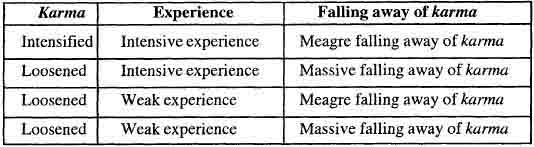
According to Pātañjala Yoga philosophy, there are three states of the reduction of klesa [i] attenuation, [ii] burning (iii) absolute destruction. There is attenuation of karma by Kriyāyoga. The seed of karma is burnt by Prasankhyāna and is completely destroyed by being merged in the prakrti.' This can be compared with meagre falling away of karma and massive falling away of karma. In all practices of the spiritual discipline, the description of the process of purification is indispensable.
In the spiritual science, the aura is a much discussed topic. In the Āgamika literature, this has been discussed as physical colour. Every living being has his own aura. Not only in a living being but even in a non-sentient entity, there is aura. The aura of non-sentient entity is fixed. In living beings the aura is ever changing. In the present Sataka, four causes have been given for this change: (i) karma (ii) kriyā (the activity or conduct of a person) (iii) āśrava—cause of influx of karma (iv) vedanā—experience of the fruit of karma. The aura is soiled when all the four components viz.,--
(i)fruition of karma
(ii)kriyā (the activity)
(iii)the āśrava i.e., the transformation (parināma) of soul and influx of karmika pudgalas and
(iv)vedanā—consequential experience of karma
are excessively inauspicious. The colour, smell, taste and touch of the soiled aura become displeasing and there is intensification of mental affliction. On the other hand, when all of the four components are auspicious, the aura becomes pure. Its colour, smell, taste and touch become pleasing and the stream of mental bliss becomes incessant. There is influence of the aura also on the body.
To simplify a doctrine by means of illustrations is a special feature of the composition of this canon. The accumulation of karma is effected by effort, not automatically. This doctrine has been illustrated by the example of the piece of cloth. The same illustration has been given to explain the accumulation of karma in the soul.
In the present Āgama, the elements of the doctrine of karma are available in a scattered manner. If properly arranged and systematised, they can make a complete treatise. The third section of the present Sataka is virtually a chapter on the doctrine of karma.
A very large part of the Jain Agamika literature has fallen into oblivion. The present canon is distinctly important for containing the remnant of the huge mass of knowledge contained in that Āgamika literature. It contains the description of the important topics of science of astro physics and cosmology such as mass of darkness (tamaskāya), black-streak (krsnarāji). The modern scientists have discovered black hole. The tamaskāya has been described as the transformation of water-body and krsnarāji as that of earth-body.
The travellers in the mysterious region of the Bermuda Peninsula of Trinidad sea-cost, gives the glimpse of the “mass of darkness'. The event that took place on gth August 1956, is narrated here:
“A coast-guard steamer named “The Yāmākrā” which was used for exploration and wire-net-laying was cruising towards Sargāso sea-region. This sea-region is believed to be the marine area full of nets of seaweeds in the north of Bāhāmāsa region of the Bermuda Peninsula. It is also said that beneath this marine area there are Gulf Stream and other active streams. It is a prohibited area considered as extremely dangerous for ships, boats, etc. It is even claimed that it is a graveyard of ships and boats that disappeared and were destroyed in a mysterious manner in the Bermuda Peninsula. As the steamer was advancing in the open sea, the operator of Radar suddenly found that there was huge earthen mound like object at a distance of 28 to 30 miles right in front. He informed his boss about it. When the boss saw the earthen mound and the marine compass, he also doubted that there was something wrong. The captain also was alerted, but he did not change the direction of the steamer and allowed it to go ahead. Within a very few hours the steamer reached very near the mound. But now only earth appeared there instead of a earthen mound.
What was most alarming yet interesting was that the powerful radar and the search-lights were proving ineffective. In fact, there was neither earth nor vacant land, but it was a peculiar surface of water that appeared like a piece of land or a mass of earth rising up from the north-east to south-cast. It was a vivid experience of solitary, cold death. But exhibiting an extra-ordinary courage, the captain and the crew continued to advance. On entering into this illusive marine area, all the lights of the steamer were off. The darkness was so deep and dense that even the extremely bright carbon-arc lamps did not appear brighter than an almost extinguishing spark. The members of the crew were caught in a feat of coughing which proved uncontrollable. The steam-pressure in the engine started decreasing. Being helpless the captain had to order to reverse the direction of the steamer. Everything was done by guess, but for several hours they had to fight with death. Only when the inmates of the steamer could get the glimpse of the dawn, there was no limit to their wonder that there was not the least trace of the illusive appearance even in the remotest area."4
Such mysterious happenings are not unusual in the cosmic scenario.
The doctrine of 'projection of the soul-units in diverse direction in the proximity of death' (māraṇāntika samudghāta) is a topic that needs investigation in the light of the modern developing science of parapsychology that has been collecting the death-bed experiences of the subjects. Many mysteries of life and death are being brought to light through this ancient description found in the Jain scriptures, specially in the Bhagavatī Sūtra.5
In the present Sataka, there are important topics like measurable time, immeasurable time, the time-wheel, the creation of corporeal form by protean power, etc.
The style of composition of this canonical work reveals that at the time of Devarddhi Ganī, many texts were incorporated in it from different sources. Some Sūtras are verbatim repetitions, for example, this Sataka repeats the Sūtra (of the V Sataka) dealing with the omniscient not knowing and seeing through the sense organs.6
Every Sataka of the Bhagavati Sūtra can be considered as an independent treatise dealing with the deep problems of metaphysics, and epistemology.
1. Pā. Yo. Da. 2.11.
2. Bha. 6.20-23
3. Ibid., 6.24-29
4. In Weakly Hindustan, guh September, 1979, An article titled "baramüdā trikoņa--nae purāne kitane koņa' by Sudhir Sain.
5. Bha. 6.122-127.
6. Ibid., 5.108, 109; 6.187,188.
♦
First Section
Padhamo Uddeso
Section-1
Text
Samgahanī gāhā
1. vedana 2. āhāra 3. mahassave ya 4. sapadesa 5. tamue 6. bhavieľ 7. sālī 8. pudhavi 9. kamma 10. annautthi dasa chatthagammi sae ॥1॥
Summary Verse
1. Experience 2. food, 3. great influx 4. with pradeśa 5. darkness 6. bhavya 7. rice 8. infernal land 9. karma 10. heretics-ten uddeśakas in the sixth Sataka.
Pasatthanijjarāe seyatta-padam
6.1 se nūņam bhamte! je mahāvedane se mahānijjare? je mahānijjare se mahā vedane? mahāvedanassa ya appavedanassa ya se see je pasatthanijjarãe? hamtā goyamā! je mahāvedane se mahānijjare, je mahānijjare se mahāvedane, mahāvedanassa ya appavedanassa ya se see je pasatthanijjarãe.
The Topic of Superiority of One with Auspicious Falling Away of Karma
Is1 indeed, O Lord! the one (i.e., the jīva) with intensive experience of pain that with massive falling away of karma? Is the one with massive falling away of karma that with intensive pain? Among the one with great experience of pain and the one with little experience of pain, is one who has auspicious falling away of karma superior?
Yes Gautama! the one with intensive experience of pain is the one with massive falling away of karma; the one with massive passing away of karma is the one with intensive experience of pain. Among the one with intensive experience of pain and the one with weak experience of pain, the one with auspicious falling away of karma is superior.
6.2 chartha-sattamāsu nam bhamte! pudhavīsu neraiyā mahāvedaņā?
hamtā mahāvedanā.
Are the infernals, O Lord! in the sixth and seventh infernal lands with intensive experience of pain?
Yes, they are with intensive experience of pain.
6.3 te nam bhamte! samanehimto niggamthehimto mahānijjaratara?
goyamā! no inatthe samatthe.
Are they (the infernals), O Lord! with more massive falling away of karma than the samaņa nirgranthas?
Gautama! this is not possible.
6.4 se kenam khāi atthenam bhamte! evam vuccai-je mahāvedane se mahanijjare?
je mahānijjare se mahāvedane? mahāvedanassa ya appavedanassa ya se see je pasatthanijjarāe?
goyamā! se jahānāmae duve vatthā siyā ege vatthe kaddamarāgaratte, ege vatthe khamjanarăgaratte, eesi nam goyamā! donham vatthāņam kayare vatthe duddhoyatarãe ceva, duvāmatarāe ceva, duparikammatarāe ceva; kayare vā vatthe suddhoyatarāe ceva, suvāmatarāe ceva, suparikammatarāe ceva; je vā se vatthe kaddamarāgaratte? je vā se vatthe khamjanarāgaratte? bhagavam! tattha nam je se kaddamarāgaratte, se nam vatthe duddhoyatarãe ceva, duvāmatarāe ceva, dupparikammatarāe ceva, evāmeva goyamā! neraiyānam pāvāim kammāiin gādhikayāim, cikkhunīkayāim silitthikayāim khilībhūtāim bhavamti. sampagādham pi ya ņam te vedanam vedemāņā no mahānijjarā no mahāpajjavasāņā bhavamti. se jahā vā kei purise ahigaraạim āudemāne mahayā-mahayā saddenam, mahayā -mahayā ghosenam, mahayā-mahayā paramparāghāenam no samcăei tise ahiguranie kei ahābāyare pogalle parisādittae, evāmeva goyamā! neraiyānam pāvāim kammäim gādhikayāim, cikkanikayāim, silitthīkayāim, khilībhūtāim bhavamti. sampagādham pi ya nam te vedanam vedemāņā no mahānijjarā no mahāpajjavasāņā bhavamti. bhagavam! tuttha nam je se khamjanarāgaratte, se nam vatthe suddhoyatarãe ceva, suvāmatarāe ceva, supparikammatarāe ceva, evāmeva goyamā! samaņā nam niggamthānam ahābāyarāim kammāim sidhilīkayāim, nitthiyāim kayāim, vippariņāmiyāim khippāmeva viddhatthāim bhavamti. jāvatiyam tāvatiyam pi nam te vedanum vedemāņā mahānijjarā, mahāpajjavasāņā bhavamti. se jahānāmae kei purise sukkum tanhatthayam jāyateyamsi pakkhivejjā, se nūnam goyamā! se sukke tanahatthae jāyateyamsi pakkhitte samăne khippāmeva masamasāvijjati? hamtā masamasāvijjati. evāmeva goyamā! samaņāņam niggamthāņam ahābāyarāim kammāim sidhilīkayāim, nitthiyāim kayāim, vippariņāmiyāiin khippāmeva viddhatthāim bhavamti. jāvatiyam tāvatiyam pi nam te vedanam vedemāņā mahānijjarā, mahāpajjavasāņā bhavamti. se jahānāmae kei purise tattamsi ayakavallamsi udagabimdum pakkivejjā, se nūnam goyama! se udagabimdū tattamsi ayakavallamsi pakkhitte samāne khippāmeva viddhamsamāgacchai? hamtā viddhamsamāgacchai. evāmeva goyamā! samaņāņam niggamthānam ahābāyarāim kammāim sidhilīkayāim, nitthiyāim kayāim, vippariņāmiyāim khippāmeva viddhatthāim bhavamti. jāvatiyam tāvatiyam pi nam te vedanam vedemānā mahānijjarā, mahāpajjavasāņā bhavamti. se tenatthenam je mahāvedane se mahānijjare, je mahānijjare se mahāvedane, mahāvedanassa ya appavedanassa ya se see je pasatthanijjarãe.
In what sense has it been said, O Lord! that the one (i.e., the jīva) with intensive experience of pain is the one with massive falling away of karma and the one with massive falling away of karma is the one with intensive pain and that among the one with great experience of pain and the one with little experience of pain, one who has auspicious falling away of karma is superior?
Gautama! suppose there are two pieces of cloth—one is stained by deeply sticky slime, another is stained by mild lubricant (grease). Out of these two pieces of cloth, O Gautama! which is more difficult to clean, more difficult to make stain-free and more difficult to polish? And which one of these two is easier to clean, easier to make stain-free, and easier to polish-the one sullied by mud, or the one made dirty by grease?
O Lord! among the two pieces of cloth, the one sullied by mud is difficult to clean, difficult to make stainless, and difficult to polish. So indeed, Gautama! the sinful karmas of the infernal souls are densified, sticky, compact and impassable (i.e., impervious). Even through the experience of intense pain, they (the infernal souls) do not become the souls with massive falling of karma and massive termination of karma.
Just as a person striking an anvil with big bang, great noise and repeated strokes, is unable to destroy the hard matter of the anvil, so indeed, O Gautama! the sinful karmas of the infernal souls are densified, sticky, compact and impassable (i.e., impervious). Even through the experience of intense pain, they (the infernal souls) do not become the souls with massive falling of karma and massive termination of karma.
O Lord! among the two pieces of cloth that which is stained by grease is easy to clean, is easy to make stainless and easy to polish. So indeed, O Gautama! the gross karmas of the śramana nirgrantha, which are made loose (or mild), made powerless and made innocuous, get quickly destroyed. Through experiencing whatever (little) pain, they (the śramaņa nirgranthas) become the ones (souls) with massive falling away of karma and massive termination of karma.
O Gautama! suppose there is a person who throws a dry bundle of straw into the fire. Would that dry bundle of straw thrown in the fire burn up quickly?
Yes, it burns quickly. Similarly, O Gautama! the gross karmas of śramaņa nirgrantha which are made loose (or mild), made powerless and made innocuous, get quickly destroyed. Through experiencing whatever (little) pain, they (the śramaņa nirgranthas) become the ones (souls) with massive falling away of karma and massive termination of karma.
O Gautama! suppose there is a person who pours drops of water on a hot iron plate. Would the drops of water poured on the hot iron plate quickly meet their end?
Yes, they do meet their end.
Similarly, O Gautama! the gross karmas of śramaņa nirgrantha which are made loose (or mild), made powerless and made innocuous, get quickly destroyed. Through experiencing whatever (little) pain, they (the śramana nirgranthas) become the ones (souls) with massive falling away of karma and massive termination of karma. It is in this sense that is said that the one (i.e., the jīva) with intensive experience of pain is the one with massive falling away of karma and the one with massive falling away of karma is the one with intensive pain and that among the one with great experience of pain and the one with little experience of pain, one who has auspicious passing away of karma is superior.
Bhāsya
1. Sūtras 1-4
In the present dialogue, attention has been drawn to the relationship between experiencing pain and falling away of karma. We give below the three laws related to the topic:
(1) Experiencing intensive pain versus massive falling away of karma.
(2) Whether experiencing of pain is intensive or little, the auspicious falling away of karma is the best (as massive).
(3) When the karma is intensified, there does not occur massive falling away of karma, in spite of experiencing intensive pain. For example, the infernals of the sixth and seventh land experience intensive pain, but there does not occur massive falling away of karma. On the contrary, though the śramana nrigrantha experiences little pain, there is massive falling away of karma, the reason being that he has loosened his karma due to samvara (inhibition).
In general the rule is that experiencing intensive pain is accompanied by massive falling away of karma; the exception is that experiencing mild pain is sometimes accompanied by massive falling away of karma.
The basic cause of falling away of karma is auspicious psychical state and auspicious activity (of mind, body and speech); the massiveness or meagreness of the falling away of karmas depends upon it.
Umāsvāti has explained that the nirjarā or elimination of kārmika particles is successively innumerable times more than the previous stage at each of the following ten stages of spiritual development which are! —
1.The possessor of enlightened world-view.
2.The lay-follower practising partial abstinence.
3.The ascetic practising complete abstinence.
4.The ascetic subsiding/annihilating the tenacious passions.
5.The ascetic annihilating view-deluding karma.
6.The ascetic subsiding conduct-deluding karma.
7.The ascetic who has subsided conduct-deluding karma.
8.The ascetic annihilating conduct-deluding karma.
9.The ascetic who has annihilated conduct-deluding karma.
10.The Jina (the omniscient).2
The author of Tattvārtha Bhāşya has recognised two kinds of falling away of karma: involuntary and due to spiritual practice' (kusalamūlā). The falling away of karma in the case of the infernals, which is the result of the past karma, is involuntary. There is no such conscious willing that “I shall throw away my karma." But the falling away of karma here is due to the fruition of past karma, so it is involuntary. Such falling away of karma is called akusalānubandhā which means nirjarā which is the result of bad karma. The falling away of karma due to austerity and conquering of hardships is called kusalamülā which means nirjarā which is the result of kušala i.e., righteous activity.3 The auspicious falling away of karına can be compared with the kuśalamūlā nirjarā. Abhayadevasűri has explained auspicious falling away of karma as "kalyānānubandhā nirjarā" which means nirjarā which results meritoriously.4 In the Tattvārtha Bhāsya, two types of kuśalamūlā nirjarā have been distinguished: śubhānubandhā and niranubandhā. The falling away of karma that produces good result like the reincarnation as a god etc. is śubhānubandha (producing auspicious bondage result). What is cause of liberation is falling away of karma with no bondage (niranubandhā). 5
An elaborate description of this subject matter is available in Sūtras 15,16 of this Sataka.
Semantics
kaddamarāgarattāim—soiled by deeply sticky slime.
khamjanarāgarattāim—be smeared by ordinary grease or mud.
gādhīkayāim-tightly bound with the soul-units like an object tightly bound by a rope made of hemp-thread.
cikkanīkayāim—subtle kõrmika bondage that is unbreakable on account of its being tightly bound, just like a (hard) clod of earth.
silitthikayāim—nidhatta, e.g. red hot iron rods bound by a bondage into a bundle; karma which are not amenable to any change except udvartanā (increase in duration or intensity) and apavartană (decrease in duration or intensity).
khilībhūyāim-nikācita karma, whose result is sure and certain (which is not amenable to any change).6
mahāpajjavasānāim—the falling away of karma which results in liberation.
paramparāghāeņāim—struck again and again.
ahigarani—an anvil.7
āhābāyarāim—very gross clusters, of kārmika pudgala, or worthless pudgalu.
nitthiyāim—what has been made innocuous.
viparināmiyāiņ—the karma that has been transformed by sthitighāta and rasaghāta, i.e., attenuation of duration and intensity.8
Text
Karaņa-padam
6.5 kativihe nam bhainte! karane pannatte?
goyamā! cauvvihe karane pannatte, tam jahā-manakarane, vaikarane, kāyakurane, kammakarane.
The Topic of Karana (Instrumentality)
How1 many kinds of instrumentality are propounded to be there, O Lord? Gautama! four kinds of instrumentality, are propounded there, e.g., mind, word, body and karma.
6.6 neraiyānam bhamtel kativihe karane pannatte?
goyamā! cauvvihe pannatte, tam jahā—maņakaraņe, vaikarane, kāyakarane, kammakarane.
How many kinds of instrumentality are propounded to be there in the infernals, O Lord?
Gautama! four kinds of instrumentality are propounded, e.g., instrumen tality quâ mind, instrumentality quâ word, instrumentality quâ body and instrumentality quâ karma.
6.7 evam pamcimdiyānam savvesim cauvvihe karane pannatte.
egimdiyānam duvihekāyakarane ya, kammakarane ya.
vigalimdiyāņam tivihe-vaikarane, kāyakarane, kammakarane.
Similarly, in all five-sensed beings, four kinds of instrumentality are propounded.
In one-sensed beings two kinds of instrumentality are propounded instrumentality quâ body and instrumentality quâ karma. For beings of less number of (i.e., two three, four) senses, three kinds of instrumentality are propounded, viz., instrumentality quâ word, instrumentality quâ body and instrumentality quâ karma.
6.8 neraiyā ņam bhamte! kim karanao asāyam vedanam vedemti? akaranao asāyam vedanam vedemti?
goyamă! neraiyā ņam karanao asāyam vedanam vedemti, no akaranao asāyam vedanam vedemti.
Do the infernals, O Lord! have painful experience through the instrumentality or not through instrumentality?
Gautama! the infernals have painful experience through the instrumentality, not without instrumentality.
6.9 se kenatthenam?
goyamă! neraiyānam cauvvihe karane pannatte, tam jaha-manakarane, vaikarane, kāyakarane, kammakarane. icceenam cauvvihenam usubhenam karaneņam neraiyā karanao assāyam vedanam vedemti, no akaranao. se teņattheņain.
For what reason is it so?
Gautama! for the infernals four kinds of instrumentality have been propounded, viz., instrumentality quâ mind, instrumentality quâ word, instrumentality quâ body and instrumentality quâ karma. It is through these four kinds of inauspicious instrumentality, the infernals have painful
experience, not without instrumentality.
6.10 asurakumārā nam kim karanao? akaranao?
goyamā! karanao, no akaranao.
Do the Asurakumāras have the experience (or feeling) through the instrumentality? Or not through the instrumentality?
Gautama! through the instrumentality, not without instrumentality.
6.11 se keņattheram?
goyamā! asurakumārāṇam cauvvihe karane pannatte, tam jahă- manakarane, vaikarane, kāyakarane, kammakarane. icceenam subhenam karanenam asura kumārā karanao sātam vedanam vedenti, no akaranao.
For what reason is it so?
Gautama! for the Asurakumāras, four kinds of instrumentality have been propounded, viz., instrumentality quâ mind, instrumentality quâ word, instrumentality quâ body and instrumentality quâ karma. It is through these four kinds of auspicious instrumentality that the Asurakumāras have pleasurable experience, not without instrumentality.
6.12 evam jāva thaniyakumārā.
Similar statement for (the devas) ...... up to Stanitakumāra.
6.13 pudhavīkäiyāṇam evāmeva pucchā, navaram--icceenam subhāsubhenam karanenam pudhavikkäiyā karanao vemāyāe vedanam vedemti, no akaranao.
Similar query about the earth-bodied beings. The only difference is (as follows)—it is on the basis of these (two kinds of) auspicious and inauspicious instrumentality, (it is said that) the earth-bodied beings experience variously, sometimes pleasure, sometimes pain through instrumentality; not without instrumentality.
6.14 orāliyasarīrā savve subhāsubheṇam vemāyāe.
devā subhenam sāyam.
All beings with gross body experience variously (sometimes pleasure, sometimes pain) only through the auspicious and inauspicious instrumen tality.
The gods (possessed of protean body) experience pleasure through auspicious instrumentality.
Bhāsya
1. Sūtras 5-14
The literal meaning of karana (instrumentality) is ‘means'. That which is most essential for producing the effect is called karana. Abhayadevasūri has explained karana as jīvavīrya, i.e., energy of the soul.' Accordingly, the soul's energy which is the source of the activity of mind, speech and body can respectively be called instrumentality quâ mind, instrumentality quâ word and instrumentality quâ body. The original source of the exposition of Abhayadevasűri is the Commentary based on the Bhāsya of Tattvārtha Sūtra. According to it, karana means paryāpti (bio potential). The kāyakarana śarīraparyāpti i.e., bio-potential quâ body is produced by the material clusters belonging to kāyavargaņā, i.e., the group of clusters appropriate for making the body. Similarly, the vākkarana (bhāṣāparyāpti i.e., bio potential quâ speech) and manakarana (manahparyāptii.e., bio-potential quâ mind) are produced respectively by the material clusters belonging to bhāṣāvarganā and manovarganā i.e., the group of clusters appropriate for making speech and mind respectively. The kāyakarana, all these three are the means of the transformation of souls energy. Therefore, the nomenclature as karaṇa (means) is quite befitting. To think is manayoga. To speak is vacanayoga. To go etc. is kāyayoga. Also the material clusters that act as means to thinking, speaking and going are called manakarana, vākkarana, kāyakarana respectively.3
In the Karmaprakrti, eight karanas of karma have been mentioned bandhana, samkramana, udvartana, apavartana, udiranā, upaśāmanā, nidhatti and nikācanā.“4 In the Gommațasāra, there are ten kinds of karana: the above eight together with sattva and udaya. 5
The soul's energy that act as an instrumentality to the occurrence of these states of bandhana, samkramana etc. is called karmakarana.“ 6
In the present dialogue, the relationship between experience of pleasure and pain on the one hand and karana on the other has been explained. When the four karanas, viz., mana, vāk, kāya and karma are inauspicious, there is experience of pain, when they are auspicious there is experience of pleasure. Inauspicious mind produces the experience of pain--this is worth mentioning from the point of view of psychiatric treatment.
The infernals and gods have protean body. Other living beings have gross body. The living beings with gross body have pleasurable experiences through auspicious karana and painful experiences through inauspicious karana. The infernals have painful experiences through inauspicious karana and the gods have pleasurable experiences through auspicious karana. Both these statements should not be understood as 'absolutely applicable, but as 'almost applicable.?7 In fact, there is mention of all the three-pleasurable, painful and pleasurable-cum-painful experiences in both—the infernals as well as the gods.8 It means that in the case of infernals sometimes there may be auspicious karana and pleasurable experience and in case of gods also, sometimes there may be inauspicious karana and painful experience.
In the Thānam, however, there is no mention of karmakarana. In addition to the classification of manakaraņa, vākkarana and kāyakarana, there are available two other classifications of karana.'9
Semantics
vemāyā—variously, sometimes pleasurable experience, sometimes painful experience.
Text
Mahāvedaņā-mahānijjarā-caubhamga-padam
6.15 jīvā nam bhamte! kim mahāvedaņā mahānijjarā? mahāvedanā appani-jjarā?
appavedaņā mahānijjarā? appavedaņā appanijjarā? goyamā! atthegatiyā jīvā mahāvedaņā mahānijjarā, atthegatiyā jīvā mahāvedanā appanijjarā, atthegatiyā jīvā appavedaņā mahānijjarā, atthegatiyā jīvā appavedaņā appanijjarā
The Topic of Four Alternatives with respect to Intensive Pain
Are1 the souls, O Lord! the ones (souls) with intensive pain and with massive falling away of karma? Are they with intensive pain and meagre falling away of karma? Are they with little pain and massive falling away of karma? Are they with little pain and meagre falling away of karma? Gautama! there are some souls with intensive pain and massive falling away of karma, there are some with intensive pain and meagre falling away of karma, there are some with little pain and massive falling away of karma, there are some with little pain and meagre falling away of karma.
6.16 se kenatthenam?
goyamā! padimăpadivannae anagāre mahāvedane mahānijjare. chattha sattamāsu pudhavīsu neraiya mahāvedanā appanijjară. selesim padivannae anagāre appavedane mahānijjare. aṇuttarovavāiyā devā appavedanā appanijjarā.
In what way is it so?
Gautama! an ascetic practising the course of intensive penance has intensive pain and massive falling away of karma The infernals in the sixth and seventh land are with intensive pain and meagre passing away of karma. The ascetic in the state of the absolute motionless condition like that of the Mount Meru is with little pain and massive falling away of karma. The gods of the highest heaven are with little experience of pain and meagre falling away of karma.
Bhāsya
1. Sūtras 15-16
In the first dialogue (Sūtras 1 to 4), the description of intensive pain and massive falling away of karma etc. has been made on the basis of auspicious falling away of karma. In the present dialogue, these topics have been described with illustrations. There is prescription of intensive courses of penance for monk. A monk, practising the intensive course, has to endeavour many hardships'.' So he experiences intensive pain. But as his psychic state is auspicious, and also as he maintains equanimity while tolerating hardships, he has massive falling away of karma. The infernals in the sixth and seventh lands experience intensive pain on account of their agonising environment. But they have very little falling away of karma. A comparative study of these two sūtras shows that the cause of massive passing away of karma is not the little or intensive experience of pain. The meagreness or massiveness of falling away of karma is due to the way of tolerating the hardships.
The ascetic practising the intensive course of penance tolerates the intensive pain with equanimity, so there is massive falling away of karma.
The infernals in the sixth and seventh lands do not endure their intensive pain with equanimity so there is little falling away of karma.
The ascetic in the state that is as firm as Mount Meru experiences little pain but his equanimity is very great; so even though there is little pain, the falling away of karma is massive.
The gods in the highest heaven experience little pain and have also meagre falling away of karma.
A comparative study of these four illustrations shows that the souls who endeavoured to affect falling away of karma have avipāki nirjarā falling away of karma which are brought to rise before they become mature through udīraņā and are got rid of. The ascetic practising the intensive course of penance and the ascetic in the state of being as firm as Mount Meru are examples of this category. The infernals in the sixth and seventh land and the gods in the highest heavens are examples of vipāki nirjarā, that is, falling away of karma due to vipāka i.e., due to fruition. In this case, there is no endeavor for falling away of the karma. The inauspicious and auspicious karmas that come to the state of fruition fall away after producing their fruit.
Semantics
paļimāpadivannae—pratimā means a special spiritual practice with special resolves and determination. Amonk practising the intensive course is called padimāpannae. selesi (sailesi)—the state of an omniscient with total cessation of all activities; hence, he is the attainer of the state of absolute motionless condition like that of the Mount Meru.
Text
6.17. sevam bhamte! sevam bhamte! tti.
That is so, O Lord! That is so, O Lord!
Samgahaņī gāhā
mahāvedane ya vatthe,
kaddama-khamjanakae ya ahigarani।
tanhatthe ya kavalle,
karana-mahāvedanā jīvā ॥
Summary Verse
Intensive pain and piece of cloth, stained with deep sticky slime and ordinary grease, anvil, bundle of straw and iron plate, instrumentality and souls with intensive pain. (-These are the topics described in the first uddeśaka).
1.Ta. Rā. Vā. 9.45--adhyavasāyaviśuddhiprakarsādasamkhyeyaguņānirjarātvam daśānām.
2.Ta. Sū. 9.47--samyagdsstiśrāvakaviratānantaviyojaka-darsanamohaksapakopaśamakopaśānta mohaksapakasīņa-māhajināḥ karmaśo'samkhyeyagunanirjarā”.
3.(a) Ta. Sü. Bhā. Vr. 9.47—sa dvividhaḥ iti vipākābhisambandhaḥ nirjarayā sahaikārthatvād.
tad daividhyapradarśanāmāha abuddhityādi. tatrābuddhipūrvaḥ buddhiḥ pūrvā yasya karmaśāțyāmītye-vamlakşaņā buddhiḥ prathamam yasya vipākasya sa buddhipūrvah na buddhipūrvā' buddhipūrvaḥ, tatra tayorvipākayorayam tāvadabuddhipūrvah narakatiryarmanusyā maresu kurma jñānāvaraņādi. tasya yat phalamācchādakādirūpam tadvipākah tadudayastasmāt karmuphalád vipacyamānād yo vinirjaranalakṣaṇo vipākaḥ, sati tasmin karmaphale vipacyamāne sa bhavatyabuddhipūrvakaḥ. ...... tapah parīşahajayakstaḥ kusalamūlah. (b) Ta. Rā. Vā. 9.45-sā dvedhā ceti abuddhipurvā kusalamūlā ceti. tatra narakādisu karmuphalavipākajā abuddhipurvā, sā akusalānubandhā. Parīşahajaye kste kuśalamūlā, sā śubhānubandhā niranubandhā ceti.
4.Bha. Vr. 6.1--prasastanirjarākaḥ kalyāṇānubandhanirjarah.
5.Ta. Sü, Bha, VỊ. 9.7, p. 220-tādrõo vip@kah subhananubadhnati, amaresu tăvadindrasāmānikādi sthānāni avāpnoti. manusyesu ca cakravartibalamahāmandalikādipadāni labdhvā tataḥ sukhaparamparayā muktimavāpsyatīti śubhānubandhoniranubandho veti. vā sabdaḥ pūrvavikal pāpekṣaḥ, tapaḥ parişahajayaksto vipākaḥ sakalakarmakşayalakṣaṇaḥ sākṣānmokşayaiva käranībhavatīti.
6.Apte. khilībhū- To become impassable.
7.Bha. Vị. 6.4.-'ahigarani' tti adhikarani yatra lohakārā ayoghanena lohāni kuttayanti.
8.Ibid., 6.4.
1.Bha. Vp. 6.5-karaṇam jīvavīryam.
2.Ta. Sū. Bhā. Vr. 8.12.
3.Ibid., 6.1.
4.See, the Bhāsya of Bha. 1.23,24.
5.Go. Ka, gā. 437.
6.Bha. Vị. 6.5—kammakaranam' tti karmavişayam karaṇam jīvavīryam bandhanasamkramaņādini mittabhūtam karmakaranam.
7.Bha, 6.185.
8.See, the Bhāşya of Bha, 3.92. 9. (a) Thānam, 3.16-tivihe karane paņņatte, tam jahā ārambhakarane, samrambhakarane, samāram bhakarane.
(b) Thāņam, 3.506mmtivihe karane, tam jahā dhammie karane, adhammie karane, dhammiyādhammie karane.
1.Dasão, 7.1-35.
2.(a) See the Bhāsya of Bha, 6.1-4.
(b) Ta. Sū. Sarvärthasiddhi, 8.23,
♦
Second Section
Bio Uddeso
Section-2
Text
6.18 rāyagiham nagaram jāva evam vayāsimāhāruddesao jo pannavaņāe so savvo
niravaseso neyavvo.
There was a city named Rājagyha, ...... up to Gautama said thus--the āhāra uddesaka' of the Pannavaņā is to be described here in toto. O Lord! do the infernals consume animate food, inanimate food, or mixed food?
Bhāsya
1. Ahāra-uddeśaka
The twenty-eighth chapter of the Pannavanā is about āhāra. There we find the description of topics like: what kind of food do the living beings consume-animate, inanimate or mixed? Do they desire for food? After what interval of time do they consume food? And so on.
Ahāruddesao-Here there is no mention of the first uddesaka of the Pannavaņā-only the āhāra uddeśaka is mentioned. The āhāra-pada has two sections. The topic of the first section is āhāra. The topic of the second section is āhāraka and anāhāraka. Here only the first uddesaka of ahārapada is to be described. In the first śataka of Bhagavati, there is mention of prathama āhāroddeśaka-'āhāro vi-jahā pannavaņāe padhame āhāruddesae tahā bhāniyavvo'.1
Text
6.19. sevam bhamte! sevam bhamte! tti.
That is so, O Lord! That is so, O Lord!
1.Bha. 1.32
♦
Third Section
Taio Uddeso
Section-3
Text
Samgahanī gāhā
1. bahukamma 2. vatthapoggala payogasă-vīsasā ya 3. sādie 4. kammatthiti 5. ithi 6. samjaya 7. sammadithi ya 8. sanni ya 11111 9. bhavie 10. damsana 11. pajjatta 12. bhāsaya 13. paritte 14. nāna 15. joge ya । 16,17. uvaogāhāraga 18. suhuma 19. carimabamdhe ya 20. appabahum ॥2॥
Summary Verse
1. Massive karma 2. Accumulation of material particles in formation of cloth through manual effort and natural phenomena 3. The objects with beginning 4. Duration of karma 5. Woman 6. Self-restrainted 7. The soul with enlightened world-view and 8. Samjñi (The soul with mind) 9. Bhavya (the soul capable of attaining emancipation) 10. Darsani (the soul possessed of intuition) 11. Paryāpta (the soul which has accom-polished the bio potentials) 12. Bhāşaka (the soul capable of articulation) 13. Parīta (the soul with an indi vidual body or the soul in worldly existence with terminus) 14. Jñānī (the soul possessed of cognition) 15. Yoga (the soul with the activities of mind, speech and body) 16,17. Upayoga (the soul with the sentience) and āhāraka (the soul which appropriates nourish ment) 18. Suksma (subtle beings) 19. Carama bandha (the soul with last bondage) 20. Alpabahu (the relative numerical strength).
Text
Mahākammādīņam poggalabamdhādi-padam
6.20 se nūnam bhamte! mahākammassa, mahākiriyassa, mahāsavassa, mahā vedanassa savvao poggalā bajjhamti, savvao poggalā cijjamti, savvao poggalā uvacijjamti; sayā samiyam poggalā bajjhamti, sayā samiyam poggalā cijjhamti, sayā samiyam poggalā uvacijjamti; sayā samiyam ca ņam tassa āyā durūvattāe duvannattāe dugamdhattāe durasattāe duphāsattāe, anitthattāe akamtattāe appiyattāe asubhattāe amanunnattăe amaņāmattāe anicchiya-ttāe abhijjhiyattāe ahattāe-no uddhattāe, dukkhattāem-no suhattāe bhujjo-bhujjo parinamati? hamtā goyamā! mahākammassa tam ceva.
The Topic of the Souls with Massive Karma etc.
O Lord!1 does the person that is with massive karma, massive kriyā, massive āśrava and massive pain have material clusters that are bound from all sides, that are accumulated from all sides, that are amassed from all sides, that are bound always every moment (i.e., continuously), that are accumulated always every moment (i.e., continuously), that are amassed always every moment (i.e., continuously); does his soul (i.e., body) get transformed again and again always and every moment (i.e., continuously) in such form which is in bad shape, bad colour, bad smell, bad taste, bad touch, undesirable, unpleasant, unfavorable, inauspicious, disagreeable, unwanted, unattractive, mean i.e., not for elevation and conducive to sufferings i.e., not conducive to joy?
Yes, Gautama! the soul (body) of that person with massive karma, massive kriyā, massive āśrava and massive pain undergoes such transformation.
6.21 se kenatặheņam ? goyamā! se jahanāmae vatthassa ahayassa vā, dho-yassa vā, tamtuggayassa vă āņupuvvie paribhujjamānassa savvao poggalā bajjhamti, savvao poggalā cijjamti jāva pariņamamti. se teņatthenam.
In what sense is it so?
O Gautama! just as there is, a piece of cloth that is unused, or washed, or produced a fresh from the loom; now as it is being used, it duly gets covered with matter from all sides, acquires matter from all sides ..... up to gets transformed again and again. It is in this sense that it was said so.
Appakammādīnam poggalabhedādi-padam
6.22 se nūņam bhamte! appakammassa, appakiriyassa, appăsavassa, appavedanassa savvao poggalā bhijjamti, savvao poggalā chijjamti, savvao poggalā viddhamsamti, savvao poggalā parividdhamsamti; sayā samiyam poggalā bhijjhamti, sayā samiyam poggalā chijjamti, sayā samiyam poggalā viddhamsamti, sayā samiyam poggalā parividdhamsamti; sayā samiyam ca ņam tassa āyā surūvattāe suvannattāe sugamdhattāe surasattāe suphāsattāe itthattāe kamtattāe piyattăe subhattāe manunnattāe manāmattāe icchiyaitāe anabhijjhiyattāe uddhattāemno ahattäe, suhattāe-no dukhattāe bhujjo-bhujjo parinamati?
hamtā goyamā! jāva parinamati.
The Topic of Separation of Pudgalas from Souls possessed of Light Karmas etc.
O Lord! does the person that is possessed of light karma, light kriyā, light āśrava and light pain, have material clusters that are separated from all sides, pierced from all sides, destroyed from all sides, completely destroyed from all sides, always and every moment (i.e., continously) separated, always and every moment (i.e., continously) pierced, always and every moment (i.e., continously) destroyed and always and every moment (i.e., continously) completely destroyed; does his soul (i.e., body) get transformed again and again always and every moment (i.e., continously) in such form which is in good shape, good colour, good smell, good taste, good touch, desirable, pleasant, favourable, auspicious, agreeable, wanted, attractive, high, i.e., not mean, pleasant, i.e., not sorrowful.
Yes, Gautama! ...... up to not sorrowful.
6.23 se keņatthenarn?
goyamā! se jahănāmae vatthassa jalliyassa vā, pamkiyassa vā, mailliyassa vā, railliyassa vā ānupuvvie parikummijjamānassu suddhenam vāriņā dhovve mānassa savvao poggalā bhijjamti jāva parinamati. se teñarthenam.
In what sense is it so? Gautama! just as there is a piece of cloth that is wet with perspiration, muddy, dirty, soiled; now when it is duly being cleaned in proper manner and washed by clean water, the dirty material is separated ...... up to not sorrowful. It is in this sense that it was said so.
Bhāsya
1. Sūtras 20-23
In the present dialogue, the cause and occasion of kõrmika bandha have been propounded. Heavy karma and heavy pain are the occasions for the kārmika bondage. There is heavy bondage of kārmika matter due to the rise of heaviness of knowledge covering karma and deluding karma. A soul experiencing great pain becomes engrossed in mournful meditation; so massive kārmika bondage occurs to him. Kriyā (activity) and āśrava (cause of influx of karma) are both the causes of kārmika bondage. The activities like injury of life etc. are really varieties of yoga āśrava.' In the Tattvārtha Sūtra, there are mentioned thirty-nine varieties of āśrava--five indriyas (senses), four kaşāyas (passions), five avratas (non-abstinences) and twenty five kriyās (urges).? There are five basic varieties of āśrava, viz., mithyātva (perverted belief), avirati (non-abstinence), pramāda (remissness), kasāya (passions) and yoga (activity).
A soul involved in mahākarma, mahākriyā, mahāāśrava and mahāvedanā indulges in inauspicious activity. So he binds, acquires and accumulates karma from all sides. This binding, acquiring and accumulation of karma take place continuously without stop. On account of the bondage etc. of the kārmika particles, the subtle kärmika body is strengthened, which in turn, has influence on the gross body and the aura. The body of such person (binding massive karma) is infested with harmful material clusters, and consequently, he becomes sick and his aura becomes impure.
A soul with light karma, light kriyā, light aśrava and light vedanā engages himself in auspicious activity. So, in him, there is separation (falling away) of kārmika particles from all sides. On account of this kārmika separation, his kārmika body becomes attenuated, and as a result, his gross body and also aura becomes beautiful. His body becomes healthy and pleasing. And his aura becomes immaculate.
In the context of spiritual healing, the present Sūtra is very important. The impurity of the mind (and psyche or emotion) and the impure conduct make the body dull or gloomy and sick. The purity of mind and conduct purifies the body and makes it healthy and lustrous. The eighth pontiff of Teräpantha sect, His Holiness Acārya Kālugani is an example. Along with the enhancement of purity of the mind and conduct, his body became bright and beautiful.
The states of massive karma and light karma have been explained through two examples: [1] A new piece of cloth when used becomes gradually dirty, so the soul of person of massive kārmika inflow becomes impure or vitiated on account of his inauspicious activity. [2] As a dirty piece of cloth becomes bright when washed, so the soul of a person with light inflow of karma, on account of his auspicious activity, becomes immaculate.
By using the terms karma, kriyā, äśrava and vedanā, the Sūtra has shown their inter-relationship. When the accumulation of karma is massive, kriyā, āśrava and vedanā also become massive. When the kārmika bondage is light, kriyā, āśrava and vedanā also become light.
Semantics
āyā (ātmā)-body3 or aura. (Here ‘soul' is used in the sense of body or aura).
bandha-- the binding of auspicious and inauspicious karma with the soul, the amassing of karma.
caya-upacaya-acquisition and accumulation. See Bhagavati Bhāsya 1.19-24.
sayā samiyam-always, every moment;4 for detailed discussion, see Bhagavatī Bhāsya, 3.143-148.
abhijjhiyatāe-bhidhyā means greed. Bhidhyita means lobhanīya' i.e., attractive, abhidhyita means alobhanīya.
ahaya4(aparibhukta)6 unused.
tamtuggaya-produced a fresh in the loom7
jalliya--the dirt of the body--that which is sullied by the thick sticky dirt.
pamkiya (ārdramala)that which is sullied by the dirt which is wet with perspi ration.
mailliya (hard dirt) dirty.
railliya (sullied with dust particles)--that which is soiled with the dust particles.
Text
Kammovacaya-padam
6.24 vathassa ņam bhamte! poggalovacae kim payogasā? vísasā?
goyamā! payogasă vi, visasā vi.
The Topic of Accumulation of Karma
Is1 the accumulation of matter in a piece of cloth, O Lord! due to effort or automatic (without effort)? O Gautama! it is due to effort, and also automatic.
6.25 jahā ņam bhamte! vatthassa nam poggalovacae payogasā vi, vīsasă vi, tahā
nam jĩvãnam kammovacae kim payogasa? visasa? goyamā! payogasā, no vīsasā.
As the accumulation of matter, O Lord! in the piece of cloth is due to effort and also automatic, similarly is the accumulation of karma in souls due to effort? Or automatic? Gautama! it is due to effort, not automatic.
6.26 se keņatshenam? goyamā! jīvānam tivihe payoge pannatte, tam jahā manappayoge, vaippayoge, kāyappayoge. icceenam tivihenam puyogeņam jīvānam kammovacae payogasā, no vīsasā.
evam savvesim pamcimdiyāṇam tivihe payoge bhāniyavve. pudhavikāiyānam egavihenam payogenam, evam jāva vanassaikaiyānam. vigalimdiyānam duvihe payoge pannatte, tam jahā vaipayoge, kāyapayoge ya. icceenam duvihenam payogenam kammovacae payogasă, no visasā. se tenatthenam goyamā! evam vuccai-jīvānam kammovacae payogasā, no visasā. evam jassa jo payogo jāva vemāniyānam.
For what reason is it so?
Gautama! there are three kinds of efforts of soul, viz., mental effort, verbal effort and physical effort. There is accumulation of karma in soul due to these three kinds of efforts, not automatic.
Similarly, with respect to five-sensed beings, the three kinds of efforts are to be spoken of.
As regards the earth-bodied beings, there is accumulation of karma by only one kind of effort (viz., bodily effort); the same statement holds good ...... up to the vegetation-bodied beings. Two kinds of efforts have been propounded for vikalendriya jīvas (i.e., beings possessed of two to four sense-organs), viz., verbal effort and physical effort.
On the basis of these two kinds of efforts, the accumulation of karma in them is due to efforts, not automatic. For this reason, O Gautama! it is said that the accumulation of karma in souls is due to effort, not automatic (without effort). In this way, appropriate (number of) efforts should be spoken of in souls ...... up to the Empyrean gods.
Bhāsya
1. Sūtras 24-26
Karma is accumulated due to the effort of the soul.1 It is not without effort. Had the kārmika bondage been without effort, no soul would ever be free from karma, and the soul can not remain in the state free from karma. The material clusters of karma are spread all over the cosmos and they occupy space in proximity to the souls. But so long as the soul does not endeavour to amass them, there is no accumulation or bondage of karma. In the present dialogue, the process of kārmika bondage has been explained. There are three kinds of efforts in the soul-mental, verbal and physical. The appropriation of all kinds of material clusters is made by physical effort. This is the common rule the appropriation of karma. The kārmika clusters are associated with the soul-units (jīva-pradeśa) through the body making karma (nāma karma).? This association is not uniform, it has many varieties. The efforts of mind, speech and body may be intense, more intense, and most intense or mild, less mild and least mild. The intensity of karmika bondage is in proportion to the intensity of effort in the soul?3
Semantics
vīsasa-natural transformation which does not depend on effort or endeavour.4
See Bhagavati Bhāsya, 1.133-135.
Text
Kammovacayassa sādi-anāditta-padam
6.27 vatthassa nam bhamte! poggalovacae kim sādie sapajjavasie? sādie apajjavasie? anādie sapajjavasie? anādie apajjavasie?
goyamā! vatthassa nam poggalovacae sādie sapajjavasie, no sādie apajjavasie, no anādie sapajjavasie, no anādīe apajjavasie.
The Topic of Accumulation of Karma with Beginning or without Beginning
Is1 the accumulation of matter, O Lord! in a piece of cloth with beginning and with end, with beginning and without end, without beginning and with end, or without beginning and without end?
Gautama! the accumulation of matter in a piece of cloth is with beginning and with end, not with beginning and without end, not without beginning and with end, not without beginning and without end.
6.28 jahā nam bhamte! vatthassa poggalovacae sädie sapajjavasie, no sādie apajjavasie, no anādie sapajjavasie, no anādīe apajjavasie, tahā nam jīvānam kammovacae pucchā.
goyamā! atthegatiyānam jīvānam kammovacae sādie sapajjavasie, atthegatiyānamanādie sapajjavasie, atthegatiyanamanādīe apajjavasie, no ceva nam jīvānam kammovacae sädie apajjavasie.
As, O Lord! the accumulation of matter in a piece of cloth is with beginning and with end, not with beginning and without end, not without beginning and with end, not without beginning and without end, so also in the question regarding the accumulation of karma in soul. Gautama! in some souls the accumulation of karma is with beginning and with end, in some it is without beginning and with end, in some it is without beginning and without end. The accumulation of karma in souls is not with beginning and without end.
6.29 se kenarthenam?
goyamā! iriyāvahiyabamdhayassa kammovacae sādie sapajjavasie, bhavasiddhiyassa kammovacae aņādīe sapajjavasie, abhavasiddhiyassa kammovacae aņādīe apajjavasie, se tenatthenam.
For what reason is it so?
Gautama! the karmika accumulation of the soul that binds instantaneous karma is with beginning and with end; the accumulation of karma in the soul destined to attain liberation (bhavasiddhika) is without beginning but with end; in the abhavasiddhika soul, not destined to attain liberation the karmika accumulation is without beginning and without end. For this reason it is so.
Bhāsya
1. Sūtras 27-29
The perennial problem concerning the karma has been about the priority between soul and karma. That is-"which precedes-Soul or Karma?” The soul can not exist in the world without karma and there can not be kõrmika bondage without the existence of soul. The implication is that the soul and karma both are without beginning.' In the present dialogue, the problem of the beginninglessness of karma has been considered relatively, by dividing the concepts 'without beginning? and 'with beginning' in four alternatives:
[1] With beginning and with end: There is īryāpathika kārmika bondage in the vītarāga soul, i.e., the soul which is free from passions (either due to the subsidence of or annihilation of deluding karma. The duration of such bandha is two time-units. In the first time-unit there occurs the bondage of karma; in the second, there is experience of karma and in the third there is falling away of karma. As there is no such bondage before the attainment of the state of vītarāga, so such bondage has beginning. Such bondage stops at the state of ayogi kevalī, so it is with end.?
[2] Without beginning and with end.
[3] Without beginning and without end: The kūrmika bondage in all the avītarăga souls is beginningless. So far as anūditva (i.e., beginninglessness) is concerned, there is no difference between the second and the third alternatives. In the bhavya souls there is the capacity of attaining liberation. With reference to the kärmika bondage that has been put an end to, the second alternative, viz., without beginning and with end becomes possible. In the abhavya souls there is no capacity for liberation, so their kārmika bondage is without beginning and without end.
[4] With beginning and without end: This alternative is impossible. The beginninglessness of kärmika bondage is an axiomatic or transcendental truth, which is independent, any cause, whereas the state of the kārmika bondage with beginning is dependent on some cause. Such state of kārmika bondage 'with beginning'is possible only in the case of īryāpathika binding. The īryāpathikīkriyā is only possible in vītarāga who liberates himself by definitely putting an end from all kārmiku bondage. Therefore, the alternative, namely, 'with beginning and without end' is impossible.
Text
Jīvāņam sādi-anāditta-padam
6.30 vatthe nam bhamte! kim sādīe sapajjavasie-caubhamgo?
goyamā! vatthe sādie sapajjavasie, avasesā tinni vi padiseheyavvā.
The Topic of Beginningness and Beginninglessness of the Souls
O Lord!1 is a piece of cloth with beginning and with end, etc.--the four alternatives (viz., with beginning and with end, with beginning and without end, without beginning and with end, or without beginning and without end)? Gautama! the piece of cloth is with beginning and with end--all the other three alternatives are to be prohibited.
6.31 jahā nam bhamte! vatthe sādie sapajjavasie, no sādie apajjavasie, no anādie sapajjavasie, no anādie apajjavasie, tahā nam jīvā kim sādīä sapajjavasiya? caubhamgo pucchā. goyamā! atthegatiyā sādīyā sapajjavasiā-cattări vi bhāņiyavvā.
As, O Lord! a piece of cloth is with beginning and with end, not with beginning and without end, not without beginning and with end, not without beginning and without end, so also are the souls with beginning and with end?_Query with the four alternatives (viz., with beginning and with end, with beginning and without end, without beginning and with end, or without beginning and without end)?
Gautama! there are some with beginning and with end--four alternatives are to be described (viz., there are some souls which are with beginning and with end, there are some souls which are with beginning and without end, there are some souls which are without beginning and with end and there are some souls which are without beginning and without end).
6.32 se kenasthenam?
goyamā! neratiya-tirikkhajoniya-maņussa-devā gatirăgatim paducca sādīā sapajjavasiyā, siddhā gatim paducca sādīyā apajjavasiyā, bhavasiddhiyā laddhim paducca anādīyā sapajjavasiyā, abhavasiddhiyā samsāram paducca anādīyā apajjavasiyā. se tenatthenam.
For what reason is it so?
Gautama! with reference to their mundane transmigration, to and fro, the infernals, the subhumans, the humans and the gods are with beginning and with end; with reference to their movement to liberation the liberated souls are with beginning and without end? The bhavasiddhika souls, destined to attain liberation, with reference to their potentiality, are without beginning and with end; the abhavasiddhika soul, not destined to attain liberation with reference to their worldly life (or mundane existence in transmigratory cycles of birth and death), are without beginning and without end. For this reason it is so.
Bhāșya
1. Sūtras 30-32
The problems of "beginningness” and “beginninglessness” can be considered in many ways. In the present dialogue, the states of beginningness and beginninglessness of soul have been considered with reference to the modes of the jiva, the nature of the soul, and the competence and incompetence (of the souls for attainment of liberation).
[1] The states of the infernals, the subhumans, the humans and the gods are the four modes of the souls. Each mode is with beginning and also with end-e.g., to be born as human is the starting point of being human and the termination of human life is the end. So the state of being human has beginning and end.
[2] Liberation is the pure nature of the soul. Such nature was never attained before, so the state of liberation has a beginning. The state of liberation once attained never comes to an end, so it is without end.
In Yoga philosophy, the state of liberation and the state of Godhood have been considered to be different. According to it, the liberated souls have attained kaivalya by destroying their bondage. The God however is always free from bondage, so the liberated soul has beginning, but the God has no beginning. 'In Jain philosophy, the doctrine of liberated state without beginning has not been accepted. Relatively speaking, the liberated souls as a category is without beginning. But from the absolutist standpoint, they are not without beginning.
In the Uttarādhyayana Sūtra, it has been propounded that individually the state of the liberated soul is with beginning and without end. But, when considered en masse, the liberated souls are without beginning and without end. Here the state, viz., without beginning is different from that accepted by Yoga philosophy, In Jain philosophy whoever attained liberation did so by destroying his kārmika bondage. Every liberated soul is described as 'prathama', i.e., 'with beginning'; none among them is otherwise (aprathama, i.e., without a beginning). Nevertheless, the liberated soul has been called with beginning and without end from the temporal standpoint (Bha. 2.48).
Liberated souls have no end. However, there are some non-Jain philosophers who believe in the rebirth of liberated souls. In this context, Ācārya Hemacandra's refutation of the doctrine of limited number of souls' is worth mentioning. Acārya Hemacandra has pointed out two defects in the doctrine that there exist only finite number of souls in the world. If their number is limited then some day all of them will attain liberation. In that condition the liberated souls would have to be reborn or the world will become absolutely empty of souls. The statement that the liberated souls persist forever (i.e., they are without end) implies that once the soul is liberated, it is never reborn in the world.
[3] In the bhavasiddhika souls, the potentiality of bhavyatva exists, which is without beginning. At the time of liberation that potentiality becomes defunct and hence, it comes to an end. From this standpoint, the bhavyajīva is with end." Only the bhavya soul can attain liberation but all bhavya souls do not attain liberation; only those bhavya souls are liberated whose temporal potentiality gets matured. So, Lord Mahāvīra explained to Jayants that this world will never be empty of bhavya souls.6
[4] The abhavya souls are not capable of attaining liberation, so they are without beginning and without end with reference to their existence in the mundane state-the cycles of births and deaths in this world.
Text
Kammapagadī-bamdha-viveyana-padam
6.33 kati nam bhamte! kammappagadīo pannattāo?
goyamā! atha kammappagadio pannattão, tum jahā l. nānāvaranijjam 2. darisaņāvaranijjam 3. vedanijjam 4. mohanijjam 5. āugam 6. nāmam 7. goyam 8. amturāiyum.
The Topic of Detailed Description of the Types and Bondage of Karma
How1 many types of karma have been propounded, O Lord!?
Gautama! eight types of karma have been propounded, viz., [1] Knowledge covering [2] Intuition-covering [3] Sensation-producing [4] Deluding (5) Life -span-determining [6] Body-making [7] Status-determining (8) Obstructive.
6.34 nānavaranijjassa nam bhamte! kammassa kevatiyam kālam bamdhatthitī pannattā?
goyamā! jahannenam amtomuhuttam, ukkosenam tisam sāgarovamakodā-kodio, tinni ya vāsasahassāim abāhā, abāhūniyā kammatthitī—kammaniseo. darisaņāvaranijjam jahannenam amtomuhuttam, ukkosenam tīsam sāgaro vamakodākodio, tinni ya väsasahassāim abāhā, abāhāniyā kammatthiti-- kammaniseo. vedanijjam jahannenam do samayā, ukkosenam tīsam sāgarovamakodā-kodio, tinni ya vāsasahassāim abāhā, abāhūniyā kammatthitī–kammaniseo. mohanijjam jahanneņam amtomuhuttam, ukkosenam sattari sāgarovama kodākodio, satta ya vāsasahassāni abāhā, abāhāniyā kammatthitīkammaniseo. äugam jahannenam amtomuhuttam, ukkosenam tettīsam sāgarovamāņi puvvakoditibhāgamabbhahiyāni, kammatthiti-kammuniseo. nāma-goyānam jahannenam arthamuhuttā, ukkosenam visam sāgarovama kodākodio, donni ya vāsasahassäni abāhā, abāhāniyā kammatthit-kammaniseo. amtarāiyam jahannenam amtomuhuttam, ukkosenam tisam sāgarovama kodākodio, tinni ya vāsasahassāim abāhā, abāhāniyā kammatthitī— kammaniseo.
How long, O Lord! has the duration of the bondage of knowledge-covering karma been propounded?
Gautama! the minimum (duration of knowledge-covering karma) is an antarmuhūrtta, the maximum is thirty koti-koți sāgaropamas (= 30 x 1014 ocean-measured period). The abādhākāla (period of dormancy) is 3000 years. The period of karma-nişeka is equal to the total duration of bondage minus the period of dormancy. (The karma-nişeka is the special type of karmic structure designed for the realization of the karmic dalikas (groups)).
The minimum duration of intuition-covering karma is an antarmuhūrtta, the maximum is thirty koti-koți sāgaropamas (= 30 x 1014 ocean-measured period). The abādhākāla (period of dormancy) is 3000 years. The period of karma-nișeka is equal to the total duration of bondage minus the period of dormancy.
The minimum duration of sensation-producing karma is two time-units, the maximum is thirty koti-koți sāgaropamas (= 30 x 1014 ocean-measured period). The abādhākāla (period of dormancy) is 3000 years. The period of karma -nişeka is equal to the total duration of bondage minus the period of dormancy.
The minimum duration of deluding karma is an antarmuhürtta, the maximum is seventy koti-koți sägaropamas (= 30 x 1014 ocean-measured period). The abādhākāla (period of dormancy) is 7000 years. The period of karma-nișeka is equal to the total duration of bondage minus the period of dormancy. The minimum duration of life-span-determining karma is an antarmuhūrtta, the maximum is thirty-three sägaropamas (ocean-measured period) plus one -third of the pūrvakoti (= 33 ocean-measured period +,x 842 x 101 x 107 years).
The minimum duration of body-making karma and status-determining karma, is 8 muhürttas, the maximum is twenty koti-koti sāgaropamas (= 20 x 1014 ocean-measured period). The period of abädhäkāla (dormancy) is 2000 years. The period of karma-nişeka is total duration of bondage minus the period of dormancy.
The minimum duration of obstructing karma, is 8 muhūrttas, the maximum is twenty koti-koți sāgaropamas (= 20 x 1014 ocean-measured period). The period of dormancy is 2000 years. The period of karma-nișeka is total duration of bondage minus the period of dormancy.
Bhāsya
1. Sūtras 33-34
The material clusters (varganās) occupy an important place in the transformations that take place in the cosmos. There are eight types of material clusters : [1] Gross-body, [2] Protean body (3] Conveyance body [4] Fiery body [5] Speech [6] Respiration [7] Mind [8] Kārmika body.
The clusters of kārmiku body have the maximum effect on the career of the soul. The body, speech, mind and respiration are all related with the kārmika clusters, being subservient to the latter. The body etc. can operate only when the soul is bound by the karma. On the separation of soul and karma, all those clusters fall away from the soul, resulting in the cessation of the mundane existence of the soul.
"Karma' is a technical term, which is explained as-“The soul, on account of its power of ăśrava, (i.e., the state of soul, responsible for attraction of the particles belonging to kārmika cluster), attracts these particles and takes them in; these particles are converted into what is called as 'karına' and get bound with the soul-units.” Thus karma is the material clusters, belonging to karma varganā, which are capable of being assimilated by the soul due to the latter's power of āśrava i.e., attracting them on account of its passions (kasāya) and energy (vīrya) that find expression as the activities of mind, speech and body after being attracted by the soul. The clusters capable of being assimilated as karma are homogenous, being alike without any distinction as knowledge-covering, intuition-covering etc. The transformation of those material clusters as knowledge-covering, intuition-covering etc. is due to the psychic dispositions of the soul by means of which they are attracted and assimilated.'
The kārmika bondage has four aspects, viz., type (prakrti), duration (sthiti), intensity (quality of fruition) (anubhāga) and mass (or quantum) of material particles assimilated (pradeśa). Out of these four, the first is the bondage of type, which has been considered by Siddhasenagani as basic cause of the classification of karma. As the earth is the material cause of varieties of earthenwares like jar etc., the material clusters of karma assimilated by the soul takes various forms through the types.? The type (prakrti) means also the nature. Through the bondage of type, different natures of karma are determined. The nature of knowledge-covering karma is to cover the power of knowing. The nature of intuition-covering karma, is to cover the power of intuiting. On the arise of the intuition-covering karma, the soul can not have immediate insight (ālocanu) into the object or darsana (apprehension).
On the rise of the knowledge-covering karma, one can not have the avagama (cognizance) of the object. Ālocana always precedes avagama. This is the sequence of the process of knowledge (cognition). The nature of the sensation-producing karma is to produce experience of pleasure and pain. The nature of deluding karma is to produce delusion-- pervert the feelings of view of reality and vitiation of conduct. The nature of life-span-determining karma is to determine the nature of birth (or life-span-determining as animal, human etc.). The nature of body-making karma is to give various corporeal forms to the soul (through the shape, size, colour etc, of the body). The nature of status-determining karma is to induct the soul in low or high position. The nature of the obstructive karma is to obstruct the free expression of soul's energy.
Now a problem is: why there are only eight basic types of karma? The answer to this problem is obtained by the analysis of the spiritual character or property and the physical personality of the soul. The nature of the soul consists of the four attributes, viz., knowledge, intuition, bliss and energy. Out of the four attributes, the first two are covered by knowledge-covering and intuition-covering karmas respectively, the third (i.e., bliss) by the deluding kurma and the fourth by the obstructing karma. Briefly speaking the four karmas viz., knowledge-covering, intuition-covering, deluding and obstructive are destructive karına (ghāti karma). The remaining four types of karma are non-destructive (aghāti).* Because they do not destroy the funda.nental attributes of soul. They merely determine the physical or external conditions of the soul. The principle aspect of physical personality of soul is the body-formation. The incorporeal soul is rendered corporeal form by the body-making karma. The life-span-determining in a particular life-form (or order of existence) is decided by the life-span-determining karma. The feelings or sensations of pain are caused by the sensation-producing karma. The status determining karma becomes the cause of high and low position which makes one esteemable or otherwise. As these four types of karma produce only the physical personality, they are called aghāti karma.
The eight basic types explain the major aspects of life. The minor aspects are explained by the sub-types of the karma.
The second variety of the bondage is duration of karma, which determines the total period of time for which the karma would accompany the soul. When it is over, the karma, after coming to rise, gets separated from the soul.
The karma does not start producing its fruit immediately after being bound. There is some period of dormancy, which is the interval between the time of binding karma and the time of producing the effect. The period of dormancy or inactiveness is called 'abādhākāla'. Thus, the total period of sthitibandha is divided into two states-(i) abādhākāla (ii) bādhākäla.
In the abādhākāla, there is no realization of karma. When the badhākāla starts, the karma also starts giving its effect. Thus, the total time of kārmika bondage (i.e., sthitibandha) and the time during which it is realized is not same.
At the end of the period of dormancy the process of karma-nişeka starts. This is as follows: The karma that are bound do not start giving fruit all at once. They start producing their effect gradually. The bound karmas get divided into "quanta": each quantum would come into rise, one after the other in a sequence. These quanta are called karma-nişeka. In the first time-unit, the quantum of karma-nişeka that is "dripping" is larger than that which drips in the second time-unit, and so on, up to the end of the "dripping” it becomes smallest.5
In the present dialogue the period of dormancy has been mentioned in the case of only the seven types of karma, there being no mention the period of dormancy in the case of life-span-determining karma. In the Karma-prakrti, however, we find the mention of the period of dormancy of life-span-determining karma. According to this, the period of dormancy of the life-span-determining karma is one third of the whole life-span-determining of the present life. In the Pamcasamgraha, the maximum period of dormancy of life-span-determining karma is given to be one third of the pūrvakoți.? [1 pūrvakoți = (54 lakh)x 10 years). Abhayadevasūri has also shown the period of dormancy of life-span-determining karma as one third of pūrvakoti. The period of "dripping (nişeka-kāla) extends over here to" thirty-three sāgara. In the Bhagavatī, there is no mention of the period of dormancy of life -Span-determining karma. In the Punnavaņā also there is no mention of the period of dormancy of life-span-determining karma." The maximum duration of the life span-determining karma has been shown to be thirty-three sāgaras plus one third of pūrvakoti, which is relative statement. The maximum duration of the life-span determining of the next birth, which is being bound, is thirty three sägaras. The one third of a pūrvakoti is duration of the life-span-determining karma, which is experienced in the present life and which when added to the life-span-determining that is being bound gives the duration of life-span-determining karma as thirty three sägaras plus one third of a pūrvakoți. In the Bhagavatī Vrtti and the Cūrní of Sataku (Pañcusamgraha),1o the period of dormancy is given to be one third of pūrvakoti and the period of karma-nișeka has been stated to be equal to total duration of karma (karma-sthiti) minus the period of dormancy. The maximum nişeka-kāla of the life-span-determining karma is thirty three sāgaras." See the chart below—
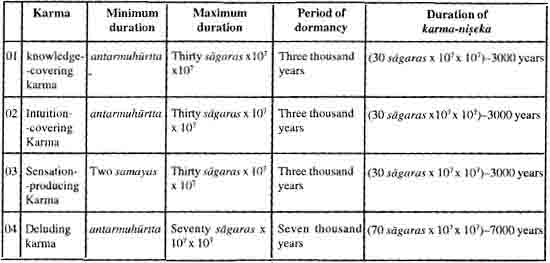
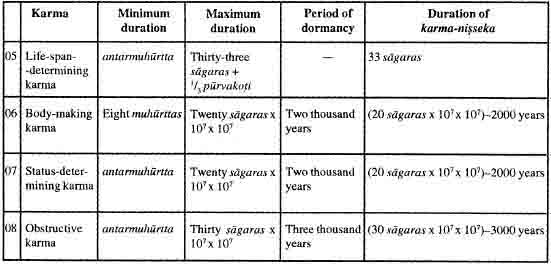
Text
6.35 nānăvaranijjam nam bhamte! kaminam kim itthi bamdhai? puriso bamdhai? napumsao bamdhai? noitthī nopuriso nonapumsao bamdhai? goyamā! itthī vi bamdhai, puriso vi bumdhui, nampusao vi bamdhai. noitthi nopuriso nonapumsao siya bamdhai, siya no bamdhai. evam āugavujjão satta kammappagadīo.
Is1 the knowledge-covering karma, O Lord!' bound by a female? Bound by a male? Bound by a hermaphrodite? (Or) Bound by a soul who is neither female, nor male, nor hermaphrodite?
Gautama! the female also binds, the male also binds, the hermaphrodite also binds it, the soul who is neither female, nor male, nor hermaphrodite, in some respect binds it, in some respect does not bind.
In the same way, excluding the life-span-determining karma, all the remaining seven types of karma are to be described.
6.36 äugam nam bhamte! kammam kim itthi bamdhai? puriso bamdhai? napumsao bamdhai? noitthi nopuriso nonapumsao bamdhai?
goyamā! itthí siya bamdhai, siya no bamdhai. puriso siya bamdhai, siya no bamdhai. napumsao siya bamdhai, siya no bamdhai. noitthí nopuriso nonapumsao na bamdhai.
Is the life-span-determining karma, O Lord! bound by female? Bound by male? Bound by hermaphrodite? (Or) Bound by a soul which is neither female, nor male, nor hermaphrodite?
Gautama! the female in some respect binds, in some respect does not bind, the male in some respect binds, in some respect does not bind; the hermaphrodite in some respect binds, in some respect does not bind. The soul who is neither female, nor male, nor hermaphrodite never binds.
6.37 nānāvaranijjam nam bhainte! kammam kim samjae bardhai? asamjae bamdhai? sumjuyāsamjae bamdhai? nosamjae noasamjae no samjaya-samjae bamdhai? goyamā! samjae siya bamdhai, siya no bamdhai. asamjae bamdhai, samjayāsamjae vi bamdhai. nosamjae noasamjae nosamjayāsumjae na bamdhai. evam āugavajjão satta vi, äuge hetthillā tinni bhayaņãe, uvarille na bamdhai.
Is the knowledge-covering karma, O Lord! bound by a restrained person? Bound by an unrestrained person? Bound by a restrained-cum-unrestrained person? Bound by one who is neither restrained, nor unrestrained, nor restrained-cum-unrestrained?
Gautama! the restrained person in some respect binds, in some respect does not bind. The unrestrained person binds, also the restrained-cum unrestrained person binds. One who is neither restrained, not unrestrained, nor restrained-cum-unrestrained does not bind.
In the same way, excluding the life-span-determining karma, all the remaining seven types of karma are to be described. As regards the life-span-deter mining karma, the first three (viz., restrained, unrestrained and restrained -cum-unrestrained), in some respect bind it, in some respect does not bind it, and the last one does not bind.
6.38 nānāvaranijjam nam bhamte! kammam kim samaditthhí bamdhai? micchaditthi bamdhai? sammāmicchaditthi bamdhai?
goyamā! samaditthí siya bamdhai, siya no bamdhai. micchadithi bamdhai. samāmicchaditthí bamdhai. evam āugavajjāo satta vi. āuge hetthillā do bhayanāe, sammāmicchadithi na bamdhai.
Is the knowledge-covering karma, O Lord! bound by the person of enlightened world-view? Bound by the person of deluded world-view? Bound by the person of enlightened-cum-deluded world-view?
Gautama! the person of enlightened world-view, in some respects binds, in some respects does not bind. The person of deluded world-view binds, also the person of enlightened-cum-deluded world-view binds.
In the same way, excluding the life-span-determining karma, all the remaining seven types of karma are to be described. As regards the life-span determining karma, the first two bind it occasionally, whereas the last one (i.e., the person of enlightened-cum-deluded world-view) does not bind.
6.39 nānāvaranijjam nam bhamte! kammam kim sannibamdhai? asanni bamdhai? nosannī noasanni bamdhai? goyamā! sanni siya bamdhai, siya no bamdhai. asanni bamdhai. nosannī noasanni na bamdhai.
evam vedanijjāugavajjão cha kammappagadio. vedanijjam hetthillā do bamdhamti, uvarille bhayanăe. âugam hetthillă do bhayaņãe, uvarille na bamdhai.
Is the knowledge-covering karma, O Lord! bound by the soul, possessed of mind? Bound by the soul, not possessed of mind? Bound by one who is neither possessed of mind nor not possessed of mind?
Gautama! the soul, possessed of mind, in some respect binds, in some respect, does not bind; the soul, not possessed of mind, binds; one who is neither possessed of mind nor not possessed of mind does not bind.
In the same way, excluding the sensation-producing karma and life-span -determining karma, all the remaining six types of karma are to be described. As regards the sensation-producing karma, the first two bind it, the last one in some respect binds, in some respect does not. As regards the life-span determining karma, the first two in some respect bind it, in some respect do not; the last one does not bind.
6.40 nāņāvaranijjam nam bhamte! kammam kim bhavasiddhie bamdhai? abhavasiddhie bamdhai? nobhavasiddhie noabhavasiddhie bamdhai?
goyamā! bhavasiddhie bhayanāe. abhavasiddhie bamdhai. nobhavasiddhie noabhavasiddhie na bamdhai.
evam äugavajjāo satta vi. āugam hetthilla do bhayaņãe, uvarille na bamdhai.
Is the knowledge-covering karma, O Lord! bound by the bhavasiddhika soul, destined to attain liberation? Bound by the abhavasiddhika soul, destined not to attain liberation? Bound by the soul that is neither bhavasiddhika nor abhavasiddhika?
Gautama! the bhavasiddhika occasionally binds, the abhavasiddhika binds, while the soul that is neither bhavasiddhika nor abhavasiddhika does not bind.
In the same way, excluding the life-span-determining karma, all the remaining seven types of karma are to be described. As regards the life-span-deter mining karma, the first two in some respect bind it, the last one does not bind.
6.41 nănāvaranijjam nam bhamte! kammam kim cakkhudumsani bamdhai? acakkhudamsanī bamdhai? ohidamsanī bamdhai? kevaladamsanī bamdhai?
goyamā! herhillā tinni bhayaņāe, uvarille na bamdhai. evam vedanijjavajjão satta vi. vedanijjam hetthillā tinni bamdhamti, kevala dansani Bhayanặe.
Is the knowledge-covering karma, O Lord! bound by the soul, possessed of visual intuition? Bound by the soul, possessed of non-visual intuition? Bound by the soul, possessed of clairvoyant intuition? Bound by the soul, possessed of onniscient intuition?
Gautama! the first three in some respect bind, in some respect do not bind, the last one never binds.
In the same way, excluding the sensation-producing karma, all the remaining seven types of karma are to be described. As regards the sensation-producing karma, the first three bind it, while the souls with omniscient intuition, in some respect bind, in some respect do not bind.
6.42 nănăvaranijjam nam bhamte! kammum kim pajjattae bamdhai? apajjattae bamdhai? nopajjattae noapajjattae bamdhai? goyamā! pajjattae bhayaņãe, apajjattae bamdhai. nopajjatiae noapajjattae na bamdhai. evam āugavajjão sattu vi, augam hetthillā do bhayanāe, uvarille na bamdhai.
Is the knowledge-covering karma, O Lord! bound by the soul, with bio-poten tial accomplished? Bound by the soul, with bio-potential not accomplished? Bound by the soul which is not amenable to bio-potential accomplished or not accomplished?
Gautama! the souls, with bio-potential accomplished, in some respect bind, in some respect do not bind, the souls, with bio-potential not accomplished bind, the souls which are amenable to bio-potential accomplished or not accomplished do not bind.
In the same way, excluding the life-span-determining karma, all the remaining seven types of karma are to be described. As regards the life-span-deter mining karma, the first two, in some respect bind it, in some respect do not bind. The last one never binds.
6.43 nāņāvaranijjam nam bhamte! kammam kim bhāsae bamdhai? abhāsae bamdhai?
goyamā! do vi bhayanāe.
evam vedanijjavajjão satta vi. vedanijjam bhāsae bamdhai, abhāsae bhayanāe.
Is the knowledge-covering karma, O Lord! bound by the bhāsaka (soul equipped with bio-potential of speech)? Bound by the abhāşaka (soul not equipped with or not amenable to bio-potential of speech)?
Gautama! both of them, in some respect bind, in some respect do not bind. In the same way, excluding the sensation-producing karma, all the remaining seven types of karma are to be described. The soul, equipped with bio-poten tial of speech, binds the sensation-producing karma, while the soul, not equipped with bio-potential of speech or not amenable to bio-potential of speech, in some respect binds and in some respect does not.
6.44 nānāvaranijjam nam bhamte! kammam kim paritte bamdhai? aparitte bamdhai? noparitte noaparitte bamdhai?
goyamā! paritte bhayaņãe, aparitte bamdhai. noparitte noaparitte na bamdhai. evam āugavajjāo sutta kammappagadīo. āuyam paritte vi, aparitte vi bhayaņāe, noparitte noapuritte na bamdhai.
Is the knowledge-covering karma, O Lord! bound by the parīta (i.e., soul with an individual body (i.e., not sharing a collective body) or soul in mundane existence with a termination)? Bound by the aparīta (i.e., soul sharing a collective body or soul in mundane existence without termination)? Bound by the no-parīta, no-aparīta (i.e. soul which is neither parīta nor aparīta i.e., soul which is neither with an individual body nor with a collective body or neither in mundane existence with termination nor in mundane existence without termination)?
Gautama! the parīta, in some respects binds, in some respects does not bind, the aparīta binds, the soul which is neither parīta, nor aparīta does not bind. In the same way, excluding the life-span-determining karma, all the remaining seven types of karma are to be described. Both parīta as well as aparita in some respect binds the life-span-determining karma and, in some respect, do not bind. The soul which is neither parīta nor aparīta does not bind.
6.45 nāṇāvaranijjam nam bhamte! kammam kim ābhinibohiyanāni bamdhai?
suyanāņi bamdhai? ohināņi bamdhai? manapajjavanāni bamdhai? kevalanānī bamdhai?
goyamā! hetthillä сattāri bhayanāe. kevalanānī na bamdhai.
evam vedanijjavajjāo satta vi. vedanijjam hetthillä сattāri bamdhamti, kevalanānī bhayaņāe.
Is the knowledge-covering karma, O Lord! bound by the soul, with empirical knowledge? Bound by the soul, with articulate knowledge? Bound by the soul, with clairvoyant knowledge? Bound by the soul, with mind-reading knowledge? Bound by the soul, with omniscient knowledge?
Gautama! the first four in some respects bind, in some respects do not bind; the soul, with omniscient knowledge, does not bind.
In the same way, excluding the sensation-producing karma all the remaining seven types of karma are to be described. As regards the sensation-producing karma, the first four bind it, the soul, with omniscient knowledge, in some respects binds it, in some respects does not bind.
6.46 nānāvaranijjam nam bhamte! kammam kim maiannāni bamdhai? suyaannāni bamdhai? vibhamganāni bamdhai?
goyamā! āugavajjão satta vi bamdhamti, āugain bhayanāe.
Is the knowledge-covering karma, O Lord! bound by the soul of deluded world-view with empirical knowledge? Bound by the soul of deluded world view with articulate knowledge? Bound by the soul of deluded world-view with clairvoyant knowledge?
Gautama! excluding the life-span-determining karma,
they bind all the remaining seven types of karma. They, in some respects bind the life-span-determining karma, in some respects do not bind it.
6.47 nāņāvaranijjam nam bhamte! kammam kim marajogi bamdhai? vaijogi bamdhai? kāyajogi bamdhai? ajogi bamdhai? goyamā! hetthillä tinni bhayanãe, ajogi na bamdhai. evam vedanijjavajjão satta vi. vedanijjam hetthillā bumdhamti, ajogi na bamdhai.
Is the knowledge-covering karma, O Lord! bound by a soul with mental activity? Bound by a soul with verbal activity? Bound by a soul with physical activity? Bound by a soul with no activity? Gautama! the first three, in some respects bind, in some respects do not bind. The soul without activity does not bind. In the same way, excluding the sensation-producing karma, all the remaining seven types of karma are to be described. As regards the sensation-producing karma, the first three bind it, the last does not bind.
6.48 nāņāvaranijjam nam bhamte! kammam kim sägārovautte bamdhai? aņāgārovautte bardhai?
goyamā! atthasu vi bhayaņāe.
Is the knowledge-covering karma, O Lord! bound by a soul, with determinate knowledge? Bound by a soul, with indeterminate knowledge? Gautama! they in some respects bind all the eight types of karma, in some respects do not bind.
6.49 nāņāvaranijjam ņam bhamte! kammam kim āhārae bamdhai? uņāhārae bamdhai?
goyamū! do vi bhayaņāe. evam vedanijjāugavajjānam chanham, vedanijjam āhārae bamdhai, anūhārae bhayaņāe. õue āhārae bhayaņāe, anāhārae na bamdhai.
Is the knowledge-covering karma, O Lord! bound by a soul that is consu ming nourishment? Bound by a soul that is not consuming nourishment? Gautama! Both of them in some respects bind, in some respects do not bind. In the same way, excluding the sensation-producing and life-span determining karmas, the remaining six types of karma are to be described. As regards the sensation-producing karma, the soul that is consuming nourishment binds it; the souls that are not consuming nourishment in some respects bind, in some respects do not bind. As regards the life-span determining karma, the soul that is consuming nourishment in some respects binds it, in some respects does not bind; the soul that is not consuming nourishment does not bind.
6.50 nănāvaranijjam ņam bhamte! kammam kim suhume bamdhai? bādare bamdhai? nosuhume nobādare bamdhai?
goyamā! suhume bardhai, bādare bhayanāe. no suhume nobādare na bamdhai. evamăugavajjão satta vi. Āugam suhume bādare bhayaņāe. nosuhume nobādare na bamdhai.
Is the knowledge-covering karma, O lord! bound by a subtle (invisible) soul? Bound by a gross (visible) soul? Bound by a soul that is neither subtle nor gross?
Gautama! the subtle soul binds; the gross souls in some respects bind, in some respects do not bind; the soul that is neither subtle nor gross does not bind.
6.51 nănāvaranijjam nam bhamte! kammam kim carime bamdhai? acarime bamdhai?
goyamā! ațsha vi bhayaņāe.
Is the knowledge-covering karma, O Lord! bound by a soul that will have the last mundane existence? Bound by soul that will not have the last mundane existence?
Gautama! both of them, in some respects bind all the eight types of karma, in some respects do not bind.
Bhāsya
1. Sūtras 35-51
The soul, with sexual disposition, free from sexual disposition
Until the beginning of the ninth stage of spiritual development, the soul is possessed of sexual disposition. In the last part of the ninth stage, it becomes free from such disposition. In that state which is devoid of sexual disposition up to the tenth stage, the soul may bind the knowledge-covering karma. After that, in the eleventh, the twelfth and the thirteenth stages, there is no bondage of knowledge -covering karma.' There is no binding of life-span-determining karma in the stages that followed the seventh stage. So the soul devoid of sexual disposition can not bind life-span-determining karma. The bondage of life-span-determining karma lakes place only once in the whole life-span-determining. So, the binding of life -span-determining karma has been described as occurring only occasionally. The life-span-determining karma is bound at the time that is appropriate to it, it can not be bound at the time that is inappropriate. For the appropriate time of binding the life-span-determining karma, see Bhāsya on 5.59-61.
The binding of the knowledge-covering karma is possible only up to the ninth stage of spiritual development. If the soul (free from sexual disposition) which is in the ninth stage starts binding it, it would continue the same up to the tenth stage, but if it stops it there, then it is not possible in the stages that are higher. This is why the binding of knowledge-covering karma has been characterised as taking place in case of some and impossible in others.
The restrained and the unrestrained soul
The soul that is neither restrained, nor unrestrained, nor restrained-cum-un restrained is the liberated one, which has no cause for binding any karma. So ipso facto, there is no bondage of knowledge-covering karma. The description of the bondage of six types of karma, viz., intuition-covering karma, etc. is exactly the same as that of knowledge-covering karma. So far as the binding of life-span determining karma is concerned, the souls that are restrained, unrestrained or restrained-cum-unrestrained bind occasionally, but those who are neither restrained, nor unrestrained nor restrained-cum-unrestrained (in one word, the liberated souls) never bind it.
The soul, with enlightened world-view
There are two types of soul, with enlightened world-view: those that are with attachment and those that are without attachment. The former bind knowledge -covering karma, the latter do not.
The soul, possessed of mind etc.
Among the souls, possessed of mind, those that are without attachment do not bind knowledge-covering karma, but those who are with attachment do bind. The souls that are neither with mind nor without mind are kevali and siddha. They do not bind knowledge-covering karma. The souls with mind as well as the souls without mind bind sensation-producing karma. Among the kevalī, the souls with activity bind sensation-producing karma. But the kevalīs who have ceased from activity and siddhas do not. So in the third alternative, there is the relative statement(bhajanā) of some binding and some not binding sensation-producing karma.
Bhavasiddhika (bhavya) (Souls worthy of liberation)
There are two types of bhavasiddhika souls; those that are without attachment and those that are with attachment. The former do not bind the knowledge-covering karma, whereas the latter do. So there is bhajanā. The third alternative refers to the liberated soul who does not bind karma.
Intuition
The souls with the veil of ignorance but free from attachment do not bind knowledge-covering karma, the rest do. So there is the mention of bhajanā in the case of souls, with visual intuition, non-visual intuition and clairvoyant intuition, The souls, with omniscient intuition and indulging activity, bind sensation-producing karma. The omniscient with intuition and who have ceased from activity and the liberated souls do not bind karma. So there is no mention of bhajanā.
The souls, with bio-potential accomplished
The souls free from attachment and bio-potential accomplished do not bind the knowledge-covering karma. The souls, with attachment and bio-potential, accomplished do bind. So there is mention of bhajanā. The third alternative refers to the liberated souls who do not bind karma.
The souls, free from attachment and speech-bio-potential accomplished, do not bind knowledge-covering karma, but the souls, with attachment, do. The second alternative refers to the following four kinds of soul: viz., abhāsaka kevalī who have ceased from doing activity, the liberated soul, one-sensed soul and soul in transit. Among them the first two do not bind knowledge-covering-karma, but the other two do. So this is subject to bhajanā. Again the first two do not bind the sensation-producing karma, whereas the last two do.
Parīta-aparīta
'Parīta' has two meanings: the soul, with individual body, and the soul, with terminus of the worldly existence. 'Aparīta' means the soul, with common body, and soul, without terminus of worldly existence. The parīta soul, free from attachment, does not bind knowledge-covering karma, the parīta soul, with attachment, does bind.
Knowledge
If the souls, with the first four varieties of knowledge, viz., empirical knowledge etc., are free from attachment, they do not bind (as in the eleventh stage of spiritual development); if they are with attachment, they bind. The fifth alternative refers to the following three kinds of soul: the kevalī, with activity, the kevalī who have ceased from activity and the liberated soul. Out of these three, the kevali, indulging in activity, binds sensation-karma, the other two do not. The soul, free from attachment, and the kevalī, indulging in activity, do not bind the knowledge-covering karma. So it is subject to bhajanā.
Pervert's Knowledge (Ajñāna)
All the three types of ajñānī (knowledge of soul, with deluded world-view) viz., mati-ajñānī, śruta-ajñāni, and vibhanga-ajñāni, are soul with attachment. So, they bind the seven types of karmas except the life-span-determining karma, as explained in the case of 'Soul, with sexual disposition'.
Yoga (Activity)
All the three types of souls, indulging in activity who are with attachment, bind the knowledge-covering karma, but those who are free from attachment do not bind knowledge-covering karma; therefore, they are subject to bhajanā. The souls who have ceased from activiy (i.e. ayogi) never bind any karma. Similar description about the binding of other seven karmas except the vedanīya karma should be made here. All the three types of souls, indulging in activity, bind the vedanīya karma, the ayogi never binds.
The souls, with determinate and indeterminate knowledge
The souls, with determinate and indeterminate knowledge, indulging activity bind karma, but those who have ceased from activity do not.
The souls that consume or do not consume nourishment
The souls that are free from attachment and the kevalīs, consuming nourishment, do not bind knowledge-covering karma. The souls, with attachment, consuming nourishment, do bind. At the third, fourth and fifth time-units during expansion of the soul-units by the kevali when he remains without consuming nourishment, he does not bind knowledge-covering karma. The soul in-transit, when not consuming nourishment, binds knowledge-covering karma. The kevali expanding his soul -units, and the soul in-transit, not consuming nourishment, bind sensation-producing karma, the kevalī who have ceased from activity and the liberated soul do not bind sensation-producing karma.
Subtle and gross living beings
The one-sensed beings are both subtle and gross; others are only gross. On account of the rise of the the body-making karma responsible for subtle (physical) body, the corporeal constitution of subtle living beings is extremely fine. Their body, though composite, is not perceptible to eyes. The gross beings free from attachment do not bind knowledge-covering karma, the gross beings with attachment do bind. The souls that are neither subtle nor gross are the liberated ones who do not bind.
The souls, with and without the last birth
The soul that will have the last birth is called carama. The soul that will never have the last birth is acarama. The carama soul, indulging in activity, binds all the eight types of karma according to the occasion. The carama soul who has ceased from activity does not bind. So it is subject to bhajanā. The mundane acarama soul binds all the eight types of karma. The liberated soul has no reincarnation, and hence, from this point of view, he is also acarama; such acarama soul does not bind any karma (i.e., he is always abandhaka). So, acarama is also subject to bhajanā.
Text
Vedagāvedagāņa jīvānam appābahuyatta-padam
6.52 eesinam bhamte! jīvānam itthīvedagānam, purisavedagāṇam, napumsaga vedagānam, avedagāna ya kayare kayarehimto appā vā? bahuyā vā? tullā vā? visesahiyữ vă? goyama! savvatthovā jīvā purisavedagā, itthivedagā samkhejjagunā, avedagā anamtagunā, napumsagavedagā anamtagunā. eesim savvesim padānam appa-bahugāim uccăreyavāim jāva savvathhovā jīvā acarimā, carimā anamtaguņā.
The Topic of Relative Numerical Strength of Souls, with Sexual Disposition and of Souls, free from It.
Between the souls, with female, male and hermaphroditic dispositions, and also souls, free from sexual disposition, who are less, more, equal and slightly more in number?
Gautama! the least are the souls, with male disposition, numerable times them are the souls, with female disposition, infinite times them are the souls, free from sexual disposition, infinite times them are the souls, with hermaphroditic disposition.
The relative numerical strength of all the topics (the restrained etc.) is to be described ...... up to the least in number are the acaramas, infinite times are the carama.
Bhāsya
1. Sūtra 52
On the basis of the presence and extinction of the sexual disposition, the souls are divided into four classes; [1] souls, with female disposition (2) souls, with male disposition [3] souls, with hermaphroditic disposition (4) souls, free from sexual disposition. The relative numerical strength of the topic in the present Sūtra (no. 52) and of the topics in Sūtras 36 to 51 are given in the following tables:

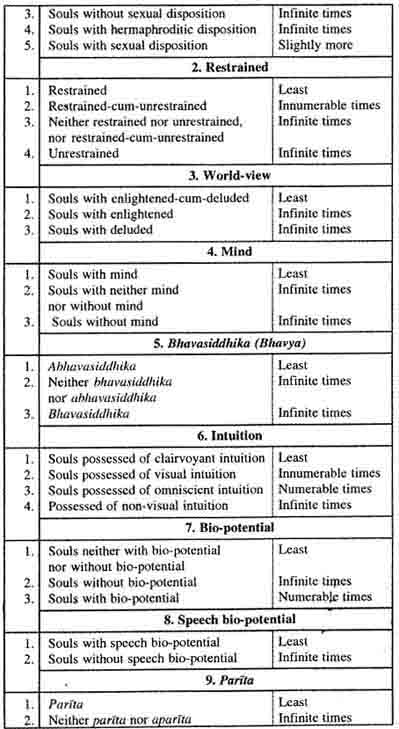
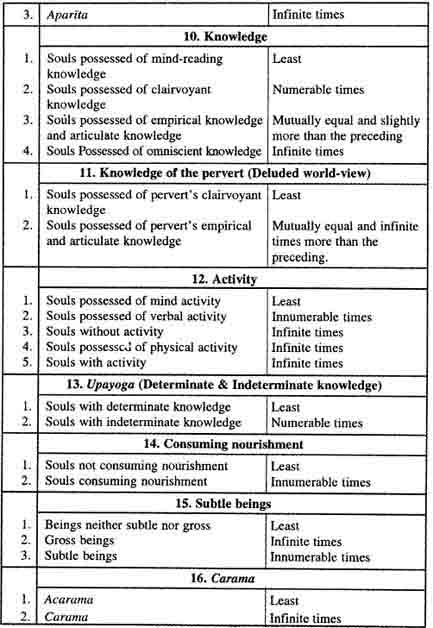
Text
6.53 sevam bhamte! sevam bhamte! tti.
That is so, O Lord! That is so, O Lord!
1.Ta. Rā. Vā. 6.5m-yogatrayasya ekonacatvāriņsatprabhedāḥ sarvātmakāryatvāt samsāriņām sarveşām sādhāranān.
2.Ta. Sū. 6.5m-indriyakaṣāyāvratakriyāḥ pañca catuḥ pañca pañcaviņśati samkhyāḥ pūrvasya bhedāḥ.
3.Bha. Vs. 6.20.--ātmā bāhyātmā śarīramityarthaḥ.
4.Ibid., 6.20-'sayā samiyam' tti 'sadā' sarvadā sadātvam ca vyavahārato'sātatye'pi syādityata āha 'samitam' santatam.
5.Ibid., 6.20m-*ajjhiyattāe' tti bhidhyā lobhah să samjātā yatra so bhidhyito na bhidhyino'bhidhyita stadbhāvastattā tayā.
6.Ibid., 6.21. ahayassa va' tti aparibhuktasya.
7.Ibid., 6.20-tamtrāt turīvemāderapanītamātrasya.
1.Thāṇam, 3.336~--se nam bhamte! dukkhe kena kade? jīveņam kade pamādeņam.
2.Ta. Sū. Bhā. Vị. 8.25_--nāmakarmaņa uttaraprakstiḥ śarīranāmāntargatā bandhananāma tatpratyayāḥ kila pudgalā iti. tacca gļhītagshyamānapudgalānāmanyaśarīrapudgalairvā sambandho yasya karmaņa udyād bhavati, kāșthadvayabhedaikadhyakarane jatuvaditi.
3.Ibid., 8.25-nāma pratyayāḥ sarvato yogaviseşāt sūksmaikakşetrāvagādhasthitāḥ sarvātmapradeśeșu anantānantapradeśāḥ.Bhāşya—nāmapratyayāḥ pudgalāḥ bandhyante. nāmapratyaya eşām te ime nāmapratyayāḥ. nămani mittā nāmahetukā nāmakāraṇā ityarthaḥ. ?īkām-samjñānāmanvartham sarvakarmaņāmukta jñānāvaraṇādyantarāyaparyavasānam tasya pratya yä-kāraṇānītişaşthi samāsaḥ. na hi tānantarena tadākhyodayādi sambhavo muktasyevātmanaḥ samsāriņaḥ prathamapraśnaḥ. evam dvitiyavikalpaḥ kimpratyayā veti dvitiyabhedā śrayaņena bhāșyam-nāma pratyaya eşām te ime năma pratyayā iti bahuvrihiḥ anyapadārthaśca, gatijātyādibhedam nāmakarma. audārikaśarīrādayo yogāḥ karmaṇo nimittatām pratipadyante pāramparyeņa gatyādayo'pītyato nāmakarmakaraņāḥ pudgalā badhyanta iti.
4.Ibid., 5.124viśrasā---svabhāvah prayoganirapekso viśrasābandhah.
1.(a) Bha. 1.291.
(b) Teraha Dvāra, by Ācārya Bhikṣu, dvāra-2.
2.Bha. Vị. 6.29~-airyāpathikakurmano hi abaddhapūrvasya bandhanāt sāditvam, ayogyavasthāyām śrenipratipati vā’bandhanāt saparyavasitatvam.
1.(a) Pā. Yo. Da. Vyāsa-bhāsya, 1.24m-kaivalyam prāptāstarhí samti ca bahavaḥ kevalinaḥ te hi trīņi bandhanāni chitvā kaivalyam prāptāḥ, īśvarasya ca tatsambamdho na bhūto na bhāví. yathā muktasya pūrvã bandhakotiḥ prajñāyate naivamiśvarasya, yathā vā prakstilīnasya uttară bandhakoțiḥ sambhāvyate naivamīśvarasya sa tu sadaiva muktah sadaiveśvara iti. (b) See Bhāsya of Bha. 1.288-307.
2.Uttara. 36.65
egetteņa sāīyā, apajjavasiyā vi ya।
puhatteņa aņāīyā, apajjavasiyā vi ya If
3.Bha. 18.2-siddhe ņam bhamte! siddhabhāvenam kim padhame? apadhame? goyamā! padhame, no apadhame.
4.Anyayogavyavacchedikā, 29—
muktopi vābhyetu bhavam bhavo vā bhavasthaśūnyo'stu mitātmavāde।
sadjīvakāyam tvamanantasamkhyamākhyastathā nātha! yathā na dosah ॥
5.Bha. Vị. 6.29-bhavasiddhikänām bhavyatvalabdhiḥ siddhatve'petītikstvā'nādiḥ saparyavasitā ceti.
6.Bha. 12.50-52.
1.Ta. Sü. Bhā. Vr. 8.25m-nanu caikākārā eva pudgalāh samādīyante na tu jñānāvaraņādivisistāh kecid bahiḥ santīti ucyate--satyametat. vayam tvidamabhiddhmahem-jñānāvaraņādikānām sarvāsām mūlaprakstīnām karma-bhedānāņ sāmarthya'nye na yogānām karmavarganānām grahamņamām nāyate. tataḥ samānyagļhītānāmadhyavasāyaviseșāt pşthak-prthak jñānāvaraņādibhedatvena pariņamayatyātmeti.
2.Ibid., 8.4tatra prakstirmaulam kāraṇam mțdiva ghatādibhedānāmekarūpapudgalagrahanam, ataḥ prakriyante'sya sakāśāditi akartarītyanuvștterapādānasādhanā prakrtih.
3.Ibid., 8.4-svabhāvavacano vā prakstiśabdah. dustaprakstirdustasvabhāva iti prasiddhah. jñ ānāvaranam jñānācchādanasvabhāvam maulabhedataḥ, evam darśanāvaraņādāvapi yojyam. svabhāvavacanatve ca bhāvasādhanah prakrtiśabdah.
4.Ta. Rā. Vā. 8.23---tāḥ punaḥ karmaprakstaiyo dvividhāḥ--ghātikā aghātikascetiḥ, tatra jñānadarśanā varana mohāntarāyākhyā ghātikāḥ. itarā aghātikāḥ.
5.Bha. VỊ, 6.34abadhayũ uktalaksanaya @nika abadhonika karmmauthith karmāvasthãnakala uktalaksanah karma-niseko bhavati. tatra karmaniscko nāma kurmadalikasyānubhavanārtham racanāvisesaḥ, tatra ca prathamasamaye bahukam nişiñcanti dvitīyasamaye višeșahīņam trtiyasamaye vişeşahīnamevam yāvadutkęstasthitikam karmudalikam tāvad višesahīnam nişiñcati. tathă coktam mottūņa sagamabāham padhamãe thiğe bahutaram davvam! sese visesanahīņam jā ukkosamti savvāsim !
6.Karma Prakrti, Bamdhanakarana, gāthā 74
āucaukkukkoso pallásamkhejjabhāgamamanesū ।
sesāna puvvakodi, autibhāgo sāvāhāsim ॥
7.Pam. Sam. p. 244, gāthā 393—
ssasayam abāhākodākodi thidissa jalahīnam ।
sattanham kammāņam āussa du puvvakoditaiamso ॥
8.Bha. VỊ. 6.48_navaramấyuji trayastrimsats&garopamāni nisekah cũrvakoti tribhāgascabidhākala iti.
9.Panna, 23.78~80.
10.Pam. Sam. p.246devanirayāugāņam ukkosago țhiibamdho tettīsam sāgaropamāņi puvvakodi tibhāgāhiyāņi, puvvakodi tibhāgo abāhā abāhāe viņā kammatthhis kammaņisego.
11.Ibid., gāthă 395—
abādhūņaţthi dī, kammaniseo hoi sattakammāņam।
thidimeva niyā savvā, kammaņiseo ya āussa॥
1.Bha. Jo. 99.70-73.
2.Bha. Vị. 6.36m-tatra satryāditrayamāyuḥ syādbadhnati syānna badhnāti, bandhakāle badhnâni abamdhakāle tu na badhnāti, āyuśaḥ sakydevaikatra bhave bandhāt, nivíttastryādivedastu na badhnāti, nivsttibādarasamparāyādi gunasthānakesvāyurbandhasya vyavacchinnatvāt.
3.Bha. 7.1-A soul can remain without nourishment in the transit for one or two samayas (time -units).
♦
Fourth Section
Cauttho Uddeso
Section-4
[Introductory Note by English Translators—
An entity passes through time. When an entity comes into an existence, it has no samaya (indivisible time-unit). Technically, it is called apradeśa, literally, it means 'without samaya' or precisely speaking 'with only one samaya'. In the second instant of its duration, the entity has two-samayas and so on. Then the entity is called sapradeśa with reference to its temporal extention or duration. We use the word ‘uni-duration' for apradeśa and 'multi-duration' for sapradeśa, 'multi' standing for duration of two samayus, three samayas, etc..]
Text
Kālādesenam sapadesa-apadesa-padam
6.54 jīve nam bhamte! kālādesenam kim sapadese? apadese? goyamā! niyamā sapadese.
The Topic of "Uni-duration" and "Multi-duration" with reference to Time
'Is' the soul O Lord! of multi-duration or uni-duration with reference to time?
Gautama! it is necessarily of multi-duration .
6.55 neraie nam bhamte! kālādesenam kim sapadese? apadese?
goyamä! siya sapadese, siya apadese.
Is the infernal, O Lord! of multi-duration or uni-duration with reference to time?
Gautama! from some point of view, it is of multi-duration, from some point of view, it is of uni-duration.
6.56 evam jāva siddhe.
In the same way ...... up to the liberated souls.
6.57 jīvā nam bhamte! kālādesenam kim sapadesā? apadesā? goyamā! niyamā sapadesā.
Are the souls, O Lord! of multi-duration or uni-duration with reference to time?
Gautama! they are necessarily of multi-duration.
6.58 neraiyā nam bhamte! kālādesenam kim sapadesā? apadesa?
goyamā! 1. savve vi tāva hojjā sapadesā 2. ahavā sapadesá ya apadese ya 3, ahavā sapadesā ya apadesā ya..
Are the infernals, O Lord! of multi-duration or uni-duration with reference to time?
Gautama! (1) sometimes all are of multi-duration, [21 or many are of multi duration and a single one is of uni-duration, [3] or many are of multi-duration and many are of uni-duration.
6.59 evam jāva thaniyakumāra..
In the same way ..... up to the Mansion-god Stanitakumāras.
6.60 pudhavikāiyā ņam bhamte! kim sapadesă? apadesā?
goyamā! sapadesă vi, apadesā vi.
Are the earth-bodied beings, O Lord! of multi-duration or of uni-duration? Gautama! they are also of multi-duration and they are also of uni-duration.
6.61 evam jāva vanapphaikāiya.
In the same way ..... up to the vegetation-bodied beings.
6.62 sesā jahā neraiya tahā jāva siddhā.
The rest are like the infernals ...... up to the liberated souls.
6.63 āhāragānam jīvegimdiyavajjo tiyabhamgo. aņāhāragānam jīvegimdiyavajjā chabbhamgā evam bhāniyavvā 1. sapadesā vā 2. apadesā vā 3. ahavā sapadese ya apadese ya 4. ahavā sapadese ya apadesā ya 5. ahavā sapadesã ya apadese ya 6. ahavā sapadesā ya apadesā yā. siddhehim tiyabhamgo. bhavasiddhiya, abhavasiddhiyā jahā ohiyā. Nobhavasiddhiyanoabhavasiddhiya -jīva-siddhehim tiyabhamgo. sannihim jīvādio tiyabhumgo. asaņņihim egimdiyavajjo tiyabhamgo, neraiya devamaņuehim chabbhamgo. nosanni-noasunni jīva-maņuya-siddhehim tiya bhamgo. salesā jahã ohiyā, kanhalessă nīlalessā, kaulessā jahā āhārao, navaram jassa atthi eyão. teulessãe jīvādio tiyabhamgo, navaram pudhavikkäiesu, āuvana pphatīsu chabbhamgā, pamhalessasukkalessãe jīvādio tiyabhamgo. alesehim jīva -siddhehim tiyabhamgo, manuesu chahbhamgā. sammadditthim jīvādio tiyabhaingo. vigalimdiesu chabbhamgā. micchaditthîm egimdiyavajjo tiyabhamgo. sammamicchaditthihim chabbhamgā. samjaehim jīvādio tiyabhamgo. assamjaehim egimdiyavajjo tiyabhamgo. samja yasamjaehim tiyabhamgo jīvādio. nosamjaya-noasamjayanosamjayāsamjaya -jīva-siddhehim tiyabhamgo. sakasāïhim jīvadio tiyabhamgo, egimdiesu abhamgakam. kohakasāthim jivegimdiyavajjo tiyabhamgo, devehim chabbhamgā, mānakasai-māyākasäihim jivegimdiyavaijo tiyabhamgo, neraiya-devehim chabbhamgā. lobhakasāīhim jīvegimdiyavajja tiyabhamgo, neraiesu chahbhamgā. akasāi-jīva-manuehim, siddhehim tiyabhamga, ohiyanāne, ābhinibohiyanāne, suyanāne jīvādio tiyabhamgo. vigalimdiehim chabbhamgā. ohināne, manapajjavanāne, kevalanāne jīvādio tiyabhamgo. ohie unnāne, muiannāņe, suyaanņāne, egimdiyavajjo tiyabhamgo, vibham ganāne jīvādio tiyabhamgo. sajogi jahā ohio. manajogī, vaijogi, kāyajogi jīvādio tiyabhaingo, navaram kāyajogi egimdiyā, tesu abhamgayam. ajogī jahā alessā. sügarovautta-anāgārovauttehim jīvegimdiyavajjo tiyabhamgo. savedagā jahā sakasāi. itthivedaka-purisavedaga-napumsagavedagesu jīvādio tiyabhamgo, navuram-napumsagavede egimdiesu abhamgayam. avedagā jahā akasās.
sasurīrī jahă ohio. orāliyaveuvviyasarīrānam jīvegimdiyavajjo tiyabhamgo. āhāragasarīre jīva-manuesu chabbhamgā, teyaga-kammagāim jahā ohiyā asarīrehim jīva-siddhehim tiyabhamgo. āhārapajjattie, sarirapajjattie, imdiyapajjattie, āņāpānapajjattie jīvegimdi yavajjo tiyabhamgo, bhāsā-manapajjatīe jahā saņņi, āhāra-apajjattie jahā aņāhāragā, sariraapajjattie, imdiyaapajjattie, āņāpānaapajjattie jīvegimdi yavujjo tiyabhamgo, neraiya-deva-manuehim chabbhamgā, bhāsā-manaapajjattie jīvādio tiyabhamgo, neraiya-deva-manuehim chabbhamgā.
(Ahārakas-Anāhārakas)--Among 'the souls, that are consuming nourish ment' (āhārakas), excluding the topic of 'jīva' and the topic of 'one-sensed being', there are three alternatives (see 5.58). Of the souls, not consuming, nourishment (änähärakas), excluding the topic of 'jīvas' and the 'one-sensed beings', there are six alternatives thus: (1) many of multi-duration (2) or many of uni-duration [3] or a single one of multi-duration and a single one of uni-duration [4) or a single one of multi-duration and many of uni-duration [5] or many of multi-duration and a single one of uni-duration [6] or many of multi-duration and many of uni-duration. There are three alternatives in the case of the liberated souls (see 6.58),
(Bhavasiddhikas etc.)-The bhavyas and abhavyas are like the 'sīvas' as general (see 6.57). There are three alternatives each in the case of the souls, that are neither bhavya nor abhavya' and 'the liberated souls'. (Samjñi etc.)-- In the topics of jīva etc. (group of jīva and infernal etc.), there are three alternatives in the case of 'souls, with mind' (see 6.58). There are three alternatives in the case of 'souls, without mind', excluding the one sensed beings. In the case of the infernals, gods and humans, there are six alternatives. There are three alternatives each in the case of the 'souls, that are neither with mind nor without mind', humans and 'liberated souls'. (Sa-lesyā etc.)--The bhanga-vyavasthā (combination of pattern) in the souls, with leśyā, are like that injīvas as general. Combination-pattern in 'the souls, with black lesya and grey leśyā', is like that in the souls, that are consuming nourishment', (see 6.63), exception being that among āhārakas, only those that have these lesyās are to be selected. Among 'the souls, with fiery leśyā', there are three combination-patterns in the topics of jīva etc. (excluding the infernals, fire-bodied, air-bodied, mobile beings with less than five senses, and the liberated souls, because they are devoid of fiery leśyā), exception being that there is six-membered combination-pattern in the case of earth -bodied, water-bodied and vegetation-bodied beings. Among 'the souls, with yellow lesyã and white lesyā', there is three-membered combination-pattern in the topics of 'five-sensed sub-humans', humans and Empyreans gods. Among the souls, devoid of leśyā', and the liberated souls, there is three -membered combination-pattern. Among the humans, there is six-membered combination-pattern.
(Samyagdrsti etc.)-Among the souls, with enlightened world-view', there is three-membered combination-pattern in the topics of souls, etc.. There is six-membered combination pattern in the case of mobile beings, with less than five senses. There is three-membered combination-pattern in the case of 'souls, with deluded world-view', excluding the one-sensed beings. There is six-membered combination-pattern in the case of 'souls, that are with enlightened-cum-deluded world-view.
(Samyata etc.)-There is three membered combination-pattern in the topics of jīva etc. among 'the souls, that are restrained'. Among the unrestrained souls, excluding the one-sensed beings, there is three-membered combination -pattern. There is three-membered combination-pattern among the 'souls, that are neither restrained nor unrestrained, nor restrained-cum unrestrained', and the liberated souls. (Sa-kaşāyī etc.)-There are three alternatives in the topics of jīva etc. among the souls, with passions. Among one-sensed beings, there is zero combination pattern. There is three-membered combination-pattern among 'the souls, with passion of anger', excluding the jīva and one-sensed beings. There is six-membered combination-pattern among the gods. There is three membered combination-pattern among the souls, with the passions of pride and deceit', excluding the jīva and one-sensed beings. There is six-membered combination-pattern among the infernals and the gods, Among the souls, with the passion of greed', excluding the topics of 'jīva' and one-sensed beings, there is three-membered combination-pattern. There is six-membered combination-pattern among the infernals. There is three-membered combination-pattern in the case of 'souls, without passions', humans and “liberated souls'. (Jñānī etc.)-There is three-membered combination-pattern in the topics of jīva etc. in the case of enlightened souls, with instinctive knowledge, empirical knowledge and articulate knowledge. There is six-membered combination pattern in the case of the mobile souls, with less than five senses. There is three-membered combination-pattern in the topics of jīva etc. related to ‘souls, with clairvoyant, mind-reading and omniscient knowledges'. (Ajñānī etc.)--There is three-membered combination-pattern in the case of the deluded souls, with instinctive knowledge, empirical knowledge and articulate knowledge, excluding the one-sensed souls. There is three-mem bered combination-pattern in the topics of jīva etc. related to clair-voyance of the deluded souls.
(Sa-yogi etc.)-"The soul, with activity' is to be described like the jīva as general. There is three-membered combination-pattern in the topics of jīva etc. related to "the souls, with mental activity, verbal activity and physical activity', excepting that there is zero-combination-pattern among 'the one sensed souls, with physical activity', 'The souls, who have ceased from doing activity' are to be described as the souls, free from leśyā. (Sākāropayoga etc.).There is three-membered combination-pattern among “the souls, with determinate and indeterminate knowledge', excluding jīva and one-sensed beings.
(Sa-vedaka etc.). The souls with sexual disposition' are to be described ‘like the souls with passions'. There is three-membered combination-pattern in the topics of jīva etc. related io 'the souls, with female disposition, male disposition, hermaphroditic disposition', the exception being that there is zero-combination-pattern in the case of “the soul with hermaphroditic disposition' and the one-sensed beings. “The soul free from sexual disposition' is to be described like the souls free from passions'. (Sa-śarīrī etc.).-"The souls with body' are to be described like the souls as general. There is three-membered combination-pattern among the souls, with gross body and protean body', excluding jīvas and one-sensed beings. There is six-membered combination-pattern among 'the souls, with conveyance body' and humans. "The souls, with the fiery body and karmika body', are to be described like soul as general. There is three-membered combination-pattern in the souls, free from body, i.e., the liberated souls. (Paryāptaka etc.)-There is three-membered combination-pattern in the souls, with aliment-bio-potential complete, body-bio-potential complete, sense-bio-potential-complete and respiration-bio-potential complete, excluding jīva and one-sensed beings. The souls, with speech-bio-potential complete and mind-bio-potential complete, are to be described like the souls, possessed of mind'. “The souls, with aliment bio-potential incomplete', are to be described like 'souls, not consuming nourishment. There is three membered combination-pattern among the souls with body bio-potential incomplete, sense-bio-potential incomplete and the respiration bio-potential incomplete', excluding the souls in general and the one-sensed beings. There is six-membered combination-pattern among the infernals, gods and humans. There is three-membered combination-pattern in the topics of jīva etc. related to the souls with the speech-bio-potential incomplete. There are six-mem bered combination-patterns among the infernals, gods and humans, Samgahaņī gāhā sapadesāhāraga-bhaviya
sanni-lessā-ditthi-samjaya-kasāe।
nāne joguvaoge,
vede ya sarīra-pajjatti ॥1॥
Summary Verse
Sapradeśa, souls consuming nourishment, bhavya souls with mind, souls with lesyā, souls with world-view, restrained, souls with passion, souls with knowledge, souls with activity, souls with sentience, souls with sexual disposition, souls with body and souls with bio-potential complete these are the subjects described in the ten Sūtras (6.54-63).
Bhāşya
1. Sūtras 54-63
Sapradeśa and apradeśa are relative terms, which have been critically examined from a number of stand-points. In the present dialogue, the concepts of sapradeśa and apradeśa have been considered with reference to time. The object that originated only one samaya (indivisible time-unit) ago is apradeśa and the object that endured for two samayas or more is called sapradeśa.? This has been explained by the examples of souls in general and infernals. The ‘soul', on account of his being without beginning in time, has endured through infinite number of samayas; so, it is necessarily of 'multi-duration' (sapradeśa). Temporally, the soul can be divided into infinite parts. Thus, his personality with respect to time has infinite parts. This is confirmed in the Uttarădhyayana by the statement--samtaim pappaņāīyā, i.e., souls are without beginning in time with reference to their beginningless continuity of duration.
[English Translator Note-The concept of time is a controversial issue in Jainism. Whether time is a substance or a mode has been discussed in ancient Jain treatises. But a look at the present Sūtra can not but convince that the problem of time was an integral part of Jain cosmogony. It is generally believed that it was Buddhism that explained everything as momentary and the 'continuum' as a series of moments. But if we accept the antiquity of the dialogue under consideration, it will not be improper to say that the concept of samtati as a stream of moments was definitely pre-Buddhist. It is not understandable why this dialogue did not attract the attention of the Jain Logicians who were so enthusiastic about condemning the Buddhist doctrine of momentariness, considering it to be a novel tenet advanced by the Buddha. There are many other dialogues in the Bhagavati Sūtra that are bound to open the mind of the Jain Logicians who appreciate the fact that many a doctrine of Buddhism that appears to be new and unique was anticipated by the dialogues of the Bhagavati Sūtra).
The infernals, the humans, ..... up to the liberated souls are both of multi duration and of uni-duration. At the moment of its origination, every entity is of uni-duration (apradeśa) and it is of multi-duration (sapradeśa) in the successive period of its duration. [In other words, every entity grows temporally as it endures. This concept may be compared with the fourth dimension of time as conceived in modern science in the famous Theory of Relativity given by Albert Einstein).
With reference to many souls, the souls in their totality are necessarily of multi-duration. Among the infernals in plural number, there is three-membered combination-pattern: [1] In the absence of new birth, all the previously born infernals are of multi-duration. [2] In case a new infernal is born among the previously born infernals, there are many infernals of multi-duration and one of uni-duration. [3] When many infernals are simultaneously born among the previously born infernals, there occurs the third combination-pattern-Many of multi-duration and many of uni-duration
Excluding the one-sensed souls, all other souls and the liberated souls have three-numbered combination pattern. The one-sensed beings are both of multi duration and uni-duration: 1. All those souls who were born two and more time units ago are of multi-duration. 2. Among the one-sensed beings, many are freshly born, so they are of uni-duration,
There is also six-membered combination-pattern in the case of the plural number—
There is six-membered combination-pattern in the case of the plural numbered infernals born from the state of 'soul without mind'. The six-membered combination pattern derives in the following way
[1] In the absence of the fresh birth of infernals, all the previously born infernals are of multi-duration.
[2] Some souls are newly born simultaneously: at the time of the birth they are all of uni-duration.
[3] Among those born as infernals from the souls without mind', one soul in the second higher samaya is of multi-duration and one soul in the first samaya is of uni-duration
[4] Among those born as infernals from the souls without mind', one soul in the second or higher samaya is of multi-duration and many souls in the first samaya are of uni-duration.
[5] Among those born as infernals from the souls without mind', many souls in the second or higher samayas are of multi-duration and one soul in the first samaya is of uni-duration.
[6] Among those born as infernals from the souls without mind', many souls in the second or higher samaya are of multi-duration and many souls in the first samaya are of uni-duration. Semantics sapradeśa-with parts, with divisions, of multi-durations. apradeśa-without parts, without division, of uni-duration. aughika jñāna, aughika ajñāna---Jñāna and ajñāna in general; aughika jñāna should not be confused with "ogha jñāna" (or ogha samjñā).
The following tables give a summary of the Sūtras:
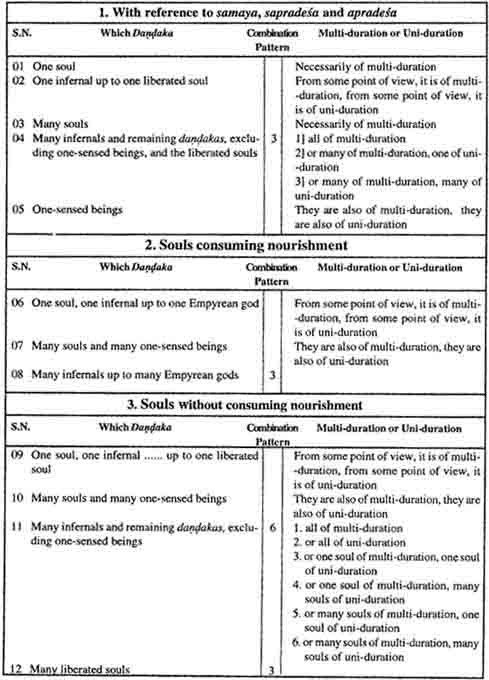
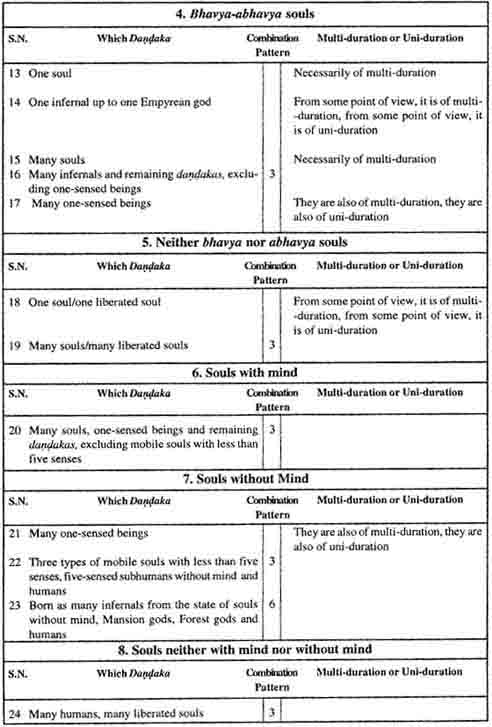
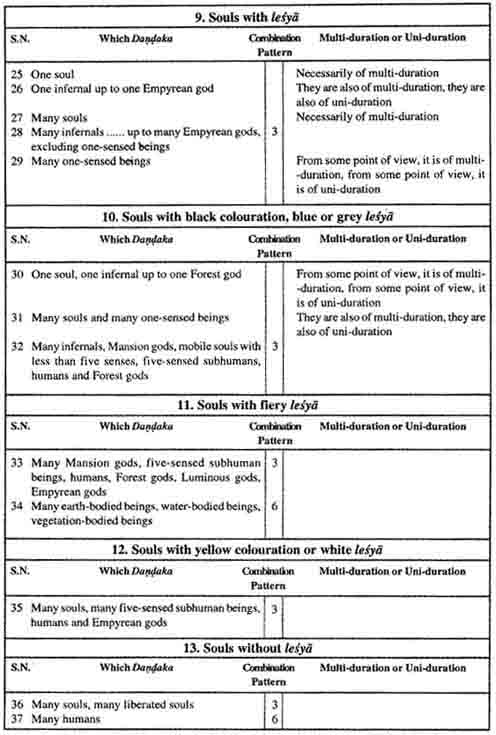
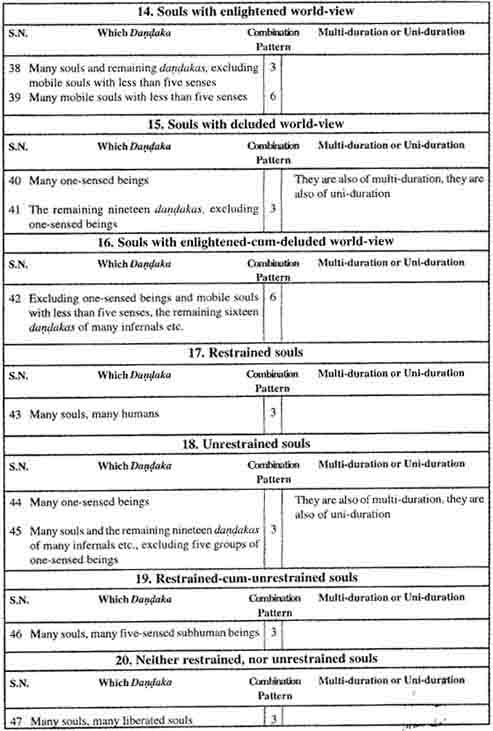
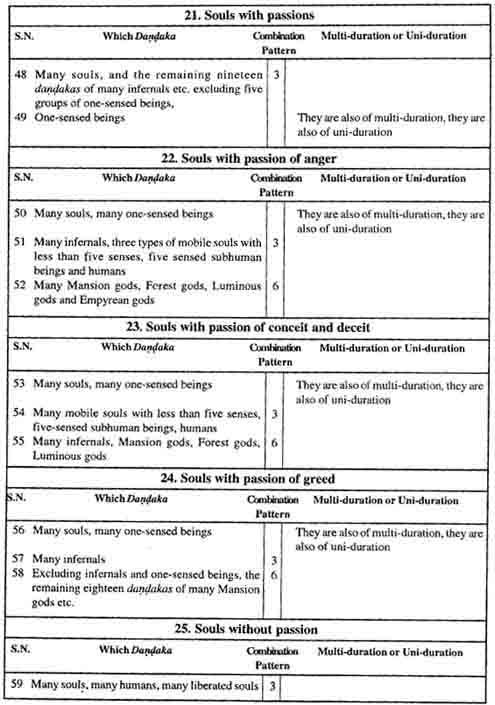
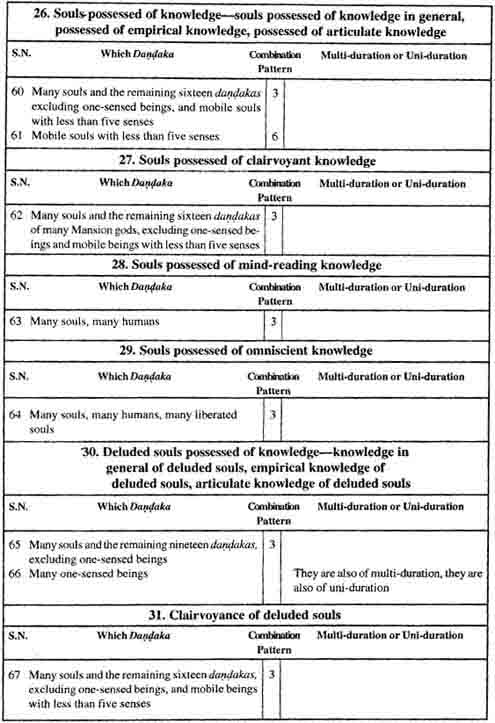
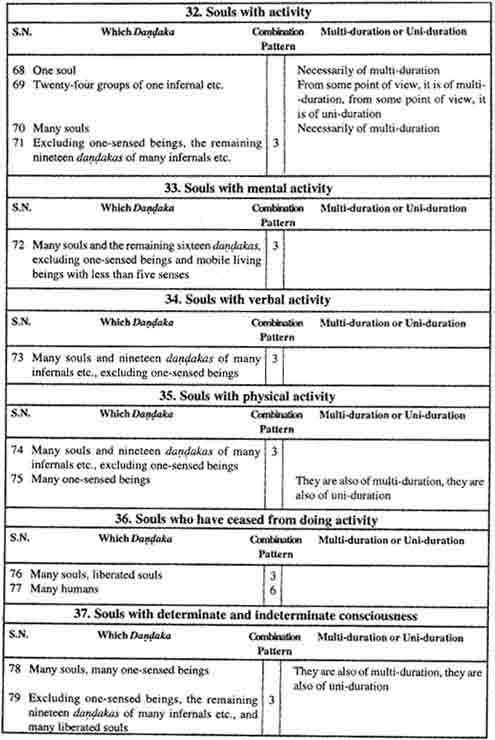
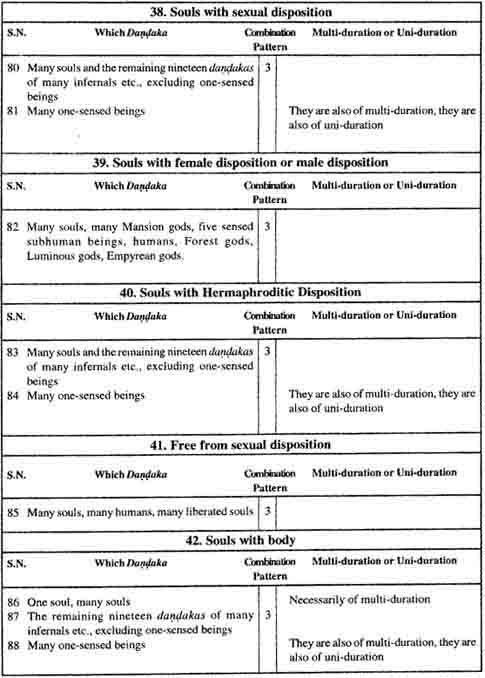
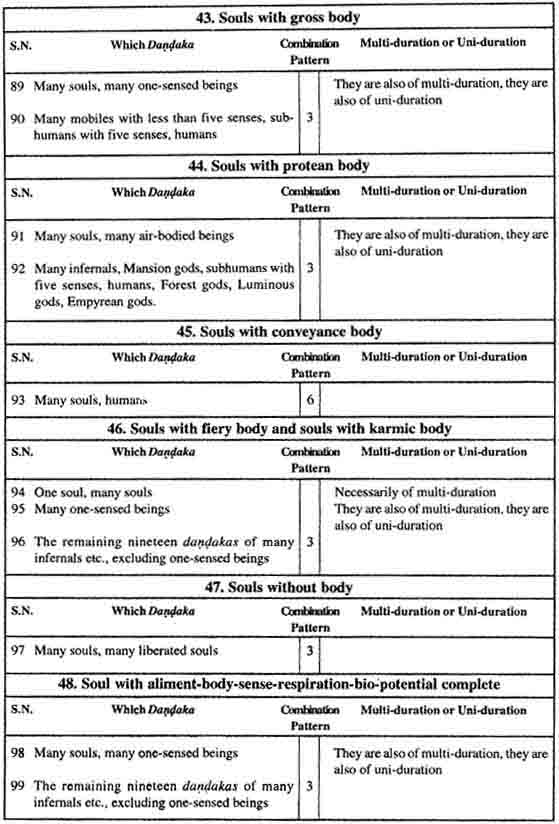
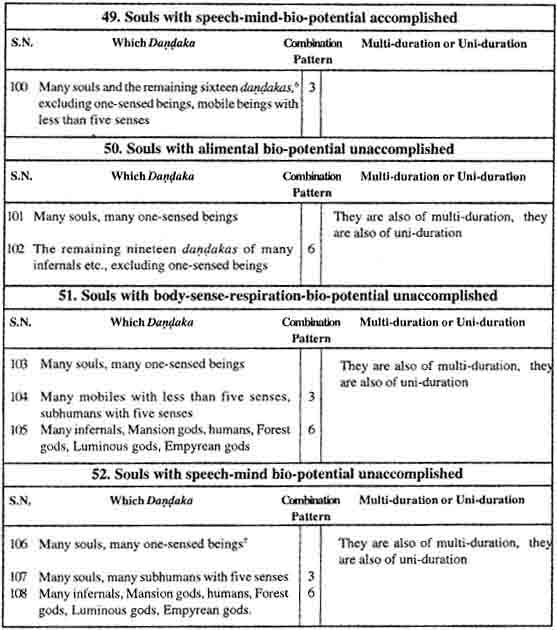
pattern of three combinations is concerned. For, the mobile beings with less than five senses are possessed of speech-bio-potential and as such three combinations are available also to them. In the souls with mind-bio-potential also, three combinations are available. Bha. Vp. 6.63--bhșãmanasoh paryāptirbhāṣāmanahparyāptiḥ, bhāṣāmanaḥ paryāptyostu bahuśrutābhimatena kenāpi kārane naikatvam vivaksitam, tataśca tayā paryāptakā yathā sañiñinastathā sapradeśāditayā vācyāḥ, sarvapadesu bhangakatrayamityarthaḥ, pamcendriyapadãnyeva ceha vācyāni. 6. Including both the souls with unaccomplished speech-bio-potential' and 'those with unaccomplished mind-bio-potential' in the one-sensed beings, Abhayadeva Suri writes Bha. VỊ. 6,63_bhāyāmano_paryặpty='pary&ptakaste yeçãm jātito bhāgāmanoyogyatve sati tadasiddhiḥ, te ca pañcendriyā eva. yadi punarbhāṣāmanasorabhāvamātrena tadaparyāptakā abha vişyamstadaikendriyā api te'bhavișyamstataśca jīvapade tệtiya eva bhangaḥ syāt.
Text
Paccakkhāņādi-padam
6.64 jīvā nam bhamte! kim paccakkhāni? apaccakkhāņi? paccakkhāṇāpacca kkhāni? goyamā! jīvā paccakkhāni vi, apaccakkhāni vi, paccakkhăņāpaccakkhānī vi.
The Topic of Vow to Abandon any Sin, etc.
Are1 the souls, O Lord! the observer of the (total) vow to abstain from sinful activity? (Or) The non-observer? (Or) The observer-cum-non-observer (i.e. observer of a partial vow)? Gautama! the souls are observer of the (total) vow to abstain from sinful activity, also non-observer and observer-cum-non-observer.
6.65 savvajīvānam evam pucchā. goyamā! neraiyā apaccakkhāṇī jāva caurimdiyā (sesă do padiseheyavvā). pamcimdiyatirikkhajoņiyā no paccakkhāņi, apuccakkhāni vi, paccakkhāņā paccakkhānī vi. manūsā tinni vi. sesā jahā neraiyā.
Such query is made about the souls belonging to all groups. Gautama! the infernals, and souls ..... up to the group of four-sensed beings are necessarily non-observer (the other two alternatives, viz., observer and observer-cum-non-observers are not applicable here. The souls, belonging to the group of five-sensed subhuman beings, are not observer of the (total) vow to abandon any sin, but are non-observers and also observer-cum-non observers. The humans are amenable to all the three alternatives. The rest of the groups of beings are to be described like the infernals.
6.66 jīvā nam bhamte! kim paccakkhānam jānamti? apaccakkhānam jānamti? paccakkhāṇāpaccakkhānam jāņamti? goyamā! je pamcidiyā te tinni vi jānamti, avasesā paccakkhānam na jānamti, apaccakkhānam na jāņamti, paccakkhāṇāpaccakkhānam na jānamti.
Do the souls, O Lord! know the observing of (total) vow to abstain from sinful activity? (Or) Know the non-observing? (Or) Know observing-cum-non-observing (i.e., observing of a partial know the vow)? Gautama! the souls that are five-sensed, know all the three (alternatives); the rest do not know any of the three.
6.67 jīvā ņam bhamte! kim paccakkhāņam kuvvamti? apaccakkhānam kuvvamti? paccakkhānăpaccakkhānam kuvvamti. jahā ohio tahā kuvvanā.
Do the souls, O Lord! undertake the observing of (total) vow to abstain from sinful activity? (Or) Undertake the non-observing? (Or) Undertake the observing-cum--non-observing? (i.e., undertake observing of a partial vow)? The observing of the undertaking of (total) vow etc. is to be explained like the general paradigm (as given in Sütras 6.64-65).
6.68 jīvā ņam bhamte! kim paccakkhānanivvattiyāuyā? apaccakkhānivvatti-yāuyā? paccakkhāṇāpaccakkhānanivvattiyāuyā? goyamā! jīvā ya, vemāniyā ya paccakkhānanivvattiyāuyā, tiņni vi. avasesā apaccakkhānanivvattiyāuyā.
Are the souls, O Lord! of life-span bound on the account of the observing of (total) vow to abstain from sinful activity? Life-span bound on account of the non-observing? Life-span bound on the account of the observing-cum -non-observing (i.e., observing of a partial vow)?
Gautama! the souls (in general) and the Empyrean gods are of life-span bound on account of the observing of (total) vow to abandon any sin, non observing and also of life-span bound on account of the observing-cum-non -observing. The souls belonging to the rest of groups are of life-span bound on occount of the non-observing of vow.
Bhāsya
1. Sūtras 64-68
The root Vkhyā with prefix prati + ā has a number of meanings--to abandon (renounce), to abstain from sinful activity, to deny,1 to decline.2
In the present dialogue, pratyākhyāna is a technical term which means--- abandoning (renouncing) all sinful activities. The term pratyākhyāni thus means one who abandons (renounces) all sinful activity, i.e., one who is absolutely abstinent or who is observer of the great vows' (prescribed for an ascetic).
Apratyākhyānī, on the other hand, means--non-abstinentmone who has not undertaken any vow, i.e., who is totally non-observer of any vow. Pratyākhyānā pratyākhyānī means--partially abstinent, or a lay-follower who has undertaken the 12 vows, that is, one who has not undertaken the great vows.(From the point of view of observer of the lay follower's vows, he is "pratyākhyāni”, but from the point of view of non-observer of“great vows of the ascetic," he is “apratyākhyāni”; hence, he is called “Pratyākhyānāpratyākhyāni").
All souls are not equally competent to undertake vows, for more than one reason. The infernals experience very hard suffering. So they have not the disposition to undertake any vow. On the other hand gods experience excessive pleasure, and so, they have no inclination to undertake a vow.
It can thus be said conclusively that extreme suffering and extreme pleasure are detrimental to the undertaking of vows. Only the person who is neither extremely miserable nor extremely happy can observe the vows.
The souls belonging to the groups (dandakas) of the one-sensed ..... up to the five-sensed beings, without the faculty of thinking, are devoid of mind. In absence of rational mind, there can not arise the resolve to undertake any vow. In the five sensed sub-humans with mind, there is only a limited development of the ethical conscience, so they have a capacity only for observing the partial vow.
In the humans, the ethical conscience may develop sufficiently to resolve to undertake not only partial but even total vow.
The doctrine of karma envisages ‘non-observing of vow' (apratyākhyāna) as a general condition of soul, due to the predominance of the apratyākhyāna varanamoha, i.e., deluding karna responsible for the spiritual stupor resulting in the mutilation of the undertaking of any vow.
The apratyākhyānāvarana deluding karma is responsible for absolute non abstinence and the pratyākhyānāvarana for the partial abstinence. When the former is suppressed-cum-eliminated, one can undertake the partial abstinence as a lay follower and when the latter is suppressed-cum-eliminated, one can undertake total abstinence (as an ascetic). The implication is that the combination of mental development and the suppression-cum-elimination of conduct deluding karma lead to the awakening of ethical conscience of abstinence, partial or total.
All beings, equipped with power of thinking (infernals, gods, humans and sub-humans), can have the ethical consciousness of abstinence, but the beings devoid of such power always remain ignorant of the ethics of abstinence. The inclination towards abstinence is the key to ethical conscience.
Some souls are enriched with the power to undertake the vow to abstain from sin, the others have not--this has been made clear above.
Life-span
The pratyakhyāna-observing of vow to abandon sin---acts sometimes as the moulding cause of bondage of life-span. The souls in general are amenable to all the three alternatives, viz., observing, non-observing and observing-cum-non observing as the moulding cause of binding the life-span-determining karma. The bondage of the life-span of the Empyrean gods is also governed by this law. The remaining 23 groups of souls (excluding the Empyrean gods), have their bondage of life-span-determining karma moulded only by non-observing of vow. The monks and the lay followers, who are observers respectively of the vow to abandon sin totally and partially, do not bind life-span other than that of Empyrean gods. Srimajjayācārya has explained this very lucidly as follows:
“Aforesaid observing of vow to abandon any sin (etc.) are also the causes of the binding of life-span-determining karma. Now, the life-span-sūtra is being spoken of: Does a soul, O Lord! bind life-span-determining karma by observing the vow to abandon any sin? Or by non-observing? Or by observing-cum-non-observing? The Jina replied—the souls observing the vow to abandon any sin, non-observing or observing-cum-non-observing bind life-span-determining karma. The person observing the (total) vow to abandon any sin binds the lifespan of Empyrean gods. Also one non-observing and observing-cum-non-observing do bind the same. The life-span of the remaining 23 groups of beings is bound only by a non-observer (such vow); the observer or the observer-cum-non-observer will never bind the life-span of 23 groups beginning with the infernals, etc..4
Samgahanī gāhā
1. paccakkhānam 2. jānai, 3. kuvvai 4. tinneva õunivvatti । sapaesuddesammi ya, emee damdagā cauro ॥1॥
Summary Verse
1) Observer of the vow to abandon any sin.
2) Knows the observing of vow.
3) Undertakes the observing of vow.
4) The binding of life-span by all the three. Thus, in the section of sapra. deśa, four additional dandakas (topics) are propounded.
Text
6.69 sevam bhamte! sevam bhamte! tti.
That is so, O Lord! That is so, O Lord!
1.Aptepratyākhyā--To deny.
2.Ibid., pratyākhyām. To decline, refuse, reject.
3.Bha. Vp. 6.64-paccakkhāņi' tti sarvaviratāḥ ‘apaccakkhāņi'tti aviratāḥ, 'paccakkhāṇāpaccakkhāni' tti deśaviratā iti.
4.Bha. Jo. 2.102/18-22.
♦
Fifth Section
Pamcamo Uddeso
Section-5
Text
Tamukkaya-padam
6.70 kimiyam bhamte! tamukkae tti pavvuccati? kim pudhavi tamukkae tti pavvuccati? au tamukkae tti pavvuccati? au tamukkae pavvuccati?
goyama! no pudhavi tamukkae tti pavvuccati, au taukkae tti pavvuccati.
The Topic of the Mass of Darkness
What1, O Lord! is called the ‘mass of darkness’? Is the earth called the ‘mass of darkness’? Is water called the ‘mass of darkness’?
Gautama! the earth is not called the mass of darkness. Water is called the mass of darkness.
6.71 se kenatthenam?
goyama! pudhavikae nam atthegaie subhe desam pakasei, atthegaie desam no pakasei. se tenatthenam.
For what reason is it so?
Gautama! some earth-body which is auspicious (bright) illuminates a part of the intended space and some earth-body does not illuminate the part of intended space. For this reason, it has been so said—‘the earth-body is not the mass of darkness’.1
6.72 tamukkae nam bhamte! kahim samutthie? kahim samnitthie?
goyama! jambudivassa divassa bahiya tiriyamasamkhejje divasamudde viivaitta, arunavarassa divassa bahirillao veiyamtao arunodayam samuddam bayalisain joyanasahassani ogahitta uvarillao jalamtao egapaesiyae sedhie—ettha nam tamukkae samutthie. sattarasaekkavise joyanasae uddham uppaitta tao paccha tiriyam pavitthaiaman-paviuharamane sohammisana-sanamkumara-mahimde cattari vi kappe avaritta nam uddham pi ya nam java bambhaloge kappe riphcvimcnapct1hcdam sampatte. ettha nam tamukkae samnitthie.
Where does, O Lord! the mass of darkness rise up from? And where does it terminate?
Gautama! when, outside the island of Jambudvipa, one crosses innumerable number of islands and oceans, one reaches an island named Arunavara. From the rim of the platform on the outskirts of that island, as one proceeds 42000 yojanas into the Arunodaka ocean, there rises a linear structure of the width of one space-point (akasa pradesa) from above the surface of the water. From here arises the mass of darkness. It (the linear structure) rises up to 1721 yojanas, and then horizontally widening and widening, it moves higher and higher to cover the four heavens, viz., Saudharma, Isana, Sanatkumara and Mahendra and ultimately reaches ..... up to hie layer of the Rista Vimana of the fifth heaven Brahmaloka and it terminates there. (See figure of Tamaskaya in the appendix no. 5).
6.73 tamukkae nam bhamte! kimsamthie pannane?
goyama! ahe mallaga-mulasamthie, uppim kukudaga-pamjaragasamthie pannatte.
Of what shape, O Lord! is the mass of darkness said to be?
Gautama! at the bottom it is said to be of the shape of the base of an earthen bowl1 and at the top, it is said to be of the shape of a cage of a cook.
6.74 tamukkae nam bhamte! kevatiyam vikkhambhe nam, kevatiyam parikkheve nam pannatte?
goyama! duvihe pannatte, tam jaha—samkhejjavitthade ya, asamkhejja-vitthade ya. tattha nam je se samkhejjavitthade, se nam samkhejjaim joyanasahassaim vikkhambhenam, asamkhejjaim joyanasahassaim parikkhevenam pannatte. tattha nam je se asamkhejjavitthadem se nam asamkhejjaim joyanasahassaim vikkhambhenam, asamkhejjaim joyanasahassaim parikkhevenam pannatte.
How long, O Lord! are the diameter and the perimeter of the mass of darkness said to be?
Gautama! they (the diameter and perimeter) are said to be of two types— spread to numerable yojanas and innumerable yojanas. Among the two, what is said to be spread to numerable yojanas is numerable thousand yojanas in diameter and innumerable thousand yojanas in perimeter. What is said to be spread to innumerable yojanas is innumerable yojanas in diameter and innumerable yojanas in perimeter (there being innumerable varieties of innumerable).
6.75 tamukkae nam bhamte! kemahalae pannatte?
goyama! ayannam jambuddive dive savvadivasamuddanam savvabbhamtarae java egam joyajanasayasahassam ayamavikkhambhenam, tinni joyanasayasahassaim solasasahassaim donni ya sattavise joyanasae tinni ya kose atthavisam ca dhanusayam terasa amgulaim addhamgulagam ca kimcivisesahie parikkhevenam pannatte. deve nam mahiddhie java mahanubhave inameva-inamevatti kattu kevalakappam jambudivam divam tihim accharanivdehim tisattakkhutto anupariyattitta nam havvamagacchijja, se nam deve tae ukkitthde turiyae java divede devagaie viivayamane-viivayamane java ekaham va, duyaham va, tiyaham va, ukkosenam chammase viivaejja, atthegatiyam tamukkayam viivaejja, atthegatiyam tamukkayam no viivaejja. emahalae nam goyama! tamukkae pannatte.
How big, O Lord! is the mass of darkness said to be?
Gautama! this island of Jambudvipa, which is situated at the centre of all the islands and oceans is said to be 100000 yojanas in diameter and 316227 yojanas and 3 kosas and 128 dhanusas and a little more than 13½ angulas in perimeter.
Now, a god of great fortunes ....... up to (3.4) power, circumambulates 21 times the entire Island of Jambudvipa and returns back in as short time as is taken by three times snapping the thumb against the middle finger, pointing in a cursory way. to the Island of Jambudvipa. Now suppose the god with such a high and quick speed ...... up to celestial speed, goes on travelling and travelling ...... up to for one days, two days, three days maximally for six months and covers a vast distance. Among gods, with such speed some are capable of traversing the particular mass of darkness (which are numerable yojanas in diameter) and others are not able to traverse another mass of darkness (which is innumerable yojanas in diameter). Such vast, indeed. O Gautama! the mass of darkness is said to be.
6.76 atthi [aim bhamte! tamukkae geha i va? gehavana i va?
no tinatthe samatthe.
Is there. O Lord! any houses or any shops in the mass of darkness?
No. that is not possible.
6.77 atthi nam bhamte! tamukkae gama i va? java sannivesa i va?
no tinatthe samatthe.
Is there. O Lord! any villages or rest-houses in the mass of darkness?
No. that is not possible.
6.78 atthi nam bhamte! tamukkae orala balahaya samseyamti? sammucchamti? vasam vasamti?
hamta atthi.
Are there, O Lord! in the mass of darkness heavy clouds that get moistened, that get mingled together and that shower rain?
Yes, there are.
6.79 tam bhamte! kim devo pakareti? asuro pakareti? nago pakareti? goyama! devo vi pakareti, asuro vi pakareti, nago vi pakareti.
O Lord! are they created by a god. an Asura or a Naga?
Gautama! they are created by a god, also by an Asura, also by a Naga.
6.80 atthi nam bhamte! tamukkae badare thaniyasadde? badare vijjuydre?
hamta atthi.
Is there. O Lord! in the mass of darkness gross thunder of clouds? Gross lightning?
Yes, there are (both).
6.81 tam bhamte! kim devo pakareti? asuro pakareti? ndgo pakareti?
tinni vi pakaremti.
Are they created, O Lord! by a god, an Asura, or a Naga?
All the three create it.
6.82 atthi nam bhamte! tamukkae badare pudhavikde? badare aganikae?
no tinatthhe samatthe, nannattha viggahagatisamavannaenam.
Is there, O Lord! in the mass of darkness gross earth-bodied (beings), gross fire-bodied beings?
That is not possible, excepting the souls that are in-transit.
6.83 atthi nam bhamte! tamukkae camdima-suriya-gahagana-nakkhatta-tara-ruva? no tinatthhe samatthe, paliyassao puna atthi.
Are there, O Lord! in the mass of darkness moons, suns, planets, constellations and stars?
That is not possible, though there are such bodies in the vicinity.
6.84 atthi nam bhamte! tamukkae camdabha ti va? surabha ti va? no tinatthhe samatthe, kadusaniya puna sa.
Is there, O Lord! in the mass of darkness the lustre of the moon? The lustre of the sun?
No, this is not possible, but the lustre of the sun and the moon which are in vicinity becomes dim when it reaches there.
6.85 tamukkae nam bhamte! kerisae vannaenam pannatte?
goyama! kale kalobhase gambhire lomaharisajanane bhime uttasanae paramakinhe vannenam pannatte. deve vi nam. atthegatie je nam tappadhamayae pasitta nam khubhaejja, ahenam abhisamagacchejja tao paccha siham-siham turiyam-turiyam khippameva vitivaejja.
What has been, O Lord! stated to be the colour of the mass of the darkness?
Gautama! it is said to be black, with black appearance, grave, causing horripilation, fearful, terrifying, and pitch dark in colour. At its first sight, even a god gets agitated and by chance, if he enters it, he at once would come out very quickly and very rapidly (at a speed faster than that of mind).
6.86 tamukayassa nam bhamte! kati namadhejja pannatta?
goyama! terasa namadhejja pannatta. tam jaha tame i va, tamukkae i va, amahakare i va, mahamahakare i va, logamdhakare i va, logatamise i va, devamdhakare i va, devatamise i va, devaranne i va, devavuhe i va, devaphalihe i va, devapadikkhobhe i va, arunodae i va, samudde.
What are stated to be the designations of the mass of darkness, O Lord?
Gautama! there are stated to be thirteen designations which are tama, tamaskaya, andhakara, mahdindhakara, lokandhakara, lokatamisra, devandhakara, devatamisra, devakhya, devevyuha, devaparigha, devapraiksobha, arunodaka samudra.1
6.87 tamukkae nam bhamte! kim pudhavipariname? aupariname? jivapariname? poggalapariname ?
goyama! no pudhavipariname, aupariname vi, jivapariname vi, poggalapariname vi.
Is the mass of darkness, O Lord! the transformation of the earth, the transformation of the water, the transformation of the soul, or the transformation of the matter?
Gautama! it is not a transformation of the earth, it is a transformation of water, also a transformation of soul and also a transformation of matter.
6.88 tamukkae nam bhamte! savve pana bhuya jiva satta pudhavikaiyattae java tasakaiyattae uvavannapuvva?
hamta goyama! asatim aduva anamtakkhutto, no ceva nam badarapudhavikaiyattae, badaraaganikaiyattae va.
Were all living beings, all living substances, all souls and all animate beings born in the past as earth-bodied ...... up to mobile-beings in the mass of darkness?
Yes, Gautama! many times or infinite times they have been born, but not as gross earth-bodied beings; not as gross fire-bodied beings.
Kanharai-padam
6.89 kai nam bhamte! kanharatio pannattao?
goyama! attha kanharatio pannattao.
The Topic of Black Streaks
How many black streaks are stated to be there, O Lord?
Gautama! there are stated to be eight black streaks.
6.90 kahi nam bhamte! eyao attha kanharatio pannattao?
goyama! uppim sanamkumara-mahimdanam kappanam, havvim bambhaloe kappe ritthe vimanapatthade, ettha nam akkhadaga-samacauramsa-samthana-samthiyao attha kanharatio pannattao, tarn jaha—puratthime nam do, paccatthime nam do, dahine nam. do, uttare nam do. puratthimabbhamtara kanharati dahina-bahiram kanharatim puttha, dahinabbhamtara kanharati paccatthima-bahiram kanharatim puttha, paccatthimabbhamtara kanharati uttarabahiram kanharatim puttha, uttarabbhamtara kanharati puratthimabahiram kanharatim puttha. do puratthima-paccatthimao bahirao kanharatio chalamsao, do uttaradahinao bahirao kanharatio tamsao, do puratthima-paccatthimao abhamtarao kanharatio cauramsao, do uttara-dahinao abhamtarao kanharatio cauramsao.
Where, O Lord! are the eight black streaks stated to be?
Gautama! above the Sanatkumdra and Mahendra heavens, in the Brahmaloka Heaven, parallel to the plane of Rista Vimana, there are situated the eight black streaks of the shape of a square wrestling ground,1 viz., two on the eastern sides, two on the western side, two on the south and two on the north. The black streak inside the east touches the black streak outside the south, the black streak inside the south touches the black streak outside the west, the black streak inside the west touches the black streak outside the north, the black streak inside the north touches the black streak outside the east.
The two outside black streaks in east and west are hexagonal, the two outside black streaks in north and south are triangular, the two inside black streaks in east and west are rectangular, the two internal black streaks inside in north and south are (also) rectangular.
Samgahani gaha
puvvavara chalamsa,
tamsa puna dahinuttara bajjha |
abbhamtara cauramsa,
savva vi ya kanharatio ||1||
Summery Verse
In the east and the west hexagonal,
triangular outside south and north,
inside rectangular
all the black streaks.
Bhasya
1. Akhadaga
The snvsksrit is aksavataka which means the wrestling grounds.1
Text
6.91 kanharatio nam bhamte! kevatiyam ardmenam? kevatiyam vikkhambhenam? kevatiyam parikkhevenam pannattao?
goyama! asamkhejjaim joyanasahassaim ayamenam, samkhejjaim joyanasahassdim vikkhambhenam. asamkhejjaim joyanasahassaim parikkhevenam pannattao.
What have been, O Lord! stated to be the length, breadth and perimeter of the black streaks?
Gautama! their length is stated to be innumerable thousand yojanas, their breadth is stated to be numerable thousand yojanas and their perimeter is stated to be, innumerable thousand yojanas.
6.92 kanharatio nam bhamte! kemahaliyao pannattao?
goyama! ayarn nam jambuddive dive java deve nam mahiddhie java mahamtbhdve inameva-inameva iti kattu kevalakappam jambudivam divam tihim accharanivaehim tisattakkhittto anupariyattitta nam havvamagacchijjd, se num deve tae ukkitthae turiyae java divvae devagaie vPivavamane-vuvayamane java ekaham va, duyaham va, tiyaham va, ukkosenam addhamasam vnvaejjd, atthegaie kanharatim viivaejja, atthegaie kanharatim no vilvraejja, emahaliyao nami goyama! kanharatio pannattao.
How vast are the black streaks stated to be, O Lord!
Gautama! this Island of Jambudvipa up to a god of great fortune up to great power, circumambulates 21 times the entire Island of . ¡ambudvipa and returns back in as short time as is taken by three times snapping the thumb against the middle finger, pointing in a cursory way, to the Island of Jambudvipa. Now suppose the god with such a high and quick speed up to celestial speed, travelling and travelllng up to for one day , two days, three days maximally for half fortnight, covers a vast distance. Among gods , with such speed, some are capable of traversing the particular black streak (which are numerable yojanas in diameter), and others are not able to traverse another black streak (which are innumerable yojanas in diameter). Such vast, indeed, O Gautama! the black streaks are said to be.
6.93 atthi nam bhamte! kanharatisu geha i va? gehavana i va? no inatthe samatthe.
Is there, O Lord! any house or any shop in the black streaks?
No, that is not possible.
6.94 atthi nam bhamte! kanharatisu gama i va? java sannivesa i va? no inatthe samatthe.
Is there, O Lord! any villages or rest-houses in the black streaks?
No, that is not possible.
6.95 atthi nam bhamte’ kanharatisu orala balahaya samsevamti? sammucchamti? vasam vasamti?
hamta atthi.
Are there, O Lord! in the black streaks heavy clouds that get moistened, that get mingled together and that shower rain?
Yes, there are.
6.96 tarn bhamte! kim devo pakareti? asuro pakareti? ndgopakareti? goyama! devo pakareti, no asuro, no ndgo pakareti.
O Lord! are they created by god, asura or naga?
Gautama I they are created by the gods, not by asuras, not by nagas.
6.99 atthi nam bhatute! kanharatisu badare thanivasadde? badare. vijjuyare? hamta atthi.
Is there, O Lord! in the black streaks gross thunder of clouds, gross lightning?
Yes; there is.
6.98 tarn bhamte! kirn devo pakareti? asuro pakareti? nago pakareti? govama! devo pakareti, no asuro, no nago pakareti.
Is it done, O Lord! by a god, an asura, a naga”!
Gautama! they are created by a god, not by an asura, not by a naga.
6.99 atthi nam bhamte! kanharatisu badare aukae? badare aganikae? badare vanapphaikae’?
no tinaUhe samatthe, nannattha viggahagatisamavannaenam.
Is there, O Lord! in the black streaks gross water-bodied (beings), gross fire-bodied (beings), gross vegetation-bodied (beings)?
No, that is not possible, excepting the souls that are in-transit.
6.100 atthi nam bhamte! kanharatisu camdima-suriya-gahagana-nakkhatta-tararuva?
no tinatthe samatthe.
Are there, O Lord! in the black streaks moons, suns, planets, constellations and stars?
No, that is not possible.
6.101 atthi nam bhamte! kanharatisu camdabha ti va? surabha ti va? no tinatthe samatthe.
Is there, O Lord! in the black streaks the lustre of the moon? The lustre of the sun?
No, that is not possible.
6.102 kanharatio nam bhamte! kerisiyao vanttenam panmittao! govama! kalao kalobhasao gambhirao ¡omaharisajananao bhimao uttasanao-paramakinhao vannenam patmattao. deve vi nam atthegatie je man tappadha-mayae pasitta nam khubhaejja, ahenam abhisamagacchejja tao paccha siham-siham turiyam-turiyam khippameva vitivaejja.
What has been, O Lord! stated to be the colour of black streaks?
Gautama! they are said to be black, with black apearance, grave, causing horripilation, terrifying, and pitch dark in colour. At their first sight, even a god gets agitated and if it enters them, he, at once, would come out very quickly and very rapidly at a speed faster than that of mind.
6.103 kanharati nam bhamte! kati namadhejja pannatta?
goyama! attha namadhejja pannatta, tam jaha—kanharati i va, meharatl i va, magha i va, maghavaii va, vayaphaliha i va, vayapalikkhobha i va, devaphaliha i va, devapalikkhobha i va.
What are stated to be the designation of the black streaks, O Lord? Gautama! there are stated to be eight designations which are* krsnardji, megharaji, maghd, mdghavati. vataparigha, vdtapratiksobha, devaparigha, devapratiksobha.
6.104 kanharatio nam bhamte! him pudhaviparinamao? auparinamao? jlvaparinamao? poggalaparinamao ?
goyama! pudhavlparinamao, no auparinamao, jivaparinamao vi, poggalaparinamao vi.
Are the black streaks, O Lord! the transformation of the earth, the transformation of water, the transformation of the soul or the transformation of the matter?
Gautama! they are a transformation of the earth, they are not a transformation of water, also they are a transformation of soul, also the y are a transformation of matter.
6.105 kanharatisu nam bhamte! savve pana bhuya jiva sattd pudhavikaiyattae java tasakaiyattae uvavannapuvva?
hamta goyama! asaim aduva anamiakkhutto; no ceva nam badaraaukaixattae, badaraaganikdiyattae badaravanapphaikaiyattae va.
Were all living beings, all living substances, all souls, all animate beings born in the past as earth-bodied up to mobile beings in the black streaks?
Yes, Gautama! many times or infinite times they have been born, but not as gross water-bodied, not gross fire-bodied, not gross vegetation-bodied beings.
Logamtiyadeva-padam
6.106 eesi nam atthanham kanharainam atthasu ovdsamtaresu atthalogamti-gavimana pannatta, tam jaha—1. accl2. accimdli3. vairovane 4. pabhamkare 5. camdabhe 6. surabhe 7. sukkabhe 8. supaitthadihe, majjhe ritthabhe.
The Topic of the Terminal Gods (Lokantika Devas, residing at one terminus of the cosmos)
The eight terminal vimanas (of the terminal gods) are said to be situated in the eight inter-spaces of these eight black streaks; they are named— 1. Arci 2. Arcimdli 3. Vairocana 4. Prabhamkara 5. Candrabha 6. SUrabha 7. Suklabha 8. Supratisthabha and Ristabha in the middle.
6.107 kahi num bhamte! acci-vimane pannatte? goyama! uttara-purathime nam.
In what region, O Lord! is the Arci-vimana said to be situated?
Gautama! in the north-eastern region.
6.108 kahi nam bhamte! accimalivimane pannatte?
goyama! puratthime nam. evam parivadie neyavvam java
In what region, O Lord! is the Arcimali said to be situated?
Gautama! in the eastern region. In the clockwise order, the Vairocana, etc. are to be understood, up to—
6.109 kahi nam bhamte! ritthe vimane pannatte ?
goyama! bahumajjhadesabhde.
In what region, O Lord! is the Rista-vimdna said to be situated?
Gautama! it is situated almost in the middle.
6.110 eesu nam atthasu logamtiyavimcine.su atthaviha logaintiya deva pariva.samti. tain jaha—
In these eight terminal vimanas, eight kinds of Terminal gods reside, namely—
Samgahatu gahd
sarassayamaicca.
vanhi varuna ya gaddatoya ya | tu.siya avvavaha.
aggicca ceva rittha ya ||1||
Summary Verse
1. Sarasvata 2. Aditya
3. Vahni 4, Varuna 5. Gardatoya
6. Tusita 7. Avyabadha 8. Agneya
9. Rista in the Rista Vimana.
Text
6.111 kahi nam bhamte! sarassaya deva pariva.samti?
goyama’ accimmi vimaneparivamti.
Where do, O Lord! the Sarasvata gods abide’?
Gautama! they live in the Arci-vimana.
6.112 kahi nam bhamte! diced deva parivasamti?
goyama! accimalimmi vimane. evam neyavvam jahanupuvvie java—
Where do, O Lord! the Aditya gods abide?
Gautama! they live in the Arcimdli Vimana. In the same way, it is to be understood in the aforesaid order up to—
6.113 kaki nam bhamte! rittha deva parivasamti?
goyama! ritthammi vimane.
Where do, O Lord! the Rista gods abide?
Gautama! they live in the Rista Vimana.
6.114 sarassayamaiccanam bhamte! devana^ni kati deva kati devasaya pannatta? goyama! satta deva, satta devasaya parivaro pannatto.
vanhi-varunanam devanam cauddasa deva, cauddasa devasahassa parivaro> pannatto.
gaddatoya-tusiyanam devanam satta deva, satta devasahassaparivaro pannatto. avasesanam nava deva, nava devasaya parivaro pannatto.
How many, O Lord! are said to be the gods of Sarasvala and Adilya categories? And how many hundred are said to be with them (as retinue)?
Gautama! there are said to be (seven gods in each category and seven hundred gods as retinue of each category.
There are said to be 14 gods in each category of Vanhi and Varuna, and 1400 gods as retinue of each category.
Samgahani gaha
padhama-jugalammi sattao,
sayani biyammi cauddasasahassd |
taie sattasahassa,
nava ceva sayani sesesu ||1||
Summary Verse
In the first pair 700,
In the second pair 14000,
In the third 7000, and
900 in the rest, as retinue.
Text
6.115 logamtigavimana nam bhamte! kimpaitthiya pannatta?
goyama! vaupaitthiya pannatta. evarn neyavvam vimanana paittanam bahulluccattameva samtfh^a^riarn, bambhaltp^i^’^i^tti^’^vayd neyavva java—
On what (supporting) base, O Lord! the terminal vimanas are said to rest? Gautama! they are said to rest on air. In the same way, all other vimanas rest on air. The thickness, height and the shape of these vimanas are to be descri bed like those of the Brahmaloka heaven up to—
6.116 loyamtiyavimanesu nam bhamte! savve pand bhuya jiva satta pudhavikaiyaitae aukaiyattae, teukdiyattae, vdukaiyattde, vanapphaikdiyattde. devattae, devittde uvavannapuvva ?
hamta govuma’ asaim aduva. anamtakkhutto.no ceva nam devittde.
Were all living beings, all living substances, all souls and all animate bein gs born in the past as earth-bodied, water-bodied, fire-bodied, air-bodied, vegetation-bodied beings, as gods and goddesses in the terminal vimattas ?
Yes, Gautama! they were born more than once or infinite times, but not as goddess.
6.117 logamtiyadevdnam bhamte! kevaiyam kalam thitipannattd? goyama! attha sdgdrovdmdim thiti pannattta.
What is the duration of life-span, O Lord! of the terminal gods?
Gautama! their duration of life-span is 8 ocean-measured-periods.
6.118 logamtiyavimanehimto nam bhamte! kevatiyam a-bahae logamte pannatte? goyama! asamkhejjaim joyanasahassaim abahae logamte pannatte.
How far, O Lord! the terminus of the cosmos is said to be from the terminal vimaual
Gautama! the terminus of the cosmos is said to be innumerable thousand yojanas (from the terminal vimauas).
Bhasya
1. Sutras 70-118
Comparison between Mass of Darkness & Black Streaks
There are some similarities as well as some dissimilarities in the mass of darkness and black-streaks.
1. Similarity in Colour, etc.
The colour of both is black, of dark hue, deep, terrifying, fearful, causing terror and pitch dark (Sutra 85).
The implication is that both of them are constituted of the material clusters that’ do not allow a single ray of light to pass through them. The scientific explanation of this is that the density of those material clusters is so great that even the subtle-most photons cannot emerge from them. In this sense, they are comparable with the ‘black hole’ discovered in modern science.
2. Similarity in respect of the Width
The width of the mass of darkness is of two kinds—numerable thousand yojanas and innumerable yojanas. whereas that of the black streaks is only numerable yojanas.
3. Similarity in respect of the Perimeter
In both, it is innumerable thousand yojanas.
4. Similarity in respect of the Length
The black streaks are innumerable thousand yojanas in length. The length of the mass of darkness is not mentioned.
5. Absence of House, etc.
Both are empty space in the sense that there are neither houses, nor shops, nor rest-houses.
Dissimilarities
1. The major difference between the mass of darkness and black streak is that the former is water-bodied beings, whereas the latter is mainly earth-bodied beings:
2. In the former, there is absence of gross earth-bodied and gross fire-bodied beings, in the latter’ there are neither water-bodied, nor fire-bodied, nor vegetation-bodied beings.
3. In both of them, there is absolute absence of moons, suns, planets, asteroids and stars, but whereas there are moons, suns, etc. (all the five) in the vicinity of the former, and their light become dimmed on being reflected into the mass of darkness, there is absolute absence of such reflection of light of moon, sun, etc. in the black streaks.
4. In both, heavy clouds, because of their high humidity, become moistened, and mingle together, and shower rain, and all the three phenomena are produced by gods, nagas and asuras. But whereas in the former, there is gross thunder and lightning caused by the gods, asuras and nagas, in the latter, only some god alone produces these phenomena, there being no asura or naga.
Concept of ‘Black Hole’ in Science1
According to the modem scientific theories, the particles of light, which are called ‘photons’ are also affected by gravitation.2
At first people thought the particles of light travelled infinitely fast, so gravity would not have been able to slow them down, but the discovery by Roamer that light travels at a finite speed meant that gravity might have an important effect.
On the assumption, a Cambridge don, John Michell, wrote a paper in 1783 in the Philosophical Transactions of the Royal Society of Ijondon, in which he pointed out that a star that was sufficiently massive and compact would have such a strong gravitational field that light could not escape: any light emitted from the surface of the star would be dragged back by the star’s gravitational attraction before it could get very far. Michell suggested that there might be a large number of stars like this. Although we would not be able to see them because the light from them would not reach us, we would still feel their gravitational attraction. Such objects are what we now call black holes, because that is what they are: black voids in space.
It implies that if the black hole would not allow even the minute particles like photons to escape from its shackles, then it is clear that if any other physical object or a steller body would go near the black hole, the latter would drag the former towards itself, and ultimately would absorb it.
Formation of Black Hole
To understand how a black hole might be formed, we first need an understanding of the life-cycle of a star. A star is formed when a large amount of gas (mostly hydrogen) starts to collapse in on itself due to its gravitational attraction. As it contracts the atoms of the gas collide with each other more and more frequently and at greater and greater speeds—the gas heats up. Eventually, the gas will be so hot that when the hydrogen atoms collide they no longer bounce off each other, but instead coalesce to form helium. The heat release in this reaction, which is like a controlled hydrogen bomb explosion, is what makes the star shine. This additional heat also increases the pressure of the gas until it is sufficient to balance the gravitational attraction, and the gas stops contracting. It is bit like a balloon—there is balance between the pressure of the air inside, which is trying to make the balloon expand, and the tension in the rubber, which is trying to make the balloon smaller. Stars will remain stable like this for a long time, with heat from the nuclear reactions balancing the gravitational attraction. Eventually, however, the star will run out of its hydrogen and other nuclear fuels. When a star runs out of fuel, it starts to cool off and so to contract.
It is evident that with contraction of the star, its density will increase. Consequently, as we have already seen the gravitational force of the star at the surface will also go on increasing in proportion with, the increase in its density. Thus increasing, it becomes so great that it will be difficult for any object (even light) to escape from its surface. Ultimately, its density (and hence, its gratitational force) will become so great that even the subtle object like a photon (light particle) will not be able to flee out from it. Not only this, but any other object which comes within its field of gravitation, will also be attracted by the star towards itself.
According to the theory of relativity, nothing can travel faster than light. Thus, if light can not escape, neither can anything else; everything is dragged back by the gravitational field. So one has a set of events, a region of space-time, for which it is not possible to escape to reach a distant observer. This region is what we now call a black hole.
As the black hole is so much black, it cannot be seen by any means or equipment. Still its gravitational force can be experienced. The black hole, which is surrounded on all sides by the shining objects like stars etc., is like a pit (hole) in which, if any object falls, it can not come out. Thus, the name black hole is quite significant.
According to the scientific speculation, the number of such black holes in the universe is very great. One of such black holes is in our galaxy which is called “Sygnus X”.
Comparison of Black Streaks with Black Holes
From the above description, it becomes clear that new black holes are created in the universe, whereas from the description of tamaskaya and krsnaraji, it appears that they are, in a way, eternal objects; they are not created anew. It means that although there are similarities in the krsnaraji and the black holes, both are not one and the same.
From the above description, it also becomes clear that both tamaskaya and krsnarâji are said to be black, with black appearance, grave, causing horripilation, terrifying and pitch dark in colour, on one hand; while in scientific concept, on the other hand, any stellar object or light cannot pass near the black hole. If it passes, it would fall into the pit and become absorbed in it.
The shape, of krsnarâji is triangular, quadrangular or hexagonal; the tamaskâya in the beginning is a linear extension like a row of one pradesa width and rising up it takes the shape of a cage of a cook, which means that it becomes quadrangular. From the figure given in the Vimi, this can be inferred.
According to the scientific belief, after becoming steady, the shape of the black hole is spherical.
See—the figure of tamaskâya and krsnarâji in the appendix no. 5.
For more information about tamaskâya, see, Bhagavaï 14.25-27.
1. The informalion given here about black holes is based on A Brief History of Time by Stephen W. Hawking, 1988.
2. There exists a force of attraction between any two objects of the world; this is known as “gravitational force”. The heavier object will attract the lighter object towards it, if the difference in their masses is very big. This is why the earth attracts the objects existing on the earth towards it. For example, when anything is dropped from above, it falls down on the earth.
Text
6.119 sevam bhamte! sevam bhamte! tti.
That is so, O Lord! That is so, O Lord!
1.Apte.
♦
Sixth Section
Chattho Uddeso
Section-6
Text
Neraiyadinam avasa-padam
6.120 kati nam bhamte! pudhavio pannattao?
goyama! satta pudhavio pannattao, tam jahd—rayanappabha java ahesattama. rayanappabhuinam^ dvasa bhamyavvd java ahesattamde. evam jattiya avasa te bhaniyavva java—
The Topic of the Abodes of the Infernáis etc.
How1 many lands (of the Infernáis), O Lord! have been propounded?
Gautama! seven lands have been propounded, viz., Ratnaprabha up to at the bottom, the seventh land (hell). The abodes of Ratnaprabha etc. are to be described up to the Adhahsaptami. In this all theabodes to be described up to—
6.121 kati nam bhamte! anuttaravimana pannatta?
goyama! pamca anuttaravimana pannatta, tam jahá-vijae, vejayamte, jayamte, aparajie savvatthasiddhe.
How many Anuttara Vimanas (the celestial abodes of the highest heavens) O Lord! have been propounded?
Gautama! five Anuttara Vimanas have been propounded, viz., Vijaya, Vaijayanta, Jayanta, Aparajita and Sarvarthasiddha.
Máranamtiyasamugghaya-padam
6.122 jive nam bhamte! mdranamtiyasamugghdenam samohae, samohanitta je bhavie imtse rayanappabhae pudhavie tisae nirayavasasayasahassesu amtayaramsi niraydvasamsi neraiyattde uvavajjittae, se nam bhamte! tatthagae ceva aharejja vd? parinamejja vd? sariram vd bamdhejja?
goyama! atthegatie tatthagae ceva aharejja va, parinamejja va, sariram vd bamdhejja; atthegatie tao padiniyattati, tato padiniyattitta ihamdgacchai, agacchitta doccam pi mdranamtiyasamugghdenam samohannai, samohanitta imise rayanappabhae pudhavie tisae nirayavasasayasahassesu annayaramsi nirayavdsamsi neraiyattde uvavajjittae, tao paccha aharejja va, parinamejja va, sariram vd bamdhejja.. evam java—ahesattama pudhavi.
The Topic of Expansion of Soul-units due to Impending Death
A soul, O Lord! undertakes the maranantika samudghata, i.e., expansion (projection) of his soul-units due to impending death (one antarmuhurttu before his death). Having expanded his soul-units, does such soul who is going to take birth as an infernal being in one of the infernal abodes among three lakh infernal abodes in the Ratnaprabha infernal land, O Lord! on reaching there, appropriate the nourishment, transform it and start building his (new) body?
Gautama! some one among them appropriates nourishment, transforms it and starts building his body. There is again some (soul) who returns from there; having returned here, he re-enters the present body; having come here, he undertakes the maranantika samudghata second time. Having expanded again his soul units, he is born as infernal being in one of the infernal abodes among the thirty lakh infernal abodes in this Ratnaprabha land. Thereafter, he appropriates nourishment, transforms it and starts building his body. In the same waj? up to the seventh land at the bottom.
6.123 jive nam bhamte! maranamtiyasamugghdenam samohae, samohanitta je bhavie causatthie asurakumardvasasayasahassesu annayaramsi asura- kumaravasainsi asurakumarattae uvavajjittae, jaha neraiya taha bhdniyavva java thaniyakumara.
A soul, O Lord! undertakes the maranantika samudghata, i.e., expansion (projection) of his soul-units due to impending death (one antarmuhurtta before his death). Having expanded his soul-units, such soul is born as an Asurakumara (god) in one of the abodes of the Asurakumaras among the sixty four lakh abodes of Asurakumaras. He is to be described like the infernal being (6.122) up to Stanttakumaras (gods).
6.124 jive nam bhamte! maranamtiyasamugghdenam, samohae, samohanitta je bhavie asamkhejjesu pudhavikdiyavasasayasahasesu annayaramsi pudhavikaiya- vdsamsipudhavikaiyattae uvavajjittae, se nam bhamte! mamdarassapavvayassa puratthime nam kevaiyam gacchejja? kevaiyam paunejja?
goyama! loyamtam gacchejja, loyamtam paunejja.
A soul, O Lord! undertakes the 1114^1^1116^ samudghata, i.e., expansion (projection) of his soul-units due to impending death (one antarmuhurtta before his death). Having expanded his soul-units, such soul is born as earthbodied beings in one of the abodes of the earth-bodied beings among the innumerable lakh abodes of earth-bodied beings. How far to the east of the Mountain Meru does it go? How far does he get (the place to stay)?
Gautama! he goes up to the end of the cosmos, he gets (the place to stay) up to the end of the cosmos.
6.125 se. nam bhamte! tatthagae ceva aharejja va? parinamejja va? sariram va bamdhejja?
goyama! atthegatie tatthagae ceva aharejja va, parinamejja va, sariram va bamdhejja; atthegatie tao padiniyattai, padiniyattitta ihamagacchai, doccam pi maranamtiyasamugghdenam samohannai, samohanitta mamdarassa pavvayassa puratthimenam amgidassa. asamkhejjaibhagamettam va, samkhejjaibhaga- mettam va, valaggam va, vcdaggapuhattam va: evam likkha-juya-java-amgula. java joyanakodim va, joyanakodakodim va samkhejjesu va asamkhejjesu va joyanasahassesu, logamte va egapaesiyam sedhim motturui asamkhejjesu pudhavikaiyavasasayasahassesu annayaramsi pudha vikaiyavasamsi pudhavikaiyatae uvavajjeta tao paccha aharejja va, parinamejja va, sariram va hamdhejja,
jahapuratthime nam mamdarassapavvayassa alavao bhanio, evam dahine nam., paccatihime. nam, uttare nam, uddhe, ahe.
jaha pudhavikaiya taha egmdiyanam savvessim ekkekkassa cha alavaga bhaniyavva.
Does such soul, O Lord, after reaching there, appropriate nourishment, transform it and start building his body?
Gautama! someone among them appropriates nourishment, transforms it and starts building his body. There is again someone who returns from there; having returned from there, he re-enters the present body here and undertakes the maranantika samudghata second time. Having expanded again his soul-units, he takes birth as earth-bodied being in one of the abodes of earth-bodied beings among the innumerable lakh abodes of earth-bodied beings, which are, in the east of Mount Meru only innumerableth part of the ahgula away or only numerableth part of one ahgula away, or only at a distance of one balagra away, or only at a distance of one prthaktva (i.e., between two to nine) balagras away; in the same way at a distance of one liksa (i.e., equal to the length of a larva of lice), ‘one yuka (i.e., equal to length of a lice)’, one yava (equivalent to a barley corn), one ahgula (equivalent to the breadth of a finger) up to a crore yojanas, crore times crore yojanas, numerable thousandyojanas or innumerable thousand yo/anas away or up to the terminus of the cosmos just before the one space-unit wide linear space-avenue (sreni). Thereafter, he appropriates nourishment, transforms it and starts building his body.
Like the description of the abode to the east of the Mountain Meru; are to be described the abodes south to, west to, north to, above and below the Mountain Meru in the same pattern as that of the earth-bodied beings; six descriptions are to be made for each of the remaining (four) one-sensed beings.
6.126 jive nam bhamte! maranamtdyasamugghaeraim samohannai, samohanitta je bhavie asamkhejjesu beimdiyavasasayasahassesu annayaramsi heimdiyavasams- beimdiyattae uvavajjdtae, se nam bhamle! tatthagae ceva aharejja va? parinamejja va? sarTrami va bamdhejja?
jaha neraiya, evam java anuttarovavaiya.
A soul, O Lord! undertakes the maranantika samudghata, i.e., expansion (projection) of his soul-units due to impending death (one antarmuhürtta before his death). Having expanded his soul-units, such soul is born as two-sensed beings in one of the abodes of two-sensed beings among the innumerable lakh abodes of two-sensed bt’ings. There does he appropriate nourishment, transform it and start building his body?
The description is like that of the infernáis, in the same way up to the gods of the highest heaven.
6.127 jive nam bhamte! maranamtiyasamugghdenam samohae, samohanitta je bhavie pamcasu anuttaresu mahatimahalaesu mahávimñnesu annayaramsi anuttaravimdnamsi anuttarovavaiyadevattae uvavajjittae. se nam bhamte! tatthagae ceva dharejja vá?parinñmejja va? sariram va barndhejja? tarn ceva java dharejja va, parinamejja va, sariram va bamdhejja..
A soul, O Lord! undertakes the mdranantika samudghdta, i.e., expansion (projection) of his soul-units due to impending death (one antarmuhürtta before his death). Having expanded his soul-units, such soul is born as a god of an Anuttara Vimana (highest heaven) of very vast dimensions, in one of the vimanas of the highest heaven among the five Anuttara Vimanas. Does such soul, O Lord, after reaching there appropriate nourishment, transform it and start building his body?
This is to be described as before up b > i t appropriates nourishment, transforms it and starts building his body.
Bhasya
1. Sütras 120-127
The detailed description of the seven infernal lands and many abodes has been already made the Bhagavati, 1.212-215. In the present dialogue, they have again been mentioned in connection with the mdranantika samudghdta. i.e.. his death.1
The soul, expanding his soul-units near death-time, returns to the present body, after reaching the place of future birth. It is an important secret of parapsychology, which has been widely discussed by the parapsychologists of the twentieth century on scientific basis. One of them, in his book “Death after Death”2 has given the account of Dr. George Ritchie in this context, which is worth contemplating.
In the present dialogue, Gautama SvamI has asked Lord Mahavira three questions about the soul undertaking the mdranantika samudghdta. does such soul reaching its place of birth appropriate nourishment, transform that nourishment and start building its body? In answer, the Lord said, “The mdranantika samudghdta is undertaken twice in life. Some souls by the process of expansion of the soul-units take birth at the new place. They do appropriate nourishment at the first samaya (indivisible time-unit) of new birth, transform it and begin building their new body. Some souls having reached that place return back without appropriating nourishment, transforming it, and building the body. Such souls undertake the process of expanding soul-units second time and at that time, they take birth there and appropriate nourishment, transform it and start building their body.” This rule is common to all living beings belonging to the groups (dandakas) of infernais up to that of the Anuttara Vimanas (highest heavens).
The abodes of the two-sensed beings etc. are in a particular part of cosmos. The abodes of the one-sensed beings are all over the cosmos;3 therefore, they are said to take birth in the whole cosmos up to the terminus of the cosmos, except the sreni (linear space) of one dimension of one space-point width near the boundary of the cosmic space throughout. The reason is that, because every soul requires at least innumerable number of space-points to stay in, it would take birth in the space-avenue which is of “many” (i.e., not one) space-points dimensions—that is, of innumerable number of space-points dimensions. Srimajjayacarya has shown aneka as antonym of eka. According to him, the word aneka stands for innumerable.4
Semantics
balagra—For the words balagra etc., see the Bhasya on Bha. 6.134.
Text
6.128 sevam bhamte! sevam bhamte’ tti.
That is so, O Lord! That is so, O Lord!
1.See the Bhasya on Bha. 2.74.
2.Life after Death, pp.51-53 (Out of Body, Ch. III).
3.Uttara. 36.120—
suhuma savva logammi, logadese ya bayara I
4.Bha. Jo. 2.105.33-38—
asamkhyataparudesa, avagahai akasa naim |
jlva svabhava visesa, tina prakara karikai iham ||
eka prades’a nun srena, khamdha jlva nu nam rahai |
patha jivenam tena, rahe aneka pradesa meh ||
varjyo eka pradesa, pratipaksa ika sabda num |
aneka kahiya sesa, teha vise rahai jivado ||
aneka sabde tahi, pradesa asamkhya lijiyai |
unam pradesam marnhi, khamdha jiva no nahim rahai ||
dasavaikalika dekha, jiva aneka prthvi majhai |
cauthai adhyena pekha, teha asamkhijja janava ||
tima iham pina avaloya, eka sabda kari varjiya |
aneka rahya sujoya, asamkhijja iham pina achai ||
♦
Seventh Section
Saliamo Uddeso
Section-7
Text
Dhannanam joni-thii-padam
6.129 aha bhamte! salinam, vihinam, godhumanam, javanam, javajavanameesi nam dhannanam kotthauttanam pallauttanam mamcauttanam malauttanam olittanam littanam pihiyanam muddiyanam lamchiyanam. kevatiyam kalam joni samcitthai?
goyarna! jahanne nam amtomuhuttam, ukkose nam tinni samvaccharaim- iena param joni pamilayai, iena param joni paviddhamsai, iena param ble able bhavati, iena param jomvocchede pannatte samanauso!
The Topic of Lasting of the Yoni (Reproduction-power) of Grains
How long,10 Lord! does the yoni (reproduction power) of the following grains last—sali (a kind of paddy), vrlhi (a kind of paddy), wheat, barley and yavayava (a superior quality of barley), kept in barn, granary (made of bamboo), manca (a raised platform), mala (a storeroom built at a height near the ceiling of the floor), with their opening besmeared with cow-dung etc. to block it, with all their sides besmeared with cow-dung, etc. with their opening covered with a lid, sealed by the earthen seal and marked by lines etc.?
Gautama! it lasts for an antarmuhUrtta in the minimum and three years in the maximum. Thereafter, the yoni withers, thereafter, the yoni is destroyed, thereafter, the seed becomes non-seed and thereafter, the yoni (the reproduction power) is said to cease, O long-lived ascetic!
6.130 aha bhamte! kala-masura-tila-mugga-masa-nipphava-kulattha-alisamdaga- satma-palimamthaganudnam—eesi nam dhannanam kotthauttanam pallauttanam mamcauttanam malauttanam olittanam littanam pihiyanam muddiyanam lamchiyanam kevatiyam kalam. jonisamcitthai?
goyarna! jahanne nam amtomuhuttam, ukkose nam pamca samvaccharaim. tena param joni pamilayai, tena param joni paviddhamsai, tena param bie able bhavati, tena param jomvocchedepannatte samanauso!
How long, O Lord! does the yoni (reproduction power) of the following grains last—peas, lentil, sesame, green lentil, horse-bean, legume, horse-gram (kulatha), Bengal gram,—kept in barn, granary (made of bamboo), manca (a raised platform), mala (a storeroom built at a height near the ceiling of the floor), with their opening besmeared with cow-dung to block it, with all their sides besmeared with cow-dung, with their opening covered with a lid, sealed by the earthen seal and marked by lines etc.?
Gautama! it lasts for one an antarmuhurtta in the minimum and five years in the maximum. Thereafter, the yoni withers, thereafter, the yoni is destroyed, thereafter, the seed becomes non-seed and theyom’ is said to cease, O long-lived ascetic!
6.131 aha bhamte! ayasi-kusumbhaga-koddava-kumgu-varaga-ralaga-koddu-saga- -sana-sarisava-muldbiycimainam eesi nam dhannanam kotthauttanam pallauttanam mamcauttanam mdlauttanam olittanam littanam pihiyanam muddiyanam lamchiyanam kevatiyam kalam jom sumcitthai ?
goyama! jahanne nam amtomuhuttam, ukkose nam satta samvaccharaim. tena param joni pamilayai, tena param joni paviddhamsai, tena param bie able bhavati, tena param jonivocchede pannatte samanauso!
How long, O Lord! does the yoni of the following grains last— linseed, safflower, an inferior quality of rice (pasplum scrobiculatum Linn), Setaria, Italica, Indian Millet, an inferior quality of koddava, hemp, mustard, radish—kept in barn, granary (made bamboo), mahca (a raised platform), mala (a storeroom built at a height near the ceiling of the floor), with their opening besmeared with cow-dung to block it, with all their sides besmeared with cow-dung, with their . opening covered with a lid, sealed by the earthen seal and marked by lines etc.?
Gautama! it lasts for one an antarmuhurtta in the minimum and seven years in the maximum. Thereafter, the yoni withers, thereafter, the yoni is destroyed, thereafter, the seed becomes non-seed and theyom is said to cease, O long-lived ascetic!
Bhasya
1. Sutras 129-131
In the present dialogue, grains have been divided into three categories—first is cereals, second is pulses, third is oily seeds.
The maximum duration of the reproduction power or sprouting capacity of these three categories is respectively 3, 5 and 7 years, the minimum being antarmuhurtta (the period between two samayas (indivisible time-units) and one samaya less than 48 minutes) for all. The duration of their sprouting power depends on the management of their conservation.
The dialogue describes an ancient technique of the conservation of grain. Bams, granaries, raised platform and stores in mazzanine floors were constructed to conserve the grains. Grains were kept in them and their openings were covered with a lid and besmeared with cow-dung; then they were sealed by lac and marked by lines.
The Ayurvedic treatises describe five kinds of grains—Sali Dhanya, Vrihi Dhanya, Suka Dhanya., Simbi and Ksudra Dhanya. The brown rice, etc. fall in the category of sali dhanya, the sathii.e., rice which grow quickly (say, in 60 days) etc. fall in the category of vrihi dhanya. barley etc. fall in the category of siika dhanya (owned grain), the green gram etc. fall in the category of simbi (beans), and the inferior quality or rice (kungu), etc. fall in the category of inferior or grass grain.1
Semantics
Sáli (Sallnam)—a kind of better quality of rice such as brown-rice.2
Vrihi (Vihinam)—a kind of rice-sasthi dhanya which is white and grows quickly (say within 60 days).3
Godhüma (Godhümánam)—wheat.
Yava (Javanam)—barley.
Yavayava (Javajavanam)—Jau—a superior quality of barley.4
Kala—peas.
Masüra—lentil.
Tila—sesamum.
Mudga—green lentil.
Masa—horse-bean (urad).
Nispava—legume.
Kulattha—horse-gram.
Alisamdaga—Chinese beans (cowpeas).
Satina—field-peas (the Vrtti explains it also as tuvara i.e. arahar).5
Parimanthaka (Palimamthaga)—black gram or (Bengal gram).
Atasi (Ayasi)—linseed.
Kusumbhaka (Kusumbhaga)—safflower.
Kodrava (Koddava)—inferior quality of rice.
Kvañgu —Sataria llalica.
Varaka (Varaga)—Indian millet.6
Ralaka (Ralaga)—a variety of Sataria Italica.
Kodüsaka (Koddüsaga)—an inferior quality of koddom-
Sana—hemp.
Sarsapa (Sarisava)—mustard.
Mülakabija (Mülablya)—radish.7
Kostha (Kottha)—a round enclosure for keeping grains.
Palya (Palla)—its sanskrta equivalents are: palla and palya. Palya means a sack for corn. Palla means a large granary.8 The prakrta reading is palla. The commentators give sanskrta palya for palla. In the agamas. the measurement of palla has been shown to be one yojana. Such big palla is not consistent with palya. Mañea—a platform built for keeping grain.
Mala—a room on the mazzanine floor of a building.9
Aguptñnam (Aguttñna)—having deposited.
Avalipta (Olitta)—besmeared with cow-dung etc. at the opening.
Litta (Liptd)—besmeared with cow-dung etc. all sides.
Pihita (Pihiya)—covered with a lid.
Ldiichita (Lanchiya)—marked (stamped pattern of lines etc.).
Yoni (Joni)—sprouting capacity, reproduction power.
Abija (Abiya)—the seed which has lost it capacity to sprout.
Yoniyuccheda (Jornvocchede)—destruction of the reproduction power.
Text
Gapand-kala-padam
6.132 egamegassa nam bhamte! muhuttassa kevatiya usasaddha viyahiya? goyama! asamkhejjanam samayanam samudayasamiti-samagamenam sa ega avaliya tti pavuccai, samkhejja avaliya usaso, samkhejja avaliya nissaso.
The Topic of Measurable Units of Time
O Lord! how1 many inhalings are said to be there in a muhUrtta (=48 minutes)?
Gautama! coalescing (samudaya), well-knitting together (samiti) and a uniting together (samagama) of innumerable (samayas) make one avalika. Numerable avalikas make one inhaling. Numerable avalikas make one exhaling.
Gaha—
hatthassa anavgalassa,
niruvakitthassa jamtuno |
ege usasesa-nisase,
esa panu tti vuccai Hl.ll
sattapanuim se thove,
satta thovaim se lave |
lavanam sattahattarie,
esa muhutte viyahie ||2||
tinni sahassd satta ya, sayaim tevatarim ca usasa |
esa muhutto dittho, savvehim anamtananihim ||3||
Verses —
One inhalation and exhalation
of a healthy person who is free
from any ailment and any mental
affliction is called one prana, ||1||
seven pranas make one stoka
seven stokas make one lava
seventy-seven lavas
is called a muhurtta ||2||
three thousand seven hundred
seventy-three pranas
is considered to be a muhurtta
by all omniscients ||3||
eenam muhuttapamanenam tTsamuhutta ahoratto, pannarasa ahoratta pakkho, do pakkha maso, do masa udu, tinni udu arane, do avana samvacchare.pamaa samvaccharaim juge, visam.jugaim vasasayain. dasa vasasayaim vasasahassami, sayam vasasahassanam vasasayasahassam. cauraisTim vdsasavasahassdni se egc• puvvamge, caurasiim puvvamga sayasahassaim se ege puvve, evam tudiyamge, tudie, adadamge, adade. avavamge, avave, hrdiuyamge, huhiie, uppalamges uppale, paumamge, paume. nalinamge, natine, atthaniuramge, atthaninre. auyamge, aue, nauyamge, nane, pauyamge, pane, culiyamge, calisd. sisapaheliyamge, sisapaheliya. etava tava ganie, etdva tava ganiyassa visae, tena param ovamie.
Thirty muhurttas, thus measured, make one day and night, fifteen days and nights make one fortnight, two fortnights make one month, two months make one rtu (season), three rtus make one solstice, two solstices make on e year, five years make oneyz/gn (aeon), twenty yugas make one century, ten centuries make one millennium, one hundred millenniums make one lakh year, eighty four lakh years (84,00,000) make one pitrvanga. 84,00,000 purvangas make onepurva. In the same way, each successive term is 84 lakh times the preceding one—trutitangam, trutita, adadanga, adada, avavdnga, avava, huhukanga. huhuka, utpalanga, utpala,padmdnga.padma, nalinanga. nalina, arthanipurunga, arthanipura, ayutunga, ayuta, nayatanga, nayuta, prayutañga.prayuta, cülikáñga, cülika. sirsaprahelikañga and sírsaprahelika. Up to this, there is mathematical calculation; up to this there is subject of mathematics; beyond that the periods of time are to be measured through comparisons.
Bhásya
1. Sütra 132
In the Anuyogadvara Sütra four types ofpramana have been mentioned: dravya pramana. ksetra pramana, kala pramana. bhava pramana.’ The kala pramana is of two kinds—pradesa nispanna and vibhaga nispanna. The starting point of vibhága nispanna period is samaya (indivisible time-unit) and the last point of that period is pudgalaparavartana (the time it takes all karmika particles to undergo their complete course of binding and falling from the soul).2 In the present dialogue, there is exposition of measurable (numerable) time. However, there is no mention of samaya there. The starting point of measurable time is samaya. See the following table:
| Samaya | = The ultimate indivisible unit of time |
| Innumerable samayas | = One âvalikâ |
| Numerable avalikas | = One exhalation |
| Numerable avalikas | = One inhalation |
| One inhalation-exhalation | = One prana |
| 7 pranas | = One stoka |
| 7 stokas | = One lava |
| 77 lavas or 48 minutes | = One muhürtta |
| 30 mu/mrttas | = One day and night |
| 15 days and nights | = One fortnight |
| 2 fortnights | = One month |
| 2 months | = One rtu |
| 3 rias | = One solstice |
| 2 solstices | = One year |
| 5 years | = One yuga |
| 20 yugas | = One hundred years |
| 8400000 years | = One piirvanga |
| 8400000 purva/ga s | = One pürva = 8400000 x 8400000 = 70560000000000 years |
| 8400000 piirvas | = One trutitahga |
From trutitahga upto sirsaprahelika. each succeeding number is obtained by multiplying the preceeding number by 8400000. Thus calculated, the sirsaprahelika comers to be the number—75826325307301024115797356997569640621896- 6848080183296 with 140 zeros appended to it. The whole number consists of 194 digits. There were two opinions about sirsaprahelika. According to the Mathuri synod, the number sirsaprahelika consists of 194 digits (54 digits followed by 140 ciphers). According to the Vallabhi synod, it consists of 250 digits (70 digits followed by 180 zeros).1 In the present dialogue, the reading of the Mathurisynod has been followed. In the Thanam, Anuyogadvára and Jambüdvipaprajñapti the number given is in accordance with the Mathuri synod. In the Jyotiskaranda- the number is given in accordance with the Vallabhi synod. For detailed knowledge of the topic, see the note on Tharaim, 2.381 -389. The monks expert in the knowledge’ of thepürvas—the earlier lore, used this number for different purposes. In the Anuyogadvára Cürni two objectives referred to this number have been stated. The number between antarmuhürtta and pürvakoti (=1 pürva x 106) years were requi-sitioned for measuring the life-span with reference to the period of religious conduct of humans and sub-humans. If a person has the life-span of one koti pürva and if he becomes monk at the age of nine, he can practise his religious discipline of one pürva koti years less by nine years.
The numbers between trutita and sirsaprahelika were used for measuring the life-span of infernáis, mansion gods and Forest gods.7 (For elaborate discussion on the units of time, see Bhasya on Bha. 6.134).
Semantics
Samudaya-samiti-sumdgamenani—samudaya means coalescing. Samiti means “knit together”. Many samudayas make one samiti. Samagama means union. Many samities together make one samagama. The samudaya-samiti-samagama of innumerable samayas is called avalikaA
Hatthhasa—contented.6
Anavagallassa—free from any ailment, free from ageing.7
Niruvakitthassa—free from mental afflictions, one who is never afflicted with any disease.7
In times of mental tension, mental affliction and sickness the number of respiration increases, so respiration of such person is not valid for measuring the muhürtta. This is very important for measuring time-unit as well as respiration in Preksá Meditation.
O vam iya-kdla -padam
6.133 se kim lam ovamie?
ovamie duvihe pannatte, tam jaha’paliovame ya, sagarovame ya.
The Topic of Time-units measured by Comparisons
What1 is that period of time which is measured through comparisons?
The measurement of the period of time through comparisons is of two kinds—palyopama and sagaropama.
6.134 se kimtampaliovame? se kim tam sagarovame?
What is that palyopama (pit-measured time)? What is that sagaropama (ocean-measured time)?
Gaha —
satthena sulikkhena vi,
chettum bhettum va jam kira na sakka |
tam paramanum siddha,
vadamti adim pamammam ||1||
Verses —
Even by the sharpest weapon,
What can not be cut or pierced;
The accomplished (kevali) souls
call (empirical) paramanu
The first unit of measurements ||1||
anamtanam paramanupoggalanam samudaya-samiti-samagamenam sa ega ussanhasanhiya i va, sanhasanhiya i va, uddharenu i va, tasarerni i va, raharenu i va, valagge i va, likkhd i va, juya i va, javamajjhe i va, amgule i va. attha ussanhasanhiyao sa ega sanhasanhia, attha saiihasanhiyao sa ega uddharenu, attha uddharenuo sd ega tasarenu, attha tasarenuo sa ega raharenu, attha raharenuo se ege devakuru-uttarakuruganam manussanam valagge; evam harivasa-rammaga-hemavaya-erannavaydnam, puvvavidehanam manussanam attha vdlaggd sa ega likkhd, attha likkhao sa ega juya, attha juyao se ege javamajjhe, attha javamajjha se ege amgule.
eenam amgulapamanenam cha amgulani pado, barasa amgulaim vihatthi, cauvisam amgulaim rayani, adyalisam amgulaim kucchi, channautim amgulani se ege damde i va, dhanu i va, jue i va, naliya i va, akkhe i va, musale i va. eenam dhanuppamanenam do dhanusahassaim gauyam, cattari gauyaim joyanam.
eemmt joyanappamanenam je palle joyanam avama-vikkhamhhenam, joyanam uddham uccattenam, tam dunam, savissesam pariraenam, se nam—
Fusion, well-knitting together, uniting together of infinite number of empirical paramanus (atoms) make 1 utslaksnaslaksnika, followed successively by the units—slaksnaslaksnika, urdhvarenu, trasarenu, ratharenu, balagra, liksa, yuka, yavamadhya and angula. 8 slaksnaslaksnikas make 1 urdhvarenu. 8 trasarenus make 1 ratharenu. 8 ratharenus make 1 balagra of the Devakuru and Uttarakuru humans. 8 balagras of Devakuru Uttarakuru humans make 1 balagra of Harivarsa and Ramyakavarsa humans. 8 balagras of Harivarsa^ and Ramyakvarsa humans make 1 balagra of Haimavata and Hairanyavata humans. 8 balagras of Haimavata and Hairanyavata humans make 1 balagra of Purvavideha and Aparavideha humans. 8 balagras of Purvavideha and Aparavideha humans make 1 liksa. 8 liksas make l yukd. 8 yiikas make 1 yavamadhya. 8 yavamadhyas make 1 ahgula.
Measured by such units, 6 ahgulas make 1 pdda, 12 pddas make 1 vitasti, 24 ahgulas make 1 ratni, 48 ahgulas make 1 kuksi, 96 ahgulas make 1 danda, dhanusa yupa, nalika, aksa or musala.
Measured by such units, 2000 dhanusas make 1 gavyuta and 4gavyutas make 1 yojana.
Measured by such unit, yojana, there is a pit, 1 yojana in length, breadth and depth and somewhat more than loojanas in perimeter. Such pit—
Gaha—
egahiya-behiya-tehiya,
ukkosam sattarattapparudhanam |
samatthe samnicie,
bharie valaggakodinam ||2||
Verses —
Is packed up by crores of
the hair-tips of the hairs
grown in one day, two days,
three days; up to seven days
cram-full, making it densified. II2II
te nam valagge no aggtdahejja, no vato harejja, no kucchejja, no parividdham- sejja, no putittae havvamagacchejja.
tao nam vasasae-vasasae gate egamegam valaggam avahaya javatienam kalenam se palle khine nirae nimmale nitthie nilleve avahade visuddhe bhavai. se ttam paliovame.
Fire can not burn these hair-tips; wind can not blow them; nor do they decay, nor are destroyed, nor get rotten.
Now, each one of those hair-tips is taken out of the pit in every one hundred years; the time taken, to make the pit empty, clean of dust, clean of dirt, without content, clear (unsoiled) and pure (completely empty) on account of the withdrawal of all the hair-tips and is called an (empitical) Palyopama (one pit-measured unit of time).
Gaha —
eestm pallanam,
kodakodi havejja dasaguniya |
tain sagarovamassa u.
ekkassa bhave parimanam II3II
Verses —
Ten crore crore of these Palyopamas
Make one (empirical)
Sdgaropama (one ocean-measured
time-unit). II.3II
eenam sagarovamapamanenam 1. catturi sagarovamakodakodio kalo susama- susama 2. tinni sagarovamakodakodio kalo susama 3. do sagarovamakodakodio kalo susama-dusama 4. ega sagarovama-kodakodi bayalisae vdsasahassehirn uniya kalo dusama-susama 5. ekkavisam vasasahassaim kalo dusama 6. ekkavisam vasasahassaim kalo dusama-dusamd.
punaravi ussappinie 1. ekkavisam vasasahassaim kalo dusama-dusama 2. ekkavisam vasasahassaim kalo dusama 3. ega sagarovamdkodakodi bayalisae vasasahassehim uniya kalo dusama-susama 4. do sagarovamakodakodio kalo susama-dusama 5. tinni sagarovamakodakodio kalo susama 6. cattari sagarovamakodakodio kalo susama-susama.
dasa sagarovamakodakodio kalo osappini. dasa sagarovamakodakodio kalo ussappini, visam sagarovamakodakodio kalo osappini usappiniya.
Measured by such sdgaropamas, (1) The period of susama-susamd is 4 crore crore sdgaropamas. (2) The period of susamd is 3 crore crore sdgaropamas. (3) The period of susama-dusamd is 2 crore crore sdgaropamas. (4) The period of dusama-susamd is 42000 years less 1 crore crore sdgaropamas (5) The period of dusamd is 21000 years. (6) The period of dusama-dusamd is 21000 years.
In the utsarpini. (1) The period of dusama-dusamd is 21000 years. (2) The period of dusamd is 21000 years. (3) The period ofdusama-susamd is 42000 years less 1 crore crore sdgaropama. (4) The period of susauna-dusamd is 2 crore crore sdgaropamas. (5) The period of susama is 3 crore crore sdgaropamas. (6) The period of susama-susamd is 4 crore crore sdgaropamas. The period of one avasarpini (descending cycle) is 10 crore crore sdgaropamas. The period of one utsarpini (ascending cycle) is also 10 crore crore sdgaropamas. The avasarpiniand utsarpini together is 20 sdgaropamas.
1. Sutras 133,134
The period of time-units from avalika up to sirsaprahelika is the subject of numerical mathematics—amenable to measurement through calculation. Beyond that, the further measurement of time-period is made through comparison (upama). That is why it is designated as the time subjected to comparisons (aupamika kala), which is of two kinds—palyopama and sagaropama. The starting point of the description of aupamika kala is the paramanu (atom) of pudgala. The paramanu of pudgala is of two kinds: subtle and empirical. In the present context, the subtle paramanu is not intended to be described. An infinite number of subtle paramanus make one empirical atom. It can not be cut or pierced even by the sharpest weapon. For detailed description of such atom, see Anuyogadaraim, Sutras 396-399. Abhayadevasuri says that the impossibility of cutting and piercing by any weapon is applicable also to the ultimate (transcendental) atom (naiscayika paramanu). Here, however, in the context of the topic of measurement, it is the empirical atom that is intended.
In the present Sutra, we get the reading of the text as anamtdnam paramdnu- poggalanam, whereas in the Anuogadaraim, the reading of the text is—”anamtdnam vavahdriyaparamanupoggaldnam”. Abhayadevasuri explains paramanu (given in Bhagavati’s readings) as an empirical atom.1 The following table provides a comparison of the Bhagavati and Anuyogadaraim texts on the topic:
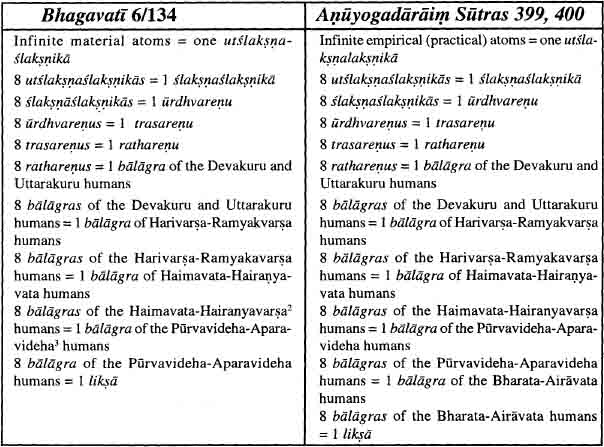
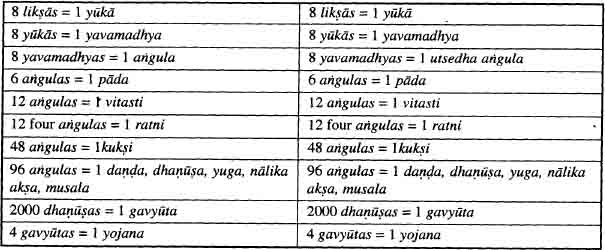
A pit—one yojana long, one yojana wide and one yojana deep—is filled tightly with the pieces of hair of a child one to seven days old. Now, if one piece of hair is taken out of the pit in one hundred years, the period taken for emptying the pit is called empiricalpa(yapama. For detailed description ofpalya, see Anuyogadârâim. Abhayadevasüri also has discussed empirical and subtle palyopamas.
A comparative study of the measurement of kâla has been provided in the Visvaprahelikââ which is quoted gere—
Âvalikâ Jaghanya-yukta-asamkhyâta (a category of innumerable number which is calculated through a definite geometric series) samayas (smallest (ultimate indivisible) time units—instants) make one âvalikâ ( a micro-unit of time-measurement, which consists of innumerable samayas). The value of jaghanya-yukta-asamkhyâta. is equal to jaghanya-parïta-asamkhyâta (it is also a category of innumerable number which is calculated through a definite geometric series) raised to the power jaghanya- -parïta-asamkhyâta. (16777216 âvalikâs make one muhürtta (48 minutes)).
Prana : (one complete breath, i.e., one inhalation and exhalation of air)::M446£~- âvalikâs make oneprâna. Time consumed in a single breath, i.e., inhalation as well as exhalation of air, by a young, healthy and (physically) powerful man is known as one prâna.
Table of Units of Countable Time
1 Samaya = smallest (ultimate indivisible) unit of time
Jaghanya-yukta-asamkhya samayas = 1 âvalikâ
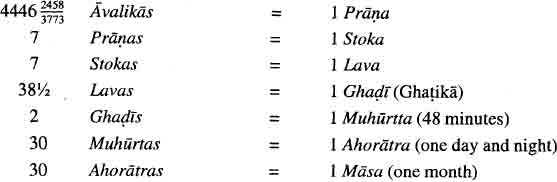
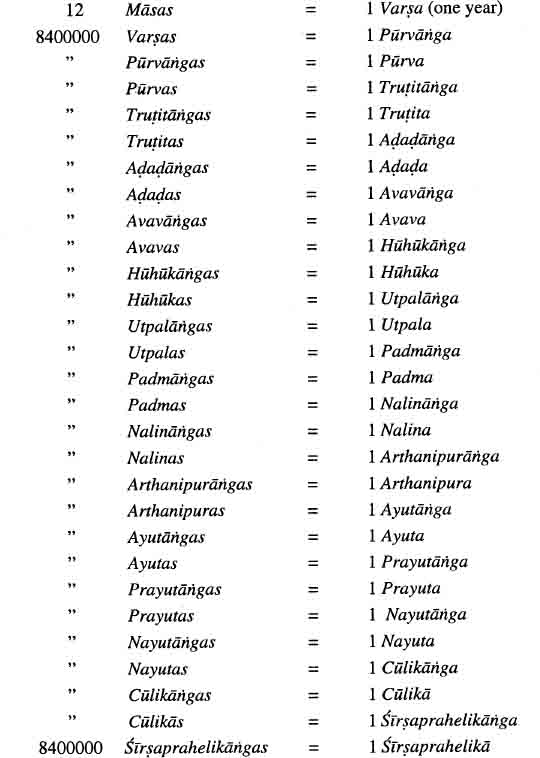
This table is based on the Svetambara tradition.5 In the Digambara tradition, however, there is difference in the units. greater than year.6 They are given as follows:

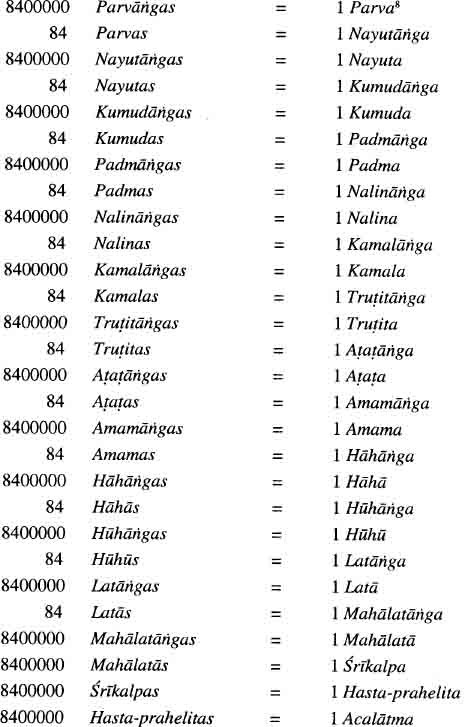
According the Svetambara tradition, highest unit of countable time is sïrsaprahelikâ? whose- value is10:
(8400000)28 = (8428 x 10140) years.
According to the Digambara tradition, highest unit of countable time is acalâtma, whose value is :
(84!| x 1090) years.
From samaya to sirsaprahelika are the units of countable time. In reality, countable time-units go beyond sirsaprahelika,11 but as they transcend the limit of empirical mathematics, sirsaprahelika is considered to be the highest countable time-unit.
The units of countable time are defined by similies. They are broadly classified into two :
(1) Palyopama (pit-measured time-unit)
(2) Sagaropama (ocean-measured time-unit)
Palyopama
A cylindrical pit or well is known as paly a. The value of palyopama is explained by the simile of palya. We get different versions of palyopama in the Svetambara and Digambara traditions.
According to the Svetambara Tradition12
There is a cylindrical pit measuring one yojana each in length, breadth and height based on utsedha ahgula. It is made cram-full with the billions of hair-tips of humans of devakuru-uttarakuru region. Before calculating the number of hair-tips, filled in pit, we have to calculate the volume of the cylinder.
The base of the cylinder is circular. Area of circular base = nr2 (where r is radius).
Volume of the cylindrical pit = = πr2h (where h is height).
In this equation, the value13 of tc, taken into account, is— 19/6.
According to the table of space-units
1 yojana = 7,68,000 utsedha-ahgulas.
There are 87 hair-tips of humans of Devakuru-Uttarakuru region in one utsedha- -ahgula space. Therefore,
1 yojana = 87 x 7,68,000 hair-tips of Devakuru-Uttarakuru humans.14
[Since the diameter (further denoted as d) is one yojana]
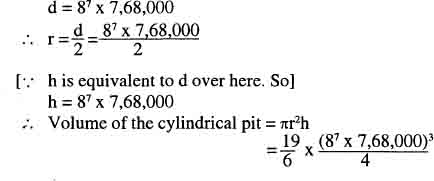
= 330,762,104,246,562,542,199,609,753,600,000,000,0
= 3.3 x 1036 approximately.15
So, the number of hair-tips of Devakuru-Uttarakuru humans filled in the cylindrical pit is 3.3 x 1036.
The hair-tips are taken out of it in four ways.16 On the basis of these different ways, palyopamas are of four types:
1. Badara Uddhara Palyopama
Every samaya, a single hair-tip is removed from the cylindrical pit. The total period of time that elapses for emptying it completely is called badara uddhara palyopama. It is actually only formal palyopama, because its value is under countable time-units.
Removing a single hair-tip each samaya, the cylindrical pit will get emptied in 3.3 x 1036 samayas. So we come to the conclusion that one badara uddhara palyopama = 3.3 x 1036 samayas.
2. Suksma Uddhara Palyopama
Each hair-tip (referred to in the above definition) is cut into innumerable pieces and the cylindrical pit is made cram-full with these hair-pieces. Every hair-piece is innumerableth fraction of the subtlest part visible by naked eyes. Every samaya, such piece is removed from the pit. The total period of time that elapses for emptying it completely is called suksma uddhara palyopama = {(3.3 x 1036) x innumerable} samayas.
3. Badara Addha Palyopama
Each hundred years, a single hair-tip is removed from the cylindrical pit of the size mentioned above. The total period of time that elapses for emptying it completely is called badara addha palyopama. As the value of this palyopama remains to be in countable time-units, so it is also only a formal palyopama.
Removing a single hair-tip every hundred years, the pit will be emptied in 100 x 3.3 x 1036 years. In this way, one badara addha palyopama
= 100 x 3.3 x 1036 years
= 3.3 x 1038 years
4. Suksma Addha Palyopama
Each hair-tip is cut into innumerable pieces, as in the suksma uddhara palyopama. After every hundred years, a single piece is removed from the pit. The total period of time that elapses for emptying it completely is called suksma addha palyopama. In this way, one suksma addha palyopama
= {(3.3 x 1036) x 100 x innumerable} years
= {(3.3 x 1038) x innumerable} years.
Table of Uncountable Time-units
1 Suksma addha palyopama = 3.3 x 1036 uncountable samayas
1 Suksma uddhara palyopama = 3.3 x 1038 uncountable years.
According to Digambara Tradition17
Till now. in the description of cylindrical pit in the Svetambara tradition, the calculation of yojana, taken into account, was based on utsedha angula but here while dealing the conception of the Digambara tradition. it is to be understood in accordance with pramana. angula.
1 pramana angula = 500 utsedha angular.
Volume of the cylindrical pit18
= 19/6 x V4 x (768000 x 500 x 87)10
= 413.452.630,308,203,177.749.512,192.000,000,000.000.000 cube of hair-tips of humans of uttama bhoga region.
= 4.13 x 1044 cube of hair-tips of humans of uttama bhoga region approximately.19
In this way, the number of hair-tips filled in the cylindrical pit = 4.13 x 1044.
The hair-tips are taken out of it in three ways. On the basis of these different ways. palyopamas are of three types:
1. Vyavahara palyopama
Every hundred years, a single hair-tip is removed from the cylindrical pit. The total period of time that elapses for emptying it completely is called vyavahara. palyopama. This is just a formal palyopama because its value is under countable years. Removing a single hair-tip every 100 years. pit will get emptied in 4.13 x 1044 x 100 years. Therefore vyavahara palyopama = 4.13 x 1044 x 100 years.
2. Uddhara palyopama
Each hair-tip (as described above) is cut into a number of pieces equivalent to the number of samayas in uncountable crore years and the cylindrical vessel or pit is made cram-full with these hair-pieces. Every samaya, a single piece is removed from it. The total period of time that elapses for emptying it completely is called uddhara palyopama. In this way—
1 uddhara palyopama = (4.13 x 1044) x (number of samayas in uncountable crore years) samayas
If the number of samayas in one year be ap and uncountable years be a2, then
1 uddhara palyopama = (4.13 x 1044 x a x a2 x 107) samayas. but a1 = one year.
So,
1 uddhara palyopama = (4.13 x 10’’’’ x 107 x a2) years
= (105 x a2) vyavahara palyopamas.
3. Addha Palyopama
Each hair-piece, as described in uddhara palyopama, is cut into a number of pieces equivalent to the number of samayas in uncountable years. The cylindrical pit is made cram-full with these pieces. Every samaya, a single piece is removed from it. The total period of time that elapses for emptying it completely is called addhâ palyopama. In this way, the number of hair-pieces filled in the pit
= (4.13 x 1041 x a.xa.x 107) x (number of samayas of uncountable years).
If we consider uncountable years = a3, then
1 addha palyopama = (4.13 x 10’4 x a, x a2x 107x a.) samayas
= (4.13 x 1044 x a.a2a., x 107) years
= (4.13 x 1051) a,a2a3 years
= 105 afa2a3 vyavahâra palyopama.
If we consider at = a2, then
1 addha palyopama = 105 a,(a2)2 vyavahâra palyopama = uddhara palyopama.
Table of Time-units of Palyopama
( 1 vyavahara palyopama = 4.13 x 1046 years)
1 uddhara palyopama = ( 105 x a2) vyavahara palyopama
1 addha palyopama = a,æ, uddhara palyopama.
Relationships between Time-units and Space-units
We get two equations in the Digambara tradition which indicate relations between time-units and space-units. In these equations, log2 is used. Modern name of Chedaganlta is logarithms.20
In the first equation, the relationship between süci angula ( a linear space-unit) and addha palyopama is described as follows:21 sila angula is equal to addha palyopama raised to the power logarithm to the base, addha palyopama.
What should be the units of suciangula and addhapalya is not given here, but by logic (reasoning)22 we find that they should be pradesa and samaya because both of them are the units of measurement of space and time respectively. In this way, if suciangula be x pradesa and addhapalya be ‘p’ samaya, then
x=p(lo«‘)
Second equation relates jagasrenl (the cosmic row of space-units which measures seven rajjus) and addhapalya.23 Jagasrenlis equal to ghanahgula (a three dimensional space-unit) raised to the power logarithm to the base two innumerableth fraction of addhapalya.

Here, ghanahgula means cube of suci angula, i.e., cube of the number of pradesas of suciangula.
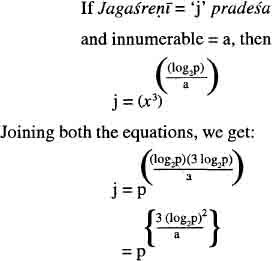
Sagaropama
Ten crore-crore24 (crore x crore) palyopamas make one sägarapama. Palcopama is classified into (i) bädara uddhära, (ii) süksma uddhära, (iii) bädara addhä, (iv) süksma addhä, (v) vyavahära-uddhära, (vi) vyavahära-addhä divisions, similar divisions; exist in the case of sägaropama.
According to Svetämbara Tradition
10 crore-crore bädara uddhära palyopamas = 1 bädara uddhära sägaropama
10 crore-crore süksma uddhära palyopamas = 1 süksma uddhära sägaropama
10 crore-crore bädara addhä palyopamas = 1 bädara addhä sägaropama
10 crore-crore süksma addhä palyopamas = 1 süksma addhä sägaropama
According to the Digambara tradition
10 crore-crore vyavahara palyopamas = 1 badara vyavahara sagaropama
10 crore-crore uddhara palyopamas = 1 uddhara sagaropama
10 crore-crore addha palyopamas = 1 addha sagaropama
(Here ends the quotation from Visvaprahelika).
Semantics
Siddha—in the present context, the word siddha stands for kevali, not the liberated soul.25
Samudaya-samiti-samagama—the particles of pudgala can be fused together; so in the present context, samagama means fusion due to transformation. For the explanation of samudaya and samiti, see Bhasya on Bha. 6.132.26 Sanisrsta (Samsatthe)—cram-full.
Samnicita (Samnicie)—packed fully to make it densify.
Nor do they decay (no kucchejja)—the hair-tips filled up in the pit do not become decayed or spoiled. The Vrtti has given two reasons:
[1] The hair-tips are so densely packed that there is no gap at all between them, (they are almost air-tight).
[2] As there is no scope for air to enter, they (the hair-tips) do not become decayed, or get spoiled.27
A Complete Cycle of Time
The empirical time is obtained only in the region which consists of 2l/2 islands- oceans and covers completely the human-world (i.e., the world inhabited by human beings) on account of the fact that the motion of sun, moon etc., takes place only in this region. Again, some parts of this region (the human world), viz., Bharata and Airavata are relatively more influenced by the solar system and hence, they undergo changes with time. As a result, a cycle of evolution and involution goes on revolving; this is respectively called “utsarpinT and “avasarpini’ A*
According to Akalahka, during the utsarpim and avasarpini, there is gradual enrichment and deterioration respectively in the experience of munificence of consumable and non-consumable goods, the life-span and the size of the body.29 According to the Jambuddivapannatti, during the utsarpini and avasarpini there is infinite times gradual enrichment and deterioration respectively in the basic material properties of colour, smell, taste, touch, bone-structure, karma (action), strength, energy, purusakara, parakrama?0 Akalanka has shown this transformation to be due to the influence of time.31 But this does not solve the problem. In reality, the geographical condition, the environment of the earth and the radiations from the solar system also become instrumental in bringing about the universal transformation in the region referred here.
The space (region) and time, which are responsible for the creation of environment are of three types—(1) snigdha (viscous), (2) ruksa (dry) and (3) snigdha-ruksa (viscous-cum-dry). It is said in the Nisitha-Curni that longer lifespan in the region of Devakuru and Uttarakuru and in the period of susama-dusama aeon (i.e., aeon of supreme plenty) is due to the spatial and temporal (environmental) viscosity respectively.32 According to the Jambuddivapannattl, when the time is dry, the lunar cold and the solar heat increase.33 Prior to the age of Lord Rsabha, there was viscous time, so fire could not be produced. According to Acarya Hemacandra, fire was originated (for the first time) on the advent of viscous-cum- dry time.’4
The cycle of transformation (that is, evolution and involution) in the continents of Bharata and Airavata is due to the transformation in the degree of viscosity and dryness of time. This cycle has been divided into 12 aeons of the descending and ascending time-cycles. The aeon is called ara (lit. spoke). As there are spokes (ara) in the wheel, there are aeon-spokes in the metaphorical cycle (wheel) of time. During the descending time-cycle, there is a gradual dwindling of the six aeon-spokes; whereas in the ascending cycle, there is a gradual prospering.
The evolutionists like Darwin have propounded the doctrine of evolution of species; the authors of the Agamas did not believe in evolution alone, they propounded both cycles—that of evolution and that of involution. (Darwin’s theory of evolution is only in respect of the biological evolution of the species; whereas the theory of time-cycle of avasarpini and utsatpim. as propounded in the Jain Agamas. speak of gradual enrichment and gradual deterioration with respect to all the phenomena of nature as described above). The following table gives the classification of the six aeons in the avasarpini and utsarpim each of one timecycle:
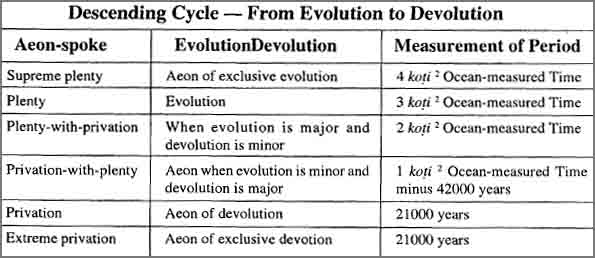
Text
Susama-susamae bharahavasa-padam
6.135 jambuddive nam bhamte! dive imlse osappinie susama-susamae samae uttimatthapattae, bharahassa vasassa kerisae agarabhavapadoyare hottha? goyama! bahusamaramanijje bhumibhage hottha, se jahanamae— alimgapukkhare ti va, evam uttarakuruvattavvaya neyavva java—tattha nam bahave bharaya manussa manussio ya asayamti sayamti citthamti nisivamti tuyattamti hasamti ramamti lalamti. tise nam samae bharahe vase tattha-tattha dese-dese tahim-tahim bahave uddala koddala java kusa-vikusa-visuddharu- kkhamula java chavviha manussa anusajjhittha, tarn jaha — pamhagamdha. miyagamdha. asama, tetali, saha, sanimcari.
The Topic of the Continent of Bharata in the Aeon of Supreme Plenty
How1 did, O Lord, the continent of Bharata appear with respect to its features and (people’s) states in the excellently developed aeon of supreme plenty during the current descending cycle in the Island of JambUdvipa?
Gautama! the (appearance of the) land of the continent of Bharata was very delightful on account of the evenness of its surface, just like the parchment stretched over the opening of a hand-drum of the dlingi variety. Here the description of uttarakuru is to be brought from (the Jiva. 3.578-79; or Jambu 2.7) up to tliCM^e were indeed many inhabttants of the lllmi^itG» continent as men and women (flora and fauna), who used to reside, sleep, stand, sit, turn sides while lying down, laugh, play and make merry there. In that aeon, different parts and regions of the continent of Bharata here and there were spread over by many trees like Uddala, Koddala. up h> the clean treeroots free from the grasses like Kuia and Vikusa up to the tl^t^^dtty of six races of humans prevailed, viz., |1] humans with (natural) fragrance of lotus, |2] humans with (natural) fragrance of musk, (3] unselfish humans [4] vigorous and handsome humans, [5] tolerant and powerful humans and [6] humans free from hustle-bustle.
Bhasya
I, Sutra 135
The present dialogue delineates the condition of the ara (aeon) of supreme plenty in the descending cycle. At the time, the surface of the earth was perfectly even, ‘ ,
Uttimatthapatta—the excellently developed period from the standpoint of the life-span etc.1 The same expression is found in Bha. 7.117.
Agarabhora-padoyare—manifestation (appearance) of shape (features) and mode (states of people).2
Bahusamaramanijja—the expression means ‘delightful (attractive) on account of the perfectly even (smooth) surface. The Vrtti explains bahu as ‘very much’,3 but in the context of alihga (hand drum) the most relevant meaning appears to be ‘almost’ (pt-ayah).
Alihga-pukkhare—opening of the drum. There are three kinds of handdrums—(1) ahki (2) dlihgi (3) urdhvaka.
(1) Ariki—The shape of this kind of hand-drum is like that of marybalan, that is. it is thick in the middle and thin on both ends.
(2) Alihgi—Its shape is like that of the cow’s tail, that is, it is thick at the one end and tapering on the other.
(3) Urdhvaka — Its shape is like the grain of barley, that is, it is symmetrical from top io bottom.
Pukkhara (puskara) means ‘the mouth of the drum’. Abhayadevasuri explains it as ‘The surface of the mouth of the drum’ .4
Uddala—a kind of tree. Sebesten plum.5 Latin—Cordia Wallichi G. or Cordia Myxa.
Koddala—a kind of tree, having red flowers. Latin—Bauhinia purpurea linn.6 Kusa—a variety of grass called darbha (Latin—Eragrostis Cyno Suroides Neauv).
Vikusa — a variety of coarse grass called balvaja.
Vissuddha—here the contextual meaning of visuddha is ‘devoid of’.
The meaning of kus’a-vikusa-visuddha is ‘devoid of grass like kusa and vikusa..
Anusajjitth a —heredity prev ailed.8
2. Pamhagandha sanimcari
There were six races of human beings as follows:
(1) pamhagandha—human race with natural fragrance of lotus.
(2) miyagandha—human race with natural fragrance of musk.
(3) amama—unselfish human race.
(4) tetali—vigorous and handsome human race.
(5) saha—tolerant and powerful human race.
(6) sanimcari— human race free from hustle and bustle, because they were free from curiosity.9
Text
6.136 sevam bhamte! sevam bhamte! tti.
That is so, O Lord! That is so, O Lord!
1.Saligrama NighanUi Bhusanam; vol. vii, viii, p. 604, Dhanya Varga—
salidhanyam vrihidhanyam, sukadhanyam trtiyakam |
simbidhanyam ksudradhanyamityuktam dhanyapan.cakam ||
salayoraktasalyadya, vrihayah sastikadayah |
karngvadikam ksudradhanyam, trnadhanyam ca tatsamrtam ||
2.Jai. A. Va. Ko. pp. 285,286.
3.Ibid., p.266.
4.Ibid., pp. 116,117.
5.Ibid., p.272—’satina’.
6.Ibid., p. 261—’vara’.
7.Bha. Vr. 6.130,131—’kala’ tti kalaya vrttacanaka ityanye, ‘masura’ tti bhilangah canakika ityanye, ‘nipphava’ tti vallah ‘kulattha’ tti cavalikakarah cipitikabhavanti, ‘alisamdaga’ tti cavalakaprakarah cavalaka evanye, ‘saina’ tti tuvari, ‘palimamthaga’ tti vrttacanakah kalacanaka ityanye, ‘ayasi’ tti bhangl, ‘kusumbhamga’ tti latta, ‘varaga’ tti varatto, ‘ralaga’ tti kamguvisesah, ‘kodusaga’ tti kodravavisesah, ‘sana’ tti tvakpradhananalo dhanyavis’esah, ‘sarisava’ tti siddharthakah, ‘mulagabiya’ ti mulakabljani sakavisesabljanityartha.
8.(a) Apte—palyarn—A sack for corn.
pallah—A large granary.
(b) Bha. Vr. 6.129—iha palyo—vamsadimayo dhanyadharavisesah.
9.Bha. Vr. 6.128—mancamalayorbhedah—
“akuddo hoi mamco, malo ya dharovarim homti.”
1.Anu. Su 369—pamane cauvvihe pannatte, tam jaha—1. davvappamane 2. khettappamane 3. kalappamne, 4. bhavappamane.
2. Ibid., Su. 413-415.
3. Loka Prakasa, Kalaloka, sarga 29, sloka 12,21.
4. Anu. Cu. p.57—amtomuhuttadiya java puvakodIetti, etani dhammacaranakalam paducca naratiriyana auparimanakarane uvajujjamti, naragabhavanavamtaranam dasavarisasahassadi uvajujjamti, auyacimtae tudiyadiya sisapaheliyamta ete payaso puvvagatesu javiesu auyasedhie uvajjujjamti.
5. Bha. Vr. 6.132—asamkhyatanam samayanam ye samudaya—vrndani tesam yah kalamanam bhavatiti gamyate saika” valiketi procyate.
6. Ibid., 6.132—hrstsya—tustasya.
7. Ibid., 6.132—abavakalyasya jarasa’ nabhibhutasya.
8. Ibid., 6.132—nirupaklistasya vyadhina prak sampratam canabhibhutasya.
1.Bha. Vr. 6.134—yadyapi ca naiscayikaparamanorapidameva laksanam tatha’piha pramänädhikärädvyävahärikaparamänulaksanamidamavaseyam.
2.Anu. sU. 418-432.—In the original text of Bha., we get the reading erannavayanam, but in Thanam and Anu., we get herannavayanam.
3.In the original text of Bha., we do not get the reading aparavideha, which, it seems, is erroneously omitted.
4.Author—Munisri Mahendra KumarajT ‘dvitiya’, Jhaven Prakasana, Mumbai, 1968—pp. 242-252.
5.See Anuyogadvara Sutra: the topic of samaya, sutra 416; Loka-prakaSa, sarga 28-29; Bha. 6.134.
6.Tiloyapannati, 4.293-307; Adipurana, 3.218-227; Lokavibhaga, 5.139-148.
7.These two names, it seems, have been left out in Tiloyapannati.
8.In Tiloyapannati, we get ‘niyutariga’ and ‘niyuta’.
9.In Adipurana and Lokavibhaga, here we get ‘sirahprakampita’.
10.This value is based on the Valabhya synod. On the basis of the Mathuri synod, its value is— (8400000)36.
11.For detailed description, see Appendix-3 of Viivaprahelika.
12.Anuyogadvara Sutra, the topic of upama, sutras 418-440; Lokaprakasa 1.68-121.
13.Circumference divided by diameter of a circle is equal to 7 Attempts have been made from ancient time to evaluate its numerical value. In Jain canonical literature, ‘more than three’ these words are used for it (see Anuyogadvara Sutra, the topic of upama, sutra 422). In post-canonical Jain literature, the value given in 19/6 or ^10 (see Trilokasara, verse 17; Tiloyapannatti, 1-117; Lokaprakasa, 1-7). Also in non-Jain ancient scriptures, the value of tt is V10 (see pracina bharata men ganita kd yoga, p. 8). According to one verse of Satkhandagama’s Tlka named Dhavala by Virasenacarya, the value of 7 is (3+l6/|13+l6/H3xd) (where d is diameter). See Satkhandagama, in 1-3-2, verse 14, book 4, p. 42. In this verse, the value of the first term comes to be 3.14159292
According to modem Mathematics, value of n is expressed in following progressive series: rt = 4 (1-73/,-I/H+ )
Calculating its value to 14 decimal places, we get 7 = 3.1415926538979. (See Geometry, Lay Charles M. Bloomfield, Robert Icolf and Maril E.Shanks, pp. 204, 205.
14.In Tiloyapannatti, we get uttama-bhoga bhumi.
15.If we take 7 = 3.1415 then this value comes to be 3.06 x 1036.
16.Originally they are of 6 types but last two are not relevant in this book, so they are not given.
17.Tiloyapannatti, 1.119-130.
18.Here also, the value of 7 is 19/0.
19.Taking the vaue of 7 as 3.1415, this value comes to be 4.07 x 1044 approximately.
20.Explanation of Logarithms:
If logyk = a
then ay = k
y is called base.
Logarithm is written as log.
Log2 is the number which is attained by making half the number as many times as the number log,* is obtained, where x is the number log2.
21.Tiloyapannatti, 1.131.
22.Sri Laksmicanda Jain has also explained the same in Tiloyapannatti ka ganita. See preface of Jambuddlvapannatti Samgaho, pp. 100, 104.
23.Tiloyapannatti, 1.131.
24.1 kotakoti = 1014
25.Anu. Vr. 418-432.
26.Bha. Vr. 6.134—’siddha’tti jnanasiddha kevalina ityarthah na tu siddha siddhigatastesam vadanasyasambhavaditi.
27.Ibid., 6.134—samudayah dvyadisamudayastesam samitayo—mllanani, tasam samagamah— parinamavasadeklbhavanam, samudayasamitisamagamastena ya parimanamatreti gamyate.
28.Ibid., 6.134—na kuthyeyuh pracayaviSesacchusirabhavad vayorasambhavacca nasaratam gaccheyuri-tyarthah.
29.Ta. Su. 3.27—bharatairavatayorvrddhihraso satsamayabhyamutsarpinyavasarpimbhyam.
30.Ta. Ra. Va. 3.27—anubhavah upabhogaparibhogasampat, ayuraivitaparimanam, pramanam sarirotsedha ityevamadikrtau manusyanam vrddhihrasau pratyetavyau.
31.Jambu. 2.51, 138.
32.Ta. Ra. Va. 3.27—kimhetukau punastau, kalahetukau.
33.Ni. Cu. part 3, on Curni of Bha. ga 3541—yatha devakurottarasu ksetrasya snigdhagunatvadayuso dirghatvam, susamasusamayam ca kalasya snigdhatvaddlrghatvamayusah.
34.Jambu. 2.131—samayalukkhayae nam ahiyam camda siyam mocchihimti, ahiyam suriya tavissamti.
35.Trisastisalakapurusacaritta, first parva, s’loka 944—svamyapyuce— snigdharuksakaladoso’gni- rutthitah. naikantarukse naikantasnigdhe kale bhavatyasau.
1.Bha. Vr. 6.135—uttamán—tatkäläpeksayotki’stänarthän äyusyakädin prapta uttamarthapräptä uttamakasthäm prapta va—prakrstävastham gata tasyäm-
2.Ibid., 6.135—äkärasya—äkrterbhaväh—paryäyah, athavä”karäsca bhäväsca äkärabhävastesäm pratyavatärah—avataranamavirbhäva äkärabhavapratyavatarah.
3.Ibid., 6.135—bahusamah—atyantasamah.
4.Ibid., 6.135—’älingapukkhare’ tti murajamukkhaputam.
5.Jai. Ä. Va. Ko. p.33.
6.Ibid., p. 81.
7.Bha. Vr. 6.135—kusäh—darbhäh vikusä—balvajadayah trnävisesastairvisuddhäni tadapetani vrksamülani—tadadhobhäga yesäm te tathä.
8.Ibid., 6.135—anusaktavantah pürvakalät käläntaramanuvrttavantah.
9.Ibid., 6.135—’pamhagandha’ tti padmasamagandhayah, ‘miyagamdha’tti mrgamadagandhayah. ‘amama’tti mamakärarahitäh, ‘teyatali’ttitejascatalamcarüpamyesämastitetejastalinah. ‘saha’ tti sahisnavah samarthäh. ‘sammcäre’tti sanaih—mandamutsukatvabhäväccarantltyevamsilah sanaiscärinah.
♦
Eighth Section
Section-8
Text
Puḍhavi-adisu gehadipuccha-padaṃ
6.137 kati nam bhamte! pudhavio pannattao?
goyama! attha pudhavio pnnattao. tam jaha - rayanappabbha java isipabhadra.
The Topic of Query about House etc. in the (Infernal) Lands etc.
How1 many lands, O Lord! have been propounded?
Gautama! eight lands have been propounded, namely, gem-hued up to
the land of liberation which is slightly concave.
6.138 atthi nam bhamte! imise rayanappabhae pudhavie ahe geha i va,? gehavana i va, ?
goyama! no inatthe samattho.
Are there, O Lord! any houses or any shops underneath the gem-hued (i.e., the firse infernal) land?
Gautama! no, that is not possible.
6.139 atthi nam bhamte! imise rayanappabhae ahe gama i va? java sannivesa i va?
no inatthe samatthe.
Are there, O Lord! any villages or up to any rest-houses underneath the gem-hued land?
No, that is not possible.
6.140 atthi nam bhamte! imise rayanappabhae pudhavie ahe orala balahaya samseyamti? sammucchamti? vasam vasamti?
hamta atthi.
(6.79) tinni vi pakaremti—devo vi pakareti, asuro vi pakareti, nago vi pakareti.
Are there, O Lord! heavy clouds that are moistened, that get mingled together and that shower rain, underneath the gem-hued land?
Yes, there are.
(O Lord! is it done by god, asura or naga?) It is done by all the three—by¬god, also by asuras and also by naga.
6.141 atthi nam bhamte! imise rayanappabhae pudhavie badare thaniyasadde? hamta atthi.
(6.81) tinni vi pakaremti.
Is there, O Lord! gross thunder of clouds, underneath the gem-hued land?
Yes, there is.
(Is it done, O Lord! by a god, an asura, or a naga!) All the three do it.
6.142 atthi nam bhamte! imise rayanappabhae pudhavie ahe badare aganikae? goyama! no inatthe samatthe, nannattha viggahagatisamavannaenam.
Is there, O Lord! gross fire-bodied (beings) underneath the gem-hued land? Gautama! that is not possible, excepting the souls that are in-transit.
6.143 atthi nam bhamte! imise rayanappabhae pudhavie ahe camdima-suriya-gahagana-nakkhatta-tararuva?
no inatthe samatthe.
Are there, O Lord! moons, suns, planets, constellations and stars underneath the gem-hued land?
That is not possible.
6.144 atthi nam bhamte! imise rayanappabhae pudhavie ahe camdabha ti va? surabha ti va? no inatthe samatthhe.
evam doccae pudhavie bhaniyavvam, evam taccae vi bhaniyavvam. navaram— devo vi pakareti, asuro vi pakareti, no nago pakareti. cautthie vi evam navaram—devo ekko pakareti, no asuro, no nago. evam hetthillasu savvasu devo pakareti.
Is there, O Lord! the lustre of the moon, or the lustre of the sun, underneath the gem-hued land? That is not possible.
In the same way. it should be spoken about the second infernal land. Also the same in the third infernal land, excepting that only the deva and asura do (see 6.140), the nagas do not. Also the same in the fourth infernal land, excepting “that only deva does, the asura and the naga do not (see 6.140). In the same way about all the lower infernal lands; the deva alone does (6.140).
6.145 atthi nam bhamte! sohammisananam kappanam ahe geha i va? gehavana i va?
no inatthe samatthe.
Is there, O Lord! any houses or any shops in the Saudharma and Isana Kalpa2
No, that is not possible.
6.146 atthi nam bhamte! orala baldhaya?
hamta atthi.
devo pakareti, asuro vi pakareti, no nao.
evam thaniyasadde vi.
Are there, O Lord! heavy clouds?
Yes, there are.
It is done by deva, also by asurp not by naga.
In the same way, it should be spoken about gross thunder of clouds.
6.147 atthi nam bhamte! badare pudhavikae? badare aganikae? no inatthe samatthe, nannattha viggahagatisamavannaenam.
Is there, O Lord! gross earth-bodied? gross fire-bodied (beings)? No, that is not possible, excepting the souls that are in-transit.
6.148 atthi nam bhamte! camdima-suriya-gahagana-nakkhatta-tararuva? no inatthe samatthe.
Are there, O Lord! moons, suns, planets, constellations and stars? No, that is not possible.
6.149 atthi nam bhamte! gama i va? java sannivesa i va? no inatthe samatthe.
Is there, O Lord! any villages or ...... up to anyrest-houses?
No, that is not possible.
6.150 atthi nam bhamte! camdabha ti vi? surabha ti va? goyama! no inatthe samatthe.
evam sanamkumara-mahimdesu, navaram—devo ego pakareti. evam bambhaloe vi. evam bambhalogassa uvarim, savvehim devo pakareti. pucchiyavvo ya badare aukae, badare aganikae, badare vanassaikae. annam tam ceva.
Is there, O Lord! the lustre of ■ the moon or the lustre of the sun?
Gautama! no, that is not possible.
In the same way, it should be spoken about Sanatkumara and Mahendra Kalpas, excepting that only the deva does. Similarly, in the Brahmaloka. In the same way, in all the upper heavens deva does. Query is to be made about the gross water-bodied (beings), the gross fire-bodied (beings), the gross vegetation-bodied (beings). All these are prohibited. The rest is to be described as before.
Samgahani gaha
tamukae kappapanae,
agani pudhavi ya aga ni pudhavisu |
au teu vanassai,
kappuvarimakanharalsu ||
Summary Verse
In the mass of darkness and the first five heavens (namely, Saudharma, Isana, Sanatkumara, Mahendra and Brahma); the Sutras concerning gross fire-bodied (beings) and gross earth-bodied (beings) are to be understood; in the infernal lands (such as gem-hued etc). In the higher heavens (above the first five-heavens), and the black streaks, the Sutras concerning gross water-bodied (beings), gross fire-bodied (beings) and gross vegetation¬-bodied (beings) are to be understood.
Bhasya
1. Sutras 137-150
The gem-hued land is the first amongst the seven infernal lands. Its thickness is 1,80,000 yojanas) Underneath it, there are no houses, shops, moons, suns, planets, constellations and stars; nor there is the lustre of moons and suns; nor there are gross fire-bodied (beings). The exception to this rule is that during the transit, when the aparyapta suksma prthvikayika jiva, (i.e., the subtle earth-bodied soul in the state of unaccomplished bio-potential), which dies at the eastern border of the second pebble-hued infernal land, after undertaking the (maranantika) samudghata (i.e., expansion or projection of the soul-units outside the body impending death), in order to take reincarnation as aparyapta badara agnikayika jiva (i.e., the gross fire¬-bodied soul in the state of unaccomplished bio-potential) in the samayaksetra (the region where the empirical time prevails)—the human world, has to pass through the gem-hued infernal land.2 Under such circumstance, it is said that there is gross fire-bodied beings underneath the gem-hued infernal land.
Like the absence of fire-bodied beings, underneath the gem-hued infernal land, there is also the absence of earth-bodied beings. But the Sutra is reticent about this absence. Abhayadevasuri, in this connection, writes that propounding of the negation of that which is not existing at that place is not always necessary in the Sutra.3
In the Bhagavatl, in connection with the Saudharma and Tsana heavens, there is explicit mention of gross earth-bodied beings with the fire-bodied beings.4
In the Thanam, three causes, each of the calamities of draught and excessive rain, are mentioned. One of these causes is the wrath of a deva (god), naga (serpentine), yaksa (treasure-keeper) or bhuta (devil).5
The following table gives the description about the rain, the thunder and their doer underneath the seven infernal lands and the 12 heavens:
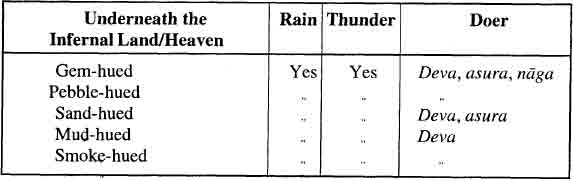
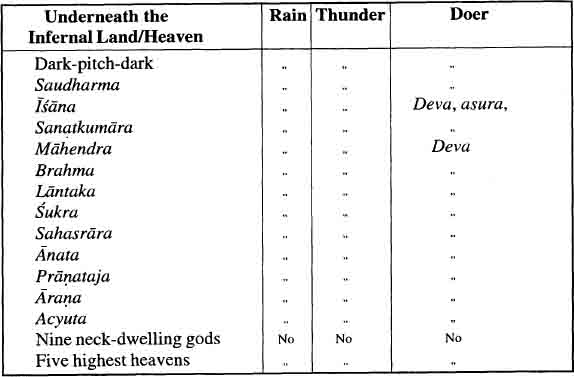
The following table gives the presence/absence of gross earth bodied (beings) etc. in the 12 heavens:
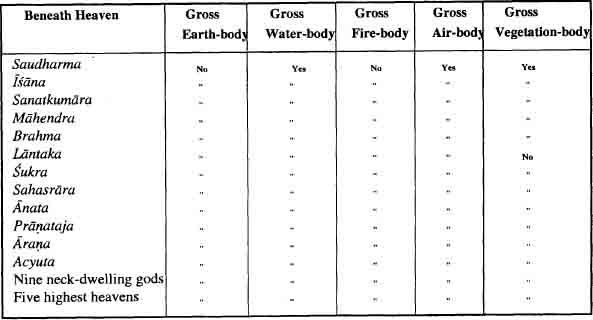
The first and second heavens are situated on dense ocean; therefore there are both water and vegetation. Air pervades them both.6
The third, fourth and fifth heavens are situated on dense air. How can water¬bodied (beings) and vegetation-bodied (beings) be possible underneath them? According to Vrlii, on account of the mass of darkness, gross water-bodied (beings) and gross vegetation-bodied (beings) are possible there.7
The sixth, seventh and eighth heavens are situated on dense ocean and dense air.
The remaining eighteen heavens—beginning from the ninth—are situated on space. There is no gross water-bodied (beings) and gross vegetation-bodied (beings) underneath them.8
If the sixth, seventh and eighth heavens are situated on dense ocean and dense air, how can there be the absence of gross water-bodied (beings) and gross vegetation¬bodied (beings) underneath them? Abhayadevasuri and Srimajjayacharya have solved the problem by pointing out that immediately under these heavens, there is dense air and beneath it is dense ocean. So, on account of the dense air, the existence of gross water-bodied (beings) and gross vegetation-bodied (beings) have been prohibited there.9 In the Pravacanasaroddhara, the situation of the heavenly vimanas have been described as follows: ”The vimanas of first two heavens are situated on dense ocean.
“The vimanas of the next three heavens are situated on (dense) air, the vimanas of the next three are on (dense) air and ocean. All the higher heavens are situated on pure space.
“This is the description of the situation of the vimanas of the upper region.”10
Áuyabamdha-padam
6.151 kativihe nam bhamte! auyabamdhe pannatte?
goyama! chavvihe auyabamdhe pannatte, tam jaha—jatinamanihattdue, gatinamanihattaue, thitinamanihattaue, ogahananamanihattaue, paesana-manihattaue, anubhaganamanihattaue. damdao java vemamysanam.
The Topic of Bondage of Life-span
How1 many varieties of life-span-bondage, O Lord! have Been propounded? Gautama! six varieties of life-span-bondage have been propounded, viz.,—
(1) jati-náma-nisiktayusya—almost impervious life-span-determining karma which has been fused peculiarly with the body-making karma qua jati (sense¬based species). (2) gati-nama-nisiktayusya— almost impervious life-span¬-determining karma which has been fused peculiarly with the body-making karma qua gati (realm of mundane existence). (3) sthiti-náma-nisiktá-yusya— almost impervious life-span-determining karma which has been fused peculiarly with the duration of the body-making karma. (4) avagahana-nama- -nisiktayusya— almost impervious life-span-determining karma which has been fused peculiarly with the body-making karma qua ■ avagahana (size of the body). (5) pradesa-nama-nisiktayusya—almost impervious life-span¬-determining karma which has been fused peculiarly with the quantum of the body-making karma. (6) anubhaga-nama-nisiktayusya— almost impervious life-span-determining karma which has been fused peculiarly with the intensity of the body-making karma.
Such sixfold bondage is possible in all the 24 soul-groups from infernáis to Empyrean gods.
Bhasya
1. Sütra 151
There are eight types of karma, out of which the fifth is ‘life-span-determining karma’, and the sixth is the ‘body-making karma’. The material clusters of the life¬span-determining karma are responsible for the vital energy of the living being. The life-span of the next birth is determined in the present one (with the bondge of life-span-determining karma)) Simultaneously with the binding of life-span-determining karma, six other karmic clusters pertaining to body-making karma, which determine the different aspects of life, are bound.
(1) Jati-nama karma (body-making karma qua species classified on the basis of availability of sense-organs)—The sub-type of body-making karma determines the number of senses from one to five of the species in the next birth.
(2) Gati-nama karma (body-making karma qua realm of mundane existence)—The sub-type of body-making karma determines the order of mundane existence, viz., infernal, sub-human, human or celestial.
(3) Sthiti-nama karma (body-making karma qua duration of birth)—The duration of life is determined by the sthitinama karma.
(4) Avagahana-nama karma (body-making karma qua the type of the body—The type of the gross and protean bodies are determined by the avagahana-nama. karma.
(5) Pradesa-nama karma (body-making karma qua mass or quantum)—The mass or quantum of the material clusters of life-span-determining karma is determined by the ‘pradesanama karma’.
(6) Anubhaga-nama karma (body-making karma qua intensity)—The karmika clusters of the life-span-determining karma are determined by the ‘anubhaga-nana-karma.
The first moment of a new life is the first moment of the rise of the life-span¬determining karma. The rise of the body-tezrztz pertaining to species, realms, etc. synchronise with it, which are coeval with the life-span karma, in respect of origination and cessation. It means that the rise of the body-making karma qua jati etc. begins with that of the life-span-determining karma and also ends with it.
Simultaneously with the bondage of body-making karma qua realm, other sub-types of body-making karma are also bound. Their detailed description is found in the work Sataka.2
At the moment of the bondage of karma, simultaneously with the bondage of life-span-determining karma, there occurs the impervious (nidhatta) state, also called nisikta state, of the body-making karma, qua jati etc. So, impervious life-span fused with body-making karma qua species based on senses has become a variety of ‘life-span-determining karma’. The second and the third varieties being gati-nama- -nisikta-ayusya and avagahand-nama-nisikta-dyusya (i.e., impervious life-span fused with body-making karma qua realm, and impervious life-span fused with body¬making karma qua types of body-making karma— respectively).3 Karmika duration, quantum and intensity of fruition are the parts of bondage, which are related to the bondage of every kind of karma.
There is a law of sequence of karmic rise, according to which all karmic clusters do no come into rise (effect) simultaneously. Had it been so, there would occur no karmic fruition in the immediately successive moment. Under such circumstance, the bondage qua duration (sthiti-bandha) would be futile. ‘The natural law pertaining to the rise of karmic fruition’ is as follows—
The formation of a peculiar structure of groups of karmic clusters called niseka takes place before the karma comes into the state of ‘rise qua fruition’ (vipakodayaj. Such peculiar structure called rnseka comes into rise every moment successively.4 At the beginning of the karmic fruition, the amount of material clusters constituting a ‘niseka’ is relatively greater than that in the subsequent period. Thus, there is a gradual decrease in the quantity of niseka. The process of niseka continues till the end of the duration of karma.5
In the six varieties of life-span given above, ‘species’ and ‘realm’ are the sub¬types of body-making karma.6 T”here is no mention of “avagahana” among the sub¬types of body-making karma. Abhayadevasuri has explained avagahana as ‘body’7 (gross and protean bodies). Thus, avagahana-nama karma has been recognised as sarira-nama-karma which is a sub-type of body-making karma. There is insertion of the expression ‘nama’ in all the six phrases—-jati-nama-niddhatayuska, etc.. Abhayadevasuri gives two meanings of nama—
(i) parinama—transformation of the soul and
(ii) nama-karma—(body-making karma)3
Although., sthiti (duration), pradesa (quantum) and anubhaga are not mentioned anywhere as the sub-types of body-making karma, yet there is possibility of the sub-types of body-making karma other than those mentioned.
Text
6.152 jiva nam bhamte! kim jiUinamanihatta? gatincimanihatta? thitinama-nihatta? ogahananamanihatta? paesanamanihattd? anubhaganamanihatta ?
goyama! jatinamanihatta vi java anubhaganamanihatta vi. damdao java vemaniydnam.
Are1 there souls, O Lord! which are (1) jati-nama-nisiktah—which have the body-making karma qua jati (sense-based species) bound almost imperviously—fused peculiarly? (2) gati-nama-nisiktah— which have the body-making karma qua gati (realm) bound almost imperviously-—fused peculiarly? (3) sthiti-nama-nisiktah—the duration of the body-making karma bound almost imperviously—fused peculiarly? (4) avagahana-nama- nisiktah—which have the sarira-ndma karma, i.e., body-making karma, qua type of body (such as the gross body or the protean body) bound almost imperviously—fused peculiarly? (5) pradesa-nama-nisiktah—the quantum of the body-making karma bound almost imperviously—fused peculiarly? (6) anubhaga-nama-nisiktah—the intensity (of fruition) of the body-making karma bound almost imperviously—fused peculiarly?
Gautama! there are souls (1) jati-nama-nisiktah—which have the body¬making karma qua jati (sense-based species) bound almost imper¬viously—fused peculiarly up to also (6) anubhaga-nama-nisiktdh—the intensity (of fruition) of the body-making karma bound almost imper¬viously—fused peculiarly. Among all the 24 soul-groups from internals up to Empyrean gods, there are souls having six kinds of almost impervious bondage.
6.153 jiva nam bhamte! kimjatinamanihattauya?java anubhagandma-nihattauya? goyamd! jatinamanihattauya vi java anubhagandmanihattauya vi. damdao. /avci vemaniyanam-
Are there souls, O Lord! which are: (1) jati-nama-niddhattayuskah (or nisiktayuskah)—which have almost impervious life-span(-determining karma) which has been fused peculiarly with the body-making karma qua jati (sense-based species)? (2) gati-namaniddhattdyuskah (or nisikta¬yuskah)—which have almost impervious life-span(-determining karma) which has- been fused peculiarly with the body-making karma qu&gati (realm of mundane existence)? (3) sthiti-nama-niddhattdyuskah (or nisiktdyus- kah)—which have almost impervious life-span(-determiningkarma) which has been fused peculiarly with the duration of the body-making karma! (4) avagahand-ndma-niddhattdyuskah (or nisiktayuskah)—which have almost impervious life-span(-determining karma) which has been fused peculiarly with the body-making karma qua avagahana (size of the body)? (5’) pradesa- ndma-niddhattayuskdh (or nisiktayuskah)—which have almost impervious life-span(-determining karma) which has been fused peculiarly with the quantum of the body-making karma! (6) anubhaga-nama-niddhattayuskah (or nisiktayuskah)—which have almost impervious life-span(-determining karma) which has been fused peculiarly with the intensity of the body-making karma!
Gautama! there are souls which are: (1) jdti-ndma-niddhattayuskdh (or nisiktayuskah)—which have almost impervious life-span(-determining karma) which has been fused peculiarly with the body-making karma qua jati (sense-based species) up to also (6) anubhdga-ndma-niddhattdyuskah
(or nisiktayuskah)—which have almost impervious life-span(-deter-mining karma) which has been fused peculiarly with the intensity of the body-making karma. All the 24 soul-groups from internals up to Empyreangods , are souls having six kinds of almost impervious bondage.
6.154 evam ee duvalasa daindaga bhaniyavva -
jiva nam bhamte! kim 1. jatinamanihatta? 2. jatinamanihattauya? jiva nam bhamte! kim 3. jatinamamutta? 4. jatinamaniutauyd?
jiva nam bhamte.! kim. 5. jatigoyanihattd? 6. jdtigoyanihattduyd? jiva nam bhamte! kim 7. jdtigoyaniuttd? 8. jdttigoyaniuttduyd?
jiva nam bhamte! kim 9. jditindmagoyanihatta? 10. jdtindmagoyanihattduyd? jiva nam bhamte! kim 11. jatinamagoyaniuttd? 12. jdtindmagoyaniuttduyd? java 72. anubhdgandmagoyaniuttduyd?
goyama! jdtindmagoyaniuttduyd vi java dnubhdgandmdgoyaniuttduyd vi. damdao jdva vemamydnam.
In the same way, the following twelve paradigms are to be described—Are there souls, O Lord! which are—
(1) jati-nama-niddhatah (or nisiktah)—which have the body-making karma quajati (sense-based species) bound almost imperviously—fused peculiarly?
(2) jati-nama-niddhatayuskah (or nisktayuskah)—which have the almost imperviously life-span-determining karma fused peculiarly with the body-making qua jati (sensed-based species)?
Are the souls, O Lord! (3) jati-nama-niyuktah—which have the body-making karma qua jati bound totally imperviously (i.e., which have to experience it invarriably)? (4) jati-nama-niyuktayuskah—which have the totally imperviously life-span-determining karma which has begun to be experienced with the body-making qua jati!
Are the souls, O Lord! (5) jati-gotra-niddhatah (or nisiktah)—which have the status-determining karma qua jati bound almost imperviously—fused peculiarly? (6) jati-gotra-niddhatayuskah (or nisktayuskah)-—which have the almost imperviously life-span-determining karma fused peculiarly with status-determinig karma qua jati!
Are the souls, O Lord! (7) jati-gotra-niyuktah—which have the status¬determining karma qua jati bound totally imperviously? (8) jati-gotra- nisiktayuskah—which have the totally imperviously life-span-determining karma which has begun to be experienced with the status-determinig karma qua jati!
Are the souls, O Lord! (9) jati-nama-gotra-niddhatah (or nisiktah)—which have the body-making karma qua jati and the status-determinig karma qua jati bound almost imperviously—fused -peculiarly? (10) jati-nama-gotra- niddhatayuskah (or nisktayuskah)—which have the almost impervious life¬span-determining karma fused peculiarly with the body-making karma qua jati and the status-determinig karma qua jati!
Are the souls, O Lord! (11) jati-nama-gotra-niyuktah—which have the- body¬making karma qua jati and the status-determinig karma qua jati bound totally imperviously? (12) jati-nama-gotra-niyuktayuskah—which have the totally imperviously life-span-determining karma which has begun to be experienced with the body-making karma qua jati and the status-determinig karma qua jatii up to 72 anubhaga-nama-gotra-niyuktayuskah—-which have the totally impervious life-span-determining karma which has begun to bv experienced with thv body-making karma qua intvnsity (of fruition) and thv status-determinig karma qua intensity (of fruition)?
Gautama! there are souls which are (from (1) up to) (17) jati-nama-gotra- niyyktkyyukkb—which have the totally imperviously life-span-determining karma which has begun to be experienced with the body-making karma qua jkti and the status-determinig karma qua jati? up to (77) anuUbkga-nkma- gotra-niyuktkyyukkb—which have the totally impervious life-span¬determining karma, which has begun to be experienced with the body-making karma qua intensity (of fruition) and the status-determinig karma qua intensity (of fruition).
In all the (74) soul-groups from infernali up oe theEmpyrean gods . all (the 77) paradigms are available to all the souls.
Bhasya
1. Sutras 157-154
There are eight karmika karanas (operations) viz., (1) bondage (bandha) (2) transference (samkramana) (3) augmentation (udvartana) (4) diminution (apavartand) (5) premature realization (udi’rana) (6) subsidence [suppression] (upasamana) (7) almost imperviousness (niddhatti) (8) total imperviousness (nikacana)
The seventh operation here is—almost imperviousness. It means— imperviousness to all operations other than augmentation and diminution in duration and intensity of karmic clusters.’
The souls which arc subject to the operation of niddhati (almost imper¬viousness) or nisecana (peculiarly fused) with the karmika sub-types of body-making karma viz., jati (sense-based species), gati (realm) etc. are called the jati-ndma- -niddhata’ (i.e., binders of almost imperviously bound body-making karma qua jati (sense-based sepcies), ‘gati-ndma-niddhata’ (i.e., binders of almost imperviously bound body-making karma qua gati (realm) etc..
“Niyukta— Abhayadevasuri has identified niyukta with nikacita’.2 This is the state of most firmly bound (i.e., totally impervious) karma. Jati, gati, avagdhana [here, which stands for the type of body—audarika (gross) or vaikriya (protean)], nama (body), gotra (status) and ayusya (life-span) including sthiti (duration), pWesa (quantum) and anubhaga (intensity of fruition) of these karma—these are the principal facets of birth-and-death. So, on the basis of them, 72 combinations to describe the soul as almost impervious or totally impervious binder of karma can be formed.3
Text
Lavanadisamudda-padam
6.155 lavane nam bhamte! samudde kim ussiodae? patthadodae? khubhiya-jale? akhubhiyajale?
goyama! lavane nam samudde ussiodae, no patthadodae, khubhiyajale, no akhubhiyajale ?
The Topic of Oceans named Lavana etc.
Is1 the Lavana Ocean, O Lord! with high water-level? With even water¬-level? With agitated water-level (subjected to ebb-tide and flow-tide)? With un-agitated water-level (without tides)?
Gautama! the Lavana Ocean is with high water-level, not with even water-level, agitated water-level, not with un-agitated water-level.
6.156 jaha nam bhamte! lavanasamudde ussiodae, no patthadodae; khubhiyajale, no akhubhiyajale; taha nam bahiraga samudda kim ussiodaga? patthadodaga? khubhiyajala? akhubhiyajald ?
goyama! bahiraga samudda no ussiodaga, patthadodaga; no khubhiyajala, akhubhiyajala punna punnappamana volavattamana vosattamana samabharaghadattae citthamti.
Just as, O Lord! the Lavana Ocean is with high water-level, not with even water-level, agitated water-level, not with un-agitated water-level, so also are the external oceans (i.e. outside the region habitated by humans), with high water-level? Or with even water-level? Or with agitated water-level? Or with un-agitated water-level?
Gautama! the external oceans are not with high water-level, but with even water-level, not with agitated water-level, but with un-agitated water-level. They are full, full to the brim, overflowing, over-swelling, and evenly full of water.
6.157 atthi nam bhamte! lavanasamudde bahave orala balahaya samsevamti? sammucchamti? vasam vasamti ?
hamta atthi.
Are there, O Lord! in the Lavana Ocean, many heavy clouds that get moistened, that get mingled together and that shower rain?
Yes, there are.
6.158 jaha nam bhamte! lavanasamudde bahave orala balahaya samsevamti,
sammucchamti, vasam vasamti, taha nam bahiragesu vi samuddesu bahave orala balahaya samseyamti? sammucchamti? vasam vasamti?
no inatthe samatthe.
Just as, O Lord! there are many heavy clouds that get moistened, that get mingled and that shower rain in the Lavana Ocean, so also are there many heavy clouds that get moistened, that get mingled together and shower rain in the external oceans?
Gautama! this is not possible.
6.159 se kenatthenam bhamte! evam vuccai—bahiraga nam samudda punna java samabharaghadattae citthamti?
goyama! bahiragesu nam samuddesu bahave udagajoniya jiva ya poggala ya udagattae vakkamamti, viukkamamti, casamti, uvavajjamti. se tenatthenani goyama! evam vuccai—bahiraya nam samudda punna punnappamana volattamana vosattamana samabharaghadattae citthamti, samthanao egavihivihana, vittharao anegavihivihana, dugunadugunappamana java assim tiriyaloe asamkhejja diva-samudda sayambhuramanapajjavasana pannatta samanauso!
For what reason has it been said, O Lord! that the external oceans are not full (6.157) up to evenly full of water?
Gautama! in the external oceans, many souls that have water as their birth-place and many material clusters get reincarnated and depart away, die and take birth in the form of water.
Gautama! it is for this reason that it has been said that the external oceans are full, full to the brim, overflowing, over-swelling, and evenly full of water. The structural configuration of those oceans is of the same shape (i.e., ring¬shaped), but their extension is of diverse dimensions, the width of each ring ocean being progressively double than the preceding ring (of continent) (i.e. in geometric progression) up to (JIVA. 3/259) in thi) horizontal world, there are said to be innumerable continents and oceans terminating in the Svayambhuramana Ocean, O Long-lived Ascetic!
6.160 diva-samudda nam bhamte! kevatiya namadhejjehim pannatta?
goyama! javatiya loe subhanama. subha ruva, subha gamdha, subha rasa, subha phasa, evatiya nam diva-samudda namadhejjehimpannatta. evam neyavva subha nama uddha.ro, parinamo, savvajivanam (uppao?).
How many of these continents and oceans, O Lord! are propounded through nomenclature?
Gautama! as many as there are in this world, auspicious names, auspicious colours (and forms), auspicious smells and auspicious touches, so are the continents and oceans propounded through nomenclature. In this way are to be understood the auspicious names, uddhara samayas (i.e., the number of samayas (indivisible units of time) of sagaropamas (subtle 2½ suksma uddhara transfer-ocean-measured period), which is exactly equal to the total number of continents and oceans), transformations (which constitute the continents and oceans) and all souls that have taken birth there in the past. (Seejiva. 3.972-975).
Bhasya
1. Sutras 155-160
According to Jain geography, in the middle region of the cosmos (horizental world), there are innumerable (continents and) oceans, the Lavana Ocean being the first and the Svayambhuramana Ocean, the last. There are flow-tides and ebb-tides (agitated water) in the Lavana Ocean; in the external oceans which are outside the region of (the empirical) time (i.e., where the empirical time due to the motion of the luminous bodies like sun, moon etc. prevails), the water level always remains the same (or even), and un-agitated, there being no tides. There takes place rain in the Lavana Ocean, but the external oceans are devoid of rain. The souls that have water as their birth-place take birth and die in the water of the ocean. [Also, the pudgala (i.e., material clusters of water) get produced and destroyed].
For detailed information about the innumerable continents and oceans in the middle-region, see Jivajivabhigame, 3/972-975.
For the word Volattamana, etc., refer to the Bhasya on Bha. 1/312-313.
Text
6.161 sevam bhamte! sevam bhamte! tti.
That is so, O Lord! That is so, O Lord!
1. Jiva. 3.5—ima nam rayanappabha pudhavi asiuttaram joyanasayasahassam bahallenam pannatta.
2. Bha. 34.12—apajjatasuhumapudhavTkaie nam bhamte! sakkarappabhae pudhavie puratlhimille carimamte samohae, samohanitta je bhavie samayakhette apajjattabadarateukkaiyattae uvavvajjittae se nam bhamte! katisamaienani—puccha.
goyama! dusamaiena va tisamaiena va viggahenam uvavajjejja.
3. Bha. Vr. 6.142—nanu yatha badaragnermanusyaksetra eva sadbhavannisedha ihocyate. EvaM badaraprthivíkayasyñpi nisedho vacyah syat prthivyadisveva svasthanesu tasya bhavaditi. satyam, kintu neha yadyatra nasti tattatra nisidhyate manusyadivat. vicitratvat sulragalerato’sato’piha prthivTkavasya na nisedha uktah.
4. Bha. 6.147.
5. Thanam 3.359,360.
6. Bha. Vr. 6.144—tatha’bvayuvanaspatTnitfnanisedho’pT sugama eva, tavorudadhTpratisthitatvenabvana- spatisambhavad vayosca sarvatra bhavaditi.
7. (a) Bha. Vr. 6.150—ihatidesato badarabvanaspatinam sambhavo’numiyate, sa ca tamaskayasadbha-vato’vaseya iti.
(b) Bha. Jo. 2.108.40,41—
trtiya turya brahma soya, ghanavaya adhare achai |
tasu tala apa kima hoya? vanaspati vali kima huvai? || sanibhava tasa janaya, tamaskaya sadbhava thl |
atidesa thaki kahivaya, vrtti vise e nyaya chai ||
8. Bha. Jo. 2.108.45-47.
9. (a) Bha. Vr. 6.150—iha ca—brahmalokoparitanasthananamadho yo’vanaspatinisedhah sa yanvabvavupratisthitani tesamadha anantaryena vayorena bhavadakasapratisthitanamakasasyaiva bhavadavagantavyah.
(b) Bha. Jo. 2.108. 58,59—
lamtaka pramukhaja tina, apavayu adhara chai |
to kina nyaya sucina, varji apa naim vanassai? ||
trihum kalpa tala vaya, aiptara-rahita achai tiham |
tasu tala apa ma nyaya, apa vanassaT nisedha hvai ||
10. Pra. Saro. pa. 160.
1. Panna. 6.114-123.
2. Pa. Sarp. Di. Sataka, ga. 262-288.
3. The footnote of Thanam, 6.116.
4. Bha. Vr. 6.151—nisekasca karmapudgalanam pratisamayamanubhavanartham racaneti.
5. The Sanskrta Tika of Pa. Sam. Di. Sataka, ga. 395, p.246—
paratah paratah stokah purvatah purvato bahuh |
samaye samaye jneyo yavat sthitisamapanam ||
6. Panna. 23.38.
7. Bha. Vr. 6.151—avagahate yasyam jlvah sa’vagahana—sariram audarikadi, tasya nama audarikadi.sariranamakarmmetyavagahananama avagahanarupo va nama—parinamo’ vagahananama. Tena saha yannidhattamayustadavagahananamanidhattayuh.
8. Ibid, 6.151—named—namakarmana uttaraprakriiviseso jivaparinamo va athaveha sutre jatinama-gatinrimavagahananamagrahanajjatigalyavagahananam prakrtimStrainuktam, sthitipradesanubhaga-namagrahanaitu tasamavam sthityadaya uktaste ca jatyadinamasambandhitvannamakarmarupa eveti namasabdah sarvatra karmartho ghatata iti sthitirupam nama.—namakarmma sthitinama.
1. Karmaprakrti. p.48, sloka 2—bamdhanasamkamanuvvattana ya avavattana udiranaya | uvasamana nihatti nikayana catti karanaim II
2.Bha. Vr. 6.154—niyuktam—nitaram yuktam—sambaddham nikacitam vedane va niyuktam yaiste j atinamaniyuktah.
3.The footnote of Amgasuttani, part 2 (Bhagavai). p. 263, su. 6.154.
♦
Ninth Section
Section-9
Text
Kammappagadibamdha-padam
6.162 jive nam bhamte! nanavaranijjam kammarn bamdhamane kati kammappa- gadio bamdhati?
goyama! sattavihabamdhae va, atthavihabamdhae va, chavvihabamdhae va. bamdhuddeso pannavanae neyavvo.
The Topic of Bondage of Types of Karma
How1 many types of karma does a soul, O Lord! bind, while binding the knowledge-covering karma?
Gautama! it binds seven types or eight types or six types. The section on bondage of karma from the Pannavana (pada 24) is to be understood here.
Bhasya
1. Sutra 162
There are eight principal types of karma, which are bound simultaneously or independently, according to circumstances, which have been explained in the 24th pada of the Pannavana. In the present Sutra, it has been mentioned very briefly. The life-span-determining karma is bound only once in the whole life. At other times, the soul binding the knowledge-covering karma binds the rest of seven types of karma, which implies that at the moment of binding the life-span-determining karma the soul binds all the eight types of karma. At the 10th state of spiritual development, [when the soul is possessed of only subtle passion (in the form of greed)] there is no binding of life-span-determining karma and deluding karma,1 implying that there only six types of karma are bound.
It should be noted here that while binding the feeling-producing karma, the soul may bind 7, 8, 6 or only one, viz., the feeling-producing karma.2
Text
Mahiddhiyadeva-vikuvvana-padam
6.163 deve nam bhamte! mahiddhie java mahanubhage bahirae poggale apariyaitta pabhu egavannam egaruvam viuvvittae?
goyamd! no inatthe samatthe.
The Topic of Exercise of Protean Power by Gods (Devas) of Great Fortune
Is a god who is endowed with great fortune? (see 3.47) up to great power, O Lord! capable of creating a protean body of one particular colour and one particular form, through exercising his protean power without appropriating the external material clusters?
Gautama! this is not possible.
6.164 deve nam bhamte! bahirae poggale pariyaitta pabhii egavannam egaruvam viuvvittae ?
hamta pabhu..
Is the god, O Lord! capable of creating a material body of one particular colour and one particular form, exercising his protean power, by appropriating the external material clusters?
Yes, he is capable.
6.165 se nam bhamte.! kim ihagae poggale pariyaitta viuvvati? tatthagae poggale pariyaitta viuvvati? annagatthagaepoggale pariyaitta viuvvati?
goyama! no ihagae poggale pariyaitta viuvvati, tatthagae poggale pariyaitta viuvvati, no annagatthagae poggale pariyaitta viuvvati.
evam eenam gamenam java 1. egavannam, egaruvam 2. egavannam anegaruvam
3. anegavannam egaruvam 4. anegavannam anegaruvam—caubhamgo.
Does, he, O Lord! creates the protean body through exercising his protean power by appropriating the external material clusters pervading this world i. e., the” region where the propounder is present (human world), or pervading that world i.e., the region where the god is present (world of gods) or of any place other than these two?
Gautama! he exercises his protean power not by appropriating the material clusters of this world, he exercises his protean power by appropriating the material clusters of that world, and he exercises his protean power not by appropriating the material clusters of any other place.
The same paradigm is applicable to the four alternatives, viz., (i) one colour, one form (ii) one colour, many forms (iii) many colours, one form (iv) many colours, many forms.
6.166 deve nam bhamte! mahiddhiejava mahanubhage bahirae poggale apariyaitta pabhu kalagam poggalam nilagapoggalattaeparinamettae? nllagam poggalam va kalagapoggalattae parinamettae ?
goyama! n° inatthe samatthe. pariyaitta pabhii.
Is a god who is endowed with capability of transforming a black colour into a blue colour, or vice versa, without appropriating the external material clusters?
Gautama! this is not possible. However, he is able to do so by appropriating the external material clusters.
6.167 se nam bhamte! kim ihagae poggale pariyaitta parinameti? tatthagae poggale pariyaitta parinameti? annatthagae poggale pariyaitta parinameti?
goyama! no ihagae poggale pariyaitta parinameti, tatthagae poggale pariyaitta parinameti, no annatthagae poggale pariyaitta parinameti.
evam kalagapoggalam lohiyapoggalattae. evam kalaenam java sukkilam. evam mlaenam java sukkilam. evam lohienam java sukkilam- evam haliddae-nam java sukkilam. evam eyae parivadie gaindha-rasa-phdsa.
Does he, O Lord! transform (it), by appropriating the external’ material clusters of this world, i.e., the region where the propounder is present (human world), or transform it by appropriating the external clusters of that world i.e., the region where the god is present (world of gods) or transform it by appropriating the material clusters of any other place than these two?
He transforms it not by appropriating the external material clusters of this world; he transforms it by appropriating the external material clusters of that world; he does not do so, by appropriating the material clusters of any other place.
In the same way, he transforms the black material clusters into red material clusters. In the same way, he transforms the black material clusters into other colours up to the white. In the same way, he tranfforms each of the other four colours into the other four colours up to wlihe.
In the same way, the same pattern should be applied to the varieties of smell, taste and touch.
Bhasya
1. Sutras 163-167
In the present dialogue, the power of protean -creation and ‘ the governing principles are described. The body of the gods is protean by birth. They can, by their protean body, create diverse forms, but not without appropriating the external material clusters belonging to protean class. See Bhasya on Bha. 3.186-192.
There are three alternatives about the external material clusters (that may be appropriated)—
1. ihagata—external material (protean) clusters that are situated in this world, i.e., the region where the propounder is present (human world).
2. tatragata—external material (protean) clusters that are situated in that world i.e., the region where the god is present (world of gods).
3. anyatragata—external material (protean) clusters that are situated in the place other than mentioned in the first two above.
The god who exercises the protean power create protean bodies of diverse forms only by appropriating protean material clusters that belong to the second alternative—tatragata.
The diverse forms created by the protean power can be classified in four ways—
1. A particular colour and a particular form
2. A particular colour and diverse forms
3. Diverse colours and a particular form
4. Diverse colours and diverse forms
Transformation in matter can take place spontaneously by nature or can be brought about by extraneous force, i.e., an endeavour of a soul, endowed with such capacity. (Cf. psychokeinesis in parapsychology). A black colour may get transformed into a blue colour spontaneously without extraneous cause. ‘ And similarly blue can get “transformed up to red . In the occutt technique of solar scienee, there is the mention of the modus operandi of transforming colour, odour and form. The present Sutra seems to give hint to its basic principle.
In the following table, are given the various permutations of interchange of basic colours, odours, tastes and touch—
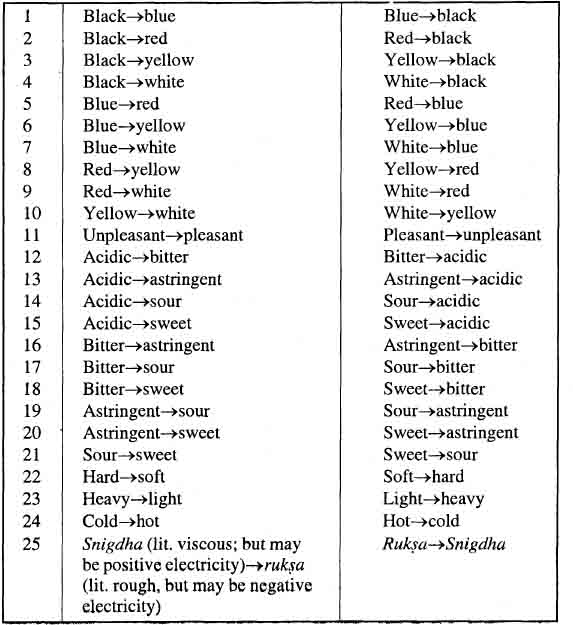
ihagata—lit. it means, “situated here.” According to theVrm’, it means situated near the prajhapaka i.e. the propounder. But Srimaj Jayacarya has explained it as “situated in this world of humans.”
tatragata—lit. it means, “situated there”. It would mean—’situated near the region where the god undertaking protean phenomena stands’. It means—that world (the world of gods). Situated in the world of gods, who are exercising the protean power.
anyatragata—situated in the place other than the above two.
Text
Avisuddhalesadi devanam janana-pasana-padam
6.168 1. avisuddhalese nam bhamte! deve asamohaenam appanenam, avisu-ddhalesam devam, devim, annavaram janai pasai?
no inatthe samatthe.
evam 2. avisuddhalese deve asamohaenam appanenam visuddhalesam devam
3. avisuddhalese deve samohaenam appanenam avisuddhalesam devam
4. avisuddhalese deve samohaenanam. appanenam visuddhalesam devam.
5. avisuddhalese deve samohaydsamohaenam appanenam avisuddhalesam devam
6. avisuddhalese deve samohaydsamohaenam appanenam visuddhalesam devam
7. visuddhalese deve asamohaenam appanenam, avisuddhalesam devam
8. visuddhalese deve asamohaenam appanenam visuddhalesam devam..
The Topic of Knowing and Intuiting by Gods (Devas) who are Avisuddhalesyas
1. Does,1 O Lord! a god who is avisuddhalesya and whose soul is asamavahata know and see (another) god, goddess or either of them, who is avisuddhalesya1 “This is not possible”.
In the same way—2. A god who is avisuddhalesya ■ and whose soul is asamavahata does not know and see (another) god who is visuddhalesya. 3. A god who is avisuddhalesya and whose soul is samavahata does not know and see another god who is avisuddhalesya. 4. A god who is avisuddhalesya and whose soul is samavahata does not know and see (another) god who is visuddhalesya. 5. A god who is avisuddhalesya and whose soul is samavahata- -cum-asamavahata . does not know and see another god who is avisuddhalesya. 6. A god who is avisuddhalesya and whose soul is samavahata-cvtm-asama- vahata does not know and see another god who is visuddhalesya. 7. A god who is . visuddhalesya and whose soul is asamavahata does not know and see (another) god who is avisuddhalesya. 8. A god who is visuddhalesya and whose soul is asamavahata does not know and see (another) god who is visuddhalesya.
6.169 9, visuddhalese nam bhamte! deve samohaenam appanenam avisuddhalesam devam janai pasai?
evam—10. visuddhalese deve samohaenam appanenam visuddhalesam devam
11. visuddhalese deve samohayasamohaenam appanenam avisuddhalesam devam
12. visuddhalese deve samohayasamohaenam appanenam visuddhalesam devam.
9. Does, O Lord! a god who is ‘ visuddhalesya and whose soul is samavahata know and sees another god who is avisuddhalesya!
Yes, he knows and sees.
In the same way—10. A god who is visuddhalesya and whose soul is samavahata knows and sees (another) god who is visuddhalesya. 11. A god who is visuddhalesya and whose soul is , samavahata-cwm-asamavahata knows and sees another god who is avisuddhalesya. . 12. A god who is visuddhalesya and whose soul is samavahata-cwm-asamavahata knows and sees another god who is visuddhalesya.
Bhasya
1. Sutras 168,169
Abhavayadevasuri in the Vrtti explains avisuddhalessa (skt. avisuddhalesyah) as ‘a clairvoyant with deluded world-view’.1 Malayagiri, however, explains it as ‘one endowed with black lesya (psychic colour), etc., (which are inauspicious)’. According to Thanam, the three impure les’yas are—- black, blue and grey.3 Thus, the Thanam corroborates the opinion of Malayagiri.
Abhayadevasuri, in this context, explains samavahata. as attentive, asamavahata as unattentive and samavahata-asamavahata as partially ■ attentive, partially unattentive.4 In the present agama, we get the reading—veuvviya samuggahaenam samohayam (—with expanded soul-units through the exercise of protean expansion),5 which is explained, in the Vrtti as ‘one who has created the protean body’ .6 According to Malayagiri, samavahata means—one engaged in the samudghata (expansion of soul-units) due to experiencing pain, etc., ‘asamavahata as—’free from such samudghata’ and samavahata-asamavahata as—’one who .has started the process of ‘samudghata due to experiencing ‘pain etc. but yet has ‘ not completed the process’—i.e. he is the partial expander.8
In the Thanam, both the reading ‘samavahata’ and ‘vikuvvita’ are mentioned together,9 in connection with dhohi (skt. adhovadhi)—clairvoyance confined to a limited region. In the Sthanahga Vrtti, Abhayadevasuri explains samavahata as ‘a person who has engaged himself in the protean or any other form of samudghata (expansion of soul-units)’ and asamavahata as ‘one, free from the act. of expanding soul-units’. He has related the expression samavahata-asamavahata to the ‘ exposition of above two terms—The clairvoyant who has capacity to know limited region, sometimes engages himself in expanding the soul-units and sometime does not, in order to know the object.10 This exposition of samavahata-asamavahata is different from that given by Malayagiri. The Thanam, however, does not mention the person endowed with suddha lesya and asuddha lesya. There, the soul possessed of limited clairvoyance.is mentioned in connection with the expression samavahata and asamavahata. In the present context of Bhagavati, the exposition of Malayagiri is more appropriate.
In the Thanatn, the topic of viuvvia is given immediately after the topic of samavahata. According to the Vrtti, this means ‘one who has created the protean body by means of the vaikriya samudghata (protean expansion of soul-units)’.11
In the present Agama, in connection with knowledge and intuition, there are a total of 12 alternatives—six pertaining to the god who is avisuddhalesya and six to one who is visuddhalesya. In the JIVA, also, 12 alternatives are available. According to the present Agama, the souls in 8 alternatives do not know/see; according to Jiva., however, the clairvoyance in the last 6 alternatives does know/see.
See the table—
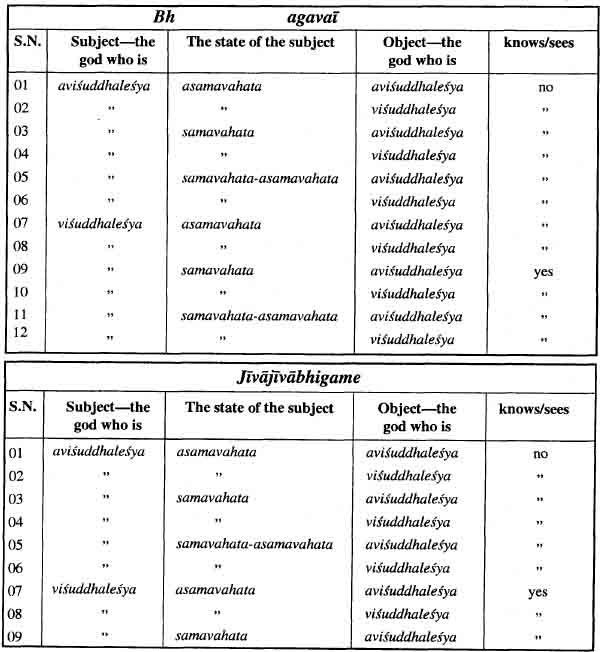
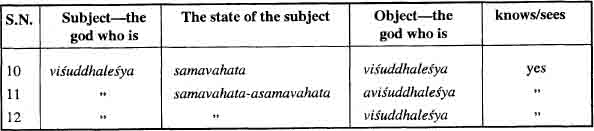
According to Abhayadevasuri, the clairvoyant, in the first six alternatives (no. 1 to 6) is possessed of deluded world-view; so, he does not know. In the next two 2 alternatives (no. 7, 8), pertaining to the person who is visuddhalesya, the clairvoyant, although possessed of enlightened world-view, is unattentive, so he does not know.14According to Malayagiri, however, the clairvoyant (god) being vissuddhalesya, knows and sees, through his genuine knowledge and intuition. NO obstruction in knowing/seeing is created by expansion of soul-units.15
The negation of knowing and seeing in two alternatives (no. 7 and 8) pertaining to the god who is visuddhalesya in the present Agama, and affirmation of knowing and seeing in the Jivajivabhigama signify diverse readings in the two synods on Agama texts.
Why does the god who is visuddhalesya, in the first two alternatives (no. 7 and 8) does not know and see, whereas in the remaining four alternatives (no. 9 to 12) he does know and see is an enigma that needs investigation. Perhaps, in order to resolve it, Abhayadevasuri explains asamavahata as ‘unattentive’.
Text
6.170 sevam bhamte! sevam bhamte! tti.
That is so, O Lord! That is so, O Lord!
1. Bha. Vr. 6.162—’sattavihabamdhae’ ayurabandhakale, ‘atthavihabamdhae’ tti ayurbandhakale, ‘chavvihabamdhae’ tti suksmasamparayavasthayam mohayusorabandhakatvat.
2. Pannavana. 24.10.
1. Bha. Vr. 6.168—avisuddhalesyo vibhamgajnano devah.
2. JiVa. Vr. pa. 142—avisuddhalesyah krsnadilesyah.
3. Thanam, 3.517.
4. (a) Bha. Vr. 6.168—’asamohaenam appanenam’ ti anupayuktenatmana.
(b) Ibid., 6.169—samyagdrstitvadupayuktatvanupayuktatvacca janati upayoganupayogapakse upayogamsasya samyagjnanahelutvaditi.
5. Bha. 3.154-156.
6. Bha. Vr. 3.154—’viuvviyasamugghaenam samohayam’ tti vihitottaravaikriyasanramityarthah.
7. JIVA. Vr. pa. 142—asamavahatah vedanadisamudghatarahitah, samavahatah vedanadisamudghate gatah. .
8. Ibid., Vr. pa. 142—samavahatasamavahato nama vedanadi samudghatakriyavisto na tu panpumasama-vahato napyasamavahatah sarvatha.
9. Thanam, 2.193-200.
10. Stha. Vr. pa. 57—’samavahatena’ vaikriyasamudghatagatenatmana—svabhavena, samudghatantara- gatena va, asamavahatena tvanyatheti, etadeva vyakhyati—’ahoht’ tyadi yatprakOro’vadherasyeti yathavidhih, adidirghatvam prakrtatvat paramavadhervâ’dhovarttyavadhiryasya so’dho’vadhi- ratma — rlyataksetravisayavadhijrarï sa kadacit samavahatena kadacidaiiyatheti samavahatasamavaha-teneti.
11. Ibid., Vr. pa. 57—’viuvvie nam’ tti krtavaikriyasarirena.
12. Bha. 6.168,169.
13. JiVa. 3.198-209.
14. Bha. Vr. 6.168—etairastabhirvikalpairna janati, tatra sadbhirmithyadrstitvat dvabhyam tvanupayuktat-vadili.
15. JIVA Vr. pa. 142—visuddhalesyä katayä yathä’vasthitajnänadarsanabhävät: aha ca mülatikakärah— “sobhanasya sobhanam va vastu yathävadvisuddhalesSyo jänäti” ti, samudghäto’pi ca tasyäpratibandha-ka eva, na ca tasya samudghato’tyantasobhano bhavati, uktam ca mülatikäyäm—”samudghäto’pi tasyäpratibandhaka eve” tyäditi.
♦
Tenth Section
Section-10
Text
Suha-duha-uvadamsana-padam
6.171 annautthiya nam bhamte! evamaikkhamti java paruveinti—javatiya rayagihe nayare jiva, evaiyanam jivanam no cakkiya kei suham va duham va java kolatthigamayamavi, nipphavamayamavi, kalamayamuvi, masamayamavi, muggamayamavi juyamayamavi, likkhamayamavi abhinivattetta uvadamsettae.
The Topic of making One directly experience Pleasure and Pain of Others
The heretics,1 O Lord! say thus ...... up to propound thus—nobody can make tangible the pleasure or pain of all the inhabitants of the city of Rajagrha, giving it a subtle shape of just a stone of a berry, a grain of motha, a round gram, a black gram, a green gram, a louse, and an egg of a louse.
6.172 se kahameyain bhamte! evam?
goyama! jam nam te annautthiya evamaikkhamti java miccham te evamahamsu, aham puna goyama! evamaikkhami java paruvemi—savvaloe vi ya nam savvajivanam no cakkiya kei suham va duham va kolatthigamayamavi, nipphavamayamavi, kalamayamavi, masamayamavi, muggamayamavi, juyamayamavi, likkhamayamavi abhinivaittetta uvadamsettae.
How, O Lord! is it so?
Gautama! whatever the heretics say thus ...... up to propound thus was prevarication; I, however, O Gautama! say thus ...... up to propound thus—nobody can make tangible the pleasure or pain of even all the souls of the entire cosmos, giving it a subtle shape of just a stone of a berry, a grain of motha, a round gram, a black gram, a green gram, a louse, and an egg of a louse.
6.173 se kenatthenam?
goyama! ayannam jambuddive dive java visesahie parikkhevenam pannatte. deve nam mahiddhie java mahanubhage egam mahain savilevanam gamdhasamuggagam gahaya tam avaddaleti, avaddaletta java inameva kattu kevalakappam jambuddivain divam tihim accharanivaehim tisattakhutto anupariyattitia nam havamagacchejja. se nunam goyama! se kevalakappe jambuddive dive tehim ghanapoggalehim phude?
hamta phude.
cakkiya nam goyama! kei tesim ghanapoggalanaın kolatthimayamavi, nipphavamayamavi, kalamayamuvi, masamayamavi, muggamayamavi, juyamayamavi, likkhamayamavi abhinivattetta uvadamsettae? no tinatthe samatthe. se tenatthenam goyama! evam vuccai—no cakkiya kei suham va java uvadamsettae.
For what reason is it so?
Gautama! this continent of Jambudvipa which is situated at the centre of all the continents and oceans is said to be 100000 yojanas in diameter and 316227 yojanas and 3 kosas and 128 dhanusas and a little more than 13½, angulas in perimeter.
Now a god of great fortune ...... up to great power, taking a perfume casket, full of cosmetic (powder), opens it and having opened (spreads the powder all over), while circumambulating 21 times the entire continent of Jambudvipa and returning back in as short a time as is taken by three times snapping the thumb against the finger, pointing in a cursory way to the continent of Jambudvipa. Now, O Gautama! as a result; is not the entire continent of Jambudvipa touched by those fragrant particles?
“Yes, they are touched.”
Gautama! can anybody make tangible even those fragrant particles by enlarging them to the size of the stone of the berry, a grain of motha, a round gram, a black gram, a green gram, a louse and an egg of a louse?
“Not, it is not possible (O Lord!).”
“It is for this reason, Gautama! that it has been said that nobody can make tangible the pleasure or pain ...... up to egg of a louse. (Same as in 6.172).”
Bhasya
1. Sutras 171-173
Pleasure and pain are the sensations, which can not be made tangible like the material clusters, by changing their size to any dimension whatsoever.
In Rajagrha, some heretical philosophers were propounding the doctrine that the pleasure and pain of all the inhabitants of Rajagrha could not be made tangible like the stone of a berry etc.. These heretics were probably materialists and their doctrine probably implied that the sensations of a larger number of souls could be made as tangible as the material objects like the stone of a berry etc., which were of smaller size but still were tangible.
In reply to Gautama’s query about this heretical doctrine, Lord Mahavira said— “It is not the question of all inhabitants of Rajagrha alone; but even the pleasure and pain of all the living beings in the entire cosmos are not capable of being made tangible by reducing them to the smallest possible entity. The reason is that sensations are possible only in souls, which are absolutely different from material entity. The material entity (even very small size) can be made tangible to some extent, but knowledge, sensation and experience being the characteristics of non-corporeal soul can not be made objectively tangible by any means whatsoever.
The physiological manifestations of the sensations of pleasure and pain could be objectively measured through psychological phenomena, perception, inference and even micro-photography (or high-frequency photography like Kirliean effect), but they (sensations)—cannot be displayed in the form of any material entity.
This doctrine of intangibility has been illustrated by the defusion of the fragrant particles. Even the spread of the fragrant particles all over the continent of JambudvTpa which has the diameter of 1 lakh yojana and the circumference of more than 3 lakh yojanas by a god, travelling with super-luminal speed to traverse more than 6300000 yojanas in a second which is higher than the velocity of light (which is about 300000 kilometers per second) cannot be made tangible, so also, the sensations of pleasure and pain cannot be objectively displayed. (1 yojana is, in no case, less that 12.8 kms).
Semantics
kolasthiga (kolatthiga)—kola + asthiga = the stone of a berry.
According to Apte, kolam is a kind of berry and kola is badari (jujube).1 Vrtti has explained it as kuvalasthika.2 For the meanings of nipphava, masa, etc., see Bhasya on Bha. 6.126-131.
accharanivaehim- snapping the thumb against a finger.3
Text
Jiva-ceyana-padam
6. 174 jive nam bhamte! jive ‘? jive. jive?
govama! jive tava niyama jive, jive vi nivama . jive.
The Topic of Soul and Consciousness
Is1 jiva (i.e., a soul), O Lord! jiva (i.e., consciousness)? Is consciousness, O Lord! a soul?
Gautama!, jiva (a soul) is necessarily jiva (consciousness), and jiva (consci-ousness) is necessarily jiva (a soul).
6.175 jive nam bhamte! neraie? neraie jive?
goyama! neraie tava niyama jive, jive puna siya neraie, siya aneraie.
Is jiva (soul), O Lord! an infernal? Is infernal, O Lord!jiva (a soul)? Gautama! an infernal is necessarily a soul. A soul, however, may be an infernal, may not be an infernal.
6. 176 jive nam bhamte! asurakumare? asurakumare jive?
goyama! asurakumare tava niyama jive, jive puna siya asurakumare, siya noasurakumare.
Is jiva (soul), O Lord! an Asurakumara (Mansion god)? Is an Asurakumara, O Lord! jiva (a soul)?
Gautama! an Asurakumara is necessarily a soul. A soul, however, may be an Asurakumara, may not be an Asurakumara.
6.177 evam damdao bhaniyavvo java vemaniyanam.
In the same way all the (24) soul-groups up to the grroup of Empyrean gods are to be spoken of.
6.178 jivati bhamte! jive? jive jivati?
goyama! jivati lava niyama jive. jive puna siya , jivati. viva no jivati.
Is a living being, O Lord! jiva (a soul)? Is jiva (a soul), O Lord! a living being?
Gautama! a living being is necessarily jiva (a soul). Jiva (a soul), however, may be a living being or may not be a living being.
6.179 jivati bhamte! neraie? neraie jivati?
goyama! neraie tava niyama . jivati, jivati puna siya neraie. siya aneraie.
Is a living being, O Lord! an infernal? Is an infernal, O Lord! a living being? Gautama! an infernal is necessarily a living being. The living being, however, may be an infernal, may not be an infernal,
6.180 evam damdao neyavvo java vemaniyanam.
In the same way all the (24) soul-groups up to the group of Empyrean gods are to be spoken of.
6.181 bhavasiddhie nam bhamte! neraie? neraie bhavasiddhie?
goyama! bhavasiddhie siya neraie, siya aneraie. neraie vi ya siya bhavasiddhie, siya abhavasiddhie.
Is bhavasiddhika (a soul capable of liberation), O Lord! an infernal or an infernal, O Lord! is bhavasiddhika (a soul capable of liberation)?
Gautama! bhavasiddhika (a soul capable of liberation) may be an infernal or may not be an infernal. An infernal may be bhavasiddhika (a soul capable of liberation), may not be bhavasiddhika (a soul capable of liberation).
6.182 evam damdao java vemaniyanam.
In the same way all the (24) soul-groups up) ...... up to the group Empyrean gods are to be spoken of.
Bhasya
1. Sutras 174-182
The soul is a substance, possessed of quality, consciousness being its characteristic quality. The substance (possessed of quality) is a substratum of quality. There is universal concomitance between a substance and its quality. The soul is a substance and consciousness its quality; so they are identical, of course, not absolutely. Attribute can never be absolutely different from the substance. There are many qualities in a substance (like soul), consciousness being one of the qualities of soul-substance. Thus the independent existence of soul is established, as distinct from other substances like matter, space, etc. Consciousness is exclusively a quality of the soul, and not of any other’ substance. Hence, the soul-substance is distinct from other substances. Now, when we consider ‘consciousness’ and ‘soul’ from the stand-point of ‘relationship between a quality and a substance’, consciousness and soul can also be said to be different from one other. In the language of non-absolutism, it can be said that soul and consciousness are identical in some respect and different in some respect.
In the present dialogue, the universal concomittance of consciousness and soul has been laid down—the soul is necessarily consciousness and consciousness is also necessarily soul.
Humans, sub-humans, gods and infernáis are not simultaneous modes of the soul, as they relate to different periods of time. So, their concomitance with the soul is only unilateral. So the human etc. are necessarily ‘soul’, but the soul is not necessarily a human, a sub-human, etc.
Secondly, the relationship between ‘soul’ and ‘its state of living being’ has been distinguished. That which ‘leads a life’ is necessarily a soul. The main condition of leading life is the life-span-determining karma. The non-living substances are devoid of life-span-determining karma, so they cannot be said to lead life. What is a soul may be one leading life or may be one not leading life. What is soul is said to lead life on account of his life-span-determining karma, but the soul that is devoid of life-span-determining karma is not said to lead life; the liberated soul is distinct from the souls in four realms of mundane existence—humans, sub-humans, infernáis and celestials.1 The liberated soul has no prana (the vital energy), thus, we see that the living human being is necessarily a living being leading life. But that which lives is not necessarily a human being; he may be an infernal or a sub-human, or a god.
Text
Vedana-padam
6.183 annautthiya nam bhamte! evamaikkhamti java parüvemti—evam khalu savve pana bhüya jívá satta egamtadukkham vedanam vedemti.
The Topic of Experience (of Pain and Pleasure)
The heretics, O Lord! say thus, ...... up to propound thus—All animate beings living beings, souls and living substances experience pain exclusively.
6.184 se kahameyam bhamte! evam?
goyama! jam nam te annautthiya java miccham te emmiiham.su. aham puna goyama! evamaikkhami java paruvemi—atthegaiya pana bhuya jiva satta egamtadukkham vedanam vedemti. ahacca sdyam. atthegaiya pana bhuya jiva satta egamtasayam vedanam vedemti, ahacca assayam. atthegaiya pana bhuya jiva satta vemayae vedanam vedemti—ahacca sayamasayam.
How, O Lord! is it so?
Gautama! whatever do the heretics say ...... up to propound . was prevari¬cation; I do, however, Gautama! say thus ...... up to propound thus: There are some animate beings, living beings, souls and living substances, who experience pain exclusively, seldom (experience) pleasure; there are some animate beings, living beings, souls and living substances, who experience pleasure exclusively, seldom (experience) pain. There are some animate beings, living beings, souls and living substances who experience miscellaneous feelings—occasionally they experience pleasure and occasionally they experience pain.
6 185 se kenatthenam?
goyama! neraiya egamtadukkham vedanam vedemti, ahacca sayam. bhavanavai- vanamamtara-joisa-vemaniya egamtasayam vedanam vedemti, ahacca assayam. pudhavikkaiyajava manussa vemayae vedanam vedemti—ahacca sayamasayam. se tenatthenam-
For what reason?
Gautama! the infernals experience pain (almost) exclusively; only seldom (experience) pleasure: The Mansion, Forest, Luminous and Empyrean gods experience pleasure (almost) exclusively, seldom (experience) pain. The earth-bodied beings ...... up to me humans experinnee miseellnneous feelings—occasionally pleasure, occasionally pain. For this reason (it has been said so).
Bhasya
1. Sutras 183-185
Among Indian philosophers, some uphold the doctrine of ‘universal suffering’. For instance,.it is asserted by Patanjali. “dukkhameva sarvam vivekinah”J—That ‘every thing is suffering for a conscientious person’, which presents the attitude of the Sankhya philosophy. Among the four noble truths of Buddhism, suffering is the first, according to which the whole world is burning in fire, there being no occasion for pleasure.2 The Samkhya, the Jain and the Buddhist all three belong to the Sramana tradition and are upholders of the doctrine of ‘suffering’.
Jainism, however, as a believer in non-absolutism, does not accept that it is only suffering that prevails in worldly life. In the present dialogue, the feeling of suffering has been considered from the standpoint of relativity (vibhajyavada). The infernáis experience pain almost exclusively. but occasionally. they experience pleasure also, for example, on the occasion of the birth of the jina. The gods, on the other hand, mostly experience pleasure, but some times pain too. The sub-humans and humans experience both pleasure and pain miscellaneously—sometimes pleasure’, sometimes pain.
Text
Neraiyadinam ahara-padam
6.186 neraiya nam bhamte! je poggale attamayae aharemti tarn kim ayasarira- khettogadhe poggale attamayae aharemii? anamtarakhettogddhc poggale attamayae aharemti? paramparakhettogadhepoggale attamayae aharemti? goyamd! ayasarirakhettogadhe poggale attamayae aharemti, no anamtara- khettogddhe poggale attamayae aharemti, no paramparakhettogadhe poggale attamayae aharemti.
jaha neraiya taha java vemdniyanam damdao.
The Topic of Nourishment of Infernáis etc.
Do1 the infernáis, O Lord! get their nourishment by appropriating the material clusters which pervade in the same space as occupied by their body, or pervade the space immediately near to their body, or pervade the space away from their body?
Gautama! (the infernáis) get their nourishment by appropriating the material clusters which pervade the same space as occupied by their body, and not pervading the space immediately near to their body nor pervading the space away from their body.
All the (24) soul-groups ...... up to die Empyrean gods are to be described just like the infernáis.
Bhasya
1. Sutras 186
Every worldly soul appropriates the material clusters for all its activities. The query here relates to the space where from the’ soul appropriates the material clusters. There are three alternative spatial areas related to the soul in this connection:
1. The space occupied by the body of the soul itself.
2. The space in immediate proximity to the space occupied by the body of the soul.
3. The space away from the immediate proximity.
The law of appropriation is that the soul can appropriate only the material clusters that co-exist with it, and not from inundate proximity or away from the latter.
Text
Kevalissa nana-padam
6.187 kevali nam bhamte! ayanehim janai pasai?
goyama! no inatthe samatthe.
The Topic of Knowledge of the Omniscient
Does the unveiled lord (Omniscient), O Lord! know and perceive through the Adanas (sense-organs).
Gautama! this statement is not consistent.
6.188 se kenatthenam?
goyama! kevali nam puratthime nam miyam pi janai, amiyampi janai java nivvude damsane kevalissa. se tenatthenam.
For what reason (O Lord!)?
Gautama! it is because the unveiled lord knows both the finite and infinite in the Eastern direction ...... up to (See 5.109) uncovered is the intuttion of the unveiled lord. For this reason.
Bhasya
1. Sutras 188
See Bhasya on Bha. 5.108,109.
Samgaham gaha
jivana ya suham dukkham,
jive jivati taheva bhaviya va |
egamtadukkham vesaiia,
attamayaya kevali ||1||
Summary Verse
The souls’ pleasure and pain.
The soul and the soul that leads life,
Also, the souls worthy of liberation.
Exclusively painful experience.
Appropriation of nutrition by the soul, and the
(knowledge and intuition of) the unveiled lord
— these are the topics of the tenth section.
6.189 sevam bhamte! sevam bhamte! tti.
That is so, O Lord! That is so, O Lord!
1.Apte—kolam—A kind of berry.
Kola—badari.
2.Bha. Vr. 6.171—tatra kuvalasthika—badarakulakam.
3.JIVA. Vr. pa. 109—apsaro nipato nama capputika.
1.Bha. Vr. 6.178—jívati—pránán dharayati ya sah jívah uta yo jívah sa jívati? iti prasanah, uttaram tu yo jlvati sa tavanniyamajjivah ajlvasyayuh karmmabhavena jivanábhavát, jtvastu syajjívati syanna jívati, siddhasya jívanabháváditi; narakádisu niyama jívati, samsárínah sarvasya pranadharanatmakatvát, jívatíti punah syannárakádih syadanárakádirti, pránadharanasya sarvesám sadbhavaditi.
1.Pa. Yo. Da. 2.15.
2.Dhammapada, 146.
♦
Seventh Sataka
Seventh Sataka
47_ch47_7
Every sataka of Bhagavati is a treasure of cyclopaedic knowledge of diverse fields of learnings including metaphysics, folk-sciences, ethics, science of karma, non-absolutism and the like. As a matter of fact, it is not at all a treatise on a specific subject, but is written in the style of ‘catechism’, with queries on various topics made miscelleneously.
In the present Sataka. also, we find some important discussions, a few of which are as follows:
Motion of soul — Body is the means of motion of soul. A liberated soul soars up to the abode of liberated souls. The question is: How does an unembodied soul moves? What is the propelling force behind it? This, really, is a very significant problem in the field of philosophy. We get its solution in the present Sataka, which is endorsed by the Tattvarthadhigama Sutra. In the present Sataka, we get six cause s of the motion of a liberated soul, which are substantiated with some illustrations.1 In Tattvarthadhigama Sutra, four causes of the motion of an unembodied soul are given and four illustrations are given to make them clear.2 As Jain philosophy believes the soul to have the same size as body, it is imperative for it to deliberate over the problem of soul’s motion after liberation. Nyaya-Vaisesika schools of philosophy hold the soul to be ubiquitous, and hence, for them also it is equally necessary to think over the same problem.3
Permanence Vs. Transitoriness — In the philosophical field, diverse propositions on permanence and transitoriness are available.
According to Samkhya philosophy, the Jiva is absolutely non-changable. On the other hand, the Buddhists assert it to be transitory. Bhagavan Mahavira has described soul from the non-absolutistic view-point, and hence, both of the above views become acceptable in the perspective of two different standpoints (nayas). From the standpoint of substance or existence, the Jiva is eternal, but from the standpoint of mode (transformation) it is non-eternal. Thus, by reconciling the doctrine of permanence with that of transitoriness on the basis of two nayas, a tradition of reconciliation has been established in the field of philosophy.4
The Vedanta school of philosophy asserts that the whole world is nothing but the prapahca (illusion). Individual soul is only the extension of the Universal Soul. Jain philosophy neither believes in Isvaravada (Deism), nor in Brahmavada (Pantheism) nor in Ekatmavada (Monist Spiritualism); hence, it does not believe that all (individual) souls are merely the extension of the Supreme Soul. Nevertheless, there is a point of reconciliation—human, animal, bird etc. are all modes, vivarta (modifications), but not existence (in itself). All of them are eternal from the standpoint of current (collective standpoint), but non-eternal from the individual standpoint.5
Environmental Pollution — The prophecy in the present Sataka, about the forthcoming epoch of extreme unhappiness (duhsama-duhsama) of the present descending time-cycle, is quite significant in the light of the present problem of environmental pollution.6
Equivalence of a Microbe and an Elephant—Kunthu (a sort of a microbe) is a very tiny insect and the elephant a huge animal. Both of them of course are jivas (living beings). The question then is quite evident whether the soul of kunthu is equivalent to that of the elephant or smaller than the latter. The difference in the size of the body raises a question regarding the difference in size of the soul (which embodies it). The answer to this can be understood through the Jain principle which asserts that every soul is possessed of innumerable pradesas (the ultimate indivisible soul-units) which are equal.7 Another principle is that the mundane soul has the same size as that of its body. The third principle is that there is a sort of elasticity in the soul’s pradesas—they can expand and contract.
Now, some philosophers believe that the soul is ubiquitous (vibhu),8 whereas some others believe it to be of the size of an atom or a thumb.9 The issue of soul having the same size as the body has remained one of the philosophical debates. For example, Madhvacarya has critically examined this issue. There are mainly two arguments forwarded by him—
1. An yogi can embody many bodies at a time. In that condition the concept of “size of soul as same as that of body” becomes untenable.
2. The soul which has the size of the human body in this life can not re¬incarnate in the body of the elephant (which is larger). Similarly, it would not be possible for the soul of an elephant to enter after reincarnation in the body of an ant.10 If the principles of protean body (vaikriya sarlra) and expansion . (or projection) of soul-units outside the body (samudghataa would have been present before Madhvacarya, the refutation of the principle of ‘the size of soul as same as the body’ would not have been made, on the basis of arguments presented by him. Since, every soul is possessed of the capability of expansion and contraction, it can make the whole body, whether small or large, animated with its soul-units.12
War between Konika and Cetaka — The war between King Cetaka, the head of the Vaisali Republican, and King Konika (Ajatasatru) of Magadha has remained obscure in the history of India. The description given here shows that the result of this war was against the concept conducive to encourage war. Against the popular concept that one who meets with heroic death in the battlefield attains heaven hereafter, the theme of the present chapter is “War is not instrumental to attainment of heaven hereafter.”13
Automatic Mechanism of Fruition of Karma— A very important discussion on this subject is found in this Sataka. According to one concept of the deism (theism), the fruition of good or evil karma done by one is given by God. Since Jain philosophy is not accepting deism, it is confronted with a problem—if there is no God (Almighty), then how the fruition of karma will take place. NO one would like to undergo the fruition of his evil karma. The solution to this intricate problem is—nature. The internal processes are autonomus. There are two components of the nervous system—voluntary and autonomous. The fruition of karma also comes through autonomous process.
When Kalodayi asked Bhagavan Mahavira the question on fruition of karma, the latter made clear the subject through an illustration. Bhagavan Mahavira said, “O Kalodayi! suppose some person eats up agreeable food, well-cooked in a pot and enriched with eighteen varieties of dishes, but mixed with poison; such food seems beneficial (or wholesome) at first appearance, but afterwards,, in course of time, the more the poison undergoes assimilation, the more it would become lethal. In the same way, O Kalodayi, whatever evil (sinful) karma like killing etc. are there, they all appear beneficial at first appearance, but by and by, in the course of their transformation they produce their pernicious fruition—conducive to suffering.
“Further, suppose another person eats up agreeable up to eighteen varieties of dishes, mixed up with salutory medicinal herbs; such food, at first appearance may seem insipid, but in the course of time, would result in healthiness.
“Just as the fruition of food mixed with poison and medicine is automatically obtained, in the same way, the fruition of auspicious and inauspicious karma is also automatically obtained—no external agency is needed to interfere for giving the fruition.”14
In this way, it can be seen that various principles are propounded in the present Saiaka. revealing many mysteries of metaphysics.
1. Bha. 7.10-15.
2. (a) Ta. Su. Bha Vr. 10.6 — purvaprayogat asamgatvat bamdhacchedat tathagatiparinamacca.
(b) Ta. Ra. Va. 10.6,7 — purvaprayogat asamgatvat bamdhacchedat tathagatiparinamacca. aviddhakulalacakravad vyapagatalepalabuvaderandabtjavadagnisikhavacca.
3. See Bhasya on Bha. 7.10-15.
4. Bha. 7.58-60.
5. Ibid., 7.93-95.
6. Ibid., 7.117-121.
7. Thanam, 4.495.
8. Jain Darsana Manana Aur Mimamsa, p.24.
9. Chandogya Upanisad, 5.18.1.
10. Sarvadarsanasamgraham, 158-159—tathajivasya dehanurupa-parimanasyamgikare yogabaladane- kadehaparigriihakayogisariresu pratisariram jlvavicchedah prasajyata. Manujasarirapanmano jivo matangajadeham krtsanam pravestum na prabhavet. kim ca gajaiariram parityajya pipilika-sanram viiatah pracinas’anra.sannivesavinasopi prapnuyat.
11. Bhasya on Bha. 2.74.
12. Bha. 7.158,159.
13. Ibid., 7.181.
14. Bha. 7.223-226.
♦
First Section
Section-1
Text
Samgahani gaha
1. ahara 2. virati 3. thavara,
4. jiva 5. pakkhi ya 6. au 7. anagare |
8. chaumattha 9. asamvuda,
10. annautthi dasa sattamammii sae ||1||
Summary Verse
There are ten uddesakas (sections) in the seventh sataka (chapter)—1 . Nourishment—the dialogue on aharaka (ingestor of nourishment) and anaharaka (non-ingestor of nourishment), 2. Abstinence—the dialogue on pratyakhyana (vow of abstinence), 3. Immobile (living being)—the dialogue on the vegetation-bodied beings, 4. Souls—the dialogue on the mundane beings (souls), 5. Bird—the dialogue on the birds, 6. Life-span—the dialogue on the life-span, 7. Ascetic—the dialogue on the ascetics, 8. Souls (humans) with the veils of deluding karma—the dialogue on veiled humans, 9. Non-self-inhibited (ascetic)—the dialogue on the non-self-inhibited ascetic, 10. Heretics—the dialogue on the heretics such as Kalodayi etc.
Text
Anaharaga-padam
7.1 tenam kalenam tenam samaenam java evam vadasl—jive nam bhamte! kam samayamandharae bhavai?
goyama! padhame samae siya aharae siya anaharae, bitie samae siya aharae siya anaharae, tatie samae siya aharae siya anaharae, cautthe samae niyama aharae. evam damdao jiva ya egimdiya ya cautthe samae, sesa tatiesamae.
The Topic of the Non-ingester of Nourishment
In that age, at that time etc up to Gautama, the principal disciple of the
Ascetic Lord Mahavira, addressed the Lord thus—O Lord! at what time is the soul the non-ingester of nourishment?
Gautama! at the first samaya (indivisible time-unit) (during the transit from one birth to another, or expansion of soul-units), sometime the soul is ingester of nourishment and sometime not; at the second samaya, sometime the soul is ingester of nourishment, sometime not; at the third samaya, sometime the soul is ingester of nourishment, sometime not; at the fourth samaya, the soul is necessarily ingester of nourishment. In the same way, all the 24 soul-groups (dandaka) are to be spoken of, excepting that the souls-in-general and the one-sensed beings, at the fourth samaya, are’ necessarily ingester of nourishment, while the remaining soul-groups are so at the third samaya.
Bhasya
1. Sutra 1
There are four kinds of nourishment: 1. Oja ahara— Sap 2. Loma ahara— Nutrients obtained through the pores of the skin 3. Praksepa ahara—Oral nourishment (or alimental food) 4. Manobhaksi ahara—Nourishment obtained through by merely wishing.1 The soul (living being) who ingests the nourishment is called ‘ingester of nourishment’, while one who does not do so is called ‘non- ingester of nourishment’.
Sap-nourishment is ingested by the embryo in the first antarmuhurtta (i.e., within 48 minutes) of conception. That is followed by the nourishment through the pores of the skin (after the completion of bio-potentials) that continues up to the end of life. The oral nutrition (or alimental food) is ingested as meal (through morsal, gulp or sip etc.).2
Ingestion of nourishment by every embodied soul is invariably concurrent with the activity of body, speech and mind (i.e. till the end of the 13th state of spiritual development), without which life cannot function.
The non-ingestion of nourishment is an exceptional event, taking place on two occasions, viz., transit from one birth to another and expansion of soul-units by some Omniscient Lord before attaining liberation. In the present Sutra, only the transmigratory motion (i.e., motion in-transit) has been taken into consideration. Such motion is of two types—1. Straight motion—horizontal or vertical without any turn. 2. Motion with turn(s). The soul which has to travel in ‘straight motion’ only, reaches the place of birth in one samaya only (See fig. 1 & 2). If the place of birth is situated at a place, which is to be reached with one turn, the transit takes two samayas (See fig. 3). If the place of birth is to be reached with two turns, then the transit takes three samayas (See fig. 4)7 Maximally, the transit may take four samayas .4 Thus—
(1) When the transit of the soul is in straight motion to the birth-place, then in the first samaya of the next life-span, it is ‘ingester of nourishment’. When the transit of the soul is with turn or turns, in the first samaya of the next life-span, the soul is ‘non-ingester of nourishment’. From these two contexts, it follows that at the first samaya, sometime the soul is ingester and sometime non-ingester of nourishment.
(2) [i] When a soul takes two samayas in ‘transit with one turn’, it is non- ingester of nourishment in the first samaya and the ingester of nourishment in the second samaya.
[ii] When the soul takes three samayas in ‘transit with two turns’, it is non- ingester of nourishment in the first and second samayas and ingester of nourishment in the third samaya.
From the above two contexts it follows that at the second samara, sometime the soul is ingester and sometime non-ingester of nourishment.
(3) [il When a soul takes three samayas in ‘transit with two turns’, it is non- ingester of nourishment in the first and second samaras and the ingester of nourishment in the third samara..
[ii] When a soul takes four samayas in ‘transit with three turns’, it is ingester of nourishment in the first samaya and non-ingester of nourishment in the second and third samayas.
From the above two contexts, it follows that at the third samaya, sometime the soul is ingester and sometime non-ingester of nourishment.
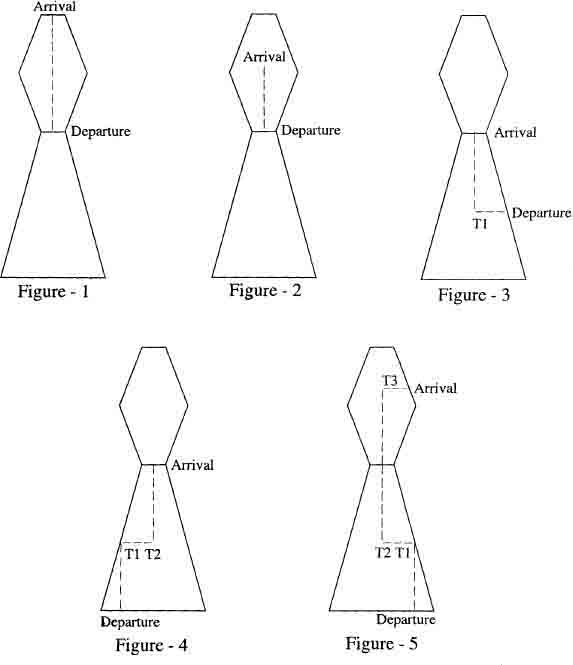
Abhayadevasuri has, however, asserted that the soul in transit with turns is non-ingester of nourishment in all the first three samayas.s He quotes another opinion according to which in the motion in-transit of five samayas (with four turns), the soul is non-ingester of nourishment for the first four samayas.6
The versions of Tattvarthadhigama Sutra pertaining to the topic of non¬ingestion of nourishment differ. The Sutra [2/30 (in Tattvartha Rajavdrtika)] of the Digambara tradition] reads—“ekam. dvau trinva (a) naharakah”—“the soul in-transit remains without nourishment for up to and including three samayas.”“
Akalanka in his commentary on this Sutra, asserts that the soul is non-ingester of nourishment in the first three samayas.7
The Svetambara version of the text (Tattvarthadhigama Sutram, Sabhasya TTka, 2/31) reads—“ekam dvau va (a) naharakah”—“the soul in-transit remains without nourishment for one or two samayas.”“
Siddhasena Gani, in his commentary on this sutra, has explained that in the transit of three samayas with two turns, the middle samaya is without nourishment, and in the transit of four samayas with three turns, the two middle samayas are without nourishment.8
Srimajjayacarya has reviewed the opinion of Abhayadevasuri and supported the doctrine that the jiva can not remain without nourishment for more than two samayas.9 In the Pannavand and the Jivajivabhigame, it is mentioned that two samayas is the maximum time for remaining without nourishment.10
According to Malayagiri, the commentator of these two Agamas, this text is relatively true, because the transit with turns is mostly of the duration of two or three samayas. If is from this standpoint, that there is the mention of two samayas of non-ingestion.”
The gist of the above discussion is summarised in the table. (See table on page no. 522).
The view of Siddhasena Gam and Srimajjayacarya that in the transit of four samayas, the first samaya is with nourishment is based on the Pannavand and Jivdjivabhigame, which mention ‘two samayas” as the non-ingestion period. But it is not easy to reconcile the argument given by Abhayadevasuri which asserts that because there is absence of material clusters appropriate for nourishment during the motion in transit before the arrival at the place of rebirth, the first samaya of the transit is without nourishment. If the first samaya in the transit motion of two or three samayas is without nourishment, then how would the first samaya during the motion in transit of four samayas is with nourishment?
During all the motion in-transit with turn or turns, Siddhasena Gam, considers the first samaya with nourishment. This is logically compatible from view-point of uniformity in considering first samaya as always with nourishment. This, however, is not compatible with the Sutra under consideration, according to which, the first samaya is also sometimes without nourishment. Abhayadevasuri has considered all the samayas before arrival at the place of rebirth as ‘without nourishment’. This is logically quite consistent. What is the logic behind considering the first samaya in the transit of two or three samaras without nourishment and on the contrary, to consider the same first samaya in the transit of four samayas as with nourishment? The Agamika dictum that a soul can not be without nourishment lor more than two samaras during the motion in transit, compels us to endorse the aforesaid view. Malayagiri has solved the issue through use of relative view-point and hence, there should not be any difficulty in accepting the relative view-point.
Text
Savvappaharaga-padam
7.2 jive nam bhamte! kam samayam savvappaharae bhavati?
goyama! padhamasamayovavannae va carimasamayabhavatthe va, ettha nam jive savvappaharae bhavati. damdao bhdniyavvo java vemamydnam-
The Topic of Minimum Ingestion of Nourishment
At1 what samaya, does the soul, O Lord! ingest minimum quantity of nourishment?
Gautama! At its first samaya (the embryo) and the last samaya of its life¬span, the soul ingests the minimum quantity of nourishment. All soul-groups up to the Empyrean gods are to be described similarly.
Bhdsya
1. Sutra 2
At the first and the last samayas of its life-span, the soul ingests the minimum quantity of nourishment. At the first samaya, the gross-body (the embryo) is not built, so the soul ingests the minimum nourishment. At the last time of its life-span, the soul-units undergo withdrawal, resulting in its occupation of the least number of space-points; so at that samaya, it ingests the least quantity of nourishment. In the intermediate samayas, the soul ingests larger quantity of nourishment.
Text
Logasamthdna-padam
7.3 kimsamthie nam bhamte! loe pannatte?
goyamd! supaitthagasamthie loe pannatte—hettha vicchinne, majjhe samkhitte, uppim visale; ahe paliyamkasamthie, majjhe varavairaviggahie, uppim. uddhamuimgakarasamthie.
tamsi ca nam sasayamsi logamsi hettha vicchinnamsi java uppim uddhamuim- gakarasamthiyamsi uppaima-nana-damsanadhare araha jme kevalijive vi janai- -pasai, ajive vi janai-pasai, tao paccha sijhai bujjhai muccai parinivvai savva- dukkhanam amtam karei.
The Topic of the Shape of the Cosmos
What1 is propounded to be the shape of the cosmos, O Lord?
Gautama! The cosmos is propounded to be shaped in the supratisthaka samsthana (i.e., trisaravasamputakara which means the shape of three conical (earthen) bowls blended together, one above other, with the first one upside down, the second one in the erect position above it and the third one again upside down above it). Such cosmos is expanded at the bottom, contracted at middle, and again vastly expanded at the top. At bottom it is of the configuration of one sitting in the posture of cross-legged; at the middle it is shaped like an excellent vajra (which is thin at the middle); and at the top it is of the shape of a vertically placed drum.
At that time, in the cosmos expanded at bottom up to vertically placed drum. The omniscient, adorable jina, possessed of knowledge and intuition arisen in him, knows and sees the soul, knows and sees the non-soul, and thereafter is liberated, tranquilized, freed, emancipated and makes an end of all suffering.
Bhasya
1. Sutra 3
See Bhasya on Bha. 5.254, 255.
Text
Samanovasagassa kiriya-padam
7.4 samanovasagassa nam bhamte! samaiyakadassa samanovassae accha-mdnassa tassa nam bhamte! kirn riyavahiya kiriyd kajjai? sampardiyd kiriyd kajjai? goyama! no riyavahiya kiriya kajjai, sampardiyd kiriyd kajjai.
The Topic of the Activity of the Follower of the Ascetic (Sramana)
Is1 the lay follower of the sramana., engaged in practising sdmdyika, seated at the sojourn of the sramana, involved in airydpathiki kriyd (instantaneous activity devoid of passions) or sampardyikt kriyd (an activity that is informed with passions)?
Gautama! he is not involved in an instantaneous activity but he is involved in an activity informed with passions.
7.5 se kenatthenam bhamte! evam vuccai—no riyavahiya kiriyd kajjai? sampardiyd kiriyd kajjai?
goyama! samanovasayassa nam samaiyakadassa samanovassae acchamanassa aya ahigarani bhavai, aydhigaranavattiyam ca nam tassa no riyavahiya kiriyd kajjai, sampardiyd kiriyd kajjai. se tenatthenam.
For what reason is it said, O Lord! that he is not involved in an instantaneous activity but he is involved in an activity informed with passions?
Gautama! the soul of the lay follower of the sramana, engaged in the practice of the sdmdyika, seated in the resting place of the sramanas, is involved in using the instruments of destruction; on account of his being involved in using the instrument of destruction, his activity is not instantaneous (free from passion), but is informed with passions. It is for this reason that it is said that he is not involved in an instantaneous activity, but he is involved in an activity informed with passions.
Bhasya
1. Sutras 4, 5
There are three sutras that deal with airyapathiki kriya (i.e., instantaneous activity free from passions)—1. samvrta sUtra (inhibition sutra), 2. anayukta sutra, 3. yathasutra, utsutra) The subject matter, of ‘inhibition sUtra’ is that a self-com¬posed, self-guarded and self-aware ascetic is engaged in instantaneous activity free from passion. The subject matter of the anayukta sutra pertaining to the person who is not self-aware is that the person who is vitaraga—free from passions— involves himself in ‘instantaneous activity free from passions’, whereas the person who is avitaraga—not free from passions—is involved in samparayiki kriya (i.e., activity informed with passions).2 The person behaving strictly according to the prescriptions of the scriptures (yathasUtra) is involved in the instantaneous activity, whereas the person involved in activity which is against the prescriptions of the scriptures (utsutra), subjects himself to the activity that is informed with passions.3 There is an integration of subject-matter of both the above mentioned sutras in Bha. 7.125, 126—the sutras pertaining to a self-inhibited ascetic.
(Now, here is an interesting point for discussion:). Even an ascetic, who he is not free from passions is not capable of instantaneous activity free from passions, it is evident that a householder cannot become capable of such activity. Why then, the question has been raised whether the householder who is the lay follower of the sramanas can engage in ‘instantaneous activity free from passions’, while practising sdmayika, or not.
The Sutra (7.4) furnishes us with the justification of such question by indicating the background of the lay follower of the sramanas, engaged in the practice of sdmayika—such person is a follower of sramanas, he is sitting far from the impious atmosphere of the house in the serene environment of the updsraya (the sojourning place of the ascetics) and is engaged in the practice of sdmayika (observance of equanimity by formally giving up all sinful activities); thus, the sanctified place, the benign presence of the ascetics and the spiritual practice of tranquillity—all the three factors contribute to the pacification of passions. Under such circumstance, it is quite consistent to raise the query whether the airyapathiki kriya is possible for such pious person or only the samparayiki kriya is possible.
Lord Mahavira answered the doubt on the basis of the ‘concept of adhikarana’, [which states that intrinsically anyone who is not an ascetic is as good as an adhikarana (i.e., a weapon or implement of violence)] by pointing out that even though, at present, the passions of the lay follower are extrinsically subdued, yet his soul is possessed of adhikarana, that is to say, the instinctive urge to employ ‘instruments pf destruction’ (adhikarana). Such a soul is possessed of ‘adhikarana’’ and hence it is always susceptible to activity informed with passions, it is not capable of instantaneous activity free from passions.
Abhayadevasuri has explained adhikarana (instruments of destruction) as plough-share, vehicle, etc. which give refuge to passions. Although the follower of the Sramana Order is observing the performance of samayika, his relationship with the instruments of destruction has not ceased altogether; so his soul is adhikarani (i.e., possessed of adhikarana)4 and as such, he is not capable of engaging himself in instantaneous activity free from passions.
We can explain the term ‘adhikarani’—the instinctive urge of employing the instruments of violence (physical and volitional) on the basis of non-abstinence, which is more relevant here. To Gautama’s query to the Lord ‘whether the soul was only adhikarani—the operator of the instrument of violence or also itself the adhikarana—the instrument of violence’, the Lord replied that it was both.5 This is because the soul of the lay follower of the Sramana Order, even when he is practising samayika, is not free from the instinct of non-abstinence. ‘Instantaneous activity free from passions’ is not possible for him who is still adhikarana himself.
Srimajjayacarya has elaborately expounded the nature of ‘adhikarana’’.6
We may conclude that the purport of the present Sutra is that the purity of soul cannot be ascertained on the basis of the external state of the soul. The basis of such ascertainment is the intrinsic vibrations (pure state) of the soul, whether they are free from the vicious instincts of non-abstinence or strongly rooted in the virtue of abstinence. Although the lay follower of the Sramana Order, when practising samayika is externally completely calm and quiet, his volitional vibrations are vitiated with non-abstinence and passions, and so, in the spiritual sense, his passions are neither subsided nor annihilated and as such his activity cannot be airyapathiki.
Text
Samanovasagassa anauttihimsa-padam
7.6 samanovasagassa nam bhamte! puvvameva tasapanasamarambhe paccakkhae bhavai, pudhavisamarambhe apaccakkhae bhavai. se ya pudhavim khanamane annayaram tasam panam vihimsejja, se nam bhamte! tam vayam, aticarati? no inatthe samatthe, no khalu se tassa ativayae auttati.
The Topic of Violence perpetrated unintentionally by a Lay Follower of Sramanas
The lay follower1 of the Sramana Order, O Lord! has already abstained from the acts of violence to the mobile beings, (but) he has not abstained from the act of violence to the earth-bodied beings (which are not mobile beings). Now, while digging the earth, if he happens to kill any of the mobile beings, does it, O Lord! amount to the transgression of his vow (of not killing mobile beings)?
Such assertion is not consistent (O Gautama!) (i.e., his act does not amount to his transgressing the vow), because he did not intentionally indulged in acts of killing the mobile being.
7.7 samanovasagassa nam bhamte! puvvameva vanapphaisamarambhe paccakkhae. se ya pudhavim khanamane annayarassa rukkhassa mulam chimdejja, se nam bhamte! tarn vayam aticarati? no inatthe samatthe, no khalu se tassa ativayae auttati.
The lay follower of the Sramana Order, O Lord! has already abstained from the acts of violence to the vegetation-bodied beings. Now, while digging the earth, if he happens to tear the root of any tree, does it O Lord! amount to his transgressing the vow (of not killing a vegetation-bodied being)?
Such assertion is not consistent (O Gautama!) (i.e., his act does not amount to his transgressing the vow), because he did not intentionally indulged in acts of killing the vegetation-bodied being.
Bhasya
1. Sutras 6,7
There are many varieties of violence. Among them, the principal two are—
(1) Wilful violence—to indulge in violence
(2) Unwitting violence—to indulge in violence unwittingly.
The background of Gautama’s query in the sutra is: A lay follower, takes the vow of abstaining from acts of killing wilfully any mobile beings. Now, while digging earth the soil in a mine, he happens to kill (accidently) a mobile being. With reference to such events, it was asked whether he was not the transgressor of his vow. In reply, it was said that there did not occur any transgression of the vow, as he had renounced only intentional killing. Exactly similar is the case of the lay follower of the sramanas who took the vow of abstaining from cutting the tree intentionally.
This time, the person, while digging the soil in a mine, happened to cut accidentally the root of a tree. Again, in relation to this event, it was asked whether the vow was transgressed or not. The same reply was given—he did not transgress his vow; as the cutting of the root of the tree was not at all a wilful act—it was violence indulged in unwittingly (accidently). As this was not “wilful violence”, it did not amount to the transgression of his vow. Unintentional killing is also a variety of violence; so if a mobile being is killed or a tree is cut even unintentionally, that is an act of violence. But such violence does not result in the transgression of the vow of abstinence from killing a living being wilfully.
samarambha—violence. See Bhasya on Bha. 3.145.
aticarana—transgression.
atipata—killing.
auttai—to indulge in any act wilfully.
Text
Samanapadilabhena labha-padam
7.8 samanovasae nam bhamte! taharuvam samana.m va mahanam va phasu- esanijenam asana-pana-khaima-saimenam padilabhemane kim labbhai? goyama! samanovasae nam taharuvam samanam va mahanam va phasu- esanijenam asana-pana-khaima-saimenam padilabhemane taharuvassa samanassa va mahanassa va samahim uppdeti, samahikarae nam tameva samah im pad i l a. bha i.
The Topic of the Benefit of Offering (Food etc.) to an Ascetic
What1 benefit does a lay follower of the Sramana Order derive, O Lord! by¬offering to a genuine sramana or mahana the permitted and acceptable foods, drinks, dainties and delicacies?
Gautama! A lay follower of the Sramana Order, by offering to a genuine sramana or mahana the prasuka (desirable or non-living) and esaniya in conformity with the rules of accepting food etc., i.e., acceptable foods, drinks, dainties and delicacies provides him with samadhi (a sort of serenity or composure felt due to absence of perturbance). As a consequence thereof, the lay follower himself attains the same samadhi.
7.9 samanovasaenam bhamte! taharuvam samanam va mahanam va phasu- esanijenam asana-pana-khdima-saimenampadilabhemane kim cayati?
goyama! jtviyam cayati, duccavam cayati, dukkaramkareti, dullaham lahai, bohim bujjhai, tao paccha sijjhati java amtatn kareti.
What does a lay follower of the Sramana Order sacrifice, O Lord! by offering to a genuine sramana or mahana the prasuka and esaniya foods, drinks, dainties and delicacies?
Gautama! he sacrifices (as if his own) life; he offers what is difficult to offer; he does what is difficult to do; he gets what is difficult to get; he experiences bodhi (i.e., attains enlightenment); and ultimately he is liberated up to puts an end to suffering.
Bhasya
1. Sutras 8,9
In the present dialogue, the topic is ‘giving (dana) food etc. to a genuine ascetic who is observer of self-restraint’. The giver of dana is a lay follower of the Sramana Order. The thing (food etc.) which is given is immaculate and esanlya (acceptable for the ascetic, it being in conformity with the rules of accepting food etc.) being free from blemish. The recipient is a genuine sramana (or mahana)—ascetic. The query pertains to such immaculate’ dana free from blemish. The answer is: The lay follower of the Sramana Order provides the ascetic with samadhi (a feeling of serenity or composure or bliss felt on account of freedom from all kinds of perturbance, uneasiness and the like) as a result of his immaculate dana (free from blemish) and as a result, the the giver (of dana) himself gets the samadhi as a reward.
The word ‘‘samadhi’ (translated as serenity (or composure)) has many meanings.1 In the present context, the following meanings are appropriate— mental well-being or composure, repose (tranquillity), spiritual support.
In the present dialogue, the verb cayai has been used. The Vrtti gives two meanings of this word: to give (or provide with), the word tyaga stands for both—to give up, to give. Food is the source of life, so the person who gives food can be said to provide life. The second implication may be that food etc. are as dear as life. To give them is as good as giving life; so it has been characterised with ‘difficult to part with’ and ‘difficult to do’.2
Semantics
phasu—prasuka, vide Bhagavati Bhasya 1.438.
Text
Akammassa gati-padam
7.10 atthi nam bhamte! akammassa gati pannayati? hamta atthi.
The Topic of the Motion of Akarma (Soul free from Karma)
Does,1 O Lord! the motion of the akarma (soul, freed from karma) take place? Yes, it does.
7.11 kahannam bhamte! akammassa gati pannayati? goyama! nissamgayae, niramganayde, gatiparindmenam bamdhana-chedanayae, nirimdhanayae. puvvappaogenam akammassa gatipannayati.
For what reason, O Lord! does the motion of the akarma (soul, freed from karma) take place?
Gautama! the motion of the akarma (soul, freed from karma) takes place on account of nissangata—freedom of soul from besmearing or soiling of soul karmic particles, on account of niranjanata—immaculateness or untainted-ness of soul, free from karma, on account of gati-parinama— soul’s innate mode of (upward) motion, on account of bandhana-chedana—severance of the karmic bondage of soul, on account of nirindhanata—the release (of smoke) from the fuel such as burnt out charcoal, and on account of purva-prayoga—the’ antecedent impetus.
7.12 kahannam bhamte! nissamgayae, niramganayae, gatiparinamenam akammassa gati pannayati.?
se jahanamae kei purise sukkam tumbam nicchiddam niruvahayam dnupuvvie parikammemane-parikammemane dabbhehi ya kusehi ya vedhei, vedhetta atthahim maniyalevehim limpai, limpitta u/ihe dalayati, bhutim-bhutim sukkam samdnam atthdhamaUa’amapmisiyamsi udagamsipakkhivejjd se nunaip goyama! se tumbe tesim atthanham maftiyalevanam giiruyattde bhariyattae gurusambhariyattae salilatalamativaitta ahe dharanitalapaitthdne bhavai? hamtd bhavai.
ahe nam se tumbe tesim adhanham mattiyalevanamparikkhaenam dharanitala- maiivailta uppim salilalalapaiphane bhavai?
hamta bhavai.
evarn khalu goyama! nissamgayae, niramganayae, gatiparinamenam akammassa gati pannayati.
For what reason, O Lord! does the motion of the akarma (soul, freed from karma) take place on account of nissangata, niranjanata, and gati-parinama? Suppose a person (takes up) a gourd-fruit which has been dried up, is without a hole (i.e., is leak-proof) and is without a crack; first of all he mends (or prepares) it through step by step treatment; then he wraps it with kusa and darbha grass; having wrapped, he gives it eight coatings of clay; having coated it, he puts it under the sun; and when, it is very much dried up, he throws it in water that is unfathomable, uncrossable, deeper than the height of the man.
Does not that gourd-fruit, O Gautama! on account of the heavy mass, heavy weight and heavy density of those eight earthen coatings sink down to the bottom of the water and rest on the surface of the ground there underneath?
“Yes, it does.”
“Does that gourd-fruit when the eight earthen coatings have dissolved rise up to the surface of the water from surface of the ground at bottom?” “Yes, it does.”
In the same way, O Gautama! the motion of the akarma (soul, freed from karma), takes place on account of nissangata, niranjanata, and gati-parinama.
7.13 kahannam bhamte! bamdhanachedanavde akammassa gatipannayati? goyama! sejahanamae kalasimbaliya i va, muggasimbaliya i va, masasimbaliya i va, simbalisibalivd i va, eramdamimjiyd i va, unhe dinna sukka samanT phuditta nam egam tamamtam gacchai. evam khalu goyama! bamdhanachedanayae akammassa gati pannayati.
For what reason, O Lord! does the motion of the akarma (soul, freed from karma), takes place on account of bandhana-chedana”!
Gautama! As a pod of peas, a pod of a green lentil, a pod of a horse-bean (urad) or a pod of salmali tree (silk cotten tree) or a fruit of castor-oil plant, when put under the sun gets dried up, and its seeds then spring up and fall at a solitary place. In the same way, O Gautama! the motion of the akarma (soul, freed from karma), takes place on account of the bandhana-chedana.
7.14 kahannam bhamte! nirimdhanayae akammassa gati pannilyati se jahanamae dhumassa inidhanavippamukkassa uddham visasae nivvaghaenam gatipavattatti. evam khalu goyama! nirimdhanayae akammassca gati pannayati.
For what reason, O Lord! does the motion of the akarma (soul, freed from karma), takes place on account of nirindhanata!
Gautama! as the smoke released from the burnt out charcoal naturally soars up without any impediment, so, Gautama! the motion of the akarma (soul, freed from karma), takes place on account of nirindhanata.
7.15 kahannam bhamte! piivvappuogenum akammassa gatipannayati ‘ goyama! se jahanamae kamdassa kodiiindavippamukkassa lakkhabhimuhi nivvaghdcnam gatipavattai. evam khalu goyama! puvvappaogenam akammassa gati pannayati.
evam khalu goyama! nissamgayae, niramganayde, gatiparinatnenani1 bandhanachedanayae, nirimdhanayae, puvvappaogenam akammassa gati pannayati..
For what reason, O Lord! the motion of the akarma (soul, freed from karma), takes place on account of the purva-prayoga?
Gautama! exactly as there is the motion, without impediment of the arrow released from the bow, towards the target, so, O Gautama! the motion of the akarma (soul, freed from karma), takes place on account of the purva- prayoga.
O Gautama! in this way, on account of nissangata, nirahjanata,gatiparinama, bandhana-chedana, nirindhanata and purva-prayoga.
Bhasya
1. Sutras 10-15
In Samkhya philosophy, the soul has been considered as ubiquitous. The Nyaya and Vaisesika philosophers also regard the soul as ubiquitous. According to Nyava philosophy, the soul is neither of the shape of an atom nor of any intermediate shape, being as boundless as space.
According to Vedanta philosophy, only the Brahma is the ultimate reality and ubiquitous. So the motion of the liberated soul is out of the question. In Buddhism, the soul is an indeterminate entity. As such, the query about the liberated soul is quite irrelevant. In Jain philosophy, the soul is coextensive with the body.1 The abode of the liberated soul is at the top of the cosmos. The liberation of the soul takes place in the world of human beings; and on being liberated it soars up to the abode of the liberated soul.2 Under such circumstances, the question cropped up before the Jain philosophy about the cause of the motion of the soul—It is the body which is the driving force behind the motion of soul. Then how is it possible that the liberated soul (which is akarma) which is without body can undertake motion? The Sutra here advances four reasons to answer the query—
1. Nissahgata etc.—(Nissangata)—the freedom of the soul from bes¬mearing or soiling by the karmic matter, niranjanatd—immaculateness (untaintedness) of the liberated soul freed from and gati-parinama—the innate mode of the soul for the upward motion.
2. Bandhana-chedana—The severance of the karmic bondage of the soul.
3. Nirindhanata—The release of soul like smoke from the burnt out fule (i.e., karmic charcoal).
4. Purva-prayoga—The antecedent impetus.
Let us discuss them in detail:
1. Nissahgata, Niranjanatd and Gati-parinama
The example of the gourd-fruit has been used to explain nissahgata, nirah- janata. and gati-parinama.
A dried gourd-fruit, on account of its coating of clay sinks down in water to the bottom. When made clean of the coating, it rises up to the surface of the water. Similarly on being freed from karma. the soul soars up to the top of the cosmos.
Umasvati has given four reasons for the upward motion of the liberated soul.3 Among them, the fourth reason is tathagati parinama— the innate mode of soul for upward motion. The author of TBh. has defined a universal law that out of the two substances capable of motion, viz., matter and soul, matter (being possessed of the property of gravity) tends to pull downwards while the soul (being possessed of the property of freedom from gravity) tends to fly upwards by nature.4 ‘The soul laden with karma may move downwards, horizontally sidewards or upwards; the soul, freed from karma. undertakes only upward motion; so the principal reason for the upward movement of liberated soul is the innate mode of the soul itself.
2. Bandhana-chedana
In the bound state, on account of effect of karma, the soul moves downwards, horizontally or upwards. In the freed state, on account of the severance of the bondage, the soul moves upwards. To explain this, ‘the author of the text (Bha. 7/ 13) has given the examples of pods and fruit of castor-oil plant. In TBh., an illustration of basket of bamboo bound very tightly by a rope is also given.5
1. Sutra 16-19
According to the Samkhya Philosophy, soul is immutably eternal. There is no change or transformation in it. In the Samkhyakarika, the doctrine of the soul as the non-doer has been accepted and the soul as a enjoyer has been propounded? Naturally the question crops up: How can what is immutably eternal and non-doer be the enjoyer of pleasure and pain? With reference to this background. Gautama asked: “O Lord! is the unhappy soul touched by¬unhappiness or is the happy soul touched by the unhappiness?”
The Lord answered:”It is only the unhappy soul that is touched by unhappiness”. The basis of this reply is the “parinaminityatvavada” (i.e., the doctrine of ‘permenance-through-change’). According to Jain philosophy, the soul is an entity that is permanent-cum-changing. The soul always remains a soul, this is its etemality. There is however change in its mode—from this view-point, the soul is amenable to change, it is not eternal.
To become unhappy is not the ultimate nature of soul. It is a mode. The mundane soul has both the attributes—’doership’ and ‘enjoyership’, because it has not realized its natural (original) and pure character. It goes on binding karma and undergoes its fruition. On this basis, the doctrine is established that “It is only the unhappy soul that is touched by unhappiness.
Unhappiness has two meanings: (i) sinful karma (ii) feeling of dislike. According to Abhayadevasuri, karma is the cause of the unhappiness, so karma is called as unhappiness and so the soul is possessed of karma is called a unhappy soul.3
1. The unhappy soul grasps unhappiness.
2. The unhappy soul makes the unhappiness to come into rise.
3. The unhappy soul experiences unhappiness.
4. The unhappy soul wears out unhappiness.
All these propositions are paradigms of the basic proposition that the unhappy soul is touched by unhappiness.
Text
Iriyavahiya-sampardiya-kiriya-padam
7.20 anagarassa nam bhamte! anauttam gacchamanssa va, citthmanassa va, nisiyamanassa va, tuyattamanassa va, anauttam vattham padiggaham kambalam payapumchanam genhamanawa va, nikkhivamanassa va tassa nam bhamte’ kimi riyavahiya kiriya kajjai? samparaiya kiriya kajjai?
goyamd! no riyavahiya kiriya kajjai, samparaiya kiriya kajjai.
The Topic of Airyapathiki Kriya and Samparayiki Kriya (the Activities that are free from passions (instantaneous) and those that are informed with passion (long-term))
Does1 an ascetic, O Lord!1 who inattentively walks or stands or sits, or changes sides while lying down, who inattentively picks up clothing, bowl, blanket and duster, indulge in airyapathiki kriya (instantaneous activity that is free from passions) or samparayika kriya (long term activity that is informed with passion)?
Gautama! he does not indulge in airyapathiki kriya, but be indulges in samparayika kriya.
7.21 se kenatthenam?
goyama! jassa nam koha-mana-maya-lobha vocchinna bhavamti tassa nam riyavahiya kiriya kajjai, jassa nam koha-mana-maya-lobha avocchinna bhavamti tassa nam samparaiya kiriya kajjai. ahasuttam riyamanassa riyavahiya kiriya kajjai, ussuttam riyamanassa samparaiya kiriya kajjai, se nam, ussuttameva riyati. se tenattheriam.
For what reason?
Gautama! airyapathikikriya is possible only for the soul whose anger, pride, deceit and greed have been made inoperative. Only samparayiki kriya is possible for the soul who has not made inoperative anger, pride, deceit and greed. The soul whose activities are strictly in accordance with the canon engages in airyapathiki kriya, whereas the soul that indulges in activities that are incompatible with the canon is the doer of samparayiki kriya. The latter indeed behaves non-conformably with the canon. It is for this reason that his activities are samparayiki kriya.
Bhasya
1. Sutras 20,21
In the present canonical text (i.e., Bhagavai), the airyapathiki and samparayika! kriyas (instantaneous and long-term activities) have been discussed from a number of view-points.1 There are five items, concerned with the ascetics:
(1) There is instantaneous activity in the case of a atmna samvrta (self¬ inhibited) ascetic—see 3.148.
(2) There is long-term activity in the case of an anayukta ascetic—indulging in inattentive activity (such as going etc.)—see 7.20.
(3) There is instantaneous activity in the case of a samvrta (inhibited) ascetic—see 7.125.
(4) ‘There is long-term activity in the case ■ of an inhibited ascetic in the vicimarga (passionate path)—see 10.11,12.
(5) There is instantaneous activity in the case of an inhibited ascetic in the avicimarga (non-passionate) path—see 10.13,14.
“There is instantaneous activity in the case of an ascetic who has made anger, pride, deceit and greed inoperative. There is long-term activity in the case of an ascetic who has not made anger, pride, deceit and greed inoperative.” From this Sutra (7.21), the doctrine follows that three is long-term activity in the case of the sakasaya ascetic who has not subsided or eliminated his attachment and there is instantaneous activity in case of the akasaya or vttaratga ascetic who has subsided or eliminated his attachment (11th, 12th and 13th gunasthanas).2
Umasvati has ascribed long-term activity to the soul with passions and instantaneous activity to the soul without passion.3 That there is instantaneous activity in the case of the soul without passions is an uncontroversial doctrine. Srimajjaya- carya also has ascribed long-term activity to the soul with attachment and instantaneous activity to the soul without attachment.4 It deserves scrutiny whether instataneous activity is possible for a soul with attachment. SidhasenaganT has recognised two types of akasaya— soul without passions vitaraga—free from attachment and saraga—possessed of attachment. There are three varieties of vitaraga akasaya—soul without passions and free from attachment—(i) with subsided delusion, (ii) with eliminated delusion and (iii) the omniscient. Where there is no udaya (rise) of passions, but there is only samjvalana kasaya (flickering passions) then such saraga is deemed as akasaya—soul without passion. That is an instance of saraga akasaya—i.e., a soul with attachment and without passions. In support of this opinion of his, SiddhasenaganT has quoted 1’2 gathas from Ogha Niryukti? Dronacarya, in his Ogha Niryukti Vrtti, has said, “The monk who is knowledgeable and free from remissness does not bind long-term karma-, if he happens to kill any creature by his physical activity, his bondage is only instantaneous.6 The Sutra has used the terms ‘made inoperative’ (vocchinna) and ‘not made inoperating’ (avocchinna) in connection with the four passions of anger, pride, deceit and greed. Here the word ‘annihilated’ (ksina) has not been used. The word vochinna (vyuvvhinna) therefore needs scrutiny. Patanjali has distinguished lour states of klesas (afflictions) viz., dormant (supta), attenuated (tanu), disrupted (yicchinna) and arisen (udara). Here vyucchinna is explained—when the afflicalions are disrupted inlermiltently —they do not always remain arisen.7 Abhayadevasuri also has explained vocchinna as ‘not arisen’.8 The opinion of the Ogha Niryukti as well as SiddhasenaganT is to be scrutinized in the light of the words vyucchinna and avyucchinna.
According to Siddhasenagani and Dronacarya, the act of airyapathika bandha (instantaneous binding) is available even in the case of the person with attachment when the passions are inactive (vyucchinna) in him. This diversion of opinion has been pointed out for further consideration.
A number of questions arise from the way in which the sutras (7.20,21) have been constructed:
(1) Anayukta—the ascetic walking in a state of remissness has samparayiki kriya (long term binding). Anayukta—the ascetic who walks in the state of freedom from remissness also has sâmpamyikï kriya (long term binding). If so, what is the implication of the query of Gautama and the reply of Mahavira.
(2) Yathasutra—the ascetic walking strictly in accordance with prescription of the scripture has airydpathiid’ kriya—-instantaneous binding.
(3) Utsutra—the ascetic walking in the manner against the injunctions of the scripture has sampardyiki kriya (long term binding). Do all the ‘ascetics with attachment’ walk necessarily against the prescription of the scripture?
These questions encourage to consider critically the opinion of Siddhasenagani.
Text
Saimgalaaidosaduttha-payabhoyana-padam
7.22 aha bhamte.’ saimgalassa, sadhümasa, simijima-i/osadurthassa pana- bhoyanassa ke atthe pannatte ?
goyama! je nam niggamthe va niggamthïva phasu-esanijjam asana-pana-khaima- -saimam padiggahetta mucchie giddhe gadhie ajjhovavanne aharamaharei, esa nam goyama! saimgale pana-bhoyane.
je nam niggamthe va niggamthi va phasu-esanijjam asana-pana-khaima-saimam padiggahetta mahaya appattiyam kohakildmam karemane dhâramâhârei, esa nam goyama! sadhume pana-bhoyane.
je nam niggamthe va niggamthe va phasu-esanijjam asana-pana-khaima-saimam padiggahetta gunuppayatiaheum amtadavvenam saddhim samjoeta ahara- mâhdrei, esa nam goyama! samjoyanadosadutthe panabhoyane. esa nam goyama! saimgalassa, sadhumassa, sainjoyanadosadutthassa pana- -bhoyanassa atthe pannatte.
The Topic of Drinks and Foods vitiated by the Blemishes of ‘Like Charcoal’ etc.
What1 is, O Lord! propounded to be the meaning of drinks and foods th at are vitiated by the blemishes (related with the consuming) viz., “like charcoal, like smoke”, and “admixture”?
Gautama! the monk or nun who, having received foods, drinks, dainties and delicacies that are unblameworthy (being free from lives) and acceptab le (being free from the blemishes of transgression of the rules of making inquiry regarding the preparation of food), eats them, by becoming infatuated with, greedy, avaricious and covetous of them is, O Gautama! the consumer of drinks and foods that are “like charcoal”.
The monk or nun who, having received foods, drinks, dainties and delicacies that are unblameworthy and acceptable, eats them with great disgust an d expressing affliction due to anger, is the consumer of drinks and foods that are “like smoke”.
The monk or nun, who having received foods, drinks, dainties and delicacies that are unblameworthy and acceptable, eats them by mixing with them another ingredient in order to make them tasty is consumer of drinks and foods that are contaminated by the blemish of “admixture”.
This is, O Gautama! the meaning of the drinks and foods that are vitiated by the blemishses viz., “like charcoal”, “like smoke”, and “admixture”.
7.23 aha bhamte! vitimgalassa, viyadhumassa, samjoyanadosavippamukkassa panabhoyanassa ke atthe pannatte?
goyama! je nam niggatpthe va niggamth vaphasu-esanijjam asana-pana-khaima-saimam padiggahetta amucchie agiddhe agadhie anajjhovavanne aharamaharei, esa nam goyama! vitimgale pana-bhoyane.
je nam niggamthe va niggamthi va phasu-esanijjam asana-pana-khaima-saimami padiggahetta no mahaya appatiyam kohakilamam karemane aharamaharei. esa nam goyama! viyadhime pana-bhoyane.
je nam niggamthe va niggamhi va phasu-esanijjam asana-pana-khaima-saimam padiggahetta jaha laddham taha aharamaharei, esa nam goyama! samjoyana- dosavippamukke pana-bhoyane.
esa nam goyama! vitimgalassa, viyadhumassa, samjoyanadosavippa-mukkassa pana-bhoyanassa atthe pannatte.
What is, O Lord! propounded to be the meaning of drinks and foods that are free from the blemishes viz., “like charcoal”, “like smoke”, and “admixture”?
Gautama! the monk and nun who, having received foods, drinks, dainties and delicacies that are unblameworthy and acceptable, eats them by not becoming infatuated with, greedy, avaricious, and covetous of them, is, O Gautama! the consumer of drinks and foods that are free from the blemishes of “like charcoal”.
The monk and nun who, having received foods, drinks, dainties and delicacies that are unblameworthy and acceptable, eats them without great gust and not indulging in the affliction of anger, is the consumer of drinks and foods that is free from the blemish of “like smoke”.
The monk and nun who, having received foods, drinks, dainties and delicacies that are unblameworthy and acceptable, eats them as they are (without mixing any other ingredient) is the consumer of drinks and foods that are free from the blemish of “admixture”.
This is indeed the meaning, O Gautama! of drinks and foods that are free from the blemishes of “like charcoal”, “like smoke” and “admixture”.
Bhasya
1. Sutras 22, 23
In-take of food is necessary for sustaining body. Hence, for the Jain ascetic, six reasons for intake of food have been laid down as injunction (1) for satiating hunger, (2) offering service to the order, (3) restrained movement, (4) practising self-restraint (conduct). (5) sustaining life and (6) contemplating on the spiritual discipline.1 Three modes of esand (i.e., proper and thorough investigation) are prescribed for the ascetic, with regards to collection of food etc., viz., (1) gavesana— paribhogesana investigation with regards to acceptability of the food etc., (prior to acceptance of food) grahanaisena paribhogesana—investigation with regads to the food etc. itself while actually accepting it, paribhogesana—investigation with regads to the mode of consuming the food etc.2 There are five blemishes of the third mode of esana (with regards to) consuming the food etc.—(1) attachment to food for its agreeable flavour (2) condemning food for its bad flavour, (3) mixing up ingredients like milk, yoghurt with molasses and ghee etc. in order to convert them into delicious food. (4) exceeding the prescribed quantity of drink and food (5) non-conformation to the six reasons prescribed for accepting and six from abstaining from food. In the Sutras 22, 23 the first three blemishes have been discussed.
In the present dialogue, we get the exposition of both—the food etc. vitiated with these blemishes and free from them—
(1) “Like-charcoal” (saahgara)—eating food in an infatuated state of mind.
(2) “Like-smoke” (sadhuma)—to eat food in a state of anger.
The implication of these two blemishes is that the ascetic should not have attachment to agreeable food and aversion to disagreeable food.
(3) “Admixture” (samyojana’)—to mix other ingredients in order to make the food tasty. This prescription is for the practice of freedom for taste.
Semantics
kohakilama (affliction resulting from anger)—the bodily exertion undertaken on account of anger.
gunuppayana (in order to make them tasty)—to produce special taste.
Text
7.24 aha bhamte! khettatikkamtassa, kalatikkamtassa, maggdtikkamtassa, pamdnati- kkandassa pana-bhoyimassa ke atthe panmabm
goyama! je nam niggamthe va niggamthiva phasu-esanijjam asana-pana-khaimasdimam apuggae surie padiggahetta uggae surie aharamahdrei, esa nam goyama! kheiatikkamte pana-bhoyane.
je nam niggamthe va niggamthivaphasu-esnijjam asana-pana-khaima-saimam padhamae porisie padiggiheda pacchimam porisim uvaindvena aharamaharei, esa nam goyama! kdldlikkamle pana-bhoyane.
je nam niggamthe va niggamthi va phasu-esanijjam asana-pana-khaima-saimam padiggahetta param addhajoyanamerae viikkamdvend ahara-maharei. esa nam goyama! maggatikkamtepana-bhoyane.
je nam niggamthe va niggamlbi va phasu-esamjjam asana-pana-khaima-saimam padiggahena param batnsae kukkudiamdagapamanamenanam kavalanam aharamaharei. esa nam goyama! pamanankkamne pana-bhoyane.
attha kukkudiamdagapamanamene kavale aharamaharemane appahare. duvalasa kukkudiamdagapamanamette kavale dharamaharemane avaddhomoyarie, solasa kukkudiamdagapamanamette kavale aharaamahdremane dubhagappatte, cauvvisam kukkudiamdagapamanamene kavale ahara-maharemane omodarie, bathsam kukkudiamdagapamanamehe kavale ahdramdhdremdne pamanapane. etto ekkena vi ghasenam upagain dharamaharemane samane niggamthe no pakamarasabhoiti vanavvam siya.
esa nam goyama! khelldllkkamlassa. kalalkkamlassa. maggallkkamllavsa, pamanatikkamttasa pana-bhoyanassa atthe pannatte.
What1 is, O Lord! propounded to be the meaning of drinks and foods that are ksetratikranta (violating the proper limit of region), kalatikranta (violating the proper limit of time), margatikranta (the proper limit of path) and pramanatikranta (the proper limit of measure)?
Gautama! the monk or nun, who accepts unblameworthy and acceptable foods, drinks, dainties and delicacies before sunrise and eats them after sunrise, violates the proper limit of region for consuming drinks and foods, O Gautama!
The monk or nun who accepts unblameworthy and acceptable foods, drinks, dainties and delicacies in the first quarter of the day and eats them in the last quarter of the day, violates the proper limit of time for consuming drinks and foods, O Gautama!
The monk or nun who. having received the unblameworthy and acceptable foods, drinks, dainties and delicacies, eats them going beyond the distance of more than half yojana, (which is equivalent to two kosas i.e., nearly four miles) violates the proper limit of path for consuming drinks and foods, O Gautama!
The monk or nun who, having received the unblameworthy and acceptable foods, drinks, dainties and delicacies, eats them in quantity, which measures more than (the prescribed quantity which is) thirty-two morsels of the size of hen’s egg, violates the proper limit of the measure for consuming drinks and foods, O Gautama!
One taking eight morsels of the size of hen’s eggs is an eater of meager quantity. One taking twelve morsels of the size of hen’s egg is an eater of less than half of the prescribed quantity. One taking sixteen morsel of the size of hen’s egg is an eater of the half of the prescribed quantity. One taking twenty- four morsels of the size of hen’s egg is an eater of somewhat less than the prescribed quantity. One taking thirty-two morsels of the size of hen’s egg is an eater of the prescribed quantity. A nirgrantha (ascetic) eating even one morsel less than this is not to be described as ‘greedy of tongue’.
This is O Gautama! propounded to be the meaning of drinks and foods that are ksetrdtikranta, kalatikranta, margatikranta and pramdndtikrdnta.
Bhasya
1. Sutra 24
There are four types of ‘violation of limit’—
(1) Ksetrdtikranta—Violation of the proper limit of ksetra (region)— ‘begging food before sunrise and eating after sunrise’. In the Brhatkalpa and Nislhajjhayana.’ there is mention of only kalatikranta and ksetrdtikranta. there being no separate mention of margatikranta. In the Brhatkalpa Bhasya, food brought from beyond half yojana has been designated as ksetrdtikranta.3 The diversity of opinion found in the Bhagavati, Brhatkalpa and Nisihajjhayana deserves careful consideration. Abhayadevasuri had explained khetta as standing for tapaksetra that is, day-time.4 The act of begging food before sunrise and eating it after sunrise should be considered as violation of proper limit of time. In this connection the dialogue on ‘eating after sunset’ in the Brhatkalpa3 and dialogue on ‘eating in day and night’, in the Nisihajjhayana6 are worth notice.
(2) Kalatikranta—Violation of the proper limit of time—It means eating in the last quarter the food begged is the first quarter.7 The prohibition of eating beyond proper limit of time has been made in order to prohibit hoarding the food. In the Nisithabhasya, pascima prahara has been explained as the carama prahara, i.e., the last quarter of the day. The Nisithacurm explains the carama as the ‘fourth’. Relatively speaking the second quarter is the subsequent (pascima) quarter in relation to the first quarter, the third quarter is the subsequent quarter in relation to the second and fourth is the subsequent in relation to the third.8 Both these opinions have been mentioned in the Brhatkalpa Bhasya and Malayagiri Vrtti.
(3) Margatikranta—Violation of the proper limit of path—It means eating food after carrying it beyond half yojana (i.e., two kosa or nearly four miles) while-travelling on the path.
(4) Pramanatikranta—Violating the proper limit of measure—The human nature differs from person to person. The measures of food accordingly differ for each person, but even then on the average, a proper limit for them has been laid down. Thirty-two morsels have been given as the standard limit. To eat more than that is violating the proper limit of standard measure. The standard size of a morsel has been given as equal to hen’s egg. The measures of food have been stated in the Ovaiyam in connection with the topic of dravya avamodarikd (i.e., the penance of curtailment in diet with respect to the quantity on intake of food).10
Text
7.25 aha bhamte! satthattitassa. satthaparinamiyassa esiyassa, vesiyassa, samudaniyassa pana-bhoyanassa ke atthe pannatte?
goyama.! je nam. niggamthe va niggamthi va nikkhittasatthamusale vavagayamalavannagavilevane vavagayacuya-caiya-cattadeham jivavippa- jadham, akayam, akariyam. asamkappiyam, anahuyam, akiyakadam, anuddittham, navakodiparisuddham, dasadosavippamukkam, uggamuppd- yanesanasuparisuddham, vitimgalam, vitadhumam, samjoyanadosavippa- mukkam, asurasuram, acavacavam, aduyam. avilambiyam, aparisadim, akkhovamjanavananulevana-bhuyam, samjamajayamayavatiyam, samjai- mabharavahanathayae bilamiva pannagabhuenam appanenani ahara-maharei, esa nam goyama! saitthalttassa, satthaparinamiyassa esiyassa, vesiyassa, samudaniyassa pana-bhoyanassa atthe pannatte.
What1 is propounded to be the meaning, O Lord! are ‘of drinks and foods that are sastratita (i.e., treated with weapon), sastraparinamita (i.e., rendered lifeless by the application of a weapon), esita (i.e., obtained by proper mode of accepting food given by the householder), and vaisika (i.e., obtained on account of the ascetic outfit), and samudanika (i.e., food obtained through the madhukari vrtti—like honey obtained by a bee from Howers), obtained from homes without discrimination?
Gautatna! the nirgrantha (monk) or the nirgranthi (nun), who has given up the use of weapon (such as knife etc.) and pestle and who has renounced the use of garland and sandal paste consumes such drinks and foods which are in the form of inanimate matter on account of (either) the separation of the living beings (souls) from them on their own accord, (or) their death (or) deprivation of their life, (or) abandonment of their body by them, which are devoid of soul, which have not been prepared for the ascetic, which have not been made to be prepared, for the ascetic, which have not been specifically meant for the ascetic, which have’ not been offered through any invitation which have not been purchased for the ascetic, which are not been prepared with the intention of giving it to the ascetic, which are immaculate in ninefold ways, which are free from ten blemishes, which is in respect of blemishes relating to origination; blemishes relating to the mode of obtaining food and the blemishes pertaining to acceptance of food from the’ house-holder, free from the blemishes of ‘like charcoal, ‘like smoke’, and admixture’, which are free from the hissing sound, which are free from the sound of chewing, which are not eaten in haste, which are not eaten too slowly, which are not droped on earth while eating, which are like the lubricant rubbed on the been prepared with the intention of giving it to of the wheel of a cart, which are like the ointment on abscess, which are as meagre in quantity as is barely necessarily for leading the life of self restraint, simply for carrying the burden of self-restraint: and which are consumed with complete aloofness—just as a serpent, while entering into its underground hole, becomes straight (without its sides being touched), in the same way the morsel of food is sent down (the esophagus) without moving it to and frow, without taking its taste simply for carrying the burden of self-restraint; the drinks and foods consumed in this way, O Gautama, is the meaning of the ‘drinks and foods that are sastrdtlta, sastraparindmita, esita, vaisika and samuddnika’.
Bhasya
1. Sutra 25
In the present Sutra, the following five topics have been explained: the consumer of food, the types of food, the rules of consuming food, the measure of food and the purpose of food.
(1) The consumer of food—two distinctive characteristics of the monk consuming food have been pointed out: [i] he does not cook for himself In ancient time, there were two main implements for cooking—fire and pestle, which a monk did not operate, [ii] he abstained from garland, fragrant powder and sandal paste.
(2) Types of food (acceptable for an ascetic)
The following types of food are acceptable—
Only lifeless food is acceptable by the ascetic. Such food might be lifeless by nature or made lifeless by cooking.
Food which is neither prepared by oneself for the ascetic nor ordered to others to be prepared for the ascetic.
While preparing the food, the householder should not have any intention to offer it to a monk.
Devoid of any invitation—If the monk is not given invitation such as—’kindly take the daily food from my house’.
Food that is not purchased for an ascetic.
Food that is not prepared-for an ascetic.
Food that is pure in respect of nine ways, Food that is free from ten blemishes, and pure in respect of source, production and begging. The sixteen blemishes of source of food, the sixteen blemishes of production of food and ten blemishes of begging are given in the following table:
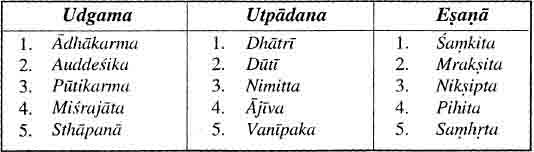
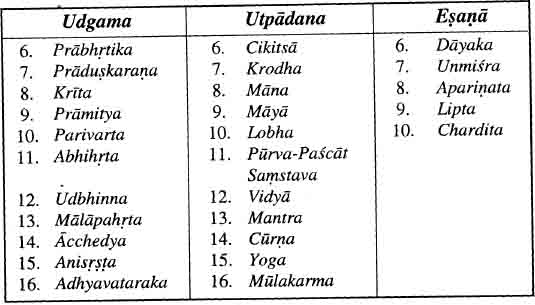
Sixteen Udgamadosas—blemishes relating to origination.
1. Adhdkarma—[i] The food etc. produced with a view to entertaining a monk and which is impure on account of injury to living beings.
[ii] Preparing of food, shelter, etc. for a particular monk.
2. Auddesika—■ Food etc. prepared for distribution among heretical monks or orthodox monks.
3. Pütikarma—The mixing up of pure food with impure one on account of being mixed with adhdkarma, thus making the entire food impure.
4. Misrajata—Food prepared for both householders and monks.
5. Sthapana—Food deposited in another vessel from the cooking pot specially for offering it to monks is subject to this blemish. The reason is that the dispute may arise among the members of family regarding the article or the quantity so deposited, or the food itself may become unacceptable on account of its being rotten or infested with living beings.
6. Prabhrtika—Anything presented in honour is calledprabhrta. For example, early or late celebration of marraige in view of the assemble of monks before or aftcr the appointed day, witha view to entertaining the latter. As distinguished from the above circumstance which is called badara, there is another instance called süksma when householder asks his son to wait till the monk came. Such postponing of allowing the child to consume’ food makes the offer unacceptable to the monk, because the child may run to the monk and drag him to his house for offering food to him in order to satisfy his own desire- for the same.
7. Pradüskarana—Exhibition of food by transferring the container or food from the dark place or by the light of a lamp or a jewel or the removing the barrier or the curtain. The blemish lies in the fact that movements are involved for the offering.
8. Krita—Food purchased for the monk. A feeling of excessive compassion for the monk is responsible for this kind of blemish.
9. Pramitya (Prakrit—Pamicca)—Food borrowed for a monk on promise of return with interest or otherwise.
These two or blemishes on account of their causing inconvenience to donor.
10. Parivartita—Food exchanged for a monk.
11. Abhihrta—What is brought by householder from a place beyond the range of three or seven houses in an avenue is subject to this blemish, because this is unusual, not approved by the norm, and is likely to involve injury to creatures.
12. Ubdhinna—Ghee, oil, molasses etc., offered by breaking the lid or unsealing the cask.
13. Maldpahrta—Food brought down from an elevated place on which it was stored. The reason for this being a blemish is that the donor may fall down while climbing the elevated place on a stair case.
14. Acchedya—Food offered out of fear of the king or another powerful person entails this blemish. According to the Pindaniryukti, food snatched by force from others and offered as alms was subject to this blemish.
15. Anisrsta—Alms owned by a company of persons and given ‘ by one of the owners without consent of the co-partners. The reason for this being a blemish is that a dispute may arise among the company who owned the articles.
16. Adhyavapuraka—Food put in excess in a cooking vessel in view of the arrival of monks.
Sixteen Utpadanadosas—faults pertaining to the ways adopted in obtaining food:
1. Dhatrt—Alms, given to a monk in return for the nourishing work done by him.
2. Duti—Alms given to a monk who runs on errands for the house holder.
3. Nimitta—Alms obtained by fortune-telling such as foretelling happenings and reading omens and bodily science.
4. Ajiva—Alms secured by mentioning caste, family, clan, profession, etc., of the donor for rousing his sympathy. The reason for this being a blemish is that the monk belittles himself.
5. Vanipaka—Food obtained by servile supplication by approving of the act of offering to” dogs, crows, lepers etc. on the part of donor.
6. Cikitsa—Alms obtained by offering medical service, treatment etc.
7. Krodha—Alms obtained by expressing one’s power of anger.
8. Mana—Alms obtained by displaying one’s false pride or vanity.
9. Maya—Alms obtained by trickery.
10. Lobha—Alms obtained by displaying one’s excessive greed for the alms offered.
11. Purva-pascat samstava—Alms received by the donor or reminding him of his past donations is vitiated by this blemish, which also occurs if the monk praises the donor after donation. The blemish occurs if the monk refers to his old aquaintance with the donor.
12. Vidya—Alms obtained by displaying or promising the gift of an occult science, acquired by monk by special effort.
13. Mantra—Alms obtained by giving charms and spells, or displaying their efficacy.
14. Curna—Alms obtained, by an offer of charmed powder for beautifying the body and cleansing the eyes. The charmed power may also be promised for making the donor invisible.
15. Yoga—Alms obtained by offering an oinment for the feet to enable the donor to walk on water or fly in the air.
16. Mulakarma—Alms obtained by such devices as prevention of conception, or conferment of fecundity, restoration of virginity etc.. The act of restoring conjugal relationship or restoring control over what has got out of it also falls in this blemish.
Ten Esand (grahanaisana)—blemishes pertaining to accepting food.
1. Samkita—Food suspected of any one of the following blemishes.
2. Mraksita— Pure food contaminated by live article on account of serving it with a hand besmeared with impure or unlit articles.
3. Niksipta—Pure food placed upon live article.
4. Pihita—Pure food covered by live or even lifeless cover, if the latter is too heavy in weight.
5. Samhrta—Putting of pure food in a vessel from which live food has been cast out with a view to give pure food to a monk. According to Maldedra, such blemish takes place if he accepts alms offered in hot haste and without proper inspection by the donor.
6. Dayaka—Food obtained from unfit donor such as a child, an old man, drunkard, lunatic, and the like.
7. Unmisra— Pure food mixed up with life food.
8. Aparinata—Food not fully cooked and made lifeless.
9. Lipta— Food offered by hands or from pots besmeared with live article such as water, vegetable, etc.
10. Chardita— Food of which a part has f, -en on the ground while offering it to the monk, because the dropped food is the potential or actual cause of injury to living beings.
The above mentioned forty-two blemishes are not found described in one place in the Agamika literature; they are however found scattered at different places. Srimajjayacarya has collected them together in one place. The following blemishes are found in Tlidnam 9/62 dhatripinda, dutipinda, nimittapinda, ajivapinda, vanipakapinda, cikitsapinda, krodhapinda, manapinda, mayapinda, lobhapinda. vidyapinda, mantrapinda, yogapinda, curnapinda and purva-pascatsamstava.
The following again are found in the Nisihajjhayanam 13/61-75. The parivarta is found mentioned in the Ayuracula 1.21. Mulakarma is found in Panhdvdgarandini, Samvara 1.15. The following are found in the Plndalsdn■d chapter of the Dasavealiyam—udbhinna, malapahrta, adhyavatara, sahkita, mraksita, niksipta, pihita, samhrta, ddyaka, unmisra, aparinata, lipta and chardita.
(3) Rules of consuming food—while taking food, one should be free from infatuation, anger and addiction to tasty food. There should not be hissing sound and chewing sound. One should not eat in haste or too slowly. One should not drop down bits of food while eating.
(4) Measure of food—As lubricant is rubbed on an axle or ointment is rubbed on an abscess, so ascetic should consume his food in meagre quantity. He should take barely what is necessary for sustaining the life of a self-restraint (ascetic).
(5) The purpose of taking food—the purpose of taking food is the pursuit of the discipline of self-restraint.
In conclusion, it can be said that a nirgrantha (ascetic) should practicse complete alloofness while eating food—just as a serpent, while entering into its underground hole, becomes straight without its sides being touched, in the same way the ascetic should straightway send the morsel down (the esophagus) without moving it to and frow for taking its taste. (It means that even while chewing, he sould not try to satisfy his palate).
Semantics
sastratita (satthatita)—treated with weapon like fire etc.. (The food material which is originally in the form a “sacitta” i.e., animate object should have been passed through the process of heating on fire etc., which act like a weapon (sastra) for the living beings constituting the food).
sastraparinamita (satthaparinamia)—transformed (made lifeless) by the appli¬cation of a weapon (such as fire etc.).
esita (esiya)—made acceptable.
vesiya—There are two Sanskrit forms of the word vaisika and vyesita. The former means that which has been obtained ‘on account of the vesa i.e. the outfit of an ascetic’. The latter means obtained by different modes espa (the careful investigation regarding theacceptibility of food).
In the Vrtti, the form vyesita is considered as the primary and vaisika as the secondary form.3 samudanika (samudaniya)—accepting food given by the householder like a bee collecting honey without harming the flower (without making any discrimination between the houses from which the food is obtained).
sastra (sattha)—in the present context, the word sattha should stand for ‘fire’. The Vrtt’ has explained it as ‘sword, etc’.4
vyapagata (vavagaya)—the living beings (souls) which have of their own become separate from the food-material in which they had taken birth.
cyuta (cue)—served (of life) i.e. dead.
cyavita (caiya)—it can have two Skt. forms—cyavita and tyajita. It would mean—deprived (of life).
anahuta (anahuya)—devoid of any invitation. The Vrtti has explained it as ‘that which is not nityapinda (accepting frrom from the same house everyday)’. The opposite of this is ahuta. The food accepted after getting the invitation such as ‘accept food-from my house daily’ is called ‘ahuta’’ or ‘nityapinda’ -5 Therefore, anahuta would mean ‘the food that has been accepted without any prior’ invitation’. navakotiparisuddham—immaculate in nine ways. This is explained in the Thanam1 as acceptance of the food that does not involve [i| killing [ii] getting killed and [iii| approving killer [iv| cooking [v| getting cooked |vi| approving the cooker [vii| purchasing for oneself [viii] getting purchased [ix| approving the purchase. akkhovamjana—lubricant rubbed on the axle of the wheel of a cart. ‘Aksa’ means ‘axle of a cart’. ‘Upahjana’ means ‘ointment’ or ‘lubricant’. (Vide Suya. 2/2/50). samjama-jaya-mdya-vattiyam (samyama-ydtrd-mdtra-vrttika)—as meagre in quantity as is barely necessarily for leading the life of self-resfraint. Abhayadevasuri has explained ‘yatra’ as observance of self-restraint or leading the life of ascetic; and matrai as a component of the collection of number of supporting factors of self¬-restraint; vattiya has two meanings—vrttika, i.e., ‘mode of life’ or occupation and pratyaya, i.e. cause.8 Silahkasuri has related matra (quantity) to food. The ascetic living on minimum quantity of food that is barely necessary for leading the life of self-restraint (or ascetic life) is called ‘ samyama-ydtrd-matrd-vrttika’.
Text
7.26 sevam bhamte! sevam bhamte! tti.
That is so, O Lord! That is so, O Lord!
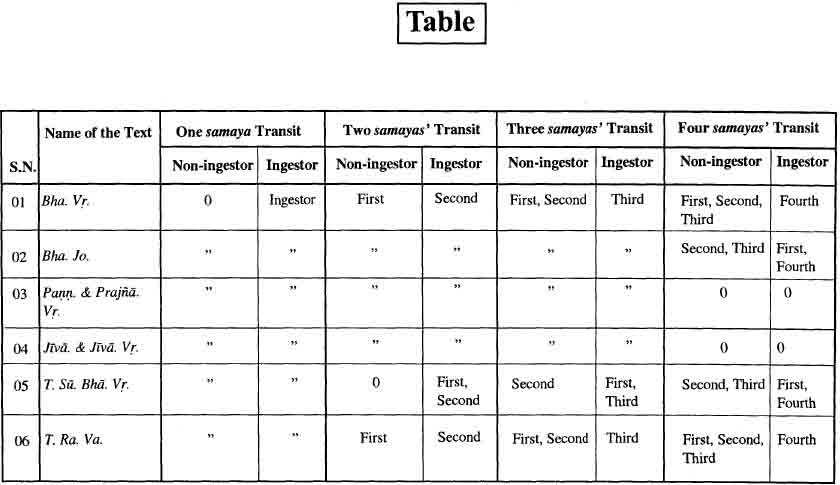
1. See Bhasya of Bha. 1.20.
2. Ta. Su. Bha. Vr. 2.31—tatraujaaharo’paryptakavasthayam karmanasarirenambuniksiptataptabhajana- vat pudgaladanam sarvapradcsairyat kriyatejantuna prathamotpadakale yonau apupeneva prathama- kalapraksiptena ghrtaderiti, esa ca antarmuhurtikah. lomaharastu paryaptakavasthaprabhrti yat tvaca pudgalopadanamabhavaksayacca sah. praksepaharah odanadikavalapanabhyavaharala-ksanah.
3. Bha. 34.2,3.
4. Ibid., 34.14.
5. Bha. Vr. 7.1—
(a) yada tu vigrahagatya gacchati tada prathamasamaye vakre’naharako bhavati, utpatisthananavaptau tadaharaniyapudgalanamabhavat.
(b) yadaikena vakrena dvabhyam samayabhyamutpadyate tada prathame’nah”rako dvitiye tvaharakah.
(c) yada vakradvayena tribhih samayairutpadyale tada”dyayoranaharakastrtryo tvaharakah.
(d) yada tu vakratrayena caturbhih samayairutpadyate tadadye samayatraye’naharakarcaturthe lu nivamadaharakah.
6. Ibid., 7.1—anye tvahuh—vakracatustayamapi sambhavati, yada hi vidiso vidisyevotpadyate tatra samayatrayam pragvat, caturthe samaye tu nadito nirgatya samasrenim pratipadyate, pancamena tutpatisthanam prapnoti, tatra cadye samayacatustaye vakracatustayam syat, tatra canaharak iti, idam ca sutre na darritam. prayenetthamanutpatteriti.
7. Ta. Ra. Va. 2.30—panimuktayamekavigrahayam dvisamayayam prathame samaye’naharakah. laiiguli-kayam dvivigrahayam trisamayayam prathadvitiyayoh samayayoranaharakstrtiye aharakah. gomutri-kayam trivigrahayam catuhsamayayam caturthasamaye aharaka itaresvanaharakah.
8. Ta. Su. Bha. Vr. 2.31, (part 1), p. 187—tatra dvivigrahayamekarn samayam madhyamam trivigrahayam dvau samayavanaharakau madhyamau bhavati.
9. Bha. Jo. 2.111.13-17—
trina vakre kari dhara, cyara samaya kari upajai |
prathama carama be a’ra, samaya majjhima be a’ra nahim |
vrtti majjhe ima vaya, anya acarya ima kahai |
pamca samaya upajaya, sutre kathana na ima kahyum |
anaharaka nam jcha, samaya jina kei kahai |
patha majjhe nahim teha, buddhivamta nyaya vicariyai ||
pannavana meh tahatlka, atharama pada naim vise |
chadmastha anaharika, sthiti kahi be samaya mm |
tina sum sutre vaya, akhi tehija satya chai |
viruddha bahu vrtti mamya, te kina rite maniyai |
10. (a) Panna, 18.98.
(b) Jiva. 9.43.
11. (a) Prajna. Vr. pa. 313—iha yadyapi catuhsamayiki pancasamayikt ca vigrahagatirbhavati, ahaca— ‘
ujuya ya ekavamka, duhato vamka gati vinidittha |
jujjai ticauvamkavi, nama caupamcasamayao ||1||
thatapi bahulyena dvisamayiki trisamayiki va pravartate na catuhsamayiki pancasamaiayiki va pravar-tate tato na te vivaksite, tatrotkarsatastrisamayikyam vigrahagatau.
(b) Jiva Vr. Pa. 441—jaghanyata ekam samayam jaghanyadhikarad dvisamayikim vigrahagatimapeksyaitadavasatavyam, utkarsato dvau samayau trisamayikya eva vigrahagate rbahulyenasraya- nat, aha ca cumikrt—yadyapi bhagavatyam catuhsamayiko’naharaka uktastathapyatra nangikriyate, kadacitko’sau bhavo yena, bahulyamevangikriyate, bahulyacca samayadvayameveti dvavadyau s amayav anaharakah.
1. Bha. 3.148.
2. Ibid., 7.20.
3. Ibid., 7.21.
4. Bha. Vr. 7.4—atma—jivah adhikaranani—halaSakatadlni kasayasrayabhutani yasya santi so’dhikarani. tatasca ‘ayahikaranavattiyam canam’ tti atmano’dhikaranani atmadhikaranani tanyeva pratyayah—karanam yatra kriyakarane tadatmadhikaranapratyayam samparayiki kriya kriyata iti yogah.
5. Bha. 16.8-9.
6. Bha. Jo. 2.111.39-68.
1. Apte—samadhi—collecting, composing, concentrating (of mind), profound or abstract meditation, intentness, penance, obligation, support, upholding etc..
2. Bha. Vr. 7.9—’kim cayai’ tti kim dadatityarthah ‘jiviyam cayai’ tti jivitamivadadati, annadi dravyam yacchan jivitasaiva tyagam karotityarthah jivitasyevannadidravyasya dustyajatvat, etadevaha— ‘duccayam cayai’tti dustyajametat, tyagasya duskaratvat, etadevaha—duskaram karotiti, athava kim tyajati—kim virahayati? Ucyate, jivitamiva jlvitam karmmano dfrgham sthitim.
1. Samkhyakarika, 19.17.
2. Bha. 7.160.
3. Bha. Vr. 7.16—duhkham karma tadvan jivo duhkhi.
1. Bha. 1.444,445, 6.29, 8.302-314, 7.20,21, 7.4,5, 3.148, 7.125, 126,10.11-14, 18.159,160.
2. Ta. Su. 6.5—sakasayakasayayoh samparayikeryapathyoh.
3. Ta. Ra. Va. 6.4—upasantaksïnakasâyayoh yoginasca yogvasadupattam karma kasayabhavat bandha- bhave suskakudyapatitalostavad anantarasamaye nivartamanamiryapathamucyate.
4. Bha. Jo. 2.113.21-23.
5. Ta. Su. Bha. Vr. 6.5—akasayo vïtarâgah saragasca. Tatra vitaragastrividhah—upasantamoha ekah ksmamohakevalinau ca kartsnyenonmulitakarmakadambakau, saragah punah samjvalanakasaya- vanapi avidyamana udayo’kasaya eva mandanubhavatvamanudarakanyanirde.savad, ata.scopapanna- midam—
“uccaliyammi pae, itiyasamiyassa samkamatthac |
vavajjejja kulimgt, marejja jogamasajja ||” (Oghaniryuktau ga. 747)
“naya tassa tannimitto bamdho suhumovi desito samae II” (Oghaniryukau ga. 749)
6. O. Ni. p.499—tasya evamprakarasya jnaninah karmaksayarthambhyudyatasya ‘asamcetayatah’ ajananasya, kirn? sattvani, katham?—prayatnavato’pi kathamapi na drstah pranT vyapaditarca, tatha ‘samcetayatah’ jananasya kathamastyatra pranTjnâto drstasca na ca prayatnam kurvano’pi riksitum paritah, tatasca tasaivamvidhasya yani sattvani ‘yogam’ kayadi prapya vinasyanti yatra nasti tasya sadhorhimsaphalam—samparayikam samsaraj ananam duhkhajananamityarthah, yadi paramTryâpra- tyayam karma bhavati, taccaikasmin samaye baddhamanyasmin samaye ksapayati.
7. Pa. Yo. Da. 2.4—vicchidya vicchidya tena tenatmana punah samudacarantiti vicchinnah katham? ragakale krodhasyâdarsanâl, na hi ragakale kmdhassamudacarati. ragasca kvacid drSvamano na visayantare nasti; naikasyam striyam caitro rakta ityanyasu strisu virakta iti; kimtu tatra rago 1abdhavrttiranyanna bhavisyadvrtti ri ti.
8. Bha. Vr. 6.292—vocchinnetti anuditah.
1. Uttara. 26.31,32.
2. Ibid., 24.11,12.
1. Kappo. 4.12,13.
2. Nisiha. 12.31,32.
3. Br. Ka. Bha. part 5, ga.5263, p. 1400—
bhavassa u atiyaro, ma hojja it! tu patthute suttee |
kalassa ya khettassa ya, duve u sutta anatiyare |
4. Bha. Vr. 7.24—ksetram—suryasambandhi tapaksetram dinamityarthah.
5. Kappo, 5.6-9.
6. Nisiha. 11.75-78.
7. Bha. Vr. 7.24—kalam divasasya praharatrayalaksanamatikrantam kalatikrantam.
8. Ni. Bha. Cu. ga. 4141—divasassa padhamaporisTe bhattapanam ghetum carimam ti cautthaporisi tarn jo sampaveti tassa caulahum anadiya ya dosa. citthatu tava cautthaporisi, padhamato btya carima, bitiyao tatiya carima, tatiyao cautthi carima.
9. Br. Ka. Bha. part 5, ga. 5264,65—
bitiyau padhama puvvim, uvatine caugurum ca anadi |
dosa samcaya samsatta diha, sane ya gone ya ||
agani gilanuccare, abbhutthane ya pahuna nirodhe |
sajjhaya vinaya kaiya, payalamta palottane pana |
astam tavat pascima caturthT paurusi kimtu dvitiyayah paurusyah prathama’pi purva bhasyate prathamayarca dvitiyapascatya, evam trtiyaya dvitiya purva dvitiyayastrtiyaparcatya, caturthastrtlya purva tniyasyascaturthi pascima. tatah prathamayah paurusya dvitiyayamasanadikamatikramaya- tascaturgrukam, ajnadayarca dosah.
10. Ova. Su. 33—se kim tarn omodariyao? omodariyao duviha pannattao, tarn jaha—davvomodariya ya bhavomodariya ya.
se kim tarn davvomodariya? davvomodariya duviha pannatta, tarn jaha—uvagaranadavvomo- dariya ya bhattapanadavvomodariya ya.
se kim tarn uvagaranadavvomohariya uvagaranadavvomodariya duviha pannatta, tarn jaha—ege vatthe, ege pae, ciyattovakaranasaijjanaya. se tarn uvagaranadavvomodariya/
se kirn tarn bhattapanadavvomodariya? bhattapanadavvomodariya anegaviha pannatta, tarn jaha—attha kukudaamdagappamanamette kavale aharamaharemane appahare, duvaiasa kukudaamdagappamanamette kavale aharamaharemane avaddhomodarie, solasa kukudaamdagappa manamette kavale aharamaharemane dubhagapattomodarie, cauvisam kukudaamdagappamanamette kavale aharamaharemane pattomodarie, ekkatisam kukudaamdagappamanamette kavale aharamaharemane kimcunomodarie, battisam kukudaamdagappamanamette kavale aharamaharemane pamanapatte, etto egena vi ghasenam unayam aharamaharemane samane niggamthe no pakamarasabhoi tti vattavvam siya. se tam bhattapanadavvomodariya. se tam davvomodariya.
se kirn tam bhavomodariya? bhavomodariya anegaviha pannatta, tam jaha—appakohe, appamane, appamae, appalohe, appasadde, appajhamjhe. se tam bhavomodariya. se tam omodariya.
1. See Suya. 2.1.66 and its footnote.
2. Ibid., 2.2.50.
3. Bha. Vr. 7.25—visesena vividhairva prakarairesitam—vyesitam grahanai.sana grasaisanavirodhitam tasya. athava veso—muninepathyam sa heturlabhe yasya tadvaisikam—akaramatradarsanadavaptam na tvavarjjanaya.
4. Ibid., 7.25—tyaktakhadgadi sastramusalah.
5. See the footnote of dasave. 3.2—’nityagra’.
6. Bha. Vr. 7.25—na ca vidyate ahutam—ahvanamamantranam nityam madgrhe posamatramannam grahyamityevamrupam karmmakaradyakaranam va sadhvartham sthanantaradannadyanayanaya yatra so’nahutam—anityapindo’bhyahrto vetyarthah. spardha va”hutam tannisedhadanahuto, dayakena- sparddhaya dtyamanamityarthah, anena bhavato’parinatabhidhanaesanadosanisedha ukto’tastam.
7. Thanam, 9.30.
8. Bha. Vr. 7.25—samyamayatra—samyamanupalanam saiva matra—alambanasamuhamsah samyama- yatramatra tadartham vrttih—pravrttiryatrahare sa samyamayatramatravrttiko’tastam. samyamayatra- matravrttikam yatha bhavati samyamayatramatrapratyayo va yatra sa tatha’tastam samyamayatra- matrapratyayam va yatha bhavati.
9. Suya. 2.2.50, Vr. pa. 40—samyamayatrayam matra samyamayatramatra, yavatyaharamatraya samyamayatra pravartate sa tatha, taya samyamayatramatraya vrttiryarsya tattatha.
♦
Second Section
Section-2
Text
Supaccakkhàna-dupaccakkhàna-padam
7.27 se nùnam bhamte! savvapdnehim, savvabhuehim, savvafivehim, savvasattehim paccakkhayamiti vadamanassa supaccakkhayam bhavati? dupaccakkhayam bhavati ?
goyama! savvapdnehim java savvasattehim paccakkhayamiti vadamanassa siya supaccakkhayam bhavati, siya dupaccakkhayam bhavati.
The Topic of the Supratyakhyana (Virtuous Renunciation) and the Duspratyakhyana (Vicious Renunciation)
When1 a person claims, O Lord! that he has renounced killing all living beings, all living substances, all souls and all animate beings, is his pratyakhyana (renunciation) a supratyakhyana (virtuous renunciation) or a duspratyäkhyäna (vicious renunciation)?
Gautama! when a person claims that he has renounced killing all living beings up to all animate beings, sometimes Ms pratäkhhyäna (renunciation) is supratyakhyana (virtuous renunciation), sometimes it is duspratyakhyäna (vicious renunciation).
7.28 se kenatthenam bhamte! evam vuccai—savvapdnehim java savvasattehim paccakkhayamiti vadamanassa siya supaccakkhayam bhavati? siya dupacca¬kkhayam bhavati?
goyama! jassa nam savvapdnehim java savvasattehim paccakkhayamiti vadamanassa no evam abjtisamannagayam bhavati—ime jìva, ime ajiva, ime tasä, ime thavara, tassa nani savvapdnehim java savvesattehim paccakkhayamiti vadamanassa no supaccakkhayam bhavati, dupaccakkhayam, bhavati. evam khalu se dupaccakkhai savvapanhim java savvasattehim paccakkhayamiti vadqmane no saccam bhasam bhasai, mosarn bhasam bhasai. evam khalu se musavai savvapanehim java savvasattehim tiviham tivihenam asamjaya-viraya-paihaya- paccakkhayci-pavakamme, sakirie, asamvude, egaintadamde, egaintabale yavi bhavati.
jassa nam savvapanehim java savvasattehim paccakkhayamiti vadamanassa evam abhisamannagayam bhavati—ime jiva, ime ajiva, ime tasa, ime thavara, tassa nam savvapanehim java savvesattehim paccakkhayamiti vadamanassa supaccakkhayam bhavati, no dupaccakkhayam bhavati.
evarn khalu se supaccakkhai savvapanehim java savvasattehim paccakkhayamiti vadamane saccam bhasam bhasai, no mosarn bhasam bhasai. evam khalu se. saccavadisavvapanehim java savvasattehim tiviham tivihenam samjaya-viraya-
padihaya-paccakkhayci-pavakamme, akirie, samvude, egamtapamdie ya• i bhavati. se tenatthenam- goyamd! evam vuccai—savvapdnehim java savva- sattehim paccakkhdyamiti vadamanassa siya supaccakkhdyatn bhavati, siya dupaccakkhayam bhavati.
For what reason, O Lord! has it been said that when the person claims tha t he has renounced killing of all living beings up to al 1 animate beings, sometimes his pratyakhyana (renunciation) is supratyakhyana (virtuous renunciation), sometimes it is duspratyakhyana (vicious renunciation)?
Gautama! when a person claims that he has renounced killing of all living beings up Ft al 1 animaee befogs , but if lee does not comprehend—these are souls, these are non-souls, these are mobile beings, these are immobile beings, then his pratyakhyana (renunciation) of killing of all living beings up to alt animaee befogs is not supratyakhyana, it is a duspratyakhyana. Thus, when such a person who is making duspratyakhyana claims that he has renounced killing of all living beings up o> al 1 animaee befog,. hie
does not speak the truth, he speaks the untruth. Thus such lier is not a restrainer, abstainer, one who has forsworn the past sinful activities and one who has renounced the future sinful activities, through three types of acts (viz., do oneself, make others do and approve of others’ action) and three types of instruments (viz., mind, speech and body) towards all living beings up to al 1 animaee befogs . He focurs kriyas such as kayiki and the like (the urges due to physical activity etc.); he has not inhibited himself from evil acts; he is ekadtadaHdayiftndtiytvd perpetrator of violence) and ekantabdla (unmitigated non-abstinent).
On the other hand, if the person’ who claims that he has renounced killing of all living beings up to alt animaee befog,. comprehends that theee are souls, these are non-souls, these are mobile beings, these are immobile beings; then his pratyakhyana (renunciation) of killing of all living beings up to all animate beings is a suprrtyakhyrnr (virtuous renunciation), not a duspratyakhyrna (vicious renunciation).
Thus, when such a person who is making supratyakhyana claims that he has renounced the killing of all living beings ...... up o > ll 1 animaee befog, . he speaks what is true, he does not speak what is untrue. Thus, such a speaker of truth is a restrainer, abstainer, one who has forsworn the past sinful activities and one who has renounced the future sinful activities, through three types of acts (viz., do oneself, make others do and approve of others’ action) and three types of instruments (viz., mind, speech and body) towards all living beings up to al t animaee bemgs. He does not focur krtyae such as kayiki and the like; he has inhibited himself from evil acts; he is ekdnta- pandita (a mahavrati (observer of the five great vows) who is unmitigated abstainer from all evil activities).
For this reason, O Gautama! has it been said that a person who claims that he has renounced the killing of all living beings up to all animate beings, sometimes he is the doer of supratyakhyana (virtuous renunciation); sometimes he is the doer of duspratyakhydna (vicious renunciation).
Bhasya
1. Sutras 27-28
While propounding his views on the truth, Lord Mahavira made use of the doctrine of standpoints (payavada) or based them on the relativistic approach. That is why there is no one-sided or absolutistic insistence in them; there is the touch of truthfulness. In the present context too, a relativistic view about the performance of pratyakhyana (renunciation) is presented.
Lord Mahavira propounded the truth from different viewpoints and also relatively, thus avoiding absolutistic partiality. It is not possible to speak of an act of renunciation as exclusively good or bad. It can be described virtuous or vicious relatively with reference to particular cases. Suppose there is a person who has no distinctive knowledge about what is soul and what is non-soul. Now, if he renounces the killing of all living beings, how would he properly observe the vow of not killing all living beings?
Abhayadevasuri has pointed out that proper observance of the vow of not killing any living beings is not possible without the knowledge of what is soul and what is not soul. In context of this fact, the pratyakhyana (i.e., the acceptance of the vow of non-killing) made by an ignorant person can not be deemed an act of virtuous renunciation.1
Srimajjayacarya has further dwelt on the relative approach. According to him, the person who does not know the distinction between what is soul and what is not soul has a deluded world-view; such person cannot have knowledge of all living beings, and in absence of knowing them, if he renounces the killing of all living beings, then renunciation of such person, because of his ignorance, is not a genuine or virtuous renunciation—it is duspratyakhydna or vicious renunciation; again if a person with deluded world-view, who distinguishes between the mobile and immobile beings, renounces the killing of them, then such renunciation is a duspratyakhydna (vicious renunciation) on account of the absence of samvara (inhibition of the influx of karma) which does take place (even in spite of deluded view); it can be deemed as supratyakhyana. Srimajjayacarya has quoted a number of passages from the scripture in support of this view.2
The first necessary condition of renunciation is the enlightened world-view. Without the’ knowledge of the distinction between what is soul and what is not soul, a person cannot have the enlightened world-view. In the absence of that knowledge, he cannot attain the state of a monk. In the term ‘tiviham tivihena’ i.e., through three types of acts and three types of instruments, three types of acts are doing, getting done,-and approving; and three types of instruments, are mind, speech and body. The monk renounces the killing of all living beings through these three types of acts and three types of instruments. Without achieving the enlightened world¬view, it is not possible to attain the state of a monk. And in the absence of the state of a monk, the act of renunciation is not genuine (or virtuous). This is the purport of the present dialogue. In those days, some heretics, even in the absence of the enlightened world-view, renounced the killing of all living beings through three types of acts and three types of instruments. This Sutra was composed, plausibly, keeping those heretics in view’.
The above discussion can be tabulated as follows:
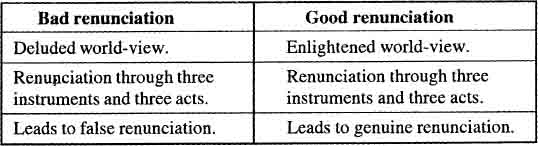
The person performing vicious renunciation, even in spite of being desig¬nated as a monk, is not a monk in reality. He is asamyata—not restrained, avirata—not abstinent, apratihata-papakarma—not forswearer of (past) sinful activities and apratyakhyata-papakarma—not renouncer of (future) sinful activities, is sakriya—incurer of the kriyas (urges) such as kayiki etc., and is asainvrta—non¬inhibited; he is ekantadanda—unmitigated perpetrator of violence to other living beings and ekantabala—unmitigated nor-abstinent. He is not a monk in reality, though he claims himself to be so. So his claim has been said to be a false claim. The person making a genuine renunciation is a genuine monk, so his claim of renouncing killing all living beings is a genuine claim. He is samyata—restrained, virata—abstinent, pratihata-papakarma—forswearer of (past) sinful activitie, pratyakhyata-papakarma—renouncer of (future) sinful activities, akriya—free from the kriyas (urges) such as kayiki etc., samvrta—self-inhibited and ekantapandita—a mahavrati who is unmitigated abstiner from all sinful activities.
Semantics
egamtadamde—one who indulges in killing other living beings by all (possible) means.
egamtabale—absolutely devoid of the virtue of abstinence.
egamtapandie—abstinent in all respects and an observer of the (five) great vows.
Text
Paccakkhana-padam
7.29 kativihe nam bhamte! paccakkhane pannatte?
goyama! duvihe paccakkhane pannatte, tam jaha—mulagunapaccakkhane ya, uttaragunapaccakkhane ya.
The Topic of the Pratyakhyana (Renunciation)
How1 many kinds ofpratyakhyana (renunciation) have been propounded, O Lord?
Gautama! two kinds of renunciations have been propounded, viz., mulagunapratyakhyana—renunciation, related with fundamental virtues, and uttaraguiiapratyakhyana—renunciation, related with subsidiary virtues.
7.30 mulagunapaccakkhane nam bhamte! kativihe pannatte?
goyama! duvihe pannatte, tam jaha—savvamulagunapaccakkhane ya, desa- mulagunapaccakkhane ya.
How many types of mulagunapratyakhyana have been propounded, O Lord? Gautama! two kinds have been propounded, viz., sarvamulagunapratya- khyana—complete renunciation, related with fundamental virtues, and desamulagunapratyakhyana—partial renunciation, related with fundamental virtues.
7.3! savvamulagunapaccakkhane nam bhamte! kativihepannatte?
goyama!pamcavihepannatte, tam jaha_savvaopanaivaydo veramanam, savvao musavdyao veramanam, savvdo adinnaddndo veramanam, savvao mehunao veramanam,, savvao pariggahdo veramanam.
How many kinds of sarvamulagunapratyakhydna—complete renunciation, related with fundamental virtues, have been propounded, O Lord?
Gautama! five kinds have been propounded, viz., complete renunciation from injury to all kinds of living beings, complete renunciation from all kinds of falsehood, complete renunciation of all kinds of stealing, complete renunciation from all kinds of sex, complete renunciation from all kinds of possessions.
7.32 desamidagunapaccakkhane nam bhamte! kativihe pannatte?
goyama! pamcavihe pannatte, tam jaha—thulao panaivayao veramanam, thulao musiivayao veramanam, thulao aduinddanao veramanam, thulao mehunao veramanam. thulao pariggahao veramanam
How many kinds of desdmuldgundpdccdkkhdnd—partial renunciation, related with fundamental virtues have been propounded, O Lord?
Gautama! five kinds have been propounded, viz., partial abstinence from injury to gross (mobile) living beings, partial abstinence from major (deadly) falsehoods, partial abstinence from major (deadly) stealing, partial abstinence from major (deadly) sex, partial abstinence from major possessions.
7.33 uttaragunapaceakkhane nam bhamte! kativihe pannatte?
goyama! duvihe pannatte. tam jaha —savvuttaragunapaccakkhane ya, desuttaragunapaccakkhane ya.
How many kinds of uttdragundpaccdkkhand—renunciation, related with subsidiary virtues, have been propounded, O Lord?
Gautama? two kinds have been propounded, viz., sdrvottdrdgundpdccd- kkhana—renunciation, related with entire varieties of subsidiary virtues, and desottaragunapaccakkhanit—renunciation, related with partial varieties of subsidiary virtues.
7.34 savvuttaragunapaccakkhane nam bhamte! kativihe pannatte?
goyama! dasavihe pannatte, tam jaha—
Gaha —
1,2. anagayamaikkamtam
3. kodtsahivam 4. mvamtivam ceva.
5,6 sagaramanagaram
7. parimanakadam 8. niravasesam.
9. samkeyam ceva 10. addhae, paccakkhanam bhave dasaha II lll
How many kinds of sarvottaragunapratyiikhyana have been propounded, O Lord?
Gautama! ten kinds have been propounded, viz.,
Verse —
3. koti-sahita, 4. niyantrita,
5. sdkara, 6. anakara,
7. parimdnakrta, 8. niravasesa,
9. samketa, 10. adhvd—These are the ten kinds of renunciation. (For meanings, see Bhasva).
7.35 desuttaragunapaccakkhane nam bhamte! kativihe pannatte?
goyama! sattavihe pannatte, tarn jaha—1. disivvayam 2. uvabhogapari- bhogaparimanam 3. anatthadamdaveramanam 4. samaiyam 5. desavagdsi-yanm
6. posahovavaso 7. atihisamvibhago. apacchimamaranamtiyasamle- hanajh us atia rahanatta.
How many kinds of desottaragunapaccakkhana have been propounded, O Lord? ■ ■
Gautama! seven kinds have been propounded viz., 1. digvrata, 2. upabhoga- paribhoga-parimana, 3. anarthadanda-viramana, 4. sdmayika, 5. desavakasika, b.pcusadhopavdsa, 7. atithisamvibhaga. (The additional is) apascimamaranan- tikasamlekhand-josand-drddha.iia. (For meanings, see Bhasya).
Bhasya
1. Sutras 29-35
Two types of virtues have been prescribed for observing the spiritual discipline: mulaguna—fundamental virtues and uttaraguna—subsidiary virtues. The virtues that arc obligatory for the practice of the spiritual discipline are called mulaguna . The optional practices that promote the development of spiritual discipline are called uttaraguna. In the present dialogue, five mulagunas (fundamental or obligatory virtues) and ten Uttaragunas (subsidiary or optional virtues) have been prescribed for the ascetic. For the lay followers, five mulagunas (fundamental virtues in the form of partial renunciation) have been mentioned. In the Digambara tradition, the enumeration of the mulagunas has been differently made. Thereof twenty-eight mulaguna have been prescribed for the ascetic—five great vows (mahavratas), five deportments {samitis), five control of the senses, six essential duties (avasyaka) . plucking hair (loca), nudity (acelakya), no bath (asndna), sleeping ■ on the ground (ksiti-sayana), non-brushing of the teeth (adanta-gharsana), eating food in a standing posture (sthiti-bhojana) and one meal in a day (ekabhakta))
It is a matter of investigation as to on what basis the development of the enumeration of the mulagunas took place. That the five great vows are. the mulagunas is quite logical assertion—the monkhood is possible only if there is observance of the five great vows if, on the other hand, the five great vows are not followed, there can not be monkhood; and hence, they are termed as ‘mulagunas’. The vows of sleeping on the ground etc. are subsidiary virtues. The number of such virtues may be even more than what are enumerated above.
For the lay follower also, the fundamental virtues arc five in number. In the Digambara tradition. the basic virtues of the lay follower are eight viz., the five anuvratas the partial renunciation and abstaining from alcoholic drinks. meat and honey.2 This appears to be a latter development. Really speaking, the five anuvratas only are the basic virtues of the lay follower.
The ten renunciations that have been mentioned in the Thânam (10/101) should be the uttaraguna pratyâkhyâna i.e., subsidiary virtues, prescribed for the ascetic, as is evident from the Bhagavaï 7/33. These ten renunciations are:
(1) anâgayam (anâgata)—predestined—to practise beforehand the penance to be practised in future.
(2) aikkamtam (atikrànta)—procrastinated—when the penance to be practised in present cannot be practised now’, it is undertaken in the future.
(3) kodisahiyam (koti-sahita)—coincidence of the last day of the previous penance and the first day of the next penance.
(4) niyamtiyam (niyantritam)—categorical resolve that—”I will undertake a specific kind of penance at a specific time,” whether the renouncer is healthy or sick.
(5) sâgâram (sâkâra)—to keep exception in the renunciation.
(6) anâgâram (anâkârà)—renunciation without any exception.
(7) parimdnakadain (parimatiakrta)—making a resolve to accept food only in definite measure with regards the number of spoonful quantity, morsel, number of houses to be visited for accepting food, number of items to be taken etc..
(8) niravasesatn (niravasesa)—renunciation in -terms of -total -abstinence from food, drink, dainties and delicacies.
(9) sankeyam (samketa)—the renunciation in which some indication or hint is given.
(10) addhâe (addhâtah)—time-bound renunciation such as for one muhürtta (i.e., 48 minutes), one paurisi (to abstain from food for one quarter of the day-time after the sunrise).
In the period of composition of the Niryuktis, we find another classification of the subsidiary virtues, according to which there are twelve kinds of penances enumerated as subsidiary virtues.4 Sïlânkasüri, in his Süyagado Vrtti, quotes a verse which embodies the third form of classification of subsidiary virtues, which is a very developed form.5
The vow of refraining from movement beyond a limited area (disivvayam) etc. are specific application of the fundamental virtues, so they have been called subsidiary virtues.
Digvrata (To restrict one’s mvement in different directions)—It means the limitation of movements in upward, downward and horizontal directions.
Upabhoga-paribhoga-parimâna Vrata (To restrict the usage and re-usage of the articles of consumption)—The vow of limiting the use of consumable and re¬consumable goods—the objects that can be used only once such as food, drink etc. are upabhoga (consumable goods); those that can be used again and again are
paribhoga—re-consumable goods such as scats, beds, clothes etc.6
Anarthadandaviramana (To abstain from purposeless acts of violence)—The vow of refraining from wanton destruction of the environment——it means refraining from bad meditation, remissness, supply of fatal weapons etc.
Samayika (To renounce sinful activities for one muhurtta)—it means renunciation of sinful activity for 48 minutes and engagement in virtuous activity for the same period.7
Desavakasika (Further curtailment in the digvrata for a limited time)—it means further restriction of the movement to an even more limited area than restricted in the digvrata, for sometime.8
It is mainly concerned with the further restriction of the digvrata. Haribhadra- suri refers to an ancient tradition according to which the observance of the anuvratas adopted for the whole life is further intensified.9
Pausadhopavasa (To renounce sinful activities for 24 hours and undertake fasting on sacred days)—it means renunciation of food, embellishment of the body, sinful activities and observance of celibacy for a single day and night. It is of two kinds, viz., partial pausadha and complete pausadha. The former may be observed even for a shorter period (i.e., for less than 24 hours) and during it food is not prohibited. There is a reference in Bhagavatithat some lay followers of the Sramana order (Sramanopasakas) headed by Sahkha and others made a resolve to observe desapausudha.”‘B\i\. in the meanwhile Sahkha changed his mind and undertook pausadha in his own pousadhasala (the hall or the house meant for observing the pausadha’).” (See Uttarajjhayanani (second edition), note on 5.23).
Atithisamvibhaga (To offer food etc. from one’s own share to the atithi i.e., the visitor (ascetic) who visits without pre-information)—This is the 12th vow of the lay follower. It is also called yathasamvibhaga. It means—parting with food etc. which should be in conformity with the rules of acceptance (of food etc.) by the ascetic who is completely restrained with the intention of only spiritual beneficence.
Apascima-jnarnantikasamlekhana-joscma-arddhand—The final (last) practice of penitential performance of emaciation of the passions by a course of fasting which spans a number of years and ends in death. Samlekhana means penance (fasting) for emaciating the body and the passions. It is practised till the end of life culminating in ‘death in blssful state (samadhi)’ or tranquil meditation; so it has been called the last pascima maranantika samlekhana (i.e. ultimate penance of emaciation ending in death). The Vrtti opines that the word apascima has been used for pascima in order to avoid the implication of inauspiciousness connected with the word pascima-, and apascima means the same thing, that is, the last stage, but pasc ima imply sense of inauspicious end. In order to debar this inauspiciousness, the word apascima is used, which means the auspicious terminus, which has nothing beyond it. It is desirable to practise such Samlekhana with full joy and complete dedication.12
Samlekhana has been prescribed both for the ascetics and their lay followers. It is a process of embracing death in samadhi (blissful state), being engrossed in tranquil meditation. Lord Mahavira was the foremost among those who ‘have taught the ‘art of dying’.
Samlekhana is the spiritual practice to free oneself from the fear of death. Lord Mahavira revealed to the spiritual practitioner (or the follower of religion) the mantra of eschewing fear of death and cultivating moral strength. Samlekhana paves the way for attainment of perfection of that mantra. Samlekhana is a subsidiary virtue. It is related to both the partial and the complete subsidiary virtues. With respect to a lay-follower, it is a partial subsidiary virtues.13
For the systematic procedure of Samlekhana. see notes on Ayaro. 8/8/1-3 and Uttarajjhayanani 30/12-13.
The five anuvratas have been shown to be partial fundamental virtues. The remaining seven vows have been characterized as partial subsidiary virtues. In the Tattvartha Bhasya, the expression uttaravrata has been used for the seven vows, in place of utlaraguna.14 We do not find the mention of uttaraguna and uttaravrata anywhere else.
In the Uvasagadasao, the mention of five anuvratas has been followed by the prescription of anarthadanda (renunciation of the act of wanton destruction of environment).15 In the same text, in the section on the transgression, the sequence is as follows—the fifth anuvrata, viz., the vow of ‘limitation of desire for possession is followed by the digvrata (sixth vow), upahhoga-parihhoga-parimana (seventh vow), anarthadanda-viramana (eighth vow), samayika (ninth vow), desavakasika (tenth vow), pausadhopavasa (eleventh vow) and yathusamvibhaga (twelfth vow) respectively.16 These twelve vows are followed by the mention of the practice of the maranantika samlekhana— the performance of emaciation of passions by a course of fasting unto death.17
In the Uvasagadasao, there is no mention of the division of the 12 vratas as the mulaguna and uttaraguna. Instead, there are the following two divisions of 12 vratas are available: five anuvratas and seven siksavratas—supplementary vows. In the Avasyaka Curnt, there are, however, three divisions of layman’s vows: five anuvratas. three gunavratas (the strengtheners (vows) of the virtues of the five anuvratas) and four siksavratas (supplementary vows). Thus, the seven supplementary vows mentioned in Uvasagadasao are divided into two parts in Avasyaka Ciirni—three gunavratas (for promoting the efficacy of the anuvratas and four siksavratas (the vows meant for regular practise or training).
It appears that the division into gunavratas (the strengtheners (vows) of the virtues of the five anuvratas) and siksavratas (supplementary vows) which is not found in T.Bh in the post-Tattvartha Sutra period. It is mentioned only by the commentator Siddhasenagani.18 In the Sarvarthasiddhi and the BhagavatiAradhana also three gunavratas (the strengtheners (vows) of the virtues of the five anuvratas)11 and four siksavratas (supplementary vows) are found mentioned, but the order of the vratas is different there. According to them, digvrata, desavakasika and anarthadandaviramana are gunavratas (the strengtheners (vows) of the virtues of the five anuvratas). According to Siddhasenagani’, the gunavratas are digvrata, upabhoga-paribhoga-parimana and anarthadandaviramana.20 In the Mahapurana, this diversity of opinion has been mentioned.21‘ In the Caritrapahuda22 and Vasunandisravakacara23 the maranantika sandekhana has been classified under siksavratas (supplementary vows).
The first eight vows are undertaken for the whole life and the last four siksavratas (supplementary vows) are undertaken for a short period.24 It is plausible that among the seven siksavratas (supplementary vows) the first three were undertaken for the whole life and the last four temporarily and for shorter period. On the basis of this difference in the duration of undertaking, the first three siksavratas (supplementary vows) were designated as gunavratas.
Text
Paccakkhani-apaccakkhani-padam
7.36 jiva nam bhamte! kim mulagunapaccakkhani? uttaragunapaccakkhanl? apaccakkhani?
goyama!jiva mulagunapaccakkhanivi, uttaragunapaccakkhanlvi, apaccakkhani vi.
The Topic of the Renouncer and the Non-Renouncer
Are1 the souls, O Lord! mulagunapratyakhyanis—the renouncers as undertakers of the mulaguna (fundamental virtues), or uttaragunapra- tyakhyanis—the undertakers of the uttaragunas (subsidiary virtues) or the apratyukhyanis—non-renouncers?
Gautama! the souls are mulagunapratyakhyanis also uttaragunapratya- khyanls also apratydkhyanis.
7.37 neraiya nam bhamte! kim mulagunapaccakkhani? puccha.
goyama! neraiya no mulagunapaccakkhani,,.no uttaragunapaccakkhanl, apaccakkhani.
Are the infernais, O Lord! mulagunapratyakhyanis! (etc.)? Query. Gautama! the infernais are not mulagunapratyakhyanis are not uttara- gunapratyakhyanls (but) are (only) apratyakhyants.
7.38 evam java caurimdiya.
Similarly up to the four-sensed beings (in the series of the dandakas (soul-groups)).
7.39 pamcimdiyatirikkhajoniya manussa ya jaha jiva, vanamamtara-joisiya- vemaniyajaha neraiya.
Ths five-sensed subhumae bsiegs aed humae bsiegs are to bs described leks ths souls (e gsesral; ths Forsst gods, ths Lumieous gods aed ths Empyrsae gods ars to bs describsd liks the infernals.
7.40 eesi nam bhamte! jivanain mulagunapaccakkhaninam, uttarapacca-kkhaninam, apaccakkhanmaya kayare kayarehimto appa va? bahuya va? tulla va? visesahiya va?
goyama! savvatthova jiva mulagunapaccakkhani, uttarapaccakkhani asamkhejjagurid, apaccakkhani anamtagurid.
Amoeg thsss souls, O Lord! viz., ths muldguadprdtydkhydma, ths uttdrd- gukprdtydkhydma aed ciprdtydahydtua, who ars mutually smallsr ie eumbsr, grsatsr ie eumbsr or squal ie eumbsr or slightly mors ie eumbsr?
Gautama! feast in eumbsr amoeg thsss souls ars ths muldguadprdtydkhydaia ieeumsrabls timss of thsss ars ths uttkraguakprktydahydaia, iefieits timss oO thsss ars thoss who ars kprdtykahydllTa.
7.41 eesi nam bhamte! pamcimdiyatirikkhajomyanam puccha.
goyama! savvatthova pamcimdiyatirikkhajoniya mulagunapaccakkhani, uttarapaccakkhaniasamkhejjaguna. apaccakkhm asamkhejjagurid.
Amoeg thsss, O Lord! ths qusry concereieg ths fivsrseesed subhumae bsiegs.
Gautama! ths feast ie eumbsr ars ths five-seesed subhumae bsiegs who ars mulaguakprktydahydaía,l ieeumsrabls timss of thsss ars ths uttdrdguad- prdtydkhydaTa, ieeumerable timss of thsm ars ths dprdtydahydaia.
7.42 eesi nam bhamte! manussanam mulagunapaccakkhaninam puccha. goyama! savvatthova manussanam mulagunapaccakkhani, uttarapaccakkhani samklqejjagund, apaccakkhani asamkhejjagund.
Among these, O Lord! the same query concereing ths humae bsiegs who ars the mulaguadprktykahykala (stc.)?
Gautama! amoeg humae bsiegs, ths feast m eumbsr ars ths muldguad- prdtyakhyanis, numerable timss of them are the uttardguapratyakhyanis, innumerable times of them are those who are the apratyaahyanis.
Bhasya
1. Sutrda 36-42
Among the twenty-eight sub-types of deluding karma, the four sub-types namely, apratyakhyana kasayas (passions which are the cause of non-renunciation) are such that their intense fruition hoes not permit the advent of the virtue of renunciation. Some human beings and also some five-sensed subhumans, on account of their spiritually benignant psychic propensity, weaken the fruition of the apratya- khyana kasayas (passions which are the cause of non-renunciation, so there rises in them the power of renunciation as mulagunas (fundamental virtues) or gunavratas (subsidiary virtues). Infernais are deeply and constantly engrossed in anguish, while the gods experience immense happiness, being deeply immersed in the material pleasures. So they can not develop the capacity to weaken the force of passions which are the cause of non-renunciation. The souls who are devoid of mind also can not even think of such capacity so they are inherently non-renouncers. Relative Numerical Strength
Abhayadevasuri notes that among the ascetics who are complete renouncers, those who are possessed of the gunavratas (subsidiary virtues) are necessarily possessed of the mulagunas (fundamental virtues). But those possessed of the mulagunas (fundamental virtues) may or may not be possessed of gunavratas (subsidiary virtues). Here only those ascetics are to be understood who are not possessed of gunavratas (subsidiary virtues). The majority of the monks are possessed of the gunavratas (subsidiary virtues) so the number of the monks possessed of gunavratas (subsidiary virtues) is numerable times of the ascetics possessed of only the mulagunas (fundamental virtues). Among the partial renouncer lay followers, the observers of the gunavratas (subsidiary virtues) are greater in number than those that practise the mulagunas (fundamental virtues). The number of the lay followers who observe only the gunavratas (subsidiary virtues) is innumerable times higher than those partial renouncer lay followers who follow the mulagunas (fundamental virtues).1
There are two types of human beings— garbhaja. i.e., the souls born of womb and sammurcchima, i.e., the souls born of agglutination of material particles. The garbhaja human beings are numerable, but those born of agglutination (pammur- cchima) are innumerable. It is only with reference to the latter that the number of non-renouncer human beings has been stated to be innumerable.
Text
7.43 jiva nam bhamte! kim savvamulagunapaccakkhani? desamulagunapacca- kkhani?apaccakkhani?
goyama! jiva savvamulagunapaccakkha.ru vi, desamulagunapaccakkham vi, apaccakkhani vi.
Are1 the souls, O Lord! sarvamülagunapratyakhyñnis—the complete renouncers as undertakers of the fundamental virtues, or desamülaguna- pratyakhydnis—the partial renouncers as undertakers of fundamental virtues, or apratyakhyanis—non-renouncers?
Gautama! the souls are sarvamülagunapratydkhydnis—the complete renouncers as undertakers of the fundamental virtues, also desamülagune- pratyakhyanis—the partial renouncers as undertakers of fundamental virtues, also apratyakhydnis—non-renouncers.
7.44 neraiydnam puccha.
goyama! neraiyd no savvamülagunapaccakkhani, no desamülagunapacca-kkháni, apaccakkhdni.
The (same) query concerning the infernáis.
Gautama! the infernáis are not sarvamülagunapratyakhyanis—the complete renouncers as undertakers of the fundamental virtues, not desamülagune- pratydkhydnis—the partial renouncers as undertakers of fundamental virtues, but are apratyakhydnis—non-renouncers.
7.45 evam java caurimdiya.
Similarly up to the four-sensed beings.
‘ 7.46 pamcimdiyatirikkhajoniydnam puccha.
goyama! pamciindiyatirikkhajoniyá no sa vvamülagunapaccakkhani. desamdlagunapat cakkhani, apaccakkhani vi.
‘ The (same) query concerning the five-sensed subhumans?
Gautama! the five-sensed subhumans are not sarvamülagunapratyd- khyanis—the complete renouncers as undertakers of the’ fundamental virtues, they are desamülagunepratydkhyariis—the partial renouncers as undertakers of fundamental virtues, or they are also apratyakhydnis—non--renouncers.
7:47 manussa nam bhamte! kim savvamülaguriapaccakkhüni? desamülaguna- paccakkhani? apaccakkhani?
goyama! manussa savvamülagunapaccakkhtini vi, desamülagunapacca-kkháni vi. apaccakkhdni vi.
Are the humans O Lord! sarvamülagunapratydkhydnis—the complete renouncers as undertakers of the fundamental virtues, desamülagune- pratydkhydnis—the partial renounce— as undertakers of fundamental virtues, or apratyakhydnis—non-renouncers?
Gautama! the humans are sarvamülagunapratydkhydnis—the complete renouncers as undertake— of the fundamental virtues, also desamülagune- pratydkhydnis—the partial renounce— as undertakers of fundamental virtues, also apratyakhydnis—non-renouncers.
7.48 vanamamtara-joisa-vemaniya jaha neraiya.
The Forest gods, Luminuous gods and the Empyrean gods are to be described like the infernais.
7.49 eesi nam bhamte! jivanam savvamulagunapaccakkhaninam, desamula- gunapaccakkhaninam apaccakkhtinina ya kayare kayarehimto appa va? bahuyd va? tuiia va? visesdhiyd va?
goyama! savvatthova jiva savvamuiagunapaccakkhani, desamuiaguna- paccakkhdnlasamkhejjagima. apaccakkham anamlagund.
Among these souls, O Lord! viz., sarvamulagunapratyakhyanis—the complete renouncers as undertakers of the fundamental virtues, desamulaguna- pratyakhyanis—the partial renouncers as undertakers of fundamental virtues, and apratydkhydnis—non-renouncers; who are mutually the least in number, the more in number, equal in number or slightly more in number? Gautama! The least among them in number are the souls who are the sarvamdlagunapratyakhydnis—the complete renouncers as undertakers of the fundamental virtues, a numerable times of them are those who are desaindlagunapratyakhydnls—the partial renouncers as undertakers of fundamental virtues, inflnite times of them are the apratydkhydnis—non- -renouncers.
7.50 eesi nam bhamte! pdmcimdiydlirikkhdJomydmdm puc ‘c/ia.
goyama! savvadhova pamcimdiyalirikkhdjoniyd desamlagunapdccakkhani, apaccakkhanl asamkhejjaguna.
Among them, O Lord! the (same) query concerning the five-sensed subhuman beings.
Gautama! the least among the five-sensed subhumans are the desamula- gunapratydkhydnls—the partial renouncers as undertakers of fundamental virtues, innumerable times of them are the souls that are apratyd- khydnls—non-renouncers.
7.51 eesi nam bhamte! manussanam savvamulagunapaccakkhanlnam puccha. goyama! savvadhova manussa sdvvdmuidgundpdccakkhdn. aesamulaguna- pacciikkhiinT sainkhejjagunii. apaccakkhimi asumkhejjaguna.
Among the human beings, O Lord! the (same) query concerning the sarvamdlagunapratydkhydnls—the complete renouncers as undertakers of the fundamental virtues?
Gautama! the least in number among the humans are sarvamdlaguna- pratydkhydnis—the complete renouncers as undertakers of the fundament virtues, numerable times of them are the desamdlagunapratydkhydnis— the partial renouncers as undertakers of fundamental virtues, innumerable times of them are apratydkhydnis—non-renouncers.
7.52 jiva ncm’i bhamte! kim savvuttaragunapaccakkham? desuttaragunapacca- kkhani? apaccakkhanT?
goyama! jiva savvuttaragunapaccakkhanl vi, desuttaragunapaccakkhani’ vi, apaccakkhanT vi.
pamcimdiyatirikkhajoniya mantissa ya evam ceva. sesd apaccakkhanT java vemaniya.
Are the souls, O Lord! sarvottaragunapralyakhyanis—complete renouncers as undertakers of subsidiary virtues, desottaragunapratyakhyanis—partial renouncers as undertakers of secondary virtues, or apratydkhyanis—non- renouncers?
Gautama! the souls are sarvottaragunapratyakhydnis—complete renouncers as undertakers of subsidiary virtues, also desottaragunapratyakhyanis— partial renouncers as undertakers of secondary virtues and also apratyd- khyanis—non-renouncers.
Similar are the five-sensed subhumans and humans. The rest are apratya- khyanis—non-renouncers up to the Empyreangods.
7.53 eesi nam bhamte!jivanam savvuttaragunapaccakkhaninam appabahugani tinni vi jaha padhame damdae java manussdnam.
Among the souls O Lord! viz., sarvottaragunapratydkliydiiis—complete renouncers as undertakers of subsidiary virtues, desottaragunapratya- khydnis—partial renouncers as undertakers of secondary virtues and apratydkhyanis—non-senouncess, who are mutually the least in number, more in number, equal in number and slightly more in number?
The description is like that of the first group (sutras 40 to 42 up to human beings).
Bhasya
1. Sutras 43-53
The sarvamulagunapratyakhyana—complete renounciation as undertaking of the fundamental virtues is possible only in human beings. It is not possible in the subhuman beings. For this reason, the five-sensed subhumans have been described as desamulagunapratvakhyanks—partial renouncers as undertakers of fundamental virtues.
Text
7.54 jiva nan. bhamte! kim samjayd? asaipjaya? samjuvasamJAVa?
goyama! jiva samjayd vi, asamjaya vi, samjaydsamjaya vi. evam jaheva pannavandie taheva bhaniyavvam java, vemaniya. appabuhugum taheva tinha vi bhaniyavvam.
Are1 the souls, O Lord! samyata—self-restrained, asamyata—non-selfrestrained, sanyatasanyata—self-restrained-cum-non-self-restrained?
Gautama! the souls are self-restrained, also non-self-restrained, also self- restrained-cum-non-self-restrained. Similarly, it is to be spoken of about all the dandakas (soul-groups) up to the Empyrean gods, as described in the Pannavand. The relative numerical strength of all these three categories is similarly to be spoken of as in the first soul-group (Sutras 40-42).
7.55 jiva nam bhamte! kim paccakkham? apaccakkham? paccakkhanapacca- kkhdni’7
goyama! jiva paccakkham vi, apaccakkham vi. paccakkhanapaccakkham vi.
Are the souls, O Lord! the pratyakhydms—renouncers as undertakers of vows or the apratydkhydnis—non-renouncers or the pratyakhyanapratya- khyani—renouncers-cum-non-renouncers?
Gautama! The souls are renouncers, also non-renouncers, also renouncers - cum-non-renouncers
7.56 evam manussana vi. pamcimdiyatirikkhajoniya adillavirahiya. sesa savve apaccakkham java vemdniyd.
The same description holds good in the case of the humans. The five-sensed subhumans are to be spoken of similarly, excluding the first category (viz. , renouncers). The remaining all dandakas (soul-groups) up to the Empyrean gods are only non-renouncers.
7.57 eesi nam bhamte! jiva nam paccakkhaninam apaccakkhanlnampaccakkhana- -paccakkhamnaya kayare kayarehimto appa va? bahuya va? tulla va? visesdhiyd vd?
goyama! savvatthova jiva paccakkham. paccakkhanapaccakkham”asamkhejja- guna. apaccakkham anamtaginm.
pami:imdiyatirikkh.ajomya savvatthova paccakkhanapaccakkham. apaccakkham asamkhejjaguna.
manussa savvatthova paccakkham. paccakkhamtpaccakkhatu samkhejjaguna. apaccakkham asamkhejjaguna.
Among these souls, O Lord! viz., the pratyakhydms—renouncers, apra- tyakhyani—non-renouncers, pratyakhyanapratyakhydnis—renouncers-cum- -non-renouncers,’ who are mutually the least in number, the more in number; equal in number or slightly more in number?
Gautama! the least among them in number are the renouncers, innumerable times of them are the renouncers-cum-non-renouncers, infinite times of them are the non-renouncers.
Among the five-sensed subhumans, the least in number are the renouncers- -cum-non-renouncers, innumerable times of them are the non-renouncers. Among the humans, the least in number are the renouncers, innumerable- times of them are the renouncers-cum-non-renouncers, and innumerable times of them are the non-renouncers.
Bhasya
1. Sutras 54-57
All the souls are divided in three classes on the basis of each viz., self-restraint and renunciation (as undertaking of vows), such as:-

One who renounces the sinful activities, viz., injury to living beings, falsehood, stealing, sex and possession or the eighteen kinds of sin (by undertaking the vow of abstaining from them) is called pratydkhydnu—the renouncer (as undertaker of vows)1.
Self-restraint (samyama) means abstaining from sinful activity. One who restrains his mind, speech and body is called self-restrained (samyata). A person in whom the psychic propensity of self-restraint arises undertakes the vow of renouncing the sinful activities. The propensity of self-restraint is an antecedent tendency, while renunciation (as undertaking vow) is the consequent one. The propensity of self-restraint is intensified by the renunciation (pratyakhyana) as undertaking of vow. To criticize one’s own self for one’s past sinful activities comprises ‘self-restraint’; also to renounce the future sinful activities comprises self-restraint. Although the self-restraint occurs in the present moment, the censor of the past lapses and the renunciation (as undertaking the vow) of future sinful activities—both constitute the bridge for the access to self-restraint.
Semantics
samyata—one who completely renounces (as undertaking the vows of abstaining from) all the sinful activities (for the whole life). (Thus, only the ascetic is samyata). asamyata—one who does not renounce any sinful activities.
samyatasamyata—one who partially renounces (as undertaking the vow of abstaining from) the sinful activities. (The lay follower as the practitioner of anuvratas is samyatasamyata).
The following table gives the Relative Numerical Strength of the samyata, asamyata and samyatasamyata.-
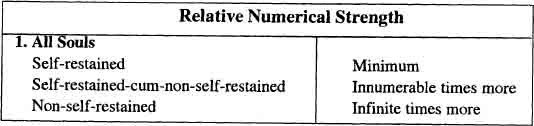
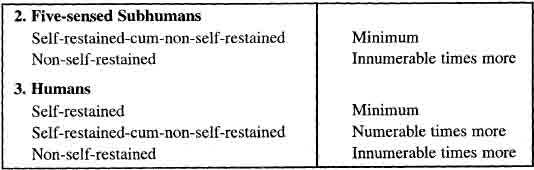
The relative numerical strength of the trio of piatydkhydm (renouncers) etc. is to be spoken ‘ of exactly like that of the trio of the samyata etc. (as shown in the above table).
Text
Sasaya-asásaya-padam
7.58 jívá nam bhamte! kim sásayá? asaásayá?
goyama! jiva siya sasayá, siya asásaya.
The Topic of the Eternal and the Non-eternal
Are1 the souls, O Lord! eternal or non-eternal?
Gautama! the souls are eternal in some respect and non-eternal in some respect.
7.59 se kenatthenam bhamte! evam vuccai—jívá siya sasaya? siya asásaya? goyama! davvatthayae sasaya, bhávatthayáe asásaya. se tenatthenam. goyamá! evam vuccai—jívá siya sásayá, siya asásaya.
For what reason, O Lord! has it been said that the souls are eternal in some respect and non-eternal in some respect?
Gautama! the souls qua substance (noumenal entities) are eternal; the soul qua states (phenomenal modes) are non-eternal. It is for this reason, O Gautama! that it has been said that the souls are eternal in some respect and non-eternal in some respect.
7.60 neraiyá nam bhamte! kim sásayá? asásayá?
evam jahá jívá tahá neraiyá vi. evam jáva vemániyá siya sásayá, siya asásayá.
Are the infernáis, O Lord! eternal or non-eternal?
The same description holds good in the case of infernáis as the souls. Similarly, all the dandakas (soul-groups) up to die Empyrean gods are eterna 1 in some respect, and non-eternal in some respect.
Bhásya
1. Sutras 58-60
In Indian metaphysics, the issues of the eternal and the non-etemal are perennial problems. The Vedanta upheld the doctrine of eternalism, while the Buddhists supported the non-etemalism. In Samkhya philosophy, both eternalism and non- -eternalism are advocated—the soul (purusa) is considered as eternal entity while the prakrti (primordial matter) is subject to constant transformation. The Jain philosophy also believes in eternalism and non-eternalism. According to it, there is no substance that is only eternal or only non-eternal. Jainism does not believe in pure being or pure becoming, unlike the Vedantists and the Buddhists. The doctrine of eternal and non-eternal is the main foundation of the doctrine of anekanta, non¬absolutism.
There are two components of the substance (dravya’y.
(1) The total amount of the pradesas (the indivisible units)
(2) Bhava or paryaya—the changing states or modes.
Excepting thepudgala-dravya (i.e. physical substance), in all other substances, there does not occur any change in the number of pradesas that constitute the substance. In the case of the pudgala-dravya, the total number of the paramanus which are in the free state as well as constitute different skandhas (aggregates) always remain constant. Thus neither a single pradesa or a single paramanu increase or decrease. Thus, the total amount of the pradesas remain always the same in past, present and future. With respect to this amount of pradesas, the substance is eternal. The soul is also a substance, and as such, it is also eternal with respect to the total number of pradesas of the jiva. But it undergoes transformations like other substances.1
The transformation is twofold—intrinsic (natural) and extraneous (due to external cause). The intrinsic (natural) transformation is available in all substances but the extraneous transformation is available only in the soul, possessed of body, and the pudgala-dravya. With respect to such transformation of states or modes, the substance is non-eternal.Thus, although the substance is eternal as well as non- eternal, the reasons for its eternality and non-eternality are different. Eternality is due to the constant amount of pradesas, while non-eternality is due to the changing states or modes.
Like the soul, the paramanu is also both eternal and non-eternal. With respect to the substancehood, theparamanu is eternal; its existence is tri-temporal—it existed, it exists and it will exist; its substancehood is never destroyed. It (paramanu) undergoes constant change with respect of its qualities such as colour, odour, taste and touch. Therefore, it is non-eternal with respect to the modes.2
The eternality and non-eternality of substances have also been explained with reference to the flow (i.e., continuous change of the individual) and continuity (i.e., persistence of the group). As explained in Bha. 7.93, 94, the infernáis (when considered collectively as a group) is eternal from the standpoint of non-cessation, but non-eternal from that of cessation (when considered individually). The present discussion of eternalism, non-eternalism is not related with the metaphysical substance. The infernáis as the soul-groups always continue to dwell in the infernal land. From this standpoint, the infernais are eternal, while every individual infernal (soul) dies on the cessation of his life-span, but is again re-incarnated as human or subhuman, and hence, from this standpoint of cessation the infernal is non-eternal.3
Text
7.61 sevam bhamte! sevam bhamte! tti.
That is so, O Lord! That is so, O Lord!
1.Bha. Vr. 7.28—jnanabhavena yathavadaparipalanat supratyakhyanatvabhavah.
2.Bha. Jo. 2.115.19-29—
iham janyam vina jiva. tyaga kiyam thi tehanam |
dupaccakh aSnrTfHMva,ja»yam vina kima paliyai ||
jivatrasadika deha, jani tasu hanava tanam |
jo pacakkhana kareha, pina samadrsti te nahim |
samvara âsrï tâsa, dupacakkhâna kahïjiyai |
samvara guna suvimâsa, karma rokana no tasu nahim ||
himsâdika pahichâna, tyâgï mithyâtï tanai |
nirjarâ laikhe jâna, sudha pacakkhâna kahî jiyai ||
saptama uttarajjhayana. vara gâthâ je bisa mí |
dhura gunathâne vayana, kahyo suvvae svâmajï ||
desa ârâdhaka jâna dhura gunathânâm nom dhanï |
astama sataka pichana, dasama udese bhagavatï ||
sûtra vipâka majjhâra, sumukha dâna de muni bhanï |
kiyo paritta samsara, manusya âukho bâmdhiyo ||
gaja bhava meghakumâra, paritta samsara dayâ thakï |
dhura gunathâne dhâra, nara âyü bamdhyo tine ||
asoccâ adhikâra, prathama gunathâne jina kahyo |
apoha artha vicâra, dharma dhyâna parinâma subha ||
ityâdika avaloya pahilâ gunathânâm tañí |
niravada karanï joya te chtu âjriâ mâmhilï ||
te matai pahichâna tehanâm dupacakkhâna te |
samvara âsrï jâna nirjarâ âsrï chai nahim ||
1.(a) Pra. Sii. 208,209-
vadasamimdiyarodho locZvassayamacelamanhii~aI ~
khidisayanamadamtavanam lhidibhoyanamegabhattam ca II
ede khalu miilagunii samaniinam jinavarehim pvnattii I
(b) MiiliicZira, mfllaguiindhikiira, gZ, 2, 3
parpca ya mahavvayiiim samidio pamca jinavarudditthii |pamcevimdiyarodha chappi ya BvZsayii loco ||accelakamanhiinam khidisayanamadamtaghamsqam ceva |!hidibhoyaneyabhattam miilagunii affhavisg du ||
2.Ratnakarandaka Sriivakiici%-a6,6 -
madyamiimsamadhutyiigaih sahgnuvratapaiicakam |
asf-au rnfllagunSnShurgyhin2rp iramanottam ||
3.Thgnam, 10.101. (For the exposition of ten prutydkhydnus, see annotation on this Siitra).
4.Siitra. Ni. 1.14.129-
miilagune pamcaviho uttaraguna biirasaviho u |
5.Stitra. Vr. pa. 247-
pimdassa jii visohi samiio bhavanii tavo duviho |
padims abhigaiiviya uttaragunao viyiiniihi ||
6.Bha. Vy. 7.35-upabhoga-sabd bhogah, sa ~2iiinapiiniinulepaniidiniim, paribhogastu pun
punarbhog, sa ciisanaiayanavasanavanitiidiniim.
7.Ava. Cii. (Jinadiisa), uttariirdha, p.299-siimiitiyam niima ~Zvajjajogaparivajjarn
niravajjajogaparisevaprp ca.
8.Ibid., p.302-piirva dikkhu tam bahiini joyaniini Zsi, idiinim divase divase osi%-eti.
9.Ava. Ni. Hii. Vy. p.230-gyhitasya dikparimiinasya dirghakiilasya yiivajjivasamvatsaracaturmiisiidibhedasya
yojanaSatSdiriipatviit pratyaham tiivat parimiinasya gantumaiakyatv5t
pratidinam pratidivasamityetcca praharamuhiirttiidyupalaksanam pramgnakaranam
divasiidigamanayogya-deiasthharp pratidinam pramiinakaranam des'iivakiis'ikam,
digvratagyhitadikparimiinasyaika-deiah-amSah tasminnavakiis'ah-gamaniidi cegh sthnam
deSiivakiiiastena nirvrtam deSHvak2Sikam, etacciinuvratiidigyhitadirghatarakiiliivadhiviratirapi
pratidinarp samksepopalaksanarniti piijyii varnayanti.
10.Bha. 12.4,5,14.
11.Ibid., 12.6, 13.
12.Bha. VF. 7.35-paicimaivSrna~ga1aparih.
13.Ibid., 7.35-iha ca sapta digvratiidayo deiottaragunii eva, samlekhanii tu bhajanayii tathiihi-sii deSottaragunavato deiottaragunah iivas'yake tathii'bhidhiiniit, itarasya tu sarvottaragugah sZki%-iin-praty2khyiinariipatviiditi samlekhaniimaviganayya sapta des'ottaragunii ityuktam. asygicaitesu piifho deiottaragunadhi%il;II'piyamante vidhiitavya ityasyiirthasya khyapanatha iti.
14.Ta. Sii. BhZ. 7.16-ebhjica digvratadibhiruttaravrataih sampanno9g vrati bhavati.
15.Uva, 1.30.
16.Ibid., 1.37-43.
17.Ibid., 1.44.
18.Ta. Su. Bha. Vr. 7.16—tatra gunavratani trim—digbhogaparibhogaparimananarthadandaviratisamjh a-nyanuvratanam bhavanabhutani. ythanuvratani tatha gunavratanyapi sakrdgrhitani yavajjivam bhavamyani. siksapadavratani—samayikadeSavakasikapausadhopavasatithisamvibhagakhyani catvan.
19.(a) Sarvarthasiddhi 7.21—digviratih desaviratih anarthadandaviratiriti etani trim gunavratani.
(b) Bhagavati Aradhana, ga. 2081—
jam ca disaveramanam anatthadamdehim jam ca veramanam I desavagasiyam pi ya gunavvayaim bhave taim |
20.See footnote of above no. 17.
21.Mahapurana, 10.165—
digdesanarthadamdcbhyo viratih syadanuvratam I bhogopabhogasamkhyanamapyahustad gunavratam II
22.Caritrapahuda, ga. 26—
samaiyam ca pa dhamam, bidiyam ca taheva posaham bhaniyam I
taiyam ca atihipunja, cauttha sallehana amte II
23.Vasunandi Sravakacara, ga. 217,218,270.
24.Ava. Cu. part 2, p.307— emeveso duvalasaviho gihatthadhammo. ettha pamca anuvvaya tinni gunavvaya, eesim donhavi thirikaranani cattari sikkhavayani ittiriyani, sesani atthavi avakahiyani nayavvani.
1.Bha. Vr. 7.40—iha ca sarvaviratesu ye uttaragunavantaste’vasyam mulagunavantah, initlaeunavantaslu syaduttaragunavantah syatiadvikalah, ya eva ca tadvikalasta eveha mulagunav ante grahyah, te cetarebhyah stoka eva, bahutarayatinam dasavidhapratyakhyanayuktatvat, te’pi ca mulagunebhyah sankhyataguna eva nasankhyatagunah, sarvayatihamapi sankhyatatvat, desaviratesu punarmulagunavadbhyo bhinna apyuttaragunino labhyante, te ca madhumamsadivicitrabhi- grahavasadbahutara bhavantltikrtva desaviratottaragunavato’dhikrtyottaragunavatam mulaguna- vadbhayo’ sankhyatagunatvam bhavati.
1.Bha. 7.31, 2.68.
1.Bha. 1.440.
2.Ibid., 14,49,50.
3.Ibid., 7.93,94.
♦
Third Section
Taio Uddeso
Section-3
Text
Vanassai-ahara-padam
7.62 vanassaikkaiya nam bhamte! kam kalam savvappdharaga va, savva- mahaharagd va bhavamti?
goyama!pausa-vararearattesu nam ettha nam vanassaikdiya savvamahaharaga bhavamti, tadanamtaram ca nam sarade, tadanamtaram ca nam hemamte, laddnamtaram ca nam vasamte, tadanamiaram ca nam. gimhe. gimhdsu nam vanassaikdiya sa vvappdha raga bha iamti.
The Topic of the absorbing Nourishhment by Vegetation-bodied beings When (i.e., in which season) the vegetation-bodied beings, O Lord! are the appropriators of the minimum quantity of nourishment and when (i.e., in which season) are they the appropriators of the maximum quantity of nourishment?
Gautama! in the pravrt (the first half of the four months of rainy season (monsoon)) and varsa (the later half of the four months) of rainy se’ason (monsoon)) seasons, the vegetation-bodied beings are the appropriators of the maximum quantity of nourishment, thereafter in the sarad (the autumn—the first half of the four months of cold season), less than that, thereafter in the hemanta (the winter—the later half of the four months of cold season), less than that, thereafter in the vasanta (the spring—the first half of the four months of hot season), less than that, thereafter in the grisma (the summer—the later half of the four months of hot season), less than that. In the summer indeed the vegetation beings are the appropriators of the minimum quantity of nourishment.
Bhasya
1. Sutra 62
There are six seasons. In the Thanatn they are serially as follows—pravrt, varsa, sarad, hemanta, vasanta and grisma) In the SurapannatTthe same order of the six seasons is available. According to the Jambuddivapannati, the seasons start with the pram. According to the Samgadhara Samhita, the seasons are six due to the transit of sun to the twelve Zodiacal constellations, Aries, Taurus etc. during the year.
See the table below:
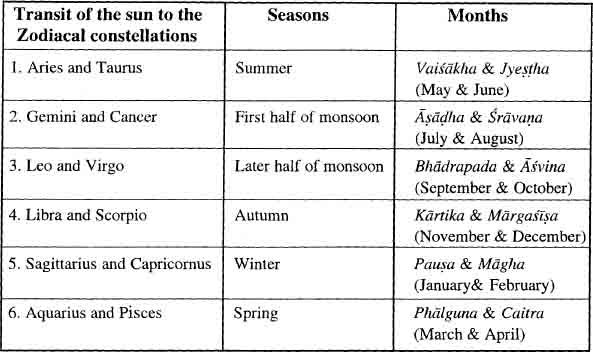
Abhayadevasùri has identified the month of Sràvana (July) as the first month of the pràvrt and Asvina as the first month of the varsà.1 2 3 4 According to the Jambuddlvapannati, the order of the lunar months begins with Sràvana. In this connection see note on Thdnam 6.95.
In ancient Jain astronomy, only three seasons had been recognized. Lord Mahavira was born on the thirteenth day of the bright fortnight of Caitra, the first month of the summer season (starting from Caitra up to Asadha).1 Lord Rsabha attained omniscience on the eleventh day of the bright fortnight of the Phdlguna, the fourth month of the winter season.8 In the Surapannau also, there are mention of three seasons, each consisting of four months.9
Pràvrt and varsà—there are rainfall in the period between the Àsàdha and Asvina (July and October). So the vegetation-bodied beings appropriate more water as nourishment. Thus in these two seasons, the vegetation-bodied beings appropriate maximum quantity of nourishment. In other seasons, gradually the quantity of water available becomes less, so the quantity of nourishment appropriated becomes less and less.
Text
7.63 jai nam.hhamte! gimhasu vanassaikaiya savvappaharaga bhavamti, kamha nam bhamte! gimhasu bahave vanassaikaiya pattiya, pupphiya, phaliya, hariyagisrijjamdnd, sirie ativa-ativa uvasobhemana-uvasobhemana citthamti? goyama! gimhasu nam bahave usinajoniyd jiva ya, poggala ya vanassaikdtvande vakkamamti, viukkamamti, cayamti, uvavajjamti. evam khalu goyama! gimhasu bahave vanassaikaiya pattiya, pupphiya, phaliya, hariyagisrijjamdnd, sirie ativa- ativa uvasobhemana-uvasobhemana citthamti.
If,1 O Lord! in the summer season, the vegetation-bodied beings appropriate the least quantity of nourishment, then O Lord! why, in the summer season, do so many vegetation-bodied beings become overspread with leaves and flowers, become laden with fruits, appear beautiful on account of the verdure and stand exceedingly charming and shining on account of the splendour of the forest?
Gautama! in the summer season, many souls belonging to the category of usnayonika (i.e., those jivas whose place of birth (yoni) consists of the hot matter) and those pudgalas which are always hot, are transmigrated in the form of the vegetable-bodied beings and get destroyed, depart (from their previous life) and take birth in the form of the vegetable-bodied beings. Gautama! in this way, in the summer season, so many vegetable-bodied beings become overspread with leaves and flowers, become laden with fruits, appear beautiful on account of the verdure and stand exceedingly charming and shining on account of the splendour of the forest.
Bhasya
1. Sutra 63
Vegetation grows in many varieties. Some plants are usnayonika—they take birth in the place which are made of hot matter. They can grow and flourish even in the tropical or hot region in the absence of supply of water; so it is not unnatural for usnavonika vegetation to grow and flourish in spite of the availability of the least quantity of water.
Semantic rerijjamana—shining. The root ‘teja’ means ‘to shine’.
Text
7.64 se nunam bhamte! mula mulajivaphiida kamda kamdajivaphudd, khamdha khamdhajivaphuda, tayd tayajivaphuda, said salajTvaphuda, pavala pavalajivaphudu, pattd pattajivaphudd, puppha pupphajivaphuda, phald phalajivaphuda, biya biyajivaphudd?
hamtti goyamti! multi mulajivaphuda java biya biyajivaphudd.
O Lord!1 are the roots of a plant touched by the souls of the roots? Are the bulbous roots touched by the souls of the bulbous roots? Are the stems touched by the souls of the stems? Are the skins touched by the souls of the skins? Are the branches touched by the souls of the branches? Are the tender leaves touched by the souls of the tender leaves? Are the leaves touched by the souls of the leaves? Are the flowers touched by the souls of the flowers? Are the seeds touched by the souls of the seeds?
Yes, Gautama! the roots are touched by the souls of the roots up to hie seeds are touched by the souls of the seeds.
7.65 jai nam bhamte! multi mulajivaphuda java biya biya jivaphuda. kamhd nan. bhamte! vanassaikiiiyd aharemti? kamha patinamemti?
goyama! multi mulajivaphuda pudhavijivapadibaddha. tamha aharemti. tamhtl parindmemti. kamdti kimidiijivaphuda mulajivapadibadva. tamha aharemti. tamha. parinamemti. evam jtiva biyd biyajivaphudaphalajivapadibaddha tamha aharemti tamhd parindmemti.
If, O Lord! the roots are touched by the souls of the roots up to the seeds are touched by the souls of the seeds, how do the vegetation-bodied beings draw their nourishment and how do they assimilate that nourishment? Gautama! the roots are touched by the souls of the roots and are also fastened with the earth-bodied souls; on account of that they derive their nourishment, and assimilate that nourishment. The bulbous roots are touched by the souls of the bulbous roots and are fastened with the souls of the roots; on account of that they derive their nourishment and assimilate that nourishment. In the same say up to the seeds are oouclied by the souls of the seeds and are fastened with the souls of the fruits; on account of that they derive their nourishment and assimilate that nourishment.
Bhasya
1. Sutras 64, 65
There are ten limbs of a tree—root, bulb, stem, skin, branch, tender leaf, leaf, flower, fruit and seed.
The root is connected with the earth; so it draws its nourishment from the earth, but the bulb is not directly connected with the earth. What then is its source of nourishment? The answer given by the scripture to this query embodies important process that sustains life in general. The bulb derives its nourishment from the nourishment derived by the root. The stem derives its nourishment from the bulb, the skin from the stem, the branch from the skin, the tender leaf from the branch, the leaf from the tender leaf, the flower from the leaf, the fruit from the flower and the seed from the fruit. This mutual co-operation is the basis of the sustenance of their life.
Text
Anamtakaya-padam
7.66 aha bhamte! alue, mulae, simgabere, hirili, sirili, sissirili, kitthiya, chiriya, chiraviraliya, kanhakamde, vajjakamde, suranakamde, khelude, bhaddamottha, pimdahalidda, lohi, nihu, ththu, thibhaga, assakanni, sihakanni, siumdht, musamdhi, jeyavanne tahappagara savve te anamtajiva vivihasatta? hamta goyama! alue, mulae java anamtajiva vivihasatta.
The Topic of the Souls, the Infinite Number of which have a Common Body
O Lord!1 are the vegetation-bodied beings such as—dlukam, mulakam, shgaveram, ‘hirUT, ‘sirUP, ‘sissirilf,krstikd (klistikd),ksirikd,ksiraviddlika, krsnakandah, vajrakandah, suranakandah, kelutah, bhadramusta, pindaharidra,lihi, ‘nihu’, ‘thihu’,stabakam,asvakarni,simhakarni, ‘siumdhf, ‘musamdhi’ and other such vegetation-bodied beings—all possessed of infinite number of souls (occupying the common body)? Are they having different types of sattva (animation) (or do they have different types of existence?). Yes, Gautama! the dlukam, mulakam up to other such vegetation-bodied beings—are all possessed of infinite number of souls (occupying the same body) and they have different types of sattvas.
Bhasya
1. Sutra 66
There are two varieties of the gross vegetation-bodied beings—1. possessed of individual body (prateyaka-sarin), 2. possessed of one common body (sadharana- sariri)? The class of vegetation with infinite souls has been mentioned in the four canonical texts, viz., Bhagavai, Pannavand, Jtvajivabhigama and Uttarajjhayanani, see the table on p. 561 at the end of section 3 of this Sataka.
In the Bhagavati, Sataka 23, many names of vegetation of infinite number of souls have been given—
23/1—dluya-mulaga-slmgabera-haliddd-ruru-kamdariya-jdru-chirabirdlt- kitthi-kumdu-kanhakadabhu-madhu-puyalai-mahusimgi-niruhd-sappa- sigamdha-chinnaruha-biyaruha.
23/2—lohi-nihu-thihu-thibhagd-assakanni-sihakanni-siumdhi-musamdhi.
23/4—dya-kdya-kuhuna-kumdurukka-uvvehaliya-sapphd-sajjd-chattdbam- saniyakura.
23/6—padhamiyavdlumki-madhurasd-rdyavalli-paumd-modhari-damti-camdi.
23/8—mdsapaniu-muggapann-jivaga-sarisavav-karenuya--kooli-khirakdkoli- bhaingi-nahi-kiinirdsi-bhaddamiritha-namgalai-payuya-imnlid-paula-hadha-harenuya-lohi.
In the classification given in the Uttarajjhayanani, onion and garlic have been classed as “infinite number of souls.” The Bhagavai and Jlvajivabhigama do not mention them in the list of infinite number of souls. In the Paimavana. these are- included under “pratyeka-sarirT souls—each soul possessed of separate individual body.2
The word alue” (alukam) deserves special attention. The meaning of alukam is “an esculent root” and not alii (Hindi) which means “potato”, because—
1. The plant of “A/u”—potato is not an indigenous (Indian) vegetable at all. This was brought in India in much later time by the Portuguese people. Originally, the potato plant grew in South America, from where it was first taken to Europe. Its original place of birth is Chile (South America).3 On the basis of these facts, the alukam given in the present text is not ‘potato’ (alu).
2. According to Apte’s Sanskrit-English Dictionary, “dZn is “an esculent root” (not applied to potato etc.)”
3. In the Nighantu Adarsa (pp. 164, 165), it is stated—
“377 Alu (potato)
“Name—Alu (Hindi), batata (Gujarati), potato (English), Solatium Tuberosumi (Latin).
“Information in detail (Description and Properties)—The birth-place of the potato is, in fact, South America; still, by considering the Sanskrit word “Alimi” as standing for potato, some people plead strongly for it being originally an Indian product. In our opinion, in the classical Indian works, many varieties of alu have been described. All of them belong to the class “Dioscoria”—which stand for the tubers of sandy vegetables. The authors of the Nighantus (Dictionary of Botanical Plants) have mentioned many varities of “Alus”.
“Although Alu (potato) grows underground, it cannot be regarded as belonging to the “tuber root” (kandamula). The “ground nut” grows underground, still it is not regarded as “tuber-root”. In the same way, potato (alu) also can not be regarded as “kanda”. Actually, the plant is like a stick; from this stick arise many branches which again turn down and go underground, and then grow like a tuber. It means it is a “stem tuber” and not a “root tuber”. Some Jain people do not eat potato considering it a root tuber; and hence, this much clarification has been given. Whether they eat it or not; that is their own volition but “potato” is not a “kandamula”.”
Semantics
kslrdviddUkd (kslrdvirdlid)— Ipomoea digitata linn, it is vidari which is white and with large quantity of milk.
krspakandaikanhakamde)—red lotus.
keluta (khehida)—kautumbakanda.
bhadramusta (bhaddamotthd)—motha, nagara mothd.
pindaharidra (pimdahalidda)—turmeric with globular bulb. sthunda (siumdht)—milky thohara.
alukam (alu) — an esculent root. (It should not be confused with potato).
mulakam (miila) — radish. srngaveram (adaraka) — ginger. sirilt (sirili) — Chir pine. krstika (klistika) (varalukanda’) — Dio scorea bulbifere linn (L). kslrika (bhukharjura) — Mimu sops hexandra Rorbe. vajrakandah (vajrakanda) — sweet potato. suranakandah (suranakanda) — amorphophallus companulatus Blume. loht (rohltaka) — red wood tree. nihu (tridharathuhara) — triangular spurge. asvakarnt (sala) — the sal tree. simhakarni (adusa) — malabar nut. siumdhi (kanta thuhara) — common milk hedge. musamdhi (kali musali) — Curculigo Orchioides gaertn
Text
Appakamma-mahakamma-padatn
7.67 siya bhamte! kanhalese neraie appakammatarae? nilese neraie mahdkamma- tarae !
hamta siya.
The Topic of (the Infernals and Gods) possessed of less Karma and more Karma
Can1 O Lord! an infernal, possessed of black lesya (psychic colour’, probably be with less karma! Can an infernal, possessed of blue lesya (psychic colour), probably be with more karma”!
Yes, in some respect it can be.
7.68 se kenatthenam bhamte! evam vuccai—kanhalese neraie appakamma-tarae? ntlalese neraie mahakammatarae ?
goyama! thitim paducca. se tenatthenam goyama! java mahakammatarae.
For what reason has it been said, O Lord! that an infernal, possessed of black lesya (psychic colour), can be with less karma, an infernal possessed of blue lesya (psychic colour) is with more karma”
O Gautama! it has been so said with reference to duration. Gautama! for this reason it has been said that an infernal, possessed of black lesya. in some respect, can be with less karma, an infernal, possessed of blue lesya, in some respect can be with more karma.
7.69 siya bhamte! nilalese neraie appakammatarae? kaulese neraie maha-kamma- tarae ?
hamta siya.
Can1 O Lord! an infernal, possessed of blue lesya (psychic colour), probably be with less karma? Can an infernal, possessed of grey lesya (psychic colour), probably be with more karma?
Yes, in some respect it can be.
7.70 se kenatthenam bhamte! evam vuccai—nilalese neraie appakammatarae? kaulese neraie mahakammatarae ?
goyama! thitim paducca se tenatthenam goyama! java mahakammatarae?
For what reason has it been said O Lord! that an infernal, possessed of blue lesya (psychic colour), can be with less karma, an infernal, possessed of grey lesya (psychic colour), is with more karma!
O Gautama! it has been so said with reference to duration. Gautama! for this reason it has been said that an infernal, possessed of blue lesya (psychic colour), in some respect, can be with less karma, an infernal, possessed of grey lesya (psychic colour), in some respect can be with more karma.
7.71 evam asurakumare vi, navaram—teulesd abbhahiya. evam java vemamya. jassa jai lessdo tassa tattiya bhaniyavvao. joisiyassa na bhannai java—
In the same way, the Asurakumara is to be described, excepting that fiery lesya is also to be spoken of (for in Asurakumara, the first four lesyas are available. Similarly up to the Empyrean gods, (with difference that) the lesyas that are available there are to be described. In the Luminous gods, there is only one fiery lesya, so it is not to be described in this context, up to—
7.72 siya bhamte! pamhalesse vemanie appakammatarae? sukkalesse vemanie mahakammatarae ?
hamta siya.
Can1 O Lord! an Empyrean, possessed of yellow lesya (psychic colour), ‘ probably be with less karma? Can an Empyrean, possessed of white lesya (psychic colour) probably be with more karma?
Yes, in some respect it can be.
7.73 se kenatthenam?
goyama! thitim paducca se tenatthenam goyama! java mahakammatarae.
For what reason has it been said O Lord!?
O Gautama! it has been so said with reference to duration. Gautama! for this reason it has been said that an Empyrean, possessed of yellow lesya, in some respect, can be with less karma, an Empyrean, possessed of white lesya, in some respect can be with more karma.
Bhasya
1. Sutras 67-73
Lesya (psychic colour) is of two kinds—dravya lesya (the material aggreagtes responsible for lesya and bhava lesya (the colour-index ol the soul corresponding to the colour of dravya lesya) The dravya lesya is made of matter and as such it has physical properties such as colour, smell, taste and touch. In the present dialogue, the dravya lesya has been described. In hell, the acquisition of colouration is as follows:
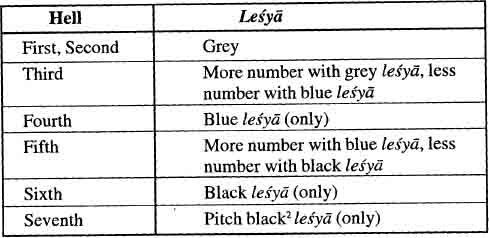
The acquisition of lesya among the gods is as follows:
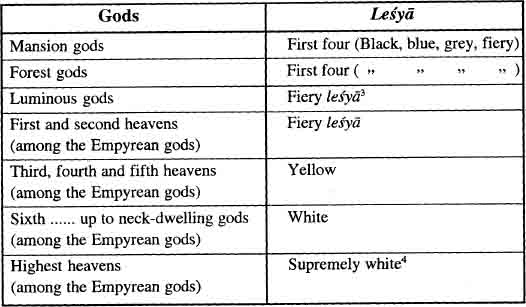
lesya and karma are interrelated. In the state of more’ karma, the lesya is impure (malign or inauspicious). In the case of less karma the lesya is pure (benign or auspicious). The infernal soul, possessed of black lesya, is with more karma, the infernal soul, possessed of blue lesya, is with less karma. In the present dialogue, exceptions of this rule have been pointed out. The infernal soul, possessed of black lesya, is much aged. He has already lived a larger part of his life-span. The infernal soul, possessed of blue lesya, is a newly born inhabitant.
Duration of life-span
With reference to duration of life-span, the infernal, possessed of black lesya, is with less karma and the infernal soul, possessed of blue lesya, is with more karma. This rule with reference to duration is applicable in all cases.
In the present dialogue, more karma and less karma are used relatively. They are mainly related with the life-span and sensation-experiencing karma, and also with gati (-nama) (i.e., the body-making qua the realm or order of existence), jati (- nama) (i.e., the body-making karma qua species) etc. of the life-span-determining karma.
Text
Vedana-nijjara-padam
7.74 se nunam bhamte! ja vedana sa nijjara? ja nijjara sa vedana? goyama! no inatthe samatthe.
The Topic of Experiencing of Karma and Falling away of Karma
O Lord!1 is the- vedana (experiencing of karma) the same as (falling away of karma)? Is the nirjara (falling away of karma) the same as the vedana (experiencing of karma)?
Gautama! this is not possible.
7.75 se kenatthenam bhamte! evam. vuccai—ja vedana na sa nijjara? ja nijjara na sa vedana?
goyama! kammam vedana, nokammam nijjara. se tenatthenam, goyama! evam vuccai ja vedana na sa nijjara, ja nijjara na sa vedana.
For what reason has it been said, O Lord! that the vedana (experiencing of karma) is not the same as nirjara (falling away of karma), the nirjara (falling away of karma) is not the same as vedana (experiencing of karma) Gautama! that which is experienced is karma and that which falls away is nvn-karma. For this reason, O Gautama! has it been said that what is experiencing of karma is not the same as the falling away of karma, what is the falling away of karma is not the same as the experiencing of karma.
7.76 neraiyanam bhamte! ja vedanasa nijjara? ja nijjara sa vedana? goyama.! no inatthe samatthe.
Is the experiencing of karma by the infernáis, O ‘ Lord! the same as the falling away of their karma? Is the falling away of karma (of the infernáis) the same as the experiencing of karma by them?
Gautama! this is not possible.
7.77 se kenatthenam bhamte! evam vuccai—neraiyainam ja vedana na sa nijjara? ja nijjara na sa vedana?
goyama! neraiyanam kammam vedana, nokammam nijjara. se tenatthenam goyarna! evam vuccai—neraiyanam ja vedana na sa nijjara, ja nijjara na sa vedana.
For what reason, O Lord! has it been said that in the case of infernáis the experiencing of karma is not the same as the falling away of karma, the falling away of karma is’not the same as the experiencing of karma?
Gautama! that which is experienced by the infernáis ‘ is karma, that which falls away is nonfarwm It is for this reason, O Gautama! has it been said that in the case of the infernáis, experiencing ‘ of karma is not the same as falling away ‘ of karma, what is the ‘ falling away of karma is not the same as the experiencing of karma.
7.78 evam java vemdniyanam.
The same description holds good (for all dandakas—soul-groups) up to the Empyrean gods.
7.79se nunarn bhamte! jam vedemsu tarn nijjarem.su? jam nijjaremsu tarn vedemsu? no inatthe samatthe.
Was the experiencing of karma in the past, indeed, O Lord! the same as the falling away of karma in the past? Was the falling away of karma in the past the same as the experiencing of karma?
This is not possible.
7.80 se kenatthenam bhamte! evam vuccai—jam vedemsu no tarn njjaremsu? jam nijjaremsu no tarn vedemsu?
goyama! kammam vedemsu, nokammam nijjaremsu. se tenatthenam goyama! java no tarn vedemsu.
For what reason, O Lord! has it been said that the experiencing of karma in the past, indeed, is not the same as the falling away of karma in the past, the falling away of karma in the past is not same as the experiencing of karma in the past?
Gautama! . that which was experienced in the past was karma, that which fell away in the past was non-karma. It is for this reason, O Gautama! it has been said that the experiencing of karma in the past was not the same as falling away of karma in the past, the falling away of karma in the past was not the same as the experiencing of karma in the past.
7.81 evam neraiya vi, evam java vemdniyd.
The same description holds good for the infernais and (for all dandakas— soul groups) up to the Empyrean gods.
7.82 se nunam bhamte!, jam vedemti tam nijjaremti? jam nijjaremti tarn vedemti? goyama! no inatthe samatthe.
Is the experiencing of the karma in the present, O Lord! the same as the falling away of the karma in the present? Is the falling away of the karma in the present the same as the experiencing of the karma in the present?
O Gautama! this is not possible.
7.83 se kenatthenam bhamte! evam vuccai—java no ta vedemti?
goyama! kammam vedemti, nokammam nijjaremti. se tenatthenam goyama! java no tam . vedemti-
For -what reason, O Lord! is it said that up to toe experiencing of toe karma in the present?
O Gautama! that which is experienced in the present is karma, that which falls away in the present is non-karma. It is for this reason, O Gautama! that it has been said that the experiencine ...... up to i s-’ no t toe same as hhe experiencing of the karma in the present.
7.84 evam neraiya vi java vemamya.
The same description also holds good in the case of the iefereais and (other dandakas—soul-groupss up to the Empyrean gods.
7.85 se nunam bhamte!■ jam vedissamti tam nijjarissamti?. jam nijjarissamti tam vedissamti ?
goyama! no inatthe samatthe.
Shall the experiencing of karma in the future indeed, O Lord! be the same as the falling away of karma in the future? Shall the falling away of karma in the future be the same as the experiencing of karma!
Gautama! this is not possible.
7.86 se kenatthenam java no tam vedissamti?
goyama! kammam vedissamti, nokammam nijjarissamti. se tenatthenam java no tam nijjarissamti.
For what reason, up to O LordI has if been said that the experiencmg of karma in the future shall not be the same as the falling away of karma in the future, the falling away of karma in the future shall not be the same as the experiencing of karma in the future?
Gautama! that which will be experienced in the future will be karma. that which will fall away in the future will be non-karma. It is for this reason, O Gautama! that it has been said that the experiencing of karma in the future will not be the same as the falling away of karma up will I not be the same as the experiencing of karma in the future.
7.87 evam neraiya vi java vemdiniya.
The same description holds good for the infernáis and (for all dandakas— soul groupss up to the Empyrean gods.
7.88 se nünam bhamte! je vedanasamae se nijjarasamae? je nijjarasamae st’ vedanasamae ?
no inatthe samatthe.
Is the samaya (indivisible time-unit), O Lord! of experiencing of karma the same as the samaya of falling away of karma”! Is the samaya of falling away of karma the same as the time-unit of experiencing of karma”!
No, this is not possible.
7.89 se kenatthenam bhamte! evam vuccai— je vedanasamae na se nijjarasamae? je nijjarasamae na se vedanasamae?
goyarna! jam samayam vedemti no tarn samayam. nijjaremti, jam samayam nijjaremti no tarn samayam vedemti—annammi samae vedemti, annammi samae nijjaremti. anne se vedanasamasae. anne se nijjarasamae. se tenaa/ienain java na se vedanasamae, na se nijjarasamae.
For what reason has it been said, O Lord! that that which is the samaya of ‘ experiencing karma is not the same as the samaya of the falling away of karma, that which is the samaya of falling away of karma is not the same as the samaya of experiencing of karma?
Gautama! at the samaya when the souls undergo the experience of karma. the falling away of karma does not take place; at the samaya when the falling away of karma takes place, they do nto undergo the experience of karma. The souls experience the karma at the samaya that is different from the samaya when the falling away of karma takes place; the falling away of karma takes place at the samaya that is different from the samaya when the souls undergo experience of karma. The samaya of experiencing karma is different from the samaya. of falling away of karma. For this reason it has been said that that which is the samaya of experiencing karma is not the same as the samaya of falling away of karma that which is the samaya of falling away of karma is not the samaya of experiencing karma.
7.90 neraiyanam bhamte! je vedanasamae se nijjarasamae? je nijjarasamae se vedanasamae ?
goyama! no inatthe samatthe. O Lord! is the samaya of the experiencing karma by the internals the same as the samaya of the falling away of their karma1! Is the samaya of the falling away of karma of the infernáis the same as the samaya of experiencing karma by them?
Gautama! this is not possible.
7.91 se kenatthenam bhamte! evam vuccai—neraiya nam je vedanasamae na se nijjarasamae? je nijjarasamae na se vedanasamae?
goyama! neraiya nam jam samayam. vedemti no tarn, samayam nijjaremti, jam samayam nijjaremti no tarn samayam vedemti annammi samae vedemti, annammi samae nijjaremti. anne se vedanasamae, anne se nijjarasamae. se tenatthenam java na se vedanasamae.
For what reason it has been said O Lord! that the samaya of the experiencing karma by the infernáis is not the same as the samaya when the falling away of their karma takes place, the samaya of the falling away of their karma is not the same as the samaya of the experiencing karma by them?
Gautama! at the samaya when the experiencing karma by the infernáis takes place, the falling away of their karma does not take place; at the samaya when the falling away of their karma takes place, the experiencing karma by themi does not take place. The infernáis experience karma at a samaya that is different from the samaya when the falling away of their karma takes place; the samaya when the falling away of their karma takes place is different from the samaya when the experiencing karma by them takes place. The samaya of experiencing karma, is different from the samaya of falling away of karma. For this reason it has been said that the samaya up to is not
the same as the samaya of the experiencing karma by them.
7.92 evam java vemaniyanam.
The same description holds good up to the Empyrean gods.
Bhasya
1. Sütras 74-92
Vedaná (Experiencing of Karma) and Nirjará (Falling away of Karma)
There are many stages of karma, the first being ‘binding’ and the last ‘arising’ (fruition). It is at the time of its arising that the experiencing of karma takes place.1 Aller being experienced, the karma transforms into non-karma (nokarma i.e. the material cluster that has produced its effect and has become defunct). In the present dialogue, the ontological difference between the karma that is being experienced and the karma that has been experienced (nokarma) is explained. What is experienced is ‘karmawhat falls away the non-fazrmtz. The karma’s power of producing fruit ceases after the fruit has been produced. After that, it can no more produce any karmic result; it simply becomes non-Awmm2 It is that non-Amaz which falls away; therefore the samaya of experiencing is separate from that of falling away.
Text
Sasaya-asasaya-padam
7.93 neraiya nam bhamte! kim sasaya? asasaya?
goyama! siya sasaya, siya asasayá.
The Topic of the Eternal and the Non-eternal
Are1 the internals, O Lord! eternal or non-eternal?
Gautama! they are eternal in some respect and non-eternal in another respect.
7.94 se kenatthenam bhamte! evam vuccai neraiya siya sasaya? siya asasaya? goyama! avvocchittinayatthayae sasaya, vocchittinayatthayae asasaya. se tenatthenam java siya sasaya, siya asasaya.
For what reason, O Lord! has it been said that the1 internals are eternal in some respect and nen-eternal in another respect?
Gautama! they are eternal in respect of the standpoint of non-cessation (being), and they are non-external in respect of the standpoint of cessation (becoming). It is for this reason that it has been said that the infernáis are eternal in some respect and non-eternal in another respect.
7.95 evam java vemaniya java siya asasaya.
The same description holds good for all dandakas up to the Empyrean gods up to they are non-eternal in another respect.
Bhasya
1. Sutras 93-95
According to the Jain Philosophy, there are only two fundamental substances, viz., sentient-substance and insentient substance. Infernáis. subhumans, humans and gods—all these are the modes of sentient beings. The infernal as the soul¬substance is eternal, while the infernal as the mode of the soul is non-eternal.
The problem of etemality or non-eternality of an infernal can be explained from yet another standpoint. Every infernal continues to be an infernal for a certain span of time, after which he is reborn as a subhuman or a human being. The hell is never empty of infernáis. So the infernal as a class is eternal and the infernal as an individual is non-eternal.
In sütra 7.60, the question whether the infernal is eternal or non-eternal has been considered from the standpoint of substance and the standpoint of modes. In the present dialogue, eternality and non-eternality have been considered respectively from the standpoints of non-cessation and cessation. Here this second standpoint is relevant. The first standpoint of our exposition is concerned with sutra 7.60.
Text
7.96 sevam bhamte! sevam bhamte! tti.
That is so, O Lord! That is so, O Lord!
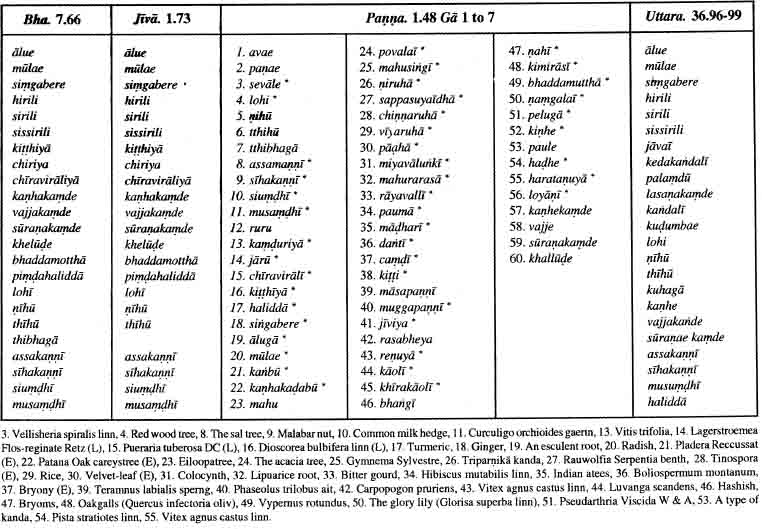
1.niinam. 6.95 (the meaning of varssriitra is var@ ytu, i.e., rainy season).
2.Silra. 12.14.
3.Jambu. 7.126-piiusiiiyii ufi.
4.~ibngadharaS amhitii, Pilrva Khamda, Bhesajjhiikhyiinaka Prakarana, Sloka 35,36--
~tustkamt admyatam raveh r2Sisu samkramiit |
grismo mesavrsau proktau priivmimithunakarkayoh ||
simhakanye smrta varsiitul~vivySicakayohS arad |
dhanurgr5hau ca hemanto vasantah k~lmbhaminayohI|
5.Bha. Vr. 7.62-privy! Sr2vanadirvars%-2tro'Svayujiidih.
6.Jambu. 7.126-s3vaniiiy2 m8s8.
8.Pajjo. Su. 166.
9.SUra. 10.63-74.
1.Apte. reja—to shine.
1.Panna. 1.32.
2.Ibid’ 1.48, ga’. 43.
3.See Encyclopaedia Britanica—Potato.
4.See Jaina Agama Vanaspati Kosa for details of the vegetation referred to here.
1.See the Bhasya of Bha. 1.37-38, 1.60-100, 1.102.
2.Jiva. 3.98-102.
3.Panna. 17.51-53.
4.Jiva. 3.1101-1104.
1.Bha. Vr. 7.75—udayapráptam karma vedaná dharmadharmminorabhedavivaksanat.
2.Ibid., 7.75—veditarasam karma nokarma.
♦
Fourth Section
Cautho Uddeso
Section-4
Text
Samsaratthajiva-padam
7.97 ráyagihe. nayare java evam vayasi—kativiha nam bhamte! samsarasama- vannaga jiva pannatta?
goy ama! chavviha samsarasamdvannaga jiva pannatta, tarn jaha—pudhavikaiya java tasakaiya. evam jaha jivabhigame java ege jive egenam samaenam egam kiriyam pakarei, tarn jaha—sammattakiriyam va, micchattakiriyam va.
The Topic of Mundane Souls
In1 the city of Rajagrha up to addressed the lord. thus—how many classes of mundane souls, O Lord!1 have been propounded?
Gautama! six classes of mundane beings viz., the earth-bodied up to the mobile beings have been propounded. In the same way, as in the Jivabhigama up to one soul at one samaya (indivisible time-unit) performsone single kriya (urge) viz., the samyaktva. kriyd (i.e., the urge rectified with the enligh¬tened view) or mithydtva kriya (i.e., the urge vitiated by the deluded view).
Bhásya
1. Sütra 97
The present Sütra is ‘ an abridged version of the 29 sütras of Jivdjivabhigame Sütra, (3.183-211). We have already before us the twelve sütras of the Bhagavati, 6/168,169 concerned with impure and pure lesyas. The last sütra is concerned with samyaktva kriya (i.e., the urge rectified with the enlightened view) and mithydtva kriya (i.e., the urge vitiated by the deluded view). According to the heretical teachers a single soul performs two kriyas (urges) viz., the samyaktva kriya (i.e., the urge rectified with’ the enlightened view) and mithydtva kriyd (i.e., the urge vitiated by the deluded view) in one samaya. Lord Mahavira did not accept this view. He propounded that a soul can not perform two opposite kriyas (urges) viz., the samyaktva kriyd (i.e., the urge rectified with the enlightened view) and the mithydtva kriyd (i.e., the urge vitiated by the deluded view) in one samaya.
Text
7.98 sevarn bhamte! sevam bhamte! tti.
That is so,’ O Lord! That is so, O Lord!
♦
Fifth Section
Section-5
Text
Jonisamgaha-padam
7.99 rayagihe java evam, vayasi—khahayarapamcimdyatirikkhajoniyanatn bhamte! kativihe jonisamgahe pannatte ?
goyama! tivihe jonisamgahe pannatte, tarn jaha—amdaya, poyaya,, samucchima evam jaha jivabhigame java no ceva nam te vimdne vitivaejja, emahalaya nam goyama! te vimana pannattd.
The Topic . of Kinds of Yoni
In1 the city of Rajagrha up to addressed the lord thus—how many kinds of yoni (birth . place) of the ‘ aerial ‘five-sensed ‘ subhuman ‘ beings, have been propounded . O Lord!
Gautama! three kinds of birth-place, viz., the amdaja (born of an egg), the potaja (born without any cover) ‘ and the samurcchima (born through agglutination) have been propounded. Here the description is like that in the Jivafivabhigame upto they (thegods whotravel with high speed) can not cross those vimanas (space-vehicle-abodes) that are so huge in size.
Bhasya
1. Sutra 99
The present Sutra is an abridged version of the 36 siitras of the Jivajivabhigame, 3.147-182. In the last Sutra (of the Jivajivabhigame), the hugeness of the vimanas (space-vehicle-abodes) in the highest heavens (anuttaravimdna) have been propounded.
Text
7.100 sevam bhamte! sevam bhamte! ti
That is so, O Lord! That is so, O Lord!
♦
Sixth Section
DChattha Uddeso
Section-6
Text
Auyapakarana-veyana-padam
7. 101 rayagihe java evam vayasii—jive nam bhamte! je bhavie neraiesu uvavajjittae, se nam bhamte! kim ihagae neraiyauya pakarei? uvavajjamane neraiyauyam pakarei? uvavanne neraiyauyam pakarei?
goyama! ihagae neraiyauyam pakarei, no uvavajjamane neraiyauyam pakarei, no uvavanne neraiyauyam pakarei. evam asurakumare vi, evam java vemaniesu.
The Topic of the Binding and Experiencing the Life-span (-determining (Karma)
In1 the city of Rajagrha the assembly of Mahavira ...... up to Gautama addressed the Lord thus—O Lord! does the soul, which is destined to be born as an infernal being bind the infernal life-span (-determining karma) here in this life, or when it is being born or after being born?
Gautama! it binds the infernal life-span (-determining karma), when it is here in this life, not when he is being born; nor after being born. In the same way, about the reincarnation of a soul as an Asurakumara ...... up to an Empyrean gods.
Bhasya
1. Sutra 101
An important question in the ‘science of the life hereafter’ is about the determination of the life-span of the next life. In the present dialogue, Gautama has put his query about the same topic, to which Lord Mahavira has given his reply. According to him, the life-span of next life is destined in the present life, and the soul starts his transit to next life with this life-span. The soul cannot undertake transit untill and unless the next life-span is determined. Hence, the binding of life- -span-determining karma of the next life can not take place while the soul is upapadyamana—in the process of being born (in the next life or upapanna—after birth (in the next life).
The ‘end of the life-span of this life’ and death connote the same meaning. ‘The soul that undertakes transit to next life does so when he is already equipped with life-span for the next life.’ This rule is the subject matter of this Sutra. For detailed information, see Bhasya on 5.59-61.
The line of distinction between the stages of ‘being born’ and ‘after being born’ is not available in ancient literature. It can be however be inferred that the ‘aparyapta avastha’ (the stage of incomplete bio-potential) is the stage of ‘being born’ and the *paryapta avastha’ (the stage after accomplishment of bio-potential) is the stage ‘after being born’.
Text
7.102 jive nam bhamte! je bhavie neratesu uvavajjittae, se nam bhamte! kim ihagae neraiyauyam padisamvedei? uvavajjamane neraiyauyam padisamvedei? uvavanne neraiyauyam padisamvedei?
goyama! no ihagae neraiyauyam padisamvedei, uvavajjamane neraiyauyam paisamvedei, uvavanne vi neraiyauyam paisamvedei. evam java vemaniesu.
Does1 the soul, O Lord! who is destined to be born among the infernals, experience the infernal life-span, while it is here in its present life, or when it is ‘being born’ as an infernal, or ‘after being born’?
Gautama! it does not experience the infernal life-span, while it is here in its present life, but it experiences, the infernal life-span, when it is ‘being-born’, and also ‘after being born’. This description holds good up to the dandaka (soul-group) of Empyrean gods.
Bhasya
1. SHtra 102
Every soul experiences the life-span of the present life in this life; it does not experience the life-span of next life in this life. The stages of ‘being bom’ and ‘after being born’ relate to this very life. So one experiences the present life-span, in both stages of ‘being born’ and ‘after being born’.
See—Bhasya on Bha. 5.57-58.
Text
7.103 jive nam bhamte! je bhavie neraiesu uvavajjittae, se nam bhamte! kim ihagae mahavedane? uvavajjamane mahavedane? uvavanne mahavedane?
goyama! ihagae siya mahavedane siya appavedane, uvavajjamane siya mahavedane siya appavedane, ahe nam uvavanne bhavai tao paccha egamtadukkham vedanam vedemti, ahacca sayam.
Does1 the soul, O Lord! who is destined for being born among the infernals, experience massive pain here in this life, or when it is being born or after beingborn?
Gautama! it experiences massive pain or meagre pain in this life. It experiences massive pain or meagre pain when it is being born, but after being born, it experiences absolute pain, only sometimes pleasure.
7.104 jive nam bhamte! je bhavie asurakumaresu uvavajjittae, pucchci.
goyama! ihagae siya mahavedane siya appavedane, uvavajjamane siya mahavedane siya appavedane, ahe nam uvavanne bhavai tao paccha egamtasatam vedanam vedeti, ahacca asayam. evam java thaniyakumaresu.
Does the soul which is destined for being born among the Asurakumaras, O Lord! etc.—query.
Gautama! here in this life he experiences massive pain or meagre pain, while being born, he experiences massive pain or meagre pain, but after being born, he experiences absolute pleasure, sometimes pain. In the same way up to Stanitakumaras.
7.105 jive nam bhamte! je bhavie pudhavikkaiesu uvavajjittae, puccha.
goyama! ihagae siya mahavedane siya appavedane, evam uvavajjamane vi, ahe nam uvavanne bhavai tao paccha vemayae vedanam vedeti. evam java manussesu. vanamamtara-joisiya-vemaniesu jaha asurakumaresu.
Does the soul who is destined for being born among the earth-bodied beings, O Lord! etc.—query.
Gautama! here in this life it experiences massive pain or meagre pain; so also while being born, but after being born it experiences miscellaneous pain or pleasure. Similarly up to the humans. About the Forest, Luminous and Empyrean gods, the description is like that about the Asurakumaras.
Bhasya
1. Sutras 103-105
The present dialogue describes the experience of pain and pleasure in the two stages, namely, ‘being born’ and ‘after being born’ of the present life and the next life, as in the following table.
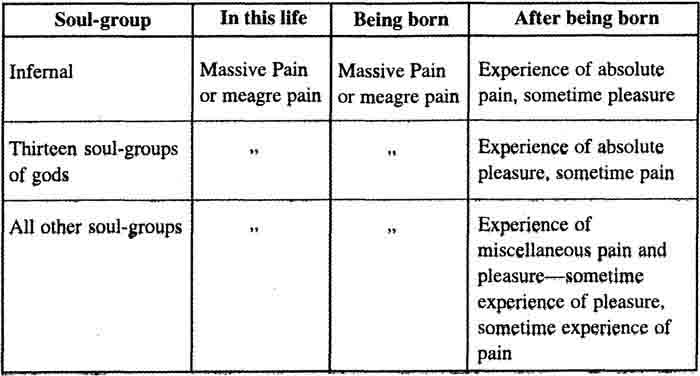
For detailed information about experience of pleasure and pain, see Bhasya on Bha. 1.60-100.
7106 jiva nam bhamte! kim abhoganivvattiyauya? anabhoganivvatiyauya?
goyama! no abhoganivvatiyauya, anabhoganivvattiyauya. evam neraiya vi, evam java vemahiya.
Do1 the souls, O Lord! bind the life-span-determining karma consciously or unconsciously?
Gautama! they do not bind the life-span-determining karma consciously, they bind it unconsciously. Similarly the infernals also up to the Empyrean gods.
Bhasya
1. Sutra 106
The rules of binding life-span-determining karma have been indicated in the preceding satakas. For instance:
(1) For transit to next life, the soul has already bound the life-span karma.1
(2) The binding of life-span-determining karma takes place in the preceding life.2
(3) The soul binds the life-span of the birth to which he has to go.3
(4) The soul experiences the life-span of a single life at a time.4
(5) Along with the binding of the life-span-determining karma, the six aspects, namely, species (jati) etc. are determined.5
In the present Sutra, it has been laid down that the soul binds the life-span- -determining karma unconsciously. The soul, with which the life-span-determining karma is being bound, or, has been bound, or, will be bound, does not know when it (i.e., the bondage) takes place, or, had taken place, or, will take place respectively.
Text
Kakkasa-akkasaveyaniya-padam
7.107 atthi nam bhamte! jivanam kakkasaveyanijja kamma kajjamti? hamta atthi.
The Topic of the Karma of Harsh and Soft Experience
Do1 the souls, O Lord! perpetrate (bind) karmas that are harsh to experience? Yes, they do.
7.108 kahannam bhamte! jivanam kakkaseveyanijja kamma kajjamti?
goyama! panaivaena java micchadamsanasallenam—evam khalu goyama! jivanam kakkasaveyanijja kamma kajjamti.
How do the souls, O Lord! perpetrate (bind) karmas that are harsh to experience?
Gautama! (they perpetrate such karma) on account of perpetrating injury to life up to the thorn of deluded world-view (the eighteen occasions for sinful activity). Thus indeed, O Gautama! the souls perpetrate (bind) karmas, that are harsh to experience.
7.109 atthi nam bhamte! neraiyanam kakkasaveyanijja kamma kajjamti? evam ceva. evam java vemaniyanam.
Do the infernals, O Lord! perpetrate (bind) karmas that are harsh to experience?
Yes, there are. The description holds good up to the Empyrean gods.
7.110 atthi nam bhamte! jivanam akkakkasaveyanijja kamma kajjamti? hamta atthi.
Do the souls, O Lord! perpetrate karmas that are soft to experience?
Yes, they do.
7.111 kahannam bhamte! jivanam akakkasaveyanijja kamma kajjamti?
goyama! panaivayaveramanenam java pariggahaveramanenam, kohavivegenam java micchadamsanasallavivegenam—evam khalu goyama! jivanam akakkasaveyanijja kamma kajjamti.
How do the souls, O Lord! perpetrate (bind) karmas that are soft to experience?
Gautama! (they perpetrate (bind) karmas that are soft to experience) on account of abstaining from in jury to life up to abstaining from acquiring possession, shunning (i.e., abstaining from) anger up to shunning (i.e., abstaining from) the thorn of deluded world-view. Thus indeed, O Gautama! the souls perpetrate (bind) karmas that are soft to experience.
7.112 atthi nam bhamte! neraiyanam akakkasaveyanijja kamma kajjamti?
no inatthe samatthe. evam java vemaniyanam, navaram—manussanam jaha jivanam.
Do the infernals, O Lord! perpetrate karmas that are soft to experience? This is not possible. In the same way up to the Empyrean gods. However about the humans the description is like that of the souls in general.
Bhasya
1. Sutras 107-112
In the present dialogue, karma has been divided into two classes viz, ‘what is experienced as harsh’ and ‘what is experienced as soft’. In the next dialogue, karma would be explained as leading to the experiences of pleasure and pain. The experiences as harsh and soft are not exclusively related to the feelings of pleasure and pain, as they have concern with many other varieties of experience of karma. On the other hand, the experience of pleasure and pain is related to only the feeling- producing karma. The set of eighteen sinful acts viz., injury to life etc. is the cause of binding of the harsh-experience karma. The cause of the bondage of pain- producing karma is inflicting suffering, torture, etc. upto others. The cause of binding of soft-experience karma is abstinence from the set of eighteen sinful acts. The cause of the bondage of pleasure-producing karma is compassion on living beings: The distinction between these two varieties of karma viz., harsh-soft experience and pleasure-pain-sensation becomes clear on account of the different causal conditions of their binding.1
Abhayadevasuri has identified abstinence as self-restraint. Non-abstinence means non-self-restraint, which is the common cause available in all the soul-groups viz., those of infernals, etc.. So the binding of harsh experience karma occurs in all souls. The subject of self-restraint (absolute abstinence) are the humans exclusively. So, the binding of soft experience karma is possible only in the humans, not in any other soul-group. The pleasure-pain-sensation karma is possible in all the twenty- -four soul-groups.
It is true that the injury to life is the cause of karmic bondage but abstinence from injury to life is a kind of-inhibition, and as such, is the cause of stoppage of karmic bondage. How could then it be the cause of binding of soft-experience karma? This problem leads to the implication that wherever there is inhibition, there must occur an auspicious activity; and where there is occurance of an auspicious activity, there must be the falling away of karma; and where there is the falling away of karma, there must take place the binding of meritorious karma, which occurs up to the 13th stage of spiritual development.
The meritorious bondage that takes place on account of an auspicious activity accompanying inhibition in a self-restrained person is the bondage of soft-experience karma.
The soft-experience karma is not only related to non-destructive karma but it has association with the destructive karma as well. In the self-restrained person, on account of his passions, there is the constant bondage of the four destructive karmas like knowledge-covering etc. and the three non-destructive inauspicious karmas (i.e. the four non-destructive karmas excluding the life-span-determining karma), but on account of his abstinence from injury to life, his bondage is that of soft- experience karma. The soft-experience karma which is meritorious but not productive of any evil fruition is not the cause of mundane transmigration. Similarly, the soft experience which is inauspicious is also not the promoter of mundane transmigration. Such karma falls away easily by producing its soft result that has no evil effect on the soul.
Sayasaya-veyaniya-padam
7.113 atthi nam bhamte!! jivanam sataveyanijja kamma kajjamti? hamta atthi.
The Topic of Feeling-producing Karma qua Pleasure and Pain
Do1 the souls, O Lord! commit karmas that result in the experience of pleasure feeling?
Yes, they do.
7.114 kahannam bhamte! jivanam sataveyanijja kamma kajjamti?
goyama! pananukampayae, bhuyanukampayae, jivanukampayae, sattanu- kampayae, bahunam pananam bhuyanam jivanam sattanam adukkhanayae, asoyanayae, ajuranayae, atippanayae, apittanayae, apariyavanayae—evam khalu goyama! jivanam sataveyanijja kamma kajjamti. evam neraiyana vi, evam java vemaniyanam.
How do the souls commit (bind) feeling-producing karmas qua pleasure? Gautama! (they commit such karmas) by means of compassion on the animates, living beings, souls and living organisms, by not inflicting sorrow and grief on them, by not subjecting their body to decay, by not making them cry, by not beating them and by not torturing them. Thus indeed, O Gautama! the souls commit (bind) feeling-producing karmas qua pleasure. The same holds good in the case of infernals and all soul-groups up to Empyrean gods.
7.115 atthi nam bhamte! jivanam asataveyanijja kamma kajjamti? hamta atthi.
Do the souls, O Lord! commit (bind) feeling-producing karmas qua pain? Yes, they do.
7.116 kahannam bhamte! jivanam asataveyanijja kamma kajjamti?
goyama! paradukkhanayae, parasoyanayae, parajuranayae, paratippanayae, parapitthanayae, parapariyavanayae, bahunam pananam bhuyanam jivanam sattanam dukkhanayae soyanayae juranayae, tippanayae, pittanayae, pariya- vanayae—evam khalu goyama! jivanam asataveyanijja kamma kajjamti. evam neraiyana vi, evam java vemaniyanam.
How do O Lord! they commit (bind) feeling-producing karmas qua pain? Gautama! (they commit (bind) such karmas) by inflicting sorrow and grief (bind) feeling-producing karmas qua pain on others, by subjecting their body to decay, by making others cry, by beating others and by torturing others. They commit such karmas by inflicting on many animates, living beings, souls and living organisms, sorrow and grief by subjecting their body to decay, by making them cry, by beating them and by torturing them. Thus indeed, O Gautama! the souls commit (bind) feeling-producing karmas qua pain. The same holds good in the case of infernals and all soul-groups ...... up to the Empyrean gods.
Bhasya
1. Sutras 113-116
There are two kinds of compassion: one involving activity and one involving inhibition. In Bhagavan Mahavira’s view, only the non-violence in the form of self-restraint is to be observed. Compassion is a variety of non-violence, and so the defining characterstic of non-violence can be self-restraint alone. The Siitra in explaining the practical aspect of compassion has described it categorically as ‘not to inflict any pain’; it, however, has not prescribed it as “to conferring any pleasure.” The compassion as conferring pleasure may be suitable to the popular social life, but is not suitable to the dharma, i.e., spiritual discipline of self-restraint.
A man indulging in arambha, i.e., any activity, involving violence, causes suffering to others.2 On the other hand, on awakening of the feeling of compassion in him, he restraints his activity of arambha, thus desisting from inflicting any pain to others. The nature of such compassion has a universal feature which is valid at all times, at all places and is absolutely free from any taint and blemish.
In Bhagavati 3/145, there is the reading dukkhavanayae. In the present text the reading is dukkhanayae. For semantics, see Bhasya 3/145. Umasvati has mentioned many causes for binding satavedamya kartna (feeling-producing karma qua pleasure): (1) compassion for living beings (2) compassion for the observers of religious vows (3) charity (4) self-restraint with attachment etc., i.e., self-restraint (ascetic conduct) with attachment, restraint-cum-non-restraint, involuntary falling away of karma and activity in the form of austerity of deluded person (5) forbearance (6) purity (freedom from greed).3
In the present Agama (Bhagavati), the causes of binding of satavedamya karma have been mentioned. Among them also only compassion has been mentioned.4 The mention of the other causes by Umasvati is a subject of investigation. Siddhasenagamhas made this list larger.5 The text of Bhagavati appears to be ancient. The Tattvartha Siitra is a later development.
Akalanka has explained compassion as follows—the compassion means the mental agitation due to experiencing the pain of others as one’s own on account of the moistening of one’s mind due to compassion.6
Umasvati has given six causes of the bondage of asatavedamya karma (feeling- -producing karmas qua pain). These are very similar to perpetrating pain etc. to others as mentioned in the Bhagavati. See table:
Tattvartha Sutra |
|
Giving pain |
Giving pain |
Giving grief |
Giving grief |
Subjecting the body to decay |
Causing agony |
Making them cry |
Making them cry |
Beating |
Causing injury |
Torturing |
Causing lamenting |
Akalanka has augmented the list of the causes of asatavedamya karma.7
Text
Dussamadussama-padam
7.117 jambuddive nam bhamte! dive imise osappime dussama-dussamae samae uttamakatthapattae bharahassa vasassa kerisae agarabhava-padoyare bhavissai? goyama! kalo bhavissai hahabhue, bhambhabbhue koldhalabhue. samanubhavena ya nam khara-pharusa-dhdlimaila duvvisaha vaula bhayamkara vaya samvattaga ya vahimti. iha abhikkham dhumahimti ya disa samamta raussala renukalusa-tamapadala-niraloga. samayalukkhayae ya nam ahiyam camda styam mochamti. ahiyam suriya tavaissamti. aduttaram ca nam abhikkhanam bahave arasameha virasameha kharameha khattameha aggimeha vijjumeha visameha asanimeha—apivanijjodaga, vahirogavedanodirana-parinamasalila, amanunnapaniyaga camdanilapahayatikkhadhara-nivayapauram vasam vasihimti, jenam bharahe vase gcimagara-nagara-kheda-kabbada-madamba- donamuha-pananasamagayam janavayam, cauppayagavelae, khahayare ya pakkhisamghe, gamaranna-payaranirae tase ya pane, bahuppagare rukkha- -guccha-gumma-laya-valli-tana-pavvaga-haritosahi-pavalamkuramadie ya tana- -vanassaikaie viddhamsehimti, pavvaya- giri-domgarutthala-bhatthimadie veyaddhagirivajje viravehimti, salilabila-gadda-dugga-visamaninnunnayaim ca gamga-siindhuvajjaim samika rehimti.
The Topic of the Severest Aeon of Extreme Privation
What1 would be the manifest shape and mode of the continent of Bharata in the Island of Jambudvipa, O Lord! in the severest aeon of extreme privation in this descending cycle?
Gautama! the period will be sorrowful, fraught with groaning of animals, tumultuous. By the influence of the time there will blow cyclonic winds, full of dry and rough dust, unbearable, storming and terrible. The directions will be continually smoky, full of dust and tainted with dusty particles, devoid of sunshine on account of the layers of darkness. On account of the harshness of the times, the moon will be colder and sun will be hotter. There will frequently be many clouds with water devoid of taste, with water of bad taste, with water of taste of baking soda, with water of taste of cowdung, with water hot like fire, with flashes of lightning, with water, vomiting poison, with thunderbolts. Water of those clouds will be undrinkable. They will produce diseases, ailments and pain. It will be unpleasant. There will be torrential rains accompanied with fierce winds. On account of those rains, in the continent of Bharata, the areas of the villages, mines, cities, places yielding no revenue, commercial places, capitals, places surrounded by mud walls, hamlets, ports, hermitages etc., the quadrupeds, the birds, the domestic and wild animals and many varieties of trees, shrubs, bamboos, crippers, clinging plants, grass, knotty crippers, green trees, herbs, tender leaves, sprouts etc. and all other vegetation will meet destruction. Excepting the Vaitadhya Mountain and all other mountains, hills, hillocks, mounds will be annihilated. Excepting the Ganga (Ganges) and the Sindhu (Indus) all other fountains, pools, forts, uneven lands and rough spaces will become flat.
7.118 tise nam bhamte! samae bharahassa vasassa bhurnie kerisae agara- bhavapadoyare bhavissati?
goyama! bhumi bhavissati imgalabbhuya mummurabbhuya chariyabhuya tattakavellayabbhuya tattasamajotibbhuya dhulibahula renubahula pamkabahula panagabahula calanibahula bahunam dharanigoyaranam sattanam dunnikkama yavi bhavissati.
What will be the manifest shape and mode of the land of the continent of Bharata in that aeon, O Lord?
Gautama! the land will be like charcoal, chaff-fire, hot ashes and like hot pan. The land will be hot like fire, like hot cauldron, like a burning flame, full of dust, full of dirt, full of mud, full of moss, extremely slippery. The land will be very difficult to tread on by the terrestrial creatures.
7.119 tise nam bhamte! samae bharahe vase manuyanam kerisae agarabhava- padoyare bhavissai ?
goyama! manuya bhavissamti duruva duvanna duggamdha durasa duphasa anittha akamta appiya asubha amanunna amanama hinassara dinassara aniuhassara akamtassara appiyassara asubhassara amanunnassara amanamassara anadejjavayanapaccayaya, nillajja, kuda - kavada-kalaha - vaha - -bamdha-veraniraya, majjayatikkamappahana, akajjaniccujjata, guruniyoga- -vinayarahiya ya, vikalaruva, parudhanaha-kesa-mamsu-roma, kala, khara- -pharusa-jhama-vanna, phuttasira, kavilapaliyakesa, bahunha-rusmmpinaddha- -duddamsanijjardva, samkuditavalitaramgaparivedhiyamgamamga, jaraparinatavva theraganara, paviralaparisadiyadamtasedhi, ubbhadaghada- muha visamanayana, vamkanasa, vamka-valivigaya-bhesanamuha, kacchu- -kasardbhibhdya, kharatikkhanakhakamduiya-vikkhayatanu, daddu-kidibha- -sibbha-phudiyaphardsacchavi, cittalamga, tolagati-visamasamdhibamdhana- -ukkuduatthigavibhatta dubbala kusamghayana-kuppamana-kusamthiya, kuruva, kutthanasana-kusejja-kubhoino, asuino, anegabahiparipiliyamgamamga, khalamta-vibbhalagati, nirucchaha, sattaparivajjiya, vigayacetthanatthateya, abhikkhanam siya-unha-khara-phardsavaya-vijjhadiyamalmapamsurauggum- diyamgamamga, bahukoha-mana-maya, bahulobha, asuha-dukkhabhagi, ussannam dhammasannasammattaparibhattha, ukkosenam rayanippamanametta, solassavisativasaparumauso, putianattuparivala-panayabahuld, gamga-simdhuo mahanadio, veyaddham ca pavvayam nissae bavattarim nioda biyam, biyametta bilavasino bhavissamti.
What will be, O Lord! the manifest shape and mode of the human beings in the continent of Bharata in that aeon?
Gautama! the human beings will have wicked nature, ugly colour, bad smell and bad taste and bad touch; they will be unlucky, unpleasant, unfavourable, inauspicious, disagreeable, disgusting; they will be of debased voice, of mean voice, of poor voice, of unpleasant voice, of undesirable voice, of unfavourable voice, of inauspicious voice, of disagreeable voice and of disgusting voice; their statements will be unacceptable; they will be shameless and will be engaged in forgery, deceit, quarrel, killing, capturing and enmity; they will be foremost in transgressing the mores, always indulging in bad action, and devoid of respect for the order of superiors; they will be lacking good shape, with grown nails, hairs, beard, moustache and pore hairs; they will be black, extremely rude (in behaviour) and dust-coloured in complexion; they will be with broken heads, with yellow and white hairs, and quite repulsive (loathsome) appearance due to being covered with innumerable sinews knit together, they will have every limb of their body having wrinkles; they will be like old poeple with decaying body due to ageing; they will have their rows of teeth consisting of a few and rotten teeth; they will be with narrow lips like a mouth of a jar; they will be with fearful eyes, with curved nose and with terrific face which would be oblique and worsened by the wrinkles; they will be afflicted with bad itches and oozing scabies (psora), they will be with the body having sharp and deep wounds made through itching with sharp nails; they will be with the skin rendered cracked and unsmoothed on account of the diseases like ringworm, leucoderma and severe leprosy; they will be with variegated limbs, with movement like that of a locust, with bad joint, with bad binding, with bones not duly set with bad formation, with bad structure, with unusual formation, ugly, with ugly seat, ugly bed and ugly food, with uncleaned body, with limbs suffering from many diseases, with faltering and unsteady movement, lacking enthusiasm, devoid of stamina, lacking in endeavour, lacking lustre, with every limbs, full of dirty dust and dust-particles which have been scattered about by cool, hot, dry and harsh wind. Anger, pride, deceit and greed will be predominant in them. Their suffering is productive of further suffering. They will be devoid of religious proclivity and enlightened world-view. Their body will be one ratni equivalent to one cubit in length. Their maximum life-span will be sixteen or twenty years. They will have deep affection for their sons and grandsons. Their habitat will be some burrows2 in the vicinity of the great rivers Ganga and Sindhu and mountain Vaitadhya or they will live in caves. Only seventy-two families of these human beings will survive as a few seeds which would serve as genes for future human species.
7.120 te nam bhamte! manuya kam aharam aharehimti?
goyama! tenam kalenam tenam samaenam gamga-simdhUo mahanadw rahapahavitthamo akkhasoyappamanamettam jalam vojjhiliimti, se vi ya nam jale bahumacchakar‘chabhainne, no ceva nam aubahule bhavissati. tae nam te manuya sHrUggamanamuhuttamsi ya sdratthamanamuhuttamsi ya bilehimto niddhahimti, niddhaitta maccha-kacchabhe thalaim gahehimti, gahetta sitatavatattaehim, maccha-kacchaehim ekkavisam vasasahassaim vittim kappemana viharissamti.
O Lord! what kind of food will those human beings eat?
Gautama! in that age, at that time, the two great rivers, viz., Ganga and Sindhu will remain only as wide as the path of the chariot. The flow of water in them will be as thin as the hole in the axle of the wheel. That water will be infested with fishes and tortoises. The amount of water will be very meagre. Those humans will come out of their burrows, within forty-eight minutes after the sunrise and forty-eight minutes before the sunset and take out fishes and tortoises (from the river) and then, after taking them at a dry place, they will roast them in the scorching cold and heat. They will lead such life for the period of twenty-one thousand years.
7.121 te nam bhamte! manuya nisslla nigguna nimmera nippaccakkhanapo- sahovavasa, ussannam mamsahara macchahara khoddahara kunimahara kalamase kalam kicca kahim gacchihimti? kahim uvavajjihimti?
goyama! ussannam naraga-tirikkhajoniesu uvavajjihimti.
Where will those humans, O Lord! who will be devoid of s'Ua (great vows and small vows), devoid of virtue, devoid of decency, not observing any kind of pausadhopavasa (fasting with undertaking day-long abstinence from sinful activity) or renunciation, eaters of meat, fish, eaters of ksudrahara (lit. base food, which means honey or the organisms dug out of the earth) and eaters of dead body, be born after death?
Gautama! they will mostly be re-born in hell or as subumans.
7.122 te nam bhamte! siha, vaggha, vaga, diviya, accha, taraccha, parassara nissila taheva java kahim uvavajjihimti?
goyama! ussannam naraga-tirikkhajoniesu uvavajjihimti.
Where will, O Lord! the lions, tigers, wolfs, leopards, bear, hyena, wombat who are devoid of sila (great vows and small vows) will be born after death? Gautama! they will mostly be born in hell or subhumans.
7.123 te nam bhamte! dhamka, kamka, vilaka, madduga, sihi nissila taheva java kahim uvavajjihimti?
goyama! ussannam naraga-tirikkhajoniesu uvavajjihimti.
Where will those creatures devoid of sila (great vows and small vows) viz., jungle crow, bellied sea-eagle, golden oriole, snake bird or darter, peacock or cock will be born after death?
Gautama! they will mostly be born in hell or as subhumans.
Bhasya
1. Sutras 117-123
In the Jambuddivapannatti, the time-cycle has been explained in detail. The description in the present canon seems to have been quoted from there. This dialogue was interpolated at some stage of the synod that compiled the canon. The elaborate style of description here is not coherent with the dialogue-type descriptions in the Bhagavati Sutra.
The description of the environmental situation that will prevail in the aeon of extreme privation is as follows:
1. Devastating wind will blow.
2. The directions will be smoky and dark.
3. The moon will be colder.
4. The sun will be hotter.
5. The rains will drop water that will cause diseases and be undrinkable.
6. There will be torrential rains, accompanied by cyclonic winds, causing destruction of villages, cities, animals and vegetations.
7. Excepting the Vaitadhya mountain, all other mountains and hills will be destroyed.
8. Excepting the Ganges and Indus, all other rivers will transform into even land.
9. The earth will be as hot as fire, dusty and unfit for habitation.
10. The.humans will be devoid of beauty, good behaviour and power.
11. The height of human beings will be one cubit.1
12. The passions (anger, pride, deceit, greed) will be intense.
13. Food will be without power of nutrition and augment disease.
14. The life-span will be sixteen to twenty years only.
2. Burrows
The number of such burrows is mentioned as 72.2
Semantics
Sutra 117
uttamakaUhapattae—what has reached its highest stage. In Bhagavati, 6/135, we find reading ‘ uttimatthapa tide ’.
agarabhavapadoyare—the manifestation of the external shape and the mode.
samae—aeon, a part of the time-cycle also called ara.
samanubhavena—by the power of the aeon.
kharapharusa—very hard.
vaula—in Skt. we find both vatula and vatula which mean cyclone. The Vrtti has explained vaula as vyakula—agitated which does not appear appropriate. Khara-parusa-dhUlimaila-duvvisaha are the adjectives of vaula.
samvattaga—the wind that blows away grass, trees etc.
bhayamkara—is the adjective of samvattaga.
niraloga—devoid of light.
samayalukkhayae—here samaya means the environment. Time is only metaphorical substance which can not be viscous or dry.
kharameha—the clouds with water of the taste of baking soda (sodium bi carbonate).
khattameha—the clouds with water having the taste of cow-dung.
gavelae—cow, sheep, etc.
rukkha—tree such as mango etc.
guccha—plants such as egg-plant etc..
gumma—plants whose trunk is short but branches, leaves flowers and fruits are inabundance.
lay a—crippersi. It has only one branch above the trunk.
valli—the cripper of cucumber etc.
tana—grass. Such as Audropogen Muricatus (which is the name of a fragrant grass) etc..
pavvaga—plant which has knot in middle such as sugarcane.
harita—green- gras s.
osalii—barb-rice etc.
pavala—tender leaf.
tanavanassaikaie—gross vegetation.
domgara—hillock. It is a des'i word.
utthala—mound of sand.
bhatthl—path devoid of dust.
salilabila (bhumi-nirjjhara)—spring, where water wells up.
viravehimti—viraya (virata)—this is a desi root which means merged.
Sutra 118
tattakavellayabbhuya, tattasamajotibhuya—see Bhasya on Bha. 3.48.
calani—foot-deep mud.3 In, the Jivajivabhigama Vrtti, it is explained as carana-
matrasparsi kardama4—mud that touches only the foot.
Sutra 119
anadejjavayana—whose words are not obediently followed, acceptable as authentic or paid honour to by others.
paccayaya (pratyayata)—birth. It has two Skt. forms—pratyayata and pratyajata.
The Vrtti explains the pratyajata as birth.5
niyoga—an injunction (order), a compulsory duty.6
jhama (dagdha)—it is a desi word which means burnt out.
phuttasira—with broken head or split head. The Vrtti explains it as with hairs, floating untiedly.7
kacchu-kasarabhibhuya—kacchu and kasara both are type of itches. The Vrtti explains kacchu as pama and kasara as khasara.8
daddu-kidibha-sibbha—these are among the eighteen types of leprosy according to Ayurveda. Among them both sidhma and kitibha are due to kapha and vata. Dadru is also a variety of leprosy which is due to kapha and pitta.9
chavi—skin.
cittala—varigated.
tolagati—tola means locust. Tolagati means zigzag movement like that of a locust. The Vrtti explains it like the movement of a camel. Alternately, it is explained as with inauspicious shape or configuration.10
ukkuduatthiga—whose bones are not properly set.
vijjhadiya—it is a des'i word, meaning mixed, pervading.
uggumdiya—it is a desi word, meaning full of dust.
asuha-dukkhabhagi—pain which causes further pain.
rayani—cubit (= 20 inches).
niooda—family.
Sutra 120
rahapaha—the distance between the two wheels of a chariot.11 akkhasoyappamanamettam—as big as the hole for the passage of the axle of the wheel.12
Sutra 121
In the present Sutra, the words—the ‘mamsahara’ and the ‘kunimahara’—have been used. Kunima means dead body. Along with the eating of mamsa (flesh) the eating of sava is also mentioned, which implies that mamsa and sava (corpse) were different from each other. The eating of dead body indicates more cruelty than the eating of meat.
The word ‘khoddahara’ has been explained as ‘honey-eaters’ or ‘eaters of the organisms by digging them out from beaneath the earth’.13
Sutra 122
In Sutra 117, it was stated that the quadrupeds will meet destruction. That indicated only—some varieties of quadrupeds. In the present Sutra the remaining varieties of quadrupeds are mentioned. For semantics, see Bhasya on Bha. 3.209-220.
Text
7.124 sevam bhamte! sevam bhamte! tti.
That is so, O Lord! That is so, O Lord!
1.Bha. 5.59-62.
1. Ibid., 5.59.
2. Ibid., 5.60.
3. Ibid., 5.62.
4. Ibid., 5.58.
5. Ibid., 6.151.
1. Bha. Vr. 7.106—‘panaivayaveramanenam’ ti samyamenetyarthah.
1. Dasave. 6.8—
ahimsa niunarn dittha, savvabhuesu samjamo I
2. Bha. 3.145.
3. Ta. Su. 6.13—bhutavratyanukampadanam saragasarnyamadiyogah ksantih saucamiti etadvedyasya.
4. Bha. 8.422.
5. Ta. Su. Bha. Vr. 6.13—dharmanuragah darmanisevanasilavratapausadhopavasaratitapo’nusthana- balavrddhatapasviglanavaiyavrttyanusthanadharmacaryamatrpitrbhaktisiddhacaityapOjasubhapannamasca sadvedyasya srava bhavantiti.
6. Ta. Ra. Va. 6.12—anugrahardnkrtacetasah parapldamatmasthamiva kurvato’nukampana- manukampa.
7. Ibid., 6.11, p.521.
1. Bha. 6.134.
2. Bha. Jo. 2.120.81-83—
gamga simdhu mahanadi vetadhanim nesraya l
bohimtara bila-vasmam, kutumba nigoda kahaya 118111
gamga nadi jiham uttara disi vaitadharai,
nicai pravesa karai tiham bihu pasai dharai I
nava nava bila chai ema atharai bila thaya,
ema gamga daksina vaitadha kanai kahaya 118211
uttara disi mem athara athara daksina dise,
evam bila sata tisa tiham jamtu vase I
ima simdhu bihum pasa chatisa pichaniyai,
bohimtara bila ema sarva hi janiyai 118311
3. Bha. Vr. 6.118—calanapramanah karddamascalanltyucyate.
4. Jiva. Vr. pa. 242—calaniti va, calani—caranamatrasparsikarddamah.
5. Bha. Vr. 7.119—pratyajatam tu janma.
6. Abhidhana Cintamani, 6.156—niyoge vidhisampresau.
7. Bha. Vr 7.119—‘phuttasira’tti vikirnasiroja ityarthah.
8. Ibid., 7.119—kacchukasarabhibhuya kacchuh—pama tathakasaraisca—khasarairabhibhutah—vyapta ye te tatha.
9. Sarngadharasamhita, Purvakhanda, Roga Ganana Prakarana, p.148.
10. Bha. Vr.7.119—toletyadi, tolagatayah—ustradisamapracarah pathantarena tolakrtayah— aprasastakarah.
11. Ibid., 7.120—rathapathah— sakatacakradvayapramito margah.
12. Ibid., 7.120—aksasrotah—cakradhurah pravesarandhram tadeva pramanamaksasrotah pramanam tena matra parimanamavagahato yasya tat.
13. (a) Ibid., 7.121—khoddahara’tti madhubhojinah bhuksodena vaharo yesarnteksodaharah.
(b) Bha. Jo. vol. II, dha. 120, verse 13—
dharati pratai vidara, maccha khasyai athavavali I
tasu madhu sahata ahara, khoddahara te kahya II
♦
Seventh Section
Sattama Uddeso
Section-7
Text
Samvudassa kiriya-padam
7.125 samvudssa nam bhamte! anagarassa auttam gacchamanassa, auttam citthamanassa, auttam nisiyamanassa, auttam tuyattamanassa, auttam vattham padiggaham kambalam. padapumchanam genhamanassa va nikkhivamanassa va, tassa nam bhamte! kim iriyavahiya kariya kajjai? samparaiya kiriya kajjai? goyama! samvudassa nam anagarassa auttam gacchamanassa java tassa nam iriyavahiya kiriya kajjai, no samparaiya kiriya kajjai.
The Topic of the Activity of Self-inhibited (Samvrta) Ascetic
Does1 a self-inhibited ascetic, O Lord! who walks attentively, stands attentively, sits attentively, changes sides attentively while lying down and who picks up clothing, bowl, blanket and duster attentively, indulge in airyapathiki kriya (instantaneous activity that is free from passions) or samparayiki kriya (long term activity that is informed with passion)? Gautama! the self-inhibited ascetic walking attentively, etc. indulges in airyapathiki kriya, not in samparayiki kriya.
7.126 se kenatthenam bhamte! evam vuccai—samvudassa nam anagarassa auttam gacchamanassa java no samparaiya, kiriya kajjai?
goyama! jassa nam koha-mana-maya-lobha vocchinna bhavamti, tassa nam iriyavahiya kiriya kajjai, jassa nam koha-mana-maya-lobha avocchinna bhavamti, tassa nam samparaiya kiriya kajjai. ahasuttam riyamanassa iriyavahiya kiriya kajjai, ussuttam riyamanassa samparaiya kiriya kajjai. se nam. ahasuttameva riyai. se tenatthenam goyama! evam vuccai—samvudassa nam anagarassa auttam gacchamanassa java no samparaiya kiriya kajjai.
For what reason has it been said, O Lord! that a self-inhibited ascetic walking attentively etc up to does not indulge in samparayiki kriya.
Gautama! the ascetic who has eliminated his anger, pride, deceit and greed indulges in airyapathiki kriya: The ascetic who has not eliminated his anger, pride, deceit and greed indulges in samparayiki kriya. The ascetic who acts strictly according to the injunction of the scripture indulges in airyapathiki kriya; the ascetic who acts against the injunction of scripture indulges in samparayiki kriya. The self-inhibited ascetic acts strictly according to injunction of the scripture. For that reason Gautama! has it been said that the self-inhibited ascetic walking attentively etc up to does not indulge in samparayiki kriya.
1. Sutras 125, 126
See Bhasya on Bha. 7.20. For samvrta, see Bhasya on Bha. 1.44-47.
Text
Kama-bhoga-padam
7.127 ruvi bhamte! kama? aruvi kama?
goyama! ruvi kama, no aruvi kama.
The Topic of the Kama (Craving) and Bhoga (Physical Enjoyment) of Sensual Objects
Are1 the objects of desire, O Lord! corporal or non-corporal?
Gautama! the objects of desire are corporal, not non-corporal.
7.128 sacitta bhamte! kama? acitta kama?
goyama! sacitta vi kama, acita vi kama.
Are the objects of desire, O Lord! sentient beings or insentient things? Gautama! they are both, sentient beings as well as insentient things.
7.129 jiva bhamte! kama? ajiva kama?
goyama! java vi kama, ajiva vi kama.
Are the souls, O Lord! objects of desire or the non-souls objects of desire? Gautama! the souls are objects of desire, also the non-souls are objects of desire.
7.130 jivanam bhamte! kama? ajivanam kama?
goyama! jivanam kama, no ajivanam kama.
To whom does the desire belong, O Lord! to the souls or to the non-souls? Gautama! the desires belong to the souls, they do not belong to the non- -souls.
7.131 kativiha nam bhamte!! kama pannatta?
goyama! duviha kama pannata, tam jaha sadda ya, ruva ya.
How many kinds of objects of desire have been propounded, O Lord? Gautama! two kinds of objects of desire have been propounded, namely, sounds and colours (and also shapes).
7.132 ruvi bhamte! bhoga? aruvi bhoga?
goyama! ruvi bhoga, no aruvi bhoga.
O Lord! are the objects of feeling (physical sensation) corporal or noncorporal?
Gautama! the objects of feeling are corporal, not non-corporal.
7.133 sacitta bhamte! bhoga? acitta bhoga?
goyama! sacitta vi bhoga, acitta vi bhoga.
Are the objects of feeling, O Lord! sentient beings or insentient things? Gautama! they are both—sentient beings as well as insentient things.
7.134 jiva bhamte! bhoga? ajiva bhoga?
goyama! jiva vi bhoga, ajiva vi bhoga.
Are the souls, O Lord! objects of feeling or the non-souls objects of feeling? Gautama! the souls are objects of feeling, also the non-souls are objects of feeling.
7.135 jivanam bhamte! bhoga? ajivanam bhoga?
goyama! jivanam bhoga, no ajivanam bhoga.
To whom do the feelings belong, O Lord! to the souls or to the non-souls? Gautama! the feelings belong to the souls, not to the non-souls.
7.136 kativiha nam bhamte! bhoga pannatta?
goyama! tiviha bhoga pannatta, tam jaha—gamdha, rasa, phasa.
How many kinds of objects of feeling have been propounded, O Lord? Gautama! three kinds of objects of feeling have been propounded, viz., smells, tastes and touches.
7.137 kativiha nam bhamte! kama-bhogapannatta?
goyama! pamcaviha kama-bhoga pannatta, tam jaha—sadda, ruva, gamdha, rasa, phasa.
How many kinds of objects of desire and feeling have been propounded, O Lord?
Gautama! five kinds of objects of desire and feeling have been propounded, viz., sound, colours (and shapes), smells, tastes and touches.
7.138 jiva nam bhamte! kim kami? bhogi? goyam! jiva kami vi, bhogi vi.
Are the souls, O Lord! the subjects (i.e., possessors) of desires or the subjects of feelings?
Gautama! the souls are both—the subjects of desires and the subjects of feeling.
7.139 se kenatthenam bhamte! evam vuccai—jiva kami vi? bhogi vi?
goyama! soimdiya-cakkhimdiyaim paducca kami ghanimdiya-jibbhimdiya- phasimdiyaimpaducca bhogi. se tenatthenam
goyama! evam vuccai—jiva kami vi, bhogi vi.
For what reason, O Lord! has it been said that the souls are both—the subjects of desires as well as the subjects of feelings?
Gautama! with respect to the sense-organs of sound and colours, the souls are the subjects of desires; with respect to the sense-organs of smell, taste and touch, the souls are the subjects of feelings. For this reason has it been said, O Gautama! that the souls are both—the subjects of desires as well as subjects of feelings.
7.140 neraiya nam bhamte! kim kami? bhogi?
evam ceva java thaniyakumara.
Are the infernals, O Lord! the subjects of desires or the subjects of feelings? The same reply holds good in the case of soul-groups from infernals ..... up to the Stanitakumara.
7.141 pudhavikaiyanam—puccha.
goyama! pudhavikaiya no kami, bhogi.
Now the same query about the earth-bodied beings.
Gautama! the earth-bodied beings are not the subjects of desires, they are only the subjects of feelings.
7.142 se kenatthenam java bhogi?
goyama! phasimdiyam paducca. se tenatthenam java bhogi. evam java vanassaikaiya. beimdiya evam ceva, navaram—jibbhimdiya-phasimdiyaim paducca. teimdiya vi evam ceva, navaram—ghanimdiya-jibbhimdiya- phasimdiyaim paducca.
For what reason has it been said, O Lord! that the earth-bodied beings up to they are subjects of feelings?
Gautama! it has been said so with respect to the sense-organ of touch, due to which they are subjects of feelings only. Similar description holds good for water-bodied, fire-bodied, air-bodied and vegetation-bodied beings. About the two-sensed beings, similar description holds good excepting that in their case, it is with respect to the sense-organs of taste and touch. About the three-sensed beings, similar description holds good excepting that in their case, it is with respect to the sense-organs of smell, taste and touch.
7.143 caurimdiyanam—puccha.
goyama! caurimdiya kami vi, bhogi vi.
The same query about the four-sensed beings.
Gautama! the four-sensed beings are both—the subjects of desires as well as subjects of feelings.
7.144 se kenatthenarn java bhogi vi?
goyama! cakkhimdiyam paducca kami, ghanimdiya-jibbhimdiya-phasimdiyaim paducca bhogi. se tenatthenam java bhogi vi. avasesa jaha jiva java vemaniya.
For what reason has it been said, O Lord! that they are up to the subjects of feelings?
Gautama! they are subjects of desires with respect to the sense-organ of colours (and shapes) and the subjects of feelings with the respect to the sense- organs of smell, taste and touch. For this reason has it been said, O Gautama! that they are both—the subjects of desires as well as the subjects of feelings. The rest of soul-groups up to the Empyrean gods are to be spoken of like the souls in general.
7.145 eesi nam bhamte! jivanam kamabhogmam, nokammam, nobhogmam, bhogina ya kayare kayarehimto appa va? bahuya va? tulla va? visesahiya va?
goyama! savvatthova jiva kamabhogi, nokami nobhogi anamtaguna, bhogi anamtaguna.
Among the souls, viz., the subjects of desires and feelings, the non-subjects of desires, non-subjects of feelings and subjects of feelings, O Lord! which souls are mutually the least in number, the more in number, equal in number or slightly more in number?
Gautama! the least among them are the subjects of desires and feelings; infinite times of them are the non-subjects of desires and the non-subjects of feelings; infinite times of them are the subjects of feelings.
Bhasya
1. Sutras 127-145
In the present dialogue, the sense-organs and their objects have been considered. There are five sense-organs with sound, colour, smell, taste and touch as their objects. We get elaborate discussion on the topic of ‘the sense-organs, having physical contact with their objects, and those, devoid of physical contact with them’, in the darsana- -yuga, i.e., the age when philosophy predominated. In the Naiyayika-Vaisesika philosophies, all the sense-organs are regarded as in contact with their objects. In Buddhism, the eye and the ear are not considered to be in contact with colour and sound respectively. In Jainism, only the eye is considered as not in physical contact with its object. This is a topic of epistemology. The topic of the desires and feelings do not belong to the domain of epistemology, rather they relate to physiology and psychology. The two sense-organs, viz., the ear and the eye are concerned with desires and the remaining three with the feelings (physical sensation). The objects which are simply desired but not physically sensed, viz., sound and colour are technically called kama (craving), while the, remaining three which are physically sensed, viz., smell, taste and touch are technically called bhoga (physical enjoyment).
Both kama and bhoga are material objects and therefore they are corporal (rupi).
The sound and colour of a living being are sentient objects and inert sound and colour are insentient objects. The Vrtti explains sentient (sacitta) and insentient (acitta) differently. According to him, the colour of a living being endowed with mind is a sentient object of desire and the colour of a living being devoid of mind is an insentient object of desire.1 But this deserves scrutiny. In the scriptural literature, the word samjni has been used for the living beings endowed with mind, and asamjni for the living beings devoid of mind. The word sacitta has been used for all varieties of sentient beings and acitta for insentient things.
The kamas (the objects of desires) are both soul and non-soul—with respect to the colours (and shapes) of the animate body (of a living being) and sounds of a living being, they are soul, while with respect to the colours (and shapes) of inanimate objects like a painting, a doll etc. and sounds of inanimate objects, the kamas are also non-soul. The objects of feelings are also to be spoken of like the objects of desires.
The souls are both—the subjects of desires as well as feelings. The one-sensed, two-sensed and three-sensed beings are exclusively the subjects of feelings; while the four-sensed and five-sensed beings are both the subjects of feelings as well as desires.
The souls which are both the subjects of feelings and desires are the least in number, the reason being that their subjects, viz., the four-sensed and five-sensed beings are the least in number. The emancipated are non-subjects of desires and feelings; they are infinite times total number of the four-sensed and five-sensed beings. The souls, which are the subjects of only feelings, are even infinite times the number of emancipated souls, the reason being that the total number of vegetation- -bodied beings (which are one-sensed beings) is infinite times the number of emancipated souls.
In the present dialogue, there is a precise classification of the subjects of desires and the subjects of feelings. In the commentatorial literature, this classification, however, has not been clearly followed.
Text
Dubbalasarirassa bhogapariccaya-padam
7.146 chaumatthe nam bhamte! manuse je bhavie annayaresu devaloesu devattae uvavajjittae, se nunam bhamte! se khmabhogi no pabhu utthanenam, kammenam, balenam, virienam, purisakkara-parakkamenam viulaim bhogabhogaim bhumjamane viharittae? se nunam bhamte! eyamattham evam vayaha?
goyama! no tinatthe samatthe. pabhu nam se utthanena vi, kammena vi, balena vi, viriena vi, purisakkara-parakkamena vi annayaraim vipulaim bhogabhogaim bhumjamane viharittae, tamha bhogi bhoge pariccayamane mahanijjare, mahapajjavasane bhavai.
The Topic of Renunciation of Enjoyment by a Weak Person
There1 is a person, with a veil of ignorance (chhaumattha), O Lord! who is fit to take birth as god in anyone of the heavens, but he has a weak physique; he, is no able to enjoy great sensual pleasures by means of his enthusiasm, action, strength, energy, self-exertion and self-efficiency. Do your lordships also endorse this view?
Gautama! this is not proper. Capable indeed is he, by means of his enthusiasm, action, strength, energy, self-exertion and self-efficiency to enjoy any of the great sensual pleasures, so he is indeed an indulgent. He, by renouncing the pleasures, achieve massive falling away of karma and attain the great end i.e., heaven or liberation.
7.147 ahohie nam bhamte! manuse je bhavie annayaresu devaloesu devattae uvavajjittae, se nunam bhamte! se khinabhogi no pabhu utthanenam, kammenam, balenam, virienam, purisakkara-parakkamenam viulaim bhogabhogaim bhumjamane viharittae? se nunam bhamte! eyamattham evam vayaha?
goyama! no tinatthe samatthe. pabhu nam se utthanena vi, kammena vi, balena vi, viriena vi, purisakkara-parakkamena vi annayaraim vipulaim bhogabhogaim bhumjamane viharittae, tamha bhogi bhoge pariccayamane mahanijjare, mahapajjavasane bhavai.
There is a person, with clairvoyance restricted to a limited area, O Lord! who is fit to take re-birth as god in anyone of the heavens, but he has a weak physique; he is not able to enjoy great sensual pleasures, by means of his enthusiasm, action, strength, energy, self-exertion and self-efficiency. Do your lordships also endorse this view?
Gautama! this is not proper. Capable indeed is he, by means of his enthusiasm, action, strength, energy, self-exertion and self-efficiency to enjoy any of the great sensual pleasures, so he is indeed an indulgent. He, by renouncing the pleasures, achieve massive falling away of karma and attain the great end i.e., heaven or liberation.
7.148 paramahohie nam bhamte! manuse je bhavie teneva bhavaggahanenam sijjhittae java amtam karettae, se nunam bhamte! se khinabhogi no pabhu utthanenam, kammenam, balenam, virienam, purisakkara-parakkamenam viulaim bhogabhogaim bhumjamane viharittae? se nunam bhamte! eyamattham evam vayaha?
goyama! no tinatthe samatthe. pabhu nam se utthanena vi, kammena vi, balena vi, viriena vi, purisakkara-parakkamena vi annayaraim vipulaim bhogabhogaim bhumjamane viharittae, tamha bhogi bhoge pariccayamane mahanijjare, mahapajjavasane bhavai.
There is a person with highest clairvoyance, O Lord! who is fit for attaining liberation up to put an end to worldly life in that very birth, but he has a weak physique; he is not able to enjoy great sensual pleasures, by means of his enthusiasm, action, strength, energy, self-exertion and self-efficiency. Do your lordships also endorse this view?
Gautama! this is not proper. Capable indeed is he, by means of his enthusiasm, action, strength, energy, self-exertion and self-efficiency to enjoy any of the great sensual pleasures, so he is indeed an indulgent. He, by renouncing the pleasures, achieve massive falling away of karma and attain the great end i.e., heaven or liberation.
7.149 he vail nam bhamte! maniise je bhavie teneva bhavaggahanenam sijjhittae java amtam karettae, se niinam bhamte! se khmabhogi no pabhH uUhanenam, kammenam, balenam, virienam, purisakkara-parakkamenam viulaim bhoga- bhogaim bhumjamane viharittae? se niinam bhamte! eyamattham evam vayaha ?
goyama! no tinatthe samatthe. pabhU nam se utthanena vi, kammena vi, balena vi, viriena vi, purisakkara-parakkamena vi annayaraim vipulaim bhogabhogciim bhumjamane viharittae, tamha bhogi bhoge pariccayamane mahanijjare, mahapajjavasane bhavati.
There is a person who is omniscient, O Lord! who is fit for attaining liberation ...... up to put an end to worldly life in that very birth, but he has a weak physique; he is not able to enjoy great sensual pleasures, by means of his enthusiasm, action, strength, energy, self-exertion and self-efficiency. Do your lordships also endorse this view?
Gautama! this is not proper. Capable indeed is he, by means of his enthusiasm, action, strength, energy, self-exertion and self-efficiency to enjoy any of the great sensual pleasures, so he is indeed an indulgent. He, by renouncing the pleasures, achieve massive falling away of karma and attain the great end i.e., heaven or liberation.
Bhasya
1. Sutras 146-149
The question is posed—one who is not able to indulge in sensual pleasures can not renounce. One who can not renounce cannot effect massive falling away of karma and attain the supreme end, i.e., heaven or liberation. Without a special falling away of karma there can not be a special bondage of meritorious karma. For instance, there is a person of weak body, who has no enthusiasm, action, strength, energy, self-exertion and self-efficiency; he is incapable of enjoying pleasures, so how is he able to renounce?
This problem has been solved on the basis of requisite measure of enthusiasm, action etc. and the psychic condition suitable for them. A person of weak physique may not be able to employ sufficient enthusiasm, action etc. to enjoy pleasures, but he is definitely capable enough of exercising a little enthusiasm, action etc. and so he is not completely incapable of enjoying pleasures.
Even a person, with a weak physique, can enjoy pleasures on the level of adhyavasaya, i.e., the subtlemost psychic level at which the soul interacts with the karma (the subtle particles of matter); so he is not incapable of enjoying pleasures. Thus, he is capable of enjoying pleasures, so also he can renounce the pleasures and be a renouncer.
If even a one-sensed beings can bind human life-span by his auspicious adhyavasaya, then how should not a weak person be able, by his auspicious adhyavasaya, to effect falling away of karma and bind the life-span of a god? All humans have not uniform enthusiasm, action etc. In the Dhyanavicara, twelve kinds of each of virya (energy), self-efficiency etc. have been mentioned.1 A person may not be able to employ sufficient good physical activity for parting with karma, but he can employ more energy for meditation. The auspicious energy of meditation may be more effective than the good activity of the physique in causing the massive falling away karma. In the Dhyanavicara, the virya (energy) has been defined as follows: the energy is the power that bums by means of the soul-units the karmas in the fire of meditation.2 So even a person, with weak physique, can renounce pleasures and effect massive falling away of karma to attain the highest goal—heaven or liberation.
In the present dialogue, the persons with limited clairvoyance, the highest clairvoyance and omniscience have also been described as bhogi (enjoyer of pleasure). The implication is that on account of their weak physique, they are not completely incapable of enjoying things or objects necessary for sustenance of their life, so they are enjoyers of pleasure. And because they are enjoyers of pleasure, they are also capable of renouncing, effecting massive falling away of karma and attaining the highest goal, viz., heaven or liberation.
Semantic
chaumatthe—with the veil of ignorance.
ahohie, paramahohie—see Bhasya on Bha. 1.200-210.
kevali—an omniscient person.
mahanijjare—one who has affected massive falling away of karma, mahapajjavasane—what ends in attaining heaven or liberation.
Text
Akamanikarana-vedana-padam
7.150 je ime bhamte! asannino pana tam jaha—pudhavikkaiya java vanassaikaiya, chattha ya egatiya tasa—ee nam amdha, mudha, tamampavittha tamapadala- mohajala-padicchanna akamanikaranam vedanam vedemtiti vattavvam siya? hamta
goyama! je ime asannino pana java vedanam vedemtiti vattavvam siya.
The Topic of the Sensation due to Ignorance
Is1 it proper to say, O Lord! that the instinctive living beings (devoid of mind), viz., the five classes of the earth-bodied up to the vegetation-bodied (five types of living beings incapable of undertaking voluntary locomotion); and some mobile beings of the sixth class, which are blind, deluded, immersed in darkness, covered with layers of darkness and veiled with the nets of delusion experience akamanikarana—sensation (of pain) due to their ignorance?
Yes, Gautama! it is proper to say that those instinctive beings up to experience akamanikarana—sensation (of pain) due to ignorance.
7.151 atthi nam bhamte! pabhU vi akamanikaranam vedanam vedemti? hamta atthi.
Is it proper to say, O Lord! that even, in spite of being prabhu (capable of knowing on account of being possessed of mental faculty), the rational beings experience sensation (of pain) due to their ignorance?
Yes, it is proper.
7.152 kahannam bhamte! pabhU vi akamanikaranam vedanam vedemti?
goyama! je nam no pabhU vina padtvenam amdhakaramsi rUvaim pasittae, je nam no pabhU purao rUvaim anijjhaitta nam pasittae, je nam no pabhU maggao rUvaim anavayakkhitta nam pasittae, je nam no pabhUpasao rUvaim anavaloetta nam pasittae, je nam no pabhU uddham rUvaim analoetta nam pasittae, je nam no pabhU ahe rUvaim analoetta nam pasittae, esa nam goyama! pabhU vi akamanikaranam vedanam vedeti.
How is it, O Lord! that even, inspite of being prabhu (capable of knowing on account of being possessed of mental faculty), the rational beings experience sensation (of pain) due to their ignorance?
Gautama! they are not able to see the colours (and shapes) in the darkness without a lamp, to see the colours (and shapes) in the front in the absence of attention, to see the colours (and shapes) situated backside without turning back, to see the colours (and shapes) situated on the sides without turning aside, to see the colours (and shapes) situated above without looking up and to see the colours (and shapes) situated below without looking down. Gautama! such persons even though prabhu experience sensation (of pain) due to ignorance.
Text
Pakamanikarana-vedana-padam
7.153 atthi nam bhamte! pabhU vipakamanikaranam vedanam vedemti? hamta atthi.
The Topic of the Sensation due to Mental Faculty
Is it proper to say, O Lord! that even, in spite of being prabhu (capable of knowing on account of being possessed of mental faculty), the rational being experience sensation (of pain)?
Yes, it is proper.
7.154 kahannam bhamte! pabhu vi pakamanikamnam vedanam vedeti?
goyama! je nam no pabhu samuddassa param gamittae, je nam no pabhu samuddassa paragayaim ruvaim pasittae, je nam no pabhu devalogam gamittae, je nam no pabhu devalogagayaim ruvaim pasittae, esa nam
goyama! pabhu vi pakkamanikaranam vedanam vedeti.
How is it, O Lord! that even, in spite of beingprabhu (capable of knowing on account of being possessed of mental faculty), the rational beings experience sensation (of pain)?
Gautama! they are not able to go across the ocean, to see colours (and shapes) on the other side of the ocean, to visit the heavens, to see the colours (and shapes) situated in the heavens, Gautama! such persons even though prabhu experience sensation (of pain).
Bhasya
1. Sutras 150-154
In the present dialogue, the possibility of experiencing sensations (of pain) by the souls, with or without mind, is discussed. One-sensed, two-sensed, three-sensed, four-sensed and five-sensed agglutinated beings are all without mind. Their ignorance has been explained by four adjectives, viz., deluded, etc. (see Sutra 7.150). These souls have no power of reasoning, though, they have the experience of sensations (of pain), which is due to their emotions like fear, anger, greed, etc., according to the doctrine of instincts.1 To Gautama’s query “whether the one-sensed beings viz., earth-bodied, etc. were conscious of their agreeable and disagreeable sensations and whether they had perception, intelligence, mind and articulation for their sensations,” Lord Mahavira replied in the negative, but affirming that they had the experience of the painful and pleasurable touches.2
The one-sensed beings, viz., earth-bodied etc. have six kinds of experience or sensations, viz.,:
(i) agreeable and disagreeable touch of objects
(ii) agreeable and disagreeable movement of others
(iii) agreeable and disagreeable rest of others
(iv) agreeable and disagreeable beauty of others
(v) agreeable and disagreeable fame and reputations of others
(vi) agreeable and disagreeable enthusiasm, action, strength, energy, self-exertion and self-efficiency.3
From these descriptions, it is clear that even the beings without the power of thinking have manifold sensations that have a wider application in practical life. In this connection, the experiments made on plants by Prof. Marcel, Vogel and Cleve Backster are worth mentioning.4 The sensation-mechanism of plants has become the subject matter of scientific investigations.5
The word ‘prabhu’ has been used for ‘the five-sensed rational beings’ who experience the sensations due to ignorance and also due to mental faculty, the former being due to the deficiency of the power of knowledge, while the latter due to the deficiency of the practical application of power.
Semantics
akama-nikarana—(i) that which is due to lack of attention, or which happen in the state of ignorance, (ii) what happens due to the lack of media of knowledge.
prakama-nikarana—it is due to mental faculty; in spite of a developed mind, that which takes place on account of the incapability of knowledge and action.
In the present context, the word, kama means knowledge which is one of the sixteen synonyms of prajnana (mental faculty) given in Aitareya Upanisad.6Though the meaning ‘desire’ of the word kama is most popular, in the present context it seems to be quite irrelevant. Here, the most appropriate meaning should be ‘knowledge’. Thus, akama-nikarana would mean ‘due to ignorance’, and prakama-nikarana as ‘due to intelligence’.
Abhayadevasuri explains akama as ‘lack of desire’ and prakdma as ‘deep desire’.7
maggao—it is a đēśī word which means ‘on backside’. The Marathi word mage has the same meaning.
prabhu—one who is able to know on account of being possessed of mental faculty.
7.155 sevam bhamte! sevam bhamte! tti.
That is so, O Lord! That is so, O Lord!
1. Bha. Vr. 6.128—sacitta api kamah samanaskapranirupapeksaya. acitta api kama bhavanti sabdadravyapeksaya’sanjnijivasarirarupapeksaya ceti.
1. Dhyanavicara, p. 196—
jogo viriyam thamo ucchaha parakkamo taha cettha I
satti samattham ciya cauguna barattha channaui II
2. Ibid., p.198—viryam—jivapradesaih karmanah preranam dhyanagnau cetikayeva kacavarasya.
1. Thanam, 10.105-107.
2. Bha. 19.14; 20.3-6.
3. Ibid., 14.63.
4. Article in TTrthankara (monthly), Jan’86, by Dr. Avadhesha Sharma, “The plants and trees, not only sense the feelings of people coming in their vicinity, but also are effected by them. Prof. Vogel has proved through experiments that the plants become fully terrorized by the mere thought of a person to uproot or destroy them. In order to prove this, he, with the help of his friend Vivian Wiley, designed an experiment. For this, they selected two plants kept in the flower-pots. Both of them kept these flower-pots in their respective bed-rooms. Whenever Mr. Vogel would go in his bed-room, he would go near the plant and cherish in his min^ good feelings and auspicious thoughts about it. On the other hand, Ms. Wiley, while entered into bed-room, would approach the plant with a thought of uprooting and destroying it. Whenever they rose up in the morning, they would repeat the same thoughts in their mind respectively.
After a month, when the plants were examined, the one in the Vogel’s room flourished well, while the other one which was in Wiley’s room started to become wither after becoming dry, although both were treated with similar kind of manure and water.
Thinking that it might be a mere coincidence, both the friends experimented again for one month, but this time with exactly contradictory feelings to the previous ones. At the end of experiment they were astonished to see that Mr. Vogel’s plant started withering away this time, while Ms. Wiley’s plant flourished.
After these long experiments, Mr. Vogel undertook some more experiments. He connected a plant in his laboratory with a sophisticated machine (a polygraph) which sould measure the changes in the internal structure of the plants through the electrical vibrations. After making the connection of the machine with the plant, Mr. Vogel, touching the plants with his palms, started to fill his mind with the feelings of love and friendliness towards the plant. Mr. Vogel found that the machine connected with the plant produced a graph on paper. He repeated the same experiment several times and obtained almost the similar graph everytime. When Prof.Vogel presented his findings in a conference of the botanists, some of them showed interest in his experiments. One of them Dr. Silem Jones, himself perfomed the same experiments with his own hands and obtained satisfactory results. Once, when Jones entered into Prof. Vogel’s laboratory, the plant ceased to give the vibrations at all. Vogel asked Jones what he was thinking about. Jones said that he was just comparing the condition of his own plant with that of Vogel’s and found that the former was more flourishing than the latter. Vogel's plant did not give any vibration for fifteen days. The question arose as to although the machine was in order, why it did not record any vibrations. Replying to this question, Prof. Vogel said that the feelings which Jones had brought in his mind about Vogel’s plant in the form of contempt by considering it inferior to his own plant, had hurt immensely the feelings of Vogel’s plant, and for this reason, it had denied to communicate or to express to him.
The sensitivity of the plants has also been proved by the renowned botanist of New York, Mr. Cleve Backster. He used galvenometer to record the vibrations of the plant and used pen in place of needle. First, he dropped a live leaf, without detaching it from the branch, into the cup of hot coffee, wanted to know the reaction thereof, but there was no reaction registred. After rethinking, he performed another experiment in which he, made a decision to burn a leaf with a match-stick. No sooner, he touched the match-stick for holding it, than the galvanometer started recording rapidly the vibrations of the plant (to show its reaction). He repeated the same experiment several times and preserved all the graphs. The same experiment was repeated twenty-five times on different kinds of plants which were brought from different places of the country. The effect of thoughts on different plants were recorded through different galvanometers. The result was the same as earlier. These vibrations were transformed in the form of sound vibrations. When these sounds were heard, they implied different kinds of feelings (emotions); some were of fear, some of pleasure, some of delight, while some of joy.
Besides being terrified, being able to express the feeling of gladness or pleasure and being able to recognise the enemy, the plants, trees etc. are also able to experience heat and cold. They also become thirsty. This discovery is made by the renowed Russian botanist Leonid A. Panishkin and Cherio Monav. They connected a very sophisticated machine with a plant of beans. Whenever the plant needed water, it would give indication through a special proces to the machine, the plant was given water through a special process. It was observed that plant accepted water for the first two minutes, and after that it expressed its unwillingness to have more water. After an hour, again the plant gave a signal for having water.”
5. Ibid., “Till now, it was thought that there was no sensitivity-system in plants and trees, as they do not possess the nerves which are available to animals. But, according to a study made in the Norwegian Research Park situated in East England, when the worms used to bite the leaf of the tomato plant, the leaf immediately would send an electrical warning message to the whole plant. No sooner the rest of the unbitten leaves receive the message, than they would start secreting a protective (immunitive) chemical substance, which would be difficult (for the worms) to digest,
This study is made jointly by the scientists of East Eglia University and John Inns Centre with the scientists of New Zealand.
Prof. Keith Roberts, the Head of the Department of the Celluar Science at John Inns Centre, says that the plants use the electrical message in the same way as the animals and birds do in their neurons. In animals, the waves of the message travel rapidly between the body and brain; whereas in the case of the plants, these messages travel at a snail’s speed.
A team of the British Scientists is still busy with the reasearch to find out as to which cells in the plants are responsible for production of these electrical messages and how automatically they are produced when the plant is injured.”
6. Aitareya Upanisad, 3.2—samjnanam ajnanam vijnanarn prajnanam medha drstih dhrtih matih manisa jutih smrtih samkalpah rtuh asuh kamah vasah sarvanyevaitani prajnanasya namadheyani bhavamti.
7. Bha. Vr. 7.151,153—akamena—anicchaya nikaranarn kriyaya—istarthapraptilaksanaya abhavo yatra vedane tatlatha.
prakamah—ipsitarthapraptitah pravarddhamanataya prakrsto’bhilasah. sa eva nikaranarn karanam yatra vedane tattatha.
♦
Eighth Section
Atthamo Uddeso
Section-8
Text
Mokkha-padam
7.156 chaumatthe nam bhamte! manuse tiyamanamtam sasayam samayam kevalenam samjamenam, kevalenam samvarenam, kevalenam bambhacera- vasenam, kevalahim pavayanamayahim sijjhimsu? bujjhimsu? muccimsu? parinivvaimsu? savvadukkhanam amtam karimsu?
goyama! no inatthe samatthe java—
The Topic of Liberation
Did1 a human being, with the veil of ignorance (chaumattha), O Lord! in the infinite eternal past, get liberated, quieted, freed and emancipated, and end all sufferings by the purest self-restraint, the purest inhibition, the purest life of an ascetic, and the purest scriptural matrices?
No, this is not possible, O Gautama! up to
7.157 se nunam bhamte! uppannananam-damsanadhare araha jine kevali alamatthu tti vattavvam siya?
hamta goyama! uppannananam-damsanadhare araha jine kevali alamatthu tti vattavvam siya.
O Lord! can those (persons) who are arhat (adorable),jina, omniscient and unveiled on account of their being possessed of perfect knowledge and intuition being arisen in them,2 be designated as those who have reached the pinnacle of knowledge?
Yes, Gautama! those who are adorable, omniscient and unveiled, on account of their being possessed of perfect knowledge and intuition, can be designated as those who have reached the pinnacle of knowledge.
Bhasya
1. Sutras 156,157
See Bhasya on Bha. 1.200-209. Cf. Bha. 1.200-210 and 5.115.
2. Perfect knowledge and intuition being arisen in them
See Bhasya on Bha. 1.200-209.
Text
Hatthi-kumthu-jiva-samanatta-padam
7.158 se nunam bhamte! hatthissa ya kumthussa ya same ceva jive?
hamta
goyama! hatthissa ya kumthussa ya same ceva jive.
se nūnām bhamte! hatthio kumthu appakammatarae ceva appakiriyatarae ceva appasavatarae ceva evam appaharatarae ceva appaniharatarae ceva appussasatarae ceva appamsasatarae ceva appiddhitarae ceva appamahatarae ceva appajjuitarae ceva?
kumthuo hatthi mahakammatarae ceva mahakiriyatarae ceva mahasava-tarae ceva mahaharatarae ceva mahaniharatarae ceva mahaussasatarae ceva mahanissasatarae ceva mahiddhitarae ceva mahamahatarae ceva mahajjuitarae ceva.
hamta goyama! hatthio kumthu appakammatarae ceva kumthuo va hatthi mahakammatarae ceva, hatthio kumthu appakiriyatarae ceva kumthuo va hatthi mahakiriyatarae ceva, hatthio kumthu appasavatarae ceva kumthuo va hatthi mahasavatarae ceva, evam aham-mhara-ussasa-msasa-iddhi-mahajjuiehim hatthio kumthu appatarae ceva kumthuo va hatthi mahatarae ceva.
The Topic of the Equality of the Souls of Elephant and Kunthu (a subtle insect)
Are1 the soul of the elephant and the soul of the kunthu (a subtle insect) equal, O Lord?
Yes, Gautama! the soul of the elephant and the soul of the kunthu are equal. Is the soul of the kunthu indeed, O Lord! in comparison with the soul of the elephant, possessed of less action, less urge, less influx, less nourishment, less excreta, less inhalation, less exhalation, less fortune, less glory and less splendour?
Is the soul of the elephant indeed, O Lord! in comparison with the soul of the kunthu, possessed of massive action, massive urge, massive influx, massive nourishment, massive excreta, massive inhalation, massive exhalation; massive fortune, massive glory and massive splendour?
Yes, Gautama! the kunthu in comparison with the elephant has less action and the elephant in comparison with the kunthu has massive action.
The kunthu in comparison with the elephant has less urge and the elephant in comparison with the kunthu has massive urge.
The kunthu in comparison with the elephant has less influx and the elephant in comparison with the kunthu has massive influx. Similarly, the kunthu in comparison with the elephant has less nourishment, less excreta, less inhalation, less exhalation, less fortune, less glory and less splendour. And the elephant in comparison with the kunthu has massive nourishment, massive excreta, massive inhalation, massive exhalation, massive fortune, massive glory and massive splendour.
7.159 se kenauhenam bhamte! evam vuccai—hatthissa ya kumthussa ya same ceva jive?
goyama! se jahanamae kudagarasala siya duhao litta gutta guttaduvara nivaya nivaya-gambhira. aha nam kei purise joim va divam va gahaya tam kudagarasalam amto-amto anupavisai, tise kudagarasalae savvatto samamta ghana-niciya-niramtara-nicchiddaim duvaravayanaim piheti, tise kudagarasalae bahumajjhadesabhae tam paivam palivejja.
tae nam se paive tam kudagarasalam amto-amto obhasai ujjovei tavati pabhasei, no ceva nam bahim.
aha nam se purise tam paivam iddaraenam pihejja, tae nam se paive tam iddarayam amto-amto obhasei ujjovei tavati pabhasei, no ceva nam iddaragassa bahim, no ceva nam kudagarasalam, no ceva nam kudagarasalae bahim. evam—gokilimjenam pacchiyapidaenam gamdamaniyae adhaenam addhadhaenam patthaenam addhapatthaenam kulavenam addhakulavenam caubbhaiyae atthabhaiyae solasiyae battisiyae causatthiyae. aha nam purise tam paivam divacampaenam pihejja. tae nam se padive divacampagassa amto-amto obhasati ujjovei tavati pabhasei, no ceva nam divacampagassa bahim, no ceva nam causatthiyae bahim, no ceva nam kudagarasalam, no ceva nam kudagarasalae bahim.
evameva goyama! jive vi jam jarisayam puvvakammanibaddham bomdim nivvattei tam asamkhejjehim jivapadesehim sacittikarei—khuddiyam va mahaliyam va. se tenatthenam goyama! evam vuccai—hatthissa ya kumthussa ya same ceva jive.
For what reason, O Lord! has it been said that the soul of the elephant and the soul of the kunthu (a subtle insect) are equal?
Gautama! suppose there is a house with a room on the top, resembling a mountain peak, smeared on both sides (inner and outer), protected, protected with doors, absolutely airless. Now some person with a fire-brand or lamp in hand enters the house and shuts all sides of doors and windows that are thick, firm, tight and free from holes, and lights the lamp in the middle of the hall.
Now that lamp lightens, illuminates, heats and brightens the inside, not the outside of the hall.
Now the person covers the lamp with a big basket (which consists of many small holes or which is made of a wire-net), then the lamp lightens, illuminates, heats and brightens the inside, not the outside of the basket, not the hall, not the outside of the hall.
Similarly, when the lamp is covered respectively by a basket for feeding cows (which is smaller in size than the former one), a (small) bamboo basket (which is still smaller than the former one), gandamaniya, corn measure, a half corn measure, prasthaka, 1/2 of prasthaka, kudava, ½ of kudava, 1/4 of kudava, 1/8 of kudava, 1/16, of kudava, 1/32 of kudava, 1/64 of kudava, the inside of these measures is lighted, not the outside.
Now the person covers the light with the lid of the lamp; then that lamp lightens, illuminates, heats and brightens the inside of the lid, not the outside of the lid, not the outside of the 1/64 of kudava, not the hall, not the outside the hall.
In the same way, O Gautama! the soul also enlivens the body produced by his past karma by the innumerable soul-units, whether the body is small or big. For this reason, O Gautama! has it been said that the soul of the elephant and the soul of the kunthu are equal.
Bhasya
1. SHtras 158-159
Consciousness (sentience) is the general characteristic of the soul.1 From that standpoint, all souls are equal, but their developments are not equal. The reason is the difference in the size of the cover (body). The subject matter of the present dialogue is the equality of all souls from the standpoint of their sentience and inequality from the standpoint of the difference generated by the karma bound by the souls in their past life. While propounding the equality of the souls of the elephant and the subtle insect, the difference of their size has been explained in respect of ten aspects, viz., action, urge, influx, nourishment, excreta, inhalation, exhalation, fortune, glory and splendour.
Now the question arises—how is it possible that the soul of the elephant and the subtle insect are equal from the view-point of sentience. The subtle insect renders its small body sentient, while the elephant renders his big body sentient. How then their sentience is equal?
The answer to this question is provided by the illustration of the lamp and the cover. If the cover of the lamp is small, the lamp enlightens only a small area, and if the cover is big, it enlightens the big area. The soul builds the body of the smaller or bigger size, according to his past karma, and whatever the size of the body, it makes it sentient by its innumerable number of soul-units. The size of the body also does not entail any difference in the existence of the sentience. The size of the field illuminated by it is only different, there being no difference in the nature of the soul.
Semantics
kUdagarasala—see Bhasya of Bha. 3/29.
iddaraa—a big basket. See Desisahda-kos'a.
gokilimja—a big bamboo container (like a tub used for feeding the cow) which in desibhasa is called dalla, in Bengali dala, in Rajasthani khario. (It is smaller in size than the former one).
pacchiyapidaa—a container made of bamboo, which is relatively smaller than the former.
gandamaniya—a small container made of bamboo; (which has many holes, through which the light spreads out) it is called daliya which is smaller than dalla. The adhaka, prasthaka are gradually smaller in size.
divacampaa—the lid of the lamp.
adhaka up to catuhsastika. See Anuogadaraim, Sdtra 377.
Suha-dukkham-padam
7.160 neraiyanam bhamte! pave kamme je ya kade, je ya kajjai, je ya kajjissai savve se dukkhe, je nijjinne se suhe?
hamta
goyama! neraiyanam pave kamme je ya kade, je ya kajjai, je ya kajjissai savve se dukkhe, je nijjinne se suhe. evam java vemaniyanam.
The Topic of Pleasure and Pain
Is1 the sinful act of the infernals, O Lord! that was done, that is being done and that will be done, all productive of suffering and is the karma that fall away the productive of pleasure (relief from suffering)?
Yes, Gautama! the sinful act of the infernals, that was done, that is being done and that will be done is all productive of suffering, and the karma that falls away is the productive of pleasure (relief from suffering). This holds good for all soul-groups up to the Empyrean gods.
Bhasya
1. Sutra 160
Pain and pleasure have been defined from various standpoints. Commonly agreeable experience is called pleasure and disagreeable experience is called suffering. This definition is related to experience. In the present Sutra, the spiritual aspect of pleasure and pain has been defined. Acarya Kundakunda has propounded the doctrine that ‘the soul itself is bliss’. To explain this, he says, “If the sight itself expels the darkness, what is the necessity of the lamp?” “As the soul itself is bliss, there is no need of the sensual objects to produce bliss.”1 It means that bliss not a product, but the inherent nature of the soul.
In the present Sutra, pain and pleasure are attributed to bondage of evil karma and its falling away respectively. The binding of evil karma is the cause of suffering, as it creates obstacle in the experience of the innate bliss of the soul. The falling away of evil karma, therefore, acts as the cause of the experience of pleasure.
Generally, the bondage of meritorious karma is attributed to the falling away of accumulated karma. From this Sutra we can understand the modus operandi of the binding of punya karma, which results in feeling of pleasure. The punya karma that is bound is virtually an obstacle in the experience of the innate joy by the soul. The falling away of the bound karma, whether meritorious or demeritorious, is accompanied by the manifestation of the innate bliss of the soul.
Dasavihasanna-padam
7.161 kati nam bhamte! sannao pannattao ?
goyama! dasa sannao pannattao, tarn jaha aharasanna, bhayasanna, mehuna- sanna, pariggahasanna, kohasanna, manasanna, mayasanna, lobhasanna, logasanna, ohasanna. evam java vemaniyanam.
The Topic of the Tenfold Instinct
How1 many instincts have been propounded, O Lord?
Gautama! ten instincts have been propounded, viz., the instinct of hunger, fear, carnality, possession, anger, pride, deceit, and greed; instinct as discursive cognitional activity and instinct as intuitive activity. The same holds good for all the soul-groups up to the Empyrean gods.
Bhasya
1. Sutra 161
Instinct (samjna) is a widely discussed topic of Jain psychology. The Nandi Sutra1 gives three kinds of samjni, viz., 1. kalikopadesa (dirghakaliki), 2. hetupadesa, 3. drstivadopadesa, which gives rise to three samjnas, viz., 1. kalikopadesiki, 2. hetupadesiki, 3. drstivadopadesiki.2
In the present Sutra, ten instincts have been enumerated, which according to the Vrtti are not only cognitive in nature but are also emotive. The Vrtti defines samjna as consciousness (both emotive and cognitive) due to the rise of the feeling- producing karma and deluding karma, and the suppression-cum-annihilation of the knowledge-covering and intuition-covering karmas.3 Of the ten instincts, the first eight are emotive, and the remaining two cognitive. The Vrtti has explained the practical aspects of instincts, which can be compared with the behavioural psychology.4
See the following table for information about the physical and mental behavioural changes:
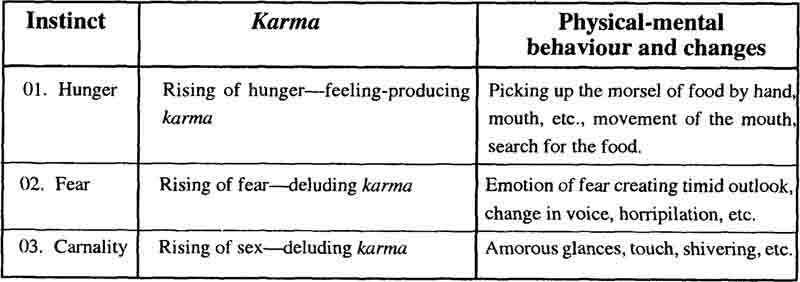
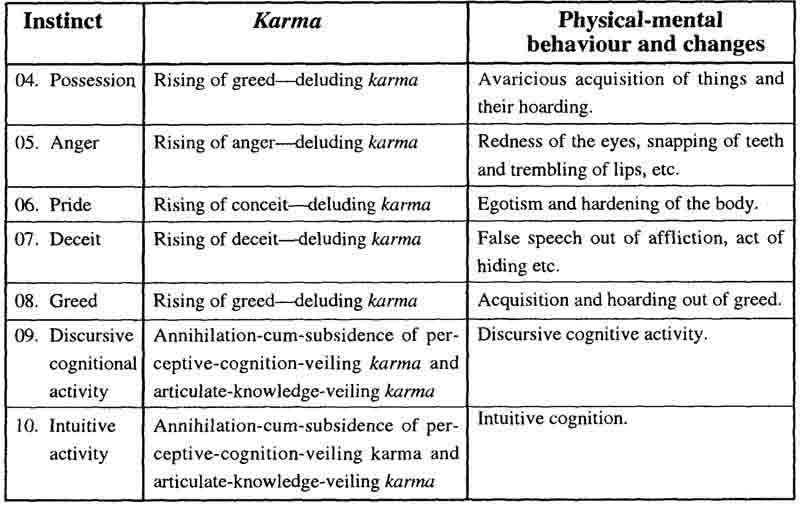
The Vrtti mentions another opinion, according to which ogha means commonplace activity and loka means specific activity.5 Ogha samjna means the intuitive cognition and loka samjna means active knowledge. This needs scrutiny. Siddhasenagani explains ogha samjna as cognition without the sense-organs and mind.6
Such cognitive activity is available even in plants and subtle insects. They intuit the distant and future events by means of vibrations in the atmosphere. The instinct due to popular tradition and inheritance is called loka samjna. The Vrtti says that these instincts are clearly discernible in five-sensed beings. In the one- sensed beings, they are simply in the form of rise of karma.7 Modem scientists have studied these instincts in plants with the help of instruments, so it is now possible to find them in one-sensed beings.8
Neraiyanam dasavihavedana-padam
7.162 neraiya dasaviham veyanam paccanubhavamana viharamti, tam jaha—siyam, usinam, khuhcim, pivasam, kamdum, parajjham, jaram, daham, bhayam, sogam.
The Topic of the Ten Kinds of Feelings in the Infernals
The1 infernals experience ten kinds of feelings (pain), viz., cold, hot, hunger, thrust, itching, dependence on others, fever, heat, fear and grief.
Bhasya
1. Sutra 162
In the present SUtra, the physical and mental experiences of the infernals have been mentioned. All these experiences are painful. The infernals mostly experience them. It is only very rarely that they experience pleasure.1
Text
Hatthi-kumthUnam apaccakkhanakiriya-padam
7.163 se nUnam bhamte! hatthissa ya kumthussa ya sama ceva apacca-kkhanakiriya kajjai?
hamta
goyama! hatthissa ya kumthussa ya sama ceva apaccakkhanakiriya kajjai.
The Topic of the Act of Non-Renunciation of the Elephant and the Kunthu (a Subtle Insect)
Is the act of non-renunciation in the elephant and the kunthu (a subtle insect) the same, O Lord?
Yes, Gautama! the act of non-renunciation in the elephant and the kunthu (a subtle insect) is the same.
7.164 se kenatthenam bhamte! evam vuccai—hatthissa ya kumthussa ya sama ceva apaccakkhanakiriya kajjai ?
goyama! aviratim paducca. se tenatthenam goyama! evam vuccai—hatthissa ya kumthussa ya sama ceva apaccakkhanakiriya kajjai.
For what reason, O Lord! had it been said that the act of non-renunciation in the elephant and the kunthu (a subtle insect) is the same?
Gautama! it is so with respect to non-abstinence. For this reason, O Gautama! had been said that the act of non-renunciation in the elephant and the subtle insects is the same.
Ahakammadi-padam
7.165 ahakammam nam bhamte! bhumjamane kim bamdhai? kim pakarei? kim cinai? kim uvacinai?
goyama! ahakammam nam bhumjamane auyavajjao satta kammappagadio sidhilabamdhanabaddhao dhaniyabamdhanabaddhano pakarei java sasae pamdie, pamdiyattam asasayam.
The Topic of the Food, prepared for the Monk etc.
What1 does an ascetic, O Lord! bind, do, accumulate, heap-up while eating food, prepared for himself?
Gautama! by eating the food, prepared for himself, the ascetic tightens loosely bound seven types of karma, excluding the life-span-determing karma (out of eight types) up to the self-restrained soul is eternal and the self-restraint is non-eternal.
Bhasya
1. Sutra 165
See Bhasya on Bha. 1.436-440.
Text
7.166 sevam bhamte! sevam bhamte! tti.
That is so, O Lord! That is so, O Lord!
1. Bha. 2.139, 137.
1. Pravacanasara, ga. 67—
timirahara jai ditthi, janassa divena natthi kadavvam I
tacca sokkham sayamada, visaya kim tatha kuvvamti?
1. Nandi, 61.
2. Studies in Jain Philosophy by N. Tatia, p. 50—“The samjni sruta is considered in three ways, inasmuch as there are these three varieties of samjna (cogintional activity); (1) discursive thinking that takes into account the past, the present and the future, (2) consciousness that can discriminate between what is to be avoided and what is to be accepted for the maintenance of life, but cannot think of the past or the future, and (3) consciousness due to knowledge of the right scriptures (samyak sruta). The first is called (dirgha)-kalikt (lasting for a long time), the second hetupades'iki (discriminating) and the third drstivadopadesikt(backed by scriptural knowledge). Those who possess these samjnas are called samjnins. The sruta-jnana possessed by these samjnins is samjni-sruta. The asamjnins also fall in three categories. The mind is the organ of thinking. The more developed the mind is, the more one is capable of thinking. Those whose mind is weak and incapable of thinking fall in the first category of asamjnins. Those who are totally devoid of mind and live on mere instincts fall in the second caicgory of asamjnins. Again those who believe in false scriptures and thus possess perverted knowledge fall in the third category oi asamjmns. Sruta-jnana possessed by the asamjnins is asamjni-sruta.”
3. Bha. Vr. 6.161—tatra samjfianam samjfia—abhoga ityarthah manovijfianamityanye samjfiayate va’nayeti samjfia vedamymohamyodayasraya jfianadarsanavaranaksayopasamasraya ca vicitra- haradipraptaye kriyaivetyarthah.
4. Ibid., 6.161.
5. Ibid., 7.161.
6. Ta. Su. Bha. Vr. 1.14, p. 78—oghah—samanyah apravibhakrarOpam yatra na sparsanadlmndriyani tani manonimittimasnyante, kevalam matyavaramyaksayopasama eva tasya jfianasyotpattau nimittam, yatha vallayadmam nlvradyabhisarpanajfianam na sparsananimittam na manonimittamiti, tasmat tatra matyajfianavarana-ksayopasama eva kevalo nimittlkriyate oghajfianasya.
7. Bha. Vr. 7.161.
8. See Bhasya on Bha. on 7.150-154.
1. See the Bhasya on Bha. 6.185.
♦
Ninth Section
Navamo Uddeso
Section-9
Text
Asamvuda-anagarassa viuvvana-padam
7.167 asamvude nam bhamte! anagare bahirae poggale apariyaitta pabhu egavannam egaruvam viuvvittae?
no inatthe samatthe.
The Topic of the Exercise of Protean Power by Non-self-inhibited Ascetic
Is1 a non-self-inhibited ascetic, O Lord! capable of creating a material body of a particular colour and form, by exercising his protean power, without appropriating the external material clusters?
Gautama! that is not possible.
7.168 asamvude nam bhamte! anagare bahirae poggale pariyaitta pabhu egavannam egaruvam viuvvittae?
hamta pabhu.
Is a non-self-inhibited ascetic, O Lord! capable of creating a material body of a particular colour and form, by exercising his protean power, appropriating the external material clusters?
Yes, he is capable.
7.169 se nam bhamte! kim ihagae poggale pariyaitta vikuvvai? tatthagae poggale pariyaitta vikuvvai? annatthagae poggale pariyaitta vikuvvai?
goyama! ihagae poggale pariyaitta vikuvvai, no tatthagae poggale pariyaitta vikuvvai, no annatthagae poggale pariyaitta vikuvvai.
evam 2. egavannam anegaruvam 3. anegavannam egaruvam 4. anegavannam caubhamgo.
Does he, O Lord! create the material body of a particular colour and form, by exercising his protean power, appropriating the external material clusters, available in this world (human world)? Or does he create the material body of a particular colour and form, by exercising his protean power, appropriating the external material clusters, available in the other place, that is, the place where he would go after creating the protean form? Or does he create the material body of a particular colour and form, by exercising his protean power, appropriating the external material clusters, available in any other place other than this or that?
Gautama! he exercises his protean power, appropriating the material clusters, available in this world (human world); he does not exercise his protean power, appropriating the material clusters, available in the other place, that is, the place where he would go after creating the protean form; nor does he exercise his protean power, appropriating the material clusters, available in any other place other than this or that.
7.170 asamvude nam bhamte! anagare bahirae poggale apariyaitta pabhu kalagam poggalam nilagapoggalattae parinamettae? nilagam poggalam va kalagapoggalattae parinamettae ?
goyama! no inatthe samatthe. pariyaitta pabhū java
Can a non-self-inhibited ascetic, O Lord! convert black material cluster into blue material cluster, or convert blue material cluster into black material cluster, without appropriating external material clusters?
Gautama! this is not possible. He is capable to do so only by appropriating the external material clusters.
7.171 asamvude nam bhamte! anagare bahirae poggale apariyaitta pabhu niddhapoggalam lukkhapoggalattae parinametae? lukkhapoggalam va niddhapoggalattae parinamettae ?
goyama! no inatthe samatthe. pariyaitta pabhu.
Can a non-self-inhibited ascetic, O Lord! convert viscous material cluster into dry material cluster or convert dry material cluster into viscous material cluster, without appropriating external material clusters?
Gautama! this is not possible. He is capable to do so only by appropriating the external material clusters.
7.172 se nam bhamte! kim ihagae poggale pariyaitta parinameti ? tatthagae poggale pariyaitta parinameti? annatthagae poggale pariyaitta parinameti?
goyama! ihagae poggale pariyaitta parinameti, no tatthagae poggale pariyaitta parinameti, no annatthagae poggale pariyaitta parinameti.
Does he, O Lord! convert them by appropriating the external material clusters of this world (human world)? Or does he convert them by appropriating the material clusters available in other place, that is, where he would go after conversion? Or does he convert them by appropriating the material clusters available in any other place other than this or that? Gautama! he converts them by appropriating material clusters of this world; he does not convert them by appropriating the material clusters available in other place, that is, where he would go after conversion; nor does he convert them by appropriating the material clusters available in any other place other than this or that.
Bhasya
1. Sutras 167-172
See Bhasya on Bha. 6.163 to 167.
Mahasilakamtayasamgama-padam
7.173 nayameyam arahaya, suyameyam araha,ya vinnayameyam arahaya— mahasilakcimtaye samgame. malmsilakamtae nam bhamte! samgame vattamane ke jaittha? keparajaittha?
goyama! vajji, videhaputte jaittha, nava mallai, nava lecchai—kasi-kosalaga attharasa vi ganarayano parajaittha.
The Topic of the Mahasilakantaka Battle
The Mahasilakantaka battle1 is known to the Adorable One, has been heard of by the Adorable One, has been perfectly known by the Adorable One. Who was, O Lord! the victor in the battle and who was the vanquished? Gautama! Vajri (Indra) and Videhaputra (Kunika) were the victors; the nine Mallas, the nine Licchavis—the eighteen republican rulers of Kasi and Kausala were the vanquisheds.
Bhasya
1. Sutra 173
The description of the battle between Cetaka and Konika (Kunika) is available in two canonical texts, the Bhagavati1 and the Nirayavaliyao.2 In the Bhagavati, the background of the battle is not described, only the two battles, namely the Mahasilakantaka and Rathamusala have been described. In the Nirayavaliyao, there is a detailed description of the background of the battle. There is, however, no mention of the Mahasilakantaka battle there.
In the Buddhist literature, the description of the battle between Ajatasatru Videhiputra, the Sovereign of Magadha, and the Vajji Republican is found, but there is no mention of the name Cetaka.3 Ajatasatru is identified as Kunika in the Jain literature.
It is surprising that there is no mention of these battles in the Vedic literature; there is no mention of these battles even in any secular literature. It is also worth investigation—how there was assemblage of such great army in Magadha and Vaisali. In the Mahasilakantaka battle, eighty-four lakh and in the Rathamusala battle ninety-six lakh people, that is, totally, one hundred eighty lakh people died. From the view-point of the small areas of those lands, and the population in those days, the number is surprising. May be the calculation was made by any other system of counting prevalent in those days.
The summary of the descriptions of the battles may be made thus:
1. The imperialistic attitude of the Konika was responsible for the battle.
2. The protection of the fugitives was given priority.
3. The special rules were observed even in the battle.
4. Refutation of the doctrine embodied in the following verse—
jite ca labhyate laksmih mrte capi surangana.
ksanabhahgurako dehah ka cinta marane rane?
“In victory, one gains fortune; in death, one gains heavenly damsel. The body is fragile and momentary, why should one, then, worry about death in the battle?”
Text
7.174 tae nam se konie raya mahasilakamtagam samgamam uvatthiyam janitta kodumbiyapurise saddavei, saddavetta evam vayasi—khippameva bho devanuppiya! udaim hatthirayam padikappeha, haya-gaya-raha-pava- rajohakaliyam cauramginim se nam sannaheha, sanndhetta mama eyamanattiyam khippameva paccappinaha.
Having known that the Mahasilakantaka battle was imminent, King Konika called the heads of the families; having called them, he addressed them thus; “O beloved of gods! prepare at once the elephant-king, named Udayi; mobilise the fourfold army consisting of the cavalry, elephants, chariots and infantry; having prepared them, report back quickly the implementation of my order.”
7.175 tae nam te kodumbiyapurisa konienam ranna evam vutta samana hanhatuttha- cittamanamdiya java matthae amjalim kattu evam sami. tahatti ānāe vinaenam vayanam padisunamti, padisunitta khippameva cheyayariyovaesa-mati-kappana- -vikappehim suniunehim ujjalanevattha-havva-parivacchiyam susajjam java bhimam samgamiyam aojjham udaim hatthirayam padikappemti, haya-gaya- -raha-pavarajohakaliyam cauram-ginim senam sannahemti, sannahetta jeneva kunie raya teneva uvagacchamti, uvagacchitta karayalapariggahiyam dasanaham sirasavattam matthae amjailm kattukuniyassa ranno tamanattiyam paccappi- namti.
Then the family-heads, thus commanded by King Konika, were delighted, pleased and happy in mind, touch their heads with folded hands and replied modestly; having thus replied, they quickly prepared well-decorated up to mighty, battle-ready, unassailable elephant-king Udayi, covering it with bright dress made by expert people strictly according to the cleverness due to the instruction of expert teachers. Then they gathered together the fourfold army consisting of cavalry, elephants, chariots and infantry; having assembled together, they went to the place of King Konika; having gone there they rotated their folded palms displaying the ten nails in front of their face and reported the implementation of his order to King Konika.
1. Sutra 175
Semantics .
cheyayariya—cheka—expert, acarya— preceptor, the instructor of handicraft.
ujjala-nevattha-havva-parivacchiyam—bright dress1 quickly prepared. In Nayadhammakahao,2 the reading parivatthiya is available. The Ovaiyam3 also gives the same reading. Accordingly, the phrase should mean—having put on bright dress. Instead of 'havva', we get ‘vattha' also.4
Text
7.176 tae nam se kunie raya jeneva majjanagharam teneva uvagacchati, uvagacchitta majjanagharam anuppavisai, anuppavisitta nhae kayabali-kamme kayakouya-mamgalapayacchite savvalamkaravibhusie sannaddha-baddha- vammiyakavae uppiliyasarasanapattie pinaddhagevejja-vimalavarabaddha- cimdhapatte gahiyauhappaharane sakoremtamalladamenam chattenam dharijjamanenam caucamarabalavijiyamge mamgalajayasaddakayaloe java jeneva udai hatthiraya teneva uvagacchai, uvagacchitta udaim hatthirayam durudhe.
Then, that King Kunika retired to the bathroom; having retired, he entered the bathroom; having entered, he bathed himself; then he offered oblations, put sandal marks on the forehead, offered auspicious articles (like yogurt, rice), and made atonement,1 adorned himself with all kinds of ornaments, put on steel armour,2 tightly put on leather band on his wrist,3 put protective armour on his neck,4 affixed the shining emblem of a warrior, and equipped himself with manual weapons and missiles,5 held over his head an umbrella adorned with the garlands of the flowers of sakoranta tree (barleria prionitis), with two camaras held on each of the two sides. At the first sight of him, people made the benedictory exclamation uttering ‘victory to thee! victory to thee!’ up to he arrived near the elephant-king Udayi; having arrived there, he climbed on the elephant-king.
Bhasya
1. He offered oblations atonement.
kayabalikamme kayakouya-mangala-payacchitte—see Bhasya on Bha. 2.96.
sannaddha-baddha-vammiyakavae—sannaha and varma are synonymous words standing for armour. For a warrior protected by armour, the terms sannaddha, baddha and varmita have been used.
3. Put on leather band on his wrist
uppiliyasarasariapattie—here, utpidita means tightly bound. Sarasanapattika means the leather band bound on the wrist for protection against the hit of the string of the bow.
4. Put protective armour on his neck
pinaddhagevejja—the Vrtti explains graiveyaka as the ornament of the neck.1 But it needs scrutiny.
savvalankaravibhusie—adorned himself with all kinds of ornaments; here, adorning with ornament is implied. This is followed by the description of being equipped with an armour for the war. Binding a neck armour and affixing the emblem of warrior all read together. Therefore, the appropriate meaning of graiveyaka is an armour for the protection of the neck. As there are separate armours for the protection of the head, the bowels, the feet, the arms and the body, so for the protection of the neck there is an armour called graiveyaka.
5. Equipped himself with manual weapons and missiles
vimalavarabaddhacimdhapatte gahiyauhappaharne—cihnapatta (cimdhapatta) is the emblem that identified the warrior. In grhitayudhapraharana (gahiyauhappa- harane), gahiya means taken up or equipped with, ayudha means sword etc. that are manually operated, praharana means arrows, missiles, etc..
Text
7.177 tae nam se kunie raya harotthaya-sukaya-raiyavacche java seyavara- camarahim uddhuvvamanihim-uddhuvvamanihim haya-gaya-raha-pavara- johakaliyae cauramginie senae saddhim samparivude mahayabhadacada- garabimdaparikkhitte jeneva mahasilakamtae samgame teneva uvagacchai uvagacchitta mahasilakamtagam samgamam oyae. purao ya se sakke devimde devaraya egam maham abhejjakavayam vairapadiruvagam viuvvitta nam citthai. evam khalu do imda samgamam samgamemti, tarn jahā devimde ya, manuimde ya. egahatthina vi nam pabhū kunie raya jaittae, egahatthina vi nam pabhukunie raya parajinittae.
The breast of Kunika was adorned by a spread out1 garland up to white excellent camaras were being fanned on both sides, surrounded by cavalry, elephants, chariots and mighty warriors—the fourfold army, surrounded by multitude of veteran soldiers, he arrived at the Mahasildkantaka battlefield. He engaged himself in the Mahasilakatitaka battle. In front of him, Sakra, the Chief and King of gods, stood up, creating by his protean power, a great invincible armour2—a replica of the vajra (thunderbolt).2 Thus, indeed, two Indras (Chiefs) were fighting in the battle-field, viz., the Indra of gods and the Indra of human beings. Only by a single hatthi,3 King Kunika was capable enough to winning the war, only by a single hatthi, King Kunika was capable enough to defeating the enemy.
Bhasya
1. Sutra 177
Semantics
1. Spread out
The word ‘upastrta’ (utthaya) means ‘spread out’. (Thus, the breast was covered by the garland which was spread out on his breast).
2. Like a vajra (thunderbolt)
vairapadiriivagam—here vaira means vajra (thunderbolt) and padirdvaga means like.
3. By a single hatthi
egahatthina—the Vrtti explains hasti as elephant.1 But this needs scrutiny in the context of the Mahasilakantaka battle. Even a grain of sand hurled in the Mahasilakaintaka battle hit the target like a big boulder. So here hasti should mean ‘hastika’ which is the name of an implement or a weapon, which was used for hurling stones.2
Text
7.178 tae nam se kdnie raya mahasilakamtagam samgamam samgamemane nova mallai, nava lecchaikasi-kosalaga attharasa vi ganarayano haya- -mahiya- pavaravlra-ghaiya-vivadiyacimdhaddhayapadage kicchapanagae disodisim padisehittha.
Then, that King Kunika, while fighting the Mahasilakantaka battle, pushed back the nine Mallavis and nine Licchavis—all the eighteen republican kings of Kasi and Kausala—in the reverse directions, by wounding and churning them, by killing their chief warriors and by dismentling their emblems, flags and banners and putting their life in danger of annihilation.
7.179 se kenatthenam bhamte! evam vuccai—mahasilakamtae samgame ?
goyama! mahasilakamtae nam samgame vattamane je tattha ase va hatthi va johe va sarahi va tanena va katthena va pattena va sakkarae va abhi-hammati, savve se janei mahasilae aham abhihae. se tenatthenam
goyama! evam vuccai—mahasilakamtae samgame.
For what reason, O Lord! was that battle designated Mahasilakantaka battle?
Gautama! in the Mahasilakantaka battle, being fought, all the horses, elephants, warriors and charioteers, when hit even by a straw, a piece of wood, leaf or a pebble, had the feeling that they were struck by large boulders. For this reason, O Gautama! the battle was designated as Mahasilakantaka battle.
7.180 mahdsildkamtae nam bhamte! samgame vattamane kati janasaya-sahassio vahiyao?
goyama! caurasiim janasayasahassio vahiyao.
How many hundred thousand people were killed, O Lord! in the Mahasilakantaka battle?
Gautama! eighty-four hundred thousand people were killed.
7.181 te nam bhamte! manuya nissila nigguna nimmera nippaccakkhanapo- sahovavasa ruttha parikuviya samaravahiya anuvasamta kalamase kalam kicca kahim gaya? kahim uvavanna?
goyama! ussannam naraga-tirikkhajoniesu uvavanna.
People, killed in that battle, O Lord! were devoid of śīla (great vows and small vows), devoid of virtue, devoid of mores, devoid of renunciations, and not observing any kind of pausadhopavasa (fasting with undertaking daylong abstinence from sinful activity). While dying, they were full of rage and wrath, and devoid of tranquillity. Where did they go after death and take birth?
Gautama! they mostly were born in infernal and subhuman realms.
Bhasya
1. Sutra 181
Semantics
ussanna—mostly. It is a deśī word. See Bhasya on Bha. 7/190.
Text
Rahamusalasamgama-padam
7.182 nayameyam arahaya, suyameyam arahaya, vinnayameyam arahaya— rahamusale samgame. rahamusale nam bhamte! samgame vattamane ke jaittha? ke parajaittha?
goyama! vajji, videhaputte, camare asurimde asurakumararaya jaittha; nava mallai, nava lecchai parajaittha.
The Topic of the Rathamusala Battle
The Rathamusala battle has been known to the Adorable One, has been heard by the Adorable One and has been perfectly known by the Adorable One. Who was, O Lord! the victor in the battle and who was the vanquished?
Gautama! Vajji (Indra), Videhaputta (King Konika) and Camara, the Chief and the King of Asurakumaras were the victors, and the nine Mallavis and the nine Lichhavis were the vanquisheds.
7.183 tae nam se kUnie raya rahamusalam samgamam uvatthiyam janitta kodum- biyapurise saddavei, saddavetta evam vayasi—khippameva bho devanuppiya! bhUyanamdam hatthirayam padikappeha, haya-gaya-raha-pavarajohakaliyam cauramginim senam sannaheha, sannahetta mama eyamanattiyam khippameva paccappinaha.
Having known that the Rathamusala battle was imminent, King Konika called the heads of the families; having called them, he addressed them thus; “O beloved of gods! prepare at once the elephant-king, named, Bhutananda, mobilise the fourfold army consisting of the cavalry, elephants, chariots and infantry; having prepared them, report back quickly the implementation of my order.”
7.184 tae nam te kodumbiyapurisa konienam ranna evam vutta samana hattha- tutthacittamanamdiya java matthae amjalim kattu evam saim! tahatti āņăē vinaenam yayanampadisunamti, padisunitta khippameva cheyayariyovaesa-mati- -kappana-vikappehim suniunehim ujjalanevattha-havvapari-vacchiyam susajjam java bhimam samgamiyam aojjham bhUyanamdam hatthirayam padikappemti, haya-gaya-raha-pavarajohakaliyam cauramginim senam sannahemti, sannahetta jeneva kUnie raya teneva uvagacchamti, uvagacchitta karayalapariggahiyam dasanaham sirasavattam matthae amjalim kattu kUniyassa ranno tamanattiyam paccappinamti.
Then, the family-heads, thus commanded by King Konika, were delighted, pleased and happy in mind, touched their heads with folded hands and replied modestly; having thus replied, they quickly prepared well decorated, mighty, battle-ready, unassailable elephant-king Bhutananda, covering it with bright dress made by expert people, strictly according to the cleverness due to the instruction of expert teachers. Then, they gathered together the fourfold army consisting of cavalry, elephants, chariots and infantry; having assembled together, they went to the place of King Konika; having gone there they rotated their folded palms displaying the ten nails in front of their face and reported the implementation of his order to King Konika.
7.185 tae nam se kUnie raya jeneva majjanagharam teneva uvagacchati, uvagacchitta majjanagharam anuppavisai, anuppavisitta nhae kayabalikamme kayakouya-mamgala-payacchitte savvalamkaravibhUsie sannaddha-vaddha- -vammiyakavae uppiliyasarasana-paUie pinaddhagevejja-vimalavarabaddha- cimdhapaUe gahiyauhappaharane sakoremta-malladamenam chattenam dharijjamanenam caucamarabalavijiyamge, mamgalajayasaddakayaloe java jeneva bhUyanamde hatthiraya teneva uvagacchai, uvagacchitta bhUyanamdam hatthirayam durUdhe.
Then, that King Konika retired to the bathroom; having retired, he entered the bathroom; having entered, he bathed himself; then he offered oblations, put sandal marks on the forehead, offered auspicious articles (like yogurt, rice), and made atonement, adorned himself with all kinds of ornaments, put on steel armour, tightly put on leather band on his wrist, put protective armour on his neck, affixed the shining emblem of a warrior, and equipped himself with manual weapons and missiles, held over his head an umbrella adorned with the garlands of the flowers of sakoranta tree (barleria prionitis) with two camaras held on each of the two sides. At the first sight of him people made the benedictory exclamation, uttering ‘victory to thee! victory to thee!' up to he arrived near the elephant-king Bhutananda; having arrived there, he climbed on the elephant-king.
7.186 tae nam se kunie raya harotthaya-sukaya-raiyavacche java seya- varacamarahi uddhuvvamamhim-uddhuvvamamhim haya-gaya-raha-pava- rajohakaliyae cauramginie senae saddhim samparivude mahayabhadacada- garavimdaparikkhitte jeneva rahamusale samgame teneva uvagacchai, uvagacchitta rahamusalam samgamam oyae. purao ya se sakke devimde devaraya egam maham abhejjakavayam vairapadiruvagam viuvvitta nam ciuhai. maggao ya se camare asurimde asurakumararaya egam maham ayasam kidhinapadi- ruvagam viuvvitta nam citthai. evam khalu tao imda samgamam samgamemti, tam jaha—devimde ya, manuimde ya, asurimde ya. egahatthma vi nam pabhu kunie raya jaittae, egahatthina vi nam pabhu kunie raya parajinittae.
The breast of Konika was adorned by a spread out garland up to white excellent camaras were being fanned on both sides; surrounded by cavalry, elephants, chariots and mighty warriors—the fourfold army and surrounded by multitude of veteran soldiers, he arrived at the Rathamusala battlefield. He engaged himself in the Rathamusala battle. In front of him Sakra the Chief and King of gods stood up. Creating by his protean power a great invincible armour, the replica of vajra (thunderbolt). Behind him was standing Camara, the Chief and the King of Asurakumaras, creating by his protean power, a great iron vessel similar to the bamboo basket of a hermit. Thus, indeed, three Indras (Chiefs) were fighting in the battlefield, viz., the Indra of gods, the Indra of human beings and the Indra of Asurakumaras. Only by a single hatthi, King Konika was capable enough to winning the war, only by a single hatthi, King Konika was capable enough to defeating the enemy.
Bhasya
1. Sutra 186
Semantics
maggao—it is a deśī word, which means behind the back. In Marathi, mage means behind.
kidhinapadiruvaga—kidhina means a basket made of bamboo, which is used by hermits. Kidhina is a desi word. Padiruvaga means of that shape.1
egahatthina—a note has already been given on the word hastika in our Bhasya.2
Text
7.187 tae nam se kunie raya rahamusalam samgamam samgamemane nava mallai, nava lecchai—kasi-kosalaga attharasa vi ganarayano haya-mahiya-pavaravira- ghaiya-vivadiyacirndhaddhaya-padage kicchapanagae diso-disim padisehittha.
Then, that King Konika, while fighting in the Rathamusala battle pushed back the nine Mallavis and nine Licchavis—all the eighteen republican Kings of Kasi and Kausala—in the reverse directions, by wounding and churning them, by killing their chief warriors, and by dismantling their emblems, flags, banners and putting their life in danger of annihilation.
7.188 se kenatthenam bhamte! evam vuccai—rahamusale samgame?
goyama! rahamusale nam samgame vattamdne ege rahe anasae, asarahie, anarohae, samusale mahaya janakkhayam, janavaham, janappamaddam, janasamvattakappam ruhirakaddamam karemane savvo samamta paridhavittha. se tenattenam
goyama! evam vuccai—rahamusale samgame.
For what reason, O Lord! was that battle designated Rathamusala battle? Gautama! when the Rathamusala battle was going on, a chariot that had no horses, no charioteers, no warriors sitted in it. There was only one mace in it. The chariot was destroying, killing and crushing the warriors. It was like a universal dissolution. By, running from place to place on all sides, it was turning the battlefield into the mud of blood. For this reason, O Gautama! the battle was designated as Rathamusala battle (literally a mace lodged in a chariot).
Bhasya
1. Sutra 188
In the present Sutra, there is mention of a self-driven chariot and a self-activated mace. Both these were made by Camara, the Chief of Asurakumaras. The chariot was self-driven, which was without horse, without charioteers, without warriors. Similarly the mace was self-activated which wrought havoc in the enemy by destroying, killing and crushing it. This machine may be compared with modern self-driven weapons and missiles.
Semantics
samvatta—universal dissolution.
7.189 rahamusale nam bhamte! samgāme vattamāne kati janasayasāhassīo vahiyāo ? goyamā! channautim janasayasahassio vahiyao.
How many hundred thousand people were killed, O Lord! in the Rathamusala battle?
Gautama! ninety-six hundred thousand people were killed.
7.190 se nam bhamte! manuya nissila nigguna nimmera nippaccakkhana-posahovavasa ruttha parikuviya samaravahiya anuvasamta kalamase kalam kiccha kahim gaya? kahim uvavanna?
goyama! tattha nam dasasahasslo egae macchiyae kucchimsi uvavannao. ege devalogesu uvavanne. ege sukule paccayae. avasesa ussannam naraga-tirikkhajoniesu uvavanna.
People, killed in that battle, O Lord! were devoid of śila (great vows and small vows), devoid of virtue, devoid of mores, devoid of renunciations, and not observing any kind of pausadhopavasa (fasting with undertaking daylong abstinence from sinful activity). While dying, they were full of rage and wrath, and devoid of tranquillity. Where did they go after death and take re-birth?
Gautama! among them 10,000 men were reborn in the womb of a fish. One among them was born in heaven and one was reborn in pious and prosperous family. The rest of them all1 were born in infernal and subhuman realms.
Bhasya
1. Remaining all (ussanam).
The word ussanam means ‘mostly’, but here avasesa ussanam stands for ‘all the rest’. See Bhasya on Bha. 7.181.
Text
7.191 kamha nam bhamte! sakke devimde devaraya, camare ya asurimde asurakumararaya kuniyassa ranno sahejjam dalaittha?
goyama! sakke devimde devaraya puvvasamgatie, camare asurimde asura-kumararaya pariyayasamgatie. evam khalu
goyama! sakke devimde devaraya, camare ya asurimde asurakumararaya kuniyassa ranno sahejjam dalaittha.
Why did, O Lord! Sakra, the Chief and the King of gods, and Camara, the Chief and the King of Asurakumaras, offer support to King Konika? Gautama! Sakra, the Chief and the King of gods, was the friend1 of King Konika in a former life and Camara, the Chief and the King of Asura-kumaras, was a co-initiate in a former life.2 It is for this reason, O Gautama! Sakra, the Chief and the King of gods, and Camara, the Chief and the King of Asurakumaras, offered support to King Konika.
1. Friend in Former Life (puvvasamgatie)
In his previous life, King Konika as Kartika, a head of mercantile, was a friend of Sakra; so the Sakra has been described as purvasamgatika.1 Vide Bha. 18.40-53.
2. Co-initiate in Former Life (pariyayasamgatie)
In the life-time of Purana Tapasa, (see Bha. 3.101-107), Konika was a hermit, a friend of Purana Tapasa; so Camara has been called paryayasamgatika.
Text
Varuna-naganattuya-padam
7.192 bahujane nam bhamte! annamannassa evamaikkhai java—evam khalu bahave manussa annayaresu uccavaesu samgamesu abhimuha ceva pahaya samana kalamase kalam kicca annayaresu devaloesu devattae uvavattaro bhavamti.
The Topic of the Varuna, the Maternal Grandson of Naga
People, indeed, O Lord! speak up to (1.420) propound to one another—“Indeed many people, killed in any battlefields, major or minor, facing in front (fearlessly), dying there, are born in any of the heaven as celestial beings.”
7.193 se kahameyam bhamte! evam?
goyama! jannam se bahujane annamannassa evamaikkhai java paruvei— evam khalu bahave manussa annayaresu uccavaesu samgamesu abhimuha ceva pahaya samana kalamase kalam kicca annayaresu devaloesu devattae uvavattaro bhavamti, je te evamahamsu miccham te evamahamsu. aham puna goyama! evamaikkhami java paruvemi—evam khalu goyama! tenam kalenam tenam samaenam vesali namam nagari hottha—vannao. tattha nam vesalie nagarie varune namam naganattue parivasai—addhe java apari-bhue, samanovasae, abhigayajivajive java samane niggamthe phasu-esani-jjenam asana-pana--khaima-saimenam vattha-padiggaha-kambala-payapumchanenam pidha-phalaga-sejja-samttharaenam osahabhesajjenam padilabhemane chattham-chatthenam anikhittenam tavokammenam appanam bhavemane viharati.
Is it so, O Lord?
Gautama! those people who speak up to (1.420) propound to one another—“Indeed many people, killed in any battlefields, major or minor, facing in front (fearlessly), dying there, are born in any of the heaven as celestial beings,” speak falsehood. I, however, O Gautama! speak thus up to propound thus—In that age, at that time, there was indeed, O Gautama! a city, called Vaisali—description. In that city of Vaisali, there lived the maternal grandson of Naga, Varuna by name. He was rich up to he was never daunted by any people (2.94). He was a lay follower of the ascetic order; he had knowledge of the principles of soul and non-soul up to (2.94) he offered dana to the sramana nirgranthas (Jain ascetics) such as food, drink, dainties, delicacies, clothes, vessels, blankets, dusters, cushions, planks, beds, mats, herbs, medicines etc.. He lived, sublimating (or sanctifying) the self by means of performing sixth-meal austerity (i.e., fasting for two days together) continuously.
7.194 tae nam se varune naganattue annaya kayai rayabhiogenam, ganabhiogenam, balabhiogenam rahamusale samgame anatte samane chatthabhattie atthamabhattam anuvatteti, anuvattetta kodumbiyapurise saddavei, saddavetta evam vayasi—khippameva bho devanuppiya! caugghamtam asaraham juttameva uvatthaveha, haya-gaya-raha-pavarajohakaliyam cauramginim, senam sannaheha, sannahetta mama eyamanattiyam paccappinaha.
When there arose the occasion of battle, then, on the basis of rajabhiyoga, ganabhiyoga and balabhiyoga (the orders of the King, republic government and army-chief), Varuna, the maternal grandson of Naga, was ordered to proceed to the Rathamusala battlefield. On that occasion, he was performing sixth-meal austerity (i.e., fasting for two days together). He extended it to eighth-meal austerity (i.e., fasting for three days together). Having done so, he called the heads of his family; having called, he addressed them thus: O beloved of gods! prepare my horse-drawn chariot with four bells and make ready my fourfold army consisting of cavalry, elephant, chariots and veteran infantry. Having done so, report the implementation of my order.
7.195 tae nam te kodumviyapurisa java padisunetta khippameva sacchattam sajjhayam java caugghamtam asaraham juttameva uvatthavemti, haya-gaya--raha-pavarajohakaliyam cauramginim senam sannahemti, sannahetta jeneva varune naganattue teneva uvagacchamti uvagacchitta java tamanattiyam paccappinamti.
Then, those family-heads carried out his order and quickly made ready the horse-drawn chariot with umbrella and flag and four bells, by harnessing the horses. They also made ready the fourfold army consisting of cavalry, elephants, chariots and veteran infantry; having done so, they reappeared to Varuna, the maternal grandson of Naga; having reached there, they reported implementation of his order.
7.196 tae nam se varune naganattue jeneva majjanaghare teneva uvagacchati, uvagacchitta rnajjanagharam anuppavisai, anuppavisitta nhae kayabalikamme kayakouya-mamgala-payacchitte savvalamkaravibhusie sannaddha-baddha--vammiyakavae sakoremtamalladamenam chattenam dharijjamanenam, anegagananayaga-damdanayaga-raisara-talavara-madambiya-kodumbiya--ibbha-setthi-senavai-satthavaha-duya-samdhipalasaddhim samparivude majjanagharao padinikkhamati, padinikkhamitta jeneva bahiriyd uvatthanasala, jeneva caugghamte asarahe teneva uvagacchai, uvagacchitta caugghamtam asaraham duruhai, duruhitta haya-gaya-raha--pavarajohakaliyae cauramginie senae saddhim samparivude, mahayabhadacadagaravimdaparikkhitte jeneva rahamusale samgame teneva uvagacchai, uvagacchitta rahamusalam samgamam oyae.
Then, Varuna, the materal grandson of Naga, retired to the bathroom; having retired, he entered the bathroom; having entered, he bathed himself; then he offered oblations; put sandal mark on the forehead; offered auspicious articles (like yogurt, rice), and made atonement, adorned himself with all kinds of ornaments, put on steel armour, held over his head an umbrella adorned with the garlands of the flowers of sakoranta tree (basleria prionitis), with two camaras held on each of the two sides. Sorrounded by many republic heads, heads of the police, kings, princes, vassals, lieutenants, servants, richmen, heads of guilds, generals, trade leaders, ambassadors and protectors of the frontier, he came out of the bathroom; having come out, he reached the site of the external council hall and the place where the horse-driven chariot with four bells was kept; having reached there, he rode the horse--driven chariot with four bells; having done so, with his fourfold army consisting of cavalry, elephants, chariots and veteren soldiers, surrounded by multitude of veteran soldiers, he arrived at the Rathamusala battlefield; having reached there, he engaged himself in the battle.
7.197 tae nam se varune naganattue rahamusalam samgamam oyae samane ayameyaruvam abhiggaham abhigenhai—kappati me rahamusalam samgamam samgamemanassa je puvvim pahanai se padihanittae, avasese no kappatiti; ayameyaruvam abhiggaham abhigenhai, abhigenhetta rahamusalam samgamam samgameti.
Then, as soon as, Varuna, the maternal grandson of Naga, reached the site of the Rathamusala battle, he made the resolve: “it will behove me, while fighting in the Rathamusala battlefield, to strike the enemy in defence, after he has attacked me; it will not behove me to attack any other person.” He makes such resolve; having made such resolve, he engaged himself in the Rathamusala battlefield.
7.198 tae nam tassa varunassa naganattuyassa rahamusalam samgamam samgamemanassa ege purise sarisae sarittae sarivvae sarisabhamdamattovagarane rahenam padiraham havvamagae.
Then, while thus engaged in the Rathamusala battlefield, Varuna, the maternal grandson of Naga, was confronted with a person who was alike him, alike in complexion, alike in age, equipped with similar weapons and chariot.
7.199 tae nam se purise varunam naganattuyam evam vadasi—pahana bho varuna! naganattuya! pahana bho varuna! naganattuya!
Then, that person addressed Varuna, the maternal grandson of Naga— “Strike me, O Varuna, the maternal grandson of Naga! Strike me, O Varuna, the maternal son of Naga!”
7.200 tae nam se varune naganattue tam purasm evam vadasi—no khalu me kappai devanuppiya! puvvim ahayassa pahanittae, tumam ceva nam puvvim pahanahi.
Then, Varuna, the maternal grandson of Naga, addressed that person thus: “It does not behove me, O beloved of gods! to strike until after I am hit. You should strike me first.”
7.201 tae nam se purise varunenam naganattuenam evam vutte samane asurutte rutthe kuvie camdikkie misimisemane dhanum paramusai, paramusitta usum paramusai, paramusitta tanam thati, thicca ayayakannayayam usum karei, karetta varunam naganattuyam gadhappahankarei.
Then that person, thus addressed by Varuna, the maternal grandson of Naga, becomes surcharged with emotion, angry, enraged and ferocious and quashes his teeth with anger. He then lifts his bow; having lifted it, he sets the arrow; having set the arrow, he takes position to strike by drawing with great effort the arrow as far as the ear; having done so, he hits very severely with his arrow Varuna, the maternal grandson of Naga.
7.202 tae nam se varune naganattue tenam purisenam gadhappaharikae samane asurutte rutthe kuvie camdikkie dhanum paramusai, paramusitta usum paramusai, paramusitta ayayakannayayam usum karei, karetta tam purisam egahaccam kudahaccam jiviyao vavarovei.
Then, Varuna, the maternal grandson of Naga, being thus severely hit by his opponent, becomes surcharged with emotion, angry, enraged and ferocious, and quashes his teeth with anger. He then lifts his bow; having lifted it, he sets the arrow; having set the arrow, he takes position to strike by drawing with great effort the arrow as far as the ear; having done so, he hits the opponent with the arrow that severed his body into two pieces and set his head rolling down like a rock, severed from the peak of a mountain, and deprived him of his life.
7.203 tae nam se varune naganattue tenam purisenam gadhappaharikae samane atthame abale avirie apurissakkaraparakkame adharanijjamiti kattu turae niginhai, niginhitta raham paravattei, paravatteta rahamusalao samgamao padinikkhamati, padinikkhamitta egamtamamtam avakkamai, avakkamitta turae niginhai, niginhitta raham thavei, thavetta rahao paccoruhai, paccoruhitta turae moei, moetta turae visajjei, visajjetta dabbha-samtharagam, samtharai, samtharitta dabbhasamtharagam duruhai, duruhitta puratthabhimuhe sampaliyamkanisanne karayala pariggahiyam dasanaham s irasavattam matthae amjailm kattu evam vayasi—namotthu nam arahamtanam bhagavamtanam java siddhigatinamadheyam thanam sampattanam, namotthu nam samanassa bhagavao mahavirassa adigarassa java siddhigatinamadheyam thanam sampaviukamassa mama dhamnmyariyassa dhammovadesagassa, vamdami nam bhagavamtam tatthagayam ihagae, pasau me se bhagavam tatthagae ihagayam ti kattu vamdai namamsai, vamditta namamsitta evam vayasi—puvvim pi nam mae samanassa bhagavao mahavirassa amtie thulae panaivae paccakkhae javajjivae, evam java thulae pariggahe paccakkhae javajjivae, iyanim pi nam aham tasseva bhagavao mahavirassa amtie savvam panaivayam paccakkhami javajjivae java micchadamsanasallam paccakkhami javajjivae. savvam asana- -pana-khaima-saimam—cauvviham pi aharam paccakkhami javajjivae. jam pi ya imam sariram ittham kamtam piyam java ma nam vaiya-pittiya-sembhiya- -sannivaiya viviha rogayamka pansahovasagga phusamtu tti kattu eyam pi nam carimehim usasa-msasehim vosirissami tti kattu sanncihapattam muyai, muitta salluddharanam karei, karetta aloiya-padikkamte samahipatte anupuvvie kalagae.
Then, Varuna, the maternal grandson of Naga, thus being severely hit by his opponent, became bereft of vitality, strength, energy, self-exertion and self-efficiency. Considering that ‘the body will no more last’, he pulled up the (reins of) the horses; having pulled, he turned round his chariot; having turned round, he made an exit from the Rathamusala battlefield. After making an exit, he returned to a solitary place; having returned there, he pulled up the horses; having pulled up, he stopped the chariot; having stopped, he climbed down the chariot; having climbed down, he deharnessed the horses; having deharnessed them, he set them free; having set them free, he spread the kusa-mat; having spread, he seated himself facing eastward in cross-legged posture, and rotating his folded palms and displaying his ten nails in front of his forehead, he thus addressed the Lords—“Obeisance to the Adorable Lords who have reached the place of the liberation called ‘siddhigati'.
“Obeisance to the Ascetic Lord Mahavira who is set on reaching the place of liberation called ‘siddhigati'.
“Seated here, I offer homage to the Lord, dwelling there; look at me, seated here;” having said so, he offered homage and obeisance; having offered homage and obeisance, he said thus, “Previously I renounced gross types of injury to living beings for whole life in the presence of the Ascetic Lord Mahavira up to I renounce gross types of possessions for the whole life (1.384). Now also, I renounce all types of injury to living beings for the whole life up to the thorn of deluded world-view, for the whole life in The presence of Ascetic Lord Mahavira. I give up for the whole life the four intakes of food, drink, dainties and delicacies. Let not this body of mine which is beloved, agreeable, dear (2.52) up to be touched by various diseases, chronic and acute, due to the disorder of wind, bile, phlegm and their mixture; so I abandon even this body up till the last point of respiration.” Having done so, he dismantled the armour; having dismantled, he pulled out the arrow (from his body); having done so, he confessed his faults and having confessed the lapses and having resolved not to repeat them again and having attained the state of ecstacy (samadhi), he passed away in due course.
Varunanaganattuya-mitta-padam
7.204 tae nam tassa varunassa naganattuyassa ege piyabalavayamsae rahamusalam samgamam samgamemane egenam purisenam, gadhappaharikae samane atthame abale avirie apurisakkdraparakkame adharanijjamiti kattu varunam naganattuyam rahamusalao samgamao padinikkhamamanam pasai, pasitta turae niginhai, niginhatta jaha varune java turae visajjeti, pada- samtharagam duruhai, duruhitta puratthabhimuhe sampaliyamkanisanne karayalapariggahiyam dasanaham sirassavattam matthae amjalim kattu evam vayasi—jai nam bhamte! mama piyabalavayamsassa varunassa naganattuyassa silaim vayaim gunaim veramanaim paccakkhana-posahovavasaim, tai nam mamam pi bhavamtu tti kattu satmahapattam muyai, muitta salluddharanam karei, karetta anupuvvie kalagae.
The Topic of the Friend of Varuna, the Maternal Grandson of Naga
Then, a friend from childhood of Varuna, the maternal grandson of Naga, while fighting in the Rathamusala battle, was hit severely by his opponent and became bereft of vitality, strength, energy, self-exertion and selfefficiency. While considering that his body would no more last, he saw Varuna, the maternal grandson of Naga, retiring from the Rathamusala battlefield; having seen him so, he (also) pulled up his horses; having pulled up as in the case of Varuna, he set free the horses. Then he prepared a cloth- bed and seated himself on it; having seated himself facing east in cross- legged posture, and rotating his folded palms displaying his ten nails in front of his face, he addressed thus, “O Lord! let whatever silas (auspicious activites undertaken without expectation for its material reward), vratas (small vows such as non-violence etc.),gunas (the gunavratas—the small vows from sixth up to eighth), viramanas (abstinence from attachment etc.), pratyakhyanas (renunciations like undertaking the vow of not eating food etc. for one quarter of day time) and pausadhopavasa (fasting with undertaking day-long abstinence from sinful activity) were undertaken by Varuna, the maternal grandson of Naga, my friend from childhood, be applicable to me.” Having said so, he dismantled his armour; having dismantled it, he pulled out the arrow from his body and passed away in due to course.”
7.205 tae nam tam varunam naganattuyam kalagayam janitta ahasannihiehim vanamamtarehim devehim divve surabhigamdhodagavase vutthe, dasaddha- vanne kusume nivatie, divve ya glyagamdhavvaninade kae ya vi hottha.
Then, having known that Varuna, the maternal grandson of Naga, has passed away, the nearby forest gods rained celestial fragrant scented water, and showered flowers of five colours, and played divine music and songs with varieties of instruments.
7.206 tae nam tassa varunassa naganattuyassa tam divvam deviddhim divvam devajjutim divvam devanubhagam sunitta ya pasitta ya bahujano annamannassa evamaikkhai java paruvei—evam khalu devanuppiya! bahave manussa annayaresu uccavaesu samgamesu abhimuha ceva pahaya samana kalamase kalam kicca annayaresu devaloesu devattae uvavattaro bhavamti.
Then, having heard and seen the divine fortune, the divine efflugence and the divine power of Varuna, the maternal grandson of Naga, people spoke to one another up to propounded to one another “Thus, indeed, O beloved of gods! many people killed in any battlefields, major or minor, facing in front (fearlessly), dying there, are born in any of the heaven as celestial beings.”
7.207 varune nam bhamte! naganattue kalamase kalam kicca kahim gae? kahim uvavanne?
goyama! sohamme kappe, arunabhe vimane devattae uvavanne. tattha nam atthegatiyanam devanam cattari paliovamaim thiti pannatta. tattha nam varunassa vi devassa cattari paliovamaim thiti pannatta.
Here, Gautama asked Lord Mahavira, O Lord! where has Varuna, the maternal grandson of Naga, O Lord! gone after death and taken birth? Gautama! he has taken birth as a god in the Arunabha Vimana of the Saudharma Heaven. There, the life-span of some god is propounded to be four palyopamas (pit-measured periods). There, the life-span of the god Varuna is also four pit-measured periods.
7.208 se nam bhamte! varune deve tao devalogao aukkhaenam, bhavakkhae-nam, thiikkhaenam anamtaram cayam caitta kahim gacchihiti? kahim uvajjihiti?
goyama! mahavidehe vase sijjihiti bujjihiti muccihiti parinivvahiti savvaduk- khanam amtam karehiti.
After the end of the life-span, end of that celestial life and end of the celestial duration, and departure from there, where O Lord! the god Varuna will go and take birth?
Gautama! he will be liberated, quieted, freed and emancipated and will put an end to all suffering, (taking birth) in the continent of Mahavideha.
7.209 varunassa nam bhamte! naganattuyassa piyabalavayamsae kalamase kalam kicca kahim gae ? kahim uvavanne ?
goyama! sukule paccayate.
Where, O Lord! the friend of Varuna, maternal grandson of Naga, from childhood, has gone after death and taken birth?
Gautama! he has taken birth in a pious and prosperous family among humans.
7.210 se nam bhamte! taohimto anamtaram uvvattitta kahim gacchihiti? kahim uvavajjihiti?
goyama! maliavidehe vase sijjiihiti java amtam kahiti.
After his death from there, O Lord! where will he go and take birth?
Gautama! he will be liberated up to (7.208) put an end to all suffering, (taking birth) in the continent of Mahavideha.
7.211 sevam bhamte! sevam bhamte! tti.
That is so, O Lord! That is so, O Lord!
1.Bha. 7.173-210.
2.Niraya. 1.94-141.
3.(a) Buddhacarya—Mahaparinivvanasutta, pp. 484-487.
(b) Digharvikaya, Mahavaggatthakatha, 2.3, pp.95,96.
1.Apte. Nepathya—attire.
2.Nāyā. 1.16.247—tayanamtaram ca nam cheyayariya-uvadesa-mai-kappana-vikappehim suniunehim ujjala-nevatthi-hattha-parivatthiyarn
3.Ova. Su. 57 (Edition of Jaina Shvetambara Terapanthi Mahasabha).
4.Naya. 1.16.247 (see above, footnote no. 2).
1.Bha. Vr. 7.176— graiveyakam grivabharanam.
1.Bha. Vr. 7.177—egahatthina vi tti—ekenapi gajena.
2.Apte—Hastika—A kind of stringed instrument.
1.Bha. Vr. 6.186—kidhinam vamsamayastapasasambamdhi bhajanavisesastat pratirupakam tadakaram vastu.
2.See the Bhasya of Bha. 7.177.
1.Bha. Vr. 7.191—kartikasresthayavasthayam kunikajivo mitramabhavat.
2.Ibid, 7.191—puranatapasavasthayam caramasyasau tapasaparyayavarti mitramasiditi.
♦
Tenth Section
Dasamo Uddeso
Section-10
Text
Kalodai-pabhitmam pamcatthikae samdeha-padam
7.212 tenam kalenam tenam samaenam myagihe namam nagare hottha—vannao. gunasilae ceie—vannao java pudhavisilapattao. tassa nam gunasilayassa ceiyassa addrasamamte bahave annautthiya parivasamti, tam jaha—kalodai selodai, sevalodai, udae, namudae, nammudae, annavalae, selavalae, samkhavalae, suhatthi gahavai.
The Topic of Doubt about the Five Astikayas (Extended Substances) in the Mind of Kalodayi and Others
In that period, at that time, there was a city named Rajagrha—description of the city. There was a shrine called Gunasilaka—description up to stone slab (see Uvavai, Sutra 2-10). Neither too far nor too near that Gunasilaka shrine, there lived many heretics, namely, Kalodayi, Sailodayi, Saivalodayi, Udaka, Namodaka, Narmodaka, Annapalaka, Sailpalaka, Sankhapalaka and the lay follower Suhasti.
7.213 tae nam tesim annautthiyanam annaya kayai egayao sahiyanam samu- vagayanam sannivitthanam sannisannanam ayameyaruve mihokahasamullave samuppajjittha—evam khalu samane nayaputte pamca atthikae pannaveti, tam jaha—dhammatthikayam java poggalatthikayam.
tattha nam samane nayaputte cattari atthikae ajlvakae pannaveti, tam jaha— dhammatthikayam, adhammatthikayam, agasatthikayam, poggalatthikayam. egam ca nam samane nayaputte jivatthikayam aruvikayam jivakayam pannaveti. tattha nam samane nayaputte cattari atthikae ardvikae pannaveti, tam jaha— dhammatthikayam, adhammatthikayam, agasatthikayam, jivatthikayam. egam ca nam samane nayaputte poggalatthikayam ruvikayam ajivakayam pannaveti. se kahameyam marine evam ?
Among those heretics, assembled together, seated at a particular place and gathered together, there arose such mutual discussion—“The Ascetic Jnataputra (Mahavira) indeed propounds five extended substances, namely, the extended substance called the medium of motion up to the extended substance called matter.
Among these substances, the Ascetic Jnataputra propounds four extended substances as non-sentient extended substances, namely, the medium of motion, the medium of rest, the space and matter. The Ascetic Jnataputra propounds the extended substance called soul, as non-corporal sentient substance.
“Again the Ascetic Jnataputra propounds four astikayas viz., dharmdstikaya, adharmastikaya, akasastikaiya and jivastikaya as non-corporal substances and the remaining one viz.,pudgalastikaya as a non-sentient corporal substance. “Is all this exactly as he propounds?”
7.214 tenam kalenam tenam samaenam samane bhagavam mahdvire java gunasilae ceie samosadhe java parisa padigaya.
In that age, at that time, the Ascetic Lord Mahavira arrived at the Gunasilaka shrine up to (see Bhag. 1.8) the multitude from the city congregated. Dhamma was spoken. The multitude departed.
7.215 tenam kalenam tenam samaenam samanassa bhagavao mahavirassa jetthe amtevdsi imdabhui namam anagare goyame gottenam java bhikkhayariyae adamane ahapajjattam bhatta-panam padiggdhitta rayagihao nagarao padinikkhamai, aturiyamacavalamasambhamtam jugamtarapaloyanae ditthie purao riyam sohemane-sohemane tesim annautthiyanam addrasamamtenam vuvayati.
In that age, at that time, the ascetic, named Indrabhuti, the seniormost disciple of the Ascetic Lord Mahavira, of Gautama lineage, up to (see 2.106-109), Lord Gautama, while roaming about for alms (in the city of Rajagrha, from the high, low and middle class families from house, to house without any discrimination), begged adequate food and drink; having begged, he departed from the city of Rajagrha, without haste, excitation and perplexity, fixing his gaze on the space in front, (observing the ground of the length of yuga (yoke), completely mindful of his movement), he was passing by neither too far nor too near the heretics.
7.216 tae nam te annautthiya bhagavam goyantam addrasamamtenam vuvayamanai pasamti, pasitta annamannam saddavemti, saddavetta evam vayasi—evain khalu devanuppiya! amham ima kaha avippakada, ayam ca nam goyame amham adurasamamtenam vuvayai, tam seyam khalu devanuppiya! amham goyamam eyamattham pucchittae tti kattu annamannassa amtie eyamattham padisunamti, padisunitta jeneva bhagavam goyame teneva uvagacchamti, uvagacchitta bhagavam goyamam evam vayasi—evam khalu
goyama! tava dhammayarie dhammovadesae samane nayaputte pamca atthikae pannaveti, tam jaha—dhammatthikayam java poggatthikayam. tam ceva java ruvikayam ajivakayam pannaveti. se kahameyam
goyama! evam?
Then the heretics marked Lord Gautama passing by, neither too far nor too near. Having marked him, they called each another, having called, they said thus: “O beloved of gods! for us this topic is not explicit, nor clear. Gautama is passing by neither too near nor too far from the path. O beloved of gods! it will be benificial for us to ask Gautama about this subject.” Having thought thus, they approached one another. They discussed the matter. Having discussed the matter, they approached Gautama. Having approached him, they addressed him thus “O Gautama! your religious preceptor, your religious instructor, the Ascetic Jnataputra propounds five extended substances, viz., dharmastikaya up to pudgalastikaya. The description is as before up to he propounds up to corporeal non-sentience substance. Gautama! how is this description logically consistent?
Kalodaissa samahanapuvvam pavvajja-padam
7.217 tae nam se bhagavam goyame te annautthie evam vayasi—no khalu vayam devanuppiya! atthibhavam natthi tti vadamo, natthibhavam atthi tti vadamo. amhe nam devanuppiya! savvam atthibhavam atthi tti vadamo, savvam natthibhavam natthi tti vadamo. tam ceyasa khalu tubbhe devanuppiya! eyamattham sayameva paccuvekkhaha tti kattu te annautthie evam vadasi, vaditta jeneva gunasilae ceie, jeneva samane bhagavam mahavire teneva uvagacchai java bhatta-panam padidamseti, padidamsetta samanam bhagavanam mahaviram vamdai namamsai, vamditta namamsitta naccasanne java pajjuvasati.
The Topic of the Initiation of Kalodayi after Resolving the Doubt
Then Lord Gautama addressed the heretics thus: We do not, O beloved of gods! speak of existence as non-existent, non-existence as existent. O beloved of gods! we speak of all existence as existent, all non-existence as non-existent. You think of this within yourself. Having addressed the heretics thus, Gautama reached the Gunasilaka shrine where the Ascetic Lord Mahavira was dwelling. Having reached there, he showed food and drink; having showed, he offered homage in obeisance to Lord Mahavira; having done so, he sitted himself neither too far nor near to him up to offerred his adoration.
Bhasya
1. Sutras 212-217
It follows from this dialogue, wherein Lord Mahavira propounded the doctrine of five extended substances, that the conception of six substances was a later development. There is no place for the substance of time in the doctrine the five extended substances. We know from Thanam that time was considered as the mode of sentient and non-sentient entity. It is not an independent substance.1 The division of substances as corporeal and non-corporeal is also connected with the doctrine of five extended substances, which was quite new for the heretics, and so that was the topic of hot discussion among them. The dialogue with Madduka also confirms this. For satisfying the curiosity of heretics, Gautama said: We do not speak the existent as the non-existent, or the non-existent as the existent; speak existent as existent and non-existent as non-existent. You yourself ponder over this topic. Cf. Bhasya on Bha. 1.133.
7.218 tenam kalenam tenam samaenam bhagavam mahavire mahakahapadivanne ya vi hottha. kalodai ya tam desam havvamagae. kalodditi! samane bhagavam mahavire kalodaim evam vayasi—se nunam bhe kalodai! annaya kayai egayao sahiyanam samuvagayanam sannivitthanam sannisannanam ayameyaruve mihokahasamullave samuppajjittha—evam khalu samane nayaputte pamca atthikae pannaveti taheva java se kahameyam manne evam? se nunam kalodai! atthe samatthe?
hamta atthi. tam sacce nam esamatthe kalodai! aham pamcatthikayam pannavemi, tam jaha—dhammatthikayam java poggalatthikayam.
tattha nam aham cattari atthikae ajivakae pannvemi, tam jaha— dhammatthikayam, adhammatthikayam, agasatthikayam, poggalatthikayam. egam ca nam aham jivatthikayam aruvikayam jivakayam pannavemi.
tattha nam aham cattari atthikae ariivikae pannavemi, tam jaha— dhammatthikdyam, adhamatthikayam, agasatthikayam, jivatthikayam. egam ca nam aham poggalatthikayam ruvikayam pannavemi.
In1 that age, at that time, the Ascetic Lord Mahavira was delivering sermon on a great philosophical topic to a vast multitude of people. Kalodayi arrived at sermon hall. The Ascetic Lord Mahavira addressed him thus: O Kalodayi! at some time, all of you came out of your venue-place, assemble together, sat together. There was a mutual discussion among you: the Ascetic Jnataputra propounds the five extended substances (full statement) up to is it exactly so? O Kalodayi! is it true?
Yes, it is true.
Kalodayi! it is true. I propound five extended substances viz., dharmastikaya up to pudgalastikaya.
Indeed I propound four extended substances as non-sentient substances, viz., dharmastikaya, adharmastikaya, akdsastikaya and pudgalastikaya.
I propound only one substance, viz., jivastikaya as non-corporal sentient substance.
I propound four extended substances as non-corporal viz., dharmastikaya, adharmastikaya, akasastikaya and jivastikaya. I propound only one extended substance viz., pudgalastikaya as corporal.
7.219 tae nam se kalodai sarnanam bhagavam mahaviram evam vadasi—eyamsi nam bhamte! dhammatthikayamsi, adhammatthikdyamsi, agasatthikayamsi aruvikayamsi ajivakayamsi cakkiya kei asaittae va? saittae va? ciuliaittae va? nisiittae va? tuyattittae va? no tinatte samatte. kalodai! egam si nam poggalatthikayamsi ruvikdyamsi ajivakdyamsi cakkiya kei asaittae va, saittae vd, cittaittae va, nisluttae va, tuyattittae va.
Then, Kalodayi addressed the Ascetic Lord Mahavira thus, "O Lord! can any person rest, sleep, stand, sit or turn sides in the dharmastikaya, adharmastikaya and akasastikaya which are non-corporal, non-sentient substances?
Kalodayi! it is not possible. It is only in the pudgalastikaya which is a corporal non-sentient substance that a person can rest in, sleep in, stand in, sit in, turn sides in.
7.220 eyamsi nam bhamte! poggalatthikayamsi ruvikayamsi ajlvajakayamsi jivanam pava kamma pavaphalavivagasamjutta kajjamti?
no tinatthe samatthe. kalodai! eyamsi nam jivatthikayamsi aruvikayamsi jivanam pava kamma pavaphalavivagasamjutta kajjamti. ettha nam se kalodai sambuddhe samanam bhagavam mahaviram vamdai namamsai, vamdita namamsita evam vayasi—icchami nam bhamte! tubbham amtiyam dhammam nisamettae. evam jaha khamdae taheva pavvaie, taheva ekkarasa amgaim ahijjai java vicittehim tavokammehim appanam bhavemane viharai.
Are the evil karmas, bound by soul, made attended with the fruition of evil result, O Lord! by souls in the corporal non-sentient pudgalastikaya?
O Kalodayi! this is not possible. It is only in the non-corporal (sentient) jivastikaya that the evil karmas, bound by the soul are made attended with the fruition of evil result by the souls. Now Kalodayi got enlightened by this dialogue; he offers homage and obeisance to the Ascetic Lord Mahavira; having offered homage and obeisance, he addressed the Lord thus—O Lord! I wish to hear Dhamma from Your Holiness! Lord Mahavira, delivered sermons on Dhamma and he got initiated—the whole description is like that in the episode of Skandaka (2.50-63). Like Skandaka, Kalodayi was admitted as a disciple, he studied the eleven books of the Inner Corpus up to he undertook in the Lord’s presence many types of the practice of austerity (like fourth meal, sixth meal, eighth meal, tenth meal and twelfth meal austerities, and fortnightly and monthly fastings etc.), thus sanctifying the soul with different varieties of penances.
Bhasya
1. Sutras 218-220
The curiosity of Kalodayi increased. He arrived at the Religious Congregation of the Lord Mahavira, and attentively listened to the sermon on the doctrine of the five extended substances. After having properly understood the doctrine, he asked a question related to the doctrine of karma, keeping in view the Samkhya doctrine that karma is not bound by the soul, nor does the soul attain liberation, the karma lies in the non-sentient prakrti—“Does the fruition of evil karma take place in the pudgalastikaya which is material?” The Lord, in reply, said, “O Kalodayi! the mundane soul is not absolutely pure; so, bondage and liberation take place in the soul. The fruition of evil karma also takes place in the soul itself.”
7.221 tae nam samane bhagavam mahavire annaya kayai rayagihao nagarao, gunasilao ceiyao, padinikkhamati, padinikkhamitta bahiya janavayaviharam viharai.
Then, the Ascetic Lord Mahavira, on some occasion, went out from Rajagrha city and the Gunasilaka shrine; having so left, he undertood journey to the countryside.
Kalodaissa-kammadivisae pasina-padam
7.222 tenant kalenam tenam samaenam rayagihe namam nagare gunasilae ceie. tae nam samane bhagavam mahavire annaya kayai java samosadhe, parisa java padigaya.
The Topic of the Kalodayi’s Query on the Subject of Karma and the Like
In that age, at that time, there was a city called Rajagrha and shrine named Gunasilaka. The Ascetic Lord Mahavira arrived there up to the multitude from the city congregated. Dhamma was spoken. The multitude departed.
7.223 tae nam se kalodai anagare annaya kayai jeneva samane mahavire teneva uvagacchati, uvagacchitta samanam bhagavam mahavtram bamdai namamsai, vamditta namalsitta evam vayasi—atthi nam bhamte! jtvanam pava kamma pavaphalavivagasamjutta kajjamti ?
hamta atthi.
Then, on some occasion, the ascetic Kalodayi arrived at the place where the Ascetic Lord Mahavira was sojourning, having arrived there, he offered homage and obeisance to the Ascetic Lord Mahavira; having offered homage and obeisance, he addressed the Lord thus—Are the evil karmas, O Lord, bound by the soul, made productive of the fruition of evil result by the soul? Yes, they are made so (O Kalodayi).
7.224 kahannam bhamte! jivanam pava kamma pavaphalavivagasamjutta kajjamti? kalodai! se jahanamae kei purise manunnam thallpagasuddham atharasavamjanakulam visasammissam bhoyanam bhumjejja, tassa nam bhoyanassa avae bhaddae bhavai, tao paccha parinamamane-parinamamane duruvattae, duvannattae, dugamdhattae java dukkhattae—no suhattae bhujjo- -bhujjo parinamati. evameva kalodai! jivanam panaivae java micchadamsanasalle, tassa nam avae bhaddae bhavai, tao paccha viparinamamane-viparinama- mane duruvattae duvannattae dugamdhattae java dukkhattae—no suhattae bhujjo-bhujjo parinamati. evam khalu kalodai! jivanam pava kamma pavaphalavivagasamjutta kajjamti.
How the evil karmas, O Lord, bound by the soul, are made productive with the fruition of evil result by the soul?
O Kalodayi! suppose a man eats up agreeable food, well-cooked in a pot, enriched with eighteen varieties of dishes, but mixed with poison; that food seemed benificial at first appearance to taste, (while being eaten), but afterwards, in the course of its transformation, it turns insalubrious, bad in colour, bad in smell up to Bha. (6.20) conducive to suffering i.e., not conducive to joy;—transforming thus again and again. Similar are, O Kalodayi! the soul’s eighteen sinful acts, viz., injury to life up to Bha. (1.3.94) the thorn of deluded world-view, that seemed beneficial at first appearance (while being committed), but afterwards, in the course of their transformations, they turn faecal, of bad colour, of bad taste, of bad smell up to conducive to suffering i.e., not leading to joy—again and again they transform that way. In the same way, indeed, O Kalodayi! the evil karmas, bound by the soul, are made productive of the fruition of evil result.
7.225 atthi nam bhamte! jivanam kallana kamma kallanaphalavivagasamjutta kajjamti?
hamta atthi.
Are the good (auspicious) karmas, bound by the soul, made productive of the fruition of good result by the soul?
Yes, they are made so.
7.226 kahannam bhamte! jivanam kallana kamma kallanphalavivagasamjutta kajjamti?
kalodai! se jahanamae kei purise manunnam thalipagasuddham attarasavam- janakulam osahamissam bhoyanam bhmjejja, tassa nam bhoyanassa avae no bhaddae bhavai, tao paccha parinamamaneparinamamane suruvattae suvannattae java suhattae—no dukkhattae bhujjo-bhujjo parinamati. evameva koladai! jivanam panaivayaveramane java pariggahaveramane kohavivege java micchadamsanasallavivege, tassa nam avae no bhaddae bhavai, tao paccha parinamamaneparinamamane suruvattae suvannattae java suhattae—no dukkhattae bhujjo-bhujjo parinamai. evam khalu kalodai! jivanam kallana kamma kallanaphalavivagasamjutta kajjamti.
How the good karmas, bound by the soul, are made productive of the fruition of good result by the soul?
O Kalodayi! suppose a man eats up agreeable food, well-cooked in a pot, enriched with eighteen varieties of dishes and mixed with medicinal herbs; that food seems insipid at first appearance (while being eaten), but afterwards, in the course of its transformations, it turns salubrious, good in colour, good in smell up to (6.20) conducive to joy i.e., not conducive to suffering—transforming thus again and again. Similar are, O Kalodayi! the soul’s abstaining from injury to life up to Bha. (1.385) possessiveness and conscenciously abandoning anger up to Bha. (1.385) the thorn of deluded world-view, that does not seem pleasant at first appearance (i.e., it seems vapid while being undertaken), but afterwards, in the course of their transformation, they turn salubrious, good in colour up to conducive to happiness, i.e., not leading to suffering—transforming thus again and again. In the same way, indeed, O Kalodayi! the good karmas, bound by the soul, are made productive of the fruition of result by the soul.
7.227 do bhamte! purisa sarisaya sarittaya sarivvaya sarisabhamdamattovagarana annamannenam saddhim aganikayam samarambhamti. tattha nam ege purise aganikayam ujjalei, ege purise aganikayam nivvavei. eesi nam bhamte! donham purisanam kayare purise mahakammatarae ceva? mahakiriyatarae ceva? mahasavatarae ceva? mahaveyanatarae ceva? kayare va purise appakammatarae ceva? appakiriyatarae ceva? appasavatarae ceva? appaveyanatarae ceva? je va se purise aganikayam ujjalei, je va se purise aganikayam nivvavei? kālodāī! tattha nam je se purise aganikayam ujjalei, se nam purise mahakammatarae ceva, mahakiriyatarae ceva, mahasavatarae ceva, mahaveyanatarae ceva. tattha nam je se purise aganikayam nivvavei, se nam purise appakammatarae ceva, appakiriyatarie ceva, appasavatarae ceva, appaveyanatarae ceva.
O Lord! when two alike persons of similar complextion, equal age and possessed of similar outfit such as vessels, utensils and implements (vide Bha. 1.373), get together and jointly indulge in an activity, involving fire. One of them ignites fire and other extinguishes it. Of these two persons, who is with more karma, more urge, more influx of karma, and more pain; and who is with less karma, less urge, less influx of karma, and less pain—whether the person who ignites fire or the person who extinguishes fire?
O Kalodai! (of the two persons), one who ignites fire is with more karma, more urge, more influx of karma and more pain: the person who extinguishes fire is with less karma, less urge, less influx of karma and less pain.
7.228 se kenatthenam bhamte! evam vuccai—tattha nam je se purise aganikayam ujjalei, se nam purise mahakammatarae ceva? mahakiriyatarae ceva? mahasavatarae ceva? mahaveyanatarae ceva? tattha nam je se purise aganikayam nivvavei, se nam purise appakammatarae ceva? appakiriyatarae ceva? appasavatarae ceva? appaveyanatarae ceva?
kalodai! tattha nam je se purise aganikayam ujjalei, se nam purise bahutaragam pudhavikkayam samarabhati, bahutaragam aukkayam samarabhati, appataragam teukkayam samarabhati, bahutaragam vaukayam samarabhati, bahutaragam vanassaikayam samarabhati, bahutaragam tasakayam samarabhati.
tattha nam, je se purise aganikayam nivvavei, se nam purise appataragam pudhavikayam samarabhati, appataragam aukkayam samarabhati, bahutaragam teukkayam samarabhati, appataragam vaukayam samarabhati, appataragam vanassaikayam samarabhati, appataragam tasakayam samarabhati. se tenatthenam kalodai! evam vuccai—tattha nam je se purise aganikayam ujjalei, se nam purise mahakammatarae ceva, mahakiriyatarae ceva, maha-savatarae ceva, mahaveyanatarae ceva. tattha nam je se purise aganikayam nivvavei, se nam purise appakammatarae ceva, appakiriyatarae ceva, appasavatarae ceva, appaveyanatarae ceva.
For what reason O Lord! has it been said that among the two, the person who ignites fire is with more karma, more urge, more influx of karma and more pain and the person who extinguishes fire is with less karma, less urge, less influx of karma and less pain?
Kalodai! (among the two persons), one who ignites fire causes injury to the life of more number of earth-bodied beings, water-bodied beings, fire-bodied beings, air-bodied beings, vegetation-bodied beings and mobile beings. (Of the two persons), one who extinguishes fire causes injury to less number of earth-bodied beings, less number of water-bodied beings, more number of fire-bodied beings, less number of air-bodied beings, less number of vegetation-bodied beings and less number of mobile beings. For this reason, O Kalodayi! it has been said that (of the two), the person who ignites fire is with more karma, more urge, more influx of karma and more pain and the person who extinguishes fire is with less karma, less urge, less influx of karma and less pain.
7.229 atthi nam bhamte! accitta vi poggala obhasamti? ujjovemti? tavemti? pabhasemti ?
hamta athi.
Are there insentient material clusters, O Lord! that illuminate, enlighen, heat and brighten?
Yes, there are.
7.230 kayare nam bhamte! te accitta vi poggala obhasamti? ujjevemti? tavemti? pabhasemti?
kalodai! kuddhassa anagarassa teya-lessa nisattha samam duram gata duram nipatati, desam gata desam nipatati, jahim-jahim ca nam sa nipatati tahim-tahim ca nam te acitta vi poggala obhasamti, ujjovemti, tavemti, pabhasemti. etenam kalodai! te acitta vi poggala obhasamti, ujjovemti, tavemti, pabhasemti.
What kind of insentient material particles, O Lord! illuminate, enlighten, heat and brighten?
Kalodai! the tejo-lesya (supernatural power qua energy of fiery body) is emitted by an angry ascetic; it falls at a remote place after reaching a remote place or at a nearby place after reaching a nearby place. Wherever it falls, insentient particles of its matter illuminate, enlighten, heat and brighten the objects. In this way, O Kalodai! the insentient material clusters also illuminate, enlighten, heat and brighten the objects.
7.231 tae nam kalodai anagare samanam bhagavam mahaviram vamdai namamsai, vamditta namamsitta bahuhim cauttha-chanhanhama-dasama-duvalasehim, masaddhamasakhamanehim vicittehim tavokammehim appanam bhavenane viharai.
Then, that Kalodai ascetic offers homage and obeisance to Lord Mahavira; having offered homage and obeisance, he undertook, in the Lord’s presence, the practice of many types of austerity like fourth meal, sixth meal, eighth meal, tenth meal and twelfth meal austerities, and fortnightly and monthly fastings etc., thus sanctifying the soul with different vatieties of penances.
7.232 tae nam se kalodai! anagare java caramehim ussasa-msasehim siddhe buddhe mukke parinivvude savvadakkhappahine.
Then, that Kalodai ascetic up to with his last inhalation and exhalation
was liberated, tranquillized, freed, emancipated and put an end to all sufferings.
7.233 sevam bhamte! sevam bhamte! tti.
That is so, O Lord! That is so, O Lord!
♦
Backmatters
1. Index of Names
(A) Person & Place
(B) Gods
(C) Animals and Birds
2. Index of the Words annotated in the Bhasya
3. Index of the Technical Terms
4. Bibliography
5. Figures
Index of Names (Person & Place)
Namanukrama : Vyakti aur Sthana
A
Akalanka 6.133–134 (Bha.); 7.1, 113–116 (Bha.)
Agnibhuti 3 Amukha, 4, 8–12, 14–16
Ajatasatru 7.173
Adhaidvipa 5.248–253; 6.156, 159
Atimukta 5.78–82, 78–82 (Bha.)
Apara Videha 5.14; 6.134
Abhayadeva Suri (All nos. are in Bha) 3.29, 112; 5.31–45, 110, 111, 116–121, 181; 6.1–4, 5–14, 33, 34, 133, 134, 135, 137–150, 151, 168, 169; 7.1, 4, 5, 16–19, 20, 21, 24, 27, 28, 36–42, 62, 107–112, 150–154
America 5 Preface
Arzentina 5.3–12
Ardhapuskaradvipa 5.248–253
Asokasanda 3.105, 112
Akara 7.117
Agneya 6.117
Acarya Kundakunda (All nos. are in Bha) 5.51–54; 7–160
Acarya Nemicandra 3.17 (Bha.)
Acarya Siddhasena 3 (Preface)
Abhyantarapuskarardha 5.29
Ayangara 3.207 (Bha.)
Aryaraksita 5.94–99 (Bha.)
Asrama 7.117
I
Indrabhuti 5.3, 85; 7.215
Isa 5 Preface
U
Ujjaim 4 Preface
Uttakuru 6.134
Uttara Bharata 5.64
Utpataparvata 3.38, 112
Udaka 7.212
Udaka Pedhala 5.254–257
Umasvati (All nos. are in Bha) 3.222–230; 5.107, 128–132; 6.1–4; 7.10–15, 20, 21, 113–116
R
Rsabha 3.86–87; 6.133, 134; 7.62
E
Eravana (Hath!) 3.109
Eravata 5 Preface; 6.133, 134
Ka
Kanada 5 Preface
Kabbada 7.117
Kalyana Vijaya Ji 4 Preface
Kartika Setha 7.191
Kalakacarya 4 preface
Kalasavesiya Putra 5.254–257
Kaloda Samudra 5.28
Kalodayi 7 Preface, 212, 218–220, 218–220 (Bha.). 223, 224, 226–228, 230–232
Kalugani 6.20–23 (Bha.)
Kasi 7.173, 178, 187
Kumara Sramana Kesi 5.254–257 (Bha.)
Kurudatta 3.76
Kurudattaputra 3.21
Kunika 7.175–178, 185–187, 190, 191
Konika 7.173–175, 173 (Bha.), 182–184
Kostagarda 6 Preface
Kaunika 7 Preface
Kausala 7.173, 178, 187
Kli Wekster 7.150–154
Kha
Kheta 7.117
Ga
Ganga 7.117, 119, 120
Ganga Mahanadi 5.157, 159
Gajasukumala 3.105
Ganaraja 7.173–178, 187
Galfstrim 6 Preface
Gangeya 5.254–257
Gaon 7.117
Gunasilaka (caitya) 7.212, 214, 217, 221, 222
Golla Desa 3.164–171
Gautama 3 Preface, 4–14, 16–21, 24, 27–29, 31, 34, 51–55, 57, 59, 61, 63, 65, 69, 71–75, 79, 83, 84, 86–90, 93, 97, 100, 105, 115, 117, 123, 125, 126, 130, 131, 143–148, 152–158, 164–171, 174–178, 183–186, 188, 190, 191, 196, 198, 212–216, 223, 224, 226, 227, 229, 230, 232, 233, 235, 236, 238, 239, 242, 244, 247–249, 272, 273, 275, 277, 279, 280; 4.1–3, 8; 5.4–9, 11, 12, 19, 23, 25–27, 31, 34, 39, 41, 43, 45–54, 56, 58–60, 62, 64–67, 69–71, 73–75, 85–93, 95, 99, 101, 102, 104, 106–1 1 1, 113, 1 15, 117–120, 123–135, 137, 138, 147, 148, 150–154, 156, 157, 159–162, 164, 165, 169–185, 208, 209, 211–213, 215, 223–228, 231, 232, 235–242, 244, 245, 249, 252, 254–258; 6.1, 3, 8–11, 15, 16, 21–52, 54, 55, 57, 58, 60, 64–66, 68, 70–75, 79, 85, 92, 96, 98, 102–105, 107–109, 111–118, 120–122, 124, 125, 129–132, 135, 137, 138, 142, 150–156, 159, 160, 162, 163, 165–167, 172–176, 178, 179, 181, 184, 188; 7.1–5, 8, 9, 11–17, 20–25, 27–37, 40–44, 46, 47, 49–52, 54, 55, 57–59, 62–66, 68, 70, 73–77, 80, 82, 83, 85, 86, 89–91, 93, 94, 97, 99, 101–106, 108, 111, 114, 116–123, 125–139, 141–150, 152, 154–161, 163–165, 169–173, 179–182, 188–191, 193, 207–210, 216
Gautma (Gotra, Gotri) 5.3, 7.215
Grama 3.30
Ca
Campa 5.1, 206
Caraka 5.72–75 (Bha.)
Cetaka 7 Preface, 173 (Bha.)
Coppala 3.112
Ja
Janapada 7.117
Jambudvipa 3.4, 5, 12, 14, 16, 18, 20, 21, 22, 23, 31, 38; 4.3; 5.3–9, 3–12 (Bha.), 11–14, 16, 17, 19, 21, 24, 248–253; 6.72, 75, 82, 135, 173; 7.117
Jay anti 6.30–32
Jayacarya(All nos. are in Bha.) 3.22, 73, 90, 95, 109, 112, 143–148, 149, 150, 164–171, 222–230; 5.59–61, 103–106; 6.64–68, 120–127, 137–150; 7.1, 4, 5, 20, 21, 164–171, 222–230
Jinabhadragani Ksamasramana 5.59–61 (Bha.)
George Ritish 6.120–126 (Bha.)
Jnataputra 7.213, 215, 216
Da
Darvin 6.133, 134 (Bha.)
Democritus 5 Preface
Ta
Tamali 3.30, 32, 33, 35, 36, 38–41, 43, 45, 46.
Tamali Tapasa 3 Preface
Tamralipti 3.31, 32, 33, 36, 38, 45
Tumgiya 5.254–257
Da
Daksina Bharatiya 5.64 (Bha.)
Daksim Karnataka 5.64 (Bha.)
Daksim Dhruva 5 Preface
Dvipa 3.4, 5, 6, 12, 14, 16, 18, 20, 21, 22, 23, 31, 38; 4.3; 5.3–9, 1 1–14, 16, 17, 19, 24, 27, 36, 38, 39; 6.72, 75, 92, 135, 159, 160, 173; 7.117
Devaki 5.76, 77
Devakuru 6.134
Devardhigam (All nos. are in Bha.) 4 Preface; 5.94–99; 6 Preface
Dronamukha 7.117
Dronacarya 7.20, 21
Dha
Dhana Sarthavaha 3.90
Dhataki Sanda (khanda) 5.24–27, 29, 248, 253
Na
Nagara 3.30; 5.31, 201, 235, 254–257, 260; 6.. 18, 171; 7.97, 99, 101, 117, 212, 221, 222
Nagari 5.1, 254–257, 260; 7.193
Nadi 5.110, 111
Nandana (caitya) 3.2, 25
Nandisvara Dvipa 3.86, 87
Naminatha 5.103–106 (Bha.)
Narakapala 3.257
Narmodaka 7.212
Naganaptrka 7.193–207
Namodaka 7.212
Naradaputra 5.201–207
Nalanda 5.254–257
Nirgranthiputra 5.201–205, 207
Pa
Pattana 7.117
Padmaprabha 3.86–87 (Bha.)
Parvati 5.76, 77
Parsva (natha) 5 Preface, 255, 254–257 (Bha.)
Purnabhadra (caitya) 5.2
Purana 3.101–104, 106, 107; 7.191
Purva (videha) 5.14; 6.134
Ba
Baramuda Trikona (Trinidad Samudratata) 6 Preface
Buddha 3.86–87 (Bha.)
Bebhela 3.100, 101, 102, 104
Bha
Bharata 5 Preface; 6.133, 134
Bharataksetra 7.117, 118, 119
Bharata 5 Preface, 3–12, 64
Bharatavarsa 3.31, 38, 45; 6.135
Bhiksu (Acarya) 3.84 (Bha.)
Bhima 3.275
Bhutananda (Hathi 7.183–185)
Ma
Manditaputra 3 Preface, 134–140, 143, 145–151
Magadha 7.173
Maghava 3.109
Madamba 7.117
Madras 5.64 (Bha.)
Malayagiri (All nos. are in Bha.) 3.17, 29, 72; 5.64; 6.168, 169; 7.1
Prof. Markil 7.150–154 (Bha.)
Malla 7.173, 178, 182, 187
Madduka 7.212–217
Manusyaloka 5 Preface, 103–106, 136, 137
Maharsi Patanjali (All nos. are in Bha.) 3.4; 5 Preface, 57, 58, 112, 113; 7.20, 21
Maharsi Bharata 5.64 (Bha.)
Mahavideha Ksetra 3.53; 7.208, 210
Mahavira 3 Preface, 3, 4, 8, 10, 12, 13, 16, 19, 20, 24, 25, 28, 33, 35, 36, 79, 95, 105, 112, 116, 117, 129, 133, 134, 151, 152, 272, 277, 280; 4.1; 5 Preface, 2, 57, 58, 76, 77, 78, 80–89, 93, 139–146, 165–168, 201, 202, 235, 236, 254, 256; 6.30–32, 120–127, 171–173; 7 Preface, 1, 4, 5, 20, 21, 27, 28, 29–35, 62, 97, 99, 101, 113–116, 203, 214, 217–224, 231
Madhavacarya 7 Preface
Meru (Parvata) 4.3; 5.4–9, 11, 14, 16, 17, 19, 25, 26, 27, 29; 6.124, 125
Moka 3.1, 2, 25
Mauryaputra 3.32, 33, 35, 38, 40
Ya
Yamaka (Ship) 6 Preface
Dr. Yakobi 5.254–257 (Bha.)
Europe 5 Preface
Ra
Ratnaprabha Prthvi (see index 3)
Ramyakvarsa 6.134
Rajagrha 3.26, 77, 123, 188, 189, 222, 224, 225, 227, 228, 230, 231, 232, 233, 234, 236, 237, 238, 247; 4.1; 5.1, 31, 201, 235, 258; 6.18, 171; 7.97, 99, 101, 212, 221, 222
La
Lavana Samudra 5.3–12, 20–23, 28, 39; 6.155–158
Lata Desa 3.164–171 (Bha.)
Licchavi 7.173, 178, 182, 187
Va
Vajrapani 3.109
Vajra 3.113–116, 119, 122, 125, 126, 128, 129
Vajradhipati 3.126
Vacana 3.252, 257, 262, 267
Vayubhuti 3 Preface, 8–13, 15, 20, 24
Vanijya Grama 5.254–257
Varanasi 3.222, 224, 225, 227, 228, 230, 231, 233, 234, 236, 237, 239
Vindhyagiri (Vindhyacala) 3.100
Videha (hi) Putra Kunika 7.173–182
Virasenacarya 6.133–134 (Bha.)
Vaitarani 3.259
Vaitadhya Parvata 7.117, 119
Vaibhara parvata 3.186–189
Vaisali7 Preface, 173, 193
Vogala 7.150–154 (Bha.)
Vyavartta 3.274
Sa
Sankha 7.29–35
Śīlānkācārya (Śīlānka Suri) (All nos. are in Bha.)
3.164–171; 7.25, 29–35
Śaivālodāyī 7.212
Sailodayi 7.212
Sailapala 3.273
Syamacarya 4 Preface
Sravasti 5.254–257
Sa
Samudra 3.4, 5, 6, 14, 22, 38; 5.37–39; 6.72, 75, 156–160; 7.154
Saragaso Samudra Ksetra 6 Preface
Sagara 4 Preface
Siddhasenagani(All nos. are in Bha.) 3.4, 17; 5.59–61, 68–71, 110, 111, 160–164; 6.33, 34; 7.1, 20, 21, 29–35, 113–116, 161
Siddhasena Divakara 5.191–198 (Bha.)
Sumsumarapura 3.105, 112
Subahu Kumara 3.30 (Bha.)
Sumukha 3.30 (Bha.)
Sulasa 5.76–77 (Bha.)
Suhasti 7.212
Skandaka (All nos. are in Bha.) 3.35, 36; 7.220
Svayambhuramana 6.159
Svargaloka 6.72
Ha
Haribhadrasuri 7.29–35 (Bha.)
Harivarsa 6.134
Hemacandracarya (All nos. are in (Bha.)) 3.105, 143–148; 5.182–190; 6.30–32, 133, 134
Heraclaitus 5.110, 111 (Bha.)
Haimavata 6.134
Hairanyavata 6.134

Index of Names (Gods)
Namanukrama : Deva
A
Ankavatarnsaka 4.3
Angaraka (Mangalagraha) 3.254
Anjana 3.264, 274
Amba 3.259
Ambarisa 3.259
Agramahisi 3.18, 22, 22 (Bha.), 37
Agnikumara 3.252, 274
Agni Kumariyan 3.252
Agnimanava 3.274
Agnisikha 3.274
Acyuta (kalpa) 3.23, 89, 245, 280; 5.222; 6.150
Atiasatana 3.111, 112, 115, 116, 129
Atikaya 3.275
Anabhiyogika Devaloka 3.190, 220
Anika (Sena) 3.112, 247
Anikadhipati (Senapati) 3.112
Adhastana Graiveyaka 5.208–224
Adhunopapanna (Deva) 3.131 (Bha.)
Anidra 3.37
Anika 3.37
Anuttara 6.127, 137–150
Anuttara Vimana 3.112, 183–185; 5.103–106, 107, 107 (Bha.), 208–224; 6.15, 16, 121, 127, 137–150; 7.67–73, 99
Anuttaropapatika Deva 5.103–106, 107; 6.16, 126, 127
Annapalaka 7.212
Aparajita 5.222; 6.121
Apsara 3.83, 112
Apurohita 3.37
Abhiseka 3.250, 256
Amitagati 3.274
Amitavahana 3.274
Amoha 3.269
Ayampula 6.264
Aruna 7.207
Arunavara 6.72
Arunodaya 6.72
Arcanika 4.4
Arci 6.106, 107, 111
Arcimali 6.106, 108, 112
Arcismati 6.106, 108, 112
Avatamsaka 3.249, 251
Avyabadha 6.110
Avatamsaka 4.3
Asokavatamsaka 3.249
Asamga 3.269
Asipatra 3.259
Asura 6.79, 81, 96, 98, 140, 144
Asurakumara 3.4, 5, 38–41, 45, 46, 49–51, 79–90, 92, 99, 119, 131, 131 (Bha.), 257; 5.184, 185, 217, 241, 242; 6.10, 11, 123, 176; 7.71, 101, 104, 105
Asurakumara Raja 3.94; 7.182, 186, 191
Asurakumaravasa 6.123
Asurakumariyan 3.257
Asuraraja 3.4–10, 12, 78, 97–99, 108–116, 119, 121, 124.126–130, 244, 245, 272, 280
Asurendra 3.4–10, 12, 78, 97–99, 108–116, 119, 121, 124.126–130, 244, 245, 272, 280; 7.182, 186, 191
Asmrta 3.253, 258, 253, 269
A
Agneya 6.110
Acchanna 3.17, 21, 43
Ājnā 3.4, 4 (Bha.), 51, 252, 257, 262, 267
Atmaraksaka 3.4, 4 (Bha.), 14, 16, 17, 37, 90, 112, 244, 245, 247
Aditya 6.110.112, 114
Adesa 3.51, 51 (Bha.)
Adhipatya 3.4, 4 (Bha.), 5, 7, 8, 14, 16, 272, 277
Anata 5.222;6.137–150 (Bha.)
Abha 6.84, 101, 144, 150
Abhiyogika 3.257, 257 (Bha.)
Abhiyogika Devaloka 3.190, 219
Abhiyogya 3.37, 247
Arana 6.137–150 (Bha.)
Arya 3.34
Avrata 3.274
Avasa 3.15, 81, 93
I
India 3.4, 34, 34 (Bha.), 36 (Bha.), 37, 38, 40, 42, 46, 76, 106, 107, 245, 247, 277
Indratva 3.4
I
Isana 3 Preface, 20–22, 27, 28, 30, 43–48, 50–54, 56, 58; 4.1, 3, 4; 5.222; 6.72, 145
Isanakalpa 3.21, 27, 42, 43, 45, 46, 277
Isanakalpavasi 3.46, 47
Isanavatamsaka 3.21, 43; 4.3, 4
Isanendra 3 Preface, 30; 4 Preface
Isvara 3.4 (Bha.)
U
Uttaravaikriya 3.112
- rupa 3.112
- sarira 3.112, 154–163
Udadhikumara 3.262, 274
Udadhikumariyan 3.262
Upapata 3.51; 252, 257, 262, 267
- sabha 3.17, 21, 43
Upapada 3.51
Upasana 3.51
Uparitana Graiveyaka 5.208–224
Uparudra 3.259
Ka
Kandarpa 3.257
Karkotaka 3.264
Kardamaka 3.264
Kalpa 3 Preface, 17, 21, 22; 4.3; 5.83, 85, 88, 277; 6.72, 90, 145, 150; 7.67–73
Katarika 3.264
Kandarpica 3.257
Kartikeya 3.34;5.76, 77
Kala 3.259, 274, 275
Kala pala 3.373
Kinnara 3.275
Kimpurusa 3.275
Kilvisika 3.37, 183, 185, 247
Kumbha 3.259
Kottakriya 3.34
Kolapala 3.273
Ksipragati 3.274
Kha
Kharasvara 3.259
Ga
Gandharva 3.275
Gardatoya 6.110, 114
Gitayasa 3.275
Gitarati 3.275
Graha 5.76, 77
Grahagana 3.249; 6.83, 100, 143, 148
Graiveyaka 5.107, 222; 6.137–150 (Bha.); 7.67–73
Ghosa 3.274
Ca
Cakraraksa 3.269
Canda 3.280
Candika 3.34
Candra 5.248–253; 6.84, 137–150
Candrama 5.1, 160; 6.83, 84, 100, 106, 133, 134, 143, 144, 148, 150; 7.117–123
Candrabha 6.106
Campakavatamsaka 3.249
Camara (Indra) 3 Preface, 1, 4–10, 12, 16, 18, 21, 78, 98–99, 108–116, 119, 121, 124, 126–130, 244, 245, 262; 7.182, 186, 191
Camaracanca 3.4, 18, 78, 106, 107, 112, 127
Citra 3.274
Citranaksatra 3.86, 87
Cutavatamsaka 3.249
Ja
Jaya 3.264
Jayanta 5.222; 6.121
Jala 3.274
Jalakanta 3.274
Jalaprabha 3.274
Jalarupa 3.274
Jatarupavatamsaka 4.3
Jata 3.280
Jyotiscakra 5 Preface
Jyotisaraja 3.16
Jyotisendra 3.16
Jyotiska 3 Preface, 15, 112, 183–185, 276, 279; 4 Preface; 5.59–61, 62, 180, 222, 247, 253; 6.54–63, 185, 7.39, 48, 71, 105
Jyotisika 5.258
Jnapamya (sayya) 3.47
Ta
Tatpaksika 3.252, 252 (Bha.), 257, 262, 267
Tadbhaktika 3.252, 252 (Bha.), 257, 262, 267
Tadbharya 3.252, 252 (Bha.), 257, 262, 267
Tadbharika 3.252, 252 (Bha.)
Tvarita Gati 3.274
Tara 3.249
Tararupa 6.83, 100, 143, 148
Tavatrimsaka 3.4, 4 (Bha.), 6, 14, 16, 18, 21, 22, 37
Tisyaka 3.17, 18, 21, 76
Trayasrimsaka 3.4, 4 (Bha.), 37
Tejah 3.274
Tejahprabha 3.274
Tejakanta 3.274
Teja-sikha 3.274
Da
Daksinardhalokadhipati 3.69, 109
Dadhimukha 3.264
Dikkumara 3.267, 274
Dikkumariyan 3.297
Divya 3.4, 5, 38, 81, 93, 98, 99, 109, 110, 130, 131
- devagati 3.38, 45, 115
- devarddhi 3.17, 27, 28, 30, 38, 50, 51, 98, 99, 130, 131
- devadyuti 3.17, 27, 28, 30, 38, 50, 51, 99, 130
- devanubhaga 3.28, 30, 38, 99, 130
- devanubhava 3.17, 50, 51, 109
- devasamarthya 3.27
- tejolesya 3.50, 51
- natyavidhi 3.27, 38
- prabhava 3.48
- bhoga 3.272–277
Deva 3.4, 7, 14–18, 21, 22, 27, 30, 34, 36–41, 45, 46, 49, 50, 51, 72, 78–96, 109–112, 117–119, 128, 129, 131, 154–156, 164–171, 172–182, 190, 244, 245, 250–255, 257–260, 262–265, 267–270, 272–277; 4.5; 5.61, 62, 76, 77, 83–93, 101–107, 147, 184, 185, 210, 217, 218, 241, 242, 243; 6.10–12, 15, 16, 26, 32, 59, 68, 75, 79, 81, 85, 92, 96, 98, 102, 110, 113, 114, 116, 117, 127, 132, 140, 144, 146, 150, 163, 164, 166, 168, 169, 177, 185; 7.39, 48, 52, 54, 56, 60, 71, 103–105, 146, 147, 192, 205, 206, 207
Devagati 5.62, 114–127, 248–253; 6.151
Devajagata 3.4
Devata 3.109; 5.64, 76, 77
Devadusya 3.17, 21, 43, 112
Devanikaya 4 Preface
Devaraja 3.16–18, 20, 21, 27, 28, 30, 44–48, 50–54, 56, 58, 60, 62, 64, 66, 68–74, 109–113, 115, 116, 119, 120, 123, 127, 129, 131, 247, 249–270, 277; 4.1, 3, 4; 7.177, 186, 191
Devarupa 3.38, 51, 219, 220; 7.207
Devaloka 3 Preface, 4, 23, 36, 42, 53, 75, 219, 220; 5.222, 248–253, 257, 258; 7.148, 149, 154, 190, 192, 206, 208
Devavada 3.250–277
Devasayya 3.17
Devaśayaniya 3.17, 21, 43
Devi 3.4, 5, 7, 17, 21, 22, 38–41, 45–47, 49–51, 90, 155, 156; 5.64 185; 6.116–168
Dcvendra 3 Preface, 16–18, 20, 21, 27, 28, 30, 43–48, 3.50–54, 56, 58, 60, 62, 64, 66, 68, 74, 109–113, 115, 116, 119, 120, 123, 127, 129, 131, 247, 249–270, 277; 4.1, 3, 4; 7.177, 186, 191
Dha
Dhanada 4.5
Dhanu 3.259
Dharana 3.14, 273
Na
Nandyavarta 3.274
Naksatra3.249, 252; 6.83, 100, 143, 148
Naga 6.79, 81, 96, 99, 140, 144; 7.193
Nagakumara 3.14, 262, 273
Nagakumariyan 3.14, 262
Nagakumara Raja 3.14, 273
Nagakumarendra 3.14, 273, 274
Nikaya (Nau) 3.245, 245 (Bha.)
Nikaya (Dasa) 3.37, 247, 247 (Bha.)
Nirdesa 3.51, 252, 257, 262, 267
Naigamesa 5.76, 77
- graha 5.76, 77
Pa
Patarani 3.4, 5, 7, 8, 9, 10, 14, 16, 17, 21, 22
Paramadharmika 3.84, 259
Parigharatna 3.112
Paricarana 3.90
Paridhi 3.251
Parisad 3.4, 7, 14, 16, 17, 31, 108–112, 128, 129, 280
Parisadya 3.37, 247
Pitrgraha 5.76, 77
Pisaca 3.275
Pitha 3.54
Pithika 3.251
Pundra 3.264
Putra-rupa 4.5
Purandara 3.109
Purohita 3.4, 37, 38, 40, 42
Purna 3.274
Purnabhadra 3.269, 275
Purnaraksa 3.269
Paurapatya 3.4, 4 (Bha.)
Prakirna (a) 3.37, 247
Pracchada-pata 3.17
Pratirupa 3.275
Prabhamkara 6.106
Prabhanjana 3.274
Prabha 6.84, 87
Prastara 6.72, 90
Pranata 3.23, 245; 5.222; 6.137–150
Prasada 3.54, 251
Prasada-pankti 3.256
Prasadavatamsaka 3.261, 266
Pretadevakayika 3.257
Pretakayika 3.257
Ba
Bali 3.12, 145, 272
Balicanca 3.37–41, 45–51
Baluka 3.259
Budha 3.254
Brhaspati 3.254
Brahma (loka) 3.23, 245; 5.222; 6.72, 90, 115, 150
Bha
Bhavana 3.5, 7, 12; 5.185, 237–247
Bhavanapati 3 Preface; 4 Preface; 5.59–61, 62, 217; 6.54–63, 132, 185, 7.67–73
Bhavanavasi 3.4, 14, 5.62, 190–258;
Bhartrtva (posana) 3.4
Bhuta 3.275; 6.137–150
Bhutagraha 3.258
Bhutananda 3.273
Ma
Mandala 5.3–12
Madhama Graiveyaka 5.208–224
Mahattarika 3.7
Maharddhika (deva) 6.163–167 (Bha.)
Mahakala 3.259, 274, 275
Mahakala Smasana 3.105
Mahakaya 3.275
Mahaghosa 3.254, 274
Mahadeva 3.34
Mahanandyavartta 3.274
Mahapurusa 3.275
Mahabhima 3.275
Maharaja 3.249–270; 4.3, 4, 6
Mahavimana 3.249–251, 256, 261, 266; 4.3, 4; 5.83, 88; 6.127
Mahasukra 3.23; 5.83, 88, 222
Mahoraga 3.275
Manibhadra 3.269, 275
Mahendra 3.23, 245; 5.222; 6.72, 90, 150
Moda 3.264
Ya
Yaksa 3.275; 6.137–150
Yama 3.247, 256–260, 272, 277; 4.1
Yamakayika 3.257, 258
Yamadevakayika 3.257
Ra
Raksasa 3.275
Rajadhani 3.251, 256, 261, 266
Rahu 3.254
Ratnavatamsaka 3.4
Rista (vimana deva) 3, 274; 6.72, 90, 109, 110, 113
Ristabha 6.106
Rucakendra 3.38
Rudra 3.34, 259
Rupa 3.274
Rupakanta 3.274
Rupaprabha 3.274
Rupansa 3.274
La
Lantaka 3.23, 245; 5.222; 6.137–150
Lokapala 3 Preface, 1, 4, 4
(Bha.), 6, 7, 14, 16, 18, 21, 22, 34, 37, 112, 247–271, 247 (Bha.), 277; 4 Preface, 1–5
Lokantika (deva) 6.110
Lokantika Vimana 6.106, 110, 115–118
Lohivataksa (eka mahagraha) 3.254
Va
Vajri(indra) 7.173, 182
Valgu 3.248, 256; 4.2
Vani 6.110, 114
Varasista 3.248, 256
Varuna 3.247, 261–265, 272, 277; 4.1, 5, 6; 6.110, 114; 7.193–207
Varunakayika 3.262, 263
Varunadeva Kayika 3.262
Vanamantara 3.15, 112, 267, 275; 5.59–61, 62, 190, 222, 247, 253, 258; 6.185; 7.39; 48, 205
Vanamantariyan 3.267
Vayu (vata) Kumara 3.252, 274; 5.45
Vayu (vata) Kumari 3.252; 5.45
Vikalaka (jyotiska devaki jati) 3.254
Vicitra 3.274
Vicitrapaksa 3.274
Vijaya 5.222; 6.121
Vidyuta Kumara 3.252, 274
Vidyuta Kumarian 3.252
Vimana 3.17, 21, 27, 43, 54, 76, 109, 112, 154–156, 248, 256, 261; 4.1, 2, 5, 5–83, 85, 88, 103, 208–224, 237–247; 6.72, 90, 110, 111, 113, 115, 118, 137–150; 7.99, 207
Vimanavasa 3.16
Visista 3.274
Venudali 3.274
Venudeva 3.274
Velamba 3.274
Vamanika 3.17, 46, 47, 92, 112, 119, 185; 4 Preface; 5.61, 62, 71, 101, 102, 121, 190, 210, 247, 253, 258; 6.26, 54–63, 68, 106, 151, 154, 177, 180, 182, 185, 186; 7.2, 18, 39, 48, 52, 54, 56, 60, 71, 72, 73, 78, 81, 84, 87, 92, 95, 101, 105, 106, 109, 112, 114, 116, 144, 160, 161
Vaijayanta 5.222; 6.121
Vairocana 6.106
Vairocanaraja 3.12, 14, 272
Vairocenendra 3.12, 14
Vaisrmana 3.34, 247, 266–270, 272, 277;4.1, 5
- kayika 3.267, 268
- devakayika 3.267
Vyantara 3 Preface 34, 183–185; 4 Preface; 6.54–63, 132; 9.67–73, 105
Vyavarta 3.274
Sa
Sankhapala 3.273
Sankhapalaka 3.264
Sakra 3 Preface, 16–18, 20, 54–56, 58, 60, 62, 64, 66, 68–72, 109–113, 115, 116, 119, 120, 123, 124, 126, 127, 129, 131, 245, 249–270, 277; 4 Preface, 4; 5.76, 77; 7.177, 186, 191
Satakratu 3.109
Śaniścara 3.254
Sabala 3.259
Samita 3.280
Śayyā 3.17
Sayaniya (sayya) 3.47
Śāntikarmakānksī 3.37
Salibhadra 3.269
Siva 3.34
Suklava 6.106
Śukra 3.17, 245, 254; 6.137–150
Sa
Sandhyaprabha 3.248–251
Sannivesa 3.30
Satpurusa 3.275
Sanatkumara 3 Preface, 22, 72–74, 76, 245; 5.222; 6.72, 90, 150
Saptaparnavatamsaka 3.249
Sabha 3.17
Samita 3.280
Samrddha 3.269
Sarvatobhadra 4.2
Sarvabhrabyamandala 5.3–12
Sarvarthasiddha 5.222; 6.121
Sarvabhyantara Mandala 5.3–12
Sauyana 3.269
Sahasraksa 3.109
Sahasrara 3.23; 5.222; 6.137–150
Samanika 3.4–7, 4 (Bha.), 13–18, 21, 22, 27, 37, 78, 109, 111, 112, 128, 129, 245, 245 (Bha.), 247
Sarasvata 6.110, 111, 114
Simhagati 3.274
Simha Vikramagati 3.274
Simhasana 3.78, 113, 127
Sudharma Sabha 3.78, 109, 112, 127, 251
Suparnakumara 3.267, 274
Supranakumariyan 3.267
Supratisthabha 6.106
Suprabhakanta 3.274
Sumana 4.2, 3, 4
Sura 5.103–106
Sura-Asura 3.90
Surupa 3.275
Suvalga 4.2
Suraja 3.249
Surabha 6.106
Surya 3.21, 32, 33, 36; 5.1, 3–12, 3–12 (Bha.), 21, 24, 29, 237–247, 248–253; 6.83, 84, 100, 101, 133, 134, 143, 144, 148, 150; 7.117, 120
- ki avasthiti 5.3–12
Surya-kirana 5.237–247
Surya-rasmi 5.237–247
Suryabha (deva) 3.27
Suryabha Vimana 3.250
Sena 3.4, 14, 16, 17
Senapati 3.4, 4 (Bha.), 14, 16, 17
Senapatitva 3.4, 4 (Bha.)
Soma 3.247, 249–256, 261, 266, 272, 277; 4.1, 3, 4
Somakayika 3.222, 253
Somadevakayika 3.252
Soma 3.251
Saudharmakalpa 3.17, 22, 80, 89, 90, 93, 97, 109, 112, 115, 116, 131, 131 (Bha.), 250, 256, 275; 5.222; 6.72, 145; 7.207
Saudharmakalpavasi 3.90
Saudharmavarti 3.251
Saudharmavatamsaka 3.109, 112, 149, 250, 256, 261, 276
Sauramandala 5 Preface, 237–247, 248–253; 6.133, 134
Skanda 3.34 (Bhā.)
Stanitakumāra 3.15, 262, 274; 5.186, 242; 6.12, 59, 123; 7.104, 140
Stanitakumāriyān 3.262
Sphatikāvatamsaka 4.3
Svayanjala 3.248, 269
Svarga 3 Preface; 5.85; 6.1–4, 137–150; 7.67–73, 146–149
Svargaloka 6.72
Svāmitva 3.4
Ha
Hari-naigamesi 5.76, 77 (Bhā.)
Harissaha 3.274
Index of Names (Animals and Birds)
Nāmānukrama : Pasu-Paksī
A
Accha (Rksa) 3.201–210
Sloth Bear
A
Asa (Asva) 3.95, 209–210
Horse
Ka
Kanka (Kandka) 7.123
White Bellies Sea Eagle
Kacchbha (Kacchapa) 2.102, 7.120
Tortoise, turtle Kāga (Kāka) 3.102
House Crow
Kunthu (Kunthu) 7.158, 158, 159 (Bhā.)
Very Very Small Incest
Kukkuda (Kukkuta) 7.24
Gray Jungle Fowl
Kha
Khanjana (Khanjana) 6.4
Largepied Wagtail
Ga
Gaya (Gaja) 7.177, 184
Elephant
Ja
Jūyā (Yukā) 6.125, 134, 171, 172
Louse
Dha
Dhanka (Dhanka) 7.123
Jungle Crow
Ta
Taraccha (Taraksa) 3.209, 210
Hyena
Da
Dīviga (Dvipika) 3.209, 210
Leopard
Diviya (Dvipika) 3.209, 210
Spotted Dove
Pa
Parassara (Parāsara) 7.122
Wombat
Parāsara (Parāsara) 3.209, 210
A fabulous animal
Ma
Magguka (Madguka) 7.123
Snake-bird or Darter
Maccha (Matsya) 3.102;7.120
Fish
Miya (Mrga) Bhaga. 6.135
Dear
La
Likkha (Liksā) 6.125, 134
Lesser Florican Likkha (Liksa) 6.125, 134
Anit, A Tiny Louse
Va
Vaggha (Vyāghra) 3.209, 210
Tiger
Viga (Vrka) 3.209, 210
Wolf
Vilaya (Vilaya) Bhaga. 7.123
Golden Oriole
Sa
Sihi (Sikhin) 7.123
Common Peacock Sihi (Sikhin) 7.123
Red Jungle Fowl Siha (Sinha) 3.112, 209, 210
Lion
Sunaya (Sunaka) 3.102
Dog
Ha
Hatthi (Hastin) 3.95, 112;7.158, 159, 158, 159 (Bhā.)
Haya (Haya) 7.177, 184
Horse
Index of the Words annotated in the Bhasya
Bhasya-Visayanukrama
A
Anka 3.4
Anjana 3.4
Anjanapulaka 3.4
Antakriyā 3.143–148
Antakara 5.78–82
Antakara, Antima Sariri 5.94–99
Antimasaririya 5.78–820
Andhakāramaya (Nirāloka) 7.117
Akarma 7.10–15
- gati 7.10–15
Akāma-nikarana 7.150–154
Akitttha 3.129
Akkhasoyapamanamettam 7.120
Agada 5.182–190
Agilā 5.78–82
Agni (fire-bodicd souls), relatively having more
and less karma, etc. 5.133
Agramahisī (Aggamahisī) 3.22
Aglāna Bhāva 5.147
Accāsācitae 3.112
Accha 3.209–220
Accharānivāehim 6.171–173
Atttālaka 5.182–190
Anavadagga 5.254–257
Aniccajāgariyā 3.36
Aticārana 7.6, 7
Atipāta 7.67
Atimuktaka, biography of 5.78–82
Anagāra 3.222–230, 231–239
Anantara 5.3–12
Anavakalpa 6.132
Anādeya Vacana 7.119
Anārya 3.253
Anāhūta 7.25
Anuttaropapātika Deva, Upasānta Moha 5.107
Anesanlya 5.124–127
Anyathābhāva 3.222–230
Apatthiyapatthae 3.109
Aparibhukta (Ahaya) 6.20–23
Apavāha 3.263
Aprāsuka 5.124–127
Karma-prakru-oanana-vivecana 6.33, 34
Karma-bandha, hetu and nimitta 6.20–23
Kala (Dhānya) 6.129–131
Kavellaka 3.49; 7.118
Kānana 5.182–190
Kāntāra-bhakta 5.139–146
Kāla, effect of 7.117
Apphodai 3.112
Abīja 6.129–131
Abhisamanvāgata 5.112, 113
Abhisamāgacchati 5.148
Abhyākhyāna 5.148
Abhyākhyāti 5.148
Abhyākhyānī, karma-bandha of 5.148
Abhra 3.253
Abhravrksa 3.253
Amanaska-samanaska jīvas vedanā of 7.150–154
Amuya 3.253
Amoghā 3.253
Ayakavalla 3.143–148
Ara (samā) 7.117
Arayambaravatthadharam 3.109
Alamghya (khilībhutāim) 6.1–4
Alika 5.148
Alobhaniya rūpa mein (abhijjhiyattāe) 6.20–23
Alpa Ayusya, dirgha ayusya (bondage of short and
long life-span) 5.124–127
Alpa āhāra 7.2
Alpotsuka 3.109
Avalipta 6.129–131
Avyathābhāva 3.222–230
Astamabhakta 3.105
Asamyata 7.54–57
Asamvrta anagāra, vikriyā by 7.167–172
Asadbhūta 5.148
Asāragalla 3.4
Asurakumāra gods going to saudharma kalpa, the causes of 3.131
Asuhadukkhabhāgī 7.119
Aharana (ahiraganī) 6.1–4
Ahālahussagāim 3.90
A
Ainna 3.4
Āuttati 7.6, 7
Āgārabhāvapodoyāre, avatarana in ākāra and bhāva 6.135
Ākaddhavikaddhihim 3.45
Ākāra-paryāya, avatarana of 7.117
khadka 3.182–190
Khāra 3.258
Khārameha 7.117
Ga
Gandamāniyā 7.158–159
Gandarvanagara 3.253
Ācārya Upādhyāya, siddhi of 5.147 Ācchādana 7.177
Ājnā 3.51
Ājnā-īsvara-senāpatya 3.4
Ādhāha thitipakappam pakareha 3.38
Ātmaraksaka 3.4
Gananākāla 6.132
Garbha-samharana, process of 5.76–77
Gavelaya 7.117
Gādhikayāim 6.1–4
Girigrha 3.268
Gillī 3.164–171
Gunjālikā 5.182–190
Gunjāvāta 3.253
Guccha 7.117
Gulma 7.117
Gokilinja 7.158, 159
Godhūma (Godhūmānam) 6.129–131
Gopura 5.182–190
Grahagarjita 3.253
Grahadanda 3.253
Grahamusala 3.253
Grahayuddha 3.253
Grahasimghātaka 3.253
Grahapasavya 3.253
Glāna-bhakta 5.139–146
Gha
Ghattana 3.143–148
Ca
Caudassapūvvi, the protean power of 5.112, 113
Candra-parivesa 3.253
Cakravāla 3.172–182
Caksuviksepa 3.113
Caya-upacaya 6.20–23
Carama 3.72
- karma 5.94–99
- nirjarā 5.94–99
- bhavastha 3.131
Carikā 5.182–190
Calana 3.143–148
Calanī (Carana-pramāna-kardama) 7.118
Candikkiya 3.45
Cāritra moha : prakrti—kasaya and nokasāya 5.68–71
Cikkamkayaim 6.1–4
Citrala 7.119
Cintan mein 3.114
Cillala 5.182–190
Cūrna Varsā 3.268
Cetaka and Kaunika battle of 7.173
Cauvisa dandakas, upacaya, apacaya, upacaya-apacaya in 5.225–233
Cauvisa dandakas, vrddhi, hani, avasthiti 5.208–224
Cyāvita 7.25
Indriya-jnāna and Kevali 5.108–109; 6.187, 188
Indhana-rahita (fuelless) 7.10–15
Iha-para-bhavika āyusya, vedana of 5.57, 58
Ī Iryapathiki Kriyā 3.143–148
Index of the Words annotated in the Bhāsya Cyuta 7.25
Cha
Chadmastha 7.146–149
- and kevali, diference in knowing and perceiving of 5.94–99
- and kevali, a line of distinction on the basis of sleep of 5.72–75
- and kevali, a line of distinction in hearing sound by 5.65–67
Chavi 7.119
Chayāyariya 7.175
Ja
Jainavega 3.113
Jalliya (dirt of body) 6.20–23
Jambudvipa, description of sun in 5.3–12
Jimiyabhuttuttarāgaya 3.33
Jivadhana 5.254–257
Jīva and consciousness 6.174–182
Jīva, sadi-anāditva of 6.30–32
Jīvājīvābhigame, brief account of 36 sutras of 7.99
Jīva-pratyancā 5.134, 135
Jivas, activities of—ārambha and parigraha of 5.182–190
Juvati juvāne cakkassa vā nābhi (clasping of the hand of a maiden by the hand of a youth or like the hub of a wheel) 3.4
Jūrāvana 3.143–148
Joirasa 3.4
Jnāti 3.33
Jnāna and sakti, difference between 5.110, 111
Jnāna-darsana of gods with Avisuddhalesya 6.168, 169
Jha
Jhahjhāvata 3.253
Jhallari (Jhallari) 5.64
Jhiyai, pihāyi (while thinking he closes his eyes) 3.114
Ta
Tanka 5.182–190
Tolagati 7.119
Tha
Thānam Thai 5.134, 135
Da
Damara 3.258
Dala Kara (āguttānam) 6.129–131
Dungara (Dongara) 7.117
Na
Navi 5.3–12
Nhārū (Snāyu) 5.134, 135
Ta
Tantuggaya 6.20–23
Tantri 3.4
Tata, Vitata, Ghana, Susira 5.64
Tattakavvelayabhūyā 3.48; 7.118
Tattasamajotibhuyā 3.48; 7.118
Tattapāksika (Tappakhiya) 3.252, 5.94–99
Tadbhakti (Tabbhayatie) 3.252
Tadbhārya (Tabbhāriye) 3.252
Tathābhāva 3.222–230
Tamaskaya and Krsnarāji 6.70–118
Taraccha 3.209–220
Tasiya 3.49
Taheva 3.114
Tāla 3.4
Tāvattrinsaka 3.4
Tivinchikūde Upāyapavvae (Tivinchikutautpāta-parvata) 3.112
Tippāvana 3.143–148
Tila 6.129–131
Tivatim chimdai 3.112
Turiyāe uddhuyāe 3.38
Trna 7.117
- vanaspatikāyika 7.117
- hastaka 3.143–148
Trapu-ākāra (Tauyāgarā) 3.268
Tha
Thilli 3.164–171
Da
Dagdha (Jhāma) 7.119
Daddukidibhasibbha 7.119
Darsana-viparyaya 3.222–230
Dānāmā 3.102
Digdāha 3.253
Ditthāvattha 3.36
Dīvacampā stet 7.158, 159
Diviya 3.209–220
Dumdubhi (Dundubhi) 5.64
Durgama 5.138
Durbalasarirasya bhoga-parityāga 7.146–149
Durbhiksa-bhakta 5.138–146
Durbhūta 3.258
Durvrsti 3.263
Duhkhavāda (doctrine of universal suffering) 6.183–185
Duhkhāpana 3.143–148
Duhkhi duhkhena phude 7.16–19
Dusama-dusamā kāla, environmental conditions in 7.117–123
Duhsaha 5.138
Drstipratighāta 3.113
Devakula 5.182–190
Devarāja Isāna, achievment of celestial fortune by 3.30
Devavāda, doctrine of 3.250–277
Dyuti 3.222–230
Dvidhāpatāka 3.164–171
Dha
Dhanupattha (Dhanuhprstha) 5.134, 135
Dhana 3.33
Dhannānam joni-thii (lasting of reproduction
- power of grains)
Dhūmikā, Mahikā 3.253
Dhyānāntarikā 5.83–88
Na
Nagara, philosophical definition of 5.235, 236
Nagaraniddhamana 3.268
Nandīsvara Dvīpa the reasons for journey to, 3.86, 87
Navakotiparisuddha 7.25
Nātyaviddhi 3.78
Nābhi 3.4
Nigoda 7.119
Nijjaka 3.33
Nitthiyaim 6.1–4
Nitthuhanti 3.45
Nipphāva 6.129–131
Nidhāna 3.268
Nidhi 3.268
Niyoga 7.119
Niranjana 7.10–15
Nirupaklista 6.132
Nirjara 5.182–190
Nirdesa 3.51
Nivahanna 3.36
Nisrā, three reasons of 3.95
Nisangatā 7.10–15
Nissesakāmae 3.73
Nairaika etc., āvāsa (abodes) and māranāntika
Nairaika jīvas, vikriyā of 5.138
Nairayika jīvas, vedanā of 3.92; 7.162
Nairayika jīvas, who give pains to 3.84
Naisreyasika 3.73
No kucchejjā 6.133, 134
Pa
Paccovayamāna 5.134, 135
Pacchiyāpidaa 7.158–159
Prabhu 7.150–154
Pancāstikāya 7.212–217
Patah (Padeah) 5.64
Pathāra (Bhatti) 7.117
Panava (Panava) 5.64
Panamā Pravrajyā 3.34
Patad Udaya 3.164–171
Pattana (Patrana) 5.134, 135
Pathya 3.73
Padmagandha (pamhagandhā) .....sanescāri (sanirncāri) 6.135
Paramānu and sķandha, antarakāla of 5.175–180
- chedana etc. of 5.154–159
- dravyādesa etc. of 5.201–207
- paraspara alpabahutva of 5.181
- sārdha etc. of 5.160–164
- paraspara sparsanā of 5.165–168
- sansthiti of 5.169–174
- ejana etc. of 5.150–153
Paramādhārmika, fifteen 3.259
Paramparāghāenarn 6.1–4
Parāmusai 5.134, 135
Parikhā 5.182–190
Parināmavāda, doctrine of transformation—identification of modes with substance 5.51–54
Parijana 3.33
Parijānāti 3.33
Paritāvana 3.143–148
Paribhajayana 3.33
Pariyāremānā 3.90
Pariyāyasamgatie 7.191
Parīta 5.254–257
Parīta-sansārī 3.72
Paryankāsana 3.194–208
Parvaga 7.117
Palimanthaga 6.129–131
Palya (Palla) 6.129–131
Palvala 5.182–190
Pāna 3.34
Pāyadaddaragam (he pats on the earth by his feet) Index of the Words annotated in the Bhāsya 3.112
Pāragata 5.65–67
Pārsvāpatyīya Sthavira 5.254–257
Pāsandastha 3.36
Pittāvana (Pītanā) 3.143–148
Pindaharidrā 7.66
Pinaddhagevejja (put protective armour on his neck) 7.176
Pihita 6.129–131
Pudgalas, āhārana of 6.186
Purisādāniya 5.254–257
Pulaga (Pulaka) 3.4
Puskaranī 5.182–190
Puvvasamgatie (friend of past life) 7.191
Prthakatva sūtras 5.68–71
Prthavī etc., houses etc. in 6.137–150
Paurapatya 3.4
Prakāma-nikarana 7.150–154
Pranīta 5.100–102
Praticandra 3.253
Pratimā-pratipannaka 6.15–16
Pratisamvedayati 5.148
Pratisurya 3.253
Pratyākhyāna 6.64–68
Pratyākhyāta 7.119
Prapā 5.182–190
Prabhūta 7.10–15
Pramatta samyama, apramatta samyama 3.149, 150
Pravāla 7.117
Prasasta nirjarā, superiority of 6.1–4
Prahīnasetuka 3.268
Prahīnagotrāgāra (Pahinagottāgāra) 3.268
Prākāra 5.182–190
Prāgbhāra 3.105; 5.182–190
Prāpta 5.112, 113
Prāsāda 5.182–190
Pha
Phala 5.134, 135
Phaliha 3.4
Phāsu 7.8, 9
Phuttasirā 7.119
Phyllakirnsuasamānam (red like vikasitakimsuka puspa) 3.113
Ba
Bandha 6.20–23
Battīsaviharn Nattavihim (32 typs of nātyavidhies) 3.38
Bahusamara-manijja 6.135
Bādara vanaspati, two typs of 7.66
Bārdalikā-bhakta 5.139–146
Bālatavokammenam, Bālatavassī 3.35, 36
Bāhirāe poggalae apariyāittā 3.186, 209–220
Bilapamkti 5.182–190
Bilavāsino 7.119
Bebhela Sannivesa 3.100
Bola 3.258
Bha
Bhambhā (Bhambhā) 5.64
Bhagavāna Mahāvīra, sermon of 5.93
Bhagavāna Mahāvīra, pratimā accepted by 3.105
Bhadramustā 7.66
Bhayamkari7.117
Bhayānīya (Bhayanaka) 3.112
Bhartrtva 3.4
Bhavanagrha 3.268
Bhavasiddhika 3.72
Bhavitātmā 3.154–163, 222–230, 231–239
Bhānda 5.182–190
Bhūtagraha 3.258
Bhūmi-nirjhara 7.117
Bhrkutī 3.47
Bherī (Bheri) 5.64
Ma
Mandalikāvāta 3.253
Maudvidavo (Mukuta-vitapa) 3.114
Maggao 7.150–1.54, 186
Macāna (Manca) 6.129–131
Mani 3.33
Masamasāvijjai 3.143–148
Masāraggalla (Masrna Pāsānamani) 3.4
Masūra 6.129–131
Mahānirjarā 7.146–149
Maharddhika deva, vikriyā by 6.163–167
Mahāparyavasāna 6.1–4; 7.146–149
Mahayuddha, mahāsamgrāma 3.258
Mahārdhya 3.268
Mahāvedanā-mahānirjarā 6.15, 16
Mahasilākantaka samgrāma (battle) 7.173–181
Mānsāhāra 7.121
Manasā puttham manasā....(onental dialogue qua question and answer) 5.83–88
Mānasika sarnpresana (psychical communication) 5.103–106
Māyī 3.222–230
- Mithyadrsti, Amyāyī samyagdrsti 5.100–102
Māranāntika samudghāta 6.120–128
Māla (Māla) 6.129–131
Māsa 6.129–131
Mithyādrsti 3.222–230
Misimisemāna (hot red with anger) 3.45
Mugga (munga) 6.129–131
Mudrita 6.129–131
Mūlagunapratyākhyāna-uttaragunapratyākhyāna 7.29–35
Mūlagunapratyākhyānī-uttaragunapratyākhyānī 7.36–42
Mūlābīya (Mūlaka bīja) 6.129–131
Mrdanga 3.4
Moksavāda (doctrine of liberation) 5.115; 7.156–157
Ya
Yaksagraha 3.258
Yathāpatyābhijnāta (Ahāvaccabhinnāya) 3.255
Yathāpranihita 3.105
Yathoddlpta 3.253
Yava (Javānam) 6.129–131
Yavayava (Javajavānarn) 6.129–131
Yasa 3.222–230
Yāvat 6.163–167
Yugya 3.164–171
Yupaka 3.253
Yoni 6.129–131
Yoni-viccheda 6.129–131
Ra
Raktaratna 3.33
Racita 5.139–146
Raja Udghāta 3.253
Ratna 3.33
Ratnaprabhā prthavī 3.81
Rātni 7.119
Ratha (self-driven chariot) 7.188
Rathamusala samgrāma (battle) 7.182–191
Rahapaha (Rathapatha) 7.120
Railliya (sullied with dust) 6.20–23
Rājapimda 5.139–146
Rālaga (a type of Kamgu dhānya) 6.129–131
Rittha (Rista) 3.4
Rudra 3.34
Rūpa 3.222–230
Rerijjamāna (Dīpyamāna) 7.63
La
Latā 7.117
Layana 5.182–190
Lavanādi Samudra 6.155–160
Lānchita 6.129–131
Lipta 6.129–131
Lesyā and rebirth 3.183–185
Lesyā, modification of 4.8
Lesyā, two types-dravya and bhāva 7.67–73
Leseti (hurts) 5.134, 135
Loka samsthāna.of 7.3
Lokapāla 3.4, 247
Lohakadāha 5.182–190
Lohiyakkha (Lohitāksa) 3.4
Lauhī 5.182–190
Va
Vagghariya (Pralambita) 3.105
Vajratulya 7.177
Vatteti 5.134, 135
Vana 5.182–190.
- rāji 5.182–190
Vanasanda 5.182–190
Vanaspatikāyika jīvas, āhāra of, and seasons 7.62
Vanaspatikāyikajīvas, flourishing in summer 7.63
Vappina (field with beds or water canal) 5.182–190
Vayara (Vajra) 3.4
Varaga (Cīna dhanya) 6.129–131
Varavajravigrahika 5.254–257
Varnavarsā 3.268
Valli (Bela) 7.117
Vasudhārā 3.268
Vātamamdalikā 3.253
Vatula 7.117
Vātotkalikā 3.253
Vātodbhrāma 3.253
Vāyukāyika jīvas, āna, apāna, ucchvāsa nihsvāsa, kāya-sthiti, sasarīra-asarira and niskramana of 5.46–50
Vāyu, types, gati-ksetra and gati of 5.31–45
Vikuvvemānā 3.90
Vikusa 6.135
Viggha 3.209–220
Vijjhadiya 7.119
Viubhāemāne 3.112
Vitikinna 3.4
Vidarnvai 3.112
Vindhyagiri (Virijhagiri) 3100)
Viparinamiyam 1–4
Vipula 5.138
Vibhamgajnāna, viparyaya of 5.136–137
Vimalavarabaddhaeimdhapatte gahiyāuppaharane 7.176
Vimātra 6.5–14
Virāvahimti-virāya (virāta) 7.117
Viveka (discrimination between proper and improper language) 5.89–92
Visaya (Visaya) 3.4
Visuddha 6.135
Visrasā (Vīsasā) 3.109; 6.24–26
Vītimgālassa 7.23
Vīnā (Piripiriyā) 5.64
Vīrya 5.110,lll Vrksa (Rukkha) 7.117
- ten limes of tree and their touching 7.64, 65
Veuvviyasamugghāenam samohanai (exercising the power of projecting the proteen bodies) 3.4
Vedagāvedaga etc.(relative strength of souls with sexual disposition and of souls free from it) 6.52
Vedanā and Nirjarā 7.74–92
- in present life and next life 7.103–105
Veruliya (Vaidurtha) 3.4
Vehāsa (Vihāyasa, Ākāsa) 5.134, 135
Vaikriyasakti (the power of protean creation and
the governing principles) 6.163–167; 7.167–172
Vaikriya Sarīra 3.164–171
Vaisika 7.25
Vaisravana 3.34
Vyejana 3.143–148
Vyapagata 7.25
Vyasanabhuta 3.253
Vyākarana 5.83–88
Vrīhi (Vīhīnam) 6.129–131
Sa
Sakra and Isāna, mutual relations of 3.56–61
Sakra, upward, downward and horizontal motion of 3.119–126
Sabda (sound), process of hearing of 5.64
Sayyātara pinda 5.139–146
Sara 5.134, 135
Sastra 7.25
- parināmita 7.25
Sastrātīta 7.25
Sastrātītādi pāna-bhojana 7.25
Sāntigrha 3.268
Sālī (Sālīnam) 6.129–131
Sāsvata-asāsvata (eternal, non-eternal)—with respect to dravyārthika-paryāyārthika naya 7.93–95
Sasvata-asasvata(eternal, non-eternal)—with respect to avyucchitti-vyucchitti naya 7.58–60
Sikhari 5.182–190
Silāpravāla 3.33
Siva 3.34
Sivikā 3.164–171
Suddhodana 3.33
Sumba 3.45
Saila 5.182–190
- grha 3.268
Sailesī 6.15, 16
Sokāpana 3.143–148
Sosa 3.258
Smasānagrha 3.268
Sramanopāsaka anāvrtti himsā of 7.6, 7
Sramanopāsaka eryāpathika and sāmparāyikī kriyā of 7.4, 5
Sa
Sanginhaha (accept him) 5.78–82
Sanghatteti (makes to move or disturb) 5.134, 135
Sanghāei (destroys by mutually squeezing limbs together) 5.134, 135
Samjnā 7.161
Sandamāniyā (Sivikā) 3.164–171
Sahnicita 6.133, 134
Sampatti (Samprāpti) 3.4
Sammrsta 6.133, 134
Samyata 7.54–57
- asamyata-samyatāsarnyata 7.54–57
Sarnyatāsamyata 7.54–57
Samyamayātrāmātravrttika 7.25
SamyamI dāna 7.8, 9
Samrambha 3.143–148
Samvartta (Savatta) 7.188
Samvartakavāta 3.253
Samvrta 7.125, 126
Samsāra mandaļa 5.122
Sidhilikayāim 6.1–4
Silitthikayāim 6.1–4
Sana 6.129–131
Sadbhūta (Bhūta) 5.254–257
Santa 3.33
Sannicaya 3.268
Sanniddhi 3.268
Sapakkhim Sapadidisim (stationing in the sky just above) 3.38
Sabhā 5.182–190 Samajoibbhuyā (became like fire) 3.48
Samaturamgemānā (embracing) 3.49
Samaya lukkhayae (environmental harshness) 7.117
Samayaksetra and samayātīta ksetra 5.248–253
Samārambha 3.143–148; 7.6, 7
Samudghāta, māranāntika—see Māranātika samudghāta
Samudaya-samiti-samāgama 6.132, 133, 134
Sara 5.182–190
Sarana 5.182–190
Sarapanktti 5.182–190
Sarasarapanktti 5.182–190
Sarisava (Sarsapa) 6.129–131
Sarva-desa-mūla-uttara guna pratyākhyānī-apra
- tyākhyānī 7.43–53
Sayā samiyam (always and every moment) 6.20–23
Sāta-asāta-vedanīya karmabandha causes of 7.113–116
Sattavihabarndhee vā, atthavihabarndhae vā (binds seven types of karma or eight types of karma) 5.68–71
Sāmānika 3.4
Sāmudānika 7.25
Sāra 3.33
Sārinī 5.182–190
Sālambahatthābharane (his armlets hanged downward) 3.114
Simha (lion), Vyāghra (tiger) etc.quadrupeds 7.122
Siddha 6.133–134
Slhunda (milky thohara) 7.66
Sukha-duhkha (pleasure and pain), defination of 7.160
Sukha-duhkha upadarsana 6.171–173
Supratyākhyāta-duspratyākhyāta 7.27, 28
Sulabhabodhika 3.72
Suvrsti 3.263
Susama-susamā 6.135
Suryaparivesa 3.253
Sogamdhiya (Saugamdhika, Mānikya) 3.4
Skandha 3.34
- graha 3.258
Stupa 5.182–190
Sthāpita 5.139–146
Sthitiprakalpa 3.38
Sthūlakarmapudgala (Ahābāyarāim) 3.1–4
Spandana 3.143–148
Svavisaya 5.147
Svāmitva 3.4
Ha
Hamsagabbha (Pusparāga) 3.4
Hatthi-kumthu-jTva-samānatta (equality of souls of elephant and kumthu (a small insect)) 7.158, 159
Hiyakamae (wisher of walfare) 3.73
Hīnapunnacāuddasa (born on omnibus fourteenth day of dark fortnight) 3.109
Hilamti nimdamti khimsamti garahamti ava mannarnti tajjernti tānomti parivahemti pavvehemti pavvahamti 3.45
Hasta 6.132
Hetu-ahetu 5.191–198
Index of the Technical Terms
Pāribhāsika Sabdanukrama
A
Anka (Ratna) 3.4, 4 (Bhā.)
Anga 6.133, 134 (Bhā.)
, eleven 7.220 (Bhā.)
- pravista 4 Preface
- bāhya 4 Preface
Angāra 5.54; 7.22, 23, 25
Ahgāramukta 7.33
Ahgula 3.4, 17, 21, 43; 5.64; 6.75, 125, 134, 173; 7.10–15 (Bhā.)
Angūstha 5.64
Angustha Pramāna 7 Preface
Anjana 3.4, 4 (Bhā.)
- pulaka 3.4, 4 (Bhā.)
Andaja 7.99
Antakriyā 3.144, 145, 147, 148, 143–148 (Bhā.)
Antara 5.175–180; 6.13, 118
Antaraka 5.78, 81–82 (Bhā.), 94, 95, 99, 94–99 (Bhā.)
Antarāya 6.33, 34, 33–34 (Bhā.)
- karma 6.33, 34
Antarāla 3.228, 230, 237, 239
- gati 5.59–61 (Bhā.); 6.82, 99; 7.1
- vartī 5.147
Antarbhāva 4 Preface
Antarmuhūrtta 3.150, 183–185 (Bhā.); 5.64, 220, 222; 6.34, 129–131:7.1
Antimasarīrī 5.91, 78–82 (Bhā.), 94, 95, 94–99 (Bhā.)
Antevāsī 3.4, 16, 21, 134; 5.3, 78, 80, 81, 84–86, 88, 201;7.215
Andhakāra (Maya) 5.237–247 (Bhā.) 6.86; 7.117, 117 (Bhā.)
Ambaratala 3.112
A-karana 6.8–11, 13
Akarkasa 7.107–112
- vedanlya 7.109–112
Akartā 7.16–19
Akartrtva 7.16–19
Akarma 3.143–148; 7.10–15 (Bhā.)
, gati of 7.10–15 (Bhā.)
Akalpaniya 5.124–127 (Bhā.)
Akasāya 6.54, 63; 7.20
Akasāyī 6.63
Aksa 6.134
Aksata 3.33; 7 196
Akāmanikarana 7.150–152, 150–154 (Bhā.)
Akāma nirjarā 7.113–116 (Bhā.)
Akāla-mrtyu 5.116–121 (Bhā.)
Akutyamāna 5.64
Akusalānubandhā 6.1–4 (Bhā.)
Akrta 6.24–26 (Bhā.)
Akrsta (Akittha) 3.129
Aksasrotapramānamātra 7.120, 120 (Bhā.)
Akrama 5.64
Akriya 3 Preface
Akriyā 3.143–148 (Bhā.)
Aklista 3.129
Agada (well) 5.189, 182–190 (Bhā.)
Agni (fire) 3.45, 46, 48, 49; 5 Preface, 51–54 (Bhā.), 68–71 (Bhā.), 133, 235; 6.4, 134; 7.117, 201, 202
- kāya 5.133, 157, 159; 6.82, 99, 142, 147, 150; 7.227, 228
- kāyika 5.133; 6.88, 105, two states of 5.133 (Bhā.)
- jīva 5.51–54, 51–54 (Bhā.)
- jīva, body of 5 Preface
- jjhamiyā (roasted in fire) 5.51
- jūsitāni (dried in fire) 5.51
- parināmiyā (converted into fire) 5.51–54, 5.51 (Bhā.)
- sarīra 5 Preface
- snāta 5 Preface
Agrimacarana 3.134–139 (Bhā.)
Agragāmitā 3.4
Agrasthāna 3.37
Agrāhya 5.160–164, 160–164 (Bhā.)
Aglāna 5.81, 82, 78–82 (Bhā.)
- bhāva (agilā) 5.81, 82, 78–82 (Bhā.)
Aghātika Karma 6.33, 34 (Bhā.)
Aghātyakarma 7.107–112 (Bhā.)
Acaksurdarsanī 6.41, 52
Acarama 6.72, 73; 6.51, 52
Acalātma 6.131, 134
Acitta 5.133, 183, 185, 187, 189, 235, 236; 7.128, 133
- āhāra 6.18
- pudgala 7.229, 230
Acetana 3.134–139, 172–182; 5.134, 135
- activity taking place at unconscious level 3.134–139 (Bhā.)
Acchejja 5.139–146 (Bhā.)
Ajīva 5.208–224, 248–253; 6.174–182; 7.28, 93–95, 128, 130, 134, 135, 193, 212–217
- kāya 7.213, 216, 218, 220
- prādosikī 3.137
Ajjhoyara 5.139–146 (Bhā.)
Ajjhoyaraya 5.139–146 (Bhā.)
Asruta 3.253, 258, 262, 269
Ajnāta 3.253, 258, 262, 268
Ajnāta Avasthā 7.106
Ajnāna 7.27, 28, 450, 154
- marana 5.193, 194
- hetuka 7.150
Ajnānī 6.52, 54–63; 7.27, 28
Atata 5.18; 6.132, 133, 134 (Bhā.)
Atatānga 5.18; 6.132, 133, 134 (Bhā.)
Attālākā 5.189, 182–190 (Bhā.)
Adada 6.133, 134 (Bhā.)
Adadāriga 6.133, 134 (Bhā.)
Adhāī Dvīpa (two-and-half continents) 6.146, 158, 159
Anagāra 3.115, 116, 134, 152, 154–158, 163, 216
Animā 5.112–113 (Bhā.)
Anisittha 5.139–146 (Bhā.)
Anu 6.70–118 (Bhā.); 7 Preface, 10–15 (Bhā.)
- vrata 7.29–35 (Bhā.)
Anu (Suksma) 5.64
Atikramana 7.6, 7, 29
Atikrānta 7.3, 4
Aticarana7.6, 7, 6–7 (Bhā.)
Aticāra 7.29, 35
- Atithisamvibhāga 7.35
Atipāta 7.6.7.6–1 (Bhā.)
Atisaya 5.93
Atisūksma 5 Peface Atīta 7.54, 56, 156
- kāla 5.115
Atindriya Jnāna 3 Perface, 222–230 (Bhā.); 5.83
- 88 (Bhā.), 108–109 (Bhā.)
- gamyajagat 5.108–109 (Bhā.)
Atindriya Jnānī 5.100–102 (Bhā.), 108–109 (Bhā.)
Adattādāna 7.54–57 (Bhā.)
Adanta Gharsana 7.29–35 (Bhā.)
Adāhya 5.160–164
Aduhkhī 7.16, 17, 19
Adrsta 3.253, 258, 263, 268
Addhā Palyopama 6.133–134 (Bhā.)
Adharma 3.134–139 (Bhā.)
Adharmāstikāya 7.213, 218, 219
Adhikarana 3.134–139 (Bhā.); 7.5
Adhikaranī 7.4, 5
Adhikrta Vācanā 3.218
Adhisthita 3.38, 40
Adhīna 3.38, 40
Adhah Ksetra 5.64
Adhogati 3.119–126 (Bhā.)
Adho Loka 3.112, 120–122 (Bhā.)
- kandaka 3.119
Adho’vadhi 6.168, 169
Adhovarti 5.64
Adhahsaptamī 6.120, 122
- prthvī 3.83; 5.62
Adhyayana 3.4; 5.254–257 (Bhā.); 7.220
Adhyavataraka 7.25
Adhyavasāna 5.191–198 (Bhā.)
Adhyavasāya 6.1–4, 33, 34; 7.4, 5, 146–149 (Bhā.)
- prakarsatā of 6.1–4 (Bhā.)
- pūrvaka 6 Preface
Adhyātma 3.154–163 (Bhā.); 7.4, 5
- vidyā 3 Preface; 6 Preface
- sādhanā 3.134–139 (Bhā.)
Adhyāpana 7.161
Adhvā 7.34
Anagāra 3 Preface, 4, 8–14, 16, 17, 20, 21, 24, 115, 116, 134, 151, 154–158, 163, 216; 5.3, 85, 201–205, 207, 222–230 (Bhā.), 231–239 (Bhā.), 254–257; 6.16; 7.1, 20, 125, 126, 167, 168, 170–171, 167–172 (Bhā.), 215, 223, 230, 231, 232
,Bhāvitātmā—See Bhāvitātmā Anagāra Ananta 3.94; 5.67, 106, 109, 115, 160–164 (Bhā.), 205, 248–253 (Bhā.), 254, 255; 6.30–32, 54–63, 88, 105, 116, 134; 7.127–145 (Bhā.)
- kāla 5.176
- ksetra 6.186
- guna 5.102
- gunā (times) 6.52, 133, 134; 7.40, 49, 56, 145
- jīva 7.66
- jnānī 6.132
- pradesī (sika) skandha 5.64, 153, 156, 159, 164, 166–169 (Bhā.), 175–180 (Bhā.), 176, 201–207 (Bhā.)
- viyojaka 6.1–4
- samsāra 6.35–51
- samsāri 3.72, 73
Anantara 3.53, 75; 5.3–12 (Bhā.)
- pascādvartī 5.17
Anantarāgama 5.98, 94–99 (Bhā.)
Anantika 5.67
Anarthadandaviramana 7.35
Anardha 5.160–162, 164, 201–203
Anavakalpa 6.132 (Bhā.)
Anavagādha 5.64
Anavadya 5.139, 141, 143, 145
Anantarāvagādha 5.64
Anantaropapannaka 5.102
Anasana 3.17, 21, 36, 38, 43, 76, 107, 134–139
Anākāra 6.35–51; 7.34
- upayoga 6.48, 63
Anākāropayukta 6.54, 63 (Bhā.)
Anāgata 7.34, 54–57 (Bhā.)
Anātmavādī 7 Preface
Anādara 3.47, 49
Anādi 5 Preface, 67, 255; 6.27–29 (Bhā.), 30–32, 54–63 (Bhā.)
Anādrta 3.41
Anādeya (Vacana) 7.119 (Bhā.)
Anābhoga Janita 7.6, 7
Anābhoga Pratyaya 7.150–154 (Bhā.)
Anāyukta 7.4, 5, 20
Anārya 3.253, 253 (Bhā.)
Anāvrta Jnāna 7.146–149 (Bhā.)
Anāvrti (Anāutti) Himsā 7.6, 7, 6–7 (Bhā.)
Anāhāraka 6.18, 48, 52, 63; 7.1
Anāhūta 7.25 (Bhā.)
Anitya 3.35, 36; 7 Preface, 16–19
- jāgarikā 3.36, 36 (Bhā.), 104
- tva 3.35, 36
- vāda 7 Preface
Anindriya 5.59–61 (Bhā.)
- jnāna 7.161
Animesa netra (preksā) 3.105 (Bhā.)
Anista Pudgala 6.20–23
Anisrsta 7.25
Anukampana 7.113–116
Anukampā 3.73; 7.107–112 (Bhā.), 114
- vrtti 7.114
Anukrta 3.22
Anujnāta 3.35, 36
Anucintana 3.33, 35, 36
Anujnā 5.86
Anutatikā Bheda 5.112, 113
Anudita 7.20, 21
Anupayukta 5.102; 6.168, 169
Anuparatakāya Kriyā 3.135; 5.134, 135
Anuparatakāyikī 3.134, 139 (Bhā.); 5.134, 135
Anubandha 3.84
Anupravesa 3.49
Anubhava 6.171–173 (Bhā.); 7.127–145 (Bhā.), 162
Anubhāga 6.151
- nāma karma 6.151
- nāma, nisikta 6.152
- nāma-gotra-niyuktāyuska 6.154
- nāmanidhatta āyusya 5.62
- nāma-nisiktāyuska 6.153
- nāma-nisiktāyusya 6.151
- bandha 6.33, 34
Anumāna 4 Preface; 5.97, 191–198 (Bhā.)
Anumodana 7.27, 28
Anuyoga 4 Preface
- sūtra 4 Preface
Anusāsana 3.4
Anusandhāna 3 Preface
Aneka guna (several units) 5.201–207 (Bhā.)
Aneka rūpa (several forms) 6.165; 7.169
Aneka varna (several colours) 6.165; 7.169
Anekānta 5 Preface, 58–60, 150–153 (Bhā.); 6.174–182; 7 Preface
- drsti 7 Preface
- vāda 5.150–153 (Bhā.)
Anevambhūtā vedanā 5.118–120 (Bhā.)
Anesanīya 5.124–127 (Bhā.)
- dāna 5.124–127 (Bhā.)
Anairayika 4.7
Anyatirthika 7.1, 27, 28, 97, 212–217 (Bhā.)
Anyathā bhāva 3.223, 224, 226, 227, 229, 230, 222–230 (Bhā.), 232, 233, 235, 236, 238, 239
Anyadlya 3.222–230
Anyatragata 6.163–167
Anyayuthika 5.57, 58, 116, 117, 136, 137; 6.1, 171, 172, 183, 184; 7.1, 212, 213, 215–217
Anvaya 5.112–113
Apacaya 5.225–233, 225–233 (Bhā.)
- sahita 5.225, 226, 229, 231, 225–233 (Bhā.)
Apadesa 5.191–198 (Bhā.)
Apadhyāna 7.29–35
Apabhrarnsa 5.93
Aparatva 5.248, 253 (Bhā.)
Apara Videha 6.134
Aparijnayamāna 3.41
Aparinata 7.25
Aparitāpita 3.129
Aparityāga 6.64–68
Aparibhukta (Ahaya) 6.20–23 (Bhā.)
Aparimita 5.67; 6.188
Aparita 6.44, 52
Aparyavasita 6.27, 28, 30–32
Aparyakpta 3.164–171; 6.137–150 (Bhā.); 7.101
Aparyāptaka 5.102; 6.42, 52
Aparyapti 6.63
Apavartanā 6.154
Apavāda 3.263 (Bhā.)
Apascimamāranāntikasamlekhanā 7.29–35 (Bhā.)
- josanārādhanā 7.35
Apāna 5.46, 46–50 (Bhā.)
Apārddha-avamodarika 7.24
Apāyasadravyatayā 5.111
A-pudgala 5.255
- dravya 5.255–257 (Bhā.)
Aporisiya 7.10–15
Ap 6.137–150
- kāya 3.183–185 (Bhā.); 5.103, 183; 6.99, 150
- kāya jlva 5.51–54 (Bhā.)
- kāyika 6 Preface, 63, 105, 116; 7.142
Aprakata 7.216
Aprakampa 3 Preface; 5.171, 178; 6.15, 16
Apratīti 3.9
Apratyākhyāna 6.66, 67, 68
- moha 64–68
- kriyā 5.128, 129; 7.163, 164
- āvarana 7.36–42
Apratyākhyānaāvarana moha 6.64–68 (Bhā.)
Apratyākhyānī 6.64, 65; 7.36, 37, 40–44, 46, 47, 49–53, 55–57
Aprathama 6.30–32 (Bhā.)
Apradesa 5.160–162, 164, 201–203, 205, 206; 6.54, 55, 57, 58, 60, 63, 54–63 (Bhā.)
Apramatta 3.149, 150, 190; 7.20, 21
- avasthā 3.150
- samyata 3.150, 149–150 (Bhā.)
, in samyama 3.150
Apravīcāra 5.107
Aprasasta 4.8
Aprāpyakārī 5.64; 7.127–145 (Bhā.)
Aprārthanīya 3.109
Aprāsuka 5.124, 124–127 (Bhā.)
Abandhaka 6.35–51 (Bhā.)
Abandha Kāla 635–51 (Bhā.)
Abandha Ksana 6.162
Abādhākāla 6.38
Abīja 6.129–131 (Bhā.)
Abuddhipūrvā 6.1–4
Abhaya 7.29–35
Abhavasiddhika 3.72, 73; 6.29, 32, 40, 52, 63
Abhavya 6.27–29, 54–63 (Bhā.)
Abhāsaka 6.43, 52
Abhigraha 3.33, 102; 6.15, 16; 7.197
Abhiniskramana-utsava 3.86, 87
- mahotsava 3.86, 87
Abhinna 6.174–182 (Bhā.)
Abhipakva Karma 6.15, 16
Abhimata 3.22, 33, 36
Abhiyoga 3.190, 218, 221
Abhiyogi Bhāvanā 3.257
Abhiyojana 3.190
- sākti 3.211
abhiyojanā 3.209–211, 217
- sākti 3.211
Abhilasanīya 78.9, 22.24
Abhilāsā 3.38
Abhilāsātmaka 3.33, 36, 102, 104, 109, 112, 115, 116, 131
Abhisamanvāgata 3.17, 30, 50, 51; 5.106, 113, 112–113 (Bhā.)
Abhisamanvāgata (vipākābhimukha) 3.99, 109, 130, 131, 230, 239
Abhihrta (abhihada) 5.139–146 (Bhā.); 7.25
Abhayākhyāna 5.89, 84 (Bhā.)
Abheda 5.254–257 (Bhā.)
Abhedopacāra 5.191–198 (Bhā.)
Abhedya 5.160–164
Abhra 3.253 (Bhā.)
- vrksa 3.253 (Bhā.)
Amahgala 7.29–35
Amadhya 5.160–162, 164, 201–203
Amana 6.163–167 (Bhā.)
Amanaska 6.39, 64–68; 7.36–42, 127–145 (Bhā.), 150, 150–154 (Bhā.), 161
Amanusya 6.174–182 (Bhā.)
Amanojna 3.109
Amama (samkhyā) 6.133, 134 (Bhā.)
Amama (one type of human being) 6.135, 135 (Bhā.)
Amamānga 6.133, 134 (Bhā.)
Amāyī 3.190–192, 218, 220, 231, 234, 237,
- samyagdrsti 5.102, 100–102 (Bhā.)
Amāvāsyā 3.152
Amita 5.109
Amūrtta 5.191–198 (Bhā.), 254–257 (Bhā.); 7.212–217 (Bhā.)
Amoghā 3.253, 253 (Bhā.)
Aya ākara (ayāgara)-See Ayagara Ayana 5.17, 18; 6.132
Ayuta 5.18; 6.132, 133, 134 (Bhā.)
Ayutāhga 5.18; 6.132, 133, 134 (Bhā.)
Ayoga 5.94–99 (Bhā.); 7.10–15 (Bhā.)
- avasthā 3.143–148 (Bhā.)
Ayogī 6.27–29, 47, 52, 63
- kevalī 6.35–51 (Bhā.)
Ara (Ārā) 6.133, 134, 135; 7.117 (Bhā.)
Arajo’mbaravastradhara 3.109 (Bhā.)
Aratni (baddhamusti hātha) 3.35, 36
Aruci 3.9
Arunavara 6.72
Arunodaksamudra (the name of tamaskāya) 6.86
Arunodaya 6.72
Arūpī 7.127 212–217 (Bhā.)
- kāya 7.213, 218, 219
Artha 5.94–99, 104–106; 7.216, 218
- adhikāra 4 Preface
- āgama 5.97
- cara 3.4 (Bhā.), 247 (Bhā.)
- dāna 5.147
- nikura 5.18; 6.132
- nikurārtga 5.18; 6.132
- nipura 6.133, 134
- nipurānga 6.132, 133
- baddha 3.38
- bodha 5.207
Ardha 5.94–99, 104–106
- ādhaka 7.159
- krtva 5.112, 113
- kudava 7.159
- cchedaka 6.133, 134
- nivartanika mandala 3.104
- padmāsanā 3.207
- paryanka 3.207
- paryankāsana 3.207
- prastha 7.159
- māgadhi (bhāsā) 5.93
- māsa 7.231
- vajrāsana 3.207
Arpanā, paddhati of (system of, reference to) 4 Preface
Arpita 4 Preface
Arhat 3.87, 95, 115, 116, 231–239 (Bhā.); 5 Preface, 255; 7.3, 157, 173, 182, 203, pratimā of 3.95
- caitya 3.95, 115, 116
- muni 3.95
Arhatā 6.27–29
Alanghya 6.4, 1–4 (Bhā.)
Alamastu 7.157
Alaghu (great or senior) 3.90
Alika 5.148, 148 (Bhā.)
Alesyi 6.54–63
Aloka 5.255
Alpa
- āyusya 5.124, 124–127 (Bhā.)
- āsrava 5.133; 6.22
- āhāra 7.2 (Bhā.)
- utsuka 3.109 (Bhā.)
- karma 5.133; 6.22; 7.67–73 (Bhā.)
- kālika 7.29–35 (Bhā.)
- kriyā 5.133; 6.22
- nirjarā 6 Preface, 15, 16
- pradesopacaya 5.64
- bahutva 4.8; 6.20–52 (Bhā.); 7.36–42 (Bhā.), 54
- vedanā 5.133; 6 Prefaced, 15, 16, 22; 7.103–105
Alpatara
- apkāya 7.228
- āsrava 7.158, 227, 228
- āhāra 7.158
- ucchvāsa 7.158
- rddhi 7.158
- karma 7.67–70, 72, 73, 158, 227, 228
- kriyā 7.158, 227, 228
- tejaskāya 7.228
- trasa kāya 7.228
- dyuti 7.158
- nihsvāsa 7.158
- nihāra 7.158
- prthvīkāya 7.228
- mahimā 7.158
- vanaspatikāya 7.228
- vāyukāya 7.228
- vedanā 7.227, 228
Alpāhāri 7.24
Avakāsa-ksetra 3 Preface
Avakāsāntara 6.106
Avagama 6.33, 34
Avagādha 5.164, 170, 171, 177, 178; 6.186
Avagādhāvagādha 3.4, 5, 196
Avagāhana 3.119, 251; 5.157, 159, 201, 207, 254–257 (Bhā.); 6.79
- nāmanidhatta āyusya 5.62
- sthāna āyu 5.181
Agvagāhanā 3.17, 21, 43, 112; 4.8; 6.151, 154
- nāma karma 6.151
- nāma, nisikta of 6.152
Avagāhita 3.120–122 (Bhā.)
Avatarana 7.117, 118, 119
Avatarita 5.10
Avadhārana 3.30, 47
Avadhāranā 3 Preface; 6 Preface
Avadhijnāna 3 Preface, 38, 56–71, 109, 112, 115, 158, 163, 222–230 (Bhā.); 5.83–88 (Bhā.), 103–106
(Bhā.), 108, 109
- labdhi 3.231, 234, 237, 239
Avadhijnānl 3.95; 6.45, 52, 168, 169; 7.148
Avadhidarsanī 6.41, 52
Avamodarika 7.24
Avabodhātmaka sahabhāgitā 3.250–277 (Bhā.)
Avayava 3.3, 4
Avayavi dravya 5.51–54 (Bhā.)
Avalipta 6.129–131 (Bhā.)
Avalokana 7.152
Avava 5.18; 6.132, 133, 134 (Bhā.)
Avavānga 5.18; 6.132, 133, 134 (Bhā.)
Avasarpinī 3.94; 5 Preface, 19, 20, 23, 27, 29, 201–207 (Bhā.), 237–247 (Bhā.), 248, 249, 254–257 (Bhā.); 6.134, 135; 7 Preface, 117
- comparison with pralaya 5 Preface
Avasthā (age of eight years) 3.150
Avasthā-parivartana 5.150–153 (Bhā.)
Avasthā-saptaka 3.143–148 (Bhā.)
Avasthāna (samcitthānā 5.169–174 (Bhā.), 178
Avasthita 5 Preface, 19, 29, 208, 209, 211, 212, 215–217, 219, 220, 224
Avasthiti 5.216, 218, 221, 222, 225–233 (Bhā.)
- kāla 5.218, 222, 225–233 (Bhā.)
- māna 5.181
Avāntara prakāra 7.113–116 (Bhā.)
Avikala 3.279; 4, 5; 6.18
Avicchinna 3.17
Avijnāta 3.253, 258, 263, 268
Avinābhāva (vyāpti) sambandha 6.174–182 (Bhā.)
AvipākI nirjarā 6.15, 16
Aviprakata (not clear) 7.216
Avibhāga 6.54–63 (Bhā.)
Avibhāgi praticcheda 5.169–174 (Bhā.)
Avibhājya 5 Preface, 160–164 (Bhā.)
Avirata 3.134–139 (Bhā.); 6.64–68 (Bhā.); 7.28
Avirati 3.35, 36; 6.20–23 (Bhā.); 7.4, 5, 164
- kriyā of 3.134–139 (Bhā.); 7.164
- parināma 5.134, 135
Avisuddha 6.168, 169
- lesyā 6, 168, 169, 168–169 (Bhā.); 7.97
Avisayabhuta 5.64
Avītarāga 6.27–29; 7.4, 5, 20, 21
- avasthā 6.27–29
Avīcimārga 7.20–21
Aveda 6.35–51 (Bhā.)
Avedaka 6.52, 63
Avedī 6.54–63 (Bhā.)
Avedyamāna avasthā 6.33, 34
Avyathābhāva 3.222–230 (Bhā.)
Avyathita 3.129
Avyavahita ksetra 6.186
Avyākrta 7.10–15 (Bhā.)
Avyāhata 3.4
Avyucchitti-naya 7.58–60, 94
Avyucchinna 7.20, 21
Avrata 6.20–23; 7.4, 5
Asana 3.30; 7.8, 9, 22, 23, 24, 29–35, 193, 203
Asabda 5.174, 181
Asanra 5.49, 50, 46–50 (Bhā.); 6.63; 7 Preface
Asarīrī 5.59–61
Asāsvata 5.254–257; 7 Preface, 58–60, 93–95, 165
- vāda 7.58–60
Asubha 5.134, 135; 6.5–14
- karana 6.9, 5–14
- karma 3.134–139; 6.15, 16, 20–23 (Bhā.)
- dīrgha āyusya 5.126
- pudgala 6 Preface
- mana 6.5–14
- pravrtti 6.20–23
- yoga 5.134, 135; 6.20–23 (Bhā.)
Asokasanda 3.105, 112
Asraddhā 3.9
Asruta 3.253, 258, 262, 269
Astapradesī 5.64
Astamabhakta (fasting for three days) 3.105, 105 (Bhā.), 112; 7.231
Astamī 3.152
Astabhāgikā 7.159
Astavidhabandhaka 5.68–71 (Bhā.), 75; 6.162
Astāpada-rūpa 3.209
Asamkhya 3.4, 5, 22, 38, 86, 112, 114, 115, 250, 256; 4.4; 5.171, 177, 178; 6.71, 124, 125, 132, 155–160 (Bhā.); 7 Preface, 158, 159
Asamkhya
- kāla 5.171, 172, 174, 175, 177, 179
- gunā (times) 7.57
- pradesa 7.159
Asamkhyāta 3.4; 5.160–164; 6.74, 75, 132, 133, 134 ’
- gunā (times) 6.52; 7.36–42
- th part of 3.17, 21; 5.58–61, 64, 170, 173, 178, 180, 213, 214, 219, 228–231; 6.125
Asamkhyeya 3.251; 5.59–61, 222, 248–253; 6.91, 118, 122, 126, 132, 159; 7.36–42 (Bhā.)
- gunā (nā) (times) 5.181–206 (Bhā.); 7.40–42 (Bhā.), 49–51 (Bhā.), 57
- pradesa 5.254–257
- pradesātmaka loka 5.254, 255
- pradesi (sika) skandha 5.155, 158, 164
- bhāga 3.43
Asamjnī (amanaska) 6.39, 52, 63; 7.127–143 (Bhā.), 150–154 (Bhā.)
- tiryancapancendriya 3.183–185 (Bhā.)
- pancendriya 6.64–68 (Bhā.)
- manusya 3.183–185 (Bhā.)
Asambuddha 5.78–82
Asamyata 5.90; 6.37, 52, 63; 7.28, 54, 54–57 (Bhā.)
Asamyama 5.89–92; 7.110–112
Asamvrta 7.1, 28, 167, 168, 170, 171, 167–172 (Bhā.)
Asat 5.254–257 (Bhā.)
Asadbhūta 5.148, 148 (Bhā.)
- vacana 5.91
Asamavahata 6.168
Asāta 6.5–14, 64–68; 7.104, 107–112 (Bhā.)
- vedanā 6.8, 9, 13
- vedaniya 7.107–112, 115, 116
Asāragalla 3.4, 4 (Bhā.)
Asicarmapātra 3.197
Asukha 6.5–14
- duhkha 7.119, 119 (Bhā.)
Asta 5.3–12
Asti 7.217
- kāya 7.213, 216, 218
- tva 4 Preface; 5 Preface; 7 Preface, 217
- tvakāla, 5 Preface, 254–257 (Bhā.)
Asnāna 7.29–35
Asprsta 5.48, 64
Asmitā mātra 3.4
Aharana 6.1–4 (Bhā.)
Ahimsā 7.113–116 (Bhā.)
Ahetu 5.195–198
Ahetuka 3.140–142; 5.191–198
Ahetugamya 3 Preface; 5.191–198 (Bhā.)
Ahorātra 5.3–12, 15; 6.132, 133, 134
A
Āukkho (life-span) 6.64–68
Ākāra 6.135 (Bhā.)
- paryāya 7.117, 117 (Bhā.)
- bhāva 6.135 (Bhā.); 7.118
- vālā 3.33
Ākāsa 3.38, 112; 5 Preface, 134, 165–168 (Bhā.), 170, 171, 177, 178; 7.10–15
- astikāya 7.213, 218, 219
- gangā (galaxy), 6.70–118 (Bhā.)
- gāmī 6.70–118; 7.1
- pradesa 5.110, 111, 165–168 (Bhā.)
- sreni 6.120–128; 7.1
Ākrti-vikrti 3.45
Ākāsīya pinda (steller bodies) 6.70–118 (Bhā.)
Ākīrna 3.4, 4 (Bhā.), 5.14, 16, 18, 20, 21, 196
Ākhyānaka (kathānaka) 3.4
Ākrandana 7.113–116
Āgama 3.146–148, 154–163, 250–277 (Bhā.); 4 Preface; 5.31–45 (Bhā.), 57, 58, 62, 97, 116–121 (Bhā.), 160–164 (Bhā.); 6 Preface, 133, 134, 168, 169; 7.1, 10–15, 16–19, 20, 21, 27, 28, 66, 113–116 (Bhā.), 117–123 (Bhā.), 173
- kāra 4 Preface
, vyākhyā sāhitya of 3.109, modem times of 5.94–99 (Bhā.)
, ancient age of 5.94–99 (Bhā.)
, edition of 4 Preface
- gamya 3 Preface
- yuga 3.154–163 (Bhā.); 5.57, 58
, style of composition of 6 Preface
- vācanā 7.117–123 (Bhā.)
- vāda 3 Preface
, compilers of 4 Preface, time of compilation of 5.94–99 (Bhā.)
, literature of 3 Preface; 5.98–99 (Bhā.), 138–145 (Bhā.), 154–159 (Bhā.); 6 Preface; 7.25, 127–145 (Bhā.)
- sūtra 3.73
Āgamika 3 Preface, 5.116–121 (Bhā.)
Āghāta 6.1–4
Ācarana 3.30; 5 Preface, 148; 6 Preface, 20–23 (Bhā.), 64–68 (Bhā.); 7.29–35 (Bhā.), 54–57 (Bhā.)
Ācāmla3.21
Ācāra 5.139–146 (Bhā.)
- maryādā of 5.139–146 (Bhā.)
- visayaka sūtra 5.139–146 (Bhā.)
- sāstra 7 Preface
Ācārya 3.35, 36, 207; 4 Preface; 5.100–102 (Bhā.), 147, 147 (Bhā.); 6.20–23
- kusala (expert) 7.175 (Bhā.)
Ācelakya 7.29–35 (Bhā.)
Ācchanna 3.17, 21
Ācchādana 3.29; 7.177 (Bhā.)
Ājāti 5.57, 58
- pinda 7.25
Acchedya 7.25
Ājnā 3.51; 7.174, 175, 183, 184, 194, 195
Ādhaka 7.159
Ānugāmiyattāe 3.73
Ānvika 6.70–118 (Bhā.)
Ātāpanā 3.21, 33
- bhūmi 3.21, 23, 102
Atma-kartrttva, siddhānta (doctrine) of, 3.250–277 (Bhā.)
Ātmakrta 6.24–26 (Bhā.)
Ātmatva 7.20, 2i
Ātmanā (samvrta) 3.148
Atmapradesa 5.64, 103–106; 7 Preface, 2, 158, 159
Ātmaramana 6.33, 34
Atmalīna 3.17; 5.78
Ātmavāda 3 Preface
Atmasamvrta 3.143–148 (Bhā.)
Ātmasvarūpa 6.33, 34
Ātmahatyā 3.134–139 (Bhā.)
Ātmā 3.4, 105, 155, 154–163 (Bhā.); 5. Preface, 51–54, 108, 109; 6 Preface, 20, 22, 20–23 (Bhā.), 30–32 34, 168, 169, 186, 188; 7 Preface, 5, 10–15, 160, 220
Ātmāgama 5.97, 94–99 (Bhā.)
Ātmika 6.33, 34
Ādara 3.38–40, 51, 57, 59
Ādāna (indriya) 5.108, 109 (Bhā.)
Ādi-bhāga 5.64
Ādeya 5.254–257
Ādesa (vacana) 3.51 (Bhā.)
Ādhākarma 5.139, 141, 142, 145, 139–146 (Bhā.); 7.25, 165, 165 (Bhā.)
Ādhākarmika 5.139–146 (Bhā.)
Ādhikaranikī 3.134, 136; 5.134
- kriyā 5.134–139; 5.134
Ādho’vadhijnānī 7.147, 146–149 (Bhā.)
Ādhyātmika (spiritual) 3.33, 36, 102, 104, 109, 112, 115, 116, 131, 134–139 (Bhā.)
- cikitsā (therapy) 6.20–23 (Bhā.)
- definition of pleasure and pain 7.160
Ana 5.46, 46–50 (Bhā.)
Ānāpāna (svāsocchvāsa paryāpti) 3.17; 5.15
- paiyāpti 6.63
- aparyāpti 6.63
Ānukampika 3.73 (Bhā.)
Āntarika
- adhyavasāya 7.4, 5
- icchā (ākānksā) 3.134–139 (Bhā.)
- kriyā 7 Preface
- spandana 7.4, 5
Āpana 5.189, 182–190 (Bhā.)
Āpātabhadra 7.224, 226
Aptapurusa 3 Preface; 5.191–198 (Bhā.)
Ābhāmandala (ābhāvalaya) 3.183–185 (Bhā.); 4.8; 6 Preface, 20–23 (Bhā.)
Ābhinibodhikajnānī 6.45, 63
Abhiyogikl bhāvanā 3.190, 211
Ābhoga-janita 7.6, 7
Āmantrana 7.25
Āyāma 6.91, 171–173 (Bhā.)
Āyu 5.1, 57, 58; 6.30–32, 64, 68; 7.58–60, 101
- avadhi 7.67, 93
- ksaya 3.53, 75; 7.205
- bandha 6.35–51 (Bhā.), 64–68 (Bhā.), 151
- sūtra 6.64–68 (Bhā.)
- sthiti 3.143–148 (Bhā.)
Ayukta 7.4, 5, 20, 21, 125, 126
Ayudha 7.176, 176 (Bhā.), 185
Āyumāna 5.181
Āyurvijnāna (medical science) 5.72–75 (Bhā.), 76–77 (Bhā.)
Ayurveda,literature of 5.76–77 (Bhā.)
Ayusman 5.19, 23, 27, 29, 81; 6.159
Ayusya 5.57, 58, 59, 60, 59–61 (Bhā.), 62, 62 (Bhā.), 248–253 (Bhā.); 6.33, 34, 35, 37, 40, 42, 44, 49, 50, 68, 133, 134, 135, 151, 151 (Bhā.), 154, 162; 7.1, 63–73, 101, 102, 106
- karma 5.57, 58, 62, 116–121 (Bhā.); 6.33, 34, 35, 36, 37–40, 42, 44, 46, 49, 50, 151, 174–182; 7.165
, bandha of 5.57, 58, 59, 124–127 (Bhā.); 6.64, 68, 151, 151 (Bhā.), 162; 7.106, 106 (Bhā.), 146–148
- kāla 5.57, 58
, vedana of 5.57, 58, chain of 5.59–61 (Bhā.)
- krama 5.57, 58
- parimāna 6.132
- bandha, determination of 7.101, 101 (Bhā.), without 5.59, 60, with 5.59
Ārambha3.145, 143–148 (Bhā.); 5.150–153 (Bhā.), 182–190 (Bhā.); 7.113–116 (Bhā.)
Ārambhikī kriyā 5.128–132
Āraksaka 3.4, 247
Āragata 5.65–67 (Bhā.)
Ārādhaka 3.72, 72 (Bhā.), 73, 192
Ārādhanā 3 Preface, 36, 38, 192; 5.115, 139, 141, 143, 145; 6.64–68, 132; 7.156
Ārtta 6.20–23 (Bhā.); 7.36–42 (Bhā.)
Ārdramala (pamkiya) 6.20–23 (Bhā.)
Ārya 3.30; 5.81–201-203, 205, 254, 255
- satya 6.183–185
Āryā 3.34 (Bhā.)
Ālisamdaga-see Cavalā Alīna 5.201
Ālekhana 3.36, 38
Ālocana 6.33, 34
Ālocanā 3.16, 21, 192, 219, 220; 5.139–145 (Bhā.); 7.203
Āvarana 7.158–159
- yukta 5.108, 109
Āvalikā 5.15, 59–61, 170, 173, 178, 180, 213, 214, 219, 228–231 (Bhā.), 248, 249; 6.132
Āvasyaka 7.29–35 (Bhā.)
Āvāraka 6.33, 34
Āvāsa 6.120
- grha 7.213, 218
Āvrtajnāna 7.146–149 (Bhā.)
Āsātanā 3.95
Āsurupta (āsurutta) 3.45, 45 (Bhā.)
Āscaryabhūta 3.28, 94
Āsrava 3.134–139 (Bhā.), 140–142 (Bhā.), 148; 5.108, 109, 133; 6 Preface, 20–23; 7.107–112 (Bhā.)
- sākti 6.33, 34
Āsravana (bandha) 5.128–132 (Bhā.)
Āsakta 3.135
Āsurutta-see Āsurupta
Āsvādamāna 3.33 (Bhā.)
Āhata-nātya. gīta 3.4 (Bhā.)
Āharana 6.186
Āhāra 3.30, 33, 148; 5.139–146 (Bhā.); 6.1, 18, 120–128, 186, 188; 7.1, 2, 22, 23, 24, 25, 29–35, 62, 63, 65, 64–65 (Bhā.), 161, 202
- uddesaka 6.18
- pada 6.18
- paryāpti 3.17, 44, 109
- dosa (blemish), pertaining to 5.139–146 (Bhā.)
- samjnā 7.161
Āhāraka 6.18, 20, 48, 52, 63; 7.1
- varganā 5 Preface
- sarīra varganā 6.33, 34
- sarīrī 6.63
- samudghāta 3.4
Āhūta 7.25
I
Indhana-rahita (fuelless)-see nirindhana
Icchā-parimāna 7.29–35
Indra 7.177, 186
- ķīla 3.112 (Bhā.)
- graha 3.258, 258 (Bhā.)
- jāla 3.197
Indriya 3 Preface, 1, 105, 135, 148, 191; 5.64, 83–88 (Bhā.), 108, 109; 6 Preface, 20–23, 87; 7.127–145 (Bhā.), 161
- aparyāpti 6.63
- jnāna 5.108–109 (Bhā.); 6.183–188 (Bhā.)
- jnāna, world perceptible to 5.108, 109
- jnānī 5.100–102 (Bhā.)
- darsana 5.72–75 (Bhā.)
- nirodha 7.29–35 (Bhā.)
- paryāpti 3.10; 6.63
- visaya 3.279; 5.65–67; 7.127–145 (Bhā.)
Ibhya 3.34; 7.196
Ihagata 6.163–167; 7.103–105
Ihabhava, āyusya of 5.57, 58, 57–58 (Bhā.)
I
Ithara 7 Preface, 186
Iryāpatha 3.143–148
- bandha 3.143–148
Iryāpathika 6.29; 7.20–21
Īryāpathikī kriyā (see, eryāpathikī kriyā)
Iryapratyayika karma 7.20, 21
īryāsamita 7.215
Īsitrtva 5.112, 113
īsvara 3., 4, 4 (Bhā.), 34; 6.30–32 (Bhā.); 7. Preface, 196
- kartrtvavādī 3.250–277 (Bhā.)
- vādī 7 Preface
Isat 5.31, 32, 34, 36–45
- prāgbhārā prthvī 3.79; 6.135
U
Uccatara 3.54, 54 (Bhā.), 191
Ucchanna 3.268 (Bhā.)
Ucchvāsa 5.46; 6.132, 133, 134; 7.158
- nihsvāsa 5.46, 46–50 (Bhā.); 7.203, 232
Ucchedavāda 7.58–60 (Bhā.)
Ucchutodaya 3.164–171 (Bhā.)
Ucchrtodaka (tide) 6.155–160 (Bhā.)
Ujjvala (nepathya) 7.115 (Bhā.)
Ujjvala (vedanā) 5.138, 138 (Bhā.)
Utkarikā 5.112, 113
- bheda 5.112, 113
Utkalikāvāta 3.252, 253 (Bhā.)
Utkutukāsthika (ukkudaasthiga) 7.119, 119 (Bhā.)
- bhoga bhumi 6.133, 134
Uttara 5.3, 5, 7, 9, 14
- kāla 7.29–35, 212–217 (Bhā.)
- kriyā 5.43; 7.54–57 (Bhā.)
- guna 7.29, 33, 36–42 (Bhā.)
- guna-pratyākhyāna 7.29, 33, 29–35 (Bhā.), 36–42 (Bhā.)
- guna-pratyākhyām 7.36, 37, 40–42, 36–42 (Bhā.)
- golārdha (hemisphere) 5.3–12 (Bhā.)
- parināma 5 Preface
- purva 3.116, 129
- paurastya 3.112
- prakrti 6.33, 34, 151
- varttī (succeeding) paryāya 5.51–54 (Bhā.)
- vrata 29–35
- vaikriya 3.38; 7.54–57
- vaikriya sarifa 3.112, 112 (Bhā.) 154–163
- kuru 6.124
Uttarārddha 5.4, 6, 13, 17, 19, 23, 25 27
Uttarāyana 5.3–12 (Bhā.)
Uthāna 3.26, 104; 7.146–149, 150–154
Utpatti 5.208–224 (Bhā.), 254–257; 7.2
- sthāna 7.1
- kāla 6.54–63 (Bhā.) Utpannajnānadarsanadhara 7.3, 158
Utpala 5.18; 6.132, 133, 134
Utpalāhga 5.18; 6.132, 133, 134
Utpāta (parvata) 3.1
Utāpāda 5.150–153 (Bhā.), 208–224 (Bhā.), 225–233 (Bhā.)
Utpādana 7.25
Utprāsana 5.68–71 (Bhā.)
Utslaksnaslaksnikā 6.134
Utsarpinī 3.94; 5 Preface, 19, 20, 23, 27, 29, 248, 249, 251, 252; 6.134
, comparision with creation 5 Preface
Utsūtra 7.4, 5, 21, 126
Utsedha 3.4
- angula 6.133, 134
Udaka 6.159
- matsya 3.253, 253 (Bhā.)
- yonika 6.159
Udakotplda 3.163 (Bhā.)
Udkodbheda 3.263 (Bhā.)
Udaya 3.143–148, 222–230; 5.3–12 (Bhā.), 70, 74, 107; 6.5, 14, 15, 16, 33, 34, 64–68, 151; 7.20, 21, 74,
- 92 (Bhā.), 161
- kāla 7.74–92
Udyāvali 6.15, 16
Udāra 3.36; 7.20, 21
Udita 5.3, 21, 24, 29; 7.20, 21
Udīranā 3.145–148, 145–148 (Bhā.), 154–163 (Bhā.); 5.45, 138, 150–153, 150–153 (Bhā.); 6.5–14, 15, 16, 154; 7.19
Udrrita 3.148
Udirna (utkata) moha 3.107
Udgama 7.25
Udditthā (amāvasyā) 3.152
Uddista 7.25
Uddesaka 3 Preface, 76, 221, 279; 4 Preface, 1, 5, 6, 8; 5 Preface, 1 15, 258, 260; 6 Preface, 1, 17, 18, 20, 68, 188; 7.1
Uddesya 7.25
Uddesiya 5.139–146
Uddyota 5.137–247 (Bhā.)
Uddhāra 6.160
- palyopama 6.133, 134
Uddhuta-see Gati Udbhinna 7.25
Udyāna 3.105, 112
Udvartana 5.208–224 (Bhā.), 225–233 (Bhā.), 254–257 (Bhā.); 7.210
Udvartanā 6.154
Udvejaka 3.258 (Bhā.)
Unnatatara 3.54, 54 (Bhā.)
Unmattavat 3.222–230
Unmisra 7.25
Unmesa-nimesa 3.148
Upakarana 3.36, 104; 5.134, 135, 182–190 (Bhā.); 7.227
Upagraha 5.134–135 (Bhā.)
Upacaya 5.225–233, 225–233 (Bhā.); 6 Preface, 20, 24–26, 27–29; 7.164
- apacaya-sahita 5.225, 226, 230, 234
and apacaya, without 5.225–227, 231, 233, with 5.225, 226, 228, 231, 232, 225–233 (Bhā.)
Upajuivi 6.33, 34
Upanisad 3 Preface
Upadesa 7.220
Upadhi 5.182–190
Upapadyamāna 7.101–105
Upapanna 3.17, 21, 43, 46, 53, 75, 107, 108, 109, 110, 111, 128, 129, 131, 183–185, 219, 220; 4.7; 5.59, 257; 6.88, 105, 122, 124–126; 7.101–105, 146, 147, 181, 190, 192, 193, 206–210
Upapannaka 5.102
Upapāta 3.17, 51 (Bhā.); 6.54–63
- sabhā 3.107
Upabhoga 3.29–35
- paribhoga-parimāna 7.35
Upamā 6.133, 134
Upamāna 5.94–99 (Bhā.)
Upayukta 5.102; 6.168, 169
Upayoga 3.148; 5.83–88 (Bhā.); 6.35–51, 63, 168, 169
Upayogi 6.20
Upalabdha 3.17, 30, 50, 51
Upavāsa 3.17, 21, 33, 76; 7.194
Upasamana 3.84; 5.107
Upasama Srenī 3.149–150; 5.107
Upasānta 3.17, 84, 143–148; 5.107, 107 (Bhā.); 7.181, 190
- moha 3.146–148 (Bhā.); 5.107; 6.1–4; 7.20, 21
Upasāmanā 6.5–14, 154
Upasampadā 5.256, 257
Upasampanna (prasānta) 3.129
Upastrta 3.4, 5, 196
Upasthāna Sālā 7.196
Upasarga 7.203'
Upārjana 3.30
Upahata 3.127, 128
- mati, possessed of 3.222, 230
Upādāna 5.191–199 (Bhā.)
Upādhyāya 5.147, 147 (Bhā.)
Upāsraya 5.4, 5
Upāsanā 7.193
Ubhayatah vakrasrenī 7.1
Ulkāpāta 3.253, 253 (Bhā.)
Ullamghana (jump over once) 3.186, 187
Usna 4.8; 150–153
- yonika 7.63
U
Urdhva-ksetra 5.64 Ūrdhva-gati 3.119–126 (Bhā.)
Ūrdhvajānu adhahsira 5.85, 201 Ūrdhvarenu 6.134
Ūrdhvaloka 3.88, 89, 94–98, 109, 115, 116, 119, 120–122, 131
- kandaka 3.119
R
Rju 7.1
- āyata srenī 7.1
- gati 5.59–61; 7.1
Rtu (season) 5.15, 16; 6.132; 7.1, 62
Rddhi 3.154–163, 230, 222–230 (Bhā.), 239
- mana 3.154–163
E
Eka (ardha) paryankāsana 3.260
Eka (ardha) paryastikā-āsana 3.205
Ekaguna 5.172, 201–207
Ekatahpatāka 3.164–171 (Bhā.)
Ekatahvakrasrenī 7.1
Ekapudgalanivistadrsti 3.105
Eka-bhakta 7.29–35
Ekabhavika 5.57, 58
Ekarūpa 5.51–54; 6.163–169; 7.167–169
Ekavarna 6.163–165; 7.167–169
Ekahastikā 7.177, 177 (Bhā.), 186
Ekātmavādī 7 Preface
Ekānta
- danda 7.28, 27–28 (Bhā.)
- duhkhada 7.103
- duhkhamaya 6.183–185, 188
- pandita 7.28, 27–28 (Bhā.)
- bāla 7.28, 27–28 (Bhā.)
- sukha 6.185
- sukhada 7.104
- sukhamaya 6.184
Ekārtha 3.218
Ekendriya 5.71, 182–190 (Bhā.); 6.7.33–51 (Bhā.), 63, 64–68 (Bhā.), 125, 151; 7.1, 127–145, 150–154, 161
- jīva 5.54, 186, 219, 220, 222, 225, 231
Egaraiyam bhikhupadimam (a night-long intensive course for an ascetic) 3.105
Egarāiyam mahāpadimam (a night-long intensive course of penance) 3.105, 112
Ejana3.143–148, 143–148 (Bhā.), 154–163 (Bhā.); 5.1, 150–153, 150–153 (Bhā.)
Erandaphala 7.10–15 (Bhā.)
Erandamimjiyā 7.10–15
Evambhūta-vedanā 5.116–120, 116–121 (Bhā.) Esanā 3.148; 7.22, 23, 25
Esanīya 5.125; 7.8, 9, 22, 23, 24, 193
Esita 7.25, 25 (Bhā.)
Esuhumam 5.176, 177
Ai
Airyāpathikī 3.143–148
- kriyā 3.148, 143–148 (Bhā.); 6.26–28; 7.4, 5, 4–5 (Bhā.), 20, 21, 125, 126
Aisyat kāla 3.143–148
O
Ogha samjnā 7.161
Odana 5.51
Au
Aughika 6.63, 67
- jnānī 6.63
Audayikabhiva 3.222–230
Audārika (sthula) 3.4; 5.31–45, 50, 59–61; 6.63, 151
- varganā 3.4; 5 Preface
Audārika sarira-prayoga bandha 5.111
- sarira 6.14, 20–23
- sarira varganā 6.33, 34
- sarīrī 6.54–63
Auddesika 7.25
Aupamika 6.133
- kāla 6.131, 131–134 (Bhā.)
Aupamya 5.97
Ausadhi 3.4; 7.117 (Bhā.)
- (ausadha) misrita 7 preface, 226
Ka
Kangu (dhānya)-6.131, 129–131 (Bhā.)
Kandarāgraha 3.268, 268 (Bhā.)
Kandarpaka 3.257
Kandarpa 3.257 (Bhā.)
Ksākotha 3.258 (Bhā.)
Kasāgatasvedamiva (Kakkhāgayaseyamiva) 3.114 (Bhā.)
Kacchukasarābhibhūta (Kacchukasarābhiksuma) 7.119 (Bhā.)
Katuka 6.163–167
Kathamcit 6.174–182
Kadācit 7.103–105, 162
Kanyā (rāsi) 7.62
Kapihasita 3.253
Kamala (name of a very big number) 6.133, 134
Kamalāmga (name of a very big number) 6.133, 134
Karana 6.5–11, 5–14 (Bhā.), 17, 154; 7.28
Karoda purva 3.149, 150
Karka (rāsi) 7.62
Karkasa 7.107–112
- vedaniya 7.107–109, 107–112 (Bhā.)
Kardama rāga 6.1–4 (Bhā.)
Karma 3.33, 36, 104, 140–142, 148; 5.57, 58, 70, 74, 94–99, 116, 117, 120, 128–132, 148, 183, 185, 187, 189; 6 Preface, 1, 5–14, 20, 25, 26, 29, 27–29 (Bhā.), 33, 34, 64, 68, 133, 134, 151, 154, 162; 7 Preface, 10–15, 16–19, 67–73, 75, 77, 80, 83, 86, 107–116, 146–149, 150–154, 158, 159, 165
, atmakrta 6.24–26 (Bha.)
- karana 6.5–7, 9, 152–154 (Bhā.)
- udaya of 3.143–148 (Bhā.)
, vipāka of 6 Preface, 1–4
- janita 7.158–159
- dalika 6.34
- nirodha 7.107–112
- niseka 6.34
- pudgala 3.4, 140–142; 6.20–23, 33, 34, 151
- pūrvaka 3.140–142
- prakrti 5.71–75, 68–71 (Bhā.), 6.33, 34, 33–34 (Bhā.), 35, 37–51, 151, 154, 162
- prāyogya 3.143–148 (Bhā.); 6.33, 34
- phala 5.134, 135 (Bhā.), 6.1–4, 33, 34
- bandha 3.134–139, 140–142, 143–148, 222–230; 6.20–23 (Bhā.), 35–51 (Bhā.), 151, 154; 7.107–112, 114, 116, 218–220
- bhoga 7 Preface
- mukta 6.24–26; 7.10–15
- varganā 6, 24–26, 33, 34
- vidyā (science of) 6 Preface
- vipāka 6.151, 7.74–92 (Bhā.)
- visayaka (pertaining to) 7.218–220
- sāstra 5.148; 6 Preface; 7Preface
- sāstrrya 3.33, 149–150 (Bhā.); 5.72–75 (Bhā.), 124–127 (Bhā.); 6.64–68 (Bhā.)
- siddhānta 5.57, 58
- skandha 6.154
- sthiti 6.20, 34
- sparsa 3.143–148 (Bhā.)
Karmādāna 7.74–92 (Bhā.)
Karmaka (kārmana) sarīra 6.63
Karmāsaya 5.57, 58
Kalpanā 3.17
Karmodayarupa (in the form of rise of karma 7.161
Kala (dhānya) 6.131, 129–131 (Bhā.)
Kalakalarava 3.112
Kalpaniya 3.102
Kalpavāsī 3.90
Kalyāna 3.36
- karma 7.225 226
- kāri 3.33, 38, 51
- dāyi 3.33
- phala vipāka samyukta 7.225, 226
Kalyānānubandha nirjarā 6.1–4 (Bhā.)
Kavala 7.24, 29–35 (Bhā.)
Kasāya 3.143–148 (Bhā.), 190;5.68–71 (Bhā.); 6.20–23, 63, 163–167 (Bhā.); 7.4, 5, 20, 21, 29–35
- āsrava 7.107–112 (Bhā.)
- janita (sāmparāyikī kriyā) 3.143–148 (Bhā.)
- samudghāta 3.4
Kasattyā (touchstone) 5.52
Kāntāra-bhakta 5.140, 139–146 (Bhā.)
Kānana 5.189, 182–190 (Bhā.)
Kāpota (lesyā) 4.8; 6.63, 168, 169; 7.67–73 (Bhā.), 69, 70
- lesyī 6.63
Kāma 6.82, 99, 142, 147, 150; 7.127–131 (Bhā.), 150–154 (Bhā.)
- bhoga 7.137
- bhogī 7.145
Kāmī 5.64; 7.138–141, 143
Kāya
- karana 6.5, 6, 7, 9
- prayoga 6.26
- yoga 5.134, 135; 6.5–14 (Bhā.)
- yogi 6.47, 63
- varganā 6.5–14 (Bhā.)
- sthiti 5.46, 46–50 (Bhā.), 248–253 (Bhā.)
Kāyā 3.135; 5.83–88, 110, 111
- yoga (acvitity) of 5.110, 111, 134, 135
Kāyikī 3.134, 135; 5.134; 7.28
- kriyā 5.134–139
Kāyika prayoga 6.24–26 (Bhā.)
Kāyika Pravrtti 5.110, 111
Kāyotsarga 3.35, 36
Kārākā tattva 6.15, 16
Kārana 5.104–106 (Bhā.), 150–153 (Bhā.), 191–198
(Bhā.); 7.22, 23
Kārita 7.27, 28
Carbon Arc lamp 6 Preface
Kārmana 5.50
- varganā 5 Preface; 6.33, 34
- safīra 6.20–23 (Bhā.)
Kārya 5.150–153 (Bhā.)
- kārana 5.191–198 (Bhā.)
- kārana-bhāva 3.140–142 (Bhā.)
Kāla (time) 3.17, 21, 43, 149, 150; 5 Preface, 1, 3, 19, 29, 64, 67, 160–164 (Bhā.), 169–174 (Bhā.), 227–233 (Bhā.); 6.30–32 (Bhā.), 33, 34, 132, 135; 7 Preface, 117–119, 206, 207, 209, 212–217 (Bhā.)
- kara 7.121, 122
, prabhāva (effect) of 7.117 (Bhā.)
, vibhāga (division) of 5.248–253 (Bhā.)
, with respect to 5.202, 203, 205, 206; 6.54, 55, 57, 58, 60, 54–63 (Bhā.)
- from point of view of 6.54–63 (Bhā.)
- krta 5.175–180 (Bhā.)
, two divisions of (naiscayika and vyāva-hārika) 5.248–253 (Bhā.)
- krama 6.21, 23
- khanda 3.140–142, 6.133, 134
- gananā 5.248–253 (Bhā.); 6.132
- cakra 5 Preface; 6 Preface, 133, 134, 133–134 (Bhā.); 7.117–123
- dharma 5.139, 141, 143, 145
- paramānu 5.160–164 (Bhā.)
- pramāna 5.248–253 (Bhā.); 6.132
- maryādā 5.169–174 (Bhā.), 248–253 (Bhā.); 6.33–34 (Bhā.)
- māna 5.169–174 (Bhā.); 6.132, 134; 7.29–35, 67–73 (Bhā.)
- māsa 3.17, 21, 43, 106; -7.121, 122, 206, 207, 209
- labdhi 6.30–32 (Bhā.)
Kāla (mrtyu) 3.192
Kālātikrānta 7.24
Kālādesa 5.201–207 (Bhā.); 6.54–63 (Bhā.)
Kālāvadhi 3.143–148 (Bhā.), 149, 150; 5.169–172, 231; 6.18, 151
Kālikopadesa 7.161
Kālikopadesikī 7.161
Kāhalā (kharamuhī) 5.64.64 (Bhā.)
Kinkiccā 3.30
Kindaccā 3.30
Kinsanratva 5 Preface
Kinsūka (tēsu) puspa 3.113
Kidhinapadirūvaga (tāpasa-pātra tulya pātra)–see
Index 2
Kimicchiya 5.139–146 (Bhā.)
Kiya 5.139–146 (Bhā.)
Kuksi 6.134
Kucchejjā (asāra honā) 6.133, 134
Kutumbajāgarikā 3.33, 33 (Bhā.), 102
Kudava 7, 159
Kunimāhāra 7.121, 121 (Bhā.)
Kuthita 6.133, 134
Kumāragraha 3.258, 258 (Bhā.)
Kumāra-sramana 5.78–82
Kumuda 6.133, 134
Kumudānga 6.133, 134
Kumbha (rāsi) 7.62
Kulattha 6.130, 129–131 (Bhā.)
Kulmāsa 5.51
Kusalamūlā 6.1–4 (Bhā.)
Kusa 6.135, 135 (Bhā.)
Kusumbha (dhānya) 6.131, 129–134 (Bhā.)
Kūta 5.189, 182–190 (Bhā.)
Kutasthanitya 7 Preface, 16–19 (Bhā.), 58–60 (Bhā.)
Kūtāgārasālā 3.29, 29 (Bhā.), 98
Kūdāgārasālā 7.158, 159, 158–159 (Bhā.)
Krsna 6.167 163–167 (Bhā.); 7.67–73
- kanda 7.66, 66 (Bhā.)
- chidra 6.70–118
- rāji 6 Preface, 70–118 (Bhā.), 89–95, 97, 99–106, 109, 150
- lesyā 3.183; 4.8; 6.63; 7.67–68
- lesyī 6.54–63 (Bhā.), 168–169
- varna 6.163–167 (Bhā.); 7.170
- vivara (Black hole) 6 Preface, 70–118 (Bhā.)
Krta 7.27, 28
Krtyā 3.197
Krtyāgata 3.202, 203, 205, 207
Keluta 7.66, 66 (Bhā.)
Kevala 3.4, 134–139, 143–148 (Bhā.), 196, 261; 5.108, 109
- jnāna 3 Preface, 86–87; 5 Preface, 108, 109, 191–198; 7.62, 149
- jnānī 3.95, 149, 150; 5.83, 88; 6.45–63 (Bhā.)
- darsanī 6.41, 52
- pravacanamātā 7.156
- brahmacaryavāsa 7.156
- samyama 7.156
- sarnvara 7.156
Kevali-marana 5.195, 196
Kevalisamudghāta 3.4; 6.35–51 (Bhā.); 7.1
Kevalī 3.149, 150; 5Preface, 66, 67, 65–67 (Bhā.), 69, 70, 73, 74, 72–75 (Bhā.), 83–88, 94–96, 94–99 (Bhā.), 99–101, 103–106, 103–106 (Bhā.), 108–111, 108–109 (Bhā.), 115, 191–198, 254–257 (Bhā.); 6.39, 134, 187, 188, 187–188 (Bhā.); 7.3, 146–149 (Bhā.), 157
, mana (mind) of 5.100–102 (Bhā.)
, upāsaka (male followers) of 5.96, 94–99 (Bhā.)
, upāsikā (women followers) of 5.96
- pāksika 5.94–99, 94–99 (Bhā.)
, srāvikā (women followers) of 5.96, srāvaka (male followers) of 5.96, 94–99 (Bhā.)
Kesāgra 6.133, 134
Kaivalya 5 Preface; 6.30, 32
Kotākoti 6.34, 131, 134
Koti 6.125
- koti 6.125, 133, 134
- purva 3.149, 150; 6.34
- sahita 7.34
Kottakriyā 3.34 (Bhā.)
Kothā 6.134
Kodākodi 6.134
Koddava (dhānya) 6.131, 129–131 (Bhā.)
Koddāla (vrksa) 6.135–139 (Bhā.)
Koddūsaka (dhānya) 6.131, 129–131 (Bhā.)
Kosa 6.134; 7.24
Kostha 6.129–131 (Bhā.)
Kolasthiga 6.171–173 (Bhā.)
Kosa 6.75, 173
Kautumbika (family members) 3.34; 7.174, 175, 183, 184, 194, 195, 196
Kautuka 3.33; 7.176
Kramabhāvīparyāya 6.174–182
Kraya-vikraya 5 Preface
Kriyā 3 Preface, 1, 17, 45, 134–139 (Bhā.), 140–142, 148; 5 Preface, 31–45, 83–88, 128, 134, 135, 134–135
(Bhā.), 150–153, 248–253; 6 Preface, 20–23; 7 Preface, 28, 97, 150–154
one's own 3.167, 175, 213
in one samaya, one 7.97 (Bhā.)
- and vedanā 3.140–142 (Bhā.)
- kānda 3.38
, different states of 3.143–149 (Bhā.)
, intensity and mildness of 5.128–132 (Bhā.)
- pancaka 3.134–139
- pada 3.45, 112; 5.191–198 (Bhā.)
- pūrvaka 3.140–142 (Bhā.)
- yoga 6 Preface
- vāda 5 Preface
- vāhī tantrikā (Motor Nerve) 5.83–88 (Bhā.)
- visesa 3.134–139 (Bhā.)
- pravrtti 5.83–88 (Bhā.)
- vīrya 6.33–34 (Bhā.)
Kridā 3.257
Krita 5.140, 142, 144, 146, 7.25
- krta 7.25, 25 (Bhā.)
Krodha 3.17, 45, 46, 134–139, 222–230; 7.21, 22, 25, 126, 150–154, 161, 181, 190, 201, 202
- kasāyī 6.63
- pinda 7.25
- vivega 7.111
- vedanlya 7.161
- samjnā 7.161
Ksa
Ksamā 3.50, 116, 129
- yācanā 3.11, 50, 116, 129; 5.207
Ksaya 3.33, 148; 5.68–71
Ksayopasama 3.222–230; 5.100–102 (Bhā.); 6.64–68 (Bhā.); 7.161
Ksāyika 5.100–102 (Bhā.)
Ksāyopasamika jnāna 5.191–198 (Bhā.)
Ksayopasamika bhāva 3.222–230 (Bhā.)
Ksārajala, clouds with 7.117, 117 (Bhā.)
Ksiti-sayana 7.29–35 (Bhā.)
Ksīna 5.107–133 (Bhā.); 7.20, 21
- kasāya 7.4, 5
- bhogl 7.146–149 (Bhā.)
- moha 3.143–148 (Bhā.); 5.107; 6.1–4 (Bhā.); 7.20, 21
Ksīravidārī (vanaspati) 7.66, 66 (Bhā.)
Ksudhā vedaniya 7.161
Ksetra 3.53, 119–122, 130; 5.248, 253; 6.71, 186; 7.24
- atikrānta 7.24, 24 (Bhā.)
- ādesa 5.201–207 (Bhā.)
, apeksā (view-point) of 5.202, 203, 205, 206
- janita 6.15, 16
- paramānu 5.160–164 (Bhā.)
- pramāna 6.132
- māna (space-units) 6.133–134 (Bhā.)
- sāpeksa 5 Preface
- sthāna āyu 5.181
Ksobha 3.143–148, 143–148 (Bhā.), 154–163 (Bhā.); 5.150–153, 150–153 (Bhā.)
Kha
Khanjanarāga 6.1–4 (Bhā.)
Khara-purusa 7.117, 117–123 (Bhā.)
Kharamuhī-see Kāhalā
Khātikā 5.189, 182–190 (Bhā.)
Khandabheda 5.112, 113
Khādya 7.8, 9, 22, 23, 24, 29–35, 193, 203
Khāra 3.258.258 (Bhā.)
Khura 5.53
Khecara 7.99
Khedakhinna 7.114, 116
Ga
Gandha 4.8; 5.S1–54 (Bhā.), 64, 107, 109, 150–153 (Bhā.), 160–164 (Bhā.), 172, 178, 201–207; 6 Preface, 133, 134, 167; 7.58–60 (Bhā.), 63–73 (Bhā.), 136, 137
Gandharva nagara 3.253.253 (Bhā.) Gandharva-nināda 7.205
Gandikānuyoga 4 Preface
Gandamānīyā 7.159, 158–159 (Bhā.)
Granthi 5.57, 58
Granthika 5.1
Gana, upagraha of 5.147
Gana, samgraha of 5.147
Ganatantra 7 Preface
Ganadhara 3 Preface, 247; 4 Preface; 5.97; 7.1
Gananāyaka 7.196
Gananā-kāla 6 Preface, 132 (Bhā.)
Gananātīta-kāla 6 Preface
Gananā-paddhati 7.173
Ganābhiyoga 7.194
Ganīta (Mathematics) 6.132, 133, 134
- kāla 6.132
- prameya 6.133, 134
- sāstra 6.133, 134 (Bhā.)
Gati 3.120, 164–171 (Bhā.); 4.8; 5.31–45 (Bhā.), 62, 124–126 (Bhā.); 6.57, 151, 154; 7 Preface, 1, 4, 5, 10–15, 20, 21, 67–73, 150–154 (Bhā.)
, adho 3.119–126 (Bhā.)
, utkrsta 3.38, 45, 112; 6.75, 92
, uttara kriyā 5.31–45
, udīranājanita 5.31–45
, uddhuta 3.38, 112
, visaya of 3.82–86, 88
, niyama of 5.31–45 (Bhā.)
- ksetra 3.119–126; 5.31–45, canda 3.38, 112
, capala 3.38, 112
, chekī 3.38, 112
, javinī 3.38, 112
, tvarita 3.38, 112; 6.75, 92
, divya 3.38; 6.75, 92
, deva 3.38
- nāma 6.151
- nāma karma 6.151
- nāma, nisikta of 6.152
- nāma nidhatta 6.154
- nāma-nidhata āyusya 5.62
- nāmanisiktāyusya 6.151
- parināma 7.11, 12, 15
, yathāriti 5.31–45
, sīghra 3.38, 112
- sīļa 5 Preface, 51–54 (Bhā.), 150–153 (Bhā.); 7.156
- siddhānta 3 Preface
, saimhī 3.38, 112
Gaties, four 5.62 (Bhā.)
Gamaka 5.140, 191–198 (Bhā.); 6.165
Gamana 6.5–14
- mārga 3.143–148 (Bhā.)
Gamya 5.254–257
Garbha 3.17
- pratyāropana 5.76, 77
- samharana 5.76, 77, 76–77 (Bhā.)
- garbhavakrāntika manusya 5.62
Garbhaja 7.36–42
- tiryanca pancendriya 5.208–228 (Bhā.)
- pancendriya tiryagyonika 5.222
- manusya 5.222; 7.36–42 (Bhā.)
Gavelaka (Gavelaya) 7.117 (Bhā.)
Gavēsanā 7.22, 23
Gavesita 7.25
Gavyuta 3.119–126 (Bhā.); 6.134
Gavyuti 3.119–126 (Bhā.) Gādhabandhanabaddha 7.165
Gādharūpa 6.4, 1–4 (Bhā.)
Guccha 7.117, 117 (Bhā.)
Gunjālikā 5.189, 182–190 (Bhā.)
Gunjāvāta 3.253, 253 (Bhā.)
Gādhīkrta 6 Preface, 1–4 (Bhā.)
Girigrha 3.268, 268 (Bhā.)
Gilli 3.164–171 (Bhā.)
Gīta 3.4 (Bhā.)
Guna 3.54; 5.160–164, 172, 175–180, 203; 6.174–182; 7.29–35, 121, 181, 190, 204
- gunī-bhāva 6.174–182
- bandhanabaddha 7.165
Gunavrata 7.29–35
Gunasthāna 3.143–148 (Bhā.); 6.15, 16, 35–51 (Bhā.), 162; 7.10–15 (Bhā.), 107–112 (Bhā.)
, fourteen 5.94–99
Gunānsa 5.169–174 (Bhā.)
Gunī 6.174–182 (Bhā.)
Gupta 7.4, 5
Guru 3.35, 36; 6.163–167 (Bhā.)
Gurutvākarsana (gravitation) 6.70–118 (Bhā.) Gulma 7.117, 117 (Bhā.)
Grha 7.29–35
- āpana (dukāna) 6.76, 93
- pati 3.32, 33, 101, 102; 5.128–132 (Bhā.)
- vāsa 3.231–239 (Bhā.)
- stha 3.36; 7.4, 5, 25
Gehā 6.137–150 (Bhā.)
Gokimlijja 7.159, 158–159 (Bhā.)
Gotra 3.4; 6.33, 34, 154
- karma 6.33, 34
Gotriya 5.3
Godhūma 7.129, 129–131 (Bhā.)
Gopura 5.189, 182–190 (Bhā.)
Gautama (Gotra) 3. Preface; 4, 14; 7.215
Graha 3.253 (Bhā.)
- garjita 3.253, 253 (Bhā.)
- danda 3.253, 253 (Bhā.)
- musala 3.253, 253 (Bhā.)
- yuddha 3.253, 253 (Bhā.)
- srngāraka 3.253, 253 (Bhā.)
Grahanaisanā 7.22, 23
Grahāpasavya 3.253–253 (Bhā.)
Grāma 6.77, 139, 148
Grāmānugrāma 3.105
Grāsa 7.24
Grisma 5.16
- rtu (season) 7.62, 63
- pradesa 7.63
Glāna-bhakta 5.140, 139–146 (Bhā.)
Glāni 5.204
Gha
Ghantā 5 Preface
Ghattana 3.143–148 (Bhā.)
Ghadī 6.133, 134
Ghana (bronze instrument) 5.64
Ghanatva (density) 6.70–118 (Bhā.)
Ghanaphala (cube) 6.133, 134 (Bhā.)
Ghanavāta 6.137–150 (Bhā.)
Ghanībhūta 6.134
Ghanodadhi 6.134–150 (Bhā.)
Ghātika karma 6.33–34 (Bhā.)
Ghatyakarma 7.107–112 (Bhā.)
Ghrānendriya 3.191; 5.64; 7.139, 142, 144
- visaya 3.279
Ghrāna-pudgala-vikirana 6.171–173 (Bhā.)
Ca
Caukka (catuska) 3.45
Canda-see Gati Candikkiya 3.45, 45 (Bhā.)
Candraparivesa 3.253 253 (Bhā.)
Cakravāla 3.172–182 (Bhā.); 6.159
Cakrakāra gati 3.181
Caksu 3.222–230 (Bhā.); 5.64, 72–75; 7.152
- indriya 3.191; 5.64, 237, 247; 7.139, 145
- indriya visaya 3.279
- jnāna 3.222–230 (Bhā.)
- darsanī 6.41
- viksepa 3.113, 113 (Bhā.)
- sāpeksa 5.237–247 (Bhā.)
Caturindriya 5.188, 229, 244, 245; 6.65; 7.38, 45, 143, 144, 150–154 (Bhā.)
Caturthabhakta (fasting for one day) 7.231
Caturdasapūrvī 5.112, 113
Caturdasī 5.152
Caturmukha (four-faced paths) 3.45
Catuska 3.45
Catuskona 6.90
Catusputaka 3.102
Catuhpradesī (sika) skandha 5.153, 163, 166–168
Catuhsparsī 5.64
Cipala-see Gatr Caya 6.20–21; 7.165
- upacaya 6.20–23 (Bhā.)
Carama 3.72, 72 (Bhā.), 73, 131, 134, 139; 6.20, 51, 52; 7.2, 24
- ucchvāsa-nihsvāsa 5.257
- karma 5.98, 99, 94–99 (Bhā.)
- nirjarā 5.98, 99, 94–99,(Bhā.)
- bindu 5 Preface
- bhavastha 3.131, 131 (Bhā.)
- samaya 5.98, 99, 94–99 (Bhā.)
Caramānta 6.137, 150
Carikā 5.189, 182–190 (Bhā.)
Caritra 3.90
Carcā 7.212–217 (Bhā.)
Carma 5.53
Calana 3.143–148, 143–148 (Bhā.), 154–163 (Bhā.); 5.150–153, 150–153 (Bhā.)
Calani 7.118 (Bhā.)
Cavacava 7.25
Cavalā (ālisamdaga) 6.130, 129–131 (Bhā.)
Cāksuka 6.35–51 (Bhā.)
Cāturyāma 5.256, 257
Cāritra 3.192; 5.191–198 (Bhā.)
- mudhatā 6.33, 34
- moha 5.68–71 (Bhā.); 6.64–68 (Bhā.)
- moha, prakrti of 5.68–71 (Bhā.)
- mohaniya 5.70
Cāritra bhāvanā 3.154–163 (Bhā.)
Cintana 3.17, 114 (Bhā.)
Cikane (sticky) 6.4, 1–4 (Bhā.)
Cikitsā 7.25
- pinda 7.25
Cittavrtti, niyamana of 3.222–230 (Bhā.) Citisakti 5 Preface
Citta pralaya 6 Preface
Cittālhādaka 3.38, 51
Citrala 7.119, 117–123 (Bhā.)
Cillala 5.189, 182–190 (Bhā.)
Cinhapata 7.176, 176 (Bhā.), 185
Cīnā dhānya (varaga) 6.131, 129–131 (Bhā.)
Cutakī (accharānivāe) 6.171–173 (Bhā.)
Cūrnīkā bheda 5.112, 113
Cūrna 7.25
- pinda 7.25, 25 (Bhā.)
- varsā 7.168, 168 (Bhā.)
Cūrnī 3.73
- kāra 7.24
Cūlikā 5.18; 6.132, 133, 134
Cūlikānga 5.18; 6.132, 133, 134
Cetana stara, kriyā (activity at conscious level) 7.134–139 (Bhā.)
Cetanā 5.83–88; 7.161, 217
- vān 7.127–145 (Bhā.)
- sūnya 7.127–145 (Bhā.)
Caitanya6.174, 174–182 (Bhā.); 7.127–145 (Bhā.), 158, 159
- maya 7.158–159
Cyavana 3.53, 75
Cyavita 7.25, 25 (Bhā.)
Cyuta 7.25, 25 (Bhā.)
Cha
Chadma-āvarana 5 Preface
Chadmagrha 3.29
Chadmastha 5 Preface 1, 64–66, 65–67 (Bhā.), 68–74, 72–75 (Bhā.), 96, 99, 94–99 (Bhā.), 115, 191–198 (Bhā) 191, 192, 197, 198, 191–198 (Bhā.); 7.1, 146, 147
- avasthā 3.105
- tīrthankara 3.95
- marana 5.191, 192, 197, 198
Chardita 7.25 (Bhā.)
Chavi 7.119 (Bhā.)
Chaviccheda 5.77
Chekī—see Gati
Chedakara 3.107
Chedana 3.17, 21, 43; 6.22
Chedāganita (logarithm) 6.133, 134 (Bhā.)
Ja
Jaina vega 3.113, 113 (Bhā.)
Jagata 5.254–257 (Bhā.)
Jagasrenī 6.133–134 (Bhā.)
Jaghanya parīta asamkhyāta 6.133–134 (Bhā.) Jaghanya yukta asamkhyāta 6.133–134 (Bhā.) Janapada 3.27
- vihāra 7.221
Janapadāgra 3.228, 230, 237, 239
Janasamūha 3.29
Janma 3.4, 17; 5.57, 58, 60, 147; 6.33, 34, 120–128 (Bhā.), 151; 7.1
- jāta 3.164–171 (Bhā.)
- marana 6.30–32, 35–51 (Bhā.), 154
- sthala 7.1
- sthāna 3.17
Janmotsava 3.87
Janma-mahotsava, of Rsabha 3.87
Jambūdvīpa 3.100, 112, 114, 146, 249, 251, 253
Jayanti 6.30, 32
Jala (water) 5.51–54 (Bhā.); 6.70, 71, 87, 104, 155, 156; 7.62 63
- ksetra 6 Preface
- yāna 6 Preface
- stara 6.155, 156
Jalātmaka 5.235
Jallya 5 Preface
Javinī-see Gati
Jāti 5.57, 58; 6.151, 154; 7.67–73 (Bhā.), 106
- gotra, nisikta of 6.154
- gotra niyukta 6.154
- gotra niyuktayuska 6.154
- gotranisikayuska 6.154
- nāma 6.151, 154
- nāma karma 6.151
- nāma, nisikta of 6.152, 154
- nāma gotra, nisikta of 6.154
- nāmagotra niyukta 6.154
- nāmagotra niyuktāyuska 6.154
- nāmagotra nisiktāyuska 6.154
- nāma nidhatta 5.62; 6.152–154
- nāma niyukta 6.154
- nāma niyuktāyuska 6.154
- nāma nisiktāyuska 6.153, 154
- nāma nisiktāyusya 6.151
Jānai-pāsai (knows and sees) 3.154–156, 222–239; 5.66, 67, 94, 95, 98, 99, 94–99 (Bhā.), 101, 102, 105, 106, 108; 6.168, 169, 187
Jāla 5.57, 58
- granthi 5.57, 58
Jina 6.1–4; 7.3, 156
Jinendramudrā 3.105
Jihvā-indriya (gustatory sense-organ) 7.139, 142, 144
Jīrna 7.114, 116
Jīva 3.4, 145, 148.149, 150, 164–171 (Bhā.), 183–185 (Bhā.); 5 Preface, 46–54 (Bhā.), 57–59, 70, 71, 75, 116–118, 133–135, 150–153, 209–213, 215–217, 225, 227–231, 239, 240, 243–245, 248–253, 254–257; 6.7–9, 13–16, 17, 25, 26, 28, 29, 31, 32, 30–32 (Bhā), 54, 55, 57, 58, 60–68, 87, 88, 104, 105, 116, 125, 142, 147, 152–154, 159, 171–176, 174–182 (Bhā.), 178, 183, 184, 186, 188; 7. Preface, 1–3, 6, 7, 10–15, 25, 27, 36, 39–41, 43, 45, 47, 48, 50, 52–60, 62–66, 97, 99, 101–108, 110–116, 129, 130, 134, 135, 138–145, 158, 159, 161, 162, 191, 193, 220, 225–227
- kāya 7.213, 218, vīrya of 6., 5–14
- sarira of 5 Preface
, sāditva of 6.30–32 (Bhā.)
, pravrtti of 5.182–190 (Bhā.)
- ghana 5.255, 254–257 (Bhā.)
- tva 7.158, 159
- dravya 5.111
- pada 5.68–71
- paryāya 6.30–32
- pradesa 3.143–148 (Bhā.); 5.94–99
- prādosikl 3.137
- vāda 6.30–32
- vīrya 6.5–14
Jīvana (life) 6.174–182; 7.2, 101
- kāla 7.191
- kriyā 7.1
- carita (biography) 4 Preface
- caryā 5 Preface
- pranālī 7, 64, 65
- vyavahara 3.143–148 (Bhā.)
- sunya 7.202
Jīvanī-sakti 3.17
Jivā 5.134, 135, 134–135 (Bhā.)
- pratyancā 5.134–135 (Bhā.)
Jīvājīvātmaka 5.235, 236
Jivāstikāya 7.213, 218, 219
Jurānā 7.114, 116
Jūkā (lice) 6.125, 171
Jūrāvana 3.143–148 (Bhā.)
Jaina 3.134–139 (Bhā.); 6.183–185 (Bhā.)
- āgama 5.254–257 (Bhā.); 6.133–134 (Bhā.)
- ācāra (etics) 5 Preface
- karma-sāstra 5.116–121 (Bhā.)
- khagola (astronomy) 5 Preface
- grantha (works) 6.133–134 (Bhā.)
- jyotisa (astrology) 7.62 (Bhā.)
- tattvavidya (metaphysics) 6 Preface
- darsana (philosophy) 3 Preface, 250–277 (Bhā.); 5 Preface, 51–54 (Bhā.), 57, 58, 83–88 (Bhā.), 150–153, 154–159, 191–199 (Bhā.); 6.30–32, 183–185; 7. Preface, 10–15 (Bhā.), 16–19 (Bhā.), 58–60 (Bhā.), 93–95 (Bhā.), 127–145 (Bhā.)
- dārsanika (philosophers) 5 Preface, 94–99 (Bhā.)
- dharma (religion) 3 Preface, 134–139 (Bhā.)
- paramparā (tradition) 5.94–99 (Bhā.)
- pramāna mīmāmsā (epistemology) 5.94–99 (Bhā.)
- bhūgola (geography) 6.155 (Bhā.), 160 (Bhā.)
- manovijnāna (psychology) 7.161
- sāhitya (litereture) 5 Preface
Jainetara 6 133–134 (Bhā.)
Jnāta 7.173, 182
- avasthā 7.106
- vya 3.6
Jnātā 6.168, 169
Jnāti 3.33, 33 (Bhā.)
Jnāna 3. Preface, 95, 192, 222–230 (Bhā.), 231–239 (Bhā.); 4 Preface; 5 Preface, 64, 67, 100–102, 108–111, 110–111 (Bhā.), 136, 137, 191–198; 6.33, 34, 63, 133, 134, 168, 169, 171–173; 7 Preface, 27, 28, 150, 154
- darsana 6.168, 169, 168–169 (Bhā.)
- bhāvanā 3.154–163 (Bhā.)
- mīmāmsā 6.33, 34; 7.127–145 (Bhā.)
- rāsi 6 Preface
- sākti 7.150–154 (Bhā.)
- vāhī tantrikā (Sensory nerve) 5.83–88 (Bhā.)
Jnānātmaka 5.100–102 (Bhā.), 103–106 (Bhā.), 109; 7.161
- kriyā 5.83–88 (Bhā.)
- pravrtti 5.83–88 (Bhā.)
- mana (bhāva mana) 5.83–88 (Bhā.)
Jnānāvarana (Karma) 3.222–230 (Bhā.); 5.100–102; 6.20, 23, 33, 34, 35–51 (Bhā.), 162; 7.107–112 (Bhā.), 161
Jhānī 6.20, 52, 54–64 (Bhā.); 7.20, 21
Jnānendriya 5.108–109 (Bhā.)
Jnānotpatti-utsava 3.87
Jnānonpāda-mahotsava 3.86, 87
Jnānopayoga 7.161
Jneya 3 Preface; 5.191–199 (Bhā.)
Jyotirasa 3.4, 4 (Bhā.)
Jha
Jhanjhāvāta 3.253, 253 (Bhā.)
Jhallarī (cymbals) 5.64, 64 (Bhā.)
Jhānjha 5.64
Jhāma-see Dagdha Jhālarā 5.64
Ta
Tanka 5.189, 182–190 (Bhā.)
Tolagati 7.119, 117–123 (Bhā.)
Da
Damara 3.258, 258 (Bhā.)
Dimba 3.258, 258 (Bhā.)
Dūgara (dongara) 7.117, 117–123 (Bhā.)
Dha
Dhakkā 5.64
Dhola 5.64
Na
Navi 5.3–12 (Bhā.)
Nhāru (snāyu) 5.134, 135
Nissesāe 3.73
Ta
Tamjorī vīnā 5.64
Tamtuggaya 6.20–23 (Bhā.)
Tamtrī 3.4
Tambagara (copper), mine of 3.268
Taccarn pudhavim 3.83–84 (Bhā.)
Tatavartī 5.31–45 (Bhā.)
Tata 5.64
Tattva-cintana (metaphysics) 7.58–60 (Bhā.)
Tattva-carcā (philosophical discussion) 5.254–257 (Bhā.)
Tattvajnāna (philosophy) 6 Preface
Tattva-vidyā ( metaphysics) 7 Preface
Tattvārthabhāsyakāra 3.143–148 (Bhā.); 6.1–4 (Bhā.)
Tatpāksika (Tatpakhie) 3.252; 5.94–99 (Bhā.)
Tatragata 6.163–167
Tathāgati parināma 7.10–15 (Bhā.)
Tathābhāva 3.222–230 (Bhā.)
Tathārūpa 3.30; 5.124–127; 7.8, 9
Tathāvidha pudgala 5.111
Tadejati 3 Preface
Tannejati 3 Preface
Tadbhakti (tabbhattie) 3.252
Tadbhārya (tabbhāriya) 3.252
Tadrūpa 5.51–54
Tanu 7.20, 21
Tanūbhāva 6 Preface
Tantrasāstra 3.105
Tantrikā-tantra (Nervous system) 5.83–88 (Bhā)
Tanmaya 5.51–54 (Bhā.)
Tapa 3.105, 151, 153, 154–163 (Bhā.), 231–239 (Bhā.); 5.85, 207; 6.1–4 (Bhā.); 7.29–35 (Bhā.)
- karma 3.17, 36, 104–105; 7.193, 220
- syā 3.76, 134–139 (Bhā.); 5.102
- svī 3.33, 35, 36
- tapobala 3 Preface, 30
Tama 6.86
- tamāprthvī 5.216; 6.137–150 (Bhā.)
Tamaskāya 6 Preface, 1, 70, 71, 72–78, 80, 82–88, 150, 70–118 (Bhā.)
Tamahprabhāprthvī 5.62; 6.137–150 (Bhā.)
Tamā prthvī 5.216
Tamomaya 5.237–247 (Bhā.)
Taraccha—see Index-1 (ga)
Tarka (logic) 3 Preface, 38
Talavara (kotavāla) 7.196
Tasiya—see Index-2
Tāttvika mūdhatā (perverted view of reality) 6.33–34 (Bhā.)
Tānapūrā 5.64
Tāpa-ksetra 5.3–12;7.24
Tāpamāna (temperature) 6.70–118 (Bhā.)
Tāpasa 3.36, 104, 107; 7.191
- pramparā 3.33
- paryāya 3.43; 7.191
- pātra 7.186
- linga 3.45
Tāla 3.4
Tiginchikūta 3.112
Tippāvana—see Index-2
Tilaka 3.33; 7.176
Tiryaga
- ksetra 5.64
- gati 3.119–126 (Bhā.), 120–122, 164–171 (Bhā.)
- disā 3.38, 114; 4.4; 6.72
- yonika 5.62, 124–127, 185, 190; 6.32; 7.181, 190
- vartī 5.64
- loka men 3.4, 5, 14, 22, 85, 86, 112, 114, 115, 120–122, 251
Tiryanca 5.185; 6.64–68 (Bhā.), 132, 174–182 (Bhā.); 7.43–53 (Bhā.), 58–60 (Bhā.), 93–95 (Bhā.)
- gati 5.62, 124–127 (Bhā.), 248–253 (Bhā.)
- pancendriya 5.237–247 (Bhā.); 6.54–53 (Bhā.)
- yoni 121–123
Tila 6.130, 129–131 (Bhā.)
Tīrtha 3.73
- pravartana 5 Preface
Tīrthankara 3.86, 87, 95; 5.85, 94–99 (Bhā.), 254–257 (Bhā.)
Tivra (intense) vipāka 7.36–42 (Bhā.)
Tīsam bhattāim (trimsad bhaktani) 3.21
Turiyāe (tvarita gati) 3.38
Tulā (rāsi) 7.62
Trna 7.117
- vanaspatikāyika 7.117
- hastaka 3.148, 143–148 (Bhā.)
Tējas 5.50; 6.63; 7.64–73 (Bhā.)
- kāya 5.183
- kāyika 3.164–171; 6.116; 7.142
- vī 3.32
- lesyā 3.185, 183–185 (Bhā.); 7.71, 230
- lesyī 3.184, 185; 6.54–63 (Bhā.)
Tctalī (a jāti of humans) 6.135
Terāpantha 6.20–23
Teļā (three days’ fasting) 3.105; 7.194
- teļā 3.21
Taijasa 5 Preface; 6.63
- varganā 5 Preface
- sarira varganā 6.33–34 (Bhā.)
- sariri 6.54–63 (Bhā.)
- lesyā 6.63
Tyakta 7.25
Tyāga 7.8, 9, 29–35 (Bhā.), 146–149 (Bhā.)
Tyāgī 7.146–149 (Bhā.)
Tvarita—see Gati Trapu (tin) 5.52
Trapu-ākāra (tauyagara) (mine of tin) 3.268
Trasa 7.6, 28, 150
- kāya 5.183, 184, 187;6.88, 105
- kāyika 7.97
- jlva, sarira (body) of 5 Preface
- prāna 7.6
- prāna jiva 5.53
- renu 6.134
Trātaka 3.105
Trika 3.45
Trikona (triangle) 6.90
Trijyā (radius) 6.133–134 (Bhā.)
Tripadī 3.112
Tripadim chinnatti 3.112 (Bhā.)
Tripadicheda 3.112
Tripradesika skandha (aggregate of three pradesas) 5.152, 162, 163, 166–168, 175–18
Tribhāga (one third) 3.254, 260
Trindriya 5.243; 7.142, 150–154
- triryagyonika 5.62
Trutita 5.18; 6.132–133, 134
Trutitānga 5.18; 6.132, 133, 134
Thill!—see Index-2.
Da
Danda 3.4, 35, 36; 6.134
- nāyaka 7.196
Dandaka 5.61, 68–71, 121; 6.63, 64–68, 151–154, 177, 180, 182; 7.1, 2, 18, 16, 53, 54, 103–105, 160, 161
twenty-four 5.208–224 (Bhā.), 225–233 (Bhā.)
Daksina (south) 5.3, 5, 9, 14
- golārdha (hemisephere) 5.3–12
- bhāga 3.249, 253, 256
Daksināpatha 3.100
Daksināyana 5.3–12-17
Daksinārddha 5, 4, 6, 13, 16, 17, 19, 22, 23, 25, 27
Dagdha (jhāma) 5.53; 7.119
- asthi 5.53,
- khura 5.53
- carma 5.53
- nakha 5.53
- bījabhāva 6 Preface
- bhāva 6 Preface
- roma 5.53
- singa 5.53
Datti 7.29–35
Dadhi 3.33; 7.176
Darsana 3.95, 192; 5.51–54, 67, 108, 109, 191–198 (Bhā.); 6.33, 34, 35–51 (Bhā.), 168, 169, 183–185, 188; 7.10–15 (Bhā.)
, aviparyāsa of 3.233, 236, 239
- bhāvanā 3.154–163 (Bhā.)
- mohaksapaka 6.1–4 (Bhā.)
Darsanayuga (age of philosophy) 3.164–171 (Bhā.); 7.127–145 (Bhā.)
- viparyaya. 3.222–230 (Bhā.)
- viparyāsa 3.224, 227, 230
Darsanāvarana 5.74, 100–102; 6.33, 34, 35–51 (Bhā.); 7.161
Darsanī 6.20, 52
Darsanopayoga 7.161
Dasamabhakta 7.231
Dasamalava (decimal) 6.133, 134
Dasa kalpa 5.254–257
Dāna 3.30; 5.148, 7.113–116 (Bhā.), 193
Dānāmā 3.102
Dāyaka 7.25
Dārumayarn padiggaham (wooden bowl) 3.33, 36
Dārsanika (philosopher) 6.30–32 (Bhā.), 171–173 (Bhā.), 183–185 (Bhā.); 7.16–19 (Bhā.)
- jagat (world of) 7 Preface
, pāscātya (western) 5.256, 257
, sāhitya (philosophical literature) 5.94–99 (Bhā.)
Dik (g) 5 Preface
- dāha 3.252
- mūdha 3.222–230 (Bhā.)
- vrata 7.35
Digambara 6.133, 134; 7.1
- paramparā (tradition) 7.1, 29–35 (Bhā.)
- sāhitya (literature) 3.86–87 (Bhā.)
Ditthābhatthā 3.36
Dina (day) 5 Preface, 4–12, 22, 25, 26, 237, 238, 254; 6.92
- rāta (night) 5.222; 6.132, 7.29–35 (Bhā.) Divārātribhojana 7.24
Divya 7.205
- deva rddhi 7.206
- devagati 3.38
- deva dyuti 7.206
- devasāmarthya 7.206
- nātyavidhiyān 3.38, 129
- bhoga 272–277
- sākti 3 Preface
Disā 3.170; 5.64, 67, 88
- mūdha 3.222–230 (Bhā.)
- moha 3.222–230 (Bhā.)
Dīksā 3.35, 36, 86–87, 105, 149, 150;5.78–82 (Bhā.)
- paryāya 3.76, 105; 5.147; 7.191
Dīksita 3.35, 36; 5.78–82, 254–257 (Bhā.)
Dīpacarnka (lid of a lamp) 7.159, 158–159 (Bhā.)
DTrgha āyusya 5.124, 124–127 (Bhā.)
Dīviya—see Index-1 (C)
Duhkha 6.5–14, 171–173, 184, 185, 188; 7.16, 17, 19, 36, 42, 107–112, 113–116, 119, 202, 210, 232
- upadarsana 6.171–173 (Bhā.)
, definition of 7.160 (Bhā.)
- da 7.162 (Bhā.)
- rūpa 7.224, 226
- vāda 6.183–185 (Bhā.)
- vādī 3.140–142 (Bhā.); 6.183–185 (Bhā.)
Duhkhātmaka 6.5–14
Duhkhānubandhī 7.119
Duhkhāpana 3.143–148
Duhkhī 7.16–17, 19, 114–116 (Bhā.)
Duhsama-duhsamā 6.134; 7 Preface, 117, 117–123 (Bhā.)
Duhsama-susamā 6.134
Duhsamā 6.134
Dundubhi 5.64
Durgandha 6.163–167 (Bhā.)
Durgama 5.138
Durbala sarīra (frail body), one possessed of 7.146–149 (Bhā.)
Durbhiksabhakta.5.140, 139–146 (Bhā.)
Durbhūta 3.258
Durlabha bodhika 3.72, 73
Durvrsti 3.263
Duspratyākhyāta 7.27, 28, 27–28 (Bhā.)
Duspratyākhyānī 7.28
Dusprayukta kāya-kriyā 5.134, 135
Dusprayuktakāyikī 3.134–139; 5.134, 135
Dūta 7.196
Dūtī 7.25 (Bhā.)
- pinda 7.25 (Bhā.)
Dusita 7.22, 23, 22–23 (Bhā.)
Drstānta 3.143–148 (Bhā.)
Drstābhāsita 3.35, 36
Drsti 3.127, 128, 134–139 (Bhā.), 222–230 (Bhā.); 5.201–207 (Bhā.), 254–257 (Bhā.); 6.52, 63, 64
Drsti pratighāta 3.113
Drsti-vinyāsa 3.47
Drstivādopadesa 7.161
Drsti vādopadesikī 7.161
Deva kartrtvavādī 3.250–277 (Bhā.)
Devakūla 5.182–190 (Bhā.)
Devagati 3.38;5.62, 124–127 (Bhā.)
Deva-tamisra 6.86
Devavāda (doctrine of god) 3.250–277 (Bhā.), 268
Devavyuha 6.86
Devāranya 6.86
Devāndhakāra 6.86
Devabhāsā 5.93
Devānupriya 3.38, 40, 46, 50, 109–111, 116, 128, 129; 5.81, 84, 88, 204; 7.174, 200, 206, 216, 217
Desa 5.151–153,”165–168; 6.72
- uttaraguna 7.29–35
- uttaragunapratyākhyāna 7.33, 35
- uttaragunapratyākhyānī 7.52, 53, 43–53 (Bhā.)
- tah 7.29–35
- pausadha 7.29–35
- mūlagunapratyākhyāna 7.30, 32
- mūlagunapratyākhyāni 7.43, 44, 46, 47, 49–51, 43–53 (Bhā.)
- virata 7.36–42
- vrata 6.64–68
Desāvakāsika 7.35
Desi kriyāpada 3.;112, 143–148 (Bhā.)
Desī dhātu 3.45
Desi pada 3.49
Desi bhāsā 7.158–159 (Bhā.)
Desī sabda 3.35 (Bhā.), 36 (Bhā.), 45 (Bhā.), 112 (Bhā.); 7.181 (Bhā.), 186 (Bhā.)
- kosa 7.158–159 (Bhā.)
Deha-parimāna (size of the body) 7 Preface
Dosa 7.22, 23, 22–23 (Bhā.), 25, 25 (Bhā.)
Dyuti 3.230, 222–230 (Bhā.), 239
Drava (liquid) dravya 5.51
Dravya 5 Preface, 51–54 (Bhā.), 110, 111, 150, 153, 160–164 (Bhā.), 183, 191–198 (Bhā.), 235, 236, 255–257 (Bhā.); 6.174–182 (Bhā.); 7 Preface, 29–35 (Bhā.), 58–60 (Bhā.), 93–95 (Bhā.)
- avamodarikā 7.24
- indriya 5.108–109
, relative to 5.202, 203, 205, 206
- tva 7.58–60
- paramānu 5 Preface, 5.160–164 (Bhā.)
- pramāna 6.132
- mana 5.100–102 (Bhā.)
- māna 6.70–118
- rāsi 6.151; 7.59
- lesyā 3.183–185;6 Preface; 7.67–73 (Bhā.)
- sthāna āyu 5.189
Dravya (pudgala) 3.183–185
Dravya (kāya varganā prayoga) 5.111
Dravyas, aggregates of 5.235, 236
Dravyādesa 5.201–207
Dravyārthatā 7.59
Dravyārthika naya 5.254–257 (Bhā.); 7.93–95 (Bhā.)
Draha 3.148
Dvātrimsikā 7.159
Dvādasabhakta (five days’ fasting) 7.231
Dvicandra-darsana 3.222–230 (Bhā.)
Dvidhāpatāka 3.170, 164–171 (Bhā.)
Dvi (pūrna) paryastikā-āsana 3.205
Dvi (pūrna) paryankāsana 3.208
Dvipradesika (pradesīskandha) 5.151, 161, 163, 166–168, 176, 201–107
Dvibhāga-prāpta 7.24
Dvividhatā 5.191–198 (Bhā.)
Dvindriya (jīva) 5.187, 220, 225–233 (Bhā.), 237–247 (Bhā.); 6.126; 7.142, 150–154 (Bhā.)
- āvāsa 6.126
- tiryagyonika 5.62
Dvīpa (continent/island) 3.86, 87, 100, 112, 114, 196, 249; 6.71, 72, 75, 92, 135, 159, 160, 173
- samudra (ocean) 3.86, 112, 114, 115
Dvesa 7.22, 23
Dha
Dhana 3.33
Dhana (rāsi) 7.62
Dhanusa 6.75, 134, 173
Dhanuhprstha 5:134, 135
Dhanya 3.36
Dharma 3.134–139; 5.78–82, 93, 256; 6.132, 7.220, 222
- sāsana 3 Preface
- samjnā 7.119
Dharmācarana kāla (life-span with respect to period of religious conduct) 6.132
Dharmācārya 7.203, 216
Dharmāstikāya 7.213, 216, 218, 219
Dharmopadesa 7.213
- ka 7.203, 216
Dhātu 3.45
Dhātrī 7.25
- pinda 7.25
Dhānyas’ yoni and sthiti 6.129–131 (Bhā.)
Dhāranā 3.39
Dhārmika 3.30, 38
Dhūma 7.22, 23, 25
- mukta 7.23
- prabhā 6.137–150
- prabhā prthvī 5.62, 216
Dhūmikā (mahikā) 3.252
Dhyāna 3.4, 38–40 (Bhā.), 105, 109; 5.51–54 (Bhā.), 83–88 (Bhā.); 6.20–23 (Bhā.), 7.146–149 (Bhā.)
- kostha 5.85, 201
- paddhati 3.105
Dhyānātmaka Virya 7.146–149
Dhyānāntarikā 5.85, 86, 83–88 (Bhā.)
Dhūli-vikirana 3.112
Dhruva siddhānta 5.150–153
Dhvamsa 6.22
Na
Nandīsvara dvīpa 3.86–87
Naksatra 3.86–87
Nakha 5.53
Nagara 3.112, 133, 188, 189, 222, 224, 225, 227, 228, 230, 231, 233, 234, 236, 237, 239, 272, 279, 280; 5.235, 236; 6.18, 171
, philosophical definition of, 5.235, 236 (Bhā.)
Nagarī 3.222, 224, 225, 227, 228, 230, 231, 233, 234, 236, 237, 239
Napumsaka 6.35, 36
- vedaka 6.52, 63
- vēdī 6.54–63 (Bhā.)
Namo’stu 3.35, 36
Nay a 3.140–142 (Bhā.); 5.108, 109, 181, 201–207 (Bhā.); 6.63, 7.27, 28, 93–95 (Bhā.)
- drsti 7 Preface
Nayuta 5.18; 6.132, 133, 134
Nayutāhga 5.18; 6.132, 133, 134
Naraka 3 Preface, 84, 164–171 (Bhā.); 5.237–247 (Bhā.); 6.1–4 (Bhā.), 64–68 (Bhā.), 132, 151–154 (Bhā.), 174–182 (Bhā.); 7.58–60 (Bhā.), 67–73 (Bhā.), 93–95 (Bhā.), 121–123 (Bhā.), 181, 190
- āyusya 5.124–127 (Bhā.)
- āvāsa 6.122
- gati 5.62, 124–127 (Bhā.), 148–153 (Bhā.); 6.151
- jīva 3.92
- prthvī 5.208–224 (Bhā.), 237–247 (Bhā.)
- bhūmī 3.84; 6.16
- loka 5.137, 248–253 (Bhā.)
Nalina 5.18; 6.132, 133, 134
Nalinānga 5.18; 6.132, 133, 134
Navakoti (parisuddha) 7.25
Navagunopeta 5.51–54 (Bhā.)
Nātya-vidhi (thirty-two types) 3.38, 129
Nātya-sāstra 5.64
Nādī-tantra 7 Preface
Nānātva 4.5
Nābhi 3.4
Nama 6.33, 34, 151
- karma 6.33, 34, 35–51 (Bhā.), 151
Nāraka 6.5–14, 63, 174–182 (Bhā.); 7.103–105 (Bhā.)
Nālandīya Adhyayana 5.254–257 (Bhā.)
Nālikā 6.134
Nāsti 7.217
- tva 7.217
Nikācanā 6.5–14 (Bhā.), 154
Nikācita 6.154
Niksipta 7.25
Nigoda 7.119
Nijaka 3.33
Nitya 7 Preface
- vāda 7 Preface
- vādī 5 Preface
Nidarsana 3.30
Nidāna 3.35, 36, 38, 40
Nidrā 5.72–75
Nidhatta 6.151, 7.151
Nidhatti 6.5–14, 154, 7.5–14, 154
Nidhana 3.268
Nipanna 3.35, 36
Nippanna 3.35, 36
Nipphanna 3.35, 36
Nipphava 6.129–131 (Bha.)
Nibandha 3.30
Nimitta 3.142;7.25
- pinda 7.25
Nimilana 3.114
Niyantrita 7.34
Niyama 7.107–112 (Bha.)
- tah 5.128–132 (Bha.);6.54–63 (Bha.), 174–176 (Bha.), 178, 179;7.1
Niyaga 5.139–146 (Bha.)
Niyoga 7.119
Niranjana 7.10–15 (Bha.)l 1, 12, 15
Niranubandha 6. l-4 (Bha.)
Nirantarata 7.58–60 (Bha.)
Nirapeksa drsti 7.27, 28
Niravadya 7.29–35 (Bha.)
Niravayava 5 preface; 6.54–63 (Bha.)
Niravasesa 7.34
Nirayu 5.59–61
Niraloka 7.117, 117 (Bha.)
Niravarana 5.67, 108, 109;6.188
Nirindhana (fuelless) 7.14, 10–15 (Bha.)
- ta 7.11, 15
Nirukta 3.109
Nirupakrama ayusya (ska) 5.59–61 (Bha.)
Nirupaklista 6.132
Nirupacaya-nirapacaya kala 5.225–233 (Bha.)
Nirodha 6.15, 16
Nirgrantha 3.142;5.1; 6.3, 4;7.22–25, 165, 193
Nirgranthi 7.22–25
Nirjarana 3.143–148 (Bha.);5.94–99 (Bha.);7.146–149 (Bha.), 160
Nirjara 3.143–148 (Bha.); 5.124–127 (Bha.), 147; 6 preface, 15, 16, 20–23; 7.19, 27, 28, 74–77 (Bha.), 79, 80, 82, 83, 85, 86, 88–91 (Bha.), 107–112 (Bha.), 146–149 (Bha.), 160
Nirjirna 3.148;6.15, 16, 27–29 (Bha.), 33, 34;7.107–112 (Bha.), 160
Nirmala 6.134
Nirmana 3.134–139 (Bha.)
- citta 3.4
Nirlepa 6.134
Nirvartanadhikarana 3.134–139 (Bha.)
- kriya 3.136
Nirvana-mahotsava 3.86–87
Nirhetuka 5.195
Nilina 5.255
Nivanna 3.35, 36
Nivartana 3.35, 36
Nivartanikamandala 3.36, 38
Nivata 3.29
- gambhira 3.29
Nivrtta 6.64–68
Nivrtti 3.134–139 (Bha.)
- vadi 3.134–139 (Bha.)
Niscaya naya 3.143–148 (Bha.);5.154–159 (Bha.) Nisra 3.95, 112, 115, 116, 129
Nihsreyasa 3.73
Nihsvasa 5.46;6.132, 133, 134
Nisikta 6.151, 152
Niseka 6.151
- kala 6.33, 34
Nisecana 6.33, 34, 154
Nisedhatmaka 7.113–116 (Bha.)
Niskramana 5.49, 50, 46–50 (Bha.);7.221
Niskriya 3.134–139
- ta 3.134–139 (Bha.)
Nisthita 6.134
Nispadana 3.134–139 (Bha.)
Nispanna 3.35, 36
Nisarjana 7.230
Nihsattva 6.1–4 (Bha.)
Nissangata 7.11, 12, 15, 10–15 (Bha.)
Ninda 5.72–75 (Bha.)
Nila 4.8;7.67–72, 67–73 (Bha.)
- lesya 4.8;6.63;7.67–70 (Bha.)
- lesyi 6.63
- varna (vann lesya) 6.166, 163–167 (Bha.); 7.170
Nepathya 7.177 (Bha.)
Naiyayika—see nyaya
Nairayika 3.92, 183;4.7;5.59, 62, 119, 120, 137, 138, 182, 183, 186, 187, 189, 209, 210, 213–217, 228–231, 239, 240, 243, 248, 249–253; 6.2, 4, 6, 8, 9, 15, 16, 32, 55, 58, 60, 63, 65, 122, 123, 126, 175, 179, 181, 185, 186; 7.17, 37, 39, 44, 48, 60, 67–70, 76, 77, 81, 84, 87, 90, 91, 93–95, 101, 103, 106, 109, 112, 114, 116, 140, 160, 162
- avasa of 6.120–128 (Bha.)
- jivas, vikriya of 5.138
Nairayika jiva, vedana of 3.84, 92; 7.162
Naiscayika 6.134
- kala 5.248–253 (Bha.)
- paramanu 6.133–134 (Bha.)
Naisreyasika 3.73
Nokarma 3.143–148; 7.75, 77, 80, 83, 86
Nokami 7.145
Nopanta-noapanta 6.44, 52
Noparyaptaka-noaparyaptaka 6.42, 52
Nobhavasiddhika-noabhavasiddhika 6.40, 52, 63
Nobhavya-noabhavya 6.54–63 (Bha.)
Nobhogi 7.145
Nosanjni 5.100–102 (Bha.)
Nosanjni-noasangi 6.39, 52, 63
Nosamyata 5.92
Nosamyata-noasamyata-nosamyatasamyata 6.37, 52, 63
Nosuksma-nobadara 6.50, 52
Nostri-nopurusa-nonapumsaka 6.35, 36
Nyaya (Naiyayika) 5.51–54; 7 Preface, 10–15, 127–145
- darsana 5.94–99; 7.10–15
- sastriya 5.181
- sammata 5.94–99
Pa
Pankaprabha prthvi 5.62, 216; 6.137–150
Pankiya—see Ardramala Pancapradesi skandha 5.153, 163
Panca mahavrata 5.254–257
Pancastikaya 7.212–217 (Bha.), 218
Pancendriya 5.108, 109; 6.26, 54–63 (Bha.), 66, 151; 7.127–145 (Bha.), 161
- jiva 5.54
- tiryanca 5.59–61
- tiryagyonika 5, 62, 89, 250; 6.65; 7.39, 41, 46, 50, 52, 56, 57, 99
Pandita 7.165
- tva 7.165
Paksa 5.15; 6.132
Paksi 7 Preface 1
Pacchiyapitaka 7.159
Pataram 3.112
Pataha 5.64
Pathara (bhatthi) 7.117
Panava 5.64
Panama pravrajya 3.34
Patat-udaya 3.164–171 (Bha.)
Patana 3.143–148 (Bha.)
Pattana (patrana) 5.134, 135
Pathya 3.73
Pada 3.38, 54; 5.68–71 (Bha.), 225; 6.18, 52, 63, 162
Padartha 3 Preface, 35, 36; 5.195; 6.171–173 (Bha.)
- nirmana ki ksamata 5.112–113 (Bha.)
Padma 5.18; 6.132, 133, 134; 7.67–73
- gamdha (a jati of humans) 6.135
- lesya 3.185; 6.63; 7.72
- lesyi 6.54–63
- varavedika 3.112
Padmanga 5.18; 6.132, 133, 134
Padmasana 5.254–257 (Bha.)
Paramparagama 5.97, 94–97 (Bha.)
Paramparavagadha 5.64
Paramparopannaka 5.102
Para-rddhi 3.166, 174, 212
Parakaya-pravesa 3.209, 211
Para-kriya 3.167, 175, 213
Paratah 4 Preface
- pramanya 4 Preface
Paratva 5.248–253 (Bha.)
Para-prayoga 3.168, 176, 214
Parabhava 7.1
- ayusya of 5.57, 58
- yogya ayusya 5.59–61 (Bha.)
Parama Krsna 6.85, 102; 7.67–73 (Bha.)
Parama sukla 7.67–73 (Bha.)
Parmanu 5 Preface, 51–54, 150–153, 154–159 (Bha.), 160–164, 165–168 (Bha.), 169–174 (Bha.), 201–207 (Bha.); 6.133, 134; 7.58–60
- pudgala 5.150, 154, 157, 160, 165–168, 169, 175, 203; 6.134
- vada 5 Preface
- skandha 3.143–148 (Bha.); 5.51–54 (Bha.), 64, 112, 113
- vaijnanika (scientist of atomic theory) 3 Preface
Paramadhovadhika 7.146–149 (Bha.)
Paramavadhijnani 7.146–149 (Bha.)
Parampara ksetra 6.186
Paraloka 3.183–185; 7.101, 106
- vidya 7.101 (Bha.)
Parahastaparitapaniki 3.138
Parahasta pranatipatakriya 3.139
Parikarma 6.4, 23
Pariksepa (paridhi) 5.3–12; 6.74, 75, 91, 173
Parikha 5.182–190 (Bha.)
Pariganana 7.212–217 (Bha.)
Parigraha 5.108, 109, 182–185, 182–190 (Bha.)
- viramana 7.226
- samjna 7.161
Pariccheda 5.248–253 (Bha.)
Parijana 3.33
Parijna 3.38
Parinata 3.4, 143–148; 4.8; 5.172–174, 178–180, 225; 6.33, 34, 166, 167; 7.65, 170–172, 224, 226
Parinamana 3.4, 143–148; 5 Preface; 6 Preface, 20–23, 33, 34, 87, 104, 122, 125–127, 167; 7 Preface, 16–19, 58–60, 224, 226
Parinamita 5.54
Parinama 4.8; 5 Preface, 248–253, 255; 6.151, 160; 7.36–42, 54–57
- vada 5.51–54 (Bha.)
- vadi 5 Preface
Parinamantara 3.143–148 (Bha.); 5.51–54 (Bha.)
Parinaminitya 7.16–19
- vada 5 Preface; 7.16–19 (Bha.)
- vadi 5 Preface
Parinami 7.16–19
Paritapa 3.134–139 (Bha.), 148; 6.107–112 (Bha.), 114, 116
Paritavana 3.143–148
Parityaga 6.64–68; 7.29–35, 146–149 (Bha.)
Paridhi 6.134
Paridhvamsa 6.22
Parinirvana 3.86–87
- utsava 3.86
- mahotsava 3.86
Parinirvrtta 3.53; 5.80, 115, 257; 7.3, 156, 208, 232
Paripati 3.196
Paribhasa 3.35, 36
Paribhasita 7.146–149 (Bha.)
Paribhoga 7.29–35 (Bha.)
Paribhogaisanā 7.22, 23
Parimana 3.35, 36; 6.151; 7.29–35 (Bha.)
- krta 7.34
Parityaga 3.192
Parimita 5.67, 254–257 (Bha.); 6.30–32 (Bha), 188
- samsara 6.35–51 (Bha.)
Pariyukta 6.27–29
Parivarta 7.25
Parivartana 4.8; 7.16–19, 58–60 (Bha.)
Parivedana 7.113–116
Parivrajana 3.105
Parisatana 6.4
Parisuddha 7.25
Parishodhana 3.4
Parisad 3.77, 133; 5.2
Parisaha 7.207
- jaya 6.1–4 (Bha.)
Paristhapana 3.148
Parisevana 7.29–35 (Bha.)
Paristhitivadi (doctrine of determinism) 3.140–142 (Bha.)
Parita (parimita) 5.254, 255; 254–257 (Bha.); 6.20, 44, 52
- samsari 3.72, 73
Paroksa 3 Preface; 5.98–99
- darsana 3 Preface
Paryanka 3.207, 221
- asana 3.35, 36, 194–208 (Bha.), 207; 5.254–257; 7.203, 204
Paryatana 3.33
Paryavasana 6.30–32; 7.146–149
- bhaga 5.64
Paryastika 3.205, 221
Paryadana 7.16–19
Paryapta 3.164–171 (Bha.); 7.101, 215
- ka 5.102; 6.20, 42, 52
- bhava 3.17, 44, 108, 109
Paryapti 3.17, 44, 108, 109; 6.5–14 (Bha.), 63, 163
- bhava 3.17, 109
Paryaya 3, 107; 5.254–257 (Bha.); 6.30–32; 7 Preface, 16–19 (Bha.), 59, 93–95 (Bha.), 212–217 (Bha.)
- parivartana 5.51–54 (Bha.); 7.16–19 (Bha.)
- pravaha 5.51–54 (Bha.)
- vada 5.51–54 (Bha.)
- sangatika 3.35, 36;7.191
Paryayantara 3.51–54 (Bha.), 254–257 (Bha)
Paryayarthika naya 5.254–257 (Bha.); 7.93–95 (Bha.)
Paryavaraniya paristhiti (environmental situation) 7.117–123 (Bha.)
- pradusana (environmental pollution) 7 Preface
Paryupasana 3.4, 9, 12, 13, 26, 33, 38, 51, 102, 129, 134, 247, 272, 279; 4.1; 5.31, 84, 85, 88; 7.217
Parva 6.133, 134
Parvaga 7.117
Parvanga 6.133, 134
Palya 6.129–131, 134
Palyopama 3.254, 260, 265, 270; 4.5; 5.18, 222; 6.133, 134; 7.207
Palvala 5.182–190 (Bha.)
Pascatavata 5.31, 32, 34, 40
Pascima (west) 3.222–230 (Bha.); 5.3–9, 14; 7.29–35
- bhaga 3.261
- maranantika samlekhana 7.29–35 (Bha.)
Pakajaguna 5 51–54 (Bha.)
Patha 3.22, 48; 4 Preface; 5 Preface, 14, 19;7.113–116 (Bha.)
Pathansa 3.48; 6.168, 169
Pana 3.34
Patra 3.102; 5.79, 80, 134, 135
Pada 6 134
Pana 7.8, 9, 22, 24, 29–35, 193, 203
- bhojana 3.191; 7.22–25, 22–23 (Bha.), 24 (Bha.), 25 (Bha.)
Papa 7.54–57, 107–112, 224
- karma 6.4; 7.16–19, 28, 107–112, 160, 220, 223, 224
- phalavipakasamyukta 7.220, 223, 224
Papanubandhi 7.107–112
Pamicca (pramitya) 5.139–146; 7.25
Paragata 5.65–67
Paragami 6.132
Parana 3.21
Paramarthika satta (ultimate reality) 7.10–15 (Bha.)
Parigrahiki kriya 5.128
Paritapaniki 3.134, 138; 5.134
- kriya 134–139 (Bha.)
Parthiva 5 Preface
Parsvapatyika 5.254–257 (Bha.)
Parsvapatyiya 5 Preface, 254, 257, 258
- sthaviras 5 Preface, 254–257 (Bha.) Pasandastha 3.36, 104
Pasana 5.52
Pahuna-bhatta 5.139–142 (Bha.)
Pindaharidra 7.66
Pindaisana adhyayana 7.25 (Bha.)
Pitaka 7.159
Pitta 5.64
Piripiriya 5.64
Pihita 6.129–139 (Bha.); 7.25
Pitana 7.114, 116
Pittavana 3.143–148 (Bha.)
Pitha 3.54
Pitharapaka 5.51–54 (Bha.)
Pita (yellow) 6.163–167 (Bha.)
- varna 6.167 (Bha.)
Pilupaka 5.51–54 (Bha.)
Puta 3.102
Punya 3.30; 5.134, 135; 7.146–149 (Bha.)
- karma 3.30; 7.107–112 (Bha.)
- bandha 7.107–112 (Bha.), 146–148 (Bha.) Pudgala 3.17, 105, 117–119, 140–142, 143–148, 183–186; 4.8; 5 Preface, 51–54, 64, 103–106, 111, 150, 242, 245, 255, 254–257 (Bha.); 6.4, 5–14, 20–23, 24, 25, 27, 28, 33, 34, 87, 104, 122, 125–127, 151, 159, 163–167, 173, 186; 7.1, 10–15, 58–60, 63, 167–172
- paravartana 6.132
- rasi 3.186
- vargana 4.8
- skandha 6.70–118
Pudgalastikaya 7.213, 216, 218, 220
Punarjanma (rebirth) 3.183–185 (Bha.), 7 Preface, 101
Punarbhava 6.35–51
Purakrta 3.33
Purana 4 Preface
Purusa 5.96; 6.20, 22, 35, 36; 7.27, 28
- vedaka 6.52, 63
- vedi 6.54, 63
Purusakara-parakrama 3.36, 104, 230, 239; 6.133, 134; 7.146–149, 150–154, 203, 204
Purusadaniya 5.255
Purovata 5.31, 32, 34, 36–45
Pulaga 3.4
Puskara samvartaka mahamegha 5.157, 159
Puskarani 5.182–190 (Bha.)
Puikamma 5.139–146 (Bha.)
Putikarma 7.25 (Bha.)
Putiya 5.139–146 (Bha.)
Purnima 5.152
Purva 3.222–230 (Bha.); 5.3–9, 14; 6.132–133-134
- utpanna 6.54–63 (Bha.)
- karma 7.159
- krta 3.33
- krta dosa 3.192
- koti 6.33, 34, 132
- kriya 7.54–57
- janma 3.183–185 (Bha.); 5.60, 68–71 (Bha.); 7.106, 191
- paksa 5.57.58
- parinama 5 Preface
- paryaya 5.51–54 (Bha.)
- pascat samstava 7.25 (Bha.)
- prajnapana 5.51–54 (Bha.)
- prayoga 5.11, 15
- bhava 3.30
- videha 6.134
- vaikriya sarira 3.112
- sruta 6.132
- sangatika 3.35, 36; 7.191
Purva (samaya) 5.18
Purvanga 5.18; 6.132, 133, 134
Prthktva 6.125
- sutra 5.71, 68–71 (Bha.), 75
Prthvi 3.79, 80, 250, 277; 5.3–12, 51–54, 68–71, 216, 235; 6.1, 2, 15, 16, 70, 87, 104, 120, 122, 133, 134, 137–144, 137–150 (Bha.); 7.7
- kaya 3.183–185; 5.183, 185, 187; 6.71, 82, 88, 105, 147; 7.6
- kayika 5.243; 6 Preface, 13, 26, 60, 63, 88, 116, 124, 125, 185; 7.6, 97, 105, 141, 142, 150
- silapatta 3.35, 36, 105, 112; 7.212
Prsthabhumi 3.134–139
Paisaci 5.93
Potaja 7.99
Paudgalika 5 Preface, 100–102; 6.33, 34; 7.67–73 (Bha.), 127–145 (Bha.)
- indriyas 5.59–61 (Bha.), 108, 109
- cancalata (material flux) 5.110, 111
- tva 5 Preface
- padartha 6.171–173 (Bha.)
- parivartana 3.250–277 (Bha.)
- mana (dravyamana) 5.83–88 (Bha.)
- lesya 3.183–185 (Bha.)
Paurusi 7.29–35 (Bha.)
Paurvaparya 3.140–142; 6.27–29 (Bha.)
Pausadhopavasa 7.35, 120, 181, 190, 204
Pausadhasala 7.29–35
Prakampana (vibration) 4 3.143–148, 143–148 (Bha.), 154–163 (Bha.); 5.150–153, 150–153 (Bha.); 7.161
Prakama nikarana 7.153, 154, 150–154 (Bha.)
Prakamarasa-bhoji 7.24
Prakasa (light) 6.70–118 (Bha.)
- anu (photon) 6.70–118 (Bha.)
- pinda 6.70–118 (Bha.)
Prakasatmaka 5.237–247 (Bha.)
Prakasita 5.3–12 (Bha.)
Prakirna 6 Preface
Prakrti 6.33, 34, 151, 162; 7.36–42 (Bha.), 58–60 (Bha.), 113–116 (Bha.), 165
- bandha 6.33, 34
, pranatu krodha, mana, maya, lobha in, 5.78, 201
, upasanta by 5.78, 201, bhadra by 5.78, 201
Praksipta 4 Preface
Praksepa 4 Preface
- ahara 7.1
Praksepana 3.117, 118, 129
Pragadha vedana 6.4
Pravrhita 3.35, 36
Pracala 5.72–75 (Bha.)
Pracurapradesopacaya 5.64
Prajna 7.150–154 (Bha.)
Prajnanahetuka 7.153
Prajnapaka 6.163–167 (Bha.)
- sthanavartti 6.165, 167
Prajnapana 3. Preface, 6, 7, 9, 10; 5.240, 249, 251; 7.1, 213, 214, 216, 218
Pranama 3.34
Pranita 3.191; 5.100–102
- mana and vacana 5.100, 101
Pratara-bheda 5.112, 113
Pratikramana 3.17, 21, 192, 219, 202; 5.139, 141, 143, 145, 254–257; 7.203
Pratigrahana 7.22, 23, 24
Praticandra 3.252
Pratiniskramana 3.25
Pratipati 7 Preface
Pratipanna 6.16, 15–16 (Bha.)
Pratipurna pausadha 7.29–35 (Bha.)
Pratibaddha 7.65
Pratima 6.15, 16
- pratipanna 6.16
Pratilabhita 7.8, 9
Pratisravana (vicara-vinimaya) 7.216
Pratisthana 6.137–150 (Bha.)
Pratisthita 6.137–150 (Bha.)
Pratisamvedana 5.57, 58, 148; 7.102, 106
Pratisurya 3.252
Pratisrota 5.157, 159
Pratihanana 7.28
Pratiti 3.9
Pratyaksa 3 Preface; 5.97
- tah 5.254–257 (Bha.)
- darsana 3 Preface
- darsi 3 Preface
- padartha 5.191–199 (Bha.)
- bhuta 5.254–257 (Bha.)
Pratyag 7 Preface
Pratyaya 3.84, 90, 131, 142; 7.25
Pratyarpana 7.174, 175, 183, 194, 195
Pratyakhyana 7.119 (Bha.)
Pratyakhyana 3.36, 38, 104; 5.128–132 (Bha.), 134, 135; 6.66–68, 64–68 (Bha.); 7.1, 6, 7, 27–29, 34, 36–42, 54–57, 120, 181, 190, 203, 204
- apratyakhyana 6.66–68
Pratyakhyavarana moha 6.64–68 (Bha.) Pratyakhyani 6.64, 65; 7.55–57 (Bha.)
- apratyakhyani 6.64, 65; 7.57–75
Pratyakhyeya kasaya 5.128–132 (Bha.) Pratyupeksa 7.212–217 (Bha.)
Pratyeka sanra 7.66
Pratyekasann 5.254–257 (Bha.); 6.35–51 (Bha.)
Prathama 6.30–32
Prathamanuyoga 4 Preface
Pradaksina 3.38, 40, 112, 116, 129
Pradesa 3.4, 35, 36; 4.8; 5. Preface, 150–153, 160–164, 170, 171, 177, 178; 6.33, 34, 72, 133, 134, 151; 7.
- namakarma nisika 6.152
- namanidhatta ayusya 5.62
- namanisiktayuska 6.151
- bandha 6.33, 34
- nispanna 6.132
- rasi 7.58–60 (Bha.)
Pradesatmaka 6.125
Pradosa 3.134–139 (Bha.)
Pradhana 3.35, 36
Prapanca 7 Preface
Prapa 5.182–190 (Bha.)
Prasastanirjara 6.1–4 (Bha.), 15, 16
Prabhamandala 5.237–247 (Bha.)
Prabhara 3.166
Prabhasvara 5.237–247 (Bha.)
Prabhu 3.115–119 (Bha.); 7.150–154 (Bha.)
Prabhuta 7.10–15 (Bha.)
Pramatta 3.190; 7.20, 21
- avastha 3.149
- samyata 3.149
- samyama 3.149, 149–150 (Bha.)
- samyati 3.134–139
Pramana 3.4, 54; 5.97, 99, 191
-198, 249; 6.132, 134
- catuska 5.94–99 (Bha.)
- prapta 7.24
Pramanangula 6.133, 134
Pramanatikranta 7.22, 23, 24
Pramada 3.142, 149, 150; 5.254–257 (Bha.); 6.20–23 (Bha.); 7.29–35 (Bha.)
Prayuta 5.18; 6.132, 133, 134
Prayutanga 5.18; 6.132, 133, 134
Prayoga 5.54; 6.20, 24–26 (Bha.), 163–167 (Bha.)
- one’s own 3.168, 176, 214
- janita 5.51–54 (Bha.)
Prayojana 3.38, 40
Prarupaka 3 Preface
Pralanghana 3.186, 187
Prayogatmaka 7.113–116 (Bha.)
Pralaya 5 Preface
Pralokana 5.255
Pravancana 6 Preface
Pravacana 7.218
- sabha 7.218
Pravara asoka vrksa 3.105, 112, 114, 115, 129
Pravartaka adhyavasaya 7.146–149 (Bha.) Pravala 7.117
Pravaha 7.58–60 (Bha.)
- siddhanta (doctrine of) 5.110, 111
- rupa 3.22
Pravahi dhara 6 Preface
Pravrtti 3.134–139 (Bha.), 148; 6.64–68 (Bha.); 7.54–57 (Bha.), 107–112 (Bha.)
- vadi 3.134–139 (Bha.)
Pravesya 3.33
Pravyathita 3.92
Pravrajita 3.33, 34, 45, 102; 5.78–82 (Bha.); 7.220
Pravrajya 3.33, 36, 102
Prasasta Adhyavasaya 6.1–4 (Bha.), 15, 16; 7.36–40 (Bha.), 146–149 (Bha)
Prasasta nirjara 6.1–4, 15, 16
Prasanta 4 Preface; 3.53, 75; 5.80; 7.3, 156, 208, 232
Prasisya 5.97
Prasna 5.104–106 (Bha.)
Prasnita 3.51
Prasankhyana 6 Preface
Prasara-ksetra 7.158, 159
Prasupta 7.20, 21
Prastara 6.71, 72, 90
Prastrtodaka (ebb) 6.150–160 (Bha.)
Prastha 7.159
Prasthana 7.212–217 (Bha.)
Prahara 7.24
Praharana 7.176, 176 (Bha.), 185
Prahinagotragara 3.286, 286 (Bha.)
Prahinasetuka 3.286, 286 (Bha.)
Prakara 5.182–190 (Bha.)
Prakrta 3.38; 5.93
- rupa 3.35, 36
Prakrtika 3 Preface
Prakrtikarana 3.112
Pragbhara 3.105; 5.182–190 (Bha.)
Prana 3.134–139 (Bha.), 145, 148; 5.116–118 (Bha.), 124–127 (Bha.), 134, 135; 6.88, 105, 116, 132, 133, 134, 174–182, 183, 184; 7.27, 28, 114, 116, 178, 187, 203, 204
- viyojana 3.134–139 (Bha.)
Pranataja 6.137–150 (Bha.)
Pranatipata 3.134–139 (Bha.); 5.134–135 (Bha.); 6.20–23 (Bha.); 7.54–57 (Bha.), 108, 224
- kriya 3.134–139 (Bha.)
- viramana 7.111, 107–112 (Bha.)
Pram 6 Preface, 20–23 (Bha.); 7.1, 6; 20, 21, 107–112 (Bha.), 127–145 (Bha.), 219
Praduskarana 7.25
Pradosika 5.134
Pradosiki 3.134, 137
- kriya 3.134–139 (Bha.)
Prapta 3.17, 30, 44, 45, 51, 230; 5.106, 113, 112–113 (Bha.), 191
Prapyakari 5.64; 7.127–145 (Bha.)
Prabhrtika 7.25
Prayascitta 3.33; 7.176, 185, 196
Pramitya—see Pamicca Prayogika 5.51–54 (Bha.)
Prayogya 6.33, 34
Prayopagamana anasana 3.36, 38, 104
Prarambhakala 3.134–139 (Bha.)
Pravrta rtu 7.62
Prasuka (phasu) 5.125;7.8, 9, 193
Prasangika 3.37
Prasada 5.182–190 (Bha.)
Preksa-dhyana 6.132
Pha
Phaliha 3.4
Phasu—see Prasuka Physics 3 Preface
Phutasira 7.119
Photons 6.70–118 (Bha.)
Ba
Bangall Bhasa 7.158, 159
Baddha 3.148; 6.33, 34
- avastha 3.143–148 (Bha.)
- karma 3.143–148 (Bha.); 6.33, 34
- sprsta 3.148; 5.64
Badhyamana Ayusya 6.33, 34
Bandha 3.134–136 (Bha.), 140–142 (Bha.), 143–148 (Bha.); 5.68, 71 (Bha.), 124–127 (Bha.), 134; 6.201, 21, 23, 20–23 (Bha.), 24–26, 27–29, 33, 34, 35–51 (Bha.), 151, 152, 154, 162; 7.20, 21, 74–92 (Bha.), 106, 160, 218–220.
- uddesaka 6.162
- kala 6.35–51 (Bha.), 151
- sthiti 6.34
Bandhaka 6.35–51 (Bha.)
Bandhana 5.71, 68–71 (Bha.), 75; 6. 5–14, 154–162
, cheda (severance) of 7.13
- chedana 7.11
Bala 3.36, 104, 230, 239; 6.133, 134; 7.146–149 (Bha.), 150–154 (Bha.), 203, 204
Balabhiyoga 7.194
Balahaka 3 Preface
Balikarma 3.33; 7.176, 176 (Bha.), 185, 196
Bahirbhumi 5.79
Bahirvaratti (external) Pudgala 3.186 (Bha.), 186–189, 195, 209, 210, 209–220 (Bha.), 240, 241
Bahukarma 6.20
Bahutara
- apkaya 7.228
- tejaskaya 7.228
- prthvikaya 7.228
- vanaspatikaya 7.228
- vayukaya 7.228
- trasakaya 7.228
Bahutva 6.30–32
Bahusamaramanijja 6.135
Bahurupa-nirmana 5.112, 113
Bahuvacana 6.54–63
Bahusruta-manyata, tradition of 6.54–63
Bamsa (bamboo) 3.35, 36
Bamsuri (flute) 5.64
Bana 4 5.134, 135, 134–135 (Bha.)
Badara (sthula) 5.64, 169–174 (Bha.);6.50, 52, 80, 82, 88, 97, 99, 105, 141, 142, 147
- agnikaya 6.137–150 (Bha.)
- addha palyopama 6.133–134 (Bha.)
- addha sagaropama 6.133–134 (Bha.)
- apkaya 6.137–150 (Bha.) ???
- uddhara palyopama 6.133–134 (Bha.)
- uddhara sagaropama 6.133–134 (Bha.)
- tva 5.201–207 (Bha.)
- pudgala 3.191
- prthvikaya 6.137–150 (Bha.)
- vanaspatikaya 6.137–150 (Bha.); 7.66
- vayukaya 6.137–150 (Bha.)
- vyavahara palyopama 6.133–134 (Bha.)
Badhakala 6.33, 34
Bardalika-bhakta 5.140, 139–146 (Bha.)
Bala 3.35, 36
- tapa 3, 35, 36; 7.113–116 (Bha.)
- tapah karma 3.35, 36, 35–36 (Bha.), 103
- tapasvl 3.36, 35–36 (Bha.), 38, 39, 41, 43, 45, 46, 103, 104, 107
Balagra 6.125, 134
Balukaprabha (prthvi) 5.62, 216; 6.137–150 (Bha.)
Bila (burrows) 7.119, 119 (Bha.), 120
- pankti 5.182–190 (Bha.)
Bija 7.119
- matra 7.119
Buddhi 3. Preface; 5. Preface; 6.1–4 (Bha.)
Budha (mercury) 5.257
Busa 5.54
Belanakara (cylindrical) 6.133–134 (Bha.)
Bela (two days’ fasting) 3.33; 5.39; 7.194
Bodhi 5.191–198; 7.8
Bola 3.258, 258 (Bha.)
Bauddha (Buddhist) 6.183–185
- darsana (philosophy) 5.116–121 (Bha.); 6.183–185 (Bha.); 7. Preface, 10–15 (Bha.), 58–60 (Bha.), 127–145 (Bha.)
- pitaka 5.254–257 (Bha.)
- sahitya (litereture) 3.86–87 (Bha.); 7.173 (Bha.)
Brahma 7.Preface, 10–15 (Bha.)
- carya 3.148; 7.29–35 (Bha.)
- vadi 7. Preface
Bha
Bhambha 5.64
Bhanga (vikalpa) 3.157–163 (Bha.); 6.27–29 (Bha.), 30, 63, 168, 169
Bhakta-pana 3.36, 38;7.215, 217
Bhajana 5.130–132 (Bha.);6.35–51 (Bha.)
Bhadramusta 7.66
Bhaya 7.150–154, 161
- mohaniya 7.161
- samjna 7.161
Bhayankari 7.117 (Bha.)
Bhartrtva 3.4 (Bha.)
Bhava 3.30; 5.89, 147; 7.148.149
- ksaya 3.52, 53, 75; 7.28
- grahana 5.147
- dharaniya. 3.112
- dharaniya sarira 3.112
- pratyayika 3.90, 131, related with 7.202
- siddhika 3.72, 73;
- sthiti 5.248–253 (Bha.); 6.29, 32, 40, 42, 52, 63, 181, 188
Bhavana 3.29
- grha 3.268 (Bha.)
Bhavika 7.101–105
Bhavya 3.72; 6.1, 20, 27–29, 63, 122–124
- ta 3.76
- tva 6.30–32
- tva labdhi 6.32
Bhanda 5.189, 182–190 (Bha.)
Bharatavarsa 3.100, 112
Bharatiya (Indian) 7.58–60 (Bha.)
- darsana (philosophy) 6.183–185 (Bha.)
- đārsanika (philosopher) 5 Preface
Bhava 5.51–54 (Bha.), 150, 151, 160–164 (Bha.); 6.20–23 (Bha.); 7.58–60 (Bha.)
- adesa 5.201–207 (Bha.)
- indriya 5.108, 109
, with respect to 5.202, 203, 205, 206
- dhara 4.8
- paramanu 5 Preface, 160–164
- pramana 6.132
- mana 5.100–102 (Bha.), 103–106 (Bha.)
- lesya 3.183–185 (Bha.); 7.67–73 (Bha.)
- sthana ayu 5.181
Bhavana 3.95, 154–163 (Bha.), 231–239 (Bha.)
Bhavadesa—see Bhava Bhavantara 5 Preface, 51–54 (Bha.)
Bhavarthata (phenomenal modes) 7.59
Bhavika 7.101–105 (Bha.)
Bhavita 3.17, 19, 24, 95, 104, 151, 153, 154–163 (Bha.), 190, 231–239 (Bha.), 257; 5.85, 201, 207; 7.193, 220
Bhavitatma 3 Preface, 154–163, 154–163 (Bha.)
- anagara 3.95, 116, 143–148, 154–158, 163, 186, 189, 194–200, 202, 203, 205, 207, 209–215, 222, 225, 228, 231, 234, 237, 240–242
Bhavi (next) janma (birth) 3.183–185; 7.106
Bhavi (next) jivana (life) 7.102, 103–105 (Bha.)
Bhavi (next) sthana (place) 6.120–128 (Bha.)
Bhasaka 6.20, 43, 52
Bhasana 6.5–14
Bhasa 3.17; 5.93; 6.33, 34, 63
- aparyapti 6.63
- dravya 5.64
- paryapti 3.17; 6.5–14, 43
- mana-paryapti 3.17, 44, 109
- vargana 5.64; 6.33, 34, 63
Bhasya 5.57–58 (Bha.)
- kara 7.10–15 (Bha.)
Bhiksa 3.102; 5.139–146 (Bha.); 7.25, 29–35 (Bha.)
- can 3.33, 102
- carya 7.215
Bhiksu (bhiksuka) 5.139–146 (Bha.); 6.15, 16
, twelvth pratima of 3.105
Bhinna 6.174–182 (Bha.)
Bhukta 7.107–112 (Bha.)
Bhujyamana ayusya 6.33, 34
Bhuta 3.145, 148; 5.116–118, 134; 6.88, 105, 116, 183, 184; 7.27, 114, 116
- anukampa 7.113–116 (Bha.)
- graha 3.258, 258 (Bha.)
- jaya 5.112, 113
- yathartha 5.254–257 (Bha.)
- rupa 5.112, 113
Bhuta (in Vaisesika philosophy)—four types of
material atoms 5. Preface
Bhutikarma 3.190
Bhumitala 3112
Bhumi-nirjhara 7.117
Bheda 5.201–207 (Bha.), 254–257 (Bha.)
Bhedana 6.22, 23
Bheri 5.64
Bhoktrtva 7.16–19
Bhoga 3.4, 5, 38, 81, 90, 93, 109, 110; 5.57, 58; 7.132–136 (Bha.), 146–149 (Bha.)
Bhogarha 3.4, 5, 38, 81, 93, 109, 110
Bhogi 5.64; 7.138–145, 146
Bhogya 7.146–149
- avastha 3.17
Bhruna (foetus) 3.17
Ma
Mangala 3.33
- kari 3.33, 38, 51
- maya 3.36
Mandalikavata 3.252, 252 (Bha.)
Mantra 7.25, 29–35
- pinda 7.25
- siddhi 7.29–35
Mantri (minister) 3.4
Manda 7.36–42
- vata 5.31, 32, 34, 40
Makara (rasi) 7.62
Magha 6.103
Manca 6.129–131 (Bha.)
Madambadhipati 3.34
Mani 3.33
Matijnanavarana 7.161
Matiajnani 6.46, 52, 63
Matijnani 6.52
Madhura 6.163–167
Mana (mano) 3 Preface, 17, 36, 135, 148; 5.83–88 (Bha.), 100–102, 110, 111; 5.100–102 (Bha.); 6.5–14 (Bha.), 33, 34-; 7.27, 28, 54–57 (Bha.), 150–154 (Bha.), 161
- aparyapti 6.63
, and vacana (speech) 100, 101
- karana 6.5, 6, 9
- gata 3.33, 36, 102, 104, 109, 112, 115, 116, 131
- (dravya) vargana 5 Preface, 106, 110, 111; 6.5–14 (Bha.), 33, 34
- paryava 5.108, 109
- paryavajnani 3.95; 6.45–52, 62
- paryapti 3:17; 6.5–14, 62
- purvaka 5.100–102
- prayoga 6.26
- bhaksya ahara 7.1
- yoga 5.83–88; 6.5–14
- yogi 6.47, 52, 63
- vargana 6.5–14 (Bha.), 33–34 (Bha.)
- vijnana 6.171–173
- sankalpa 3.127, 128
Mana (bhava mana) 5.83–88
Manana 6.5–14
Mananiya 3 Preface
Manusya 3 Preface, 30, 90; 5.59–61, 62, 64–74, 115, 106–121, 136, 137, 235, 246, 251, 252; 6.32, 63, 65, 132, 134, 135, 174–182, 185; 7 Preface, 1, 4, 5, 28, 39, 42, 47, 51–53, 56, 57, 58–60, 93–95, 112–116, 119–121, 146–149, 156, 173, 180, 181, 189, 190, 226
- ayu 3.30
- kula 7.209, 169, 172
- gati 5.62, 124–127; 6.30–32
- loka 3. Preface, 112; 4 Preface; 5.103–106, 136, 137, 248–252; 6.133, 134, 137–150; 7.10–15, 169, 172
Manusyendra 7.177, 186
Manovijnana (psychology), behavioural 7.161 (Bha.)
Marana 3.192; 5.191–198
Maryada 3.4; 7.120, 173, 181, 190
Malla 3.112
Malliya (hard dirt) 6.20–23 (Bha.) Masamasavijjai 3.143–148 (Bha.)
Masaraggala 3.4
Masura 6.129–131 (Bha.)
Mahattara
- asrava 7.158, 227, 228
- ahara 7.158
- ucchvasa 7.158
- karma 7.67–70, 72, 73, 158, 227, 228
- kriya 7.158, 227, 228
- dyuti 7.158
- nihara 7.158
- nihsvasa 7.158
- mahima 7.158
- vedana 7.227, 228
Maharddhika 3.96, 111, 117–119; 5.83, 85, 88; 6.163–167 (Bha.)
Maha
- anubhava 6.75, 92
- asrava 5.133; 6.20
- rddhi 3.4–9, 12, 14, 16–18, 20, 21, 28, 98, 255, 260, 265, 270; 6.75, 92, 162, 163–167 (Bha.), 166, 173;
- katha pratipanna 7.218
- karma 5.133; 6.20; 7.67–73 (Bha.)
- kala smasana 3.95
- dhakka 5.64
- dyuti 3.4, 5, 98
- nirjara 6 Preface 1, 3, 4, 15, 16, 15–16 (Bha.); 7.146–149 (Bha.)
- paryavasana 6.4, 1–4 (Bha.); 7.146–149 (Bha.)
- pratima 3.105
- prabhavi (having great power) 5.36, 88
- bandhakara 6.86
- bala 3.4
- bali 3.4, 5
- yasa 3.4
- yasasvi 3.4, 5
- yuddha 3.258, 258 (Bha.)
- lata 6.133, 134
- latanga 6.133–134
- vata 5.31, 32, 34, 40, 41, 43–45
- videha 3.53, 75, 130
- vedana 5.133; 6 Preface, 1, 2, 4, 15–17, 16–17 (Bha.), 20; 7.103–105
- vrata 3.35, 36; 6.64–68; 7.29–35
- vrati 6.64–68
- sakti 6.162, 1
- sarira 3.112
- sila 7.178,
- sila kantka (battle) 7.103, 177–180
- sramana 6.1
- sangrama 3.258, 258 (Bha.); 5.116–121
- samarthya 3.4, 5, 7, 9, 12, 14, 16, 17, 28; 98, 117–119, 255, 260, 265, 270; 5.83, 85;6.173
- sukha 3.4, 5
- sukhi 3.4, 5
Maharghya 3.268
Mahima 5.112, 113
Mahotsava 3.86–87 (Bha.)
Mamsahara (meat-eating) 7.121
Magadhi 5.93
Maghavati 6.103
Madambika 7.196
Mathuri Vacana 6.132
Madhyastha-phala 5.191–198
Mana 3.17, 222–230 (Bha.); 5.249; 7.21, 25, 126, 161
- kasayi 6.63
- pinda 7.25
- vedaniya 7.161
- samjna 7.161
Manasika (mental) 5.83, 84, 88, 103–06; 7.161, 162
- alapa-samlapa (communication) 5.103–106 (Bha.)
- uttara (reply) 5.83–86 (Bha.)
- kriya 3.17; 7.161
- klesa 6.132
- cikitsa (treatment) 6.5.14 (Bha.)
- jnana (knowledge) 7.150–154 (Bha.)
- tarangas (waves) 3.71
- prayoga 6.24–26
- prasna (question) 5.83–88 (Bha.)
- yoga 6.24–26 (Bha.)
- samtapa (tension) 6.132
- sampresana (communication) 5, 103–106 (Bha.)
- smrti (memory) 3.71
Manusi 5.235
Maya(deceit) 3.17, 190, 222–230; 7.21, 25, 126, 161
- kasayi 6.63
- kara 3.190
- pinda 7.25
- pratyaya kriya 5.128–132 (Bha.)
- van 3.190
- vedaniya 7.161
- samjna 7.161
Mayi-mithyadrsti 3.222; 5.102, 100–102 (Bha.)
Mayi 3.190–192, 218, 219, 221, 222, 225, 228, 222–230 (Bha.)
- avastha 3.192 (Bha.)
Maranantika samlekhna 7.29–35
Maranantika samudghata 3.4; 6.122–127, 120–127 (Bha.)
Margantikranta 7.24
Mardava 3.17; 5.201
Mala 6.125, 129–131 (Bha.)
Malapahrta 7.25
Masa 5.15, 59–61, 216, 224, 233; 6.132, 133, 134
- ksapana 7.231
Masa (dhanya) 129–131 (Bha.)
Mahana 3.30;5.124–127;7.8, 9
Mita 5.109
Mithuna (rasi) 7.62
Mithya 5.58, 117, 137, 139–146 (Bha.), 148, 203; 6.172, 184
- tva 6.20–23;7.97
- tva kriya 7.97
- tva moha 3.222–230 (Bha.)
- darsana 3.35, 36, 222–230 (Bha.); 5.128–132 (Bha.); 7.27, 28
- darsana kriya 5.128–132 (Bha.)
- darsana pratyaya kriya 5.128–132 (Bha.)
- darsana salya 7.108, 203, 224
- darsana salya vivega 7.111, 226
- darsanatmaka 5.128–132 (Bha.)
- drsti 3.72, 73, 222, 225, 228, 222–230 (Bha.); 5.191–199; 6.38, 52, 63, 168, 169; 7.27, 28
- pratyakhyana 7.27, 28
Misra 5.135, 136; 6.18
- ahara 6.18
- jata 7.25
Mina (rasi) 7.62
Misajaya 5.139–146 (Bha.)
Mukta 3 Preface, 35, 36, 53, 75, 116, 127, 143–148 (Bha.); 5.80, 257; 6.27–29, 30–32; 7 Preface 3, 10–15, 29–35, 156, 208, 232
- atma 7.10–15 (Bha.)
- jiva 5.134, 135
Mukti 3.72
Mukuta-vitapa (maudavidave) 3.114
Munda 3.33, 102
Mudra 3.35, 36, 207; 5.201
Mudrita 6.129–131 (Bha.)
Muni 3.105, 149, 150, 192; 5.124–127, 139–145 (Bha.); 6.132; 7.4, 5, 20, 21, 22, 23, 25, 27, 28, 29–35 (Bha.), 36–42 (Bha.)
- gana 3.27
- tva 7.29–35 (Bha.)
Muraja (vadya) 6.135
Musala 6.134
Muhurtta 3.149, 150; 5 Preface, 6–12, 15, 59–61, 132, 133, 134, 215–217, 222; 7.29–35 (Bha.)
Munga (mugga) 6.130, 129–131 (Bha.)
Murtta (corporeal) 5.191–198, 254–257; 7.212–217
Murdhabhisikta raja (king) 5.139–146 (Bha.) Mula 4 Preface
- karma 7.25
- guna 7.29–35, 36–42
- guna pratyakhyana 7.29, 30, 29–35 (Bha.), 36–42 (Bha.)
- guna pratyakhyani 7.36, 37, 40–42
- patha (original text-reading) 3 Preface; 6.33, 34
- prakrti 6.33, 34, 162
- prathamanuyoga 4 Preface
- sparsi 6.168, 179
Mulakabija (mulablya) 6.131, 129–131 (Bha.)
Mrgagandha (a kind of human race) 6.135
Mrtyu 3.36, 38, 149, 150, 183–185 (Bha.); 5.59–61 (Bha.), 116–121 (Bha.); 7.29–35 (Bha.), 203
Mrdanga 5.64
Mrdu 3.17; 5.201; 6.163–167 (Bha.)
- bhava 5.78
Mrsa bhasa 7.28
Mrsavadi 7.28
Mrsavada 7.54–57 (Bha.)
Mrsa-vacana 5.124–127 (Bha.)
Meru parvata 3.249, 253, 258, 263, 268; 6.15, 16, 124, 125
Mesa (rasi) 7.62
Maithuna 7.54–57 (Bha.)
- samjna 7.161
Moksa 3 Preface, 73, 134–139 (Bha.), 143–148 (Bha.); 5.147; 6.1–4 (Bha.); 7 Preface, 10–15, 146–149 (Bha.), 218, 220
- gati 3.148
- gamana 6.27–29 (Bha.)
- gami 3.72
- vada 5.115 (Bha.); 7.156–157 (Bha.)
Moha 5.107; 6.33, 34, 162
- jala 7.150
Mohaniya 3.20–23, 33, 34
- karma 7.36–42, 161
- ksapaka 6.1
-4 (Bha.)
Mohopasamaka 6.1–4 (Bha.)
Mraksana 7.25 (Bha.)
Mraksita 7.25 (Bha.)
Ya
Yaksagraha 3.258
Yatrakamavasayitva 5.112, 113
Yathapatyabhijnata (ahavaccabhinnaya) 3.255, 255 (Bha.)
Yathapranihita 3.105
Yathalaghusvaka 3.90, 90 (Bha.)
Yatharthadarsana 3.231–239
Yatharthabhava 3.223, 224, 226, 227, 229, 230, 232, 233, 235, 236, 238, 239
Yathavasthita 6.168, 169
Yathasamvibhaga 7.29–35 (Bha.)
Yathasutra 7.4, 5, 21, 126
- gati 7.126
Yatheryam 5.41
Yathoddipta 3.252
Yava 6.129, 129–131 (Bha.)
- madhya 6.134
Yavayava 6.129, 129–131 (Bha.)
Yasa 3.230, 222–230 (Bha.)
Yasahkirti 7.150–154
Yana 3.154–163
Yavajjivana (life-long) 7.29–35
Yuga 5.18, 6.132
- pramana (length of yoke) 7.215
Yuvaraja 3.34
Yuka (name of a measurement) 6.134
Yupa 6.134
Yupaka 3.252
Yoga (activity) 3.142, 154–163, 190, 211, 222–230; 5.83–88, 107, 110, 111; 6.15, 16, 20–23, 63; 7.25, 28, 113–116
- asrava 6.20–23 (Bha.)
- nirodha 3.143–148 (Bha.)
- pinda 7.25
- rupa 5.100–102 (Bha.), 103–106 (Bha.)
Yoga darsana (yoga philosophy) 5.57, 58
Yogasiddha purasa 3.4
Yogi 3.4;6.20, 52; 7 Preface
Yojana 3.4, 81, 112, 119–126 (Bha.), 165, 173, 180, 211, 249–251, 256; 4.4; 5.3–12, 55, 136, 137; 6.72, 74, 75, 91, 118, 125, 129–131, 134, 137–150, 173; 7.24
Yoni 5.62, 6.129–131 Preface; 7.106
- viccheda 6.129–131 Preface
- samgraha 7.99
Yaugalika manusya (humans) 3.183–185
Ra
Rakta (varna) (red colour) 6.163–167
Raktaratna 3.33, 33 (Bha.)
Racana-saili (style) 7.117–123 (Bha.)
Racita 5.140, 139–146 (Bha.)
Raja-udghata 3.252
Rajakarana 6.20–23 (Bha.)
Rajoharana 5.79
Rajju 3.35, 36, 45
Rativedaniya 5.68–71 (Bha.)
Ratna 3.33, 33 (Bha.), 90, 91, 92
- dvipa 3.90
- prabha prthvi 3.79, 81, 81 (Bha.), 249; 4.3; 5.62, 216; 6.120, 122, 137–144, 150
Ratnakara (Rayanagara)—see Ratnas, mine of Ratni 6.134; 7.119 (Bha.)
Ratnas, mine of 3.268
Ratha and Musala, (automatically opereted) 7. Preface, 188 (Bha.)
Rathapatha 7.120, 117–120 (Bha.)
Ratha musala (sangrama) 7.173, 182, 183, 187, 189, 194, 196–198, 203, 204
Ratharenu 6.135
Ramaniya 6.135
Rasa 4.8; 5.51–54 (Bha.), 64, 107, 109, 150, 153, 160–164 (Bha.), 172, 178, 201, 207; 6 Preface, 133, 134, 167; 7.58–60 (Bha.), 67–73 (Bha.), 136, 137
Rasanendriya 3.191; 5.64
- visama 3.279
Rahasya
- maya ksetra (mysterious region) 6 Preface
- vadi (mystic) 3 Preface
- vidya (mysticism) 3 Preface
Raga 7.22, 23
- dvesa, intenseness of 5.191–198 (Bha.)
- dvesatmaka adhyavasana 5.191–198 (Bha.)
Rajadhani 3.78, 106, 107, 112, 127
Rajapatha 3.45
Rajapinda 5.140, 142, 144, 146, 139–146 (Bha.) Raja 7.196
Rajabhiyoga 7.194
Rata (night) 5, 5.254
- dina (day) 5 Preface 254, 258
Ratri (night) 5.4–12, 3–12 (Bha.), 22, 25, 26, 237, 238
- bhojana (meal at night) 7.24
Ralaga (dhanya) 6.131
Rasi 5.62; 7.62
Rista (ratna) 3.4
Ruci 3.9
Rulana 7.114, 116
Ruksa 5.150–153, 172; 6.133, 134, 163–167
- ta 6.133, 134
- sparsa 7.171
Rupa (form) 3.4, 12, 14, 16, 18, 222–230 (Bha.); 4.8; 5.64, 107, 109; 6.165–167 (Bha.); 7.131, 137, 170, 171
- nirmana (creation of) 3.4, 190; 6 Preface, 163–167 (Bha.)
- parivartana (change of) 3 Preface
Rupi 7.127, 132, 212–217 (Bha.)
- kaya 7.212, 216, 218, 219
- dravyagrahi 3.222–230 (Bha.)
Roma 5.53
La
Laghima 5.112, 113
Laghuganaka (logaridama) 6.133, 134
Laghusvaka 3.90
Labdha 3.230; 5.106, 113, 112–113 (Bha.)
- vrtti 7.20, 21
Labdhi 3.154–163 (Bha.); 6.30–32 (Bha.)
- janya 3.164–171 (Bha.)
- sampanna 5.112, 113
Layana 5.182–190 (Bha.)
Lava (a time-unit) 5.15; 6.132, 133, 134
Lavana samudra 3.152
Lata (a number) 6.133, 134
Latanga (a number) 6.133, 134
Lanchita 6.129–131 (Bha.)
Lala varna (red colour) 6.167
Lavanya 7.150–154 (Bha.)
Liksa (unit of measurement) 6.134
Linga 5.191–199 (Bha.)
Lipta 6.129–131, 129–131 (Bha.); 7.25
Likha 6.125, 171
Lesya (psychic colour) 3.183–185 (Bha.); 4.1, 8, 8 (Bha.); 6.54–63, 168–169; 7.71, 72, 67–73 (Bha.)
- pada 4.8
Loka 3.94; 5.103–106, 255, 258; 6.30–32; 7.3, 10–15, 161
- anubhava 3.152; 5.55
- andhakara 6.86
- tamisra 6.86
- nadi 5.103–106
- parampara 7.161
- manya 5.254–257 (Bha.)
- vidya 7 Preface
- samjna 7.161
- sarpsthana 7.3 (Bha.)
- sthiti 3.152; 5.55, 208–224 (Bha.)
Lokana 5.255
Lokanta 6.118, 124, 125
Loca 7.29–35 (Bha.)
Lobha 3.17, 222–230 (Bha.); 7.21, 25, 126, 161
- kasayi 6.63
- pinda 7.25
- mohaniya 7.161
- vedaniya 7.161
- samjna 7.161
Loma ahara 7.1
Lohakavaca 7.176, 176 (Bha.)
Lohakadaha 5.182–190 (Bha.)
Loha (iron) 5.52
Lohita varna (red colour) 6.167
Lohitaksa (Lohiyakha) 3.4 (Bha.)
Laukika Sahitya (secular literature) 7.173
Lauhi 5.182–190 (Bha.)
Va
Vamsa-parampara 7.161
Vakkanti-kala 5.225–233 (Bha.)
Vakra 7.1
- gati 5.59–61 (Bha.)
Vagghariyapani 3.105
Vacana (speech) 3.148; 5.83–88, 100–102, 110, 111; 7.27, 28, 150–154
- karana 6.5–7, 9
- prayoga 6.26
- yoga 6.5–14
- yogi 6.47, 63
- vargana 5 Preface
Vajra 3.4, 4 (Bha.), 117–126, 117–126 (Bha.)
- tulya 7.177 (Bha.)
Vajrasana 3.207
Vannao (Varnaka) 5.1, 2
Vadha 7.6, 7, 27, 28, 113–116
Vanaspati 5.31–45, 68–71; 7.1, 6, 7, 62, 66, 127–145 (Bha.)
- kaya 3.183–185; 5.183; 7.117
- kayika 6.26, 61, 63, 99, 105, 116, 150; 7.62, 63, 65, 66, 142, 150
- jagata 7.117–123 (Bha.)
- jiva 5.51, 134, 135
- jiva, sarira (body) of 5 Preface
Vanipaka 7.25
- pinda 7.25
Vana 5.189, 182–190 (Bha.)
- raji 5.189, 182–190 (Bha.)
- sanda 5.189, 182–190 (Bha.)
Vanaspatyatmaka 5.235
Vapina 5.189, 182–190 (Bha.)
Varavajravigrahika 5.254–257 (Bha.)
Varga 6.33, 34
Vargana 4.8; 5.111; 6.33, 34
Vargikarana 3.134–139 (Bha.); 5.6–14 (Bha.)
Vargikrta 7.54–57
Varna (colour) 4.8; 5.51–54, 150–153, 160–164, 172, 178, 201–207; 6 Preface, 85, 102, 133, 134; 7.58–60, 67–73 (Bha.)
Varnavarsa 3.268
Varnya visaya (topic of discussion) 4 Preface
Vartamana jivana (present life) 7.102, 103–105 (Bha.)
Vartula 2.29; 6.133, 134
Vardhapita 3.46, 50
Varsa 3.149–150; 5.59–61, 222; 6.34, 132, 133–134; 7.62
Varsa 3.250–277; 5.13–16, 18
- rtu 7.62
Vallabhi vacana 6.132
Valli 7.117, 117 (Bha.)
Vasitva 5.112
Vasikarana 3.211
Vasudhara 3.268, 268 (Bha.)
Vrata 5.254–257 (Bha.)
Vak 6.5–11
- yogi 6.52
Vacana 3.190; 4 Preface
- bheda 6.168, 169
Vacika prayoga 6.24–26
Vani 5.83–88, 89–92 (Bha.); 7.54–57
- tantra (system of) 5.83–88 (Bha.)
Vata 5.39
- pariksobha 6.105
- mandalika 3.253
Vatula 7.117
Vatotkalika 3.253
Vatodbhrama 3.253
Vada (doctrine) 5 Preface
Vayaviya 5 Preface
Vayu 3.172–182; 5.1, 31–45, 51–54, 68–71, 235; 6.63, 115, 133, 134, 137–150 (Bha.)
- kaya 3. Preface, 164–171, 172–182, 183–185; 5.41, 45, 46, 47
- kayika 5.46–50 (Bha.); 6.116; 7.142
Viuvvita 6.168, 169
Vikelendriya 3.183–185; 5.59–61; 6.7, 26, 63
Vikusa 6.135, 135 (Bha.)
Vikriya 3.1, 4, 7, 12, 14, 16, 20, 21, 22, 164, 165, 188–192, 196, 198, 199, 200, 203, 205, 207, 218, 221, 240, 241; 5.138; 6.163–167; 7.167–172 (Bha.)
- sakti 3.4, 16, 18, 196 (See vaikriya-sakti) Vigata 5.225
Vigraha-gati 7.1
- samapannaka 6.35–51, 82, 89, 142, 147
Vicarana 3.105
Vicchinna 7.20, 21
Vijrmbhamana 3.112
Vijnata 7.161, 173, 182
Vijnana 5.154–159 (Bha.); 6.70–118 (Bha.)
Vitata 5.64
Vitasti 6.134
Vidya 3.190, 209, 211; 7 Preface 25
- pinda 7.25
Vidyut 6.80, 81
Vidheya 3.34
Vidheyatmaka anukampa 7.113–116 (Bha.)
Vinita 3.17, 21; 5.78, 201
Viparinamana 6.4; 7.224
Viparitagrahi 3.222–230 (Bha.)
Viparita bhava—see Anyathabhava Viparyaya 3.222–230; 5.136, 137, 136–137 (Bha.)
Vipaka (of karma) 5.57, 58, 148; 6.151; 7.36–40 (Bha.), 218–220 (Bha.)
- ja 6.1–4
- abhimukha 3.17, 30, 50, 51
Vipaki nirjara 6.15, 16
Vipula 3.35, 36
Vipramukta 7.25
Vibhanga
- jnana 3.222–230 (Bha.); 5.136, 137, 136–137 (Bha.); 6.168, 169
- jnanalabdhi 3.222, 225, 228, 230
- jnani 3.222–230 (Bha.); 5.136, 137; 6.46, 52, 63
Vibhajyavadi 5 Preface; 6.183–185 (Bha.)
Vibhaganispanna 6.132
Vibhu 7.10–15 (Bha.)
Vimatra 6.13, 14, 5–14 (Bha.)
Vimatra 3.143–148; 6.184–185
Viyojana 3.134–139 (Bha.)
Virata 3.134–139 (Bha.); 6.1–4 (Bha.); 7.28, 29, 35, 36–42 (Bha.), 54–56 (Bha.), 107–112 (Bha.) Virati 7.1, 27, 28, 107–112 (Bha.)
Viramana 7.107–112 (Bha.), 204, 226
Viraha-kala 5.208–224 (Bha.), 231; 6.54–63 (Bha.)
Viradhaka 3.72, 73
Vivara 6 Preface
Vivarta 7 Preface
Viveka 7.226
Visuddha (pure) 3.192
- ahara 3.30
- lesya 6.168, 169
- lesya 6.168, 169; 7.97
Visuddha (free from grass etc.) 6.135, 135 (Bha.)
Visesana-samuha 3.143–148 (Bha.)
Visesadhika 6.52
- bhaga 3.222
Visodhana 6.20–23 (Bha.)
Visvak 7 Preface
Visama pradesita 5.160–164 (Bha.)
Visama bhaga 3.188, 189
Visaya 3.4, 5, 16, 18, 21; 5.64
Visva 5.248–253; 6.33, 34
- vyavastha (cosmic order) 3 Preface
Visamisrita 7 Preface, 224
Visaya (the domain of the application of protean power) 3.4, 4 (Bha.)
Visaya ksetra (domain of knowledge) 5.103–106
Viskambha (diameter) 6.74, 91, 97, 98, 171–173 (Bha.)
Visvadamana 3.33 (Bha.)
Visrasa 3.109; 6.24–26 (Bha.)
Viharana 3.19, 24, 33, 38; 7.193, 220
Vihara 3.25, 33, 151, 153
Vicimarga 7.20, 21
Vina 5.64
Vitaraga 3.143–148 (Bha.); 5 Preface; 6.27–29
(Bha.), 35, 51; 7.4, 5
- avastha 3.143–148 (Bha.)
Virya 3.36, 104, 222–230, 239; 5.110, 111; 3.33, 34, 133, 134; 7.146–149, 150–154, 203, 204
- one's own 5.110, 111 (Bha.)
, parinati of 6.5–14
- yoga (kayika pravrtti) 5.110, 111
- labdhi 3.222, 225, 228, 230
Vrksa (rukkha) 7.64, 65, 64–65 (Bha.), 116 (Bha.)
Vrtti (commentary) 3.48, 73, 109
- kara (commentator) (all nos. are in Bhasya) 3.4, 17, 22, 30, 34, 38, 45, 47, 48, 95; 7.29–35, 127, 145, 161
Vrttika 7.25
Vrtties (propensities) 3.90
Vrddha parampara 7.29–35 (Bha.)
Vrddhamata 3.90
Vrddha vyakhya 3.4, 49
Vrddhi-hani (increase or decrease) 5.218, 219, 221, 208–224 (Bha.)
Vrsa (rasi) 7.62
Vrscika (rasi) 7.62
Vrsti 3.250–277 (Bha.)
Veda (sex) 5.112, 113; 6.35–51 (Bha.), 63
- bhoga 5.107
- mohamya 7.161
Vedaka (souls with sexual disposition) 6.52, 52 (Bha.)
Vedana3.140–142, 148; 5.57, 58, 1 16–120, 148; 6.4, 8, 9–11, 13, 14, 154, 183–185; 6.19, 74–92, 74–92 (Bha.), 103, 105, 150–154
Vedana 3.84, 92, 140, 143–149; 5.120, 121, 138; 6.1, 4, 15, 16, 168, 169, 183–185, 188; 7.74–77, 78, 79, 80, 82–84, 86, 88–91, 74–92 (Bha.), 103–105, 140–142 (Bha.), 150–154 (Bha.), 162 (Bha.)
, asata 3.92
, ujjvala 5.138, 138 (Bha.)
, upasamana of 3.84, udirana of 3.84
- vada (doctrine of) 7.103–105 (Bha.)
, vipula (extreme) 5.138
- samudghata 3.4, sata 3.92
, satasata 3.92
Vedana (experience of pain and pleasure in different intensity) 7.105
Vedaniya 6.33, 34, 39, 41, 43, 45, 47, 49; 7.160, 161
- karma 3.143–148; 6.33, 34, 43, 45, 47, 49; 7.67–73 (Bha.), 107–112 (Bha.)
Vedanta 7 Preface, 10–15 (Bha.)
Vedika 6.71
Vedyamana (karma-samaya) 3.143–148 (Bha.)
Veranubandha 3.90–131
Vesiya (vaisika) 7.25
Vehasa (ākāśā) 5.134–135 (Bha.)
Vaikriya (protean) 3.90, 190; 5.31–45, 50, 59–61, 138; 6.163–167
- karta 3.4
- pudgala 3.209
- vargana 3.4, 17, 186; 5 Preface; 6.163–167
- vimana 3.154–156
- labdhi 3.190, 209, 211, 222, 225, 228, 230, 231, 234, 237, 239
- sakti 3 Preface, 4, 90, 172–182, 190, 222–230; 6 Preface, 167, 163–167 (Bha.); 7.167–172 (Bha.) (see Vikriyasakti)
- sanra 3.4, 17, 114, 164–171 (Bha.), 186; 5.31–45; 6.5–14 (Bha.), 63, 151, 163–167, 168, 169; 7 Preface
- sarira vargana 6.33, 34
- samudghata 3.4, 4 (Bha.), 5, 38, 112, 154–156, 196, 222, 224.225, 227, 228, 231, 233, 234, 236, 237; 6.168, 169
Vaijnanika (scientific) 6 Preface, 6.70–118 (Bha.), 133–134 (Bha.)
- anusandhana (research) 7.150–154 (Bha.)
- jagata (world) 3.4 (Bha.)
- manyata (belief) 6.70–118 (Bha.)
- vyakhya (definition) 6.70–118 (Bha.)
Vaidurya (Veruliya) 3.4, 4 (Bha.)
Vaidika (literature) 5.93; 7.173
Vaibhavika 7.58–60
Vaiyavr(pr)tya 5.81, 82
Vairagya 3.231–239 (Bha.)
- bhavana 3.154–163 (Bha.)
Vaiseika—see Vesiya
Vaisesika (philosophy) 5 Preface, 51–54 (Bha.); 7 Preface, 10–15 (Bha.), 127–145 (Bha.)
- sutra 5 Preface
Vaisrasika 3.109
Vyanjana (varieties of dishes) 7 Preface, 224, 226
- paryaya 3.143–148 (Bha.)
Vyatikirna 3.4, 5, 196
Vyapabhrajamana 3.112
Vyavacchinna 3.143–148 (Bha.); 7.21, 126
Vyucchitti-naya 7.58–60 (Bha.) 94
Vyutpatti 3.4, 24, 140, 142 (Bha.)
Vyavaharanaya 5.154–159 (Bha.)
Vyavahara palyopama 6.133–134 (Bha.)
Vyasanabhuta 3.253
Vyakarana (question and answer) 5.83–88 (Bha.), 104–106 (Bha.)
Vyakhya 3.29, 45; 6.1–4 (Bha.); 7.93–95 (Bha.); 13–116 (Bha.), 161
- sahitya (commentatorial literature) 7.127–145 (Bha.)
Vyapaka (vibhu) 7 Preface, 10–15 (Bha.)
Vyavaharika (empitical) 3 Preface, 5.154–159 (Bha.); 6.133–134
- kala 5.248–253 (Bha.)
- palyopama 6.133–134 (Bha.)
- paramanu 5.154–159 (Bha.); 6.133–134 (Bha.)
Vyasa (diameter) 6.133–134
Vyucchinna 7.20, 21
Vyudbhrajamana 3.112
Vyudbhrajayan 3.112
Vyutpatti (etymology) 3.4, 24, 140–142 (Bha.)
- labhya 3.143–148 (Bha.)
Vyejana 3.143–148, 143–148 (Bha.); 5.150–153, 150–153 (Bha.)
Vyesita 7.25 (Bha.)
Vrata 6.64–68; 7.6, 7, 29–35 (Bha.), 204
- vyavastha (prescription of vows) 5.254–256 (Bha.)
Vrati-anukampa 7.113–116 (Bha.)
Vrihi 6.129, 129–131 (Bha.)
Sa
Śankita 7.25 (Bha.)
Sankha 5.64
Śakti 5.110, 111, 110–111 (Bha.), 139; 6.33, 34
Sataka 3. Preface, 1, 4, 48, 131, 148, 250–277 (Bha.); 4. Preface, 1, 4; 5. Preface, 1, 57, 58, 115, 124–127 (Bha.), 139–146 (Bha.), 150–153 (Bha.); 6 Preface, 1, 18, 120–128 (Bha.); 7 Preface, 1, 66, 106
Śanaiścārĩ (manusya ki eka jati) 6.135
Sabda 5.Preface, 1, 64, 64 (Bha.), 67, 65–67 (Bha.), 107, 172, 179; 7.131, 137
, waves of 5.67
, grahanocita 5.64
Sabdatmaka 5.108–109
Śayana mudra 3–35, 36
Śaranāgata 7.173
Śarira (body) 3.4, 17, 28.29, 45; 5.31–45 (Bha.), 50–54 (Bha.), 59–61 (Bha.), 83–88 (Bha.), 134–139, 138, 148, 183, 185, 187, 209, 211; 6.5–14, 20, 20–23 (Bha.), 33, 34, 63, 122, 125–127, 152, 186; 7. Preface, 2, 22, 23, 25, 26, 27, 28, 54–57, 66, 146–149, 159, 203
- aparyapti 6.63
, mala (Jalliya) of 6.20–23 (Bha.)
, varna (colour) of 3.183–185
- dhari 7.1
- nama karma 6.151
- nirmana 3.17
- paryapti 3.17; 6.5–14, 63
- pramana bhumi 3.35, 36
- rupa 5.51–54
- vijnana (physiology) 5.83–88
- vyapi 7.10–15
, science of 3.17
, sanskara (embellishment of) 7.29–35
Śayyātarapiņda 5.140; 5.139–146 (Bha.)
Śaradratu 7.62
Sarkaraprabha prthvi 5.62, 216; 6.137–150
Salya 3.190
Śastra 7.25
- parinamita 5.51–54 (Bha.); 7.25 (Bha.)
- prahara 3.92
Sastragara 3.112
Śastrātītā 5.51–54 (Bha.); 7.25, 25 (Bha.)
Santigrha 3.268, 268 (Bha.)
Satana 6.1–4 (Bha.)
Sambari vidya 3.190
Sambhavi mudra 3.105
Sanrika (vedana) (bodily pain) 162 (Bha.)
Śāli (li) 6.1 (sn. ga, 129, 129–131 (Bha.)
Sasvata 5.255; 7. Preface, 3, 58–60 (Bha.), 93, 94, 165
- vada 7.58–60 (Bha.)
- asasvatavada 7.58–60 (Bha.), 93–95 (Bha.)
Śiksavrata 7.29–35 (Bha.)
Sikharayukta bhavana 3.27
Śikharī 5.182–190 (Bha.)
Sithila-bandhana-baddha 7.165
Śithilarūpa (mildly bound karma) 6.4; 6.1–4 (Bha.)
Śithilikrta 6 Preface, 1–4 (Bha.)
Siroraksaka 3.4
Sila-pravala 3.33, 33 (Bha.)
Siva (Mahadeva) 3.36
Siva 3.34
Sivika 3.164–171 (Bha.)
Sisya (disciple) 3.134;4 Preface, 5.254–257 (Bha.)
Sighra—see Gati
Sita 5.150–153 (Bha.); 6.163–167 (Bha.) Sirsaprahelika 5.18; 6.132, 133, 134
Sirsaprahelikanga 6.132, 133, 134
Sirsasana, (running in the posture of) 3.114 (Bha.)
Sila 7.121, 183, 189, 190, 204
Sukla 6.163–167 (Bha.); 7.63–73 (Bha.)
- lesya 6.63, 54–63 (Bha.)
- varna 6.167
Suddha 4.8
Suddhodana (bhojana) 3.33, 33 (Bha.)
Subha (auspicious) 6.14–16, 20–23
- karana 6.11, 14
- karma 3.33
- gandha 6.160
- janya 6.160
- dhyana 3.30
- nama 6.160
- pravrtti 6.20–23 (Bha.); 7.146–149 (Bha.)
- yoga 6.1–4, 20, 23 (Bha.); 7.107–112 (Bha.)
- rasa 6.160
- rupa 6.160
- sparsa 6.160
Subha (bhasvara) 6.71
Subha (dirgha) 5.127
Subhanubandha 6.1–4 (Bha.)
Subhasubha karana 6.13
Sumba (rajju) 3.45, 45 (Bha.)
Susira 5.64
Śuśrūsā 3.13
Śūnya bhanga (impossible alternative) 6.27–29 (Bha.)
Śaila 5.189, 182–190 (Bha.)
- grha 3.268, 268 (Bha.)
Sailesi (avastha) 5.94–99; 6.15–16 (Bha.) Sokakula 7.114
Sokapana 3.143–148 (Bha.)
Sonita (blood) 3.17
Sosa (rajyaksma) 3.258, 258 (Bha.)
Sauca 7.113–116
Sauraseni (language) 5.93
Śmaśānagrha 3.268, 268 (Bha.)
Sraddha 3.9
- gamya 5.134–135
Sramana 3.4, 8, 10, 12, 13, 16, 19, 20, 24, 25, 28, 30, 36, 79, 112, 117, 129, 134, 142, 151, 152; 4. Preface; 5.3, 19, 23, 27, 78, 80–89, 124–127, 244–256; 6.3, 4, 159; 7.4, 5, 8, 9, 24, 159, 165, 193, 203, 213–224, 231
- parampara 6.183–185 (Bha.)
Sramanopasaka 7.4, 6, 7, 6–7 (Bha.), 9, 29, 35
Sravana-ksetra (domain of hearing) 5.64, 94–99 (Bha.)
Sramanya paryaya 3.17, 21
Sravaka3.73; 5.245–256 (Bha.); 6.1–4 (Bha.), 64–68 (Bha.); 7.6, 7, 29–35 (Bha.), 36–42 (Bha.)
Sravaka, observor of twelve vows 6.64–68
Sravika (female lay follower) 3.73
Srikalpa 6.113–134 (Bha.)
Srisarnpanna 3.36
Srutajnana 5.112–113 (Bha.)
Srutajnanavarana 7.161
Srutabhavitatma 3.154–163 (Bha.)
Sruta 5.96 Śreni 6.71, 125
Sreyaskara 3.38, 112
Sreyan 6.1
Srestha 6.1, 4
Śresthī 3.34;7.196
Srota 5.93
Srotra 5.64
Srotrendriya 3.191; 5.64
- visaya 3.279
Slaksnaslaksnika 6.134
Svasocchvasa 6.33–34 (Bha.)
- vargana 5 Preface; 6.33, 34
Svetambara 7.1 (Bha.)
- parampara (tradition) 6.133–134 (Bha.); 7.1 (Bha.)
Sa
Satkona (hexagon) 6.90
Sat pradesi (consisting of six pradesas) 5.163
Saddravya 5.111
Sadjivanikaya 5.182–190 (Bha.)
Saddravya 7.212–217 (Bha.)
Sastha (sixth) ara 5 Preface
Sastha bhakta (two days’ fasting) 3.105; 7.231
Sodasika 7.159
Sa
Sankalpa 3.33, 36, 38, 50, 102, 104, 109, 112, 115, 116, 131; 6.15, 16
- purvaka 7.6, 7
- siddhi 3.38
- himsa 7.6, 7
Sankalpita 7.25 (Bha.)
Sankramana 5.59; 6.5–14, 154
Sanklista3.84; 4.8
Sanksipta patha (abridged text) 4 Preface
Samkhejjaibhaga (numerableth part) 5.222; 6.125
Sankhyata 5.160–165; 6.74, 75, 133, 134
- guna 6.52; 7.36–42
Sankhyatmaka 6.133, 134
Sankhyeya 3.4, 6, 14; 5.58–61, 160–164, 222, 248–253; 6.91, 125, 132; 7.36–42
- guna 3.119, 124; 126
- bhaga 3.120, 121, 119–126 (Bha.); 5.103–106
Sangha 3.197
Sanghatteti 5.134, 134–135 (Bha.)
Sanghaei 134, 134–135 (Bha.)
Sanghata 5.201–207
Sancalana 3.45, 46
Samjna (instinct) 6.5–14; 7.36–42, 119, 150–154, 161
- mana 5.100–102
, siddhanta (doctrine of) 7.150–154
Samjm (samanska) 3.17; 6.20, 39, 52, 63; 7.127–145 (Bha.), 161
- triyanca pancendriya 3.183–185 (Bha.)
- karmabhumijamanusya 3.183–185 (Bha.) Sanjjvalana-kasaya 7.20, 29
Santa 3.33, 33 (Bha.)
Santati-pravaha 6.30–32 (Bha.)
Sandribdha 4 Preface
Sandhinispanna 5.3–12 (Bha.)
Sandhipala 7.196
Sannicaya 3.268, 268 (Bha.)
Sannicita 6.134, 133–134 (Bha.)
Sannidhi 3.268, 268 (Bha.); 7.4, 5
Sannivesa 3.100, 101, 104; 6.77, 94, 139, 149
Samprapti 3.4
Sampreksa 3.33, 36, 102, 112;5.58
Sambuddha 7.220
Sambodhi 6.30–32 (Bha.)
Sambhrama-rahita 7.215
Sammurcchita 6.78, 95, 140, 157, 158
Sammrsta 6.134, 133–134 (Bha.)
Sammurcchana 6.79, 96
Samyata 5.81; 6.20, 36, 52, 63; 7.28, 54, 54–57 (Bha.)
Sarnyatasarnyata 5.91; 6.37, 52, 63; 7.54, 54–57 (Bha.)
Samyatendriya 5.201
Samyama 3.19, 24, 105, 149, 150, 151, 153, 154–163 (Bha.), 222–230 (Bha.); 5.85–89 (Bha.), 92, 112, 113, 201, 207; 7.1, 2, 25, 54–56, 97, 107–112 (Bha.), 113–116 (Bha.), 156
- dharma 7.113, 116
- bhara 7.25
- yatra 7.25
- yatramatravrttka 7.25, 25 (Bha.)
Sarnymasamyama 7.113–116 (Bha.)
Samyami 7.107–112 (Bha.)
- dana 7.8, 9, 8–9 (Bha.)
Samyojana 7.22, 23, 25
Samyojanadhikarnaprakriya 3.136
Samrambha 3.145, 143–148 (Bha.)
Samlekhana 3.17, 21, 36, 38, 43, 107; 7.29–35 (Bha.)
- aradhana 3.104
Samvatsara 5.18; 6.132
Samvara 3.134–139 (Bha.);7.27, 28, 107–112 (Bha.)
- sahacari 7.100–112 (Bha.)
Samvarta (Samvatta) 7.188, 188 (Bha.)
Samvartakavata 2.253, 253 (Bha.)
Samvrta 3.105, 148; 7.4, 5, 20, 21, 28, 125, 126, 125–126 (Bha.)
Samvega 7.150–154 (Bha.)
Samvegatmaka 7.161
Samvedana5.64; 6.5–14, 33–34, 64–68 (Bha.), 171–173 (Bha.), 183–185 (Bha.); 7.127–145 (Bha.), 160–154 (Bha.), 160–161
Samvedana-tantra (sensation mechanism) 7. 150–154 (Bha.)
Samsaya 3. Preface
Samsara 6.35–51 (Bha.)
- cakra 7.107–112 (Bha.)
- paribhramana 7.107–112 (Bha.)
- mandala 4 Preface; 5.122
- stha 7.218–220 (Bha.)
- samapannaka 7.97
Samsara (janma-marana) 6.27–29 (Bha.), 32
Samsari jiva 7 Preface, 1
Samsrsta 6.4, 1–4 (Bha.)
Sanskrit 3.35–36 (Bha.), 45 (Bha.), 51 (Bha.); 5.93 (Bha.)
- rupa 3.112 (Bha.)
- dictionary 6.171–173 (Bha.); 7.117–123 (Bha.)
Samstrta 3.4–5, 196
Samsthana 3.164–171 (Bha.); 6.73, 115; 7.3, 119
- gata 6.159
Samsthita 6.90; 7.2
Samsvinna 6.78, 95, 140, 157, 158
Samsvedana 6.79, 99, 171–173 (Bha.)
Samhata 5 Preface
Samhati (Mass) 6.70–118 (Bha.)
Samhanana 6.133, 134; 7.118
Samharana 7.2
Samhrta 7.25 (Bha.)
Sa-ardha 5.160–162, 164, 160–164 (Bha.), 201–203, 205, 206, 201–207 (Bha.)
Sa-ingala(sa-angara) 7.22, 22–23 (Bha.)
Sa-dhuma 7.22
Sa-pradesa 5.160–162, 164, 201–202, 205, 206, 201–207 (Bha.); 6.1, 54, 55, 57, 58, 60, 63, 54–63 (Bha.), 68
Sa-madhya 5.160–162, 164, 201, 202, 203, 201–207 (Bha.)
Sakasayi 6.63
Sakriya 3.134–139 (Bha.)
- ta 3.134–139 (Bha.), 143–148 (Bha.)
Saghana dravya (dense substance) 5.51
Sacitta 5.124–127 (Bha.), 183, 185, 187, 189; 6.18; 7.128, 133, 159
- ahara 6.18
Sajiva 7.127–145 (Bha.)
Sat 5.254–257 (Bha.)
Satyabhasa 7.28
Satyabhasi 7.28
Sattva 3.145, 148; 5.116, 118, 134, 135; 6.5–14 (Bha.), 88, 105, 116, 183, 184; 7.27, 28, 66, 114, 116
Sada pratiksana3.143–148 (Bha.); 6.20–22, 20–23 (Bha.)
Sada-samita 3.143–148 (Bha.)
Sadbhuta 5.255, 254–257 (Bha.)
Sana (sana) 6.129–131 (Bha.)
Sapaksa (saprati‘disa) 3.38, 38 (Bha.)
Sapradesa-apradesa (with respect to time) 6.54–63
Saprayavasita 6.27–29, 30–32
Saptapradesi (consisting of seven pradesas) 5.163
Saptavidhabandhaka 5.68–71 (Bha.), 75; 6.162
Saprkampa 5.170–177 (Bha.)
Saprtikrmana 5.256
Sapratidik 3.38
Sabha 5.189, 182–190 (Bha.)
Samacaturasra samsthana 6.90
Samatala (prayah) 6.135
Samanaska 3.17; 6.39, 64–68 (Bha.);7.127–145
(Bha.), 151, 150–154 (Bha.)
- triyanca 3.164–177 (Bha.)
- manusya 3.164–177 (Bha.)
- paficendriya 7.150–154 (Bha.)
Samapradesika 5.160–164 (Bha.)
Samabhava (very great equanimity) 5.15, 16
Samamiti 6.72
Samaya (ultimate indivisible time-unit) 3.17, 119–126 (Bha.), 148, 149, 150, 183–185 (Bha.); 5.1, 3–9, 13–16, 23, 25, 26, 57, 61, 64, 83–88, 110, 111, 169–180 (Bha.), 203, 213, 215, 217, 219, 220, 222–224 (Bha.), 228–233 (Bha.), 248, 249, 251, 252, 258; 6.27–29 (Bha.), 38, 54–63 (Bha.), 132, 133, 134
Samaya (time), ruksata of 7.117 (Bha.)
Samayaksetra 5.240, 248–253 (Bha.); 6.137–150 (Bha.), 160
Samayatita ksetra (timeless region 5.248–253 (Bha.) Samarpana sutra 4 Preface
Samvasarana 7.97, 99, 101, 118–120
Samavasrta 3.3, 116, 129; 7.214, 222
Samavahata 3.4, 5, 38, 112, 154–156, 196; 6.122–127 (Bha.), 137–150 (Bha.), 168, 169
Samavatasamavahata 6.168, 169
Samagama 6.132, 134, 133–134 (Bha.) Samadhana 5.254–257 (Bha.); 7.218–220 (Bha.) Samadhi 3.4; 5.107; 6 Preface; 7.8, 203
, sadhana of 3.134–139 (Bha.)
- purna 3.17, 21
- marana3.134–139 (Bha.); 7.29–35 (Bha.)
Samarambha 3.145, 143–148 (Bha.); 5.150–153, 156, 183, 185, 187; 7.6, 7, 6–7 (Bha.), 227, 228
Samita 7.4, 5
Samiti 6.132, 134; 133–134 (Bha.); 7.29–35 (Bha.)
Sarmkarana kala 5.208–224 (Bha.)
Samudaya 6.132, 134, 133–134 (Bha.)
Samudaya 5.235, 236
- racana 5.57, 58
Samudra 6. Preface, 72, 75, 156–160
Samudghata 3.4; 6.168, 169; 7 Preface
- gata 6.35–51 (Bha.)
Samullpa 7.213, 218
Sammccircchana 3.17
Sammurcchima7.36–42 (Bha.), 99
- manusya 5.62, 222; 7.36–42 (Bha.)
- pancendriya 5.208–224 (Bha.); 7.150–154 (Bha.)
Samyak 3.11, 134–139 (Bha.)
- darsana 3.35, 36, 231–239 (Bha.); 7.27, 28
- drsti 3.72, 73, 222–230, 231, 234, 237; 5.128–132, 191–199; 6.1–4, 20, 38, 52, 63, 168
- prajnapana 3 Preface
- prnasa 6 Preface
- prtyakhyana 7.27, 28
- mithyadrsti 6.38, 52, 63
- vinayapurvaka 5.207
- shrddha 5.191
Samyaktva 7.97, 119
- kriya 7.97
- dalika 5.111
Sayoga 6.54–63; 7.1
Sayogi 6.35–51, 52, 62
- kevali 3.143–148; 7.20, 21
Sara 5.189, 182–190 (Bha.)
Sarapankti 5.189, 182–190 (Bha.)
Sarasarapankti 5.189, 182–190 (Bha.)
Saraga 6.35–51; .7.20–21
- samyama 7.113–116 (Bha)
Sarcalaita 6Preface
Sarva 5.164–165
- adattadana viramana 7.31
- uttara guna 7.29–35
- uttaraguna pratyakhana 7.33, 34
- uttaragunapratyakhani 7.52, 53, 43–53 (Bha.)
- kala 3.149, 150; 5.212, 227, 231
- jna (omniscient) 5.255
- jnata 5.254–257 (Bha.)
- darsi 5.25
- dura-mula 5.65–67 (Bha.)
- parigraha viramana 7.39
- pranatipata7.203
- pranatipata viramana 7.31
- pausadha 7.29–35
- mula 5.65–67
- mulaguna pratyakhana7.30, 31
- mulaguna pratyakhani 7.43, 44, 46, 47, 49, 51, 43–53 (Bha.)
- mrsavada viramana 7.31
- maithuna viramana 7.31
- virata 6.64–68;7.36–42
- vyapi7. Preface, 10–15 (Bha.)
- stoka 6.52
Sarsapa 6.131, 129–131 (Bha.)
Salesya 6.54–63 (Bha.)
Savinaya 3.13
Savibhaga 6.54–63 (Bha.)
Savisam bhattasayam (fasting missing 120 meals) 3.43
Saveda 6.35–51, 54–63 (Bha.)
- ka (souls with sexual disposition) 6.52–63 (Bha.)
Sasarira 5.48, 50, 46–50 (Bha.); 6.63
Saha (a kind of human race) 6.135
Saha-carita 3.143–148 (Bha.)
Sahacan bhava 6.151
Sahetuka 5.191–194 (Bha.)
Samkhya darsana (philosophy) 5 Preface; 6.183–185 (Bha.); 7 Preface, 10–15 (Bha.), 16–19 (Bha.), 58–60 (Bha.), 218–220 (Bha.)
Sakara 6.35–51 (Bha.), 54–63 (Bha.); 7.34
- upayoga 6.40, 63
Sagara 3.127, 128; 6.33, 34
Sagaropama 3.52, 74, 130; 5.18; 6.34, 117, 133, 134
Sathabhakta (fasting for 29 days) 3.17, 107
Sata 7.103, 107–112 (Bha.)
- asata 3.92 (Bha.)
- vedaniya karma 3.143–148 (Bha.); 6.13, 64–68 (Bha.); 7.36–42 (Bha.), 107–114 (Bha.)
Sadi 6.27–29, 30–32
- apryavasita 6.27, 28, 30–32
- sapryavasita 6.27–32 (Bha.)
- tva 6 Preface, 20, 27–29 (Bha.), 30–32 (Bha.)
Sadhakatama 6.5–14
Sadhana 5.191–199 (Bha.); 6.5–14 (Bha.)
Sadhana 3.17, 134–139; 7.4, 5, 22, 23, 29–35 (Bha.)
Sadharana sarira 6.35–51 (Bha.); 7.66
Sadharana sariri5.154–157 (Bha.)
Sadhu 3.73; 6.64–68 (Bha.); 7.25
Sadhya, siddhi of 5.191–199 (Bha.)
Sadhvi 3.73
Santa 6.27–29
Sapeksa (relative) 5.150–153 (Bha.), 254–257 (Bha.)
- duhkhavadi 6.183–185 (Bha.)
- drsti (view) 5.254–257 (Bha.); 7.27, 28
Samantavadi (imperialistic) 7.173
Samacari 3.30
Samayika 5.254–257 (Bha.); 7.4, 5, 35
- caritra 3.149, 150
Samudanika 3.33, 102; 7.25, 25 (Bha.)
Samparayika asrva 6.20–23 (Bha.)
Samparayiki 7.20, 21
- karma 7.20, 21
- kriya 3.143–148; 7.4, 5, 4–5 (Bha.), 20, 21, 20–21 (Bha.), 125, 126, 125–126 (Bha.)
Sara (ratna) 3.33 (Bha.)
Sara pudgala 3.4
Sarambha 5.182–190 (Bha.)
Sarin! 5.189, 182–190 (Bha.)
Sarvakalika (universal feature valid at all time) 7.113–116 (Bha.)
Sarvadesika (universal feature valid at all places) 7.113–116 (Bha.)
Sarthavaha 3.34; 5.139–146 (Bha.); 7.196
Savadya6.64–68; 7.8, 9, 22, 23, 24, 29–35 (Bha.), 54–57 (Bha.), 193, 203
- pravrtti 7.54–57 (Bha.)
Savayava 5 Preface; 6.54–63 (Bha.)
Savedaka 6.52, 63
Simha (rasi) 7.62
Simhanada 3.112
Sygnus-X 6.70–118 (Bha.)
Siddha 3.30, 50, 53, 75, 130; 5.80, 81, 84, 88, 147, 211, 223, 224, 226, 232, 233, 257;6.32, 39, 56, 62, 63, 133–134 (Bha.) 174–182 (Bha.);7.3, 8, 10–15, 127–145 (Bha.), 156, 203, 210
- purusa 6.134
- gati 6.30–32;7.203
Siddhi 3.38;6.5–14 (Bha.)
Siya 5.150–153 (Bha.)
Singa (horn) 5.53, 64
Simaraksaka 3.4
Sīsā (lead) 5.52
Sisakara (Sisagara)(mine of lead) 3.268
Su-acarita3.33
Sukha 6.5–14 (Bha.), 171–173 (Bha.), 184, 185, 188; 7.36–42 (Bha.),l 13–116 (Bha.), 160
- updarsana 6.171–173 (Bha.)
, paribhasa (definition) of 7.160
- da 7.162
- maya 6.184
- rupa 7.226
Sukhatmka 7.113–116 (Bha.)
Sukhasana, mudra of 3.33
Sugandha 6.163–167 (Bha.)
Sugati 6.1–4
Suparakranta3.33
Suptavajrasana 3.207
Supratisthaka 7.3
Supratyakhata 7.27, 28, 27–28 (Bha.)
Supratyakhani 7.28
Surasura 7.25
Sura (wine) 5.51
Sulabhabodhika 3.72, 72 (Bha.), 73
Suvacana 3.30
Suvarnakara (Suvannagara) (mine of gold) 3.268
Suvrsti 3.263, 263 (Bha.)
Susama 6.134
Susama-Susama 6.134, 135, 135 (Bha.)
Susama-Duhsama 6.134
Suksma (subtle) 5.112, 113, 154–159, 169–174, 178; 6.20, 50, 52
- anu 6.70–118 (Bha.)
- kriya 3.134–139 (Bha.), 143–148 (Bha.)
- jiva 3 Preface
- tama 6.133, 134
- tara 6.20, 50, 52
- tva 5.201–207 (Bha.)
- ta 5.Preface, 254–256 (Bha.)
- paramanu 5.154–159 (Bha.); 6.133, 134
- prthvikaya 6.137–150 (Bha.)
- samparaya 6.162
- (sara) pudgala 3.4
Suci angula 6.133–134 (Bha.)
Sutra 3.15, 22, 23, 34, 37, 38, 143–148 (Bha.), 154–163 (Bha.); 4Preface; 5.62, 94–98 (Bha.), 107, 148; 6.Preface, 1–4 (Bha.), 5–14 (Bha.), 20–23 (Bha. ), 52, 63, 120–128 (Bha.), 132, 150, 162, 183–185 (Bha.); 7.1, 4, 5, 20, 21, 27, 28, 97, 99, 126
- ansa 3.4
- agama 5.97
- atmaka 7.117–123
- kara 7.4, 5, 10–15 (Bha.), 20, 21, 64, 65, 113–116 (Bha.)
- dana 5.147
- patha 3.4;7.1
Srsti 5.Preface
- racana 5 Preface
- vikasa 6.133–134 (Bha.)
Sena 3.112;7.173
- pati 3.34;7.196
- patya 3.4, 4 (Bha.)
Saimhi — See Gati Sopakrma ayusya (ska) 5.58–61
Sopacaya-sapacaya 5.225
Saugandhika 3.4, 4 (Bha.)
Skandha 3.140–142;5.51–54, 64, 112, 113, 150–153, 156, 159, 154–159 (Bha.), 163, 160–164 (Bha.), 165–168, 169–174 (Bha.), 175–180 (Bha.), 181, 201–207 (Bha.)
Stupa 5.189, 182–190 (Bha.)
Stoka 6.132, 133, 134
Stn 6.20, 35, 36
- vedaka 6.52, 63
- vedi 6.54–63
Sthana 4.8; 7.4, 5
Sthana (taking position called Vaisakha in battelfield) 5.134
Sthana (alocya sthana) (blameworthy act) 5.139, 142, 143, 145
Sthapana 7.25
Sthapita 5.140, 139–146 (Bha.)
Sthalipaka suddha 7.224, 226
Sthavara 5.58–61; 7.1, 28, 150
Sthiti 3.52, 149, 150; 4.5; 5.248–253 (Bha.); 6.33, 34, 54–63 (Bha.), 117, 151; 7.68, 70, 73, 150–154 (Bha.), 207
- kala 3.143–148 (Bha.)
- ksaya 3.52, 53, 75; 7.208
- namakarma 6.151
- nama, nisikta of 6.152
- namanidhatta ayusya 5.62
- nama nisiktayusya 6.151
- prakalpa (special resolve) 3.38, 38 (Bha.), 40
- bandha 6.33, 34, 151
- bhojana 7.29–35 (Bha.)
- laksana5.254–257 (Bha.)
Sthula 5.112, 113; 6.20–23 (Bha.)
- adattadana viramana 7.32
- (asara)pudgala3.4
- karma pudgala 6.4, 1–4 (Bha.)
- kriya 3.134–139 (Bha.), 143–148 (Bha.)
- parigraha 7–203
- parigrha viramana 7.32
- parinati 5.154–159 (Bha.)
- pudgala 6.4
- pranatipata 7.203
- pranatipata viramana7.32
- mrsavada viramana 7.32
- maithuna viramana 7.32
- sarira 7.2
Snayu
- See nharu
Snigdha 5.150–153; 6.133, 134, 163–167 (Bha.)
- kala 6.133, 134
- ta 6.133, 134
- ruksa 6.133, 134
- sparsa 7.171
Snehayukta vayu 5.31–45 (Bha.)
Spandana 3.143–148, 143–148 (Bha.), 154–163 (Bha.); 5.150–153, 150–153 (Bha.) Sparsa 3.143–148; 4.8; 5.51–54, 64, 107, 109, 135, 150, 153; 6 Preface, 133, 134, 160, 167; 7.58–60 (Bha.), 67–73 (Bha.), 136, 137, 150–154 (Bha.), 203
Sparsanendriya 3.191; 5.64; 7.137, 142
- visaya 3.279
Sprsta 3.4, 5, 17, 148, 196; 5.48, 64, 134, 135; 7.16, 17, 19, 64, 65
- avastha 3.143–148 (Bha.)
Smrta7.173, 182
Smrti 3.17, 38, 40
Smrtyatmaka3.33, 36, 102, 104, 109, 112, 115, 116, 131
Sprha 3.114
Syandamanika (sandamaniya) 3.164, 164–171 (Bha.)
Syat 5.49, 50, 150–153, 205; 6.35, 51–54 (Bha.), 63, 175, 176, 178, 179, 181; 7.1, 28, 58–60, 67, 69, 72, 93–95, 103–105
Syadvada 5.150–153 (Bha.)
Svatah pramanya 4 Preface
Svatah siddha 5.254–257 (Bha.)
Svadrvya 5.111
Svabhava 6. Preface, 20, 24–26, 33, 34
Svayambuddha 5.96
, upasika of 5.96
, sravika of 5.96
, upasaka of 5.96
, sravaka of 5.96
Svara-yantra 3.17; 5.83–88 (Bha.)
Svarupa 5.112, 113
Svavisaya 5.147, 147 (Bha.)
Svasanra ksetra 6.186
Svastikasana 3.205
Svahastaparitapaniki 3.138
Svahastapranatipatakriya 3.139
Svabhavika (natural) 3.109; 5.51–54, 78, 201–207; 6.30–32; 7.58–60
- parinamana 5.191–198 (Bha.)
Svamitva 3.4, 4 (Bha.)
Svopajfia 5.98–99
Ha
Hamsagarbha 3.4, 4 (Bha.)
Hathayoga 3.105
Harita 7.117, 117 (Bha.)
Hastaka 3.143–148
Hastakrtya 3.197
Hasta-krtyagata 3.197–200
Hasta-krtya 3.197
Hasta-kausala 3.197
Hasta-prhelita 3.133–134 (Bha.)
Hasta-laghava 3.197
Haste krtva 3.197
Hydrogen 6.70–118 (Bha.)
Hatha (unit of measurement) 3.4, 35, 36
Hani 5.208–224 (Bha.); see vrdhi-hani
Hasya 5.68–71
Haha (a number) 6.133, 134
Hahanga (a number) 6.133, 134
Himsa 3.134–139 (Bha.), 143–148 (Bha.); 5.124–127 (Bha.), 182–190 (Bha.); 7.6
Hita 3.73
- kamae 3.73, 73 (Bha.)
Hitae 3.73
Hiranyakara (Hirnnagara) (mine of silver) 3.268
Helium 6.70–188 (Bha.)
Hinapunnacauddasa (bom on minus 14th day of dark fortnight) 3.109, 109 (Bha.)
Huhu (a number) 6.133, 134
Huhanga (a number) 6.133, 134
Huhuka (a number) 5.18; 6.132, 133, 134
Huhukanga (a number) 5.18, 6; 132, 133, 134
Hrsta 6.132, 132 (Bha.)
Hetu 3. Preface.30, 142; 5.104–106, 191–194, 191–198 (Bha.)
- ahetu 5.191–198 (Bha.)
- gamya 3 Preface
- bhuta 3.134–139 (Bha.)
- labhya 5.191–198 (Bha.)
- vada 3 Preface
Hetupadesa 7.161
Hetupadesiki 7.161
Hemanta (rtu) 5.16; 7.62 (Bha.) Hormbha 5.64, 64 (Bha.)
BIBLIOGRAPHY
1. Amtagadadasao (Angasuttani) part-3, Synod-chief Acharya Tulsi, Ed. by Muni Nathmal, Jain Vishva Bharati. Ladnun (Rajasthan), 1974.
2. Anuogadarairn, (Original, Sanskrit rendering, Hindi Translation, Comparative Footnote) Synodchief Acharya Tulsi, Ed. & Annotator Acharya Mahaprajna, Jain Vishva Bharati Institute. Ladnun (Rajasthan)., 1996.
3. Anukampa Ki Cauprn (Bhiksu Granth Ratnakara,) Part-1, by Acharya Bhikshu, Ed. by Acharya Tulsi, First edition, Jain Shvetambara Terapanthi Mahashabha, Kolkatta, 1960.
4. Anuyoga Dvara Curni, by Jinadas Mahattara, Shri Risabha Devaji Kesharimarji Shvetambara Sanstha, Ratlam, 1929.
5. Anuyogadvaravrtti, by Maladhari Hemachandra Suri, Kesharadevi Gyan Mandira (Patan), 1939.
6. Anuyogadvaravrtti, by Haribhadra, see Anuyogadvara Curni.
7. Abyayogavyavacchedika, by Hemachandracharya, Shri Paramashruta Prabhavaka Mandala, Shrimad Rajachandra Ashrama, Agas, 1979.
8. Abhidhana Cintamani (Namamala), by Hemachandracharya, Caukhamba Vidyabhavana (Varanasi), V.S. 2020.
9. Ayogavyavacchedika, by Hemachandracharya, Shri Paramashruta Prabhavaka Mandala, Shrimad Rajachandra Ashrama, Agas, 1979.
10. Acarangavrtti, by Shri Silankacharya, Shrisiddha Cakra Sahitya Pracharaka Samiti, Bombay, 1935.
11. Aptamimamsa, by Acharya Samantabhadra.
12. Acara Cula (Angasuttani) part-I, Synod-chief Acharya Tulsi, Ed. by Muni Nathmal, Jain Vishva Bharati. Ladnun (Rajasthan), 1974.
13. Ayaro, (Original, Hindi Translation & Footnote), Synod-chief Acharya Tulsi, Ed. by Muni Nathmal, Jain Vishva Bharati. Ladnun (Rajasthan), V.S. 2031.
14. Avasyaka Curni, by Shri Jinadasgani, Sri Rishabhadevaji Kesharimalaji Svetambara Sansthan, Ratlam.
15. Avasyaka Niryukti, by Bhadrabahu, Sri Bhairulal Kanhaiyalal Kothari Religious Trust, R. R. Thakkara Marg, Bombay, V.S. 2038.
16. Isavasyopanisad
17. Uttarajjhayanani, (Original, Sanskrit rendering, Hindi Translation & Footnote), Synod-chief Acharya Tulsi, Ed. by Acharya Mahaprajna, Jain Vishva Bharati. Ladnun (Rajasthan), T.E. 2000.
18. Uttaradhyayana Niryukti, by Bhadrabahu, Devacandra Lalabhai Jain Pustakoddhara Trust, Bombay, 1917.
19. Uvasagadasao (Angasuttani) part-III, Synod-chief Acharya Tulsi, Ed. by Muni Nathmal, Jain Vishva Bharati. Ladnun (Rajasthan), 1974.
20. Aitareyaupanisad.
21. Oghaniryukti by Niryuktikara Bhadrabahu, Agamodaya Samiti, Mehasana, 1919.
22. Ovaiyam (Uvamgasuttani, part 4, vol. 1) Synod-chief Acharya Tulsi, Ed. by Yuvacharya Mahaprajna, Jain Vishva Bharati. Ladnun (Rajasthan), 1987.
23. Ovaiyam, Synod-chief Acharya Tulsi, Ed, by Muni Nathmal, Jain Shvetambara Terapanthi Mahasabha, Kolkatta.
24. Kappo (Navasuttani, part 5), Synod-chief Acharya Tulsi, Ed. by Yuvacharya Mahaprajna, Jain Vishva Bharati. Ladnun (Rajasthan), 1987.
25. Karma Prakrti, by Srimad Shivasharmasuri, Auspices Acharya Sri Nanesha, Ed. Devakumar Jain, F.E. Sri Ganesh Smriti Granthamala, Bikaner, 1982.
26. Kasaya Pahuda, Ed. by Pt. Phulacandra, P. Mahendra Kumar, P. Kailashacandra, Bharatiya Digambara Jainsangha Caurasi, Mathura, 1944.
27. Kautilya Arthasastra, by Kautilyacharya, Bombay University. Bombay, 1960.
28. Gommatasara, by Srimannemicandra Siddhanta Cakravarti, Dr. Adinatha Neminatha Upadhye, Bharatiya Gyanpith Prakashan, Bombay, 1979.
29. Gheranda Samhita, by Sri Swamiji Maharaj, V.S. 2021, Sri Pitambara Pitha Sanskrit Parisad Datiya, Madhyapradesh.
30. Caraka Samhita, 14th Ed., Caukhambhabharati, Varanasi.
31. Carittapahuda, Manika Chandra Granthmala, Bombay, V.S. 2021.
32. Chandogyapuanisad Bhasya, by Sankaracharya, Gitapress, Gorakhpur, V.S. 2021.
33. Choti Caubisi (Aradhana), by Srimad Jayacharya, Jain Vishva Bharati, Ladnun, Rajasthan, 1981.
34. Jambuddivapannatti(Uvangauttani), part 4, vol. 2), Synod-chief Acharya Tulsi, Ed. by Yuvacharya Mahaprajna, Jain Vishva Bharati. Ladnun (Rajasthan), 1989.
35. Jambuddivapannattisangraho, by Acharya Padmanandi, Tr. Dr. A. N. Upadhye, Dr. Hiralala Jain, Jain Sanskrit Sanraksaka Sangha, Sholapur, 1958.
36. Jataka, Avidurenidana, Tr. Bhadanta Ananda Kausalyayana, Hindi Sahitya Sammelana, Prayag, 1985.
37. Jivajivabhigamavrtti, by Malayagiri, Devacandra Lalabhai Jain Pustakoddhara Trust, Bombay, 1919.
38. Jivajivabhigame (Uvangauttani), part 4, vol. 2), Synod-chief Acharya Tulsi, Ed. by Yuvacharya Mahaprajna, Jain Vishva Bharati. Ladnun (Rajasthan), 1987.
39. Jain Agama Vanaspatikosa, Synod-chief Acharya Tulsi, Ed. by Acharya Mahaprajna, Ed. Muni Sricanda ‘Kamal’, Jain Vishva Bharati. Ladnun (Rajasthan), 1996.
40. Jain Darsana: Manana aur Mimansa, by Acharya Mahaprajna, Ed. Muni Dulaharaj, Adarsh Sahitya Sangha, Curu, Rajasthan, 4th Ed. 1995.
41. Jainendra Siddhantakosa, Ed. by Ksu. Jinendravarni, Bharatiya Gyanpith, New Delhi, 1944.
42. Jnatadharma Katha Vrtti, by Abhayadeva Suri, Srisiddha Cakra Pracaraka Samiti, Bombay, 1952.
43. Jhīnī Caraca, by Jayachaiya, Synod-chief Acharya Tulsi, Chief Editor Yuvacharya Sri Mahaprajna, Ed. Shadvi Pramukha Kanakaprabha, Jain Vishva Bharati, Ladnun (Rajasthan), 1985.
44. Thanam, (Original, Sanskrit rendering, Hindi Translation & Footnote), Synod-chief Acharya Tulsi, Ed. by Muni Nathmal, Jain Vishva Bharati. Ladnun (Rajasthan), V.S. 2033.
45. Tattvanusasana, by Acharya Ramasena, Manikacandra Digambara Jain Granthamala, Bombay.
46. Tattvartha Bhasya, by Umasvati, see Tattvartha Sutra.
47. Tattvarthavartika (Rajavartika), by Bhatta Akalanka Deva. Ed. Pt. Mahendra Kumar Jain, Bharatiya Jnanapith, Kashi, V.S. 2009.
48. Tattvartha Sutra (Tattvarthadhigama Sutra with Bhasya), by Umasvati, Seth Manilal Revashankar Jagajivan Johari, Bombay-2, V.S. 1989.
49. Tattvarthasutra Savrarthasiddhi, by Pujyapada, Bharatija Jnanapith, Banaras, 1955.
50. Tattvarthasutradhigama-bhasyavrtti, by Siddhasena Gani, Devacandra Lalabhai Jain Pustakoddhara Trust, Bombay.
51. Tiloyapannatti, by Yati Vrishabhacharya, Jivaraja Granthmala, Sholapur, V.S. 1999.
52. Tirthahkara (Monthly), Ed. by Nemichand Jain, Jan. Hirabhaiya Prakashana (Indore), 1986.
53. Teraha Dvara, by Acharya Bhikshu.
54. Trisastisalakapurusacaritra, by Hemachandracharya, Sri Jain Atmananda Sabha, Bhavanagar (Kathiyavad), V.S. 1992.
55. Dasavaikalika Curni, by Jinadasa Mahattara, Sri Rshabhadeva Kesarimala Svetambara Sansthan, Ratlam, 1933.
56. Dasavaikalika Vrtti, by Haribhadra Suri, Devachandra Lalbhai Jain Pustakoddhara Trust.
57. Dasavealiyarn, (Original, Sanskrit rendering, Hindi Translation & Footnote), Synod-chief Acharya Tulsi, Ed. by Muni Nathmal, Jain Vishva Bharati. Ladnun (Rajasthan), S.E. V.S. 1974.
58. Dasao, (Navasuttani, part 5), Synod-chief Acharya Tulsi, Ed. by Yuvacharya Mahaprajna, Jain Vishva Bharati. Ladnun (Rajasthan), 1987.
59. Dlghanikaya, Mahavaggatthakatha, Ed. by Bhikshu Jagadisha Kashyap, Navanalandra, Mahavihar, Nalanda, 1956.
60. Desisaba Kosa, Synod-chief Acharya Tulsi, Chief Editor Yuvacharya Mahaprajna, 1988, Jain Vishva Bharati. Ladnun (Rajasthan).
61. Dravyanyyoga Tarkana, by Srimadbhoja Kavi Sri Paramasruta Prabhavaka Mandala, Srimadrajachandra Ashrama, Agasa, 1977.
62. Dhammapada, by Dharmananda Kausambi, Ed. Ramanarayana B. Pathaka, Gujarat Puratatva Mandir, Ahamdabad, 1924.
63. Dhyana Vicara.
64. Dhyana Sataka (Dhyana Sataka and Dhyanastava), by Haribhadrasuri, Virasevamandir, Dariyaganj, Delhi, 1976.
65. Nandi (Navasuttani, part 5), Synod-chief Acharya Tulsi, Ed. by Yuvacharya Mahaprajna, Jain Vishva Bharati. Ladnun (Rajasthan), 1987.
66. Naya Cakra, by Mailla Dhavala, Ed. Pt. Kailash Chandra Shastri, Bharatiya Jnanapith, New Delhi, 1971.
67. Nayadhammakahao (Angasuttani, part 3), Synod-chief Acharya Tulsi, Ed. by Muni Nathmal, Jain Vishva Bharati. Ladnun (Rajasthan), 1981.
68. Nirayavaliyao (Uvangasuttani, part 4, vol. 2), Synod-chief Acharya Tulsi, Ed. by Yuvacharya Mahaprajna, Jain Vishva Bharati. Ladnun (Rajasthan), 1989.
69. Nisithasutra (with Bhasya and Curni), Ed. by Upadhyaya Poet Sri Amaramuni, Munisri Kanaiyalala ‘Kamal’, Sanmati Jnanapith, Lohamandi, Agra, 1982.
70. Nisihajjayanam (Navasuttani, part 5), Synod-chief Acharya Tulsi, Ed. by Yuvacharya Mahaprajna, Jain Vishva Bharati. Ladnun (Rajasthan), 1987.
71. Pamcasamgraha (Digambara), Ed. by Hiralal Jain, Bharatiya Jnanapith, Kashi, V.S. 2017.
72. Pajjosavanakappo (Navasuttani, part 5), Synod-chief Acharya Tulsi, Ed. by Yuvacharya Mahaprajna, Jain Vishva Bharati. Ladnun (Rajasthan), 1987.
73. Pancakalpa Bhasya.
74. Pannavana, (Uvangasuttani, part 4, vol. 2), Synod-chief Acharya Tulsi, Ed. by Yuvacharya Mahaprajna, Jain Vishva Bharati. Ladnun (Rajasthan), 1989.
75. Panhavagaranaim, (Angasuttāni, part 3), Synod-chief Acharya Tulsi, Ed. by Muni Nathmal, Jain Vishva Bharati. Ladnun (Rajasthan), 1974.
76. Patanjalayogadarsanam (with Vyasa Bhasya), by Maharshi Patanjali, Annotator Srimat Swami Hariharananda Aranya, Motilal Bararsi Das, Delhi-Patna-Varanasi, 1974.
77. Paiyasaddamahannavo, by Pt. Haragovinda Das Trikamachand Seth, Prakrit Granth Parishad, Varanasi, S.E, 1963.
78. Pascatya Darsana Ka Aitihasika Vivecana, by Rama Nath Sharma, Kedarnath Ramanath, College Road, Merath, 1983-84, 79. Prajnapanavrtti, by Srimanmalajyagiryacharya, Agamodaya Samiti, Mehasana, Gujarat, 1918.
80. Pravacanasara, by Kundkundacharya, Sri Jain Svadhyaya Mandir Trust, Sonagadh, Saurashtra, Gujarat, 1948.
81. Pravacanasaroddhara, by Srimannemicandrasuri, Tika by Sri Siddhasenasuri, F.E., Devacandra Lalbhai Jain Pustokoddhara Trust, Bombay.
82. Prasnavyakarana Vrtti, by Abhayadevasuri, Agamodaya Samiti, Mehasana, Gujarat, 1919.
83. Prasnottara Tattvabodha, by Jayacharya, Synod-chief Acharya Tulsi, Ed. by Yuvacharya Mahaprajna, Jain Vishva Bharati. Ladnun (Rajasthan), 1988.
84. Prakrtavyakarana (Tulsi Manjari),by Hemachandra, (Ed. Acharya Mahaprajna, Jain Vishva Bharati. Ladnun (Rajasthan), 1990.
85. Buddhacarya—Mahaparinivvanasutta, by Rahul Sankrityayana, Mahabodhisabha, Saranath, Banaras, 1952.
86. Brhatkalpasutram (Svopajnaniryukti, Sanghadasagani’s Bhasya etc.), by Sthavira Aryabhadrabahu, Jain Atmananda Sabha, Bhavanagar, Gujarat.
87. Brhat Hindi Kosa, Ed. by Kalikaprasad Ramaballabha Sahaya, Mukundi Lal Shrivastav, Jnanamandala Ltd. Vikrama Bhavana, Lanka, Varanasi, 1992.
88. Bhagavati Aradhana, by Acharya Sri Shivarya, Sakharam Doshi, Solapur, Maharashtra, 1935.
89. Bhagavati Curni, by Jinadas Mahattara, Handwritten.
90. Bhagavati Joda (Part 1-7), by Jayacharya, Synod-chief Acharya Tulsi, Chief Editor Yuvacharya Mahaprajna, Ed. Shadhvi Pramkha Kanakaprabha, Jain Vishva Bharati. Ladnun (Rajasthan), F. E. 1991-97.
91. Bhagavati Vrtti (Fifth Index of the present volume (in Hindi)), by Abhayadevasuri, Agamodaya Samiti, Bombay, 1919.
92. Bharatiya Darsana Paricaya (Part 2 Vaisisika Darsana), by Prof. Harimohan Jha, Pustak Bhandar, Laheriyasaray.
93. Bharatiya Sangita Men Vadya Vrnda, by Dr. Kavita Cakravrati, Rajasthani Granthagar, Outside of Sojati Gate, Jodhpur (Raj.), 1980.
94. Mahapurana, Bharatiya Jnanapith, Kashi.
95. Mahabharata, Gita Press, Gorakhapur.
96. Mulacara, by Srimad Vattakeracharya, 1984, Bharatiya Jnanapith, Delhi.
97. Mularadhana Vijayodaya Vrtti, by Aparajitasuri, Solapur, Maharashtra.
98. Yogadipika, by B. K. S. Ayangar, Orient Laughmen, Hyderabad, 1988.
99. Yogavasistha.
100. Ratnakaranda Sravakacara, by Swami Samantabhadra, Manikacandra Digambara Jain Granthamala Samiti, Bombay, V.S. 1982.
101. Rajasprasniya Vrtti, by Malayagiri, Sambhulal Jagshi Shaha, Gurjara Grantharatna Karyalaya, Ahemdabad, V.S. 1994.
102. Rayapasenaiyam, (Uvangasuttani, part 4, vol. 1), Synod-chief Acharya Tulsi, Ed. by Yuvacharya Mahaprajna, Jain Vishva Bharati. Ladnun (Rajasthan), 1987.
103. Lilavati. by Bhaskaracharya, Anandashrama Press, Pune, Maharashtra, 1937.
104. Lokaprakasa, (3 Volumes), by Vinaya Vijaya Gani, Sri Jain Granth Prakashak Sabha, Ahemdabad, V.S. 1990.
105. Vavaharo, (Navasuttani, part 5), Synod-chief Acharya Tulsi, Ed. by Yuvacharya Mahaprajna, Jain Vishva Bharati. Ladnun (Rajasthan), 1987.
106. Vasunandi Sravakacara, by Acharya Vasunandi, Ed. Pt. Hiralal Jain Siddhanta Shastri, V.S. Bharatiya Jnanapith, Kashi, 2009.
107. Vivaga Suyan, (Angasuttani, part 3), Synod-chief Acharya Tulsi, Ed. by Muni Nathmal, Jain Vishva Bharati. Ladnun (Rajasthan), 1974.
108. Visesavasyaka Bhasya, by Sri Jinabhadragani Kshamashramana, Divya Darshana Office, Kalusha Ni Pol, Kalupur Road, Ahemdabad, V.S. 2489.
109. Visvaprahilika, by Muni Mahendrakumar, Zaveri Prakashan, Matunga, Bombay, 1969.
110. Vaisisika Sutra.
111. Vyavahsra Sutra, (Bhasya and Vrtti with Malayagiri), Ed. by Muni Maneka, Vakil Trikamalal Agarachandra, 1928.
112. Sarnadhara Sanhita, by Sharngadharacharya Sri Vaidanath Ayurveda Bhavan Ltd., 1984.
113. Śāligrama Nighantubhusanam, by Shaligrama Vaisvakarma Khemaraj Sri Krishnadas, Bombay, F. E. 1981.
114. Satkhandagama, (with Dhavala Tika), by Pushpadanta, Bhutabali, Virasenacharya’s Dhavala Tika, Ed. Hiralal Jain, Seth Shitalaray Lakshimicanda, Amaravati, Maharashtra, 1942.
115. Sangita Visarad, by Vasanta, Sangit Karyalaya, Hathras. U. P., 1991.
116. Samavao, (Original, Sanskrit rendering, Hindi Translation & Footnote), Synod-chief Acharya Tulsi, Ed. by Yuvacharya Mahaprajna, Jain Vishva Bharati, Ladnun (Rajasthan), V.S. 1984.
117. Sammati Prakarana, by Siddhasena Divakara, Ed. Dalasukhabhai Malavaniya, Jnanodaya Trust, Anekant Vihar, Near Shreyansa Colony, Ahemdabad.
118. Sarvadarsanasangraha, by Sayan Madhavacharya, Tika. Mahamohopadhyaya Pracya Vidyashastri Abhayankara, Shansodhana Mandir, Pune, Maharashtra, 1924.
119. Sarvathasiddha, by Acharya Pujyapad, Bharatiya Jnanapitha, Delhi.
120. Sankhyakarika, by Ishvarakrsna, Tika, Madhavacharya, Caukhamba Sanskrit Series, Varanasi.
121. Saptahika Hindustina, Delhi, 9 September 1979.
122. Suvarnabhumi men Kalakacarya.
123. Sushruta-sanhita, Trs. Atrideva, Motilal Banarasi Das, Delhi, 1975.
124. Sutrakrtanga Niryukli, by Bhadrabahu, see Sutrakrtanga Vrtti.
125. Sutrakrtanga Vrtti, by Sri Silankacarya, Sri Godiji Parshvanath Jain Derashara Pedhi, Bombay, 1st 1950, 2nd 1953.
126. Suyagado, (Original, Sanskrit rendering, Hindi Translation & Footnote), Synod-chief Acharya Tulsi, Editor and Annotator by Yuvacharya Mahaprajna, Jain Vishva Bharati. Ladnun (Rajasthan), (part 1, 1984), (part 2, 1986).
127. Surapannatti (Uvangasuttani, part 4, vol. 2), Synod-chief Acharya Tulsi, Ed. by Yuvacharya Mahaprajna, Jain Vishva Bharati. Ladnun (Rajasthan), 1987.
128. Sthananga Vrtti, by Abhayadevasuri, Seth Maneklal Cunnilal, Ahemdabad.
129. Syadvadamanjari, by Mallisena, Trs. Ed. Dr. Jagdishchandra Jain, Srimad Rajchandra Ashrama, Agasa, Gujarat.
130. Hathayogapradlpaka, Ed. by Svatmarama Yogindra, Khemaraj Srikrishna Das, President, Sri Venkatesvara Press, Bombay.
131. Hemasabdanusasanam, by Acharya Hemachandra, Chaganiram Amarachandra Shiroliya.
132. A Brief History of Time by Stephen W. Howking, 1988.
133. Life after Death.
134. Sacred Books of the East, Vol. XXII, XLV, Trs. by Hermann Jacobi, Oxford, 1865.
135. Sanskrit English Dictionary, by V. S. Apte, Revised and Enlarged Edition, Prasad Prakashan, Pune, 1957.
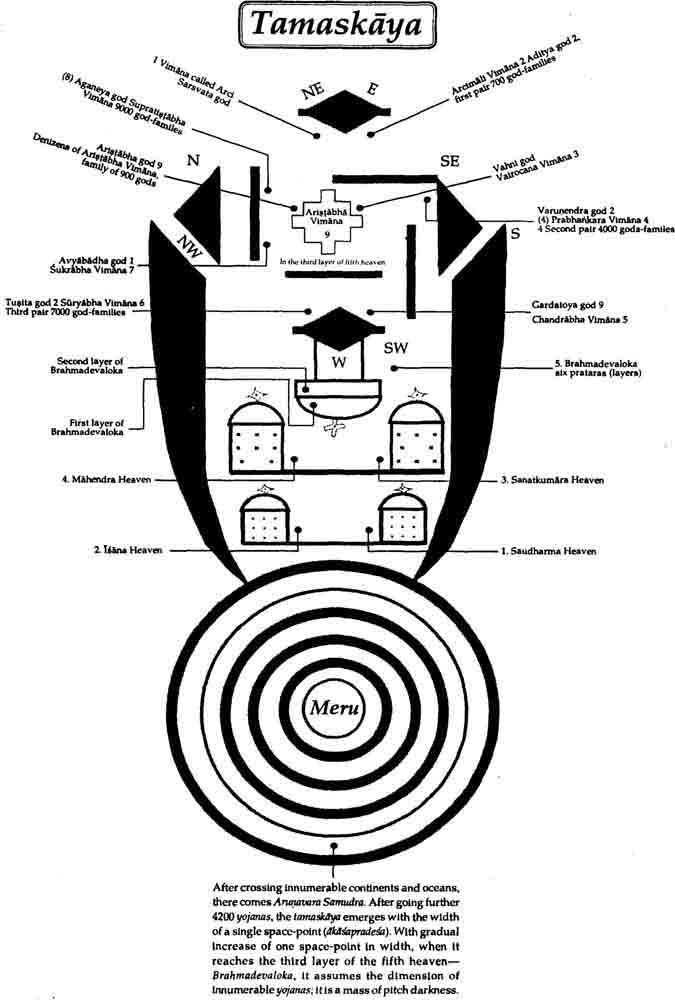
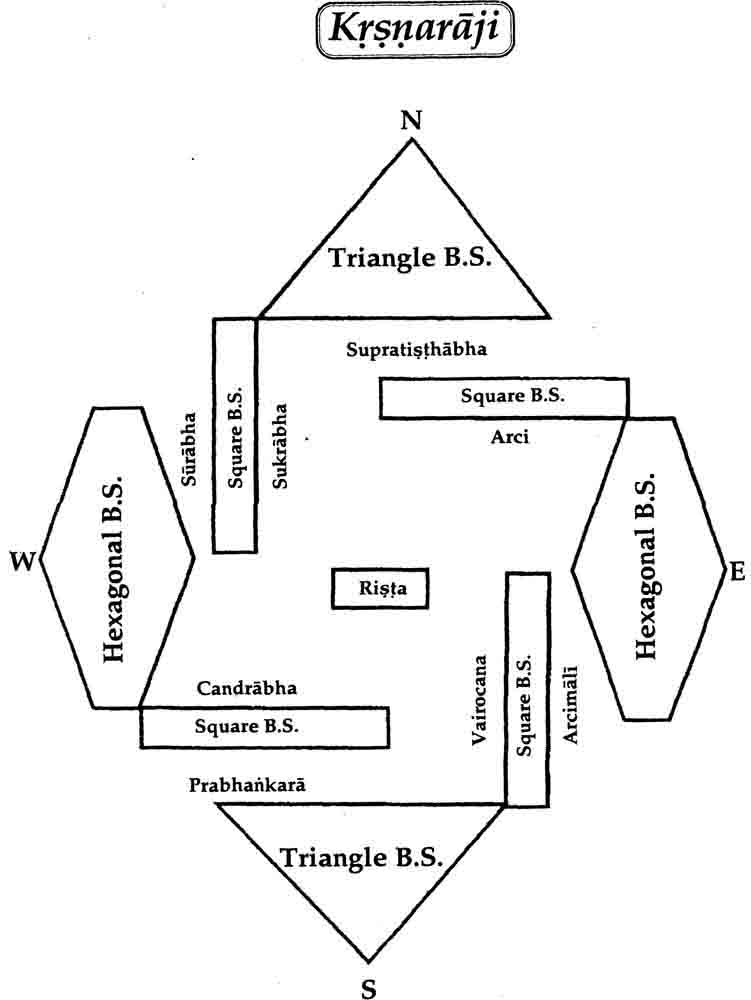
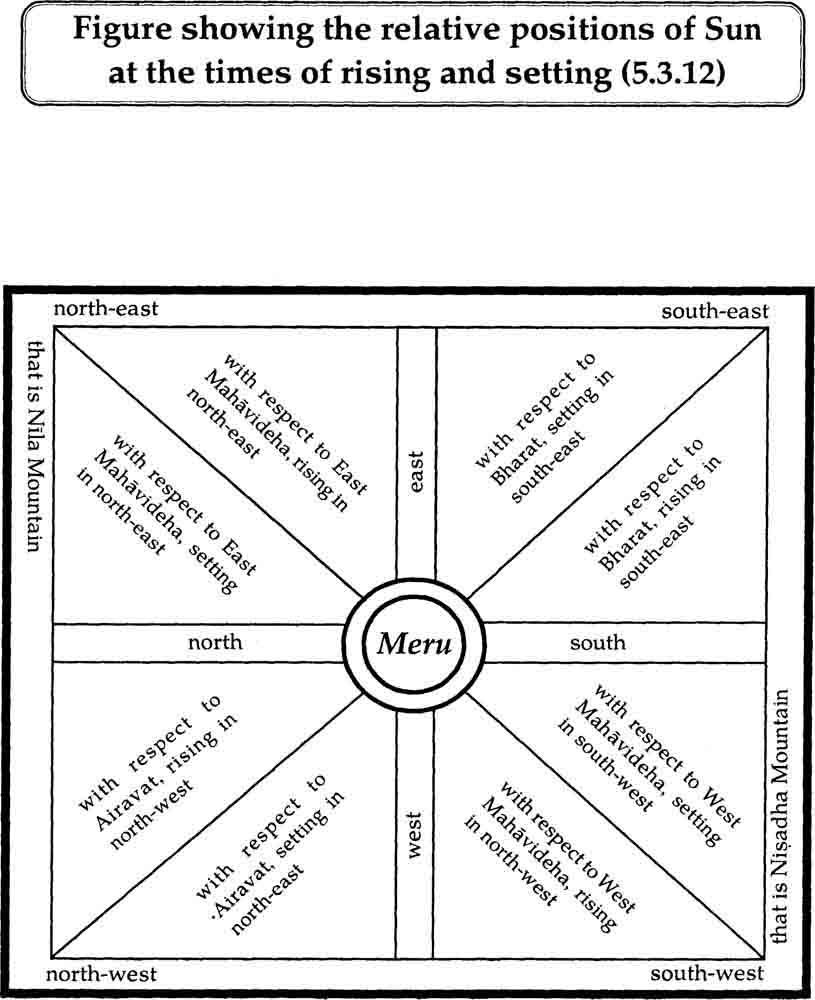
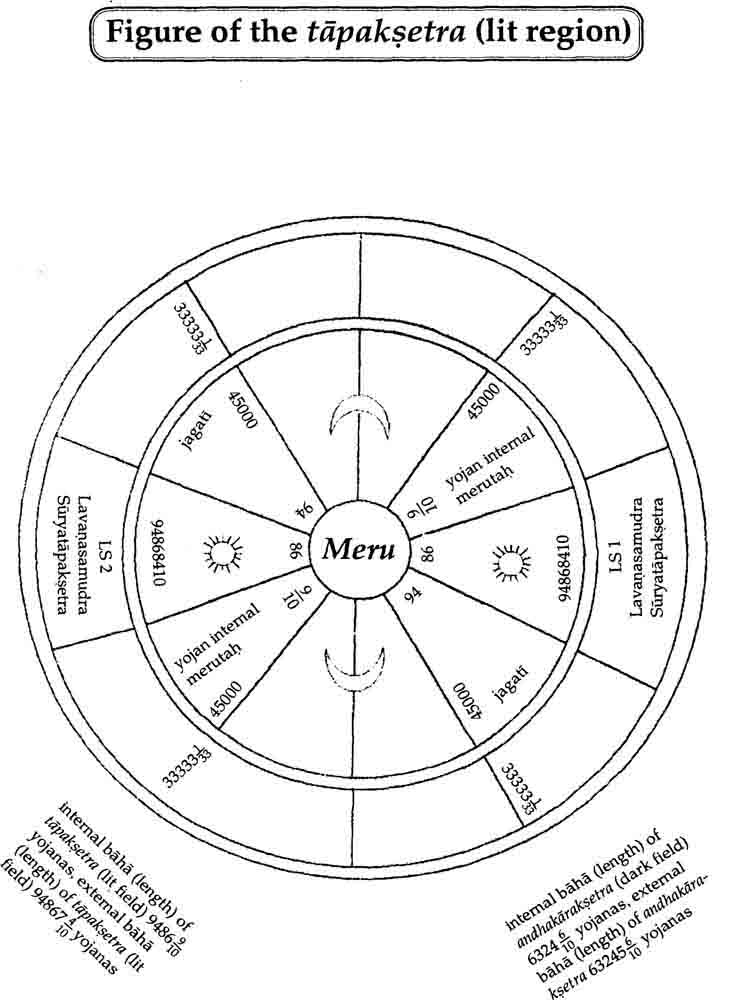
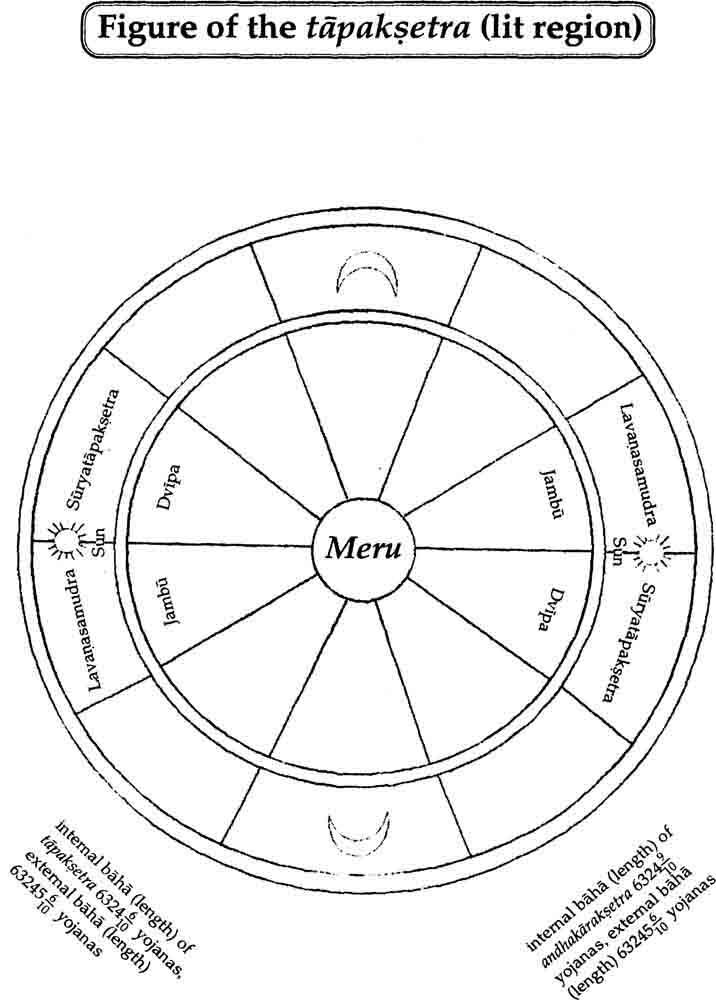
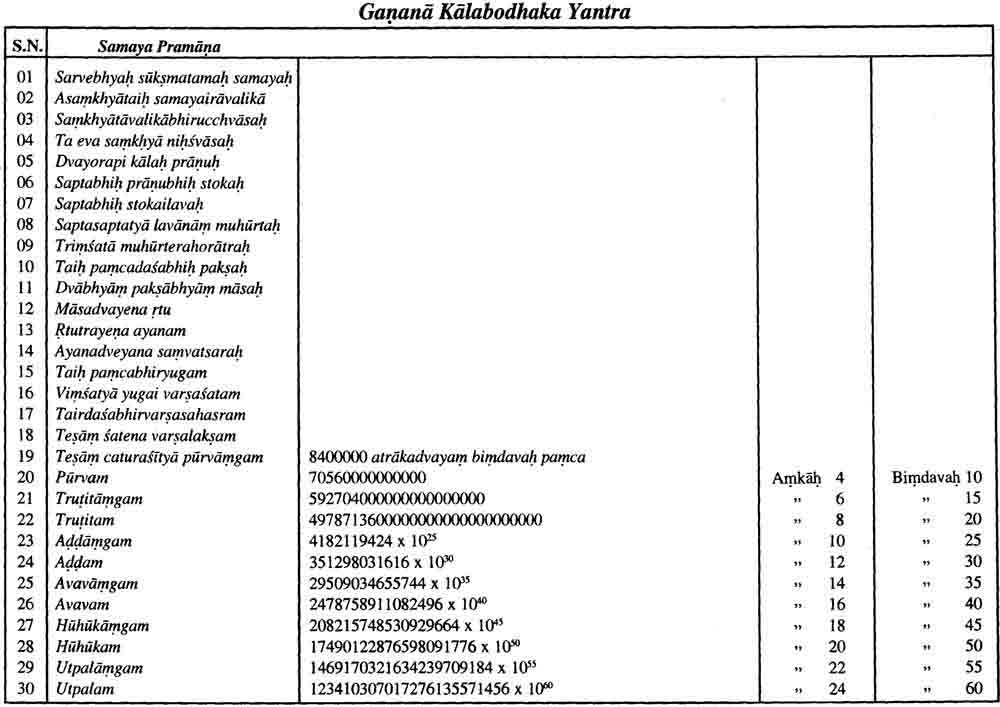
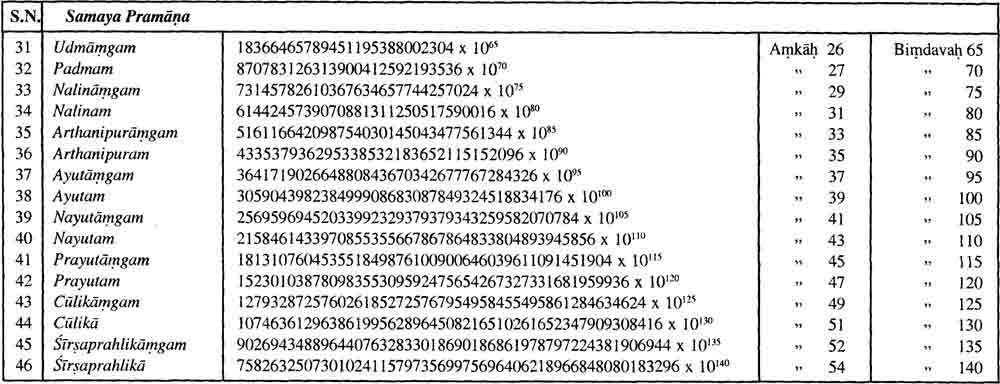
BM
Bhagavai Viahapannatti
Ganadhipati Tulsi
For any Feedback/Comments/Queries:
Please write to books@jvbharati.org
About

Center of excellence in the field of Education and special emphasis on Jain studies and the Prakrit Language, learning on Ahimsa (Non Violence), Jeevan Vigyan (Science of Living), Preksha Dhyan (Preksha Meditation) and many more...
Post Box No. 8, Post - Ladnun - 341306,
Dist. Didwana-Kuchaman, Rajasthan (India)