
 +91-8742004849 books@jvbharati.org

Jeev Ajeev
- Cover Page
- Title Page
- Preface
- Contents
- 1. Gati-4
- 2. Jaati 5
- 3. Kaay-6
- 4. Indriya-5
- 5. Paryaapti -6
- 6. Praan-10
- 7. Shareer-5
- 8. Yog-15
- 9. Upayog-12
- 10. Karma-8
- 11. Gunasthaan-14
- 12. Paanch Indriyon ke Vishay-23
- 13. Mithyaatva-10
- 14. Nine Tattva ke 115 Bhed
- 15. Aatma 8
- 16. Dandak-24
- 17. Leshya-6
- 18. Drishti-3
- 19. Dhyaan-4
- 20. Dravya-6
- 21. Raashi-2
- 22. Shraavak Vrat-12
- 23. Mahaavrat-5
- 24. Bhaanga-49
- 25. Chaaritra-5
- 027_backmatter
Cover Page
Title Page
Acharya Mahapragya

© Jain Vishva Bharati, Ladnun
Preface
Padhamam naanam tao dayaa ‘Right knowledge precedes right conduct’ – This is the integrated doctrine of Jain philosophy. There cannot be conduct without knowledge and knowledge has no meaning until it transcends in action. Therefore, a combination of both knowledge and conduct is essential.
The essence of knowledge in Jain spirituality is to know about liberation and the means of liberation such as self-restraint, non-violence, etc. For this, knowledge of living and non-living beings is essential. Lord Mahavira says-
'Jo jeeve vi na yaanaai, ajive vi na yaanaai,
Jeevaajeeve ayaananto, kaham so nahii sanjamam'
How can a person comprehend the notion of self- restraint, if he does not have knowledge of living beings, knowledge of non-living things, and the knowledge of both living and non-living beings?
It is therefore, imperative for an observer of non-violence to understand both jeev (living beings) and ajeev (non-living beings), which have been described in Jain philosophy in great detail and propounded through various perspectives.
Pacchis Bol is a small compendium of twenty-five meta- physical maxims laid down in the form of twenty-five tenets. The compiler has presented the analysis of living and non- living beings lucidly and scientifically.
The brief description of the twenty-five maxims is as follows:
1. Mention of four main places of birth of living beings.
2. Classification of living beings based on sense organs.
3. Description of immobile and mobile living beings.
4. Sense organs and their sub-divisions.
5. Six kinds of bio-potentials: their nature and functions.
6. Nature and functions of ten kinds of bio-energies. The inter-relation of bio-potential and bio-energy. A detailed explanation of life-span bio-energy.
7. Five kinds of body and their descriptions.
8. A detailed description of mental, vocal, and physical activities.
9. A detailed description of five kinds of knowledge, three kinds of nescience, and four kinds of perceptions.
10. Eight types of karma:
• Their effects, description of their nature and different causes of karmik bondage.
• Explanation of the ten states of karma, the five factors that cause accomplishment of any effect
• Elaborate information about the relation between soul and karma.
11. The explanation of fourteen stages of spiritual development, criteria to reach the stages, duration within each stage, etc.
12. Nature and objects of sense organs.
13. Ten kinds of perverted faith.
14. Divisions and sub-divisions of nine reals and the analysis of four means of liberation.
15. Logical reasoning to prove the existence of the soul, the soul is a non-corporeal then why is it considered as a substance, the size of the soul, etc.
16. Twenty four places of experiencing karmik fruition and their sub-divisions.
17. Six aural colors and their characteristics.
18. Three kinds of world views. Significant characteristics, blemishes, and bhushan (adornment) of the right faith.
19. Four kinds of meditation.
20. The six kinds of substances present in the universe concerning the division of time, modes of material substances, and their nature.
21. Two gross categories of being- a description of living and non-living beings.
22. Twelve vows of a layman and their religious, social, and national applications.
23. Characteristics of five great vows.
24. Various types of renunciations and ways to renounce sinful deeds.
These twenty-five maxims describe ‘Right Knowledge, Right Faith, and Right Conduct’. In this context, spiritually conducive and non-conducive factors have been discussed in detail.
The outline or the structure of the ‘Jeev-Ajeev’ was made during Acharyashree Tulsi’s stay at Sri-dungargarh, in Vikram Samvat 2002. Dr. Jethmal Bhansali and his assistants edited the script and the first edition of the book was published by Shree Jain Shwetamber Terapanth Sabha, Sri-dungargarh. It proved to be beneficial for all and the second edition edited by Muni Sudarshan, was published by Shree Jain Shwetamber Terapanth Mahasabha. Subsequently, it was included in the course of Jainology and through this book thousands of people have become conversant with the basic tenets of Jainism. At present, it is being published by Jain Vishva Bharati.
RanavasAcharya Mahapragya
02 November, 1982
♦
Contents
1. Gati-4
Four Gati ‘States of Existence of Worldly Beings’:
1. Narakgati (Hellish state)
2. Tiryanchgati (Sub-humans or animal and plants state)
3. Manushyagati (Human state)
4. Devgati (Heavenly state)
As per Jainism, there are two types of living beings, siddha (liberated) and sansaari (mundane). Each object is distinct from the other. The differences among the objects are on account of dissimilarity found in them. It is not surprising to find differences in the object belonging to the heterogeneous class, but it is found in homogenous class too. Based on this fact even the objects of the same class have been variously classified. The characteristic of living beings (jeev) are consciousness (chetna) and cognition (upayog). This exists only in living beings. At the level of consciousness, all living beings are equal, but the purity of the soul is not the same in all. Thus, living beings are broadly divided into two categories: siddha and sansaari. Souls that are cleansed of all karmic impurities and are in the purest form are called siddha, and they are infinite in number.
Liberated souls reside in the upper-most part of the universe. There is no birth, aging, sorrow, or fear in them and all the liberated souls are equal to their inherent state of spiritual development. They are classified into fifteen types depending on their worldly state just before liberation. For example, those who attain liberation in the form of a householder are called grihalinga siddha, those in Jain ascetic form are called svalinga siddha and those in the form of other ascetics are called anyalinga siddha. Similarly, those who attain liberation as women, men, and 'krit-napunsak (person’s gender made neuter through an unnatural process)' form are called 'strilinga siddha', 'purushlinga siddha', and 'napunsaklinga siddha' respectively. After liberation, the worldly life cycle of birth and death ends forever.
Dagdhebeeje yathaatyantam, praadurbhavati naankurah |
Karmabeeje tathaa dagdhe, na rohati bhavaankurah ||
The seeds that are burnt to ashes do not sprout again. Similarly, once the seed of karma is burnt, the rebirth of the soul does not occur. There is no re-birth of the soul after liberation.
The impure souls burdened with karmik particles are called sansaari jeev (worldly souls). Due to the different types of karmik bondages, the conditions of all worldly beings are different. Some have one sense organ whilst others have five senses. Some are mobile beings whilst others are immobile beings. Some have a mind, where as some others do not. Thus, there are innumerable classifications of worldly beings.
Question: We know that the soul is immortal and we also know that some have just been born whilst others have just died. Death does not occur to immortal things. And there is no birth without death. Therefore, how does an immortal soul undergo birth and death?
Answer: The existence of a soul does not end with the birth and death of a being. They are just different states of existence on account of which the soul transits from one living form to another. The worldly soul transmigrates in the four states of existence –
1. Narakgati
2. Tiryanchgati
3. Manushyagati
4. Devgati
In a literal sense, ‘gati’ means movement from one place to another. However, in this technical context, ‘gati’ means transmigration from one life form to another. For instance, when the soul transmigrates to life in the human form, it is called ‘manushyagati’, and when the same soul transmigrates into the subhuman form, it is called ‘tiryanchgati’.
As per Jain cosmology, there are seven landmasses below this earth called ‘narak’ (hell) where hellish beings reside. Living beings born in that state are called narak-gati, whereas living beings born in the celestial state are called devgati and in the human state are called Manushyagati. The Tiryanchgati consists of all organisms with one-sense to five-senses except above said three states and this gati is called Tiryanchgati. Human beings and sub-humans are visible to us; therefore, we cannot deny their existence. Although heaven and hell are not visible to us, their existence cannot be denied. When the soul exists, Punya and Paap exist, and then on what basis should the existence of hell and heaven be rejected. All the worldly souls transmigrate from one form of life to another based on the fruition of gati-naam karma.
01. Narakgati – Birth in hell is called Narakgati. There are seven hells-Ratnaprabha, Sharkaraprabha, Balukaaprabha, Pankaprabha, Dhoomaprabha, Tamaprabha, and Mahatamaprabha. These seven hell is located in the lower region of the cosmic space.The living beings taking birth in hell are called 'Naarak'.
02. Tiryanchgati - Birth in the form of one, two, three, and four sensed living beings along with five sensed living beings which include those that are terrestrial, aerial, or aquatic are called tiryanch.
03. Manushyagati-Birth in human form is called the Manushyagati. Humans are classified into two types: sangi (endowed with the mind) and asangi (without mind). Sangi human beings are viviparous, whereas asangi human beings are born in fourteen kinds of excretory wastes of sangi human beings such as faeces, urine, cough, etc. They are too subtle and thus invisible to us.
04. Dev Gati – Birth in the heavenly abode is called dev gati.1
Dev is of four types:
01. Bhavanpati Dev (Mansion dwelling heavenly beings)
02. Vyantar Dev (Forest, cave-dwelling heavenly beings)
03. Jyotishka Dev (Luminous heavenly beings)
04. Vaimaanik Dev (Super-celestial heavenly beings)1
All worldly beings, according to their acquired karmas, move from one state of being to another. For instance, a single soul can be human in one birth and in any of the other gatis in the next.
Question: How does worldly-being travel from one birth to another or from current gati to the next gati?
Answer: The movement made by the worldly beings to travel from one birth to another is called antaraal gati (trans-migratory movement). It is of two kinds:
01. Rijugati (trans-migratory movement without turns)
02. Vakragati (trans-migratory movement with turns, with a minimum of one turn to a maximum of three turns)
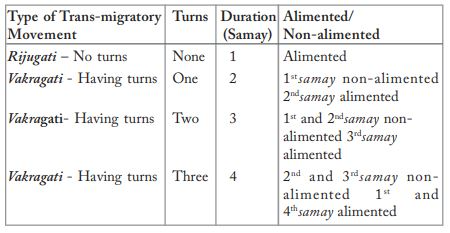
During this trans-migratory movement, the gross body is absent. This body is abandoned during the time of death. Two subtle bodies- taijas body or bio-electrical body and the karmik body accompany the soul. The trans-migratory movement occurs due to the karmik body. Two categories of living beings move from one birth to another discarding the previous body. One is when the soul sheds both its gross and subtle bodies together forever to reach the ultimate state of being that is liberation. Second is where the soul acquires a new gross body after leaving the previous gross body. The former kinds of beings are known as liberated, whereas the latter types of beings are called worldly beings. Soul attain liberation through rijugati and not by vakragati, whereas those who take a new physical form can move either in a straight line or take multiple turns depending on the location of the next birth. The cause for rijugati or vakra gati is dependent on the location of the next birthplace. When the birthplace is situated in a straight line to the place of death, the soul takes only one samay (smallest unit of time) to reach there. When the next birthplace is not situated in a straight line, the soul can take one, two, or three turns.
In the riju gati, the soul does not have to make an extra effort. When the soul leaves the previous body, it accelerates towards the new destination, just like an arrow is shot from the bow, due to the thrust obtained from previous body.
Vakra gati has turns, As soon as the turn appears, the acceleration given by the previous body reduces and the soul reaches its destination through a new effort made by the subtle body (karmik body). This is called kaarman yog. The minimum duration of this trans-migratory movement is one samay and maximum duration can be of two, three, or four samayas. In vakra gati, if there is one turn it takes two samay; if there are two turns it takes three samay and if there are three turns, it takes four samay.
When a soul moves towards liberation, it is bereft of both subtle and gross bodies during trans-migratory movement. Therefore, there is no need for material (alimental) assistance during this state. Worldly souls have subtle bodies, so they need material assistance for their movement.
When soul leaves its previous body and move through rijugati, it simultaneously receives aahaar (aliment) at the location of its rebirth. Anaahaarak state (without alimentary assistance) is found in vakra gati, when there is one or more turns, it takes two or more samays. The first samay of the one-turn transmigration, first and second samay of two turn transmigration, and the second and third samay of three turn transmigration are non alimented or anaahaarak.
Table-1 Trans-migratory State of the Soul
1. For further details refter 20th Chapter.
♦
2. Jaati 5
Five Classes of Beings:
1. Ekendriya (Beings with one sense)
2. Dveendriya (Beings with two senses)
3. Treendriya (Beings with three senses)
4. Chaturindriya (Beings with four senses)
5. Panchendriya (Beings with five senses)
Consciousness is the characteristic of a soul. Its development is not similar in all living beings but varies. The first stage of development is sensory knowledge. Super sensory cognition may or may not be present in all the beings, but sensory knowledge is present even in the most undeveloped living beings. If this sensory perception is absent, then how can there be any demarcation between living and non-living?
The classification of living beings made on the basis of number of sense organs (skin, tongue, nose, eyes, ears) is known as jaati. The word ‘jaati’ means a class of homogenous beings, for example – class of cow, class of horse, etc. The class of ‘cow’ includes all kinds of cows such as black, white, yellow, etc. In the class of horse, all breeds of horses are included. Similarly in one sensed class, all the beings of earth, water, fire, air, plant bodies are included. Likewise, in the class of two sensed beings, all organisms possessing two senses are included, and similar is the case with all the three, four, and five sensed beings.
The order of sequential increase in sense organs is as follows – In the class of one sensed beings, only the sense of touch is present. The sense of taste, smell, sight, and sound are additionally present respectively in two, three, four, and five sensed beings. Thus, each sense organ keeps on increasing as the number of senses increases from two to five.
Beings that possess only one sense (the sense of touch) belongs to ekendriya class, such as earth bodied beings, water bodied beings, fire bodied beings, air bodied beings, and plant bodied beings.
Beings that possess two senses (i.e., the sense of touch and taste) are called dveendriya. Example: Worms, snails, woodworm, shells, etc.
Those beings that possess three senses (touch, taste, smell) belong to treendriya class of beings. Example: Ants, bugs, lice, etc.
Those beings that possess four senses (touch, taste, smell and, sight), belong to the class of chaturindriya. Example: mosquitoes, flies, bees, wasps, locusts, scorpions, etc.
Those beings that possess all five senses – (touch, taste, smell, sight, and sound) belong to the class of panchendriya. Example - animals such as fish, crocodile, cow, buffalo, snake, bird, etc. and humans, heavenly beings, and hellish beings.
Tiryanch are of three types-
01. Jalachar (Aquatic) – those who live in water – fish, tortoise, crocodile, etc.
02. Sthalchar (Terrestrial) – Those who live on the land. These are of two types:
a) Chatushpaad (Quadrupeds)–four-legged animals.
b) Parisarpa (Reptiles)–those which move by crawling their body.
Chatushpaad (Quadrupeds) is of four kinds –
(i.) Ekkhur- Single ungulate (hooved) animals like horse, donkey etc.
(ii.) Dvikhur- Bi-ungulate (hooved) animals like cow, ox, buffallo etc.
(iii.) Gandipad- Round (footed) animals like elephant, camel etc.
(iv.) Sanakhpad- Claws with nails (toed) animals like lion, tiger, dog, cat etc.
Parisarpa (Reptiles) is of two kinds –
(i.) Bhuj parisarpa- Those that crawl using their arms like rat, mangoose etc....................
(ii.) Ura parisarpa- Those that crawl on their chest like snakes, etc.
03. Nabhachar (Aerial animals) is of four kinds –
i. Charma Pakshi –Beings with membranous wings such as bats etc.
ii. Rom Pakshi –Beings with feathered wings such as swan, crane, etc.
iii. Samudra Pakshi –Those birds, whose wings are not well developed, their wings are always covered and are in the shape of a box. They dwell far away from human habitations.
iv. Vitat Pakshi – Those birds, whose wings are always wide open or out-stretched. They also dwell far away from human habitats.
Humans are of two types –
(i.) Sammurchchhim Manushya - These humans are produced in the excreta, urine, cough, etc. of human beings. They do not possess a mind, thus they are also called asangi manushya.
(ii.) Garbhaj Manushya - They are born from the womb and possess a mind. Therefore, they are also called as sangi-manushya.
Sangi-manushyas are also of two types –
01. Karma Bhoomik Manushya- These humans live in karma - bhoomi, where the livelihood is based on, arms/weapons, literature, agriculture, business, arts, etc.
02. Akarma Bhoomik Manushya- Regions where one does not have to toil for their livelihood and all necessities are fulfilled by natural resources and trees called kalpavriksha (wish-fulfilling trees).The humans inhabiting in such regions are known akarma-bhoomik manushya.
♦
3. Kaay-6
Six Kinds of Beings :
1. Privtvikaay (Earth bodied beings- Beings in the form of Earth)
2. Apkaay (Water bodied beings- Beings in the form of Water)
3. Tejaskaay (Fire bodied beings- Beings in the form of Fire)
4. Vaayukaay (Air bodied beings- Beings in the form of Air)
5. Vanaspatikaay (Plant bodied beings- Beings in the form of Plants)
6. Traskaay- (Mobile beings)
There are six groups of worldly beings and this classification is based on the material cluster by which their bodies are made up of. The word kaay means body. The being, whose body is in the form of earth, sand, etc. is called earth bodied being. Being whose body is in the form of water is known as a water bodied being. The being, whose body is in the form of fire, is known as fire bodied being. The being, whose body is in the form of air, is known as air bodied beings. Similarly, plant-bodied organisms are known as vanaspatikaay or plant-bodied beings and a being with a mobile body is known as traskaay.
Out of these, the first five kinds of beings belong to the 'immobile'class of beings. Their comfort and discomfort cannot be perceived by common human beings and they cannot move on their own to seek comfort or to avoid discomfort. Due to the uday (rising state) of the sthaavar naam karma, they are known as sthaavar. Whereas beings who express happiness and sorrow and are capable of movement for seeking comfort or evading discomfort are called traskaay beings. For such living beings, the trasnaam karma is in the rising state, thus they are known as tras or mobile beings. The characteristics of living beings include the ability to move forward or turn back, to contract or expand the body, to make sound, to move around due to fear, to run-away, to know about arrival and departure, to reproduce, etc.1
Fire and air bodied beings also move but not to seek comfort or to evade discomfort. For this reason, they are not tras in actual sense, but are called gati-tras.
Depending on one’s karma, one acquires a body in one of the forms described above and are named accordingly. The word ‘kaay’ also means a group. A small lump of sand or a drop of water comprises of the innumerable bodies of earth, water respectively living in a group.
Question: If there are innumerable souls in a lump of soil or a drop of water, then how many bodies are in them?
Answer: Innumerable.
When we express those innumerable beings in totality, we collectively term them as ‘Earth-bodied-being’, ‘water- bodied-being’, etc.
I) Prithvikaay (Earth bodied beings)- Earth, sand, stones, rock, salts, iron, vermilion, red chalk, copper, lead, silver, gold, antimony, gravel, coal, etc. are all earth bodied beings.
There are innumerable independent souls in a lump of soil. Earth bodied beings are sachit (living) until they come in contact with any kind of destructive substance. When they come into contact with any life destructive thing, they become achit (lifeless).
II) Apkaay (Water bodied beings) - Rain-water, dew, ocean, well, step well, fog, ponds, lakes, rivers, etc. are living beings whose body is water. There are innumerable independent souls or beings in a drop of water which is living. They remain alive until they come in contact with any kind of damaging substance. If they are hurt by opposing weapons they become lifeless.
III) Tejaskaay (Fire bodied beings) - Fire, lightning, thunders, meteors, etc. are all fire bodied beings. There are innumerable independent souls in a spark of fire. Fire bodied beings are living until they come in contact with any kind of life destructive substance. If they are hurt by opposing weapons they become lifeless.
IV ) Vaayukaay (Air bodied beings) - Air bodied beings are classified into five types:
1. Utkaalika- intermittent winds, which stops and moves on.
2. Mandalika – a whirlwind, which moves in circles (tornado, etc.)
3. Ghanvaayu – It is found below the ratnaprabhaa (gem hued) hell or heavenly vimaanaas. This is dense and thick, like frozen water, and provide support to those lands.
4. Gunjaa vaayu – sound-producing wind or air.
5. Shuddha vaayu - pure wind which is devoid of the above qualities and flows gently.
There are innumerable independent beings in the form of air. They become lifeless when they come in contact with life destructive substances.
V) Vanaspatikaay (Plant-Bodied Beings)- Living beings in the form of plants are plant-bodied beings like mango, grapes, bitter-gourd, banana, vegetables, potato, onion, garlic, etc.
They are of two types:
1. Saadhaaran (Common bodied beings): Where infinite souls share one body in common. All underground vegetables like carrots, onions, raddish, etc., are Saadhaaran vanaspati.
2. Pratyeka (Individual bodied beings): Where each soul has an independent body.
They are further classified as:
1. Vriksha - Trees — Mango, etc.
2. Lataa - Creepers — Bitter gourd, Cucumber etc.
3. Trina - Grass, etc.
4. Haritkaay - Leafy vegetables— Spinach, etc.
5. Jalarooha - Aquatic plants –Lotus, etc.
In these individual plant-bodied beings, a single soul forms the body, but there can be innumerable souls dependent on it. It is not the same case for two-sensed beings, etc. which have separate bodies.
Depending on the birth, plants are divided into eight types:
1. Agra-beej: Plants whose tip or shoot acts as a seed. For example, jade, rubber, camellia, etc.
2. Mool-beej: Plants whose roots act as a seed. For example, rhizome.
3. Parva-beej: Plants whose nodes or knots act as seeds. For example, sugarcane, bamboo, etc.
4. Skandha-beej:Plants whose trunk acts as a seed. For example thoohar (cactus).
5. Beej-ruh:Plants that are produced by seeds. For example, wheat, barley, etc.
6. Sammurchim: Plants that are produced by self. For example, sprouts,etc.
7. Trin: Grass, etc.
8. Lata: Creepers. For example, chameli ( Jasmine), cucumber, watermelon, muskmelon, etc.
There are many independent souls in plants. Plant bodied beings are living until they come in contact with any kind of damaging substance. There are infinite souls in plants and innumerable souls in the remaining five categories. Everything we see: earth, water, etc., are a group of innumerable bodies.
One category of living beings can be harmful to the living beings which belong to another category and also for living beings within the same category. Just as weapons are detrimental to human life, in the same way, beings with opposite nature are detrimental to each other. For example, two kinds of sand with opposing nature are detrimental to each other. For water bodied beings, fire bodied beings are harmful, similarly, for fire bodied beings, water bodied beings are harmful. If living beings are harmful to the living beings of the same category, then it is known as sva-kaay-shastra (weapon for one’s class). If they are harmful to the living beings of another category, then it is called Par-kaay-shastra (acts as a weapon for other classes of beings). The harmful substance for air bodied beings is air itself. The destruction of living air on account of the contact with another kind of living air is known as sva-kaay-shastra, whereas the destruction of living air on account of contact with non-living air is known as par-kaay-shastra.
VI) Traskaay (Mobile Beings)- All living beings endowed with two to five senses and capable of moving are called traskaay. There are eight types of birth conditions of traskaay:
1. Andaj (Oviparous): Those which are born out of eggs. For example birds, snakes, etc.
2. Potaj (Uncovered): Those which have open or uncovered organs during their birth. For example, elephants, etc.
3. Jaraayuj (Placental): Those which are surrounded by amniotic sac during the birth. For example, humans, buffalos, cows, etc.
4. Rasaj- Those which are produced in curds and other juices. For example, worms, etc.
5. Svedaj: Those which are born in sweat. For example, lice, etc.
6. Sammurchim (Spontaneous): Those who are born asexually. For example, flies, ants, etc.
7. Udbhij: Those which are born by rupturing the earth. For example, a grasshopper, moth, etc.
8. Aupapaatik (Accomplished) - Those who are born in specific places like heaven and hell without staying in the womb. For example, heavenly and hellish beings.
1.From the scientific point of view, the following are the characteristics of life-adaptability, sensitivity, communication, excitement, metabolism, growth, development, and reproduction
♦
4. Indriya-5
Five Kinds of Sense Organs :
1. Sparshanendriya – Sense of Touch (skin)
2. Rasanendriya – Sense of Taste (tongue)
3. Ghraanendriya – Sense of Smell (nose)
4. Chakshurindriya – Sense of Sight (eyes)
5. Shrotrendriya – Sense of Hearing (ears)
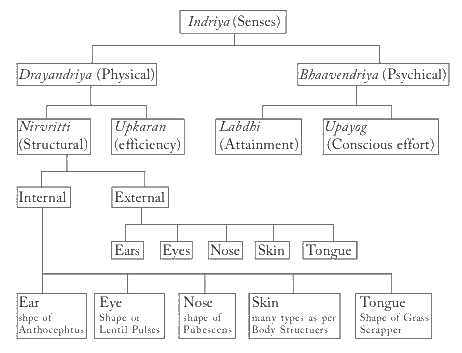
All souls possess the prosperity of all the three parts of universe, thus are called indra and the endowment through which the Indra (soul) is recognized is known as indriya (sense organs).This is the etymological meaning of the term indriya. A sense organ is defined as 'that which cognizes and provides input for the perception of a subject of its kind'. The sense organ that cognizes touch is skin. The sense organ through which taste is cognized is the tongue. The sense organ through which smell is cognized is the nose. The sense organ through which color and form are cognized is the eye. The sense organ through which sound is cognized is the ear.
There are two types of senses:
1. Dravyendriya (Physical sense organ) - the physical inner and outer structure of sense organs, such as the nose, ears, etc. and their specific shapes.
2. Bhaavendriya (Psychical sense organ) - the specific quality of the soul is bhaavendriya, i,e., the capacity of the soul (senses) to know and its functioning.
The physical sense organ (dravyendriya) has two types:
1. Nirvritti (physical structure of sense organs)
2. Upakaran (efficiency of cognizance in sense organs)
Nirvritti refers to the structural framework of the sense organ. The framework is of two kinds – the baahya (external) and the aabhyantar (internal) framework.
The outer framework of sense organs vary between different organisms, but the internal structure remains the same for all the beings. For example, the internal structure of the ear is like the flower kadamba (anthocephalus); the eyes resemble the lentil pulse; the nose resembles the flower chandrika of atimuktak (gasminum pubescens); the tongue resembles khurpa (trowel). Only the internal structure of the sense of touch i.e. skin differs in all living beings. It is according to the different body structures.
Upakaran (Efficiency of sense organ): The material capacity of the sense organs to be receptive to its specific subjects.
Question: What’s the difference between aabhyantar nirvritti dravyendriya and upakaran dravyendriya?
Answer: Aabhyantar nivritti dravyendriya refers to the internal structure of the sense organs whereas upakaran dravyendriya refers to the material capabilities of the sense organs to perceive their subjects. Even though the internal structure is intact but the efficiency of upakaran dravyendriya is lost due to some physical ailments like imbalance in air, bile, cough etc, it is unable to perceive its objects of perception. For example, the outer structure is like that of a sword and the inner structure is like its sharp edge and its efficiency is the capacity to sever the objects.
The psychical sense organ (Bhaavendriya) is of two kinds:
1. Labdhi Bhaavendriya (Attainment)
2. Upayog Bhaavendriya (Conscious activity)
1. Labdhi Bhaavendriya: The ability of the sense organs to perceive senses like touch etc. on an account of kshayopasham1 (partial elimination and subsidence) of gyaanaavaraniya, (knowledge obscuring) karma and darshanaavaraniya (perception obscuring) karma.
2. Upayog: The use of the capacity attained on account of kshayopasham of knowledge obscuring karma and perception obscuring karma.
Question: What is the difference between labdhi and upayog?
Answer: Labdhi is the capacity of consciousness in respect to perception and upayog is the functioning of consciousness for perception. It refers to the use of labdhi. In other words, labdhi bhaavendriya is the achievement of the self. This means, the manifestation of the soul to the extent that one can cognize touch, smell, colour, taste and sound through the activity of cognizance. This activity is known as upayog. For example, a person buys a telescope, this is his labdhi, but when he uses it to view distant objects, it is upayog.
Question: What is the basis of the division of the senses into the four categories as nirvritti, upakaran, labdhi and upayog?
Answer: Consciousness is a characteristic of the soul, and not of the matter. Until consciousness is fully developed, it can only know things on which it concentrates and not the other. This is the basis for labdhi and upayog. The efficiency or capacity of the soul to know or cognize is labdhi. But it does not mean that mere attainment of efficiency will lead to continuous cognition of the subject. When the particular sense is put in use, only then cognition of its respective subject is possible. This is known as upayog indriya.
Sensory knowledge is not independent. It needs the help of physical sense organs to cognize its particular subject. Inspite of having the ability of cognizance, if the eyeball is distorted, then the cognition of visual objects is not possible. Therefore, a physical structure (nirvritti) is equally necessary. Sometimes, even in the presence of nirvritti, the sense organ cannot perceive its subjects, therefore it is understood that apart from the physical structure there exists some power, which helps in the process of cognition and this is called as upkaran indriya. Nirvritti and upakaran are the channels to sensual cognition. Labdhi is the power of knowledge and upayog is the transformation of power into action. Altogether, they cognize the respective subjects not one, two, or three independently2.
Apart from these five senses, there exists one more sense called Mind. Mind is the means of knowledge. It is not external, like sense of touch and taste etc, but it is internal means of knowledge. Therefore, it is also called as 'antahkaran'. The subject of mind is not limited as it is in the case of the senses. Senses can cognize only corporeal objects that too partially. However, mind can cognize both corporeal and non-corporeal objects with its various attributes. The function of the mind is to think. It can think on all the subjects depending on its capacity. It can analyze the subjects perceived by sense organs. Therefore it is called quasi-sense or (no indriya/ishad indriya). Since it is independent to think, so it is called anindriya.
1. The term kshyopasham is made up of two words- kshaya and upsham destruction cum subsidence, when the subsidence is associated with destruction, it is known as partial destruction cum subsidence. Destruction here means to eliminate the relation of karma from soul, and subsidence means ineffectiveness of karma in spite of karma being related with soul. Only four destructive karmas undergo destruction cum subsidence. In this state, there remains subtle rise of karmas in space points of soul, and in subsidence, even this rise is absent.This is the difference between destruction cum subsidence and total subsidence. The state which a soul undergoes due to destruction cum subsidence is known as state of destruction cum subsidence or kshayopasham bhaav.
2. In this context, the opinions of other philosophies differ. Others believe that sense organs are non-living by nature. It acquires knowledge through the mind. As per Jain philosophy, visible sense organs are non-living but the power that possesses this cognizance is living. Non-living things can never acquire cognizance by itself or with the help of anything else. If non-living things acquire cognizance with any kind of support then there would not be any difference between living and non-living entities. Thus it can be said that cognizance is the nature of living and not of the non-living.
♦
5. Paryaapti -6
Six Types of Bio-potentials:
1. Aahaar Paryaapti (Aliment Bio-potential)
2. Shareer Paryaapti (Body Bio-potential)
3. Indriya Paryaapti (Sense organ Bio-potential)
4. Svaasocchvaas Paryaapti (Respiratory Bio-potential)
5. Bhaasha Paryaapti (Speech Bio-potential)
6. Manah Paryaapti (Mind Bio-potential)
Paryaapti or Bio-potential means the accomplishment of aggregating the material energy required for the sustenance of life. When a soul abandons the gross body of this birth and acquires another gross body in the next, then to sustain the next life, it immediately accumulates the essential material energy. This process or this essential energy produced by this material is called paryaapti (bio-potentials).
The formation of all six bio-potentials begins at the same time. However, its completion takes place sequentially one after the other. Thus, there is a fixed order of bio-potentials. The alimentary bio-potential is completed in only one samay1 whereas each of five other bio-potentials is completed in antarmuhurt (infra-hour/ within 48 minutes)2.
01. A man while making a house first collects the raw materials such as wood, bricks, sand, stones, clay, etc. Similarly, while entering into a new birth, a soul collects the materials i,e aahaar (aliment) required for sustenance of life. Such materials or their potential are known as aahaar paryaapti (aliment bio-potential).
02. In aahaar paryaapti (aliment bio-potential), materials related to all the other paryaaptis are collected. After the collection of the raw materials, its classification occurs. As an illustration, particular wood is suitable for pillars and another type for cupboards, for doors, etc. Such kind of division is body bio-potential. A material capable of sustenance of the body is collected in aahaar paryaapti and such material or its potential to build the body is called shareer paryaapti.
03. While making the walls or rooms, doors are designated for the entrance and exit. Similarly, in body when compared to a house, there are doors such as indriya paryaapti. This is known as the sense organ bio-potential. The soul is endowed with indirect knowledge since it knows the outer world through sense organs.
04 and 05. The svaasocchvaas3 (respiration) and bhaasha (speech) bio-potentials are also similar to the example given above because even in these two the entrance and exit take place as in sense organs.
06. After the completion of the house ‘this room is hot thus it is suitable for cold weather’, ‘this room is cold so it is favourable for summer’, ‘this is a bedroom’, ‘this is a dining room’ and other such settings are comparable to mind bio-potential. The wisdom of relinquishing the abandon-able objects to be avoided and accepting the useful objects is possible only through the support of the discretion power of mind bio-potential.
Concluding the above discussion, Bio- potentials can be defined as:
01. The accomplishment of the activity of collecting the material aggregate essential for the other five bio-potentials is aahar paryaapti.
02. The accomplishment of the activity of collecting the material aggregate required for building up the body and its different parts is shareer paryaapti.
03. The accomplishment of the activity of reception of the material aggregate required for the formation of sense organs such as skin etc. is called indriya paryaapti.
04. The accomplishment of the activity of reception and elimination of the required material for respiration of material aggregate is called svaasocchvaas paryaapti.
05. The accomplishment of the activity of reception and elimination of the required material for speech of material aggregate is called bhaasha paryaapti.
06. The accomplishment of the activity of reception and elimination of the required material for the mind is called manah paryaapti.
Question: What does a living being acquire after the completion of bio-potentials?
Answer: Through aliment bio-potential, the soul acts to acquire basic material that is aliment for the sustenance of life constantly for every movement4 It acquires the required material aggregates and the acquired material gets segregated into the excretable (khala i.e. urine and faeces) and the absorbable (rasa) forms.
Through body-bio-potential, the acquired basic material of the body gets transformed into the seven elements (dhaatu).
The soul acquires the materials through the sense organ bio-potential which assists in the perception of the subject of senses. The act of respiration, speech, and thought is carried out with the help of respiratory, speech, and mind bio- potentials respectively.
Bio-potentials are distinctive characteristics of living beings. This characteristic is not available in any other form of existence other than living organisms. Through the bio-potentials-acquisition, transformation, and elimination of various kinds of materials take place in living beings.
Through aliment - bio-potential, we acquire the material appropriate for aahaar (aliment), transform it in the form of food, and eliminate excretory wastes.
Through body – bio-potential, we acquire the material appropriate for the body, transform it in the form of the body, and eliminate excretory wastes.
Through sense – bio-potential, we acquire the material appropriate for senses, transform them in the form of senses, organs and eliminate excretory wastes.
Through respiratory – bio-potential, we acquire the material appropriate for respiration, transform it in the form of respiration, and eliminate excretory wastes.
Through speech – bio-potential, we acquire the material appropriate for speech, transform it in the form of speech, and eliminate excretory wastes.
Through mind – bio-potential, we acquire the material appropriate for the mind, transform it in the form of mind, and eliminate excretory wastes.
1. According to Jain philosophy, the indivisible, the subtlest part of time is known as samaya (instant).
2. The time between two instant to one instant less 48 minutes is known as infrahour or antarmuhurta. There are three types of antarmuhurta (infrahour)
˜Minimum intrahour 2 samay (instants)
˜Maximum intrahour one instant less in 48 minutes.
˜Medium intrahour The time period between the minimum and maximum intrahour.
3.The term svaasocchvaas means to inhale the external air and to exhale the internal air out of the body.This act of respiration does not only occur through lungs but also through the pores of the body.We respire through our whole body. If we accept only lungs as the means of respiration, then there cannot be respiration in plants as plants do not have lungs. But as per Jain doctrine, plant beings also respire.Therefore, it becomes necessary to accept that the respiration occurs from the entire body of an organism.
4. The term ailment or aahaar refers to the acquisition of materials related to the physical body for making audarik,vaikriya and aahaarak bodies and all six bio-potentials. It is of three types —
Oj aahaar- The materials aggregate acquired in the first instant of life through kaarmanyog is known as oj aahaara.
Rom aahaar- The material aggregate acquired through the sparshanendriya (skin) is known as romaaahaara.
We continuously acquire material energy through our pores of skin. For instance, a traveller walking from a long distance in intense heat and feeling thirsty feels a great relief after sitting under the shade of a tree, as he absorbs the cold matters through pores of skin.
Kavalaahaar (prakshep)- Food which is ingested through the mouth or injected to the body through other instruments such as through nasal tube, anal tube, injection etc, are included under kavalaahaar. Another kind of food is mental food, which is taken by the celestial beings.
♦
6. Praan-10
Ten Types of Bio-energy :
1. Shrotendriya Praan (Auditory sense (ears) bio-energy)
2. Chakshurindriya Praan ( Visual sense (eyes) bio- energy)
3. Ghraanendriya Praan (Olfactory sense (nose) bio- energy)
4. Rasanendriya Praan (Gustatory sense (tongue) bio- energy)
5. Sparshanendriya Praan (Touch sense bio-energy)
6. Manobal Praan (Bio-energy of the mind)
7. Vachanabal Praan (Bio-energy of the speech)
8. Kaayabal Praan (Bio-energy of the body)
9. Svaasochvaasbal Praan (Respiratory Bio-energy)
10.Aayushyabal Praan (Life-span Bio-energy)
Bio-energy means vital energy. By the association of which an organism acquires life and dissociation of which leads to death is called praan. It is an external characteristic of life. These are living beings and they have life-such kind of cognition is possible only through bio-energies. Without bio-energy, no organism can survive. The functioning of bio-energies occurs continuously which is actually the life of worldly beings.
The power of cognition that is present in the five sense organs is known as indriya praan or sense organ bio-energy, which is five in number. The power of thought, speech, and physical activities is called the bio-energy of mind, speech, and body respectively. The terms power and bio-energy are synonymous. The inhalation and exhalation of material particles in the form of respiration are known as respiration bio-energy. The power responsible for sustaining a particular life for a particular duration is the life-span bio-energy.
Question: What is the difference between bio-potential and bio-energy?
Answer: Bio-energy is the power of the soul, whereas bio-potential is the power of the material acquired by the soul. Bio-potential is the auxiliary cause, whereas, bio-energy is the effect. All the activities of the soul are performed only with the help of matter, be it mental, verbal, or physical.
An airplane flies until it has fuel and other external aids. No conscious activity can take place without the aid of matter, whether it is related to the mind, speech, or body. Therefore, in the worldly state, there exists a close relation between soul and matter. The soul is an invisible substance and matter is a visible substance. This is the reason why many are skeptical regarding the existence of the soul. However, it must be understood that activities seen such as eating, drinking, walking, speaking, etc. are merely actions. The doer of them is the invisible soul. Until the soul resides in the body, activities can be carried out. The regulator of these activities is called bioenergy and the material energy which helps in the execution of those activities is called bio-potentials.
Question: Which bio-potential is the cause of a particular bio-energy?
Answer: The causes of five sense organ bio-energy are sense organ-bio-potential. The cause of the body, speech, and mind bio-energy is a body, speech, and mind bio-potentials respectively. The cause of respiratory bio-energy is the bio- potential of respiration, and the cause of life span bio-energy is aliment bio-potential because aliment bio-potential sustains the life span bio-energy.
To understand the nature of bio-energy or life force, one must also know what is death? Modern science defines death as the permanent cessation of all functions of various organs of the body such as the brain, heart, and lungs, etc.
When the vital organs of the ‘human-machine’ such as heart, lungs, and brain are subjected to wear and tear, the machine stops working all at once. When these organs are injured or damaged, due to some illness or an accident, or when their efficiency comes to an end, they stop functioning completely, which is known as death.
Interestingly, we do find many examples contradicting the above concepts, such as someone surviving even after a prolonged stoppage of the heart. Even after the complete stoppage of vital activities (such as respiration, heartbeat, etc.) for forty eight hours, a man was found alive. We also find such examples in which a person, who was kept in an airtight container for forty days, emerged alive.
Jain concept holds that the source of life forces is not only organs such as the brain, heart, lungs etc. but it is the ten bio-energies also. Out of these ten, if anyone of them stops its functiong, life does not come to an end. As long as the life span bio-energy is active, a being remains alive even when other vital organs stop their activities. There are examples where the brain, heart, lungs and other vital organs had stopped their activities for forty days, they were not functioning, but the person’s life span bio-energy was functioning and therefore life could sustain. As soon as the external factors were obtained, the dormant life forces become active again. All the activities of the body and the functioning of organs are possible only as long as the lifespan bio-energy is active. Once that becomes inactive, then all other activities come to an end and we say that the person is dead.
Question: A. If the body is hale and hearty, brain, heart, lungs and all the five sense organs are healthy and there exists neither any disease nor an occurrence of an accident, even then such a healthy person dies suddenly. Why?
Question: B. A body has turned old, it has become decrepit, there is a serious problem, chronic illness has occurred, even then a person does not die. Life sustains for long. What is the reason?
Question: C. It is said that the life span of a person is fixed. One cannot increase or decrease it for even one second. Still, we do observe that if one falls into the fire or swallows deadly poison, then death is definite. What is the logic behind this?
Answer: When the karmik particles of life span (aayushya karma) are less, a healthy person dies without any accidental or causal incidences. When such particles of life span are more, a person even after meeting with an accident or becoming chronically ill, surprisingly survives.
There are two kinds of life spans -
01. Apavartaniya (Reducible): Life span which is liable to complete before its fixed duration of fruition is known as reducible life span.
02. Anapavartaniya (Non-reducible): The life span which is not liable to complete before its fixed duration is known as non-reducible life span.
The life span of the next birth is fixed in the present life itself. If the emotions or feelings are mild during the bondage, then the bondage of aayushya karma will be weak, as a result of which the period of life span can be reduced due to the occurrence of some causes. In contrast, when the feelings are strong, the bondage of life span becomes intense, the duration of which can never be reduced even if there are changes in external situations such as accidents, etc. Lifespan bound with highly aroused emotions does not finish before its fixed duration even if one is endangered by weapons, poison or an accident. But karma that determines the life span bound loosely on account of the state of mild or shallow emotions is experienced within an infra-hour by accident, weapons or poison, etc, before the completion of its full duration. This rapid experience of life span karmas is known as reducible lifespan or apavartan premature death, whereas the life span which is experienced at its fixed duration is known irreducible or the natural death or anapavartaniya.
The reducible life span is susceptible to upakrama (intervention). A strong weapon, blazing fire, etc through which premature death occurs is known as intervention.
The irreducible life span is both sopakrama and nirupakrama i.e. with and without interventions. The intervention of premature death may or may not occur for a being with an irreducible life span. Even after facing the deadliest circumstances, the lifespan of a person with an irreducible life span gets neither reduced nor annihilated. They can never have accidental or premature death and the person remains alive until they complete their natural lifetime. They escape all kinds of accidents irrespective of any circumstances.
Infernals, heavenly beings, humans and sub humans with innumerable years of life spans, those who are in the last birth (determined to be liberated in the very birth) and sixty-three extraordinary personals – tirthankara (fordmaker), chakravarti (emperor), baladeva, vaasudeva and prativaasudev have an irreducible life span. As the lifespan is fixed, so it remains. In any way, they cannot die before their duration of life span ends.
Generally, humans, plants, and animals have both kinds of life span i.e reducible and non-reducible. On account of the occurrence of accidents etc., sudden death can take place and when such a situation does not occur, sudden death does not happen. According to the karma theory, the clarification of the above fact is as follows.
The life span that has to be experienced for a long time is experienced rapidly altogether and thus there is no more life span left to experience, for example –
01. When a bundle of wet grass is lit with a spark of fire it slowly and subsequently burns each blade of grass. Whereas the same fire when ignites the dry grass, then the fire turns the grass into ashes in no time.
02. Two identical pieces of cloth were dipped in water. One of them was put to dry by spreading it completely, whereas the other one after folding it. The first piece of cloth will dry quickly whereas the other will take time. Although the washing process is the same still there is a difference in the time taken to dry both the clothes. The cloth which is spread out completely takes less time, whereas the folded clothes take more time to become dry. Similarly, reducible and non-reducible lifespan having the same account of duration can be experienced in a short or long period.
♦
7. Shareer-5
Five Types of Body :
1.Audaarik Shareer (The gross body)
2. Vaikriya Shareer (The protean body)
3. Aahaarak Shareer (The communication body)
4. Taijas Shareer (The luminous body)
5. Kaarman Shareer (The karmik body)
Body (shareer) is that through which activities such as moving, walking, eating, and drinking, etc., are carried out, which has the characteristic of decay and degradation, which is formed through the rise of body-making karma (shareer naam karma) and that which accommodates the worldly souls.
The soul is non-corporeal. It is not subject to our vision, but from a certain perspective, worldly souls are also considered as corporeal. Therefore, they are visible to us. All worldly souls possess a body. We understand the presence of souls by observing all the bodies of living entities around us.
The soul itself constructs its own body and uses it as a means to carry out all the activities of life. Hence, when it leaves the body, all the activities come to an end. Therefore, this is an unambiguous fact that the body is a completely different entity from the soul. Souls possess knowledge whereas the body is devoid of knowledge as it is a material entity. Whatever physical pleasure and pain are experienced by the soul, it occurs only through the body. Therefore, the body is also defined as ‘paudgalika sukha-dukkhaanubhavasaadhanam shareeram’ which means 'the instrument for the experience of material related pain and pleasure is body.'
01. Audaarik (Gross) Body: The body, which is made up of gross material aggregates, is called audaarik body. Protean and the other bodies are made-up of subtler material aggregates. Gross bodies can stay back even after they become dissociated with the soul, whereas protean and the other bodies disintegrate soon after they dissociate from the soul. The gross body can be split into parts which is not possible in the case of other kinds of body. The attainment of emancipation is possible only through the gross body. This gross body is composed of flesh, bones, blood, etc. and is characterized by the nature of disintegration, decay and destruction.
02. Vaikriya (Protean) Body: The body, which is capable of adopting diverse forms such as contraction, expansion, subtle, gross, single and multi form, etc., which does not contain bones, flesh, blood, and which disintegrates after death as camphor is called as vaikriya shareer.
03. Aahaarak (Communication) Body: Body built with a special kind of matter by an ascetic with the knowledge of fourteen poorvas, on account of the occurrence of special kinds of situation is known as communication body.1
04. Taijas (Luminous) Body: Body which is capable of digesting food and which is composed of luminous atoms is called a luminous body. It is also known as the electrical body.
05. Kaarman (Karmik) Body: The body which is made up of material aggregates of eight karmas such as knowledge obscuring etc. is called karmik body.
Out of these, the luminous and karmik bodies always accompany worldly souls. The gross body is acquired with birth. The protean body is acquired by birth and also by spiritual powers (labdhi). The communication body is obtained through yogic practices. The relation of the soul with the body doesn’t have beginning from non individual point of view, but it has beginning from an individual point of view.
The gross body, protean body, and communication body have organs, whereas other bodies do not have organs. The kaarman body is the cause of the other four bodies such as gross body etc., and which is again the resultant of influx of karmas (aashrava).
Question: How can a soul enter a new body leaving the old one?
Answer: This problem seems very complicated to many of the aatmaavadi (theist) philosophers. However, after understanding the karmik body, it can easily be solved. Until the attainment of salvation, the soul cannot become body less. The soul leaves one gross body and enters another, only when it is bound with a karmik body. The luminous and karmik bodies are very subtle and therefore their entrance is not restricted by any object of the world. Subtle entities have unobstructed movement everywhere just like the entrance of fire into the hardest metal. The luminous and karmik body always accompanies all the worldly souls from the perspective of continuity. Gross body is liable to change. Worldly souls can have a minimum of two and maximum of four bodies at a time but never five together.
Two bodies together – Luminous and karmik body.
Three bodies together – Luminous, karmik, and gross body or luminous, karmik, and protean body.
Four bodies together – Luminous, karmik, gross, communication and protean.
1. See lesson 20
♦
8. Yog-15
Fifteen Types of Activities :
Manoyog (Mental Activities) are of four types
1. Satya Manoyog (Truthful Mental Activity)
2. Asatya Manoyog (Untruthful Mental Activity)
3. Mishra Manoyog (MixedMental Activity)
4. Vyavahaar Manoyog (Practical Mental Activity)
Vachanyog (Verbal Activities) are of four types
5. Satya Vachanyog (Truthful Verbal Activity)
6. Asatya Vachanyog (Untruthful Verbal Activity)
7. Mishra Vachanyog (Mixed Verbal Activity)
8. Vyavahaar Vachanyog (Practical Verbal Activity)
Kaayayog (Physical Activities) are of seven types
9. Audaarik Kaayayog (Gross Body Activity)
10. Audaarik Mishra Kaayayog (Mixed Gross Body Activity)
11. Vaikriya Kaayayog (Protean Body Activity)
12. Vaikriya Mishra Kaayayog (Mixed Protean body Activity)
13. Aahaarak Kaayayog (Communication Body Activity)
14. Aahaarak Mishra Kaayayog (Mixed Communication Body Activity)
15. Kaarman Kaayayog (Karman Body Activity)
The activity of the soul carried out through the body, speech, and mind is known as yog. The soul carries out its operations with the assistance of material power which is also known as yog. As per Jainism, the efforts of the soul are called bhaav yog (psycical activity) whereas that of the collaborative material is called dravya yog (physical activity) respectively. Without these two mechanisms no mental, verbal, or physical activities can occur.
Manoyog (Mental Activity)
Mental activity means the efforts rendered by the soul through the mind. It is of two types – dravya-manoyog (physical mental activity) and bhaav-manoyog (psychical mental activity). The manovargana (mental material aggregates of mind) that are acquired to carry on mental activities are called physical mental activity. The thought process that occurs with the assistance of those received material aggregates is known as psychical mental activity.
There are four types of mental activities:
1) Satya Manoyog - The activity of the mind regarding truth is known as satya manoyog.
2) Asatya Manoyog - The activity of the mind regarding non-truth is asatya manoyog.
3) Mishra Manoyog - Mental activity which comprises both partial truth and partial falsehood is known as mixed mental activity.
4) Vyavahaar Manoyog - The activity of mind which is neither truthful nor untruthful is known as practical mental activity. To think about giving orders or sermons etc. are called practical mental activity.
Vachanyog (Verbal Activity)
The activity carried out by the soul through language is vachanyog. It is of two types – dravya-vachanyog (physical verbal activity) and bhaav-vachanyog (psychical verbal activity). Material aggregates of speech are known as dravya- vachanyog. The effort of the soul in the use of language is called bhaav-vachanyog. There are four types of verbal activity – satya vachanyog (truthful verbal activity), asatya vachanyog (untruthful verbal activity), mishra vachanyog (mixed verbal activity) and vyavahaar vachanyog (practical verbal activity).
Satya Vachanyog (Truthful Verbal Activity) - To speak the truth.
There are ten types of truthful verbal activity -
1. Janpad Satya (colloquial truth) - language that prevails in a particular region is called the janpad satya of that particular region. For example, the word ‘chokha’ denotes ‘good’ in marwar region and rice in mewar region.
2. Sammat Satya (accepted truth) – The meaning of the words accepted by the ancient scholars in a particular context is called sammatsatya. For example ‘pankaj’ literally means that which is born in the mud. Lotus and frog both are born in sludge, but pankaj refers to the flower lotus only and not the frog.
3. Sthaapana Satya (representative or symbolic truth) – To tag something by name and call it accordingly is sthaapana satya. For example, to set up the shape of ‘A’ as ‘A’ sound, to denote hundred as one followed by two zeroes and thousand, by one followed by three zeroes, To call the wooden piece as horse/bishop or the elephant/rookie in a game of chess.
4. Naam Satya (name truth) - To call a thing or person by a particular name, though that quality is absent in that person is called naam satya. For instance, a poor person named Laxmipat is called by the name Laxmipati, which means ‘King of Prosperity’.
5. Roop Satya (appearance truth) - To call a person by a particular name based on how they appear. For example, referring to someone as a monk on seeing him in the attire of a monk.
6. Prateeti Satya (apeksha satya, relative truth) - Calling an object, small, big, heavy, light in comparison to other objects is called prateeti satya. For example, to call a ring finger smaller when compared to the middle finger and bigger when compared to the little finger.
7. Vyavahaar Satya (conventional truth) - Language that is commonly used is called vyavahaar satya. For example, stating that destination is reached whilst travelling (where as the vehicle reaches in actuality). Another example is stating that this road goes to Delhi, even when the road is always stationary. Only people or vehicles move on the road. We commonly say that the mountain is on fire, though actually the trees and bushes on the mountain are on fire, and not the mountain itself.
8. Bhaav Satya (formal truth) - To speak of an object depending on its dominant characteristic is bhaav satya. All visible objects have all five colors, yet we call some as black and some as white. A parrot has many colors, still stating that it is green in color.
9. Yog Satya (activity truth) - To refer anyone by the name based on the activity they are involved in, is yog satya. Calling a teacher as ‘teacher’, even when they are not teaching.
10. Upamaa Satya (analogical truth) - Based on one of the similarities, comparing one object with another and to call it with that name is analogical truth.
Such an analogy can be of four types:
(a) The analogy of existent to non-existent.
For example, a tirthankar has unimaginable power that they can turn Mount meru into a stick or earth into an umbrella. Though, the tirthankar never does so, and therefore this is an analogy of existing power with hypothetical action.
(b) The analogy of non-existent to existent.
It is a poetic phrase that ‘When the east direction sees the sun meeting the west’, it turns pale’ this expresses the fact that women are never bereft of jealousy. Here the non-existent is compared to existent.
(c) The analogy of a non-existent to a non-existent.
For example, the flower of sandalwood blooms as the sky lotus. Neither flower of sandalwood exists, nor does the lotus in the sky. Thus, this is an analogy of a non-existent with a non-existent.
(d) The analogy of existent to an existent.
For example, eyes are like lotus.
Asatya Vachanyog (Non-truthful Verbal Activity) :
To speak untruthfully. There are ten types of non-truthful verbal activities -
1. Krodh Mishrit (anger mixed) - The untruthful words spoken with anger.
2. Maan Mishrit (pride mixed) - The untruthful words spoken with ego.
3. Maayaa Mishrit (deceit mixed) - The untruthful words spoken with deceptive intentions
4. Lobh Mishrit (greed mixed) - The untruthful words spoken out of greed.
5. Raag Mishrit (attachment mixed) - The untruthful words spoken out of attachment or affection.
6. Dvesh Mishrit (aversion mixed) - The untruthful words spoken out of aversion.
7. Haasya Mishrit (laughter mixed) - The untruthful words spoken for amusement, laughter or humour.
8. Bhaya Mishrit (fear mixed) - The untruthful words spoken out of fear.
9. Aakhyaayika Mishrit (tale mixed) - To add the impossible contents while narrating stories.
10. Upghaat Mishrit (violence mixed) - Untruthful speech that talks about violence.
Mishra Vachan yog (Mixed Verbal Activity) – Speech that contains both truth and untruth.
The speech that includes a part of the truth and a part of untruth is called mixed speech activity.
There are ten types of the same:
1. Utpanna Mishrit (mixed information regarding birth) - To mention more or less number of births than that have occurred.
2. Vigat Mishrit (mixed information regarding death) - To mention more or less the number of deaths that have occurred.
3. Utpannavigata Mishrit (mixed information regarding birth and death) - To mention more or less the number of both birth and death than that have occured.
4. Jeev Mishrit (mixed information about living beings) - To say ‘what a huge group of living beings is this!’ whereas there is a big group of both living and non- living things.
5. Ajeev Mishrit (mixed information about non-living things) - To say ‘all these are non-living’ looking at a big heap of garbage, whereas there are also many living beings in it.
6. Jeevajeev Mishrit (mixed information about both living and non-living beings) - To give the false number of living and non-living in a group of living and non-living beings.
7. Anant Mishrit (infinite body mixed speech) – Referring to vegetables such as potato, cucumber as anant-kaay when only potato is anant-kaay.
8. Pratyek Mishrit (single bodied mixed speech) – Referring to all the vegetables as pratyek vanaspati when vegetables such as cucumber, potato, etc are lying together. Here only cucumber is pratyek vanaspati.
9. Addhaa Mishrit (partial truth about day and night) - To speak partial truth about the day, night, etc. For example, a sleepy person at dawn says 'there is still a quarter of night remaining, let me sleep'.
10. Addhaaddha Mishrit (partial truth about day or night) - A single part of day or night is called addhaaddha; the sun is just rising, still the master says to his attendant,’Why didn’t you switch off the lights, see, it is already afternoon’.
Vyavahaar Vachanyog (Practical Verbal Activity)–
The speech that is neither true nor false is practical speech. For example: to give orders, counsel, or advice etc. It is of twelve types:
1. Aamantrini – To call. For example, 'Oh! God'.
2. Aagyaapani – To order, for instance, 'Do this work'.
3. Yaachani – To beg, to ask for, for example, 'Please! lend me this'.
4. Pracchhani – To ask queries for the clarification of doubt.
5. Pragyaapani – To propound, for instance; living being exists, non-living being exists etc.
6. Pratyaakhyaani - To take vows of renunciation, like 'I would not eat a particular thing.'
7. Icchhaanulomaa – To acknowledge others wishes, for instance; someone asked,‘shall I do this job or not’then to respond as, 'Yes, you do it, I will appreciate your work’.
8. Anabhigrahitaa – Not showing compliance. For instance; when one asks, 'Shall I do this?' Then to respond as, 'As you wish.'
9. Abhigrahitaa – To suggest that you should do this work.
10. Sanshayakaarini – To use a word which has many meanings, for instance; order is given to bring saindhav, here the word saindhav creates confusion as it has two meanings – salt and horse.
11. Vyaakrit – To speak elaborately, so that it can be clearly understood.
12. Avyaakrit – To speak with such depth, that it cannot be comprehended easily.
Kaayayog (Bodily activity)
The types of material aggregates acquired for physical activities are known as dravya-kaayayog and the proclivity of the soul to undertake physical activities with the help of these material aggregates is called the bhaav-kaayayog.
There are seven types of bodily activities:
1. Audaarik Kaayayog (Gross Body Activity) :
The activities carried out by manushya (humans), tiryanch (plants, animals, etc.) using gross physical body after completing shareer paryaapti (body-building-bio-potential) is audaarik kaayayog.
2. Audaarik Mishra Kaayayog (Mixed Gross Body Activity):
This is possible in four ways.
A. During birth in manushya or tiryanch form, the soul takes aliment, but the shareer paryaapti (body-building bio-potential) has not fully accomplished in the physical body then it is called audaarik mishra kaayayog (mix of karmik body activity with gross body activity).
B. Some manushya and tiryanch are capable of making vaikriyashareer. Until this process of making the vaikriya shareer becomes complete it is called audaarik mishra kaayayog. (Mix of gross body activity with that of the protean body).
C. Higher spiritual aspirants can have special powers to form aahaarak shareer. Until this process of making the aahaarakshareer becomes complete, there is a mixed state of aahaarak shareer with gross body then it is called audaarik mishra kaayayog (mix of gross body with communication body).
D. During the 2nd, 6th, and 7th instantof kevali samudghaat,1 there is a mix of gross-body activity and kaarman body activity.
3. Vaikriya Kaayayog (Protean Body Activity) :
The activities of the living beings mentioned below using their protean body is called protean body activity. After the completion of shareer paryaapti the activities of vaikriya shareer in dev, narak and the activities of vaikriya shareer acquired through superpowers (labdhi) by manushya and tiryanch are called protean body activity.
4. Vaikriya Mishra Kaayayog – (Mixed Protean Body Activity)
This is possible in two ways.
A. During birth in dev or narak gati (heaven and hell), the soul takes aliment, but the shareer paryaapti (body-bio- potential) has not yet accomplished. In such a situation there is vaikriya mishra kaayayog with kaarman kaayayog (mix of karmik-body activity with protean body activity).
B. Those humans and animals possessing a gross body, and who make a protean body with their special power and then take reverse, until the gross body does not become complete again; there is a mix of protean body activity with gross body activity.
5. Aahaarak Kaayayog-(Communication Body Activity):
After the completion of the formation of aahaarak shareer its activity is called communication body activity.
6. Aahaarak Mishra Kaayayog (Mixed Communication Body Activity)
Until the process of the communication body i.e accomplishing its task and returning to its original body is complete, the mixture of communication body with the gross body is called mixed communication body activity.
7. Kaarman Kaayayog (Karmik Body Activity) :
A. Transmigration of the soul from one birth to another, happens through riju gati (straight motion) or vakra gati (crooked motion). In the riju gati which is of one samay, the soul does not remain un-alimented, but in the vakra-gati for minimum one samay and maximum two samay it remains un-alimented as it has no access to any kind of aliment. The activity during this period is called kaarman body activity.
B. During kevali samudghaat, there is kaarman kaayayog in third, fourth, and fifth samay.
Question: As in the case of four other bodies, why is there no activity of the luminous body?
Answer: The activity of tejasshareer is included in the activity of karmik body. When gross, protean, and communication bodies exist, they carry out their functions, but in the absence of these bodies (during transmigration from one birth to another), the activities of energy (veerya) are carried out through karmik body. Such activities are of tejasshareer. Thus, the activity of the tejasshareer is included in karmik body activity.
Question: What is man (mind)?
Answer: The instrument of thinking, speculation, and contemplation is man (mind). Mind cognizes and analyzes objects perceived by the five sense organs and also the other objects. Mental cognition is not limited to present as in the case of sensory cognition, but instead, it cognizes all events of the three spans of time (traikaalik) - past, present, and future
Nature of Mind: Mind is knowledge and knowledge is an attribute of the soul. The attributes and the possessor of attributes have something in common and also have some distinct qualities from different perspectives. If the attribute is completely different from the substance, then this cannot be said that this attribute belongs to this particular substance. On the contrary, if both of them are one and the same, then we cannot distinctly say that this is the quality and that is the possessor of quality. Therefore, quality is qua-similar and qua-different from the possessor of quality. The mind can never be completely distinct from the soul. From this viewpoint, the mind is identical to the soul but since the mind is an attribute to the soul, from this perspective it is different from the soul.
Classification of Mind : There are two kinds of mind- dravya-man (physical mind) and bhaav-man (psychical mind).
The relation of the physical mind is with the brain and senses, whereas the psychical mind is related to the soul. The soul and psychical mind both are not different, they are the same.
The power of the soul through which one can think is known as bhaav-man, and the subtle matter that helps in thinking is called dravya-man. The psychical mind is present in all living beings but like an elderly person cannot walk without a stick, though he possesses energy in his legs. Similarly, all living beings cannot think, speculate, or contemplate with the psychical mind without the aid of a physical mind. The categories of living beings as sangi and asangi are based on the attainment of physical mind only.
One sensed to four sensed beings do not possess the physical-mind. Only five sensed beings possess the mind, but not all of them. There are four types of five sensed beings - heavenly beings, hellish beings, humans, and animals. Humans and animals that are born from the womb possess physical-mind. If they are sammur him (spontaneously born), then they do not have a mind. Worms, bugs, etc. have subtle mental powers, on account of which they move around for their comfort and discomfort. Their mental functions are restricted only to sustain the body and hence they are also categorized as asangi (without physical-mind). Sangi living beings with an appropriate cause can remember all the instances of past lives including all heavenly beings, hellish beings and five-sensed humans and animals born out of the womb are sangi living beings.
Sequence of Knowledge :
We perceive the outer world through our senses. The senses relay its information to the brain, which passes it to the dravya-man (physical mind) followed by bhaav-man (psychical mind). This eventually makes it available to the soul.
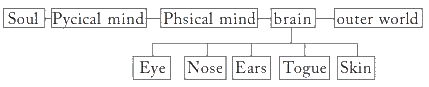
If there is no physical mind (dravya-man), the soul cannot have any sensory knowledge. Mundane souls endowed with mind certainly possess physical mind. Liberated souls do not have the physical mind and therefore, liberated souls have no sensory knowledge. They themselves are the embodiment of knowledge.
Functioning of Mind: After the perception of sensory knowledge i.e touch, taste, odour, form and sound, the activity of mind takes place. When the sense organs perceive their own objects, then to process that information is the function of mind. Other thought processes can also emerge independently in the mind.
Size of the Mind: The physical mind formed out of material aggregates that assists in thinking is body pervasive. The psychical mind is present in each pradesh (space point) of the soul. The mind functions upon all the subjects of the senses. Without accepting the presence of mind all across the body, this cannot happen.
The mind is present in the entire body and not in any specific location of the body. The objects perceived by sense organs situated in different parts of the body are processed by the mind, hence mind exists all over the body as it is said – 'yatra pavanastatra manah' which means where there is air there is mind.
1. 1. Kevali Samudghaat – when the duration and quantum of vedaniya karma (Feeling Producing karma) is more than aayushya karma (life-span determining karma), then to balance them, kevalisamudghaat happens. It happens only when the life-span of a liberating soul remains upto Antar-muhurt (one infra hour). It takes eight samay. In the first samay, the soul points spreads in the form of a stick. This stick’s length is of a size of the universe in one dimension and its width is the size of the body. In the second samay, the stick spreads in the east, west, south and north directions to give the shape of a door, which spreads completely in two dimensions. In the third samay, the door shaped soul points of the soul spreads in the shape of a churner in the east, west, north and south completely spreading in three dimensions. In the fourth samay, the units of the soul spreads into the remaining corners and empty sections of the cosmos. With this, the soul points spreads into the entire cosmic space points. Just like the soul-pointsspreads in the first four samay, it sequentially shrinks back to the size of the body in the next four samay. In the fifth instant it comes back to the shape of churner (three dimensions), in the sixth instant it comes back to the shape of a door (two dimensions) and in the seventh it acquires the shape of a stick (one dimension) and lastly in the eighth instant the points of the souls gets its original shape of body-size.
♦
9. Upayog-12
Twelve Types of Conscious Activities :
Five kinds of Gyaan (Knowledge)
1. Matigyaan - Perceptual Knowledge
2. Shrutagyaan - Verbal Knowledge
3. Avadhigyaan - Clairvoyance
4. Manahparyavagyaan - Mind reading
5. Kevalgyaan - Omniscience
Three kinds of Agyaan (Nescience)
1. Mati agyaan - Perceptual Nescience
2. Shrut agyaan - Verbal Nescience
3. Vibhanga agyaan - Para clairvoyant Nescience
Four kinds of Darshan (Perceptions)
1. Chakshudarshan - Ocular perception
2. Achakshudarshan - Non-Ocular perception
3. Avadhidarshan - Clairvoyant perception
4. Kevaldarshan - Omniscient perception
The word ‘upayog’ means 'utility'. To utilize knowledge and perception is known as upayog (consciousactivity). The quality of soul is to know. There are two basic qualities of things: general and specific quality or differentiating quality. To know things in general is known as perception. The knowledge of specific qualities of objects is known as saakaar or determinate knowledge. For example, when we look at an audience or a garden, it is our perception and after that we notice each person or tree distinctly, that is specific knowledge. This is determinate knowledge. In other words, it can be understood that there are two fundamental objects of knowledge-general and specific. Subduing the specific quality and giving importance to general quality is darshan whereas giving importance to the specific quality whilst subduing the general quality is known as knowledge or gyaan.
There are five kinds of knowledge
1. Matigyaan - Perceptual Knowledge
2. Shrutagyaan - Verbal Knowledge
3. Avadhigyaan - Clairvoyance
4. Manahparyava gyaan - Mind reading
5. Kevalgyaan - Omniscience
Matigyaan (Perceptual Knowledge) :
The knowledge of the present that occurs with the help of sense organs and mind is perceptual knowledge. It is of four kinds -
1. Avagraha (Sensation)
2. Iha (Speculation)
3. Avaay ( Judgment)
4. Dhaarana (Retention)
Avagraha (Sensation) :
The generic knowledge acquired by the contact and relation of object and sense organs is known as sensation. It is of two kinds
1. Vyanjanaavagraha 2. Arthaavagraha
The contact of sound waves, etc. with the organic structure (Nivritti) of the sense organs (ears) is known as vyanjana and the indefinite knowledge acquired by this is known as vyanjanaavagraha. After vyanjanaavagraha or even in the absence of such contact (in the sense of eyes and mind), there occurs ambiguous generic knowledge. For example ‘this is something’- when such knowledge occurs it is called arthaavagraha.
Ihaa (Speculation) :
A further analysis of the object which is cognized through sensation is speculation. After sensation of some farther objects, there occurs a doubt about what the object is; ‘is it a human being or something else’? The movement of head and actions of the hands and legs, etc. are such visible characteristics that convey ‘it should be human’ and such knowledge is known as ihaa (speculation).
Avaay (Perceptual Judgment) :
Further analysis of the object that is cognized through speculation such as ‘the object is this and not the other’- Such determinate knowledge is known as perceptual judgement or avaay.
Dhaarana (Retention) :
When the knowledge acquired through avaay becomes so entrenched that it is not forgotten even after some time, it is known as dhaarana (retention).
In other words, avagraha - the process of knowing it can be explained as-
Avagraha – Sensation – primary knowledge
Ihaa – Speculation – further analysis
Avaay – Perceptual Judgment – determination
Dharana– Retention – capacity of retaining sensory knowledge
By sensation, speculation, perceptual judgment, and retention- one can know only the modes of substance (paryaay), but not the substance. They know the substance only by mode.The main object of senses and mind is only the mode. Eyes cognizes only the mango.This implies that eyes have seen only a mango’s shape and color, but not all its modes. Apart from the shape and color, there are many other modes of mango, such as touch, taste, and smell which cannot be recognized through the eyes. Similarly, skin, tongue, nose can know their domain of touch, taste, and odour respectively. To think of all the aspects at once is not possible even for the mind.
The four sense organs i.e. ears, tongue, nose, and skin, are called praapyakaari (contactile). They can know the object only when direct contact with the object has been established. Until the sound waves do not enter the ears, sugar is not placed on tongue, the fragrance of the flower is not sensed by the nose, water does not touch the body, the sound cannot be heard, the taste of sugar cannot be realized, the fragrance of the flower is not recognized nor can the touch of water be known as to whether it is hot or cold.
Eyes and mind are apraapyakaari (non-contactile). They do not need direct contact with the object to see and know about it i.e vyanjanaavagraha. Eyes and mind can perceive the object without direct contact but the object which lies within a certain range. Eyes know the object such as a tree or a mountain even from quite a distance and mind thinks of an object even though it is situated thousands of miles away. Thus eyes and mind have been considered as apraapyakaari (non-contactile).
Shrutgyaan (Verbal Knowledge):
Knowledge that is gained by shrut. That by which we know the relationship between word and meaning, that which occurs after perceptual knowledge is known as shrutgyaan (verbal knowledge), for instance; after hearing the word ‘fire’ and relating it to physical fire or after seeing fire relating that to the word ‘fire’. Such an act of relating words with its meaning and meaning with the words and to contemplate all the related things of the same subject is called shrutgyaan. Perceptual knowledge and verbal knowledge are related profoundly. It is impossible to separate them. They have a cause-effect relationship. Perceptual knowledge is the cause and verbal knowledge is the effect. Perceptual knowledge is only the act of reflection; it is useful for the self. This reflection when it is translated into words or alphabet becomes verbal knowledge, which serves others through the different forms of communications such as order, preaching, etc. Speech concerning ordering and preaching in itself is not verbal knowledge, but it is verbal activity.The meaning implied by the words contain verbal knowledge and the words through which meaning is communicated is dravya shrut (physical verbal knowledge).
Avadhigyaan (Clairvoyance) :
This knowledge cognizes the corporeal object without the help of senses and mind within the limitation of substance, place, time, and modes is called clairvoyance. A clairvoyant can know the subtlest material objects.
Manahparyavagyaan (Mind Reading Knowledge):
The knowledge of mental states of samanaska (rational- with mind) beings without any assistance of mind and senses and with the limitation of substance, place, time and mode, is known as mind reading knowledge or manahparyavagyaan. The person endowed with this knowledge can know clearly the mental status of rational beings through dravya man (physical mind).
Kevalgyaan (Omniscience):
The knowledge through which corporeal, non-corporeal, subtle and gross and all substances with all their modes is known as kevalgyaan (omniscience).
Agyaan (Nescience) :
It is of three types; they are - perceptual nescience, verbal nescience, and para clairvoyance. Avadhi agyaan - The word ’agyaan’ here does not mean the absence of knowledge but it is in the sense of perverted knowledge.
Question: How can knowledge be false?
Answer: Knowledge is never false or perverted; knowledge is called nescience due to its association with perverted faith. Just as when a good person is also known as bad because of the company of bad people.
Between knowledge and nescience, there is only a difference in the subject or beholder. If the subject has the right faith, then their knowledge would be termed as knowledge, whereas if they have perverted faith, then their knowledge will be termed as nescience. Both knowledge and nescience are acquired through destruction cum subsidence of knowledge obscuring karmas.
Thus, both knowledge and nescience are acceptable and both are attributed to the act of knowing. There is another kind of nescience which is formidable i.e the observed knowledge, which hinders the development of knowledge.
The definition of perceptual nescience, verbal nescience, and para clairvoyance is similar to perceptual, verbal, and clairvoyant knowledge.
Mind reading and omniscience are acquired only by qualified spiritual aspirants only and they can never be acquired by people with perverse faith. Therefore, nescience is of only three types and not five.
Darshan (Perception): (anaakaar upayog)
Indeterminate cognition is known as perception. Any object can be known in two ways - generic and specific. When we know an object from a generic perspective only, then our knowledge perceives only the general qualities, hence it is general or indeterminate.
When we know a single substance from various specific perspectives, then the same primary perception cognizes specific aspects which is referred to as knowledge, as it knows only the specific qualities.
There are four types of perception – ocular, non-ocular, clairvoyant, and omniscience.
Chakshudarshan (Ocular Perception):
Generic knowledge of substances acquired by visual sense organs on account of destruction cum subsidence of chakshu - darshanaavaraniya karma is known as ocular perception.
Achakshudarshan (Non-ocular Perception) :
Generic knowledge acquired by other sense organs except for eyes, i.e. tactile, gustatory, olfactory, auditory senses and mind on account of the destruction cum subsidence of achakshu darshana, avaranaya karma is known as non- ocular perception.
Avadhidarshan (Clairvoyant Perception):
Generic knowledge of corporeal objects without the help of senses and mind on account of destruction cum subsidence of avadhi darshnaavaraniya karma is known as clairvoyant perception. It is concurrent with clairvoyance.
Kevaldarshan (Omniscient Perception) :
The generic knowledge of all substances on account of the destruction of kevaldarshanaavaraniya karma is called omniscient perception. It is concurrent with omniscient knowledge.
Question: Why ocular and non-ocular has to be differentiated. It could have been just included under sensory perception or if that is not acceptable, then each sense organ could have its independent type of perception?
Answer: The classification of perception is primarily done based on generic and specific nature of the object; ocular perception is generic perception, yet it is more reliable than other sense organs. Therefore it has been considered as an independent perception.
Question: Why is there no mind-reading perception as mind-reading knowledge?
Answer: Perception always cognizes generic attributes. Mind reading cognizes only the modes of mind that are specific. The object of mind reading is mental states which are always in specific modes; therefore there cannot be mind reading perception.
Question: What are the differences between sensory knowledge, ocular and non-ocular primary perception, sensory bio-potentials and bio-energies?
Answer: Sensory knowledge can be of two kinds - determinate and indeterminate. The knowledge gained due to the destruction cum subsidence of knowledge obscuring karma is determinate knowledge (saakaar) and the knowledge acquired through the destruction cum subsidence of perception obscuring karma is indeterminate (anaakaar). When a substance is cognized with its modes it is known as determinate perception and when a substance is cognized without its modes, it is called indeterminate knowledge.
The specific knowledge of touch, taste, etc. is specific sensory knowledge and it emerges due to the destruction cum subsidence of knowledge obscuring karma. That which causes generic knowledge of touch etc. is ocular and non-ocular perception. It is due to destruction cum subsidence of perception obscuring karma.
During birth, shapes of sense organs are formed due to material aggregate are known as sensory bio–potential which is obtained due to rise of naam karma (body determining karma).
In the acquisition of knowledge and perception, the partial or complete destruction of knowledge and perception obscuring karma is required. Similarly, the partial or complete destruction of antaraay karma (obstructing karma) is also needed. The sense organ bio–energy is the power of sensory knowledge. This power is obtained by the partial destruction cum subsidence of obstruction producing karma.
Question: What is the difference between body, tactile sense, body bioenergy, and the activity of body called kaay yog?
Answer: The body is built up of material aggregates of audaarik, etc. It is contained in the space in which it is visible.
The tactile sense is of two types-physical and psychical. The physical tactile sense is present in the innumerable part of the angula and it is obtained by the rise of naam karma.
Psychical tactile sense organs have the power to cognize the touch of the object and it is obtained by the destruction cum subsidence of gyaanaavarniya and darshanaavarniya karma. The tactile sense organ is spread all over the body. Through this, a living being cognizes touch. There is no part in the body where this sense organ i.e sparshanendriya is not present. Although without body, sparshanendriya cannot sustain yet, body and sparshanendriya are two different entities.
Body bio energy: It is the power that works in the body, which arises due to the partial destruction cum subsidence of obstruction producing karma. Kaayayog (Physical activities) refer to activities like moving, walking, etc.
♦
10. Karma-8
Eight Types of Karma :
1. Gyaanaavarniya (Knowledge obscuring)
2. Darshanaavarniya (Perception obscuring)
3. Vedaniya (Feeling i.e. pleasure and pain producing)
4. Mohaniya (Deluding)
5. Aayushya (Life span determining)
6. Naam (Body determining)
7. Gotra (Status determining)
8. Antaraaya (Obstruction producing)
The soul is a sentient incorporeal substance. The subtle veil of impurity attached to the soul is known as karma. Karma is matter and non-living. The karmik matter attached to the soul is called karmadala (karma-cluster) or karmik impurity. The karmik clusters are bound to the soul according to the intensity of our passions and fickleness in the form of activity. Karmik particles are attached to the soul since eternity. Over a period of time, some of these karmik bondages break apart and new ones get attached. In this way the process continues. Due to perversion, non-abstinence, remissness, passions and activities, the soul absorbs the karmik particles. Karmik particles are attached to the soul, it is called karma. Karmik particles are a kind of very subtle particles which can be known only by an omniscient and a clairvoyant.
Definition of Karma
Karmik particle is that which is attracted and bound to the soul by its good and bad activities, and that which obscures the pure nature of the soul, distorts and results in auspicious and inauspicious (good and bad) effects,these particles are called karma. Although these karmik aggregates are of the same kind, they have different names according to their effect on a soul such as obscuring, distorting or effecting, etc.
There are eight attributes of the soul :
1. Kevalgyaan (Omniscience)
2. Kevaldarshan (Omni-Perception)
3. Aatmiksukh (Spiritual Bliss)
4. Kshaayik Samyaktva (Enlightened worldview obtained due to destruction of relevant karma)
5. Atal avgaahan (Immortality, ever-stable-configuration of space units of the soul)
6. Amurtikpan (Incorporeality)
7. Agurulaghupan (Neither high nor low status)
8. Labdhi (Omnipotence)
The first attribute of the soul is infinite knowledge (omniscience). Karmik particles that obstruct knowledge are known as knowledge obscuring karma. All the souls in the world possess infinite knowledge. Until the veil of knowledge obscuring karmas is completely annihilated, knowledge remains partial. When this knowledge obscuring karma is completely destroyed, omniscience is acquired.
The second attribute of the soul is omniperception. Omniperception is present in all living beings. The karmik material covering this attribute is known as perception obscuring karma. Once this karma is destroyed, omniperception is obtained.
The third quality of the soul is spiritual bliss. Karma particles that obstruct this quality are called feeling producing karmas.
The fourth attribute of the soul is right faith. Karma particles that distort the quality of right faith are called deluding karmas.
The fifth attribute of the soul is its ever-stable configuration of space units of the soul. The karma particles that obstruct this quality of eternal stability are called lifespan determining karmas.
The sixth attribute of the soul is amurtikpan (Incorporeality). The karma particles that obstruct this quality are the body determining karmas. The body is obtained by the rise of body determining karma. Due to this the incorporeal soul contained in the body seems to be corporeal.
The seventh quality of the soul is agurulaghupan (equivalence, neither high nor low). Karma particles that hinder this quality are called status determining karmas.
The eighth quality of the soul is labdhi (omnipotence). Karma particles that obstruct this quality are called hindrance producing (antaraay) karmas.
Karmik aggregates have only four types of touches and not eight. All material aggregates existing in this universe related to living beings can be divided into two categories:
1. Ashta-Sparshi -Materials having eight attributes of touch: Those material aggregates which possess color, taste, smell along with eight types of touch such as hot or cold, viscous or dry, soft or hard, heavy or light are called ashta-sparshi material aggregates.
2. Chatuh-Sparshi -Material having four attributes of touch: Those material aggregates which consist of color, taste, smell with only four types of touch -hot and cold, viscous and dry only are called catuh-sparshi material aggregates.
Two Categories of Karma :
Karmik materials that get attracted to the soul can be divided into two categories – ghaati karma and aghaati karma.
1. Ghaati (Destructive) Karma:
Karmik material that affects significant or primary attributes of the soul after being attached to the soul is calleddestructive karma. By completely cleansing them, the soul acquires omniscience and omni-perception. There are four destructive karmas, namely knowledge obscuring, perception obscuring, deluding and hindrance producing.
2. Aghaati (Non destructive) Karma:
Karmas that do not affect the original attributes of the soul are called non-destructive karma. They cannot exist in absence of destructive karma and the non destructive karmas get completely destructed in that very birth. Feeling producing, life-span determining, body determining and status determining karmas are the types of non-destructive karmas.
Karma and their Functions
1. Knowledge obscuring karma is like a band on the eyes. By tying a band on the eyes, vision gets obstructed. Similarly, gyaanaavarniya karma obstructs knowledge.
2. Perception obscuring karma is like a doorkeeper. As a doorkeeper obstructs one to meet the higher authority such as King etc. Similarly, darshanaavarniya karma obstructs the perception or vision.
3. Feeling producing karma is compared to a sword dipped in honey which when tasted, gives a sense of pleasure. This is like the pleasure producing karma (saata-vedaniya). On the other hand, when the sword cuts the tongue, it results in pain. This is like the pain-producing karma (asaata-vedaniya).
4. Deluding karma is compared to intoxication. There is no presence of mind in an intoxicated person similarly by the rise of deluding karma person’s view is perverted and the person indulges in material and sensory pleasures.
5. Lifespan determining karma is compared to shackles. As a man restrained with shackles is not able to free him without breaking them. Similarly, the soul cannot move from one birth to the other without experiencing all the effects of aayushya (lifespan) karma and without the complete destruction of this karma, one cannot attain liberation too.
6. Body determining karma is compared to a painter. As a painter makes different kinds of paintings, the effect of body determining karma makes different kinds of bodies and endows the soul with different shapes and organs.
7. Status determining karma is compared to a potter. As the potter makes pots of various sizes such as small, large, etc., the rise of status determining karma determines whether an individual gets high or low status in life.
8. Hindrance producing karma is compared to a treasurer of a King. In spite of having permissions from the king, one cannot have access to the materials until the Treasurer gives it. Similarly, without the destruction of hindrance producing karma, one cannot get the desired things.
Causes of Karmik Bondage - Five Ashravas (Influx)
Mithyaatva (Perverted faith), Avirati (Non-abstinence), Pramaad (Remissness), Kashaay (Passions – anger, ego, deceit and greed), and Yog (activities of mind, speech and body) are the five causes of karmik bondage and are called paanch-aashrav (five doors of influx).
The causes include the classifications of all the different activities of all living beings. A common person cannot comprehend the causes of the karmik bondages. Therefore, its detailed study becomes necessary. Each type of karmik bondage has its independent causes.
Causes of Bondage of Knowledge Obscuring Karma
1. Gyaan-Pratyanikata: Keeping a bad attitude towards knowledge or the learned person.
2. Gyaan-Ninhav: Showing disrespect towards, knowledge or the teacher. Example: to say that this teacher is not a knowledgeable person.
3. Gyaan-Antaraay: Obstructing others from obtaining knowledge.
4. Gyaan-Pradvesh: Hatred towards knowledge and the learned person.
5. Gyaan-Ashaatana: Misbehaviour towards knowledge and the learned person.
6. Gyaan-Visamvaadan: Opposing the knowledge and the words of the learned person.
Causes of Bondage of Perception Obscuring Karma
1. Darshanpratyanikata: Keeping a bad attitude towards perception or its possessor.
2. Darshan-Ninhav: Disrespect towards perception or the teacher. Example: To say a good perceptor is not a good possessor of perception.
3. Darshan-Antaraay: Obstructing others from perception.
4. Darshan-Pradvesh: Hatred towards perception or its possessor
5. Darshan-Ashaatana: Disregard the perception or misbehaviour with the perceptor.
6. Darshan-Visamvaadan: Opposing the perception or the words of the perceptor.
Causes of Feeling Producing Karma: Vedaniya karma is of two types – Saata-vedaniya (pleasure producing karma) and Asaata-vedaniya (pain producing karma).
Causes of bondage of pleasure producing karma:
· Not inflicting pain to living beings (praan, bhoot, jeev, satva)1 by violent activities in the following ways cause the bonding of saata-vedaniya karma
· Not to hurt the body of the praan, bhoot, jeev, sattva.
· Not to condemn the praan, bhoot, jeev, sattva.
· Not to trouble the praan, bhoot, jeev, sattva.
· Not to harm praan, bhoot, jeev, sattva by any source of weapon.
· Not to torture praan, bhoot, jeev, sattva.
If the above mentioned deeds are conducted, then it binds pain feeling producing karma.
Causes of Bondage of Deluding Karma
Intense anger, ego, deceit and greed, intense delusion of right faith, intense delusion of conduct, intense perversity.
Intense no-kashaay (nine-quasi passions like laughter, fear, etc).
Causes of Bondage of Lifespan Determining Karma
A. Four causes of Narak-Ayu (Lifespan in Hell)
1. Maha-Aarambh (Extreme Violence)
2. Maha-Parigraha (Extreme Possession)
3. Panchendriya Vadh (Killing of five sensed beings)
4. Maansaahaar (Consumption of meat)
B. Four causes of Tiryanch-Ayu (Lifespan in Sub-human form)
1. Maaya (Deceitful act)
2. Goodh-Maaya (Intense Deceitful act – to create a chain of deceitful deeds).
3. Asatyavachan (Untruthful speech)
4. Koot-tol-maap (Corruption in weights and measurements)
C. Four causes of Manushya-Ayu (Lifespan in human form).
1. Saral prakriti (Straight for wardness) - Simple and good nature
2. Vineetprakriti (Humility) - Modest nature
3. Daya - being compassionate
4. Irshyaa na karna - Not to be jealous
D. Four causes of Dev-ayu (Lifespan in Heaven)
1. Saraag-sanyam - To practice self-restraint with attachment. Aayushya-bandha (lifespan determination) does not happen due to attachment nor does it happen due to self-restraint. It happens due to penance (self- restraint) with attachment. By the abhedopachara (considering cause and effect as one ) this cause is called saraag-sanyam.
2. Sanyamaasanyam (Partial self-restraint) - To follow the layman(Shravak) vows.
3. Baal tapasya - Penance with perverted belief.
4. Akaam nirjara - Penance done without the desire for liberation.
Causes of Bondage of Body Determining Karma
There are two types of body determining karma: Shubh (Auspicious) and Ashubh (Inauspicious).
There are four causes of Bondage of auspicious body determining karma :
1. Kaaya rijuta: Not performing any physical activity to cheat others
2. Bhaav rijuta: Not performing any mental activity to cheat others.
3. Bhaasha rijuta: Not performing any verbal activity to cheat others.
4. Avisamvaadanyog: No contradiction in speech and action.
If the above-mentioned acts are done with intention to cheat others, it results in the bondage of inauspicious body determining karma.
Causes of Bondage of Status Determining Karma
There are two types of status determining karma- Uccha (superior) status determining karma and Neech (inferior) status determining karma.
There are eight causes of status determining karma.
1. Jaati (Class) 2. Kul (Clan) 3. Bal (Power) 4. Roop (Beauty) 5. Tapasya (Penance) 6. Shrut (Knowledge) 7. Laabha (Benefit) 8. Aishvarya (Prosperity)
Not being proud due to any of the above eight factors is the cause of superior status determining karma and the ego of the above factors causes the bondage of inferior status determining karma.
Causes of Bondage of Obstruction Producing Karma:
By obstructing a person from 1} Daan (charity), 2} Laabh (Benefits), 3} Bhog (Enjoyment) 4} Upabhog (Indulgence), 5} Veerya (spiritual potential) causes the bondage of obstruction producing karmas.
Ten States of Karma
1. Bandha (Bondage)
2. Udvartan (Augmentation)
3. Apavartan (Attenuation)
4. Satta (Existence)
5. Uday (Realisation)
6. Udeerana (Premature Realization)
7. Sankraman (Transformation)
8. Upshaman (Subsidence)
9. Nidhatti (Incapability of all these processes except augmentation and attenuation)
10. Nikaachanai (Incapacitation of all these processes)
Bandha: Soul has innumerable units (aatma-pradesh). Mithyaatva (perversion), Avirati (non-abstinence), Pramaad (remissness), Kashaay (passions – anger, ego, deceit and greed), and Yog (activities of mind, speech and body) cause vibrations in the aatma-pradeshas (units of the soul). As a result, infinite karmik particles get attached to the individual units of aatma-pradesh in that area. This process through which the bondage of these karmik particles occurs with the units of the soul is called bondage. The relation of soul with karma is akin to milk and water or fire and hot iron. In essence, karmik aggregates bound with soul are called karma.
There are four types of bondage.
a. Prakriti bandha (Nature of bondage): Karmik particles attracted by auspicious activity of the soul are auspicious and by the inauspicious activities are inauspicious. They get classified into knowledge obscuring, perception obscuring, etc. After the contact of the soul with karmik particles is called prakriti bandh.
b. Stithi bandha (Duration of bondage): Karmik particles both auspicious and inauspicious, attracted by the soul remain bonded with the soul for a specific duration keeping their nature intact. This includes the dormant phase called abaadhaa kaal. After this, they move into the active phase giving auspicious and inauspicious results. This karmik bondage with the soul for a specific duration is called stithi bandh.
c. Anubhaag/Rasa bandha (Intensity): Some karmas are bound with strong intensity whilst others with mild intensity. The intensity of the activity of soul while doing auspicious and inauspicious activities determines the intensity of the bondage of karma and possess the same intensity while fruition of karma.
d. Pradesh bandha (karmik mass): The number of particles varies in different karmik aggregates and this is pradesh bandha.The attracted karmik particles gets divided based on their nature in different quantum. This division in to different quantum is pradesh bandha. The soul does not attract the aggregate of numerable karmik particles (sankhyaat parmaanu). Instead, it attracts the aggregate of infinite karmik materials particles.
1. Udvartan: Increase in duration and intensity of bondage is known as augmentation.
2. Apavartan: Decrease in duration and intensity is known as attenuation. Preponing or postponing the effects of karma and the change in intensity of effect is due to augmentation and attenuation.
3. Satta: Karmas do not bear their effects immediately. Results are experienced after a fixed duration. As long as karmas remain bound with the soul without giving its effects, it is known as satta.
4. Uday: On the completion of duration of karmik bondage, fruition of karmik particles is experienced as auspicious or inauspicious forms which are called uday i.e. rising state of karma. This is of two types – phaloday and pradeshoday.
a. Phaloday – Karmas experienced on physical levels is called phaloday
b. Pradeshoday (virtual realization) – Karmas which are experienced in the units of the soul is called pradeshoday.
5. Udeerana: Prior realization of the results of karma. This is a process whereby karmas that are towards rising state, are pulled and realised before its fixed time, after the completion of the period of dormancy by the special efforts of the soul along with other karmas that are in the state of rising. This process is known as premature realization.
6. Sankraman: Efforts through which mutual transformation of the sub types of karma belonging to the same genus (interchange of sub-types of the same karma takes place). Interchange of anger and ego etc. is called transformation. Ayusha karma cannot undergo such transformation. Darshan-moh (faith deluding) and Chaaritra-moh (conduct deluding) karma also cannot undergo transformation with each other.
7. Upashaman: Complete ineffective state of mohaniya (deluding) karma is called upshaman. This is the period when both actual and virtual rising does not take place. This state of incapacitation with exception is called subsidence.
8. Nidhatti: The state, in which only udvartan and apavartan are possible and all other modifications like sankraman etc are not possible, is called nidhatti.
9. Nikaachanai: The karmik bondages which have fixed duration and intensity and have to be physically experienced (phaloday or vipaakoday) in the same form is called nikaachana. These kinds of karmik bondages are very intensely bound to soul and cannot be modified through udvartan, apavartan, udeernaa etc.
In Jain philosophy, Karmavaad holds the same position as the position of ‘kaarak’ is in Sanskrit grammar. The diversity in all living forms is only because of their karma. Some are wise and some are foolish, some are attached and, some are detached, some are born and some die. Some acquire reputations, others insult, some scholars are poor whereas some fools are millionaires, some are writers but not poets, some are poets but not speakers, some are writers, poets and even speakers at the same time, some having all qualities are workers, others having no quality are leaders. There are innumerable differences in each and every living being and the underlying cause is karma. In association with certain circumstances, the respective karmas become active and affect our life.
Q. How can a non-corporeal be in relation with corporeal?
Answer: Karmas are bound to the soul since time immemorial. Any worldly soul cannot stay in this world even for a single moment without karma. All the karmic bondages with soul are attached for specific duration only. No karmic particle is bonded with the soul forever. Therefore, we have to accept the fact that the stream of karmik bondage has been forever, but specific karmik bondage has a beginning based on individual souls.
As per tarka shastra (logic), the nature of dravya (substance) is such that anything present since eternity will continue to be forever. We also know that a soul attains liberation after breaking the unprecedented cycles of karmik bondages. Therefore the solution to this enigma is that relationship of the soul and the karmik bondage is since eternity with respect to karmik cycles, but has a beginning and also an end with respect to bondage of specific karmik particles.
The next question is - how can a non-living corporeal karmik matter get into the bondage with non-corporeal conscious soul?
By nature, soul is non-corporeal. However, since worldly souls are covered with the veil of karma, they are partially corporeal. The bonding of karma occurs only with these worldly souls. When the worldly souls are completely cleansed of all karmik bondages, then no further karmik attractions or bondages can occur. The crux is that karmik bondages occur only to the worldly souls with existing karmik veils.
It can be asked, how did the soul get attached with karma in the first instance? When we cannot find the starting point of the soul or karma because those does not exist whatsoever, then how can we identify the starting point of their first bonding? The answer to this is that the relation between soul and karma is apashchaanupurvi. There is neither a posterior nor prior relationship.
If we accept the soul before the existence of karma, then there exists no reason for karmik bondages. We cannot even accept karmik bondages before the soul, because it is the soul that binds karma and in the absence of the soul what will bind karma. Creation of both together is also illogical. First of all, there is no such creator. Secondly, if we imagine that God has created then this paradigm gets more complicated. There can be so many other logical issues which will not result in any solution. Did God create existent from non-existent or transformed the existent? It is a universal fact that one can neither produce the existent from non-existent, nor non-existent from existent. Why was existent transformed? How was it done and what was the process? What was it before and what did it get transformed to later? There are no satisfactory explanations for these questions. Thus, we have to accept that the relation between soul and karma is since time immemorial. Their eternal beginning less existence is more logical and comprehensive.
Question: Soul is non-corporeal and karma is corporeal, then how can there be any bondage between two opposite and contradictory objects?
Answer: There can be no bondage of the corporeal karma with the non-corporeal soul. But on each space point of the worldly souls, infinite karmik-aggregates are attached. Thus, although the soul is non-corporeal, it becomes corporeal on account of being attached with the karmik body. This cycle of karmik bondage has been existing eternally. The bondage of karmik aggregates is only due to this karmik body. When the karmik bondages are completely cleansed, the soul becomes completely free and then the karmas never get attracted to such a pristine soul. In summary, only when there is a presence of karmik body or reason for karmik bondage with the soul, there can be new karmik bondages, not otherwise! Although liberated souls are also present in the space filled with all kinds of material aggregates, there is a complete absence of causes of karmik bondages in these souls. In spite of karmik particles being present, they cannot form any relation with liberated souls. Thus, the karmik particles being present there cannot make any relation with liberated souls.
The karmik material not acquired by the activities of the soul remain spread in the universe, they do not have any power to produce effect on the soul. In mundane soul, there exists a cause for karmik bondage. Thus, the karmik particles acquired by the soul possess the power to get unified with the soul and ultimately produce their effects. They get disassociated from the soul after producing their effects. Therefore, the major cause of karmik bondage is activity appropriate for the bondage, by the soul.
The relation of the soul and the karma is eternal. Not even a single karmik particle is such that it has been attached to the Aatma (soul) forever. The maximum duration of karmik bondage is of mohaniya karma whichis 70 kroda-karod saagar (a measure unit of time specific in Jainism). Therefore, there is no obstacle in liberation. Karmik bondages always have a cause. Until the causes for karmik bondage exist, bondages will keep on occurring and get disassociated from the soul after yielding its results. When the soul closes the door of karmik bondage influx (aashrav), it stops further karmik bondage and the existing karmik bondages are either destroyed through premature realization or dissociate naturally from the soul, after producing their effects and the soul attains salvation.
Question: If karmas are material, how do they produce appropriate effects?
Answer: It is absolutely correct that karmas cannot judge as to whether a particular soul has done a particular good or bad deed and therefore such and such effect must be given. According to the soul’s activity, the auspicious and inauspicious karmas are attracted. Due to that bondage, the soul transforms and accordingly gets the results. When did alcohol have the knowledge of its power to intoxicate? When did poison learn to kill? Still, intoxication is felt after consuming alcohol and death occurs after consuming poison. Healthy foods do not know how to provide health, medicine does not know how to cure illness, even then healthy food improves the health and medicine cures the illness. When there are all such effects of external material substances, why should there be any doubt about the effect of subtle karmik materials on the soul which are attracted by the soul’s activities? With appropriate procedures, the power of medicine and poison can be altered. Similarly, by penance there can be modification in resultant power of karma. Karmas with longer duration and high intensity can be modified into low intensity and shorter duration through apavartan (attenuation).
Question: Every soul seeks comfort and not discomfort, then why would a soul by itself experience the fruit of inauspicious karma?
Answer: In this context, one wonders whether comfort and discomfort occur according to one’s merit and demerit or according to one’s wish. If we get happiness through our wish, then karma has no relevance. What you desire, you will get. In such a situation the desire itself becomes the essence of the supreme power of the world, whether you call it chiintaamani (a wish fulfilling stone) or a kalpavriksh (a wish fulfilling tree). If karma exists, then the result would be acquired according to karma. Good karmas bear good fruition; bad karmas result in bad fruition. Buddhikarmaanusaarini - Intellect follows the karma.This aphorism clears the subject, that as the karmas decide the intellect, the intellect decides the action and the action produces the results.
No judge is required to determine the results of our karma. A person can indulge in violence, theft, prostitution and other immoral activities on account of the previously bound karmas. A judge punishes in order to prevent a man to indulge in criminal acts then why should a pure so called supreme soul/god like judge choose to punish man in such a way that the man is forced to get indulged in violence, theft etc.
According to Jain philosophy, the universe is beginningless and endless. Neither it has a beginning (anaadi), nor an end (ananta). There is no creator. According to some philosophies, the world is a creation. If it is a creation, then there must be a creator and that creator is known as God. If we accept this logic, then many questions arise, such as - If God manages everything, then he must suffer from blemish for being partial in giving happiness and misery to living beings. Those who are happy are in such a state because God loves them and those who are in misery are because God hates them. Thus, in this case God in himself would stand impure because of the presence of malices like attachment and aversion in itself. Thus, how can we accept such a God as the supreme power?
If we accept such a God as a creator of this universe then there should be a creator of that God and thus occurs the fallacy of regressus ad infinitum. If everything is God’s creation, then there is no space for purushaartha (virtuous efforts) and the whole creation would run as per his desires. According to the Jain philosophy, each individual soul itself is responsible for all its karma, which results in different experiences of happiness and pain.
The paramaatma (purest souls) are devoid of attachment and aversion. They are not concerned with worldly affairs.
Question: Due to external circumstances such as war etc, crores of people die. Ironically, noble and religious people suffer multiple troubles and sinful people relish happiness. Therefore, is it right to say that circumstances are a major cause of happiness and sorrow, and not karma?
Answer: Many people die in war; the cause for this is the udeerana or pre-mature realization of life span karma. Udeerana means the karmas that are to be realised later, are brought to fruition before its actual time with special efforts. In any sudden incidents and unusual circumstances, Udeerana plays a vital role. The circumstance is a kind of an effect of karma. One has to experience the conditions of life according to one’s own karmik bondages. The changes that occur in the circumstances are also due to the karmik effect. Some are born rich but die penniless and vice versa. Some find happiness in prior part of their life, some in the later part. Some are poor in rich countries and some are rich in poor countries. Some have wealth but suffer from poor health and some have good health but suffer poverty. All such circumstances and changes are results of karma. Therefore, karma is paramount. Karma brings changes in these circumstances. Its effect is flawless. If previously inauspicious karmas are bound and are nikaachit (certain with no alternations possible), then a person being righteous in the present will have to bear inauspicious results of those previous karmas. If auspicious karma is bound and is definitive, then even being sinful at present one will bear the auspicious result of karma. In this context, it is important to understand that Jain philosophy never advocates one to be totally dependent on karma and neglect the efforts. There is neither supremacy of karma nor any objection to efforts, but a harmony between both. This is a significant component of spiritual development.
The doctrine of karma generates hope, enthusiasm, and energy in life. With total faith in this doctrine, there remains no room for depression, discouragement, and laziness. The experiences of pain and pleasure do not affect the soul.
Karma is the only cause of the soul’s cycle of birth and death. Our present is the result of past deeds. Whatever a person inherits, is the fruit of one’s own deeds and the seeds which were cultivated by him.
We make our destiny through our thoughts and desires. What we are today is the result of karmas we acquried in previous lives. Ishwar (God) is not responsible for our present condition. We ourselves are responsible, and if this paradigm of the soul is understood, then we can shape our future for the better and our regression will cease. We can gradually grow spiritually until we achieve the ultimate goal of life.
The soul is not dependent on any whims of a mysterious or mighty entity. It doesn’t have to knock the door of the so-called mighty God for the fulfillment of its desires. For spiritual growth or to absolve the sins, it is not necessary to beg for compassion, cry or bow one’s head before any mighty power. As per karmavaad – the doctrine of karma in Jainism, the soul of all living beings is equal and they all have the same potential. The differences we see in the worldly souls are based on the variation of spiritual development caused by karmik bondages.
As per karmavaad, the person with the highest spiritual development is called lord or paramaatma. Our spiritual development is hindered or hampered by karmik veils. However, through effort and exertion (purushaartha), these veils can be removed. Every soul has the capability to cleanse the soul, clear the veils of karma and such powers can be developed to attain the supreme state of purity and become paramaatma.
Jain philosophy believes that for anything to happen, karma and efforts are not sufficient factors, there are five ultimate causes namely kaal (time), svabhaav (nature), karma, purushaartha (effort) and niyati (destiny).
Kaal: (Time)
Niyati (destiny), svabhaav (nature) and purushaartha (efforts) do not operate without time. The effects of auspicious and inauspicious karma do not occur as soon as they are bound. Their effects are realised after a specific period. A baby cannot be taught to walk and talk, as soon as it is born even after arduous efforts. It can only learn to do things at an appropriate time. A seed of mango has the potential to become a huge tree and bear thousands of fruits, but this does not occur as soon as it is sown. Similarly, the disease cannot be cured as soon as the medicine is given, it takes time. All substances undergo origination, persistence, destruction, integration, and disintegration, which occur through a definite passage of time.
Svabhaav: (Nature)
The seed of mango has all the qualities of becoming a gigantic tree with the efforts of a farmer. Each object has its specific nature. Babool tree cannot produce mangoes.
Karma
A woman gives birth to two babies, one good looking and smart whereas the other is ugly and unintelligent. Why? Although factors such as time, effort, and nature are the same, why is there a difference? Having the same ovum and sperm of the same mother and father, born out of the same womb, having the same environment, still such differences occur, why? This is all due to the effect of karma. The soul that has done good deeds in its previous birth, acquires favorable conditions whereas the soul that is indulged in sinful actions, acquires unfavorable conditions.
Purushaartha: (Effort)
Karma is the cause of transmigration in the world and it does not have the capacity to liberate the soul. For liberation, exertion is required. In spite of good deeds of previous birth and bondage of auspicious karma, one may not get the desired positive effects if there is no effort in the present life. For this effort is necessary. In spite of having all the ingredients such as flour, water, fire, etc. to make food, the food cannot be prepared just by fate. There has to be a physical effort in preparing food. Without doing any effort in the present nothing can be accomplished. Efforts design the fate but once designed then the fate is independent; efforts have no say in this regard.
Niyati : (Destiny)
Niyati (destiny) is the material aggregate of karmik particles whose effects cannot be modified or changed in any form. Such karmik bondages are called nikaachit bandha. When even after all the exertions and efforts for a particular purpose does not yield the desired results, then it must be understood that it is because of destiny. Efforts fail only in case of destiny.
For successful completion of any activity, all the above five factors are essential. For example, if a student has to clear his class X examinations.
· Kaal: It would require at least six-seven years of preparation.
· Svabhaav: Only with the concurrence of some of the qualities such as concentration, interest, and capacity of learning, etc, it is possible to pass the exams.
· Karma: Intelligence and good health are required which is obtained by rising or destruction cum subsidence of previous karmas.
· Purushaartha. Efforts are required. One has to go to school, learn the lessons.
· Niyati: Even when all the above four factors coincide, one can still have a lot of hurdles. There can be a brief illness, but a doctor’s medicine can help and one may pass the exam. But there can be other hurdles and in spite of all efforts they cannot be avoided and the students fail. This is the result of niyati (fate).
Life is full of challenges, obstacles, and pains. These things can easily frighten a person. The mind becomes very unstable. It is easy to curse and blame the circumstances for all sufferings. In these difficult situations, the doctrines of karma can show the right way. Its chief maxim is-soul itself is the creator of its destiny. All the suffering is self-procured and it is the result of one’s deeds. No external factors can make a soul happy or miserable. All other factors can only be circumstantial (nimitta). With strong faith, all the challenges can be dealt without fear and without blaming the circumstances. Karmavaad protects us from pessimism, provides power to tolerate sorrows, and gives strength to face adverse conditions with mental stability.
1.Praanah dvitri- chartuh proktah, bhootaastu taravah smritaah
Jeevaah panchendriya, gyeyaah, sattvaah udeeritah
Living beings having two, three or four senses are known as praan. Vanaspati i.e one sensed plant bodied living beings are called bhoot and five sensed beings are called as jeev, whereas the remaining four kinds of sthaavar (immobile beings -earth, water, fire and air bodied) are termed as sattva.
♦
11. Gunasthaan-14
Fourteen Stages of Spiritual Development :
1. Mithya Drishti ( Perverted faith)
2. Saasvaadan Samyak Drishti (Receding Spiritual Faith)
3. Mishra Drishti (Right cum wrong Faith)
4. Avirat Samyak Drishti (Right Faith with non-abstinence)
5. Deshvirati (Partial Abstinence)
6. Pramatta Sanyat (Renunciation with Laxity)
7. Apramatta Sanyat (Renunciation Devoid of Laxity)
8. Nivritti Baadar (Removal of Gross Passions)
9. Anivritti Baadar (Presence of Subtle Passions)
10. Sukshma Samparaay (Subtle delusion/Subtle passion of greed)
11. Upshaant Moha (Repressed delusion)
12. Ksheen Moha (Complete elimination of delusion)
13. Sayogi Kevali (Omniscience with activities)
14. Ayogi Kevali (Omniscience with the total cessation of activities)
The spiritual development from the lowest level to the highest as per Jain philosophy is classified into fourteen stages. These stages through which one ascends the spiritual development are called gunasthaan. As the purity of the soul increases, one ascends the stages of spiritual development whilst as impurity increases, one descends down.
1. Mithya Drishti (Perverted Faith): People with antagonistic spiritual beliefs, having no spiritual alignment or faith in spirituality, or having a perverted perception about liberation is called mithya drishti. This stage of spiritual development is known as mithya drishti gunasthaan.
The perception of a person having perverted world view due to partial destruction cum subsidence of karma is known as mithya drishti or mithya drishti gunasthaan.
According to the first definition, the quality present in a person with a perverted view is mithya drishti, hence this gunasthaan is called mithya dristhi gunasthaan. The first definition focuses on the quality of the person with perverted world view, whereas the second definition focuses on the kshayopashamik drishti of the person, subordinating the person himself. However, the meaning of both remains the same, just the expression varies.
2. Saasvaadan Samyak Drishti (Receding Spiritual Faith): This is the stage of spiritual development in which the viewpoint of the person is with the lingering taste of the right belief. This is known as saasvadan samyak dristhi gunasthaan. It is a transitory stage. When a person moves from upashama samyaktva (right faith due to subsidence of the relevant karma) to the first stage i.e mithya drishti gunaasthaan of spiritual development is called saasvaadan samyak drishti. It is the moment in which the fruit has fallen from the tree but has not yet touched the ground is comparable to the second stage of spiritual development.
3. Mishra (Right-cum-Wrong faith): This is a doubtful, oscillating state of the soul. The characteristic of this stage is that spiritual faith is inconclusive, regarding reality, it remains ambiguous, doubtful and his view swings between right and wrong. This fluctuating state of spiritual development is called mishra gunasthaan. The difference between the first and third stages of spiritual development is that in the first, the faith regarding truth is absolutely perverted, whereas, in the third stage, the faith is skeptical.
4. Avirati Samyakdrishti (Right Faith with Non-abstinence): One who has acquired the right belief, but does not have any kind of abstinence, belongs to this stage of spiritual development called ‘right belief with non-abstinence’. This is a state of right worldview without abstinence. Faith towards truth is entrenched, but the conviction to follow the abstinence is not yet developed. In this condition, the soul realizes itself. The person acquires wisdom of discretion between body and soul and ponders upon the fundamental questions, such as what is the goal of life? Why are we in this world? What are the ways for escaping from this worldly bondage? He endeavours to move towards liberation. In other philosophies, it is also called as self-realization or self-enlightenment.
5. Desh Virati (Right Faith with Partial Abstinence): Those who have both abstinence and non-abstinence. The people who belong to this stage they are not completely restraint, their state of spiritual development is known as right belief with partial abstinence or the state of abstinent-cum-non abstinent. This state of deshvrati, (partial abstinence) is also known as samyataasamyati (restrained cum non-restrained), vrataavrati (vowed cum vow less), dharmaadharmi (religious cum-non-religious state). The onset of the conduct of truth commences.
6. Pramatta Sanyat (Complete Abstinence with Remissness): Stage of spiritual development of a non-vigilant saint is known as a state of abstinence with remissness. In this stage, there is a strong resolution to follow the conduct of truth. Life of complete renunciation and spiritual practices begins from this level.
7. Apramatta Sanyat (Self-restraint devoid of Remissness): The state of spiritual development of a vigilant saint is known as the state of self-restraint without remissness. In this state, remissness is totally absent; therefore this state is purer than the sixth state.
8. Nivritti Baadar (Dissimilar or Dissociation from Gross Passions): The state in which soul absolves from gross passions, (either partially suppressed or destroyed) is called a dissimilar gross passion state. In this state, the soul is devoid of intense passions namely anger, pride, deceit, and greed.
9. Anivritti Baadar (Presence of Similar Residual Gross Passions): In this state, residual intense passions continue to exist. Though, the soul becomes free from passions to a large extent. This stage is also called similar gross passion. In the eight stage, there is the annihilation of passion to some extent, therefore it is known as nivritti (eradication) whereas in ninth state residual passion exists, therefore it is called anivritti baadar gunasthaan. The name of the eighth stage is based on passions that are eradicated, whereas the name of the ninth stage is based on passions that are left back but are to be eliminated.
10. . Sukshma Samparaay (Subtle Greed Passions): The word ‘samparaay’ means greed. The state of spiritual development where only subtle greed remains is known state of subtle greed passions. In this state anger, ego, and deceit are repressed or completely destroyed; only residual greed remains.
11. Upshaanta Moha (Complete Subsidence of Delusion): When a person’s delusion is repressed for infra–hour (antar-muhurt) it is known as upshaanta moha gunasthaan. The greed that remained through previous stages is repressed completely but not annihilated in this stage. It is just like a flame that is buried under the ash, which flares up again.
12. . Ksheen Moha (Complete Elimination of Delusion): When a person’s mohaniya (deluding) karma is completely destroyed, this spiritual state is known as ksheen moha gunasthaan. In this state, delusion is completely destroyed. The subtle greed of the previous stage is completely removed. The soul becomes free from all passions in this state and is called veetaraag (Free of all attachments).
13. . Sayogi Kevali (Omniscience with Activities): In this spiritual stage, an omniscient has activities of mind, speech, and body. This state therefore is known as sayogi kevali gunasthaan. In this state, all destructive karmas – gyaanaavarniya, darshanaavarniya, and antaraay are completely destroyed. The soul attains omniscience, omni-perception, and omni-potence.
14. . Ayogi Kevali (Omniscience with the Total Cessation of Activities): In this stage, an omniscient is without any kind of activity of mind, speech, or body. Thus this state is known as ayogi kevali gunasthaan. Here the omniscient stops all mental, verbal and physical activities and becomes ayogi i.e., motionless. All the remaining karmas are completely destroyed and the soul attains absolute liberation and becomes free. This is the end of the transmigration of the soul forever.
Question: What is the basis for stages of spiritual development?
Answer: There are five types of impurities in the worldly soul. First is perverted faith, which obscures the right faith and perverts the wisdom. The second impurity is non-abstinence, which traps the soul in the web of desires. The third impurity is remissness, which breaks the soul’s everlasting spiritual enthusiasm and makes the person remiss. The fourth impurity is passion, which makes the soul agitated. The fifth impurity is activities (yog) which makes the soul fickle. These five impurities are called as aashrav (Influx) in Jainism. These aashrav combined with the strong or mild intensity of mohaniya karma determine the fourteen stages of spiritual development. The greater the impurities are removed, the purer the soul becomes, and this purity is known as stages of spiritual development.
Sequence of Spiritual Development :
In the first stage, the perverted spiritual faith remains as it is. There is a strong belief in materialism and one feels that spirituality is meaningless. This is simply an opposite mental condition to that of spirituality. In such a situation too there is destruction-cum-subsidence of knowledge obscuring and other karma, etc. thus the purity that is obtained is considered as gunasthaan. However, perverted faith towards reality is not gunasthaan. As the perverted soul has some equanimity, so he takes order in gunasthaan. The partial right conduct or general knowledge he holds is his gunasthaan. A person with the perverted faith cognizes cow as a cow and buffalo as a buffalo and all other general things as they are. Such right cognition is gunasthaan. He does not have an interest in spirituality, thus he is called a mithyaatvi (person with perverted world view). All his conduct may not necessarily be perverse. Some of his actions can also be in accordance with emancipation. In this condition, minimum spiritual development occurs, but it is not considered as a stage of spiritual development.
The second stage is not a stage of spiritual progress; instead, it is a stage of spiritual regression. It is a transitional stage of regression.
The third stage is the movement of a soul towards both progression and regression. The movement from the fourth stage of development to third is a state of regression, whereas from the first stage to the third stage of development is a state of progress.
Once the duration of karmik bondages reaches completion and the congenial environment and proper ingredients are found, the internal efforts of the soul begin. In this effort, the invincible gordian knot of delusion which had never been severed before, is cut down and the person attains an enlightened world view (samyakdrishti). This is the fourth stage of spiritual development. After the attainment of an, enlightened world view, the practice of partial abstinence occurs for a limited period of time. This is the fifth stage of spiritual development. When it enters into a lifelong practice of full abstinence, it is a state of only abstinence, where all material possessions are left out. This is the sixth stage of spiritual development. This leads to an experience of gradually increasing spiritual bliss leading to the seventh stage of spiritual development. As the spiritual enthusiasm decreases, soul comes back to the sixth state of spiritual development from the seventh and again when the enthusiasm increases, the seventh stage is attained. Thus, the transition from sixth to seventh and seventh to sixth continues. In the eighth state of spiritual development, there is a need for more spiritual power to destroy delusions. In this state, there is novel spiritual purity. Therefore it is also called an unprecedented state, (apooravakaran). From this stage two paths or ladders appear– the ladder of subsidence and the ladder of destruction. In the ninth stage- anger, pride, and deceit, and in the tenth stage greed are destroyed or subsided. If anger, etc. subside, the soul moves towards the eleventh stage and if they are destroyed then the soul moves to the twelfth stage of spiritual development. In the eleventh state, the soul moves forward by subsequent subsidence, therefore, after an infra hour (48 minutes), it becomes essential to transcend down from eleventh to the lower stages of spiritual development. The soul in the twelfth stage destroys delusion and moves forward to attain omniscience in the thirteenth stage. A soul first inhibits its mental activities, followed by verbal and physical activities, and eventually attains the fourteenth stage of spiritual development. This stage is of a short period, after which the soul is liberated.
Upward Movement of the Liberated Soul
The natural movement of pure souls is in an upward direction. The liberated soul rises until it has the support of medium of motion. Beyond that, there cannot be any movement therefore; the pure souls become stable in siddhashila. This place is the upper end of the universe which is also called siddhagati or moksha- the abode of liberated souls.
Avagaahana (Configuration) of liberated souls
One-third part of the body (mouth, eyes, stomach) is a hollow, whereas the two-third part of it is dense. When the soul gets liberated from its last body, the soul points residing in its dense two-third part remains spread-out in siddhasthan (aboard of liberated souls). This is called as configuration of the soul. The space points of different liberated souls are non- obstructive to each other. Still each soul remains independent. Just as a room have thousands of lamps, without the light of the one lamp obstructing the other. Instead light pervades the entire room. Such absolutely pure souls are devoid of attachment, delusion, and aversion, therefore, they do not return to this transmigratory world.
Duration of Stages of Spiritual Development:
The soul that dwells in the first stage of the spiritual development has no limit of transmigration in the mundane world. This first stage is an ever-lasting treasure of souls who would never attain emancipation. In no other stage the soul can stay for infinite times as it can in the first gunasthaan. This stage is compared with an ocean whereas other stages are compared with the ponds. This stage is unprecedented and endless for the bhavya beings, which are incapable of attaining emancipation and for the abhavya who can attain emancipation, it is unprecedented but it has an end. Those beings, which attain the right world-view abandoning perversity and fall back to the perversity, can attain the right world view again, for them the first stage is with a beginning and with an end. Apart from this, all other stages have a beginning and an end.
Duration of other States of Spiritual Development:
Second state of spiritual development – 6 aavalikas.
The fourth state of spiritual development – little more than 33 Saagar.
Fifth, sixth and thirteenth state of spiritual development – little less than 1 crore poorvas.
Fourteenth state of spiritual development – pronunciation of 5 short vowels (a i u o i).
The duration of all the remaining states of spiritual development (Stages 3, 7, 8, 9, 10, 11, 12) is antar-muhurta (infra hour, the time span within 48 minutes).
♦
12. Paanch Indriyon ke Vishay-23
Twenty-three Objects of Five Sense Organs:
I The object of auditory sense – Shrotrendriya (ears) is of three kinds:
1. Jeev shabda (The sound produced by living being)
2. Ajeev shabda (The sound produced by non-living being)
3. Mishra shabda (The sound produced by a mixture of both)
II The objects of visual sense Chakshurindriya (eyes) are of five kinds:
4. Krishna varna (Black colour)
5. Neel varna (Blue colour)
6. Rakta varna (Red colour)
7. Peet varna ( Yellow colour)
8. Shvet varna ( White colour)
III The object of olfactory sense Ghraanendriya (odour) is of two kinds:
9. Sugandh (Pleasant odour)
10. Durgandh (Unpleasant odour)
IVThe object of gustatory sense Rasanendriya (taste) is of five kinds:
11. Tikta ras (Acrid taste)
12. Katu ras (Bitter taste)
13. Kashaay ras (Astringent taste)
14. Aamla ras (Sour taste)
15. Madhur ras (Sweet taste)
VThe object of tactile sense Sparshendriya (touch) is of eight kinds:
16. Sheet sparsha (Cold touch)
17. Ushna sparsha (Hot touch)
18. Ruksha sparsha (Dry touch)
19. Snigdha sparsha (Moist touch)
20. Laghu sparsha (Light touch)
21. Guru sparsha (Heavy touch)
22. Mridu sparsha (Soft touch)
23. Karkash sparsha (Rough touch)
There are twenty-three objects of sense organs. In other words, there are twenty-three functions or domains of the five senses. In brief, each sense organ has a specific utility that is, sound for the auditory sense, colour for the visual sense, odour for the olfactory sense, taste for the gustatory sense, and touch for the tactile sense. When these are expanded, it becomes twenty-three types.
All objects in the world can be divided into two categories- murta (having form) and amurta (formless). Objects which are composed of touch, taste, odour, and colour are corporeal and those devoid of them are non-corporeal. Only corporeal materials are perceived by senses. The twenty three objects of the five senses are not different entities, but attributes of a single substance. For example, a laddu (sweet ball) can be perceived by all the five senses in its different forms. The fingers know it as hot or cold by touching it. The tongue knows it as sweet or sour by tasting it. The nose will give information about its pleasant and unpleasant odour. Eyes will know its colour like red, yellow, etc. The ears will hear the sounds made while eating it and can know if it’s freshly made or a few days old. Thus, touch, taste, colour, and smell are not present at different locations of the laddu; instead, they are all present in each and every part of the laddu simultaneously. They are integrated attributes of the same object. Touch, taste, odour, and colour are attributes of material substance, and sound results out of matter. No matter how potent the senses are, they cannot cognise any object besides their own functional capacity. Eyes can never hear and ears cannot see. Each of the five senses has their own independent objects.
Shabda (Sound)
It is produced by infinite aggregate atoms of matter. Sound is produced due to two causes- integration and disintegration. The sound is generated by the integration of two separate material objects or by the disintegration of the same objects. There are three types of sound - living sound, non-living sound, and a combined sound.
What is spoken by living beings is living sound (sachit shabda). For example: Sound produced by human beings. The sound created by non-living material objects is a non-living sound (achit shabda) for instance, the sound of cracking wood. The sound produced by the combination of both living and non-living is known as combined sound (mishra shabda), for example, the sound of musical instruments when used by human beings. Sound is an object of auditory sense organs (ears) only.
Roop (Form)
The form is material. It has two meanings- colour and shape. In the present context, the term 'roop' refers to only colour, not the shape. Colour in itself is not matter, but it is an attribute of matter. Colour is of five kinds- black, blue, red, yellow, and white. The mixture of these colours can produce many hues. For instance, one degree of white colour when mixed with one degree of black colour produces a grey colour. The form is an object of the visual sense (eyes) only.
Gandh (Odour)
Odour is also material. It is of two types - pleasant and unpleasant. The pleasant odour is an agreeable smell that pleases the mind and relishes the senses. An unpleasant odour is that which the mind and senses dislike. The smell is an object of olfactory sense (nose) only.
Ras (Taste)
Taste is also material. It is of five kinds- Bitter, Acrid, Astringent, Sour and Sweet.
1. Dry ginger (saunth) is acrid
2. Neem is bitter.
3. Myrobalan (harad) is astringent
4. Tamarind (imli) is sour
5. Sugar (chini) is sweet
Taste is the object of gustatory sense organ (tongue) only.
Sparsh (Touch)
Touch is also material. It is of eight kinds.
1. Sheeth (Cold)
2. Ushna (Hot)
3. Snigdh (Viscous)
4. Ruksh (Dry)
5. Laghu (Light)
6. Guru (Heavy)
7. Mridu (Soft)
8. Karkash (Rough)
The first four are primary and the last four are based on the predominance of the four primary touches. Light, heavy, soft, and hard are relative. From a practical point of view, the material can be of four kinds- heavy, light, both heavy and light, and neither heavy nor light. Stone is heavy, a flame is light, the air is both heavy and light, and space is neither heavy nor light, but from a transcendental point of view no substance is absolutely heavy or absolutely light. Stones etc. are heavy, but by force, they can be moved in an upward or downward direction. Thus, it cannot be absolutely heavy. For instance, a piece of cotton thrown from the roof falls down, thus it is not absolutely light. In fact, the stone is relatively heavier than a piece of cotton, and cotton is lighter than the stone. Moving upwards and downwards is definitely not only due to heaviness and lightness. The inherent nature of upward and downward movement of material makes the matter to move upward or downward respectively. The smoke has an inherent nature of urdhvagati parimaan to move in upward direction. Due to the adhogati parimaan (nature of downward movement) some objects move downwards. Here, the only cause of movement is the nature of objects to move upwards and downward and not lightness and heaviness. Nature keeps changing. This change can occur both naturally or by efforts. Materials consisting of four primary touches are weightless. For example, material aggregates of respiration, mind, speech, and karma. The materials containing eight touches can be heavy or light. For example, the material aggregates of four types of bodies with the exception of karmik bodies.
Some of the scriptures describe the characteristic of touch as follows: hot touch produces heat and softness whereas cold touch produces purity and stability. Viscous touch is responsible for bonding whereas dry touch is responsible for non-bonding. A light touch is responsible for upward and horizontal movement. Heavy touch is responsible for downward movement. The soft-touch is responsible for movements such as bending and hard touch for stiffness. The predominance of dry-touch causes lightness and the predominance of viscous touch causes heaviness. The predominance of cold and viscousness leads to soft-touch whereas the combination of dry and heat leads to rough touch. In this way, the four touches produced by the combination of four primary touches transform even the subtle aggregate into the gross ones.
The reason for the formation of eight touch aggregates from the four touch aggregates is its viscosity and dryness.
Sheeta ushna nidha ruksha re, suksham e chihun moolagaa |
Anya chihun ka, kha, da pramukh re,te kim baabar neepaje ||
Lookha farsha nee jaana re,bahulaee karee huve laghu |
Nidha tanee pahichan re, bahulaee karee huee guru ||1
Touch and other senses are corporeal as they are material so they are sensed by senses. There is no rule that dictates all corporeal materials should be known to senses. Atom is corporeal, but not an object of senses. Infinite atoms make a material aggregate but remain invisible. Until it does not transform itself from subtle to gross, it does not become an object of the senses. All objects that are visible are corporeal and made up of aggregates of infinite atoms. The subtlest objects visible through modern scientific instruments are also aggregates of infinite atoms and so they are in the boundaries of sensory knowledge. Atoms cannot be seen without avadhigyaana (clairvoyance). Sound and all other sensory objects are aggregates consisting of infinite atoms and so they are in the boundaries of sensory knowledge. Only gross objects are known through sense organs, and not the subtle objects. If this is applied in the context of the eyes, then we will have to accept that whatever is visible is gross, and that which can be seen only through an apparatus is subtle. But this is not the ultimate truth. Whatever is visible is gross, irrespective of whether it is seen through eyes or through apparatus.
The question arises that if they are all gross, then why are they not seen directly without the help of proper instruments. The response to this question is that for sensory knowledge, external assistance is needed. Until a sense does not acquire proper external assistance, it cannot comprehend its object totally.
1.Bhagati Ki Jod, by Shrimad Jayacharya, Shatak, 18.6
♦
13. Mithyaatva-10
Ten Kinds of Perverted Faith:
1. Believing dharma (righteousness) as adharma (non- righteousness).
2. Believing adharma (non-righteousness) as dharma (righteousness).
3. Believing maarga (right path) of liberation as kumaarga (wrong path).
4. Believing the kumaarga (wrong path) of liberation as the maarga (right path).
5. Believing jeev (soul) as ajeev (non-living).
6. Believing ajeev (non-living) as jeev (soul).
7.Believing saadhu (ascetic) as asaadhu (non-ascetic).
8. Believing asaadhu (non-ascetic) as saadhu (ascetic).
9. Believing mukta (liberated) as amukta (non-liberated).
10. Believing amukta (non-liberated) as mukta (liberated).
The state of a soul with perverted faith is known asmithyaatva or perversity believing a fact as not true or having opposing belief is mithyaatva. The nature of any object is known through its distinctive characteristics which makes the object distinct. The word ‘lakshan’ (characteristic) is defined as that which differentiates it from the other objects. One must understand the connotation of the terms dharma (righteousness), adharma (non-righteousness), etc. through which one can understand the present chapter in its real sense.
Dharma – Adharma (Righteousness and non-righteousness) That which leads to the development of spirituality of the soul is known as righteousness. The complete development or upliftment of the soul is known as liberation. Righteousness is of two kinds -
• Samvar– stoppage of influx or inhibition of karma
• Nirjara – the shedding of karma
The samvar or inhibition means the stoppage of the influx of new karmas. Nirjara or shedding of karma means to destroy previously bound karmik bondages. By inhibition, purity of the self is protected, and by shedding of karma, the soul is purified. In other words, inhibition is called self- restraint, and shedding of karma is called as right action.
To apprehend righteousness as non-righteousness and non-righteousness as righteousness is perversity.
Maarga - Kumaarga (Right Path-Wrong Path)
Knowledge, faith, conduct, and penance – these comprise the path of liberation. They are the means, the method of liberation. Through knowledge, the soul knows the real nature of objects. By faith, it develops the right attitude towards them. By conduct the soul stops the entry of new karmas and through penance, it gets purified by destroying the karmas acquired in the past. It becomes wrong faith if these four ways are not apprehended as the ways of liberation and the contrary ways are apprehended as the path of liberation. This is perversity.
Jeev - Ajeev (Living and Non-living)
In Jain scriptures, the distinction between living and non-living is detailed with different points of view. It is very important to have the right knowledge of the soul and non-soul for a person advancing in spiritual development. One who knows the nature of living and non living can know the nature of restraints. The characteristic of the soul is consciousness and this consciousness is the characteristic that distinguishes soul from non-soul. That which has consciousness is the soul and that which does not have it is non-soul. To believe non-soul as soul and soul as non soul is perversity.
Saadhu-Asaadhu (Ascetic and Non-ascetic)
An ascetic following the five great vows completely is an ascetic. The defining qualities of an ascetic are non-violence, truthfulness, non-stealing, celibacy, and non-possessiveness. To consider those who follow these five vows as non-ascetic and those who are not following these as ascetic is perversity.
Mukta-Amukta (Liberated and Non-liberated)
Complete freedom from the eightfold karmas is a characteristic of liberated souls. Liberated souls are bereft of karmas. Believing liberated souls as bound with karmas and apprehending souls with karmas (non-liberated souls) as liberated is perversity.
Dharma (righteousness), maarg (path) of liberation, jeev (soul), sadhu (saint), and mukta (liberated) – these five elements are pillars for the building of spirituality. The soul is the foundation and righteousness and path is the way to liberation. Sainthood is the fieldwork of spiritual development because righteousness and ways of liberation can be followed diligently and resolutely in the state of sainthood. The ultimate and final destination of spiritual practice is liberation or moksha.
♦
14. Nine Tattva ke 115 Bhed
Hundred and Fifteen Sub-divisions of Nine Tattva:
1. Fourteen types of Jeev (Living)
2. Fourteen types of Ajeev (Non-living)
3. Nine types of Punya (Merit)
4. Eighteen types of Paap (Demerit)
5. Twenty types of Aashrav (Influx of Karmas)
6. Twenty types of Sanvar (Inhibition of karmik Bondage)
7. Twelve types of Nirjara (Shedding of karmik Bondage)
8. Four types of bandha (Bondage of karma)
9. Four types of means that lead to Moksh (liberation)
The meaning of Tattva is Sadvastu, i.e. objects whose existence is real.
There are nine Tattva:
1. Jeev – An indivisible aggregate of innumerable space points that has consciousness.
2. Ajeev – non-living entity (Non conscious entity).
3. Punya – Rise of pleasure producing auspicious karmik aggregate.
4. Paap – Rise of pain producing inauspicious karmik aggregate.
5. Aashrav – The state of the soul which attracts karma.
6. Sanvar – The state of the soul which stops or inhibits the attraction of karma.
7. Nirjara – The state of the soul which sheds the bonded karma.
8. Bandh – The union of karmik aggregate with the soul as milk and water.
9. Moksh – Elimination of total karmik bondages and manifestation of the pure nature of the soul.
1. Jeev (living beings)
There are five kinds of living beings based on sense organs. One sensed beings are of two kinds –
1. Sukshma (Subtle): Those which are not visible through eyes, the body of these beings are not visible.
2. Baadar (Gross): The body of these beings is visible.
There are no living beings which are subtler than one sensed beings. What we mean by subtle organisms is that they are so subtle that they cannot be destroyed by any kind of attack or weapons and are present in the entire universe. So, no human beings can get the demerit of hurting their bodies.
Gross one sensed beings having one soul in one body are not always visible to us. What we see is a group of innumerable bodies with innumerable souls. They can be seen in the aggregate forms, thus are named as gross. Such four divisions of living beings are found in either one sensed beings or five sensed beings. Just as one sensed beings have been classified into two groups that are subtle and gross, five sensed beings are also classified into two groups- sangi (with mind) and asangi (without mind).
One sensed to four sensed living beings have no mind. Thus, they have not been categorized on the basis of mind. Five sensed beings, which take birth asexually, also do not have mind. All other five sensed beings possess mind and are sangi.
Living Beings ( Jeev) are of fourteen types:
1-2 two types of subtle one sensed beings – undeveloped (aparyaapta with incomplete bio-potentials) and developed (paryaapta- with bio-potentials completed)
3-4 two types of gross one sensed beings – undeveloped and developed
5-6 two types of two sensed beings – undeveloped and developed
7-8 two types of three sensed beings – undeveloped and developed
9-10 two types of four sensed beings – undeveloped and developed
11-12 two types of asangi five sensed beings – undeveloped and developed
13-14 two types of sangi five sensed beings – undeveloped and developed
The above fourteen categories are of embodied living beings. Living beings are infinite in numbers. In respect of the space points, extension, and consciousness, all living beings are equal. Nonetheless, based on karmik diversities they have been divided into many types. For example, one living being may have a subtle body; others may have a gross body. One may possess one sense organ, others may have more senses, and some are sangi and some are asangi. Such variations are on account of karmik variations. Though all beings are of the same nature, they appear to be different due to karmik variations.
The fourteen types mentioned in the present context, are in respect to their acquisition of bio-potential during their birth. Bio potentials are not equal in all beings. One sensed beings possess aliment, body, senses, and respiration-the first four bio-potentials. Two sensed to asangi five sensed beings possess five bio-potentials except mind bio-potential. Sangi five sensed beings possess all the six bio-potentials. If a being dies before acquiring the number of bio-potentials to be acquired in a particular state of being or until they are acquired, that state is called aparyaapta (undeveloped) and those who acquire them are called paryaapta (developed). Until the first three bio-potentials are acquired, no being can die. Even after acquiring them until the fourth bio-potential i.e, respiratory bio-potential is not completed, the one sensed beings are undeveloped and when they complete the fourth bio-potential, they are called developed. The two sensed to asangi five sensed beings are undeveloped until speech bio-potential is not completed and they are developed once that is completed. Sangi five sensed beings are undeveloped until the mind bio-potential is not completed. They become developed as soon as it is completed.
2. Ajeev (Non-living):
Non-living substances are mainly divided into five classes and further subdivided into fourteen categories.
1. Dharmaastikaay (Medium of motion) is of three types:
a) Skandha (Aggregate)
b) Desh (Imaginative fraction of skandha)
c) Pradesh (indivisible unit of skandha)
2. Adharmaastikaay (Medium of rest) is of three types:
a) Skandha (Aggregate)
b) Desh (Fraction)
c) Pradesh (Indivisible unit)
3. Aakashaastikaay (Space) is of three types:
a) Skandha (Aggregate)
b) Desh (Fraction)
c) Pradesh (Indivisible unit)
4. Kaal (Time) has only one type:
a) Kaal (Time)
5. Pudgalaastikaay (Matter) has four types:
a) Skandha (Aggregate)
b) Desh (Fraction)
c) Pradesh (Indivisible unit)
d) Parmaanu (Atom)
Skandha (Aggregate): That which is indivisible, does not have any part is known as aggregate. According to the second definition, when different parts come together and become a whole, it is also called an aggregate but in the present context of astikaay; only the first definition is considered.
There are infinite aggregates and they are of different types. For example an aggregate of two atoms is called dvipradeshi (di-atomic) aggregate. The aggregate of three atoms is called tripradeshi (tri-atomic) aggregate. Similarly, the aggregate of innumerable atoms is asankhya pradeshi (innumerable atomic) aggregate. An aggregate of ananta i.e, infinite atoms are ananta pradeshi called (infinite atomic). An aggregate of anantaananta, infinite multiplied by infinite atomic aggregates is called anantaananta pradeshi skandha.
Aggregate is of two kinds –
1. Svaabhaavik (Natural aggregate): Medium of motion, medium of rest, space, and soul are natural aggregates. They can never be broken or divided.
2. Vaibhaavik (Aggregate made with efforts): An aggregate of matter which is liable to integration and disintegration is un-natural aggregate or aggregate made with efforts.
Desh (Fraction): The imaginary section of an aggregate is known as a fraction.
Pradesh (Indivisible Unit): The subtlest part of aggregate is known as the indivisible unit.
Parmaanu (Atom): An atom has one colour, one taste, one smell, and two touches (one out of hot and cold and one out of viscous and dry). Indivisible units and an atom are the same. Until an atom is attached to an aggregate, it is known as pradesh (an indivisible unit) and once it dissociates from it, it is known as an atom.
1. Medium of motion: It is a substance that renders auxiliary assistance in the movement of living beings and matter. Just as water assists the fish to move.
2. Medium of Rest: It is a substance which renders auxiliary assistance in the repose of living beings and matter which tends to rest.
3. Space: That which accommodates or provides space for soul and matter is known as space.
4. Time: It is a metaphorical substance. It has been accepted on the basis of the solar and lunar movements. It does not have divisions like skandha, desh or pradesh. The smallest unit of time is samay (instant).The samay originate and gets terminated automatically. Immediately, the samay which is to be originated, yet it is non-existent and the present samay is one. Aggregate is produced out of a group. The quantum of time is one instant. Time does not have a skandha because there is no group of samay. Without skandha, there is no desh, etc. Time emerges and ends at the same moment. Hence time does not have pradesh. Therefore, time does not have any sub-divisions and remains as one.
5. Matter: The substance which possesses colour, taste, smell, and touch is called matter.1
3. Punya (Merit)
Merit is the rise of auspicious karma. It is the fruition of previously bound auspicious karma. Merit is of nine kinds:
1. Anna Punya (Offering food)
2. Paan Punya (Offering drink)
3. Sthaan Punya (Offering shelter)
4. Shayan Punya (Offering bed)
5. Vastra Punya (Offering cloth)
6. Man Punya (Meritorious thoughts)
7. Vachan Punya (Meritorious words)
8. Kaay Punya (Meritorious physical activities)
9. Namaskaar Punya (Offering homage)
The above list is not actually the types of merit, but types of causes of merit. These causes are also not primary but secondary.
For each effect two causes-primary cause and the auxiliary cause (upaadaan and nimitta) are required. Sometimes, there is even a need of a third cause i.e a creator (nirvartak). The primary cause of pot is sand whereas the auxiliary (secondary) cause is wheel, thread, etc. and the third creator cause is a potter. Similarly, the material cause for merit is karmik matter which itself gets transformed into merit. The auxiliary cause of merit is food, water, place, bed, cloth, etc., and the creator cause is auspicious activity and the rise of auspicious body determining karma.
It is believed that the above nine types of merits are proposed to keep the monk into consideration. A monk needs food and water, not the gold or silver, therefore, giving food, water, etc according to the monks’ requirements, moreover, keeping mind, speech, and body pure whilst giving alms and paying homage to the monks is part of shraavaks’ (layman) life.
No meritorious bondage can occur without spiritual activity. Dharmaavinaabhaavi punyam - merit is regarded as a concomitant to spiritual activity. The auspicious activities of soul, whether mental, vocal and physical are spiritual and righteous. It leads to the purification of soul and with this purification, bondage of meritorious karma occurs. This conglomeration of meritorious karma is called dravya punya (Physical merit). When previously accumulated bound meritorious karmas come into the rise and give auspicious results (effect) then they are called auspicious karma or merit. Normally, good action is treated as merit (punya), but in reality, a good action is the cause of merit and not the merit itself. Merit is the fruit of good deeds. This is not the main, but it is the incidental result of good deeds. The main result is the purity of the soul due to the shedding of the karma. For instance, the main fruit of agriculture is the grain and not the fodder. Therefore, good action should be done for shredding karma and not for merit.
Question: How can single righteous activity lead to two effects-purity of the soul and bondage of merit?
Answer: There can be many subsidiary results with one main outcome. When agriculture is done for crops, one can get many other by-products along with crops such as weeds, etc. The act of giving food etc. to a monk is an auspicious physical activity that leads to the purity of the soul and at the same time it is the cause of meritorious karmik bondage. Considering that cause as effect, even the cause itself (of giving etc.) is accepted as merit.
Question: What is the difference between merit (punya) and righteousness (dharma)?
Answer: Generally, they are regarded as synonymous, but from the perspective of meta-physics both are as different as sky and earth. The inhibition of perversity, non-abstinence, remissness, passions, and activities is called inhibition and is dharma. The auspicious activities of mind, body, and speech leads to shedding of the karma and is dharma. Whenever auspicious activity is done, auspicious karma get bound to the soul which are called dravya punya (physical meritorious karma) or bondage of auspicious karmas. When those karmas come into fruition and give its effect to the soul, that rising state of auspicious karma is known as punya or merit. Righteousness is a purificatory state of the soul where as merit is material and it is the cause of material pleasure.
Question: What is the difference between demerit and non-righteousness?
Answer: Perversity, non-abstinence, non-vigilence, passion, and inauspicious activities, etc. are the causes of influx of karma, and it is non-righteous. This state of soul causes the bondage of inauspicious karmas. This is known as inauspicious bondage. When this bondage comes into fruition it is called a demerit. Non-righteousness is the impure state of the soul and demerit is material aggregate leading to the obscure of qualities of the soul such as knowledge etc and giving painful conditions to the being.
Question: Does meritorious bondage occur independently or not? Is it possible that meritorious bondage takes place without righteousness?
Answer: All the activities of the soul can be divided into two-inauspicious and auspicious. Inauspicious acts lead to bondage of demerit. There are two results of auspicious auspicious activity - primary and secondary. Primarily, an auspicious activity leads to purification of the soul and as an incidental effect bondage of merit occurs. This is the nature of meritorious karma bondage. The most important thing in this context to be considered is that an inauspicious activity can never lead to meritorious bondage, but whenever there is auspicious activity certainly shedding of karmas occurs which purifies the soul and therefore it is righteous. There are no other situations where merit is bound in the absence of righteousness. Also, it is certain that nothing occurs without auspicious and inauspicious activity. Thus without righteousness, no merit is possible. This fact is consistent both theoretically and logically.
Question: Many people believe that a person with perversity cannot practice righteousness but get the meritorious bondage. How can this be resolved?
Answer: That state of the soul is righteous which purifies the soul. A person with a perverted belief does good activities. This leads to dissociation of karmas and by that soul gets purified. Therefore, auspicious activities of such people are righteous. If the purification of a soul is not accepted in the person with perverted faith, then how would that person attain the right faith without the purification of the soul?
4. Paap (Demerit or Sin)
Sin is the rise of inauspicious karma. When inauspicious karma comes into the rise and gives inauspicious fruits then it is called paap or demerit. Sins are of eighteen kinds:
1. Pranaatipaat (Injury to life) – The inauspicious karmik aggregate bound to the soul through injuring life in any form.
2. Mrishaavaad (Falsehood) – The inauspicious karmik aggregate bound to the soul through falsehood or untruthfulness
3. Adattaadaan (Stealing) – The inauspicious karmik aggregate bound to the soul through stealing.
4. Maithun (Sexual activity) – The inauspicious karmik aggregate bound to the soul through non-continence (abrahmacharya).
5. Parigraha (Possession) – The inauspicious karmik aggregate bound to the soul through possessiveness.
6. Krodh (Anger) – The inauspicious karmik aggregate bound to the soul through anger.
7. Maan (Pride) – The inauspicious karmik aggregate bound to the soul through pride.
8. Maaya (Deceit) – The inauspicious karmik aggregate bound to the soul through deceit.
9. Lobh (Greed) – The inauspicious karmik aggregate bound to the soul through greed.
10. Raag (Attachment) – The inauspicious karmik aggregate bound to the soul through attachment.
11. Dvesh (Hatred) – The inauspicious karmik aggregate bound to the soul through hatred.
12. Kalah (Quarrel) – The inauspicious karmik aggregate bound to the soul through quarrelling.
13. Abhyaakhyaan (Abuse) – The inauspicious karmik aggregate bound to the soul through false blaming.
14. Paishunya (Backbiting) – The inauspicious karmik aggregate bound to the soul through backbiting or speaking ill about someone in his absence.
15. Parparivaad (Censure) – The inauspicious karmik aggregate bound to the soul through censure or criticism.
16. Rati – Arati (Perverse indulgence in respect of non- restraint and restraint) – The inauspicious karmik aggregate bound to the soul through perverse indulgence in respect of non-restraint and restraint; (to have interest in non-restraint and no interest in restraint.)
17. Maaya Mrisha (deceitful untruthfulness) – The inauspicious karmik aggregate bound to the soul through deceitful untruthfulness or falsehood with deceit.
18. Mithya Darshan Shalya (The thorn of false faith) – The inauspicious karmik aggregate bound to the soul through the thorn of perverted faith.
This division is not actually of demerit but this classification is made on the basis of the causes of bondage of demerit karma, it has been divided into eighteen types. The separation of life from the body, that is killing, is yog aashrav, and the karmas bounded by killing are called as praanaatipaat paap. The cause of material aggregates (karma) to be bound to the soul is killing. If there would be no such activity there would be no relation to such corresponding karmik aggregates with soul. Therefore, that activity due to which particular karma is bound is correspondingly named after it.
That karma by the rise of which a living being indulges in violence, lying, and such similar demeritorious actions, such karmas are termed as praanaatipaat paapsthaan, mrishaavaad paapsthaan and so on.
5. Aashrav (Influx)
The state of the soul which attracts the karma is known as influx. It is a state of the soul therefore, it is categorised as living. The karmik particles that are attracted by the soul are non living. Broadly aashrav is categorised into five types:
1. Mithyaatva aashrav (Perverted faith influx) : Having perverted faith or no interest in seeking truth.
2. Avirati aashrav (Non-abstinence influx): non- renunciation, the implicit desire for material and worldly pleasures.
3. Pramaad aashrav (Remissness influx): The absence of enthusiasm and vigor in respect of spirituality. More often there are five kinds of remissness are mentioned in the form of sleep, chatting, etc. When the above definition is considered, there remains no difference between influx due to activity and influx due to remissness. According to Acharya Bhikshu, the influx due to remissness is an absence of interest and internal enthusiasm towards spirituality, not merely sleep, etc. because they are activities of mind, speech, and body. Such activities would be included only in activity influx. The difference between the influx of remissness and activity influx is clear that the latter (e.g. sleep) is not constant but remissness is constant. This is why Acharya Bhikshu writes, 'tina su laage nirantar paapo re' which means ‘remissness causes continuous inauspicious karmic bondage’.
4. Kashaay aashrav (Passion): It is the arousal of the four passions such as anger and so on, at the level of the soul. The redness of the face, the changes in the eyebrows, and so on is part of activity influx and not passion influx. Passion influx leads to internal aggression.
5. Yog aashrav (Activity influx): It is the action of the body, mind, and speech. It is of two types: auspicious activity influx and inauspicious activity influx.
Auspicious activity leads to shedding of karma (nirjara). From this point of view, auspicious activity is not cause of influx but since it is also the cause of auspicious bondage, therefore this auspicious activity is also called yog aashrav i.e., the cause of influx through activity.
Question: Why is an auspicious activity considered as influx?
Answer: There are two effects of auspicious activity-bondage of auspicious karma and shedding of inauspicious karma. Since it leads to bondage of auspicious karma, it is called auspicious activity influx. Since it eliminates inauspicious karma, it is known as shedding of karma. The fact is that without auspicious activity or auspicious subtle vibrations, there cannot be any purification of the soul or any bondage of auspicious karmas.
There are two kinds of activities of the soul- external and internal. The external activity is known as ‘yog’ and the internal activity is known as ‘adhyavasaay’. Yog and adhyavasaay both are of two types- auspicious and inauspicious. When they are inauspicious, they lead to demerit and impurification of the soul. When they are auspicious, they lead to the elimination of karma (purification of soul) and at the same time bondage of meritorious karmas.
How can one cause, produce two effects?
The scriptural solution to this problem is that auspicious activity occurs due to:
• Destruction, subsidence, and destruction cum subsidence of deluding karma, and
• Rise of the auspicious body determining karma.
Due to the first cause shedding of karma takes place and due to the second cause bondage of auspicious karma takes place hence, the cause of shedding of karma and bondage of auspicious karma seems empirically one but in reality, it is not so. The destruction, subsidence, destruction along with subsidence' nature of the auspicious activity is the cause of nirjara. The audayik nature of the auspicious activity is the cause of the bondage of merit.
Therefore, it can be said that a single auspicious activity is of two natures and these two natures produce two different effects. For example, a sun produces two effects from its two natures i.e., it gives light and also heat. On the burning of an earthen candle, one effect is the production of light and the other is the production of kaajal (collyrium). Through a gross view, we infer that both the production of light and kaajal is from a single nature of the earthen lamp but the fact is that the light is produced due to the effulgent nature of fire. It is the burning of oil that produces carbon which when collected becomes kaajal. Sowing of wheat seeds produces not only the wheat crop but also the husk. Taking this example of the wheat crop, sowing the seeds of auspicious activity leads to the production of a crop like shedding of karma, which is accompanied by husk-like meritorious karma. As an auspicious activity is never bereft from the rise of the body determining karma, so there occurs the bondage of meritorious karma. In this context, it should be noted that the shedding of karma occurs due to auspicious activity and not due to auspicious activity influx.2
Question: Auspicious activity leads to shedding of karma and shedding of karmas leads to liberation but auspicious activity also leads to auspicious karmik bondage, then how is liberation possible?
Answer: The soul is covered with so much karmas that liberation is not possible at once. Gradually through continuous efforts, as and when shedding of karmas increases, the soul gets purified. The relation of the soul to karmik matter mainly occurs with the help of passions and activity. When passions are intense, a higher number of karmas get attracted by the soul, which in turn stays for longer periods and produce intense effects. When the passions become weak, then the bondage of karma particles is also weak.
Question: Does auspicious activity support or become a hurdle to liberation?
Answer: It is both a support and a hurdle. The auspicious activity leads to purification of the soul and hence it is a means to liberation. An auspicious activity also leads to the bondage of meritorious karma and hence, it is a hurdle to liberation. The more wet the fuel is, more is the smoke produced with the light. Similarly, the stronger the passion and activity of soul, the stronger is the karmic bondage. Once the passions are destroyed, the inauspicious karmik bondages completely stop and even the auspicious karmik bondage occurs for such a short period that in the first instant, the bondage occurs and the rise takes place in the second instant and gets destroyed in the third instant sequentially. Thus, there is no obstacle in the liberation of the soul.3
There are two obstacles to the liberation of the soul:
1. Continuous bondage of karma; and
2. Non-destruction of the previously bonded karma.
In the twelfth stage of spiritual development, there is a complete stoppage of four kinds of influx and inauspicious yog influx. Thus, there is a stoppage of the bondage of inauspicious karmas. Only auspicious karmik bondages remain and that too for a very short time (for a period of two instants). In the fourteenth stage of development, even the activity is completely stopped. In the absence of activity, even the bondage of auspicious karmas comes to an end and the remaining karmas are also destroyed and the soul gets liberated. The activity influx is independent and at the same time exhibits the first four influxes externally.
The above is a brief description of the five types of influx. The remaining fifteen types are the secondary classifications of activity influx. The description of those is as follows:
1. Praanaatipaat aashrav (Injury to life influx) - to kill a living entity.
2. Mrishaavaad aashrav (Falsehood influx) - telling lies.
3. Adattaadaan aashrav (Stealing influx) - taking things without permission.
4. Maithun aashrav (Incontinence influx) - non-celibacy.
5. Parigraha aashrav (Possession influx) - having attachment towards materialistic items like wealth, house.
6. Shrotrendriya aashrav (Auditory sense influx) - the activity of auditory sense with attachment and aversion.
7. Chakshurindriya aashrav (Visual sense influx) - the activity of visual sense with attachment and aversion.
8. Ghraanendriya aashrav (Olfactory sense influx) - the activity of olfactory sense with attachment and aversion.
9. Rasanendriya aashrav (Gustatory sense influx) - the activity of gustatory sense with attachment and aversion.
10. Sparshanendriya aashrav (Tactile sense influx) - the activity of tactile sense with attachment and aversion.
11. Man aashrav (Mental influx) - Mental activity.
12. Vachan aashrav ( Verbal influx) - Verbal activity.
13. Kaay pravritti aashrav (Physical activity influx) - Bodily activity.
14. Bhandopakaran aashrav - The influx of keeping articles without awareness.
15. Shuchi kushaagra maatra aashrav - To indulge in sinful activites to the least extent, similar to that of the tip of the needle.
The inauspicious karmas are bound by perverse faith, non-abstinence, remissness, passion, and inauspicious activity. Auspicious activity leads to auspicious karmic bondage. Thus, on account of auspicious karmik bondage, the auspicious activity is considered as an influx. It is called auspicious activity influx.
6. Samvar (Inhibition)
The state of the soul that inhibits the bondage of karma is samvar. This is the opposite of aashrav. The influx of karmik bondage is aashrav and inhibition of the same is samvar. There are twenty classifications of aashrav and therefore, samvar also has twenty classifications. For each aashrav, there is a contradictory samvar. For instance, for mithyaatva aashrav (wrong faith), there is samyaktva samvar (right faith), for avrat (non-abstinence), there is vrat (abstinence), for pramaad (remissness), there is apramaad (mindfulness), for kashaay (passions), there is akashaay (passionless), and for yog (activity), there is ayog (inactivity). Similarly, for the fifteen secondary sub-classifications of aashrav, there are corresponding samvar. For example, for praanaatipaat aashrav, there is praanaatipaat samvar.
1. Samyaktva samvar (Inhibition due to right Faith - Right Faith Inhibition): To renounce the perverse faith is samyaktva samvar. Even when samyaktva is obtained, if there is no renunciation, there cannot be samyaktva-samvar. With subsidence of the anantaanubandhi kashaay (highest/degree), one acquires samyaktva. With kshayopsham (partial destruction or subsidence) of apratyaakhyaan kashaay (third degree), one obtains samvar.
2. Vrat samvar (Inhibition due to right Abstinence - Inhibition Abstinence): To renounce both expressed and unexpressed desires is called abstinence inhibition. The desires that exist for things unseen, unheard, and unused is unexpressed desire. Both the samyaktva and vrat samvar is achieved only through abstinence or renunciation, not through anything else.
3. Apramaad Samvar (Inhibition due to right Vigilance - Vigilance Inhibition): The complete elimination of remissness present in the space unit of the soul is vigilance inhibition.
4. Akashaay Samvar (Inhibition due to right Dispassion- dispassion inhibition): The complete elimination of passions- anger, pride, deceit, and greed present in the space unit of the soul is inhibition of dispassion.
5. Ayog Samvar (Inhibition due to right non action inhibition- non-action inhibition): The complete stoppage of activity of the mind, speech and body is non-action inhibition.
Inhibition of vigilance, dispassion, and non-action- These three inhibitions are not obtained by renunciation but they happen naturally after the soul is purified by tapasya (penance) etc.4
Right faith, abstinence, vigilance, dispassion, and non- action are five types of inhibition. Apart from these five, there are fifteen other kinds of inhibition, which are directly related to vrat samvar. To follow these fifteen kinds of inhibition, abstinence is needed. That fifteen samvar is obtained only by the renunciation of sinful (saavadya) activities. Those fifteen types are as follows.
1. Praanaatipaat viraman samvar (Inhibition of injury to life);
2. Mrishaavaad viraman samvar (Inhibition of false speech);
3. Adattaadaan viraman samvar (Inhibition of stealth);
4. Maithun viraman samvar (Inhibition of incontinence);
5. Aparigraha viraman samvar (Inhibition of possessions);
6. Shrotrendriya nigraha samvar (Inhibition of auditory sense activity);
7. Chakshurendriya nigraha samvar (Inhibition of ocular sense activity);
8. Ghraanendriya nigraha samvar (Inhibition of olfactory sense activity);
9. Rasanendriya nigraha samvar (Inhibition of gustatory sense activity);
10. Sparshanendriya nigraha samvar (Inhibition of tactile sense activity);
11. Manonigraha samvar (Inhibition of mental activity);
12. Vachannigraha samvar (Inhibition of verbal activity);
13. Kaaynigraha samvar (Inhibition of physical activity);
14. Bhandopakaran Samvar (Inhibition of unalert keeping and using of utensils and other articles)
15. Shuchi Kushaagra maatra aashrav (Not to indulge in the minutest blemish in conduct)
Question: Inhibition of injury to life and others are categorized under vrat-samvar (abstinence inhibition) whereas in the influx, injury to life, etc. is a part of yog ashrav (activity influx). Why is an injury to life etc. not considered under ayog samvar (activity-inhibition)?
Answer: The cause of non-abstinence influx is sinful activity. This means there are fifteen kinds of influxes namely injury to life, etc. Not refraining from such sinful activities is known as non-abstinence influx. These fifteen influxes are activities. These sinful activities are carried on through the inauspicious state of the mind, body and speech.To act, is yog influx, so all these come under activity influx. When one renounces such activities, one acquires the inhibition of non-abstinent influx and thus, abstinence inhibition is obtained. Therefore by the renunciation of sinful deeds ayog samvar is not obtained. The reason being all activities are of two kinds- auspicious and inauspicious. Inhibition of activity is acquired when both the activities are completely stopped. Inhibition of inauspicious activities takes place partly until the fifth stage of spiritual development and completely in the sixth stage. But the auspicious activity persists until the thirteenth stage of spiritual development and completely stops in the fourteenth stage before salvation. Therefore, by the renunciation of injury to life, etc, inhibition of abstinence takes place prominently; its effect on a yog samvar is only to the extent that it hinders all inauspicious activities. Though from one point of view, it can be considered as a part of it, but it cannot be called a complete inhibition or ayog samvar.
7. Nirjara (Shedding)
The partial purification of the soul on account of auspicious activities is known as the shedding of karma. Though shedding is of one natureonly, it cannot be categorised, still considering the cause in the effect, shedding has been divided into twelve types. Just as fire is of one kind, still, depending on the fuel, it has been categorised as a wood fire, grass, fire, cow dung fire, mountain fire etc, similarly depending on the kinds of penances, even shedding or nirjara has been categorized into twelve kinds but there remains no difference in shedding and purity of the soul acquired.
Shedding (Nirjara) is of twelve kinds:
1. Anashan (Fasting): To abstain from three or four kinds of food (grains, beverages, dry fruits, and mouth fresheners) is fasting. It is for a minimum of one day and night and a maximum of six months.
2. Unodari (Semi-Fasting): Eating less than the appetite, to keep the stomach a little hungry or empty is semi-fasting.
3. Bhikshaachari- Vrittihraas (Conditional acceptance of alms): by making resolutions (abhigraha). A saint makes abhigrahas by saying 'I will not take alms from more than a particular number of houses. If I do not get a particular food, then I will not have food.'
4. Rasaparityaag (Abstinence from the delicacies): To abstain from vigaya (milk, curds, butter, etc.).
5. Kaayaklesh (Bodily austerity): To do asana, exercises, etc. and to abstain from the attachment towards the body.
6. Pratisanleenata (Seclusion): To keep the senses secluded from their objects.
The above six are classes of external austerities. They are external causes of purity of the soul and have their effect on the external body making it strong enough to practice spirituality. Thus it is known as external austerities.
The last six types of austerities are of internal penance:
7. Praayashchitta (Atonement): To do special and prescribed penance for the purity of the action done against right conduct. It means to purify the impurity caused by the defiled action of the soul through the auspicious activity.
8. Vinay (Reverence): To follow modesty and renounce mental, verbal, and physical ego.
9. Vaiyaavrittya (Service): To serve Acharyas and aged saints and so on.
10. Svaadhyaay (Scriptural studies): Following the rules of time, etc. to study scriptures and develop spirituality.
11. Dhyaan (Meditation): Secluding the mind from inauspicious activity and to concentrate on auspicious activity.
12. Vyutsarga (Abandonment): To stop the activities of the body and to renounce anger etc.
The above are internal causes of the soul’s purity which cleanses the internal activities of the soul. Thus, they are known as internal austerities.
The cause of inhibition is stoppage of karma. The cause of shedding of karma is activity. With inhibition, there is always shedding of karma. Purity can be without inhibition too. In fasting, the renunciation of not eating food is inhibition of karmik influx. During fasting, there is tolerance of physical pain and there is a flow of pure thoughts, auspicious activities are also done. All this leads to shedding of karma and purifies the soul. Thus, fasting is both shedding with inhibition. A person stays hungry for spiritual purity, without taking a vow to not eat food.In this case, it is shedding of karma without inhibition. The crux is that shedding is the result of auspicious activity whether it is associated with inhibition or not.
There are two kinds of shedding of karma:
1. Voluntary (sakaam) 2. Involuntary (akaam)
The penance done with the aim of the purity of the soul is voluntary shedding and the penance done without such aim is regarded as involuntary.
8. Bandha (Bondage)
The union of karma particles with the space points of the soul, just like mixture of milk and water, is known as bondage. There are four types of bondage: Prakriti (bondage of nature of karma), Sthithi (duration), Anubhaag (intensity), and Pradesh (mass of material atoms bound.)5
Bondage is of two kinds: auspicious and inauspicious.
Question: What is the difference between merit and demerit and bondage of karma?
Answer: Merit and demerit are the rising states of karmas. Bondage is the bound state of karma.
Until karma particles are bound with a soul or they are present in the form of existence, the soul does not experience good or bad results. When there is a rise of auspicious karma, then the soul obtains pleasure. This rising state of karma is called merit. When there is a rise of inauspicious karma, then the soul obtains pain which itself is called demerit or sin. Until the karma is in the bound state, that state is called bondage and when those bound karmas give good and bad results, and then the auspicious fruition is called merit and inauspicious fruition as a demerit.
9. Moksha (Liberation)
The partial destruction of karma is shedding and the complete destruction of all karmas is called liberation. The place where the emancipated soul resides is also metaphorically termed as liberation, but it is not moksha tattva (real liberation). The moksha tattva refers to the liberation of the souls only.
There are four means to achieve liberation:
1. Gyaan (Knowledge) – To know the objects actually as they are.
2. Darshana (Faith) – To have faith in reality, right faith.
3. Chaaritra (Conduct) – To stop the inflow of karma.
4. Tapa (penance) – Such a penance, in which there is no violence of any being and the soul, is purified.
The living being knows the tattva through knowledge and believes in the tattva through faith. Through conduct, it stops the inflow of karma, and through penance sheds the accumulated karma and purifies oneself.
The worldly existence is full of disturbances and struggles. It is filled with terrible miseries and problems at each step. One can reach a state of utmost peace through the right knowledge, faith, conduct, and penance. By acquiring this state, one becomes complete. This is the highest limit of happiness. This is the highest state of being. This itself is liberation. This is emancipation. This is nirvaan.
Some people think of heaven itself as the ultimate goal. In their view, the happiness of heaven is the highest but even that happiness has an end. Therefore, in Jain philosophy, it is not recognized as the highest happiness. Though, the life span of heavenly beings is much longer compared to the life span of humans but it comes to an end one day. The merit that leads to heaven comes to an end after enjoying the heavenly pleasure; the heavenly being, then leaves the abode of heaven and takes another birth in the realm of the world. Therefore, those who aspire to the eternal bliss cannot believe in the heaven to be the source of eternal bliss.
We rather aspire to such an endless bliss, which does not have unhappiness even to the minutest extent, to which there is no higher degree of happiness. Such an eternal bliss can never be attained anywhere else than liberation.
Some conceive that liberated souls are in a state of bliss only until the final disaster of the universe or catastrophe, after which the souls get back into the worldly existence. They believe that when there is a catastrophe, the world comes to an end and when the new creation begins, and then even the liberated souls come back in this world. Those who believe in such a contention argue that if the liberated soul does not come back, then one day all living beings will be liberated and the world would be devoid of living beings. If this creation is there from time immemorial, then all the living beings should have been emancipated but until now the world has not been emptied. As a result after a catastrophe, when recreation happens, then those liberated souls will take birth again and keep the world going on.
According to this view, emancipation has a limited duration and there is no difference between heaven and liberation. Heavenly beings have more lifespan when compared to us. Liberated souls have more lifespan than heavenly bodies. In this viewpoint, the bliss of the liberated soul is proved finite. One day that bliss would come to an end. In such a condition, even to think of eternal bliss is like a dream. This means that the soul will be transmigrating for the infinite period, This will never stop and it will never acquire eternal bliss.
According to Jain philosophy, an infinite number of souls have been liberated and an infinite number of beings will attain liberation. There are infinite souls in the world. Though infinite souls will get liberated, still there would remain infinite souls in the world. Thus, there would be no end of the world. Thus, it is devoid of a beginning and an end. If a student of mathematics is asked to subtract infinite from infinite, what remains? The response would be infinite. Then how could there be an end of the world comprised of infinite beings?
When we compare the total number of living beings to the totality of liberated beings, they are just like a drop in the ocean. To think that by the liberation occurring continuously and those liberated souls not coming back to this world, this world would be devoid of living beings, is just like thinking that if the an removes water from the ocean, one day the ocean will become empty of water.
According to Jain philosophy, one can attain liberation only when all the karma is destroyed. Those who have destroyed all the karmas, then in the complete absence of karmas, how they can come back to worldly existence. And if they come back, then it must be admitted that they were not liberated at all.
Primarily, there are only two types of beings - living and non-living. But to reveal the mystery of liberation, they have been divided into nine categories. Out of these nine, the first class is of living beings and the last is that of liberation. The in-between types of reals are either conducive or obstructive for liberation.
The true nature of the soul is consciousness. The soul desires to discover its nature, but the obstructive real becomes a hurdle for the soul to reach its nature. The obstruction is non-living things. Since it is non-living, it cannot produce any hindrance by itself but the soul accepts it through its activities. This state of the soul is called influx. The accepted non-living being gets intermingled with the soul and veils the original nature of the soul. This is bondage, which remains for a fixed period after which the soul experiences pleasure or pain and finally, it is released from the soul. This condition is known as merit and demerit. When the soul destroys the same karma before the actual time of rise, or by its auspicious activity, that state is known as shedding karma. Through the intense desire for liberation, the soul inhibits all such activities which lead to the bondage of new karma (samvar) and the soul thus becomes free by eliminating the previously acquired karmas too and this state is liberation.
The soul is the primary real. Non-living is its opposing real. Bondage, merit and demeritare all different states of non- living caused by the activity of the soul which hinder the soul to express the true nature of the soul. Influx is the hindrance producing state; inhibition and shedding of karma are conducive to self-realization. Liberation is the true nature of the soul.
1.For further details refer chapter 20.
2.Jayaacharya wrote
Shubha yog ne soya re kahiye, ashrav nirjaraa,taasa nyaya avaloya re, chitta lagaai sambhalo ||
Shubha joga kari taasare, karma kate tina kaarane kahi nirjara jaasa re,karani lekhe jaanavi ||
Te shubh jog kareej re,punya bandhe tina kaarane, ashrava jasa kahija re,varu nyaya vicariye||
3. Jayaacharya, saadhak baadhak soratha.
Chadmasthana shubh yog re, karma katai chai teha thi|
Kshyopashama-bhaav-prayog re, shiv saadhak chai teha su ||
Chadmasthana shubh yog re, punya bandhe chai teha thi |
Uday bhaav soo prayog re, shiva saadhak ina kaarane ||
4. Nav padaarth, Samvar Padaarth, Dhal (song) 1 verse 1
Nav hee padaarth shraddhai yathatatthya, tin ne kaheeje samyaktva nidhaan |
Pache tyaag kare undha sardhantanare samyaktva samvar pradhaan ||
5. Refer Chapter 10, Bandha Prakarana.
♦
15. Aatma 8
Eight states of the soul:
1. Dravya (Substantial soul)
2. Kashaay (Soul in the state of passion)
3. Yog (Soul in the state of activity)
4. Upayog (Soul in the state of conscious activity)
5. Gyaan (Soul in the state of knowledge)
6. Darshan (Soul in the state of faith)
7. Chaaritra (Soul in the state of conduct)
8. Veerya (Soul in the state of energy)
As many varied conditions of a soul, that many are the states of the soul. There are so many states of soul that they all cannot be brought into discussion. Therefore, in the present chapter mainly eight types of the souls are discussed.
1. Substantial soul: The aggregate of innumerable points of consciousness is called substantial soul.
2. Soul in the state of passion: The passionate transformation of the soul in anger, pride, deceit and greed.
3. Soul in the state of activity: The transformation of the soul in the form of mental, verbal and physical activities.
4. Soul in the state of conscious activity: It is the soul’s state of knowledge and primary perception.
5. Soul in the state of knowledge: The cognitive state of the soul.
6. Soul in the state of faith: The state of the soul where the soul has the right or perverted faith towards the ultimate realities like soul, non-soul etc.
7. Soul in the state of conduct: The state of the soul which stops the inflow of karma.
8. Soul in the state of energy: The state of the soul which is in the form of energy.
Aatma (Soul) and Jeev (Living being):
Aatma is synonymous to jeev. Dravya aatma and jeev refer to the same object. Passion is the impurity of the soul caused by karma. Activity is the action of the soul. Conscious activity is the significant characteristic of the soul, knowledge is its attribute and faith is the inquisitiveness or predilection towards the soul. Conduct is the pursuit of self control. Veerya is the vital energy of the soul.
Here, substantial soul is the fundamental soul and out of the rest seven souls some define its characterstics, some are virtuous whereas some are detrimental. Just like seven different basic states of one dravya aatma is mentioned here, similarly, as many types of transformations take place in dravya aatma that many are the souls i.e., states of the soul. In conclusion, we can say, the soul is eternal-cum-transitory substance. There are infinite transitions which are actually the states of the soul. The word 'aatma' refers to all these states of the soul.
Existence of the Soul:
The soul is incorporeal. It does not have colours such as black, yellow, etc. or any form and thus cannot be perceived by sense organs. The sense organs can recognise only corporeal objects and that is why people who believe only in sensory knowledge as valid cannot acknowledge the existence of the soul. Those people say there is nothing beyond sensory knowledge. How can one negate the existence of any object in the absence of complete knowledge? How can one deny the existence of micro-organisms in the absence of tools like microscope? The sensory knowledge works with material instruments. The stronger the instrument, the clearer is the knowledge. But it can recognize only material objects and not the incorporeal objects. The objects which are normally not perceived through eyes can be perceived through laboratory instruments and what cannot be perceived through scientific instruments can be perceived through the development of spiritual or intuitive knowledge. Therefore, to say and believe that soul is non-existent on account of its non- perceptibility through the senses is illogical.
Through sense organs, one can know only the external aspects of objects. For the knowledge of finer details, inventions of scientific instruments have been made and have achieved some success. But after some days of its use, the attraction towards them comes to an end. We again try to invent more efficient instruments. In this way, even after newer inventions and discoveries, we feel that we have not reached to any ultimate truth. We feel that we are helpless even today to know the ultimate truth. Finally, it is concluded that however efficient an instrument may be, it cannot recognise an object beyond perceptual knowledge in its real form in spite of spending a lot of time and energy. The knowledge produced by such instruments today may turn false tomorrow and the knowledge of this century may stand false in the next century.
Knowledge of the Soul through Inference:
One can know about the existence of the soul through inference. We cannot see air; still we feel its presence through touch. Similarly, we cannot perceive the soul; still we infer its existence through the power of knowledge and experience.
In a closed dark room, a movie is being watched on screen. We are looking at its images. Someone opens all the windows and doors of the hall and full sunlight falls on the screen. Suddenly, images cannot be seen. The images are still there, but we cannot see them. Can we negate the presence of images on the screen under such condition? No. Similarly, the instances of past lives are still with our soul; although we cannot recall them, they still exist. Our knowledge in the present life has blocked the knowledge of our past lives. Therefore, if we close the windows and doors of present sensual knowledge and then try to recollect by meditating on the soul with intense concentration, then we can acquire the knowledge of complete instances and experiences of past lives.
Soul is Immortal:
The soul has never taken birth nor will it ever die. It does not have an origin or an end. It is eternal, permanent, and immortal. After the death, the body perishes but the soul continues to exist.
It is an eternal law of nature; everyone has to face the consequences of their deeds. It is not possible that one person suffers the results of the deeds of another person. This also means that if in this birth, the fruits of karma remains unrealized, then to realize them the soul has to take re-birth to suffer the results of those unrealised karma.
The soul obtains the states like childhood, youth, and old-age in the present life; similarly it obtains life in the next birth also. The body goes through a lot of changes, but the soul does not change. The soul that existed during childhood in our body is the same soul during our old age. If this was not possible then we would not remember things of ten twenty years back. As the soul remains the same in spite of changes taking place in the body, similarly the soul remains the same even after acquiring the new body after death. In reality, the body undergoes changes but the soul remains the same.
According to physiology, we die in each instant. It is said that every seven years, the whole body changes. Still our existence continues and we can recall the incidents of fourteen or twenty-one years and even of more years. This proves the fact that there is something other than the body, which keeps our existence intact and that is the soul.
Question: How does a soul leaving one body enter into another?
Answer: Through subtle karmik bodies. (karman and tejas bodies)
Question: Why cannot we see the soul?
Answer: Because it is not corporeal.
Question: How can we believe in the existence of soul without perceiving it directly?
Answer: Just on account of non-perceptibility, the existence of anything cannot be denied.
Question: If the soul has no form, shape or colour, then how can it be called a substance?
Answer: Form, shape and weight are specific attributes of one substance i.e., matter and not all substances.
The main characteristic of any object is that there is a constant vibration of change of modes in it which is called artha kriya kaaritva (causal efficiency). The substance is that which has continuous inherent activity.
The second characteristic of object is existence. Existence means not to leave its existence in spite of leaving the past modes and acquiring new modes. Both the above characteristics are present in soul.
The soul is characterised by consciousness. It always undergoes conscious activity. Despite undergoing change from childhood to old age or from one body to another, the consciousness is constant. Nature remains the same. The soul is an independent substance. A sense of attachment towards body is observed in even small organisms such as worms. Such an attachment cannot occur without previous experiences. If they would not have had an attachment with their body in their previous birth, they would not try to save themselves. Why do they have a sense of self defence? Such an attachment to the body must have some cause. It is not without any cause. The cause is impression or sanskaar and karma of previous births.
According to Jain philosophy, the soul is the doer of its own karma. And at the same time, it is the soul which experiences the effect of karma. It is the soul which causes transmigration in the world and its liberation.
'The soul does not exist.' Such a statement is illogical. 'The soul exists'. The strongest logic for such a statement is the existence of non-soul.
Consciousness is the characteristic or attribute of living organisms. Non-conscious objects can never be the cause of consciousness.
According to Jain philosophy, the soul is body-sized. It is neither all pervasive as space nor it is atomic in nature. When a soul gets a small body, then it shrinks to adjust into that body, just like drying leather. On the contrary, when it gets a large body then it expands its space points in it just like drops of oil in water. The expansion and contraction of space points of the soul happens easily. It can also be compared to a light of a lamp. The light of a lamp kept in the open sky has a wider area of expansion whereas the same lamp when kept in a small room has its expansion limited to that space. If it is kept in a pot, the light remains in the pot. Similarly, on account of obscurance of the karmik body, the expansion and contraction of the soul’s space units take place. The soul that remains in the body of a child is the same in the adolescent’s body and even in its old age. The soul expands or contracts according to the slimness and fatness of the body. Therefore, it is self-evident that the soul expands and contracts with the body.
In this context, there arises a query that if a soul is body sized, and then it must have organs, and if it has organs, that means it is non-eternal. That which is non-eternal, is subject to destruction. For instance, a pot has parts. Therefore, it is non-eternal. The same case would be with the soul.
The solution to the above query is that, it is not a rule that whatever has organs is always subject to destruction. Space, for instance, has parts as in the case of space of pot or a space of cloth etc. But it is still eternal. Similarly, soul is also eternal and has organs (parts). The parts which unite on account of any cause only, they are liable to separation and the parts which are indivisible can never be separated. Any object of the universe can never be completely eternal or non-eternal but has qualities of eternal and non-eternal both (nityaanitya). The soul is eternal, and non-eternal. The consciousness of the soul is never lost, therefore it is eternal. The space points of the soul occasionally expand and contract. The soul is sometimes sad and sometimes happy. Due to the reason of having different states, it is known as non-eternal. From a non-absolutist point of view, even having organs or parts does not contradict a soul to be considered as body-size.
Empirically, the soul can be recognised based on the following characteristics-
Reproducing the same species, development of the same or similar cells, production of similar kinds of cells, acquisition of dissimilar objects and transforming it into one’s own form by acquisition, digestion and excretion.
Reproduction of the same species means to take birth from a body of one’s own kind. Development of some species means to grow after the birth. Production of the species means to produce the offspring similar to one-self. To acquire and transform the foreign or alien objects into the self means to acquire foreign food, digest it and transform it into one’s own self. One cannot observe such acquisition and transformation in a non-living object. As the living being acquires the foreign things, so they excrete too. All the above are the characteristics found in living beings and not in non-living things. These characteristics are not found in all the living beings, hence are secondary characteristics.
Many people for this reason conclude that the living body is the greatest machine. There are many machines which work regularly, so the body of a living being is an excellent machine. Soul is not a stagnant object, to prove this statement the above discussion is beneficiary. However good a machine is, it still cannot be reproduced by itself, nor can it grow or produce a machine of its own kind. Therefore, the soul and a machine are not of the same kind. Also there is no prevalent characteristic of food and drinks too. An engine eats and drinks, but still it is non-living. Liberated souls on the contrary, neither eat nor drink, still, they are living. Similarly, there can be many such characteristics given for the recognition of a living being but they are not perfect. Among all of them, consciousness is the significant characteristic. There exists no living being without consciousness. From one-sensed beings to five-sensed rational beings, from those possessing a mind to those who have extra sensory perception, all possess consciousness at all times. This does not mean that only one who has an intellect is living. Intellect is the higher development of knowledge, but consciousness does not mean intelligence. Rather, it means the ability to know or experience. Each living organism possesses at least the least form of cognition in the form of experience.
♦
16. Dandak-24
Twenty-four Kinds of Places of Karmik Fruition:
1. The first place of karmik fruition where one experiences the fruition of karma is the seven hells i.e saat naaraki.
Ten places of karmik fruition of bhavanpatidev (mansion dwelling celestial beings)
2. Asurakumar (Fiendish youth)
3. Naagakumar (Serpentine youth)
4. Suparnakumar (Vulturine youth)
5. Vidyutkumar (Lightning youth)
6. Agnikumar (Fiery youth)
7. Dveepkumar (Island youth)
8. Udadhikumar (Oceanic youth)
9. Dikkumar (Guardian of the Cardinal directions)
10. Vaayukumar (Stormy youth)
11. Stanitkumar (Thundering youth) Nine places of karmik fruition are of plants and animals i.e., tiryanch
12. Prithvikaay (Earth bodied beings)
13. Apkaay (Water bodied beings)
14. Tejaskaay (Fire bodied beings)
15. Vaayukaay (Air bodied beings)
16. Vanaspatikaay (Plant bodied beings)
17. Dveendriya (Two-sensed beings)
18. Treendriya (Three-sensed beings)
19. Chaturindriya (Four-sensed beings)
20. Tiryanch panchendriya (Plants and animals with five- senses)
The remaining four places of karmik fruition
21. Manushya panchendriya (Human beings having five senses)
22. Vyantar (Forest heavenly beings)
23. Jyotishk (Luminous heavenly beings)
24. Vaimaanik (Empyrean heavenly beings)
The place or realm where the soul experiences the fruits of karma and which is like a punishment place for one’s own deeds is called dandak. The soul depending on its karmik bondages keeps transmigrating in the four gatis. When these four states are elaborated, they result in twenty-four subdivisions called Dandak.
First Dandak of Seven Hells
In the lower part of the Lok (cosmic space), there are seven layers of land called as narak (hell). Sequentially they are one below the other. There is a big gap between each of these land layers with ghanodadhi, ghanvaat, tanuvaat, (dense water, dense air, thin air, respectively) and aakash (space) existing one below the other. The seven earths are as follows:
1. Ratnaprabha (Gem-hued earth)
2. Sharkaraaprabha (Pebble-hued earth)
3. Baalukaaprabha (Sand-hued earth)
4. Pankaprabha (Slush-hued earth)
5. Dhoomprabha (Smoke-hued earth)
6. Tamaprabha (Darkness-hued earth)
7. Mahatamaprabha (Dense darkness hued earth) These seven earths are called hells.
In hell, there is extreme discomfort of heat and cold, and even more extreme discomfort of hunger and thirst. The pain of hunger is so intense that even after consuming food like fire that consumes everything around, the hunger pangs only keep worsening. No matter how much water you drink, the thirst is never quenched. There is even deeper pain due to violence and fights amongst themselves. They have inborn enmity towards all the hellish beings just like the enmity of snake and mongoose.
In the first three hells, paramaadhaarmikdev (devil who inflict pain to hellish beings) are also present. These are a type of asuradev, who are devilish by nature. They are too cruel and are always engaged in sinful deeds. They are merciless, curious and enjoy torturing others. They seek happiness in making hellish beings fight with each other like cats and dogs. Even though these paramaadhaarmik dev have many other ways of enjoyment, still they find happiness in making others suffer, due to their own karmas acquired in the previous births.
Except for the first hell, ratnaprabha, all the remaining six hells do not have islands, oceans, mountains, villages, and towns, etc., nor trees, grass, or any vegetation nor two-sensed to five sensed sub-human beings nor human beings nor any of celestial beings. Except for ratnaprabha, in the remaining six hells, only hellish beingsand one-sensed beings are present. There is an exception to this general rule that in some places, the existence of humans, celestials, and five-sensed animals is also possible. The possibility of human existence is on the account of kevali samudghaat, where omniscient (human) expand space units of their soul (aatma-pradesh) throughout the universewhich includes the seven narak. Similarly, on an account of maaranaantika samudghaat, tiryanch and manushya’s soul can stretch to these areas. Heavenly beings can also travel to hell to help their friends or trouble their enemies of previous births.
Bhavanpati: The place of karmik fruition of Bhavanpati is from the second to eleventh place. Bhavanpati dev live in mansion type structures, they are called bhavanpati dev for this reason. These mansions are in the lower part of lok and they are not sequentially arranged. Because there is a difference in the mansions, they are divided into ten types - Asurkumaar, Naagkumaar, Suparnakumaar, Vidyutkumaar, Agnikumaar, Dveepkumaar, Udadhikumaara, Dikkumaar, Vaayukumaar, and Stanita kumaar. They are counted after hells because these mansions are situated in the lower intermediate gaps (antars) ofthe first hell and all bhavanpati dev are known as ‘kumaar’ (youth) because they are attractive, young and playful.
The places of karmik fruition of tiryanch are from the twelfth to twentieth levels. There are nine places of karmik fruition defined in this category.
Question: Who are tiryanch (subhumans)?
Answer: All life forms except heavenly beings, hellish beings, and humans are called subhumans. Heavenly beings, hellish beings, and humans are five-sensed beings. In subhumans, there are living beings with one sense up to five senses. Heavenly beings, hellish beings, and humans live in specific areas of the universe but subhumans are found in all the corners of the universe. There is no place in the universe, where subhumans are not found.
There are nine types of Tiryanch:
1. Prithvikaay (Earth-bodied beings)
2. Apkaay ( Water-bodied beings)
3. Tejaskaay (Fire-bodied beings)
4. Vaayukaay (Air-bodied beings)
5. Vanaspatikaay (Plant-bodied beings)
6. Dveendriya (Two-sensed beings)
7. Treendriya (Three-sensed beings)
8. Chaturindriya (Four-sensed beings)
9. Tiryanch panchendriya (Five-sensed sub-human beings)
Each of these categories has separate places of karmic fruition; therefore there are nine dandak for tiryanch.
Manushya Dandak:
Twenty-first place of karmic fruition belongs to human beings. All humans are five-sensed so they are all included in one place of karmic fruition.
Vyantar dev (Forest Gods):
The twenty-second place of karmic fruition is for forest gods. They reside in the middle part of the cosmos. They go to different places, either on their own or when inspired by others. Because they are often found in secluded and empty places like mountains, caves, forests, and so on, therefore, they are called vyantar dev (forest gods).
They are of eight types:
1. Pishaach (Goblin)
2. Bhoot (Ghost)
3. Yaksh (Devil)
4. Raakshas (Demon)
5. Kinnar (Deformed Human)
6. Kimpurush (Deformed Person)
7. Mahorag (Great Serpent)
8. Gandharv(Musician)
All of them have specific symbols. Most of the symbols are based on trees. Even though there are eight types of forest gods, they are all categorised in one place of karmic fruition.
Jyotishka (Luminous Gods):
Luminous godis the twenty-third place of karmic fruition. They are found in luminous vimaan (Heavenly flying planes) hence they are known as jyotishka. The sun, moon, and other stars that we see are not the heavenly beings, but they are vimaan (flying planes) of luminous gods. They visit such vimaan of luminous god just for enjoyment. Their permanent residence is the earth itself. The vimaan of jyotishka in the abode of humans (manushya kshetra) are always in motion.
They are of five types:
1. Surya (Sun)
2. Chandra (Moon)
3. Graha (Planet)
4. Nakshatra (Satellite)
5. Taara (Stars)
The vimaans outside the abode of humans are not in motion. Their light and aura are always stable. All types of luminous gods, are categorized in one place of karmic fruition.
Vaimaanik (Empyrean gods):
Vaimaanik is the twenty-fourth place of karmic fruition. Above the abode of luminous gods, at a distance of innumerable yojan, there are twenty-six heavens one above the other. The heavenly beings born in these heavens are known as empyrean gods i.e, vaimaanik dev. They are the most prosperous heavenly beings.
They are divided into two categories:
1. Kalpopanna (Graded Empyrean heavenly beings) and,
2. Kalpaateet (Non-graded Empyrean heavenly beings).
The word ‘kalp’ means limitation, order or discipline. In kalpopanna, dev, there exist hierarchies of grades as higher and lower, chief and subordinate, etc. In kalpaateet, there are no such hierarchies of chief and subordinates. They are also called ahamindra (almighty).
There are twelve types of graded empyrean heavenly beings:
1. Saudharm, 2. Ishaan, 3. Sanat Kumaar, 4. Maahendra, 5. Brahmalok, 6. Laantak, 7. Mahasukra, 8. Sahastraar, 9. Aanat, 10. Praanat, 11. Aaran, 12. Achyut
The heavenly beings who take birth in these heavens are called graded empyrean heavenly beings. The lokaantik dev, are also kalpopanna dev, who live in all the four directions of the third rishta of the fifth heaven named as brahmalok. They do not have materialistic attachments and are also called as devarshi (heavenly saints). They do not have any kind of hierarchies among them, therefore they are all independent. When tirthankars leave their home for initiation into monk- hood, these beings present themselves before a tirthankara to fulfil their duty to awaken them by uttering the words repeatedly bujjaha bujjaha.
In all the categories of graded empyrean heavenly beings, they have hierarchies like chief and subordinate, higher and lower.
1. Indra (chief ) - the chief of all other heavenly beings including saamaanik.
2. Saamaanik (co-chief ) - they are similar in age, power etc. to that of an Indra and are revered but they are not Indra.
3. Traayastrinsha (ministers) - they are like ministers.
4. Paarisadya (members) - they are like friends.
5. Aatmarakshak (sentinels) - they are like guards with weapons.
6. Lokpaal (custodians) - they are like the border security force to protect the borders.
7. Aneek (army chief ) - they are like soldiers and army chiefs.
8. Prakeernak (citizens) - they are citizens of the town or nation.
9. Aabhiyogya (attendants) - they are like servants, attendants, etc.
10. Kilvishik (menials) - they are like slaves.
These ten categories are found in kalpopanna dev but in vyantar and jyotishka, there are only eight with traayastrinsh and lokpaal excluded.
Kalpaateet
Those who take birth in nine graiveyak (neck regioned heaven) and five anuttar vimaans, (highest heavens of spiritual conquest) are kalpaateet. Above the first twelve heavens of the graded empyrean gods, there are nine graivaiyak. When the shape of universe, is compared to the shape of a man, these nine vimaans are located in the region of the neck (greeva) hence are called graivaiyak. Above these nine heavens, there are five anuttar vimaans the highest or the sovereign heavens. They are: Vijay, Vaijayant, Jayant, Aparaajit, and Sarvaarthasiddha.
They are the highest and the most premier heavens. Therefore, they are called Anuttar.
Compared to lower heavenly beings, the higher heavenly beings are incremental in the following seven ways:
1. Duration – life span
2. Area of influence
3. Pleasure – sensual pleasure
4. Lustre – the splendour of the body, clothes, and ornaments
5. The purity of aural colouration
6. Sensory perception – ability to perceive distant objects through the senses
7. Clairvoyance – ability of clairvoyant knowledge
Compared to the lower heavenly beings, the higher heavenly beings lack the following:
1. Movement
2. Body size
3. Attachment to materials possessions, wealth, etc.
4. Pride or Ego
♦
17. Leshya-6
Six types of Aural Coloration:
• Krishna (Black)
• Neel (Blue)
• Kaapot (Grey)
• Tejo (Red)
• Padma ( Yellow)
• Shukla (White)
The auspicious and inauspicious state of the soul is called leshya. A soul bound with karmik impurity has a strong affinity to matter. When materials get acquired by the soul, they impact the thought process of a soul. There can be no change in the thought process without the effect of these materials. Good materials help in processing good thoughts and bad materials process bad thoughts. This is a general rule. In certain places, inauspicious materials suddenly transform even good thoughts into bad. In Jainism, the psychic thoughts are called bhaav-leshya and the material that assists is known as dravya-leshya.
Although the soul, by itself is as pure as a crystal but the karmik impurities render it impure. Because of these variations in impurities, the soul transits between good and bad thoughts.There is an infinite degree of variation in purity and impurity in the stream of thought. This variation in thought is caused by matter results in the aural colorations which are classified as six leshya. Out of these six, the first three are inauspicious and rest of the three are auspicious. These names are based on material or physical aural colour (dravya-leshya).
1. Krishna Leshya (black) – The transformation of the soul due to the association of matter similar to the bitterness that is infinite times more bitterly than neem and which is as black as kaajal or coal.
2. Neel Leshya (blue) - The transformation of the soul due to the association of matter similar to acridness that is infinite times acrid than ginger and which is as blue as neelam i.e. blue sapphire.
3. Kaapot Leshya (grey) - The transformation of the soul due to the association of matter similar to sourness that is infinite times sour than raw mango and which is as grey as the neck of a pigeon.
4. Tejo Leshya (red) - The transformation of the soul due to the association of matter similar to the sweetness that is infinite times sweeter than ripe mango and which is red as hingula i.e. vermilion.
5. Padma Leshya (yellow) - The transformation of the soul due to the association of matter similar to the sweetness that is infinite times sweeter than honey and which is as yellow as turmeric.
6. Shukla Leshya (white) - The transformation of the soul due to the association of matter similar to the sweetness that is infinite times sweeter than rock sugar and which is as white as a conch shell.
The leshyas are identified by the following characteristics:
1. Unrestrained mental, verbal and physical activities, action without deliberation, cruel behavior, etc. are the results of Krishna leshya.
2. Deception, shamelessness, binge-eating, hankering for material pleasures, etc. are the results of neel leshya.
3. Crookedness in speech and action, abusive language, etc. are the results of kaapot leshya.
4. Detachment, interest in spirituality, etc. are the results of tejo leshya.
5. Control over anger, speech, and senses, etc. are the results of padma leshya.
6. Devoid of attachment and aversion and self- engrossment, etc. are the results of shukla leshya.
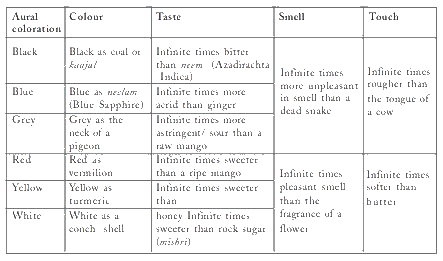
Six people go to a garden of black plum. As soon as they reach there, the first man says, 'Let’s cut down the tree so that we can merrily eat the fruits.' The second says, 'What is the use of cutting the whole tree? Cutting off only big branches will serve the purpose.' The third says, 'This is not right, we can also get it from the smaller branches.' The fourth says, 'The removal of a bunch of fruits is enough.' The fifth says, 'We can just pluck the fruits from the tree'. Finally, the sixth says, 'The fruits we need are already on the ground. What is the purpose of plucking the fruits from the tree?’
By this illustration, one can understand leshya more clearly. The first person’s behaviour is due to krishna leshya and sequentially the sixth person’s behaviour is due to white aural colouration. This example is just to show the degrees of hierarchy in the thought process.
♦
18. Drishti-3
Three types of View:
1. Samyakdrishti (right view)
2. Mithyaadrishti (perverted view)
3. Samyak-Mithyaadrishti (mixed view)
The word ‘drishti’ generally means eye. But here the word ‘drishti’ means perspective or attitude or faith in spiritual reality.
Right view means the perspective or an attitude that leads to the true nature of realities. Perverted view is the perspective or an attitude that leads to a wrong belief about the realities. When our faith is right towards some realities and when our faith is doubt towards regarding even one reality, it is known as samyak-mithyadrishti (mixed view). In this context, a person endowed with the right faith towards realities is called samyaktvi and his view is called samyakdrishti. Similarly, the person with a perverted and mixed faith is called mithyaatvi and samyak-mithaatvi, and their views are known as mithyaadrishti and samyak-mithyaadrishti respectively. The views of all the three is nirvadya (harmless/non-violent) and pure. They are obtained by the partial elimination cum subsidence of deluding karma.
Question: What is the difference between mithyaatva (delusion) and mithyaadrishti (deluded view)?
Answer: Delusion is caused by the rise of the deluding karma and a perverted faith is obtained by partial destruction cum subsidence of deluding karma. Delusion (mithyaatva) means perversion in the belief of reality whereas perverted faith (mithyaadristhi) means the extent of purity of view found in a person with perverted view (mithyaatvi).
A seeker with the right perspective is known as samyakdrishti and the one whose perspective is deluded is known as mithyaadrishti and the one who possesses both the right and deluded perspective is known as samyak mithyaa drishti. Here the focus is on the seeker and in the earlier statement the focus is on the qualities of the seeker and this is more important than the seeker himself. Right view is an attribute. People endowed with this attribute are known as samyaktvi or samyakdrishti person.
Samyaktvi is bereft of most intense passions (anantaanubandhi kashaay). They do not have intense anger, ego, deceit, and greed. They are also relatively very simple and pure at heart. Those who have strong attachment or aversion towards material objects cannot have the right view towards reality. Many people by listening to lectures of gurus and saints subside their attachment and aversion and attain the right faith. Whereas some others attain the true path through the purity gained by the subsidence of attachment and aversion by themselves and then the seed of samyaktva sprouts within them.
Samyaktva is a quality-based attainment that is not restricted to any kind of class, society, or individual. It is only achieved through the purity of the soul and suppression or partial elimination of anger, ego, etc. Therefore, in order to identify samyaktva, five quality based characteristics of samyaktva have been mentioned:
1. Sham – tranquillity of passions
2. Samveg – the desire for liberation
3. Nirved – detachment
4. Anukampa – compassion
5. Aastikya – spiritual faith
Samyaktva is a spiritual quality. It cannot be seen but can be inferred. Just like the fire is inferred through smoke, through the five characteristics mentioned above, one can infer the presence of right view in a person.
There are five blemishes of right view by which right view is lost. Therefore, the following five blemishes should be avoided:
1. Shanka (skepsis) – doubt about the ultimate goal.
2. Kaanksha (perverse proclivity) – craving for a false goal or opposing view to goal.
3. Vichikitsa (doubt) – doubt regarding the means to achieve spiritual goals.
4. Parpaashanda prashansa (admiration for heretics) – praise for the opponents of the spiritual goal or mithyaatvi (people with false beliefs).
5. Parpaashanda sanstav (cultivation of familiarity with heretics) – association with the opponents.
Such a contact with persons having perverted faith enhances ones’ own wrong faith.
The one who is free from such self-destructive blemishes is understood to be possessed of a right world view. There are five adornments of right view:
1. Sthairya (persistence) – perseverance in the spiritual path propounded by Tirthankars and also helping others to be stable in spirituality.
2. Prabhaavana (exaltation) – propagation of the importance of a religious organisation and clarifying the misconceptions.
3. Bhakti (devotion) – devotion and respect towards religion.
4. Kaushal (prudence) – acquisition of excellence in comprehending and explaining the doctrines propounded by the tirthankaras.
5. Teerthaseva (service) – rendering service to the four- dimensional teerth (a religious congregation of nuns and monks; devotees - men and women).
For stablising the right faith, the following six facts need to be endorsed:
1. The soul exists.
2. The soul is substantially eternal.
3. The soul is the doer of its karma.
4. The soul experiences the fruits of karmas bound by itself.
5. The soul can be free from karma.
6. There are means for the liberation of the soul.
There are two kinds of Mithyaatvi (person with perverted faith):
1. Aabhigrahik (deliberate)
2. Anaabhigrahik (non-deliberate)
Those, who are biased and prejudiced towards untruth due to their strong passions and emotions, are called as deliberate perverted faith.
Those who have a deluded faith due to a lack of opportunity to test or know the truth and those who are not biased towards untruth, they are called as non-deliberate perverted faith.
It is not right to say that people with a perverted faith live in an illusion and their righteous actions are not beneficial. Often people ask whether a certain individual is right viewed or wrong viewed. This is not a matter of question but rather a matter of experience. In reality, it is difficult to ascertain as to who has right view and who has a perverted view, but different characteristics of both are given, based on which one may ascertain accordingly.
♦
19. Dhyaan-4
Four Kinds of Meditation:
1. Aartadhyaan (mournful meditation)
2. Raudradhyaan (wrathful meditation)
3. Dharmdhyaan (analytic meditation)
4. Shukladhyaan (pure meditation)
The word 'Dhyaan' (meditation) means concentration of the mind on a meditative subject or concentrating the mind on a single subject or to prevent all the activities of the mind, speech, and body.
Through meditation, the seeker can make efforts to achieve his dhyey (goals) and can also succeed in it. Based on desirable and undesirable goals, meditation also becomes desirable and undesirable. Normally the types of goals are infinite. The concentration level of every individual varies. It is impossible to explain all those concentration levels. In brief, dhyaan is divided into four categories.The concentration against spirituality (anaatmaabhimukh) is aartadhyaan and raudradhyaan and that which takes you towards spirituality (aatmabhimukh) is dharmdhyaan and shukladhyaan. The first two result in the endless worldly transmigration of the soul and need to be abandoned (heya) and the other two result in the liberation of the soul and should be adopted (upaadeya).
Aartadhyaan (mournful meditation) - The word ‘arti’ means mourning, sorrow or grief. The concentration that indulges in mourning, sorrow and grief is known as aartadhyaan. There are four main causes of miseries and based on these causes, there are four types of aartadhyaan.
1. Anishtha Sanyog: The continuous and concentrated thought for the separation from undesired objects or persons, when they accompany us.
2. Priya Viyog: The continuous and concentrated worry of not to lose the desired things or person or to get back the lost.
3. Pratikool Vedana (Pain): The continuous agony for eliminating physical and mental illness when they occur.
4. Bhog-laalasa (Hankering): Strong resolution for unattained pleasure, being engrossed in intense desire, and keeping the mind occupied with the same, continuously.
Raudradhyaan (wrathful meditation)- A person who is cruel and harsh is called rudra, and his meditation or concentration is called raudradhyaan. Violence, deceitfulness, theft, and possessiveness lead to cruelty and harshness. Constant focus on these attribute are categorized as hinsaanubandhi (violence-bound), mrishaanubandhi (deceit-bound), steyaanubandhi (theft-bound) and vishay-sanrakshanaanu- bandhi (possessiveness-bound) raudradhyaan respectively.
Dharmadhyaan (Analytic Meditation): Dharmdhyaan is of four types:
1. Aagya vichay: To focus and contemplate on the teachings of the omniscient.
2. Apaay vichay: To focus and contemplate on the following- What are vices? What is their nature? How can one be free from them?
What have I done for my spiritual development in this life or what is left to be done? What is that which I can do and not done? Which are the mistakes, which I am not avoiding? Do others see my mistake or do I see it myself ?1
The bad deeds of the soul are more severe than the wound which the enemy gives when he strikes the neck to behead a person.'2 This type of contemplation results in apaay vichaya meditation.
1. Vipaak vichay: To contemplate on the karmik fruition and to relate the effects of karma to the past deeds as to which karma leads to what kind of possible results?
2. Sansthaan vichay: To contemplate on the absolute nature of the universe.
Shukladhyaan- (Pure Meditation) is of four types:
1. Prithakatva Vitark Savichaar (different subject oriented meditation) - The word ‘prithaktva’ means diversity, ‘vitark’ means scriptural knowledge, and ‘vichaar’ means ‘transition of thoughts’ from one meaning to another, from one word to another, from the meaning to the word and a word to its meaning, and from one activity to another.
In this kind of meditation, the person guided by scriptural knowledge concentrates independently on different modes such as origination, destruction, transformation, persistence, corporeality, in-corporeality, activeness, inactions, etc. of living and non-living substances. The focus keeps shifting therefore this meditation is called multiple contemplation or differential contemplation.
2. Ekatva Vitark Avichaar (single contemplation) – The word ‘Ekatva’ means single, ‘Vitark’ means scriptural knowledge and ‘Avichaar’ means non-trasition of thought from one word to the other, one meaning to the other, meaning to the word, word to meaning, one activity to another. Such people focus on a single word and its context. Among the three yog, i.e., mind, speech and body they restrict the activity to one yog. They do not shift the focus to different words, meanings, activities. It is majorly a non differentiating convergent called single contemplation.
Expertise in different subject oriented meditation is the qualification to practise identity or single contemplation. Just like mantras are used to accumulate the poison of a snake bite spread in the whole body to one place, the concentration of the wavering mind is brought to a single thought through focus and meditation. When the mind can focus on one point, it becomes peaceful and stable. This results in the veils of knowledge getting removed completely.
3. Sukshma Kriya Apratipaati - When an omniscient takes support of only subtle-body activities and stops all other gross-body activities (mental, verbal, and physical), they reach a state of meditation called sukshma kriya apratipaati. In this state, only the subtle body activities like respiration remain. One who attains this state does not fall into any other lower states and continues to remain stable in this state.
4. Sammuchhinna Kriya Anivritti - When the subtlest activity of the body including respiration stops and the soul space points becomes completely stable, then it is known as sammuchhinna kriya anivritti. In this state, all the gross and subtle (mental, verbal, and physical) activities stop. Once this state is attained, it is never lost. This state is so powerful that all karmik bondages are destroyed. In this state of meditation, all the karmas are destroyed and the soul gets liberated. In the third and fourth stage of shukla dhyaan, since there is no support of scriptures, they are referred to as anaalamban (support less).
Apart from the third and fourth shukla dhyaan, all others are thoughtful meditation. Until omniscience is attained, all meditations are thoughtful. He has only meditation to restrain yog or activity. Within antar-muhurt (infra-hour), just before liberation, the mental activities stop first followed by the stoppage of verbal and physical activities and finally respiration stops. Here, fourteenth stage of spiritual development (gunasthaan) is attained. All the activities of the soul cease and the soul becomes still like the saileshi meru (rock mountain). With this, the soul gets liberated.
1.Kim me kadam kim cha me kicchasesam, kim sakkanijjam na samaayaraami |
Kim me paro paaisa kim va appa, kim chaaham khaliyam na vivajjyaami ||
2. Na tam ari kantha chettaa karei, jam se kare appaniyaa durappaa
♦
20. Dravya-6
Description of Six Kinds of Substances:
1. Dharmaastikaay (medium of motion)
2. Adharmaastikaay (medium of rest)
3. Aakaashaastikaay (space)
4. Kaal(time)
5. Pudgalaastikaay (matter)
6. Jeevaastikaay (soul)
Dravya – that which has attributes (guna) and modes (paryaay) is known as substance.
Guna – that which remains inherently with substance, co exists with it and never gets and dissociated from the substance. The substance and the guna are never separated.
Paryaay- the different states or modes of a substance is called paryaay.
Substances give up their existing state and acquire a new state without changing their original nature. In both states, the substance keeps its nature intact. Gold acquires new forms and shapes as and when it is processed. Gold remains gold, whether it is made into a ring or a bangle. The change is only in its shape. Gold is not an independent substance. It is one of the infinite states of matter. The material aggregate in the form of gold we see today can leave its state of gold and get transformed into the sand. Later, it can leave the state of sand and transform into anything else. Despite all the transformations, it remains as substance. The characteristics of matter are colour, smell, taste, and touch. When the matter is in the form of gold, it has colour, smell, taste, and touch. Even if it transforms into the sand, it will still have the characteristics of colour, smell, taste, and touch.
In whatever form the matter transforms into, it will have its fundamental characteristics intact. Even when aggregates of this matter disintegrate into the smallest atomic particle called parmaanu, it will definitely have these four characteristics. Substance may change modes, but not nature.
Substance is both eternal and transient. Even when its form changes, it does not leave its original form, so it is considered eternal and because it keeps changing from one state to the other, it is termed as transient.
Except for matter, all other five substances are non-corporeal, therefore they are not visible. Matter is corporeal, even then parmaanu and other subtle material aggregates are not visible with the most sophisticated microscopes. According to Jain philosophy, the so-called atom perceived by the sophisticated technology of present science is also an anant-pradeshi-skandha (an aggregate of infinite atoms).
There are fourteen1 perspectives available to know more about substance. When we look at new objects, we have a curiosity to know more about it. By what the object was made? How and when was it made? What are its characteristics and so on?
In the present chapter, only five perspectives - Dravya, Kshetra, Kaal, Bhaav, and Guna of substance have been explained.
1. Dravya (Substance) – what is its nature?
2. Kshetra (Place) – where is it found?
3. Kaal (Time) – when did it originate? Does it exist at present or not? Until when will it remain?
4. Bhaav (Mode) – in what state is it?
5. Guna (Quality) – is it of use to this world or not? If it is, then what is its use?
The objective of this chapter is to explain the six dravya in the context of the above five questions
1. Dharmaastikaay (Medium of Motion)
In this context, the word ‘dharma’ means that substance that renders direct assistance without exercising any activity to the movement of living beings and matters, when they have developed the tendency to move. The word ‘astikaay’ means a homogeneous continuum of indivisible space points (pradesh). From the substance point of view, it is a group of inseparable innumerable space points. That is, it is one and not many. From the space point of view, it is present in the whole cosmos. From the temporal point of view, it has no beginning and no end. It is never originated nor will it have its end. That means it is present in all three periods of time. From the mode point of view, it is non-corporeal. It does not have any form, shape, or colour. From quality, it assists in movement.
Question: How many mobile substances are there?
Answer: There are two mobile substances-soul and matter.
Question: Is the ability of movement is present in medium of motion or in jeev and pudgal?
Answer: The ability of movement is in the soul and matter and not in the medium of motion. It is only an auxiliary cause in the movement of the souland matterand soul just like water assists the movement of fish. The actual cause of movement is matter and soul itself. Without the medium of motion, the soul and matter cannot move. Therefore, medium of motion is imperative. The movement of the soul and matter exists in all three time frames, past, present, and future (traikaalik), so the medium of motion is also considered to be available in all three time frames.The movement of soul and matter is found in the entire universe. Therefore, the presence of medium of motion in the entire universe is imperative. It does not have any of the five colours like black etc and so it is non-corporeal. There cannot be substancewithout guna. Dharmaastikaay is a substance; therefore the attribute of assisting movement must exist in it. There is no medium of motion in alok (space beyond lok) and so no soul and matter can travel in supra-cosmos.
2. Adharmaastikaay (Medium of Rest)
In this context, the word ‘adharma’ means the substance that renders direct assistance without exercising any activity to the repose of the soul and matters when they have developed the tendency to come to a halt. From the substance point of view, the medium of rest is one. From a spacial point of view, it pervades in the whole cosmos. From a temporal point of view, it has no start and end. From a modal point of view, it is non-corporeal. From the attribute point of view, it is helpful in repose.
Question: How many substancesare stationary?
Answer: All substances are stationary. Except for soul and matter, the remaining substances are definitely stationary. Soul and matter also are not always in motion. They move sometimes and other times they stand stationary. The cycle of mobility and stability in the soul and matter goes on.
Question: Does medium of restassists in the repose of moving soul and matter or does it assist other substances also which are already motionless by nature?
Answer: Medium of rest does not assist substances that are already in rest. It only assists the substance that is mobile by nature. The substances that are already stationary do not need any assistance. Only objects that are in motion need assistance when they tend to stop. It is the inherent capacity of the substances to repose. Medium of rest only assists.
Without a medium of rest, no soul and mattercan stay stable. Thus, the existence of a medium of rest is essential. The repose of the soul and matter is found in the entire universe. Therefore, the presence of a medium of rest in the entire universe is imperative just like a medium of motion. All other properties of medium of motion apply to the medium of rest. There is no medium of restis supra cosmos. Thus there is no question of stability or repose in the supra cosmos, because in the absence of medium of motion the soul and matter can not move into supra-cosmos.
Question: Is the existence of medium of motion and medium of rest proved through only the Aagam or is there any other proof ?
Answer: Through inference also it can be proved that medium of motion and medium of rest exist. The distinction between cosmosand supra-cosmos is done based on these two substances. Space is pervasive in both. Only in that part of space, where medium of motion and medium of rest are present, soul and matter exist; they are, not anywhere else and that is why it is called cosmic space or lok. Where soul and matter are absent, that is called as supra-cosmos or alok. If the existence of medium of motion and medium of rest is not accepted, then there will be no such substance available which can become the cause of distinction between cosmos and supra cosmos. Therefore, it can be easily inferred that there must be some substance that separates cosmos from supra cosmos.
Question: Whether 'supra cosmos' exists this doctrine is just arbitrarily accepted or proved by any proof ?
Answer: Its validity is proved through Aagam.
Question: Do philosophies other than Jainism should believe in the existence of supra-cosmos?
Answer: People, who believe in lok, cannot reject the existence of alok. If you study the etymology of words, for all affirmative words, there exists another word which stands opposite. In the absence of a contradictory substance, nothing can be proved to be existent. For example the darkness is the opposite of light, similarly, hot and cold, soft and hard, viscous and dry, etc. All the words that have a positive reference will also have the opposite negative reference. The names that are etymologically derived are stipulated as such due to the contradictory nature of the substance. Therefore by the existence of cosmos, we would be bound to believe in the existence of supra-cosmos.
3. Aakaashaastikaay
Akaash is a substance which accommodates the soul and matter. ‘Astikaay’ means homogeneous space points. From the substance point of view, it means one aggregate of inseparable infinite space points. The aim of using the term 'one' is that it is not individually different but an interconnected single form. From spatial point of view, it is spread in both cosmosand supra-cosmos. From Temporal point of view, it does not have a beginning or an end. From a modal point of view, it is non-corporeal, and its attribute is to provide space.
Question: How many substances is aadhaar (support) and how many are aadheya (supported)?
Answer: Only spaceis aadhaar and all other substancesare aadheya. Spaceis non-corporeal and hence is not visible. Still it is accepted based on logic and inference. Without support, no substancecan be sustained. A pot can store water because it has an attribute to accommodate liquid. Similarly, there must be some all-pervasive substance that accommodates all souls and matterand that substance is space. The whole universe exists because space can provide accommodation.
Tras and sthaavar (the mobile and immobile beings) are supported by the land. The land is supported by water. Water is supported by air, and the air is supported by space. Land, water, air, etc. are both aadhaar and aadheya. Space is only a support and it is not supported. The land supports mobileandimmobilebeingsbut it is supported by water and that is why it is both – aadhaar and aadheya. Udadhi (Water) is a support for the land but it is supported by the air so it is also both aadhaar and aadheya, (supported). Similarly, air supports water but it is supported by space hence it is also the same. Space provides support and it is not supported by anything else. Therefore it is a support and not supported substance.
Question: Space is non-corporeal, then why is the sky blue?
Answer: The blue colour is not the colour of space. The space present there is the same that is present everywhere. The blue colour that we see is the colour of distant molecules in the air. These molecules are present in our vicinity also but cannot be seen due to the lesser distance. Due to distance and density, we see the molecules in blue colour. From a distance, the clouds look dense but with proximity they do not look the same. From a distance, it looks like the sky touches the land, but when you go near, that is never the case.
For those, who believe in only direct sensuous cognition, for them touch, taste, sight, smell, and sound are the subject of the senses and apart from them, non-corporeal things do not exist. Only what the senses can perceive are acceptable as proof and no other proof is required. When the question of the existence of space arises, they get perplexed. They have to acknowledge the existence of space-like substance that accommodates everything in that universe, and that is inevitable. Therefore, in some situations, it becomes mandatory to depend on inference and not be rigid to believe only on sensory proofs.
Space is present in both cosmos and supra-cosmos. The number of space pointsof cosmic spaceis innumerable. The total length of it is fourteen rajju. The concept of ‘rajju’ is explained through an analogy. If a man can travel one lakhyojan in a blink and at the same speed the distance that he covers in six months is known as one rajju or we can say in simple terms – innumerable yojan makes a rajju. The number of space points in cosmic-space is comparable to the number of space points in medium of motion and medium of rest and the space point of one soul. The space points of medium of motion and medium of rest are innumerable. Each space point of medium of motion and medium of rest is spread on each space point of cosmic-space. The number of space points of any soul is also innumerable. During kevali-samudhghaat, each soul points occupy one unit of cosmic-space.
The space outside the cosmic area where nothing other than space exists is called alok-aakaash (Supra-cosmic space). It surrounds the cosmic space from all sides and is infinite.
4. Kaal (Time)
Muhurt (48 minutes), din (day), raat (night), paksh (fortnight), maas (month), etc. are references of time only in the region of humans not outside. The most popular references of time used in manushya-lok are used for all references of similar time outside human-region. The references of time are based on the solar and lunar movements. Only the luminous gods- sun, moon etc, of human-region have movement. Other luminous gods do not move. The division of time depends on the movement of the stars. The gross time frames like day, night, etc. are based on the definite movement of the sun and moon. The subtle time-frames like samay, aavalika, etc. cannot be known through the movement of the sun and moon.
In any place, the time between sunrise and sunset is called day. Similarly, the time from sunset to sunrise is called night. One-thirtieth part of day and night is known as one Muhurt (48 minutes). One fortnight comprises fifteen days and nights. Two fortnights makes a month. Two months make a ritu (season). Three ritus make an ayan (six months).Two ayans make a year. Five years makes a yug. All these time frames are based on the movement of the sun. Anything happening in the present is called vartamaan. That which has already occurred is called bhoot or past. Events that will occur in the future are called bhavishya.
Time is not an astikaay conglomeration of units. Unlike other substances, there is no aggregation of units of time. It is not a real substance. It is a metaphorical substance by nature.
Anaagatsyaanutpatteh utpannasya cha naashatah,
pradeshaprachayaabhaavaat kaale naivastikaayata'
Which means the future has not arrived yet, the emerged time gets destroyed, the points do not disseminate thus there is no aggregation of time points. Hence time is not an astikaay. Concerning substance, time is infinite. For kshetra, it is applicable in humanregion (2.5 islandswhich includes jambu dweep, ghaatakee-khand, and of pushkar dweep). From the perspective of time, it does not have a beginning, nor does it have an end. For mode, it is non-corporeal. From the perspective of guna (attribute), it is the existence (vartana).
Question: When time is not a real substance, why should it be referred to in the list of substances? How can it be infinite in quantum and how is it beginning less and endless?
Answer: Time does not have pradesh or atom that is why it is referred to as a metaphorical substance.
The utility of time is understood easily, because without time no activity is determined. For the shortest to the longest activity, the support of time is required. Everybody needs the reference to the past, present, and future. Without this, nothing functions.Thus, this utility of time is evident.
The subtlest unit of the time is samay (instant). Infinite samay has already passed and there is one instant in the present. There will be infinite instants in the future. So from substantial point of view, time is infinite. There are infinite souls and matter. For each of them, there is a reference to time. From this point of view, also it is infinite. Cosmos has been forever (anaadi-anant). Therefore, time is also beginning less and endless. The beginningless and endless nature of time is based on the state of the cosmos.
Divisions of Time:
Through the division of time, life span etc, are determined. The shortest indivisible unit of time is samay (instant). There are many examples in the scriptures that explain an instant. One meaning is as much time as it takes to tear one yarn of tattered piece of cloth by a strong man. The innumerableth part of that period is called instant. As much time is taken in a blink of an eye the innumerableth part of that time is called instant. Electricity travels lakhs of miles within a small fraction of time. As much the space it covers in the minutest part of the time is divided into innumerable parts, that innumerableth part is called instant.2
By these examples we can infer about the subtleness of instant.
That which is the cause of change, that which passes with time and the time which is present in cosmos and supra-cosmos is called nischay-kaal (transcendental time). Time mentioned as muhurt, din (day), raat (night), etc exists only in human inhabiting area not outside. These time frames are based on the movement of the sun and the moon.
The time that can be counted in numbers is called sankhyeya. The time that cannot be counted and can only be explained with analogies is called asankhyey like palyopam, sagaropam, etc. The time, which has no end, is called eternalor infinite.
5. Pudgalaastikaay (Matter)
That which has colour, smell, taste, and touch and which has a property of association and dissociation is called matter. Atom is also a part of matter, but in this context, the suffix kaay is used. Hence here it is appropriate to derive the meaning of asti as the indivisible unit (Pradesh) only. The aggregated atom itself is called Pradesh. For example, two joint parmaanu are called dvi-pradeshi-skandha.
From substantial point of view, matter is infinite. The matter is divisible, unlike other substances that are indivisible. The atom in disintegrated form is called paramaanu and when they get integrated, they get formed into skandha (aggregates). From spatial point of view, matter is present in the entire universe.
Question: The number of space points of cosmic space is innumerable (asankhya) whereas the space points of the matter is infinite (ananta) which is much more in terms of numbers. How can matter be accommodated in cosmic space?
Answer: Due to the wonders in transformation, infinite matter can become accommodated in finite space. As an atom occupies one space point of cosmic space, similarly, dvi- pradeshi (two-pradesh), sankhyaat-pradeshi (countable space points), asankhyaat-pradeshi (innumerable space points) and even anant-pradeshi (infinite space points), skandha can reside in one space point of space due to dense transformations. And when they expand, dvi-pradeshi skandha occupies two space point, asankhyaat pradeshi and anant pradeshi skandha occupy asankhyaat pradesh (space points) of cosmic space. But they can never occupy more aakaash-pradesh than the number of skandha-pradesh like two pradeshi skandha can spread in a maximum two space points of cosmic space and not in three. Occupying less or more space points in cosmic space is caused by the difference in the density of the substance.
The aggregate of higher numbers of units of matter can occupy lower numbers of space points due to high densityand in comparison this lower number of aggregates can occupy more space-units due to low density. One kilogram of mercury occupies less space compared to one kilogram of iron, one kilogram of sand, and one kilogram of cotton. The density of sand is higher than cotton, the density of iron is higher than sand, the density of mercury is higher than iron, therefore the space points they cover also decreases subsequently. Just like an aggregate of infinite space points of matter, gets accommodated in finite space points of cosmic space. Similarly, even bigger anantaanant pradeshi skandha can get accommodated in finite space points of cosmic space. Where the light of one lamp can spread in a room, the light of several lamps can also spread in the same room. When dense hot iron is blasted with air, fire particles find their way through the iron and when water is sprinkled on the hot iron even vapours get through the metal. Therefore, it is the wonders in the transformation that makes it occupy more or less space.
From temporal point of view, pudgalaastikaay is anaadi- anant. From the modal point of view it is corporeal. With respect to attributes, matter has the properties of colour, smell, taste, and touch.
Whatever we see through our eyes, taste by our tongue, smell through our nose, touch through the skin are all material, therefore the colour, smell, taste, touch is the characteristics of matter.
Matter is corporeal. Only those substances are corporeal, which possess colour, smell, taste, and touch. Except for matter, all the remaining five substances are incorporeal. Since they do not have the properties of colour, smell, taste, and touch, they are not visible to us. Except omniscience, the object of all the other four types of knowledge (mati, shrut, avadhi, and manahparyav) is matter. Non-corporeal substances can be perceived only through omniscience. Sound, smell, grossness, subtleness, shadow, light, darkness, etc. are all modes of matter.
Shabda (Sound):
The sound that we hear is of material property. In sound, the characteristic of matter i.e., touch, taste etc., are present. Rocks also have that property of touch etc. When there is a collision with the rock, the sound is produced. Similarly, the sound in caves produces echoes. The materiality of sound is quite clear in the use of telephone, telegraph, wireless gadgets, phonogram, etc. because machines can acquire and process only corporeal objects. Except for matterall other substances are non-corporeal; therefore sound is the property of matter.
Bandha (Integration):
Integration means the state of unity. Through the integration of atomic parts, material aggregates are made. The viscosity and dryness of the atoms are necessary for bondage to occur. Contact between two atoms alone is not enough to make diatomic aggregate. Viscosity and dryness are the two types of touch out of eight. Touch is the attribute of matter; therefore, integration is also a state of matter. There can be no bondage of non-corporeal objects, as they are indivisible and cannot be divided. The matter is the only substance that has the capacity of integration with other matter. When infinite atoms integrate, then they become an aggregate of infinite atoms and many such infinite atomic aggregates make a gross object.
Sukshmata and sthulata (Subtleness and Grossness) -
This property is found only in matter. Other substances do not have the classification of big or small and light or heavy. Some matter is small, others are big, some are light, and others are heavy. The material aggregates that are spread are big and those that are compact are small. The object with the light touch is light weight whereas the object with heavy touch possesses more weight.
Chaaya (Shadow) –
Even shadow is material. There is a continuous change in the states of material objects. They have the nature of integration and disintegration and illumination. They always emit rays that transform, according to acquired suitable materials. This transformation is called shadow or chaaya. The shadow in unclear objects is grey in daylight and black in the night, whereas the shadow in clear objects is of its shape.
Prakaash-Andhakaar (Light-Darkness) –
Light is material. Darkness has the veiling property and is material. Darkness does not refer to the absence of light. It is material in itself that exists in opposite to the property of light. During heavy rains, the objects disappear only the droplets of rain are visible. Similarly, in dense darkness, only darkness is seen and objects are not visible. This is just like walls and roofs. As a physical barrier that blocks the sight of other things. Similarly, darkness is an entity that also acts as a physical barrier that blocks the sight.
When rain stops or the walls are broken, the objects become visible. Similarly, when the darkness is destroyed, all the objects become visible. How can darkness be non-existent when its black colour is visible? That which does not exist, cannot have a colour. If darkness has a colour, it means it exists and it is a material.
There is a strong relation between soul and matter. And there are many ways that souls use the material.
It is said–'Dravya nimittam hi sansaarinaam viryamupajaayate' meaning 'All the efforts of the soul are possible only with the help of matter'. To understand how matter is useful to the soul, it is important to know the various vargana (aggregates) of matter.
Vargana means material aggregates or a group of similar kinds of matter. They are of many categories like mano (mind) vargana, bhasha (speech) vargana, shareer (body) vargana, audaarik (gross body) vargana, vaikriya (protean body) vargana, aahaarak (body) vargana, tejas (luminous body) vargana, kaarman (karma) vargana, and shvaasochhvaas (respiration) vargana.
The material aggregate that helps the soul to think is known as mano-vargana.
The material aggregate that helps the soul to speak is known as vachan-vargana or Bhaasha Vargana.
The material aggregate that helps the soul to feel good and bad and help in movement is shareer-vargana.
The material aggregates that forms the gross body is called audaarik-vargana.
The material aggregates through which different shapes and forms of the protean body can be formed as desired is known as vaikriya-vargana.
The material aggregate through which a strange powerful body is made, is known as aahaarak-vargana.
When an extra-ordinary spiritual ascetic is asked a difficult question and he does not have an answer for it, then he acquires the aggregates of aahaarak-vargana, makes a beautiful effigy, and sends it to an omniscient to get the answer. The effigy gets the answer and comes back. The ascetic is now able to clarify the questions asked to him. These actions take place in such a short period that the questioning person does not even realize that there is a delay in the answers.
The material aggregate that forms the luminous body is known as tejas vargana.
The material aggregate that forms the kaarman body is known as kaarman vargana.
The material aggregate absorbed during respiration is called svaasochvaas-vargana.
More than a hundred elements that are accepted by modern scientists fall into the category of matter. According to the scientist, the elements are those substances which do not lose their properties even after undergoing several chemical reactions. Gold, silver, iron, sulphur mercury, etc., are elements. One can change their forms such as solid to liquid or liquid to gas, etc. by heating or cooling, but cannot change into another element. Iron would remain iron and gold as gold. When two elements combine, they become a compound. Water is a compound of two hydrogen atoms and one atom of oxygen. All elements and compounds have the characteristics of colour, odour, taste, and touch, therefore they are all material. The corporeal objects which other philosophies call bhautik (physical) are termed as paudgalik (material) in Jain philosophy.
6. Jeevaastikaay
The meaning of the term jeev is to possess praan (bio- energy of life). The word astikaay means an aggregate of the homogeneous continum of space points.
Question: If acquiring praan defines jeev, then how is this definition applicable to the liberated souls?
Answer: There are two kinds of bio-energy physical (dravya) and psychic (bhaav) bio energy). In the sixth chapter, ten bio energies have been mentioned. Those are physical bio energies, Knoweledge and perceptions are psychic bio energy. In the wordly souls, there are both types of bio energies. In the liberated soul, there is only psychic bio energy.
Substantial point of view - jeev is infinite. From spatial point of view, they are found in the cosmos. Temporally, they are beginningless-endless.From modal point of view, they are non-corporeal. From the attribute point of view, they are conscious.
Jeev or the soul has innumerable space points. Soul with innumerable space points is infinite in number. Unlike the medium of motion, which has innumerable space units, and is one and indivisible. Soul is not one and indivisible. That is why in terms of quantity, souls are mentioned as infinite.
When it is said that jeevaastikaay is present in the entire cosmic space, it does not mean that one soulis spread in the entire cosmic space. This only means that there is no place in the entire cosmos, where soulis not present.
The soul does not have an origin and there is no creator of the soul. Therefore, it is beginningless. Any real that is beginningless, does not have anend either. That is why soul also is referred to as infinite.
The soul is non-corporeal, but through sva-samvedan (self-recognition, etc.) we can know about the existence of the soul. 'I exist'- such inquisitiveness is not possible if the soul does not exist. We can also infer the existence of the soul.
When we have lifeless things around us, there should also be some contradictory substance that is with life also. Without the existence of a contradictory substance, it is not possible to know the existence of a substance. If there is no substances called chetana (consciousness) then on what basis are the two words as chetan i.e, conscious, achetan i.e, non conscious coined. The absolute absence of anything is shown only when there exist some contradictory things. Soul and non-soul are absolutely absent in each other and that is why, the existence of a conscious substance is inevitable.
The characteristic of the soul is consciousness. It is comprised of innumerable space points . They are all characteristically conscious. A soul is an indivisible aggregate of innumerable cognitive space points. It does not mean that innumerable souls integrate into one soul. Every soul has infinite knowledge but is covered by a veil of karma. The denser the veil is, the more obscured the knowledge is. As the veil gets thinner, the knowledge manifests. When the veil is completely removed, the soul becomes omniscient. Even if the soul is covered to the maximum extent, a least part of knowledge remains always unobscured. If knowledge gets completely obscured, then there will be no distinction between living and non-living. Even among one-sensed living beings sense of touch is present. Through consciousness, it is possible to know the soul. Consciousness exists in all three phases of time- past, present, and future.
The acceptance of only six substances is on the basis of the fact that the significant attributes of six substances are not found in any of each other substance. If a substance does not have a significant quality that co-exists with it for all three phases of time, then that cannot be an independent substance at all. Except for these significant qualities, we do not find any other such quality that is not present in other substances. The quality which is found in many substances cannot determine the existence of an independent substance. Therefore, there are only six substances. Each substance has infinite modes.
1.1. Nirdesh 2. Svamitva, 3. Saadhan, 4. Adhikaran, 5. Sthiti, 6. Vidhaan 7. Sat, 8. Sankhyaa 9. Kshetra 10. Sparshan 11. Kaal 12. Antar 13. Bhaav 14. Alpabahutva
2.Divisions of time
Indivisible time – one instant
Innumerable instant- one aavalika
253 aavalika- one kshullaka bhava (lowest age)
2223 1229/3773 aavalika = one ucchvaas nishvaas
4446 2458/3773 or 17 aavalika + kshullaka bhava = 1 praan
7 praana = one stoka
7 stoka = one lava
3811 lava = one ghadi (24 minutes)
2 ghadi or 3773 praana or 65536 kshullak bhava = 1 muhurt
167272161 avalika = 1
30 muhurt = one day (din)
15 days = 1 paksha (forthnight)
2 paksh = 1 maas (month)
2 maas = one ritu (season)
3 ritu = one ayan (six monthly)
2 ayana = one varsh (one year)
5 years = 1 yug
70 crores X 70 crores
56 lakh crore = one poorva
Innumerable varsha = palyopam
10 crores X 10 crores palyopam = 1 kaalchakra
Infinite kaalchakras = 1 pudgalparaavartan
♦
21. Raashi-2
Two Categories of Beings:
1. Jeev Raashi (category of living beings)
2. Ajeev Raashi (category of non-living beings)
When we categorise all the substances of the world, we may end up with thousands of categories like humans, cows, buffaloes, camels, houses, clothes, utensils, etc. From this diversity when we move towards convergence, we find that there exist only two basic categories:
1. Chetan- living beings with consciousness endowed with knowledge and perception; and
2. Achetan - non-living substances bereft of knowledge or perception.
We can conclusively state that the entire universe can be classified into these two categories and there is nothing beyond them. In other terms, we can state that the existence of this universe is entirely dependent on just these two entities. The existence of six substances and nine tattva are also inclusive to these categories.
For a better understanding of the universe, when we study deeper then the number of substances increases from two to six substances.
How is a soul liberated? What are the conditions of living beings or non-living beings that are helpful or stand as an obstacle in the way of liberation? This inquiry directs the classifications into nine realities (nine tattva). Among the nine, the non-living tattva are ajeev, punya, paap, and bandh: and the living tattva are jeev, aashrav, samvar, nirjara, and moksha.
But in reality, the basic entities are only two. These six substances and nine realities are made for better utility and better understanding. We cannot understand the utility of the living and the non-living in the functioning of the universe without understanding these two categories.
Medium of motion assists the movement in the world. Any movement in the universe, even the subtlest of vibrations, occurs only with its assistance. Medium of rest is just the opposite factor. It assists in immobility. In other words, the former is the medium of action and the latter is the medium of inaction. Though activity and inactivity are the results of one’s power, still these cannot be performed without the support of medium of motion and medium of rest. Aakaashaastikaay (space) has its importancebecause it provides accommodation. The entire universe is accommodated in this space. All functions of the universe are methodically regulated by time. This is its clear benevolence. All the embodied souls depend on the matter to sustain life. Right from respiration to eating, clothing, and for all other activities, material things are used. The body itself is material in nature. The activities related to mind and speech also require the assistance of matter. The soul which is pure consciousness puts these things into use. If we unite the functions of all the six substances, the structure of the entire universe comes before our eyes.
In the understanding of the system of the universe, the things that fall into the category of non- living are much more important than the different states of a living entity. The understanding of different states of the soul is essential for spiritual practice. Living and non-living are fundamental elements. Punya, paap, and bandha bind the soul resulting in worldly pleasure and pain. Therefore, thus these three are the hurdles in liberation. Influx is the state of the soul that receives karmas, is also an obstacle for liberation. Samvar inhibits the ways of reception of karmas and through shedding, the existing karmic bondages are eliminated. These two purify the soul; therefore, they are conducive for liberation. Moksha is the pure state of the soul, free from karmic bondages.
If we understand them fundamentally then punya, paap, and bandha are non-living states, whereas aashrav, samvar, nirjara, and moksh are states of the soul. In the six substances, there are no sub-classifications of jeev but in the nine tattva, four additional states of the jeev are defined. In the six substances, there is a mention of five independent types of non living substances and in the nine tattva, three additional states of non-living are also mentioned. Therefore, we see that in the six substances, only one substance is jeev and the remaining five substances are ajeev and in the nine tattva, five realities are jeev and four are ajeev. This only proves that fundamentally there are only two categories in the universe: one is the jeev (living) category where all the living beings are included and the other is the ajeev category where all the non living materials are included. Therefore, we can conclude that the entire universe is included in these two categories, jeev and ajeev.
♦
22. Shraavak Vrat-12
Twelve Vows of Lay Followers:
1. Ahimsa anuvrat (Partial vow of non-violence)
2. Satya anuvrat (Partial vow of truth)
3. Asteya anuvrat (Partial vow of non-stealing)
4. Brahmacharya anuvrat (Partial vow of celibacy)
5. Aparigraha anuvrat (Partial vow of non-possession)
6. Digvirati vrat (Spatial limitation)
7. Bhogopabhoga parimaan vrat (Limitation of consumption)
8. Anarthadanda virati vrat (Avoidance of worthless sinful deeds)
9. Saamaayik vrat (Abstinence from all sinful activities for a fixed period i.e for one muhurta 48 minutes)
10. Deshaavakaashik vrat (Further restraint for a limited period)
11. Paushadh vrat (Observance of fasting along with celibacy on sacred days)
12. Atithisamvibhaag vrat (Parting with food and the like by offering them to the ascetics)
Purity of conduct is the essence of human life. In Jain philosophy, the right conduct is given the same importance as the right knowledge. The attainment of emancipation is impossible with only knowledge or with only conduct exclusively. It is the proper combination of both that leads to the attainment of emancipation. The cart cannot move on a single wheel.
According to Jain philosophy, being at home, doing business and duties of layman, a lay follower can also follow righteousness. All that falls under good conduct is righteousness. However, depending on the practitioner, righteousness is divided into two types:
• Complete righteousness
• Partial righteousness
The practitioners of complete righteousness are the saints who devote all their life and efforts in renunciation, penances, and spiritual practices becoming completely restrained. The followers of partial abstinence can be anyone. For example, on the righteous practice of non-violence, a layman cannot completely abstain from violence, but he can refrain himself from unnecessary violence. When a layman stays away from unnecessary violence then that is called righteousness. A lay follower is incapable of avoiding violence of subtle beings for food, clothes and other needs, violence against gross animals for self protection and violence that occurs out of negligence. Such violence is not a part of their righteousness but when one abstains from killing innocent beings deliberately then it is righteousness. Similarly avoiding gross untruthfulness such as false witnessing and abstaining from gross stealing and extra marital sexual relations, not collecting unnecessary wealth and limitation of even necessary wealth is righteousness. Being living a household life, the layperson forgives others, behaves friendly, remains straight-forward; these all are acts of righteousness that lead to the upliftment of the soul. Righteousness is the medium of internal purity and can be done at any place and in any condition by anyone. Righteousness is not an external thing; it is the attribute of the soul. Righteousness means spiritual practice and self-control.
Scriptures and religious leaders are empirical sources of religion. To make the self spiritual, they are essential. In reality, righteousness is dependent on one’s conduct. If a man does not want to follow the righteous path, then no scripture or religious leader or anyone else can forcefully make him do so. Therefore, the right means to spirituality is preaching. Through the right teaching, people recognise the truth and practise self-control and pure conduct. Goodness is found in all even if it is in a very small portion. Those lay followers who are more inclined towards spiritual aspiration; they restrict themselves even in the necessary violence and make themselves most content. Sometimes even without taking initiation of monkhood, they follow such an intensity of self- control that it equals the monkhood. They are specially termed as ‘pratimaadhaari shraavaka.’
Monks have to follow non-violence and the other codes of conduct completely without any relaxation for their entire life; for them, the rules are called mahaavrat (great vows). These vows are discussed further in chapter twenty-three. A householder with the right vision of the world accepts the twelve vows of lay followers according to his capacity. A short description of these vows is presented here. For special and detailed study one can read in Baarah vrat ki chaupai authored by Shrimad Bhikshuswami.
1. Ahimsa Anuvrat (Partial Vow of Non-violence): A lay follower (shravak) cannot refrain completely from violence towards all living beings, mentally, verbally and physically, but can partially refrain from gross forms of violence like refraining from killing mobile innocent animals intensionally, etc., This is known as the partial vow of non-violence.
2. Satya Anuvrat (Partial Vow of Truthfulness): A lay follower may feel incapable of desisting from subtle untruthfulness, but if he lives with awareness, he can at least avoid gross lies by which an innocent being is killed or punished. This is called satya Anuvrat.
3. Asteya Anuvrat (Partial Vow of Non-stealing): Refraining from stealing, robbery, by breaking the locks, snatching, etc. is the small vow of non-stealing. The theft on account of which one is penally punished and looked down in the society, such stealing is a heinous act. Renouncing such an act is not only a duty of a lay follower (shravak) but also of any civilized person.
4. Brahmacharya Anuvrat (Partial Vow of Celibacy): The term brahmacharya anuvrat means to limit sexual instincts. Refraining from extramarital sex, avoiding adultery, and practising limited sexual activity even with one’s spouse. This is small vow of celibacy . Controlling sexual feelings to the extent possible is the partial vow of celibacy.
5. Aparigraha Anuvrat (Partial vow of Non-possession): Gold, silver, houses, property, money, etc. are possessions and to renounce or put a limit on the collection of such items is the partial vow of non-possession. There is no end in acquiring money, material items, and, prosperity in the world. As the man acquires them, so his greed increases. To check such a greedy instinct of man, the vow of non- possession has been advocated. Somewhere a person has to be content with his possessions.
For the stability and strengthening of the five small vows (anuvrat), three supplementary vows (gunavrat), and four disciplinary vows (shikshaavrat) have been propounded.
6. Dig Virati vrat (Spatial Limitation): Limiting travel in all directions like east and west and to refrain from all sinful activities beyond the decided boundary is the vow of spatial limitation.
7. Bhogopabhoga Parimaanvrat (Limitation of Consumption): Limiting fifteen kinds of sinful business and twenty-six types of consumeristic activities is known as limitation ofconsumption.1
8. Anarthadanda virati vrat (Avoidance of Purposeless Sinful Acts): Indeed, one cannot live without violence for survival. But if violence done without any purpose is acceptable? Not indulging in violence which has no purpose, is the vow of avoidance of purposeless sinful acts.
9. Saamaayik (Abstinence from all Sinful Activities for a Fixed Period, say, one muhurt i.e 48 minutes): Abstaining from all sinful activities for one muhurt (48 mins), and staying engrossed with one’s nature, during that time is saamaayik vrat.
10. Deshaavakaashik vrat (Abstinence for a limited period): Abstaining from violence etc., for a fixed period is known as deshaavakaashik vrat. The first eight vows are taken for a lifetime but any vow observed for a specific limited period like two or four years etc. is categorized as deshaavakaashik vrat.
11. Paushadhopavaas vrat (Observance of Paushad Upvas on Sacred days): Fasting on the eighth, fourteenth and fifteenth day of the lunar calendar or on any other day, and abandoning all the sinful activities, appearance, enhancement like makeup, etc. for one complete day and night is known as paushadopavaasa. It can only be practised with strict fasting without any intake of water or food. If water is taken and this vow is taken for twelve hours or so, it is included in the tenth vow and not in eleventh.
12. Yathaa/Atithi samvibhaag vrat (Parting with food and the like by offering them to the saints): Lay followers need to have a feeling of giving pure alms to the monks. It leads to a transgression, if the food is made for a monk or added more while cooking for us, for the monks. Therefore, to abstain from giving impure food/alms and to give pure alms is the vow of parting withfoodby offering it to the saints.
Utility of Vows
The vows of lay followers are important not only from the religious point of view but are important also from the social and national point of view as follows-
1. Through violence mutual enmity spreads, the hatred becomes stronger and, humanity perishes. Therefore, violence should be abandoned. The motto based on the first vow of the lay follower is 'metti me savva bhooyesu veram majjha na kenai.' This means, 'All beings are my friends. I do not have enmity with any beings.'
2. All social relationships are based on truth. A single day cannot go on smoothly without truth. There can be no transaction without exchange, no exchange can take place without faith and no faith can be built without truthfulness. Therefore, truth is always necessary.
3. Ruling over others, grabbing, stealing, robbing, and military attacks create an unpeaceful environment. The common man gets disturbed and fear spreads everywhere. Therefore, for sustainable peace, one must refrain from all such criminal activities. This is a great utility of the third vow of non-stealing. Theft is social poison. For the development of society, neutralising this poison is essential.
4. Celibacy is life. Without this, a human being, becomes drained of energy and lethargic. The confidence of a person following celibacy is invincible. One cannot take a celibate person away from the path of righteousness (nyaayamarg). Such a person is blessed with amazing willpower. For the construction of a powerful society, celibacy plays a great role.
5. To hoard wealth and materials beyond the needs of an individual is detrimental to society. Socialists argue that there should not be a system where there are billionaires on one hand and poor people on the other side of society. The purpose of aparigrahavrat is to ensure people do not accumulate things that are not necessary.
6. By the vow of the curtailment of direction, the mentality of expansion is reduced. If movement in all the directions is limited, then automatically the tendency of exploitation and attacks will reduce. Those who have a desire to expand, go to distant places for business and ownership. But a person, who has taken the vow of limiting the movements in directions, either does not travel to distant places beyond the limit or even if they do, they do not travel for business or war.
7. It is said we should not use imported materials for the industrial development of the nation. Do not accumulate excessive consumer goods. By following the seventh vow, this is naturally followed. The one who resolves that I will not use materials except my own country and I will not use materials more than the set limit, then this will automatically lead to national development as well as self-development.
8. A layman is engaged in violence for selfish motives, but he must at least save himself from purposeless violence. To kill any being without reason, to use foul language, to fight with others, be jealous, to harbour feelings of enmity, to waste water purposelessly, to walk on vegetation, to ignite a fire and leave it unattended, to keep the vessel of oil and ghee open, and many other such actions must be avoided for self- development and as well as for the betterment of society.
9. Equanimity is the highest bliss. Non-equanimity is misery. Since a layman must practise equanimity, the ninth vow of the layman has been prescribed for one muhurt. By doing the practice of equanimity (48 minutes), through meditation and introspection, one can realise real happiness.
10. The tenth vow is for the purity in daily routine. There are no limitations to consumer products. The desires are so compelling that people end up using more and more products of sensual pleasure. This deteriorates the physical body and the mind. The tenth vow teaches us the futility of indulging in material pleasures and the usefulness of self-restraint. If worldly pleasures cannot be abandoned altogether, the practice can be done for a certain period. If it cannot be practised for a longer period, one can limit one’s consumption for only one day or even for a lesser time. This would lead to the upliftment of the soul and with that health would be improved. The person will become mentally strong and their will power will increase.
11. In the eleventh vow, one must practice paushadopavas atleast once a year. This leads to a feeling of spiritual bliss. It will also have a good impact on our health.
12. The twelfth vow is the advocacy of sharing. To give some part of one’s food, clothing, etc. to a monk is the duty of a layman. The goods given in charity to a monk must not be replaced with the same but one must practise self-control. For lay followers, food can be prepared and items can be bought but a Jain monk never accepts those things that are made or bought especially for him or her. Therefore, it is a prime duty of a shravak that he must give a part of his share of food and other things to the monk. This is paatradaan (pure offering of alms) and aatmasanyam (self-control).
1. For the details of fifteen karmaadaana and 26 bhogopabhog refer Shravak Vrata Dharana Vidhi edited by Samaj Bhushan Chhoga Malji Chopra.
♦
23. Mahaavrat-5
Five Great Vows:
1. Ahimsa mahaavrat (Great vow of non-violence)
2. Satya mahaavrat (Great vow of truthfulness)
3. Asteya mahaavrat (Great vow of non-stealing)
4. Brahmacharya mahaavrat (Great vow of celibacy)
5. Aparigraha mahaavrat (Great vow of non-possession)
When a person renounces the world (takes diksha), at that time, he resolves to follow five great vows for his remaining long-life. He abandons all the doors of influx namely; violence, untruthfulness, stealing, incontinence, and possession, from three modes mentally, verbally, and physically, and in three ways by not doing it one self, not making others do it and not approving others doing it.
1. The Great Vow of Non-violence: The first great vow is non-violence. In this great vow, all kinds of violence are completely renounced. Since food is the first and foremost necessity of life and food cannot be prepared without violence.Then how a monk can survive? A monk neither prepares his food nor makes others prepare food for him nor approves others doing so. Sharing a part of food with the householders, from whatever they prepare for themselves, the monk thus leads his life.
Question: Although a monk does not cook his food, nor make others cook his food nor does he approve such acts of cooking, he does take a share of the food cooked for householders. Why then should the monk not be regarded as partly responsible for the violence done in cooking the food?
Answer:The monk could be held responsible for the violence caused by cooking food only if he is directly or indirectly involved in the violence done while preparing food. The person who at any cost does not take the food made for oneself, then how one could be responsible for the violence caused in preparing the food. A householder commits violence for oneself, not for a monk. If he cooks for a monk and the monk takes it, then the monk cannot save himself from the sin of committing violence. Until the monk gets the food from the house of lay followers, the monk has neither any right nor any relation with that food. Whilst the process of violence goes on during cooking, the food is not acceptable by a monk. Even after its process of cooking is over, if a householder does not wish to give the food, the monk cannot take it because taking things that are not given to him is a theft that is completely banned for a monk. Thus, those things belong to the monk only when a householder gives it to the monk and not before that. In this way, a monk saves himself from violence related to food, water, etc.
Violence is of two kinds – partial violence and complete violence. The inauspicious activity that raises discomfort to any being is partial violence and the activity that kills any being is known as complete violence. For a monk, both of these are to be abandoned completely.
At night time, Jain monks sweep the floor while walking with a rajoharan (woolen broom), so that there can be the prevention of violence. A particle of sand consists of innumerable living beings; therefore a monk does not touch newly dug sand, until it does not become lifeless by the opposite weapon like water, fire, etc. Similarly, the water of a pond, river, well, rainwater, etc. is nothing but water bodied beings (animate) and therefore such water cannot be taken by the monk.
By boiling the living water or by mixing ash or lime in the water, water is made inanimate. If a monk is given boiled water or water mixed with ash etc., he takes it because this water is lifeless. There also exists a scientific basis for taking inanimate water because in inanimate water there remains no micro-organisms causing diseases, eggs, worms, etc.
A monk does not use fire since fire is also a living entity. He does not even touch it. Even in the coldest season, he does not go near a fire to warm himself.
Green vegetables and fruits are plant-bodied beings; a monk does not even touch them. By the contact of fire and other weapons, if those things become non-living, then after that, such items can be taken by the monk. In this way, to practise non-violence for one’s whole life is the great vow of non-violence.
2. The Great Vow of Truthfulness: In the second great vow, there is a total renunciation of lying. Even to save a life or protect religion, a monk cannot lie. He cannot utter any words which hurt others. A monk cannot be a witness in a court because even by giving a truthful statement, it always hurts one person out of the two. To hurt anyone through one’s inauspicious activity is violence and the violent words are untruthful. Thus violent and untruthful acts are prohibited for a monk.
3. The Great Vow of Non-stealing: In the third vow, stealing is completely renounced. A monk cannot stay in the house without the permission of its owner. A monk cannot initiate or give diksha to a person before acquiring the permission of their guardians, parents, or dependants. A monk cannot take even a blade of grass without the permission of its owner.
4. The Great Vow of Celibacy: In the fourth great vow, one completely abstains oneself from incontinence. A monk cannot even touch the opposite gender even if she is his sister or mother. He cannot sit on one seat with a woman. One can read sheel ki navbaad of Acharya Bhikshu for the guidance in practice of celibacy.
5. The Great Vow of Non-possession: In the fifth great vow, possession is renounced completely. A monk does not possess anything other than the articles required to sustain his spiritual practices. He never gets attached to those things too.
Question: Why are the articles of a monk required to sustain his spiritual practices such as clothes, utensils, and books not considered as possessions?
Answer: The articles that are possessed due to attachment are called possessions. A monk only takes limited clothes, utensils, etc, which are necessary for the continuation of his self-restrained life. They are not possessions, rather are helpful in self-restraint. If we believe them to be possessions, then why can’t even the body of a monk be considered as a possession? As clothes and utensils are possessions, so too is the body. It cannot be said that the body is necessary but not the articles. If we say that 'What can be left out, is possession.' This is not the correct definition of possession. In reality, attachment causes possession. A monk neither takes food and clothes by greed nor keeps attachment towards them nor does he have a desire to collect such items. Therefore, his utensils and articles are not in possession.
6. Refraining from Eating at Night: Apart from the above five great vows, there is also the sixth vow. In this vow, one refrains from eating during the night for his whole life. A monk is not supposed to keep any kind of eatables or beverages with him at night. He cannot eat or drink anything during the night (after sunset until sunrise).
♦
24. Bhaanga-49
Forty Nine Kinds of Combinations:
There are two types of wisdom- wisdom of knowledge and wisdom of renunciation.
Through the wisdom of knowledge, one can know the nature of the substance. By the wisdom of renunciation, one abandons the things that are to be abandoned. There is a deep relation between both of them. Without knowledge, there cannot be renunciation as there is a lack of knowledge of the objects to be abandoned and the objects to be accepted. Without the wisdom of renunciation, the door of the inflow of karma cannot be inhibited. In this chapter, the sequence of renunciation has been exhibited. Normally, the meaning of the renunciation is understood in a restricted sense as not to do a particular wrong act. But this is only a gross form of renunciation. Until renunciation is not done in the nine ways, it is not complete. Nine ways of renunciation include three ways of action i.e., karan – not doing, not making others do an act, not approving others doing an act - and three levels of actions i.e., yog – mental, verbal, and physical and their combination.
Forty Nine Kinds of Combinations (Bhaanga)
11– 9 : Selecting one karan and one yog at a time, we get nine combinations
1. Not doing with mind
2. Not doing with speech
3. Not doing with body
4. Not making others do with the mind
5. Not making others do with speech
6. Not making others do with the body
7. Not approve others doing with mind
8. Not approve others doing with speech
9. Not approve others doing with body.
12–9: Selecting one karan and two yog at a time, we get nine combinations
10. Not doing with mind and speech
11. Not doing with mind and body
12. Not doing with speech and body
13. Not making others do through mind and speech
14. Not making others do through mind and body
15. Not making others do through speech and body
16. Not approving others through mind and speech
17. Not approving others doing through mind and body
18. Not approving others doing through body and speech
13–3 : Selecting one karan and three yog at a time, we get three combinations
19. Not doing through mind, speech, and body
20. Not making others do through mind, speech, and body
21. Not approving others doing through mind, speech, and body
21-9: Selecting two karan and one yog at a time, we get nine combinations
22. Not doing and neither making others do through the mind
23. Not doing and neither making others do through speech
24. Not doing and neither making others do through body
25. Not doing and neither approving others doing through the mind
26. Not doing and neither approving others doing through speech
27. Not doing and neither approving others doing through the body
28. Not making others do and neither approving others doing through the mind
29. Not making others do and neither approving others doing through speech
30. Not making others do and neither approving others doing through the body
22–9 : Selecting two karan and two yog at a time, we get nine combinations
31. Not doing and neither making others do through mind and speech
32. Not doing and neither making others do through mind and body
33. Not doing and neither making others do through speech and body
34. Not doing and neither approving others doing through mind and speech
35. Not doing and neither approving others doing through mind and body
36. Not doing and neither approving others doing through speech and body
37. Not making others do and neither approving others doing through mind and speech
38. Not making others do and neither approving others doing through mind and body
39. Not making others do and neither approving others doing through speech and body
23–3: Selecting two karan and three yog at a time, we get three combinations
40. Not doing and neither making others do through mind, speech, and body
41. Not doing and neither approving others doing through the mind, speech, and body
42. Not making others do and neither approving others doing through the mind, speech, and body
31-3: Selecting three karan and one yog at a time, we get three combinations
43. Not doing, not making others do, neither approving others doing through the mind
44. Not doing, not making others do, neither approving others doing through speech
45. Not doing, not making others do, neither approving others doing through the body
32–3 : Selecting three karan and two yog at a time, we get three combinations
46. Not doing, not making others do, neither approving others doing through mind and speech
47. Not doing, not making others do, neither approving others doing through mind and body
48. Not doing, not making others do, neither approving others doing through speech and body
33–1: Selecting three karan and three yog at a time, we get one combination
49. Not doing, not making others do, neither approving others doing through mind, speech, and body.
Nine types of Renunciation(koti)
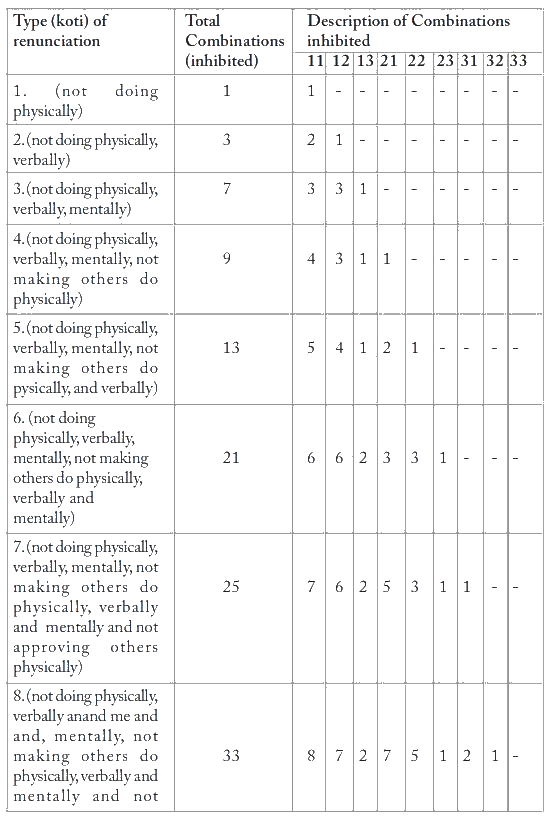
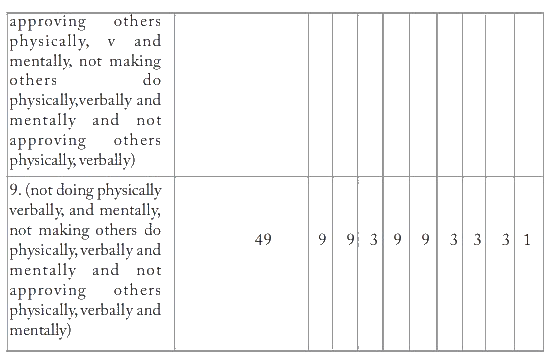
A monk renounces sins through all the nine ways. A lay follower renounces sin through two to eight ways. Doing through the mind, speech, and body, making others do, mentally, verbally, and physically and approving the sinful activities mentally, verbally, and physically all these belong to the same class. The one who does violence, who makes others do violence and who approves violence is also violent and the one who thinks that violence is good is also violent. In the same way, one doing violence mentally, verbally, and physically is violent. Thus, there are nine possibilities in doing, making others do and approving others committing violence through mind, speech, and body. These are the nine ways through which karmas enter the soul, and by renunciation of which, these ways are blocked. This stoppage is called 'inhibition' (samvar).
Nine Levels of Renunciation
The 49 combinations of practising abstinence can be easily learned through this chart:

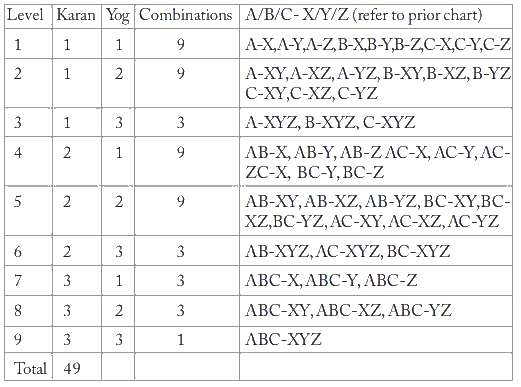
♦
25. Chaaritra-5
Five Types of Conducts:
1. Saamaayik (Initiation conduct)
2. Chhedopasthaapaneeya (Confirmation by ordination)
3. Parihaar vishuddhi (Purification conduct)
4. Sukshma samparaay (Conduct attended with subtle passion)
5. Yathaakhyaat (Perfect conduct)
The word 'Chaaritra or conduct' has three meanings (1) the stoppage of impure activities of soul (2) the effort to keep the soul in its pure state and (3) activities that destroy karma.
Saamayik Chaaritra: The word ‘samaayik chaaritra’ means (initiation conduct) means to abstain from all sinful activities to stabilize oneself in sambhaava (equanimity). The four other conducts such as confirmation by ordination, purification, etc, are nothing but special practices in initiation conduct itself. Since they possess specialities in their qualities and conduct, they have been categorised under different heads. Acquisition or attainment of initiation conduct is through total abstinence of all sinful activities, to renounce the sinful deed by threefold (karan) doing, getting done by others, praising the one doing it, and three kinds of activities (yog) body, speech, and mind is aamaayik chaaritra. By doing so, the influx of karma by non-abstinence (avrat aashrav) is stopped completely.
Chhedopasthaapaniya chaaritra or confirmation by ordination means the final admission by means of detailed instruction in the individual mahaavrats one by one, taking the great vows with division. The other meaning is to obtain the chaaritra again after the infringement of previously obtained chaaritra. In initiation conduct, sinful activities are refrained (generally) on the whole but in ordination there is the abstinence of sinful activities in detail with all its possible divisions.
When a person is initiated, he takes up saamayik chaaritra and he only says – Savvam Saavajjam jogam pachakkhaami –abstaining oneself from all sinful activities. But after seven days or six months of initiation, these five mahaavrats are taken again sequentially with all its classifications. This is called confirmation by ordination; a process of reinitiating is conducted. Whenever there are blemishes in the previously accepted initiation conduct, an ascetic is re-initiated as atonement for the sins committed. This is also confirmation by ordination conduct.
Initiation and confirmation by ordination conduct- these two conducts are followed in the sixth to the ninth stage of spiritual development (Gunasthaans).
Parihaar Vishuddhi (Purification) conduct - The word ‘parihaar’ means special penance for purification. Thus it is known as parihaarvishuddi chaaritra or purification conduct.
In this conduct, a penance called parihaar is practised. A group of nine monks come together to practise a rigorous penance for eighteen months. In this conduct in the first six months, four monks practice penance (fasting) and four others help them and remain in their service. One out of them is elected as the Acharya. In the next six months, those who were in service undertake penance and those who did penance take the charge of service. The Acharya or leader remains the same. In the last six months, the (elected) Acharya undergoes penance, and one out of the eight others is elected as new Acharya, and the rest seven serve the previous Acharya. The sequence for penance is as follows.
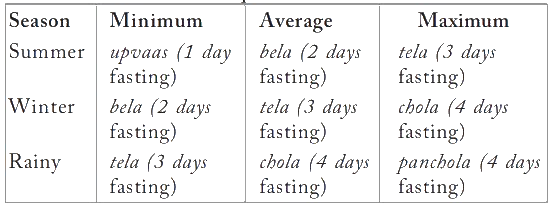
This conduct is practised in the sixth and seventh stages of spiritual development (Gunasthaans).
Sukshma-Samparaay Chaaritra (Subtle Passion Conduct): In the condition where anger, pride, and deceit are completely subsided or destroyed, only a residue of subtle greed remains. In that pure state of the soul subtle passion conduct is achieved.
Yathaakhyaat Chaaritra (Perfect Conduct): The condition in which delusion is completely subsided or destroyed is known as yathaakhyaat or perfect conduct. This is also called the conduct of veetaraag (omniscient). In this condition, further bondage of sinful karmas is completely stopped. The practitioners of this conduct are of two types of monks:
1. Those with subsided passions
2. Those with destroyed passions
The ascetic with subsided passions cannot attain liberation in the same birth. The ascetic with destroyed passions attains liberation in the same birth. This conduct remains from the eleventh to fourteenth stages of spiritual development (Gunasthaan).
Those who follow initiation conduct partially, those who follow the twelve vows and abstains from violence, etc. partially, they are called as a partial vow follower or layman (deshvirati shravak) and the one who follows all the five types of conduct as per the set rules is known as an ascetic monk (saadhu).
♦
027_backmatter
Jeev Ajeev
Acharya Mahapragya
For any Feedback/Comments/Queries:
Please write to books@jvbharati.org
About

Center of excellence in the field of Education and special emphasis on Jain studies and the Prakrit Language, learning on Ahimsa (Non Violence), Jeevan Vigyan (Science of Living), Preksha Dhyan (Preksha Meditation) and many more...
Post Box No. 8, Post - Ladnun - 341306,
Dist. Didwana-Kuchaman, Rajasthan (India)